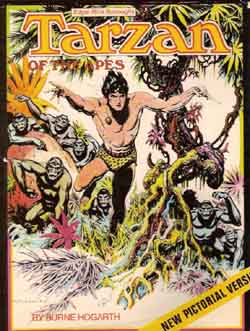
Tarzan of the Apes

TARZAN OF THE APES

By Burne Hogarth, with text by Edgar Rice Burroughs (Hamlyn)
ISBN: 0-600-38689-9

Here’s another strong candidate for the title of first Graphic Novel, adapting half of the landmark popular classic. Burne Hogarth drew the Tarzan Sunday newspaper strip after Hal Foster left to create Prince Valiant, and his superb anatomical skill and cinematic design skills revolutionised the action/adventure strip. The modern dynamism of the idealised human figure in comic books can be attributed directly to Hogarth’s pioneering drawing.

When he left the strip he eventually found his way into teaching and produced an invaluable series of art text books such as Dynamic Anatomy and Dynamic Figure Drawing, which influenced a generation of aspiring and wannabe pencillers. I can see my own copies from where I sit typing this.

In the early 1970s he was lured back to the realm of the legendary Lord Greystoke, and produced two magnificent volumes of graphic narrative in the dazzling style that had captivated audiences nearly forty years previously. Large bold panels, vibrantly coloured, with blocks of Burroughs’ original text, leap out at the reader in a riot of hue and motion as they tell the triumphant, tragic tale of the orphaned scion of the British nobility raised to awesome manhood by the Great Apes of Africa.

I suspect this book is criminally out of print – certainly my internet searches couldn’t locate a copy less than twenty-five years old. But until some publisher wises up, I can’t think a better example of narrative art for the dedicated aficionado to go hunting for.

Bon Chance, Mes Braves!

© 1972 Edgar Rice Burroughs Incorporated. All Rights Reserved.

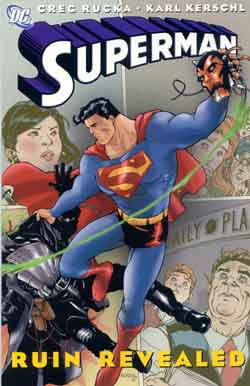
Superman: Ruin Revealed

Superman: Ruin Revealed

By Greg Rucka, Karl Kerschl & others (DC Comics)
ISBN 1-84576-244-4

Collecting Adventures of Superman issues #640-641 and #644-647, this slim volume reprints the final stages in the meandering, angst and testosterone cocktail of the revenge obsessed villain Ruin who had waged a campaign of hate and destruction against the Man of Steel and his closest friends.

With inelegant haste – presumably to clear the decks for the looming Infinite Crisis storylines – Superman, with guest-stars Zatanna and Steel, plough their way through a veritable rogue’s gallery comprising the Toyman, OMACs, the new Parasites, Lex Luthor and even Mr. Mxyzptlk, before the final confrontation with the vengeance-crazed Ruin, who is promptly defeated and revealed to be just who you expected him to be.

Although rushed and disappointingly written by Greg Rucka, Nunzio Defilippis and Christina Weir – through, I’m sure, no fault of their own – the art by Karl Kerschl, Renato Guedes, Darryl Banks, Adam Dekraker, Wayne Faucher, Cam Smith and Robin Riggs, and vibrant colouring of Guedes and Tanya & Richard Horie is varied and wonderfully effective. Illustration fans will at least have something to applaud in this otherwise shiny pretty, vapid pot-boiler that can only satisfy the completist fan.

© 2005 DC Comics. All Rights Reserved.

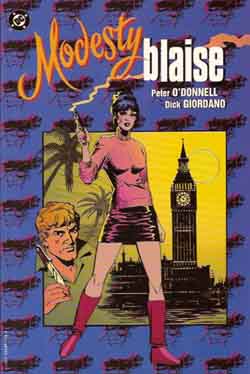
Modesty Blaise

Modesty Blaise

By Peter O’Donnell & Dick Giordano (DC Comics)
ISBN 1-56389-178-6

Here’s an odd little item that’s worth a second look. Modesty Blaise is a reformed criminal genius who got rich and retired clean, but came back to the game out of boredom, only this time on the other side.

Originally a newspaper strip created by Peter O’Donnell and drawn by the brilliant Jim Holdaway, she and her charismatic partner in crime (and latterly crime-busting) Willie Garvin have starred in 13 books/short story collections, two films, one TV pilot, a radio play and nearly one hundred comic strip adventures between 1963 and the strip’s conclusion in 2002. The strip has been syndicated world-wide, and Holdaway’s version has been cited as an artistic influence by many comic artists.

In this volume O’Donnell adapts his first novel, which expanded upon the origins of the characters before reprising the first strip sequence, ‘The Gabriel Set-Up’, where she is seduced out of retirement by British Secret Service Chief Sir Gerald Tarrant. Willie Garvin has been arrested in a banana republic, and by informing Modesty so she can rescue him from a death sentence, the civil servant has accrued a debt of honour she can never repay. Also, she was so very, very bored with a life of ease.

To acquire oil rights for Britain, a payment must be made in diamonds to the ruler, but the government has caught wind of a plot to steal the gems en route. Old rival and criminal super-genius Gabriel wants the loot and nothing has ever stopped him before…

This classic adventure thriller is given a slick and glossy sheen in this original adaptation for the US market. The scripts crackles with energy and tension, the heroes are indomitable yet never implausible, and veteran Dick Giordano produces some of the best art of his career, free to work with a full page rather than within the tier of panels the daily strip was restricted to.

While not to every fan’s taste, the story is a solid entertainment, and a worthy addition to the fund of splendid pictorial action O’Donnell has crafted over his long career.

™ & © 1994 Modesty Blaise Ltd. All Rights Reserved.

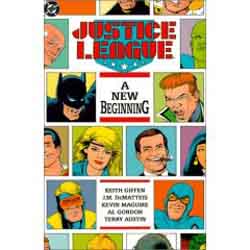
Justice League: A New Beginning

Justice League: A New Beginning

By Keith Giffen, J.M. DeMatteis, Kevin Maguire, Al Gordon & various (DC Comics)
ISBN: 0-930289-40-4

When the continuity altering shenanigans of Crisis on Infinite Earths produced such spectacular commercial success, DC felt more than justified in revamping a number of their hoariest icons for their next fifty years of publishing. As well as Superman, Flash, and Wonder Woman, the Justice League of America was earmarked for a radical revision.

Editor Andy Helfer assembled plotter Keith Giffen, dialoguer (?) J.M. DeMatteis and neophyte penciller Kevin Maguire to produce an utterly new approach to the superhero monolith: they played them for laughs.

Combining a roster of relative second-stringers Black Canary, Blue Beetle, Captain Marvel, Dr, Fate, Guy Gardner/Green Lantern, and Mr. Miracle with heavyweights Batman and Martian Manhunter – as nominal straight-men – and later supplemented by Captain Atom, Booster Gold, Dr. Light, and Rocket Red, they mixed high-speed action with quick-fire humour for a truly revolutionary – and popular – delight.

Introducing the charismatic and manipulative Maxwell Lord, who used his wealth and influence to recreate the super-team, the creators unfolded a mystery that took fully a year to play out. The team passed the time fighting terrorist bombers (#1, ‘Born Again’ inked by Terry Austin), displaced Alien heroes determined to abolish Nuclear weapons (#2-3 ‘Make War No More’ and ‘Meltdown’) and good old fashioned super-creeps like the Royal Flush Gang (#4 ‘Winning Hand’).

‘Gray Life, Gray Dreams’ and ‘Massacre in Gray,’ guest-starring the Creeper, was a supernatural threat dealt with in issues #5-6, and Lord’s scheme bears fruit in #7’s ‘Justice League… International’ as the team achieves the status of a UN agency, with rights privileges and embassies in every corner of the World.

These are wonderfully light yarns full of sharp badinage and genuinely gleeful situations, perfect for the Ghostbusters generation. That the art is still great is no surprise, and the action still engrossing is welcome, but to find that the jokes are still funny is a glorious relief. Track this down and discover even after twenty years why fans still greet each other with the secret mantra “Bwah-Hah- Hah!”

© 1987, 1989 DC Comics. All Rights Reserved.

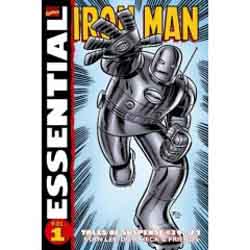
Essential Iron Man, Vol 1

Essential Iron Man, Vol 1

By Stan Lee, Don Heck, Jack Kirby, & various (Marvel)
ISBN 0-7851-0759-2

There are a number of ways to interpret the creation and early years of Tony Stark, glamorous millionaire industrialist and inventor – not to mention his armoured alter-ego, Iron Man.

Created in the aftermath of the Cuban Missile Crisis and at a time when “Red-baiting” and “Commie-bashing” were American national obsessions, the emergence of a brilliant new Thomas Edison, using Yankee ingenuity and invention to safeguard and better the World seemed inevitable. Combine the then-common belief that technology could solve any problem with the universal imagery of noble knights battling evil and the proposition almost becomes a certainty. Of course it might simply be that us kids thought it both great fun and very, very cool…

This fabulous black and white compendium of the Golden Avenger’s early days reprints all his adventures, feature pages and pin-ups from Tales of Suspense #39 (cover-dated March 1962) through #72 (December 1965), from the dawn of Marvel’s renaissance up to their first commercial successes. This period would see them start to topple DC Comics from a position of dominance, but not quite become the darlings of the student counter-culture. In these tales Tony Stark is still very much the patriotic armaments manufacturer, and not the enlightened capitalist dissenter he would become.

TOS #39, with a script by Larry Lieber (over brother Stan Lee’s plot) and art by the criminally unappreciated Don Heck features ‘Iron Man is Born’, wherein electronics genius Tony Stark is field testing his latest inventions in Viet Nam when he is wounded by a landmine. Captured by the Viet Cong commander Wong-Chu, Stark is told that if he creates weapons for the Reds he will be operated on to remove the metal shrapnel in his chest that will kill him within seven days.

Knowing that Commies can’t be trusted, Stark and aged Professor Yinsen – another captive scientist – build a mobile iron lung to keep his heart beating. They also equip this suit of armour with all the weapons that their ingenuity can secretly build whilst being observed by their captors. Naturally they succeed and defeat Wong-Chu, but not without tragic sacrifice.

From the next issue Iron Man’s superhero career is taken as a given, and he has already achieved fame for largely off-camera exploits. Lee continues to plot but Robert Bernstein replaces Lieber as scripter for issues #40-46 and Jack Kirby shares the pencilling chores with Heck. ‘Iron Man versus Gargantus’ follows the young Marvel pattern by pitting the hero against aliens – albeit via their robotic giant caveman intermediary, in delightfully simple romp pencilled by Kirby and inked by Heck.

‘The Stronghold of Doctor Strange’ (art by Kirby and Dick Ayers) features a glorious battle with a wizard of Science (not the Lee/Ditko Sorcerer), and Heck returns to full art for the espionage thriller ‘Trapped by the Red Barbarian’. Kirby and Heck team again for the science-fantasy adventure ‘Kala, Queen of the Netherworld!’, but Heck goes it alone when Iron Man time-travels to ancient Egypt to help Cleopatra against ‘The Mad Pharaoh!’, has to withstand ‘The Icy Fingers of Jack Frost!’ and face his Soviet counterpart ‘The Crimson Dynamo’.

Tales of Suspense #47 presaged big changes. Stan Lee wrote ‘Iron Man Battles the Melter!‘, and Heck inked over the unique pencils of Steve Ditko, but the big event came with the next issue’s ‘The Mysterious Mr. Doll!’ as Lee, Ditko and Ayers scrapped the old cool-but-clunky boiler-plate suit for a sleek, gleaming, form-fitting, red-and-gold upgrade, that would – with minor variations – become the symbol and trademark of the character for decades.

Paul Reinman inked Ditko on Lee’s crossover/sales pitch for the new X-Men comic when ‘Iron Man Meets the Angel!’, but the series only really takes hold with Tales of Suspense #50. Don Heck returns as regular penciller and occasional inker and Lee invents the Armoured Avenger’s first major menace in ‘The Hands of the Mandarin’, a modern Fu Manchu derivative who terrifies the Red Chinese so much that they manipulate him into attacking America, with the hope that one threat will fatally wound the other. The Mandarin would become Iron Man’s greatest foe.

Our hero made short work of criminal contortionist ‘The Sinister Scarecrow’, and the red spy who stole that Russian armour-suit when ‘The Crimson Dynamo Strikes Again!’ (scripted, as was the next issue, by the mysterious “N. Kurok”), but the latter issue did introduce a much more dangerous threat in the slinky shape of the Soviet Femme Fatale the Black Widow. With TOS #53, she was back when ‘The Black Widow Strikes Again!’ ‘The Mandarin’s Revenge!’ followed; a two-part tale that concluded with #55’s ‘No One Escapes the Mandarin!’, but ‘The Uncanny Unicorn!’ promptly attacked after Iron Man did, only to fare no better in the end.

The Black Widow resurfaced to beguile budding superhero ‘Hawkeye, The Markman!’ into attacking the Golden Avenger in #57, before another landmark occurred in the next issue. Until now Iron Man had monopolised Tales of Suspense, but ‘In Mortal Combat With Captain America’ (inked by Dick Ayers) depicted an all-out battle between the two heroes resulting from a clever impersonation by evil impressionist The Chameleon. It was a primer for the next issue when Cap would begin his own solo adventures, splitting the monthly comic into an anthology featuring Marvel’s top two patriotic heroes.

Iron Man’s initial outing in TOS #59 was against the technological paladin ‘The Black Knight!’, and as a result Stark was unable to remove the armour without triggering a heart attack, a situation that hadn’t occurred since the initial injury. Up until this time he had led a relatively normal life by simply wearing the life-sustaining breast-plate under his clothes. The introduction of soap-opera sub-plots were a necessity of the shorter page counts, as were continued stories, but this seeming disadvantage worked to improve both the writing and the sales.

With Stark’s “disappearance,” Iron Man was ‘Suspected of Murder!’, a tale that featured the return of Hawkeye and Black Widow, and led directly into ‘The Death of Tony Stark!’ and ‘The Origin of the Mandarin!’. After that extended epic, a change of pace occurred as short complete exploits returned. The first was #63’s sabotage thriller ‘Somewhere Lurks the Phantom!’, followed by the self-explanatory ‘Hawkeye and the New Black Widow Strike Again!’ (inked by Chic Stone), and ‘When Titans Clash!’ where a thief steals the new armour and Stark must defeat his greatest invention with his old suit (by new regular inker Mike Esposito under the pseudonym Mickey Demeo).

Sub-sea villain Attuma is the threat in ‘If I Fail a World is Lost’ and crime boss Count Nefaria uses dreams as a weapon in ‘Where Walk the Villains!’, returning in the next issue to attack Stark with hallucinations in ‘If a Man be Mad!’, a rather weak tale that introduces Stark’s ne’er-do-well cousin Morgan, written by Al Hartley.

Issues #69-71 form another continued saga, and one of the best of this early run. ‘If I Must Die, Let It Be With Honor!’ (inked by Vince Colletta) sees Iron Man forced to duel a new Russian opponent called the Titanium Man in a globally televised contest that both super-powers see as an vital propaganda coup, oblivious of the cost to the participants and their friends. ‘Fight On! For a World is Watching!’ (inked by Demeo) piles on the intrigue and tension as the Soviets, caught cheating, pile on the pressure to at least kill the American champion if they can’t score a publicity win, and the final part ‘What Price Victory?’ is a rousing, emotional conclusion of triumph and tragedy made magnificent by the super-glossy inking of troubled artistic genius Wally Wood.

This would have been the ideal place to end the volume but there’s one more episode included. TOS #72 by Lee, Heck and Demeo deals with the aftermath of victory. Whilst the fickle public fete Iron Man, his best friend lies dying, and a spiteful ex-lover hires the Mad Thinker to destroy Stark and his company forever. ‘Hoorah for the Conquering Hero!’ closes the book on a pensive down-note, but the quality of the entire package is undeniable. From broad comedy and simple action to dark cynicism and relentless battle, Marvel Comics grew up with this deeply contemporary series.

Iron Man developed amidst the growing political awareness of the Viet Nam Generation who were the comic’s maturing readership. Wedded as it was to the American Industrial-Military Complex, with a hero – originally the government’s wide-eyed golden boy – gradually becoming attuned to his country’s growing divisions, it was, as much as Spider-Man, a bellwether of the times. That it remains such a thrilling uncomplicated romp of classic super-hero fun is a lasting tribute to the talents of all those superb creators that worked it.

© 1962, 1963, 1964, 1965, 2000, 2007 Marvel Characters, Inc. All Rights Reserved.

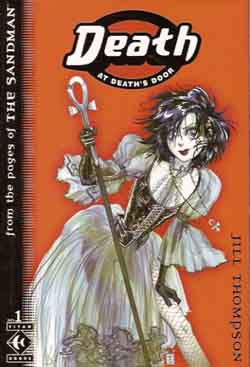
Death: At Death’s Door

Death

By Jill Thompson (Vertigo/Titan Books)
ISBN: 1-84023-695-7

Jill Thompson crafts a canny alternative look to the overwhelmingly successful Sandman by giving him the manga treatment in this reinterpretation of some pivotal events from the landmark fantasy series.

During Sandman: Season of Mists (ISBN: 978-1-85286-447-7) Morpheus tries to liberate his old lover from Hell, whence he banished her ten thousand years previously. His confrontation with Lucifer takes an unexpected turn when the Lord of the Damned abdicates, and shuts Hell. Freeing all the demons and souls in bondage, Lucifer gives the place and the responsibility to the Sandman.

The repercussions of these events resounded for years through the Vertigo corner of the DC Universe, and Thompson’s sharp, light tale details background events that happened “off-camera” during those tumultuous times. As Morpheus entertains embassies from gods and devils all eager to obtain the supernatural lebensraum of the Underworld, his sister Death has a couple of problems of her own.

Primarily, deprived of an abode, the damned dead souls from Hell are all turning up on her doorstep, but almost as troubling is the fact that her untrustworthy sisters Desire and Delirium have decided to turn the whole mess into an excuse for the wildest party in the Universe.

Cutesy comedy hi-jinks coupled with chilling suspense and fantasy make for an uncomfortable mix but Thompson makes it work, although the end result might not be to every fan’s taste.

© 2003 DC Comics. All Rights Reserved.

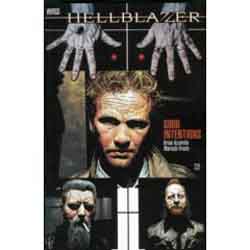
Hellblazer: Good Intentions

Hellblazer: Good Intentions

By Brian Azzarello & Marcelo Frusin (Vertigo)
ISBN 1-84023-433-4

In this volume Brian Azzarello continues to explore human monstrosity, dredging the darkest depths of life. Freed from prison (see Hellblazer: Hard Time -ISBN: 1-84023-255-2 for the grim details) the magical, morally ambivalent Trickster-Magician has headed deep into America’s rural Southlands. Constantine has a half-baked idea of explaining the true circumstances of his incarceration to the family of the man he’s supposed to have murdered. It doesn’t help that the bereaved wife is actually one of his old girlfriends, from the days when he was a punk rock singer, and a mere dabbler in the dark world of the supernatural.

Doglick, West Virginia is a sleazy, broken hole in the ground. Dirt-poor, with no jobs for anybody the dumb, redneck yokels that abide there are every hillbilly hick cliché you could imagine. Constantine and the Fermin boys go back a ways, and his old girl friend married Richard. They used to call him ‘Lucky’, but that was before he killed himself and framed Constantine for the murder.

Inured to the horrors of the Outer Dark and the vile lust for power that infects human and Unhuman alike, the Magician is totally unprepared for the different kind of horrors that infests the poverty-stricken hell-hole he finds himself trapped in.

Azzarello & Marcelo Frusin have challenged John Constantine with a truly different kind of horror. Cloying, oppressive and inexorable, this visceral and truly disturbing wilderness tale is a powerful testament to the versatility of the character. Constantine has been many things: Con-man, hero, villain, thief and even monster. Here he is also pitifully human…

Compelling storytelling – even if only for those who can handle it.

© 2000, 2001 DC Comics. All Rights Reserved.

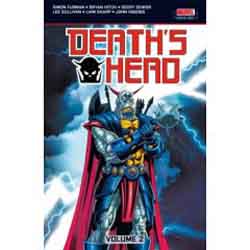
Death’s Head, Vol 2

UK EDITION

Death's Head, Vol 2

By Simon Furman & various (Panini Publishing UK)
ISBN 1-905239-69-6

This collection completes the gathering of material featuring the robotic Freelance Peacekeeping Agent (never, ever call him a bounty hunter!) who rampaged through the British corners of the Marvel Universe – and indeed the Americas, as this volume riotously reveals – before he was upgraded into a multiple-personalitied super-killer in the Death’s Head II miniseries.

‘Time Bomb’ (originally printed in Death’s Head #8) is written and inked by Steve Parkhouse and illustrated by Art Wetherell. Our far-future protagonist is hired to “Remove” the Doctor (that would be Doctor Who to the uninitiated) before he can thwart the plans of Josiah W. Dogbolter – who sees Time as a precious commodity, and therefore wants to corner the market in it.

Utilising the “Dogbolter Temporal Rocket” Death’s Head is dispatched through the Chronal Ether to eliminate the Time Lord (the Sylvester McCoy version, if you’re keeping count) only to discover that he’s been set up by the scurrilous plutocrat. He also finds that the Doctor has left him on top of the Fantastic Four’s headquarters…

Simon Furman and Geoff Senior return for the next tale. ‘Clobberin’ Time’ is a good old fashioned fist-fest as the Fantastic Four first fight, then befriend, the robotic Fixer. Unfortunately, their attempts to return him to his own era go awry and he lands in the corporate dystopia of 2020AD, geting into a big bust-up with the Iron Man of that time. Bryan Hitch illustrates Furman’s ‘The Cast Iron Contract’, which ended the 10 issue run of Death’s Head. But the Freelance Peacekeeper was too popular to stay in limbo for long…

Furman and Senior returned to the character in ‘The Body in Question’, a lavish original graphic novel that explored his origin as well as tying up some loose ends with the villain Big Shot who had been built up over a number of stories only to lose his chance when the comic book was cancelled.

From there Death’s Head became a guest-star in other comics – the traditional route to regaining a comic series of one’s own. Furman and Hitch, plus inker John Beatty created ‘Priceless’ in She-Hulk #24, and Walt Simonson included him in his extended time-travel saga during his run as writer/artist on Fantastic Four (‘Kangs for the Memories’ in FF #338). He also had a solo adventure, ‘The Deadliest Game,‘ in the fortnightly anthology Marvel Comics Presents (#76 by Furman and Hitch again).

He returned to his roots in Doctor Who Monthly #173, as Writer Gary Russell, and artists Mike Collins and Steve Pini invited him to a TV fans delight in the cameo-crazy bash entitled ‘Party Animals’.

Post-Death’s Head II, Furman and Senior got one last crack at the big guy in a rather good alternative history tale from volume 2, #54 of What If…? Death’s Head II is a super-android called Minion which killed and absorbed the abilities and personalities of more than 100 of the universe’s most powerful beings, including our robotic star. In this tit-for-tat switch we see what might have happened to the Marvel Universe in ‘What If Minion had not Killed Death’s Head?’

Fast-paced and fantastic, brimming with action and guest-stars, and reeking of the cynical irreverence and black humour that typifies British comics, this is a rare gem of high quality from a generally poor period in Marvel’s history. So if you like sardonic asides with your science fiction and can see the funny side of excessive violence, this book (and its predecessor Death’s Head Vol. 1 ISBN 1-905239-34-3) is for you.

© 1988, 1989, 1990, 1991, 1993, 2007 Marvel Characters, Inc. All Rights Reserved.
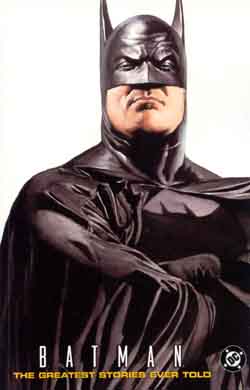
Batman: The Greatest Stories Ever Told

Batman: The Greatest Stories Ever Told

By Various (DC Comics)
ISBN: 1-84576-038-7

If you buy into the myth, then there are actually many, many great Batman stories. Over the decades lots of very talented creators excelled themselves with the various toys and icons of Gotham City. That’s not to say that there haven’t been some real turkeys along the way, but on the whole people seem to extend themselves for Batman. Often the real problem is one of context, since many stories worry reprint editors in terms of “Sell-By Date”; as if nearly eight decades of creativity can avoid looking dated to some modern consumers.

Guys, who cares? These are the ones who want to colourise Citizen Kane and Arsenic and Old Lace, add cell-phones to Shakespeare and never read any book written before 1989. If they can’t get Wuthering Heights unless Angelina’s in it, their money’s no good anyway.

At least this selection contains a few general rarities from the canon, although the origin from Detective Comics #33 (1939) has been seen so often that most fans can draw it from memory – and many parody artists have. ‘The Case of the Honest Crook’ comes from Batman #5 (1941) and ‘The Secret Life of the Catwoman’ is from #62 (1951). ‘Robin Dies at Dawn’ (Batman #156, 1963) is one of the last classic-look tales before Julie Schwartz, John Broome and Gardner Fox projected Batman into the Silver Age of Comics with their “New Look”, a period strangely unrepresented here.

‘The Batman Nobody Knows’ comes from Batman #250, an attempt by Frank Robbins and Dick Giordano to rationalize the then newly-restored aura of mystery to the character, whilst ‘The Joker’s Five-Way Revenge’ (Batman #251, 1973) is a genuine classic from Denny O’Neil and Neal Adams that totally redefined the Joker for our age. For many people this is The Definitive Batman/Joker story.

Steve Englehart is fondly remembered for his collaboration with Marshall Rogers, but ‘Night of the Stalker’ (Detective #439, 1974), illustrated by Vin and Sal Amendola, with Giordano inks is one of his most powerful and emotive successes, but Rogers’s accompanying illustrations for O’Neil’s lacklustre prose vignette ‘Death Comes at Midnight and Three’ displays little of his design skill. It originally ran in DC Special Series #15 (1978). Number 21 of that magazine (1980) gave us Frank Miller’s first Bat story when he illustrated O’Neil’s ‘Wanted: Santa Claus – Dead or Alive’.

In 1987 legendary and beloved artist Dick Sprang was coaxed out of retirement to produce a double page spread for Detective #572, which here precedes the introspective ‘…My Beginning… and My Probable End’ (Detective #574), by Mike W Barr, Alan Davis and Paul Neary. Bringing us out of the nineties is ‘Favourite Things’ by Mark Millar and Steve Yeowell (Legends of the Dark Knight #79, 1996) and the twenty-first century is represented by ’24/7′ by Devin Grayson and Roger Robinson from Gotham Knights #32 (2002).

In an industry that’s constantly seeking to reinvent and revitalize itself, it’s oddly reassuring to see that entertainment can have a timeless quality, even in a supposedly “throw-away” medium like the comic strip.

© 2005 DC Comics. All Rights Reserved.

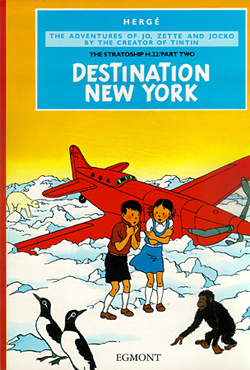
The Adventures of Jo, Zette & Jocko

DESTINATION NEW YORK
Part 2 of THE STRATOSHIP H.22

The Adventures of Jo, Zette & Jocko 2

By Hergé, translated by Leslie Lonsdale-Cooper & Michael Turner (Egmont UK)
ISBN 13: 978-1-4052-1243-4

This volume concludes the saga of ‘The Stratoship H.22’, starring the capable Legrand children and their pet monkey Jocko, who saved their father’s revolutionary high-speed plane from a bombing raid by flying it away only to emergency-land it on a tiny desolate island where they are marooned without food or fuel…

The islet is a desolate French Possession, and they discover from its only inhabitant that the next boat isn’t due for five months, but after a terrific storm, fuel drums wash ashore. Scant weeks remain before the one-year deadline expires on John Archibald Pump’s $10,000,000 death-bed challenge to break the non-stop flying record between Paris and New York. Refuelling swiftly, Jo and Zette decide to return to France, even though they aren’t quite sure where it is…

Tragically the plucky youngsters overshoot and after a fearsome voyage, crash in the frozen Arctic where they are taken in by a tribe of Eskimos. Jocko becomes separated from them and is rescued from an ice-floe by a passing ocean liner. Recognising the famous pet, the ship sends a message and the children are found. A rescue plane is dispatched with spare parts and the super-plane, once again piloted by the children, is returned to France.

With days remaining to make the attempt, the saboteurs step up their efforts to foil the French effort, but as ever childish ingenuity stymies their every dirty trick. With one day remaining Jacques Legrand is finally ready to fly his brainchild into the history books. But when Jo and Zette come to see him off they find him and his crew all drugged into comas. With the deadline upon them, who can possibly fly the ship now..?

These beautiful graphic adventures are powerful and evocative fantasies for children, full of daring and accomplishment, and confirming the eternal truth that good kids will always defeat bad adults. If only the real world was as rewarding as these thrilling romps for the young-at-heart of all ages.

© 1951, 1979, 2007 Editions Casterman, Paris& Tournai. All Rights Reserved.
English text © 1987, 2007 Egmont UK Limited. All Rights Reserved.