James Bond: Casino Royale

James Bond: Casino Royale 

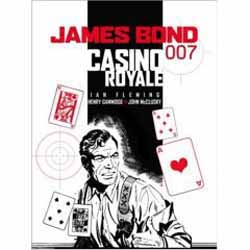
By Ian Fleming, Anthony Hern, Henry Gammidge & John McLusky (Titan Books)
ISBN 1-84023-843-7

In Casino Royale Bond is ordered to gamble with and bankrupt Le Chiffre, a communist agent who has embezzled his Soviet masters’ operating capital in a moody tale of tension that results in torture and violent death, heady stuff for newspaper readers of 1958, when it first ran. Live and Let Die has 007 and US agent Felix Leiter tackle Mr. Big, another commie agent, who rules the Harlem underworld through Voodoo, and Moonraker concerns the attempt by Hugo Drax, a Nazi officer who has infiltrated the British aristocracy to drop a guided missile on London.

These editions of Titan Books’ 007 newspaper strip collections come from a period when the dependable John McLusky was developing a less formal approach, before going on to produce some of his best work, illustrating adaptations of Fleming’s tales. Casino Royale was the opening strip in a nearly twenty-five year run, and the somewhat muted artwork here shows an artist still not completely comfortable with his task. It was adapted and scripted by Anthony Hern, who had won the author’s approval after writing condensed prose versions of the novels for the Daily Express. Live and Let Die and Moonraker are both adapted by Henry Gammidge.

As the strip settles in for the long haul, McLusky warms to the potentialities of the job with cracking tales of Cold-War intrigue and fast, dangerous living set in a multitude of exotic locales. This is a welcome return to public gaze of some of the most influential – and exciting – comic strips in British history.

Strip © Express Newspapers Ltd. 1987. All Rights Reserved

James Bond: On Her Majesty’s Secret Service

James Bond: On Her Majesty's Secret Service 

By Ian Fleming and Various (Titan Books)
ISBN 1-84023-674-4

There are sadly very few British newspaper strips that can rival the influence and impact of the classic daily and Sunday “funnies” from America, especially in the field of adventure fiction. The 1930’s and 1940’s were particularly rich in popular, not to say iconic, creations. You would be hard-pressed to come up with household names to rival Popeye, Dick Tracy, Buck Rogers, The Phantom, Mandrake the Magician, Flash Gordon or Steve Canyon, let alone Terry and the Pirates or the likes of Little Lulu, Blondie, Li’l Abner, Little Orphan Annie or Popeye and yes, I know I said him twice, but Elzie Segars’s Thimble Theatre was funny as well as thrilling, constantly innovative, and really, really good.

What can you recall for simple popularity let alone longevity or quality in Britain? Rupert Bear? Absolutely. Giles? Technically, yes. Nipper? Jane? Garth? I hope so, but I doubt it. The Empire didn’t quite get it until it wasn’t an empire any more. There were certainly many wonderful strips being produced: well-written, beautifully drawn, but that stubborn British reserve just didn’t seem to be in the business of creating household names. Until the 1950’s.

Something happened in the ‘fifties in Britain – and I’m not going to waste any space here discussing it. It just did. Now we’re moving on. In a new spirit that seemed to crave excitement and accept the previously disregarded, comics got carried along on the wave. Eagle, the regenerated Beano, girls’ comics in general, all shifted into high gear, and so did newspapers. And that means that I can go on about a graphic collection with proven crossover appeal for a change.

The first 007 novel – Casino Royale -was published in 1953 and was serialised in the Daily Express from 1958, beginning a run of book adaptations (by Anthony Hern, Henry Gammidge, Peter O’Donnell and Kingsley Amis) before Jim Lawrence, a jobbing writer who had scripted the aforementioned Buck Rogers, came aboard with The Man With The Golden Gun to complete the transfer of the Fleming canon to strip format, thereafter being invited to create all new adventures, which he did until the strip’s demise in 1983.

The art on the strip was always of the highest standard. John McLusky provided the illustration until 1966 and the conclusion of You Only Live Twice. Although perhaps lacking in verve, the workmanlike clarity of his drawing easily handled the immense variety of locales, technical set-ups and sheer immensity of cast members, whilst accomplishing the then novel conceit of advancing a plot and ending each episode on a cliff-hanging “hook” every day. He was succeeded by Yaroslav Horak, who also debuted on Golden Gun with a looser, edgier style, at once more cinematic and with a closer attention to camera angle and frenzied action that seemed to typify the high-octane 1960’s.

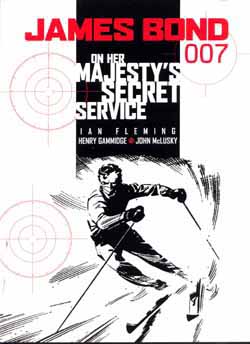
What’s in this volume? Possibly the two best novels adapted back to back. After a falling out with the Express‘ owner, the Bond strip was missing from the paper’s pages from February 1962 until June 1964. The gap was explained as Bond’s year long search for arch villain Blofeld. On Her Majesty’s Secret Service has the agent finally discover his enemy and his perfect woman in a high-octane action extravaganza in the Swiss Alps. Closely adhering to Fleming’s script – as did the George Lazenby film version – the adventure ends with the wedding day murder of Bond’s bride, an atypically downbeat conclusion that directly leads into You Only Live Twice.

Eight months after the death of his wife, a broken Bond is called back from compassionate leave for a routine mission to Japan. Both he and ‘M’ know that this will be a make-or-break job for the demoralised super-agent. Initially indifferent, Bond warms not only to the culture but the characters of Japan, and when circumstances alter the mission into one of ultimate revenge, Bond is back with a vengeance!

Titan Books is re-releasing collected editions of these classic strips after an abortive first attempt in the 1980s. The utterly minor niggle that they’re not coming out in chronological order (I’m a fanboy too, so sue me) is easily countered by the informative checklist in each volume; and these are superb examples of the best of British – even if Lawrence is a damn Yankee and Horak an Ozzie by way of Manchuria. Get them all and sort it all out in a big leather chair over a Vodka Martini. You know the way it should be served… and by the time you read this it won’t matter anyway, so just remember your instructions. Buy them all!

Strip © Express Newspapers Ltd. 1987. All Rights Reserved.

Gotham Central: The Quick and the Dead

Gotham Central: The Quick and the Dead 

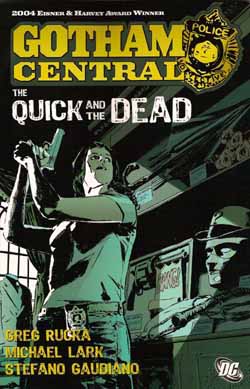
By Greg Rucka, Michael Lark & Stephen Gaudiano (DC Comics)
ISBN 1-84576-381-5

Gotham City is a bad place to be a cop – even a crooked one. If you’re a straight arrow it’s even worse because then both sides of the street want you dead. When Detectives Crispus Allen and Renee Montoya turn their attention to corrupt Crime Scene Investigator Jim Corrigan it sets them both on a path steeped in tragedy and loss. “Corrigan” (originally published in issues #23-24 of the monthly comic) is by the regular team of Greg Rucka, Michael Lark and Stephen Gaudiano.

The same team bring us “Lights Out” (issue #25) as, in the aftermath of the War Games (see Batman: War Drums; War Games: Outbreak, Tides, Endgame and War Crimes) event, new police commissioner Akins severs all official ties to the Batman and has the Bat-Signal removed from Police Headquarters roof.

“Keystone Cops” (issues #289-31) is another superb blend of the procedural and the outlandish as beat cop Andy Kelly is mutated by a super-criminal’s booby-trap whilst rescuing some kids from a fire. Montoya and Allen must cross jurisdictional boundaries and moral landmarks to obtain the assistance of deranged Flash villain Doctor Alchemy if there’s any hope of curing their comrade. With the most chilling exploration of a super-villain’s motivation in many a year and a generous tip of the hat to ‘The Silence of the Lambs’ this is a moody masterpiece with a unsuspected kick in the tail. Rucka writes and Gaudiano graduates from inks to pencils with the embellishing falling to the capable Kano and Gary Amaro in this fourth volume of the award winning series.

© 2004, 2005 DC Comics. All Rights Reserved.

Gotham Central: Unresolved Targets

Gotham Central: Unresolved Targets 

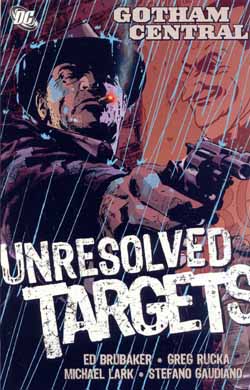
By Ed Brubaker, Greg Rucka, Michael Lark & Stephen Gaudiano (DC Comics)
ISBN 1-84576-130-8

There are two names synonymous with Gotham City, USA. If you’re a cop you keep your own opinions about the Batman, but it’s pretty much unanimous that The Joker is not someone you ever want to deal with. A madman with a homicidal flair for the theatrical, he loves a special occasion. It’s Christmas and it’s started to snow…

This third volume collecting the procedural exploits of the police of Batman’s hometown is tense and brooding, and manic and breathtaking by turns, as the poor officers of the Major Crimes Unit must catch a sniper who is randomly assassinating citizens – including the mayor. Even his early capture doesn’t halt the killings, since the proud culprit is the insane and Machiavellian Joker, who can seemingly now kill by remote control. This Yule looks to be the most memorable ever for the hard-pressed detectives in a tale entitled “Soft Targets” by Ed Brubaker, Greg Rucka, Michael Lark & Stephen Gaudiano (originally published in issues #12-15 of the monthly comic).

The second story, “Unresolved” by Brubaker, Lark & Gaudiano (issues #19-22) focuses on a cold case of fan-favourite character and all-around slob Harvey Bullock. When one of the maverick ex-cop’s old cases goes live again, the team must solve a high-school murder-bombing that somehow involves one of Batman’s weirdest foes.

Solid gritty police drama seamlessly blended with the grisly fantasy of the modern superhero seems like a strange brew but it delivers knockout punches time after time in this captivating series.

© 2003, 2004, 2006 DC Comics. All Rights Reserved.

Batman: Scarecrow Tales

Batman: Scarecrow Tales 

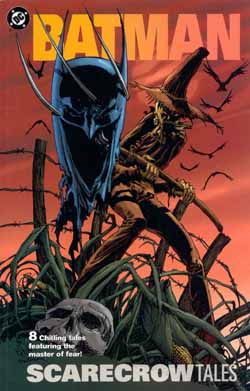
By Various (DC Comics)
ISBN 1-84576-063-8

As with the appalling Catwoman film, DC produced a fine volume of reprints featuring the comic book appearances of the Scarecrow to capitalise on Batman Begins. Although having a much shallower well to draw from, there are some wonderful tales on offer (and the occasional dog, it must be admitted) with various pin-up pages and a cover gallery.

The obvious kick-off is the first adventure from World’s Finest #3 (1941), followed by his third outing in “Fright of the Scarecrow” (Batman #189, 1967) wherein scripter Gardner Fox introduces his current Modus Operandi of artificially inducing terror, rather than the forties version which consisted mostly of shooting at you until you wet yourself.

Two lesser efforts follow: “The Scarecrow’s Trail of Fear!” (Batman #262, 1975) is by Denny O’Neil, Ernie Chua/Chan and Dick Giordano and the frankly appalling duel with the Joker “The Scarecrow’s Fearsome Face-Off!” This turkey’s by Elliot S! Maggin, Irv Novick and Tex Blaisdell, and is from Joker #8 (1976). If you’re of the persuasion to think that some things can be so bad they become ‘good’ this one’s for you.

Gerry Conway wrote “The 6 Days of the Scarecrow”, beautifully illustrated by the vastly under-rated and sorely missed Don Newton, with inking by Dan Adkins (Detective #503, 1981) and Alan Davis and Paul Neary visualised Mike W Barr’s “Fear For Sale” (Detective #571, 1987). Next up is “Mistress of Fear” by Peter Milligan and Duncan Fegredo from the one-shot (Villains: Scarecrow #1, 1998), a truly exceptional psychological thriller, with “Fear of Success” by Devin Grayson, Roger Robinson and John Floyd (Gotham Knights #23, 2002) rounding out the volume.

As a trawl through the changing nature of the industry this book is quite illuminating and in all honesty there really wasn’t a lot of material to choose from, although one glaring omission is the ignoring of the great little stories featuring the character that ran in assorted issues of the TV Cartoon based Batman Adventures. Now those were thrilling…

© 2005 DC Comics. All Rights Reserved.

DC: The New Frontier, vol 2

DC: The New Frontier, vol 2 

By Darwyn Cooke with Dave Stewart (DC Comics)
ISBN 1-84576-064-6

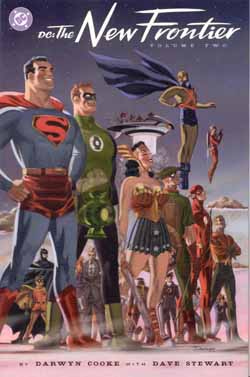
In the concluding volume of Darwyn Cooke’s tribute to the glory days of DC comics and idealistic Americana, the world teeters on the brink between a new age or ultimate destruction as a reptilian alien the size of Manhattan Island prepares to replace humanity with its own spawn. Only the small, brave band of heroes willing to defy a US Government banning order stand between humanity and a new holocaust.

This bright reworking of the 1950s, seen through twenty-first century eyes, and featuring all the stars of DC’s early Silver Age, manages to leaven our righteous cynicism about a truly dark, hypocritical and paranoid era of American history with a bright, child-like hopeful enthusiasm for a better tomorrow defended by better heroes. It is an absolute delight to see a worldly-wise but upbeat heroic tale.

It looks good, it reads good, and By Golly, it does you good!

© 2005 DC Comics. All rights reserved.

DC: The New Frontier, vol 1

DC: The New Frontier, vol 1 

By Darwyn Cooke with Dave Stewart (DC Comics)
ISBN 1-84023-939-5

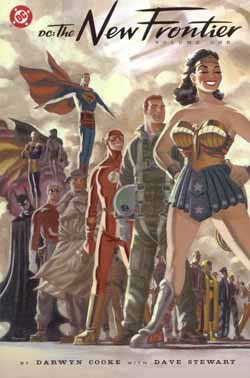
Ever since DC Comics retrofitted most of their first fifty years of story continuity with the incredibly successful Crisis on Infinite Earths they’ve apparently been seeking ways to get it all back into play again. Comics seem to work best when they access some component of nostalgia, and Darwyn Cooke’s tribute to the 1950s is a glorious blending of simpler times, two-fisted slam-bang action and the brooding menace of both Communism and McCarthyism delivered in the garish four-colour dreams of ten-year-old children.

All the DC greats come into play in a brand new yet refreshingly, comfortingly, old retelling of the archetypes of that era. There are aliens, monsters, Martians, test pilots, cars with fins, feisty reporters and Rock ‘n’ Roll. The story is basic and simple, but never slips into pastiche or parody. Darwyn Cooke successfully manages to skate between and around the hurdles of kids with no access to the time period involved (nor indeed the characters) and the expectations of an older generation of readers who have spent such a long time wondering where “their” heroes went.

For my part, this is probably one of the best things I’ve read in the last ten years. Cooke and especially colourist Dave Stewart have managed to access and treat with respect an era that I’d thought gone forever, whilst at the same time concocting a cracking good yarn that seems genuinely timeless. My only quibble is that I have to wait for the second and concluding part, notwithstanding the fact that I bought the mini-series when it came out last year.

An absolute gem for kids of all ages; even casual readers who watch more movies than they read comics will be immensely satisfied.

© 2005 DC Comics. All rights reserved.

Batman Chronicles vol 2

Batman Chronicles vol 2 

By Bob Kane & various (DC Comics)
ISBN 1-84576-292-4

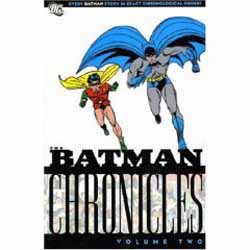
More Batman magic from the dawn of comic-book time re-presenting further early Dark Knight tales in their original publishing order. Starting with “The Horde of the Green Dragon” from Detective Comics #39 through to #45 “The Case of the Laughing Death” (May to November 1940), every Batman and Robin story is reprinted, including the eight adventures from Batman #2 and #3 and the incredibly rare “Batman and Robin Visit the New York World’s Fair” from New York World’s Fair Comics.

© 1940, 2006 DC Comics. All Rights Reserved.

Batman Chronicles vol 1

Batman Chronicles vol 1 

By Bob Kane & Various (DC Comics)
ISBN 1-84576-036-0

For anyone who’s read more than a few of these posts, my tastes should be fairly apparent, but in case you’re in any doubt, here’s an up-front summation: I’m that shabby, crazy old geezer muttering at the bus-stop about how things were better before, and all new things are crap and not the same and…

You get the picture. Now, ignore all that. It’s true but it isn’t relevant.

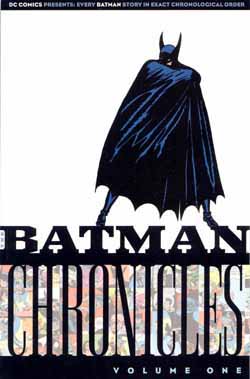
Batman Chronicles is another re-presentation of the earliest Batman stories in the original order they came out. Starting with “The Case of the Chemical Syndicate” from Detective Comics #27, every story is reprinted up until #38, which introduces Robin, The Boy Wonder, and then Batman #1 in its entirety, featuring The Cat (who later added the suffix ‘Woman’ to her name to avoid confusion), Hugo Strange and the first and second appearances of the Joker.

These early stories set the standard for comic superheroes. Whatever you like now, you owe it to these stories. Superman gave us the idea, but writers like Bill Finger and Gardner Fox refined and defined the meta-structure of the costumed crime-fighter. Where the Man of Steel was as much Social Force and wish fulfilment as hero, Batman and Robin did what we wanted to do. They taught bad people the lesson they deserved.

Bob Kane, Jerry Robinson and their compatriots created an iconography that carried the strip well beyond its allotted life-span until later creators could re-invigorate it. They added a new dimension to children’s reading. And their work is still captivatingly readable.

One final thing. I’m that guy in paragraph one, right? I’ve read a lot of these stories many times, and in many formats, and I’d like to thank whoever decided that they should forego the glossy and expensive versions and print this time on newsprint-like paper, producing the same bright-yet-muted colour that graced the originals. More than anything else, this served to recapture the mood of the young Batman and of course, my poorly concealed inner child.

© 1939, 1940, 2005 DC Comics. All Rights Reserved.

Batman: Broken City

Batman: Broken City 

By Brian Azzarello & Eduardo Risso (DC Comics)
ISBN 1-84023-922-0

It’s something of a maxim in industry circles that if you do the slightly outré titles (for which please read non-superhero) well enough you’ll be given your shot at the major properties. That usually means that if your writing/drawing can generate enough attention, or shock-horror!, big sales on whatever the fan-base considers a no-hope proposition like a vampire, humour or even – gasp! – crime comic, editors will come begging for you to work your magic on Wonder Woman, Spider-Man, Superman or the Bat. It happens all the time.

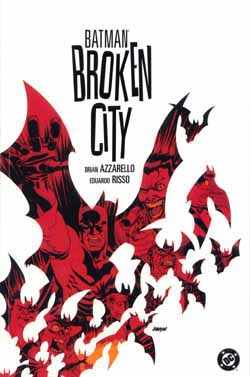
Broken City (reprinting issues #620-625 of Batman) is a “quest story” with a dark and gritty hero skirting the edges of his own unconventional morality in a hunt to catch the killer of a young woman. Angel Lupo butchered his sister. Everybody says so. The sister wasn’t no angel. There’s new muscle in town handing out beatings. And when the hero’s nearly got the do-er an innocent couple become collateral victims, just like the hero’s parents all those years ago. Another little boy gets to grow up alone, and the hero goes a little crazy, while he’s hunting.

All dark, moody stuff, and beautifully rendered by Eduardo Risso. Gotham has never looked better – or is that worse? There’s a genuine mystery to solve (or is that two?) with a masterful eleventh-hour plotting stroke worthy of Rex Stout or Ellery Queen. The styling is classic Noir. Creeps, Bad-Eggs and dissimulating hookers abound, the hero gets lied to and kicked around a whole lot, and there’s even that tantalising double-edged vibe with a “pal on The Force” that makes for a truly great Philip Marlowe yarn. The only really jarring aspect is that fruity weirdo in the tights and long-eared hat.

And that’s the real problem here and in a lot of these Hot Name/Big Brand press-gangings. This wonderful crime story is wasted on Batman, just as this wonderful character is forced into the inappropriate and ill-fitting Gumshoes better suited to a Jonny Double or Jason Bard. Don’t misunderstand me, I love my Batman just as hard-boiled as the next guy, but Broken City isn’t Gotham City and here he’s completely out of place.

© 2005 DC Comics. All Rights Reserved.