Black Widow: Kiss or Kill


By Duane Swierczynski, Joe Aherne, Manuel Garcia, Brian Ching, Lorenzo Ruggiero, Bit & various (MARVEL)
ISBN: 978-0-7851-4701-5 (TPB/Digital edition)

The Black Widow started life in 1964 as a svelte & sultry honey-trap Soviet Russian agent during Marvel’s early “Commie-busting” days. Natalia Romanova was subsequently redesigned as a super villain, falling for an assortment of Yankee superheroes – including Hawkeye and Daredevil – defecting and finally becoming an agent of S.H.I.E.L.D., freelance do-gooder and occasional leader of The Avengers.

Throughout her career she has been efficient, competent, deadly dangerous and somehow cursed to bring doom and disaster to her paramours. As her backstory evolved, it was revealed that she had undergone experimental Soviet procedures which had enhanced her physical capabilities and lengthened her lifespan, as well as assorted psychological processes which had messed up her mind and memories…

Always a fan favourite, the Widow only really hit the big time after featuring in the Iron Man, Captain America and Avengers movies, but for us unregenerate comics-addicts her print escapades have always offered a cool, sinister frisson of delight. This particular caper compilation (reprinting Black Widow volume 4 #6-8 spanning November 2010 to January 2011) was the second and final story arc of a short-lived series and includes a riotous team up tale from the Iron Man: Kiss & Kill 1-shot (August 2010).

The espionage excitement opens with the eponymous 3-chapter ‘Kiss or Kill’ by Duane Swierczynski (Birds of Prey, Cable, Deadpool), illustrated by Manuel Garcia, Lorenzo Ruggiero, Bit and colourist Jim Charalapidis, as idealistic young journalist and recently bereaved son Nick Crane finds himself the target of two mega-hot, ultra-lethal female super-spies in Houston’s club district.

Both of them say they want to save him but each seems far more intent on ending Nick’s life, and in between mercilessly fighting each other and hurtling across the city in a stampede of violent destruction, both have demanded that he name his privileged source…

Nick is inclined to believe the blonde called Fatale. After all, he has a surveillance tape of the redhead – Black Widow – with his father moments before he died…

When his senator dad was found with his brains all over a wall, Nick started digging and uncovered a pattern: a beautiful woman implicated in the deaths of numerous key political figures around the world. After a shattering battle across the city Natalia is the notional victor but isn’t ready when Nick turns a gun on her. She still goes easy on him and he wakes up some time utterly baffled and in Roanoke, Virginia. The Widow explains she’s on the trail of an organisation devoted to political assassination and using a double of her to commit their high profile crimes… but the angry young man clearly doesn’t believe her.

Further argument is curtailed by the sudden arrival of an extremely competent Rendition Team who remove them both to a secret US base in Poland. After a terrifying interval the Widow starts thinking her extreme scheme to get that name out of Nick might be working but that all goes to hell when a third force blasts in and re-abducts them.

Realising her own government liaison is playing for more than one side, the Widow blasts her way out, dragging Nick along. Soon they’re on the run with only her rapidly dwindling, increasingly untrustworthy freelance contacts to protect them. The escape has however almost convinced Nick to trust her with his source… but that moment passes when the latest iteration of the Crimson Dynamo and illusion-caster Fantasma derail the train they’re on…

Another explosive confrontation is abruptly cut short when Fatale arrives but rather than assassination she has alliance in mind. The mystery mastermind behind the killings and framing the Widow has stopped paying the killer blonde and thus needs to be taught a lesson about honouring commitments…

Now armed with details for Nick’s contact, they go after enigmatic “Sadko” but the shady operator seems to be one step ahead of them as usual. But only “seems”…

Rounding out this espionage extravaganza ‘Iron Widow’, written by Joe Aherne with art by Brian Ching and colourist Michael Atiyeh from Iron Man: Kiss & Kill, sees the Russian emigre give Avenging inventor Tony Stark a crash course in spycraft after a very special suit of Iron Man armour is stolen.

Fully schooled, the billionaire succeeds too well in locating his missing mech but falls into a trap set by sinister Sunset Bain and becomes a literal time-bomb pointed at the origin of The Avengers. Luckily Black Widow is on hand to prove skill, ingenuity and guts always trump mere overwhelming firepower…

A fast and furious, pell-mell, helter-skelter rollercoaster of high-octane intrigue and action, Kiss or Kill also includes a captivating collation of covers-&-variants by Daniel Acuna, J. Scott Campbell, Brian Stelfreeze, Ching & Chris Sotomayor and Stephane Perger, making this such a superb example of genre-blending Costumed Drama that you’d be thoroughly suspect and subject to scrutiny for neglecting it.
© 2010, 2011 Marvel Characters, Inc. All rights reserved.

Batman: Turning Points


By Greg Rucka, Ed Brubaker, Chuck Dixon, Steve Lieber, Joe Giella, Dick Giordano, Bob Smith, Brent Anderson, Paul Pope, Claude St. Aubin & various (DC Comics)
ISBN: 978-1-4012-1360-2 (TPB)

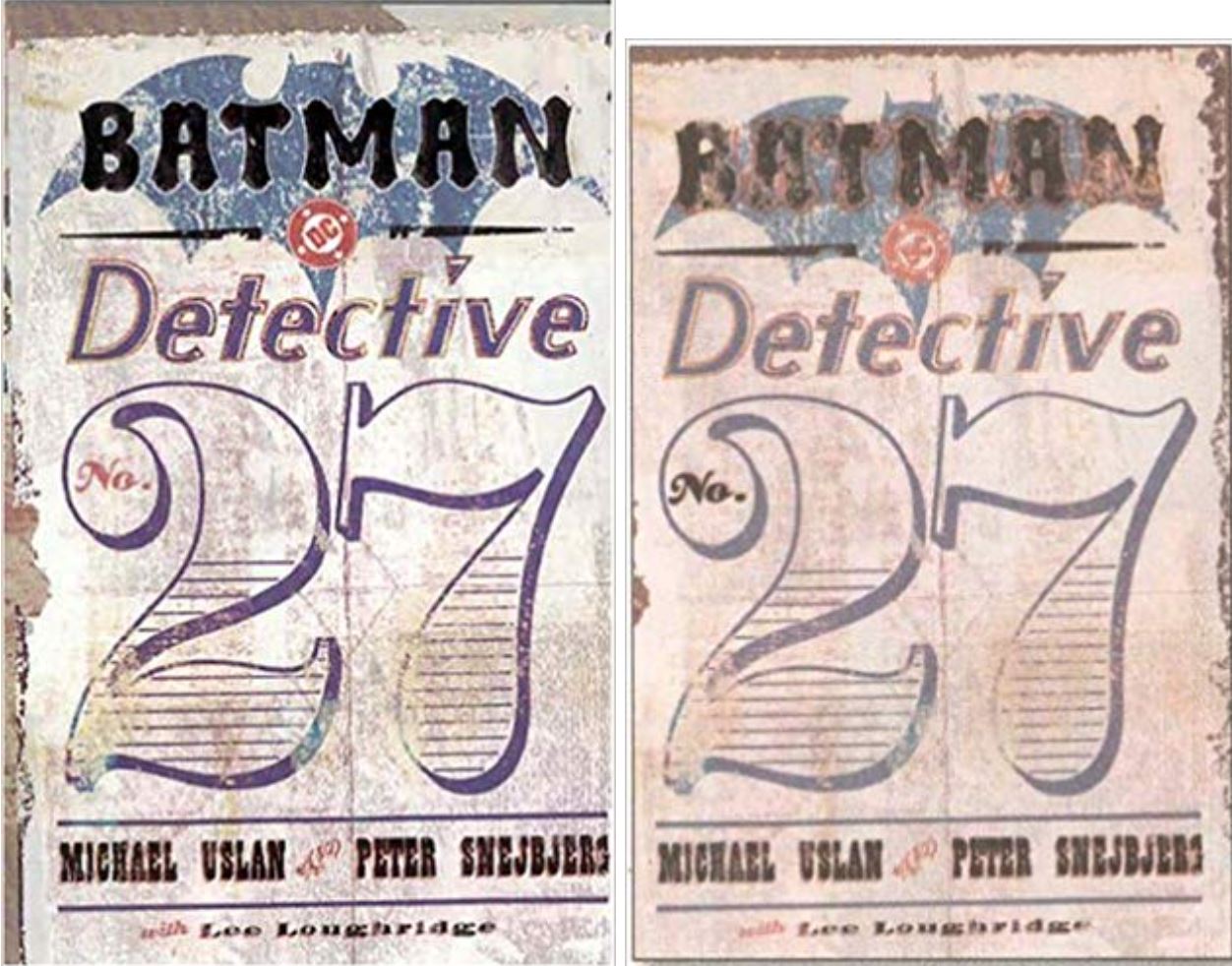
When Superman debuted in Action Comics #1, the only still-the-same-today supporting character was Lois Lane. When “The Bat-Man” premiered a year later in Detective Comics #27 (cover-date May 1939 but on sale from March 30th), the only other person you might recognise was Police Commissioner Gordon. Make of this what you will…

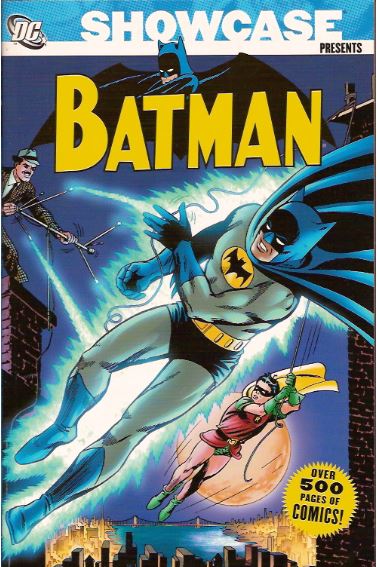
Over the 85 years of Batman’s existence, almost as important as the partnership between the Dark Knight and assorted Boy Wonders has been a bizarrely offbeat symbiotic relationship between those costumed vigilantes and Gotham City’s top cop James Gordon.

This collection – inexplicably one of very few Batman books unavailable in digital formats – compiles five individual pastiches released as 2001 miniseries Turning Points. Here, readers see significant moments in the development of that shadowy alliance produced primarily for long-term aficionados in tribute to key eras in Batman’s career by veteran artists and (then) new wave creators.

It all begins with Greg Rucka & Steve Lieber’s ‘Uneasy Allies’, set in the days – and visual style – of the mysterious vigilante’s stormy debut in Frank Miller & Dave Mazzuchelli’s exemplary Batman: Year One. Police Captain Gordon is still the only honest cop on a corrupt and brutally gung-ho force, reeling from the shock of his wife divorcing him. When bereaved, heartsick and crazed college professor Hale Corbett takes an entire wedding hostage, Gotham’s SWAT team commander is champing at the bit to storm in and rack up the body-count, whereas wanted felon The Batman offers Gordon a slim hope of ending the siege without loss of life.

All the masked nut-case wants in return is a sympathetic ear at the GCPD…

A clandestine working relationship established, …And Then There Were… Three?’ (by Ed Brubaker & Joe Giella – who drew many of 1960s stories and Batman’s newspaper strip) celebrate the era of TV’s “Batmania”. About a year after their first meeting, reports of a garishly garbed boy assistant to Batman begin filtering in. As deadly psychopath Mr. Freeze rampages through the city, Gordon demands to why the now-tolerated Caped Crusader is recklessly endangering a child.

In a rowdy romp packed with past icons like giant props and gaudy villains, a decidedly deadly outcome forces the cop to see and realise the true nature of Batman and Robin’s relationship…

Brubaker, Dick Giordano & Bob Smith set ‘Casualties of War’ in the bleak aftermath following the death of second Robin Jason Todd, the crippling of Barbara (Batgirl) Gordon and the torture of her father, at the bone-white hands of The Joker. A solitary, driven Dark Knight haunts streets and allies, ceaselessly crushing criminals with brutal callousness, whilst sinister serial killer The Garbage Man prowls unchallenged…

When wheelchair-bound Barbara fails in her attempted intervention to calm a Batman pushing himself to breaking-point, it takes a rooftop heart-to-heart with recently promoted Commissioner Gordon to finally crack the manhunter’s shell and begin the healing process…

Chuck Dixon & Brent Anderson step in years later when, as a result of a strategically systematic attack by would-be crime-lord Bane, an exhausted and broken Batman is replaced by another, darker champion. Set during the Knightfall publishing event, ‘The Ultimate Betrayal’ describes the moment Gordon realises his enigmatic ally has become a remorseless machine/exterminating angel hunting criminals with no regard to life anymore. If only third Robin Tim Drake could have told him that the man behind the cowl – and claws and razor-armour – is actually Azrael: hereditary and murderously programmed living weapon of an ancient Christian warrior-cult…

Rucka, Paul Pope & Claude St. Aubin bring the journey full circle in ‘Comrades in Arms’ wherein a mysterious stranger and his family hit Gotham on a mission to find Gordon and Batman, just as the Commissioner introduces his destined successor Michael Akins to the Major Crimes Unit. Word on the street is the Russian mob are planning a huge retaliatory strike and every cop is waiting for the hammer to fall when Hale Corbett walks back into GCPD HQ, demanding to see Gordon and the masked manhunter who changed his life many years ago…

Filtered through gritty modern sensibilities but still able to revere past glories and Batman’s softer sides, this thoroughly readable collection includes a cover gallery by artistic all-stars Javier Pulido, Ty Templeton, Joe Kubert, Howard Chaykin, Pope & Tim Sale, and offers a gripping thrill ride for newcomers and veterans alike.
© 2001, 2007 DC Comics. All Rights Reserved.

It’s a Bird…


By Steven T. Seagle, Teddy Kristiansen & various (Vertigo)
ISBN: 978-1-4012-0109-8 (HB) 987-1-4012-7288-3 (TPB)

Since his debut in June 1938, Superman has proven to be many things to billions of people, to the point of even changing their lives and shaping their actions. It’s a Bird… was first released in 2004, offering a departure from typical Superman graphic novel fare with author Steven T. Seagle working through his understandable creator-angst about writing the ongoing adventures of the Man of Steel without simply rehashing what has gone before.

Seagle (whose other comics work includes Uncanny X-Men, Sandman Mystery Theatre, Big Hero 6 and Genius, and is part of TV cartoon creation collective Man of Action) actually scripted Superman #190-200 – published between April 2003 and February 2004. The intriguing, demi-therapeutic exercise revealed in this slim and beguiling pictorial introspection deals with the author’s misgivings about contributing to the canon of an eternally unfolding legend.

However, underpinning what might so easily become a self-gratifying ego-stroke is a subtle undercurrent of savvy verity that struck a chord with many fellow industry professionals and insightful consumers as the professional writer finally found themes he needed to explore to be satisfied with his commission.

Let’s be honest here, every comic fan, indeed every twitcher and hobbyist, looks for a way to present and explain their particular passion to the “real” or perhaps “civilian” world and not feel like an imbecile in the process…

Employing barely One Degree of Separation, “Steve” is a writer working through some emotional baggage. He is still coming to terms with his family’s gradual but inescapable disintegration – mental, physical and spiritual – from hereditary genetic disease Huntington’s Disease (Chorea, as was).

In everyday life, his father has gone missing, and his mom and partner are making the “let’s have kids” noises whilst Steve is helplessly waiting for a hammer to fall regarding his own potential prognosis with a condition that cannot be beaten…

He never wanted to write comics – even though he’s successful at it – and now his editor wants him to write Superman. Steve has never had any feeling for the character or the medium and his damned editor just keeps on and on and on about…

You get the picture?

It’s a Bird… is slow and lyrical in its deconstructive self-absorption as Steve – eventually – makes his choices, whilst Teddy (The Sandman, The Dreaming, Grendel Tales, Genius) Kristiansen’s range of enticing drawing styles provides an eye-catching display of sensitivity and versatility – one which won him the 2005 Eisner Award for Best Painter/Multimedia Artist (Interior). If you feel the urge to go beyond panel borders of your private obsession, this one is well worth a look, and a book demanding a digital rerelease ASAP.
© 2004, 2017 DC Comics. All Rights Reserved.

Essential Punisher volume 1


By Gerry Conway, Archie Goodwin, Len Wein, Mike W. Barr, Marv Wolfman, Dennis O’Neil, Roger McKenzie, Frank Miller, Bill Mantlo, Stephen Grant, Jo Duffy, Ross Andru, Tony DeZuniga, Frank Springer, Keith Pollard, Al Milgrom, Greg LaRocque, Mike Zeck, Mike Vosburg & various (MARVEL)
ISBN: 978-0-8571-2375-0 (TPB)

Debuting in 1974 and despite being one of the industry’s biggest hits from the mid-1980s onwards, the obsessed vengeance-taker known as The Punisher was always an unlikely and uncomfortable star for comic books. His methods were excessively violent and usually permanent. It’s intriguing to note that unlike most heroes who debuted as villains (Black Widow or Wolverine come to mind) the Punisher actually became more ruthless, immoral, anti-social and murderous, not less. The Punisher never toned down or cleaned up his act – the buying public simply shifted its communal perspective.

He was created by Gerry Conway, John Romita Sr. and Ross Andru: a (necessarily) toned down, muted response to increasingly popular prose anti-heroes like Don Pendleton’s Mack Bolan: the Executioner and a bloody tide of fictive Viet Nam vets returned from South East Asia who all turned their training and talents to wiping out organised crime in the early 1970s. The story goes that Marvel’s bosses were reluctant to give The Punisher a starring vehicle in the mainstream colour comic-book line, feeling the character’s very nature made him a bad guy, not a good one. Other than the two magazine stories and the miniseries which closes this volume, Frank Castle was not supposed to be the star or even particularly admirable to the impressionable readership.

Therefore these early appearances could disappoint die-hard fans even though they are the formative tales of his success. Perhaps it’s best to remember and accept that when not actually the villain in the tales he was at best a controversial guest and worrisome co-star…

Boy, how times do change.

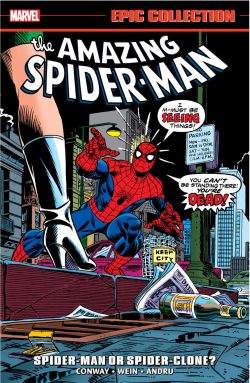
He was first seen as a villain/patsy in Amazing Spider-Man #129 (cover-dated February 1974 but actually on sale from 30th October 1973 – so even in terms of his anniversary, Castle apparently “jumped the gun” (I’m so weak!). He repeatedly returned thereafter until getting his shot at the big time – just not in newsstand publications but in Marvel’s monochrome, mature magazine line. This initial Essential compilation gathers all those tentative stabs and guest-shots from February 1974 through to the breakthrough 1986 miniseries which really got the ball rolling. These include Amazing Spider-Man #129, 134-135, 162-163, 174-175, 201-202; Amazing Spider-Man Annual #15; Giant-Size Spider-Man #4; Marvel Preview #2; Marvel Super-Action #1; Captain America #241; Daredevil #182-184; Peter Parker, The Spectacular Spider-Man #81-83 and The Punisher #1-5, but many die-hard modern fans may be disappointed in the relative lack of brutality, carnage and even face time contained herein. Just keep in mind that for the greater part of these early appearances the skull-shirted slayer was at best a visitor and usually the villain du jour…

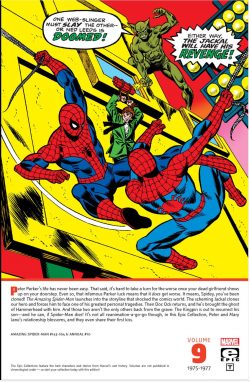
The first case in this mammoth monochrome war journal comes from ASM #129, introducing not only the renegade gunslinger but also nefarious manic mastermind The Jackal in ‘The Punisher Strikes Twice!’ Scripted by Conway, and illustrated by Ross Andru, Frank Giacoia & Dave Hunt, it reveals how a mystery lone gunman is duped by manipulative Professor Miles Warren into hunting the wallcrawler who was wrongly implicated in the deaths of police captain George Stacy and his daughter Gwen and currently a suspect in the death of Norman Osborn. Here he is subsequently set up by The Jackal for the murder of the Punisher’s gunmaker before clearing the air and going their own ways…

The much-misunderstood champions of the oppressed crossed paths again in Amazing Spider-Man #134-135 when a South American bandit – intended to be his oppressive regime’s Captain America – attempts to pillage a Manhattan tour boat in ‘Danger is a Man Named… Tarantula!’ Once again unwilling allies, Spidey and the Punisher’s trails cross when the duo dutifully dismantle the villain’s schemes during a ‘Shoot-Out in Central Park!’

The Punisher played a more central role in Giant-Size Spider-Man #4 (April 1975) when the webslinger forces himself into one of the sinister shootist’s cases in ‘To Sow the Seeds of Death’s Day!’ when ruthless arms dealer Moses Magnum began testing a deadly chemical weapon on randomly kidnapped victims. Tracking down the vile monster in ‘Attack of the War Machine!’, the reluctant allies found themselves infiltrating his ‘Death-Camp at the Edge of the World!’ before seeing summary justice dispensed more by fate than intent…

John Romita Senior’s original concept pencil sketch of The Punisher from 1973 is followed by the vigilante’s first solo role – in black-&-white magazine Marvel Preview #2 (August 1975) – wherein Conway & Tony DeZuñiga pronounced a ‘Death Sentence’ on some of Castle’s old army buddies. They had been tricked into becoming assassins by a millionaire madman who wanted to take over America, as the gritty yarn at last revealed the tragic reasons for The Punisher’s unending mission of vengeance.

Highly decorated Marine Castle saw his wife and children gunned down in Central Park after the carefree picnickers stumbled into a mob hit. When the killers turned on the helpless witnesses, only Castle survived. Recovering in hospital, the bereft warrior dedicated his life to eradicating criminals everywhere. Following a stunning Punisher and Dominic Fortune pin-up by Howard Chaykin, Archie Goodwin, DeZuñiga & Rico Rival’s ‘Accounts Settled… Accounts Due!’ – from Marvel Super Action #1 (January 1976) – draws another matured-themed plot to a close as Castle finally tracks down the gunsels who carried out the shooting and the Dons who ordered it, only to find his bloody vengeance hasn’t eased his heart or dulled his thirst for personal justice…

Castle was reduced to a bit-player in Amazing Spider-Man #162-163 (October & November 1976 by Len Wein Andru & Mike Esposito), as the newly relaunched X-Men were sales-boosted via a guest-clash with the webspinner in ‘…And the Nightcrawler Came Prowling, Prowling’. Here Spider-Man jumps to wrong conclusion when a sniper shoots a reveller at Coney Island and by the time Nightcrawler has explained himself (in the tried-&-true Marvel manner of fighting the star to a standstill) old skull-shirt has turned up to take them both on. Soon however, mutual foe Jigsaw is exposed as the true assassin in concluding episode ‘Let the Punisher Fit the Crime!’

Inked by DeZuñiga & Jim Mooney, November 1977’s ASM #174 declared ‘The Hitman’s Back in Town!’ with Castle hunting a costumed assassin hired to rub out J. Jonah Jameson, but experiencing unusual reticence since the killer is an old army pal who had saved his life in Vietnam. Nevertheless the tale ends in fatality at the ‘Big Apple Battleground!’ in #175.

Captain America #241 (January 1980, by Mike W. Barr, Frank Springer & Pablo Marcos) was a fill in benefitting from the Frank Miller effect – he drew the cover – as ‘Fear Grows in Brooklyn’ depicted the Sentinel of Liberty getting in the way of Castle’s latest mission and refusing to allow The Punisher to go free. Cap wasn’t on hand stop him escaping police custody and Amazing Spider-Man #201-202 (February & March 1980) by Marv Wolfman, Keith Pollard & Mooney. ‘Man-Hunt!’ and ‘One For Those Long Gone!’ reveal how Castle almost uncovers Peter Parker‘s big secret whilst relentlessly stalking a mob boss responsible for the death of a kid who had saved Castle’s life…

Amazing Spider-Man Annual #15 (1981 by Dennis O’Neil, Miller & Klaus Janson) is putatively the genesis of the antihero in his proper form. ‘Spider-Man: Threat or Menace?’ sees maniac fugitive Castle back in the Big Apple and lethally embroiled in a deadly scheme by Doctor Octopus to poison five million New Yorkers. Soon both Parker and his colourful alter-ego are trapped dead-centre of a terrifying battle of ruthless wills in a tense and clever suspense thriller, highlighting and recapturing the moody mastery of Steve Ditko’s heyday.

The Miller connection continued in three landmark issues of Daredevil (#182-184, May-July 1982) which ideally embody everything that made The Punisher a momentous, unmissable, “must-read” character…

It is presaged by an untitled excerpt by Miller & Janson from ‘She’s Alive’ – wherein Castle is extracted from prison by a government spook to stop a shipment of drugs the authorities can’t touch. Meanwhile a shattered Matt Murdock is failing to cope with the murder of his first love Elektra. Of course, once Castle has stopped the drugs and killed the gangsters, The Punisher refuses to go back to jail…

The story proper begins in ‘Child’s Play’ – with Roger McKenzie lending a scripting hand – and deals with school kids using drugs. It was originally begun by McKenzie & Miller but shelved for a year, before being reworked into a stunningly powerful, unsettling tale once Miller & Janson assumed full creative chores on Daredevil. When Murdock visits a high school he is a helpless witness to a little girl high on “Angel Dust” going berserk, attacking staff and pupils before throwing herself out of a third floor window The appalled hero vows to find the dealers and encounters her bereaved and distraught younger brother Billy, determined to exact his own vengeance, and later coldly calculating Castle who has the same idea and far more experience…

The hunt leads inexorably to a certain street pusher and DD, Billy and The Punisher all find their target at the same time. After a spectacular battle a thoroughly beaten Daredevil has Billy, a bullet-ridden corpse and a smoking gun…

The kid is innocent – and so, this time at least, is Castle – and after Murdock proves it in court, the investigation resumes with the focus falling on drug boss Hogman. When DD’s super-hearing confirms the gangster’s claims of innocence, Murdock successfully defends the vile dealer, only to have the exonerated slimeball gloatingly admit to having committed the murder after all! Horrified, shocked, betrayed and resolved to enforce justice, DD finds a connection to a highly-placed member of the school faculty deeply involved with the drug lord in concluding chapter ‘Good Guys Wear Red’, but it’s far too late: Castle and Billy have both decided to end the matter Hogman’s way…

Scripted by Bill Mantlo and illustrated by Al Milgrom & Mooney, Peter Parker, The Spectacular Spider-Man #81-83 (August-October 1983) opens with ‘Stalkers in the Shadows’ as an increasingly crazed Punisher goes after misdemeanour malefactors with the same murderous zeal previously reserved for killers and worse. Spider-Man meanwhile, has his hands full with teen vigilantes Cloak and Dagger who have graduated from tackling street drug pushers to go after Wilson Fisk, The Kingpin of crime.

‘Crime & Punishment!’ sees Castle applying lethal force indiscriminately all over town, culminating in his own crazed attack on Fisk… who beats him to a pulp. Illustrated by Greg LaRoque & Mooney the saga ends with ‘Delusions’ as The Punisher goes on trial and is found to have been dosed with psychosis-inducing drugs…

In 1984 Marvel gave way to the inevitable and commissioned a Punisher miniseries, although writer Steven Grant and penciller Mike Zeck apparently had an uphill struggle convincing editors to let the grim, gun-crazed maniac loose in the shiny world where little kids might fixate on a dangerous role model – and their parents might get all over-protective, litigious and (skull) shirty. A year later the creators finally got the green-light and a 5-issue miniseries – running from January to May – turned the industry on its head. There was indeed plenty of controversy to go around, especially as the tale featured a “hero” who had lots of illicit sex and killed his enemies in cold blood. Also causing problems for censorious eyes were the suicide of one of the major characters and the murder of innocent children. Doesn’t it make you proud to realise how far we’ve since come?

The company mitigated the potential fall-out with the most lacklustre PR campaign in history, but not telling anybody about The Punisher (AKA Circle of Blood) didn’t stop the series becoming a runaway, barnstorming success. The rest is history. Two years later as the graphic novel market was becoming established and with Frank Castle one of the biggest draws in comics (sorry, I’m such a child sometimes), that contentious series was released as a complete book and it remains one of the very best of all his many exploits.

Here, rendered even more stark and uncompromising in gritty moody monochrome, the action begins in ‘Circle of Blood’ as Castle is locked in Ryker’s Island prison where every inmate is queuing up to kill him. Within hours he has turned the tables and terrified the General Population, but knows both old foe Jigsaw and the last of the great mob “Godfathers” have special plans for him…

When a mass breakout frees all the cons, Castle brutally steps in. For this the warden allows his escape and offers him membership in The Trust: an organisation of “right-minded, law-abiding citizens” who approve of his crusade. Castle also learns he’s being stalked by Tony Massera, a good man who thought he had escaped the influences of his crime-family…

Tony must kill Castle to avenge his father – one of Punisher’s many gory successes – but only after the streets have been swept clean of scum like his own relations. ‘Back to the War’ finds Punisher on the streets again, hunting scum, armed and supplied by the Trust… but still not a part of their organisation. After an abortive attempt to blow up The Kingpin, Castle is saved by the enigmatic Angel, and begins a loveless liaison with her. With everybody mistakenly believing the master of New York’s underworld dead, bloody gang-war erupts with greedy sub-bosses all trying to claim the top spot, but by the events of ‘Slaughterday’, Castle realises too many innocents are getting caught in the crossfires.

He also discovers in ‘Final Solution’ that the Trust have their own national agenda as hit men and brainwashed criminals dressed in his costume swarm the streets, executing mobsters and fanning the flames. All the Trust’s plans for this “Punishment Squad” and the country are uncovered in blockbusting conclusion ‘Final Solution Part 2’, when all the pieces fall into place and the surviving players reveal their true allegiances. In a classy final chapter mysteriously completed by the highly underrated Jo Duffy& Mike Vosburg, from Grant’s original plot, The Punisher takes charge in his inimitable manner, leaving God and the cops to sort out the paperwork. We can only speculate as to why the originators fell away at the last hurdle, but I’m pretty sure those same reluctant editors played some part in it all…

This economical Essential edition comes with a plethora of pin-ups, concluding with comprehensive information pages culled from the Marvel Universe Handbook.

These superb, morally ambiguous if not actually ethically challenging dramas never cease to thrill and amaze, and have been reprinted a number of times. Whichever version suits your inclinations and wallet, if you love action, cherish costumed comics adventure and crave the occasional dose of gratuitous personal justice, this one should be at the top of your “Most Wanted” list.
© 1974, 1975, 1976, 1977, 1980, 1981, 1982, 1983, 1986, 2011 Marvel Characters, Inc. All rights reserved.

Fantastic Four Epic Collection volume 9: The Crusader Syndrome – 1974-1976


By Gerry Conway, Roy Thomas, Len Wein, Tony Isabella, Steve Englehart, Marv Wolfman, Chris Claremont, Rich Buckler, John Buscema, George Pérez, Sal Buscema, Bob Brown, Joe Sinnott, Jim Mooney, Joe Staton, Frank Giacoia, Mike Esposito, Chic Stone, Vince Colletta with Stan Lee, Dick Ayers, Paul Reinman & various (MARVEL)
ISBN 978-1-3029-4875-7 (TPB/Digital edition)

Monolithic modern Marvel truly began with the adventures of a small super-team who were as much squabbling family as coolly capable costumed champions. Everything the company is now stems from the quirky quartet and the groundbreaking, inspired efforts of Stan Lee & Jack Kirby…

Cautiously bi-monthly and cover-dated November 1961, Fantastic Four #1 – by Stan, Jack, George Klein & Christopher Rule – was raw and crude even by the ailing company’s standards: but it seethed with rough, passionate and uncontrolled excitement. Thrill-hungry kids pounced on its dynamic storytelling and caught a wave of change starting to build in America. It and succeeding issues changed comics forever. As seen in the premier issue, maverick scientist Reed Richards, his fiancée Sue Storm, their close friend Ben Grimm and Sue’s bratty teenaged brother Johnny survived an ill-starred private space-shot after Cosmic Rays penetrated their ship’s inadequate shielding.

All four permanently mutated: Richards’ body became elastic, Sue became (even more) invisible, Johnny Storm burst into living flame and tragic Ben shockingly devolved into a shambling, rocky freak. After the initial revulsion and trauma passed, they solemnly agreed to use their abilities to benefit mankind. Thus was born The Fantastic Four.

Throughout the 1960s it was indisputably the key title and most consistently groundbreaking series of Marvel’s ever-unfolding web of cosmic creation: a forge for new concepts and characters. Kirby was approaching his creative peak: continually unleashing his vast imagination on plot after spectacular plot, whilst Lee scripted some of the most passionate superhero sagas ever seen. Both were on an unstoppable roll, at the height of their powers and full of the confidence only success brings, with The King particularly eager to see how far the genre and the medium could be pushed… which is rather ironic since it was the company’s reticence to give the artist creative freedom which led to Kirby’s moving to National/DC in the 1970s.

Without Kirby’s soaring imagination the rollercoaster of mind-bending High Concepts gave way to more traditional tales of characters in conflict, with soap-opera leanings and super-villain-dominated Fights ‘n’ Tights dramas. This stripped-down, compelling compilation gathers Fantastic Four #147-167, Giant-Size Fantastic Four #2-4 and Avengers #127: collectively covering June 1974 to February 1976 and heralding a change of pace and partial return of The King – even if only on covers…

Fantastic Four #147 offers action-tinged melodrama with Gerry Conway, Rich Buckler & Joe Sinnott in how ‘The Sub-Mariner Strikes!’ as long-sidelined and neglected Susan Richards starts divorce proceedings against Reed whilst seemingly taking comfort in the arms of long-time admirer/stalker Prince Namor of Atlantis. When Reed, Johnny, Ben and Inhuman substitute teammate Medusa try to “rescue” her, the Atlantean ruler thrashes them before Sue sends them packing…

To add insult to injury, the dejected men return home to find the Baxter Building once more invaded by the Frightful Four and are forced to fight a ‘War on the Thirty-Sixth Floor!’ Sadly The Sandman, Wizard and Trapster have no idea their newest ally Thundra is secretly smitten with the Thing. FF #149 resolves the scandalous Sub-Mariner storyline as the undersea emperor invades New York in ‘To Love, Honour, and Destroy!’ Happily, his awesome attack is merely a cunning plan to trick Sue into reconciling with her husband. It almost works…

Courtesy of Conway, John Buscema & Chic Stone, Giant-Size Fantastic Four #2 reveals a time-twisting ‘Cataclysm!’, wherein cosmic voyeur The Watcher warns of a hapless innocent who has inadvertently altered history, thanks to Dr. Doom’s confiscated time platform. Once again the supposedly non-interventionist extraterrestrial expects the FF to fix a universal dilemma…

With more than one temporal hot-spot, Reed and Johnny head for Colonial America to rescue the Father of the Nation in ‘George Washington Almost Slept Here!’, whilst Ben and Medusa crash into the “Roaring Twenties” and save the time-lost wanderer from being rubbed out by racketeers in ‘The Great Grimmsby’. Thinking their mission accomplished, the heroes are astounded to then find themselves trapped in timeless Limbo, battling monstrous giant Tempus before escaping to their restored origin point in ‘Time Enough for Death!’

For months lovelorn Johnny had fretted and fumed that his first true love Crystal was to marry super-swift mutant Quicksilver. That plot-thread finally closed in a 2-part crossover tale opening in Avengers #127 (September 1974). Crafted by Steve Englehart, Sal Buscema & Joe Staton, ‘Bride and Doom!’ sees the Assemblers travel to Attilan (hidden homeland of the Inhumans) for the wedding of aforementioned speedster Pietro to elemental enchantress/Royal Princess, only to meet an uprising of the genetic slave-race designated Alpha Primitives. Once again, sinister robotic colossus Omega has incited revolt, but this time it isn’t insane usurper Maximus behind the seditious skulduggery but an old Avengers enemy who reveals himself in the concluding chapter from in Fantastic Four #150.

‘Ultron-7: He’ll Rule the World!’ (Conway, Buckler & Sinnott) finds both teams joining Black Bolt’s Inhumans against the malign A.I., but only saved by a veritable Deus ex Machina after which, at long last, ‘The Wedding of Crystal and Quicksilver’ finally closes events on a happy note – for everybody but the Torch, that is…

The dramatic tensions resume with Giant-Size Fantastic Four #3 as plotter Gerry Conway, scripter Marv Wolfman and illustrators Rich Buckler & Joe Sinnott deliver an epic tale of global import. The extra-special quarterly Giant-Size range was devoted to offering blockbuster thrills, and herein reveal ‘Where Lurks Death… Ride the Four Horsemen!’ as cosmic aliens arrive, intent on scourging the Earth.

Forewarned after the team stumble across the first horror in ‘…There Shall Come Pestilence’, our harried heroes split up with Inhuman stand-in Medusa and Johnny striving against international madness in ‘…And War Shall Take the Land!’ whilst Reed and Ben fight to foil the personification of Famine in ‘…And the Children Shall Hunger!’, before all reunite to wrap up the final foe in ‘…All in the Valley of Death!’

In FF #151 Conway, Buckler & Sinnott begin revealing the truth about the mysterious “Femizon” stalking the Thing. ‘Thundra and Lightning!’ introduces male-dominated alternate Future Earth Machus and its brutal despot Mahkizmo, the Nuclear Man, who explosively invades the Baxter Building in search of a mate to dominate and another world to conquer…

Inked by Jim Mooney, #152 exposes ‘A World of Madness Made!’ with the team captive in the testosterone-saturated side-dimension whilst Medusa seemingly flees, whilst actually seeking reinforcements from the diametrically-opposed Femizon future/alternity, resulting in two universes crashing together in the concluding ‘Worlds in Collision!’ by Tony Isabella, Buckler & Sinnott.

Rapidly reworked by Len Wein, Fantastic Four #154 featured ‘The Man in the Mystery Mask!’: a partial reprint from Strange Tales #127 in which Stan Lee, Dick Ayers & Paul Reinman pitted Ben and Johnny against ‘The Mystery Villain!’. Here, however, Bob Brown, Frank Giacoia & Mike Esposito’s revisions depict how Reed’s early lesson in leadership has been hijacked by another old friend with explosive and annoying results…

Meanwhile over in Giant-Size Fantastic Four #4, Wein, Chris Claremont, John Buscema, Chic Stone & Sinnott unite to introduce ‘Madrox the Multiple Man’: a young mutant who grew up on an isolated farm unaware of the incredible power he possessed. When his parents pass away, the kid is inexplicably drawn to New York City, where the hi-tech suit he wears to contain his condition malfunctions. Soon the boy devolves into a mobile fission device that can endlessly, lethally replicate himself. Thankfully the FF are aided by mutant Moses Charles Xavier who dutifully takes young Jamie under his wing…

A minor classic from Wein, Buckler & Sinnott follows s seen in Fantastic Four #155-157 when the long dormant Silver Surfer resurfaces in ‘Battle Royal!’ – apparently a murderous thrall of Doctor Doom. The Iron Dictator commands the Stellar Skyrider because he holds the alien’s lover Shalla Bal –-even cruelly threatening to take her in marriage. However, as seen in ‘Middle Game!’ (with Roy Thomas joining as co-writer and Editor) the Surfer cannot kill and merely delivers the defeated FF as prisoners to the Devil Doctor’s citadel. Naturally, there are schemes within schemes unfolding and Doom is playing a waiting game whilst covertly siphoning the Surfer’s “Power Cosmic” to fuel a deadly Doomsman mechanoid…

With Thomas in full authorial control ‘And Now… the Endgame Cometh!’ sees the heroes fight back to conquer the Lethal Latverian, blithely unaware the entire charade has been a crafty confection of malignly manipulative demon-lord Mephisto

The furore is followed by another nostalgia-tinged 2-part epic beginning with FF #158’s ‘Invasion from the 5th (Count it, 5th!) Dimension’ by Thomas, Buckler & Sinnott. When one of the Torch’s earliest solo scourges returns to occupy the homeland of the Inhumans, extra-dimensional dictator Xemu opens his campaign of vengeance by dispatching Quicksilver to lure his sister-in-law Medusa back to Attilan. The intention is to force defiant King Black Bolt to utilise his doomsday sonic power on the invaders’ behalf, for which the conqueror needs the silent king’s true love as a bargaining chip. However, when the FF accompany her into the blatant trap, they bring a hidden ally who turns the tables on Xemu, unleashing ‘Havoc in the Hidden Land!’, coincidentally and at last reuniting the First Family of comic book fiction…

More pan-dimensional panic ensues when a multiversal conflict is cunningly concocted by a hidden mastermind orchestrating Armageddon for a trio of dimensionally-adjacent planets for ‘In One World… and Out the Other!’ Devised by Thomas, John Buscema & Stone, the initial chapter sees shapeshifting Reed Richards sell his patents to a vast corporation, even as in the streets his counterpart from another universe is kidnapped by barbarian warlord Arkon the Magnificent. That abduction is investigated by a very Grimm Thing who has uncomfortable suspicions about what’s occurring…

With Buckler & Sinnott doing the depicting ‘All the World Wars at Once!’ expands the saga as Johnny Storm visits the recently liberated 5th Dimensional Earth to discover it under assault by androids from yet another slightly different one. As the Thing teams up with his other-earth counterpart to quell a dinosaur invasion, “our” world is assaulted by an army from the 5th dimension led by the Torch. With each realm believing itself provoked by trans-terrestrial aggressors, the divided team only knows one thing: each invading force is using weaponry invented by Richards…

The crises peaks in ‘The Shape of Things to Come!’ as the mastermind is exposed and the scheme to annihilate three worlds come close to fruition, necessitating a voyage to a cosmic nexus point and a devastating battle with yet another twisted alternate-reality hero to save existence in a spectacular and poignant ‘Finale  #163.

A new direction began with #164 (part 1 of a reconditioned yarn originally intended for Giant-Size Fantastic Four), courtesy of Thomas and then-neophyte illustrator George Pérez, backed up by Sinnott. ‘The Crusader Syndrome!’ sees the team battling a veteran superhero gone bad since his last outing as Atlas-Era champion Marvel Boy. Now as The Crusader he wages savage war on financial institutions whose self-serving inaction doomed his adopted Uranian race in the 1950s. However, his madness and savagery are no match for the FF and #165’s ‘The Light of Other Worlds!’ details his apparent demise. It also sparks many successful additions to Marvel Continuity, such as new hero Quasar, the 1950s Avengers and Agents of Atlas whilst introducing Galactus’ herald-in-waiting Frankie Raye as Johnny’s new girlfriend…

This formidable high-tension Fights ‘n’ Tights tome terminates in a titanic tussle as Vince Colletta inks #166 as ‘If It’s Tuesday, This Must be the Hulk!’ as the team hunts the Gamma Goliath with a potential cure for Bruce Banner. Sadly, aggressive and insulting military treatment of their target enrages fellow-monster Ben Grimm who unites with The Hulk to menace St. Louis, Missouri as ‘Titans Two!’ (with Sinnott back on inks). Following a mighty struggle with his old friends and constantly bathed in Hulk’s Gamma radiation, Ben is permanently reduced to human form and contemplates a whole new life…

To Be Continued…

With covers by Buckler, Gil Kane, John Romita, Ron Wilson, Kirby, Sinnott and more this power-packed package also includes the covers to all-reprint Giant-Sized Fantastic Four #5 & 6 and the original unused cover for GSFF #5 (which contents became FF #158-159); house ads and the new material from The Fabulous Fantastic Four Marvel Treasury Edition #2 (December 1975). This bombastic oversized tabloid edition featured a bevy of classic yarns and is represented here by front-&-back cover art from John Romita, a Marie Severin frontispiece and Stan Lee Introduction, contents page and double-page pin-up of the team and supporting cast by John Buscema & Giacoia.

Also on view are extracts from F.O.O.M. #8-10 (comedic exploits of Doctor Foom by Charley Parker), pertinent pages by Buckler & Sinnott from The Mighty Marvel Calendar 1975, cover plus splash page by Dave Cockrum & Sinnott from November 1977’s Marvel Super Action #4 which reprinted Marvel Boy stories from the early 1950s and a gallery of original art pages and a colour guide.

Although Kirby had taken the unmatched imagination and questing sense of wonder with him on his departure, the sheer range of beloved characters and concepts he had created with Lee carried the series for years afterwards. So once writers who shared their sensibilities were crafting the stories a mini-renaissance began. Although the “World’s Greatest Comics Magazine” didn’t quite return to the stratospheric heights of yore, this period offers fans a tantalising taste of the glory days. These honest and extremely capable efforts will still thrill and enthral the generous and forgiving casual browser looking for an undemanding slice of graphic narrative excitement.
© 2023 MARVEL.

The Golden Age Sandman Archives volume 1


By Bert Christman, Gardner F. Fox, Creig Flessel, Chad Grothkopf, Ogden Whitney & various (DC Comics)
ISBN: 978-1-4012-0155-5 (HB)

Probably illustrated, scripted and created by multi-talented all-rounder Bert Christman (with the assistance of young scripting star Gardner F. Fox), The Sandman premiered in either Adventure Comics #40 July 1939 (two months after Batman’s debut in Detective Comics #27) or two weeks earlier in New York World’s Fair Comics 1939 – depending on whose distribution records you choose to believe. Intriguingly, the Dark Knight didn’t make the cut for the legendary commemorative comic book and only appeared in New York World’s Fair Comics #2 in Summer 1940…

Head obscured by a gas-mask and slouch hat; caped, business-suited millionaire adventurer Wesley Dodds was cut from the radio drama/pulp fiction mystery-man mould that had made The Shadow, Green Hornet, Lone Ranger, Phantom Detective, Black Bat, Spider, Avenger and so many more into household names of early mass-entertainment and periodical publication. Wielding a sleeping-gas gun and haunting the night to hunt a host of killers, crooks and spies, he was eventually joined and accompanied by plucky paramour Dian Belmont, before gradually losing readers’ interest and slipping from cover-spot to last feature in Adventure Comics, just as the shadowy, morally ambiguous avengers he emulated slipped from popularity in favour of more flamboyant, true-blue fictional fare.

This splendidly sturdy, moodily atmospheric Archive edition gathers those landmark early appearances from New York World’s Fair Comics 1939 & 1940 and the rip-roaring exploits from Adventure Comics #40-59, spanning July 1939 to February 1941: a period when Detective Comics Incorporated frantically sought to follow up Superman and Batman with the “Next Big Thing in comic books”…

Following an erudite appreciation from historian and comics all-star Jim Amash, the dramas begin with the fast-paced thriller from the groundbreaking, pioneering comics premium New York World’s Fair Comics #1 as Christman & Fox introduced ‘Sandman at the World’s Fair’. In those long-lost days, origins and back story were not as important as action and spectacle so we quickly plunge into a fast-paced yarn as wealthy, rugged playboy scientist Dodds visits the global festival with plans for a new ray-gun. En route he encounters spies and a traitor within his own company. Already active as The Sandman – and sought by the cops for it – the vigilante tracks down and deals with the pre-war enemies of America…

Over in Adventure Comics #40, at about the same time, the cover-featured crusader saves kidnapped actress Vivian Dale when ‘The Tarantula Strikes’ (Christman & Fox) in a rousing romp reminiscent of the High Society hi-jinks of movie marvels The Saint, Falcon or Lone Wolf: prowling allies and moonlit rooftops, breaking into criminals’ lairs, rifling safes and dealing as much death as dream gas. He also utilised a unique calling card, sprinkling sand to proclaim and terrify wherever he has silently been and gone…

Christman wrote and drew many of the early thrillers such as #41’s ‘On the Waterfront’, wherein plucky reporter Janice Blue inadvertently stumbles into a dockside narcotics ring just as murderous seadog Captain Wing makes a fateful takeover bid. Luckily for Janice, the stealthy Sandman is already on the case…

Adventure #42 highlighted Christman’s love of aviation in ‘The Three Sandmen’, as Dodds met up with former Navy Flying Corps buddies to solve a string of murders. Somebody was rubbing out all the members of the old squadron…

Allen Bert Christman first came to public attention by following near-mythic Noel Sickles on seminal newspaper strip Scorchy Smith. A dedicated patriot and flyer, Christman entered the Naval Air School in 1940 and joined Claire Lee Chennault’s 1st American Volunteer Group, known as the legendary fighter squadron The Flying Tigers. These volunteers began fighting the Japanese in China long before America officially entered WWII on December 8th 1941, and Christman – officially designated a Colonel in the Chinese Air Force – used his artistic talents to personalise and decorate many of the planes in his Flight. He was shot down and died in horrific circumstances on January 23rd 1942.

Issue #43 saw his last official story as Dodds went on a South Seas flying vacation and was embroiled in an ‘Island Uprising’: spectacularly saving embattled white pearl hunters from natives enraged to fury by latter-day pirate Red Hatch

In Adventure #44 (November 1939), Fox & Creig Flessel stepped into the breach left by Christman when ‘The Sandman Meets the Face’. Here the playboy was back in civilisation and aiding a down-&-out friend against a mercurial disguise artist and mob boss terrorising the city. This splendid blood-&-thunder caper also saw the page count rise from 6 to 10 as The Sandman finally found his lurking, moody metier…

‘The Golden Gusher’ (#45 by Fox & Flessel) was nightclub singer Gloria Gordon, threatened with kidnap or worse until the Master of Sleep intervened, whilst #46’s ‘The Sandman Meets with Murder’ saw rising talent Ogden Whitney step into the artistic hot seat when the slaying of another old Dodds chum led into a deliciously convoluted murder-mystery involving beautiful twins, counterfeiting and a macabre cross-dressing killer…

A huge step in continuity occurred in #47 as District Attorney Belmont agreed to an unofficial truce with The Sandman following the assassination of a prominent banker. Simultaneously, Wesley caught a wily thief trying to crack his safe and became unwilling partner to the ‘Lady in Evening Clothes’ (Fox & Whitney) after she uncovered his secret identity. A celebrated cat-burglar, the sophisticated she-devil was plagued by not knowing who her parents were, but happily went straight(ish) in return for Dodd’s pledge to help her…

Eventually revealed as long-lost Dian Belmont, she became a regular cast addition in #48 as ‘Death to the D.A.’ found her newly-found father under threat from gangsters and far less obvious killers on a palatial island retreat, after which ‘Common Cold – Uncommon Crime’ (#49 by Fox, Flessel & perhaps Chad Grothkopf on inks) sees the mystery-man tracking killers who were eradicating scientists who refused to hand over their cure for one of our most unforgiving ailments.

With a year gone by and global war looming, the “World of Tomorrow” exhibition was slowly closing, but there was still time for New York World’s Fair Comics #2, where this time ‘Sandman Goes to the World’s Fair’ (by Fox & Grothkopf) delivered a blistering crime caper as Wesley and Dian are stuck babysitting her maiden Aunt Agatha around the Fair and targeted by ambitious but exceedingly unwise kidnapper Slugger Slade

In Adventure Comics #50 ‘Tuffy and Limpy’s Revenge Plot’ – by Fox & Flessel – covered similar ground as a murderous campaign of apparently unrelated deaths points to another scheme to remove the dauntless DA, drawing Sandman and Dian into a blockbusting battle against ruthless rogues, whilst #51’s (June 1940, by Fox & Flessel and previously reprinted elsewhere as ‘The Pawn Broker’) ‘The Van Leew Emeralds’ provided a fascinating mystery romp for the romantically inclined crimebusters to solve in fine style and double-quick time.

A burglary at the Belmont residence only netted a pair of gloves in #52’s ‘Wanted! Dead or Alive’, but inexorably led to a perplexing scavenger hunt with sinister overtones and a deadly pay-off when scandalous Claudia Norgan framed her best gal-pal Dian for the Amber Apple Gang‘s crimes, after which in #53, ‘The Loan Sharks’ unwisely aroused the dynamic dream-maker’s ire after graduating from simple leg-breaking to murder to enforce their demands. They almost ended the Sandman too before he finally got the better of them…

Adventure #54’s ‘The Case of the Kidnapped Heiress’ saw Wes and Dian witness a bold snatch-&-grab, but their frenzied pursuit only resulted in both the DA’s daughter and millionairess Nana Martin being abducted together. Fury-filled and frantic, Sandman tracked down the ransoming rogues only to find himself in the unexpected role of Cupid.

When the legendary jewel ‘The Star of Singapore’ was stolen in #55, the trail led to an ever increasing spiral of death and destruction until the Man of Dreams finally recovered it, whilst next issue, ‘The Crook Who Knew the Sandman’s Identity’ (Fox, Flessel & Grothkopf) learned to his regret it just wasn’t so, thanks to Dian’s imaginative improvisation…

Mystery and general skulduggery gave way to world-threatening science fiction in #57 when The Sandman battled a mad scientist who had devised a deadly atom-smasher for blackmail and ‘To Hammer the Earth’, after which more macabre murders point the dream-team to spies and killers profiting from ‘Orchids of Doom’. This stylish selection of outré crime-thrillers concludes with Adventure #59’s ‘The Story of the Flaming Ruby’ as a cursed gem enables a hypnotic horror to turn honest men into thieves and Dian into a mindless assassin…

Possessing an indefinable style and charm but definitely dwindling pizzazz, the feature was on the verge of cancellation when The Sandman abruptly switched to a skin-tight yellow-&-purple bodysuit – complete with billowing cape for two issues – and gained boy-sidekick, Sandy the Golden Boy (in Adventure Comics #69, December 1941, courtesy of Mort Weisinger & Paul Norris), presumably to emulate the overwhelmingly successful Batman and Captain America models then reaping such big dividends. It didn’t help much at first but when Joe Simon & Jack Kirby came aboard with #72 it all spectacularly changed.

A semi-supernatural element and fascination with the world of dreams (revisited by S&K a decade later in their short-lived experimental suspense series The Strange World of Your Dreams) added a moody conceptual punch to equal the kinetic fury of their art, as Sandman and Sandy became literally the stuff of nightmares to the bizarre bandits and murderous mugs they stalked. Those spectacular but decidedly different adventures can be found in The Sandman by Joe Simon & Jack Kirby… if you dare…

With covers by Sheldon Mayer, Jack Burnley and Flessel, these raw, wild and excessively engaging early comics capers are some of the best but most neglected thrillers of the Golden Age. Modern tastes have moved on and these yarns are far more in tune with contemporary mores, making this a truly unmissable treat for fans of mystery, murder and stylish intrigue…
© 1939, 1940, 1941, 2004 DC Comics. All Rights Reserved.

The Batman Adventures volume 1


By Kelly Puckett, Marty Pasko, Ty Templeton, Rick Burchett, Brad Rader, Mike Parobeck, Rick Taylor, Tim Harkins & various (DC Comics)
ISBN: 978-1-4012-5229-8 (TPB/Digital)

Batman: The Animated Series aired in America from September 5th1992 until September 15th 1995. Ostensibly for kids, the TV cartoon show was devised and designed by Paul Dini, Bruce Timm and Eric Radomski (with writer Paul Dini). Its success utterly revolutionised the image of the Dark Knight, resulting in some of the absolute best comic book tales in his decades-long publishing history as the series spawned a print spinoff and eventually a niche genre.

Employing a timelessly elemental and primal visual tone (dubbed “Dark Deco”) TV episodes mixed iconic elements from all comic iterations of the character and, without diluting the power and mood of the premise, perfectly honed the grim avenger and his team into a wholly accessible, thematically memorable form even the youngest of readers could enjoy, whilst adding shades of exuberance and noir style that only most devoutly obsessive Batmaniac could possibly find fault with.

The comics version became a cast-iron certainty for collection in the newly-emergent trade paperback market which stormed into and out of shops in the mid-1990s. Here the first ten titanic all-ages exploits (October 1992 to July 1993) from The Batman Adventures comic book are rediscovered and gathered with tales in a smashing, straightforward sampler of Fights ‘n’ Tights fantasy.

With colourist Rick Taylor, and letterer Tim Harkins on duty throughout, the moodily magnificent action opens with ‘Penguin’s Big Score’ by writer Kelly Puckett, and artists Ty Templeton & Rick Burchett. Each story was divided into three chapters and ‘Charm School Dropout!’ sees the Bird of Ill Omen taking tips on how to rehabilitate his nefarious reputation from The Joker, whilst in ‘Top of the World, Ma!’ the Foul Fowl’s new standing as a philanthropist has all Gotham agog. The sinister scheme is finally exposed by Batman in climactic third act ‘Power of the Press’, but the hero has no idea the real winner is the Clown Prince of Crime…

For #2, Puckett, Templeton & Burchett deliver ‘Catwoman’s Killer Caper’, kicking off with a gem heist before – at Joker’s insistent urging – sultry Selina Kyle visits England’s Tower of London to swipe ‘The Family Jewels!’ In hot pursuit, the Gotham Gangbuster pops across The Pond to quell ‘Panic over Londontown’ and solve an apparently impossible theft in ‘Midnight Madness’ …but not before the Harlequin of Hate snatches the real prize…

The crafty conniving culminates in ‘Joker’s Late-Night Lunacy!’ (#3 by Puckett, Templeton & Burchett), with Gotham’s airwaves hijacked and Commissioner Gordon kidnapped by the larcenous loon and made himself literally unmissable viewing in ‘A Star is Born!’

‘I Want My JTV!’ depicts District Attorney Harvey Dent make it onto the Joker’s inhospitable guest list, but Batman is still one step ahead of the game and lowers the boom in explosive finale ‘Flash in the Pan!’

Writer Marty Pasko and penciller Brad Rader joined inker Burchett for a gripping 2-issue terror tale guest starring Robin as ‘Riot Act’ describes ‘Panic in the Streets’ after a strange plague caused citizens to lose the ability to read. Even with complete chaos gripping Gotham the Teen Wonder’s ‘Help on the Wing’ results in a huge step forward but when ‘Robin Takes a Fall’, the hidden culprit reveals himself before the drama intensifies in #4 with ‘Riot Act: Johnny Can’t Read!’ as The Scarecrow steps up his campaign to teach slackers of the modern world a harsh lesson. In fact, the Dynamic Duo are well aware of the ‘Hi-Fi Hijinx’ at the root of the problem and, with the help of a repentant henchman, crush the crisis in ‘Those Who Can’t Do!’

A crafty change of pace finds Bruce Wayne is arrested for murder in ‘The Third Door!’ as crafted by Puckett, Rader & Burchett. The cunning locked-room mystery opens with ‘The Party’s Over’ as the prime suspect details the facts of the case to young Dick Grayson, before being locked up with a mob of dangerous thugs in ‘Crime and Punishment’, leaving the wonder kid to ferret out the real killer in tense conclusion ‘War and Peace’

After a mere half-dozen superb stories the comic book adventures took a step towards total perfection when then-rising star Mike Parobeck assumed the pencilling duties. Although his professional comics career was tragically short (1989 to 1996, when he died, aged 31, of complications from Type 1 Diabetes) his gracefully fluid, exuberant, kinetically fun-fuelled animation-inspired style was a revelation. Parobeck revolutionised superhero action drawing and sparked a resurgence of kid-friendly comics and merchandise at DC and everywhere else in the comics publishing business.

Here his tenure began with ‘Raging Lizard!’, which sees shady pro wrestler Killer Croc confront a long dark night of the soul. In ‘Requiem for a Mutant!’ Croc’s scheduled to fight Masked Marauder – a grappler who humiliated and broke him in their last bout. Batman meanwhile is searching for Mandrake: a Chicago mobster planning on taking over Gotham City by ousting reigning crime czar Rupert Thorne in ‘Eye of the Reptile!’

Naturally all those trajectories converge in the third act for a major throw-down ‘Under the Waterfront!’

TBA #8’s ‘Larceny, My Sweet’ begins with the hunt for an unstoppable thief who can ‘Break the Bank!’ with his bare hands, whilst TV reporter Summer Gleeson divides her time between chasing scoops and being romanced by a dashing stranger in ‘Love’s Lost Labours’. Sadly, when the Gotham Gangbuster crushes the crime-wave he also exposes monstrous old muck menace Clayface and accidentally ends the affair of ‘Beauty and the Beast!’

Next issue ‘The Little Red Book’ everyone’s chasing holds all Thorne’s dirty secrets and Commissioner Gordon is presiding over a ‘Gangster Boogie!’ With the cops and entire underworld looking to win out over ‘The Big Boss’, it takes all Batman’s energy and wits to bring the diary to DA Dent for the beginning of ‘Rupert’s Reckoning!’

Ending the all-ages action is ‘The Last R?ddler Story’ which details ‘Nygma’s Nadir!’ as the perpetually frustrated Prince of Puzzlers considers retirement. Dispirited and despondent because the Caped Crusader always solves his felonious games, the villain grudgingly accedes to a faithful hench-person’s pleas to give it one more try in ‘Days of Wine and Riddles!’

How upset would Eddie Nygma be if he knew Batman isn’t even aware of him, absorbed as he is in apprehending infamous trio Mastermind, Mr. Nice and The Perfesser in ‘Triumph or Tragedy…?’

Breathtakingly written and iconically illustrated, these stripped-down rollercoaster-romps are quintessential Bat-magic: treasures every fan of any age and vintage will adore.

Pure, unadulterated delight!
© 1992, 1993, 2014 DC Comics. All Rights Reserved.

The Inhumans: The Origin of The Inhumans


By Stan Lee & Jack Kirby, with Chic Stone, Vince Colletta, Frank Giacoia, Joe Sinnott, Tom Sutton & various (Marvel)
ISBN: 978-0-7851-8497-3 (TPB/Digital edition)

Officially debuting in 1965 and conceived as yet another incredible lost civilisation during Stan Lee & Jack Kirby’s most fertile and productive creative period, The Inhumans are a race of incredibly disparate (generally) humanoid beings genetically altered in Earth’s pre-history, and consequently evolving into a technologically-advanced civilisation far ahead of emergent Homo Sapiens.

They isolated themselves from the world and barbarous dawn-age humans, first on an island and latterly in a hidden valley in the Himalayas, residing in a fabulous city named Attilan. The mark of citizenship is immersion in mutative Terrigen Mists which further enhance and transform individuals into radically unique and generally super-powered beings. Inhumans are necessarily obsessed with genetic structure and heritage, worshipping the ruling Royal Family as the rationalist equivalent of mortal gods.

How the voluntary mutants joined the Marvel Universe can be traced in this compilation scrupulously gathering teasing early appearances in 1964 from Fantastic Four #36 and 38, the extended introductory saga from FF #41-47, 54 and 62-65, and a proper team-up tale from Fantastic Four Annual. Also included are pertinent extracts from FF #48, 50, 52 and 56-61, plus the entire Tales of the Uncanny Inhumans back-up series incongruously seen in Thor #146-153 and a moment of spoofish light-relief from Not Brand Echh #6, spanning cover-dates March 1965 (and on sale from December 10th 1964) to May 1968.

The first inkling of something epic in the wind came from Fantastic Four #36 (Lee, Kirby & Chic Stone) with the introduction of a ferocious female supervillain as part of the hero-team’s theoretical nemeses ‘The Frightful Four!’ A sinister squad – evil genius The Wizard, shapeshifting Sandman and gadget fiend The Trapster (he was in fact still Paste Pot-Pete here, but not for long) – were supplemented by enigmatic outsider Madame Medusa, whose origins were to have a huge impact on the MU in months to come.

FF# 38 saw a rematch with the heroes ‘Defeated by the Frightful Four!’ in a momentous tale with a startling cliff-hanger marking Stone’s departure in landmark manner. Vince Colletta assumed inking chores for a bombastic run which perfectly displays the indomitable power and inescapable tragedy of brutish Ben Grimm in a tense and traumatic trilogy in which the Frightful Four brainwash The Thing, turning him against his teammates. It starts in # 41 (August 1965) with ‘The Brutal Betrayal of Ben Grimm!’, continues in rip-roaring fashion with ‘To Save You, Why Must I Kill You?’ and concludes in bombastic glory with #43’s ‘Lo! There Shall be an Ending!’

The next issue was a landmark in many ways. Firstly, it saw the arrival of Joe Sinnott as regular inker: a skilled brush-man with a deft line and superb grasp of anatomy and facial expression, and moreover an artist prepared to match Kirby’s greatest efforts with his own.

Some inkers had problems with just how much detail The King would pencil in: Sinnott relished it and the effort showed. What had been merely wonderful became incomparable.

‘The Gentleman’s Name is Gorgon!’ premiered a mysterious powerhouse with metal hooves instead of feet: a hunter implacably stalking Madame Medusa.

His rampage through New York embroils the Human Torch – and subsequently the whole team – in Medusa’s frantic bid to escape, and that’s before monstrous android Dragon Man shows up to complicate matters. All this was merely a prelude: with the next episode readers were introduced to a hidden race of superbeings who had secretly shared Earth with humanity for millennia. ‘Among us Hide… the Inhumans’ revealed Medusa as part of the Royal Family of Attilan: rulers of a hidden race of paranormal beings. She had been on the run ever since a coup deposed the true king…

Black Bolt, Triton, Karnak and the rest would quickly become mainstays of the Marvel Universe, but their bewitching young cousin Crystal and giant teleporting dog Lockjaw were the real stars here. For young Johnny Storm, it was love at first sight, and Crystal’s eventual fate would greatly change his character, giving him a hint of angst-ridden tragedy that resonated greatly with the generation of young readers growing up with the comic…

‘Those Who Would Destroy Us!’ and ‘Beware the Hidden Land!’ (FF #46 and 47) saw the heroes unite with the Royals as Black Bolt battled to regain his throne from his brother Maximus the Mad, only to stumble into the usurper’s plan to wipe humanity from the Earth.

Ideas just seem to explode from Kirby at this time. Despite being halfway through one storyline, FF #48 trumpeted ‘The Coming of Galactus!’ with the first Inhumans saga swiftly wrapped up by page 7, and the entire subspecies sealed by Maximus behind an impenetrable dome called the Negative Zone (later retitled the Negative Barrier to avoid confusion with the gateway to sub-space Reed Richards had worked on for years). Those pages and further excerpts from #50 and 52 advance the “Inhumans-in-a-bottle” plot are included here, but you’ll need to seek elsewhere for the Galactus saga.

I suspect this experimental – and vaguely uncomfortable – approach to narrative mechanics was calculated and deliberate, mirroring the way TV soap operas increasingly delivered their interwoven storylines, and was here introduced as a means to keep readers glued to the series.

They needn’t have bothered. The stories and concepts were enough.

The next full story follows the Torch and college pal Wyatt Wingfoot as they seek a way to sunder the barrier and reunite Johnny with Crystal. This led to the unearthing of the lost tomb of Prester John in #54’s ‘Whosoever Finds the Evil Eye…!’ This became a running sub-plot with The Inhumans striving to break out whilst, on the other side of the Great Barrier, Johnny and Wyatt wandered the wilds also seeking a method of liberating the Hidden City.

The next major development occurs in snippets from FF #55-61 as Black Bolt at last liberates his imprisoned people, utilising the immeasurable power of his devastating voice: an uncontrollable sonic shockwave which can destroy everything – including the impenetrable energy barrier and the city trapped within it…

Free to follow her heart, Crystal finds Johnny just as Mr. Fantastic is lost in the antimatter hell of the Negative Zone’s sub-space corridor. ‘…And One Shall Save Him!’ (FF #62, May 1967) spotlights aquatic Inhuman Triton who steers the FF’s leader home to Earth after being lost, but the foray brings with them a terrifying brute who joins with earthly enemy Sandman. The battle against ‘Blastaar, the Living Bomb-Burst!’ is frantic and furious, mirroring the Royals’ explorations of the world beyond Attilan and subsequent explosive clash with agents of a totalitarian nation…

In ‘The Sentry Sinister’ – a frenetic romp pitting the FF against a super-robot buried for millennia by an ancient star-faring race – the first inkling of the Inhumans’ true origins can be found. This tropical treat expands the burgeoning interlocking landscape to an infinite degree by introducing the imperial Kree: also totalitarian and militaristic but on a cosmic scale and who would grow into a fundamental pillar supporting continuity in Marvel’s Universe.

Although regarded as long-dead, the Kree resurfaced in the very next issue when the team are attacked by an alien emissary ‘…From Beyond this Planet Earth!’ as formidable functionary Ronan the Accuser arrives to investigate what could possibly have destroyed a Kree Sentry. Simultaneously, as Johnny and Crystal’s romance grows more intense, her sister and cousins meet the Black Panther: sharing the stage with the Fantastic Four in that year’s Annual (#5, inked by Frank Giacoia), wherein sinister sub-microscopic invader Psycho-Man attempts to ‘Divide… and Conquer!’, pitting emotion-bending alien technology against both the King of the Wakandans and the Royal Family of Attilan until the Fab Four can pitch in…

The Annual also included the customary Kirby pin-ups: stunning shots of Inhumans Black Bolt, Gorgon, Medusa, Karnak, Triton, Crystal and Maximus plus a colossal group shot of Galactus, the Silver Surfer and others – all included here at no extra cost…

That same month the hidden race won their first solo feature: a series of complete, 5-page vignettes detailing some of the tantalising backstory so effectively hinted at in previous appearances. ‘The Origin of… the Incomparable Inhumans’ – by Lee, Kirby & Sinnott from Thor 146 (November 1967) – ranges back to the dawn of civilisation where cavemen flee in fear from technologically advanced humans who live on an island named Attilan. In that futuristic metropolis, wise King Randac finally makes a decision to test his people’s latest discovery: genetically mutative Terrigen rays…

The saga expanded a month later in ‘The Reason Why!’ as Earth’s Kree Sentry visits the island and reveals how in ages past its master experimented on an isolated tribe of primitive humanoids. After observing their progress, the menacing mechanoid learns the Kree lab rats have fully taken control of their genetic destiny and must now be considered Inhuman…

Skipping ahead 25,000 years, ‘…And Finally: Black Bolt!’ reveals how a newborn’s first cries wreck Attilan and reveal the infant prince to be an Inhuman unlike any other…

Raised in isolation, the prince’s 19th birthday marks his release into the city and full contact with the cousins he has only ever seen on video systems. Sadly, the occasion is co-opted by envious brother Maximus who tortures the royal heir to prove Bolt cannot be trusted to maintain ‘Silence or Death!’

Thor #150 (March 1968) saw the start of a continued tale as ‘Triton’ left the hidden city to explore the human world, only to be captured by a film crew making an underwater monster movie. Allowing himself to be taken back to America, the canny manphibian escapes when the ship docks and becomes an ‘Inhuman at Large!’ The story – and series – concluded with Triton on the run and acting as a fish out of water ‘While the City Shrieks!’, before returning to Attilan with a damning assessment of the human race…

Rounding off the thrills and chills is a silly snippet from Not Brand Echh #6 (the “Big, Batty Love and Hisses issue!” from February 1968) wherein ‘The Human Scorch Has to… Meet the Family!’: a snappy satire on romantic liaisons from Lee, Kirby & Tom Sutton, appended with creator biographies and House Ads for the Inhumans’ debut.

These are the stories that introduced another strand of outsiders to the maverick Marvel universe and cemented Kirby’s reputation as an innovator beyond compare. They also helped the company to overtake all its competitors and are still some of the best stories ever produced: as exciting and captivating now as they ever were. This is a must-have book for all fans of graphic narrative or potential fans of Marvel’s next cinematic star vehicle.
© 1965, 1966, 1967, 1968, 2017 Marvel Characters, Inc. All rights reserved.

Golden Age Marvel Comics Masterworks volume 1


By Carl Burgos, Bill Everett, Paul Gustavson, Ben Thompson, Ed Wood/Fred Schwab, Al Anders, Tomm Dixon/Art Panajian, Steve Dahlman, Stockbridge Winslow/Bob Davis, Irwin Hasen, Ray Gill, David C. Cooke, Charles J. Mazoujian, Paul Lauretta, Harry Ramsey, Alex Schomburg & others (MARVEL)
ISBN: 978-0-7851-1609-7 (HB/Digital edition) 978-0-7851-5052-7 (TPB)

There are many comics and strip anniversaries this year and this title ranks among the most significant, containing not one but two superstar launches and a few minor milestones too…

After a rather shaky start and inauspicious in 1936, the fledgling comic book industry was saved by the invention of Superman two years later. His iconic innovations launched a new popular genre and paved the way for explosive expansion. By 1939 the new kids on the block were in a frantic flurry of creative frenzy with every publisher trying to make and own the Next Big Thing.

Martin Goodman’s pulp fiction outfit leapt into the turbulent marketplace and scored big with initial offering Marvel Comics, released late in the year before inexplicably switching to the marginally less euphonious Marvel Mystery Comics with the second issue. During those early days, novel ideas, raw ambition and sheer exuberance could take you far and, as most alternative means of entertainment escapism for kids were severely limited, it just wasn’t that hard to make a go of it as a comic book publisher. Combine that with a creative work-force which kept being drafted, and it’s clear to see why low and declining standards of story and art didn’t greatly affect month-to-month sales during the years of World War II.

However, once hostilities ceased a cascade-decline in superhero strips began even before GI boots hit US soil again. Those innocent kids had seen a lot and wanted something more than brashness, naivety and breakneck pace from their funnybooks now…

Both The Human Torch and Sub-Mariner quickly won favour with the burgeoning if fickle readership, but the remaining characters were soon acknowledged to be B-listers and subject to immediate replacement if a better idea presented itself. Still, 2 out of 7 was pretty good: Action and Detective Comics only had one super-star apiece at the outset. Another holdover from the pre-comics, pulp fiction era of the company was its tendency to treat instalments as serial chapters; always promising more & better if you’d just come back next month…

Before the year was out Timely’s “Big Two” would clash – frequently and repeatedly battling like elemental gods in the skies above Manhattan. Goodman apparently favoured Ka-Zar and The Angel: both characters devolving from his own stable of pulp genre stars. Sadly, neither generic jungle adventures of the company’s premiere Tarzan knockoff nor the thud-&-blunder crimebusting rogue’s potboilers – which owed so much to Leslie Charteris’ iconic dark knight The Saint – appeal to kids like the spectacular graphic histrionics of anarchic Fire and Water anti-heroes did…

An editorial policy of rapid expansion was quickly adopted: release a new book filled with whatever was dreamed up by the art-&-script monkeys of the comics “shop” (freelancers who packaged material on spec for publishing houses: Martin Goodman bought all his product from Lloyd Jacquet’s Funnies Inc.), keep the popular hits and ditch everything else. Timely Comics, or Red Circle as the company occasionally called itself, enjoyed a huge turnover of characters who only minimal appearances before vanishing, thereafter un-seen again until modern revivals or recreations produced fresh versions of characters like Angel, Ka-Zar or Electro.

This volume – available in hardback, softcover and eBook editions – kicks into high gear following a knowledgeable and informative scene-setting introduction by Golden Age Guru Roy Thomas. The landmark Marvel Comics #1 sported a cover by pulp illustrator Frank R. Paul, and after spot gag page ‘Now I’ll Tell One’ (by “Ed Wood” – AKA Fred Schwab) introduces to the gasping populace Carl Burgos’ landmark conception ‘The Human Torch’

The Flaming Fury led off a parade of wonderment, bursting into life as a malfunctioning humanoid devised by Professor Phineas Horton. Igniting into an uncontrollable blazing fireball whenever exposed to air, the artificial innocent was condemned to entombment in concrete but escaped to accidentally imperil the city until falling into the hands of a gangster named Sardo. When his attempts to use the gullible android as a terror weapon backfire, the hapless newborn is left a misunderstood fugitive, like a modern-day Frankenstein’s monster. Even his creator only sees the flaming waif as a means of making money…

Crafted by Paul Gustavson (Human Bomb, Fantom of the Fair, Man O’ War), the opening episode of ‘The Angel’ owed a litigiously large debt to 1938 Louis Hayward film The Saint in New York. Although dressed like a superhero, the globetrotting do-gooder offered a blend of Charteris’s iconic valiant scoundrel and The Lone Wolf (Louis Vance’s urbane 2-fisted hero who was subject of 8 books and 24 B-movies between 1917 and 1949). However, the four-colour paladin’s foes soon tended towards only the spooky, the ghoulish and the just plain demented. He also seemed able to cast giant shadows in the shape of an angel. Not the greatest aid to cleaning up the scum of the Earth, but he coped in his initial enterprise when tasked with cleaning up New York’s gang problems and dealing with the deadly depredations of a crime syndicate dubbed The Six Big Men’

Bill Everett’s contribution ‘The Sub-Mariner’ was actually an expanded reprint of a beautiful black-&-white strip from Motion Picture Funnies. Prince Namor was scion of an aquatic civilisation living under the South Pole. These technologically advanced merfolk had been decimated by American mineral exploration a generation previously, and Namor’s future mother Fen had been dispatched to spy upon them. She had gotten too close, fallen pregnant by one of the interlopers. Twenty years later her amphibious mutant-hybrid son was bent onto exacting revenge on the air-breathers – which he began by attacking New York City…

Cowboy Jim Gardley was framed by ruthless cattle-baron Cal Brunder and found the only way to secure a measure of justice was to become ‘The Masked Raider’: dispensing six-gun law. Al Anders’ Lone Ranger riff was competent but uninspired, lasting until Marvel Mystery #12. Offering a complete adventure, ‘Jungle Terror’ by Tomm Dixon (aka Art Panajian) follows gentlemen explorers Ken Masters and Tim Roberts (pictorially patterned on Caniff’s Pat Ryan and Terry Lee) battling savages in the Amazon to find cursed diamonds. After a brief prose vignette – a staple of early comics – detailing Ray Gill’s racing car drama ‘Burning Rubber’ the aforementioned ‘Adventures of Ka-Zar the Great’ begins with Ben Thompson (The Masked Marvel, Hydro-Man) adroitly adapting Bob Byrd’s pulp novel King of Fang and Claw to strip serial form. In the first chapter, South African diamond miner John Rand and his wife crash their plane into the Belgian Congo where their son David grows up amidst jungle splendour to become brother to King of Lions Zar. An idyllic life is only marred years later when murderous explorer Paul De Kraft kills old John, leaving young David to seek vengeance…

Behind a Charles J. Mazoujian Angel cover, the abruptly re-titled Marvel Mystery Comics #2 (December 1939) again offered ‘The Human Torch’ by Burgos, wherein the fiery fugitive attains a degree of sophistication and control before stumbling onto a murderous racing car racket. Here gangster Blackie Ross ensures his drivers always win by strafing other contestants from an airplane, until the big-hearted, outraged Torch steps in…

Gustavson despatched ‘The Angel’ to Hong Kong to stop museum researcher Jane Framan falling victim to a curse when the perils of The Lost Temple of Alano prove to be caused by greedy men, not magical spirits, but ‘The Sub-Mariner’ himself is the threat in Everett’s second chapter, as the Marine Marvel goes berserk in a NYC powerhouse before showing his true colours by chivalrously saving a pretty girl caught in the ensuing conflagration. Anti-heroism gives way to traditional nobility as Anders’ ‘Masked Raider’ then breaks up an entire lost town of outlaws, after which the debuting ‘American Ace’ (by Paul Lauretta and clearly based on Roy Crane’s soldier of fortune Wash Tubbs) finds Yankee aviator Perry Wade flying straight into danger when the woman who caused the Great War returns to start WWII by attacking innocent European nations with her hidden armies…

‘The Angel’ stars in an implausible, jingoistic prose yarn (by David C. Cooke illustrated by Mazoujian), single-handedly downing a strafing ‘Death-Bird Squadron’ whilst Thompson introduced fresh horrors – including a marauding, malicious ape named Chaka – to plague young David in more ‘Adventures of Ka-Zar the Great’ before the issue ends with gag pages ‘All in Fun’ by Ed Wood and ‘Looney Laffs’ from Thompson.

Cover-dated January 1940 and sporting an Alex Schomburg Angel cover, Marvel Mystery Comics #3 saw ‘The Human Torch’ evolving into a recognisable superhero series as he battles a ruthless entrepreneur trying to secure the formula for a super-explosive he can sell to Martian invaders, whilst ‘The Angel’ confronts a bloodthirsty death-cult sacrificing young women. Next ‘The Sub-Mariner’ takes a huge leap in dramatic quality after policewoman Betty Dean entices, entraps and successfully reasons with the intractably belligerent subsea invader. With global war looming ever closer, opinions and themes constantly shifted and Everett reacted brilliantly by turning Namor into a protector of all civilians at sea: preying on any warlike nation sinking innocent shipping. Naturally, even before America officially joined the fray, that meant primarily Nazis got their subs and destroyers demolished at the antihero’s sinewy hands…

When gold and oil are discovered under ranch land, ‘The Masked Raider’ steps in to stop greedy killers driving off settlers in a timeless tale of western justice, whereas current events overtook the ‘American Ace’, who faded out after his tale of blitzkrieg bombings in a picturesque Ruritanian nation. Even Cooke & Everett’s text thriller ‘Siegfried Suicide’ was naming and shaming the Axis directly in a yarn of a lone Yank saving French soldiers from German atrocity, before neutrality resumes as, under African skies, the ‘Adventures of Ka-Zar the Great’ sees the boy hero rescue his animal friends from a well-meaning zoo hunter in a tale revealing hints of a Jungle Book style congress of animals…

The final inclusion – Marvel Mystery Comics #4, February 1940 – opens with a Schomburg cover depicting Sub-Mariner smashing a Nazi U-Boat before another inflammatory Burgos ‘Human Torch’ epic sees the android create secret identity Jim Hammond and return to New York to crush a criminal genius terrorising the city with warriors cloaked in lethal, sub-zero ‘Green Flame’

‘The Angel’ too is in the Big Apple, hunting a small time hood manipulating a monstrous hyper-thyroid case named ‘Butch the Giant’. Impervious to pain and able to punch through brick walls, this slavish meal ticket is eventually overcome, after which ‘The Sub-Mariner Goes to War’ as the passionate Prince rallies his Polar people, employing their advanced technology in a taskforce enforcing his Pax Namor upon the surface world’s war mongers…

Even by its own low standards ‘The Masked Raider’ tale of claim-jumping is far from exemplary, but prose crime puzzler ‘Warning Enough’ (Cooke & Harry Ramsey) is a genuinely enthralling change of pace tale.

Rendered by Steve Dahlman, ‘Electro, the Marvel of the Age’ introduces brilliant Professor Philo Zog who constructs an all-purpose wonder robot and forms an international secret society of undercover operatives who seek out uncanny crimes and great injustices for the automaton to fix. The first case involves retrieving a kidnapped child actress…

Another debut is ‘Ferret, Mystery Detective’ by Stockbridge Winslow (Bob Davis) & Irwin Hasen, following the eponymous crime-writer and his faithful assistants as they solve the case of a corpse dropped on the authors doorstep. Proceedings culminate with another winner in the ‘Adventures of Ka-Zar the Great’ as despised villain De Kraft returns to face the beginning (but not the end: that’s frustratingly left to the next issue …and volume) of the jungle lord’s just vengeance…

Despite many problems – especially its regrettable populist tendencies and desperately dated depictions of race, class, ethnicity and gender – I’m constantly delighted with this substantial chronicle, warts and all, but I can fully understand why anyone other than a life-long comics or Marvel fan might baulk at the steep price-tag in these days of grim austerity, with a wealth of better quality and more highly regarded comics collections available. Nevertheless, value is one thing and worth another, and the sheer vibrantly ingenious rollercoaster rush and vitality of these tales, even more than historical merit or cultural obsolescence, is just so intoxicating that if you like this sort of thing you’ll love this sort of thing.

If anything could convince the undecided to take a look, later editions also include numerous tantalising house ads of the period and a full colour cover gallery of Marvel Mystery Comics’ pulp predecessors: Marvel Science Stories, Marvel Tales, Marvel Stories, Ka-Zar, The Angel Detective, Uncanny Tales, Mystery Tales, Dynamic Science Stories and Star Detective Magazine by illustrators Norman Saunders, Frank R. Paul, H. W. Wesso and John W. Scott. Upping the ante, further bonuses comprise the second print cover of Marvel Comics #1, a sample of Norman Saunders’ original painted art, Everett Sub-Mariner pages and unused cover roughs, a Mazoujian-pencilled Angel cover reworked into the never-printed Zephyr Comics ashcan cover and a Burgos watercolour sketch offering a partial redesign of The Human Torch.

Although probably not to the tastes of most modern fans, for devotees of superheroes, aficionados of historical works and true Marvel Zombies there’s still plenty to enjoy here, and as always, in the end, it’s up to you…
© 1939, 1940, 2004, 2017 Marvel Characters, Inc. All rights reserved.

Showcase Presents Metamorpho, The Element Man


By Bob Haney, Gardner Fox, Ramona Fradon, Joe Orlando, Sal Trapani, Jack Sparling, Charles Paris, Mike Sekowsky, Mike Esposito, Bernard Sachs & various (DC Comics)
ISBN: 978-1-4012-0762-5 (TPB)

By the time Metamorpho, The Element Man was introduced to a superhero-obsessed world the first vestiges of a certifiable boom were just becoming apparent. As such, the light-hearted, nigh-absurdist take struck a Right-Time, Right-Place chord, blending far out adventure with tongue-in-cheek comedy.

Celebrating 60 years of weird happenings, the bold, brash “Man of a Thousand Elements” debuted in The Brave and the Bold #57, cover-dated January 1965 and on sale from October 29th 1964 – just in time for Halloween. After a second try-out tale in the next issue, he and his crackers cast catapulted right into a solo title for an eclectic and oddly engaging 17-issue run. Sadly, this canny monochrome compendium – collecting those eccentric debut adventures from B&B #57 & 58, Metamorpho, The Element Man #1-17 and team-up tales from The Brave and the Bold #66 and 68 and Justice League of America #42 – is at present STILL the only archival collection available. Until someone rectifies that situation, at least here you can revel in some truly enchanting monochrome illustration and madcap myth-making. Unlike most Showcase editions, the team-up stories here are not chronologically re-presented in original publication order but are closeted together at the back, so if stringent continuity is important to you, the always informative old-school credit-pages will enable you to navigate the wonderment in the correct sequence.

Sans dreary preamble, the action commences immediately with ‘The Origin of Metamorpho’, written by Bob Haney (who created the concept and character and wrote everything here except the Justice League story). The captivating art is by Ramona Fradon & Charles Paris and introduces glamorous he-man Soldier of Fortune Rex Mason: currently working as a globetrotting artefact-procurer and agent for ruthlessly acquisitive scientific genius and business tycoon Simon Stagg. Mason is obnoxious and insolent but his biggest fault as far as the boss is concerned is that the mercenary dares to love – and be loved – by the plutocrat’s only daughter Sapphire

Determined to rid himself of the impudent “fortune-hunter”, Stagg sends his potential son-in-law to Egypt tasked with retrieving a fantastic artefact dubbed the Orb of Ra from the lost pyramid of Ahk-Ton. The tomb raider is accompanied only by Java, a previously fossilised Neanderthal corpse Rex had extracted from a swamp and which (whom?) Stagg had subsequently restored to life. Mason plans to take his final fabulous fee and whisk Sapphire away from her controlling father forever, but fate and his companion have other plans…

Utterly faithful to the scientific wizard who was his saviour, Java sabotages the mission and leaves Mason to die in the tomb, victim of an ancient, glowing meteor. The man-brute rushes back to his master, carrying the Orb and fully expecting Stagg to honour his promise and give him Sapphire in marriage. Meanwhile, trapped and painfully aware his time has come, Mason swallows a suicide pill as the scorching rays of the star-stone burn through him…

Instead of death relieving his torment, Rex mutates into a ghastly chemical freak capable of shapeshifting and transforming into any of the elements or compounds that comprise his human body: carbon, hydrogen, oxygen, calcium, iron, cobalt and so many others…

Hungry for vengeance, Mason returns and confronts his betrayers only to be overcome by the alien energies of the Orb of Ra. An uneasy détente is declared as Mason accepts Stagg’s desperate offer to cure him – if possible…

The senior Stagg is further horrified when Rex reveals his condition to Sapphire and finds she still loves him. Totally unaware of his employer’s depths of duplicity, Mason starts working for the tycoon as metahuman problem-solver Metamorpho, the Element Man.

Brave and the Bold #58 (February-March 1965) reveals more of Stagg’s closeted skeletons when old partner Maxwell Tremayne kidnaps the Element Man and later abducts Sapphire to ‘The Junkyard of Doom!’ Apparently, the deranged armaments manufacturer was once intimately acquainted with the girl’s mother and never quite got over it…

The test comics were an unqualified success and Metamorpho promptly started in his own title, cover-dated July-August 1965, just as the wildly tongue-in-cheek “High Camp” craze was catching on in all areas of popular culture: mixing ironic vaudevillian kitsch with ancient movie premises as theatrical mad scientists and scurrilous spies began appearing everywhere.

‘Attack of the Atomic Avenger’ sees nuclear nut-job Kurt Vornak seeking to crush Stagg Industries, only to be turned into a deadly, planet-busting radioactive super-atom, after which ‘Terror from the Telstar’ pits our charismatic characters against Nicholas Balkan, a ruthless criminal boss set on sabotaging America’s Space Program. Manic multi-millionaire T.T. Trumbull uses his own daughter Zelda to get to Simon Stagg through his heart, accidentally proving to all who know him that the old goat actually has one. This was part of TT’s attempt to seize control of America in ‘Who Stole the U.S.A.?’, with the ambitious would-be despot backing up the scheme with an incredible robot specifically designed to murder Metamorpho.

Happily, Rex Mason’s guts and ingenuity prove more effective than the Element Man’s astonishing powers…

America saved, the dysfunctional family head South of the Border, becoming embroiled in ‘The Awesome Escapades of the Abominable Playboy’ as Stagg schemes to marry Sapphire off to Latino Lothario Cha Cha Chavez. The spoiled wilful girl is simply trying to make Mason jealous and had no idea of her dad’s true plans; Stagg senior has no conception of Chavez’s real intentions or connections to the local tin-pot dictator…

With this issue the gloriously stylish innovator Ramona Fradon left the series, to be replaced by two artists who strove to emulate her unique, gently madcap manner of drawing with varying degrees of success. Luckily, veteran inker Charles Paris stayed on to smooth out the rough edges. First was E.C. veteran Joe Orlando whose 2-issue tenure began with outrageous doppelganger drama ‘Will the Real Metamorpho Please Stand Up?’ wherein eccentric architect Edifice K. Bulwark tries to convince Mason to lend his abilities to his chemical skyscraper project. When Metamorpho declines, Bulwark and Stagg attempt to create their own Element Man with predictably disastrous consequences. ‘Never Bet Against an Element Man!’ (#6 May-June 1966) took the team to the French Riviera as gambling grandee Achille Le Heele snookers Stagg and wins “ownership” of Metamorpho. The Gallic toad’s ultimate goal was stealing the world’s seven greatest wonders (including the Taj Mahal and Eiffel Tower) and, somehow, only the Element Man can make that happen…

Sal Trapani began drawing with #7’s ‘Terror from Fahrenheit 5,000!’ as the acronymic superspy fad hit hard. Here Metamorpho is enlisted by the C.I.A. to stop suicidal maniac Otto Von Stuttgart destroying the entire planet by dropping a nuke into the Earth’s core, before costumed villain Doc Dread is countered by an undercover Metamorpho becoming ‘Element Man, Public Enemy!’ in a diabolical caper of doom and double-cross. Metamorpho #9 shifted into classic fantasy when suave and sinister despot El Mantanzas maroons the cast in ‘The Valley That Time Forgot!’: battling cavemen and antediluvian alien automatons, after which a new catalysing element is added in ‘The Sinister Snares of Stingaree!’ This yarn introduces Urania Blackwell – a secret agent somehow transformed into an Element Girl and sharing all Metamorpho’s incredible abilities. Not only is she dedicated to eradicating evil such as criminal cabal Cyclops, but Urania is also the perfect paramour for Rex Mason, who even cancels his wedding to Sapphire to go gang-busting with her…

With a new frisson of sexual chemistry sizzling barely beneath the surface, ‘They Came from Beyond?’ finds a conflicted Element Man confronting an apparent alien invasion whilst ‘The Trap of the Test-Tube Terrors!’ sees another attempt to cure Rex of his unwanted powers. This allows mad scientist Franz Zorb access to Stagg Industry labs long enough to build an army of chemical horrors. The plot thickens with Zorb’s theft of a Nucleonic Moleculizer, prompting a continuation in #14 wherein Urania is abducted only to triumphantly experience ‘The Return from Limbo’

Events and stories grew increasingly outlandish and outrageous as TV’s superhero craze intensified and ‘Enter the Thunderer!’ (#14, September/October 1967) depicted Rex pulled between Sapphire and Urania whilst marauding extraterrestrial Neutrog terrorises Earth in preparation for the arrival of his mighty mutant master. The next instalment augured an ‘Hour of Armageddon!’ as the uniquely menacing Thunderer takes control of Earth until boy genius Billy Barton aids the Elemental defenders in defeating the alien horrors.

Trapani inked himself for Metamorpho #16: an homage to H. Rider Haggard’s She novels (and 1965 movie blockbuster) wherein ‘Jezeba, Queen of Fury!’ changes the Element Man’s life forever. When Sapphire marries playboy Wally Bannister, the heartbroken Element Man undertakes a mission to find the lost city of Ma-Phoor and encounters an undying beauty who wants to conquer the world… and just happens to be Sapphire’s exact double. Moreover, the immortal empress of a lost civilisation once loved an Element Man of her own: a Roman soldier named Algon who became a chemical warrior two thousand years previously.

Believing herself reunited with her lost love, Jezeba finally launches her long-delayed attack on the outside world with disastrous, tragic consequences…

The oddly appetising series came to a shuddering unsatisfactory halt with the next issue as the superhero bubble burst and costumed comic characters suffered their second recession in 15 years. Metamorpho was one of the first casualties, cancelled just as (or perhaps because) the series was emerging from its quirky comedic shell with the March/April 1968 issue.

Illustrated by Jack Sparling, ‘Last Mile for an Element Man!’ sees Mason tried – and executed! – for the murder of Bannister, resurrected by Urania Blackwell and set on the trail of true killer Algon. Consequently, Mason and Element Girl uncover a vast conspiracy and rededicate themselves to defending humanity at all costs. The tale ends on a never-resolved cliffhanger: when Metamorpho was revived a few years later no mention was ever made of these last game-changing issues…

Our elemental entertainment doesn’t end here though, as this tome somewhat expiates the frustrating denouement with three terrific team-up tales, beginning with The Brave and the Bold #66 (June/July 1966) and ‘Wreck the Renegade Robots’ wherein a mad scientist usurps control of the Metal Men just as their creator Will Magnus is preoccupied with a cure turning Metamorpho back into an ordinary mortal…

Two issues later (B& B #68 October/November 1966), the still chemically active crimebuster battles popular TV Bat-Baddies The Penguin, Joker and Riddler as well as a fearsomely mutated Caped Crusader in thoroughly bizarre tale ‘Alias the Bat-Hulk!’ with both yarns courtesy of Haney, Mike Sekowsky & Mike Esposito. Sekowsky also drew the final exploit in this volume as Justice League of America #42 (February 1966) sees the hero joyfully join the World’s Greatest Superheroes to defeat cosmic menace The Unimaginable. The grateful champions instantly offer him membership but are astounded when – and why – ‘Metamorpho Says… No!’: a classic romp written by Gardner Fox and inked by Bernard Sachs.

The wonderment concludes with a sterling pin-up of Element Man and core cast by Fradon & Paris. Individually enticing, always exciting but oddly frustrating in total, this book will delight readers who aren’t too wedded to cloying continuity but simply seek a few moments of casual, fantastic escapism.
© 1965-1967, 2005 DC Comics. All Rights Reserved.