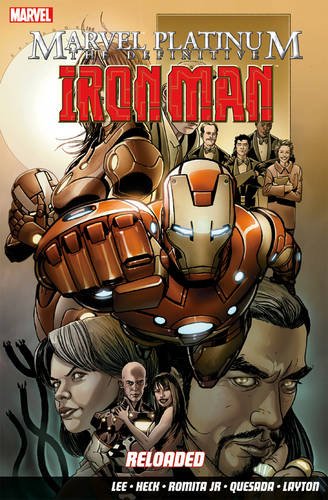
Marvel Platinum: The Definitive Iron Man Reloaded


By Stan Lee, Archie Goodwin, Mike Friedrich, Tony Isabella, Len Kaminski, Matt Fraction, Don Heck, George Tuska, Greg LaRocque, Kev Hopgood, Salvador Larroca, Carmine di Giandomenico, Nathan Fox, Haim Kano & various (Marvel/Panini UK)
ISBN: 978-1-84653-529-1 (TPB)

It’s hard to encapsulate six decades of excellence but as the Golden Avenger celebrates his anniversary, here’s a rare old gem from ten years gone, still readily available, that has a pretty good go at just that…

Produced under the always intriguing Marvel Platinum/Definitive Editions umbrella, this treasury of tales gathers a some of the more impressive but happily less obvious landmarks from the Steel Sentinel’s extensive canon; this time cannily focusing on sinister mastermind, ultimate arch-enemy The Mandarin.

Contained herein are high-tech hi-jinks from Tales of Suspense #50, Iron Man volume 1, #21-22, 68-71, 291 & 500, Marvel Team-Up #146 and Iron Man volume 5 #19, (listed on Marvel’s Database as Invincible Iron Man volume 1 #19), cumulatively spanning 1964 to 2011, and offering a fair representation of what is quite frankly an over-abundance of riches to pick from…

Arch-technocrat and supreme survivor Tony Stark has changed his profile many times since debuting in Tales of Suspense #39 (cover-dated March 1963) when, as a VIP visitor in Vietnam observing the efficacy of the munitions he had designed, he was critically wounded and captured by sinister, cruel Communists.

Put to work building weapons with the dubious promise of medical assistance on completion, Stark instead created the first Iron Man suit to keep himself alive and deliver him from his oppressors. From there it was a simple jump to full time superheroics as a modern Knight in Shining Armour…

Since then the inventor/armaments manufacturer has been a liberal capitalist, eco-warrior, space pioneer, Federal politician, affirmed Futurist, Statesman and even Director of the world’s most scientifically advanced spy agency, the Strategic Hazard Intervention Espionage Logistics Directorate, and, of course, one of Earth’s most prominent superheroes with The Mighty Avengers…

For a popular character/concept lumbered with a decades-long pedigree, radical reboots were and are a painful but vital periodic necessity. To keep contemporary, Stark’s origin and Iron Man’s continuity have been drastically revised every so often with the crucible trigger event perpetually leapfrogging to America’s most recent conflicts. As always, change is everything but, remember, these aren’t just alterations, these are upgrades…

After a mandatory introduction from co-originator Stan Lee, the star-studded action begins with ‘The Hands of the Mandarin!’ from Tales of Suspense #50 wherein the wonderful Don Heck returned as regular penciller and occasional inker after a brief absence, and Lee introduced The Golden Avenger’s first major menace. This was a contemporary Fu Manchu who terrified the Red Chinese so much they manoeuvred him into attacking America in the hope that one threat would destroy the other. Please, if you can, remember that these were simpler, less evolved and far more casually racist times than today…

In response, the Golden Avenger invades the mastermind’s Chinese citadel where, after a ferocious but futilely inconclusive fight, he simply goes back home to the Land of the Free. The furious Mandarin holds a grudge, however, and would make himself arguably Iron Man’s greatest foe.

Of course, whilst Stark was the acceptable face of 1960s Capitalism – a glamorous millionaire industrialist, scientist and a benevolent all-conquering hero when clad in the super-scientific armour of his alter-ego – the turbulent tone of the 1970s soon relegated his suave, “can-do” image to the dustbin of history. With ecological disaster and social catastrophe from the myriad abuses of big business manifestly the new zeitgeists of the young (and how right they were!), the Metal Marvel and Stark International were soon confronting tricky questions from their increasingly politically savvy readership. With glamour, money and fancy gadgetry not quite so cool anymore, the questing voices of a new generation of writers began posing uncomfortable questions in the pages of a series that was once the bastion of militarised America…

Iron Man #21-22 (January & February 1970, by Archie Goodwin, George Tuska & Mike Esposito-as-Joe Gaudioso) found the multi-zillionaire trying to get out of the arms business and – following a heart transplant – looking to retire from the superhero biz. African-American boxer Eddie March became ‘The Replacement!’ as Stark, free from the heart-stimulating chest-plate which had preserved him for years, was briefly tempted by a life without strife. Unknown to all, Eddie had a major health problem of his own…

As Stark pursued a romantic future with business rival Janice Cord, her chief researcher and would-be lover Alex Niven was revealed as a Russian fugitive using her resources to rebuild the deadly armour of the Crimson Dynamo. Niven easily overcame the ailing substitute Avenger and, when Soviet heavy metal super-enforcer Titanium Man resurfaced with orders to arrest the defector, a 3-way clash ensued. Stark was forced to take up his metal burden again – but not before Eddie was grievously injured and Janice killed in #22’s classic tragedy ‘From this Conflict… Death!’

Stark’s romantic liaisons always ended badly. Four years later he was ardently pursuing Roxie Gilbert, a radical pacifist and sister of his old enemy Firebrand. She, of course, had no time for a man with so much blood on his hands…

Iron Man #68-71 (June to November 1974) was the opening sortie in a multi-part epic which saw mystic menace The Black Lama foment a war amongst the World’s greatest villains with ultimate power and inner peace as the promised prize. Crafted by Mike Friedrich, Tuska & Esposito, it began in Vietnam on the ‘Night of the Rising Sun!’ as the Mandarin struggled to free his mind (at that time trapped in the dying body of Russian villain the Unicorn).

Roxie had dragged Stark to the recently “liberated” People’s Republic in search of Eddie March’s lost brother: a POW missing since the last days of the war. The Americans were soon separated when Japanese ultra-nationalist, ambulatory atomic inferno and sometime X-Man Sunfire was tricked into attacking the Yankee Imperialists. The attack abruptly ended when Mandarin shanghaied the Solar Samurai and used his mutant energies to power a mind-transfer back into his own body.

Reborn in his original form, the deranged dictator began his campaign in earnest, eager to regain his castle from rival “oriental overlord” Yellow Claw. First, though, he had to crush Iron Man who – in ‘Confrontation!’ – had tracked him down and freed Sunfire A bombastic battle ended when the Golden Avenger was rendered unconscious and thrown into space…

‘Who Shall Stop… Ultimo?’ found the reactivated giant robot-monster attacking Mandarin’s castle even as the tyrant duelled the Claw to the death, with Iron Man and Sunfire arriving too late and left to mop up the contest’s survivor in ‘Battle: Tooth and Yellow Claw!’

‘Hometown Boy’ (September 1984, by Tony Isabella, Greg LaRocque & Esposito) comes from the period when Stark again succumbed to alcoholism and lost everything, whilst friend and bodyguard Jim Rhodes took over the role of Golden Avenger. As Stark tried to make good with a new start-up company, this engaging yarn from Marvel Team-Up #146 sees the substitute hero still finding his ferrous feet whilst battling oft-failed assassin Blacklash at a trade fair in Cleveland, as much hindered as helped by visiting hero Spider-Man

Despite successfully rebuilding his company, Stark’s woes actually increased. Iron Man #291 (April 1993) found the turbulent technocrat trapped in total body paralysis: using a neural interface to pilot the armour like a telemetric telepresence drone. He had also utterly alienated Rhodes who had been acting as his proxy in a tailored battle suit dubbed War Machine

Concluding an extended epic saga, ‘Judgment Day’ by Len Kaminski & Kev Hopgood explosively revealed how the feuding friends achieved a tentative rapprochement whilst battling a legion of killer robots and death dealing devices programmed to hunt down Rhodes at all costs…

From December 2009 comes Invincible Iron Man #19, courtesy of Matt Fraction & Salvador Larroca. At this time, Federal initiative the Superhuman Registration Act led to Civil War between costumed heroes and Stark was appointed the American government’s Security Czar: “top cop” in sole charge of a beleaguered nation’s defence and freedom. As Director of high-tech enforcement agency S.H.I.E.L.D., he was also the last word in all matters involving metahumans and the USA’s vast costumed community…

However, his heavy-handed mismanagement of various crises led to the arrest and the assassination of Captain America and an unimaginable escalation of global tension and destruction, culminating in an almost-successful Secret Invasion by shape-shifting alien Skrulls.

Discredited and ostracised, Stark was replaced by rehabilitated villain and recovering split-personality Norman Osborn (the original Green Goblin), who assumed full control of the USA’s covert agencies and military resources. He disbanded S.H.I.E.L.D. and placed the nation under the aegis of his new umbrella organisation H.A.M.M.E.R.

Osborn was still a monster at heart, however, and wanted total power. Intending to appropriate all Stark’s technological assets, the “reformed” villain began hunting the fugitive former Avenger. Terrified that not only his weaponry but also the secret identities of most of Earth’s heroes would fall into a ruthless maniac’s hands, Stark began to systematically erase all his memories, effectively lobotomising himself to save everything…

‘Into the White (Einstein on the Beach)’ delivers the conclusion of that quest as Stark, little more than an animated vegetable wearing his very first suit of armour, faced his merciless adversary in pointless futile battle, whilst in America faithful aide Pepper Potts, The Black Widow and S.H.I.E.L.D.’s last deputy director Maria Hill raided Osborn’s base to retrieve a disc with Tony’s last hope on it and simultaneously engineer the maniac’s ultimate defeat…

The comics portion of this winning compilation concludes with the lead tale from Iron Man #500 (March 2011) wherein a mostly recovered Stark is plagued by gaps in his mostly restored memory.

‘The New Iron Age’ by Matt Fraction, Carmine di Giandomenico, Nathan Fox, Haim Kano & Salvador Larroca, is a clever, twice-told tale beginning when Stark approaches sometime ally and employee Peter Parker in an effort to regain more of his lost past. Stark is plagued by dreams of a super-weapon he may or may not have designed, and together they track down the stolen plans for the ultimate Stark-tech atrocity which has fallen into the hands of murderous anti-progress fanatics resulting in a spectacular showdown of men versus machines…

Contiguously and interlaced throughout the tale are dark scenes of the near future where the Mandarin has conquered the world, enslaved Tony Stark and his son Howard and, with the ruthless deployment of Iron Man troopers and that long-ago-designed super weapon, all but eradicated humanity.

With Earth dying, rebel leader Ginny Stark leads the suicidal Black Widows armed with primitive weapons in one last charge against the dictator, aided by two traitors within the Mandarin’s household and guided by a message and mantra from the far forgotten past…

The book concludes with covers from Jack Kirby, Tuska, Esposito, Jim Starlin, Dave Cockrum, Ron Wilson, John Romita Sr., LaRoque, Bob Layton, Hopgood & Larroca, plus a dense and hefty 21 pages of text features, including ‘The Origin of the Mandarin’ by Mike Conroy and history, background and technical secrets of Crimson Dynamo, Justin Hammer, Happy Hogan, Mandarin, Pepper Potts, Stark Industries, Titanium Man and War Machine.

A thoroughly entertaining accompaniment tailored to the cinematic Marvel Fan, this is also a splendid device to make curious movie-goers converts to the comic incarnation: another solid sampling to entice the newcomers and charm the veteran Ferro-phile.
© 2013 Marvel. Licensed by Marvel Characters B.V. through Panini S.p.A. All rights reserved. A British Edition published by Panini Publishing, a division of Panini UK, Ltd.
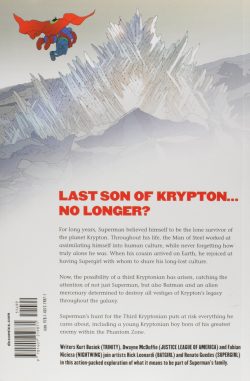
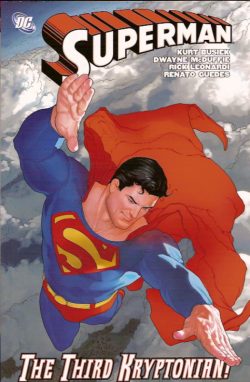
Superman: The Third Kryptonian


By Kurt Busiek, Dwayne McDuffie, Fabian Nicieza, Rick Leonardi, Renato Guedes, José Wilson Magalhaés, Dan Green & various (DC Comics)
ISBN: 978-1-4012-1987-1 (TPB)

After interminable page counts and the preponderant never-ending angst of hyper-mega-ultra-braided multi-part cross-overs, it’s quite nice to pick up an – admittedly slim – endeavour of more modest means and intent: to wit, a book with a couple of stories that actually begin, occur and end.

Collecting Action Comics #847, Superman #668-670 and Superman Annual #13, this tome actually has three yarns to delight, beginning with Kurt Busiek, Rick Leonardi and Dan Green’s mini-epic wherein every survivor of lost Krypton on Earth, including Power Girl, Clark and Lois’ adopted son Chris (don’t fret, it’s all explained in the story) and even Krypto are targeted for destruction by brutal space pirate Amalak, hungry to take vengeance for the misdeeds of the long dead “Kryptonian Empire”.

Imagine how the irate rogue reacts upon discovering that – unbeknownst to all – an actual survivor of that long-dead galactic aggressor-state has been living secretly on Earth for years…

Good old-fashioned romp though it is, the real meat of this tale was an adjustment and rewriting of Kryptonian history for the post-Smallville/Superman Returns generation. As the disparate continuities of TV, Cinema and comic books were massaged closer to overarching homogeneity, the best of the old was retrofitted to the new. This is an uncomplicated adventure thriller with nostalgic overtones that has a lot to recommend it.

‘The Best Day’ (Busiek, Fabian Nicieza, Guedes & José Wilson Magalhaés) offers sheer delight, and beautiful execution. In a quiet moment, Superman and Supergirl take the Kent clan on a picnic to the stars where we get a chance to see beloved characters interact in joy and relaxation, as the skies of a million universes aren’t collapsing around their invulnerable ears. It’s a brave, rewarding return to old ways and I still want to see more of it.

So go no further than ‘Intermezzo’ (McDuffie and Guedes), another introspective segment sliced from a longer epic, short on punching but big on emotional wallop as Jonathan and Martha Kent share secrets and reveal close-held fears as their adopted son struggles off-camera with another “Never-Ending Battle.”

It’s such gentle moments and the emotional beats that give the best adventure fiction its edge, and this book has them in delightful quantities. This is the stuff that made Superman a legend, and in this anniversary year this collection is an ideal argument for stuff like this to stage a comeback.
© 2007, 2008 DC Comics. All Rights Reserved.

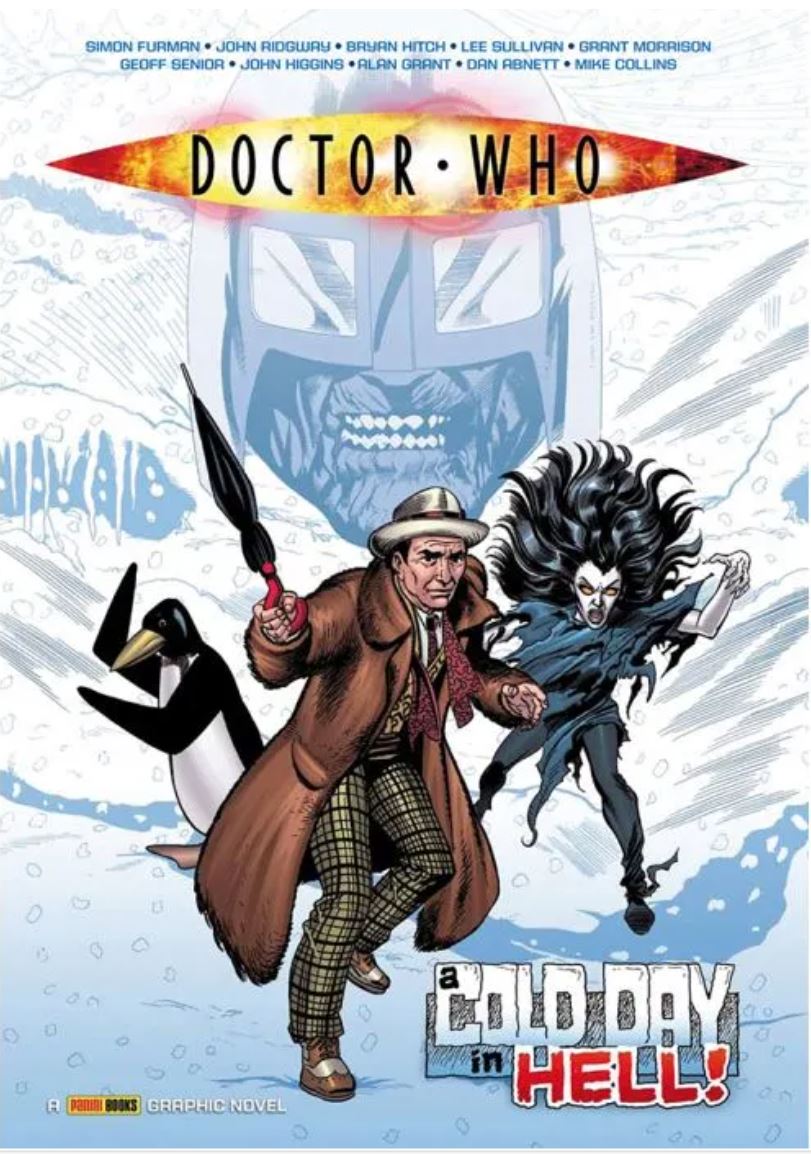
Doctor Who volume 11: Cold Day in Hell


By Simon Furman, Mike Collins, Grant Morrison, John Freeman, Dan Abnett, Richard Alan & John Carnell, Alan Grant, John Ridgway, Kev Hopgood, Tim Perkins, Geoff Senior, David Hine, Bryan Hitch, John Higgins, Lee Sullivan, Dougie Braithewaite & Dave Elliott, Andy Lanning, Martin Griffiths & Cam Smith & various (Panini Books)
ISBN: 978-1-84653-410-2 (TPB)

Despite the volatile vagaries of quantumly entanglementation, if you generally experience reality in a sequential manner, this year remains the 60th Anniversary of Doctor Who. Thus there is/has been/will be a bunch of Timey-Wimey stuff on-going as we periodically celebrate a unique TV and comics institution…

The British love comic strips, adore “characters” and are addicted to celebrity. The history of our homegrown graphic narratives includes an astounding number of comedians, Variety stars and television actors: such disparate legends as Charlie Chaplin, Arthur Askey, Charlie Drake and so many more I’ve long forgotten and you’ve likely never heard of.

As much adored and adapted were actual shows and properties like Whacko!, Supercar, Thunderbirds, Pinky and Perky, The Clangers and literally hundreds of others. If folk watched or listened, an enterprising publisher made printed spectacles of them. Hugely popular anthology comics including Radio Fun, Film Fun, TV Fun, Look-In, TV Comic, TV Tornado, and Countdown readily and regularly translated our light entertainment favourites into pictorial joy every week, and it was a pretty poor star or show that couldn’t parley the day job into a licensed strip property…

Doctor Who premiered on black-&-white televisions across Britain on November 23rd 1963 with the premiere episode of ‘An Unearthly Child’. In 1964, a decades-long association with TV Comic began: issue #674 heralding the initial instalment of ‘The Klepton Parasites’.

On 11th October 1979 (although adhering to the US off-sale cover-dating system so it says 17th), Marvel’s UK subsidiary launched Doctor Who Weekly. Turning monthly magazine in September 1980 (#44) it’s been with us – in various names and iterations – ever since. All of which proves the Time Lord is a comic star of impressive pedigree and not to be trifled with.

Panini’s UK division ensured the immortality of the comics feature by collecting all strips of every Time Lord Regeneration in a uniform series of over-sized graphic albums.

Each concentrates on a particular incarnation of the deathless wanderer and this one gathers stories originally published in the early 1990s (from Doctor Who Monthly #130-150): a time when regular illustrator John Ridgway gave way to a succession of rotating creators as part of the company’s urgent drive to cut costs – although there’s no appreciable drop in quality that I can see.

These yarns feature the Seventh Doctor (Sylvester McCoy): an all monochrome compendium that kicks off with the eponymous ‘Cold Day in Hell!’ by writer Simon Furman, Ridgway and inker Tim Perkins: a 4-part thriller featuring an attack by Martian Ice Warriors on a tropical resort planet, which leads directly into the moody, single story ‘Redemption!’ care of Furman, Kev Hopgood and Perkins.

At that time and in this book Marvel sanctioned some controversial crossovers with other Marvel UK characters. The first of these is Death’s Head: a robot bounty hunter from the Transformers comic guest-starring in Furman & Geoff Senior’s ‘The Crossroads of Time’ (DWM #135), before it’s back to sounder stuff with freak-filled 3-part Victorian Great Exhibition epic ‘Claws of the Klath!’ (Mike Collins, Hopgood & David Hine).

Fresh-faced scribe Grant Morrison wrote of charmingly different ‘Culture Shock!’ for equally neophytic ascending star Bryan Hitch to draw, before John Higgins limned Furman’s ‘Keepsake’: a classy space opera about an indigent salvage man. John Freeman & Lee Sullivan started a long association with the magazine in 2-parter ‘Planet of the Dead’ (DWM #141-142), featuring an ambitious, spooky team-up of all seven Time Lord regenerations, on a world filled with Companions who had died in their service…

Dan Abnett & Ridgway delivered ‘Echoes of the Mogor!’ (DWM #143-144) – an eerie chiller set on a mining planet where Earth workers are mysteriously dying, whilst ‘Time and Tide’ by Richard Alan & John Carnell, illustrated by Dougie Braithewaite & Dave Elliott (DWM #143-144), maroons the Doctor on a drowning world amongst aliens who don’t seem to care if they live or die…

Carnell wrote the other crossover previously mentioned, a far less well-regarded romp with imbecilic detectives The Sleeze Brothers. ‘Follow that Tardis!‘ was illustrated by Andy Lanning, Higgins, Braithwaite & Elliot, before the strip content concludes with Alan Grant’s 3-part ‘Invaders from Gantac!’, wherein a colony of alien torturers invade 1992 London by mistake in a tale as much comedy as thriller, drawn by Martin Griffiths & Cam Smith.

Supplemented with tons of text features, pin-ups, creator-biographies and commentaries, this is a grand book for casual readers, a fine shelf addition for fans of the show and a perfect opportunity to cross-promote our particular art-form to anyone minded to give comics one more go…
All Doctor Who material © BBCtv. Doctor Who, the Tardis and all logos are trademarks of the British broadcasting corporation and are used under licence. Death’s Head and The Sleeze Brothers © Marvel. Published 2009. All rights reserved.

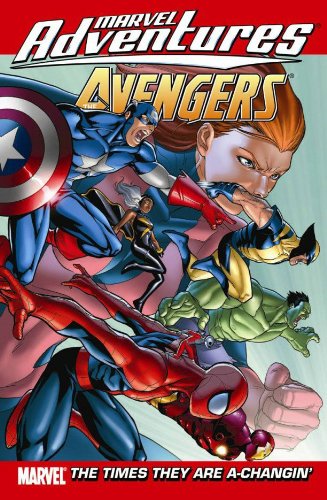
Marvel Adventures Avengers volume 9: The Times They Are A‘Changin’


By Paul Tobin, Matteo Lolli, Ig Guara, Casey Jones, Christian Vecchia & Sandro Ribeiro (Marvel)
ISBN: 978-0-7851-3832-7 (PB/Digital edition)

Time for another anniversary shout-out, so let’s celebrate the fact that The Avengers #1 (cover-dated September 1963 but on sale from July 2nd) was sold out on newsstands all over America by today’s date…

In 2003, the House of Ideas created a Marvel Age line updating classic original tales by Stan Lee, Jack Kirby and Steve Ditko before merging it with remnants of its failed manga-based Tsunami imprint, which was also intended for a junior demographic.

The experiment was tweaked in 2005, becoming Marvel Adventures with core titles Marvel Adventures: Fantastic Four and Marvel Adventures: Spider-Man carrying all-original yarns. Additional titles included Marvel Adventures: Super Heroes, Power Pack, Hulk and The Avengers, which ran until 2010 when they were cancelled and replaced by new volumes of Marvel Adventures: Super Heroes and Marvel Adventures: Spider-Man.

This particularly light-hearted digest-sized collection re-presents issues #32-35 of Marvel Adventures Avengers (from 2009), offering stand-alone yarns to delight fans with a sense of humour and iota of wit…

What You Need To Know: this incarnation of the World’s Mightiest Superheroes operates an “open-door” policy where almost every metahuman marvel might turn up for duty. However – presumably because of their TV cartoon popularity – the Wondrous Wallcrawler and Jade Juggernaut are on scene in almost every episode…

Written throughout by Paul Tobin (No Romance in Hell, Plants vs Zombies), an avalanche of fast-paced fun begins with ‘The Big Payoff’ illustrated by Matteo Lolli & Christian Vecchia, wherein the team gets a most unpleasant visit from Special Agent Clark Harvey of the Internal Revenue Service.

This weaselling civil servant is ostensibly there to collect individual Avengers’ taxes, but it’s all a ploy to blackmail the team into forcing a bunch of defaulting villains into paying up…

Smart and deviously hilarious, the clashes between Giant-Girl, Spider-Man and Luke Cage against Whirlwind, the web-spinner and erudite philosophical monster/political activist Oog or Man-Bull versus Iron Man are entertainment enough, but Iron Man and Giant-Girl overmatched against the Absorbing Man and the childlike Hulk convincing assassin Bullseye to do his patriotic duty are utterly priceless…

When jungle king Ka-Zar visits from the Antarctic lost world, all he can think about is learning how to use a car. Sadly Wolverine, Storm, Giant-Girl, Hulk and Spidey all feel safer battling an invasion of super-saurians unleashed by Stegron the Dinosaur Man than sitting in the same vehicle as the Lord of the Savage Land in ‘You’re Driving Me Crazy’, with art by Ig Guara & Sandro Ribeiro…

When ancient Egyptian magicians turn time into an out-of-control merry-go-round, ‘Sgt. Fury and his Howling Commandos!’ (Lolli & Vecchia) are caught up in the assorted eras of chaos, with Ant-Man, Giant-Girl, Tigra, Storm, the wallcrawler and Hulk frantically fighting just to keep up…

Rendered by Casey Jones, this titanic tiny tome concludes on a romantic note in ‘Lovers Leaper’ when all the female Avengers head off for a vacation break. They foolishly thought Captain America, Cage, Spider-Man, Hawkeye and Wolverine could handle things for a while, but boys will be slobs and soon the HQ is a ghastly mess of “man-cave” madness…

Moreover, since Hawkeye now needs a date for the Annual Archer Awards, he tries an on-line dating service, and uploads not just his but all his buddies’ information onto the site…

With seemingly every eligible lady – super-powered and not – in New York City subscribing to the Lovers Leap site, our unsuspecting heroes are soon being bombarded by an army of annoyed women who think they’ve been stood up by the utterly oblivious Avengers.

… And when they try to get the owner to remove their details, the heroes discover French former bad-guy Batroc the Leaper is in charge and unwilling to do them any favours…

Smart and fun on many levels, bright, breezy and bursting with light-hearted action and loads of solid laughs, this book offers a fabulous alternative to regular Marvel Universe angst and agony. Even with the violence toned down and “cartooned-up” these stories are superbly thrilling and beautifully depicted: a perfect introduction for kids and adults alike to the vast realm of adventure we all love…

These collected stories present an intriguing and perhaps more culturally accessible means of introducing character and concepts to kids born generations away from those far-distant 1960s originating events.
© 2010, 2011 Marvel Characters, Inc. All rights reserved.

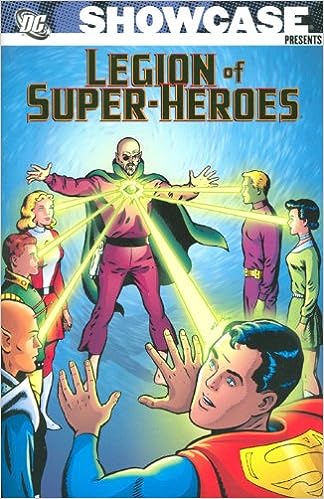
Showcase Presents Legion of Super-Heroes volume 3


By Jim Shooter, E. Nelson Bridwell, Otto Binder, Curt Swan, George Klein, Pete Costanza, Jim Mooney & George Papp (DC Comics)
ISBN: 978-1-4012-2185-0 (TPB)

Once upon a time, in the far future, a band of super-powered kids from a multitude of worlds took inspiration from the greatest legend of all time and formed a club of heroes. One day those Children of Tomorrow came back in time and invited their inspiration to join them…

And thus began the vast and epic saga of the Legion of Super-Heroes, as first envisioned by writer Otto Binder and artist Al Plastino in early 1958, just as the revived comicbook genre of superheroes was gathering an inexorable head of steam. Since that time the fortunes and popularity of the Legion have perpetually waxed and waned, with their future history tweaked and rebooted, retconned and overwritten over and over again to comply with editorial diktat and popular whim.

This third sturdy, action-packed monochrome compendium gathers a chronological parade of futuristic delights from October 1966 to May 1968, as originally seen in Adventure Comics #349-368, and includes a Legion story from Superman’s Pal Jimmy Olsen #106 (October 1967).

During this period the Club of Champions finally shed the last vestiges of wholesome, imaginative, humorous and generally safe science fiction strips to become a full-on dramatic action feature starring a grittily realistic combat force in constant, galaxy-threatening peril: a compelling force of valiant warriors ready and willing to pay the ultimate price for their courage and dedication…

The main architect of the transformation was teenaged sensation Jim Shooter, whose scripts and layouts (usually finished and inked by veterans Curt Swan & George Klein) made the series accessible to a generation of fans growing up in the Future…

The tense suspense begins with Adventure #349’s ‘The Rogue Legionnaire!’ (Shooter, Swan & Klein) wherein Saturn Girl, Colossal Boy, Shrinking Violet, Chameleon Boy and Brainiac 5 hunt hypnotic villain Universo through five periods of Earth’s history, aided by boy-genius Rond Vidar, a brilliant scientist with a tragic secret…

This is followed by a stellar 2-parter from #350-351 scripted by E. Nelson Bridwell which restores a number of invalided or expelled members to the team. In ‘The Outcast Super-Heroes’, a cloud of Green Kryptonite particles envelope Earth and force Superboy and Supergirl to retire from the Legion just as demonic alien Evillo unleashes his squad of deadly metahuman minions on the universe.

The Kryptonian Cousins are mind-wiped and replaced by armoured and masked paladins Sir Prize and Miss Terious in ‘The Forgotten Legion!’ but quickly return when a solution to the K Cloud is found. With Evillo’s eventual defeat, the team discover the wicked overlord has healed one-armed Lightning Lad and restored Bouncing Boy’s power for his own nefarious purposes, and together with the reformed White Witch and rehabilitated Star Boy and Dream Girl, the Legion’s ranks grow and might swell to bursting point.

That’s a very good thing as in the next issue Shooter, Swan & Klein produce one of their most stunning epics. When a colossal cosmic entity known as the Sun Eater menaces the United Planets, the Legion are hopelessly outmatched and forced to recruit the galaxy’s most dangerous criminals to help them save civilisation.

However, The Persuader, Emerald Empress, Mano, Tharok and Validus are untrustworthy allies at best and form an alliance as ‘The Fatal Five!’, intending to save the galaxy only so that they can rule it…

Adventure #353 reveals how the Five seemingly seal their own fate through arrogance and treachery with the true cost of heroism paid when ‘The Doomed Legionnaire!’ sacrifices his life to destroy the solar parasite…

Issue #354 introduced ‘The Adult Legion!’ when Superman travelled into the future to visit his grown-up comrades – discovering tantalising hints of events that would torment and beguile LSH fans for decades to come – before the yarn concluded with #355’s ‘The War of the Legions!’ as Brainiac 5, Cosmic Man, Element Man, Polar Man, Saturn Woman and Timber Wolf, accompanied by the most unexpected allies of all, battled the Legion of Super-Villains.

The issue also included an extra tale in ‘The Six-Legged Legionnaire!’ (by Otto Binder, Swan & Klein) wherein Superboy brings his High School sweetie Lana Lang to the 30th century, where she joins in a mission against a science-tyrant as bug-based shape-shifting Insect Queen. Disaster soon strikes though when the alien ring which facilitates her changes is lost, trapping her in a hideous insectoid incarnation.

Issue #356 sees Dream Girl, Mon-El, Element Lad, Brainiac 5 and Superboy transformed into babies to become ‘The Five Legion Orphans!’: a cheeky, cunning Bridwell-scripted mystery leading into darker matters as repercussions and guilt of the Sun-Eater episode are explored and survivors of that mission are apparently haunted by ‘The Ghost of Ferro Lad!’ (#357, by Shooter, Swan & Klein), after which ‘The Hunter!’ (Shooter & George Papp) sees the LSH stalked by a murderously insane sportsman with a unique honour code.

Adventure #359 depicts the once-beloved champions disbanded and on the run as ‘The Outlawed Legionnaires!’ (Shooter, Swan & Klein) thanks to manipulations of a devious old foe, only to rousingly regroup, counter-attack and triumph in #360’s ‘The Legion Chain Gang!’.

Illustrated by Jim Mooney, and with the superhero squad once more a key component of United Planets Security, the Legion are assigned as secret service to protect alien ambassadors The Dominators from political agitators, assassins and a hidden traitor in tense thriller ‘The Unkillables!’, before ‘The Lone Wolf Legion Reporter!’ (from Superman’s Pal Jimmy Olsen #106, October 1967, by Shooter & Pete Costanza) finds the young newsman seconded to the 30th century to help with the club newspaper. Sadly, he’s far better at making news than publishing it…

The team is scattered across three worlds in Adventure Comics #362 as mad scientist Mantis Morlo refuses to let environmental safety interfere with his experiments in ‘The Chemoids are Coming!’, culminating in a lethally ‘Black Day for the Legion!’

Shooter & Costanza then top that gripping 2-parter by uncovering ‘The Revolt of the Super-Pets!’ in #364, when the crafty rulers of planet Thanl seek to seduce the animal adventurers from their rightful – subordinate – positions with sweet words and palatial new homes.

When the isolated world of Talok 8 goes dark and becomes a militaristic threat to the UP, their planetary champion Shadow Lass leads Superboy, Brainiac 5, Cosmic Boy and Karate Kid on a reconnaissance mission which results in the cataclysmic ‘Escape of the Fatal Five!’ (illustrated by Swan & Klein). The vicious quintet then nearly conquer the UP itself: only frustrated by the defiant, last-ditch efforts of the battered heroes in blistering conclusion ‘The Fight for the Championship of the Universe!’

In grateful thanks, the Legion are gifted a vast new HQ but before the paint is even dry, a vast paramilitary force attempts to invade, slowly reconstructing planet Earth in #367’s ‘No Escape from the Circle of Death!’ (Shooter, Swan, Klein & Sheldon Moldoff), before this volume ends on a note of political and social tension as a glamorous alien envoy attempts to suborn the diminished and downtrodden female Legionnaires in #368’s ‘The Mutiny of the Super-Heroines!’

The Legion of Super-Heroes is unquestionably one of the most beloved and bewildering creations in comic book history and largely responsible for the growth of the groundswell movement that became American Comics Fandom. These scintillating, seductively addictive stories, as much as Julie Schwartz’s Justice League, fired up the interest and imaginations of a generation of readers to underpin the industry we all know today.

If you love comics and haven’t read this stuff, you are the poorer for it and need to enrich your future life as soon as possible.
© 1966, 1967, 1968, 2009 DC Comics. All Rights Reserved.

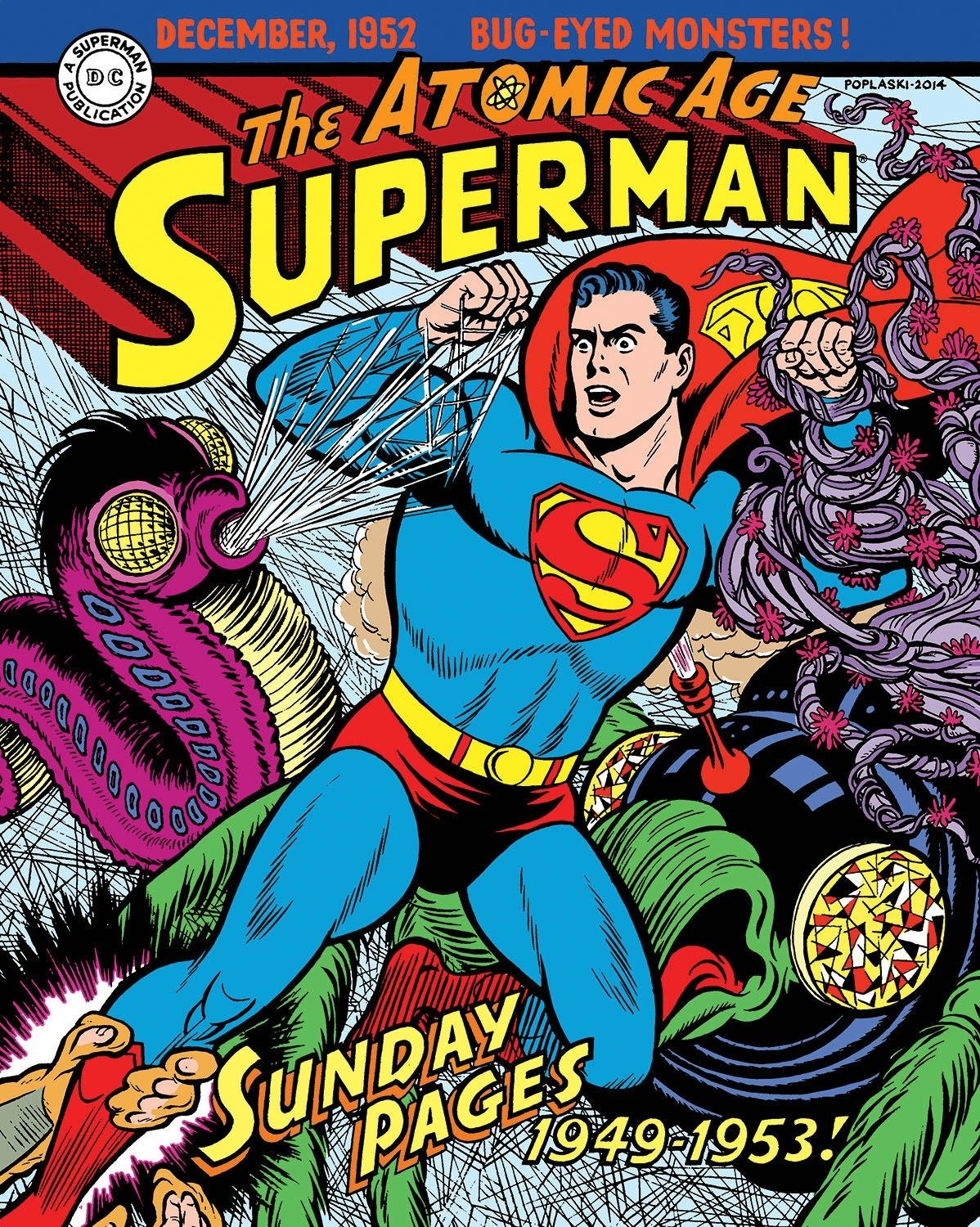
Superman – The Atomic Age Sundays volume 1: 1945-1953


By Alvin Schwartz, Wayne Boring & Stan Kaye (IDW/DC Comics)
ISBN: 978-1-63140-262-3 (HB)

It’s indisputable that the American comic book industry – if it existed at all – would be an utterly unrecognisable thing without Superman. Jerry Siegel & Joe Shuster’s bold and unprecedented invention was fervidly adopted by a desperate and joy-starved generation and quite literally gave birth to a genre if not an actual art form. He was also shamelessly copied and adapted by many inspired writers and artists for numerous publishers, spawning an incomprehensible army of imitators and variations within three years of his summer 1938 debut.

The intoxicating blend of breakneck, breathtaking action and triumphal wish-fulfilment which epitomised the early Man of Steel soon grew to encompass cops-and-robbers crime-busting, socially reforming dramas, science fiction, fantasy, whimsical comedy and, once the war in Europe and the East also engulfed America, patriotic relevance for a host of gods, heroes and monsters, all dedicated to profit through exuberant, eye-popping excess and vigorous dashing derring-do.

In comic book terms Superman was master of the world. Moreover, whilst transforming and dictating the shape of the fledgling funnybook industry, the Man of Tomorrow relentlessly expanded into all areas of the entertainment media. Although we all think of the Cleveland boys’ iconic invention as the epitome and acme of comics creation, the truth is that very soon after his debut in Action Comics #1 the Man of Steel became a fictional multimedia monolith in the same league as Popeye, Tarzan, Sherlock Holmes and Mickey Mouse.

Diehard comics fans regard our purest and most powerful icons in primarily graphic narrative terms, but the likes of Batman, Spider-Man, Black Panther, The Avengers and all their hyperkinetic kind long ago outgrew four-colour origins and are now also fully mythologized modern mass media creatures, instantly familiar across all platforms and age ranges…

Far more people have viewed or heard the Man of Steel than have ever read his comic books. His globally syndicated newspaper strips alone reached untold millions, and by the time his 20th anniversary rolled around at the very start of what we know as the Silver Age of Comics, he had been a thrice-weekly radio serial regular and starred in a series of astounding animated cartoons, as well as two films and a novel by George Lowther.

Superman was a perennial sure-fire success for toy, game, puzzle and apparel manufacturers and had just ended his first smash live-action television serial. In his future were three more shows (Superboy, Lois & Clark and Smallville), a stage musical, a franchise of blockbuster movies and an almost seamless succession of games, bubblegum cards and TV cartoons beginning with The New Adventures of Superman in 1966 and continuing ever since. Even superdog Krypto got in on the small-screen act…

However, during his formative years the small screen was simply an expensive novelty so the Action Ace achieved true mass market fame through a different medium: one not that far removed from his print origins.

Although pretty much a spent force these days, for most of the last century the newspaper comic strip was the Holy Grail all American cartoonists and graphic narrative storytellers aimed for. Syndicated across country – and frequently the planet – they were seen by millions of readers and generally accepted as a more mature and sophisticated form of literature than comic-books. Strips also paid far better and rightly so: some of the most enduring and entertaining characters and concepts of all time were made to lure readers from one particular paper to another and many of them consequently grew to be part of global culture. Flash Gordon, Dick Tracy, Buck Rogers, Charlie Brown and so many more evolved beyond humble, tawdry newsprint to become meta-real: existing in the minds of earthlings from Albuquerque to Zanzibar.

Some still do…

Even so, it was always something of a risky double-edged sword when comic book characters become so popular that they swim against the tide (after all weren’t the funny-books invented just to reprint strips in cheap accessible form?) to became actual mass-entertainment – and often global – syndicated serial strips.

Superman was the first comic book character to make that leap – about six months after he exploded out of Action Comics – but only a few have ever successfully followed. Wonder Woman, Batman (eventually) and groundbreaking teen icon Archie Andrews made the jump in the 1940s with only a handful such as Spider-Man, Howard the Duck and Conan the Barbarian having done so since.

The daily Superman newspaper comic strip launched on 16th January 1939, augmented by a full-colour Sunday page from November 5th of that year. Originally crafted by Siegel & Shuster and their studio (Paul Cassidy, Leo Nowak, Dennis Neville, John Sikela, Ed Dobrotka, Paul J. Lauretta & Wayne Boring), the mammoth task soon required the additional artistic gifts of Jack Burnley and ancillary writers Whitney Ellsworth, Jack Schiff & Alvin Schwartz. The McClure Syndicate feature ran from 1939 until May 1966 and at its peak appeared in over 300 daily and 90 Sunday newspapers: a combined readership surpassing 20 million.

For most of the post-war years, Boring & Stan Kaye illustrated the spectacular Sundays (latterly supplemented by Win Mortimer and Curt Swan). The majority of strips – from 1944 to 1958 – were written by still largely unsung scribe Alvin Schwartz. Born in 1916, Schwartz was an early maestro of comic books, writing Batman, Superman, Captain Marvel and for many other titles and companies. Whilst handling the Superman strip he also freelanced on Wonder Woman and other superheroes as well as DC genre titles such as Tomahawk, Buzzy, A Date with Judy and House of Mystery.

After numerous clashes with new superman Editor Mort Weisinger, Schwartz quit comics for commercial writing: selling novels, essays, documentaries and docudramas for the National Film Board of Canada. He worked miracles in advertising and market research, developing selling techniques like psychographics and typological identification. A member of the advisory committee to the American Association of Advertising Agencies, he died in 2011.

After too many years wallowing in obscurity most of Superman’s newspaper strip exploits are at last available to aficionados and the curious newcomer in tomes such as this compiled under the auspices of the Library of American Comics.

Showcasing Schwartz & artist Wayne Boring in their purest prime, these Sundays (numbered as pages #521 to #698 collectively spanning October 23rd 1949 to March 15th 1953) star a nigh-omnipotent Man of Steel in domestically-framed tales of emotional dilemma and pedestrian criminality rather than a parade of muscle-flexing bombast. Here humour, wit and satire comfortably replace angst and bludgeoning action.

Following an affable appreciation of the creators and the times in Mark Waid’s ‘An Introduction’, ‘A Wayne Boring Gallery’ offers a tantalising selection of contemporaneous Superman and Action Comics covers before weekly wonderment commences in all its vibrant glory. Sadly, the serials are untitled, so you’ll just have to manage with my meagre synopses of individual yarns…

Kicking off is a charming fantasy as the Metropolis Marvel is temporarily stranded in Arthurian Britain after a US government time travel experiment goes awry. Whilst living in the past he befriends and assists court magician Merlin: an old duffer whose conjuring tricks aren’t fooling anyone anymore…

The first new tale of 1950 begins on February 12th, detailing how swindler Joseph Porter cons the Man of Steel into taking his place and clearing up his problems with cops and numerous gulled victims. This includes a hilarious spoofing sequence as the hero plays un-matchmaker to a scandalously-affianced hillbilly ingenue that will delight fans of Li’l Abner

The extended saga opening on May 28th offers another human-interest drama given a super-powered spin: two aging robber barons recalling their regulation-free heydays before embarking on a ruthless wager to see who will get “anything they wish for” first. The only limitations imposed are their imaginations and financial resources. Before long Superman is hard-pressed to keep collateral casualties to a minimum…

One of the few antagonists to transfer from funnybooks to the Funny pages was fifth dimensional prankster Mr. Mxyztplk who popped back to our third dimension and took instant umbrage to an arrogant Earth educator. Dr. Flipendale had the temerity to declare the imp a mass delusion and refused to believe or even acknowledge the escalating chaos his stark pronouncements triggered…

Strip #573 (October 22nd) offers a different take on the classic secret identity crisis as Clark is exposed as an invulnerable man to all of Metropolis. Although gangsters are convinced, Lois Lane is not, claiming the underworld is perpetrating a frame-up…

That yarn takes us to years’ end and 1951 opens on January 7th with a tale of suspicion and injustice as Clark heads back to childhood hometown Smallville to celebrate Superboy Week and encounters a young man nursing an ancient grudge. When the poison pen/rumour campaign looks set to spoil festivities, the hero’s investigations uncover a betrayed child, a framed, murdered father and nefarious clandestine misdeeds carried out by corporate rogues in the Boy of Steel’s name…

Another identity crisis bedevils Clark beginning on April 1st. A killer’s case of mistaken identity seemingly exposes the reporter as super-strong and bulletproof. Surely, he must be the indomitable Man of Steel in disguise? Not according to Professor Pinberry who believes our hapless scribe has been accidentally exposed to his new superpower ray machine, Clark is happy to grasp at the fortuitous alibi but trouble mounts after the public demands to see the machine in action again and the city’s biggest mobster goes after the gadget to make himself Superman’s equal.

Strip #609 commenced on July 1st as aged duffer Salem Cooley comes to Metropolis and enjoys the most miraculous winning streak in history. Even Superman’s astounding powers can’t keep up with the string of happy circumstances, fortuitously profitable accidents and close shaves. Everybody wants to be the old coot’s pal, so who then is behind the constant assassination attempts on superstitious Salem… and what reward could possibly tempt anyone to challenge the luckiest man alive?

September 9th saw Superman agree to write Daily Planet articles about some of his previous exploits to benefit crime prevention charities. However, when capers he cites are restaged by mysterious malefactors, the city soon turns against the Man of Tomorrow and it takes all his super-wits to uncover the mastermind behind it all and quash one of the boldest crimes in the city’s history…

To lure a crime boss out, the Action Ace agrees to be absent Metropolis for a few weeks in the next adventure (running November 18th 1951 – January 13th 1952). However, when a poverty-struck boy succumbs to disease and depression, the Man of Might opts to return undercover, inspiring the kid’s recovery by granting wishes made on a “magic wand”. The task becomes increasingly difficult after crooks get hold of the stick and the invisible hero has to play along to sustain little Teddy’s recuperation…

From January 20th, Superman plays guardian angel to former wastrel and drunken playboy Reggie de Peyster who swears he’s a reformed character. Nobody but Superman realises the trust fund brat is sincere and all the appalling, shameful scandals he’s currently implicated in are being manufactured to cut him out of a vast inheritance…

Lois Lane takes centre stage from April 6th as, after months of being sidelined, the daring reporter quits her job to find a career offering some real excitement. She’s soon assistant to private detective Mike Crain: catching crooks and bodyguarding glamourous stars, but the work seems dull and pedestrian. Of course, Lois is utterly oblivious to the fact Superman is secretly intervening: patriarchal efforts to get her back where she belongs. Ah, different times, eh?

When maverick Hollywood producer/director Hans Bower arrives in Metropolis, (from June 29th he promptly declares Clark to be his latest mega-sensational super-star. A force of nature unable to take no for an answer, Hans soon has the bewildered reporter helming his next box office blockbuster. As shooting progresses, however, Superman uncovers a covert agenda and shocking secret behind the mogul’s extraordinary actions.

Uncanny crime is the order of the day from September 21st when bizarre illusions plague Metropolis and scientist Dr. Wagonrod accuses Superman of perpetrating hoaxes and staging crises due to an undiagnosed split personality. The truth is far more devious than that…

Concluding this first Atomic Age collection, November 30th 1952 to March 15th 1953 found readers avidly watching the skies when an alien capsule fell to Earth and disgorged a succession of alien bio-weapons to test humanity. Superman was hard-pressed to defeat the army of bizarre beasts but did have one immeasurable advantage: the sage advice and input of life-long science fiction fan Sedgwick Ripple…

The Atomic Age Superman: – Sunday Pages 1949-1953! was the first of three huge (312 x 245 mm), lavish, high-end hardback collections starring the Man of Steel and a welcome addition to the superb commemorative series of Library of American Comics which has preserved and re-presented in luxurious splendour such landmark strips as Lil Abner, Tarzan, Rip Kirby, Polly and her Pals and many of the abovementioned cartoon icons.

It’s an unimaginable joy to see these neglected Superman stories again, offering a far more measured, domesticated and comforting side of one of America’s most unique contributions to world culture. It’s also a pure delight to see some of the most engaging yesterdays of the Man of Tomorrow. Join me and see for yourself and agitate for the entire library to find time to release digital editions…
© 2015 DC Comics. All rights reserved. SUPERMAN and all related characters and elements are trademarks of DC Comics.

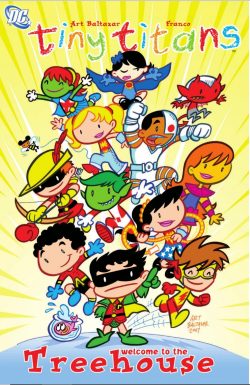
Tiny Titans volume 1: Welcome to the Clubhouse


By Art Baltazar & Franco (DC Comics)
ISBN: 978-1-4012-2207-5 (TPB/Digital edition)

The links between animated features and comic books are long established and, for young consumers, indistinguishable. After all, it’s just entertainment in the end…

For quite some time at the beginning of this century, DC’s Cartoon Network imprint was arguably the last bastion of children’s comics in America and worked to consolidate that link between TV and 2D fun and thrills with stunning interpretations of such television landmarks as Ben 10, Scooby Doo, Powerpuff Girls, Dexter’s Laboratory and so many other screen gems.

The kids’ comics line also produced some truly exceptional material based on TV iterations of the publisher’s proprietary characters such as Legion of Super Heroes, Batman: Brave and the Bold and Krypto the Super Dog as well as material like Billy Batson and the Magic of Shazam! which was merely similar in tone and content. Perhaps the line’s finest release was a series ostensibly aimed at early-readers but which quickly became a firm favourite of older fans and a multi-award winner too.

Superbly mirroring the magical wonderland inside a child’s head where everything is happily all smooshed up together, Tiny Titans became a sublime antidote to continuity cops and slavish fan-boy quibbling (all together now: “… erm, uh… I think you’ll find that in…”) by reducing the vast cast of the Teen Titans Go! animated series, the far greater boutique of the mainstream comics – and eventually the entire DC Universe continuity – to little kids and their parents/guardians in a wholesome kindergarten environment.

It’s a scenario spring-loaded with multi-layered in-jokes, sight-gags and the beloved yet gently mocked trappings and paraphernalia generations of strip readers and screen-watchers can never forget…

Collecting issues #1-6 (cover-dated April to September 2008) of a magically madcap, infinitely addictive all-ages mini-masterpiece, this debut volume begins after an as-standard identifying roll-call page at ‘Sidekick City Elementary’ where new Principal Mr. Slade is revealed to be not only Deathstroke the Terminator but also poor little Rose’s dad! How embarrassing…

Art Baltazar and co-creator Franco (Aureliani) pioneered and mastered a witty, bemusingly gentle manner of storytelling that just happily rolls along, with the assorted characters getting by, trying to make sense of the great big world while having “Adventures in Awesomeness”. A primal example is Beast Boy getting a new pet and becoming Man’s Dog’s Best Friend’

The method generally involves stringing together smaller incidents and moments into an overarching themed portmanteau tale… and it works astoundingly well.

Back in class Robin and Kid Flash tease a fellow student in ‘Speedy Quiz’ whilst ‘Meanwhile in Titans Tower’ (the treehouse of the title) finds Wonder Girl, Bumblebee, Raven and Starfire discussing whether to let Batgirl Barbara Gordon join their circle…

Later everyone meets up and helps scary blob Plasmus cope with an ice cream crisis but shocks still abound at school. Raven’s dad is an antlered crimson devil from another universe, but his most upsetting aspect is as the new substitute teacher!

Happily, however, at the treehouse the kids can forget their worries, as Wonder Girl Cassie’s new casual look – after initial resistance – wins many admirers among the boys…

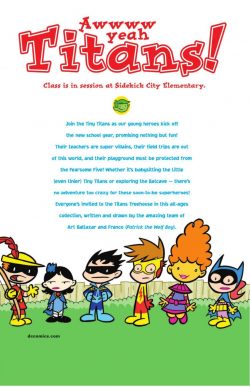
The original comics were filled with activity pages, puzzles and pin-ups, so ‘Help Best Boy Find his Puppy Friend!’ and awesome group-shot ‘Awwwww Yeah Titans!!!’ offers an arty interlude before shenanigans resume with ‘Ow’ as new girl Terra persists in throwing rocks at the boys yet knows just how to make friends with the girls…

Not so much for the little lads though: they’ve got into another confrontation with mean kids Fearsome Five. Apparently the only way to determine who wins is to keep ‘Just a-Swingin’ – and ignore those bullies…

After teeny-weeny Little Teen Titan Kid Devil finds a delicious new way to use his heat power, Beast Boy becomes besotted by Terra in ‘Shadows of Love’, even though his obvious affection makes him act like an animal. While ‘Easy Bake Cyborg’ saves the day at snack time, the lovesick green kid follows some foolish advice and transforms into a ‘Beast Boy of Steel’…

At least Kid Devil is making friends, providing ‘Charbroiled Goodness’ for a local food vendor, just as the Fearsome Five show up again…

Following a pin-up of the bad kids and a brainteaser to ‘Match the Tiny Titans to their Action Accessories!’, a new school day finds science teacher Doctor Light losing control in ‘Zoology 101’ thanks to Beast Boy’s quick changes, after which ‘Sidekick’s Superheroes’ debate status and origins whilst Rose’s ‘Li’l Bro Jericho’ causes chaos and closes the school for the day.

When Robin brings some pals home, Alfred the Butler is reluctant to let them check out the ‘Batcave Action Playset’. He should have listened to his misgivings: that way there wouldn’t be so much mess or so many penguins…

After Aqualad’s suggestion ‘Let’s Play: Find Fluffy!’ the Boy Wonder has the strangest day, starting with ‘Robin and the Robins’ and culminating in a new costume. Before that though, you can see ‘Beast Boy at the Dentist’, Wonder Girl enduring a ‘Babysittin’ Baby Makeover’, meet ‘Beast Boy’s Prize’ and experience hair gone wild in ‘Do the “Do”’. Eventually, however, ‘It’s a Nightwing Thing’: revisiting the exotic yesteryears of disco mania as new outfits debut to mixed reviews and reactions…

Once done testing your skill with the ‘Tiny Titans Match Game!’ and admiring a ‘Little Tiny Titans Bonus Pin-up’ there are big thrills in store when ‘Playground Invaders’ introduces annoying Titans from the East side of the communal games…

Sadly, Fearsome Five are still around to tease the former Robin in ‘Nightwing on Rye’ even whilst ongoing epic ‘Enigma and Speedy’ sees the Boy Bowman trapped in a very one-sided battle of wits with the Riddler’s daughter…

Robin’s costume crises continue to confuse in ‘May We Take a Bat-Message?’, resulting in a kid capitulation and ‘Back to Basics’ approach to the old look, after which ‘Tiny Titans Joke Time!’ and a ‘Tiny Titans East Bonus Pin-up’ segues neatly into ‘Meet Ya, Greet Ya’ with newcomers Supergirl and Blue Beetle turning up just ahead of a host of wannabee Titans (Power Boy, Zatara, Vulcan Jr., Hawk & Dove, Li’l Barda and Lagoon Boy)…

With the riotous regulars away camping, Raven opens her eyes to a potential daybreak disaster as ‘Home with the Trigons’ finds her dressed by her dad for a change. Meanwhile, ‘Let’s Do Lunch’ finds Blue Beetle losing a very public argument with his backpack, and after the kids bring their super-animal pals in, everything goes horribly wrong. At least they decide that the “First Rule of Pet Club is: We Don’t Talk About Pet Club”…

This insanely addictive initial collection wraps up with visual and word puzzles ‘How Many Beast Boy Alpacas Can You Count?’ and ‘Blue Beetle Backpack Language Translation!’, a huge and inclusive Pin-up of ‘The Tiny Titans of Sidekick City Elementary’ and a hilarious ‘Tiny Titans “Growth Chart”

Despite ostensibly being aimed at super-juniors and TV kids, these wonderful, wacky yarns – which marvellously marry the heart and spirit of such classic strips as The Perishers or Peanuts with something uniquely mired and marinated in pure American comic-bookery – are outrageously unforgettable yarns and gags no self-respecting fun-fan should miss: accessible, entertaining, and wickedly intoxicating.
© 2008, 2009 DC Comics. All Rights Reserved.

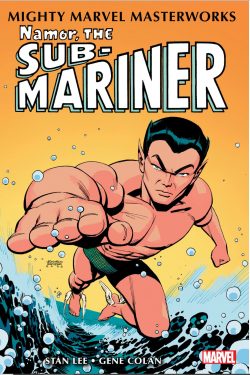
Mighty Marvel Masterworks: Namor, the Sub-Mariner volume 1: The Quest Begins


By Stan Lee, Gene Colan, Wallace Wood & various (MARVEL)
ISBN: 978-1-3029-4885-6 (TPB/Digital edition)

If you’re currently sitting on or near a beach that isn’t actually storm-wracked or on fire, you might be feeling in the mood for a little salty sea-borne fun about now. The stories re-presented here are timeless and have been gathered many times before but today we’re enjoying another example of The Mighty Marvel Masterworks line: designed with economy in mind and newcomers as target audience. These books are far cheaper, on lower quality paper and smaller – like a paperback novel. Your eyesight might be failing and your hands too big and shaky, but at 152 x 227mm, they’re perfect for kids. If you opt for digital editions, that’s no issue at all.

Prince Namor, the Sub-Mariner is the offspring of a water-breathing Atlantean princess and an American polar explorer: a hybrid being of immense strength; highly resistant to physical harm; able to fly and exist above and below the waves. Created by young, talented Bill Everett, Namor technically predates Marvel/Atlas/Timely Comics.

He first caught the public’s attention as part of the fire vs. water headlining team in Marvel Comics #1 (October 1939 and soon to become Marvel Mystery Comics). He shared honours and top billing with The Human Torch, but had originally been seen (albeit in a truncated monochrome version) in Motion Picture Funnies: a promotional giveaway handed out to moviegoers earlier in the year.

Quickly becoming one of the company’s biggest draws, Namor gained his own title at the end of 1940 (cover-dated Spring 1941) and was one of their last super-characters to go at the end of the first heroic age.

In 1954, when Atlas (as the company then was) briefly revived its costumed character “Big Three” (the Torch and Captain America being the other two), Everett returned for a run of superb fantasy tales, but even so the time wasn’t right and the title sunk again.

When Stan Lee & Jack Kirby started reinventing comic-books in 1961 with the Fantastic Four, they revived the all-but-forgotten awesome amphibian as a troubled, semi-amnesiac, and decidedly more regal, if not grandiose, antihero. The returnee despised humanity; embittered at the loss of his sub-sea kingdom (seemingly destroyed by American atomic testing) whilst simultaneously besotted with the FF’s Sue Storm.

Namor knocked around the budding Marvel universe for a few years, squabbling with other assorted heroes such as the Hulk, Avengers and X-Men, before securing his own series as one half of Tales to Astonish. Marvel’s “split-books” had been devised as a way to promote their burgeoning stable of stars whilst labouring under a highly restrictive distribution deal limiting the number of titles they could release per month. In 1968 the company ended this commitment and expanded exponentially.

This first celebratory volume collects one of those 1960’s guest shots – Daredevil #7 – and the first Subby’s solo stories from Tales to Astonish #70-80, spanning April 1965 to June 1966, and opening without preamble with a fateful encounter with his least powerful antagonist. Previously, Fantastic Four #4 had reintroduced the all-powerful amphibian Prince of Atlantis as an amnesiac relic who recovered his memory thanks to some rather brusque treatment by teen delinquent and AWOL Human Torch Johnny Storm. Rapidly returning to his sub-sea homeland he found it lain waste by atomic testing. A monarch without subjects, he swore vengeance on humanity and attacked New York City with a gigantic monster. In short order thereafter he met and battled Doctor Doom, The Hulk, Puppet Master, The Avengers, Magneto, the X-Men, and Doctor Strange, Master of the Mystic Arts

As previously stated, prior to Tales to Astonish, Namor appeared in numerous titles as guest villain du jour. One last guest shot with Namor acting as a misunderstood bad-guy was Daredevil #7 (April 1965): a tale qualifying as a perfect comic book and a true landmark – to my mind one of the Top Ten Marvel Tales of all time.

Here, Lee and creative legend Wally Wood concocted a timeless masterpiece with ‘In Mortal Combat with… Sub-Mariner!’ as Namor of Atlantis – recently reunited with the survivors of his decimated race – returns to the surface world to sue mankind for their crimes against his people. To expedite his claim, the Prince engages the services of Matt Murdock‘s law firm; little suspecting the blind lawyer is also the acrobatic Man without Fear.

Whilst impatiently awaiting a hearing at the UN, Namor is informed by his lover Lady Dorma that his warlord Krang has usurped the throne in his absence. The tempestuous monarch cannot languish in a cell when the kingdom is threatened, so he fights his way to freedom through the streets of New York, smashing National Guard battalions and the dauntless Daredevil with supreme ease.

The hopelessly one-sided battle with one of the strongest beings on the planet shows the dauntless courage of DD and the innate nobility of a “villain” far more complex than most of the industry’s usual fare at the time.

Augmented by a rejected Wood cover repurposed as ‘A Marvel Masterwork pin-up: Namor and D.D.’, this yarn is merely a cunning prelude…

A few months later Tales to Astonish #70 heralded ‘The Start of the Quest!’ as Lee, Gene Colan (in the pseudonymous guise of Adam Austin) & Vince Colletta set the Sub-Mariner to storming an Atlantis under martial law. The effort is for naught and the returning hero is rejected by his own people. Callously imprisoned, the troubled Prince is freed by the oft-neglected and ignored Lady Dorma…

As the pompous hero begins a mystical quest to find the lost Trident of King Neptune – which only the rightful ruler of Atlantis can hold – he is unaware that treacherous Krang allowed him to escape, the better to destroy him with no witnesses. The serialised search carries Namor through a procession of fantastic adventures and pits him against spectacular sub-sea horrors: a giant octopus in ‘Escape… to Nowhere’: a colossal seaweed man in ‘A Prince There Was’ and a demented wizard and energy-sapping diamonds in ‘By Force of Arms!’

As the end approaches in ‘When Fails the Quest!’, revolution grips Atlantis, and Namor seemingly sacrifices his kingdom to save Dorma from troglodytic demons the Faceless Ones.

Issue #75’s ‘The End of the Quest’ finds the Prince battling his way back into Atlantis with a gravely-injured Dorma, before the saga calamitously concludes in ‘Uneasy Hangs the Head…!’ as the status quo is restored and Namor finally regains his stolen throne.

Back in charge, the Prince once more turns his thoughts to peace with the surface world and resolves ‘To Walk Amongst Men!’, but his mission is derailed on encountering a deep-sea drilling platform and finds himself fighting the US military and retired Avengers Henry Pym and Janet Van Dyne. The fracas is abruptly curtailed in #78’s ‘The Prince and the Puppet’ as an old adversary once again seizes control of the amphibian’s fragile mind…

Inked by the brilliant Bill Everett, ‘When Rises the Behemoth’ sees Namor struggling against Puppet Master’s psychic control and confronting the US Army in the streets of New York, before returning to clash with a cataclysmic doomsday monster in Atlantis. Dick Ayers stepped in to ink tense conclusion ‘To the Death!’, wherein Warlord Krang returns, blackmailing Dorma into betraying her beloved Prince and fleeing away with him…

To Be Continued…

Supplemented with House ads, a full cover gallery and pages of Colan original art this assemblage of tales featuring Marvel’s first antihero are timeless treasures to delight comics lovers of every age and vintage.
© 2022 MARVEL.

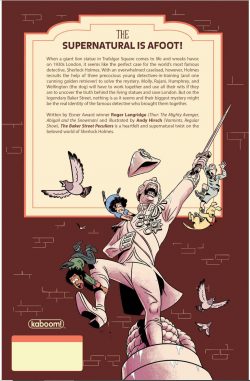
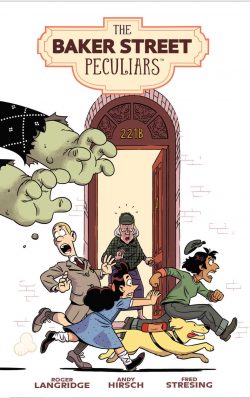
The Baker Street Peculiars


By Roger Langridge, Andrew Hirsh & Fred Stresing (KaBOOM!)
ISBN: 978-1-60886-928-2 (PB) eISBN: 978-1-61398-599-1

Roger Langridge is a very talented gentleman with a uniquely beguiling way of telling stories. He has mastered every aspect of the comics profession from lettering (Dr. Who) to writing (Thor: The Mighty Avenger) to illustration (Knuckles the Malevolent Nun, Zoot!). When combining his gifts – as Fred the Clown, Popeye, Abigail and the Snowman – the approbation, accolades and glittering prizes such as Eisner and Harvey Awards can’t come fast enough.

He is also a bloody genius at making folk laugh…

The Baker Street Peculiars started life as an all-ages comicbook miniseries before being gathered in a titanic detective tome and craftily references a glittering reservoir of cool concepts encompassing the mythology of Sherlock Holmes, 1930s London, cosy crime mysteries, kid gangs and rampaging monster movies. Moreover, thanks to Langridge’s keen ear for idiom and slang, every page resonates with hilarious dialogue any lover of old films or British sitcoms will find themselves helplessly chortling over – if not actually joining in with…

Blimey, Guv’ner!

Illustrated by Andy Hirsch (Science Comics: Dogs, Varmints, Adventure Time, Regular Show) and coloured by the inestimable Fred Stresing, ‘The Case of the Cockney Golem’ opens in foggy old London Town circa 1933, currently enduring an odd spot of bother. Exceedingly odd…

‘A Beast in Baker Street’ reveals that famous landmark statues are going missing. Now, with one of the bronze lions in Trafalgar Square coming to life and bolting away down Charing Cross Road – unlike the crowds rushing about in panic – three wayward tykes (and a dog) chase after it. Soon they are all embroiled in the story of a lifetime… perhaps several lifetimes…

Tailor’s granddaughter Molly Rosenberg, orphan street thief Rajani Malakar and neglected filthy rich posh-boy Humphrey Fforbes-Davenport (and his canine valet Wellington) are all out long after bedtime and keen on a spot of adventure. Having individually chanced upon the commotion, they spontaneously unite to doggedly track the animated absconder to Baker Street where they enjoy a chance encounter with a legendary investigator…

Molly is especially intrigued: she’s read every exploit of the famous consulting detective. When he roundly rubbishes their claim of moving statues – and claims to be too busy with other cases – she angrily suggests that they act as his assistants. The detective quite quickly complies, but only to conceal an incredible secret not even his fanciful new deputies could ever imagine…

As Molly’s grandpa suffers another visit from thugs running an extortion racket for the nefarious Chippy Kipper – “the Pearly King of Brick Lane” – the kids’ bizarre quest continues in ‘The Lion, the Lord and the Landlady’ after the junior sleuths meet up at 221B Baker Street. Although consoled with a fine meal, they are disappointed to find their hoped-for mentor absent.

Receiving further instructions from the great detective’s elderly cook Mrs. Hudson, the youthful team learn that Mr Holmes believes the statues are simply being stolen and that he wishes the dauntless children to post guard on Boadicea at Westminster Bridge and Lord Nelson in Trafalgar Square…

Their sentinel duties bear strange fruit, however, as East End thugs perform a strange and dangerous ritual and the beloved tourist attractions come to menacing life. As the kids follow the ambulatory landmarks back to Kipper’s hideout, Molly strives to recall a story her grandfather used to tell her: a fable about a Rabbi in old Prague who used a scroll to bring a giant avenging clay statue to life…

As the colossal Chippy shares his own unique origins with his cohort of thugs and sculptures, the youngsters sneak in. Swifty captured and stuck in a dungeon, they can only watch in horror as Kipper uses ancient magic to make a new kind of monster. ‘The Old, Hard Cell’ brings the plot to a bubbling boil as the terrified tykes swallow simmering resentments and work together. Even as they escape their current predicament, elsewhere, other, more mature truth-seekers are compelled to change their stubbornly-held opinions…

Someone else with a keen eye and suspicious mind is enterprising lady journalist Hetty Jones of The Mirror. Her own patient, diligent enquiries have brought her to Baker Street in time to collaborate with the aged detective-in-charge. With all eventualities except the impossible exhausted, the grown-ups must accept the truth and soon track down the missing lion. It’s probably too late, however, as an army of animated marble and bronze artefacts rampage through London towards the East End, with only three nippers (and a dog) ready to confront them…

With Chippy Kipper in the vanguard, the chilling regiment invades Molly’s home turf but ‘The Battle of Brick Lane’ is no one-sided affair. One plucky minor has remembered the secret of the Rabbi’s Golem and conceived a daring stratagem to immobilise the monstrous invaders. As for Kipper’s human thugs, they’ve severely underestimated the solidarity of hundreds of poor-but-honest folk pushed just a bit too far, one time too many…

When the dust settles, Sherlock Holmes has one last surprise for his squad of juvenile surrogates…

Adding to the charm and cheer is a cover-&-variants gallery by Hirsch & Hannah Christenson, sketch and design feature ‘Meet the Peculiars’ and a delirious sequence of all-Langridge strips starring his unique interpretation of the Great Detective Himself in ‘The Peculiar Adventures of Sherlock Holmes’.

Reverently refencing and spoofing beloved old films and our oh-so-idiosyncratic manners and parlance with a loving ear for an incongruous laugh, The Baker Street Peculiars is a sheer triumph of spooky whimsy, reinventing what was great about classic British storytelling. Fast, funny, slyly witty and with plenty of twists, it is an absolute delight from start to finish and another sublime example of comics at its most welcoming.
™ & © 2016 Roger Langridge & Andrew Hirsch All rights reserved.

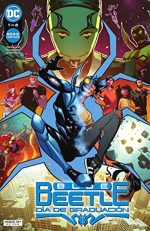
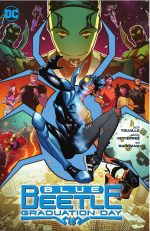
Blue Beetle Graduation Day


By Josh Trujillo & Adrián Gutiérrez, with Wil Quintana, Lucas Gattoni & various (DC Comics)
ISBN: 978-1-7795-2324-2 (TPB/Digital edition)

As the most recent incarnation of the vintage and venerable Blue Beetle brand at last makes the jump from comic book limbo and kids’ animation into live action movie madness, the event sparked a new comics miniseries bridging the teen hero’s old life and new comic book series. Here that is…

The Blue Beetle first appeared in Mystery Men Comics #1, published by Fox Comics and cover-dated August 1939. The eponymous lead character was created by Charles Nicholas (AKA Charles Wojtkowski) as a pulp-styled mystery man and born nomad. Over years and crafted by a Who’s Who of extremely talented creators, the Beetle was also inexplicably popular and hard to kill: surviving the collapse of numerous publishers before ending up as a Charlton Comics property in the mid-1950s.

After a few issues sporadically published, the company shelved him until the superhero revival of the early 1960s when Joe Gill, Roy Thomas, Bill Fraccio & Tony Tallarico revised and revived the character in a 10-issue run (June 1964, February 1966). Cop-turned-adventurer Dan Garrett was reinvented an archaeologist, educator and scientist who gained super-powers whenever he activated a magic scarab with the trigger phrase “Khaji Da!”

Some months later, Steve Ditko (with scripter Gary Friedrich) utterly reimagined the Blue Beetle. Ted Kord was an earnest and brilliant young researcher who had been a student and friend of Professor Garrett and when his mentor seemingly died in action, Kord trained himself to replace him: a purely human inventor/combat acrobat, bolstered by ingenious technology. This latter version joined DC’s pantheon during Crisis on Infinite Earths, earning a solo series and quirky immortality partnered with Booster Gold in Justice League International and beyond…

When Kord was murdered in the run up to Infinite Crisis, it led to all-out war across realities and at the height of the linked catastrophes El Paso high-schooler Jaime Reyes found a weird blue jewel shaped like a bug. That night, as he slept, it invaded him and turned him into a bizarre insectoid warrior. suddenly gifted with great powers, and revealed how some heroes are remade, not born – especially when a sentient scarab jewel affixes itself to your spine and transforms you into an armoured bio-weapon. Almost instantly, he was swept up in the chaos, joining Batman and other heroes in a climactic space battle.

Inexplicably returned home, Jaime revealed his secret to his family and tried to do some good in his hometown but had to rapidly adjust to huge changes. Best bud Paco had joined a gang of super-powered freaks, he learned the local crime mastermind was the foster-mom of his other best bud Brenda, and scary military dude named Christopher Smith (The Peacemaker) started hanging around. He claimed the thing in Jaime was malfunctioning alien tech, not life-affirming Egyptian magic that he also had an unwelcome and involuntary connection to…

That led to a secret war against an alien collective of conquerors called the Reach whose shady dealings and defeat have been covered in Blue Beetle: Jaime Reyes volumes One & Two. You should get those also.

Gathering Blue Beetle: Graduation Day #1-6 (cover-dated January to June 2022), and including an excerpt from the new Blue Beetle series it leads into, this collection is also quite rightly available in a Spanish language edition.

In an effort to maximise your fun and save time let’s briefly hit the high notes here.

Crafted by scripter Josh Trujillo (Adventure Time, Captain America, Rick & Morty), illustrator Adrián Gutiérrez (Batman, The Flash), colourist Wil Quintana and letterer Lucas Gattoni, ‘Graduation Day’ is set following recent DC megaevent Dark Crisis on Infinite Earths with our neophyte champion at long last getting a handle on his other life. He’s even become pals with his sentient passenger bug Khaji Da, allowing them to seamlessly work together.

With school days practically done, as the story opens Jaime is currently wrecking downtown El Paso battling magical thief Fadeaway and worrying about his non-superhero future. After almost missing his own graduation ceremony, Reyes suddenly finds it all going wrong again when he receives a terrifying vision of The Reach and loses control, uncontrollably shifting to his blue battle form…

His family share his secret, but aren’t happy about it and when he returns to his own party hours later, the festivities are long over and his furious mother wants to know what he’s doing with his life. So does Superman, who “just” popped by to see if the alien conquerors had regained control of their greatest weapon…

Intel confirms that The Reach are coming back and the (adult) superhero community feels it might be prudent if Jaime doesn’t use his powers for the foreseeable future…

Benched, grounded, jobless and not destined for college any time soon, the frustrated lad is summarily packed off to toil in his aunts’ diner in Palmera City, but fate has other plans. Repeatedly targeted by extremely Reach-like and savage Beetle-morphs Dynastes and Nitida, BB is forced to fight back until the Justice League shut him down again…

Some salvation comes when mentor Ted and his terrifying older smarter sister Victoria Kord offer him an (unpaid!) internship at Kord Industries. Ted is laid back and cool but Jaime can’t stop thinking how Victoria has the largest collection of alien tech on Earth and keeps looking at him funny…

As Beetle catastrophes keep coming, Reyes and still-on-the-fritz Khaji Da encounter a splinter faction of The Reach. Unable to trust The Horizon, they instead put themselves in the hands of Teen Titans Starfire, Cyborg and their allies. At least they can keep Batman and his private superhero goon squad off their collective shiny blue buggy back. Or Not…

And that’s when Paco and Brenda show up, begging Jaime to help their new best buddy Fadeaway. That does not go well…

With imminent doom encroaching and everybody telling him what” they” should do, Jaime and Khaji Da finally unlock the root problem that’s been jamming them up, consequently evolving into whole new Blue Beetle able and ready to fix their own problems…

And that’s when the aliens all come screaming into Earth’s atmosphere…

An enticing extra offers an extract and sneak peek from the new Blue Beetle #1 (‘Scarab War!’) due for release in September 2023, before a gallery of covers and variants by Cully Hamner, Rafael Albuquerque, David Marquez & Alejandro Sánchez, Ramon Villalobos, Gutiérrez & Quintana, Joe Quinones, Chokoo!, Danny Miki & Ivan Plascencia, Serg Acuña, Ricardo López Ortiz, Baldemar Rivas, Daniel Sampere & Alejandro Sánchez, Bruno Redondo, Jorge Corona & Sarah Stern segue into an extensive and expansive sketch gallery from Gutiérrez.

Here’s another smart, fast and joyous fun ride to delight fans of comics and other, lesser, media forms. So few series combine action and adventure with all-out fun and genuine wit, or can evoke shattering tragedy and poignant loss on command. Now read this even before you wallow in film fun…
© 2022, 2023 DC Comics. All Rights Reserved.