
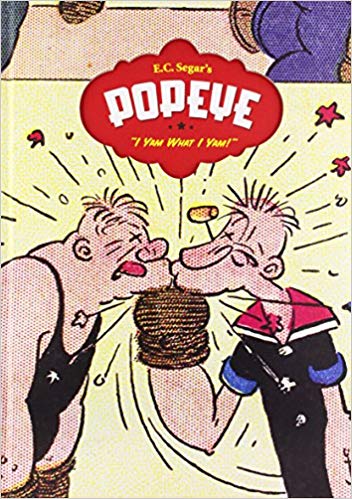
E.C. Segar’s Popeye volume 1: “I Yam What I Yam!”


By Elzie Crisler Segar (Fantagraphics Books)
ISBN: 978-1-56097-779-7

HAPPY 90th BIRTHDAY POPEYE!

Call me an idiot (you know you want to) but for years I laboured under the misapprehension that comics’ first superhuman hero debuted on January 29th 1929. Eventually. thanks to a superb collection of archival albums from the wonderful folk at Fantagraphics, I was disabused of that erroneous notion. Those mammoth oversized compendia are still the best books about the old Swabbie ever published…

Thimble Theatre was an unassuming comic strip which began on 19th December 1919; one of many newspaper features that parodied/burlesqued/mimicked the silent movies of the era. Its more successful forebears included C.W. Kahles’ Hairbreadth Harry and Ed Wheelan’s Midget Movies (later and more famously renamed Minute Movies).

These all used a repertory company of characters to play out generic adventures firmly based on the cinema antics of the silent era. Thimble Theatre‘s cast included Nana and Cole Oyl, their gawky daughter Olive, diminutive-but-pushy son Castor, and Horace Hamgravy, Olive’s sappy, would-be beau.

The series ticked along for a decade, competent and unassuming, with Castor and Ham Gravy, as he became, tumbling through get-rich-quick schemes, gentle adventures and simple gag situations until September 10th 1928 (the first strip reprinted in this astonishingly lavish and beautiful collection), when explorer uncle Lubry Kent Oyl gave Castor a present from his latest exploration of Africa: a hand-reared Whiffle Hen – most fabulous of all birds. It was the start of something groundbreaking.

As eny fule kno Whiffle Hens are troublesome, incredibly rare and possessed of fantastic powers, but after months of inspired hokum and slapsick shenanigans, Castor was resigned to Bernice – for that was the hen’s name – when a series of increasingly peculiar circumstances brought him into contention with the ruthless Mr. Fadewell, world’s greatest gambler and king of the gaming resort of ‘Dice Island’.

Bernice clearly affected writer/artist E.C. Segar, because his strip increasingly became a playground of frantic, compelling action and comedy during this period.

When Castor and Ham discovered that everybody wanted the Whiffle Hen because she could bestow infallible good luck, they decided to sail for Dice Island to win every penny from its lavish casinos. Sister Olive wanted to come along but the boys planned to leave her behind once their vessel was ready to sail. It was 16th January 1929…

The next day and in the 108th instalment of the saga, a bluff, irascible, ignorant, itinerant and exceeding ugly one-eyed old sailor was hired by the pair to man the boat they had rented, and the world was introduced to one of the most iconic and memorable characters ever conceived. By sheer, surly willpower, Popeye won the hearts and minds of every reader: his no-nonsense, grumbling simplicity and dubious appeal enchanting the public until by the end of the tale his walk-on had taken up full residency. He would eventually make the strip his own…

The journey to Dice Island was a terrible one: Olive had stowed away, and Popeye, already doing the work of twelve men, did not like her. After many travails the power of Bernice succeeded and Castor bankrupted Dice Island, but as they sailed for home with their millions Fadewell and his murderous associate Snork hunted them across the oceans. Before long, Popeye settled their hash too, almost at the cost of his life…

Once home their newfound wealth quickly led Castor, Ham and Olive into more trouble, with carpetbaggers, conmen and ne’er-do-wells constantly circling, and before long they lost all their money (a common occurrence for them), but one they thing they couldn’t lose was their sea-dog tag-along. The public – and Segar himself – were besotted with the unlovable, belligerent old goat. After an absence of 32 episodes Popeye shambled back on stage, and he stayed for good.

Although not yet the paramour of Olive, Popeye increasingly took Ham’s place as a foil for the sharp-talking, pompous Castor Oyl, and before long they were all having adventures together. When they escaped jail at the start of ‘The Black Barnacle’ (December 11th 1929) they found themselves aboard an empty ship and at the start of a golden age of comic strip magic…

Segar famously considered himself an inferior draughtsman – most of the world disagreed and still does – but his ability to weave a yarn was unquestioned and it grew to astounding and epic proportions in these strips.

Day by day he was creating the syllabary and graphic lexicon of a brand-new art-form, inventing narrative tricks and beats that a generation of artists and writers would use in their own works, and he did it while being scary, thrilling and funny all at once.

‘The Black Barnacle’ introduced the dire menace of the hideous Sea-Hag – one of the greatest villains in fiction – and the scenes of her advancing in misty darkness upon our sleeping heroes are still the most effective I’ve seen in all my years…

This incredible tale leads seamlessly into diamond-stealing, kidnappings, spurned loves, an African excursion and the introduction of wealthy Mr. Kilph, whose do-gooding propensities would lead Castor and Popeye into plenty of trouble, beginning with the eerie science fiction thriller ‘The Mystery of Brownstone Hill’ and the return of the nefarious Snork, who almost murders the salty old seadog a second time…

The black and white dailies section ends with ‘The Wilson Mystery’ as Castor and Popeye set up their own detective agency: something that would become a common strip convention and the perfect maguffin to keep the adventures tumbling along – even Mickey Mouse would don metaphoric deerstalker and magnifying glass (see Mickey and Donald and The Lair of Wolf Barker among many others).

These superb and colossal hardcover albums (200 pages and 368 mm by 268 mm) are augmented with fascinating articles and essays; including testimonial remembrances from famous cartoonists – Jules Feiffer in this first volume – and accompanied by the relevant full colour Sunday pages from the same period.

Here then are the more gag-oriented complete tales from 2nd March 1930 through February 22nd 1931, including the “topper” Sappo.

A topper was a small mini-strip that was run above the main feature on a Sunday page. Some were connected to the main strip but many were just filler. They were used so that individual editors could remove them if their particular periodical had non-standard page requirements. Originally entitled The 5:15, Sappo was a surreal domestic comedy gag strip created by Segar in 1924 which became peculiarly entwined with the Sunday Thimble Theatre as the 1930s unfolded – and it’s a strip long overdue for consideration on its own unique merits….

Since many papers only carried dailies or Sundays, not necessarily both, a system of differentiated storylines developed early in American publishing, and when Popeye finally made his belated appearance, he was already a fairly well-developed character.

Thus, Segar concentrated on more family-friendly gags – and eventually continued mini-sagas – and it was here that the Popeye/Olive Oyl modern romance began: a series of encounters full of bile, intransigence, repressed hostility, jealousy and passion which usually ended in raised voices and scintillating cartoon violence – and they are still as riotously funny now as then.

We saw softer sides of the sailor-man and, when Castor and Mr. Kilph realised how good Popeye was at boxing, an extended, trenchant and scathingly funny sequence about the sport of prize-fighting began. Again, cartoon violence was at a premium – family values were different then – but Segar’s worldly, probing satire and Popeye’s beguiling (but relative) innocence and lack of experience kept the entire affair in hilarious perspective whilst making him an unlikely and lovable waif.

Popeye is fast approaching his centenary and still deserves his place as a world icon. These magnificent volumes are the perfect way to celebrate the genius and mastery of EC Segar and his brilliantly imperfect superman. These are books that every home should have.
© 2006 Fantagraphics Books Inc. All comics and drawings © 2006 King Features Inc. All rights reserved.
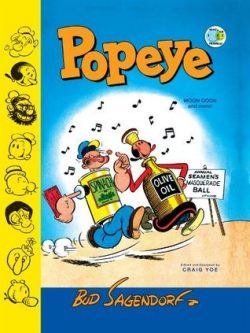
Popeye Classics volume 2


By Bud Sagendorf, edited and designed by Craig Yoe (Yoe Books/IDW)
ISBN: 978-1-61377-652-0                  eISBN: 978-1-62302-415-4

There are few comic characters that have entered communal world consciousness, but a grizzled, bluff, uneducated, visually impaired old sailor with a speech impediment is possibly the most well-known of that select bunch.

Elzie Segar had been producing Thimble Theatre since December 19th 1919, but when he introduced a coarse, brusque “sailor man” into the everyday ongoing saga of Ham Gravy and Castor Oyl on January 29th 1929, nobody suspected the giddy heights that walk-on would reach…

In 1924 Segar created a second daily strip The 5:15: a surreal domestic comedy featuring weedy commuter and would-be inventor John Sappo and his formidable wife Myrtle which endured – in one form or another – as a topper/footer-feature accompanying the main Sunday page throughout the author’s career. The feature even survived his untimely death, eventually becoming the trainee-playground of Popeye’s second great stylist: Bud Sagendorf.

After Segar’s far-too-premature death in 1938, Doc Winner, Tom Sims, Ralph Stein and Bela Zambouly all worked on the strip, even as the animated features brought Popeye to the entire world. Sadly, none of them had the eccentric flair and raw inventiveness that had put Thimble Theatre at the forefront of cartoon entertainments…

Born in 1915, Forrest “Bud” Sagendorf was barely 17 when his sister – who worked in the Santa Monica art store where Segar bought his supplies – introduced the kid to the master who became his teacher and employer as well as a father-figure. In 1958, Sagendorf took over the strip and all the merchandise design, becoming Popeye’s prime originator…

When Sagendorf became the Go-To Guy, his loose, rangy style and breezy scripts brought the strip itself back to the forefront of popularity and made reading it cool and fun all over again. He wrote and drew Popeye in every graphic arena for 24 years.

He died in 1994 and was succeeded by “Underground” cartoonist Bobby London.

Bud had been Segar’s assistant and apprentice, and – from 1948 onwards – exclusive writer and illustrator of Popeye’s comicbook adventures in a regular monthly title published by America’s king of licensed periodicals, Dell Comics.

When Popeye first appeared, he was a rude, crude brawler: a gambling, cheating, uncivilised ne’er-do-well. He was soon exposed as the ultimate working-class hero: raw and rough-hewn, practical, but with an innate, unshakable sense of what’s fair and what’s not; a joker who wanted kids to be themselves – but not necessarily “good” – and someone who took no guff from anyone…

Naturally, as his popularity grew Popeye mellowed somewhat. He was still ready to defend the weak and had absolutely no pretensions or aspirations to rise above his fellows but the shocking sense of dangerous unpredictability and comedic anarchy he initially provided was sorely missed… but not in Sagendorf’s comicbook yarns…

Collected in their entirety in this beguiling full-colour hardback (also available in a digital edition) are issues #5-9 of the Popeye comicbooks produced by the irrepressible Bud, collectively spanning February/March to October/November 1949.

The stunning, seemingly stream-of-consciousness stories are preceded by an effusively appreciative Foreword‘Society of Sagendorks’ – by inspired aficionado, historian and publisher Craig Yoe and a fabulous collation of candid photos, strip proofs, original art and designs, foreign edition covers and greetings cards in another ‘Bud Sagendorf Scrapbook’.

Popeye‘s fantastic first issue launched in February 1948, with no ads and duo-coloured (black & red) single-page strips on the inside front and back covers – which were always dynamic, surreal, silent sight gags of incredible whimsy and ingenuity.

We rejoin the parade of laughs and thrills one year later with #5 and a single-page duel of wits between Popeye and master moocher Wellington J. Wimpy over the price of water before main event ‘Moon Goon! or Goon on the Moon! or The Man in the Moon is a Goon!’ espies the scrappy sailor-man hired in dishonest circumstances to pilot a ship to our nearest celestial neighbour.

Once there, he and Wimpy meet a number of incredible races, discover the origins of their unsightly associate Alice the Goon and enjoy an astounding and perilous new means of locomotion to get them back down to Earth…

Short prose stories were a staple of these comics and ‘Swee’ Pea‘s Dip in the Dark!’ details a frantic scramble for survival after the mighty muscled, irrepressible “infink” falls overboard during a sudden squall at sea, after which cartoon hilarity ensues as Wimpy tests the patience and resolve of diner chef Rough House in ‘Another Day, Another Breakfast!’ before deciding to grow his own burgers by raising cattle…

The interior end page then sees Olive Oyl fall foul of Swee’ Pea’s boisterous playtime whilst the full-colour back cover gag sees the little lad get down and dirty defending his pocket money…

Sporting a shark-themed cover #6 (April/May 1949) opens with a monochrome Popeye short involving bad dreams before lengthy sea-borne saga ‘Raft! or It’s a Long Drift Home! or Rafts are Boats, But Not So Comfortable!’ depicts Swee’ Pea and playmate Hink jerry-build a dubious wooden vessel and disappear down the river and out into the ocean…

When piratical rogue Captain Zato picks up the soggy waifs he thinks he has the secret of controlling Popeye and gaining vast wealth, but he’s made a terrible mistake…

‘Pappy Doesn’t Tell a Story!’ offers a prose poser as Popeye’s salty sire Poopdeck adamantly refuses to lull Swee’ Pea with a bedtime tale, after which that ravenous finagler J. W. Wimpy stars in ‘A Story of Hunger and Desert Madness entitled Food! Food! or May I Borrow Your Duck, Mister?’ dumped in a desert for his usual parsimonious behaviour (fare-dodging on a locomotive). As starvation looms, the chiseller encounters owlhoot bandit Terrific Tension and a grim battle begins for possession of the cowboy’s most treasured possession – a ham sandwich…

A Popeye and Olive end-page reveals how to keep the picnic dry before #7 (June/July) opens with a similar jape starring Wimpy bamboozling the overconfident Sailor-man. Then, in dazzling full-colour, ‘Help! or Sailor, Save My Baby!’ finds our grizzled hero acting as bodyguard to a millionaire’s little girl. Sadly, Olive is not happy since the precious Miss Pat Goldhold is old enough to pose a matrimonial threat, and is almost glad when thieves and a hulking man-monster turn up to rob her…

After getting the notion that people only like him because he’s tougher than them, Popeye feigns weakness and hosts a ‘Surprize Party!’ to test his theory. The result is quite an eye-opener and segues into text tale ‘Swee’ Pea and the Hungry Lady!‘ with Wimpy resorting to drag to steal provender from a baby…

The master moocher exhibits even greater guile in ‘A Tale of Brains vs. Work entitled Who Won? or The Fleeter of Foot Emerges Victorious!’, again fooling Rough House and his customers with the old raffle dodge, before a Popeye closing gag finds Olive learning the finer points of manners from her brawling beau…

Issue #8 (August/September) sees the opener-strip back in black & red as Popeye decides Swee’ Pea’s new kite might a bit big for him, after which ‘On the House’ finds the sailor and the skiver go into business together as hamburger vendors. Happily, Swee’ Pea is on hand and on guard to ensure Wimpy’s carnivorous instincts are kept under control…

Sagendorf took his japery with alternate appellations to extreme limits with ‘I Am the Mayor!’) but I’m not playing anymore so just buy the book if you want to see the tale’s other titles) but the comedy is even sharper than usual as Swee’ Pea races across America to substitute for Popeye and save the town of Boghill from bullying entrepreneur and arms dealer Bull Branco…

‘Quiet Please’ offers prose diversions as the bombastic baby attempts to fix Poopdeck’s hammock and ensure a good night’s sleep for the veteran mariner after which Sagendorf’s old strip charges ‘Sappo and Wotasnozzle’ unexpectedly resurface. Here henpecked oaf John Sappo once more allows his mad scientist lodger Professor Wotasnozzle to make him a pasty after sampling the bonkers boffin’s food stretching breakfast additive. Of course, it’s not just the meal that elongates exponentially…

Black and white and red all over the Popeye and Olive Oyl end-page reveals the sailor’s breaking point when being asked to constantly rearrange furniture before the last issue in this outrageous compendium (#9, October/November) opens with the first half of the prose tale as opener. ‘Black Jack’ reveals the sheer stupidity of telling a kid like Swee’ Pea pirate stories at bedtime before main cartoon feature ‘Misermites! or I’d Rather Have Termites!’ details how the peaceful coastal town of Seawet is plagued by an invasion plundering dwarves. When the petty pilferers vanish back to their island with Swee’ Pea as part of their spoils, Popeye and Wimpy give chase and end up battling a really, really big secret weapon…

Then ‘Presenting John Sappo and the Experiment of the Sound Pills!’ finds the goony-eye genius and his long-suffering stooge enduring the gibes of Sappo’s little nephew and respond in typical over-the-top fashion after which the concluding part of ‘Black Jack’ wraps up this particular nautical compendium.

There is more than one Popeye. Most of them are pretty good, and some are truly excellent. This book is definitely top tier and if you love lunacy, laughter, frantic fantasy and rollicking adventure you must add this treasure trove of wonder to your collection.
Popeye Classics volume 2 © 2013 Gussoni-Yoe Studio, Inc. All Rights Reserved. Popeye © 2013 King Features Syndicate. ™ Heart Holdings Inc.