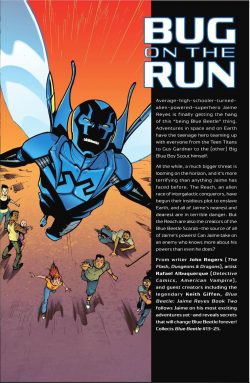
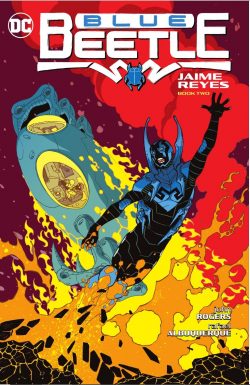
Blue Beetle: Jaime Reyes Book Two


By John Rogers, J. Torres, Keith Giffen, Justin Peniston, Rafael Albuquerque, Freddie E. Williams II, Andy Kuhn, David Baldeón, Dan Davis, Steve Bird & various (DC Comics)
ISBN: 978-1-7795-2027-2 (TPB/Digital edition)

As the most recent incarnation of the venerable Blue Beetle brand makes the jump from comic book limbo and kids’ animation reruns into live action movie madness, here’s a recent collection from the superb 36-issue run that began in 2006: one of the most delightfully light-hearted and compelling iterations of the Golden Age stalwart and still pure joy to behold…

The Blue Beetle first appeared in Mystery Men Comics #1, published by Fox Comics and cover-dated August 1939. The eponymous lead character was created by Charles Nicholas (AKA Charles Wojtkowski): a pulp-styled mystery man who was a born nomad. Over the years and crafted by a Who’s Who of extremely talented creators, he was also inexplicably popular and hard to kill: surviving the failure of numerous publishers before ending up as a Charlton Comics property in the mid-1950s.

After releasing a few issues sporadically, the company eventually shelved him until the superhero revival of the early 1960s when Joe Gill, Roy Thomas, Bill Fraccio & Tony Tallarico revised and revived the character in a 10-issue run (June 1964, February 1966). Cop-turned-adventurer Dan Garrett was reinvented an archaeologist, educator and scientist who gained super-powers whenever he activated a magic scarab with the trigger phrase “Khaji Da!”

Later that year, Steve Ditko (with scripter Gary Friedrich) utterly reimagined the Blue Beetle. Ted Kord was an earnest and brilliant young researcher who had been a student and friend of Professor Garrett. When his mentor seemingly died in action, Kord trained himself to replace him: a purely human inventor/combat acrobat, bolstered by ingenious technology. This latter version joined DC’s pantheon during Crisis on Infinite Earths, earning a solo series and quirky immortality partnered with Booster Gold in Justice League International and beyond…

Collecting Blue Beetle (volume 7) #13-25 and spanning June 2007 to May 2008 – the saga follows the hallowed formula of a teenager suddenly gifted with great powers, and reveals how some heroes are remade, not born – especially when a sentient scarab jewel affixes itself to your spine and transforms you into an armoured bio-weapon.

At the height of the Infinite Crisis, El Paso high-schooler Jaime Reyes found a weird blue jewel shaped like a bug. That night, as he slept, it invaded him and turned him into a bizarre insectoid warrior.

Almost instantly, he was swept up in the chaos, joining Batman and other heroes in a climactic space battle. Inexplicably returned home, Jaime revealed his secret to his family and tried to do some good in his hometown of El Paso but had to rapidly adjust to huge changes. Best bud Paco had joined a gang of super-powered freaks, he learned that the local crime mastermind was his other best bud Brenda’s foster-mom, and a really scary military dude named Christopher Smith AKA Peacemaker started hanging around. He claimed the thing in Jaime’s back was malfunctioning alien tech, not life-affirming Egyptian magic and that he also had an unwelcome and involuntary connection to it…

We resume this cinematically-inspired return engagement with John Rogers, Rafael Albuquerque, David Baldeón & colourist Dan Davis’ ‘Defective’. Here a benevolent (seeming) alien from an interstellar collective named The Reach introduces himself and reveals that the scarab is an invitation used to prepare endangered worlds like Earth for trade and commerce as part of a greater pan-galactic civilisation. Unfortunately the one attached to Jaime has been damaged over the centuries it was here and isn’t working properly.

The Reach envoy is a big fat liar…

The Scarab should have paved the way for a full invasion and once they discover this, Jaime and Peacemaker grasp that The Reach are the worst kind of alien invaders; patient, subtle, deceptive and stocked with plenty of space-tech to sell to Earth’s greedy governments. The only hope of defeating the marauders is to expose their real scheme to the public – which is currently too dazzled by the intergalactic newcomers’ media blitz to listen…

‘Mister Nice Guy’ (Rogers & Albuquerque) finds the Beetle teamed again with erratic Guy Gardner: a Green Lantern who knows all about The Reach and their Trojan Agenda. Here the unhappy allies must defeat the macabre Ultra-Humanite who has sold his telepathic services to the prospective new overlords.

Seeking allies and solutions, Jaime meets Superman in guest creators J. Torres & Freddie Williams Jr.’s ‘Someone to Watch Over Me’: battling electrical anti-villain Livewire before one of the DCU’s gravest menaces manifests in Rogers & Albuquerque’s startlingly powerful change of pace tale ‘Total Eclipso: the Heart’.

‘Something in the Water’ sees elemental menace Typhoon employed by The Reach to endanger a coastal city – and Bruce Wayne’s off-shore oil wells – in a clever, insightful tale packing plenty of punch, before ‘Away Game’ – with contributions from Baldeón & Davis – finds the Beetle and Teen Titans in pitched and pithy battle against the unbeatable alien biker-punk Lobo.

Weirdly whimsical Keith Giffen joins Rogers & Albuquerque next, focusing on Brenda, who has blithely lived her entire life unaware that her surrogate parental unit is El Paso’s crime boss supreme. La Dama is also a hoarder and supplier of alien, futuristic and magical weaponry. The distraught lass learns ‘Hard Truths’ when rival mob Intergang declare war: sending 50-foot woman Giganta to smash La Dama’s family to gooey pulp… until the Beetle buzzes in…

The previous tales were first collected in 2008 as Blue Beetle: Reach for the Stars and are accompanied here by most of sequel volume End Game, which finds the blue boy fighting a very secret war against the seemingly saintly visitors from the stars.

What the Green Lantern Corps already know is that The Reach are rapacious conquerors who follow near-sacrosanct ancient “strategies” to increase their empire. First a scarab converts an indigenous inhabitant into a pathfinder – a devastating marauding bug warrior – before the undetectably orbiting Reach “arrive”, offering weapons and planet-changing technologies to any who want them. And in the interim, the benefactors build world-ripper engines to eventually tear planet and remaining resources into manageable, marketable portions…

Rogers & Albuquerque set up the climactic counterstrike to Armageddon in ‘Fear to Live’, as Peacemaker is selected by a Sinestro Corps power ring due to his ability to “instil great fear”, just as Reach’s Chief Negotiator seeks to take him out. The silent invaders are terrified: desperate to learn why after countless millennia a scarab has rebelled against their infallible programming and created a disobedient, destructive maverick in Reyes.

Having finally deduced the part Peacemaker plays in the rebellion of his strategic weapon, the Negotiator infects Smith with a fully-obedient scarab and transforms him into a monstrous killer-drone. However, the terrifying “Infiltrator” is still no match for Jaime and his now sentient and liberated inner bug, especially after the yellow ring and alien Green Lantern Brik join the struggle…

Before Jaime’s meticulously constructed masterplan to save Earth gets underway, Justin Penniston & Andy Kuhn step in with a powerful tale of mistakes and consequences in #21’s ‘Ghost of a Chance’. Stepping in to quell a riot at a Federal Correctional facility, The Beetle finds the latest incarnation of The Spectre impatiently executing murderers the authorities haven’t got around to yet. Severely outmatched and deeply emotionally conflicted, Jaime needs the sage advice of his father and sorceress girlfriend Traci 13 to a get a handle on the Why as much as the How and Who of this crisis…

After almost a year of preparation, the fate of Earth is resolved in End Game parts one to four, by Rogers, Albuquerque & Majors, starting out ‘Under Pressure’ as Earth’s leaders get deeper in debt to the so-amenable Reach, whilst the Beetle and his allies – his parents, Peacemaker, Paco, Brenda and Danni Garrett (granddaughter of the first Blue Beetle) – try to expose the hidden world-ripper stations and uncover a hidden race who are far from what they seem…

The unravelling eternal strategies have sown discord amongst the Reach with Chief Negotiator’s subordinate openly displaying defiance and advocating abandoning the texts and a century of invisible sedition for total savage warfare right now. Pushed into rash action, the big boss targets the Reyes family, but too late…

‘World Tour’ reveals how Blue Beetle has already invaded their orbiting cloaked base, using a tactic and weapon the scarabs have never before used…

All too soon the boy is defeated, captured, tortured and deprived of the malfunctioning scarab designated Khaji Da. As the Negotiator sadistically gloats, he’s unaware that this was the plan: to strike from ‘Outside-In’

With Traci 13 shielding the Reyes from retaliation, Jaime and his now-sentient symbiotic scarab are methodically taking the Reach apart, provoking a rash public attack on El Paso, the abrupt exposure of the formerly-shielded Reach legions and bases and a gathering of heroes. Can it be merely coincidence that the first responders in concluding clash ‘A Little Help From…’ are Ted Kord’s closest friends and allies, Fire, Ice, Guy Gardner and Booster Gold, or that Jaime has outwitted the perfidious purveyors of illicit high technology with the most primitive methods ever devised by humanity?

… And as Jaime and Khaji Da are plucked from certain death, the rebels leave behind something that will have devastating repercussions for The Reach…

To Be Continued

With covers by Cully Hamner, and Albuquerque this is a smart, fast and joyous thrill ride to delight fans of comics and other, lesser, media forms. There are so few series combining action and adventure with all-out fun and genuine wit, or which can evoke shattering tragedy and poignant loss on command. John Rogers and his stand-ins excel in this innovative and impossibly readable saga and the art is always top notch. With the climactic final battle against the Reach only setting the scene for more and better to come, this is a second chance you probably don’t deserve but should reach out and grab onto with all you’ve got.
© 2007, 2008, 2023 DC Comics. All Rights Reserved.
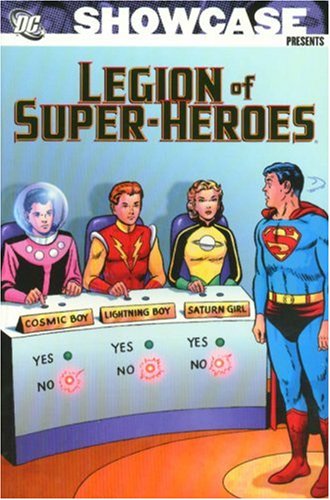
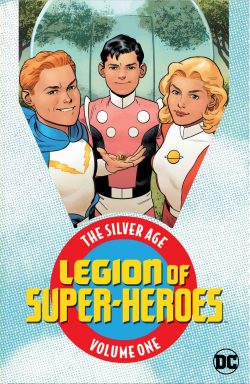
Showcase Presents Legion of Super-Heroes volume 1


By Otto Binder, Jerry Siegel, Robert Bernstein, Edmond Hamilton, Al Plastino, Curt Swan, John Forte, Jim Mooney, & various (DC Comics)
ISBN: 978-1- 4012-1382-4 (TPB)

Once upon a time in the far future, super-powered kids from many alien civilisations took inspiration from the greatest legend of all time and banded together as a club of heroes. One day those Children of Tomorrow came back in time and invited that legend to join them…

Thus, began the vast and epic saga of the Legion of Super-Heroes, as first envisioned by writer Otto Binder & artist Al Plastino when the many-handed mob of juvenile universe-savers debuted in Adventure Comics #247 (April 1958), just as the revived superhero genre was gathering an inexorable head of steam in America. Happy 65th Anniversary, team!

Since that time the fortunes and popularity of the Legion have perpetually waxed and waned, with their future history tweaked and rebooted, retconned and overwritten again and again to comply with editorial diktat and popular whim.

This glorious, far-and-wide ranging collection assembles the preliminary appearances of the valiant Tomorrow People, tracking their progress towards and attainment of their own feature. It re-presents in stunning monochrome all pertinent tales from Adventure Comics #247, 267, 282, 290, 293, 300-321, Action Comics #267, 276, 287, 289, Superboy #86, 89, 98, Superman #147, Superman Annual #4 and Superman’s Pal Jimmy Olsen #72 and 76.

As already stated, the many-handed mob of youthful worlds-savers debuted in Adventure #247, dreamed up for a Superboy tale wherein three mysterious kids invite the Boy of Steel to the 30th century. He is being vetted to join a team of metahuman champions unanimously inspired by his historic career. Binder & Plastino’s throwaway concept inflamed public imagination and after a slew of further appearances throughout Superman Family titles, the LSH eventually took over Superboy’s lead spot in Adventure: thereafter enjoying their own far-flung, quirky escapades, with the Kid Kryptonian reduced to “one of the in-crowd”…

However here the excitement was still gradually building as the kids returned for an encore 18 months later, Adventure #267 (December 1959) saw Jerry Siegel & George Papp make the Boy of Steel ‘Prisoner of the Super-Heroes!’ when the teen wonders attacked and incarcerated Superboy of Steel because of a misunderstood ancient historical record…

The following summer Supergirl met the Legion in Action Comics #267 (Siegel & Jim Mooney, August 1960) as Lightning Lad, Saturn Girl and Cosmic Boy secretly travelled to “modern day” America to invite the Maid of Might onto the team, in a repetition of their offer to Superboy 15 years previously (in nit-picking fact they claimed to be the children of the original team – a fact glossed over and forgotten these days. Don’t time-travel stories make your head hurt?).

Due to a dubious technicality, young and eager Kara Zor-El failed her initiation at the hands of ‘The Three Super-Heroes’ and was asked to reapply later – but at least we got to meet a few more Legionnaires, including Chameleon Boy, Invisible Kid and Colossal Boy.

With the editors still cautiously testing the waters, it was Superboy #86 (January 1961) before the ‘The Army of Living Kryptonite Men!’ by Siegel & Papp turned the LSH into a last-minute Deus ex Machina to save the Smallville Sentinel from juvenile delinquent Lex Luthor’s most insidious assault. Two months later, in Adventure #282, Binder & Papp introduced Star Boy as a romantic rival for the Krypton Kid in ‘Lana Lang and the Legion of Super-Heroes!’

Action Comics #276 (May 1961) debuted Supergirl’s Three Super Girl-Friends’ (Siegel & Mooney) which finally saw her crack the plasti-glass ceiling and join the team, sponsored by Saturn Girl, Phantom Girl and Triplicate Girl. We also met for the first time Bouncing Boy, Shrinking Violet, Sun Boy and potential bad-boy love-interest Brainiac 5 (well at least his distant ancestor Brainiac was a very bad boy…)

Next comes pivotal 2-part tale ‘Superboy’s Big Brother’ (by Robert Bernstein & Papp from Superboy #89 and June 1961) in which an amnesiac, super-powered space traveller crashes in Smallville, speaking Kryptonese and carrying star-maps written by the Boy of Steel’s long-dead father…

Jubilant, baffled and suspicious in equal amounts, Superboy eventually, tragically discovers The Secret of Mon-El’ by accidentally exposing the stranger to a lingering, inexorable death, before providing critical life-support by depositing the dying alien in the Phantom Zone until a cure can be found…

Sporting an August 1961 cover-date, Superman #147 unleashed ‘The Legion of Super-Villains’ (Siegel, Curt Swan & Sheldon Moldoff): a stand-out thriller featuring Luthor and an evil adult Legion coming far too close to destroying the Action Ace until the temporal cavalry arrives…

In Adventure #290 (November), Bernstein & Papp seemingly gave Sun Boy a starring role in ‘The Secret of the Seventh Super-Hero!’ – a clever tale of redemption and second chances, which is followed in #293 (February 1962) by a gripping thriller from Siegel, Swan & George Klein. The Legion of Super-Traitors’ sees the future heroes turn evil, prompting Saturn Girl to recruit a Legion of Super-Pets – comprising Krypto, Streaky the Super Cat, Beppo, the monkey from Krypton and magical Super-horse Comet to save the world…

‘Supergirl’s Greatest Challenge!’ (Siegel & Mooney, Action #287 April) sees her visit the Legion (quibblers be warned: for some reason it was mis-determined as the 21st century in here) to save future Earth from invasion). She also meets a telepathic descendent of her cat Streaky. His name is Whizzy (I could have omitted that fact but chose not to – once more for smug, comedic effect and in sympathy with all humans-with-cats everywhere)…

Action #289 featured ‘Superman’s Super-Courtship!’ wherein the Girl of Steel scours the universe to locate an ideal mate for her cousin. One highly possible candidate is adult Saturn Woman, but her husband Lightning Man objects…

Perhaps charming at the time, although modern sensibilities might quail at the conclusion that his perfect match is a doppelganger of Kara herself… albeit – and thankfully – a bit older…

By the release of Superboy #98 (July 1962), the decision had been made. The buying public wanted more Legion stories and after ‘The Boy With Ultra-Powers’ by Siegel, Swan & Klein introduces an enigmatic lad with greater powers than the Boy of Steel, focus shifted to Adventure Comics #300 (cover dated September 1962) where the super-squad finally landed their own gig; even occasionally taking an alternating cover-spot from still top-featured Superboy.

Tales of the Legion of Super-Heroes opened its stellar run with Siegel, John Forte & Plastino’s ‘The Face Behind the Lead Mask!’; a fast-paced premier pitting Superboy and the 30th century champions against an unbeatable foe until Mon-El, long-trapped in the Phantom Zone, temporarily escapes a millennium of confinement to save the day…

In those halcyon days humour was as important as action, imagination and drama, so many early exploits were light-hearted – if a little  moralistic. Issue #301 offered hope and role model to fat kids everywhere with ‘The Secret Origin of Bouncing Boy!’ by regular creative team Siegel & Forte. This yarn formalised a process of open auditions – providing devoted fans with loads of truly bizarre and memorable applicants over the years – whilst allowing the rebounding human rotunda to give a salutary pep talk and inspirational recount of heroism persevering over adversity.

Adventure #302 featured ‘Sun Boy’s Lost Power!’, as the golden boy is forced to resign until fortune and boldness restore his abilities, whilst ‘The Fantastic Spy!’ in #303 provides a tense tale of espionage and possible betrayal by new member Matter-Eater Lad.

The readership was stunned by the events of #304 when Saturn Girl engineers ‘The Stolen Super-Powers!’ to make herself a one-woman Legion. Of course, it was for the best possible reasons, but still doesn’t prevent the shocking murder of Lightning Lad…

With cosy complacency utterly destroyed, #305 further shook everything up with ‘The Secret of the Mystery Legionnaire!’ who turns out to be the long-suffering Mon-El finally cured and freed from his Phantom Zone prison.

Normally I’d try to be more obscure about story details – after all my intention is to get new people reading old comics, but these “spoiler” revelations are key to further understanding here and you all know these characters are still around, don’t you?

Pulp science fiction writer Edmond Hamilton took over the major scripting role with #306, and introducing ‘The Legion of Substitute Heroes!’ (quirkily, perfectly illustrated by John Forte). This is a group of rejected applicants who selflessly band together to clandestinely assist the champions who spurned them, after which transmuting orphan Element Lad joins the major team. He seeks vengeance on space pirates who had wiped out his entire species in ‘The Secret Power of the Mystery Super-Hero!’ before #308 seemingly sees ‘The Return of Lightning Lad!’

Actual Spoiler Warning: skip to the next paragraph NOW!!! if you don’t want to know it’s actually his similarly empowered sister who – once unmasked and unmanned – takes her brother’s place as Lightning Lass

‘The Legion of Super-Monsters!’ is a straightforward clash with embittered applicant Jungle King who takes rejection far too personally and gathers a deadly clutch of space beasts to wreak havoc and vengeance, whilst #310’s ‘The Doom of the Super-Heroes!’: a frantic battle for survival against an impossible foe.

Adventure #311 opens ‘The War Between the Substitute Heroes and the Legionnaires!’ with a cease-and-desist order from the A-Team that turns into secret salvation as the plucky, stubborn outcasts carry on regardless under the very noses of the blithely oblivious LSH…

The next issue (September 1963) features the ‘The Super-Sacrifice of the Legionnaires!’ and inevitable resurrection of Lightning Lad – but only after the harrowing sacrifice of one devoted team-member, after which Superman’s Pal Jimmy Olsen #72 (October, by Siegel, Swan & Klein) visits ‘The World of Doomed Olsens!’ Depicting an intriguing enigma as the cub-reporter is confronted by materialisations of his most memorable metamorphoses, it’s all just a prank by those naughty Legion scamps – but one with a serious purpose behind the jolly japery…

Adventure #313’s ‘The Condemned Legionnaires!’ (Hamilton, Swan, Klein & Forte) affords Supergirl a starring role after the sinister Satan Girl infects the team with a deadly plague, forcing them all into perpetual quarantine, before ‘The Super-Villains of All Ages!’ (art by Forte) reveals how a manic mastermind steals a Legion Time-Bubble to recruit the greatest monsters and malcontents of history – Nero, Hitler and John Dillinger – as his irresistible army of crime.

Why he’s surprised when they double-cross him and possess Superboy, Mon-El and Ultra Boy is beyond me , but happily, the lesser legionnaires still prove more a match for the brain-switched rogues. Then ‘The Legionnaires Super-Contest!’ in #315 finally sees the Substitute Heroes go public, for which the primary team offer to allow one of them to join the big boys. Which one? That’s the contest part…

Issue #316’s ‘The Renegade Super-Hero!’ outs one trusted teammate as a career criminal who then goes on the run, but there’s more to the tale than at first appears, after which the heroes confront The Menace of Dream Girl!’: a ravishing clairvoyant who beguiles her way into the Legion for her own obscure, arcane reasons. In her knowing way she presages the coming of deadly foe The Time Trapper and even finds time to convert electrically redundant sister of recently-resurrected Lightning Lad into gravity-warping Light Lass.

Adventure #318 sees The Mutiny of the Legionnaires!’ as Sun Boy succumbs to battle fatigue and became a draconian Captain Bligh during an extended rescue mission, whilst in Superman’s Pal Jimmy Olsen #76 (April 1964) Siegel & Forte describe Elastic Lad Jimmy and his Legion Romances!’ wherein the plucky journo is inveigled into the future and finds himself inexplicably irresistible to the costumed champions of Tomorrow. It isn’t his primitive charm, though…

Hamilton & Forte began a strong run of grittier tales from #319 on, beginning with ‘The Legion’s Suicide Squad!’ as the Science Police ask the team to destroy, at all costs, a monolithic space fortress, whilst #320 debuts daring new character in Dev-Em, a forgotten survivor of Superman’s dead homeworld who was little more than a petty thug when Superboy first defeated him. Now in ‘The Revenge of the Knave From Krypton!’ ( Siegel, Forte, Papp, Moldoff & Plastino), the rapscallion returns as either a reformed undercover cop or the greatest traitor in history…

The story portion of this titanic tome concludes with Adventure Comics #321 and Hamilton, Forte & Plastino’s ‘The Code of the Legion!’, revealing the team’s underlying Articles of Procedure during a dire espionage flap, simultaneously testing one Legionnaire to the limits of his honour and ingenuity and actually ending another’s service forever.

Perhaps. Sort of…

An appropriate extra from Superman Annual #4, follows: featuring a 2-page informational guide and pictorial check-list illustrated by Swan & Klein which was amended and supplemented in Adventure #316 with additional pages of stunning micro-pin-ups, all faithfully included here. This fabulously innocent and imaginative chronicle also includes every cover the team starred on: mostly the work of honorary Legionnaire Curt Swan and inkers George Klein, Stan Kaye & Sheldon Moldoff.

The Legion is undoubtedly one of the most beloved and bewildering creations in American comic book history and largely responsible for the growth of the groundswell movement that became Comics Fandom. Moreover, these sparkling, simplistic and devastatingly addictive stories as much as the legendary Julie Schwartz Justice League fired up the interest and imaginations of a generation of young readers and built the industry we all know today.

These naive, silly, joyous, stirring and utterly compelling yarns are precious and fun beyond any ability to explain – even if we old lags gently mock them to ourselves and one another. If you love comics and haven’t read this stuff, you are the poorer for it and need to enrich your future life as soon as possible.
© 1958-1964, 2007 DC Comics. All Rights Reserved.
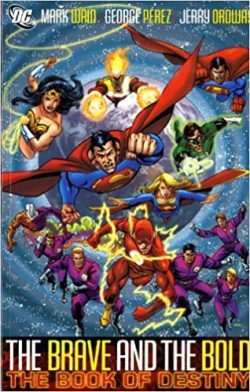
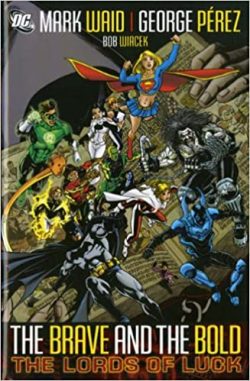
The Brave and the Bold volumes 1 & 2: The Lords of Luck and The Book of Destiny


The Lords of Luck By Mark Waid & George Pérez & various (DC Comics)
ISBN: 978-1-84576-649-8 (US HB) 978-1-84576-649-8 (TPB)

There are so many great graphic novels and compilations available these days that it’s always a shock when I realise how many more are still out of print. Here’s a classic example just begging for revival and digital editions…

The Brave and the Bold: The Lords of Luck collects the first 6 issues of another revival of a venerable DC title (technically volume 3 and spanning April -September 2007): returning it not only to the fitting team-up format we all enjoyed, but doing so with such style, enthusiasm and outright joy that I’m reduced to a gawping, drooling nine-year-old again.

Here Mark Waid, George Pérez and inkers Bob Wiacek & Scott Koblish crafted an intergalactic romp through time and nether dimensions, ripping across the DC Universe in a funny, thrilling and immensely satisfying murder-mystery-come-universal-conquest saga.

When Batman and Green Lantern (in part one ‘Roulette’ and concluding episode ‘The Girl Who Knew Too Much’) discover absolutely identical corpses hundreds of miles apart it sets them on the trail of probability-warping aliens and the missing Book of Destiny – a mystical chronicle of everything that ever was, is, and will be!

And yes, that makes this a notional tie-in to The Sandman series by Neil Gaiman and his coterie of classy creatives…

Each issue/chapter highlights a different team-up and eventually the hunt by Adam Strange, Blue Beetle (‘The Lord of Time’), Destiny (of the Endless, no less in chapter 4 ‘The Garden of Destiny’), the Legion of Super Heroes (‘The Batman of Tomorrow’), Lobo, Supergirl (‘Ventura’) and a mystery favourite from long-ago (you’ll thank me for not blowing the secret, honestly!) plus an incredible assortment of cameo stars coalesces into a fabulous free-for-all that affirms and reinforces all the reasons I love this medium.

With the value-added bonus of an annotated exploration of Waid & Pérez’s creative process to entrance the aspiring creator-of-tomorrow, this is a great story with great art, and is perfect for all ages to read and re-read over and over again. So let’s hope that happens soon…

© 2006, 2007 DC Comics. All Rights Reserved.
 

The Book of Destiny

By Mark Waid, George Pérez, Jerry Ordway, Bob Wiacek & Scott Koblish (DC Comics)

ISBN: 978-1-4012-1838-6 (HB) 978-1-4012-1861-4 (TPB)

The Book of Destiny is a mystical ledger which charts the history, progress and fate of all Reality and everything in it – except for the four mortals entrusted with its care at the end of The Brave and the Bold: The Lords of Luck. The death-defying Challengers of the Unknown – cool pilot Ace Morgan, indomitable strongman Rocky Davis, intellectual aquanaut Prof. Haley and daredevil acrobat Red Ryan – live on borrowed time and were bequeathed the terrifying tome by Destiny of the Endless since their lives are no longer included within its horrifying pages…

After the staggering spectacle of the previous Brave and the Bold story-arc, here Waid & Pérez, with inkers Bob Wiacek & Scott Koblish are joined by co-penciller Jerry Ordway for a stunning sequel featuring most of the DC universe…

This compilation collects issues #7-12 (volume 3 from December 2007-June 2008) of the high-energy, all-star revival of the venerable DC title: playing novel games with traditional team-up format as a mysterious mage begins manipulating heroes and villains in a diabolical alchemical scheme to transform the cosmos fundamentally and forever…

Beginning with ‘Scalpels and Chainsaws’ – wherein Wonder Woman and the ever-abrasive Power Girl rub each other the wrong way (oh please, what are you, ten!?) whilst tackling an undead invasion, the case takes a stranger turn and Kara-Zor-L accidentally discovers the Caped Kryptonian has been brainwashed into trying to murder her cousin Superman

Their ill-tempered investigations lead to the fabled Lost Library of Alexandria and a disastrous confrontation with the deranged Dr. Alchemy, but he too is only a pre-programmed pawn – of a sinister presence called Megistus – who needs Power Girl to use the mystical artefact known as the Philosopher’s Stone to turn the Fortress of Solitude into pure Red Kryptonite…

Thanks to Wonder Woman’s battle savvy, the plot is frustrated and the stone thrown into the sun… just as Megistus intended…

All this has been perused in the mystic chronicle by the Challengers and their fifth member Dr. June Robbins – whose merely mortal existence and eventual doom are tragically recorded in the Book. They rush off to investigate a universe-rending menace even as ‘Wally’s Choice’ brings The Flash and his rapidly aging children Jai and Iris West into unwelcome contact with manipulative genius Niles Caulder and his valiant Doom Patrol. “The Chief” claims he can cure the twins’ hyper-velocity malady, but Caulder never does anything for selfless reasons…

With no other hope, Wally and wife Linda acquiescence to the mad genius’ scheme – which relies on using elemental hero Rex Mason to stabilise their kids’ critical conditions. It might have worked, had not Metamorpho been mystically abducted mid-process – consequently transforming the children into bizarre amalgams of Negative Man and Robot Man

Worst of all, Flash is almost forced to choose which child to save and which should die…

Thinking faster than ever, the Scarlet Speedster beats the odds and pulls off a miracle but, in a distant place, the pages of the Book are suddenly possessed and abruptly attack the Challengers…

‘Changing Times’ features a triptych of short team-up tales which play out as the Men that History Forgot battle a monster made of Destiny’s pages, beginning as the robotic Metal Men joined forces with young Robby Reed who could become a legion of champions whenever he needs to Dial H for Hero.

Sadly not even genius Will Magnus could have predicted the unfortunate result when crushingly shy robot Tin stuck his shiny digit in the arcane Dial…

Next, during WWII the combative Boy Commandos are joined by The Blackhawks in battling animated mummies intent on purloining the immensely powerful Orb of Ra from a lost pyramid, after which perpetually reincarnating warrior Hawkman joined All-New Atom Ryan Choi in defending Palaeolithic star-charts from the marauding Warlock of Ys.

None of them are aware that they are doing the work of malignly omnipresent Megistus…

The fourth chapter paralleled the Challengers’ incredible victory over the parchment peril with a brace of tales seeing the Man of Steel travel to ancient Britain to join heroic squire Brian of Kent (secretly the oppression-crushing Silent Knight) in bombastic battle against a deadly dragon, whilst the Teen Titan’s untold second ever case finds Robin, Wonder Girl and Kid Flash in Atlantis for the marriage of Aquaman and Mera.

Unfortunately Megistus’ drone Oceanus crashes the party, intent on turning Aqualad into an enslaved route map to the future…

And in California, the Challengers attempted to save Green Lantern’s Power Battery from being stolen only to find it in the possession of an ensorcelled Metamorpho…

As the Element Man easily overwhelms Destiny’s Deputies, Jerry Ordway assumed the penciller’s role for issues #11-12.

‘Superman and Ultraman’ saw the natural enemies initially clash and then collaborate at the behest of an alternate universe’s Mr. Mixyezpitelik, who reveals the appalling scope and nature of Megistus’ supernal transformational ambitions, leading to a gathering of the heroic clans and a blistering Battle Royale in the roaring heart of the Sun…

With the fate of reality at stake and featuring a veritable army of guest stars ‘The Brave and the Bold’ concludes the saga with a terrible, tragic sacrifice from the noblest hero of all, whilst subtly setting the scene for the then-upcoming Final Crisis

With fascinating designs and pencil drawings from Ordway to tantalise the art lovers, this second captivating collection superbly embodies all the bravura flash’n’dazzle thrills superhero comics so perfectly excel at. This is a gripping fanciful epic with many engaging strands perfectly coalescing into a frantic and fabulous free-for-all overflowing with all the style, enthusiasm and exuberant joy you’d expect from top costumed drama talents.

The Brave and the Bold: The Book of Destiny is another great story with great art, ideal for kids of all ages to read and re-read over and over again.
© 2007, 2008 DC Comics. All Rights Reserved.
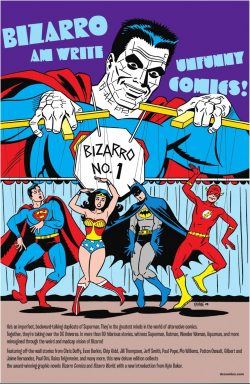
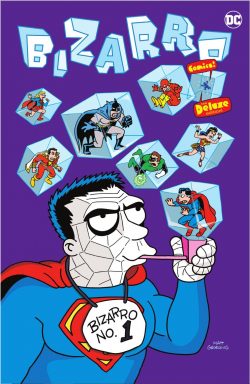
Bizarro Comics! – The Deluxe Edition


By a big bunch of very funny people AKA Jessica Abel, Todd Alcott, Rick Altergott, Peter Bagge, Kyle Baker, Gregory Benton, Charles Berberian, Aaron Bergeron, Nick Bertozzi, Ariel Bordeaux, Rand & David Borden, Ivan Brunetti, Eddie Campbell, Jim Campbell, Dave Cooper, Leela Corman, Mark Crilley, Jef Czekaj, Farel Dalrymple, Brian David-Marshall, Paul Dini, Paul Di Filippo, D’Israeli, Evan Dorkin, Mike Doughty, Eric Drysdale, Ben Dunn, Philippe Dupuy, Sarah Dyer, Phil Elliott, Hunt Emerson, Maggie Estep, Bob Fingerman, Abe Foreu, Ellen Forney, Liz Glass, Paul Grist, Matt Groening, Tom Hart, Dean Haglund, Tomer & Asaf Hanuka, Dean Haspiel, Danny Hellman, Sam Henderson, Gilbert Hernandez, Jaime Hernandez, Matt Hollingsworth, Paul Hornschemeier, Dylan Horrocks, Nathan Kane, John Kerschbaum, Chip Kidd, Derek Kirk Kim, James Kochalka, John Krewson, Michael Kupperbaum, Tim Lane, Roger Langridge, Carol Lay, Jason Little, Lee Loughridge, Matt Madden, Tom McCraw, Pat McEown, Andy Merrill, Scott Morse, Peter Murrietta, Tony Millionaire, Jason Paulos, Harvey Pekar, Will Pfeifer, Paul Pope, Patton Oswalt, Brian Ralph, Dave Roman, Johnny Ryan, Alvin Schwartz, Marie Severin, R. Sikoryak, Don Simpson, Jeff Smith, Jay Stephens, Rick Taylor, Raina Telgermeier, Craig Thompson, Jill Thompson, M. Wartella, Andi Watson, Steven Weissman, Mo Willems, Kurt Wolfgang, Bill Wray, Jason Yungbluth, & various (DC Comics)
ISBN: 978-1-7795-1012-9 (HB/Digital)

Here am big, dull shopping list of top-ranking cartoonists from beginning of twenty-oneth century. Bunch of names not very entertaining, but what they draw and write am, especially when taking loving pot-shots at beloved DC Comics icons and moments…

I’ll happily go on record and say that practically all of the fun and true creativity in comics has come out of the ‘alternative’ or non-mainstream writers and artists these days. To prove my point I’d list a bunch of things, and very near the top of that list would be this book -actually two older, smaller books sensibly nailed together in 2021.

In its near 90 years of comics publishing, DC Comics has produced many of the most memorable, most engaging and most peculiar comic characters and concepts you could imagine. For all that, they also managed to stir echoes and forge a deep and abiding affection in the hearts and minds of some of the most creative people on the planet.

As I’ve already said, the material in this titanic tome of titters (sorry, apparently I’m channelling my inner Frankie Howerd today) first emerged in a brace of cartoon anthology volumes: Bizarro Comics and Bizarro World in 2001 and 2005, disrespectively.

They delivered fast and furious skits, sketches and gags by profoundly engaged – often deeply disturbed – fans turned pros. There was a heavy dependence on small-press and self-published creators all used to having complete control of their work…

It was all meant to make you laugh and feel longing for simpler whackier times, and the Introduction by Kyle Baker should be all you need to steer you through what follows.

If I were you, I’d stop here and just buy the book, but just in case you’re a stubborn holdout, I’m going to add to my editor and proof-reader’s many woes by listing exactly who is in the thing, what they did and even add a few critical comments, just to earn my keep.

Then I’ll make my poor staff read the book too, just to cheer them up after all my word salad…

Following Matt Groening’s Bizarro Comics cover (which you get here for free) lurks a hilarious framing sequence, as a monstrous unbeatable creature attempts to conquer Mr Mxyzptlk’s 5th dimensional home. Chris Duffy & Stephen DeStefano – aided by legendary cartoonist and colourist Marie Severin – tell a weird and wonderful tale of outlandish failed Superman clone Bizarro that begins in ‘Bizarre Wars Part One’ and diverges into a wonderland of individual battles against cosmic games player A.

As the appointed defender of the entire endangered dimension, Bizarro resorts to a heretofore unsuspected ultimate power: producing comic strips featuring unfamiliar adventures of DC’s most recognizable heroes that come to life …ish.

Cue a veritable Who’s Who of the cool and wonderful of modern comics creating a plethora of wacky, dreamy, funny, wistful and just plain un-put-downable strips that would delight any kid who read comics but then accidentally grew up.

In rapid rollercoaster fashion and Fighting the Goof Fight for reality come ‘Bizarro-X-Ray One’ by Gregory Benton, Bizarro-X-Ray Two’ by John Kerschbaum and Bizarro-X-Ray Three’ by Gilbert Hernandez – all coloured by Tom McCraw. Sam Henderson & Bob Fingerman reconvene the ‘Super-Pets’ whilst Duffy & Craig Thompson expose Green Lantern in ‘The Afterthoughts’. Chip Kidd & Tony Millionaire revisit early days of ‘The Bat-Man’ in stylish monochrome before Henderson, Dean Haspiel, Bill Oakley & Matt Madden recount the silly charm-packed saga of ‘Captain Marvel and the Sham Shazam’

Baker & Elizabeth Glass test the mettle of ‘Letitia Lerner, Superman’s Babysitter!’ and Aquaman endures double trouble as Evan Dorkin, Brian David-Marshall, Bill Wray & Matt Hollingsworth draw attention to ‘Silence of the Fishes’ before Andy Merrill & Jason Little douse the Sea King in ‘Porcine Panic!’

Fingerman, Pat McEown, Oakley & Hollingsworth inflict ‘The Tinnocchio Syndrome’ on The Metal Men before Andi Watson, Mark Crilley & Lee Loughridge orchestrate ‘Wonder Girl vs Wonder Tot’ and James Kochalka, Dylan Horrocks & Abe Foreau pit Hawkman against ‘The Egg-Napper!’, even as ‘The GL Corps: The Few, The Proud’ glean more story glory courtesy due to Will Pfeifer, Jill Thompson, Clem Robins, Rick Taylor & Digital Chameleon.

Horrocks, Jessica Abel & Madden then see Supergirl and Mary Marvel have a moment in ‘The Clubhouse of Solitude’ whilst Nick Bertozzi & Tom Hart tune in to ‘Kamandi: The Last Band on Earth!’ before Jeff Smith, Paul Pope & Loughridge depict Bizarro demanding ‘Help! Superman!’ as Jef Czekaj & Brian Ralph confront Aquaman with ‘The Man Who Cried Fish!’ in advance of Wonder Woman pondering ‘One-Piece, Two-Piece, Red-Piece, Blue-Piece’ on a shopping trip organised by Fingerman & Dave Cooper.

Ellen Forney, Ariel Bordeaux & Madden probe a young girl’s ‘Bats Out of Heck’ and Eddie Campbell, Hunt Emerson, Rick Taylor & Digital Chameleon went full-on Batmaniacal in ‘Who Erased the Eraser’ before Crilley & Watson negotiate a shocking ‘First Contact’ with The Atom, after which The Batman invites us ‘Inside the Batcave’ with Pope & Jay Stephens as tour guides.

Dorkin, D’Israeli & Digital Chameleon expose ‘Solomon Grundy: Bored on a Monday’ before Alvin Schwartz, Roger Langridge & Loughridge debut ‘The Most Bizarre Bizarro of All’ and Ivan Brunetti, Dorkin & Sarah Dyer reveal ‘That’s Really Super, Superman!’ to The World’s Finest Team whilst Dorkin, Carol Lay, Tom McCraw & Digital Chameleon invite everyone to ‘The J’onn J’onzz Celebrity Roast’ before Bordeaux, Forney & Madden share ‘Wonder Woman’s Day Off’

The initial volume and that framing Mxyzptlk yarn are coming to a close as Dorkin, Wray, John Costanza & Hollingsworth craft ‘Unknown Challenges of the Challengers of the Unknown’ and Dorkin, Steven Weissman & Dyer go to bat for all the forgotten creature sidekicks in ‘Without You, I’m Nothing’ before Duffy, DeStefano, Phil Felix, Severin & Digital C reunite for the climactic conclusion of ‘Bizarre Wars – Part Two’

If you haven’t heard of anybody on that overwhelming list then get Googling. Then get this book and get enjoying.

No? that’s okay… There’s More…

The turn of this century was a particularly fraught time – aren’t they always? – and one of the best ways to combat the impending travail was to make people laugh. A follow up to the remarkably successful Bizarro Comics again invited a coterie of alternative comics creators (and guests!) to make sport of various hallowed DC icons. Superman, Batman, Wonder Woman and all the lesser gods were dragooned into more tales humorous, dolorous and just plain peculiar, drawn in an eye-wrenching range of styles. Many of those involved continued to display a disturbing knowledge of, if not respect for, the DC continuity of the 1960s whilst others seem to centre on the TV and Movie interpretations, but the fondness for times gone by was readily apparent throughout.

Behind a Bizarro World cover from Jaime Hernandez, Rian Hughes & Coco Shinomiya is unsurprisingly story ‘Bizarro World’ by Duffy, Scott Morse, Rob Leigh & Dave Stewart as a couple of unwary kids fall into a universe stuffed to overflowing with everyday super people…

Answers come from a crusty reporter with extensive files and notes from many stringers…

Kidd, Millionaire & Jim Campbell review ‘Batman with Robin the Boy Wonder’ and Merrill, Langridge & Madden get seasonally silly in ‘Jing Kal-El’, whilst Mo Willems, Forney & Madden reveal ‘The Wonder of it All’ for the youthful feminist before Foreu, Kochalka & Madden have shapeshifter Chameleon Boy ask ‘Where’s Proty?’

Nostalgia and childish wish-fulfilment masterfully merge in pants-wettingly funny ‘Batman Smells’ by American National Treasures Patton Oswalt, Fingerman & Stewart, whilst Duffy & Craig Thompson channel ‘The Spectre’ and Jasons Yungbluth & Paulos confirm with Hal Jordan that ‘It’s Not Easy Being Green’ even as Aaron Bergeron & Kerschbaum revel in ‘The Power of Positive Batman’

Mike Doughty & Danny Hellman’s Fish-out-of-water ‘Aquaman’ segues into another true Stand Out story: ‘Batman: Upgrade 5.0’ by Dean Haglund & Peter Murrieta, illustrated by Don Simpson, before comics bad boy John Ryan joins Dave Cooper to explore being ‘Super-Dumped’ via the sad story of Clark and Diana

Elsewhere, Dorkin & M. Wartella retroactively introduce Batman to ‘Monkey, the Monkey Wonder’ whilst comics verité legends Harvey Pekar & Dean Haspiel declare ‘Bizarro Shmizarro’ just as Dylan Horrocks, Farel Dalrymple & Paul Hornschemeier proposition ‘Dear Superman’ on behalf of a youngster with a secret…

‘The Red Bee Returns’ courtesy of Peter Bagge, Gilbert Hernandez & Madden, after which Eric Drysdale, Tim Lane, Oakley & Madden organise ‘The Break’ for the JLA. Dorkin & Watson then find The Legion of Super-Heroes ‘Out with the In Crowd’ just as Todd Alcott, Michael Kupperman & Ken Lopez detail the ‘Ultimate Crisis of the Justice League’

Tomer & Asaf Hanuka join Lopez & Campbell to define ‘Batman’ whilst Paul Dini & Carol Lay have the very last word on ‘Krypto the Superdog’ and Ariel Bordeaux & Rick Altergott unwisely launch ‘Legion.com’ before mercurial Harvey Dent enjoys a ‘Dinner for Two’ thanks to Dorkin & Iva Brunetti…

Maggie Estep & Horrocks take on ‘Supergirl’ and her horsey history before Leela Corman & Tom Hart steer a ‘Power Trip’ for Batgirl, Wonder Woman and the Girl of Steel, whilst Eddie Campbell, Paul Grist & Phil Elliott schedule ‘A Day in the Life in the Flash’ before hilariously reprising their manic madness via ‘The Batman Operetta’

Bizarro returns in an activity page from his ‘Daily Htrae’ – by Dorkin & R. Sikoryak – and the GL Corps turn Japanese in ‘Lantern Sentai’ from Rand & David Borden of Studio Kaiju, manifested by multi-talented Benn Dunn. Philippe Dupuy & Charles Berberian then offer a continental touch in ‘Batman of Paris’, Kurt Wolfgang & Brian Ralph have fun with ‘The Demon’ and John Krewson, Dorkin & Dyer expose ‘Kamandi, The Laziest Boy on Earth’.

Despite all the craziness, the best has wisely been left until last and end begins with The Justice League of America regretting ‘Take Your Kids to Work Day’ (by Dave Roman & Raina Telgemeier) whilst ultimate manservant Alfred Pennyworth conducts his master’s business as a “Personal Shopper” thanks to Kyle Baker & Elizabeth Glass, before we finish with Deadman who learns with horror – from Paul Di Filippo & Derek Kirk Kim – that ‘Good Girls Go to Heaven. Bad Girls Go Everywhere’

What do you get if you give a whole bunch of vets and alternative comics creators carte blanche and a broad brief? You should get this.
© 2001, 2005, 2021 DC Comics. All rights reserved.

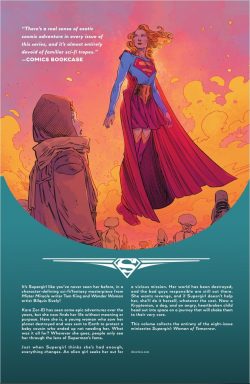
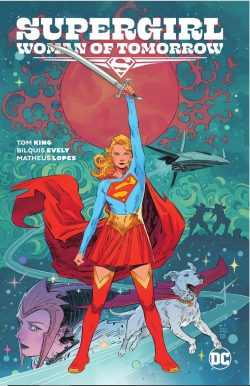
Supergirl: Woman of Tomorrow


By Tom King, Bilquis Evely, Matheus Lopes, Clayton Cowles & various (DC Comics)
ISBN: 978-1-7795-1568-1 (TPB/Digital edition)

As a rule, superhero comics don’t generally do whimsically thrilling anymore. They especially don’t do short or self-contained. Modern narrative momentum concentrates on continuous extended spectacle, major devastation and relentless terror and trauma. It also helps if you’ve come back from the dead once or twice and wear combat thongs and thigh boots…

Although there’s nothing intrinsically wrong with that – other than a certain inappropriateness in striving to adjust wedgies during a life-or-death struggle – sometimes the palate just craves a different flavour…

Once upon a time, angsty in-continuity cataclysm was the rule, not the exception, but ever since DC readmitted all its past epochs into one vastly welcoming expansion multiverse via the Dark Night: Death Metal, Future State and Infinite Frontier mega-events, a spirit of joyous experimentation has resulted in some truly memorable storytelling.

This decidedly backward-looking modern fable harks back to simpler days of clearly defined plots, solid, imaginative characterisation and suspensefully dramatic adventure, by way of an almost alternative take on redoubtable Kara Zor-El, late of Krypton’s Argo City and another illegal alien immigrant on Earth.

Supergirl first gained popularity as a back-up feature in Action Comics: a tag-along (and trademark protection device) to her more illustrious cousin. After years of faithful service, in 1985 she was killed as a sales gimmick in the groundbreaking Crisis on Infinite Earths. Since then, a number of characters have used the name – but none with the class or durability of the original.

This latest incarnation cunningly references much of the original’s trappings, but combines stellar whimsy, dark modern attitudes and an edgier twist, as befits today’s readership. Written by Tom King (Mister Miracle, The Vision, The Sheriff of Babylon, Omega Men, Strange Adventures, Batman) and delightfully illustrated by Brazilian artist Bilquis Evely (Wonder Woman, The Dreaming, Detective Comics, Shaft: a Complicated Man) in a deliriously addictive, retro-futurist pulp style, it examines the concepts of justice and power of reputation through the wide eyes of a worshipful child who is both outraged orphan and lonely sidekick/secret weapon in waiting…

After a few intriguing concept-tweaking test-runs, the first true Girl of Steel debuted as a future star of the ever-expanding Superman pocket universe in Action Comics #252 (cover-dated May 1959). Superman’s cousin had been born on a city-sized fragment of Krypton, hurled intact into space when the planet exploded. Eventually, Argo turned to Kryptonite like the rest of the detonated world’s debris, and Kara’s dying parents, observing Earth through their viewer scopes, sent their daughter to safety even as they apparently perished.

Crashlanding, she immediately and fortuitously met the Metropolis Marvel, who created a cover-identity: hiding “Linda Lee in an orphanage in bucolic Midvale so that she could adjust to and learn about her new world whilst mastering her powers in secrecy and safety.

…And isolation. At no stage did anyone consider moving the recent orphaned newcomer in with her only surviving family. Kara reached her maturity without the closeness Clark Kent’s human parents provided …although she was eventually adopted by Earth couple Fred and Edna to become Linda Lee Danvers

Supergirl experienced her own secret double life in the rear of Action Comics: gradually moving from Superman’s covert secret weapon to an independent star turn, and from minor player to acclaimed public celebrity. From the back of the book to the front of the house is always a reason to celebrate, right?

For decades, DC couldn’t make up their minds over Supergirl. I’ve actually lost count of the number of different versions to have cropped up over the years, and never been able to shake a queasy feeling that above all else she’s a concept that was cynically shifted from being a way to get girls to reading comic books to one calculated to ease young male readers over the bumpy patch between sporadic chin-hair outbreaks, voice-breaking and that nervous period of hiding things under your mattress where your mum never, never ever looks…

Her popularity waxed and waned until her attention-grabbing death during Crisis on Infinite Earths. However, in the aftermath – once John Byrne had successfully rebooted the Man of Steel and negated her existence along with all other elements of doomed Krypton – non-Kryptonian iterations began to appear: each accumulating a legion of steadfast fans. Ultimately, early in the 21st century, DC’s Powers-That-Be decided the real Girl of Steel should come back… sort of…

The New 52 company-wide reboot recast her as an angry, obnoxious distrustful teen fresh from Argo, before the 2016 DC: Rebirth event unwrote most of those changes: bringing back much of that original origin material whilst aligning the comic book iteration with the popular TV series broadcast from October 2015 to November 2021. Then under the aegis of the Infinite Frontier revolution, King, Evely, colourist Mat Lopes & letterer Clayton Cowles crafted 8-issue limited series Supergirl: Woman of Tomorrow (cover-dated August 2021-April 2022).

This focussed on a major moment in the hero’s life and how it changed everything…

King was inspired by Charles Portis’ 1968 novel True Grit – and both movie adaptations – to cast Supergirl as mentor to a vengeance-obsessed child: tracing how a united quest/journey reshaped both of them. Employing the latitude afforded by IF’s umbrella premise, he incorporated iconic characters and trappings from various iterations of Kara’s many super-lives. The result is pure magic, made real by Bilquis and her visual collaborators.

Wordy and wondrous, colours and calligraphy are key components of this space opera, which opens with youthful narrator Ruthye Marye Knoll disclosing how she first met an alien voyager after merciless bandit Krem of the Yellow Hills butchered her father…

Intent on rightful retribution, little Ruthye tracks the killer to a tavern in ‘Men, Women, and Dogs’, encountering a violent drunken woman from another world. Supergirl was on this unnamed backwater red sun world with frivolous intent: it was her 21st birthday and she wanted to get really, really drunk…

Things go bad when Supergirl tries to help her get justice. The intergalactic warrior seriously underestimates Krem, and nearly dies when he puts three arrows through her chest, before apparently killing her dog Krypto and stealing her spaceship…

Barely alive, Kara agrees to let Ruthye help her hunt Krem down: travelling so very slowly by commercial starship and encountering the full annoying range of sentient lifeforms – and a deadly space dragon – in ‘Wounded, Stranded, and Impotent’, before finally reaching a region of space where yellow suns can recharge her…

Stranded on tourist trap Coronn for weeks, they jointly expose appalling racist atrocity in ‘Modest, Calm, and Quiet’ and learn the quarry has joined Barbond’s Brigands: a marauding fleet of space plunderers who become Supergirl’s greatest concern after their latest raid exterminates an entire species in ‘Restraint, Endurance, and Passion’.

Repeated close encounters with them result in furious frustration as Krem has mastered a mystic banishment spell that deposits his pursuers all over the cosmos. Slowly, steadily, Supergirl and Ruthye close in, with the latter honing her skills in eager anticipation of bloody revenge, despite anything Kara can say to dissuade her. Repeatedly fighting a succession of colossal lizard beasts, and enduring a slow painful death and resurrection, does nothing to help their moods either in ‘The Lake, the Trees, and the Monsters’

Finally – reinforced by magical superhorse Comet – the seekers capture Krem and spectacularly engage the brigands in ‘Home Family, and Refuge’ and ‘Hope, Help, and Compassion.’, but the outcome is shockingly unexpected …and tragic.

Final chapter ‘Ruthye, Supergirl, and Krem of the Yellow Hills’ delivers major emotional and conceptual payoffs as antagonists and protagonists take their vendetta to its foregone conclusion. The vengeful child fulfils her quest, but learns some adult truths…

Supplemented by a covers-&-variants gallery by Evely, Lopes, Gary Frank & Alex Sinclair, Lee Weeks, David Mack, Rose Besch, Amy Reeder, Steve Rude, Nicola Scott & Annette Kwok and Janaina Medeiros, this book includes a stunning swathe of character and costume designs, to augment a tale profoundly and consciously mythic in scope and execution.

The apparent maiming and deaths of beloved characters – and animals at that! – and epic transitions and evolutions of the twin leads are potently and evocatively depicted against a universe of inspirational wonders and casual horrors, allowing us to see how heroes are forged, and the device of using a childlike Boswell to define Supergirl’s humanity is both compelling and revelatory.

A cosmic odyssey in the grandly poetic idiom of Jack Vance and Samuel R. Delaney, realised via retro-futuristic visuals reminiscent of Roy G. Krenkel, Jack Katz and Michael William Kaluta, Supergirl: Woman of Tomorrow is a mesmerising mix of space opera and superhero drama exploring the mechanics of myths and power of storytelling on a multitude of levels.

It’s also a sublime rollercoaster ride of vivid, cathartic joy for old fans and newcomers alike: one every fantasy and adventure lover must see.
© 2022 DC Comics. All Rights Reserved.
Legion of Super-Heroes: The Silver Age volume 1


By Otto Binder, Jerry Siegel, Edmond Hamilton, Robert Bernstein, Al Plastino, George Papp, Jim Mooney, Curt Swan, John Forte & various (DC Comics)
ISBN: 978-1-4012-8157-1 (TPB/Digital edition)

Once upon a time, in the far future, a super-powered kids from dozens of alien civilisations took inspiration from the greatest legend of all time and formed a club of heroes. One day those Children of Tomorrow came back in time and invited that legend to join them…

And thus began the vast and epic saga of the Legion of Super-Heroes, as first envisioned by writer Otto Binder & artist Al Plastino in early 1958, just as the revived comic book genre of superheroes was gathering an inexorable head of steam. Since that time the fortunes and popularity of the Legion have perpetually waxed and waned, with their future history tweaked and rebooted, retconned and overwritten again and again to comply with editorial diktat and popular whim.

This glorious, far-and-wide ranging collection assembles the numerous preliminary appearances of the valiant Tomorrow People and their inevitable progress towards and attainment of their own feature. It includes all pertinent material from Adventure Comics #247, 267, 282, 290, 293, and 300-310, Action Comics #267, 276, 287, 289, Superboy #86, 89, 98 and Superman #147, cumulatively spanning April 1958 through July 1963.

Happy anniversary!

The many-handed mob of juvenile universe-savers eponymously premiered in Adventure Comics #247 (cover-dated April 1958) in Superboy tale ‘The Legion of Super-Heroes!’ wherein three mysterious kids invited the Boy of Steel to the 30th century to join a club of metahuman champions inspired by his life.

Devised by Otto Binder & Al Plastino, the throwaway concept gripped public imagination and, after frequent further appearances throughout Superman Family titles, the LSH eventually took over the Boy of Steel’s lead spot in Adventure for their own far-flung, quirky escapades, with the Caped Kid Kryptonian reduced to merely “one of the in-crowd”…

However, here the excitement is still gradually building as the kids return 18 months later in Adventure #267 (December 1959) for Jerry Siegel & George Papp to play with. In ‘Prisoner of the Super-Heroes!’ the teen wonders attack and incarcerate the Boy of Steel because of a misunderstood ancient record they have uncovered…

The following summer Supergirl met the Legion in Action Comics #267 (August 1960, by Siegel & Jim Mooney) as Lightning Lad, Saturn Girl and Cosmic Boy secretly travel to “modern day” America and invite the Maid of Might to join the team, in a repetition of their offer to Superboy 15 years previously (in nit-picking fact they claimed to be the children of the original team – a fact glossed over and forgotten these days: don’t time-travel stories make your head hurt?).

Due to a dubious technicality, young and overeager Kara Zor-El fails her initiation task at the hands of ‘The Three Super-Heroes’ and is asked to reapply later – but at least we get to meet a few more Legionnaires, including Chameleon Boy, Invisible Kid and Colossal Boy

With editors still cautiously testing the waters, it was Superboy #86 (cover-dated January 1961 but on sale in November 1960) before ‘The Army of Living Kryptonite Men!’ (by Siegel & Papp) turned the LSH into a last-minute Deus ex Machina to save the Smallville Sentinel from juvenile delinquent Lex Luthor’s most insidious assault.

Two months later in Adventure #282, Binder & Papp introduced Star Boy as a romantic rival for the Krypton Kid in ‘Lana Lang and the Legion of Super-Heroes!’

For Action #276 (May 1961) Siegel & Mooney debuted ‘Supergirl’s Three Super Girl-Friends’, which finally saw her crack the plasti-glass ceiling and join the team, sponsored by Saturn Girl, Phantom Girl and Triplicate Girl. We also met for the first time Bouncing Boy, Shrinking Violet, Sun Boy and potential bad-boy love-interest Brainiac 5 (well, at least his distant ancestor Brainiac was a very bad boy…)

Next comes a pivotal tale as ‘Superboy’s Big Brother’ (by Robert Bernstein & Papp from Superboy #89, June 1961) reveals how an amnesiac, super-powered space traveller crashes in Smallville, speaking Kryptonese and carrying star-maps written by the Boy of Steel’s long-dead father…

Jubilant, baffled and suspicious in equal amounts, Superboy eventually, tragically discovers ‘The Secret of Mon-El’ after accidentally exposing the stranger to a lingering, inexorable death, before providing critical life-support by desperately depositing the dying alien in the timeless Phantom Zone until a cure can be found…

With an August 1961 cover-date Superman #147 unleashed ‘The Legion of Super-Villains!’ (Siegel, Curt Swan & Sheldon Moldoff): a stand-out thriller featuring the adult Luthor and correspondingly mature wicked future bad guys coming far too close to destroying the Action Ace …until the temporal cavalry arrives…

Bernstein & Papp seemingly give Sun Boy a starring role in ‘The Secret of the Seventh Super-Hero!’ (Adventure #290, November 1961), followed by a clever tale of redemptive second chances followed in #293 (February 1962) in a gripping thriller from Siegel, Swan & George Klein. ‘The Legion of Super-Traitors’ posits the future heroes turning evil, prompting Saturn Girl to recruit a Legion of Super-Pets including Krypto, Streaky the Super Cat, Beppo, the monkey from Krypton and magical Superhorse Comet to save the world…

Siegel & Mooney set ‘Supergirl’s Greatest Challenge!’ in Action #287 (April 1962) seeing her visit the Legion (quibblers be warned: for some reason it was mis-determined as the 21st century in this story) to save future Earth from invasion. She also met a telepathic descendent of her cat Streaky. His name was Whizzy (I could have omitted that fact but chose not to – once again for smug, comedic effect and in sympathetic solidarity with cat owners everywhere…)

Action #289 originally hosted ‘Superman’s Super-Courtship!’ wherein the Girl of Steel scours the universe for an ideal mate for her cousin. One highly possible candidate is the adult Saturn Woman, but for some reason her husband Lightning Man objects…

Modern sensibilities might quail at the conclusion but at that time his obvious perfect match was a doppelganger of Supergirl herself… albeit thankfully a little bit older…

By the release of Superboy #98 (July 1962), the decision had been made. The buying public wanted more Legion stories and after ‘The Boy with Ultra-Powers’ (Siegel, Swan & Klein) introduced a mysterious lad with greater powers than the Boy of Steel, focus shifted to Adventure Comics where #300 (cover-dated September 1962) proudly saw the futuristic super-squad finally land their own gig: even occasionally taking an alternating cover-spot from the still top-featured Boy of Steel.

Tales of the Legion of Super-Heroes opened its stellar run with ‘The Face Behind the Lead Mask!’ by Siegel, John Forte & Plastino: a fast-paced premier pitting Superboy and the 30th century champions against an impossibly unbeatable foe until Mon-El, long-trapped in the Phantom Zone, briefly escapes a millennium of confinement to save the day…

In those halcyon days humour was as important as action, imagination and drama, so many early exploits were light-hearted and moralistic. Adventure #301 offered hope to fat kids everywhere with ‘The Secret Origin of Bouncing Boy!’ by regular creative team Siegel & Forte, wherein the process of open auditions was instigated.

These provided fans with dozens of truly bizarre and memorable applicants over the years but here allows the rebounding human rotunda to deliver a salutary pep talk and inspirational account of heroism persevering to triumph over adversity.

Adventure #302 featured ‘Sun Boy’s Lost Power!’ with the golden boy forced to resign until fortune and boldness restore his abilities, after which ‘The Fantastic Spy!’ in #303 sparks a tense tale of espionage and potential betrayal by new member Matter-Eater Lad.

The happy readership was stunned by the events of #304 when Saturn Girl engineered ‘The Stolen Super-Powers!’ to make herself a one-woman Legion. Of course, it was for the best possible reasons, but still didn’t prevent the shocking murder of Lightning Lad…

As a result she was elected Legion leader – at that time the first female to ever lead a comic book team.

With comfortable complacency utterly destroyed, #305 further shook everything up with ‘The Secret of the Mystery Legionnaire!’ who turns out to be long-suffering Mon-El, finally cured and freed from his Phantom Zone prison.

Normally I’d try to be more obscure about story details – after all my intention is to get new people reading old comics – but these “spoiler” revelations are crucial to further understanding here and besides you all know these characters are still around, don’t you?

Pulp sci fi author Edmond Hamilton took over the major scripting role with Adventure #306, introducing ‘The Legion of Substitute Heroes!’ (still quirkily, perfectly illustrated by John Forte): a group of rejected audition applicants selflessly banding together and clandestinely assisting the champions who had spurned them, after which transmuting orphan Element Lad joins the big league.

He seeks vengeance upon the space pirates who had wiped out his entire species in ‘The Secret Power of the Mystery Super-Hero!’ whilst in #308 readers seemingly saw ‘The Return of Lightning Lad!’

Actual Spoiler Warning: skip to the next paragraph NOW!!!

Otherwise you’ll find out it was actually his similarly empowered sister who – once unmasked and unmanned – took her brother’s place as Lightning Lass

Penultimate escapade ‘The Legion of Super-Monsters!’ was a straightforward clash with embittered applicant Jungle King who took his rejection far too personally and gathered a deadly clutch of space beasts to wreak havoc and vengeance, after which the future tension temporarily subsides with ‘The Doom of the Super-Heroes!’ from #310: a frantic battle for survival against an impossible foe

The Legion is undoubtedly one of the most beloved and bewildering creations in American comic book history and largely responsible for the growth of the groundswell movement that became Comics Fandom.

Moreover, these sparkling, simplistic and devastatingly addictive stories, as much as the legendary Julie Schwartz Justice League, fired up the interest and imaginations of a generation of young readers and built the industry we all know today.

These naive, silly, joyous, stirring and utterly compelling yarns are precious and fun beyond any ability to explain – even if we old lags gently mock them to ourselves and one another. If you love comics and haven’t read this stuff, you are the poorer for it and need to enrich your future life as soon as possible.
© 1958-1963, 2018 DC Comics. All Rights Reserved.
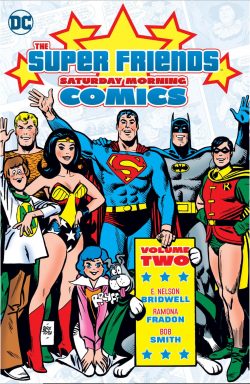
Super-Friends: Saturday Morning Comics volume 2


By E. Nelson Bridwell, Bob Rozakis, Martin Pasko, Bob Oksner, Ramona Fradon, Kurt Schaffenberger, Romeo Tanghal, Joe Staton, Bob Smith, Vince Colletta & Kim DeMulder with Alex Toth & various (DC Comics)
ISBN: 978-1-7795-0592-7 (HB/Digital edition)

Win’s Christmas Gift Recommendation: Absolute Entertainment Perfection… 9/10

Once upon a time comics were primarily created with kids in mind and, whilst I’d never advocate exclusively going back to those days, the modern industry has for the longest time sinned by not properly addressing the needs and tastes of younger fans these days. Happily, DC has latterly been rectifying the situation with a number of new and – most importantly for old geeks like me – remastered, repackaged age-appropriate gems from their vast back catalogue.

A superb case in point of all-ages comics done right is this massive tome. And don’t stress the title: it may celebrate the joys of past childhood shows but this is definitely a great big Sunday “settle back and luxuriate” treat…

The Super Friends: Saturday Morning Comics gathers comic book tales spun off from a popular Saturday Morning TV Cartoon show of the 1970s: one that – thanks to the canny craftsmanship and loving invention of primary scripter E. Nelson Bridwell – became an integral and unmissable component of the greater DC Universe, as a well a key supplier of fresh fodder to enhance its all-encompassing omniverse. So very many of his supporting characters became superstars in their own right and trappings such as the junior characters, villains and the Hall of Justice are now key components of today’s overarching continuity…

The Super Friends was also one of the most universally thrilling and satisfying superhero titles of the period for older fans: featuring the type of smart and witty, straightforward adventures people my age grew up with, produced during a period when the entire industry was increasingly losing itself in colossal continued storylines and bombastic, convoluted, soap opera melodrama.

It’s something all creators should have tattooed on their foreheads: sometimes all you really want is a smart plot well illustrated, sinister villains well-smacked, a solid resolution and early bed…

Under various guises, the TV show Super Friends ran from 1973 to 1986: a vehicle for established television-alumni Superman, Batman and Robin, Aquaman and Wonder Woman, supplemented by a succession of studio-originated kids as student crimebusters. The show also offered airtime to occasional guest stars from the DCU on a case by case basis. The animated show made a hugely successful transition to print as part of the publisher’s 1976 foray into “boutiqued” comics which saw titles with television connections cross-marketed as “DC TV Comics”.

Child-friendly Golden Age revival Shazam! – the Original Captain Marvel had been adapted into a popular live action series and its Saturday Morning silver screen stablemate The Secrets of Isis consequently reversed the process by becoming a comic book. With the additions of hit comedy show Welcome Back Kotter and animated blockbuster Super Friends’ four-colour format, DC had a neat little outreach imprimatur tailor-made to draw viewers into the magic word of funnybooks.

At least, that was the plan: with the exception of Super Friends, none of the titles lasted more than 10 issues…

This massive mega-extravaganza (the second of 2) gathers Super Friends #27-47, The Super Friends Special #1, The Best of DC: Blur Ribbon Digest #3, Limited Collectors’ Edition C-41 and Super Friends!: Truth Justice and Peace! (collectively spanning December 1979 to August 1981), ending the initial run whilst sharing material from assorted reprints and one-shots.

The majority of stories were by E. Nelson Bridwell & Ramona Fradon (Aquaman; Batman; Metamorpho the Element Man; The Brave and the Bold; Brenda Starr, Reporter). Bridwell (Secret Six; Inferior Five; Batman; Superman; The Flash; Batman and Robin newspaper strip; Legion of Super-Heroes; Captain Marvel/Shazam!) had been one of the art form’s earliest mega-fans, turning his hobby into a career in the 1950s.

He was justly renowned as DC’s Keeper of Lore and Continuity Cop – thanks to an astoundingly encyclopaedic knowledge of publishing minutiae and ability to instantly recall every damn thing about anything! Thankfully, he was also an ingenious and supremely witty writer. Fradon was a pioneering artist who also got her start in the 1950s, graced with a uniquely smooth and accessible style. She became one of comics’ earliest (acknowledged!) female artists and was a fan-favourite for generations.

Neither Bridwell or Fradon considered working at the junior end of the market as in any way less important or prestigious than the auteur/adult drama sector just starting to manifest in the American industry…

When Super Friends first aired, the costumed champions were mentors to two kids and their pet: tasked with training the next generation of superheroes. Without warning or explanation, Wendy, Marvin and Wonderdog were replaced for the second television season by alien shapeshifters Zan and Jayna and their elastic-tailed space monkey Gleek. In the comics – with more room to extrapolate and far more consideration for the fans – Bridwell turned the cast change into an extended epic.

When two siblings from distant planet Exor – a girl able to transform into animals and a boy who can become any form of water from steam to ice – came to Earth with an urgent warning they saved the world and were marooned here.

Their integration became an ongoing plot strand with the adults (and Robin) not only training Zan and Jayna, but also jointly acclimating them and introducing them into human society…

This concluding compilation of thrilling fun resumes with The Super Friends #27 and ‘The Spacemen Who Stole Atlantis!’ (Bridwell, Fradon & inker Bob Smith) sees domed undersea city Poseidonis stolen away by ruthlessly curious alien scientists who had not factored in Earth’s greatest defenders.

Inked by Vince Colletta, the next issue detailed a ‘Masquerade of Madness!’ in a Halloween yarn packed with guest stars (including Etrigan the Demon, Solomon Grundy, Man-Bat, Swamp Thing and Jimmy “wolfboy” Olsen) as mystic malcontent Felix Faust crashes a costume ball, trapping attendees in their outfits until Bruce Wayne hands over a certain magical gem… And that’s when the other – untransformed – Super Friends step in…

Another extraterrestrial invasion by colonising invaders seeking to evict humanity manifests in #29, with the new bosses wielding technology that seems to make all resistance futile. However, Wonder Woman and the Wonder Twins find a work-around meaning the war can be won by the heroes making themselves ‘Invisible Defenders of Earth!’

The issue also offers an adventure of the Wonder Twins, who now have secret identities and live in the home of guardian Professor Carter Nichols – Bruce Wayne’s science advisor/time travel expert who debuted in Batman #24, August 1944.

Here Bridwell, Kurt Schaffenberger & Smith establish the ‘Scholars from the Stars’ as transfer students at Gotham Central High, but John and Joanna Fleming are soon being stalked by curious classmates eager to learn all they can about the strange newcomers…

Nichols plays a major role in #30 as Fradon-illustrated ‘Gorilla Warfare Against the Humans!’ sees the heroes battle super-primate Grodd and his ally Giganta as they deploy their new tech to transform men into apes…

Guest stars were always a big draw and #31’s ‘How to Trap an Orchid!’ (inked by Colletta) saw DC’s most enigmatic hero targeted and framed by a ruthless enemy and helped by the Friends before Schaffenberger pencilled and Smith inked #32’s ‘The Scarecrow Fights with Fear!’ as the Tyrant of Terror afflicts the heroes with crippling weaponised personal phobias that only teamwork and determination can overcome

Fradon & Colletta combine for ‘The Secret of the Stolen Solitaire!’ as obsessive old enemy Menagerie Man returns, still using trained animals to commit spectacular robberies. His schemes are derailed when Jayna becomes a famously extinct creature and is “captured”, leading the heroes and visiting VIP Hawkman to his lair and the Winged Wonder’s captive sidekick Big Red

With #34, two stories per issue became the norm, leading with Bridwell, Fradon & Colletta’s ‘The Creature That Slept a Million Years!’, in which a hibernating beast awakened on Earth causes inadvertent chaos, balanced by ‘The Boss and the Beast’ as John and Joanna Fleming help their favourite teacher by saving her husband from a crooked boss fitting him up for a life of crime…

Romeo Tanghal & Smith illustrate full-length spectacle ‘Circus of the Super-Stars’ as the Super Friends and their showbiz impersonators trade places to outwit crooks targeting a massive charity event, before #36 bifurcates with a brace of tales limned by Tanghal & Colletta. First up is ‘Warhead Strikes at Gotham’ with Plastic Man and Woozy Winks tracking a war-mongering maniac and overlapping with the Super Friends battle to stop a paramilitary criminal force, after which The Wonder Twins visit a museum in their school personas and discover the shocking truth about ‘The Dinosaur Demon!’

Fradon & Colletta depict #37’s ‘Bad Weather for Supergirl!’ as the Kryptonian Crime-crusher (in her then-current day job as teacher) brings a class to Gotham just as the Weather Wizard goes on a rampage. Kara’s problem is not the villain’s outrages but that her kids seem far more impressed by the late-arriving superteam than their own hometown hero…

Drama is balanced by rampant fantasy in support story ‘The Giant Who Shrunk Ireland!’, with Bridwell’s creation Jack O’Lantern using his magical gifts to save the Celtic fairy realms from an awakened Fomorean Giant.

Jack was one of a number of international heroes Bridwell and Fradon devised, who grew in popularity and were eventually retrofitted into a team dubbed the Global Guardians. Another debuted in a solo spot at the back of #38, after ‘The Fate of the Phantom Super Friends’ (art by Fradon & Colletta), which saw alien tyrant Grax recruit and arm Earth gangsters to take revenge on his enemies. Then Bob Oksner & DeMulder illustrate ‘The Seraph’s Day of Atonement’ as Bridwell relocates his Israeli holy warrior to a new Jewish settlement in disputed territory just in time to save it from bandits pretending to be Arab terrorists. When, in his righteous anger, he goes too far in punishing the evildoers, he faces divine consequences…

Another former foe resurfaces in #39 with a sinister scheme to create hyper-evolved clones of the only being he trusts… himself. However, ‘The ‘Future’ Son of Overlord!’ (Fradon & Colletta) proves insufficient to the demands and the demise of “Futurio” only results in Overlord cruelly retrenching, after which the human-seeming Wonder Twins discover nightclubs are another place crazy crime can occur in ‘The Boogie Mania Will Get You’ (Tanghal & Collett)…

Inked by Kim DeMulder, #40’s lead tale ‘Menace of the Mixed-Up Senses!’ pits the heroes against a vindictive scientist creating disasters by scrambling perceptions, before Jack O’Lantern returns to teach a smooth-talking conman a life lesson in ‘Blarney for Sale!’ (Bridwell, Tanghal & DeMulder)

Bob Rozakis joins Fradon & Colletta in detailing ‘The Toyman’s Tricky Thefts!’ as the veteran villain attacks a Christmas toy convention as prelude to his true diabolical plan, whilst the rear guard of #41 witnesses Oksner write & illustrate ‘Dry Earth… Stolen Waters’ as The Seraph foils an industrial spy stealing the secrets of an experimental desalination device…

In Seasonal Special #42, Bridwell, Tanghal & Colletta debut Brazilian hero Beatriz Da Costa (AKA Green Fury, Green Flame and/or Fire) who joins the Wayne Foundation just in time to help the Super Friends defeat a vegetation-controlling villain in ‘How Green Was My Gotham!’ and still leave room for the Wonder Twins to enjoy ‘A Christmas with Everything!’ in a heartwarming tale of family and little miracles…

Overlord tries again in #43, unleashing ‘Futurio Times Ten!’ to destroy the collegiate heroes, (and Green Fury) but fails when the over-evolved clone develops an unholy fascination with potential mate Wonder Woman, after which Plastic Man bounces back in ‘Mouth-Trap!’ by Pasko, Staton & Smith, taking down thieving shock jock Lou Kwashus – AKA Chatterbox

Issue #44 leads with Bridwell, Tanghal & Colletta’s ‘Peril of the Forgotten Identities!’ as a menace from the Wonder Twins’ homeworld warps the memories of the team leaving Zan, Jayna & Beatriz to save the day. As counterpoint, Jack O’Lantern then solves a snag in the (super)natural order by ensuring ‘The Death-Cry of the Banshee!’ is heard by the right person…

The “International Heroes” who would become Global Guardians (Rising Sun, Bushmaster, Olympian, Wild Huntsman, Godiva and Little Mermaid) were formally gathered by immortal wizard Doctor Mist in #45 and united with the Super Friends to defeat ‘The Man Who Collected Villains!’

Another classic by Bridwell, Tanghal & Colletta, it pits the merged squads against uber-baddie The Conqueror and his personal Doom Legion – Hector Hammond, Kanjar Ro, Queen Bee, Sinestro, Time Trapper and World-Beater – in a brutal clash that concludes in the next issue.

Before that though, courtesy of Pasko, Staton & Smith, Plastic Man & Woozy discover ‘One of Our Barbarians Is Missing!’ and must halt the rampage of a temporarily-deranged movie swordsman being manipulated by devious crooks…

The frantic Fights ‘n’ Tights clash then results in ‘The Conqueror’s Greatest Conquest!’ (Bridwell, Tanghal & Colletta) – and ultimate downfall before The Seraph battles an ‘Echo of Evil’ and the ghosts of Masada (look it up) in an all-Oksner thriller.

The comic book Super Friends ended with #47: a 25-page epic by Bridwell, Tanghal & Colletta detailing the origin of Green Fury, a plane of animal spirits and ‘The Demons from the Green Hell!’ whose actions sought to unmake the world until the team stepped up…

Times and tastes were changing and it would be years until superheroes – and not toy tie-ins – for kids were a viable option again: when once again TV led that march with breakthrough adaptations of Batman, Superman and Justice League Animated Series…

Here and now, this epic collation closes with series designer Alex Toth’s 1976 cover for Limited Collectors’ Edition C-41 and The Best of DC: Blur Ribbon Digest #3 (January-February 1980) cover by José Luis García-López & Bob Smith. Also on view is Ross Andru & Dick Giordano’s cover from The Super Friends Special #1 1981 and Toth’s frontage from the 2003 Super Friends!: Truth Justice and Peace! trade paperback collection.

Sublimely resplendent in the rich flavours and simple joys of DC’s Silver Age boom, and with covers by Fradon, Smith, Schaffenberger, Tanghal, & Colletta, this concluding compendium is superbly entertaining, masterfully crafted and utterly engaging. It offers stories of pure comics gold to delight children and adults in equal proportion. Truly generational in appeal, they are probably the closest thing to an American answer to the magic of Tintin or Asterix and no family home should be without this tome.
© 1976, 1979, 1980, 1981, 2003, 2020 DC Comics, Inc. All Rights Reserved.

Superman vs. Shazam!


By Gerry Conway, Roy Thomas, Julie Schwartz, Paul Kupperberg, Joey Cavalieri, Mark Waid, Jerry Ordway, Judd Winick, Rich Buckler, Gil Kane, Alex Ross, Ian Churchill & various (DC Comics)
ISBN: 978-1-7795-0909-3 (TPB/Digital edition)

Win’s Christmas Gift Recommendation: Golden Grudge-Match Magic… 8/10

Superman debuted in Action Comics #1 in the summer of 1938. Created by Jerry Siegel & Joe Shuster, it proved extremely popular across many disparate media and sparked a new kind of hero and story form. You’re here right now because of him…

Another one of the most venerated and loved characters in American comics was created by Bill Parker & Charles Clarence Beck for Fawcett Publications as part of the wave of opportunistic creativity that followed that successful launch of Superman. Although there were many similarities in the early years, the “Big Red Cheese” moved swiftly and solidly into the area of light entertainment and even broad comedy, whilst as the 1940s progressed the Man of Tomorrow increasingly left whimsy behind in favour of action and drama.

Homeless orphan and thoroughly good kid Billy Batson was selected by an ancient wizard to battle injustice and subsequently granted the powers of six gods and mythical heroes. By speaking aloud the wizard’s name – itself an acronym for the six patrons Solomon, Hercules, Atlas, Zeus, Achilles and Mercury – Billy would transform from scrawny boy to brawny (adult) hero Captain Marvel.

At the height of his popularity, Captain Marvel hugely outsold Superman but, as the decade progressed and tastes changed, sales slowed. An infamous court case begun in 1941 by National Comics citing copyright infringement was settled and like so many other superheroes, the Captain disappeared, becoming a fond memory for older fans. A big syndication success, he was missed all over the world…

In Britain, where an English reprint line had run for many years, creator/publisher Mick Anglo had an avid audience and no product, and transformed Captain Marvel into atomic age hero Marvelman, continuing to thrill readers into the early 1960s.

Decades later, as America lived through another superhero boom-&-bust, the 1970s dawned with a shrinking industry and wide variety of comics genres servicing a base that was increasingly founded on collectors and fans rather than casual or impulse buyers. National Periodicals/DC Comics needed sales and were prepared to look for them in unusual places.

Since the court settlement with Fawcett in 1953 they had secured the rights to Captain Marvel and his spin-off Family. Now, though the name itself had been taken up by Marvel Comics (via a circuitous and quirky robotic character published by Carl Burgos and M.F. Publications in 1967), the publishing monolith decided to tap into that discriminating if aging fanbase.

In 1973, riding a wave of national nostalgia on TV and in the movies, DC brought back the entire beloved cast of the Captain Marvel crew in their own kinder, weirder universe. To circumvent the intellectual property clash, they named the new title Shazam! (…With One Magic Word…) after the memorable trigger phrase used by myriad Marvels to transform to and from mortal form and a word that had already entered the American language due to the success of the franchise the first time around.

Although the fortunes of Billy and Co have waxed and waned, one thing never did – the primal joy of all fans everywhere as they asked the eternal question of the golden age sales competitors: “Who would win if…?”

This rather hastily updated and rereleased volume is based on a 2013 edition but has come back presumably because it features so many stories starring surprise modern movie star Black Adam and gathers All-New Collectors’ Edition C-58, DC Comics Presents #33-34 & 49, DC Comics Presents Annual #3, Kingdom Come #4, Superman #216 and Power of Shazam #46 spanning 1978 to 2005. It’s by no means a comprehensive compilation with some notable omissions – such as my personal favourite ‘Make Way for Captain Thunder!’ from Superman # 276 (June 1974) – but there is plenty here to whet appetites and tantalise fading memories if you’re nearer the age of the Wizard than Billy…

The action begins ‘When Earths Collide’ as seen in May 1978’s tabloid-sized special All-New Collectors’ Edition C-58 as crafted by Gerry Conway, Rich Buckler & Dick Giordano. At this juncture, prior to Crisis on Infinite Earths, the Shazam Family lived on alternate Earth-S whilst the regular DC pantheon inhabited the universe dubbed Earth-One.

This epic yarn sees ancient Martian sorcerer Karmang the Evil attempt to merge both worlds by harvesting the energy of cataclysmic combat, to which end he resurrects long-dead Shazam-empowered Black Adam and the mystic Quarmer being that haunted Superman as the Sand Thing.

As they stalk and provoke the heroes, Karmang curses the champions with addictive rage, compelling them to attack each other and liberate the super-forces Karmang craves. Thankfully, Lois Lane, Jimmy Olsen and Supergirl join Mary Marvel and an unsuspected secret ally to sabotage the scheme before the Big Blue Boy Scout and Big Red Cheese pummel each other and the worlds out of existence…

Conway, Roy Thomas, Buckler & Giordano then craft a 2-part epic in DC Comics Presents #33 and 34 (May & June 1981) as ‘Man and Supermarvel’ finds the Action Ace and Good Captain helplessly swapping powers, costumes and Earths, thanks to the mirthlessly manic machinations of Fifth dimensional imp Mr. Mxyzptlk and malevolent alien worm Mr. Mind.

Despite the intervention of Mary Marvel and Captain Marvel Junior in the concluding issue, the villains’ sinister manipulations allow antediluvian revenant King Kull to become ‘The Beast-Man that Shouted ‘Hate’ at the Heart of the U.N.’ (Thomas, Buckler & Giordano).

The consequent confrontational clash rumbles across myriad dimensions and only goes the heroes’ way after they stumble upon the garish homeworld of Lepine Legend Hoppy the Captain Marvel Bunny

Black Adam takes centre stage in DC Comics Presents #49 (September 1982) as Thomas, Paul Kupperberg, Buckler & John Calnan detail how the troubled Billy Batson of Earth One is targeted by the immortal wizard in ‘Superman and Shazam!’

From his citadel in the Rock of Eternity, the mage seeks to empower a child and create a Marvel on Superman’s adopted homeworld. However, when he tries to enlist the Man of Steel’s assistance to create another Captain Marvel, everything goes badly wrong and the Earth-S original has to step in from his own world to stop the opportunistic depredations of his devil-hearted predecessor Teth Adam

Captain Marvel’s blend of charm, drama and whimsy made and remade many fans, even prompting a live action TV series, but never quite enough to keep the series going in such economically trying times. Despite cancellation, however, the series persevered in back-up slots in other magazines and the character still made the occasional bombastic guest-appearance such as 1984’s DC Comics Presents Annual #3.

As delivered by Thomas, Julie Schwartz, Joey Cavalieri and illustrator Gil Kane, ‘With One Magic Word’ is a cracking and witty 40-page romp which sees the Earth-S Doctor Sivana appropriate the mystic lightning that empowers Billy, leading to a monolithic multidimensional melee involving not just the Marvel Family but also the Supermen of both Earths One and Two (this was mere months before Crisis on Infinite Earths lumped all these heroes onto one terribly beleaguered and crowded world) before peace, sanity and the status quo was restored…

Envisaged and designed by artist Alex Ross, Kingdom Come was originally released as a 4-issue Prestige Format miniseries in 1996 to rapturous acclaim and numerous awards and accolades. Although set in the future and an “imaginary story” released under the Elseworlds imprint, it almost immediately began to affect the company’s mainstream continuity.

Set approximately twenty years ahead, the grandiose saga detailed a tragic failure and subsequent loss of Faith for Superman and how his attempt to redeem himself almost caused an even greater and ultimate apocalypse.

Scripted by Mark Waid, the events are seen through the eyes and actions of Dantean witness Norman McCay, an aging cleric co-opted by Divine Agent of Wrath The Spectre after the pastor officiated at the last rites of dying superhero Wesley Dodds. As The Sandman, Dodds had been cursed with precognitive dreams which compelled him to act as an agent of justice.

This is a world where metahumans have proliferated: spawning a sub-culture of constant, violent clashes between the latest generation of costumed villains and vigilantes, all uncaring of collateral damage they daily inflict on mere mortals around and in all ways beneath them.

The preacher sees a final crisis coming… but feels helpless until the Spectre takes him on a bewildering voyage of unfolding events, McCay must act as the ghost’s human perspective as the Spirit of Vengeance prepares to pass judgement on Humanity…

Seen here is the concluding chapter: a staggering battle of superpowers, one last moment of salvation and a second chance for humanity during a calamitous ‘Never-Ending Battle’…

At first Superman’s plans seemed blessed to succeed, with many erstwhile threats flocking to his banner and doctrinaire rules of discipline, but as ever there are self-serving villains with their own agendas. Lex Luthor had organised a cabal of like-minded compatriots such as Vandal Savage, Catwoman and Kobra – a “Mankind Liberation Front”. With Captain Marvel as their utterly corrupted slave, this group is determined the super-freaks will not win, but salvation hinges on the outcome of their tool’s clash with a despondent, embittered Man of Steel…

The emotional trauma is heaped on Billy in Power of Shazam #46 (February 1999) as he reels from his failure to stop an atomic atrocity that killed many of his friends. Deeply traumatised, he at first ignores the depredations of Black Adam and allows Superman to fight his foe in Fawcett City, but when turns when pushed to far unleashing his ‘Absolute Power’ and lashing out at family, friends and foes alike in a powerful and disturbing tale by Jerry Ordway & Giordano…

The Fights ‘n’ Tights furore ends here with another single chapter from a greater epic as Superman #216 (June 2005, by Judd Winick, Ian Churchill & Norm Rapmund) sees the heir of Shazam battling a Man of Steel controlled by rage-filled Demon of Darkness Eclipso in ‘Lightning Strikes Twice Part Three’ which was part of the build up to the Acts of Vengeance storyline…

Comics are such an interconnected, overlapping and entwined medium these days that I suppose my crusty old git reservations against incomplete stories can be ignored by most readers. That said, the material here is spectacular and thrilling and should gratify and satisfy new readers generated by movies or even word of mouth. With covers by Buckler, Giordano, Kane, Ross, Churchill & Dave Stewart and Ordway, this tome offers a quick glimpse of what’s great and topical, and for those in need of more there are entire worlds waiting for you to find them…
© 1978, 1981, 1982, 1984, 1996, 1999, 2005, 2013, 2018, 2021 DC Comics. All Rights Reserved.

The Other History of the DC Universe


By John Ridley, Giuseppe Camuncoli, Andrea Cucchi, José Villarrubia & various (DC Comics)
ISBN: 978-1-7795-1197-3 (HB/Digital edition)

Win’s Christmas Gift Recommendation: Hard-Hitting, Strong Medicine… 9/10

The evolution and assimilation of non-white, non-standard characters – defined and othered by skin colour, religion, ethnicity and who loves whom – has been in most mass media what author and screenwriter John Ridley (12 Years a Slave; Future State: The Next Batman) has described as “measured progressiveness”.

That’s especially true in comics, where incremental firsts have been applauded – and rightly so, as the industry has always been at the forefront of progressive thinking and action – but has also suffered from a tickbox mentality where true change has been slow to materialise and hard to sustain. We can say “first black superhero”, “first gay hero”, “first interracial marriage” or “first same-sex kiss” , but other than offering a glimmer of acceptance, and recognition, what has changed?

It’s certainly better than an all-white, all-male milieu where “different” equates to “lesser than”, where more than 50% of the populace and who knows how much of the readership doesn’t conform to proposed norms and are reduced to eye-candy, plot props and useless bystanders (not even competent villains who at least have agency!). For the longest time these attitudes were tacitly enshrined on funnybook pages – and not even for sinister reasons – but what appears to simply be an unconscious acceptance of an unchallenged status quo…

You can read other books or even some previous posts here from the last month for background, if you want, but here and now, I’m pointing you towards a fascinating and gripping series recently collected as an answer to that situation.

Here Ridley – with illustrators Giuseppe Camuncoli, Andrea Cucchi, José Villarrubia and letterer Steve Wands – re-examines and deconstructs DC’s record of Diversity progress via all those slow incremental steps and breakthroughs: interpreting through the eyes and attitudes of the revolutionary characters the company added but with modern sensibilities and opinions in play…

Filtered from a socio-political perspective and assessment of those times – but not in the comfortably parochial “everything’s basically fine” tones of a white, male middle class parental audience-placator – you’ll learn a different history: one told not under Comics Code Restrictions, or commercial interests sanitising culture and attitude to keep (covertly and actively) racist authorities from embargoing titles but as heroic individuals finally telling their sides of a well-known story.

Published under DC’s Black Label mature reader imprint it begins with the story of Black Lighting in Book One – 1972-1995: Jefferson Pierce. Here we see the inner workings of an African American former Olympian who became a school teacher and vigilante to save lives and how it destroyed and damaged his family, after which Book Two – 1970-1989: Karen Beecher-Duncan & Mal Duncan recounts in their words how being the tokens on a team of white privileged teen super do-gooders shaped their lives and relationship.

A far darker divergence is applied to Japanese warrior/assassin Katana in Book Three – 1983-1996: (plus the kanji for Yamashiro Tatsu), exploring the tragic Japanese widow’s reinventions from faithful wife/widow to murderous killer and lethal weapon to nurturing superhero and beyond…

The lecture continues with the tale of a Gay Latinx cop who inherited the role of DC’s most mysterious avenger in Book Four – 1992-2007: Renee Montoya, before The Question resolves into second generation angst and answers for Book Five – 1981-2010: Anissa Pierce. Here Black Lightning’s actual legacy and effect on DC continuity is reappraised through the eyes of his superhero children Thunder and Lightning, with religion and sexual orientation also coming under fire.

All we’ve seen before is summed up with no obfuscations or confusions, but you might want to reread or acquaint yourself with the original material as seen in various volumes of Black Lightning, Teen Titans, The Outsiders as well as selected continuity highpoints of Green Lantern, Batman, Cosmic Odyssey, Crisis on Infinite Earths, Death of Superman. Don’t let the reading list deter you though: you could simply plunge right in and wing it. The material, its tone and reinterpretation are carefully orchestrated and fully approachable for any level of fan from veteran adept to casual film watcher…

Ridley enacts a miraculous slice of sleight of hand here, examining simultaneously the actual published comics as accepted DC lore but also the redefining times they were created in and filling out the characters in modern terms – quite a feat of meta-realism…

The covers are by Camuncoli & Marco Mastrazzo with Jamal Campbell producing some stunning variants, but the true attraction of The Other History of the DC Universe is the knowledge that times and attitudes have changed enough that this book is even possible. Read it and see…
© 2021 DC Comics. All Rights Reserved.
Superman vs Zod


By Robert Bernstein, Cary Bates, Steve Gerber, Geoff Johns, Richard Donner, George Papp, Curt Swan, Alex Saviuk, Rick Veitch, Rags Morales & various (DC Comics)
ISBN: 978-1-4012-3849-0 (TPB/Digital edition)

Superman is comics’ champion crusader: the hero who heralded a whole genre. In the decades since his spectacular launch in April 1938 (cover-dated June), one who has survived every kind of menace imaginable. With this in mind it’s tempting and very rewarding to gather up whole swathes of his prodigious back-catalogue and re-present them in specifically-themed collections, such as this fun but far from comprehensive chronicling of someone who’s become his latter-day Kryptonian antithesis: a monstrous militaristic madman with the same abilities but far more sinister values and motivations.

For fans and comics creators alike, continuity can be a harsh mistress. These days, when maintaining a faux-historical cloak of rational integrity for the made-up worlds we inhabit is paramount, the greatest casualty of the semi-regular sweeping changes, rationalisations and reboots is those terrific tales which suddenly “never happened”.

The most painful example of this – for me at least – was the wholesale loss of the entire charm-drenched mythology that had evolved around Superman’s birthworld in the wonder years between 1948 and 1986. Happily, DC post Future State and Infinite Frontier is far more inclusive and all-encompassing…

Silver Age readers buying Superman, Action Comics, Superman’s Girlfriend Lois Lane, World’s Finest Comics and Superman’s Pal Jimmy Olsen (not forgetting Superboy and Adventure Comics) would delight every time some fascinating snippet of information was revealed. We spent our rainy days filling in the incredible blanks about the lost world through the delightful and thrilling tales from those halcyon publications.

Thankfully DC was never as slavishly wedded to continuity as its readership and understood that a good story is worth cherishing. This captivating compilation gathers material from Adventure Comics #283, Action Comics #473, 548-549, DC Comics Presents #97 and Action Comics Annual #10; spanning 1961-2007), re-presenting appearances both landmark and rare, current and notionally non-canonical featuring Kryptonian warlord and arch-nemesis General Dru-Zod, crafted by so many brilliant writers and artists who have contributed to the mythology of the Man of Tomorrow over the years.

Naturally this terrific tome begins with the first appearance – brief and incidental though it was – of the warrior who tried to conquer Krypton with an army of Bizarro-like clonal “inorganisms”. ‘The Phantom Superboy’ – by Robert Bernstein & George Papp – was lead feature in Adventure Comics #283 (cover-dated April 1961), describing how a mysterious alien vault smashes to Earth and the Smallville Sensation finds sealed within three incredible super-weapons built by his long-dead dad Jor-El.

There’s a disintegrator gun, a monster-making de-evolutioniser and a strange projector that opens a window into an eerie, timelessly dolorous dimension of stultifying intangibility. However, as Superboy reads the history of the projector – used to incarcerate Krypton’s criminals such as Dr. Xadu and the traitorous General – an implausible accident traps him inside the Phantom Zone and only by the greatest exercise of his mighty intellect does he narrowly escape…

Although there were plenty more appearances of the Red Sun Rebel, we jump here to ‘The Great Phantom Peril’ from Action Comics #473 (July 1977, by Cary Bates, Curt Swan & Tex Blaisdell) for the concluding chapter in a 3-issue tale introducing sadistic psycho-killer Faora Hu-Ul.

In this instalment, the male-hating escapee engineers freedom for all her ghostly companions, leaving criminal Kryptonians running riot on Earth. Thankfully, foresighted Superman has contrived to place all humanity in the Phantom Zone even as the prisoners explosively exited it…

Again no more than a bit-player, Zod was left to shout empty threats and wreck property until the ingenious Man of Steel turned the tables on his foes and banished them all back behind intangible bars once again…

He played a far more important role in the next epic. ‘Escape from the Phantom Zone!’ (Action Comics #548 October 1983) was the first part of a 2-issue yarn by Bates, Alex Saviuk, Vince Colletta & Pablo Marcos: an engaging if improbable saga of cosmic vengeance as a race of primordial plunderers discovered the dead remains of Argo City, hurled intact into space when the planet exploded and birthplace of Superman’s cousin Kara Zor-El AKA Supergirl. The starfarers gleefully realised that there was at least one Kryptonian left in the cosmos and started searching…

The alien marauders were Vrangs, savage slavers who had conquered Krypton in eons past and brutally used the primitive populace to mine minerals too toxic for the aliens to handle. Krypton’s greatest hero was Val-Lor, who died instigating the rebellion which drove off the Vrangs and prompted the rise of a super-scientific civilisation.

All Kryptonians developed an inbred hatred of Vrangs, and when Phantom Zone prisoners Jax-Ur, Professor Va-Kox, Faora and General Dru-Zod observe their ancestral oppressors from the stark and silent realm of nullity that had been their drearily, unchanging, timeless jail since before Krypton perished, they swore to destroy them. If their holy mission also allowed the Kryptonian outcasts to kill the hated son of the discoverer of the eerie dimension of stultifying intangibility, then so much the better…

Using the psycho-active properties of Jewel Kryptonite – a post-cataclysm isotope of the very element poisonous to Vrangs – a quartet of Zoners break-out and head to Earth for vengeance… but upon whom?

Soon after, Clark Kent, still blithely unaware of his peril, investigates a citizens’ defence group that has sprung up in Metropolis in response to a city-wide rash of petty crimes. ‘Superman Meets the Zod Squad’ (Action Comics #549) as Zod, Faora, Tyb-Ol and Murkk infiltrate human society and bide their time, while the Man of Steel and Lois Lane are most concerned with how these “White Wildcats” can afford to police neighbourhoods with jet-packs and martial arts skills unknown on Earth…

Uncovering militarist maniac Zod behind the scheme, Superman is astounded when the Kryptonians surrender, offering a truce until their ancient mutual enemies are defeated.

…And that’s when the Vrangs teleport the Man of Steel into their ship, exultant that they now possess the mightiest slave in existence.

Moreover, there are four more potentially priceless victims hurtling up to attack them, utterly unaware in their blind rage and hatred that the Vrangs have a weapon even Kryptonians cannot survive…

This clever, compulsive thriller of cross, double and even triple-cross is a fabulously intoxicating, tension-drenched treat blending human foibles with varying notions of honour, and shows that even the most reprehensible villains may understand the value of sacrifice and the principle of something worth dying for…

In 1986 DC celebrated its 50th year with the groundbreaking, Earth-shattering Crisis on Infinite Earths by radically overhauling its convoluted multiversal continuity and starting afresh. All the Superman titles were cancelled or suspended pending this back-to-basics reboot courtesy of John Byrne, allowing the opportunity for a number of very special farewells to the old mythology.

One of the most intriguing and challenging came in the last issue of team-up title DC Comics Presents: specifically #97 (September 1986) wherein ‘Phantom Zone: the Final Chapter’ – by Steve Gerber, Rick Veitch & Bob Smith – offered a creepy adieu to a number of Superman’s greatest foes and concepts…

Tracing Jor-El’s discovery of the Phantom Zone through to the impending eradication of the multiverse, this tale reveals that the dread region of nullity was in fact sentient and had always regarded the creatures deposited within as intruders.

Now as cosmic chaos ensues the entity Aethyr, served by Kryptonian mage Thul-Kar, causes the destruction of the Bizarro World and deification/corruption of Fifth Dimensional pest Mr. Mxyzptlk as well as the subsequent crashing of green-glowing Argo City on Metropolis.

As a result Zod and his fellow immaterial inmates are freed to wreak havoc upon Earth until the now-crystalline pocket dimension merges with and absorbs the felons, before implausibly abandoning Superman to face his uncertain future as the very Last Son of Krypton…

This compilation concludes with a thoroughly modern reinterpretation of General Zod from Geoff Johns, Richard Donner, Rags Morales & Mark Farmer from Action Comics Annual #10 in 2007.

Blending elements of the 1978 filmic Superman franchise (and starring Zod, Ursa and Non as seen in Superman: the Movie and Superman II),‘The Criminals of Krypton’ reveal that their lost world was no utopian paradise in its final days and how its ruling Science Council silenced Jor-El’s mentor and kept word of the impending planetary explosion quiet by operating on Non’s brain…

Although pacifistic Jor-El chose to argue his position from within the strictures of the Council, his impatient converts Zod and Ursa tried to seize control of the government to save the unwary citizens, forcing the head of the House of El to exile (or perhaps save?) them from the cataclysm to come…

Superman has proven to be all things to all fans over his decades of existence, and with the character again undergoing another radical overhaul, these timeless tales of charm and joy and wholesome wit (accompanied by classic covers from Papp, Swan, Neal Adams, Gil Kane, Veitch & Smith) are more necessary than ever: not just as a reminder of great tales of the past but as an all-ages primer of wonders still to come…
© 1961, 1977, 1983, 1986, 2007, 2013 DC Comics. All Rights Reserved.