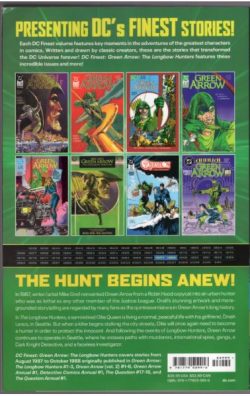
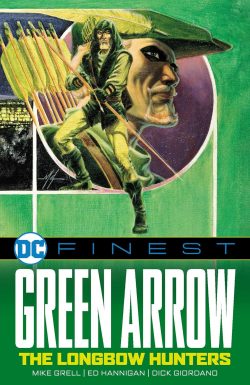
DC Finest: Green Arrow The Longbow Hunters


By Mike Grell, Sharon Wright, Dennis J. O’Neil, Lurene Haynes & Julia Lacquement, Ed Hannigan, Denys Cowan, Randy DuBurque, Ed Barreto, Tom Artis, Dick Giordano, Frank McLauglin, Rick Magyar, Klaus Janson, Tony DeZuñiga, Tom Dzon, Arne Starr, Gary Martin & various (DC Comics)
ISBN: 978-1-77952-991-6 (TPB)

This book includes Discriminatory Content produced in less enlightened times

It’s been a big year for comic book anniversaries and next year is another one. Let’s get our congratulations in early for a change…

Debuting in More Fun Comics #73 (cover-dated November 1941 and on sale from 19th September), Green Arrow is one of very few costumed heroes to be continuously published (more or less) since the Golden Age of American comic books. On first look, the combination of Batman and Robin Hood seems to have very little going for him, but he has always managed to keep himself in vogue and on view. Probably the most telling of his many, many makeovers came in 1987, when – hot on the heels of The Dark Knight Returns – Mike Grell was given the green light to make the Emerald Archer the star of DC’s second Prestige Format Mini-Series.

Grell was a major league, much celebrated creator at the time, having practically saved the company with his Edgar Rice Burroughs-inspired fantasy series Warlord. He had also illustrated many of GA’s most recent and radical tales (in Green Lantern/Green Arrow, Action Comics and elsewhere, and was a confirmed fan-favourite after well-received runs on Legion of Super-Heroes, Aquaman, Phantom Stranger, Batman and others. During the early 1980s, he had worked on the prestigious Tarzan newspaper strip and created successful genre series including Starslayer and Jon Sable, Freelance for pioneering indie publisher First Comics.

By the middle of the grim ‘n’ gritty Eighties, it was certainly time for an overhaul of the Battling Bowman. Exploding arrows yes, maybe even net or rope arrows, but arrows with boxing gloves on them just don’t work (trust me – I know this from experience!).

Moreover, in his 1960s makeover, the hero had evolved into a tempestuous, social reformer using his gifts to battle for the little guy. Now, in a cynical era of corrupt government, secret services with private agendas, drug cartels and serial killers, this emerald survivor adapted again and thrived once more. Thus, sans preamble, the action unfolds, laying a new path that would quickly lead to the hero becoming a major player at long last and, ultimately, a TV sensation.

The plot is astutely logical and still controversial, concerning a superhero midlife crisis. Weary, aging Oliver Queen relocates to Seattle, struggling to come to terms with the fact that since his former sidekick Speedy, is now a dad, he is “technically” a grandfather. With longtime significant other Dinah Lance AKA Black Canary, Ollie starts simplifying his life, but the drive to fight injustice hasn’t dimmed for either of them. As she goes undercover to stamp out a pervasive drug ring, the Arrow becomes embroiled in the hunt for a psycho-killer dubbed “The Seattle Slasher”.
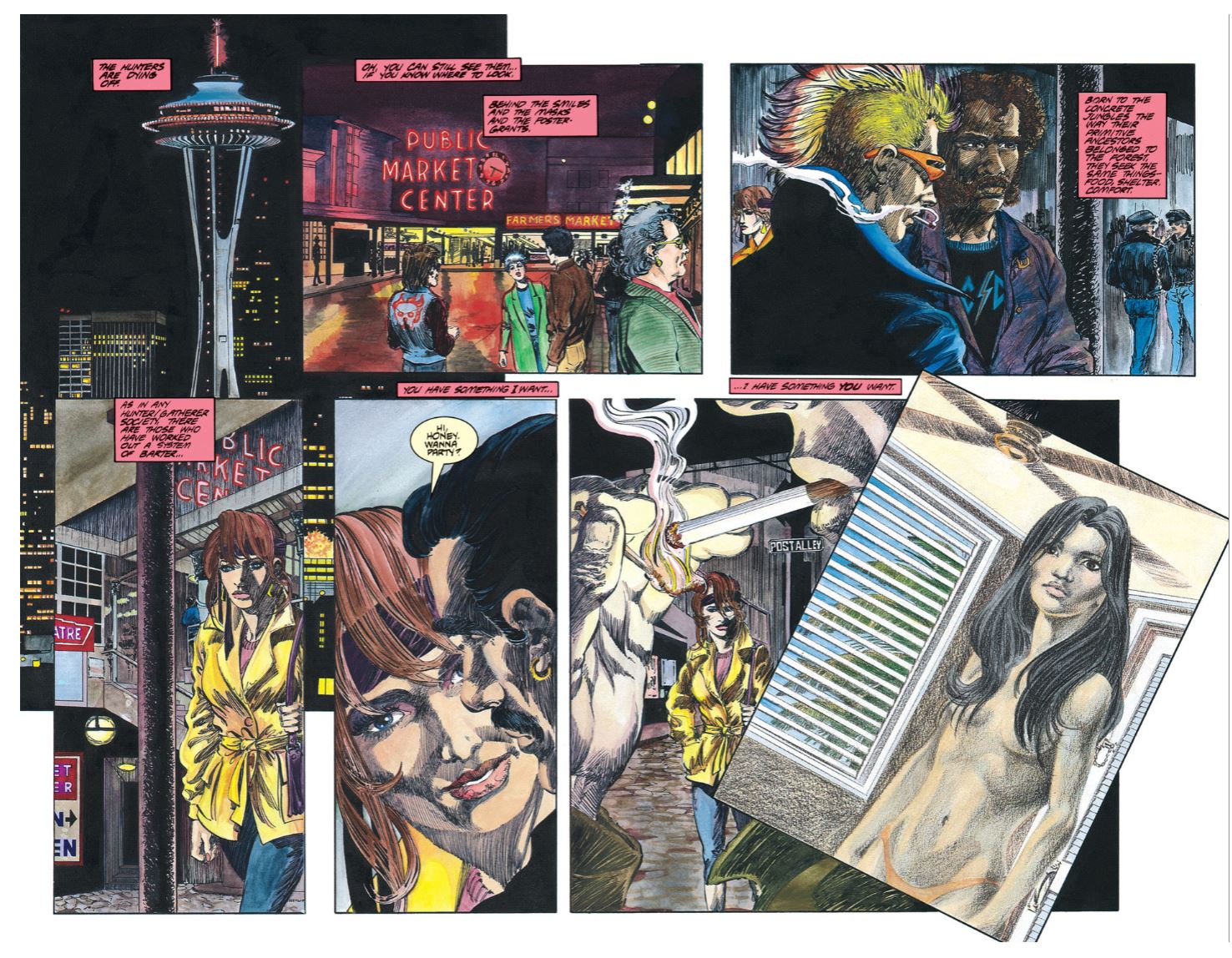
As he tracks a prolific stalker butchering prostitutes, Ollie becomes aware of a second – cross-country – slayer using arrows to murder people. Infuriatingly, this travesty only comes to his attention after the “Robin-Hood Killer” slaughters a gravedigger in his new city…

Eschewing gaudy costume and gimmicks to find such unglamorous hidden monsters, Queen reinvents himself as an urban hunter relentlessly searching Seattle’s darkest corners and soon stumbles into a complex mystery leading back to World War II involving the Yakuza, CIA, corporate America and even the Vietnam war: secrets that converge and will eventually change the course of the Archer’s life…
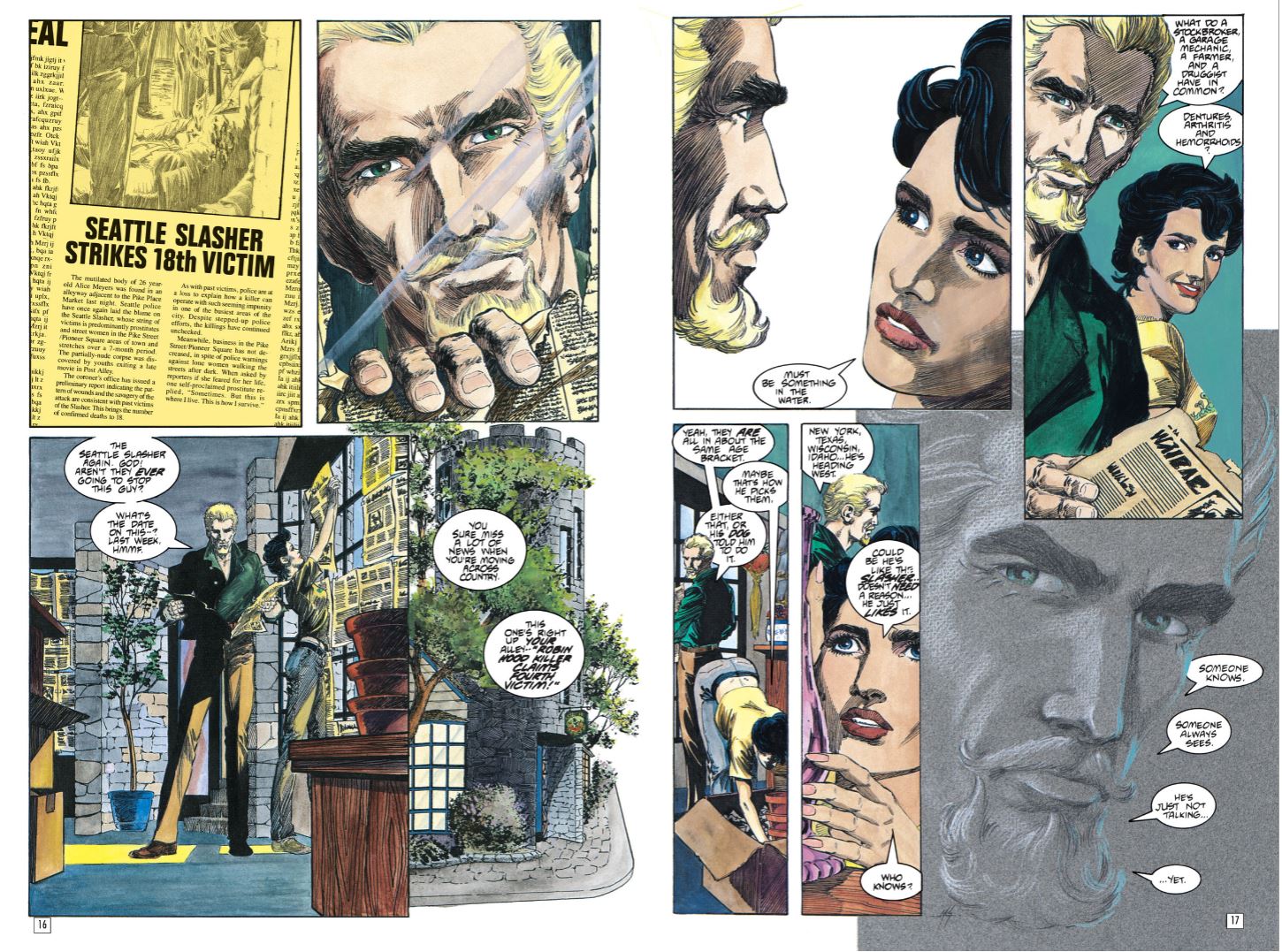
The intricate plot effortlessly weaves around the destabilized champion and past loves, thereby introducing new character Shado, exploring and echoing themes of vengeance and family in a blending of three stories that are in fact one, yet still delivers a shocking punch even now, through its disturbingly explicit examination of torture. These issues won the miniseries much undeserved negative press when first published. Although possibly tame to modern eyes this was eye-opening stuff at the time, which is a shame, since it diverted attention from the tale’s real achievement. That was narrative quality and sophistication, as this tale is arguably the first truly mature superhero yarn in the DCU.

Across ‘The Hunters’, ‘Dragon Hunt’ and ‘Tracking Snow’ Grell crafts a gripping, action-packed mystery adventure that pushes all the right buttons, all conveyed by artwork – in collaboration with Lurene Haynes & Julia Lacquement – that was and remains a revelation. Beautifully demure yet edgily sharp as required, these painterly visuals and watercolour tones perfectly complement a terse, sparse script, offering a compulsive, compelling ride any prose thriller writer would be proud of.
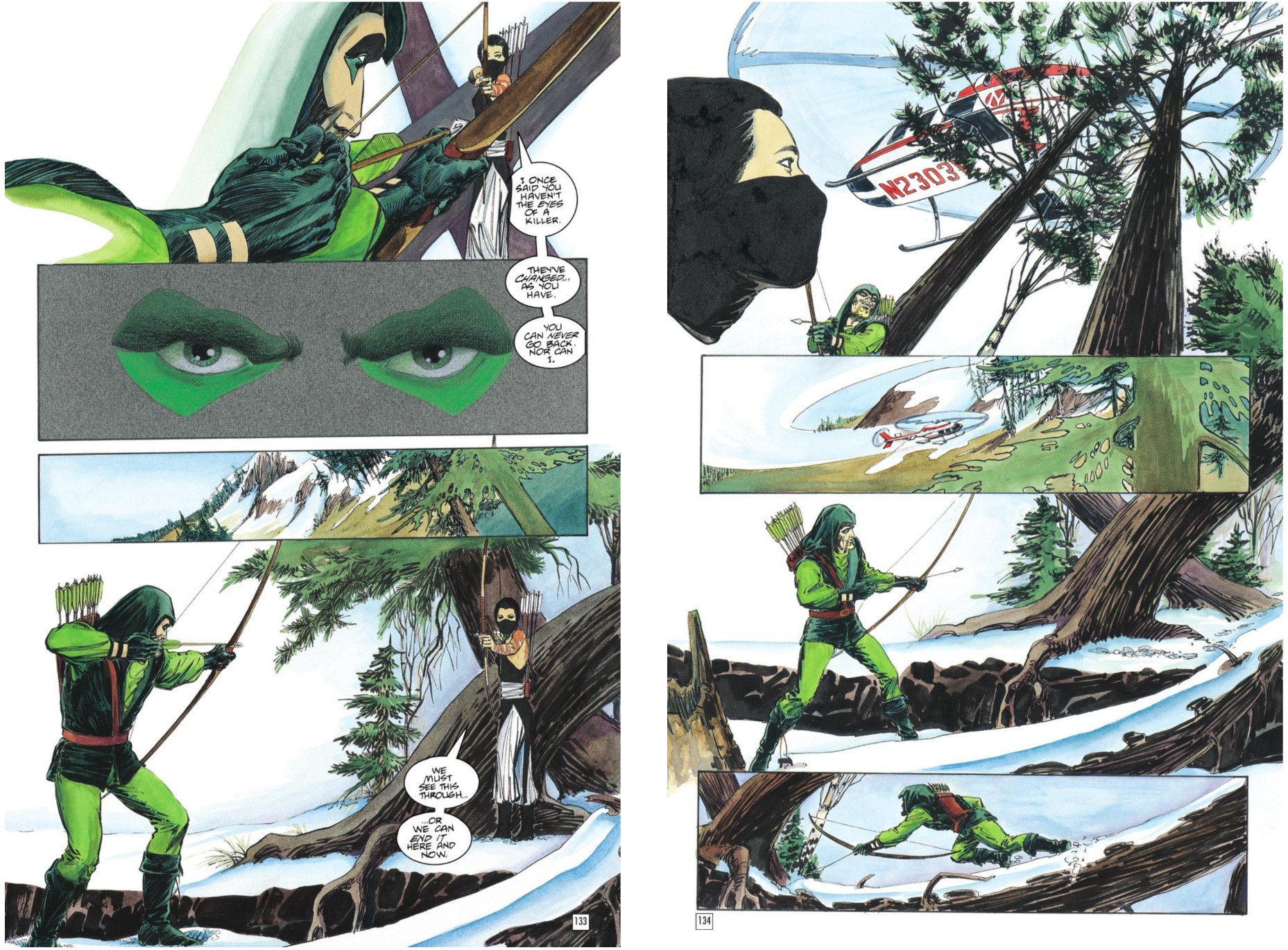
The saga – weaving themes of age, diminishing potency, vengeance and family – was another major turning point in American comics and led to an ongoing series specifically targeting “Mature Readers”. Latterly, the treatment and tone herein heavily influenced and flavoured TV adaptation Arrow.

Collectively covering February to October 1988, this paperback compilation (no digital edition yet, sadly) gathers the miniseries Green Arrow: The Longbow Hunters, Green Arrow volume 2, #1-8, The Question #17-18, and a crossover tale told in Detective Comics Annual #1, The Question Annual #1 and Green Arrow Annual #1. Controversy notwithstanding, the comic book retooling swiftly spawned a monthly series which itself evolved into one of the best reads of the 1990s and those monthly events immediately follow…

Scripted by Grell with superbly efficient and powerfully understated art from Ed Hannigan, Dick Giordano & Frank McLaughlin, the new series presented grimly realistic yarns ripped from headlines, tailored and honed for maximum impact and relevance. Sparse, spartan and devastatingly compelling, the initial episodes were constructed as two-part dramas, beginning with ‘Hunter’s Moon’ as the hunter (the series was notable in that other than on the cover, the soubriquet “Green Arrow” was never, ever used or uttered) prowls his new home. He deals harshly with thugs, gangbangers and muggers before heading home to his still-traumatised girlfriend.

As graphically depicted in Longbow Hunters, Black Canary was tortured for days before Ollie found her and, although the physical wounds have faded, Dinah is still suffering…

She’s not the only one. Police Lieutenant Jim Cameron has just heard that child-torturing sociopath Al Muncie has used his vast beer-dynasty inheritance to buy a retrial after 18 years in prison. The cops couldn’t get him for murdering all those “missing” kids back then, but one lucky 10-year-old, after days of appalling torment, escaped and testified so Muncie’s been locked up for aggravated assault ever since. Now the heartbroken cop has to tell that brave survivor she must do it all over again…

The victim grew up to be Dr. Annie Green and she’s working wonders treating Dinah, but the therapist’s own long-suppressed terrors come flooding back when Muncie – despite being in total lockdown in his palatial house on the family brewery estate – somehow hand-delivers a little souvenir of their time together…

Present when Annie freaks out and flees in panic, Ollie gives chase and finds her once more calm and resigned. On hearing the full story he makes a house-call on the maniac but cannot “dissuade” him from paying Annie another visit that night. The veteran manhunter is waiting as a masked assailant tries to break ino the doctor’s apartment, but when the intruder shrugs off a steel arrow to the chest Ollie realises something’s not right…

Part Two expands the mystery of how Muncie gets past police guards at will, but by the time the Arrow has convinced cops to raid Muncie’s den with the solution to the obsessed sociopath’s disappearing act and apparent invulnerability, the killer has already made his move. Sadly for him, once again Muncie has underestimated Annie, and her defiance buys Ollie time to intercept the hellbent human fiend. After a furious chase back to the brewery, the killer meets his fate in a most ironic manner…
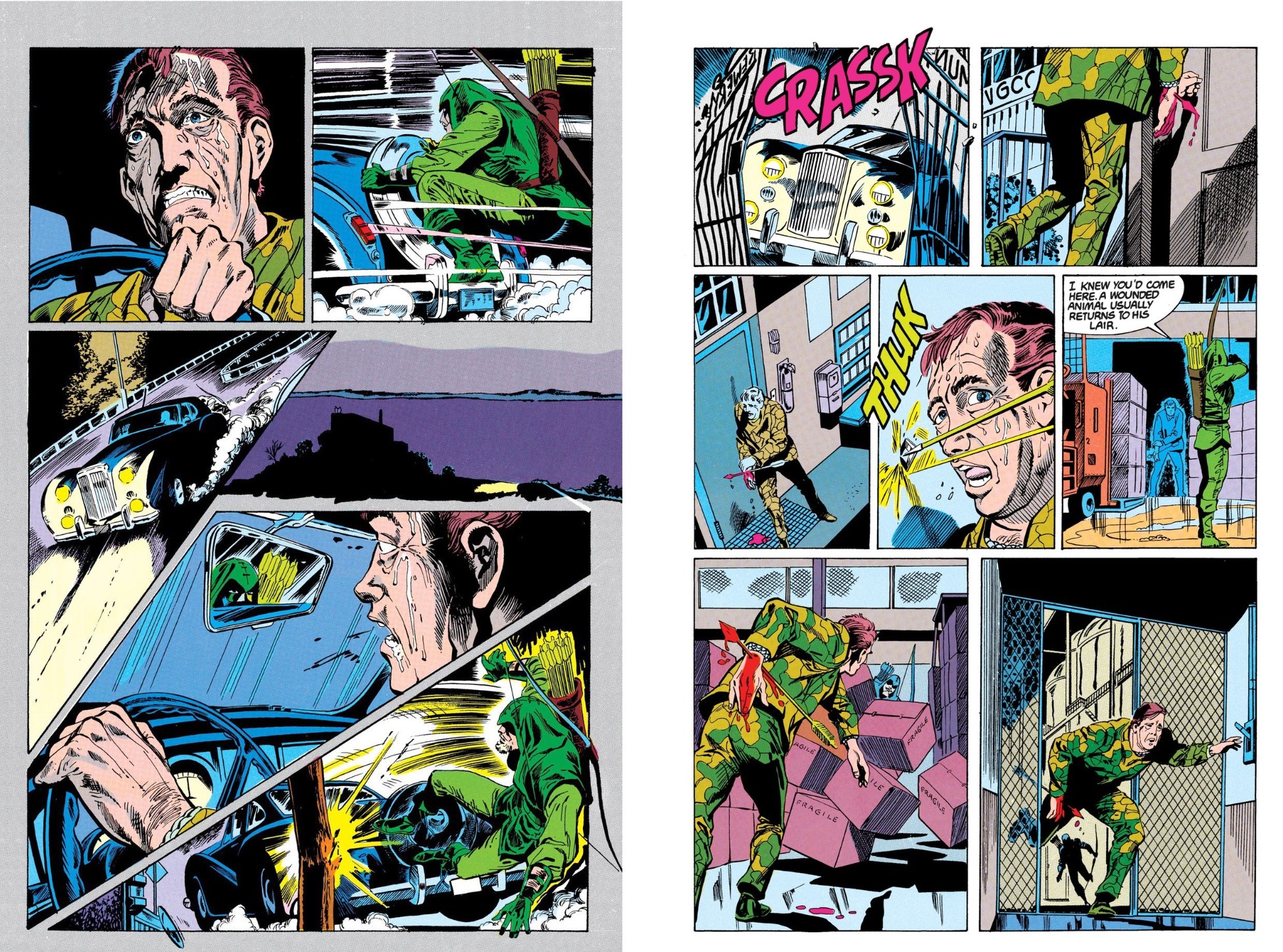
A broad change of pace follows as part one of ‘The Champions’ sees Ollie abducted by US government spooks and pressganged into competing for a deadly prize. A joint space venture with the Chinese has resulted in a deadly “DNA-programmable” virus being created and – following the sudden destruction of the satellite lab where it was propagated – the only surviving sample has crashed onto remote San Juan Island. With political allies turned rivals for sole possession of a bio-agent which can be set to kill anything from wheat harvests to black or yellow or white people, open warfare would only lead to catastrophic publicity, so the political superpowers have agreed to a gladiatorial bout as the method of deciding ownership.

Ollie has his own reasons for accepting the job. For starters he doesn’t trust any government with the DNA-hunting bug, the agents who drafted him are actually Russian, not American and, most urgently, he has no doubt that he’ll be killed if he refuses to compete…

Equipped with a tracking device, Ollie is dumped on the island as a colossal storm kicks off, meeting his arrogant opposite getting off the ferry. Former CIA operative Eddie Fyers is an old foe and one of the sneakiest killers on Earth. Fyers convinces Ollie they should work together before double-crossing and leaving him to bleed out in a blizzard. The archer is saved by an archaeologist who has inadvertently picked up the lost bio-agent pod, but as Ollie argues with his rescuer over the wisdom and morality of his mission, her cabin is peppered with gunfire…

Fyers has the upper hand but suffers a sudden change of attitude when a third team ambushes him and his prisoners. It seems neither Russians nor Chinese trust their champions…

Again forced to join forces, spy and vigilante despatch the hit squad before Ollie has the very last word after finding a way to deprive everybody of the death-sample…

The hunter appeared tangentially in The Question #17-18 (June & July 1988 by Dennis O’Neil, Denys Cowan & Rick Magyar) as ‘A Dream of Rorschach’; tacitly acknowledging the debt owed to the groundbreaking series Watchmen for the revival of Steve Ditko’s obsessive faceless trouble-seeker The Question. Here journalist/crimebuster Vic Sage is chasing murder-obsessed miscreants Butch and Sundance out of Hub City. Catching a plane, he reads the graphic novel and has a vision of and conversation with the iconic sociopath whilst flying to Seattle and a chilling showdown. On arrival he is intercepted by highly suspicious, extremely overprotective and intensely impatient local hero the Arrow before they ally to catch the scum as they seek fresh kill supplies from terrorists in massive clash-concluding chapter ‘Desperate Ground’

Determined to challenge all manners of social inequity, Grell’s next story in Green Arrow confronted the rise in homosexual prejudice that manifested in the wake of the AIDs crisis. It begins after two customers leaving Dinah’s flower shop are brutally attacked by kids ordered to “gay-bash” as part of their gang initiation. The horrific crime is further compounded when Ollie discovers Dinah’s new assistant Colin is not only a bloody-handed perpetrator but also a victim…

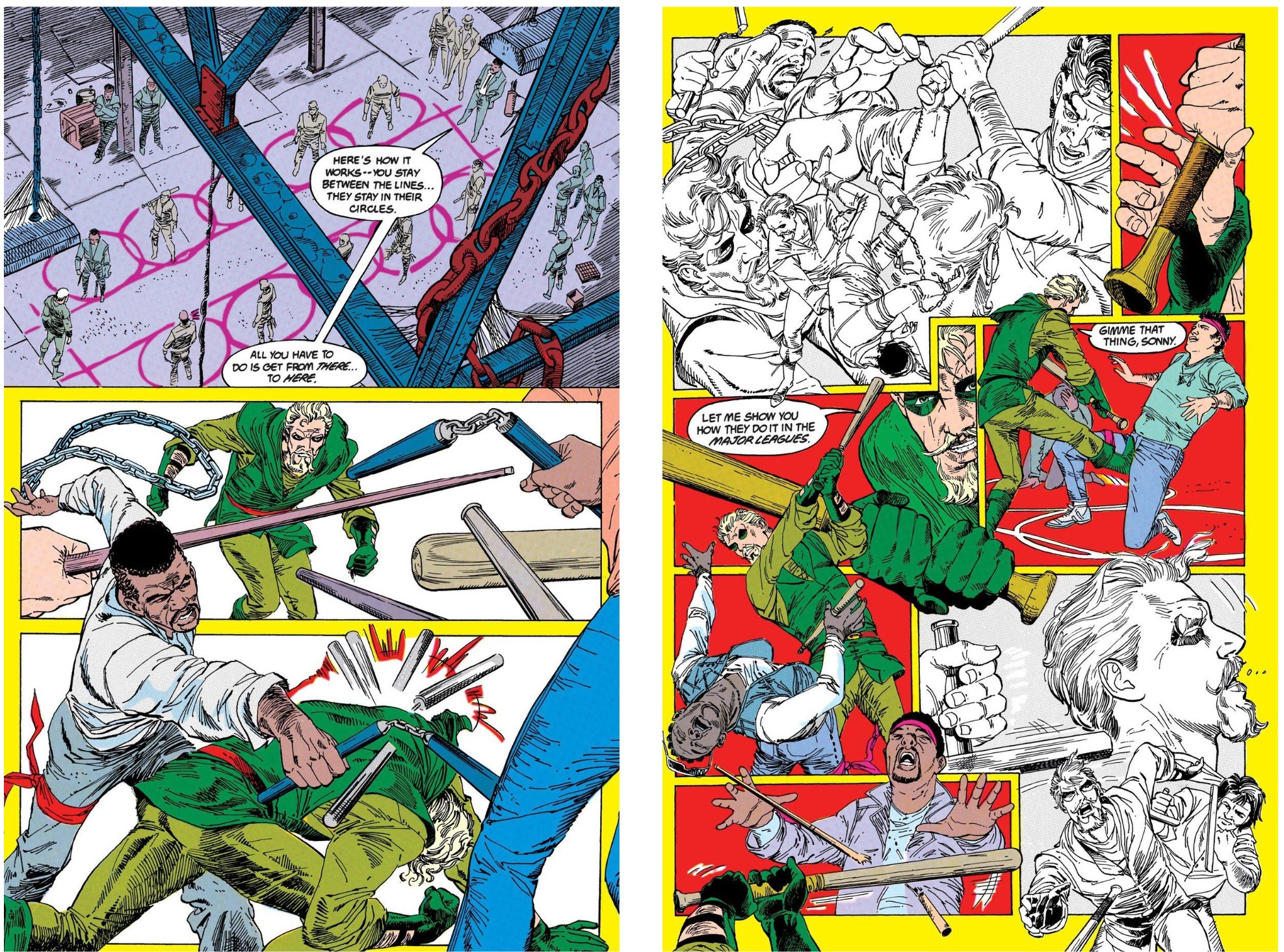
The Warhogs are the most powerful gang in the city, but their latest induction policy is one the Arrow cannot allow to exist any longer. Any kid refusing to join is mercilessly beaten by a ‘Gauntlet’ of thugs. Those who eagerly volunteer suffer the same treatment at their own initiation… and once you’re accepted as a Warhog, you still have to prove your loyalty by beating – and preferably killing – a “queer”…

In the shocking conclusion Ollie, having failed to make a dent through any of his usual tactics, goes straight to the top. Big boss Reggie Mandel has big plans for the Warhogs. He’s already made them a national force to be reckoned with, but when he arrives in Seattle to check on regional deputy Kebo, the Machiavellian schemer is confronted by a nut with a bow challenging him in his own crib…

The Arrow is keen to point out the strictly local Warhog policy of gay hate-crimes is not only bad for business but serves someone else’s private agenda. Reggie actually agrees with the vigilante, but before he’s prepared to take appropriate action he expects his verdant petitioner to undergo the same gauntlet any Warhog must survive before being heard…
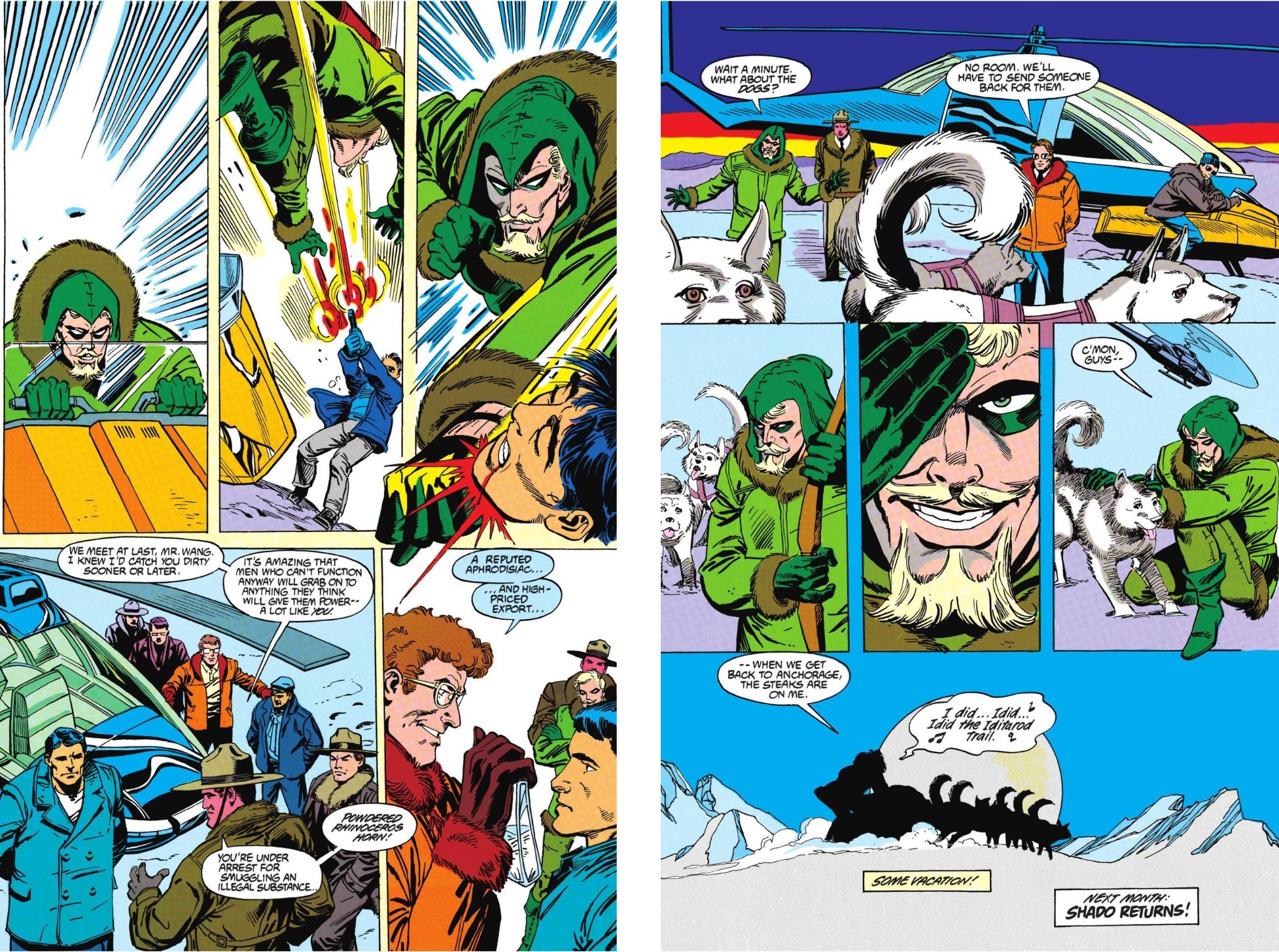
Next comes complex collaboration ‘The Powderhorn Trail’ – written by Grell & Sharon Wright who divided the Ollie and Dinah sections between them, with Randy DuBurque illustrating Black Canary pages whilst Ed Barreto pencilled Arrow bits, with Giordano & Arne Starr inking it all. The round-robin episode sees the hunter stumbling upon a clue to drug-smuggling at his local carwash and having to explain to Dinah why he’s taking off for Alaska. Possibly coincidentally, she is approached by a casual acquaintance whose life the Canary once saved, who inadvertently tips Dinah to a string of crimes-in-the-making…

The tempestuous conclusion (by Grell, Paris Cullins, Gary Martin & Giordano) then sees Ollie solo-stalking from Anchorage to deep in the North country on the trail of not just drug dealers and high-end car thieves but also opportunistic Tong smugglers trafficking illegal, poached and utterly pointless Chinese herbal remedies under cover of the infamous Iditarod. Sometimes it’s just good and so satisfying to be a lawless vigilante…
This initial collection concludes with a Denny O’Neil martial arts epic/experimental comic book koan ‘Fables’: a crossover tale encompassing Detective Comics Annual #1, Green Arrow Annual #1 and The Question Annual #1, which will make far more sense if you read Richard Dragon: Kung Fu Fighter: Coming of the Dragon!

It begins in China during Japan’s invasion prior to the official start of WWII, where a truly honourable bushido warrior is shamed by his own troops and resigns his commission to become a warrior monk: the O-sensei. Years later he and his student (Lady Shiva “the most dangerous woman on Earth”) arrive in America seeking a new hero called The Batman. They have a lesson to impart but first must find him. This overture means working again with an old student named Vic Sage…

Rendered by Klaus Janson & Tony DeZuñiga, ‘The Monkey Trap’ sees the Dark Knight hunt a horrific bio-weapon stolen from arch maniac Ra’s Al Ghul and pursued by money-mad miscreant The Penguin. The quest is only accomplished after the cocky masked manhunter learns a crucial lesson from the warrior sage and incurs a monumental debt of honour…

Then ‘Lesson for a Crab’ – illustrated by Tom Artis & Tom Dzon – finds the former Emerald Archer & Black Canary embroiled in the schemes of English aristocrat Lord Kalesque who wants to be the greatest archer in the world but cannot feel secure in the title until he crushes a certain vigilante in Seattle. As Kalesque is no adherent of fair play, that can be accomplished by perpetrating a string of murders to destabilize the hunter and put him and his woman off their game. Happily, Shiva and the O-Sensei are already on their way with advice and a zen teaching that will be of great service…

The interlinked saga concludes in The Question Annual #1 (Cowan & Magyar art) with explanations and conclusions. The aged sage wants to be buried beside his Japanese wife but her family are opposed to the plan and have moved her body. Star pupil Shiva orchestrates a plan involving western heroes touched by his teachings and owing service to the O-Sensei, and her efforts culminate in ‘The Silent Parable’. Now Batman’s detective skills locate the resting place and the Americans join what seems like a cursed mission to Malaya – one that is beset by an army of assassins and string of natural disasters; and which seems to end in utter failure…

However, in the aftermath The Question deduces that fate and honour have worked their own miracles and made a suitable accommodation with the universe…

Closing the book and capping the fantasy is a linked cover triptych of the Annuals by Janson, Ed Hannigan, Cowan & Bill Sienkiewicz, and rest – both fully painted and line art – are by Grell, Cowan, Sienkiewicz, Giordano, Hannigan & Tatjana Wood and suitably placed throughout…

Terse, sparse scripts, intelligent, flawed human interactions, stunning action delivered through economical and immensely effective illustration and an unfailing eye for engaging controversy make these some of the most powerful comic tales US comics ever produced, an epic of masked mystery saga no lover of the genre will want to miss.
© 1987, 1988, 2024 DC Comics. All Rights Reserved.

In 1911 strip writer Nicholas P. Dallis (Apartment 3-G, Rex Morgan MD) was born. Nine years later so was the fabulous Kurt Scaffenberger (Captain Marvel, Lois Lane, Jimmy Olsen) with Al Plastino popping in 366 days later. He was a key Superman illustrator who co-created the Legion of Super-Heroes and also drew the Batman newspaper strip (see Batman: Silver Age Dailies and Sundays 1968 – 1969).

In 1953 JM DeMatteis was born, in 1961 Reginald Hudlin arrived and in 1969 Stuart Immonen, but we did lose Abie the Agent illustrator Harry Hershfield in 1974 and Uruguayan Eduardo Barreto who drew many US features including Steel Sterling, Aliens, Teen Titans, Superman, Batman and Judge Parker.
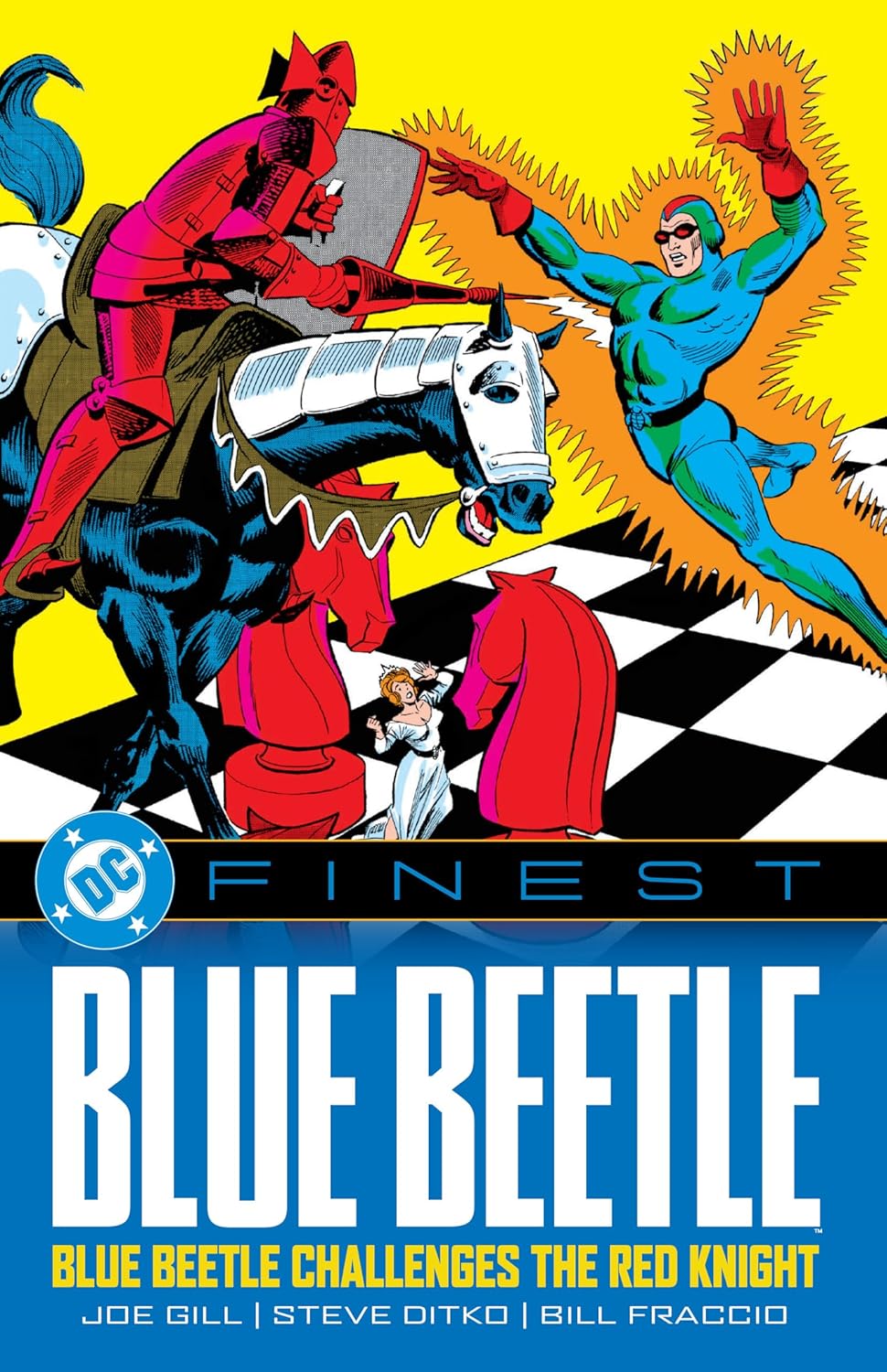
DC Finest Blue Beetle – Blue Beetle Challenges The Red Knight


By Joe Gill, Roy Thomas, Gary Friedrich, Benjamin Smith, Bill Fraccio, Tony Tallarico, Dick Giordano, Steve Ditko, Dan Reed & Bob McLeod, Albert Val, Bill Black & various (DC Comics)
ISBN: 978-1-79950-248-7 (TPB)

This book includes Discriminatory Content produced in less enlightened times

This absorbing yet inarguably eccentric DC Finest compilation offers some of the rarest material ever aquired by the company and probably owes its existence solely to the screen success of the ever-changing titular star. I honestly never expected to see such seminal material in a modern collection and I hope the dated nature of the material finds an appreciative audience and rewards DC for their boldness… 

Sadly as ever, it’s not yet available digitally, but we live in hope…

The Blue Beetle premiered in Mystery Men Comics #1, released by Fox Comics and cover-dated August 1939. The pulp-inspired star was created by Charles Nicholas and possibly initially scripted by Will Eisner. “Charles Nicholas” was a shared pseudonym used by Chuck Cuidera (Blackhawk), Jack Kirby (everything) and Charles Wojtkowski (Blonde Phantom, Young Allies, Nyoka, Iron Corporal) with the last one generally attributed with actually inventing our remarkably resilient Azure Adventurer.

A mystery man in every sense of the term, the Cobalt Crimecrusher was inexplicably popular from the start: translating his comics venues into merchandise, a radio show and even a newspaper comic strip. Constantly acquired and traded by numerous publishers, BB survived the extinction of most of them: blithely undergoing many revisions to his origins and powers. By the mid-1950s he had ended up at Charlton Comics, appearing sporadically in a few long-inventoried tales before seemingly fading away. However, that was only until the early 1960s superhero resurgence when Joe Gill, Bill Fraccio, Tony Tallarico and, latterly, neophyte scripter/devoted Golden Age acolyte Roy Thomas revised and revived the character. It led to a unique 10-issue run spanning June 1964 to March 1966 (technically, two separate 5-issue runs), but you’ll see that it wasn’t quite that simple…

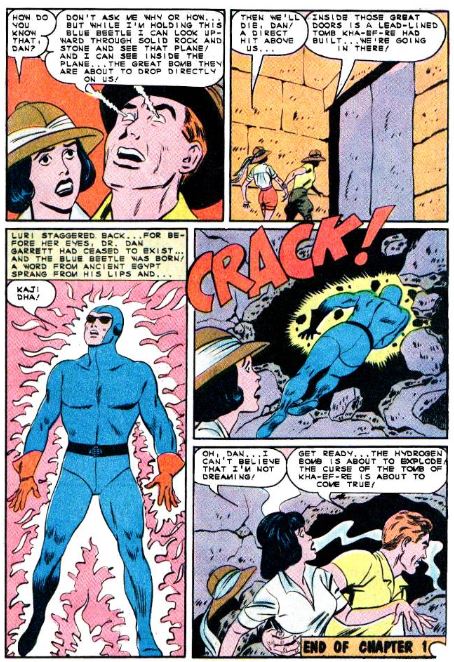
Pulling together many disparate strands from previous incarnations, former cop and valiant troubleshooter Dan Garrett was reshaped into an archaeologist gifted with a mysterious, magical ancient Egyptian scarab. This trinket would transform him into a lightning-throwing, super-sensed flying superman whenever he touched the scarab and uttered trigger phrase “Khaji Dha!”

After another brief sojourn in comic book limbo, Garrett resurfaced when Steve Ditko took on the concept, tweaking it to construct a fresh retooled hero for the gadget-conscious, superhero-savvy society perfect to continually confront a crimeridden culture.

Ditko accepted and acknowledged but sagely set aside all that prior history to utterly recreate a hero he could understand. Ted Kord is an earnest and proudly decent young scientist with a secret tragedy in his past, which Ditko and scripter Gary Friedrich sagely forbore revealing in deference to intrigue and action. The result was a taut, captivating noir thriller that opened the neopgyte’s azure casebook – which we’ll get to in the fullness of time…

Here, though, we open with the venerable veteran bursting back onto newstands courtesy of Gill, Fraccio, & Tallarico.

Cover-dated June 1964 the revival began in Blue Beetle (vol. 1, #1) with the disinterrment of ‘The Giant Mummy Who Was Not Dead’ as prominent visitor Dr. Dan Garrett and comely local egyptologist Professor Luri Hoshid fall foul of a rapidly changing political crisis whilst excavating an ancient site. The tomb of Kha-Ef-Re holds untold discoveries but resident strongman-with-despotic-aspirations – and a private nuclear arsenal – General Amenhotep may well end their dig out of sheer spite. Threatened but perservering, the duo unearth vile Kha-Ef-Re’s remains and a fantastic blue scarab that seemingly acts as a means of imprisoning his mummy.

On touching the gem, Garrett experiences an astounding vision as another ancient Egyptian – “The Great Pharoah” – reveals the scarab is a portal to fantastic power to be used in the service of good…

Transformed, Garrett immediately gets a chance to test it as a nuclear strike by Amenhotep’s forces awakens the mummy which grows to fantastic size and rampages across the nation. Thankfully the powers and abilities of The Blue Beetle are sufficient to defeat and re-entomb the monster and deal with the military maniac who thought to exploit him…

Relentlessly formulaic but somehow ly kitsch and bizarrely appealing, the stage was set for a succession of the same as BB #2’s ‘Hot War in the Arctic’ finds Garrett and sexy accomplice du jour Captain Elaine Norr (USAF) investigating peril in the far north. Here they clash with Red Chinese forces building secret airbases as well as cavemen, lost Goths, extinct big beasts and even dinosaurs from the sanctuary of a lost land… until more hastily applied atomics trigger a disaster…

Alien invasion was the theme of the third adventure as supersonic transport and possibly even the space program were threatened by a man who talked to lightning. ‘Mr. Thunderbolt and the Superstar’ led to a sustained war of nerves and powers narrowly won for humanity before a traditional supervillain arrived in the bright green form of ‘The Praying Mantis-Man’. Aided by Mexican entymologist firecracker Juanita Rivera, Garrett and his alter ego barely survive the efforts of self-mutating chlorophyl addict Hunter Mann to replace humanity with giant bugs. The macabre yarn is supplemented by a pinup of the Cobalt Crusader by Pat Masulli, before #5 finds Gill, Fracchio & Tallarico disclosing how and why ‘Blue Beetle Challenges the Red Knight’

This eerie yarn sees Garrett come to the aid of his friend Lewis Coll after the astrophysicist returns from a space mission strangely altered. Now obsessive and cruel, Coll shuns his fiancee Regina White and transforms himself into a invulnerable crimson armoured tyrant seeking to destroy all aircraft. So tough is his opposition that Blue Beetle must seek aid from the The Great Pharoah himself to end the threat…

The series went on a brief hiatus and returned with a new numbering system as, cover-dated July 1965, Blue Beetle #50 pitted the hero against ‘The Scorpion’ as villainous Mister Crabb sought to control the oil industry with thugs and giant robots, whilst in # 51 deranged incel Dr. Jeremiah Clugg sought to offset his self-perceived physical flaws and failings with women by placing his personality and mentality inside a super-srobot dubbed ‘Mentor the Magnificent’. Unable to reason, the Beetle had to quell his increasing instability with force…

Gill & Tallarico handled #52 as ‘Magno, the Man Who Shakes the World’ finds disgraced anthropologist Louis Forte targeting Garrett for revenge that escalates into shattering the entire planet as tectonic terrorist Magno-Man, after which Praying Mantis-Man returns to bedevil humanity in ‘The People Theives’, with the mantid maniac snatching humans as lab fodder until the Azure Avenger steps in and stomps him…

The last hurrah of the old guard saw aspiring junior Roy Thomas script for Fracchio & Tallarico a deft return to Egypt in final foray (Blue Beetle #54 February/March 1966) as Garrett and Luri Hoshid reunite after her latest find is co-opted by a rival who knows its true power. Sadly even Professor Philipps is unaware of the full force and malign sentience of ‘The Eye of Horus’ Soon the ancient device is enslaving and transforming humans in its quest for dominance, but the Great Pharoah has a plan to aid his new agent defeat it. All the hero has to do is visit the gods in the Land of the Dead and return with a certain weapon…

Despite it being the height of superhero madness in popular culture, Blue Beetle folded then and was left fallow until the end of the year. As stated above, he returned much changed in the back of Captain Atom (#83 November 1966) with Charlton Comics’ biggest gun in the process of his own refit and renewal again courtesy of Ditko.

The remodelling of the Atomic Ace left room for expansion and experimentation so Ditko plunged right in, introducing an acrobatic, technologically armed swashbuckler taking care of business without any extraneous exposition or explanation… and using one of the oldest names in the business.

Here ‘The New Blue Beetle’ displays his modus operandi by stopping a vicious crime-spree by the Killer Koke Gang. The untitled yarn has all classic elements of a Ditko masterpiece: outlandish, intense fight scenes, compact, claustrophobic yet dynamic layouts, innovative gimmickry and a clear-cut battle between Right and Wrong. It’s one of the very best introductory stories of a new hero anywhere in comics – and it’s only 7 pages long…

With a definite feeling of no safety or status quo, next instalment ‘Wanted for Murder’ – scripted by Mike Friedrich with full art from Ditko – pits the new kid against a mysterious Masked Marauder who has invaded ghis own home. However, the real kicker is a bombshell revelation that Homicide Detective Fisher, investigating the disappearance of Garrett, suspects a possible connection to Kord…

Next in the imaginatively entitled ‘Blue Beetle Fights a Submarine’ the vigour and vitality of the hero is again undeniable as a mid-air hijack is foiled before a spy sub and giant killer octopus are given short shrift by the indomitable rookie crusader. Then CA #86 sees the return of ‘The Masked Marauder’ as the cobalt crimebuster confronts a ruthless scientist/industrial spy he’s convinced he has battled before…

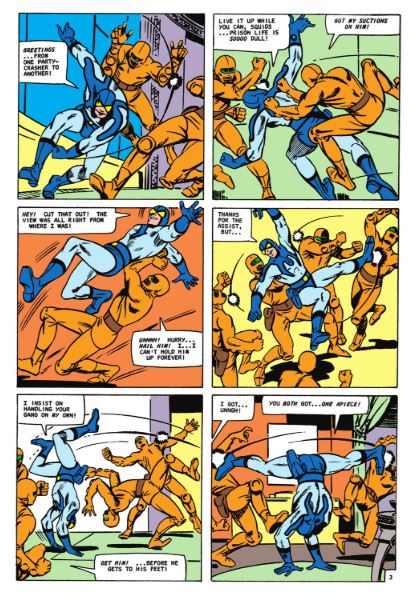
This is all preamble to the main event as – cover-dated June 1967 – Blue Beetle (volume 2) #1 launched.with lead tale ‘Blue Beetle Bugs the Squids’; an all-Ditko masterpiece (even scripting it as “D.C. Glanzman”) with the hero in astounding action against a deadly gang of bandits. ‘Blue Beetle… Bugs the Squids’ is crammed with the eccentric vitality that made Amazing Spider-Man such a monster hit, with justice-dispensing joie de vivre balanced by the moody, claustrophobic introduction of Ditko’s most challenging mainstream superhero creation. Sadly, you’ll need a different book to meet this version of The Question

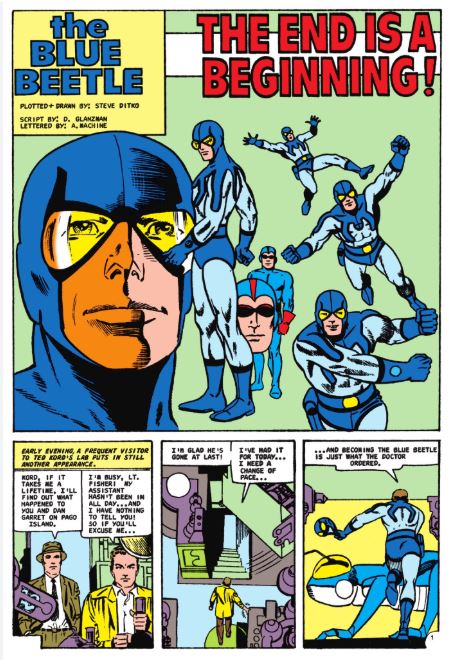
Another all-Ditko affair, Blue Beetle #2 shows the master at his peak. ‘The End is a Beginning!’ at last reveals the origin of the hero as well as the fate of Dan Garrett, and even advances Kord’s relationship with his long-suffering ever-pining assistant Tracey. #3 is another superbly satisfying read, as the troubled warrior routs malevolent, picturesque thugs ‘The Madmen’ in a sharp parable about paranoia and misperception.

Blue Beetle #4 is visually the best of the bunch as Kord follows a somehow-returned Garrett to an Asian backwater in pursuit of lost treasure and a death cult. ‘The Men of the Mask’ is pure strip poetry and bombastic action, cunningly counterbalanced by final outing ‘Blue Beetle Faces the Destroyer of Heroes’ (Blue Beetle #5). It remains a decidedly quirky tale featuring a notional team-up of the azure avenger and The Question wherein a frustrated artist defaces heroic and uplifting paintings and statues. Ditko’s committed if reactionary views of youth culture, which so worried Stan Lee, are fully on view in this charged, absorbing tale…

The Ditko Beetle was sublime but short-lived: an early casualty when the Sixties Superhero boom reversed and horror again ruled the newsstands, Charlton’s “Action Hero” experiment was gone by the close of 1968, preceding a long line of costumed champions into limbo and clearing the decks for a horror renaissance.

Time passed and reading tastes changed again. After the cosmos-consuming Crisis on Infinite Earths re-sculpted DC’s universes in 1986, a host of stars and even second stringers got floor-up rebuilds to fit them for a tougher, uncompromising, straight-shooting, no-nonsense New American readership of the Reagan era. In the intervening years, DC had pursued an old policy: gobbling up the characters and properties of defunct publishers. A handful of Charlton buy-outs had already appeared in Crisis, and now Captain Atom, The Question and two separate Blue Beetles seamlessly slotted into the new DCU, ahead of the rest of the lost contingent…

Before that moment though, there was a final flurry of the old guard.

This collection ends with the rare one-off Charlton Bullseye #1 (June 1981), released as Charlton was finally winding down its business. Written by Bejamin Smith and illustrated by Dan Reed, Albert Val & Bill Black ‘The Enigma’ sees Blue Beetle and The Question officially meet for the first time as someone they just don’t know targets them both for vengeance and assassination. He doesn’t succeed this time but does get away and threaten to return…

With covers by Fraccio, Frank McLaughlin, Vince Colletta, Masulli, Dick Giordano, Tallarico, Ditko, Rocke Mastroserio, Reed & Bob McLeod this a book that is both sublime and ridiculous, but one any lover of Fights ‘n’ Tights fiction just must have.
© 1964, 1965, 1966, 1967, 1968, 1969, 1981, 2025 DC Comics. All Rights Reserved.

Today in 1913 utterly unique UK cartoonist and raconteur Bill Tidy was born. We last bowed before T’ Mastuh with our coverage of The Fosdyke Saga volume 1. In 1949 Jim Starlin entered this world, and you can check out the bajillions he’s created since by using our search box. Ditto for Matt Wagner, who is so much more than just Grendel, Mage, Batman and Sandman Mystery Theatre. He joined us right about…. NOW! back in 1961.

Showcase Presents Blue Beetle


By Len Wein, Joey Cavalieri, Paris Cullins, Gil Kane, Ross Andru, Don Heck & various (DC Comics)
ISBN: 978-1-4012-5147-5 (TPB)

This book includes Discriminatory Content produced in less enlightened times.

The Blue Beetle premiered in Mystery Men Comics #1, released by Fox Comics and dated August 1939. The pulp-inspired hero was created by Charles Nicholas and possibly initially scripted by Will Eisner. “Charles Nicholas” was a shared pseudonym used by Chuck Cuidera (Blackhawk), Jack Kirby (everything) and Charles Wojtkowski (Blonde Phantom, Young Allies, Nyoka, Iron Corporal) with that last one generally attributed with inventing our remarkably resilient Azure Avenger.

The Cobalt Crimecrusher was inexplicably popular from the start: translating his comics venues into merchandise, a radio show and even a newspaper comic strip. Constantly traded and acquired by numerous publishers, BB survived the extinction of most of them: blithely undergoing many revisions to his origins and powers. By the mid-1950s he ended up at Charlton Comics, appearing sporadically in a few long-inventoried tales before seemingly fading away. However, that was only until the superhero resurgence of the early 1960s when Joe Gill, Bill Fraccio, Tony Tallarico and, latterly, neophyte scripter/devoted Golden Age acolyte Roy Thomas revised and revived the character. Technically, it resulted in a 10-issue run cover-dated June 1964 to 1966 (actually two separate 5-issue runs), but if you also check out our Action Heroes Archive review you’ll see that it wasn’t quite that simple…

Pulling together many disparate strands from previous incarnations, former cop and valiant troubleshooter Dan Garrett was reshaped into an archaeologist gifted with a mysterious and magical ancient Egyptian scarab recovered from lost tomb. This trinket would transform him into a lightning-throwing, flying superman whenever he touched the scarab and uttered the trigger phrase “Khaji Dha!”

After another brief sojourn in comic book limbo, Garret (note the different spelling, it varies from issue to issue, but we’ll stick to double “r”, double “t”, okay?) resurfaced as Steve Ditko took on the concept, tweaking it to construct a fresh new, retooled hero. This one started as a back-up feature in Captain Atom #83 (November 1966) before graduating to his own solo title. Ted Kord was a troubled scientist with mystery and undisclosed tragedy in his past, as well as an unspecified connection to Garrett. In fact, he was the police’s prime suspect in the academic’s disappearance and possible murder…

The Ditko version was sublime but short-lived: an early casualty when the Sixties Superhero boom reversed and horror again ruled the newsstands, Charlton’s “Action Hero” experiment was gone by the close of 1968, leading a long line of costumed champions into limbo and clearing the decks for a horror renaissance.

Time passed and reading tastes changed again. After the cosmos-consuming Crisis on Infinite Earths re-sculpted DC’s universes in 1986, a host of stars and even second stringers got floor-up rebuilds to fit them for a tougher, uncompromising, straight-shooting, no-nonsense New American readership of the Reagan era. In the intervening years, DC had pursued an old policy: acquiring characters and properties of defunct publishers. A handful of Charlton buy-outs had featured in Crisis and now Captain Atom, The Question and two Blue Beetles seamlessly slotted into the new DCU, ahead of the rest of the lost contingent…

Primarily scripted and steered by Len Wein (Swamp Thing, New X-Men, Batman, almost everything else), this massive monochrome compilation gathers the entire 24-issue run of Blue Beetle volume 6 (cover-dates June 1986 through May 1988) plus a superb crossover origin/restated backstory from Secret Origins (volume 2) #2, originally released as a vanguard to the series. Sans preamble, a steady diet of light-hearted swashbuckling begins with Len Wein, Paris Cullins & Bruce D, Patterson’s ‘Out from the Ashes!’ wherein a Chicago office building burns down. Suddenly, above the roaring flames a giant mechanical bug floats into view and from it plunges rookie hero Blue Beetle. He is desperate but determined to help the beleaguered firefighters… but not with the conflagration. His target is deranged super-arsonist Firefist, but the glorified acrobat’s tricky gadgets seem to be no match for the heavily armoured foe’s ferocious firepower. Barely escaping with his life, Beetle takes some comfort from the fact that even if he didn’t stop the bad guy or save the skyscraper, he has rescued an imperilled fireman…

In the aftermath, the masked man heads back to work: revealed to us as junior genius Ted Kord who has just (most reluctantly) assumed control of his tyrannical father’s technological innovations and manufacturing business. Ted doesn’t like business but loves inventing, which is why he spends as much time as possible with the company’s quirky thinktank geniuses Jeremiah Duncan, Melody Case and Murray Takamoto. Now he learns the company is sitting on a discovery of Earth-shattering importance. What Ted doesn’t know is that someone nefarious and extremely close wants it, or that far, far away someone has broken into the crypt on Pago Island where Ted’s mad scientist uncle Jarvis Kord killed Dan Garrett – the original Blue Beetle. An archaeological rival, Conrad Carapax is seeking the fabled something that cost his competitor his life…

Suddenly, Firefist attacks again and the neophyte hero rushes off to challenge him. The woefully one-sided battle gets serious in ‘This City’s Not for Burning!’ as the arsonist almost kills our hero again, forcing Ted to get smart and investigate where and why; not how. Despite catastrophic collateral their final clash leads to victory of sorts but leaves the hero open to betrayal from within his trust circle and targeted by a major supervillain seeking the modified wonder element Promethium undergoing modifications in Kord Inc’s labs…

Also adding to Ted’s woes and generally amping up tensions is slowly circling – and rapidly spiralling – cop Lt. Max Fisher who cannot shake the conviction that the glib scientist in his sights knows something about the Garret disappearance…

With Firefist apparently dead, two separate evil masterminds amp up their plans with the disguised janitor at affiliate/partner S.T.A.R. Labs convincing career criminal Farley Fleeter to revive his old gang The Madmen to attack Kord Inc. in BB #3’s ‘If This Be Madness…!’ As the melee is interrupted by the handily close-by Blue Beetle, corporate machinations and untrustworthy trusted friends all further their own treacherous schemes against Ted, allowing one of those villains in the shadows to make a move, revealing ‘The Answer is Alchemy!’ Here old Flash-foe Al Desmond/Mr. Element/Doctor Alchemy steals the hotly contested Promethium sample to reenergise his failing, matter-reshaping Philosopher’s Stone, but the battle to reclaim it is wild and violent, and against all odds the Beetle triumphs…

With a plethora of soap opera subplots in place, the tales assume a more action-driven shape and pace in the Azure Avenger’s first team up. ‘Ask the Right Question!’ introduces DC’s remodelled iteration of Ditko’s other, Other, OTHER immortal creation – albeit prior to his reinvention by Denny O’Neil & Denys Cowan. As up-&-coming masked mobster The Muse organises Chicago’s disparate gangs into an army a well-dressed but faceless vigilante in a powerplay to seize control from reigning Don Vincent Perignon. After the customary introductory confusion-clash Beetle and Question (AKA investigative journalist Vic Sage) set about dismantling the organisation and usurpation in ‘Face-Off!’ (BB #6) and blockbusting, Dell Barras-inked conclusion ‘Gang War!’

A delightful sentiment-soaked divertissement comes in BB #8 as ‘Henchman!’ sees Ted Kord reject job applicant and former criminal minion Ed Buckley, inadvertently driving him back to lawlessness and a position with evil genius The Calculator: a tragic mistake that the hero is happy to pay for when reformed-&-honest Ed subsequently saves the Beetle’s life…

The other lurking super-villain reveals himself at last in #9 & 10 as ‘Timepiece!’ (Cullins & Barras art) and sequel ‘Time on his Hands!’ (Chuck Patton & Barras) – both tie-ins to crossover event Legends. They see America’s superheroes outlawed by Presidential decree as part of New God Darkseid’s plan to destroy the very concept of heroism. As Ted’s conscience and desire to save innocents compete, another close friend falls foul of time bandit Chronos, and he suits up to settle the matter with the villain, law or no law. Meanwhile elsewhere, the Kord Promethium project has advanced to a point where it’s ready to be stolen by more lurking fiends, whilst on Pago Island, Carapax has uncovered a terrifying menace…

Guest-starring the New Teen Titans (Nightwing, Cyborg, Wonder Girl, Starfire, Jericho & Changeling/Beast Boy) ‘Havoc is… the Hybrid’ (#11, Cullins & Barras) sees deranged former Doom Patrol member Mento (Steve Dayton) unleash a personal pack of Promethium-mutated villains against the super-team with Blue Beetle caught as ‘Man in the Middle’ (co-scripted by Joey Cavalieri) before Wein, Cullins & Barras reveal the final fate of another unlucky unfaithful Kord collaborator in ‘Prometheus Unbound!’

Simultaneously, Carapax finally recovers and is subsumed by the maverick tech he accidentally unleashed. In BB #14 to Ted makes a momentous decision. Set on finally confronting Max Fisher about the death of Garrett, Ted is unaware that the cop is already facing ‘The Phantom of Pago Island!’ after travelling to the atoll and meeting a monster which promptly slaughters his entire party. Resolved to deal with Fisher, Blue Beetle arrives in time to join him ‘In Combat with… Carapax!’ (pencilled by Ross Andru) with both escaping believing the killer robot gone for good. As they form a tenuous new relationship with Fisher increasingly exploiting the fact that he knows Kord is a superhero, another manic supervillain (Catalyst) and megalomaniacal business competitor (Klaus Cornelius) lurk in the wings, kidnapping Jeremiah Duncan for info on Kord’s business secrets…

In ‘Anywhere I Hang my Head is Home!’ – art by Andru & Danny Bulanadi – cop and vigilante unite to catch a ruthless “Skid Row Slasher”, before Fisher oversteps by picking targets for the Beetle, even as the gallant hero is battling new masked menace Overthrow in #17’s ‘The Way the Brawl Bounces!’ (Cullins & Bulanadi) before and inevitably the original Blue Beetle returns to reclaim his mantle in ‘…And Death Shall Have No Dominion’ (all Cullins art): a grim and brutal clash with a shocking sting in the tale.

Exposing criminality and deceptions at S.T.A.R. Labs, Ted hunts a potential heir of Dan Garrett and clashes with a bizarre mechanoid organism in #19’s ‘A Matter of Animus!’ (as Andru & Bulanadi begin a sustained run), prompting a trip to Kord’s middle east facility as ‘Iran Scam!’ (another company crossover event component – this time for Millennium) reveals how a close enemy is actually an agent for ancient alien cabal the Manhunters, in a sly cover for a worthy pop at how women are oppressed under the Ayatollahs. It’s counterbalanced and leavened by purer superheroics in follow-up Millennium chapter ‘If This Works, It’ll Be a Miracle!’ (BB #21) wherein Ted and Justice League International take on a nest of Manhunters.

Crisis successfully averted, Ted is blindsided by vengeful Chronos who traps the Blue Beetle millions of years in the past before Kord turns the tables on him in #22’s ‘A Question of Time!’ (Andru, Gil Kane & Bulanadi art) before returning to now and a second episode with the Madmen in ‘Don’t Get Mad, Get Even!’ (Don Heck & Bulanadi). Now the series abruptly terminates on a cliffhanger as – in the midst of battling Carapax again – Ted’s dad Thomas Kord reclaims “his” company from the son and heir who’s ruining it in ‘If At first, You Don’t Succeed…!’

With the solo series ended, Ted made a welcome home as a beloved but underestimated comedy foil in various Justice League iterations, whilst this book closes on that promised origin yarn ,as seen in Secret Origins #2. Crafted by Wein & Kane, ‘Echoes of Future Past!’ spectacularly traces valiant Dan Garrett’s life, career and ultimate sacrifice in a bravura masterclass on superheroism as a humble college professor becomes a divinely chosen wonder man saving Earth from undead giant mummies, corrupt governments, scientific madmen, supervillains and worse before paying the final price and inspiring a lineage of heroes…

With covers by Cullins Patterson, Barras, Terry Austin, Patton, Andru, Bulanadi, Steve Bové, Dick Giordano, Mike Mignola, Chris Wozniak, Keith S. Wilson, Garry Leach, Gil Kane & Ricardo Villagran this bold bonanza of Fights ‘n’ Tights delights is a book no superhero lover should miss – unless DC finally get around to giving one of comics’ grandest brands the archive treatment he/they deserve…
© DC 1986, 1987, 1988, 2015, DC Comics All Rights Reserved.

DC Pride 2021


By Vita Ayala, Sina Grace, Sam Johns, Danny Lore, Nicole Maines, Steve Orlando, Andrea Shea, Mariko Tamika, James Tynion IV, Andrew Wheeler, Stephen Byrne, Elena Casagrande, Klaus Janson, Nic Klein, Trung Le Nguyen, Amancay Nahuelpan, Slylar Patridge, Amy Reeder, Ro Stein & Ted Brandt, Lisa Sterle, Rachael Stott, Luciano Vecchio & various (DC Comics)
ISBN: 978-1-88456-804-6 (HB/Digital edition)

Since the 1960s and the birth of the Civil Rights Movement, comics have always been at the forefront of the battle for equality. Maybe more so in terms of racial issues at the start and not so much on gender disparity or sexual complexity, but now most print and screen superheroes work towards greater diversity and inclusion. The most noticeable strides and breakthroughs have come from industry leaders DC and Marvel, but maybe it’s just that more is expected of them…

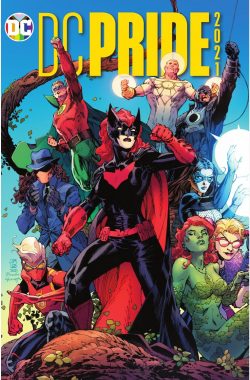
In 2021, the former celebrated accumulated personal freedoms by collecting one-shot DC Pride #1 and select material from similarly-themed specials New Years Evil #1, Mysteries of Love in Space #1 and Young Monsters in Love #1 (cumulatively spanning 2018-2021), celebrating the infinite variety of interpersonal relationships focusing on LGBTQIA+ characters in the DC catalogue as interpreted by creators equally all-embracing.

The compilation – variously lettered by Aditya Bidikar, Josh Reed, Arian Maher, Becca Carey, Steve Wands, Tom Napolitano and Dave Sharpe – opens with a fulsome Foreword from Out & Proud bestselling author and comics scribe Mark Andreyko before we plunge into assorted antics…

James Tynion IV & Trung Le Nguyen begin the festivities with ‘The Wrong Side of the Looking Glass’ as Batwoman Kate Kane confronts memories of her twin sister/deranged arch nemesis Alice and how her enforced solitude after Beth Kane seemingly died may have affected her own life path, after which John Constantine meets magician Extraño in a pub and starts chatting. Gregorio de la Vega was officially DC’s first openly gay super-character, debuting in weekly megaseries Millennium #2 (January 1988) and latterly as a member of The New Guardians. For ‘Time in a Bottle’ creators Steve Orlando & Stephen Byrne pit him in a tall tale contest co-starring Midnighter and featuring queer Nazi vampire cultist Count Berlin

Vita Ayala, Skylar Patridge and colourist José Villarrubia then set lesbian cop Renee Montoya and her alter ego The Question on the trail of a missing politician in ‘Try the Girl’ whilst Mariko Tamaki, Amy Reeder & Marissa Louise have Harley Quinn & Poison Ivy spectacularly and near-lethally address their unique relationship problems in ‘Another Word for a Truck to Move Your Furniture’.

After being in the closet since the 1930s, original Green Lantern Alan Scott shares the story of his first love with openly out son Todd AKA Obsidian. As related by Sam Johns, Klaus Janson & colourist Dave McCaig, ‘He’s the Light of My Life!’ is a sweet romantic interlude balanced by ‘Clothes Makeup Gift’ – by Danny Lore, Lisa Sterle & Enrica Angiolini – a female wherein future Flash multitasks prepping for a date with a new girlfriend and taking down a Mirror Master knockoff Reflek

The Flash connection continues with reformed Rogue Pied Piper foiling and then mentoring social activist outlaw Drummer Boy in wry caper ‘Be Gay, Do Crime’ by Sina Grace, Ro Stein & Ted Brandt before DCTV superhero Dreamer makes their comic book debut in ‘Date Night’, courtesy of Nicole Maines, Rachael Stott and Angiolini.

Arch villains Monsieur Mallah and The Brain prove to gay cop Maggie Sawyer that love truly comes in all forms in Orlando & Nic Klein’s moving confrontation ‘Visibility’ after which Lobo’s troubled, long-abandoned daughter Crush learns some hard truths from the wrong role model in ‘Crushed’ by Andrea Shea and Amancay Nahuelpan Trish Mulvihill…

Harley Quinn offers her particular seasonal felicitations to Renee Montoya and Gotham City in Ayala, Elena Casagrande & Jordie Bellaire’s rendition of ‘Little Christmas Tree’ prior to a host of gay heroes attending a Pride March and forming a team of their own to battle Eclipso in ‘Love Life’ by Andrew Wheeler, Luciano Vecchio & Rez Lokus.

The combination of Aqualad Jackson Hyde, Aerie, Wink, Apollo & Midnighter, Bunker, Tasmanian Devil, The Ray, Shining Knight, Steel/Natasha Irons, Sylvan Ortega, Tremor, Traci 13, Extraño, Batwoman and Crush proved unbeatable and led to them proudly declaring themselves Justice League Queer

This award-winning collection also comes with a cover gallery including 17 variant covers for DC titles during Pride Month and featuring many other out stars, crafted by David Talaski, Brittney Williams, Kevin Wada, Kris Anka, Nick Robles, Sophie Campbell, Travis Moore & Alejandro Sánchez, Jen Bartel, Paulina Ganucheau, Stephen Byrne and Yoshi Yoshitani and closes with a screen-loaded fact feature.

‘DCTV: The Pride Profiles’ offers brief interviews, and Q-&-As of LGBTQ characters in The CW shows – including Batwoman/Ryan Wilder (played by Javicia Leslie), Dreamer (Nicole Maines), White Canary/Sara Lance (Caity Lotz), John Constantine (Matt Ryan), Thunder (Nafessa Williams) and Negative Man (Matt Bomer).

Forthright, fun, thrilling and fabulous, feel free to find and feast on these comics and stories.
© 2018, 2019, 2021, 2022 DC Comics. All Rights Reserved.

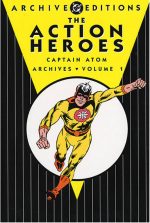
Action Heroes Archive volume 1: Captain Atom & volume 2: Captain Atom, Blue Beetle & The Question


By Steve Ditko, Joe Gill, Gary Friedrich, Dave Kaler, Steve Skeates, Rocke Mastroserio, Frank McLaughlin, Al Milgrom, Roger Stern, John Byrne, Michael Uslan, Alex Toth, and various (DC Comics)
ISBN: 978-1-4012-0302-3 (HB vol. 1) 978-1-4012-1346-6 (HB vol. 2)

Clearly I’m cashing in on the pre-release hype around a new DC Cinema blockbuster here, but I take honest refuge and some comfort in the fact that these books and the stories they contain are actually germane as well as being some of the best Silver Age comics ever crafted… 

Despite being dead – and so very much missed – Steve Ditko remains comics’ most unique stylist. Love him or hate him, you can’t mistake his work for anyone else’s. His career began in the early 1950s and, depending on whether you’re a superhero fan or prefer deeper, more challenging experimental work, peaked in either the mid-1960s or 1970s.

Leaving the Avenging World, Mr. A and his other philosophically-derived creations for another time, the superhero crowd should heartily celebrate and clamour for new editions of these deluxe collections of the first costumed do-gooder that Ditko worked on. Although I’m a huge fan of his linework – which is always best served by monochrome printing – the crisp, sharp colour of these Archive editions is still much better than the appalling reproduction on bog-paper that first displayed Charlton Comics’ Atomic Ace and latterly the Bug Bombshell to the kids of Commie-obsessed America.

As discussed in the Foreword by historian and Ditko-expert Blake Bell, Action Heroes Archive volume 1: Captain Atom reveals – in all the full-on, simplistic furore of a 1950s B-Movie – how a Cold War-obsessed America copes with a modern-day miracle just as the concept of costumed superheroes was being reimagined…

With covers by Ditko and/or Mastroserio, this tome amasses pertinent tales from Space Adventures #33-40 & 42 (spanning cover-dates March 1960 to October 1961), augmented by the contents of the revived, solo-starring Captain Atom #78-82, as published for December 1965 through September 1966.

In those simpler times the short, terse adventures of Captain Atom seemed somehow more telling than the innovative yet rather anodyne DC fare, whilst Marvel was still pushing romances, westerns and monsters in underpants, explorers in pith helmets and citizen scientists with labs in their garden sheds. Their particular heroic revolution was still months away even though Steve Ditko was producing top-flight work for both companies.

Nevertheless, Ditko’s hero was different and we few who read him all knew it….

As scripted by Jo Gill and predating Fantastic Four #1 by more than 18 months, Space Adventures #33 even cover-featured the new sensation-in-waiting as ‘Introducing Captain Atom’ in a brief but vivid vignette, giving us a true American hero and man of his time before instantly killing him.

Captain Adam was an astronaut accidentally but literally atomised in a rocketry accident. Eerily – and the way it’s drawn spooked the short pants off me when I first read it all those years ago – he gradually reassembles himself on the launch pad…

Now blessed with astounding powers, he reports to the President (Eisenhower) and is swiftly kitted up in a protective outfit, allowing contact with normal, non-irradiated humans and reassigned as a masked superhero who will be the USA’s secret weapon…

Mostly written by or co-written with Joe Gill, the first wonderful, addictive run of 18 stories from Space Adventures #33-42 (and three of those were in fact drawn by uninspired, out-of-his-comfort zone Rocke Mastroserio) are a magnificent example of Ditko’s emerging mastery of mood, pacing, atmosphere and human dynamics.

In 1961, with Ditko increasingly doing more work for blossoming – and better paying – Marvel, Charlton killed the Captain Atom feature. However, when Dick Giordano jumped on the superhero bandwagon and created a costumed character line for Charlton in late 1965, the Captain was revived. Space Adventures was retitled, with Atom’s first full length issue numbered #78.

Since he was still drawing Amazing Spider-Man and Doctor Strange, Ditko could only manage pencils, so Mastroserio was recruited to ink the series, resulting in an oddly jarring finish. With #79, Ditko became lead writer too, and the stories took on an eccentric, compelling edge and tone, lifting them above much of the competition’s fare. Eventually the inker adapted to Ditko’s style and much of the ungainliness disappeared from the figurework, although so had the fine detail that had elevated the early art. This volume ends with issue #82, leaving six more published issues and a complete unpublished seventh for another time…

However, those early, Cold War-fired tales are a truly unique blend of action, tension and sheer whimsy which continued in Space Adventures #34 as ‘The 2nd Man in Space’ cheekily sees the magnanimous hero covertly undercut another Soviet space triumph by saving the USSR’s first cosmonaut from his defective capsule, whilst #35#s ‘The Little Wanderer’ finds him traversing the stars to rescue the spirit of an little boy inadvertently abducted by a well-meaning cosmic traveller…

A thermonuclear double bill graced #36, beginning with ‘The Wreck of X-44’, with a new craft detonating in space and leading Captain Atom to a deadly saboteur, after which ‘Captain Atom on Planet X’ finds him defending a US satellite from all-out attack by the dastardly ruthless Russians…

Geopolitics gives way to fantasy as #37 (December 1960) initially details a fusion-foiled invasion by ‘The Space Prowlers’ before a US probe to the second planet is scuttled by svelte space sirens who score ‘A Victory for Venus’ over the stounded atomic Earthman…

Two months later and the count climbed to three stories, beginning with ‘One Second of War’, wherein the Captain wrecks the doomsday missile attack of Dr. Claudius Jaynes, a suicidal maniac with his own atomic arsenal, before repeating the feat in ‘Backfire’ when a tin-pot dictator seeks to nuke the USA. The issue ends with ‘The Force Beyond’ as an alien entity tries to destroy the world with meteors before encountering our nuclear nemesis…

Space Adventures #39 begins with a ‘Test-Pilot’s Nightmare’ as arrogance threatens the life of a helpless jet jockey and Atom invisibly comes to the rescue after which Mastroserio limns ‘Peace Envoy’ with the energetic enigma turning back another alien invasion. Ditko is back for the final fling as Captain Adam goes undercover in Berlin (just before The Wall went up) to crush an espionage plot in ‘An Ageless Weapon’

The atomic experiment was coming to a close. After #40’s ‘The Crisis’ – wherein the hero helps a diplomat call a tyrant’s bluff and ‘The Boy and the Stars’ features another Earth tot transported into the wondrous cosmos – the costumed heroics were absent the next issue.

Just as the FF was about to go big, Space Adventures #42 (October 1961) arrived and depleted all the inventory tales at once beginning with a brace of Mastroserio drawn yarns and one last tantalising Ditko masterpiece. ‘The Saucer Scare’ is yet another mediocre space war clash whilst ‘The Man in Saturn’s Moon’ sees the atomic ace hunting a Soviet dissent squirreled away by wicked commies. Those lesser efforts are utterly eclipsed by ‘The Silver Lady from Venus’ as another sexy extraterrestrial beguiles the humans of Earth before making a fool of the fiery champion…

And that was that the end until of 1965 when a global resurgence of costumed capers led to a new line at Charlton. Leading that charge came Captain Atom #78 (cover-dated December) when Gill & Ditko – with Mastroserio inking – revived the Atomic Adventurer in ‘The Gremlins from Planet Blue’. The genre had moved on in four years and the stripped-back, pared-down B-Movie feel of those early tales had evolved into a more uniquely fulsome and flamboyant affair for this particular extraterrestrial infiltration. Here were subplots and supporting cast to spare, as the hero foiled alien sabotage and mind control at Cape Kennedy, romancing Leah Jupe whilst her scientist father fell under the control of insidious infiltrators. There was even a new gadfly for Captain Adam in the grumpy form of martinet military man General Brill before ultimately saving Earth again…

In the next issue (February/March 1966), a true but tragic supervillain arrives in the series as ‘Captain Atom Faces Doctor Spectro, Master of Moods’ when a spy hunt brings the hero into the orbit of an embittered recluse seeking to master light and colour to revolutionise medicine. Sadly, sudden success tips him over the edge and his newfound abilities drive him even more crazy…

Apparently destroyed, the miscreant is soon forgotten when a wandering planetoid nears Earth and sounds the ‘Death Knell of the World’ (#80, Ditko, Gill & Mastroserio). Happily, the High Energy Hero is up to foiling a cosmic tyrant and liberating his captive satellite people before confronting ‘The Five Faces of Doctor Spectro’ as the misunderstood miscreant reappears in five prismatic pieces with a plethora of different plans but one overriding goal: pulling himself together and finally splitting this atom…

The hero hosts a quick fact feature drawn by Frank McLaughlin in ‘Captain Atom’s Secret’ before this initial outing ends with a magnificent step up in tension and quality. Issue #82 – cover-dated September 1966 and by Ditko with Dave Kaler & Mastroserio – debuts not just the series’ ultimate archfoe and a major story arc but also the company’s first female superhero.

With an enigmatic teleporting thief casually robbing the nation and the military of its wealth and top secrets, Captain Adam is sent undercover with mystery operative Nightshade in ‘Captain Atom vs. The Ghost’

Their mission introduces sleek scoundrel Alec Rois, channels the spy craze of the era and hints at a vast conspiracy underpinning a threat to Earth and even finds time to see the heroes battle an army of thugs and save Fort Knox from bold bullion banditry…

Over half a decade pioneers Steve Ditko and Captain Atom and paved the way and lit a path to a revolution in comics storytelling and these early exploits were only the start…


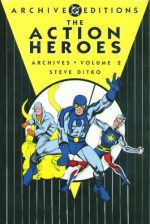
Action Heroes volume 2: Captain Atom, Blue Beetle & The Question

A second – far longer – volume completes Ditko’s controversial Charlton Comics costumed hero contributions with the remainder of Captain Atom’s exploits, the introduction of a new Blue Beetle and debut of his uniquely iconic vigilante The Question.

Following an effusive and extremely informative Introduction by original Action Line inventor and editor Dick Giordano, Captain Atom #83 (November 1966) starts the ball rolling again with a huge blast of reconstructive character surgery.

Although ‘Finally Falls the Mighty!’ was inked by Mastroserio and scripted by relative newcomer Kaler, thematically it’s pure Ditko. Plotted and drawn by him, it sees an ungrateful public swiftly turn on the Atomic Ace, due to the manipulations of a former colleague turned cunning criminal.

Intended to tone down the character’s sheer omnipotence, the added approachable empathy-inducing humanity of malfunctioning powers made his struggles against treacherous Professor Koste all the more poignant.

Moreover, the sheer visual spectacle of his battle against a runaway reactor is some of Ditko’s most imaginative design and layout work. The tale ends on a cliffhanger – a real big deal when the comic came out every two months – and with the last 7 pages dedicated to debuting a new superhero with one of the oldest names in the business.

The Blue Beetle first appeared in Mystery Men Comics #1, released by Fox Comics and cover-dated August 1939. Created by Charles Nicholas (nee Wojtkowski) the character was inexplicably popular: surviving the collapse of numerous publishers before ending up as an acquired Charlton property in the mid-1950s. After releasing a few issues sporadically, Charlton shelved him until the superhero revival of the 1960s when Gill and latterly young Roy Thomas revised and revived the character for a combined 10-issue run (June 1964 – February 1966).

Here however, Ditko accepts but sets aside all that history to utterly recreate him. Ted Kord is an earnest young scientist with a secret tragedy in his past, which Ditko and scripter Gary Friedrich sagely forbear revealing in deference to intrigue and action, in a taut, captivating crime-thriller where the new hero displays his modus operandi by stopping a vicious crime-spree by the Killer Koke Gang.

This untitled short has all the classic elements of a Ditko masterpiece: outlandish intense, fight scenes, compact, claustrophobic yet dynamic layouts, innovative gimmickry and a clear-cut battle between Right and Wrong. It’s one of the very best introductory stories of a new hero anywhere in comics – and it’s 7 pages long…

The remodelling of the Atomic Ace concludes in the next issue with ‘After the Fall a New Beginning’. Once again Ditko rattled his authorial sabre about the fickleness of the public as the villainous Koste exposes the hero’s face on live TV. Escaping, Atom gets a new costume to match his curtailed powers …and consequently, a lot more drama drapes the series.

Now there is a definite feeling of no safety or status quo. The untitled Blue Beetle back-up (scripted by Friedrich with full art from Ditko) pits the new kid against a Masked Marauder, but the real kicker is the bombshell revelation that Homicide detective Fisher – investigating the disappearance of Dan Garrett – suspects a possible connection to Kord…

Whilst extending a running plot-line about the mysterious Ghost and his connection to a lost civilization of warrior women, ‘Strings of Punch and Jewelee’ introduces a couple of shady carnival hucksters who find a chest of esoteric alien weapons and use them for robbery. Although Cap and partner Nightshade are somewhat outclassed here, the vigour and vitality of the Blue Beetle is again undeniable as a mid-air hijack is foiled and a spy sub and giant killer octopus are given short shrift by the indomitable rookie crusader.

Captain Atom #86 finally brings the long-simmering plot-thread of tech thief The Ghost to a boil as the malevolent science-wizard goes on a rampage, totally trouncing Nightshade and our hero before being kidnapped by the aforementioned mystery maidens. ‘The Fury of the Faceless Foe! is by Ditko, Kaler & Mastroserio whilst in the (still) untitled Blue Beetle strip by Friedrich & Ditko, the cobalt crusader confronts a ruthless scientist/industrial spy he’s convinced he battled before…

This leads directly into the first issue of his own comic book. Blue Beetle #1 (cover-dated June 1967) is an all-Ditko masterpiece (even scripting it as “D.C. Glanzman”) with the hero in all-out action against a deadly gang of bandits. ‘Blue Beetle… Bugs the Squids’ is crammed with the eccentric vitality that made Amazing Spider-Man such a monster hit, with justice-dispensing joie de vivre balanced by the moody, claustrophobic introduction of Ditko’s most challenging mainstream superhero creation.

‘The Question’ is Vic Sage, a TV journalist with an uncompromising attitude to crime and corruption, employing an alter-ego of faceless, relentless retribution. In his premiere outing he exposes the link between his own employers’ self-righteous sponsors and gambling racketeer Lou Dicer. This theme of unflinching virtue in the teeth of both violent crime and pernicious peer and public pressure marked Ditko’s departure from straight entertainment towards philosophical – some would say polemical – examination of greater societal issues and the true nature of both Good and Evil that would culminate in his controversial Mr. A, Avenging World and other independent ventures.

In Captain Atom #87 (August 1967), ‘The Menace of the Fiery-Icer’ presaged the beginning of the end for the Atomic Ace as Kaler, Ditko & Mastroserio dialled back on plot threads to deliver a visually excellent but run-of-the-mill yarn about a spy ring with a hot line in cold-blooded leaders.

Blue Beetle #2 however – another all-Ditko affair from the same month – showed the master at his peak. Lead story ‘The End is a Beginning!’ at last reveals the origin of the character as well as the fate of Dan Garrett, and even advances Kord’s relationship with his assistant Tracey. The enigmatic Question, meanwhile, tackles flying burglar The Banshee in a vertiginous, moody thriller reminiscent of early Doctor Strange strips.

Frank McLaughlin joins as inker for a satisfying no-nonsense escapist romp ‘Ravage of Ronthor’ (Captain Atom #88, October 1967), as the hero answers a distress call from space to preserve a paradise planet from marauding giant bugs. Blue Beetle #3 was another superbly satisfying read, as the eponymous hero routes malevolent, picturesque thugs ‘The Madmen’ in a sharp parable about paranoia and misperception. Equally captivating is the intense and bizarre Question vignette wherein a murderous ghostly deep-sea diver stalks some shady captains of industry…

Cover-dated December 1967, issue #89 was the last Captain Atom published by Charlton: an early casualty of the burn-out afflicting the superhero genre and leading to a resurrected horror and mystery craze. This resurrected genre would form a new backbone for the company’s 1970’s output; one where Ditko would shine again in his role as master of short story horror.

Scripter Kaler satisfactorily ties up most of the hanging plot threads with the warrior women of Sunuria in sci-fi-meets-witchcraft thriller ‘Thirteen’, although the Ditko/McLaughlin art team was nowhere near top form.

The next episode promised a final ‘Showdown in Sunuria’, but never materialized…

Blue Beetle #4 (released the same month) is visually the best of the bunch as Kord follows a somehow-returned Dan Garrett to an Asian backwater in pursuit of lost treasure and a death cult. ‘The Men of the Mask’ is pure strip poetry and bombastic action, cunningly counterbalanced by a seedy underworld thriller as the Question seeks to discover who gave the order to ‘Kill Vic Sage!’ Scripted by Steve Skeates (as Warren Savin) it was the last action any Charlton hero saw for the better part of a year…

Then, cover-dated October 1968, The Question returned as the star of Mysterious Suspense #1, with Ditko producing a captivating cover and three-chapter thriller (with Mastroserio providing a rather jarring full-page frontispiece). ‘What Makes a Hero?’ (probably rescued from partially completed inventory material) sees crusading Vic Sage pilloried by the public, abandoned by friends and abandoned by his employers yet resolutely sticking to his higher principles in pursuit of hypocritical villains masquerading as pillars of the community. Ditko’s interest in Ayn Rand’s philosophical Objectivism had become increasingly important to him and this story is arguably the dividing line between his “old” and “new” work. It’s also the most powerful and compelling piece in this entire book.

A month later one final issue of Blue Beetle (#5) was published. ‘The Destroyer of Heroes’ is a decidedly quirky tale featuring a nominal team-up of the azure avenger and the Question as a frustrated artist defaces heroic and uplifting paintings and statues. Ditko’s committed if reactionary views of youth culture, which so worried Stan Lee, are fully on view in this charged, absorbing tale.

Other material had been created and languished incomplete in editorial limbo. In the early 1970s a burgeoning and committed fan-base created fanzine Charlton Portfolio. With the willing assistance of the company, a host of kids who would soon become household names in their own right found a way to bring the lost work to the public gaze. Their efforts are also included here, in monochrome as they originally appeared.

For Charlton Portfolio #9 and 10 (1974), the unreleased Blue Beetle #6 was serialized. ‘A Specter is Haunting Hub City!’ is another all-Ditko extravaganza, pitting the hero against an (almost) invisible thief. Follow-up magazine Charlton Bullseye (1975) finally published ‘Showdown in Sunuria’ in its first two issues.

Behind an Al Milgrom Captain Atom cover, Kaler’s plot was scripted by Roger Stern (working as Jon G. Michels) and Ditko’s pencils were inked by rising star John Byrne – a cataclysmic climax almost worth the 8-year wait. But even there, the magic doesn’t end in this magnificent Archive volume.

Charlton Bullseye #5 (1975) offers one last pre-DC tale of The Question: 8 gripping, intense and beautiful pages plotted by Stern, scripted by Michael Uslan and illustrated by the legendary Alex Toth. This alone is worth the price of admission.

These weighty snapshots from another era are packed with classic material by brilliant craftsmen. They are books no Ditko addict, serious fan of the genre or lover of graphic adventure can afford to be without. It’s impossible to describe the grace, finesse, and unique eclectic shape of Steve Ditko’s art. It must be experienced, and this is as good a place to start as any. It’s just a shame DC have let these tales languish so long, but hopefully the power of Hollywood will induce a revival…
© 1966, 1967, 1968, 1974, 1975, 1976, 2007 DC Comics. All Rights Reserved.

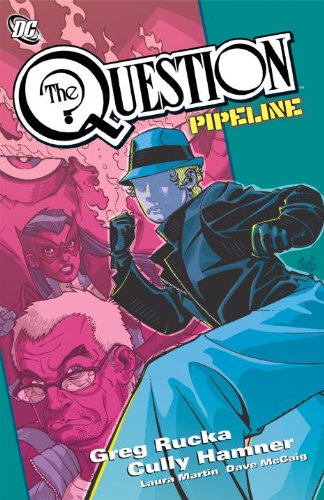
The Question: Pipeline


By Greg Rucka, Cully Hamner, Laura Martin, Dave McCaig & various (DC Comics)
ISBN: 978-1-4012-3041-8 (TPB)

As created by Steve Ditko, The Question was Vic Sage: a driven, obsessed journalist who sought out crime and corruption irrespective of the consequences. The Charlton Comics “Action-Hero” line was acquired by DC – along with a host of other cool and quirky outsiders – when the B-List company folded in 1983, and the ultimate loner became the template for the compulsive vigilante Rorschach when Alan Moore & Dave Gibbons first drafted the miniseries which would become Watchmen.

An ordinary man pushed to the edge by his upbringing and obsessions, Sage used his fists and a mask that made him look faceless to get answers (and, consequently, justice) whenever normal journalistic methods failed.

After a few minor successes around the DC universe Sage got a job in the town where he grew up. Hub City (purportedly based on East St. Louis) was a true urban hell-hole: the most corrupt and morally bankrupt municipality in America. When Sage started cleaning house as his faceless alter ego, he was promptly killed, rescued and resurrected by the inscrutable Shiva – “World’s Deadliest Assassin”.

Crippled, Sage journeyed into the wilderness to be healed and trained by Denny O’Neil’s other legendary martial arts creation, Richard Dragon.

Eventually, a new kind of hero resurfaced in Hub City, philosophically inquisitive rather than merely angry and frustrated, but still cursed with a drive to understand how and why things universally go bad. Aligning himself with his old intellectual mentor and ethical sounding board Professor Aristotle Rodor, Sage set about cleaning up “The Hub” and finally getting a few answers…

Spinning out of DC’s 52 (2006-2007) and Countdown to Final Crisis (2007-2008) mega-events, disgraced Gotham City cop Renee Montoya was selected and trained to take up the faceless mask and obsessions of the shadowy hero when Sage slowly succumbed to cancer.

First as his disciple and then as his heir (and after being masterfully schooled in martial arts by Dragon) she took up Sage’s quest. Montoya was soon drawn into a secret war with the passionate adherents of a malign “gospel of All Things Evil” alternatively known as the Books of Blood or the Crime Bible.

This legendary antithetical tract was said to counter all that is good in the world: justifying and codifying all that is wrong. Driven by a need to understand the evils she fights and stop the spread of this monstrous belief, the new Question hunted down the remaining copies of the book and the distinct factions which protected them and promoted the terrible teachings.

Her path eventually pitted her against the secret master of the “Dark Faith”: immortal Vandal Savage, who was believed by many to be the human species’ first murderer…

Collecting a stunning back-up series originally from Detective Comics #854-865 (August 2009 to July 2010), this globe-girdling saga of corruption and depravity is by writer Greg Rucka, illustrator Cully Hamner and colourists Laura Martin & Dave McCaig opens in the aftermath of that apocalyptic confrontation.

Montoya and inherited ally “Tot” Rodor are ensconced in their desolate lighthouse on the Outer Banks of North Carolina, looking for a new case: sorting through emails from a “help-offered” website they’d set up…

Eventually, a particular message catches Renee’s eye. Hector Soliz is an illegal immigrant who has searched for his sister ever since she went missing. He foolishly trusted the “coyote” who originally smuggled him into America to do the same for Louisa, but never took into account that, for men like Varga, pretty young girls have a value far beyond simple cargo to be smuggled across a closed border…

Taking the case, Renee is soon breaking into the flesh peddler’s home and dealing harshly with Varga’s brutal thugs. There she finds a bed with chains and a camera set-up…

After undergoing some especially intense enquiries, the coyote gives up the name of the man he eventually sold Louisa to: millionaire shipping exporter Gordon Chandless.

Gettng into the businessman’s palatial HQ isn’t much harder, but overconfidence costs The Question dearly when she is surprised and overpowered by hulking bodyguard Mr. Bolt and his handy tasers…

Unable to pry any answers from his faceless captive, Chandless opts for her quiet removal, and by the time The Question escapes a watery death-trap and returns in a very bad mood, the wily trafficker is already gone…

Painfully aware that she’s tracking an evil enterprise of vast proportions, Renee uses Tot’s data-mining skills to track the mogul of misery to a luxury Hollywood lair: going in blazing, and utterly disdainful of his army of heavies. They might be unable to stop the implacable Question, but two of them are capable enough to kill their own boss at the clandestine command of his master…

Despite being back at square one in regard to the criminal hierarchy, Renee now has a location on a certain container vessel ready to ship out with a new cargo of slaves. Righteous indignation, cold fury and lucky intervention by the FBI soon sees all the victims safe and free – including little Louisa Soliz…

‘Pipeline: Chapter Two’ moves the story on as The Question continues her crusade to destroy the trafficking empire: slowly and violently working her way up a chain of scum and crushing individual enterprises whilst inexorably zeroing in on the major player behind the network of sin and misery…

Such costly interventions prompt the mystery leader to fight back hard, and during her raid on a top-of-the-range hot car franchise, bad guys retaliate with a devious and deadly ambush of their own. That’s when Montoya’s secret weapon makes her presence known and the crooks all end up maimed or worse at the hand of the relentless unforgiving Huntress

Helena Bertinelli was mob royalty but, following the type of massacre considered an occupational hazard for “The Family”, she disappeared. The only survivor of a major hit, she trained: becoming a masked avenger mercilessly punishing all gangsters, whilst defending ordinary folk. She especially despises those who prey on children…

Huntress and The Question continue busting rackets across the world, methodically dismantling the network whilst climbing the ladder to the big boss. They finally provoke an overwhelming response in the form of super-assassin Zeiss.

It’s all part of a deeper plan conceived by the vengeful vigilantes, who promptly co-opt the mercenary killer to give up his unassailable paymaster. However, their tactics revolt Tot and the elderly scholar resigns.

Undeterred, but now deprived of crucial technical support, the determined duo head for Gotham City where Helena introduces The Question to the top-secret leader of the all-female super-team known as the Birds of Prey. Former GCPD detective Montoya cannot believe that Commissioner Gordon’s mousey dweeb daughter Barbara was once Batgirl and is now covert anti-crime mastermind Oracle…

Her irresistible cyber-probing soon has the duo invading an underworld server-farm in Odessa which – after a studied application of maximum force – provides a money trail to the Pipeline overlord. Sadly, when they sneak onto Oolong Island, they walk straight into a trap…

The rogue state is the ultimate expression of Capitalism. Populated by criminals and mad scientists of many nations, it maintains its precarious independence by selling proscribed technologies to anyone with money, proudly free from the annoying oversight of law or hindrance of morality…

President-for-Life Veronica Cale starts by torturing her captive heroes, but after debating with The Question, soon sees that the most profit doesn’t necessarily stem from staying bought…

Soon, Montoya and Bertinelli are on the final stretch: sneaking into Syria and invading the stronghold of the man who has turned humans into commodities and exported sin and horror on a global scale. Unfortunately, the wickedest man alive is ready and waiting for them…

The cataclysmic ultimate confrontation is as much theosophical debate as brutal beat-down, and in the final reckoning the allies must become enemies for the best possible reasons before finding anything approaching an acceptable answer to their dilemmas…

Moody, fast-paced, challenging and astoundingly action-packed, this stylish book also offers a hugely engaging ‘Sketchbook’ section from Cully Hamner, offering developmental glimpses into his evolution of the characters; a fascinating 8 pages of layouts and roughs and amazing set designs for story-locations which will delight and amaze all lovers of comic art.

Compelling and breathtaking, Pipeline exposes the dark underbelly of mainstream Fights ‘n’ Tights comics, proving that you don’t need graphic excess to tell hard-hitting tales.

© 2009, 2010, 2011 DC Comics. All Rights Reserved.

Blue Beetle Jaime Reyes Book One


By Keith Giffen, John Rogers, Cully Hamner, Duncan Rouleau, Rafael Albuquerque, Cynthia Martin, Kevin West, Phil Moy, Jack Purcell, Casey Jones & various (DC Comics)
ISBN: 978-1-77951-506-3 (TPB/Digital edition)

Win’s Christmas Gift Recommendation: All Action Superhero fun and Thrills… 9/10

As the most recent incarnation of the venerable Blue Beetle brand makes the jump from comic book limbo and kids’ animation reruns into live action movie madness, here’s a recent re-release of the first dozen of the superb 36-issue run that began in 2006: one of the most light-hearted and compelling iterations of the Golden Age stalwart and still a pure joy to behold…

The Blue Beetle first appeared in Mystery Men Comics #1, published by Fox Comics and cover-dated August 1939. The eponymous lead character was created by Charles Nicholas (AKA Charles Wojtkowski): a pulp-styled mystery man who was a born nomad. Over the years and crafted by a Who’s Who of extremely talented creators, he was also inexplicably popular and hard to kill: surviving the failure of numerous publishers before ending up as a Charlton Comics property in the mid-1950s.

After releasing a few issues sporadically, the company eventually shelved him until the superhero revival of the early 1960s when young Roy Thomas revised and revived the character for a 10-issue run (June 1964, February 1966) reinventing cop/adventurer Dan Garrett as an archaeologist, educator and scientist who gained super-powers whenever he activated a magic scarab with the trigger phrase “Kaji Da!”

Later that year, Steve Ditko (with scripter Gary Friedrich) utterly recreated the Blue Beetle. Ted Kord was an earnest and brilliant young researcher who had been a student and friend of Professor Garrett. When his mentor seemingly died in action, Kord trained himself to replace him: a purely human inventor/combat acrobat, bolstered by ingenious technology. This latter version joined DC’s pantheon during Crisis on Infinite Earths, earning his own series and a quirky immortality partnering with Booster Gold in Justice League International and beyond…

Collecting Blue Beetle (volume 7) #1-12 spanning May 2006 – April 2007, this saga follows the hallowed formula of a teenager suddenly gifted with great powers, and reveals how some heroes are remade, not born…

At the height of the Infinite Crisis (Link please, June 18 2008), El Paso high-schooler Jaime Reyes found a strange blue jewel shaped like a bug. That night, as he slept, it attached itself to his back, transforming him into a bizarre insectoid warrior. Almost immediately, he was swept up in the chaos, joining Batman and other heroes in a climactic space battle.

As this series opens on ‘Blue Monday’ (written by Keith Giffen & John Rogers and limned by Cully Hamner), he’s come home to El Paso, Texas; terrified for staying out late on a school night, and is suddenly attacked by Green Lantern Guy Gardner. The situation rapidly escalates as his sentient bug armour reacts instinctively and manically to the emerald energy of the foe…

As the fight builds in intensity, by way of flashbacks we see Jaime’s life before everything changed: meeting best buds and fellow high school inmates Paco and Brenda – who were with him when he found the scarab that messed up his life – and bratty little sister Milagro as well as his wonderfully cool parents…

The battle ends as soon as Gardner realises he’s fighting a child, but as when he flies off, the Lantern drops a shocking bombshell: whatever is empowering the kid and manifesting his talking, weapons-infested bug suit, it ISN’T magic…

The mystery intensifies in ‘Can’t Go Home Again’ as more recovered memories detail early clashes with local super-gangbangers The Posse and hint at big changes in Jaime. In the present, Reyes is slowly making his way back to his house, terrified over how his folks will react to his disappearance last night. It’s far worse than he could have imagined and a real shock when he discovers that he’s actually been missing for a year…

Illustrated by Cynthia Martin & Philip Moy ‘The Past is Another Country’ sees Jaime demonstrate his new powers to his gobsmacked family, only to be (initially) rejected and abandoned. Whilst the Reyes clans come to terms with their “dead” son resurrected as a bug monster, the stunned lad road tests his new powers and tracks down his old friends.

A lot has changed: Paco is now part of the Posse and those outcast teens are locked in a deadly war with the minions of local organised crime-boss La Dama… who just happens to be Brenda’s legal guardian Tia Amparo

Cully Hamner returns in #4 as Giffen & Rogers detail how Jaime starts looking into previous Blue Beetles and owners of the scarab and becomes a ‘Person of Interest’ to cyber-hero Oracle/Barbara Gordon who tests him with a view to making him one of her Birds of Prey. That doesn’t end well and presages far worse as militaristic mystery man The Peacemaker hits town on the down-low, secretly seeking old comrade and associate “Blue”…

Delivered in two parts over #5 and 6, ‘Secrets’ is illustrated by Duncan Rouleau, Martin, Kevin West, Moy & Jack Purcell. It reveals how The Phantom Stranger arrives, also hoping to clear up the mystery of this new Blue Beetle. Seeking to ascertain the teen’s place in the hierarchy of “the New Age of Magic” is something many factions are working on, from The Posse to La Dama’s pet goon the Diviner. Chaos reigns as all the investigators converge and clash when a baby of great power is stolen and Jaime at last learns that sometimes you just have to step up and do the right thing…

Following a brutal confrontation with plenty of shocking revelations ‘Secrets Pt 1 of 2’ sees a sharp redefinition of allegiances and anew status quo that almost immediately founders when Peacemaker reveals what nobody seemed able to discern – the true nature of Jaime’s scarab…

John Rogers is sole scripter for BB #7 as ‘Brother’s Keeper’ offers a guest-star packed recap of Reyes’ career to date: filling in many blanks since the night the new Beetle helped save the world. Illustrated by Hamner & Casey Jones and with Giffen back on board, ‘Road Trip’ sees Jaime, Brenda and Peacemaker go looking for even more answers: beginning by consulting young cyber-geek Dan Garrett – a self-proclaimed expert on all previous Blue Beetles.

As the original hero’s granddaughter she also has a fair claim to being the rightful owner of the gem, but a potential squabble and their research is interrupted by the return of a monstrous hunchbacked maniac determined to destroy the “demonic” new hero.

Following that Roleau renders ‘Inside Man’, telling why Peacemaker has so-unwillingly involved himself in Jaime’s life just as Brenda finds herself in a world of trouble…

Living with her aunt – the magic-wielding, arch crime boss of El Paso – in a felonious clearing house for stolen super-technology and magical artifacts, it was only a matter of time before Brenda stumbled upon something really dangerous. Whisked to an far-distant world in ‘Should’ve Taken that Left Turn at Albuquerque…’ (with art from Hamner and Rafael Albuquerque!), her disappearance forces an uneasy truce between Jaime and La Dama so that the Beetle can rescue Brenda, consequently encountering a selection of New Gods and hungry aliens before successfully bringing her back in ‘The Guns of Forever’ (by Rogers & Albuquerque, and we end on a thematic cliffhanger with ‘Meet the New Boss’ as Beetle and Peacemaker investigate cattle mutilations, battle a giant bug monster and meet its owner – an extraterrestrial envoy from extragalactic trading empire The Reach. He also claims to be the creator of the scarab…

With a gallery of variant covers, sketches and character designs by Hamner, this is a welcome return for a great series: one of precious few comic books to combine action and adventure, with comedy and suspense perfectly leavened with fun and wit. Blue Beetle Jaime Reyes offers an innovative and wryly engaging saga impossible to resist, especially with the artistic endeavours of Hamner, Martin, Albuquerque, Rouleau and Jones making each page a visual treat. Even 17 years on, Blue Beetle remains a fresh and delightful joy, so why not bug out and Go Read This!
© 2006, 2007, 2022 DC Comics. All Rights Reserved.

The Question: The Deaths of Vic Sage


By Jeff Lemire, Denys Cowan, Bill Sienkiewicz, Chris Sotomayor, Willie Schubert & various (DC Comics)
ISBN: 978-1-7795-0558-3 (HB/Digital edition)

One of DC’s best 1980s comics series was – for the longest time – out of print and unavailable digitally. It more or less still is, except for a prohibitively expensive Omnibus edition, and if you have strong arms and a big budget you should really track those stories down, whilst the rest of us wait for more reasonable trade paperbacks and eBook editions…

As devised and delivered by Steve Ditko in the 1960s – as he sank ever more deeply into the Objectivist philosophy of Ayn Rand – The Question was Vic Sage: a driven, implacable, justice-obsessed journalist seeking out crime and corruption uncaring of the consequences.

The Charlton “Action-Line Hero” was acquired by DC when the Connecticut outfit folded and was the template for compulsive vigilante Rorschach when Alan Moore & Dave Gibbons first drafted the miniseries that would become the groundbreaking Watchmen.

The contemporary rumour-mill had it that since the creators couldn’t be persuaded to produce a spin-off Rorschach comic, DC went with a reworking of the Ditko original…

As revised by writer Denny O’Neil and illustrators Denys Cowan & Rick Magyar, Vic Sage was an ordinary man pushed to the edge by his obsessions, using his fists and a mask that made him look utterly faceless to get answers (and justice) whenever standard journalistic methods failed. After a few minor appearances around the DC universe, Sage got a job in the town where he grew up and resumed his campaign for answers…

Always more cult hero than classic crusader, The Question revival carved a unique niche for itself as “comics grew up” post Crisis on Infinite Earths and Watchmen. The character was periodically radically rebooted and reimagined, but here scripter Jeff Lemire (Sweet Tooth, The Underwater Welder, Trillium, Black Hammer, Descender, Ascender, Gideon Falls, Essex County) returns to O’Neil’s canon to tell a revelatory tale of reincarnation, zen mystery and undying evil. The project was part of DC’s latest high end mature reader imprint Black Label: released as four single issues before becoming a spiffy hardback with a digital equivalent…

Hub City is a hell-hole, the most corrupt and morally bankrupt municipality in America. Mayor Wesley Fermin is a slick, degenerate crook, but real power resides in his Special Counsel Holden Malick, political cronies, a hand-picked gang of “heavies” and the largely corrupt and racist police force…

Originally, Sage was supported by college lecturer Aristotle “Tot” Rodor: the philosopher-scientist who created his faceless mask and other gimmicks as well as being a sounding board for theories and plans and ethical bellwether. He remains so here but is also increasingly challenging his former pupil’s motives and methods…

After being killed by Fermin’s forces The Question was revived and retrained by O’Neil’s other legendary martial arts creation, Richard Dragon, Kung Fu Fighter . A year passed and a reenergised, faceless avenger began cleaning up Hub City…

The saga opens with the city rushing into chaos and the Question busting a brothel trafficking children to city officials. Later, when reporting the raid on his TV show, Sage ambushes former lover Myra Fermin (the mayor’s sister and oblivious City Alderman) with the fact that the Councilman he left for the cops has mysteriously been erased from all official reports. Shocked and outraged, Fermin continues deluding herself about her brother and the administration, but the damage has been done and she starts looking where she shouldn’t…

When Malick arrives to clean up the mess, Sage notices a ring the politico wears: something old and somehow deeply disturbing…

Tot is no help, but the ring sticks in Sage’s mind and eventually he uncovers a historical organisation called the Hub City Elder Society that all wore such symbols and draws some telling conclusions to today’s political elite…

Hot on the trail he moves, unaware that events are converging into a dark miracle. At the exact moment The Question uncovers an ancient den of occult ceremony, an innocent black man is gunned down by a racist cop and Myra Fermin bursts in on her beloved brother committing savage atrocities on a bound captive. The concatenation of blood climaxes as The Question finds an old faceless mask with a bullet hole through the forehead in a cavern under the city. It’s not one of his, but he is assaulted by a wave of memories and images of supernal evil when he holds it…

Barely conscious, he retreats from the underground lair into streets awash with blood as a protest march becomes a race riot. Urged by Tot to go on TV to calm the tide, all Sage can think of is finding Dragon and getting some metaphysical first aid…

What he gets is doped, as the hermit applies zen hoodoo and drugged tea, despatching the unwilling rationalist sceptic on a vision quest into the past…

Sage awakens in the wilderness that will one day be his home town, bare-footed and wearing a faceless mask…

In Hub City 1886, Viktor Szasz is a blacksmith desperately seeking to escape the vile acts he committed as a soldier fighting the Comanche, in a frontier outpost well on its way to becoming truly civilised. Silent and solitary Viktor intervenes when negro settler Irving Booker and his family are repeatedly harassed and ultimately murdered by the local priest and his devout flock. Szasz reverts to his gun-toting ways to save or avenge them but is outmatched until rescued by a red-headed Indian woman. She shares some secrets about true evil, most notably that a mystical “Man with a Thousand Faces” can only be killed by someone named “Charlie”.

Delirious and experiencing hallucinations of himself in different times, agnostic Szasz still refuses to believe in devils, which is probably why the thing in pit under the town gets the drop on him…

In 1941, Hub City private eye Charlie Sage groggily looks at his notebook, where someone has written “Man with no face” and “man with a thousand faces???”. Blaming too much booze, he cleans himself up whilst glimpsing flashes of unknown dead people and adds “red-haired woman” to the page for no reason he can think of…

When red-haired walk-in client Maggie Fuller hires him to investigate her brother Jacob’s disappearance, he has no idea it will be his last case. They are both union organisers and prime targets for the bosses and the city officials they own, and before long the shamus has annoyed all the wrong people, ending up attacked by thugs wearing fancy rings…

Even his one pal on the Police Force – veteran patrolman “Tot” – can’t help him. But does reluctantly pass him a file full of juicy potential prospects for Fuller’s absence. Still enduring staggering western visions and brutal flashforwards, Charlie becomes lost in civil violence in three eras, and succumbs to another ring-wearer ambush.

The PI awakes in a subterranean chapel in the middle of some kind of crazy black mass, meets a devil and is never seen again…

Awaking from his vision-quest, present-day Sage leaves Dragon, set on sorting his city’s real world distress: braving riot and savage, premeditated retaliation by the administration and cops hungry to put the rabble back in their place. Unable to stop the carnage with his fists, The Question instead uses mass media to deliver a stunning counterstroke, turning the tables and critically destabilising Firmin and Malick.

He also has Tot build a permanent solution to the thing in the pit under Hub City, but has gravely underestimated the horror and indeed his own childhood connection to it…

Even after overcoming the odds, the illusion of victory is tenuous and insubstantial, leaving The Question still looking for answers in all the wrong places…

This book also offers covers and a gallery of variants by Cowan, Sienkiewicz & Sotomayor, Lemire & Marcelo Maiolo; Eduardo Risso; Howard Chaykin & Gustavo Yen, Andrea Sorrentino plus Cowan & Sienkiewicz’s sketchbook section ‘Questionable Practises’ with roughs, finished pencils pages and covers, portraits, finished pre-colour inks, unused cover art and creator bios.

Combating Western dystopia with Eastern Thought and martial arts action is not a new concept, but here the problems of a society so utterly debased that the apocalypse seems like an improvement are also lensed though a core of absolutism. Is man good? Is there such a thing as True Evil? What can one man do?

Who’s asking..?

Although the creators keep the tale focused on dysfunction – social, societal, civil, political, emotional, familial and even methodological – the core motivation for today’s readers has shifted, with the horror show that is and always has been Hub City now arguably attributed to an eternal supernatural presence. Regulation masked avenger tactics don’t work in such a world, and some solutions require better Questions…
© 2019, 2020 DC Comics. All Rights Reserved.

DC’s Greatest Detective Stories Ever Told


By Jerry Siegel & Joe Shuster, Gardner F. Fox, Mindy Newell, Mike W. Barr, Denny O’Neil, Andy Helfer, Rusty Wells, Creig Flessell, Carmine Infantino, Alan Davis, Paul Neary, Terry Beatty & Dick Giordano, Al Vey, E.R. Cruz, Denys Cowan & Rick Magyar, Mark Badger, Jim Aparo & Mike DeCarlo & various (DC Comics)
ISBN: 978-1-7795-0594-1 (TPB/Digital edition)

Fundamental and definitive aspects of “detective stories” have been attributed to the Bible, ancient Greek dramas, One Thousand and One Nights and similarly compelling classical texts from China, India and other places, but the true genre of crime and mystery fiction really began with cheap printing and the rise of mass entertainment culture.

Detective stories are a subgenre wherein an investigation – by amateur or professional (active or retired) – into a legal felony or moral/social injustice. Like exploration/adventuring, fantasy, horror and science fiction, Detective Stories blossomed in white western societies in the mid-19th century: spreading from prose books and magazines to other entertainment media like plays and films, with early stars including C. Auguste Dupin, Sherlock Holmes, Jules Maigret, Father Brown, Lord Peter Wimsey, Sexton Blake and Hercule Poirot. Tales aimed at youngsters generated their own sleuthing stars: Nancy Drew, The Hardy Boys and more

As comic strips developed, they also spawned detective champions like Hawkshaw, Dick Tracy, Charlie Chan, Kerry Drake ad infinitum: all contributing to a tidal wave of pulp fiction crimebusters that inspired true literary legends – Philip Marlow, Sam Spade, Simon Templar, Mike Hammer and so on…

Detective Comics #1 had a March 1937 cover-date and was the third and final anthology title devised by luckless pioneer Major Malcolm Wheeler-Nicholson. In 1935, the entrepreneur had seen the potential in Max Gaines’ new invention – the comic book – and reacted quickly, conceiving and releasing packages of all-new strips in New Fun: The Big Comic Magazine and its follow-up New Fun/New Adventure (which ultimately became Adventure Comics) under the banner of National Allied Publications.

These publications differed from similar prototype comics magazines which simply reprinted edited collations of established newspaper strips. However, these vanguard titles were as varied and undirected in content as any newspaper funnies page.

Detective Comics was different. Specialising solely in tales of crime and crimebusters, the initial roster included (amongst others) adventurer Speed Saunders, Cosmo, the Phantom of Disguise, Gumshoe Gus and two series by a couple of kids from Cleveland named Siegel & Shuster: espionage agent Bart Regan and two-fisted shamus Slam Bradley

Within two years the commercially unseasoned Wheeler-Nicholson had been forced out by his more adept business partners, and eventually his company grew into monolithic DC (for Detective Comics) Comics. Surviving a myriad of changes and temporary shifts of identity and aims, it’s still with us – albeit primarily as a vehicle for the breakthrough character who debuted in #27 (May 1939)…

Celebrating that quintessential connection and affiliation to the form, this slim tome gathers an unconventional array of sleuths and problem solvers, many not native to the parent title, but all offering a heady taste of what made the title great. Re-presenting material from Adventure Comics #51; Batman #441; Detective Comics #2, 329 & 572; Lois Lane #1-2; Secret Origins #40 and The Question #8 it spans August 1937 to November 1989: an epic package chronologically sampling the company’s connection and debt to the genre that truly started their ball rolling…’’

Sans preamble, we dive straight into action with early star Slam Bradley in his second ever case. ‘Skyscrapers of Death’ originated in the April 1937 cover-dated Detective Comics #2, (by Jerry – back when he still called himself “Jerome” – Siegel & Joe Shuster). It reveals how the abrasive, two-fisted gumshoe is framed for murder by a crooked Union boss. Slam and his assistant Shorty were a big draw in those early days: revelling in all the raw action and spectacle that would fire up his younger cousin Superman. The Bradley strip ran until October 1949, finally closing shop in Detective Comics #152.

Next up is quintessential pulp sleuth The Sandman who premiered in either Adventure Comics #40 July 1939 (two months after Batman debuted in Detective Comics #27) or two weeks earlier than that in New York World’s Fair Comics 1939, depending on which distribution records you choose to believe.

He was created and originally illustrated and scripted by multi-talented all-rounder Bert Christman, with assistance from Gardner F. Fox. Head utterly obscured by a gas-mask and slouch hat; caped, business-suited millionaire adventurer Wesley Dodds is a rugged playboy scientist cut from the radio drama/prose periodical mystery-men mould of The Shadow, Phantom Detective, Green Hornet, Lone Ranger, Spider, Avenger and so many more: all household names of early mass-entertainment.

Wielding a sleeping-gas gun and haunting the night hunting killers, thieves and spies, he was soon joined by plucky paramour Dian Belmont, before gradually losing readers’ interest and slipping from cover-spot to last feature in Adventure, just as the shadowy, morally ambiguous avengers he emulated also slipped from popularity in favour of gaudily clad glory-boys…

Alternately titled ‘The Pawn Broker’ in previous reprints, ‘The Van Leew Emeralds’ comes from Adventure Comics #51 (June 1940 by Fox & Creig Flessel): a fascinating mystery romp for the romantically-inclined crimebusters to solve in fine style and double-quick time…

In 1963 Julius Schwartz took editorial control of Batman and Detective Comics and finally found a home for a character who had been lying mostly fallow ever since his debut as a walk-on in The Flash #112 (April/May 1960). The Elongated Man was Ralph Dibny: a circus-performer who discovered an additive in soft drink Gingold which granted certain people increased muscular flexibility. Intrigued, he refined the chemical until he had a serum bestowing ability to stretch, bend and compress his body to an incredible degree. Then Ralph had to decide how to use his new powers…

Designed as a modern take on Jack Cole’s immensely popular Golden Age star Plastic Man, Dibny became a regular guest star/colleague for the Scarlet Speedster. He married vivacious debutante Sue Dibny and joined Flash’s battles against aliens and supervillains, but when the back-up spot opened in Detective Comics (previously held by Martian Manhunter since 1955 and only vacated because J’onn J’onzz was promoted to lead position in House of Mystery) Schwartz had Dibny slightly reconfigured as a flamboyant, fame-hungry, attention-seeking, brilliantly canny globe-trotting private eye solving mysteries for the sheer fun of it.

Aided by his equally smart but thoroughly grounded wife, the short tales were patterned on classic Thin Man filmic adventures of Nick and Norah Charles: blending clever, apparently impossible crimes and events with slick sleuthing, all garnished with the outré permutations and frantic physical antics first perfected by Cole…

Drenched in fanciful charm and sly dry wit, the complex yet uncomplicated sorties began in Detective #327 (May 1964) running until #371 (cover-dated January 1968). Crafted by Fox & Infantino – who inked himself in early episodes – this third outing has them heading for cowboy country to unravel the ‘Puzzle of the Purple Pony!’ (Detective Comics #329) by inadvertently playing cupid for a young couple hunting a gold mine before capturing a gang of murderous bandits with money and murder in mind.

Next up is a rare, completely serious outing for the oldest female lead in superhero comics. Although her role varied from patsy to comedy stooge, from jester to romantic ideal to eye-candy as the situation warranted, Lois Lane was always an investigative whirlwind.

Here in the dying moments of the pre-Crisis on Infinite Earths continuity, scripter Mindy Newell & artist Gray Morrow found their 4-issue miniseries scrunched into two double-length issues (August-September 1986,with that notorious “Superman’s Girl Friend…” strap line thankfully dropped) as Lois Lane #1-2, scrupulously, meticulously, obsessively, and ultimately unsuccessfully tried to bring a national crisis in missing children to the public’s attention in ‘When it Rains, God is Crying’.

Devoid of superhero involvement, the regular Superman cast are drawn into a polemical story exposing the extent of child abduction, the repercussions of recovering victims – dead or otherwise – and official responses in ‘Ignorance Was Bliss’, ‘Dark Realities’, ‘Quicksand’ and ‘Bless the Child’ after Lois becomes increasingly driven to solve the mystery of an unidentified child found dead in Metropolis. Refusing to accept the horrific toll of disappearances she uncovers, the traumatised reporter puts her life and career on the line to find answers nobody seems willing to hear…

From painful reality we fold back into fantastic fantasy as anniversary issue Detective Comics #572 (March 1987) unites Batman, second Robin Jason Todd, Elongated Man, Slam Bradley and Sherlock Holmes in a hunt for ‘The Doomsday Book’, courtesy of scripter by Mike W, Barr, Alan Davis & Paul Neary, Terry Beatty & Dick Giordano, Infantino & Al Vey & ER Cruz.

The story begins with the descendent of infamous Professor Moriarty enacting a century old scheme, countered by each hero in a solo turn before all leads connect them to a certain British castle and a manic climactic confrontation…

In the gritty post-Crisis reality, Denny O’Neil, Denys Cowan & Rick Magyar retooled Steve Ditko’s ultimate lone agent of justice into a philosophical force of nature, relentless in his pursuit of answers.

An ordinary man pushed to the edge by his obsessions, Vic Sage used his fists and a mask that makes him look faceless to secure truth and justice whenever normal journalistic methods failed. Here the remorseless Question prowls Hub City hunting the ‘Mikado’ (The Question #8, September 1987): a good man driven by the daily horrors of the city to take action, against villains and hypocrites, making his punishments fit the crime…

In the years when superheroes were in retreat and considered too foolish for readers. DC launched Rex the Wonder Dog, who solved crimes, fought dinosaurs and saved the world. In issue 4 (July/August 1952), a back-up feature launched. Written by John Broome, Bobo was Detective Chimp: a Florida-based stalwart who was assistant and deputy to the local sheriff. He cracked many cases and was extremely popular among certain types of fan. He remains so and in Secret Origins #40 (May 1989) finally enjoyed ‘The Origin of Detective Chimp’ thanks to Mark Badger Andy Helfer & Rusty Wells. Madcap and hilarious, it’s a wild ride but has been superseded in later years by other, more quasi rational tales. Nevertheless, an ape solving crimes is a sure-fire winner as many other hirsute DC gumshoes could attest…

This eclectic selection closes with the middle chapter of a landmark crossover tale. Crafted by Marv Wolfman, Jim Aparo & Mike DeCarlo, ‘Parallel Line’ comes from Batman #441 (November 1989) the third chapter of the Batman: A Lonely Place of Dying arc introducing third Robin Tim Drake.

After original Robin Dick Grayson’s departure, the Dark Knight worked solo until he caught a streetwise urchin stealing the Batmobile’s tires. This lost boy was Jason Todd, whose short but stellar career as the Boy Wonder was fatally tainted by his impetuosity, tragic links to one of the hero’s most unpredictable foes and shocking death. The trauma of losing his comrade forced Batman to re-examine his own origins and methods, becoming darker still..

After a period of increasingly undisciplined encounters Batman was on the edge of losing not just his focus but also his ethics and life: seemingly suicidal on frequent forays into the night. Interventions from his few friends and associates had proved ineffectual. Something drastic had to happen if the Dark Knight was to be salvaged.

Luckily there was an opening for a sidekick…

The crossover tale originally appeared in Batman #440-442 and New Teen Titans #60-61 (all plotted by Wolfman & George Pérez) and a new character entered the lives of the extended Batman Family; a remarkable child who would reshape the DC Universe.

‘Parallel Lines’ unravels the enigma of Tim Drake, who as a toddler was in the audience the night the Flying Graysons were murdered. Tim was an infant prodigy, and when, some months later he saw new hero Robin perform the same acrobatic stunts as Dick Grayson, he instantly deduced who the Boy Wonder was – and by extrapolation, the identity of Batman.

A passionate fan, Drake followed the Dynamic Duo’s exploits for a decade: noting every case and detail. He knew when Jason became Robin and was moved to act when his death triggered Batman’s increasing instability. Taking it upon himself to fix his broken heroes, Tim tried to convince the “retired” Grayson to became Robin once more – but fate had other plans…

Eccentrically engaging, these tales are the merest hint of the wonders locked in DC’s vaults of fun and wonder. Hopefully, it’s also simply the start of a long and vibrant caseload of recovered mysteries
© 1937, 1940, 1964, 1986, 1987, 1989, 2020 DC Comics. All Rights Reserved.

The Question: Zen and Violence


By Dennis O’Neil, Denys Cowan & Rick Magyar (DC Comics)
ISBN: 978-1-4012-1579-8 (TPB)

Denny O’Neil died on June 11th. It didn’t make the news or mostly anywhere. For comics readers of my vintage he was the voice of our generation, carrying us through some of the most turbulent times in world history and using his gifts to pass on a philosophy never before seen in comics. He utterly remade Batman, Green Lantern, Green Arrow and Superman. He created the relevancy movement, bringing social conscience back to comics for the first time since Jerry Siegel & Joe Shuster were told to tone it down with the wife beaters and grasping mine owners…

He was a remarkably insightful and prolific writer and a nurturing, imaginative editor. Think of a hero or title: Denny probably made it better. We’ve been the poorer since his retirement, but now there’s no chance of one last hurrah…

One of DC’s best comics series of the 1980’s – and probably the closest to O’Neil’s personal beliefs – is criminally out of print in trade paperback format and still hasn’t made it to digital editions yet, but it’s something well worth tracking down.

The Question, as created by Steve Ditko, was Vic Sage: a driven, justice-obsessed journalist who sought out crime and corruption irrespective of the consequences. This Charlton “Action-Line Hero” was purchased by DC when the Connecticut outfit folded and was the template for the compulsive avenger Rorschach when Alan Moore & Dave Gibbons first drafted the miniseries that would become the groundbreaking Watchmen.

The contemporary rumour-mill had it that since the creators couldn’t be persuaded to produce a spin-off Rorschach comic, the company went with a reworking of the Ditko original…

An ordinary man pushed to the edge by his obsessions, Vic Sage used his fists and a mask that made him look utterly faceless to get answers (and justice) whenever normal journalistic methods failed. After a few minor appearances around the DC universe, Sage got a job in the town where he grew up.

Hub City is a hell-hole, the most corrupt and morally bankrupt municipality in America. Mayor Wesley Fermin is a degenerate, drunken sot and the real power is insane cleric and political advisor Reverend Jeremiah Hatch, whose hand-picked gang of “heavies” are supplemented by the world’s deadliest assassin, Lady Shiva.

Reuniting with Aristotle Rodor, the philosopher-scientist who first created his faceless mask and other gimmicks, Sage determines to clean up The Hub, but despite early victories against thugs and grafters, is easily defeated by Shiva, and left to the mercies of Hatch and his gang. A brutal beating by the gangsters breaks every bone in his body and – after shooting him in the head – the callous minions simply dump his body in the freezing waters of the river.

Obviously, he doesn’t die. Rescued by the inscrutable Shiva, but utterly crippled, Sage is sent into the wilderness to be healed and trained by O’Neil’s other legendary martial arts creation, Richard Dragon. A year passes…

It’s a new type of hero who returns to a Hub City which has sunk even lower into degradation. Sage’s old girlfriend is now the Mayor’s wife, Reverend Hatch has graduated from thugs to terrorist employees, and his madness has driven him to actually seek the destruction of Humanity. Will the new Question be sufficient answer to the problems of a society so utterly debased that the apocalypse seems like an improvement?

Combating Western dystopia with Eastern Thought and martial arts action is not a new concept, but the author’s spotlight on cultural problems rather than super-heroics make this series O’Neil’s most philosophical work, and Denys Cowan’s quirky, edgy art – inked with jagged precision by Rick Magyar – imbues this darkly adult, powerfully sophisticated thriller with a maturity that is simply breathtaking.

This is a story about dysfunction: Social, societal, political, emotional, familial and even methodological. The normal masked avenger tactics don’t work in a “real”-er world, and some solutions require better Questions…
© 1986, 1987, 2007 DC Comics. All Rights Reserved.