 Â
Â
By Hergé (Egmont UK)
ISBN 13: 978-1-4052-2895-4
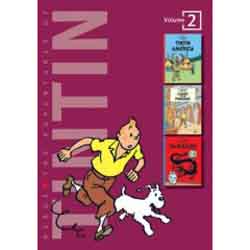
By the time Georges Remi, known the world over as Hergé, began the third adventure, Tintin in America (which ran from 1931-1932), he was well on the way to mastery of his art but was still growing as a writer. Although the periodical format meant that a certain degree of slapstick and seemingly directionless action was necessary to keep the attention of the reader, his ability to integrate these set-piece elements into the building of a complete narrative was still developing.
Following directly on from Tintin in the Congo (see Adventures of Tintin vol 1, ISBN 13: 978-1-4052-2894-7) the valiant boy reporter heads for Chicago to sort out the gangster Al Capone, whose diamond smuggling enterprise he had scotched in Africa. But Capone and his hoods are ready and waiting…
Thwarting the plots and schemes of the legendary gangster make for thrilling, uproarious reading, full of chases, fights and hairsbreadth escapes, but events take a darker turn – and broad diversion – once Capone’s biggest rival Bobby Smiles enters the picture. Head of the Gangsters Syndicate of Chicago, Smiles first tries to buy Tintin off, and when he is furiously rebuffed, tries repeatedly to have him killed.
Setting a trap with the police, Tintin smashes the GSC and chases Smiles out west to Redskin City, only to fall foul of a tribe of Indians the mobster has hoodwinked into attacking the indomitable lad. Hergé had a life-long fascination with the American West, and it featured in many of his works (‘Tim the Squirrel’ and ‘Popol Out West’, for example). It’s also clear that he watched a lot of movies, as the signature Western set-pieces are all featured in a thrilling pursuit involving a railroad chase, dynamite sabotage, a prairie wildfire and even tying our heroes to the tracks before Tintin and Snowy finally capture the desperate thug.
Returning to the city Tintin is once more the target of the remaining criminal gangs but they prove no match for his resourceful ingenuity, and he leaves America a better, cleaner place.
With this somewhat long and rambling series of exploits; still not quite a cohesive narrative, Hergé begins to pepper the instalments with sly, dry social commentary, beginning the process of sophisticating the stories, and adding satire to the slapstick – an acknowledgement that adults too, were devout fans and followers of the strip. The comedy of such moments as the rush of speculators when oil is found on the Indian Reservation, or the inept way in which cowboys try to lynch Tintin and Snowy (is that PC these days? – still, it is awfully funny), is graphically interesting but surely aimed at a more worldly and cynical consumer.
Cigars of the Pharaoh (which ran from 1932-1934) is stylistically much more of a designed thriller, with a solid plot underpinning the episodic hi-jinks. Tintin and Snowy meet the first in a string of absent-minded professors (which would culminate in the outlandish but lovable Cuthbert Calculus) Sophocles Sarcophagus whilst on a ship to Egypt. This archaeologist has divined an ancient mystery that is somehow connected to a ring of ruthless drug smugglers. Tintin first encounters the detectives Thompson and Thomson here, when narcotics are planted in his cabin, and a complex drama unfolds as the lad and Professor Sarcophagus discover a lost pyramid is not only the smuggler’s base but the foundation for a much darker game – the overthrow of nations!
Hergé introduced many other recurring and supporting characters in this tale. As well as the Detectives, there was the villainous seaman Captain Allan, the trader Oliveira da Figueira and the Movie Mogul Roberto Rastapopoulos, who would all return in later stories. He was gearing up for the long creative haul, and also began inserting plot-seeds that would only flower in future projects.
When Tintin’s investigations take him to India, where the villains are attempting to topple a Maharajah trying to destroy the Opium poppy industry, he befriends the potentate and thwarts the plan of a crazed Fakir. This villain uses a drug called Rajaijah, which drives men mad forever, and is connected to the Egyptian gang.
The contemporary version of this tale was revised by Hergé in 1955, and sharp-eyed fans will spot a few seeming anachronisms, but the more open-minded will be able to unashamedly wallow in a timeless comedy-thriller of exotic intrigue and breakneck action. Although the mystery of the Cigars of the Pharaoh ends satisfactorily with a climactic duel in the rugged and picturesque hill-country, the threat and relevance of Rajaijah would not be resolved until Hergé’s next tale, and his first masterpiece.
The final album collected in this delightful little re-compilation is The Blue Lotus (which was serialised from 1934-1935): A tale of immense power as well as exuberance, and a marked advance on what has gone before. Set in a China that was under colonial assault by Imperial Japan, it is imbued with deep emotion and informed by the honest sentiment of a creator unable to divorce his personal feeling from his work.
Set amidst ongoing incursions into China by the Japanese during the period of colonial adventurism that led to the Pacific component of World War II, readers would see Tintin embroiled in a deep, dark plot that was directly informed by the headlines of the selfsame newspapers that carried the adventures of the intrepid boy reporter.
Whilst staying with the Maharajah of Gaipajama, Tintin intercepts a mysterious radio message just before a visit by a secretive oriental from Shanghai. This gentleman is attacked with Rajaijah, before he can introduce himself or explain his mission, so the lad sets off for China to solve the mystery.
At the conclusion of Cigars the creator stated that Tintin would go to China next, and he was promptly approached by Father Gosset of the University of Leuven, who begged him to avoid the obvious stereotyping when dealing with the East, and who introduced him to a Chinese art-student named Chang Chong-chen (or Chong-jen or possibly Chongren). They became great friends and Chang taught Hergé much of the history and culture of one of the greatest civilisations in history. This friendship also changed the shape and direction of all Hergé’s later work. The unthinking Colonial superiority of the white man was no longer a casual given, and the artist would devote much of his life to correcting those unthinking stereotypes that populated his earlier work.
Chang advised Hergé on Chinese art and infamously lettered the signs and slogans on the walls, shops and backgrounds in the artwork. He also impressed the artist so much that he was written into the tale as the plucky, heroic street urchin Chang, and would eventually return in Tintin in Tibet.
As Tintin delves into the enigma he finds a web of deception and criminality that includes gangsters, military bullies, Japanese Agent-provocateurs, and corrupt British policemen. He also took an artistic swing at the posturing, smugly superior Westerners that contributed to the war simply by turning a blind-eye, even when they weren’t actively profiting from the conflict.
As Tintin foils plot after plot to destroy him and crush any Chinese resistance he finds himself getting closer to the criminal mastermind in league with the Japanese, and we see a valiant, indomitable nation fighting oppression in a way that would typify the Resistance Movements of Nazi-occupied Europe a decade later, with individual acts of heroism and sacrifice tellingly mixed with the high-speed action and deft comedy strokes.
An altogether darker and oppressive tale of high stakes, the villains in this epic of drug-running and insidious invasion are truly fearsome and despicable, and the tradition of Chinese wisdom honestly honoured. After all, it is the kidnapped Professor Fang Hsi-ying who finally finds a cure for Rajaijah – once rescued by Tintin, Snowy and Chang. But despite the overwhelmingly powerful subtext that elevates this story, it must be remembered that this is also a brilliant, frantic rollercoaster of fun.
It’s hard to imagine that comics as marvellous as these still haven’t found their way onto everybody’s bookshelf, but if you are one of this underprivileged underclass, this lush series of hardback collections is a very satisfying way of rectifying that sorry situation. So why haven’t you..?
Tintin in America: artwork © 1945, 1973 Editions Casterman, Paris & Tournai.
Text © 1978 Egmont UK Limited. All Rights Reserved.
The Cigars of the Pharaoh: artwork © 1955, 1983 Editions Casterman, Paris & Tournai.
Text © 1971 Egmont UK Limited. All Rights Reserved.
The Blue Lotus: artwork © 1946, 1974 Editions Casterman, Paris & Tournai.
Text © 1983 Egmont UK Limited. All Rights Reserved.