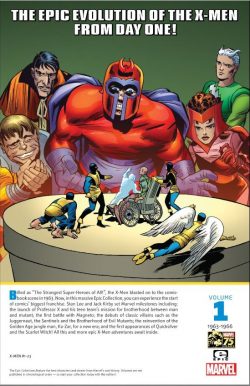
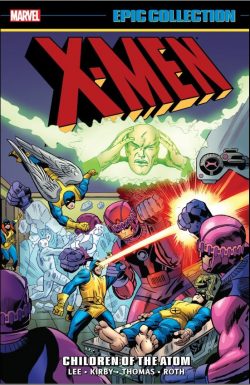
X-Men Epic Collection volume 1 1963-1966: Children of the Atom


By Stan Lee & Jack Kirby, Roy Thomas, Werner Roth, Alex Toth & various (Marvel)
ISBN: 978-0-7851-8904-6 (TPB)

In 1963 things really took off for the budding Marvel Comics as Stan Lee & Jack Kirby expanded their diminutive line of action titles, putting a bunch of relatively new super-heroes (including hot-off-the-presses Iron Man) together as the Avengers; launching a decidedly different war comic in Sgt. Fury and his Howling Commandos and creating a group of alienated heroic teenagers who gathered together to fight a rather specific, previously unperceived threat to humanity.

Those halcyon days are revisited in this splendid trade paperback and eBook compilation: gathering from September 1963 to August 1966, the contents of X-Men#1-23.

Issue #1 introduced Cyclops, Iceman, Angel and the Beast: very special students of Professor Charles Xavier, a wheelchair-bound telepath dedicated to brokering peace and integration between the masses of humanity and the emergent off-shoot race of mutants dubbed Homo Superior. The story opens as the students welcome their newest classmate, Jean Grey, aka Marvel Girl, a beautiful young woman with the ability to move objects with her mind.

No sooner has the Professor explained their mission than an actual Evil Mutant, Magneto, single-handedly takes over American missile base Cape Citadel. A seemingly unbeatable threat, the master of magnetism is nonetheless driven off – in under 15 minutes – by the young heroes on their first mission …

It doesn’t sound like much, but the gritty dynamic power of Kirby’s art, solidly inked by veteran Paul Reinman, imparted a raw energy to the tale which carried the bi-monthly book irresistibly forward. With issue #2, a Federal connection was established in the form of FBI Special Agent Fred Duncan, who requested the teen team’s assistance in capturing a mutant who threatened to steal US military secrets in ‘No One Can Stop the Vanisher!’.

These days, young heroes are ten-a-penny, but it should be noted that these kids were Marvel’s first juvenile super-doers since the end of the Golden Age, so it’s perhaps unsurprising that in this tale of a terrifying teleporter the outmatched youngsters needed a little adult supervision…

Issue #3’s ‘Beware of the Blob!’ displays a rare lapse of judgement as proselytising Professor X invites a sideshow freak into the team only to be rebuffed by the felonious mutant. Impervious to mortal harm, The Blob incites his carnival cronies to attack the hidden heroes before they can come after him, and once again it’s up to teacher to save the day…

With X-Men #4 (March 1964) a thematic sea-change occurs as Magneto returns at the head of ‘The Brotherhood of Evil Mutants!’ Intent on conquering a South American country and establishing a political powerbase, he ruthlessly dominates Mastermind, Toad, Quicksilver and the Scarlet Witch, who are very much his unwilling thralls in the bombastic struggle that follows. From then on, the callow champions-in-training are the hunted prey of many malevolent mutants.

‘Trapped: One X-Man!’ in issue #5 sees early results in that secret war as Angel is abducted to Magneto’s orbiting satellite base Asteroid M, and only a desperate battle at the edge of space eventually saves him…

‘Sub-Mariner Joins the Evil Mutants!’ is a self-explanatory tale of gripping intensity elevated to magical levels of artistic quality as superb Chic Stone replaced Reinman as inker for the rest of Kirby’s tenure. The issue also incorporates a stunning ‘Special Pin-up page’ starring “Cyclops”.

Genuine narrative progress is made in ‘The Return of the Blob!’ as their mentor leaves on a secret mission, but not before appointing Cyclops acting team leader. Comedy relief is provided as Lee & Kirby introduce Beast and Iceman to the Beatnik-inspired “youth scene” whilst the high action quotient is maintained courtesy of a troubled teaming of the Blob and Magneto’s malign brood…

Another and very different invulnerable mutant debuted in ‘Unus the Untouchable!’: a wrestler with an invisible force field who attempts to enlist in the Brotherhood by offering to bring them an X-Man. Also notable is the first real incident of “anti-mutant hysteria” after a mob attacks Beast: a theme that would become the cornerstone of the X-Men mythos and the delights include a ‘Special Pin-up page’ featuring ‘The Beast’.

X-Men #9 (January 1965) is the first true masterpiece of this celebrated title. ‘Enter, the Avengers!’ reunites the mutants with Professor X in the wilds of Balkan Europe, as deadly Lucifer seeks to destroy Earth with a super-bomb, subsequently manipulating the teens into an all-out battle with the awesome Avengers. This month’s extra treat is a ‘Marvel Masterwork Pin-up’ of ‘Marvel Girl’

This is still a perfect Marvel comic story today, as is its follow-up ‘The Coming of Ka-Zar!’: a wild excursion to Antarctica, featuring the discovery of the Antediluvian Savage Land and the modern incarnation of one of Marvel/Timely’s oldest heroes (Kazar the Great was a pulp Tarzan knock-off who translated to the comics page, originating in October/November 1939’s Marvel Comics #1).

Dinosaurs, lost cities, spectacular locations, mystery and all-out action: it doesn’t get better than this…

After spectacular starts on most of Marvel’s Superhero titles (as well as western and war revamps), Kirby’s increasing workload compelled him to cut back to simply laying out most of these lesser lights whilst Thor and Fantastic Four evolved into perfect playgrounds and full-time monthly preoccupations for his burgeoning imagination. The last series he surrendered was the still-bimonthly X-Men wherein an outcast tribe of mutants worked diligently and clandestinely to foster peace and integration between the unwary masses of humanity and the gradually-emergent “coming race” of Homo Superior.

The King’s departure in #11 was marked by a major turning point. ‘The Triumph of Magneto!’ sees our heroes and the Brotherhood of Evil Mutants both seeking a fantastically powered being dubbed The Stranger. None are aware of his true identity, nature or purpose, but when the Master of Magnetism finds him first, it spells the end of his war with the X-Men…

With Magneto gone and the Brotherhood broken, Kirby relinquished pencilling to other hands, providing loose layouts and design only. Alex Toth & Vince Colletta proved an uncomfortable mix for #12′s tense drama ‘The Origin of Professor X!’ it opened a 2-part saga introducing Xavier’s half-brother Cain Marko and revealed that simplistic thug’s mystic transformation into an unstoppable human engine of destruction.

The story concludes with ‘Where Walks the Juggernaut’: a compelling, tension-drenched tale guest-starring the Human Torch, and most notable for the introduction of penciller Werner Roth (using the name Jay Gavin). He would be associated with the mutants for the next half decade. His inker for this first outing was the infallible Joe Sinnott.

Roth was an unsung veteran of the industry, working for the company in the 1950s on such star features as Apache Kid and the inexplicably durable Kid Colt, Outlaw, as well as Mandrake the Magician for King Features Comics and Man from U.N.C.L.E. for Gold Key. As with many pseudonymous creators of the period, it was his DC commitments (mostly romance stories) which forced him to disguise his moonlighting until Marvel grew big enough to offer him full-time work.

From issue #14 and inked by Colletta, ‘Among us Stalk the Sentinels!’ celebrated the team’s inevitable elevation to monthly publication with the first episode of a 3-chapter epic introducing anthropologist Bolivar Trask, whose solution to the threat of Mutant Domination was super-robots that would protect humanity at all costs. Sadly, their definition of “protect” varied wildly from their creator’s, but what can you expect when a social scientist dabbles in high-energy physics and engineering?

The X-Men took the battle to the Sentinels’ secret base but became ‘Prisoners of the Mysterious Master Mold!’ before wrapping up their ferrous foes with ‘The Supreme Sacrifice!’

Veteran Dick Ayers joined as inker from #15: his clean line blending perfectly with Roth’s clean, classicist pencils. They remained a team for years, adding vital continuity to this quirky but never top-selling series.

X-Men #17 dealt with the aftermath of the battle – the last time the US Army and government openly approved of the team’s efforts – and the sedate but brooding nature of ‘…And None Shall Survive!’ enabled the story to generate a genuine air of apprehension as Xavier Mansion is taken over by an old foe who picks them off one by one until only the youngest remains to battle alone in climactic conclusion ‘If Iceman Should Fail..!’

‘Lo! Now Shall Appear… The Mimic!’ in #19 was Lee’s last script: the pithy tale of a troubled teen possessing the ability to copy the skills, powers and abilities of anyone in close proximity. The writing reins were turned over to Roy Thomas in #20, who promptly jumped in guns blazing with ‘I, Lucifer…’: an alien invasion yarn starring Xavier’s arch-nemesis as well as Unus the Untouchable and the Blob. Most importantly, it revealed in passing how Professor X lost the use of his legs.

With canny concluding chapter ‘From Whence Comes Dominus?’, Thomas & Roth completely made the series their own, blending juvenile high spirits, classy superhero action and torrid soap opera with beautiful drawing and stirring adventure.

At this time Marvel Comics had a vast and growing following among older teens and college kids, and the youthful Thomas spoke and wrote as they did. Coupled with his easy delight in large casts, this would increasingly make X-Men a most welcoming read for any educated adolescent …like you or me…

As suggested already, X-Men was never one of young Marvel’s top titles but it found a devout and dedicated following, with the frantic, freakish energy of Kirby’s heroic dynamism comfortably transiting into the slick, sleek attractiveness of Roth as the fierce tension of hunted, haunted juvenile outsider settled into a pastiche of college and school scenarios so familiar to the students who were the series’ main audience.

The action pauses here with a crafty 2-parter resurrecting veteran Avengers villain Count Nefaria who employs illusion-casting technology and a band of other heroes’ second-string foes (Unicorn, Porcupine, Plantman, Scarecrow and the Eel, if you’re wondering) to hold Washington DC hostage and frame the X-Men for the entire scheme.

‘Divided… We Fall!’ and ‘To Save a City!’ comprise a fast-paced, old-fashioned Goodies vs. Baddies battle with a decided sting in the tail. Moreover, the tale concludes with Marvel Girl yanked off the team as her parents insist she furthers her education by leaving the Xavier School to attend New York’s Metro University…

To Be Continued…

Supplemented by a copious gallery of original art pages – by Kirby, Reinman, Roth & Ayers – a wealth of evocative house ads and an unseen never used alternate cover by Kirby & Stone, these quirky tales are a million miles removed from the angst-ridden, breast-beating, cripplingly convoluted X-brand of today’s Marvel and, in many ways are all the better for it. Superbly rendered, highly readable adventures are never unwelcome or out of favour, and it should be remembered that everything here informs so very much of the mutant monolith. These are stories for dedicated fans and rawest converts. Everyone should have this book.
© 2019 MARVEL.
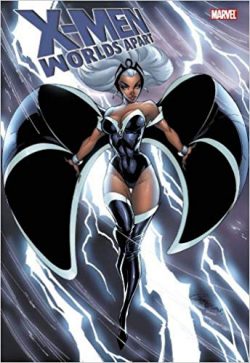
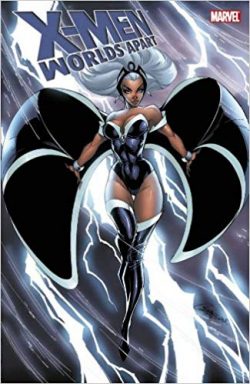
X-Men: Worlds Apart


By Christopher Yost, Diogenes Neves & Ed Tadeo; Priest, Sal Velluto & Bob Almond; Chris Claremont & John Byrne, & various (Marvel)
ISBN: 978-0-7851-4030-6 (HB) 978-0-7851-3533-3 (TPB)

In 1963 The X-Men #1 introduced Cyclops, Iceman, Angel, Marvel Girl and the Beast: very special students of Professor Charles Xavier, a wheelchair-bound telepath dedicated to brokering peace and integration between the masses of humanity and the emergent off-shoot race of mutants – Homo Superior.

After years of eccentric and spectacular adventures the mutant misfits disappeared at the beginning of 1970 as mystery and all things supernatural once more gripped the world’s entertainment fields and triggered a sustained downturn in costumed hero comics.

Although their title was revived at the end of the year as a cheap reprint vehicle, the missing mutants were reduced to guest-stars and bit-players throughout the Marvel universe and the Beast was transformed into a monster to cash in on the horror boom, until Marvel editor-in-chief Roy Thomas green-lighted a bold one-shot in 1975 as part of the company’s line of Giant-Sized specials.

Giant Size X-Men #1 detailed how the classic team had been lost in action, leaving Xavier to scour the Earth for a replacement team. Recruiting old foes-turned-friends Banshee and Sunfire and throwaway Hulk villain Wolverine, most of the savant’s time and attention was invested in newcomers. These comprised Kurt Wagner, a demonic German teleporter who would be codenamed Nightcrawler, Russian farmboy Peter Rasputin, who could transform into a living steel Colossus, embittered, disillusioned Apache superman John Proudstar who was cajoled into joining the makeshift squad as Thunderbird and a young woman who was regarded as an African weather goddess.

Ororo Munroe AKA Storm was actually the lost daughter of Kenyan royalty and an American journalist. On joining Xavier’s team, she spent years fighting the world’s most deadly threats as part – and eventually leader – of the outlaw, unloved, distrusted mutant hero horde, before eventually leaving her second home to marry a boy she had met whilst trekking across the Dark Continent decades previously.

In Fantastic Four #52 (August 1966) an incredible individual calling himself the Black Panther tested himself against the Cosmic Quartet and disclosed in the following issue how, as a child, he had lost his father to a ruthless scientist’s mercenary army when they invaded his hidden African homeland Wakanda.

Young Prince T’Challa had single-handedly avenged the murder of his father T’Chaka and driven off the raiders, inheriting the role of king and spiritual leader of his people. Eventually, he became a member of the Mighty Avengersand introduced his country to the world, with technologically-advanced Wakanda swiftly advancing to the forefront of nations by trading its scientific secrets and greatest natural resource – incredible alien mineral Vibranium.

Whilst a boy wandering the plains of Africa, he had encountered a beautiful young girl with incredible powers trekking from Egypt to West Africa. Years later he found her again as one the X-Men. Slowly rediscovering old feelings, the pair married and Storm became the First Lady of Wakanda…

This compilation collects 4-issue miniseries X-Men: Worlds Apart from 2008-2009, Black Panther volume 3, #26 (January 2001) and material from Marvel Team-Up #100 (December 1980), and follows the African Queen through her darkest hours even as it affords a little space to examine key moments in her tempestuous relationship with the earthly agent of the very-real, very paws-on Panther God.

The romance commences with the eponymous ‘Worlds Apart’ crafted by Christopher Yost, Diogenes Neves, Ed Tadeo & Raul Treviño, with the action opening in New York’s sewers where Storm and some-time comrade Cyclops seek to convince hidden Morlock refugees to join the West Coast mutant enclave and safe-haven known as Utopia. When she is suddenly called back to Africa, Ororo’s erstwhile friend contentiously questions her loyalties…

Even as august and elevated co-ruler of a fabulous kingdom, Ororo iq adi T’Challa is still painfully aware of humanity’s – and more specifically her own subjects’ – bigotry regarding the genetic offshoot politely dubbed Homo Superior. When one of her protégés – young Wakandan mutant Nezhno Abidemi – is accused of murder she rushes to defend him.

…But the evidence is overwhelming, incontrovertible and damning…

Nevertheless, she knows something is amiss and when she arbitrarily frees him, the entire country turns against her. Even her adoring husband wants her blood…

The cause soon smugly reveals himself as Amahl Farouk: a sinister, soul-corrupting telepath she and Charles Xavier killed years ago, when she was merely an orphan child-thief in Cairo. Sadly, the dying monster evolved into a malign body-stealing psychic force; an untouchable Shadow King feeding on hatred and polluting everything it touches…

Biding its time, Shadow King insinuated itself into Wakanda, stoking ill-feeling throughout. Now wearing her beloved T’Challa, it plans on extracting a much-postponed final vengeance…

As the poisonous presence gloats, Ororo realises it is not just her at risk: the Shadow King has simultaneously taken Cyclops in America and is using her fellow X-Man as a weapon to kill the only earthly threat to Farouk’s power – supreme telepath Emma Frost, who is also Scott Summers’ lover…

With an entire nation and the precious body of her beloved mercilessly hunting her and Nezhno, the wondrous weather-warrior must first direct her powers half a world away to stop Cyclops whatever the cost, before somehow destroying a foe no power on Earth can touch.

Happily, the Spiritual co-ruler of Wakanda has her own direct line to the country’s cat god – or is that goddess?

Short, sharp, spectacularly action-packed and wickedly satisfying – especially the climactic battles with the assembled X-Men and friendly rival Cyclops – this bombastic Fights ‘n’ Tights adventure is rather bafflingly complemented with ‘Echoes’ from Black Panther #26. Created by Priest, Sal Velluto & Bob Almond, it’s the opening part of a longer epic entitled ‘Stürm und Drang – a Story of Love and War’. Here T’Challa’s childhood friendship with Ororo is slowly and painfully re-cultivated during an incursion into Wakanda by alien-hunting US Federal Agents, and a barely-civil embassy from the secret race known as Deviants, all seeking possession of an unearthly parent and child. The untenable situation eventually forces a drastic reaction from the sympathetic African heroes…

As an orphaned part of an ongoing storyline, this interlude, although smart and pretty, is pretty baffling and aggravating too, ending as it does on an unsatisfying cliffhanger, and unless you already know the greater tale, is far more annoying than elucidating…

Still at least you can track down the entire tale in numerous Black Panther collections…

This intriguing safari into the unknown concludes with the far more pleasing – and done-in-one – story of Ororo and T’Challa’s first meeting as kids in the wilds of Africa. It first appeared as a back-up in Marvel Team-Up #100 in 1980, cleverly revealing how the kids enjoyed an idyllic time on the veldt (reminiscent of Henry De Vere Stacpoole’s 1908 novel The Blue Lagoon) until a South African commando team tried to kidnap the Wakandan prince as a bargaining chip.

Now, as adults in America they are hunted by the vicious Afrikaner Andreas de Ruyter who has returned, attempting to assassinate Ororo before seeking to exact final revenge upon the Black Panther. Cue long-delayed lover’s reunion and team-raid on an automated House of Horrors…

Clearly designed as an outreach project to draw in audience demographics perceived to be short-changed by mainstream Marvel, Storm and the Black Panther have proved to be a winning combination in terms of story if not sales, and Worlds Apart is the kind of tale that will please fans of the genre and followers of the film franchises.
© 1980, 2001, 2008, 2009 Marvel Characters, Inc. All rights reserved.

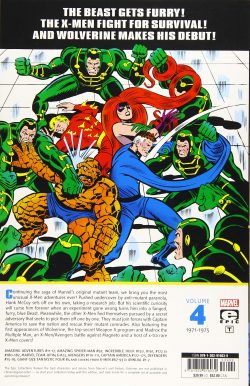
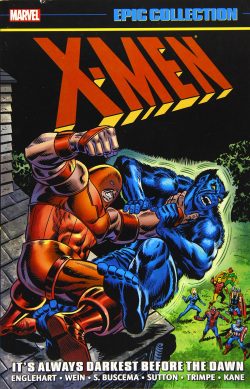
X-Men Epic Collection volume 4 1970-1975: It’s Always Darkest Before the Dawn


By Steve Englehart, Len Wein, Gerry Conway, Stan Lee, Roy Thomas, Archie Goodwin, Mike Friedrich, Tony Isabella, Chris Claremont, Sal Buscema, Tom Sutton, Herb Trimpe, Gil Kane, Don Heck, John Buscema, Bob Brown, Jim Starlin & various (Marvel)
ISBN: 978-1302916039 (TPB)

X-Men was never one of young Marvel’s top titles but it did secure a devout and dedicated following, with the frantic, freakish energy of Jack Kirby’s heroic dynamism comfortably transiting into the slick, sleek prettiness of Werner Roth as the blunt tension of hunted outsider kids settled into a pastiche of the college and school scenarios so familiar to the students who were the series’ main audience.

The core team consisted of tragic Scott Summers/Cyclops, telepath and mind-reader Jean Grey/Marvel Girl, wealthy golden boy Warren Worthington/Angel, ebullient Bobby Drake/Iceman, and erudite, brutish genius Henry McCoy/Beast in training with Professor Charles Xavier, a wheelchair-bound (and temporarily deceased) telepath dedicated to brokering peace and integration between the masses of humanity and the gradually emerging race of mutant Homo Superior. In latter days they had been joined by magnetic Polaris and cosmic ray fuelled Havoc… although they were usually referred to as Lorna Dane and Alex Summers.

However, by the time of this massive full-colour paperback and digital tome (collecting the covers from reprint issues X-Men #67-93 plus Annual #1-2, Amazing Adventures #11-17, Amazing Spider-Man #92, Incredible Hulk #150, 161, 172, 180-182, Marvel Team-Up #4, 23, Avengers #110-111, Captain America #172-175, Defenders #15-16 and Giant-Size Fantastic Four #4: spanning December 1970 through June 1975 and chronologically re-presenting every mutant appearance of the era) the outcasts had been reduced to reliving past glories and riding the guest star circuit. A one-shot entitled Giant-Sized X-Men #1 would soon change all that forever…

After nearly eight years of eccentrically spectacular adventures the mutant misfits virtually disappeared at the beginning of 1970 during another periodic downturn in superhero comics sales. Just as in the closing years of the 1940s, mystery men faded away as supernatural mysteries and traditional genre themes once more dominated the world’s entertainment fields…

Although gone, the mutants were far from forgotten. The standard policy at that time to revive characters that had fallen was to pile on guest-shots and reprints. X-Men #67 (December 1970) saw them return in double-sized issues, re-presenting early classics beginning with the Juggernaut tale from #12-13. Although returned as a cheap but shelf-monopolising reprint vehicle, the missing Children of the Atom were reduced to bit-players throughout the ongoing Marvel universe, whilst the bludgeoning Beast was opportunistically transformed into a scary monster to cash in on the horror boom and ultimately a comedy foil in the Avengers.

Then, with sales of the spooky stuff subsequently waning in 1975, Marvel Editor-in-Chief Roy Thomas green-lighted a bold one-shot as part of the company’s line of Giant-Size specials and history was made…

A brace of covers – X-Men Annual #1 by Jack Kirby & Chic Stone and X-Men #67 by Marie Severin & Joe Sinnott – lead us to John Romita’s cover for Amazing Spider-Man #92 (January 1971) and a tale by Stan Lee, Gil Kane & Romita depicting ‘When Iceman Attacks’.

This actually concludes the Amazing Arachnid’s battle against corrupt political boss Sam Bullit, as the ambitious demagogue convinces the youngest X-Man that Spider-Man is a kidnapper. Despite being a closing chapter, this all-out action extravaganza efficiently recaps itself and is perfectly comprehensible to readers.

The covers to X-Men #68-74 (by Kirby, Dick Ayers, Sal Buscema, Werner Roth, Bill Everett & Kane) and King Size Annual #2 (Kane & Romita) further celebrate the individual and collective Merry Mutants comeback tour before the next story opens.

Alec Summers had left the X-Men, terrified of his uncontrollable cosmic power, to isolate himself in the deserts of New Mexico. When Lorna Dane goes looking for him in ‘Cry Hulk, Cry Havok!’ (Incredible Hulk #150 April 1972, Archie Goodwin, Herb Trimpe & John Severin) she encounters a menacing biker gang and an Emerald Giant violently protective of his privacy. Mercifully Havok proves a match for the rampaging titan…

The previous month Marvel had launched a reinvented X-Man in a solo series as a response to the world horror boom which shifted general comic book fare from bright shiny costumed heroes to dark and sinister monsters.

Premiering in Amazing Adventures #11 (March 1972), written by Gerry Conway and illustrated by the incredibly effective team of Tom Sutton & Syd Shores, ‘The Beast!’ reveals how brilliant Hank McCoy leaves Xavier’s school and takes a research position at the conglomerate Brand Corporation.

Using private sector resources to research the causes of genetic mutation, McCoy becomes embroiled in industrial skulduggery and – to hide his identity – uses his discoveries to “upgrade” his animalistic abilities – temporarily turning himself into a fearsome anthropoid creature with startling new abilities. At least it was supposed to be temporary…

Bracketed by Kane & Frank Giacoia’s covers for X-Men #75-76, Steve Englehart assumes the writing reins in AmazingAdventures #12 (May), and monster maestro Mike Ploog takes the inker’s chair for ‘Iron Man: D.O.A.’ as McCoy, trapped in a monstrous new shape, took extreme measures to appear human as he desperately strove to find a cure for his condition. Unfortunately, Brand is riddled with bad characters and when Tony Stark visits, it’s inevitable that the Beast and Iron Man clash…

Incomprehensibly that battle led to Iron Man’s death; or so McCoy thought. In fact, the monster has been mesmerized by villainous Mastermind in a scheme to force the outcast to join the Brotherhood of Evil Mutants. ‘Evil is All in Your Mind!’(Englehart, Sutton & Giacoia) also reintroduces two characters from the wildest fringes of Early Marvel continuity who will both play major roles in months and years to come. Patsy Walker was an ideal girl-next-door whose wholesome teen-comedy exploits had delighted readers for decades since her debut in Miss America #2 (Nov. 1944).

She starred in seven separate comic series until 1967. Here she joins the cast of the Beast as the tag-along wife of her boyhood sweetheart Buzz Baxter who had grown from an appealing goof to a rather daunting military martinet and Pentagon liaison. As McCoy is throwing off the defeated mesmerist’s psychic influence, Captain Baxter lays plans to capture the maligned mutate…

George Tuska & Vince Colletta’s cover for X-Men #77 precedes the next full story, proving the other X-Men were not forgotten. New Horror-Hero rising star Morbius, the Living Vampire was making things tough for Spider-Man in Marvel Team-Up #4 (September 1972) as the Human Torch temporarily bows out to be replaced by the mutant team. ‘And Then… the X-Men!’ is a terse, tense thriller written by Conway, inked by Steve Mitchell and illustrated by the magnificent Gil Kane at the top of his form detailing how the outsiders hunt the sanguine predator in search of a cure for as the ailing arachnoid…

Bloodsuckers literal and metaphorical are also the order of the day in Amazing Adventures #14. ‘The Vampire Machine’ (inked by Jim Mooney) sees Iron Man return as computerized killer and incipient AI assassin Quasimodo attacks Brand Corp. in an attempt to steal radical technology to build himself a body…

Kane & Giacoia’s cover for X-Men #78 precedes AA #15’s ‘Murder in Mid-Air!’ (rendered by Sutton, Giacoia & John Tartaglione) finding a gravely wounded Beast making an unexpected ally and confidante, before old comrade the Angel comes calling, encountering a hideous artificially mutated monster dubbed the Griffin en route. This tale reintroduced another old friend of Hank McCoy’s and should segue into another X-crossover (Incredible Hulk #161, March 1973), but not before the cover of X-Men #79 and 80 intermingle with AA #16 – wherein our hirsute hero battles an old foe in the Halloween thriller ‘…And the Juggernaut Will Get You… If You Don’t Watch Out!’ by Englehart, Bob Brown & Frank McLaughlin, with a horde of classic caricatures from cartoon legend Marie Severin.

It was the last time McCoy would be seen in a full tale until the bombastic Beast joined the Avengers. Amazing Adventures #17 featured a 2-page framing sequence by Englehart, Jim Starlin & Mike Esposito (included here) which bracketed an abridged reprint of the Beast origin back-ups from X-Men #49-53 (which are not).

At last that Hulk hiatus ends as ‘Beyond the Border Lurks Death!’ (Englehart, Trimpe & Sal Trapani) sees the Green Goliath and Bouncing Blue Beast as reluctant allies in a battle against old X-foe the Mimic, whose ability to absorb the attributes of others has gone tragically, catastrophically haywire…

X-Men #81’s cover leads to another titanic team-up – from Avengers #110-111 (April and May 1973) – as Captain America, Thor, Iron Man, Scarlet Witch, Vision and Black Panther investigate the disappearance of the mutant heroes and are thoroughly beaten by their oldest enemy sporting a new power.

‘… And Now Magneto!’ (Englehart, Don Heck, Giacoia & Esposito) ends with half the team brainwashed captives of the master villain with the remaining crusaders desperately searching for new allies.

Not included here is their journey to San Francisco to recruit Daredevil and the Black Widow so the saga resumes and concludes in Avengers #111 as, ‘With Two Beside Them!’ (Englehart, Heck & Esposito) the returned heroes and West Coast vigilantes successfully rescue the X-Men and Avengers enslaved by the malign Magneto…

With X-Men #82 (June), the covers generally reverted to recoloured and modified versions of the original releases: rendered by Dan Adkins, Ross Andru, Heck, Tuska & Giacoia, bringing us to February 1974 and Incredible Hulk #172.

A Roy Thomas plot and Tony Isabella script sees the Gamma Giant captured by US soldiers and hurled into another dimension, allowing the unstoppable mystic menace to inadvertently escape. ‘And Canst Thou Slay… The Juggernaut?’ reveals that even his magically augmented might cannot resist our favourite antihero and features a telling, conclusive cameo by Cyclops, Marvel Girl and Professor X, after which the Tuska cover for X-Men #87 precedes a crucial episode in the lives of the mutant adventurers.

Englehart was at this time making history with an allegorical saga in Captain America and the Falcon mirroring the national scandal of President Nixon and Watergate. The Patriotic Paragon found himself framed for murder and smeared by a media disinformation campaign and forced to go on the run to clear himself.

Brought to you by Englehart, Sal Buscema & Vince Colletta, it begins in Captain America #172 as ‘Believe it or Not: The Banshee!’ finds Cap and the Falcon tracing a lead to Nashville, clashing with the eponymous fugitive mutant and stumbling into a clandestine pogrom on American soil…

For months mutants have been disappearing unnoticed, but now the last remaining – Cyclops, Marvel Girl and Charles Xavier – have tracked them down, only to discover that Captain America’s problems also stem from ‘The Sins of the Secret Empire!’ whose ultimate goal is the conquest of the USA…

Eluding capture by S.H.I.E.L.D., Steve and Sam infiltrate the evil Empire, only to be exposed and confined in ‘It’s Always Darkest!’ before abruptly turning the tables and saving the day in #175’s ‘…Before the Dawn!’ (interrupted only by the cover for X-Men #88) wherein the vile grand plan is revealed, the mutants liberated and the culprits captured. In a shocking final scene, the ultimate instigator is unmasked and horrifically dispatched within the White House itself…

Marvel Team-Up #23 (July 1974, by Len Wein, Kane & Esposito) offers a case of mistaken identity – and powers – before Human Torch Johnny Storm and Iceman fractiously unite to stop Equinox, the Thermo-Dynamic Man on ‘The Night of the Frozen Inferno!’ after which Ed Hannigan & Giacoia’s cover for X-Men #89 carries us to Defenders #15 (September), which initiates a 2-part duel with Magneto who first institutes a ‘Panic Beneath the Earth!’ – courtesy of Wein, Sal Buscema & Klaus Janson – leading telepath Charles Xavier to enlist the outcast heroes’ (Dr. Strange, Nighthawk, Valkyrie and Hulk) aid. The concluding clash involves the insidious Brotherhood of Evil Mutants and ‘Alpha, the Ultimate Mutant’ (inked by Esposito) as well as the apparent end of a true master of evil…

The same cover-month that X-Men #90 (by John Buscema) was released, a pivotal X-character made a rather inauspicious debut.

Incredible Hulk #180 (October 1974 by Wein, Trimpe & Jack Abel) declares ‘And the Wind Howls… Wendigo!’ as the Green Giant gallivants across the Canadian Border and encounters a witch attempting to cure her brother of a curse which has transformed him into a rampaging cannibalistic monster. Unfortunately, that cure means Hulk must become a Wendigoin his stead…

It is while the Great Green and Weird White monsters are fighting that mutant megastar Wolverine first appears – in the very last panel – leading to the savage fist, fang and claw fest that follows.

‘And Now… The Wolverine!’ captivatingly concludes the saga as the Maple nation’s top-secret super-agent is unleashed upon both the Emerald Goliath and man-eating Wendigo in an action-stuffed romp teeming with triumph, tragedy and lots of slashing and hitting. The rest is history…

The aftermath spilled over into #182’s ‘Between Hammer and Anvil!’ with Trimpe taking sole charge of the art chores for the two pages included here as Wolverine is called off by his Canadian spymasters…

John Buscema & Tuska’s cover for X-Men #91 then leads to the last story in this colossal compendium as in Giant-Size Fantastic Four #4 Wein, Chris Claremont, John Buscema, Chic Stone & Joe Sinnott unite to introduce ‘Madrox the Multiple Man’: a young mutant who grew up on an isolated farm unaware of the incredible power he possesses.

When his parents pass away, the kid is inexplicably drawn to New York City, but the mysterious hi-tech suit he wears to contain his condition soon malfunctions and the boy devolves into a ambulatory fission device who can endlessly, lethally replicate himself…

Thankfully the FF are aided by mutant Moses Charles Xavier who dutifully takes young Jamie under his wing…

Concluding with the covers to X-Men #92 and 93 (by Ron Wilson & Giacoia and John B & Tuska), house ads and the wraparound October 1986 cover to one-shot The Incredible Hulk and Wolverine #1 – by John Byrne & Abel – this massive meander into Marvel mutant minutiae is a little scrappy and none too cohesive but is packed to the brim with wonderful comics sagas and groundbreaking mini-masterpieces which reshaped the way we tell stories to this day. This comprehensive collection is an unquestionable treasure no fan should be without.
© 2019 MARVEL

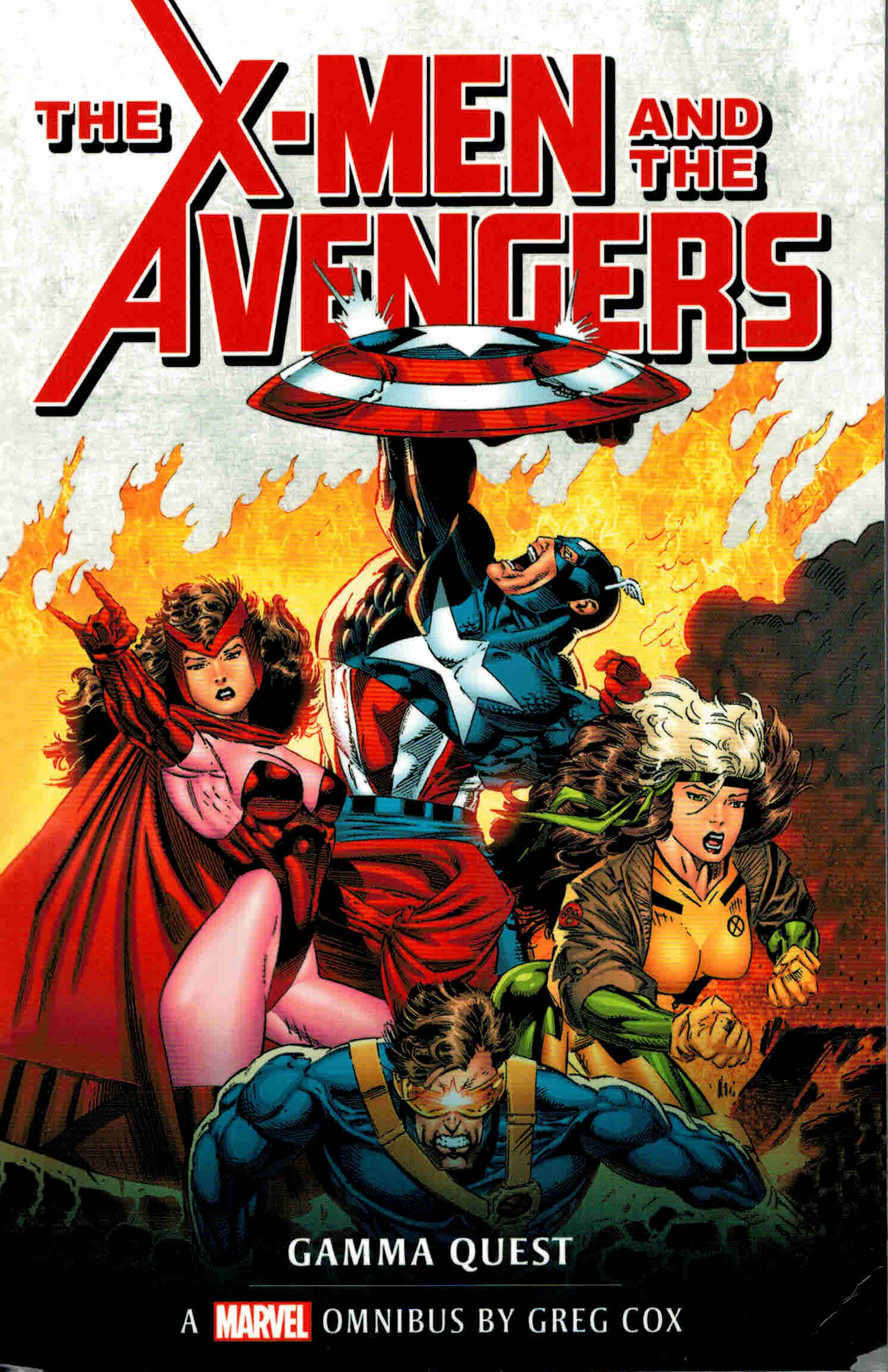
The X-Men and the Avengers: Gamma Quest – a Marvel Omnibus


By Greg Cox (Titan Books)
ISBN: 978-1789093339 (PB) eISBN: 978-1789093346

After a few half-hearted and ultimately abortive attempts in the 1960s and a more strategic – but no less enduring – attempt at the close of the 1970’s, Marvel finally secured a regular presence on prose bookshelves in the 1990s with a select series of hardback novels. Since then, those fans who want to supply their own pictures to gripping MU exploits have enjoyed a successive string of text thrills in all formats…

In recent times, British publisher Titan Books have been repackaging and rereleasing many of those powerhouse prose publications. Latest on the list in their Novels of the Marvel Universe line is this hefty paperback representing a trilogy first released in 1999.

Written by adaptions and licensed properties specialist Greg Cox (all iterations of Star Trek; Buffy The Vampire Slayer; Batman: The Court of Owls; Daredevil; Iron Man, Fantastic Four; Underworld; Warehouse 13; The Librariansand many more) this Titanic tome bundles linked novels Gamma Quest: Lost and Found, Search and Rescue and Friend or Foe? into a vast, action-packed thrill ride.

Although newcomers and casual fans won’t notice, all three books comprising Gamma Quest are deeply embedded in the minutiae of Marvel’s comic book continuity, and relate how mutant sorceress Wanda Maximoff AKA the Scarlet Witch, power parasite Rogue and immortal berserker Wolverine are abducted by a deranged super-scientific megalomaniac and his secret ally, eager to master the genetic anomalies that fuel their incredible powers.

With such prominent members of the world-famous Avengers and outlaw heroes the X-Men, missing it’s not long before their comrades and allies are on the trail.

Tragically, thanks to deviously-planted false clues, both teams are soon erroneously hunting the Gamma-generated gargantuan know as the Incredible Hulk whilst battling each other…

The issue is further complicated when S.H.I.E.L.D. director Nick Fury is forced to admit that top secret, illegally-constructed mutant hunting Sentinels have been stolen from his helicarrier…

Starring Iron Man, Captain America, The Vision, The Beast, Cyclops, Storm, Iceman and a wealth of guest stars, this riotous page-turner offers tons of twists, stacks of suspense and an abundance of action as both squads first battle then unite to hunt their true enemies, visiting the most outlandish locations both on and off Earth before everything concludes in the kind of cataclysmic clash Marvel fans and movie buffs expect…

Strong, accurate characterisation, fast-paced, non-stop super-powered conflict and ever-ratchetting tension make this impossible to put down, but picture lovers might be disappointed that there’s no room for interior illustrations this time out…
© 2019 Marvel.

The X-Men and the Avengers: Gamma Quest – a Marvel Omnibus will be released on 21st January 2020 and is available for pre-order now.

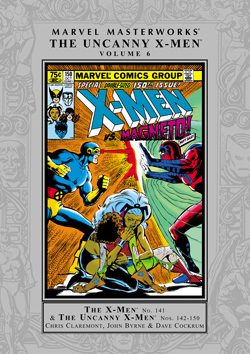
Uncanny X-Men Marvel Masterworks volume 6


By Chris Claremont, John Byrne, Brent Anderson, Bob McLeod, Dave Cockrum, Terry Austin, & various (Marvel)
ISBN: 978-0-7851-3013-0 (HB)

In the autumn of 1963, The X-Men #1 introduced Scott (Cyclops) Summers, Bobby (Iceman) Drake, Warren (Angel) Worthington, Jean (Marvel Girl) Grey and Hank (The Beast) McCoy: very special students of Professor Charles Xavier.

The teacher was a wheelchair-bound telepath dedicated to brokering peace and integration between the masses of humanity and the emergent off-shoot race of mutants dubbed Homo superior; considered by many who knew him as a living saint.

After nearly eight years of eccentrically spectacular adventures the mutant misfits virtually disappeared at the beginning of 1970 during another periodic downturn in superhero comics sales. Just like in the closing years of the 1940s, mystery men faded away as supernatural mysteries and traditional genre themes once more dominated the world’s entertainment fields…

Although the title was revived at the end of the year as a cheap reprint vehicle, the missing mutants were reduced to guest-stars and bit-players throughout the Marvel universe and the Beast was refashioned as a monster fit for the global uptick in scary stories until Len Wein & Dave Cockrum revived and reordered the Mutant mystique with a brand-new team in Giant Size X-Men #1 in 1975.

To old foes-turned-friends Banshee and Sunfire was added one-shot Hulk hunter Wolverine, and all-original creations Kurt Wagner, a demonic German teleporter codenamed Nightcrawler, African weather “goddess” Ororo Monroe AKA Storm, Russian farmboy Peter Rasputin, who transformed at will into a living steel Colossus and bitter, disillusioned Apache superman John Proudstar who was cajoled into joining the makeshift squad as Thunderbird.

The revision was an instantaneous and unstoppable hit, with Wein’s editorial assistant Chris Claremont writing the series from the second story onwards. The Uncanny X-Men reclaimed their own comicbook with #94 and it quickly became the company’s most popular – and high quality – title.

Cockrum was succeeded by John Byrne and as the team roster shifted and changed the series rose to even greater heights, culminating in the landmark Dark Phoenix storyline which saw the death of arguably the book’s most beloved and imaginative character.

In the aftermath team leader Cyclops left but the epic cosmic saga also seemed to fracture the epochal working relationship of Claremont and Byrne. Within months of publication they went their separate ways: Claremont staying with the mutants whilst Byrne moved on to establish his own reputation as a writer on series such as Alpha Flight, Incredible Hulk and especially his revolutionised and freshly-groundbreaking Fantastic Four…

This sixth superb compilation (available in luxurious hardcover, trade paperback and eBook editions) is perfect for newbies, neophytes and even old lags nervous about reading such splendid yarns on fragile but extremely valuable newsprint paper.

Gathering Uncanny X-Men #141-150 – spanning January to October 1981 – the action opens without preamble or hesitation as an evocative and extended subplot opens which would dictate the shape of mutant history for years to come. ‘Days of Future Past’ depicts an imminently approaching dystopian apocalypse wherein almost all mutants, paranormals and superheroes have been eradicated by Federally-controlled Sentinel robots.

The mechanoids rule over a shattered world on the edge of utter annihilation. New York is a charnel pit with most surviving superhumans kept in concentration camps and only a precious few free to fight a losing war of resistance.

Middle-aged Kitty Pryde is the lynchpin of a desperate plan to unmake history. With the aid of telepath named Rachel(eventually to escape that time-line and become the new Phoenix) Pryde swaps consciousness with her younger self in a last-ditch attempt to prevent the pivotal event which created the bleak, black tomorrow where all her remaining friends and comrades are being pitilessly exterminated one by resolute one…

‘Mind Out of Time’ sees the mature Pryde in our era, inhabiting her own 13-year-old body and leading her disbelieving team-mates on a frantic mission to foil the assassination of US senator David Kelly on prime-time TV by a sinister new iteration of the Brotherhood of Evil Mutants – super-powered terrorists determined to make a very public example of the human politician attacking the cause of Mutant Rights…

Fast-paced, action-packed, spectacularly multi-layered, bitterly tragic and agonisingly inconclusive – as all such time-travel tales should be – this cunning, compact yarn is indubitably one of the best individual tales of the Claremont/Byrne era and set the mood, tone and agenda for the next two decades of mutant mayhem…

With the timeline restored and tragedy averted, things slow down at the X-Mansion as John Byrne left for pastures new. His swan song in #143 was a bombastic romp which finds lonely, homesick Kitty home alone at Christmas… except for a lone N’garai ‘Demon’ determined to eat her. Her solo trial decimates the X-Men citadel and proves once and for all that she has what it takes…

The changing of the guard in X-Men #144 was marked by ‘Even in Death…’, scripted by Claremont and illustrated by Brent Anderson & Joseph Rubenstein wherein heartbroken Scott Summers (who quit the team after the death of Jean Grey AKA the Phoenix) fetches up in coastal village Shark Bay and joins the crew of Aleytys Forester‘s fishing boat.

Trouble is never far from the man called Cyclops, however, and when she introduces him to her dad, the hero must draw upon all his inner reserves – and uncomprehending help of the macabre swamp guardian Man-Thing – to repel the crushing, soul-consuming assaults of pernicious petty devil D’spayre…

Dave Cockrum returned to the team he co-created in #145, joining Claremont & Rubinstein in an extended clash of cultures as ‘Kidnapped!’ sees the team targeted by Doctor Doom thanks to the machinations of deranged assassin Arcade. With half of the team – Storm, Colossus, Angel, Wolverine and Nightcrawler – invading the Diabolical Dictator’s castle, a substitute-squad consisting of Iceman, Polaris, Banshee and Havoc are despatched to the maniac’s mechanised ‘Murderworld!’ to rescue a kidnapped coterie of innocent family and friends…

Sadly, in the interim Doom has triumphed over the invaders to his castle, but his act of entrapping claustrophobe Ororo has backfired, triggering a ‘Rogue Storm!’ that might erase the USA from the globe…

Issue #148 opens with Scott and Aletys shipwrecked on a mysterious island holding the remnants of a lost civilisation but the main event is a trip to Manhattan for Kitty, accompanied by Storm, Spider-Woman Jessica Drew and Dazzler Alison Blair. That’s a good thing as wandering mutant empath Caliban calamitously attempts to abduct the child in ‘Cry, Mutant!’ by Claremont, Cockrum & Rubinstein…

A major menace resurfaces in #149 to threaten Scott and Aletys, but the X-Men are too busy dealing with resurrected demi-god Garokk and an erupting volcano in ‘And the Dead Shall Bury the Living!’ before all the varied plots combine and coalesce in anniversary issue #150 (October 1981).

Extended epic ‘I, Magneto…’ sees the merciless, malevolent master of magnetism threaten all humanity. with Xavier’s team helpless to stop him… until a critical moment triggers an emotional crisis and awakening of his long-suppressed humanity…

These are some of the greatest X-stories Marvel ever published; entertaining, groundbreaking and painfully intoxicating, offering an invaluable grounding in contemporary fights ‘n’ tights fiction no fan or casual reader can afford to ignore.
© 1980, 1981, 2013 Marvel Characters, Inc. All rights reserved.

Captain America Marvel Masterworks volume 8

By Steve Englehart, Roy Thomas, Tony Isabella, Mike Friedrich, Sal Buscema, Alan Weiss & various (Marvel)
ISBN: 978-0-7851-9929-8 (HB)

Created by Joe Simon & Jack Kirby in an era of frantic patriotic fervour, Captain America was a bombastic, dynamic and highly visible response to the horrors of Nazism and the threat of Liberty’s loss.

He faded away during the post-war reconstruction but briefly reappeared after the Korean War: a harder, darker sentinel ferreting out monsters, subversives and the “commies” who lurked under every brave American kid’s bed. Then he vanished once more until the burgeoning Marvel Age resurrected him just in time for the turbulent, culturally divisive 1960s.

By the time of the tales gathered in this eighth Masterworks volume (available in luxurious hardback and accessible eBook formats and re-presenting issues #160-175 of Captain America and the Falcon from April 1973 to July 1974), the once convinced and confirmed Sentinel of Liberty had become an uncomfortable symbol of a divided nation, but was looking to make the best of things and carve himself a new place in the Land of the Free. Real world events were about to put paid to that American dream…

Into an already turbulent mix of racial and gender inequality played out against standard Fights ‘n’ Tights villainy came creeping overtones of corruption and betrayal of ideals that were fuelled by shocking real-world events…

Following an informative behind-the-scenes reminiscence from scripter Steve Englehart in his Introduction, the action opens here with ‘Enter: Solarr!’ (illustrated by Sal Buscema &Frank McLaughlin), offering an old-fashioned clash with a super-powered maniac as the main attraction.

However, the real meat is the start of twin sub-plots that would shape the next half-dozen adventures, as the Star-Spangled Avenger’s newfound super-strength increasingly makes partner-in-crimefighting Sam – the Falcon – Wilson feel like a junior and inferior hindrance, even as Steve Roger’s long-time romantic interest Sharon Carter leaves him without a word of explanation…

Inked by John Verpoorten, Captain America and the Falcon #161 ramps up the tension between Steve and Sam as the heroes search for Sharon in ‘…If he Loseth His Soul!’, and find a connection to the girl Cap loved and lost in World War II in a deadly psycho-drama overseen by criminal shrink Dr. Faustus. This culminates one month later in a singular lesson in extreme therapy which only proves ‘This Way Lies Madness!’

‘Beware of Serpents!’ heralded the return of super snakes Viper and Eel, who combine with the Cobra to form a vicious but ultimately unsuccessful Serpent Squad to attack the heroes. Defeated former ad-exec Viper then vengefully begins a media manipulation campaign to destroy the Sentinel of Liberty with the “Big Lie”, fake news weapons and the worst tactics of Madison Avenue. Although the instigator quickly falls, his scheme rumbles on with slow, inexorable and dire consequences…

Issue #164 offers a stunningly scary episode illustrated by Alan Lee Weiss, introducing faux-coquette mad scientist Deadly Nightshade: a ‘Queen of the Werewolves!’ who infects Falcon with her chemical lycanthropy as an audition to enlist in the fearsome forces of one of the planet’s greatest menaces…

The full horror of the situation is only revealed when ‘The Yellow Claw Strikes’ (Englehart, Buscema & McLaughlin); renewing a campaign of terror begun in the 1950s, but this time attacking his former Chinese Communist sponsors and the USA indiscriminately. Giant bugs, deadly slave assassins and reanimated mummies are bad enough, but when the Arcane Immortal’s formidable mind-control dupes Cap into almost beating S.H.I.E.L.D. supremo Nick Fury to death during the ‘Night of the Lurking Dead!’, the blistering final battle results in further tragedy when an old ally perishes in the Frank Giacoia inked ‘Ashes to Ashes’…

One of the Star-Spangled Avengers most durable foes sort-of resurfaces in tense, action-heavy romp ‘…And a Phoenix Shall Arise!’ (scripted by Roy Thomas & Tony Isabella and inked by John Tartaglione & George Roussos) before Viper’s long-laid plans begin to finally bear bitter fruit in #169’s ‘When a Legend Dies!’ (with additional scripting from Mike Friedrich).

As anti-Captain America TV spots make people doubt the honesty and sanity of the nation’s greatest hero, the Falcon and his “Black Power” activist girlfriend Leila Taylor depart for the super-scientific African nation of Wakanda in search of increased powers, leaving Cap to battle third-rate villain the Tumbler.

In the heat of combat the Avenger seemingly goes too far and the thug dies…

‘J’Accuse!’ (Englehart, Friedrich, Buscema & Vince Colletta) sees Cap beaten and arrested by too-good-to-be-true neophyte crusader Moonstone, whilst in Africa Leila is kidnapped by exiled Harlem hood Stone-Face: far from home and hungry for some familiar foxy ghetto friendship…

‘Bust-Out!’ in #171 finds Cap forcibly sprung from jail by a mysterious pack of “supporters” as Black Panther and the newly-flying Falcon crush Stone-Face preparatory to a quick dash back to America and a reunion with the beleaguered and tarnished American icon.

‘Believe it or Not: The Banshee!’ opens with Captain America and the Falcon beaten by – but narrowly escaping – Moonstone and his obscurely occluded masters, after which the hard-luck heroes trace a lead to Nashville, encounter the fugitive mutant Master of Sound and stumble into a clandestine pogrom on American soil.

For long months mutants have been disappearing unnoticed, but now the last remaining X-Men – Cyclops, Marvel Girl and Professor Charles Xavier – have tracked them down, only to discover that Captain America’s problems also stem from ‘The Sins of the Secret Empire!’, whose ultimate goal is the conquest of the USA…

Eluding capture by S.H.I.E.L.D., Steve and Sam infiltrate the evil Empire, only to be exposed and confined in ‘It’s Always Darkest!’ before abruptly turning the tables and saving the day in #175’s ‘…Before the Dawn!’, wherein the vile grand plan is revealed, the mutants liberated and the culprits captured.

In a shocking final scene, the ultimate instigator is unmasked and horrifically dispatched within the White House itself…

At this time America was a nation reeling from a loss of unity, solidarity and perspective as a result of a torrent of shattering blows such as losing the Vietnam war, political scandals like Watergate and the (partial) exposure of President Nixon’s lies and crimes.

The general loss of idealism and painful public revelations that politicians are generally unpleasant – and even possibly ruthless, wicked exploiters – kicked the props out of most Americans who had an incomprehensibly rosy view of their leaders, so a conspiracy that reached into the halls and backrooms of government was extremely controversial yet oddly attractive in those distant, simpler days…

Unable to process the betrayal of all he has seen, the Star-Spangled Avenger cannot accept that this battle has any winner: a feeling that will change his life forever – in the next volume…

Any retrospective or historical re-reading is going to turn up a few cringe-worthy moments, but these tales of matchless courage and indomitable heroism are fast-paced, action-packed and still carry a knockout conceptual punch. Here Captain America was finally discovering his proper place in a new era and would once more become unmissable, controversial comicbook reading, as we shall see when I get around to reviewing the next volume…
© 1973, 1974, 2016 Marvel Characters, Inc. All rights reserved.

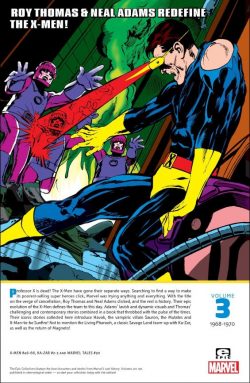
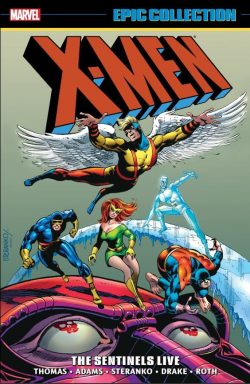
X-Men Epic Collection volume 3 1968-1970: The Sentinels Live


By Roy Thomas, Arnold Drake, Gary Friedrich, Dennis O’Neil, Linda Fite, Jerry Siegel, Neal Adams, Jim Steranko, Werner Roth, Don Heck, George Tuska, Barry Windsor-Smith, Sal Buscema & various (Marvel)
ISBN: 978-1-3029-1275-8 (TPB)

X-Men was never one of young Marvel’s top titles but it did secure a devout and dedicated following, with the frantic, freakish energy of Jack Kirby’s heroic dynamism comfortably transiting into the slick, sleek prettiness of Werner Roth as the blunt tension of hunted outsider kids settled into a pastiche of the college and school scenarios so familiar to the students who were the series’ main audience.

The core team still consisted of tragic Scott Summers/Cyclops, telepath and mind-reader Jean Grey/Marvel Girl, wealthy golden boy Warren Worthington/Angel, ebullient Bobby Drake/Iceman, and erudite, brutish genius Henry McCoy/Beast in training with Professor Charles Xavier, a wheelchair-bound (and temporarily deceased) telepath dedicated to brokering peace and integration between the masses of humanity and the gradually emerging race of mutant Homo Superior.

However, by the time of this massive full-colour paperback and digital tome (collecting issues #46-66 from July 1968 to February 1970) of the turbulent teens’ original series, plus material from Ka-Zar volume 1 #2-3 and Marvel Tales #31, despite some of the most impressive and influential stories and art of the decade, the writing was definitely on the wall for Marvel’s misunderstood mutants…

Following the supposed death of their mentor and founder the team was in for even greater heartache when ‘The End of the X-Men!’ (by Gary Friedrich, Werner Roth, Don Heck & John Tartaglione) was declared in issue #46, with the reading of Charles Xavier’s will.

Former government liaison FBI Agent Duncan reappeared and ordered the team to split-up: monitoring different parts of the country for mutant activity just as the unstoppable Juggernaut turned up once more…

The series was at that time offering ‘The Origins of the Uncanny X-Men’ in the back of each issue and Iceman’s past concludes here with ‘…And Then There were Two!’ (Friedrich, George Tuska & Tartaglione) as Cyclops rescues the kid from a human mob and recruits him to Xavier’s school…

Friedrich was joined by Arnold Drake to script Beast and Iceman’s adventure ‘The Warlock Wears Three Faces!’ wherein the ancient mutant once called Merlin once more re-branded himself: this time as the psychedelic guru Maha Yogi, whilst Drake, Roth & John Verpoorten explained the cool kid’s powers in the info feature ‘I, the Iceman.’

Drake penned the Cyclops and Marvel Girl tale ‘Beware Computo, Commander of the Robot Hive’; a fast-paced thriller with a surprise guest villain, whilst ‘Yours Truly the Beast’ wrong-footed everybody by explaining his powers before actually telling his origin epic.

X-Men #49 gave a tantalising taste of things to come with a startling and stylish Jim Steranko cover, behind which Drake, Heck, Roth & Tartaglione revealed ‘Who Dares Defy… the Demi-Men?’: nominally an Angel story, but one which reunited the team to confront the assembled mutant hordes of Mesmero and Iceman’s new girlfriend – the daughter of Magneto! This shocker was supplemented by Drake Roth & Verpoorten’s natal chapter ‘A Beast is Born.’

Drake, Steranko & Tartaglione reached astounding heights with the magnificent ‘City of Mutants’ in #50: a visual tour de force that remains as spectacular now it did in 1968, but which was actually surpassed by Magneto’s return as ‘The Devil had a Daughter’ in #51 before the saga concluded in a disappointing ‘Twilight of the Mutants!’

Don’t misunderstand me, however: This isn’t a bad story, but after two issues of Steranko in his creative prime, nobody could satisfactorily end this tale, and I pity Heck & Roth for having to try.

The pertinent Beast origin chapters in those issues were ‘This Boy, This Bombshell’; ‘The Lure of the Beast-Nappers!’ and ‘The Crimes of the Conquistador!’ and that particular epic of child exploitation and the isolation of being different ended in #53’s ‘Welcome to the Club, Beast!’ but that last issue’s main claim to fame was a lead feature drawn by another superstar in the making.

Hard to believe now, but in the 1960s, X-Men was a series in perpetual sales crises, and a lot of great talent was thrown at it back then. ‘The Rage of Blastaar!’ was illustrated by a young Barry Smith – still in his Kirby appreciation phase – and his unique interpretation of this off-beat battle-blockbuster from Drake, inked by the enigmatic Michael Dee, is memorable but regrettably brisk.

More mutant mayhem commences with ‘Wanted: Dead or Alive… Cyclops!’ (X-Men#54 by Drake, Heck & Vince Colletta), which introduces Scott’s kid brother Alex just in time for the lad to be kidnapped by Egyptian acolytes of The Living Pharaoh. It appears the boy has a hidden power the Pharaoh covets, necessitating framing the X-Men’s leader for murder…

At the back, ‘The Million Dollar Angel’ (Drake & Roth) began the tale of Warren Worthington III, precocious rich boy rushed off to prep school. When he grew wings, he hid them by making himself the most despised and lonely person on campus…

Roy Thomas returned as scripter for #55’s ‘The Living Pharaoh!’ (Heck, Roth & Colletta) which saw the full team follow the Summers brothers to the Valley of the Kings and soundly thrash the faux king’s minions, only to have the new mutant’s unsuspected power go wild. Meanwhile, in ‘Where Angels Fear to Tread!’ (Thomas, Roth & Sam Grainger) little Warren has left school and plans a superhero career until an atomic accident brings him into contact with a couple of kids code-named Cyclops and Iceman…

Nobody knew it at the time – and sales certainly didn’t reflect it – but with X-Men #56 superhero comics changed forever. Neal Adams had already stunned the comics buying public with his horror anthology work and revolutionary adventure art on Batman and Green Lantern/Green Arrow but here, with writer Thomas in iconoclastic form, they began expanding the horizons of graphic narrative with a succession of boldly innovative, tensely paranoid dramas pitting mutants against an increasingly hostile world.

Pitched at an older audience, the run of gripping, addictively beautiful epics captivated and enchanted a small band of amazed readers – and were completely ignored by the greater mass of the buying public. Without these tales the modern X-phenomenon could not have existed, but they couldn’t save the series from cancellation. The cruellest phrase in comics is “ahead of its time…”

Courtesy of Thomas, Adams & inker extraordinaire Tom Palmer, ‘What is… the Power?’ reveals the uncanny connection between Pharaoh and Alex Summers, and as the Egyptian mastermind transforms into a colossal Living Monolith, the terrified boy’s mutant energies are unleashed with catastrophic results. At the back, an unbalanced Angel had become ‘The Flying A-Bomb!’ but luckily is defused in time to become the newest X-Man…

Issue #57 revives the team’s most relentless adversaries in ‘The Sentinels Live!’, as a public witch-hunt prompts the mutant-hunting robots to capture X-Men across the globe. Amongst the first victims are magnetic Lorna Dane and Alex Summers, but the sinister cybernoids have their unblinking eyes set on all mutants…

That issue also offers a rundown on Marvel Girl’s abilities in the final back-up feature ‘The Female of the Species!’. From the next issue, Thomas & Adams would have all the pages to play with…

‘Mission: Murder!’ ramps up the tension as the toll of fallen mutants increases, with Iceman, the Pharaoh, Angel and Mesmero all falling to the murderous mechanoids, but when their human controller discovers an unsuspected secret the automatons strike out on their own…

With all other mutants in the Marvel universe captured, Cyclops, Marvel Girl and Beast are reduced to a suicidal frontal assault in ‘Do or Die, Baby!’: pulling off a spectacular victory, but only at great cost to Alex Summers, now known as Havok…

Badly injured, Alex is brought to an old colleague of Professor Xavier’s named Karl Lykos – a discreet physician hiding a dark secret. ‘In the Shadow of Sauron!’ reveals that the not-so-good doctor had been bitten by Pterodactyls from the Antarctic Savage Land and become an energy vampire. Now, with a powerful mutant to feed on, his addiction fully manifests as Lykos transforms into a winged saurian with hypnotic powers, determined to sate himself on the other X-Men.

After a shattering struggle in ‘Monsters Also Weep!’ Lykos is defeated, instinctively flying South to the Savage Land. Drained of his power, he reverts to human form and when the X-Men track him down, the tormented leech chooses suicide rather than become Sauron once more…

Searching for his body, Angel is also attacked by Pteranodons and crashes to the bottom of a vast crevasse, precipitating the mutants into another primordial encounter with wild man Ka-Zar as ‘Strangers …in a Savage Land!’

Marooned once more in a lost world, Angel is healed by the enigmatic Creator: a wounded genius protecting the Savage Land’s mutant population with his own team of X-Men counterparts.

As his team-mates search for him, the Winged Wonder switches allegiance, unaware that his benefactor is actually the X-Men’s ultimate enemy…

‘War in the World Below!’ sees the villain’s plans revealed and finally thwarted by the heroes and Ka-Zar, leaving the returning team to tackle a controversial Japanese extremist in ‘The Coming of Sunfire!’ (#64, with stalwart Don Heck doing an impressive fill-in job for Adams) before the next issue revives the long-dead Professor Xavier – only to nearly kill him again in the Denny O’Neil scripted alien invasion yarn ‘Before I’d Be Slave…’: an astounding epic that ended Neal Adams’ artistic tenure in grand style.

The rapid staffing changes were hints of a bigger shake-up and with X-Men #66 (March 1970), despite all the frantic and radical innovations crafted by a succession of supremely talented creators, the series was at last cancelled. ‘The Mutants and the Monster’ by Thomas, Sal Buscema & Sam Grainger, is a potent swansong though, as the team hunt for Bruce Banner in an attempt to save Professor X from a coma induced by his psychic battle against the aliens.

Unfortunately, when you hunt Banner what you usually end up with is an irate Incredible Hulk…

Although gone, the mutants were far from forgotten. The standard policy at that time to revive characters that had fallen was to pile on the guest-shots and reprints. X-Men #67 (December 1970) saw them return, re-presenting early classics and in that same month a 3-chapter miniseries began in the pages of Ka-Zar #2. Crafted by Jerry Siegel, Tuska & Dick Ayers, ‘From the Sky… Winged Wrath!’ focused on the Angel and his plutocratic home life, as his father is murdered by a super-scientific foe. Hungry for justice the enraged winged mutant quickly falls ‘…In the Den of the Dazzler!’ (Ka-Zar #3 March 1971), before gaining his revenge in concluding episode ‘To Cage an Angel!’ (from Marvel Tales #30, April 1971).

A hoard of graphic goodies packs out the bonus section here. As well as unused original Roth and Adams art, there is a gallery of original Heck, Steranko and Adams pages; 20 pages of colour Adams’ guides; covers and additional story pages by Mike Zeck & Palmer from 1980s Classic X-Men reprints plus cover art for Adams’ X-Men Visionaries volume, and previous collection covers painted and modified by Richard Isanove…

Although a little scrappy and none too cohesive, these disparate stories are wonderful comics sagas that were too radical for the readership of the times but have since been acknowledged as groundbreaking mini-masterpieces that reshaped the way we tell stories to this day.

These tales perfectly display Marvel’s evolution from quirky action romps to more fraught, breast-beating, convoluted melodramas that inexorably led to the monolithic X-brand of today. Well drawn, highly readable stories are never unwelcome or out of favour, and it should be remembered that everything here informs so very much of today’s mutant mythology. Everyone should own this book.
© 1968, 1969, 1970, 2019 Marvel Characters, Inc. All rights reserved.

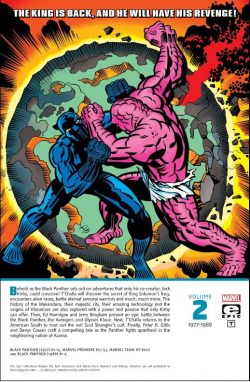
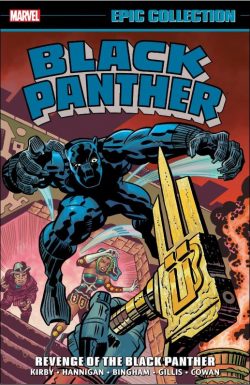
Black Panther Epic Collection volume 2 1977-1988: Revenge of the Black Panther


By Jack Kirby, Ed Hannigan, Peter B. Gillis, Jim Shooter, Chris Claremont, John Byrne, Jerry Bingham, Denys Cowan & various (Marvel)
ISBN: 978-1-3029-1542-1 (TPB)

Acclaimed as the first black superhero in American comics and one of the first to carry his own series, the Black Panther‘s popularity and fortunes have waxed and waned since he first appeared in Fantastic Four. In fact, back then the cat king actually attacked Marvel’s First Family as part of an extended plan to gain vengeance on the murderer of his father. He was also the first black superhero in American comics, debuting in summer 1966.

As created and realised by Jack Kirby & Stan Lee, T’Challa, son of T’Chaka, is an African monarch whose secretive kingdom is the only source of vibration-absorbing wonder mineral Vibranium. The miraculous alien metal – derived from a fallen meteor which struck the continent in lost antiquity – is the basis of the country’s immense wealth, enabling Wakanda to become one of the wealthiest and most secretive nations on Earth. These riches allowed the young king to radically remake his country, creating a technological wonderland even after he left Africa to fight as one of America’s mighty Avengers.

For much of its history Wakanda has been an isolated, utopian technological wonderland with the tribal resources and people safeguarded and ruled since time immemorial by a human warrior-king deriving cat-like physical advantages from secret ceremonies and a mysterious heart-shaped herb. This has ensured the generational dominance of the nation’s Panther Cult and Royal Family.

Wakanda has never been conquered by outsiders. The primary reason is an unbroken line of divinely-sponsored warrior kings who safeguard the united, unified tribes. Another is that miraculous super-mineral found nowhere else on Earth. The top-secret “Vibranium mound” had guaranteed the country’s status as a clandestine superpower for centuries but in modern times has increasingly made Wakanda a target for subversion, incursion and even invasion as the world grew ever smaller…

In contemporary times the chieftain is T’Challa: an unbeatable, super-smart, feline-empowered strategic genius who divides his time between ruling at home and serving abroad in superhero teams such as The Avengers, Fantastic Force, The Illuminati and The Ultimates, beside the world’s mightiest costumed champions.

This trusty trade paperback (and eBook) gathers the entire blockbusting, mind-bending reinvention by Jack Kirby and others from Black Panther volume 1 # 1-15 (January 1977-May 1979), the continuation in Marvel Premiere #51-53 (cover-dated December 1979 to April 1980), material from Marvel Team-up #100 (December 1980) and a groundbreaking, 4-issue miniseries spanning July to October 1988.

Jack Kirby’s return to Marvel in the mid 1970’s was much hyped at the time but swiftly proved to be controversial. His new creations (2001, The Eternals, Devil Dinosaur, Machine Man) found friends rapidly, but his tenure on established earlier creations Captain America and Black Panther divided the fan base.

Kirby was never slavishly wedded to tight continuity and preferred, in many ways, to treat his stints on titles as a “Day One”. His commitment was to wholesome, eye-popping adventure, breakneck action and breathless, mind-boggling wonderment. Combined with his absolute mastery of the comic page and unceasing quest for the Next Big Thrill, it all makes for a captivating read, but will never satisfy those readers fully committed to the minutiae of the Marvel Universe.

Beginning here with Black Panther #1, what they got was a rollercoaster ride of classic Kirby concept-overload as the Hereditary King of a miraculous Lost Kingdom gallantly pursues fabulous time machines, fights future men and secret samurai clans, thwarts the plots of super-rich artefact stealers and foils schemes to nuke his hidden homeland, usurp his rule and even consume his faithful subjects…

This feline funfest is about frantic action and begins at full pelt with a re-introductory romp spotlighting diminutive treasure hunter Abner Little. This devious gentleman entices T’Challa into a search for ‘King Solomon’s Frog!’ after introducing himself as a friend and colleague of the Panther’s grandfather Azzari the Wise…

Soon, the mismatched pair are in hot pursuit of a historical wonder machine that sows death and destruction in its wake. The ancient brass amphibian has the ability to open time-portals, bringing lethal threats from other eras, but its real capacity for catastrophe comes from Little’s rival Collectors, who bring astounding ordnance and unsurpassed riches into play in their own efforts to possess the mystic time-machine.

Most ruthless and relentless is Queen Zanda of Narobia, who expertly ambushes the questers with a highly-skilled mercenary taskforce before accidentally triggering the frog into shanghaiing a hyper-evolved walking WMD from his own far-flung future era. She also assures T’Challa’s continued assistance by targeting Wakanda with atomic missiles…

Reluctantly uniting to sedate ‘The Six-Million Year Man’, T’Challa, Little and Zanda then race to uncover King Solomon’s tomb where a twin of the Brass Frog rests. This particular item possesses the most welcome function of returning objects and creatures to their point of origin…

Their ‘Race Against Time’ is exacerbated when the groggy tomorrow-man revives just as the searchers locate the tomb. He angrily unleashes psionic hell and awakens King Solomon’s formidable funereal guardian Ogar. Thankfully, reluctant teamwork saves them and the newly-found second frog restores order, if not sanity…

Tragically for the tomb-raiders, the time to determine if they are ‘Friends or Foes’ swiftly passes, since the calamitous clashes have destabilised the long-lost treasury trove. With mighty explosions wracking the site, it is all T’Challa can do to drag his artefact-lusting companions to safety before Armageddon occurs…

Unfortunately for the Panther, he has proved his worth and – with Wakanda still a nuclear target – ultimate ineffectuality. When the assembled Collectors – Zanda, Count Zorba, Colonel Pigman and withered coffin-dodger Silas Mourner – see the warrior king in battle, they determine he must win for them the ultimate prize…

The ‘Quest for the Sacred Water-Skin!!’ begins as T’Challa and equally reluctant Abner Little set off to find a fabled hidden land where a sect of Samurai warriors have dwelt for centuries; sustained by honour, their martial arts and a literal fountain of youth.

Overcoming monsters and warriors, T’Challa establishes a bond of honour with the last proponents of Bushido, but sadly his venal companion upsets the applecart by secretly stealing ‘A Cup of Youth’…

Meanwhile in Wakanda, internal trouble flares when the Panther’s half-brother General Jakarra makes a power-grab, bolstered by a sacrilegious utilisation of unrefined vibranium…

Black Panther #7 sees the hero and his scurrilous sidekick escape the Samurai city even as ‘Drums!’ sound across Wakanda and the incredible secret origin of Panther Cult and Vibranium Mound are simultaneously revealed.

When the awesome sky metal first crashed to Earth in primordial times, it transformed many men into monsters. Thankfully mighty chief Bashenga – taking the black cat as his totem – created a force to destroy the creatures and police the metal: preventing alien infection from spreading and forever after shielding his people through a line of dedicated defenders.

As his latest successor heads for a final confrontation with the Collectors, King T’Challa has no way of knowing his devoted regent N’Gassi has been captured or that Jakarra has gained deadly power through exposure to the gene-warping force of raw Vibranium…

Having battled his way free, T’Challa heads for home. His people, however, are already suffering the increasingly crazed depredations of a Jakarra no longer even remotely human.

Further delayed by a mercy mission – plucking dying men from the sea – the king bemoans his absence whilst half a world away, N’Gassi takes a desperate gamble and “requests” that the sedentary royal cousins – Ishanta, Joshua Itobo, Khanata and Zuni – step up to lead the fight against Jakarra. But are they ‘Panthers or Pussycats?’…

Surprising everybody with a show of solidarity and unconventional tactics, the ‘Black Musketeers’ manage to contain the monstrous usurper until T’Challa returns, but his arrival coincides with the loss of Jakarra’s last vestige of humanity. Now a shambling beast resolvs that ‘This World Shall Die!’ in an Earth-shattering detonation. The horrific abomination is barely defeated inside the Mound by a true Black Panther who does not escape the mineral’s mutagenic properties…

Issue #11 finds T’Challa recovering from his struggle against Jakarra and plagued by eerie recurring dreams of future battles. As citizens begin vanishing all over Wakanda – including Prince Khanata – the medical team reaches the conclusion that the king has developed some form of Extra-Sensory Perception.

This new gift – or perhaps curse? – promptly leads the Panther to the abductors’ HQ where phantasmal madman ‘Kiber the Cruel’ is converting abducted humans to energy and consuming them…

Following ‘The Kiber Clue’, T’Challa strives mightily to save his kinsman and subjects, but arrives too late for anything but vengeance…

As Jim Shooter, Ed Hannigan, Jerry Bingham & Gene Day take over from the abruptly departed Kirby, the saga swiftly wraps up with the true nature of Kiber grotesquely exposed and the Panther’s judgement delivered in #13’s ‘What is… and What Should Never Be’…

With Hannigan scripting, the Black Panther rapidly re-entered the mainstream Marvel universe in ‘The Beasts in the Jungle!’ (#14 March 1979): opening Wakanda’s first Embassy in New York City, applying to the United Nations and rejoining his former allies in the Avengers.

All too soon smothered in red tape and diplomatic hurdles, T’Challa welcomes working with his superhero guests but is quickly embroiled in a deadly scheme by old enemy Klaw, the Master of Sound, and blithely unaware that other relationships are about to be renewed…

After the resurgent villain battles the World’s Mightiest Heroes to a standstill, T’Challa manages to inflict the ‘Revenge of The Black Panther!’ in the final issue (May 1979), yet leaves everything on a cliffhanging note as former lover and consort Monica Lynne breaks into the Wakandan Embassy…

When Kirby took over the character, Black Panther had just ended a highly-acclaimed run in Jungle Action. Following the epic ‘Panther’s Rage’ saga, scripter Don McGregor began an even more groundbreaking saga in ‘The Panther Versus the Klan’.

That convoluted yarn had been abruptly cancelled before conclusion the previous year, but the contents of Marvel Premiere#51-53 provided an ending to the Klan clash as well as an acceptable in-universe explanation as to why wise and noble T’Challa abruptly dropped his hunt for answers and abandoned his adored beloved Monica…

Opening minutes after Black Panther #15 finished, ‘The Killing of Windeagle!’ sees T’Challa arriving back at his new American Embassy, only to be attacked by an unknown flying warrior who claims to be an old foe.

After subduing the assailant, the King experiences even more turmoil as Lynne and Georgia journalist Kevin Trublood accost him. Although his staff all seem familiar with the woman, T’Challa has no memory of either of them…

Granting an audience with the couple, the Panther hears how Monica’s sister Angela was murdered, and how the death seemed to involve both the Ku Klux Klan and rival offshoot the Dragon’s Circle. As he listens, T’Challa hears that for a time he was the prime investigator of the murder, but his mind is clouded and he recalls none of it. Suddenly Windeagle attacks again, but as the Panther fights back his opponent is assassinated by a sniper…

Working with the police, T’Challa uncovers the sordid history of a petty gangster who somehow became a flying fury and establishes links to yet another organisation: The Spiritual Light Society. At every turn, events seem to be pushing him towards one inescapable conclusion: Monica’s ridiculous, unbelievable story is true and someone has tampered with his mind and memory…

When they are ambushed again by armed thugs – later identified as Klansmen – their spirited resistance is supplemented by more sniper fire and the Panther’s ‘Journey Through the Past!’ impels him to invade a Klan gathering. This conclave is subsequently violently disrupted by a costumed maniac called Soul Strangler…

Despite not remembering, the Panther believes he’s deduced the nature of the contemporary civil war between KKK and Dragon’s circle, and more importantly, who killed Angela. With resignation and trepidation, T’Challa, Kevin and Monica head for a showdown in the Deep South…

Inked by Alan Gordon, Marvel Premiere #53 delivered ‘The Ending, In Anger!’ as T’Challa visits Monica’s family home and the dam in his memory finally shatters. Acting with clarity at last, the Black Panther tracks down the villains who captured and brainwashed him during his previous visit, exposes a tawdry truth behind all the death and intimidation and brings a kind of closure to all the innocents touched by the tragedy…

With the major story-arcs at last concluded it was back to relative obscurity and bit-parts for the Panther, with the exception of a short tale that would have huge repercussions on the hero’s life in the future.

‘Cry… Vengeance!’, by Chris Claremont, John Byrne & Bob McLeod, first appeared in Marvel Team-Up #100 and saw African X-Man Storm targeted by assassins. Easily defeating her attackers, she learns they were hired by Boer hardman Andreas de Ruyter…

This sends her mind winging back to her childhood journey across Africa as teenager: an arduous trek made easier after she linked up with a young boy on his own rite of passage ritual. His name was T’Challa and she learned that he was a prince only after South African mercenaries led by de Ruyter tried to kidnap the boy for political advantage.

After driving the thugs off, the youngsters spent a brief but idyllic time together before their paths diverged and duty pulled them apart.

Decades later, the villain is back and seeking vengeance, so Ororo reunites with the boy the world now calls Black Panther to end the maniac’s threat forever…

As the 1980s closed, the Panther made a dynamic comeback in 1988, courtesy of writer Peter B. Gillis and illustrators Denys Cowan & Sam DeLarosa…

The Black Panthers rule over a fantastic African paradise which isolated itself from the rest of the world millennia ago. Blessed with unimaginable resources – both natural and not so much – the nation of Wakanda developed uninterrupted into the most technologically advanced human nation on Earth, utterly unmolested by rapacious European imperialism. That did not mean that geographical neighbours were allies, however…

In ‘Cry, the Accursed Country!’ technologically-advanced white nationalist country Azania has subjugated and tormented its own black majority population for centuries whilst plotting the downfall of Wakanda. As global condemnation of the apartheid regime mounts, T’Challa learns that the Panther God has withdrawn his blessing and instead consecrated and empowered an imprisoned priest in Azania as a new Black Panther. When this savage avatar begins inflicting bloody retribution on the ruling class, the Azanians blame Wakanda…

Deprived of his feline gifts and herding war-hungry dissidents in his own nation, T’Challa faces a crisis of confidence – and faith – in ‘For Duty, For Honor, For Country!’ which is no help when Azania targets Wakanda with its own team of super-agents: The Supremacists…

Soon T’Challa’s people face international condemnation and nuclear Armageddon after ‘The Moorbecx Communique!’ adds layers of espionage to the escalating crisis, compelling the outcast king to risk his principles and challenge his god to regain his birthright in ‘A Cat Can Look at a King…’

Most tragically, the Panther must defeat his dark mirror image and knows that win or lose, nothing will ever be the same again…

This collection is also augmented by Kirby-era Editorial pages, house ads, a potted history of the Black Panther from #14, the Rich Buckler & McLeod cover to the never-released BP #16 and unused Bingham pencil pages. Also on show, are info pages and maps of Wakanda from The Official Handbook of the Marvel Universe, featuring T’Challa, Klaw, Klaw’s Blaster, Vibranium, and Kiber the Cruel.

There are also text features from Marvel Age #20 and #63; covering the much-delayed Gillis/Cowan revival, plus a pinup by Bill Reinhold, and Kirby/Ernie Chan and Al Milgrom/Klaus Janson original art pages as well as unused Bingham pencils to feast your eyes upon…

An explosive rocket ride of thrills, spills, chills and too-long delayed gratification, these long-lost classics confirm the Black Panther as one of the most complex and versatile characters in comics and simply scream “Read me! Read me!” So you should and you must…
© 1977, 1978, 1979, 1980, 1988, 2019 Marvel. All rights reserved.

Astonishing Spider-Man & Wolverine


By Jason Aaron, Adam Kubert & various (Marvel)
ISBN: 978-0785140801 (TPB)

Remember when comic stories were fun, thrilling and, best of all, joyously uncomplicated? Here’s one of those…

Eschewing mind-boggling continuity-links and crossover overload, writer Jason Aaron and artist Adam Kubert – with the impressive support of inkers Mark Morales, Dexter Vines & Mark Roslan (as well as colourist Justin Ponsor and letterer Rob Steen) – simply set out to craft a well-told, action-packed and even poignant time-travel fun-fest that does everything right… and superbly succeeded. The result was 6-issue miniseries Astonishing Spider-Man & Wolverine.

Without giving away too much delicious detail (trust me you’ll be grateful once you read the full epic adventure) 65-million years ago, as a giant asteroid hurtles towards Earth and an impact which will wipe out the dinosaurs and at least two emergent species of proto-hominid, a warring couple of marooned superheroes from the 21st century sadly make peace with their fate if not each other…

Lost in time for months through the most ridiculous of circumstances, Wolverine and Peter Parker are ready to die. The feral mutant has become leader of the smart but diminutive Small People, leading them to salvation from the predations of their giant evolutionary rivals the Kill People and all other threats, whilst the erstwhile Spider-Man has isolated himself from all contact, terrified of rewriting the future even if he is no longer part of it.

Moreover, Parker’s dreams are haunted by a woman he doesn’t know, but who has become the only thing he cares for…

At a most precipitous moment, the pair are snatched from their time zone and returned to what appears to be an utterly devastated present. The Small People have survived humanity’s fall and are new rulers of a shattered society, but are currently at risk of losing their own shot as overlords of Earth. A fresh Armageddon from leftover human technology, a time-travelling z-list villain and a terrifying sentient planet with the ghost consciousness of Doctor Doom appears to be about to end civilisation one more time…

After Wolverine saves the day and is brought back from beyond death by Parker, they are separated in time and dumped at significant and harrowing moments of each other’s early life; but all the while sinister forces wielded by a hidden cosmic mastermind are manipulating not just the heroes but time itself…

After literally saving the world and perhaps the universe, the heroes are still hunted and continually assaulted by Temporal Gangstas The Czar and Big Murder, until Spider-Man and Wolverine finally strike back and seemingly triumph, only to be stranded in the American West for years…

At least this time Peter is happily united with the mysterious girl of his dreams.

However, the epic is far from finished and heartbreak is just around the chronal corner…

Fast-paced, spectacular, incredibly ingenious and uproariously witty, this tale – available in trade paperback and digital editions – is a sparkling timeless gem and the perfect antidote for over-angsty costumed drama overload.
© 2012 Marvel Characters Inc. All rights reserved.

Uncanny X-Men Marvel Masterworks volume 5


By Chris Claremont, Mary Jo Duffy, Bob Layton, John Byrne, Terry Austin, John Romita Jr., Bob McLeod, Dave Cockrum, Ricardo Villamonte, John Buscema, Klaus Janson, George Pérez, Alfredo Alcala & various (Marvel)
ISBN: 978-0-7851-5872-1 (TPB) 978-0-7851-1698-1 (HB)

In the autumn of 1963, The X-Men #1 introduced Scott (Cyclops) Summers, Bobby (Iceman) Drake, Warren (Angel) Worthington, Jean (Marvel Girl) Grey and Hank (The Beast) McCoy: very special students of Professor Charles Xavier.

The teacher was a wheelchair-bound telepath dedicated to brokering peace and integration between the masses of humanity and the emergent off-shoot race of mutants dubbed Homo superior; considered by many who knew him as a living saint.

After nearly eight years of eccentrically spectacular adventures the mutant misfits virtually disappeared at the beginning of 1970 during another periodic downturn in superhero comics sales. Just like in the closing years of the 1940s, mystery men faded away as supernatural mysteries and traditional genre themes once more dominated the world’s entertainment fields…

Although the title was revived at the end of the year as a cheap reprint vehicle, the missing mutants were reduced to guest-stars and bit-players throughout the Marvel universe and the Beast was refashioned as a monster fit for the global uptick in scary stories until Len Wein & Dave Cockrum revived and reordered the Mutant mystique with a brand-new team in Giant Size X-Men #1 in 1975.

To old foes-turned-friends Banshee and Sunfire was added one-shot Hulk hunter Wolverine, and all-original creations Kurt Wagner, a demonic German teleporter codenamed Nightcrawler, African weather “goddess” Ororo Monroe AKA Storm, Russian farmboy Peter Rasputin, who transformed at will into a living steel Colossus and bitter, disillusioned Apache superman John Proudstar who was cajoled into joining the makeshift squad as Thunderbird.

The revision was an instantaneous and unstoppable hit, with Wein’s editorial assistant Chris Claremont writing the series from the second story onwards. The Uncanny X-Men reclaimed their own comicbook with #94 and it quickly became the company’s most popular – and high quality – title.

Cockrum was succeeded by John Byrne and as the team roster shifted and changed the series rose to even greater heights, culminating in the landmark Dark Phoenix storyline which saw the death of arguably the book’s most beloved and imaginative character.

In the aftermath team leader Cyclops left but the epic cosmic saga also seemed to fracture the epochal working relationship of Claremont and Byrne. Within months of publication they went their separate ways: Claremont staying with the mutants whilst Byrne moved on to establish his own reputation as a writer on series such as Alpha Flight, Incredible Hulk and especially his revolutionised and freshly-groundbreaking Fantastic Four…

After Apache warrior Thunderbird became the team’s first fatality, the survivors slowly bonded, becoming an infallible fighting unit under the brusque and draconian supervision of Cyclops. When Jean seemingly died to be reborn as a fiery godlike super-psionic, the team’s adventures became unmissable reading as there seemed to be no telling what shocks might come next…

This fifth fabulous compilation (available in luxurious hardcover, trade paperback and eBook editions) is perfect for newbies, neophytes and even old lags nervous about reading such splendid yarns on fragile but extremely valuable newsprint paper. It celebrates the absolute peak of Claremont & Byrne’s collaborative synergy (with regular inker Terry Austin very much a part of the magical experience) as the mutants confirmed their unstoppable march to market dominance through groundbreaking, high-quality stories: specifically, issues #132-140 of the decidedly “All-New, All-Different” X-Men plus Annual #4 – spanning April 1980 to July 1981, plus chronologically askew treats from Phoenix: the Untold Story and Bizarre Adventures #27.

In the previous volume two new mutants – Kitty Pryde and Disco diva Alison “the Dazzler” Blair – debuted as the X-Man clashed with plutocratic secret society The Hellfire Club: a battle the heroes survived by the skin of their teeth, and now the saga resumes in #132 as ‘And Hellfire is their Name!’ brings the Angel back into the fold. Their latest foes are in actuality a centuries-old association of the world’s most powerful and wealthy individuals and Warren Worthington’s family have been members in good standing for generations.

What better way of infiltrating the organisation than with someone already deep on the ultra-privileged inside?

As Wolverine and Nightcrawler scurry through sewers beneath the society’s palatial New York headquarters, Warren inveigles the rest in through the grand front doors into the year’s swankiest soiree whilst he and the Professor await events.

It’s a bold move but a pointless one. Although the rank and file are simply spoiled rich folk, there is an Inner Circle led by mutant powerhouse Sebastian Shaw which comprises some of Earth’s most dangerous men and women… and they have been waiting and watching for the mutants-in-mufti’s countermove…

As soon as the heroes are inside, mystery mindwarper Jason Wyngarde strikes, pushing Jean Grey until she succumbs to a fictitious persona he has woven over months to awaken her darkest desires. With the Phoenix’s overwhelming power added to the Inner Circle’s might, former friends quickly fall before the attack of super-strong Shaw and cyborg human Donald Pierce. Even Wolverine is beaten, smashed through the floors to his doom by mass-manipulating mutant Harry Leland…

As the Inner Circle gloat, Cyclops – connected to Jean by their psionic rapport – sees the world through his lover’s corrupted, beguiled eyes and despairs. However, when Wyngarde, revealed as mutant illusion caster Mastermind, apparently stabs Cyclops, the effect on “his” Black Queen is far from anticipated…

Far below their feet, a body stirs. Battered but unbowed, ‘Wolverine: Alone!’ begins to work his ruthless, relentless way through the Club’s murderous minions. His explosive entrance in #134’s ‘Too Late, the Heroes!’ gives the captive heroes a chance to break free and strike back, soundly thrashing the Hellfire blackguards. Sadly for Mastermind, not all his tampering has been expunged, and when Jean catches him, Jason Wyngarde’s fate is ghastly beyond imagining…

As the mutants make their escape the situation escalates to crisis level as the mind-manipulation finally unleashes all Jean’s most selfish, self-serving desires and she shatteringly transforms into ‘Dark Phoenix’…

Manifested as a god without qualm or conscience, Jean attacks her comrades before vanishing into space. Soon she reaches a distant system and, cognizant that she is feeling depleted, consumes the star, indifferent to the entire civilisation that dies upon the planet circling it…

Passing the D’Bari system is a vast and powerful ship of the Shi’ar star fleet. Rushing to aid the already extinct world, they are merely a postprandial palate cleanser for the voracious Phoenix…

X-Men #136 opens with the horrified Shi’ar Empress Lilandra mobilising her entire military machine and heading for Earth, determined to end the threat of the ‘Child of Light and Darkness!’ On that beleaguered world Cyclops has called in the Beast to build a psychic scrambler to disrupt Jean’s immeasurable psionic might but when she cataclysmically reappears to trounce the team, the device burns out in seconds.

Sporadically Jean’s gentler persona appears, begging her friends to kill her before she loses control, but Dark Phoenix is close to destroying the world before, in a cataclysmic mental duel, Xavier shuts down her powers and establishes psychic circuit breakers to prevent her ever going rogue again…

With Jean left as little more than mind-maimed human, the exhausted heroes shudder in the aftermath of Earth’s latest close call when suddenly, in a flash of light, they all vanish…

The epic concludes in X-Men #137 as the outraged and terrified Shi’ar arrive in orbit to settle ‘The Fate of the Phoenix!’

With observers from the Kree and Skrull empires in attendance, Lilandra has come to exact justice and prevent the Phoenix from ever rising again. She is not prepared to accept her fiancé Charles Xavier’s word that the threat is already ended…

Summary execution is only avoided when Xavier invokes an ancient rite compelling Lilandra to accept a form of trial-by-combat. Relocating to the enigmatic Blue Area of the Moon (with its artificial pocket of breathable atmosphere) the mutants engage in all-out war with a brigade of cosmic champions the Shi’ar Imperial Guard (an in-joke version of DC’s Legion of Super Heroes). However, despite their greatest efforts they are pushed to the brink of defeat.

With collapse imminent and her friends doomed, Jean’s psychic shackles slip and the Phoenix breaks free again. Horrified at what will inevitably happen, Jean commits suicide to save the universe…

Days later on Earth, the X-Men mourn her passing in #138’s ‘Elegy’ as Cyclops recalls his life with the valiant woman he loved so deeply – and we get a comprehensive recap of the mutant team’s career to date. Heartbroken, the quintessential X-Man resigns just as phase shifting teenager Kitty Pryde moves in…

Breaking from the monthly run, X-Men Annual #4 then describes ‘Nightcrawler’s Inferno!’ (by Claremont, John Romita Jr.& Bob McLeod) as Doctor Strange is called in after Kurt Wagner is targeted by a demonic Lord of Limbo and uncovers a secret family connection to uber-witch Margali Szardos…

A new day dawns in issue #139’s ‘…Something Wicked This Way Comes!’ as the Angel returns to the squad just in time to see Nightcrawler join Wolverine in heading north for a reconciliation with the Canadian’s previous team, Alpha Flight. The visit turns into a hunt for carnivorous magical monster Wendigo, culminating in a brutal battle and an increasingly rare clean win in #140’s concluding chapter ‘Rage!’

Wrapping up the mutant mayhem are a selection of tales retroactively crafted for this period of X-history. The first is a marketing oddity of the period. Phoenix: The Untold Story was released in 1984 and reprinted in X-Men #137… mostly.

By all accounts that epic conclusion was originally completed with a different ending and Jean Grey surviving the battle against the Shi’ar. That was before then Editor-in-Chief Jim Shooter overruled the outcome and decreed that she should die for her sins. You can judge the merits of the decision for yourself. Also included here are ‘The Dark Phoenix Tapes – a candid conversation between Byrne, Shooter and Claremont’ on the contentious issue.

That’s followed by monochrome magazine Bizarre Adventures #27 (published in July 1981) which offered untold tales under the umbrella heading of ‘Secret Lives of the X-Men’…

Preceded by ‘X-Men Data Log’ pages by illustrated by Dave Cockrum, solo tales of idiosyncratic stars begin with Phoenix in ‘The Brides of Attuma’ by Claremont, John Buscema & Klaus Janson. Here the dear departed mutant’s sister Sara Grey recalls a past moment when they were abducted by the undersea barbarian and Jean proved to be more than any mortal could handle…

That’s followed by Iceman vignette ‘Winter Carnival’ by Mary Jo Duffy, George Pérez & Alfredo Alcala, wherein Bobby Drake becomes embroiled in a college heist with potential catastrophic consequences before ‘Show me the way to go home…’ by Bob Layton, Duffy, Cockrum & Ricardo Villamonte pits Nightcrawler against villainous teleporter the Vanisher in a light-hearted trans-dimensional romp involving warrior women, threats to the very nature of reality and gratuitous (male) nudity…

For many fans these tales – and those in the next volume – comprise the definitive X-Men look and feel. Rightly ranking amongst some of the greatest stories Marvel ever published they remain thrilling, groundbreaking and painfully intoxicating and an invaluable grounding in contemporary fights ‘n’ tights fiction no fan or casual reader can afford to ignore.
© 1979, 1980-1984, 2014 Marvel Characters, Inc. All rights reserved.