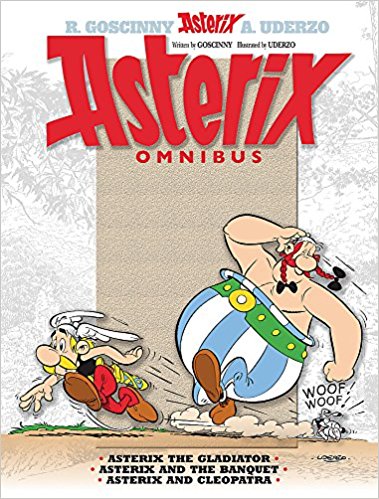
Asterix Omnibus volume 2: Asterix the Gladiator, Asterix and the Banquet, Asterix and Cleopatra


By René Goscinny & Albert Uderzo, translated by Anthea Bell & Derek Hockridge (Orion Childrens Books)
ISBN: 978-1-4440-0424-3

It’s been a painful year for lovers of comics, with many of our greatest practitioners – famous or otherwise – leaving us. I’m going to spend the remainder of the year dwelling on them and recommending examples of their work we can read to commemorate them in the best way possible… through enjoyment.

Suffolk-born Anthea Bell OBE came from prestigious stock. She was born in 1936 and translated numerous works from history books such as WG Siebald’s Austerlitz to the works of Hans Christian Andersen to fantasies such as Cornelia Funke’s Inkworld books Either singly or with Derek Hockridge, however, she found true immortality: translating thousands of pages of European comics and Bande Dessinée. She was a smart and dedicated woman and brilliantly adroit with worlds and concepts in many tongues. Her creative punning and naming techniques in the Asterix books garnered praise all over the world and many aficionados believe the strip is actually funnier in English than in any other language.

I can certainly confirm that’s the case with German…

Among her many triumphs are the aforementioned Asterix, Le Petit Nicolas, Lieutenant Blueberry and Iznogoud.

She died on 18th October 2018 and can never be replaced.

Asterix the Gaul is probably France’s greatest literary export: a wily wee warrior who resisted the iniquities, experienced the absurdities and observed the myriad wonders of Julius Caesar’s Roman Empire with brains, bravery and a magic potion which bestowed incredible strength, speed and vitality.

One of the most popular comics in the world, the chronicles have been translated into more than 100 languages; 8 animated and 3 live-action movies, assorted games and even into a theme park (Parc Astérix, near Paris). More than 325 million copies of 34 Asterix books have been sold worldwide, making Goscinny & Uderzo France’s bestselling international authors.

The diminutive, doughty hero was created as the transformative 1960s began by two of the art-form’s greatest masters, René Goscinny & Albert Uderzo and even though their perfect partnership ended in 1977 the creative wonderment still continues – albeit at a slightly reduced rate of rapidity.

When Pilote launched in 1959 was Asterix was a massive hit from the start. For a while Uderzo continued working with Charlier on Michel Tanguy, (Les Aventures de Tanguy et Laverdure), but soon after the first epic escapade was collected as Astérix le gaulois in 1961 it became clear that the series would demand most of his time – especially as the incredible Goscinny never seemed to require rest or run out of ideas (after the writer’s death the publication rate dropped from two books per year to one volume every three to five).

By 1967 the strip occupied all Uderzo’s time and attention. In 1974 the partners formed Idéfix Studios to fully exploit their inimitable creation and when Goscinny passed away three years later Uderzo was convinced to continue the adventures as writer and artist, producing a further ten volumes since then.

Like all great literary classics, the premise works on two levels: for younger readers as an action-packed comedic romp of sneaky, bullying baddies regularly getting their just deserts and as a pun-filled, sly and witty satire for older, wiser heads, enhanced here by the brilliantly light touch of the translators who played such a massive part in making the indomitable Gaul so very palatable to the English tongue.

Launched in Pilote #1 (29th October 1959, with the first page appearing a week earlier in a promotional issue #0, June 1st 1959), the stories were set on the tip of Uderzo’s beloved Brittany coast in the year 50BC, where a small village of redoubtable warriors and their families resisted every effort of the all-conquering Roman Empire to complete their conquest of Gaul. Unable to defeat these Horatian hold-outs, the Empire resorted to a policy of containment and the little seaside hamlet is perpetually hemmed in by the heavily fortified garrisons of Aquarium, Laudanum, Petibonum and Barbaorum (the latter two becoming Compendium and Totorum for us Brits).

The Gauls don’t care: they daily defy the world’s greatest military machine by just going about their everyday affairs, protected by a magic potion provided by the resident druid and the shrewd wits of a rather diminutive dynamo and his simplistic best friend…

With these volumes a key pattern was established: the adventures would henceforth – like a football match – alternate between Home and Away, with each globe-trotting escapade balanced by an epic set in and around he happily beleaguered Gaulish village (if you’re counting, home tales were odd numbered volumes and travelling exploits even-numbered…)

Asterix the Gladiator debuted in Pilote #126-168 (1963) with the canny rebel and his increasingly show-stealing pal Obelix (who had fallen into a vat of potion as a baby and was a genial, permanently superhuman, eternally hungry foil to the smart little hero) despatched to the heart of the Roman Empire on an ill-conceived mission of mercy…

When Prefect Odius Asparagus seeks to give Julius Caesar a unique gift he decides upon one of the indomitable Gauls who had been giving his occupying forces such a hard time.

Thus, he has village Bard Cacofonix abducted and bundled off to Rome. Although in two minds about losing the raucous harpist, pride wins out and the villagers mount a rescue attempt, but after thrashing the Romans again they discover that their lost comrade is already en route for the Eternal City…

Asterix and Obelix are despatched to retrieve the missing musician and hitch a ride on a Phoenician galley operated under a bold new business plan by captain/general manager Ekonomikrisis. On the way to Italy the heroes first encounter a band of pirates who would become frequent guest-stars and perennial gadflies.

The pirates were a creative in-joke between the close-knit comics community: Barbe-Rouge or Redbeard was a buccaneering strip created by Charlier & Victor Hubinon that also ran in Pilote at the time.

As Asterix and Obelix make friends among the cosmopolitan crowds of Rome, Caesar has already received his latest gift. Underwhelmed by his new Bard, the Emperor sends Cacofonix to the Circus Maximus to be thrown to the lions just as his chief of Gladiators Caius Fatuous is “talent-spotting” two incredibly tough strangers who would make ideal arena fighters…

Since it’s the best way to get to Cacofonix, our heroes join the Imperial Gladiatorial school; promptly introducing a little Gallic intransigence to the tightly disciplined proceedings. When the great day arrives, the lions get the shock of their lives and the entertainment-starved citizens of Rome “enjoy” a show they will never forget…

As always, the good-natured, comedic situations and sheer finesse of the yarn rattles along, delivering barrages of puns, oodles of insane situations and loads of low-trauma slapstick action, marvellously rendered in Uderzo’s expansive, authentic and continually improving big-foot art-style.

Asterix and the Banquet originated in Pilote #172-213 (1963), inspired by the Tour de France cycle race.

After being continually humiliated by the intractable Gauls coming and going as they please, Roman Inspector General Overanxius instigates a policy of exclusion and builds a huge wall around the little village, determined to shut them off from their country and the world. Modern world leaders might get a clue from this book, here… if they read books. Even books with pictures…

Incensed, Asterix best the smug Prefect that Gauls can go wherever they please and to prove it invites the Romans to a magnificent feast where they can sample the culinary delights of various regions. Breaking out of the stockade and through the barricades, Asterix and Obelix gather produce from as far afield as Rotomagus (Rouen), Lutetia (Paris, where they also picked up a determined little mutt who would eventually become a star cast-member), Camaracum (Cambrai) and Durocortorum (Rheims), easily evading or overcoming the assembled patrols and legions of man-hunting soldiers. However, they don’t reckon on the corrupting power of the huge – and growing – bounty on their heads and some Gauls are apparently more greedy than patriotic…

Even with Asterix held captive and all the might of the Empire ranged against them, Gaulish honour is upheld and Overanxius, after some spectacular fights, chases and close calls, eventually is made to eat his words – and a few choice Gallic morsels – in this delightful, bombastic and exceedingly clever celebration of pride and whimsy.

Asterix and Cleopatra ran from 1963-1963 in issues #215-257 and, although deriving its title from Shakespeare’s Antony and Cleopatra, is actually a broad visual spoof of the 1963 movie blockbuster Cleopatra (the original collected album cover was patterned on the film poster).

Rome is a big empire to run but Caesar always has time to spare for the fascinating Queen of Egypt – even though she can be a little overbearing at times…

When Caesar calls her people decadent, Cleopatra announces that her Egyptians will build a magnificent palace within three months to prove their continued ingenuity and vitality.

Her architect Edifis is less confidant and subcontracts the job, recruiting his old friend Getafix the Druid to help, with Asterix, Obelix and faithful pooch Dogmatix coming along to keep him out of trouble…

After another short, sharp visit with the pirates, the voyagers reach the Black Lands only to find the building site an utter shambles. Edifis’ arch rival Artifis has stirred up unrest among the labourers and consequently sabotaged the supply-chain, entombing the visitors in a deadly tourist-trap and even frames Edifis by attempting to poison the Queen.

For all these tactics the ingenious Gauls have a ready solution and the Palace construction continues apace, but when Caesar – determined not to lose face to his tempestuous paramour – sends his Legions to destroy the almost-completed complex, it’s up to the two smallest, smartest warriors to come up with a solution to save the day, the Palace and the pride of two nations…

Outrageously fast-paced and funny and magnificently illustrated by a supreme artist at the very peak of his form, Asterix and Cleopatra is one of the very best epics from a series that has nothing but brilliant hits.

This is supremely enjoyable comics storytelling and if you’re still not au fait with these Village People you must be as Crazy as the Romans ever were…
© 1964-1965 Goscinny/Uderzo. Revised English translation © 2004 Hachette. All rights reserved.
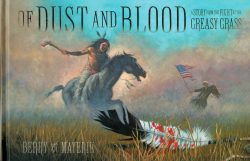
Of Dust and Blood – A Story from the Fight at the Greasy Grass


By Jim Berry & Val Mayerik (Jim Berry)
ISBN: 978-0-692-63801-9

Win’s Christmas Gift Recommendation: Even More Potent, Powerful, Unmissable… 10/10

Back in October I reviewed a beautiful book published by NBM: a passionate and compelling re-examination of one of the most infamous and iconic moments in American history. I thought it was superb and said so in pixel-print.

After the review posted we were contacted by the writer of the book who very graciously thanked us. He also said that the original crowdfunded Kickstarter edition was not only better but how the book should be seen. He even sent us a copy to prove it.

He was right.

Here’s a tweaked review. Go buy this one. Even if you already have the perfectly excellent oversized, portrait format hardback edition. Get this one too. You won’t regret it…

Thanks to the twin miracles of humanity’s love of stories and the power of commercial narrative there’s no logic to how or why some events pass into the forgotten corners of history whilst others become touchstones of common experience or even actual living myths.

In 1875 final – official – tally of casualties for The Battle at Little Big Horn listed 268 US dead and 55 severely wounded men… and an unknown or unspecified number of native casualties.

Eleven years earlier the Chivington (Sand Creek) Massacre recorded a wildly estimated 500-600 killed and mutilated Cheyenne and Arapaho (two thirds of whom were women and children). To be fair, the figures might have been as low as 60 or 70 heathen souls, but practically nobody white really cared…

My point is that the reason you’ve heard of one but not the other is the force of publicity…

After Custer’s debacle and the slaughter of the 7th Cavalry, the Anheuser-Busch brewery commissioned prints of a painting memorialising “Custer’s Last Fight” and had them framed and hung in bars and saloons across America, forever connecting their product in the minds of generations of drinkers with unvarnished white heroism…

With historical veracity at a supreme disadvantage, the ill-judged clash at Little Big Horn – alternatively described by the winning side (on that day, at least) as the Battle of the Greasy Grass – has become the stuff of imagination and extrapolation.

Atrocity aside, that’s not necessarily a bad thing as it’s led numerous thoughtful creative types to examine the event on their own terms and applying the perspective of history to the events and the shameful, bloody aftermath…

Two of the very best are comics veteran Val Mayerik and journalist-turned-author Jim Berry who have here shaped the conflict to their own deeply moving ends with this superb offering. Originally crowdfunded through Kickstarter contributions, this stunning landscape format (295 x 192 mm) full-colour hardback explores truth and myth whilst adding another powerful fictive component to the sprawling patchwork.

Following Berry’s mood-setting and painfully timely Introduction – dramatically augmented by a linework Map of The Battle of the Greasy Grass/Little Big Horn by fellow graphic scholar and historian Rick Geary – the story (lettered by Simon Bowland) unfolds in rapid yet panoramic moments, and traces two ultimately converging paths.

On one side cavalry scout Greenhaw takes some time off to pen a letter to his beloved Rose, even as some distance away young Lakota warrior Slow Hawk performs the funeral rites for his brother. Now he is the last of his family…

Against the background of the tragically documented specifics of the inevitable, legendary greater clash, these two strangers are carried by events towards an inescapable and bloody confrontation…

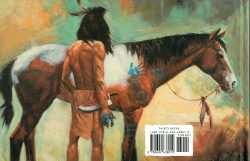
Rendered with staggering virtuosity by Mayerik, the smaller moments and incidents contributing to the greater clash we all think we know are beguiling and breathtaking in their warmth and humanity, magnificently underscoring Berry’s incisive questioning of the point and merit of the battle.

Augmenting the visual narrative is a text essay describing what happened After the Battle and how commercial interests monetised and weaponised public sentiment against the Indians and led to America’s own final solution to the Indian Wars at Wounded Knee Creek in 1890.

Following on, Val Mayerik: The Process describes, with plenty of access to the artist’s sketchbook, how many of the most evocative images were created before this terrific tome concludes with a Bibliography (illustrated by Aaron McConnel of further reading for interested parties and a moving page of dedications dubbed ‘Philamayaa’… (it means “Thank You”)

This is a wondrous and sobering experience any comics fan or student of human nature must seek out share. And that’s best seen in the original edition.

© 2016 Jim Berry, all rights reserved. 1st Edition. All fictional characters are trademarks of Jim Berry and Val Mayerik.

Copies of the first edition Of Dust and Blood can be purchased on eBay.

The Beatles in Comics


By Michels Mabel, Gaet’s, Lu-K, Vox, Anne-Sophie Servantie, Ludivine Stock, Amandine Puntous, Romuald Gleyse, Julien Lamanda, Efix, Pierre Braillon, Ben Lebègue, Anthony Audibert, Bloop, Victor Giménez, Akita, Laurent Houssin, Richard Di Martino, Piero Ruggeri et Filipo Neri, Martin Trystram, Clément Baloup, Edwina Cosme et Christophe Billard, Patrick Lacan, Virginie de Lambert, Joël Alessandra, Odile Santi & various: translated by Joe Johnson (NBM)
ISBN: 978-1-68112-187-1 (HB)

Win’s Christmas Gift Recommendation: A Magical Mystery Tour for All… 10/10

Graphic biographies are all the rage at the moment and this one – originally released on the continent in 2016 – is one of the best I’ve seen and the most likely to appeal to a far larger mainstream audience than comics usually reach. It certainly deserves to…

If you’ve never heard of the Beatles there’s very little point in you carrying on any further.

Still with us? Okay then…

As if cannily repackaged popular culture factoids and snippets of celebrity history – accompanied by a treasure trove of candid photographs, song lyrics, posters and other memorabilia – aren’t enough to whet your appetite, this addition to the lore of the Fab Four adds a vital and enticing extra element.

The individual chronological articles and the comics vignettes they each precede are all written by Michels Mabel & Gaet’s, with an army of illustrators providing vivid and vibrant mini-strips, beginning with the meeting of ‘John, Paul and George’, as envisioned by Lu-K.

Vox details the euphoria of the first gigs in ‘Hamburg’ before Anne-Sophie Servantie details the iconic contribution of photographer ‘Astrid Kirchherr’ to the band’s growing mystique after which the crucial contribution of their tragedy-marked manger is explored in ‘Mister Epstein’ with vivid illustration from Ludivine Stock.

A tone of smug schadenfreude tinges Amandine Puntous’ ‘The Man Who Refused to Sign the Beatles!’ before Romuald Gleyse recalls the moment the magic finally gelled as a proper music producer takes the rowdy kids in hand with ‘George Martin’s Wager’.

With the world at their feet, a close brush with respectability and civil honours are covered in

‘The Queen’s Rebels’ by Julien Lamanda after which Efix encapsulates conquest of the New World and ‘The Beginning of Beatlemania’; with Pierre Braillon tackling key appearances on ‘The Ed Sullivan Show’ and Ben Lebègue depicting ‘Shea Stadium and the American Tour’.

Once they started getting successful, tensions began to fracture the band’s enthusiastic solidarity. The creation of the song ‘Yesterday’ (Anthony Audibert art) and an anticlimactic meeting of giants, as seen in Bloop’s ‘The Beatles and Elvis’ starts tracing the cracks, whilst movie sensation ‘A Hard Day’s Night’ – by Victor Giménez – and Akita’s visualisation of ‘John’s Opinion’ reinforce the tensions.

Courtesy of Laurent Houssin, ‘New Musical Horizons’ are explored, and Richard Di Martino celebrates ‘The Triumph of Sgt. Pepper’s Lonely Hearts Club Band’ before the hammer falls with the death of their protective manager. ‘Goodbye Brian’ by Piero Ruggeri et Filipo Neri signals a creative explosion and the beginnings of financial disaster as conmen target the band resulting in a fractious ‘Trip to India’ (by Martin Trystram), the advent of ‘Yoko Ono’ (from Clément Baloup) and the musical masterpiece that is ‘The White Album’ as depicted by Edwina Cosme & Christophe Billard.

Patrick Lacan then visually traces the insane and inane conspiracy theories claiming ‘Paul is Dead’ before more artistic triumphs are balanced by incipient catastrophe in Virginie de Lambert’s ‘Abbey Road/Let it Be’.

From there it’s all about ‘The Break-up’ (Joël Alessandra) after which Odile Santi scrapbooks 1971 to now in the postscriptive ‘Post Beatles’ section…

The compelling and remarkable biography concludes on a deliciously whimsical note as ‘Do you want to know a secret?’ offers 18 absurd anecdotes to delight everyone who loves to hear classic absurdism. The Beatles in Comics is an astoundingly readable and beautifully rendered treasure for comics and music fans alike: one that resonates with anybody who loves to listen and look. Without it, you’re simply nowhere, man…

© 2016 Petit as Petit. © 2018 NBM for the English translation.
NBM books are also available in digital formats. For more information and other great reads see http://www.nbmpub.com/

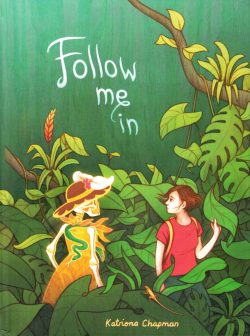
Follow Me In


By Katriona Chapman (Avery Hill Publishing)
ISBN: 978-1-910395-38-7 (HB)

Win’s Christmas Gift Recommendation: The Perfect Holiday Getaway… 10/10

I read a lot of graphic novels. Some are awful, many are so-so and the rest I endeavour to share with you. Of that remaining fraction most can be summarised, plot-pointed and précised to give you a clue about what you might be buying if I’ve done my job right.

Sometimes, however, all that fuss is not only irrelevant but will actually impede your eventual enjoyment. This is one of those times…

Katriona Chapman is a story-maker based in London, from where she’s been crafting superb tales in Small Press titles like Tiny Pencil (which she-cofounded), Comic Book Slumber Party, Ink & Paper, Save Our Souls, Deep Space Canine and her own award-winning Katzine. She draws beautifully and knows how to quietly sneak up, grab your undivided attention and never let go… and she hasn’t spent all her life in the Smoke either…

Follow Me In is her first novel-length tale and combines recollections of a particularly troubling time in her life with clearly the most life-affirming and inspirational events one could hope to experience.

At the station, a young woman meets up with an old boyfriend. He’s a writer and she draws. It’s been years and they’re still awkward and uncomfortable in each other’s presence. They talk about the time in 2003 when they decided to trek the entire country of Mexico, north to south east to west. Back then they were looking for themselves. As her mind goes back, she realizes she’s a lot closer to answers than he is…

This magnificently hefty, pocket-sized (165 x 216 mm) hardcover then follows that voyage with exquisite detail, relating history, culture, the sights, and most especially the actual, non-screaming headlines, bad-movie images of a young nation with thousands of years of history, architecture and archaeology: a nation that proudly boasts dozens of indigenous cultures living in relative harmony, speaking at least 68 legally recognised languages and constantly being reshaped by political turmoil. Moreover, no traveller should miss this tome, if only for the advice on bugs, minibeasts and illnesses…

Follow Me In is slyly lyrical and enchantingly enticing; a moving and intoxicating graphic assessment of a crucial time in the illustrator’s life, filled with facts, warmth and conflict, offering fascinating data on such varied topic as ‘A Selection of Mexican Foods’, ‘Learning Spanish’, ‘Travel Sketching’, ‘What’s in our Bags?’ and ‘The Conquests’, all equally compelling and useful to know. And through it all, you’ll want to know what happened to our travellers as they transition from kids to grown-ups as much as what they’ll see next in this magnetic story within a story.

Refreshing, redemptive and rewarding, this is a book to chase away all winter blues and existential glums and a reading experience you must not deprive yourself – or your family – of.
© Katriona Chapman 2018. All rights reserved.

Day of Wrath


By Wayne Vansant (Caliber)
ISBN: 978-0-98363-077-7

Comics creators have a strong history of treating war stories right, and none more so that those who’ve actually served in combat. Wayne Vansant was born in Atlanta, Georgia on July 13th 1949, making him an ideal age to fight in the Vietnam War. After leaving the US Navy he attended Atlanta College of Art, graduating in 1975.

He followed Michael Golden as illustrator on Marvel’s landmark 8-year miniseries The ‘Nam (notching up over 50 issues), and – with a few notable exceptions – has spent his career writing and drawing war comics and historical books about combat for companies as varied as Eclipse, Byron Preiss, Caliber, Dark Horse and Penguin. His canon includes New Two-Fisted Tales, Real War Stories, Shiloh, The Vietnam War: A Graphic History, Semper Fi (Tales of the Marine Corps) and Witches’ Caldron, as well as Foreign Legion epic Battron and Knights of the Skull.

His Heritage Collection: Civil War and World War II are superb and incisive commemorations of those conflicts and he’s also adapted Stephen Crane’s The Red Badge of Courage.

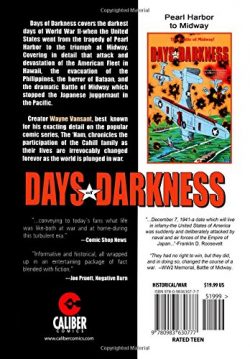
In the early 1990s he worked with Apple Comics, on a black and white miniseries detailing the early days of America’s Pacific war, immediately following Japan’s shameful attack on Pearl Harbor on the morning of Sunday December 7th 1941. It was collected as a trade paperback by Caliber in 2012 (still readily available) and is also out there in a number of eBook formats.

Seen through the eyes of a multi-generational and far-flung Texas family, the saga follows events and concerns affecting the Cahill clan and, by extension, every American from that horrific sneak attack to the critical turning point when they finally started winning battles against a seemingly inhuman and apparently unbeatable foe.

With a tremendous amount of detail easily delivered by a range of characters of every stripe and persuasion, the tale begins with a birthday party in Texas and an appalling war crime in Hawaii on the ‘Day of Infamy’, rapidly fleshed out by the immediate aftermath in ‘At Dawn We Slept, At Dusk We Wept’. Here the view is widened to encompass the multiple and simultaneous unannounced assaults on military and civilians in the Philippines…

The onslaught expands in ‘After Pearl Harbor – Japanese Juggernaut’ as British, French and Dutch colonies from Malaysia to Bangkok, Luzon to Burma, Borneo to Wake Island to Hong Kong fall to the Empire and Allied shipping and planes prove helpless against Japanese ordnance and tactics.

When General Douglas MacArthur abandons his responsibilities – and the population of Manilla – he leaves a token American force and many Philippine troops to a ‘Last Stand on Bataan!’ packed with revolting and amazing vignettes of personal courage before the all-conquering Nippon forces compel the survivors to endure the infamous atrocity of the ‘Bataan Death March!’

The unfolding saga and the trials of Assorted Cahills eventually bring us to May 30th 1942 and the narrow victory that changed everything as Admiral Chester Nimitz and the US Pacific Fleet and Japanese forces all converge on a fortified and still fighting island to see fate and destiny play out in final chapter ‘The Battle of Midway!’

Of course, what we regard as victory and turning point is still open to wide interpretation…

Supplementing the pictorial drama are numerous prose-&-pic extra features, including ‘Learning the Legacy of World War II’, ‘A date which will live in infamy…’ – the text of President Roosevelt’s request to Congress for a Declaration of War – plus ‘It will not only be a long war, it will be a hard war’ and ‘We are going to win the war, and… the peace that follows’ (his radio “Fireside Chat” to the nation on December 9th).

Adding context is The Cahill Family Tree, a map and history of ‘The Philippines’ plus ‘Angels of Mercy’ – a feature on the American nurses who attended the defenders and what happened to them.

Not only solidly authentic but overwhelming in its sense of veracity and initial hopelessness, this dramatized history lesson is potent and powerful, easily blending military data with human interest and interactions, giving a time of true terror and dry statistics a shockingly human face. Despite never pulling any punches, Days of Darkness is not gratuitous in its treatment of the characters, white, black or Asian, male or female, and remains one of the most accessible treatments of the events in any medium. If you crave knowledge and understanding or just love great comics, this is a book you must see.
© 1992 Wayne Vansant. All Rights Reserved.

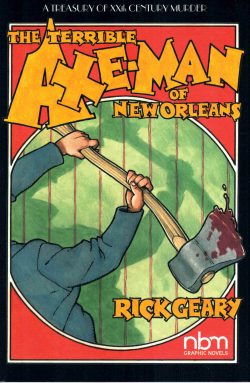
The Terrible Axe-Man of New Orleans


By Rick Geary (NBM)
ISBN: 978-1-56163-179-6

Win’s Christmas Gift Recommendation: Cutting Edge Crime and a Ripping Holiday Read… 8/10

For decades he toiled as an Underground cartoonist and freelance illustrator of strange tales and wry oddments, published in locales as varied as Heavy Metal, Epic Illustrated, Twisted Tales, Bop, National Lampoon, Vanguard, Bizarre Sex, Fear and Laughter, Gates of Eden, RAW and High Times.

For these illustrious venues he honed a unique ability to create sublimely understated stories by stringing together seemingly unconnected streams of narrative to compose tales moving, often melancholy and always beguiling.

Discovering his natural oeuvre with works including biographies of J. Edgar Hoover or Trotsky and his multi-volume Treasury of Victorian Murder series, Geary has grown into a grandmaster and towering presence in both comics and True Crime literature.

His graphic reconstructions of some of the most infamous murders ever committed since policing began combine a superlative talent for laconic prose, incisive observation and meticulously detailed pictorial extrapolation. These are filtered through a fascination with and understanding of the lethal propensities of humanity as his forensic eye scours police blotters, newspaper archives and history books to compile irresistibly enthralling documentaries.

In 2008 he turned to the last century for ongoing series Treasury of XXth Century Murder, focusing on scandals which seared the headlines during the “Gilded Age” of suburban middle class America. He has not, however, forsaken his delight in fiction nor his gift for graphic biography.

Delivered in stark monochrome in either luxurious collectors’ hardback, accessible eBook or engaging paperback editions like this one, his investigations diligently sift fact from mythology to detail the grisliest events in modern history.

Geary’s tales are so compelling because the subject matter methodology resonates through his quirky illustration. Geary always presents facts, theories and even contemporary minutiae with absorbing pictorial precision, captivating clarity and devastating dry wit, re-examining each case with a force and power Oliver Stone would envy.

This particular chiller-thriller comes – after far too long a wait – as a cheap-&-cheerful paperback release of a 2010 offering but it’s still a grand outing for lovers of macabre history…

Geary’s forensic eye scoured the data and scores a palpable if rather unpalatable hit here with a relatively unknown serial killer saga that would make an incredible film – if only the fiend had ever been caught!

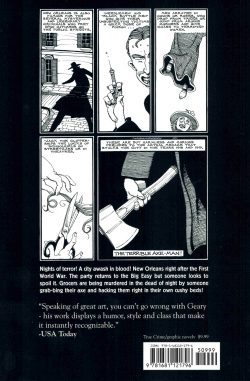
In 1918 with the Great War moving into the inevitable End-game the iconic and legend-laden city of New Orleans suffered a chilling campaign of terror that lasted well over a year with far-reaching repercussions felt clear across the United States.

As explained in the captivating capsule history that opens this moreish monochrome and exceedingly noir thriller, New Orleans was founded by the French in 1717, lost to the Spanish in 1763, seized by Napoleon in 1802 and then sold to the Americans a year later. That makes it one of the oldest and certainly most eclectic, eccentric, artistic and elegant cities in the USA.

By 1918 it was a huge, sprawling and vital hub of trade and commerce, peopled by a vast melting pot of immigrant populations. On the night of May 23rd an Italian couple running a grocery store were hacked to death by an intruder who broke into their home and attacked them with their own household axe.

Over the next 18 months a phantom killer would, under the horrifying glare of public scrutiny, kill six people, maim and mutilate another half dozen and hold the entire city a virtual hostage with insane proclamations and demands. He – if it was, indeed, a man – was often seen but never apprehended.

Geary is as meticulous and logical as ever, forensically dissecting the various attacks, examining the similarities and, more importantly, the differences whilst dutifully pursuing the key figures to their unlikely ends.

All the victims were grocers of Italian origin (leading to a supposed Mafia connection) except for the ones who were not, which possibly refuted the theory but equally suggested opportunistic copy-cat killers. A number of personal grievances among the victims led to many false arrests and even convictions, and the killer or killers left many survivors who all agreed on a general description but all subsequently identified different suspects. There’s even a broader than usual hint of supernatural overtones.

Occurring at the very birth of the Jazz Age, this utterly compelling tale is jam-packed with intriguing snatches of historical minutiae, plus beautifully rendered maps and plans which bring the varied locations to moody life: yet another Geary production tailor-made for a Cluedo special edition!

The author presents the facts and theories with chilling graphic precision, captivating clarity and devastating dry wit, and this enigma is every bit as compelling as his other homicidal forays: a perfect example of how graphic narrative can be so much more than simple fantasy entertainment. This merrily morbid series of murder masterpieces should be mandatory reading for all comic fans, mystery addicts and crime collectors.
© 2010 Rick Geary. All Rights Reserved.

The Terrible Axe-Man of New Orleans will be published on December 15th 2018 and is available for pre-order now. For more information and other great reads see http://www.nbmpub.com.

The Great North Wood


By Tim Bird (Avery Hill)
ISBN: 978-1-910395-36-3 (PB)

Win’s Christmas Gift Recommendation: A Glorious Ramble to Shake Loose the Cerebral Cobwebs… 9/10

Lots of comics, and most forms of fiction, in fact, depend on strong – or at least memorable – characters and plenty of action to capture the attention. You need to be really good and quite brave to try anything outside those often-infantile parameters.

That’s actually a pretty good description of London-based cartoonist and author Tim Bird whose sundry works explore themes of time and place, history, memory and myth as well as our connection to the planet in such comics as the award-winning From The City To The Sea. He calls these forays psychogeography…

Here that empathy is transformed into a far-too-brief lyrical travelogue and sharing of lost folklore as this oversized (178 x 279 mm) colour paperback traces the slow decline and curtailment of the vast forest that swathed Britain before humanity, whilst highlighting those icons of modernity and great survivors who seem to adapt to all changes with dogged aplomb.

As Man took hold, the trees grew small and fragmented, so our far-ranging focus takes in the range of Southern England described in the title and relates experiences from before writing to just a few moments from now…

The scene is set with symbolic guile in ‘An Ancient Forest’ before focusing in to define ‘The Great North Wood’ then and now. The origins of place names such as ‘Norwood’ and its satellites are accompanied by captivating expositions on local tales such as ‘The Vicar’s Oak’. It’s interesting to consider just how many comics artisans and popular arts creators have lived in the many sites listed in Bird’s introductory map. I’m just one of them. I could list dozens more…

The origin of the ‘Honor Oak’ leads to outlaw glamour in ‘The Story of Ned Righteous’ whilst ‘Gipsy Hill’ (a place and a person) segues beguilingly into ‘Bombs’ after which a visit to the still relatively-abundant ‘Sydenham Hill Woods’ takes us to a hopeful note in ‘A Forest Again’…

Even now I’ll recite the chapter headings like a mantra and remember the places cited herein where I’ve lived over the last four decades and feel I’m also part of something bigger than me…

This paean to a feeling of belonging – to both time and space – evokes the same vibrant elegiac tone as Harry Watt and Basil Wright’s 1936 documentary Night Mail (with its evocative poem/soundtrack by W. H. Auden and score by Benjamin Britten). It’s a feeling no one can decry or wish to end…

Sadly, this glorious celebration is not available digitally yet, but that just means you can give physical copies to all your friends, suitably gift-wrapped and ready to be properly appreciated by all the tactile senses as well as cerebral ones…

A graphic marvel to savour and ponder over and over again.
© Tim Bird 2018. All rights reserved.

Rex Generations


By Ted Rechlin (Rextooth Studios)
ISBN: 978-1-59512-229-4

Win’s Christmas Gift Recommendation: Marvellous Monster Madness and Science with a Bite… 9/10

I’ve never met a kid who didn’t love dinosaurs, and that gleeful fascination doesn’t fade with age or what we laughingly regard as maturity.

Ted Rechlin clearly ascribes to that belief too, and has made it his life’s work, whether it’s in his six – and counting – books (including End of the Ice Age, Jurassic and the award-winning Sharks: A 400 Million Year Journey) or in freelance commissions for the likes of DC Comics, Dark Horse or Dover Publications.

Rex Generations is an incredibly informative and engaging book about family, rendered with great deftness, gleeful aplomb, and packed with the latest scientific thinking regarding arguably the most famous species of big lizard (or is that bird?) on Earth.

In case you weren’t paying attention, the clan in question is thundering great tyrannosaur Cobalt and his feisty mate Sierra, just getting by in what is nowadays Hell Creek, Montana.

This stunning full-colour hardback, however, opens in the Mesozoic bit of the Cretaceous Period, or approximately 66 million years ago on a very special night. Here our anxious apex predators proudly celebrate the hatching of four eggs, heralding the start of the next generation, after which we’ll closely follow the pack over the next decade or so. The parents teach and provide in a dangerous environment packed with a wide variety of dangerously capable prey, rival predators and unknown perils of every description.

This is dinosaurs and natural history, not Lady and the Tramp with really big teeth, so brace yourself and your own youngsters with a little spoiler alert: not everybody present at this antediluvian nativity is going to make it…

Compelling, beguilingly educational and splendidly entertaining, T. Rex Generations is a glorious celebration of Earth’s Saurian inhabitants and our enduring love affair with them. More, Please!
© 2018 Ted Rechlin. All rights reserved.

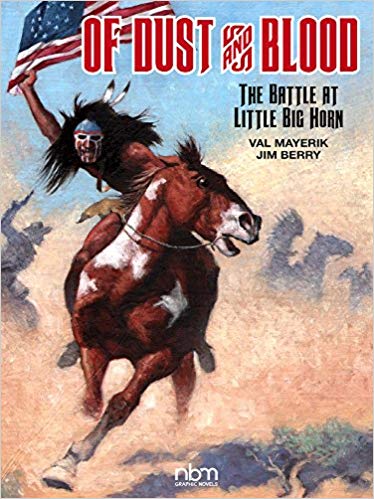
Of Dust and Blood – the Battle at Little Big Horn


By Val Mayerik & Jim Berry & various (NBM)
ISBN: 978-1-68112-183-3

Win’s Christmas Gift Recommendation: Potent, Powerful, Unmissable… 9/10

Thanks to the twin miracles of humanity’s love of stories and the power of commercial narrative there’s no logic to how or why some events pass into the forgotten corners of history whilst others become touchstones of common experience or even actual living myths.

In 1875 The Battle at Little Big Horn noted 268 US dead and 55 severely wounded men… and an unknown or unspecified number of native casualties.

Eleven years earlier the Chivington (Sand Creek) Massacre recorded a wildly estimated 500-600 killed and mutilated Cheyenne and Arapaho (two thirds of whom were women and children). To be fair, the figures might have been as low as 60 or 70 heathen souls, but practically nobody white really cared…

My point is that the reason you’ve heard of one but not the other is the force of publicity…

After Custer’s debacle and the slaughter of the 7th Cavalry, the Anheuser-Busch brewery commissioned prints of a painting memorialising “Custer’s Last Fight” and had them framed and hung in bars and saloons across America, forever connecting their product in the minds of generations of drinkers with unvarnished white heroism…

With historical veracity at a supreme disadvantage, the ill-judged clash at Little Big Horn – alternatively described by the winning side as the Battle of the Greasy Grass – has become the stuff of imagination and extrapolation.

Atrocity aside, that’s not necessarily a bad thing as it’s led numerous thoughtful creative types into examining the event on their own terms and applying the perspective of history to the events and the shameful, bloody aftermath…

Two of the very best are comics veteran Val Mayerik and journalist-turned-author Jim Berry who have here shaped the conflict to their own deeply moving ends with this superb offering. Originally self-published through Kickstarter contributions, this stunning oversized (315 x 238 mm) full-colour hardback second edition (also available in digital formats) explores truth and myth whilst adding another powerful fictive component to the sprawling patchwork.

Following Berry’s mood-setting and painfully timely Introduction – superbly augmented by a linework Map of The Battle of the Greasy Grass/Little Big Horn by fellow graphic scholar Rick Geary – the story (lettered by Simon Bowland) unfolds in rapid yet panoramic moments, and traces two ultimately converging paths.

On one side cavalry scout Greenhaw takes some time off to pen a letter to his beloved Rose, even as some distance away young Lakota warrior Slow Hawk performs the funeral rites for his brother. Now he is the last of his family…

Against the background of the tragically documented specifics of the inevitable, legendary greater clash, these two strangers are carried by events towards an inescapable and tragic confrontation…

Rendered with staggering virtuosity by Mayerik, the smaller moments and incidents contributing to the greater clash we all think we know are beguiling and breathtaking in their warmth and humanity, magnificently underscoring Berry’s incisive questioning of the point and merit of the battle.

Augmenting the visual narrative is a text essay describing what happened After the Battle and how commercial interests monetised and weaponised public sentiment against the Indians and led to America’s own final solution to the Indian Wars at Wounded Knee Creek in 1890.

Following on, Val Mayerik: The Process describes, with plenty of access to the artist’s sketchbook, how many of the most evocative images were created before this terrific tome concludes with a Bibliography of further reading for interested parties and a moving page of dedications dubbed ‘Philamayaa’…

This is a wondrous and sobering experience any comics fan or student of human nature must seek out share.
© 2018 Jim Berry, all rights reserved. 2nd Edition. All fictional characters are trademarks of Jim Berry and Val Mayerik.

Of Dust and Blood will be published on October 30th 2018 and is available for pre-order now. For more information and other great reads see http://www.nbmpub.com/

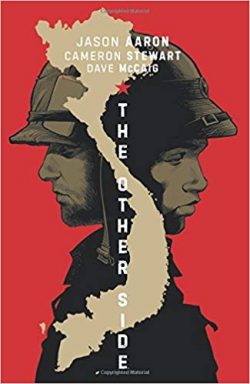
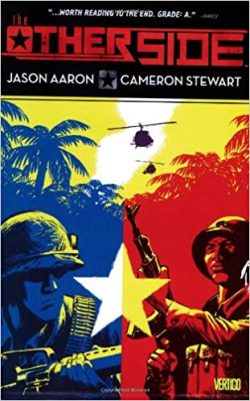
The Other Side


By Jason Aaron, Cameron Stewart with Dave McCaig & various (Image: Vertigo)
ISBN: 978-1-53430-222-8 (Image HB)                     978-1-4012-1350-3 (Vertigo PB)

The Viet Nam conflict scarred the American psyche the way no other war has – not even the still somehow-technically-ongoing debacle in Iran, Afghanistan and all points pointless.

Depending on your politics you will either agree or disagree with that statement. These days there are no shady areas or topics of nuance to debate.

What is indisputable is the effect Viet Nam still has on the American consumer. So, it was intriguing to see an attempt to portray that earlier conflict less in term of “Us and Them” and more as “You and Me”.

This superb and deeply memorable tale contrasts the journey from happy home to bloody combat of surly average teen Billy Everette, his counterpart, farmer’s son Vo Binh Dai, and their predestined clash at the Battle of Khe Sanh.

Drafted from his Alabama home, Everette is a reluctant screw-up turned into an average Marine by the sheer hell of Boot Camp, where even the terrifying and very real hallucinations and delusions he suffers from can’t keep him from that dreaded Tour of Duty.

In contrast, patriotic, dutiful Vo Dai enlists in the People’s Army of Vietnam and endures starvation and disease on his long march south, determined to sell his life dearly to free his country from oppression. He too is plagued both by doubts of his worth, and terrifying hallucinations…

This simple tale, powerfully told and subversively drawn, is a sensitive, darkly magical, horrific parable about war, politics and insanity, if indeed they aren’t all the same thing in the end.

The paperback book also contains sketches and artist Cameron Stewart’s photo diary of his research trip to modern Viet Nam – a compelling bonus greatly amplified in the 2017 deluxe hardcover edition from Image comics as well as the various digital editions – and hopefully those gentle counterpoints to history’s blunders from a later if no less wise era can offer a shred of hope to soldiers and families currently reliving the traumas of another age.
© 2007 Jason Aaron & Cameron Stewart. All Rights Reserved.