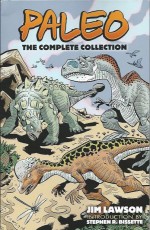
Paleo: the Complete Collection


By Jim Lawson, with Stephen R. Bissette, Peter Laird & various (Dover Comics & Graphic Novels)
ISBN: 978-0-486-80356-2

It’s a rare hominid that hates dinosaurs. Sure, the occasional chimpanzee might prefer a nice kitten or peanut, but most of us soft, hairy two-leggers can’t get enough of our antediluvian predecessors. Apart from the cool way they look and the marvellous variety they came in, it’s pretty clear they concentrated on eating their surroundings and/or each other and never once tried organised sports, or to appropriate more deckchairs than they could use, or wreck the planet…

Seriously though, there’s an irresistible, nigh-visceral appeal to all manner of saurians; small or super-sized. Most of us variously and haphazardly evolved hairless apes seem obsessively drawn to all forms of education and entertainment featuring monster lizards from our primordial past. That’s especially true of comics.

Most nations and many languages have filled countless pages with illustrated stories featuring cretaceous cameos and lizardly line-ups, but America has proudly gone one stage further than most by evolving a true sub-genre. As eruditely and loving explained by Stephen R. Bissette in his scholarly overview and Introduction ‘The Paleo Path: Paleo and the History of Dinosaur Comics’, the terrifying thunder lizards have been visitors and antagonists in literature and the arts for decades but it was comics – specifically a minor back-up feature in Turok, Son of Stone #8 (August 1957, by Paul S. Newman & Rex Maxon) – which finally gave them a voice of their own.

What’s a Dinosaur Comic? One set in the creatures’ own times and scenarios, with no human intrusion or overblown authorial invention. They are scientifically credible tales about animals living and dying on their own terms and in their own context: no cavemen, aliens, time machines or human heroes. All Then, All Lizard, All the Time…

There have been precious few – and Bissette lists them all, including his own wonderful Tyrant – but for us devotees, paramount amongst them is the far-too occasional Paleo: Tales of the Late Cretaceous by Jim Lawson.

Since 2001 the exceptionally gifted, prolific and apparently tireless Lawson has relaxed from his day jobs (most impressive of which are the thousands of pages of Teenage Mutant Ninja Turtles he has written and drawn for more than two decades) by crafting a string of 8 black-&white comics detailing the fictionalised natural history and dramas of the big beasts.

Now Dover has republished Lawson’s 2003 graphic novel compilation, with the added attraction of two more unpublished issues: three all-new stories produced in collaboration with Bissette, Peter Laird and other equally dedicated devotees.

In case the name still seems familiar, Lawson’s other interests include motorcycles – one day I’ll review his outrageous debut series Bade Bike and Orson – and fantastic fantasy. His other cartoon forays include Rat King, Planet Racers (with TMNT co-originator Laird) and in 2013 he began new project Dragonfly…

This mammoth monochrome collection begins with that aforementioned Introduction before quickly thundering on to the meat we all crave, opening with Book One (inked and lettered by Laird) which focuses attention on a key moment in the life of a Triceratops seventy million years ago…

These “Tales from the Late Cretaceous” are all delivered with the earnest veracity and unsentimental authenticity of a show on Animal Planet, or perhaps the better Disney wildlife films of the 1960s and 1970s, and the spectacular, eye-popping narrative takes the form of informed observation as a young, leathery, three-horned cow interacts with or avoids Quetzalcoatalus, egg-stealing proto-rodents and voracious Daspletosaurs, getting into a fix which nearly ends her young life. Nearly…

Lawson inked his own pencils on Book Two where an alpha male Dromeosaur deals with a pushy young male in the female-heavy pack. Status quo re-established, the hunters collaboratively take down a massive Tsintaosaurus but when an apex predator Albertosaur claims the kill, the pack’s hierarchy again becomes an issue of survival…

This issue was supplemented with ‘Gratitude… A Paleo Short Story’ wherein the most experienced female of the pack examines her precarious place in the world…

Book Three examines a strange case of maternal transference as a baby Stegoceras loses one mother and believes a roosting Quetzalcoatalus might be a likely substitute whilst Book Four reviews ‘A Busy Day in the life of a Plotosaurus’ with the colossal sea lizard coming in-shore to scavenge from Aublysodons and later making the kill of a lifetime in deep water after boldly attacking a much larger Thallassomedon Plesiosaur…

It’s a time of snow and deadly cold in Book Five as an aging Albertosaurus takes a bad wound from the Styracosaur he planned on eating. As the world slowly turns white, the hunter finds himself regarded as prey…

There’s a shift in focus and look at the true top killers in Book Six as a herd of feeding Corythosaurs idly watch a dragonfly pass. The insect which is the epoch’s most efficient hunter then makes a mistake for the ages when it lands on the wrong tree at the right moment…

Lawson is at his dramatic best depicting a night hunt in ‘A Paleo Short Story’: a stark, wordless, dramatically chiaroscuric duel to the death in the dark…

Book Seven offers layers of passionate empathy as a Tyrannosaurus Rex battles a host of lesser beasts taking advantage of her seeming defeat by an unconquerable enemy – viscous mud flats – before Book Eight lingers lovingly on the lives of the era’s biggest beasts as a brace of Alamosaurs provide smaller herbivores such as Lambeosaurs and Edmontosaurs a safe, sheltering, mobile feeding environment. But what happens when one disappears and the other is no longer passive…?

The lengthy new material begins with ‘Easy’ (story by Bissette, art Lawson & lettered by Thomas Mauer) as a healthy young male meat-eater succumbs to the pressure of the breeding impulse, heedless of the deadly consequences, after which the same creative team craft ‘Floater’ with a baffled tyrannosaur unable to tear himself away from a tantalising carcass in the river. She’s long dead. She should just be food, but why is her belly still heaving and moving?

This catalogue of carnosaur carnage and herbivore history closes with ‘Loner’ – an all-Lawson affair – as an adolescent Tyrannosaur is driven away by his mother and sisters and learns the cost of being alone. Why then would such a solitary survivor after years alone adopt another rejected young male at he risk of his life?

This book superbly opens a window onto distant eons of saurian dominance and provides a profound panorama that focuses on a number of everyday experiences which simply have to be exactly how it was, way back then…

As in all these tales, the astoundingly rendered and realised scenery and environment are as much characters in the drama as any meat and muscle protagonists and all the other opportunistic scavengers and hangers-on that prowl the peripheries of the war, ever eager to take momentary advantage of every opportunity in a simple battle for survival…

Lawson’s love for his subject, sublime feel for spectacle and an unmatchable gift for pace coupled to a deft hand which imbues the vast range and cast with instantly recognisable individual looks and characters, always means the reader knows exactly who is doing what.

This is book no lover of lizards and comics fan should miss.
© 2003, 2016 Jim Lawson. All rights reserved.

Paleo: the Complete Collection is available in comic shops and online around the world now. It can be pre-ordered online for a February 26th release in the UK.
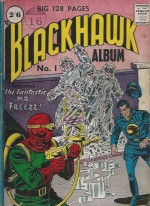
Blackhawk Album #1


By Dick Dillin, Chuck Cuidera, Jack Kirby, Sheldon Moldoff, George Roussos, Mort Meskin, Nick Cardy, Frank Frazetta, Bill Ely, Bob Brown & various (Strato Publications)
No ISBN:

Here’s another long-lost oddity of the eccentric and exotic British comics market that might be of passing interest to curio collectors and unrepentant comics nerds like me.

The early days of the American comicbook industry were awash with both opportunity and talent and those factors happily coincided with a vast population hungry for cheap entertainment.

The new medium of comicbooks had no acknowledged fans or collectors; only a large, transient market open to all varied aspects of yarn-spinning and tale-telling – a situation which publishers believed maintained right up to the middle of the 1960s. Thus, in 1940 even though America was loudly, proudly isolationist and more than a year away from any active inclusion in World War II, creators like Will Eisner and publishers like Everett M. (“Busy”) Arnold felt Americans were ready for a themed anthology title Military Comics.

Nobody was ready for Blackhawk.

Military #1 launched at the end of May 1941 (with an August cover-date) and included in its gritty, two-fisted line-up Death Patrol by Jack Cole, Miss America, Fred Guardineer’s Blue Tracer, X of the Underground, The Yankee Eagle, Q-Boat, Shot and Shell, Archie Atkins and Loops and Banks by “Bud Ernest” (actually aviation-nut and unsung comics genius Bob Powell), but none of these strips, not even Cole’s surreal and suicidal team of hell-bent fliers, had the instant cachet and sheer glamour appeal of Eisner and Powell’s “Foreign Legion of the Air” led by the charismatic Dark Knight of the airways known only as Blackhawk.

Chuck Cuidera, already famed for creating the original Blue Beetle for Fox, drew ‘the Origin of Blackhawk’ for the first issue, wherein a lone pilot fighting the Nazi invasion of Poland in 1939 was shot down by Nazi Ace Von Tepp; only to rise bloody and unbowed from his plane’s wreckage to form the World’s greatest team of airborne fighting men…

This mysterious paramilitary squadron of unbeatable fliers, dedicated to crushing injustice and smashing the Axis war-machine, battled on all fronts during the war and – once the embattled nations had notionally laid down their arms – stayed together to crush international crime, Communism and every threat to democracy from alien invaders to supernatural monsters, consequently becoming one of the true milestones of the US industry.

Eisner wrote the first four Blackhawk episodes before moving on and Cuidera stayed until issue #11 – although he triumphantly returned in later years. There were many melodramatic touches that made the Blackhawks so memorable in the eyes of a wide-eyed populace of thrill-hungry kids. There was the cool, black leather uniforms and peaked caps. The unique, outrageous – but authentic – Grumman F5F-1 Skyrocket planes they flew from their secret island base and of course their eerie battle-cry “Hawkaaaaa!”

But perhaps the oddest idiosyncrasy to modern readers was that they had their own song (would you be more comfortable if we started calling it an international anthem?) which Blackhawk, André, Stanislaus, Olaf, Chuck, Hendrickson and Chop-Chop would sing as they plummeted into battle. (To see the music and lyrics check out the Blackhawk Archives edition but just remember this catchy number was written for seven really tough leather-clad guys to sing while dodging bullets…

Quality adapted well to peacetime demands: superheroes Plastic Man and Doll Man lasted far longer than most of their Golden Age mystery man compatriots and rivals, whilst the rest of the company line turned to tough-guy crime, war, western, horror and racy comedy titles.

The Blackhawks soared to even greater heights, starring in their own movie serial in 1952. However the hostility of the marketplace to mature-targeted titles after the adoption of the self-censorious Comics Code was a clear sign of the times and as 1956 ended Arnold sold most of his comics properties to National Publishing Periodicals (now DC) and turned his attentions to becoming a general magazine publisher.

Most of the purchases were a huge boost to National’s portfolio, with titles such as GI Combat, Heart Throbs and Blackhawk lasting uninterrupted well into the 1970s (GI Combat survived until in 1987), whilst the unceasing draw and potential of characters such as Uncle Sam, the assorted Freedom Fighters costumed pantheon, Kid Eternity and Plastic Man have paid dividends ever since.

The “Black Knights” had also been a fixture of the British comics reprint industry since the early 1950s, with distributor-turned publisher Thorpe & Porter releasing 37 huge (68-page, whilst the US originals only boasted 36 pages) monochrome anthologies to entrance thrill-starved audiences under their Strato imprint.

This commodious British collection combines a flurry of tales featuring the Air Aces, balanced out by an assortment of mystery and science fiction tales from DC’s wide selection of weird adventure anthologies (primarily culled in this instance from September and October 1957) and kicks off with the contents of (US) Blackhawk #117 and ‘The Fantastic Mr. Freeze’ wherein the paramilitary aviators battle a chilling criminal maniac with a penchant for cold crimes before tackling smugglers masquerading as Vikings in ‘The Menace of the Dragon Boat’.

‘How Not to Enjoy a Vacation’ was seen in many places; a Public Service feature probably written by Jack Schiff and definitely illustrated by Rueben Moreira, followed by prose poser ‘I Was a Human Missile’, relating a technician’s account of when he was trapped during the test firing of a missile – and how he escaped – after which ‘The Seven Little Blackhawks’ become the targets of a ruthless mastermind exploiting their fame and reputations to plug his new movie…

Regrettably most records are lost so scripter-credits are not available (likely candidates include Ed “France” Herron, Arnold Drake, George Kashdan, Jack Miller, Bill Woolfolk, Jack Schiff and/or Dave Wood) but the art remained in the capable hands of veteran illustrators Dick Dillin & Chuck Cuidera: a team who meshed so seamlessly that they often traded roles with few any the wiser…

Moreover although broadly formulaic, the gritty cachet, exotic crime locales, Sci Fi underpinnings and international jurisdiction of the team always allowed great internal variety within the tales…

Here however the uniformed escapades pause as House of Mystery #67 (October 1957) offers the sorry saga of ‘The Wizard of Water’ – a scurvy conman who accidentally gets hold of King Neptune’s trident as drawn by Bill Ely – and, after an always-engaging ‘Science Says You’re Wrong’ page and text terror tale ‘The Mummy’s Revenge’, counts down ‘Five Days to Doom’ (illustrated by Sheldon Moldoff from House of Mystery #66, September 1957) wherein a printer discovers a seemingly-prophetic calendar and uses it to track down aliens planning to destroy Earth.

‘The Legend of the Golden Lion’ (HoM #67 again and illustrated by George Roussos) then described a Big Game Hunter’s confrontation with a leonine legend of biblical pedigree whilst from the same issue the ever-excellent Bob Brown depicted a weird science-tinged crime caper about ‘The Man Who Made Giants’ before the Blackhawks soared back into action battling ‘The Bandit with a Thousand Nets’ – yet another audacious costumed thief with a novel gimmick (from Blackhawk #118, October 1957).

That issue also provided ‘The Blackhawk Robinson Crusoes’ wherein the Pacific Ocean proved to be the real enemy when an accident marooned the Aviators as they hunted the nefarious pirate Sting Ray, followed by much-reprinted western classic ‘The Town Jesse James Couldn’t Rob’ limned by Frank Frazetta and itself a reprint from Jimmy Wakely #4.

Text feature ‘From Caveman to Classroom’ charted the history of map-making after which Blackhawk #118 continues to completion as ‘The Human Clay Pigeons’ found the entire squadron helpless targets of international assassin/spymaster the Sniper, leaving the rest of this collection to astound and amuse with more genre-specific tales such as the Roussos illustrated psychological crime thriller ‘Sinister Shadow’ from House of Mystery #66 Sept 1957.

Also in that issue is Jack Kirby’s eerie mystery of best friends turned rivals ‘The Thief of Thoughts’, Moldoff’s jungle trek chiller ‘The Bell that Tolled Danger’ and Mort Meskin & Roussos’ tragic supernatural romance ‘The Girl in the Iron Mask’.

Rounding out the collection are selections from House of Mystery #64 (July 1957) beginning with Nick Cardy’s irony-drenched riff on the curse of Midas wherein a criminal subjects himself to ‘The Golden Doom’ – pausing briefly for Jack Miller’s prose expose of mind-readers ‘A Clever Code’ (from HoM #66) and another Public Service ad with teen star Binky explaining ‘How to Make New Friends’ (Schiff & Bob Oksner) – before Bill Ely delivers a murderous revelation regarding ‘The Artist Who Painted Dreams’.

A brace of Henry Boltinoff gag pages starring ‘Professor Eureka’ and ‘Moolah the Mystic’ then segues into Bernard Baily’s macabre depiction of criminal obsession in ‘My Terrible Twin’ (HoM #64) to bring the fun to a close on a spooky high note.

These stories were produced – and reprinted here – at a pivotal moment in comics history: the last showing of broadly human-scaled action-heroes and two-fisted mystery-solvers in a marketplace increasingly filling up with gaudily clad wondermen and superwomen. The iconic blend of weary sophistication and glorious, juvenile bravado where a few good men with wits, firearms and an occasional trusty animal companion could overcome all odds was fading in the light of spectacular scenarios and ubiquitous alien encounters.

These are splendidly engaging tales that could beguile and amaze a whole new audience if only publishers would give them a chance. But whilst they won’t your best bet is to seek out books like this in specialist comic shops or online.

Go on; let your fingers do the hard work…

Despite there being no copyrights included in this tome, I think it’s safe to assume:
All material © 1957, 1958, 2015 DC Comics. All Rights Reserved.

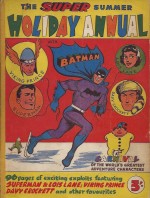
The Super Summer Holiday Annual (No. 1)


By various (Atlas Publishing & Distributing Co. Ltd.)
No ISBN:

It took the British a very long time to get the hang of American-style superheroes – just ask any old UK-based fan about Tri-Man, Gadget Man and Gimmick Kid or the Phantom Viking if you doubt me – but we never had any trouble with more traditional genre standards, which is why this delightful oddment of UK reprint publishing boasts such a decidedly eclectic all-star line up.

Probably released in 1961, it’s a monochrome affair with soft card-covers, gathering select licensed snippets from National Comics/DC, presumably thought to be appealing or of interest to us junior limeys. The decidedly quirky special offers choice late-1950s escapades of Batman and Robin the Boy Wonder, The Viking Prince, Superman & Lois Lane and Davy Crockett, bundled up as a marvellously mixed bag of tales which must have frankly baffled and bedazzled the kids of Britain in equal amounts.

The book was (probably) released in 1961 by UK based Atlas Publishing and Distribution, re-reprinting material licensed to Australian outfit KG Murray Publishing Company – one of many small outfits repackaging American strips for the anything-goes UK marketplace…

In America during the 1950s, when superheroes were in a seemingly inescapable trough, comicbook companies looked to different types of leading men in their action heroes. In 1955 writer/editor Robert Kanigher created a traditional adventure comic entitled The Brave and the Bold which featured historical strips and stalwarts.

The Golden Gladiator, illustrated by Russ Heath, was set in the declining days of the Roman Empire, The Silent Knight fought injustice in Norman Britain, courtesy of Irv Novick, and the already-legendary Joe Kubert was drawing the exploits of a valiant young Norseman dubbed the Viking Prince.

This last feature appeared in almost every issue and eventually took over Brave and the Bold entirely, until the resurgent superhero boom saw B&B retooled as a try-out title with its 25th issue. Before that, however, those fanciful, practically “Hollywoodish” Viking sagas were among some of the finest adventure comics of all time (and they’re long overdue for a definitive collection of their own).

The valiant Jon has long been a fan favourite, intermittently returning in DC’s war titles and often guest-starring in such varied venues as Sgt. Rock and even Justice League of America.

Here at the height of his popularity, the lonely wanderer and his companion the Mute Bard kick off proceeding in fine fettle, accepting ‘The Challenge of the Flying Horse’ (B&B #19 Aug/Sep 1958 by Bob Haney & Kubert) and invading Valhalla to aid the comely Valkyries against an invasion of menacing Moon Vikings…

Tales from the censorious 1950s (with just a little overlapping touch of the 1960s) always favoured plot over drama – indeed, a strong argument could be made that all DC’s post-war costumed crusaders actually shared one personality (and yes I’m including Wonder Woman) – so narrative drive focused on comfortably familiar situations or outlandish themes and paraphernalia, but as a kid they simply blew me away.

They still do.

The Gotham Gangbusters especially had to perpetually think and act outside the box as they fought crime and worse with kid gloves on. ‘Batman… Superman of Planet X!’ (from Batman #113, February 1958 by France Herron, Dick Sprang & Charles Paris) offers fantastic science fiction fantasy and perhaps the best ever art job ever seen in an incredible, spectacular stupendous romp with the Cowled Crimebuster shanghaied to a distant galaxy to save an advanced civilisation from invasion…

At a time when the rise of television had made the colonial west crucial viewing, almost every publisher who had survived the birth of the Comics Code had their own iteration of Davy Crockett. National/DC joined the party rather late with Frontier Fighters, which ran for 8 issues between summer 1955 and the end of 1956.

The anthological title supplemented the man of the moment with the equally public-domain likes of Kit Carson, Buffalo Bill, Buck Skinner and similar mythic types whilst incorporating all the tropes and ingrained stereotypes you’d expect of the times, but cover-featured Crockett was always the main attraction.

‘The Renegade Fur-Traders’ was first seen in #6 (July-August 1956), by an unnamed author and illustrated with captivating authenticity by the excellent John Prentice, not long before he would begin ghosting the Rip Kirby newspaper strip. It told of how Davy and his mountainous pal Sam Willoughby saved a tribe of Piegan Indians from being swindled by wicked white men…

When Lois Lane – arguably the oldest supporting character/star in the Superman mythology if not DC universe – finally received her own shot at a solo title, it was very much on the terms of the times. I must shamefacedly admit to a deep, nostalgic affection for her bright and breezy, fantastically fun adventures, but as a free-thinking, (nominally) adult liberal of the 21st century I’m often simultaneously shocked nowadays at the jolly, patronising, patriarchally misogynistic attitudes underpinning too many of the stories.

Of course I’m (painfully) aware that the series was intended for young readers at a time when “dizzy dames” like Lucille Ball or Doris Day played to the popular American gestalt stereotype of Woman as jealous minx, silly goose, diffident wife and brood-hungry nester, but to ask kids to seriously accept that intelligent, courageous, ambitious, ethical and highly capable females would drop everything they’d worked hard for to lie, cheat, inveigle, manipulate and entrap a man just so that they could cook pot-roast and change super-diapers is just plain crazy and tantamount to child abuse. They’re great, great comics but still…

I’m just saying…

Superman’s Girlfriend Lois Lane #1 launched at the start of 1958) and became the regular venue for stunning yarns illustrated by sleek, slick Kurt Schaffenberger whose distinctive art-style would quickly become synonymous with the reporter. In this yarn from the second issue (April/May) Lois was apparently appalled to uncover ‘Superman’s Secret Sweetheart’ (possibly written by Bill Finger), but was in fact on her very best mettle, helping a bullied college girl fight back against her mean sorority sisters…

Prince Jon then became ‘The Viking Genie’ (Bill Finger & Joe Kubert from B&B #14 Dec 1958/Jan 1958) as he is sealed in a barrel by his enemies and washes up some time later on the shores of distant Araby.

Freed from his prison by an old man and his beautiful daughter, the golden-haired Northman uses ingenuity and superb physicality to grant the dotard’s three wishes, consequently unseating a tyrant and restoring the old man to the throne of Baghdad…

Detective Comics #249 (November 1957) was the original setting for Finger & Sheldon Moldoff’s ‘The Crime of Bruce Wayne’ wherein civic-minded Bruce Wayne agrees to Commissioner Gordon’s scheme to impersonate masked criminal The Collector. Sadly things go badly awry: Gordon is hospitalised and Wayne is sentenced to death, with Robin and Batwoman frantically trying to find the real Collector before time runs out for the incarcerated, incognito Caped Crusader…

Davy Crockett was then captured by ‘Two Little Paleface Indians’ (Frontier Fighters #3 Jan Feb 1956, art by Prentice) stolen and raised by the warlike Creek. Not only does he have to escape imminent execution but also return the bellicose little waifs to their true parents, after which ‘The Bombshell of the Boulevards’ (Leo Dorfman & Schaffenberger) sees Lois Lane donning a peroxide wig to deceitfully secure a Hollywood interview.

Apparently blondes not only have more fun but also make more trouble and soon she has provoked a death-duel between rival enflamed suitors. Of course, it was only another scheme by Superman and Jimmy Olsen to teach her a lesson in journalistic ethics. Good thing reporters are so much less unscrupulous these days…

The Viking Prince returns to frozen climes to confront the ‘Threat of the Ice-King’ (Haney & Kubert from B&B #18, June/July 1958) and spectacularly rescues a Rose Princess from the icy ogre’s legion of arctic monsters before Davy Crockett tackles ‘The Indian Buccaneers’ (Frontier Fighters #5, May/June 1956 Prentice) dragooned into raiding Louisiana with infamous pirate Swampfox Cy…

The weirdly enticing array of adventures ends with charming Public Service ad ‘Don’t Give Fire a Place to Start’ by Jack Schiff & Win Mortimer, wrapping up the all-ages fun on a cautionary note every hoarder of highly inflammable collectibles should heed…

Although I’ve been nostalgically self-indulgent and a touch jocund throughout, there’s no denying the merit of these ancient tales, especially since they’re presented in staggeringly powerful and beautifully composed black and white: all marvellous examples of a level of artistic individuality and virtuosity we’re losing today as computer-colour advances and digital shortcuts are increasingly homogenising the craft and design of graphic narrative.

While we’re all revelling in the variety and creative freedom of today’s technology, let’s never forget the sheer force and potent efficiency of the lone line and an artist’s innate sense of flair and individuality. These are things of magical beauty and infinite potential…

Although there are no copyrights included I think it’s safe to assume:
All material © 1956, 1957, 1958, 2015 DC Comics. All Rights Reserved.

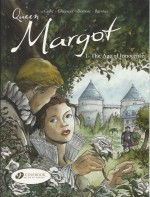
Queen Margot volume 1: The Age of Innocence


By Olivier Cadic, François Gheysens & Juliette Derenne, coloured by Sophie Barroux and translated by Luke Spears (Cinebook)
ISBN: 978-1-90546-010-6

Although not so well known in Britain as his other novels, on the Continent Alexandre Dumas père’s historical romance La Reine Margot is an extremely popular and well-regarded fictionalisation of the life of Marguerite de Valois.

This unlucky historical figure was the daughter of Henry VII of France and infamously diabolical arch-plotter Catherine de Medici and spent most of her early life as a bargaining chip in assorted convoluted dynastic power-games.

We don’t see a lot of proper historical romance in English-language comics; which is a shame as the stylish intrigue, earthy humour, elegant violence and brooding suspense (just think Game of Thrones without the excessive sex and violence… or dragons) of this one would certainly attract legions of fans in other sectors of artistic endeavour.

This substantial yet enchanting treatment of the events and uncorroborated legends of the girl who eventually became the wife of Henri IV, Queen Consort of France twice-over and the most powerful, influential and infamous woman in Europe is well worth a look-see, especially as most of what we know about her comes first-hand.

Queen Margot related the events of the times and her life – in exquisite, penetrating detail – through an infamous series of memoirs published posthumously in 1628…

Co-scripted by publisher, politician, computer entrepreneur, historian and statesman Olivier Cadic and François Gheysens, illustrated with intensely evocative passion and potently authentic lyricism by Juliette Derenne (Les Oubliés, Le 22e jour de la Lune) and enlightened through the graceful colours of Sophie Barroux; the first chapter appeared in 2006 as La Reine Margot: Le Duc de Guise and opens here with a spiffy gate-fold cover offering a potted history and run-down of the major players before the intrigue unfolds…

In August 1569, sixteen year old Margot and her Lady-in-waiting/governess Madame Mirandole arrive at castle of Plessis-lez-Tours. In the ongoing wars between Papists and Huguenots, Margot’s ailing brother Charles might be King of Catholic France, but her other brother Henri, Duke of Anjou is the darling of the court: a veritable Adonis and glorious war-hero smiting the Protestant foe. Anjou is also a sibling she adores and worships like a schoolgirl…

What little brotherly love there was stood no chance against a sea of popular feeling and cruel, envious unstable, hypochondriac Charles is determined to see it end and all Henri’s growing power and inherent glamour with it. Naturally, his dynastically-obsessed mother has plans to fix everything, but they never extend to showing her practically worthless daughter the slightest hint of kindness or approval.

Although young, Margot (who prefers the familiar name “Marguerite”) knows well that she’s nothing more than a disposable piece in a grand game, but briefly forgets her inevitable fate as Henri bedazzles the Court with his tales of martial triumph. Later he shares his own ambitions and misgivings with her. He dreads jealous, inept Charles taking the role of military commander for his own, and does not want to be married off to the Arch-Duchess of Austria…

Marguerite has problems of her own: Henri’s most trusted lieutenant; the appalling Lord Du Guast, tries to force himself upon her whilst making the most disgusting suggestions and veiled accusations before she can escape…

Worst of all, her mother – steeped in five generations of Machiavellian Medici manipulation and inspired by the bizarre prognostications of her personal seer Ruggieri – has begun setting her plans for the potentially invaluable, royally connected daughter.

Margot can do nothing against her mother’s wishes but, with the aid of drugged wine, she repays Du Guast’s affront with a public humiliation she will come to regret…

Everything changes when charismatic Henri, Duke of Guise and hero of the Siege of Poitiers arrives. He and Marguerite were childhood friends and now that they are both grown, their mutual attraction is clear to all. Instantly, his family sense a chance to advance themselves through a love match and quick marriage…

The kids themselves are only dimly aware of alliances. They want each other and even an entire gossiping, constantly watching Court is not enough to deter them…

As the war progresses into slow and depressing attrition, Anjou doggedly pursues victory and awaits his inevitable ousting, whilst Du Guast lays his plans to destroy and possess Marguerite.

News of her dalliance with Guise is of great worth to him and even though Catherine has organised a tentative betrothal to the Catholic king of Portugal, the vile seducer has ways and means of spoiling the proposed match. He’s even inadvertently aided by Marguerite herself, who tries many stratagems to disrupt the regal deal…

The constant in-fighting and subterfuge turns Anjou against his sister and when “proof” of her affair with Guise reaches Catherine the old queen moves swiftly.

Marguerite is compelled to capitulate to save Guise from Charles’ insane wrath and grimly faces the prospect of never seeing him again: cushioned in despised luxury and once more the pliable prize and powerless pawn in a game she cannot escape, avoid or win…

To Be Continued…

Colourful, intoxicating and powerfully compelling, The Age of Innocence is a beguiling view of eternal passions and human intrigue to delight the hardest of hearts and the most finicky of comics aficionados.
Original edition © 2006 Cinebook Ltd/Cadic – Gheysens. All rights reserved. English translation 2006 © Cinebook Ltd.

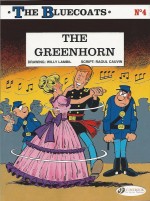
The Bluecoats volume 4: The Greenhorn


By Willy Lambil & Raoul Cauvin, translated by Erica Jeffrey (Cinebook)
ISBN: 978-1-84918-014-6

The modern myths and legends of the filmic American West have fascinated Europeans virtually since the actual days of owlhoots and gunfighters. Hergé and Moebius were passionate devotees and the wealth of stand-out Continental comics series ranges from Italy’s Tex Willer to such Franco-Belgian classics as Blueberry and Lucky Luke, and tangentially even children’s classics such as Yakari or colonial dramas such as Pioneers of the New World and Milo Manara and Hugo Pratt’s Indian Summer.

As devised by Louis “Salvé” Salvérius & Raoul Cauvin – who has scripted every best-selling volume – Les Tuniques Bleues (or as we know them The Bluecoats) debuted at the end of the 1960s, specifically created to replace Lucky Luke when the laconic gunslinger defected from weekly anthology Spirou to rival publication Pilote.

The substitute swiftly became one of the most popular bande dessinée series in Europe.

Salvé was a cartoonist of the Gallic big-foot/big-nose humour style, and when he died suddenly in 1972 his replacement, Willy “Lambil” Lambillotte slowly introduced a more realistic – but still broadly comedic – illustrative tone and manner. Lambil is Belgian, born in 1936 and, after studying Fine Art in college, joined publishing giant Dupuis as a letterer in 1952.

Born in 1938, scripter Cauvin is also Belgian and before entering Dupuis’ animation department in 1960 studied Lithography. He soon discovered his true calling – comedy writing – and began a glittering and prolific career at Spirou. In addition to Bluecoats he has written dozens of long-running, award winning series including Cédric, Les Femmes en Blanc and Agent 212: more than 240 separate albums. The Bluecoats alone has sold more than 15 million copies of its 58 album series.

As translated for English audiences, our sorry, long-suffering protagonists are Sergeant Cornelius Chesterfield and Corporal Blutch: a pair of worthy fools in the manner of Laurel & Hardy, hapless, ill-starred US cavalrymen posted to the wild frontier and various key points of fabled America during the War Between the States.

The original format featured single-page gags set around an Indian-plagued Wild West fort, but from the second volume Du Nord au Sud (North and South) the sad-sack soldiers went back East to fight in the American Civil War (a tale was rewritten as 18th album Blue rétro to describe how the chumps were drafted during the war).

Every subsequent adventure, although often ranging far beyond America and taking in a lot of thoroughly researched history, is set within the timeframe of the Secession conflict.

Blutch is your average whinging little-man-in-the street: work-shy, mouthy, devious and especially critical of the army and its inept commanders. Ducking, diving, even deserting whenever he can, he’s you or me – except sometimes he’s quite smart and heroic if no other (easier) option is available.

Chesterfield is a big burly fighting man; a career soldier who has passionately bought into all the patriotism and esprit-de-corps of the Military. He is brave, never shirks his duty and wants to be a hero. He also loves his cynical little troll of a pal. They quarrel like a married couple, fight like brothers and simply cannot agree on the point and purpose of the horrendous war they are trapped in…

The Greenhorn was the fourth translated Cinebook album (chronologically 14th Franco-Belgian volume Les Tuniques Bleues: Le blanc-bec) and opens with a grand Officer’s Ball in distant, desolate Fort Bow. As the festivities continue, out in the moonlit desert two weary cavalrymen wend their way towards the stockade…

Chesterfield and Blutch have just returned for three weeks leave and are infamous amongst the troops as regular survivors of the quite mad Captain Stark’s Suicide Regiment – as well as for their own reputation for starting fights.

It’s for that reason that the guards don’t want to mention that Colonel Appleton‘s beautiful daughter Emily has been dancing with a dashing young Lieutenant named George. Every man there knows Chesterfield is smitten with her and has a hair-trigger temper these days…

The news nearly incites the sergeant to mass-murder and it takes all Blutch’s guile to convince his pal to ride into town – and Charlie’s Saloon – instead. Sadly Chesterfield’s well-earned reputation for trouble is just as feared there and when an Indian boy is bullied by local drunks the spoiling-for-trouble sergeant – subtly prodded by underdog-loving Blutch – gleefully steps in…

By the time the harried barman reaches Fort Bow and brings back a contingent of troops, Chesterfield has decimated most of the saloon and all of the patrons and is hungry for more. When brash neophyte Lieutenant George slaps the enraged enlisted man, all hell breaks loose…

Events spiral even further out of control after the patrol final drags the unrepentant sergeant back to the Fort. When the little native lad, dragged along as a witness, takes his chance to escape, he is shot by the flustered “greenhorn” officer.

It is both a tragedy and a disaster: the boy is the son of Chief Gray Wolf who, on discovering what’s happened, demands that whoever perpetrated the appalling act be surrendered to his justice.

…Or else it’s war…

When Chesterfield and Blutch discover exactly who George is, the little corporal flees, rushing off to the encamped hostiles and claiming he was responsible. Chesterfield, not to be outdone in the guilt stakes, also owns up and baffled Gray Wolf is nearly driven crazy when bold, brave, stupid and honourable Colonel Appleton also rides into camp and takes the blame…

A tense compromise is reached as Gray Wolf agrees to let the “Long Knives” treat his gravely wounded boy; decreeing that if he lives they will be no war, but if the morning brings bad news the entire fort and town will suffer…

With a little time bought, the Colonel deals with his most immediate problem. After a ferocious dressing down Chesterfield and Blutch are sent back to Stark’s Suicide Regiment and – over Emily’s hysterical protestations – George goes with them…

Days later the trio rendezvous with Stark’s dispirited contingent as he manically battles Confederate forces. The Captain’s sole tactic is to have his men charge straight at their artillery, presumably in the certain knowledge that the enemy must run out of ammunition eventually…

Blutch and Chesterfield have developed a tactic which has kept them alive so far and, having sworn to Emily to keep George safe, force him to employ it too. However the guilt-ridden, hero-struck fool is unhappy with the shameful strategy and soon starts throwing himself into the thick of battle, intending to die with dignity…

When word comes of the recovery of Gray Wolf’s son, their ordeal seems over and, with honour satisfied, all three make a grateful departure from Stark’s depleted forces. Typically however just as a peace (and quiet) seems likely, Blutch and Chesterfield find another way to set the West ablaze and drive the natives to the brink of war…

This is another hugely amusing anti-war saga targeting young and less cynical audiences. Historically authentic, and always in good taste despite its uncompromising portrayal of violence, the attitudes expressed by the down-to-earth pair never make battle anything but arrant folly and, like the hilarious yet insanely tragic war-memoirs of Spike Milligan, these are comedic tales whose very humour makes the occasional moments of shocking verity doubly powerful and hard-hitting.

Fun, informative, beautifully realised and eminently readable, Bluecoats is the sort of war-story that appeals to the best, not worst, of the human spirit.
© Dupuis 1979 by Lambil & Cauvin. English translation © 2010 Cinebook Ltd. All rights reserved.

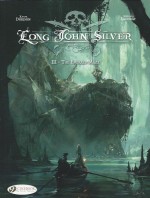
Long John Silver volume III: The Emerald Maze


By Xavier Dorison & Mathieu Lauffray, translated by Jerome Saincantin (Cinebook)
ISBN: 978-1-84918-105-1

British and European comics have always been far more comfortable with period-piece strips than our American cousins and much more imaginative when reinterpreting classical fiction for jaded comicbook audiences. The happy combination of familiar exoticism, past lives and world-changing events blended with drama, action and, most frequently, broad comedy has resulted in a uniquely narrative art form suited to beguiling readers of all ages and tastes.

Our Franco-Belgian associates in particular have made an astonishing success out of repackaging days-gone-by but this particularly enchanting older-readers yarn forgoes the broad belly-laughs whilst extending the adventures of literature’s greatest rogue into a particularly engaging realm of globe-girdling thriller.

Robert Louis Stevenson’s Treasure Island was originally serialised from 1881-1882 in Young Folks magazine as Treasure Island or, the mutiny of the Hispaniola, as pseudonymous penned by one “Captain George North”.

It was collected and published as a novel in May 1883 and has never been out of print since. A landmark of world storytelling, Treasure Island has been dramatised too many times to count and adapted into all forms of art. Most significantly, the book created a metafictional megastar – albeit at best an anti-hero – as immortal as King Arthur, Robin Hood, Sherlock Holmes, Tarzan or Superman. Almost everything the public “knows” about pirates devolves from the book and its unforgettable, show-stealing one-legged antagonist…

Writer Xavier Dorison was born in Paris in 1970 and graduated business school before moving into storytelling. He works as an author, film writer, lecturer and movie script doctor. He began the award-winning Long John Silver in conjunction with preferred collaborator Mathieu (Prophet) Lauffray in 2006, with the last volume released in 2013.

Lauffray is also a Parisian born in 1970. He spends his days illustrating, drawing comics, crafting games and concept designing for movies. His art has graced international items as varied as Dark Horse’s Star Wars franchise, games like Alone in the Dark, the album Lyrics Verdun, February 21, 1916 – December 18, 1916, Tarzan and much more…

Their collaborative exploration of the piratical prince’s later years is a foray into far more mature arenas set decades after the affair of the Hispaniola and ranges far and wide: from foggy, oppressive England to the vast, brooding inner recesses of the Amazon.

What has Gone Before: in 1785 treasure-hunting Lord Byron Hastings found the lost bastion of Guiana-Capac but needed further funds to exploit this fabulous City of Gold.

In England, his profligate and wanton wife Lady Vivian had been enjoying herself too much and was with child by lecherous neighbour Lord Prisham. With a baby in her belly and a husband gone three years, she was considering having Byron declared dead and undertaking a hasty remarriage…

Suddenly shattering those plans her despised brother-in-law turned up with an aged, garish tribesman named Moxtechica bearing a message and map from her long-lost husband. Prudish and cruel, Royal Naval officer Edward Hastings gleefully told the scheming strumpet he abhorred that his brother had succeeded and demanded she sell everything – including all the treasured family possessions, manor house and lands she brought to the marriage – to finance his return…

Byron named Edward sole Proxy and the martinet delighted in giving high-born trollop Vivian her marching orders. He even urged her to confine herself to a convent and save them all further shame and disgrace…

Raging in front of her conniving maid Elsie, the Lady considered a number of retaliatory tactics before settling upon the most bold, dangerous and potentially rewarding. After announcing to the stunned Edward that she would accompany him to South America and reunite with her beloved husband, the fallen noblewoman sought out a doctor to take care of the biological problem she was still secretly carrying…

Dr. Livesay was a decent, god-fearing soul who led a quiet, prosperous life ever since his adventures on Flint’s Island. However, it was not just her condition which brought Vivian to the physician’s door, but also persistent tales of a former acquaintance; a formidable, peg-legged rogue with a reputation for making life’s difficulties disappear…

Against his better judgement, Livesay capitulated to Vivian’s urgings and introduced her to retired sea-cook John Silver. Amidst the (alleged) ex-pirate’s inner circle of scary-looking confederates she spun the story of the Spaniard Pizarro‘s discovery of a City of Gold and how, centuries later, her husband had reclaimed it.

She wanted to travel there with a few capable men and make those riches her own and needed Silver and his colleagues to infiltrate Edward’s crew, seize the ship he chartered and complete the voyage under her command…

Unable to convince Vivian to desist or Silver to reject her offer, Livesay reluctantly joined them in vain hopes that he could keep the debased woman from mortal harm. Nobody was aware that Silver concealed a debilitating and soon-to-be-fatal affliction as the rascal orchestrated his own hiring and packed the Neptune with suitable scoundrels and compelled Lady Vivian to sign a sacrosanct Pirates Contract.

With all the various schemers believing their own plans were proceeding satisfactorily, the Neptune set sail for the Americas, but at the last moment Silver suffers a major setback when rival rogue Paris inveigled his way into the crew…

As the tension-driven voyage progressed, Silver’s men, Paris’ contingent and even Captain Hastings’ innocent hires all slowly succumbed to the Sea Cook’s glib tongue and fascinating tales of the Red Brotherhood.

Only Hastings’ lieutenants Dantzig and Van Horn had any inkling of the battle of wills occurring below decks, but even that shaky détente shattered after Elsie was murdered. Well-aware that everybody aboard was gripped by gold-fever, Hastings tried to rule with a rod of iron and full naval discipline. Settling upon boy seaman Jack O’Kief (a protégé of Paris, but beloved by Silver) as responsible for the maid’s death, Hastings had him brutally flogged.

A vicious and prolonged battle of wills followed, pushing the crew to the edge of mutiny. Hastings delayed making final landfall on the tantalisingly close South American coast and strained tensions exploded just as a colossal storm pushed Neptune inexorably towards its foregone destination. An inevitable mutiny erupted, resulting in appalling bloodshed and a red-handed settling of many scores…

Literally above it all, old shaman Moxtechica rode out both tempests, patiently waiting to see what the calm of dawn might bring…

The Emerald Maze opens in the ghastly aftermath of the maelstroms of human and natural forces with the becalmed and battered Neptune drifting idly off-shore and the survivors reeling aimlessly on her decks. In sight of terrifying cliffs, the stunned rabble are near panic and babbling of sailing on to Tortuga until Silver’s ferocious tongue-lashing brings them to heel.

Now completely in charge, the old pirate almost loses them again after making Dantzig (the only trained pilot and navigator left alive) second-in-command, despite the Navy Man swearing he’ll see them all hang one day…

Boldly sailing Neptune straight into the cliffs, Silver and Dantzig navigate a barely discernible channel in the stony walls and bring the ship through into a calm and beguiling tributary of the Amazon. With time taken to repair and recover, however, the men soon resort to their old ways. Dead are buried, a few old scores settled and Jasper, a new rival to Silver’s authority, begins to assert himself. Seeing the way things are going, Vivian steps in and employs her wiles and cunning…

She quickly beguiles the entire crew with her story of the Emperor Viracocha and his immense pagan City of Gold. She tells of how her husband claimed it and wins them all over by promising how they will take it from him…

With their goal so close, the wary mariners impatiently and so-slowly sail up the vast river in an epic journey through labyrinthine courses and jungle backwaters. Each time they stall or founder Moxtechica is there, silently divining which way they should go in the inexorable voyage to lost Guiana-Capac.

This in itself is a cause of growing suspicion to Lady Vivian. Her brutal, impatient husband was never a man to trust others or inspire loyalty – even in other Englishmen – and now she begins to have grave doubts over the shaman’s true motives…

Those same thoughts are plaguing Silver and his wily old shipmate Olaf as the river gradually becomes perilously shallow. Soon the voyagers are shocked to see the foundered, rotting wreckage of Lord Byron Hastings’ ship The Nimrod in the scant waters abutting a hugely overgrown and jungle-covered city…

As Silver readies his depleted contingent to begin searching the ruins, Vivian surprises the pirate by requesting to be left aboard Nimrod. She has too many questions and perhaps her husband’s ship holds some answers…

As Vivian find a grimy journal and begins to read, aboard the Neptune nobody really cares that Moxtechica has gone missing… but they should…

To Be Concluded…

Tense, evocative, shockingly powerful and eerily, magnificently realised, these further exploits of Long John Silver are a modern masterpiece of adventure fiction worthy of Stevenson’s immortal adventure. They might even convince a few more folks to actually read the original novel…
© Dargaud, Paris, 2010 by Dorison & Lauffray. All rights reserved. English translation © 2011 Cinebook Ltd.

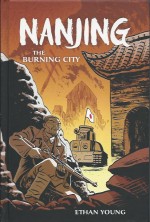
Nanjing: the Burning City


By Ethan Young (Dark Horse)
ISBN: 978-1-61655-752-2

Ethan Young comes from New York City, born the youngest of three boys to Chinese immigrant parents. Following studies at the School of Visual Arts he began work as a commercial illustrator, supplementing that with his debut graphic novel Tails: Life in Progress which won Best Graphic Novel award at the 2007 Independent Publisher Book Awards.

It lives on as a webcomic, as does his other ongoing all-ages project A Piggy’s Tale: the Adventures of a 3-Legged Super-Pup (created and written by Tod Emko). His latest work however, is a far cry from those themes. Nanjing: the Burning City is a stunning and excoriating anti-war parable, detailing one incomprehensibly dark night of horror in a war most of the world has conveniently forgotten about.

Whilst many Japanese – such as Keiji Nakazawa (author of the astounding Barefoot Gen and a tireless anti-war campaigner for most of his life) – are fully prepared and able to acknowledge and “own” Japan’s horrific excesses throughout World War II (and the colonial expansion into China – noncommittally dubbed The Second Sino-Japanese War – which preceded it), far too many survivors of the original conflicts and, more disturbingly, modern apologists and revisionists find it easier and more comfortable to excuse, obfuscate or even deny Japan’s role.

Sadly, I suspect today’s China is just as keen to systematically refute the excesses of the Maoist years and beyond…

Every nation that’s fought a war has committed atrocities, but no country or government has the right to dodge shame or excise blame by conveniently rewriting history for expediency or political gain; not Britain, not the USA, not Russia and never, ever those barbaric “Axis Powers” who tormented mankind between 1933 and 1945.

Delivered in stark, stunning yet understated black-&-white in a sturdy hardback edition, Young’s tale reveals the callous brutality – without resorting to “us-and-them”, “good guys vs. bad guys” polemic, by simply focusing on one night and three very different military men caught up in the ghastly events.

The Second Sino-Japanese War began on July 7th 1937 when the aggressively expansionist Empire of Japan invaded Shanghai. The well-equipped force moved swiftly inland towards Nanking, capital of Kuomintang Generalissimo Chang Kai-Shek’s newly established Republic of China.

The unstoppably modernised Imperial army reached the city on December 12th whereupon Nanking’s military and civil leaders fled in panic, leaving hundreds of thousands of Chinese soldiery and citizens to bear the brunt of a savage, bestial assault described by author Iris Chang as The Rape of Nanking.

The Republican officers didn’t even issue orders for the soldiers they abandoned to retreat…

Over the next six weeks more than 300,000 died in a campaign of organised torture and massacre. Uncountable numbers of women and children were raped and brutalised. Before the Japanese military chiefs surrendered in 1945, they had all records of the taking of Nanking destroyed. The never-to-be-properly-accounted dead are rightly known as the Forgotten Ones…

An event almost completely overlooked for decades by western – and Japanese – historians, the torment began with a night of appalling, unparallelled atrocity with Young concentrating his tale on the efforts of a nameless Captain and his sole surviving subordinate as they make their way through the shredded remnants of the metropolis. The betrayed, beaten warriors harbour a fanciful hope of sanctuary in the enclave occupied by European diplomats, businessmen, missionaries and their servants: the sacrosanct “Safety Zone” where white people go about their business largely untouched by strictly Asian “local politics”…

It’s only a few kilometres to salvation and the Zone indeed houses many sympathetic foreign souls who will risk their lives for humanitarian reasons, but to get to them the soldiers must avoid the hordes of prowling, drunken, blood-crazed conquerors and deny their own burning desire to strike back at the invaders – even if it costs their lives…

As they slowly scramble through the hellish ruins they are doggedly pursued by a Japanese colonel who apparently has no stomach for the gleeful bloody debaucheries of his soldiers but rather carries out his duties with a specialised zeal and for a different kind of reward…

Whilst the weary Kuomintang survivors make their way to the Safety Zone however a far more deadly hazard constantly arises: crushed, beaten, desperate fellow Chinese begging them to stop and help…

This is a gripping story with no happy ending and is supplemented by a large Sketchbook and Commentary section by Young, offering character, studies, developmental insights and rejected cover roughs, as well as a formidable Bibliography for further reading…

Nanjing: the Burning City is a beautiful, haunting book designed to make you angry and curious and in that it succeeds with staggering effect. It’s not intended as a history lesson but rather a signpost for the unaware, offering directions to further research and greater knowledge, if not understanding; a provocative lesson from history we should all see and learn from.
© 2015 Ethan Young. All rights reserved.

Hip Hop Family Tree Book 3: 1983-1984


By Ed Piskor (Fantagraphics)
ISBN: 978-1-60699-848-9

Another year gone and at long last another spectacularly barnstorming, award-winning comicstrip history lesson from proudly self-confessed Hip Hop Nerd and cyber-geek Ed Piskor is here, detailing more secrets about the world’s most explosive musical discipline.

In astounding detail and with a positively chillin’ attention to the art styles of the period, Piskor resumes his astoundingly engaging exploration of the rise of the rhyme-&-rhythm musical art form – all whilst paying equal attention to the symbiotic and parallel growth of graffiti and street art – with wit, charm and astonishing clarity.

Kicking off with a crucial ‘Rogues Gallery’ of the 80 movers and shakers involved, this latest blockbuster-sized volume begins in 1983 after Hip Hop at last makes the leap from local parks and parties to the club scene and onto vinyl. It also sees the street wisdom that Rap doesn’t work on albums finally disproved forever…

Of course now that the strange noise and weirdly evocative dance moves are a proven commodity, the establishment business sharks begin to circle the pioneering proponents and all their hundreds of hungry wannabe, would-be stars…

‘The Freaks Come Out at Night of the Living Bassheads’ closely studies that inexorable rise, following a few key behind-the scenes-personalities like in-at-the-start devotee Russell “Rush” Simmons, fanatical white-boy Rick Rubin and miracle-working Swiss opportunist Charlie Stettler whose tireless efforts are slowly eclipsed as the movement goes global, tracking the tenuous migration to television via shows such as Graffiti Rock and documentaries Style Wars and Breakin’ and Enterin’ until even whites Rock-only MTV finally capitulates …

Filled with feuds, mash-ups and team-ups of the new talents, highlighting Rubin and Simmons unification as Def Jam and focussing closely on British support from landmark books such as Martha Cooper and Henry Chalfant’s Street Art, this titanic tome covers the start of the careers of Whodini, The Fat Boys, Slick Rick, LL Cool J and Doug E Fresh, sees The Beastie Boys adopt rap as their metier and follows Run DMC‘s unstoppable rise.

As always the technical and stylistic innovations, musical struggles and physical battles, management shenanigans and recording landmarks are all encyclopaedically yet engaging revealed as Piskor connects a bewildering number of strands and weaves them into the coolest of tapestries …

To Be Continued…

Produced in the tone and style of those halcyon, grimily urban times and manufactured to look just like an old Marvel Treasury Edition (a tabloid sized 334 x 234 mm -reprint format from the 1970s which offered classic tales on huge and mouth-wateringly enticing pulp-paper pages), this compelling confection also includes a copious and erudite ‘Bibliography’, ‘Reference’ and ‘Funky Index’, a fun-filled Author Bio and another blazing collection of ‘Pin Ups’ with spectacular images from guest illustrators including TLC by Natalie Andrewson, Biz Markie by Miss Lasko Gross, Kool Moe Dee by Jonny Negron, Kool DJ Red Alert by Toby Cypress, Blowfly by Johnny Ryan, Jay Z by Jim Rugg, Wu Tang Clan by Benjamin Marra, Mantronix by Dean Haspiel, Dr. Dre by Jenny Goldstick, MC Hammer by Robert Crumb and Digital Underground by Skottie Young to get your pulses racing, if not your toes tapping…

Informative and irresistible, Hip Hop Family Tree is wild fun and deliciously addictive – and only a year until the next one…
This edition © 2015 Fantagraphics Books. All Hip Hop comic strips by Ed Piskor © 2015 Ed Piskor. Pin ups and other material © 2015 their respective artists. All rights reserved.

Ghetto Brother – Warrior to Peacemaker


By Julian Voloj & Claudia Ahlering (NBM/Comics/Lit)
ISBN: 978-1-56163-948-9

How’s your modern history? What about your familiarity with the development of contemporary music? Before you answer you might want to take a look at a potent and powerful new graphic documentary created by author and photographer Julian Voloj and artist/illustrator Claudia Ahlering.

In I971 New York City was a broken, dirty metropolis increasingly divided by top-down, enforced gentrification. From the end of the 1950s the mostly ethnically European population of the Bronx had been moving out into the suburbs – a process dubbed the “White Flight” – whilst poorer inner city newcomers, mostly Blacks and Hispanics, were driven or priced out of their cheap bohemian enclaves in Greenwich Village, Little Italy, Chinatown and Soho to fill the vacated places.

Those emptied Manhattan regions now comprise some of the most expensive and exclusive real estate in the Big Apple…

Further social assault came when ruthless urban reformer and City Planner Robert Moses slashed the newly coalescing community of “foreigners” in half by steamrollering the Cross Bronx Expressway through the formerly scenic Borough.

Subsequent blight, administrative neglect and lack of funding soon turned the whole region into isolated islands of forgotten residents, and their hopeless, opportunity-starved kids began forming fiercely territorial gangs to defend spurious concepts of dignity, personal honour and the little territory they called theirs…

The South Bronx became a global byword for urban decay and a breeding ground for violence by the poor upon the poor. By December 1971 it seemed inevitable that the more than one hundred gangs situated in the Borough would wipe each other out and possibly take the entire city with them.

…And then something miraculous happened…

This stunning graphic testament tells in the impassioned words of Benjamin “Yellow Benjy” Melendez how, in the year Dr. Martin Luther King Jr. and Robert Kennedy were assassinated, he formed the Ghetto Brothers, quickly turning it into the largest and most powerful Puerto Rican gang.

It further reveals how the senseless murder of one of his closest friends led to the Hoe Avenue Peace Meeting: a tense, protracted conference where rival gang-lords talked instead of fought and astonishingly agreed to a truce which all but ended gang warfare for a generation.

With fighting curtailed, all those bored, frustrated kids needed new outlets for their pent-up energies and what slowly emerged was today’s Rap and Hip-Hop movement…

Melendez’s path also encompassed music, but he mostly concentrated on turning the Brothers into a rough and ready outreach project for the community, with the gang forming an association with organisations of Puerto Rican nationalism, including the then-new Puerto Rican Socialist Party.

Highlighting long-forgotten events of a critical time through one key individual’s incredible epiphany, this amazing tale then reveals his chance discovery of a hidden and quite shocking personal truth that changed Benjy’s life forever…

Addressing a growing cultural zeitgeist attuned to that time and place as recently seen in books and movie documentaries like Fresh Dressed, Rubble Kings, 80 Blocks From Tiffany’s and Flyin’ Cut Sleeves, this utterly absorbing monochrome chronicle is bracketed by an Introduction from Jeff Chang (author of Can’t Stop Won’t Stop: A History of the Hip-Hop Generation) and the compelling, informative photo-essay ‘The Story Behind the Story’ which further explores that groundbreaking meeting at Hoe Avenue and offers biographies and further reading.
© 2015 Julian Voloj and Claudia Ahlering.

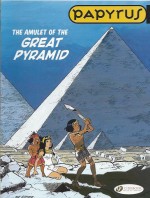
Papyrus volume 6: The Amulet of the Great Pyramid


By Lucien De Geiter, coloured by B. Swysen & translated by Jerome Saincantin (Cinebook)
ISBN: 978-1-84918-240-9

Papyrus is the astoundingly addictive magnum opus of Belgian cartoonist Lucien de Gieter. Launched in 1974 on the pages of legendary weekly Spirou, it has run to more than 35 albums and spawned a wealth of merchandise, a TV cartoon series and video games.

Born in 1932, the author studied at Saint-Luc Art Institute in Brussels before going into industrial design and interior decorating. In 1961 he made the jump into sequential narrative, first via ‘mini-récits’ (half-sized, fold-in booklet inserts) for Spirou, starring his jovial cowboy ‘Pony’, and later by writing for art-star regulars such as Kiko, Jem, Eddy Ryssack and Francis.

He later joined Peyo’s studio as inker on ‘Les Schtroumpfs’ (The Smurfs) and took over the long-running newspaper strip ‘Poussy’ and launched mermaid fantasy ‘Tôôôt et Puit’ when Pony was promoted to Spirou‘s full-sized pages. Deep-sixing the Smurfs, he then expanded his horizons by joining a select band contributing material to both Tintin and Le Journal de Mickey.

From 1972-1974 he worked with cartooning legend Berck on ‘Mischa’ for Germany’s Primo whilst perfecting his newest project: a historical fantasy which would soon occupy his full attention and delight millions of fervent fans for the following four decades.

The annals of Papyrus encompass a huge range of themes and milieux, mixing Boy’s Own adventure with historical fiction, fantastic action and interventionist mythology. The Egyptian epics gradually evolved from standard “Bigfoot” cartoon style and content to a more realistic, dramatic and authentic iteration. Each tale also deftly incorporated the latest historical theories and discoveries into the beguiling yarns.

Papyrus was a fearlessly forthright young fisherman favoured by the gods who rose against all odds to become an infallible hero and friend to Pharaohs. As a youngster the plucky Fellah was singled out and given a magic sword courtesy of the daughter of crocodile-headed Sobek before winning similar boons and blessings from many of the Twin Land’s potent pantheon.

The youthful champion’s first accomplishment was to free supreme deity Horus from imprisonment in the Black Pyramid of Ombos, restoring peace to the Double Kingdom, but it was as nothing compared to current duty: safguarding Pharaoh’s wilful, high-handed and insanely danger-seeking daughter Theti-Cheri – a dynamic princess with an astounding knack for finding trouble …

The Amulet of the Great Pyramid is the sixth Cinebook translation (21st album of the series, originally released in 1998 as Le Talisman de la grande pyramide); an enthralling rollercoaster romp through living mythology and a spooky trial for the plucky chosen one which begins when Papyrus is dragged from the palace – and a rare reward from Theti-Cheri for saving her life and soul again – by phenomenally intelligent donkey Khamelot.

The savvy beast of burden belongs to court jester Puin and whenever it comes running in such a manner it means that the funny little man has found trouble…

An eventful trip to the Giza plateau with its royal necropolis and great pyramids of Kheops, Khefren and Mykerinus results in the daring lad finding not only his diminutive friend but also a desiccated and extremely active mummy unearthed by tomb-robbers.

Puin has been hearing ghastly screams emanating from the pyramids and convinces the boy-hero to stay and listen for them too, but he never expected his bold friend to go looking for what made them…

The sinister sounds lead deep into the nobles’ grave fields, but as they proceed the searchers stumble upon another acquaintance. The unconscious man is one of the three Pepi brothers charged with keeping the recently-restored Sphinx free of desert sands …

Leaving the comatose victim in Puin’s care, Papyrus presses on. Before very long though the eerie events prove too much and the panicked Professional Fool bolts.

His pell-mell rush carries him down a passage far under the Kheops pyramid where he is confronted with the spirit of Seneb the Dwarf, magician and priest of that august and long-deceased pharaoh…

The garrulous ghost is in need of a favour and urges his terrified “guest” to carry his jewelled heart scarab to Papyrus who will know what to do with it…

Scrabbling out of the ancient passageway, Puin is eventually rescued by his donkey and impetuous Theti-Cheri – who has again refused to be left out of the action and secretly followed her bodyguard into peril.

Papyrus meanwhile has plunged deeper into the necropolis and been attacked by a pack of spectral jackals. Even his magic sword is no help and the malign mobbing only ends when Anubis himself calls a halt to it. The God of the Dead is angered by the sudden increase in grave-robbing and has taken two of the caretaking Pepi brothers, thinking them to be desecrators.

Unfortunately, rather than admit a mistake, the jackal-headed judge demands Papyrus retrieve Kheops’ heart amulet in return for their liberty. Anubis needs it to weigh the king’s soul before he can remove all the wandering spirits of the region to a place where the living can no longer disturb them…

And thus begins an astonishing race against time as the young champion has to scour the Great Pyramid from top to bottom (magnificently detailed and scrupulously explained in some of the best action illustration the author has ever produced); defeating deadly traps, defying spectral sabotage and godly interventions and solving the riddles of the dead to accomplish his mission.

However even after more than satisfying the demands of Anubis, there’s still the murderously mundane menace of the grave-robbers holding Theti-Cheri hostage to deal with before the canny champion can rest easy…

Epic, chilling, funny, fast-paced and utterly engaging, this is another amazing adventure to thrill and enthral lovers of wonder from nine to ninety-nine, again proving Papyrus to be a sublime addition to the family-friendly pantheon of Euro Stars who wed heroism and humour with wit and charm.

Any avid reader who has worn out those Tintin and Asterix albums would be wise beyond their years to add these classic chronicles to their cartoon chronicle bookshelves.
© Dupuis, 1998 by De Gieter. All rights reserved. English translation © 2015 Cinebook Ltd.