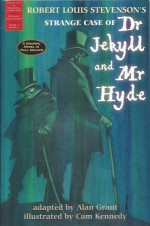
Robert Louis Stevenson’s Strange Case of Dr. Jekyll and Mr. Hyde – the graphic novel


Adapted by Alan Grant & Cam Kennedy (Waverley Books)
ISBN: 978-1-902407-44-9

As part of the celebrations for Edinburgh’s selection in 2004 as the first UNESCO City of Literature, Scottish comics veterans Alan Grant and Cam Kennedy were invited to convert a brace of classic tales by Robert Louis Stevenson to publishing’s hottest medium…

The second appeared in 2008 with a bare minimum of abridgement or adulteration by Grant and galvanically brought to life through the stunning art of the inimitable Kennedy with colours and letters provided by Jamie Grant: all seamlessly collaborating to perfectly picture one of the most famous and groundbreaking tales of terror in the annals of storytelling.

The timeless tale opens as lawyer Mr. Utterson becomes intrigued by the ‘Story of the Door’ as related by walking companion Richard Enfield. That worthy describes how, after remonstrating with a bestial, shrivelled homunculus of a man who was thrashing a street child, he discovered a possible although unlikely and unwelcome connection to a mutual friend of superlative honour and worthiness.

However what connection a depraved creature such as Edward Hyde might have with the benevolent and brilliant Dr. Henry Jekyll was beyond either man’s conception. Blackmail perhaps…?

The multi-layered and convoluted chain of events unfolds at a beguiling pace as the pair begin a systematic ‘Search for Mr. Hyde’, even consulting the scientist’s great mentor Dr. Lanyon before unexpectedly encountering the despicable decadent himself, sneaking into Jekyll’s home through the means of his own key.

Eventually Utterson is compelled to ask the suspected extortion victim himself but ‘Dr. Jekyll was Quite at Ease’ and even extracted a promised that the lawyer would ensure that Hyde got his legal due should untoward circumstances warrant…

Events overtake everyone when details of ‘The Carew Murder Case’ become a public sensation and Hyde is hunted for killing a prominent politician in fit of unprovoked fury. Long-shrouded secrets begin to leak out after the ‘Incident of the Letter’ as Jekyll assures his distraught and apprehensive friends that Hyde will be seen no more, leaving Utterson to conclude that Henry is completely under the thumb of the desperate fugitive…

‘The Remarkable Incident of Dr. Lanyon’ precipitates further speculation as the failing sage gives the inquisitors a letter to be opened upon his (imminent) demise, prompting Enfield and Utterson to reluctant action and intervention on ‘The Last Night’ which reveals the shocking truth of the affair…

With the tragedy complete all that remains is to discover the reasons and causes which are provided by the aforementioned letter containing ‘Henry Jekyll’s Full Statement of the Case’…

Chances are high that nobody reading this is unaware of the general events of this much retold tale but the moody, evocative, dynamic and suspenseful reiteration here is a sheer pictorial triumph which adds freshness to familiarity and emerges as not simply a distillation, adjunct or accommodation but actually works as well in comics terms as the original literary ones.
Adapted text © 2008 Alan Grant. Illustrations © 2008 Cam Kennedy. All rights reserved.

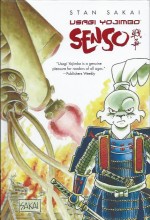
Usagi Yojimbo: Senso


By Stan Sakai (Dark Horse)
ISBN: 978-1-61655-709-6

One of the very best and most adaptable survivors of the 1980s black-&-white comicbook explosion/implosion is a truly bizarre and wonderful synthesis of historical Japanese samurai fiction and anthropomorphic animal adventure, as well as a perfect example of the versatility and strengths of a creator-owned character.

Usagi Yojimbo (which translates as “rabbit bodyguard”) first appeared as a background character in multi-talented creator Stan Sakai’s peripatetic comedy feature The Adventures of Nilson Groundthumper and Hermy, which debuted in furry ‘n’ fuzzy folk anthology Albedo Anthropomorphics #1 (1984) subsequently appearing there on his own terms as well as in Critters, Amazing Heroes, Furrlough and the Munden’s Bar back-up in Grimjack.

Sakai was born in 1953 in Kyoto, Japan before the family emigrated to Hawaii in 1955. He attended University of Hawaii, graduating with a BA in Fine Arts, and pursued further studies at Pasadena’s Art Center College of Design after moving to California.

His first comics work was as a letterer, most famously for the incredible Groo the Wanderer, before his nimble pens and brushes found a way to express a love of Japanese history and legend. Also shaped by his hearty interest in the filmic works of Akira Kurosawa and his peers, Sakai turned a proposed story about a human hero into one of the most enticing and impressive – and astoundingly authentic – sagas of all time.

The deliciously rambling and expansive period fantasy series is set in a world of sentient animals whilst specifically referencing the Edo Period of Feudal Japan (how did we cloth-eared Westerners ever get “Japan” from “Nihon” anyway?) and is drenched in classic cultural icons as varied as Lone Wolf and Cub, Zatoichi and even Godzilla to enrich the ongoing exploits of Miyamoto Usagi, a Ronin (masterless, wandering Samurai) whose fate is to be drawn constantly into a plethora of incredible situations.

And yes, he’s a rabbit – a brave, sentimental, gentle, honourable, conscientious and heroic bunny who cannot turn down any request for help…

The long-eared nomad has changed publishers a few times but has been in continuous publication since 1987 – with nearly 40 graphic novel collections and compilations to date – with guest-shots in sundry other series such as Teenage Mutant Ninja Turtles and its TV incarnation – he even almost made it into his own small-screen show but there’s still time yet and fashions can revive as quickly as they die out …

Sakai and his creation have won numerous awards both within the comics community and amongst the greater reading public and his bombastic bunny has branched out into high-end collectibles, art prints, computer games and RPGs, a spin-off sci fi comics serial and lots of toys. In November 2014 the Rabbit Ronin premiered in a stage show here in London…

Celebrating his 30th anniversary our hero recently appeared in a staggering out-of-continuity cosmic clash first seen in the 6-issue miniseries Usagi Yojimbo: Senso (August 2014-January 2015) now gathered into a sturdy monochrome hardback edition.

Senso means War! – it says so on the back of the book – and this epic Armageddon tale opens fifteen years from the rabbit’s current timeframe with all the regular characters in play for the final battle between usurping over-villain Lord Hikiji and the forces of the Shogun led by Lord Noriyuki of the Geishu Clan.

Preceded by comedic cartoon Introduction ‘Usagi and Stan’ and a selection of cover sketches for the compilation volume, the action opens as the Shogun’s forces, led by recently aligned and fully restored Samurai Usagi, clash with the Dark Lord’s armies.

Also drawn into the cataclysmic battle and employed in key positions are valiant bodyguard Lady Tomoe, former bounty hunter General Gennosuke and even the rabbit’s (unsuspected and unacknowledged) son Jotaro.

Even though the battle seems to be going against them the noble young lord is appalled when chief scientist Takenoko-Sensei offers his new prototype weapon – an armoured, steam-powered, self-propelled moving fortress called Kameyama (“Turtle Mountain”).

Preferring defeat to the shame of utilising an atrocity weapon, the indomitable legion of heroes fight on with renewed desperation, but everything changes in an instant when the sky is suddenly rent by a fiery scream and a colossal metal shell crashes onto the field.

In the silent aftermath the shocked remnants of two shattered armies drag themselves from the blood and dust to discover a third force has entered the fray: ghastly beings like giant octopi, killing with heat and light and riding immense three-legged walking machines…

It takes ninja leader Chizu to discover that the rubbery horrors can be killed and their diabolical machines destroyed, but her consequent and so-noble death will not be the last…

Tense, oppressively ominous and downright scary in places, this fabulous reworking of HG Wells’ War of the Worlds is an astounding and compelling variation on the hallowed theme which offers one tantalising “maybe” after another as three decades of beloved characters assemble to face the end of a world and triumph in a most incredible manner, and at the most horrific of prices…

Amongst the bonus features in this titanic tome are all six wraparound covers from the miniseries and a Process section offering comparisons, deleted and reworked pages and scenes plus fascinating developmental notes and sketches from the story.

The multi-faceted legendary Lepus’ nigh-universal irresistible appeal encompasses every aspect and genre of adventure comics and this moving “End of Days” epic will delight devotees and certainly make converts of the most hardened hater of “funny animal” stories.

Text and illustrations © 2015 Stan Sakai. All rights reserved.

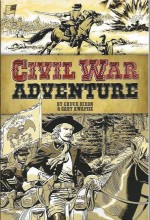
Civil War Adventure


By Chuck Dixon & Gary Kwapisz, with Esteve Polls, Enrique Villagran, Silvestre & Erik Burnham (Dover Comics & Graphic Novels)
ISBN: 978-0-486-79509-6

From its earliest inception, cartooning and graphic narrative has been used to inform. In newspapers, magazines and especially comicbooks the sheer power of pictorial storytelling – with its ability to distil technical recreations of time, place and personage whilst creating deep emotional affinities to past or imagined events – has been used to forge unforgettable images and characters within us. When those stories affect the lives of generations of readers, the force that they can apply in a commercial, social, political or especially educational arena is almost irresistible…

Thus the compelling power of graphic narrative to efficiently, potently and evocatively disseminate vast amounts of information and seductively advocate complex issues with great conviction through layered levels has always been most effectively used in works with a political, social or historical component.

Comics have brought the past to life since they began. Superb examples of a broad view include such triumphs as Jack Jaxon’s Los Tejanos and Comanche Moon or more recently The Loxleys and the War of 1812 and Fight The Power – a Visual History of Protest Among the English Speaking Peoples, but the medium is equally adept in crafting more personal biographs such as Terry Eisele & Jonathon Riddle’s With Only Five Plums or Wilfred Santiago’s “21”: the Story of Roberto Clemente.

And that brings us to another superb and welcome re-release from Dover Comics & Graphic Novels intended to bring “The War Between the States” to life for younger readers.

Originally published by History Graphics Press in 2009 as Civil War Adventure 1: Real History Stories of the War that Divided America, this marvellous monochrome tome – crafted primarily by gritty fantasy comics veterans Chuck Dixon and Gary Kwapisz – alternates actual historical events, maps, diagrams and found writings with a fictionalised thread of tales depicting how the conflict affected one poor Southern family.

The graphic re-enactments are preceded by a ‘Map of the United States’ detailing the division of the States in 1860 and a ‘Civil War Timeline’ which marks key moments and battles (sensibly linking them directly to the stories which follow) after which ‘Choice of Targets’ by Dixon and Esteve Polls features a text vignette explaining the development of snipers and sharpshooters before offering a pithy moment during the second day of the Battle of Gettysburg in 1863 when opposing marksmen found themselves in a life-or-death duel…

‘Berdan’s Sharpshooters’ is a short cartoon lesson on the innovative Union soldier who invented the concept of snipers, promptly followed by a chilling and heartrending incident of battlefield misfortune in Dixon & Kwapisz’s ‘Home Again’ after which an illustrated info and glossary page reproduces an actual letter from a Confederate lad the night before he fell…

‘Mosby Bags a General’ – an all Kwapisz affair – combines a potted history of the South’s most successful raider with a compelling strip revealing how bold Lieutenant John Mosby infiltrated far behind Union lines to capture 58 horses , thirty prisoners and their captain plus sleeping General Stoughton, all in one night…

‘Tempered in Blood’ (Dixon & Kwapisz) then introduces the narrative strand as the simple Campbell clan are torn apart when, after heated family discussion, both father and first son Tybalt sneak off from the farm to enlist in the Spring of 1861.

Each confidently assures themselves that all the shooting will all be over long before harvest and they unknowingly individually abandon Mrs. Campbell and the little sisters to link up with the overconfident volunteers massing for what everybody believes will be one fast knockout blow…

After barely surviving the brutal training that turns hunters, croppers and ploughmen into real soldiers, the Southern heroes finally learn what warfare means at Bull Run…

More contemporary terms, factual data and historical insight is offered in ‘The War is Joined!’ before ‘The Devil’s Due’ (Kwapisz) delves into the atrocity of total warfare as a Bluecoat patrol diligently follows its bald orders to “turn the South into a wasteland”…

A fact-feature page on ‘John Singleton Mosby’ leads to a feature on rising star and flamboyant self-aggrandiser George Armstrong Custer whose rash adventuring leads ‘The Boy General’ (Dixon & Enrique Villagran) into desperate straits against overwhelming rebel opposition… resulting in Custer’s First Stand…

Information pages on the devastating ‘Sharps Rifle’ and the double-pronged naval blockade of the Mississippi River spins off into an account of the duel between ironclad vessels and the brilliant countermeasure devised by Colonel Charles Ellet in ‘Ram Squadron’ (Dixon & Silvestre), capped off with a Kwapisz segment detailing ‘Hell on the Mississippi’ as a Union flotilla horrifically fails to sneak past the naval guns established above Vicksburg…

‘Tempered in Blood II’ returns to the troubled Campbell Clan as Ty wakes in the bloody aftermath of battle to discover his best friend Seth has had enough and absconded. By the time he has found and brought back Seth, however, he discovers his own father has similarly fled.

The elder is not running from bloody death but heading home to save his farm from ruin and family from fever, but that won’t make any difference if he’s picked up by ruthless and remorseless Confederate Picquets…

The tragic true tale of ‘Colonel Cocke’ and his unseemly death gives way to the ribald eccentricity of ‘Darnel Dingus is a…’ which reveals the insane and impecunious ends to which some States descended to ensure their manpower obligations were met. The tale is couched in the story of famous war artist Winslow Homer and a practical joking jackass who learned the hard way that war isn’t funny, and is appended by an grim examination of ‘The Ultimate Punishment’ for desertion under fire and other – even worse – infringements…

The strip section then closes with a sobering and ironic tale of comeuppance in ‘The Letter’ by Erik Burnham & Kwapisz wherein a burned-out sawbones steals a missive from one of his less lucky patients and chases a dream to a woman he has fallen for based solely on her handwriting and prose…

Following one last Kwapisz-illustrated info page – on ‘Battle Field Surgery’ – this stunning introduction to the birth of modern warfare ends with a comparative list of

‘Further Reading’ and a moving notification of how to learn more in ‘If the Valley Was Lost’.

Similar in tone and style to the best of Harvey Kurtzman’s triumphant anti-war classics from Two-Fisted Tales and Frontline Combat, this is a rousing, evocative and potently instructive collection which melds history and horrific entertainment – and not a little grim wit and actual belly-laughs – to bring a pivotal time to vivid life.

© 2009 Chuck Dixon &Gary Kwapisz. All other material © 2015 its respective creators.

Civil War Adventure will be in stores from May 20th 2015 and is available for pre-order now. Check out www.doverpublications.com or your internet retailer or comic shop of choice.

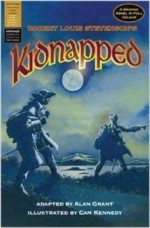
Robert Louis Stevenson’s Kidnapped – the graphic novel


Adapted by Alan Grant & Cam Kennedy (Waverley Books)
ISBN: 978-1-902407-38-8

Practically as soon as comicbooks were invented, high-minded enterprising souls were using the new medium to get readers interested in great literature: paring down deathless prose whilst adding the sheer power of pictures in narrative sequence.

In most cases over the intervening decades these adaptations have been less than stellar, but every so often a piece of work emerges that is not just a mere distillation, adjunct or accommodation but actually works as well in comics terms as the original literary ones.

One sterling example of such graphic magic came out of the 2004 selection of Edinburgh as the first UNESCO City of Literature, when Scottish funnybook veterans Alan Grant and Cam Kennedy were invited to convert a brace of classic tales by Robert Louis Stevenson to publishing’s hottest medium…

With a bare minimum of abridgement or adulteration and astonishingly augmented by the stunning art and colours of the inimitable Kennedy, the timelessly classic tale unfolds beginning with seventeen year old David Balfour who in June 1751 strides away from rural Essendean and the only home he has even known into peril, terror and astounding adventure…

Upon his father’s death Davie receives a letter which reveals the existence of a relative he never knew he possessed, so he promptly walks all the way to Edinburgh and sees for the first time the dilapidated, broken-down but still imposing House of Shaws.

At a time when the oppressive English conquerors are still openly revelling in crushing the Jacobite Rebellion, his progress is slow and cautious. One day David reaches the manor but is not comforted nor relieved, having heard no good word from any he passed about Ebenezer Balfour and his “house built on blood”…

The Laird is an elderly, scared-seeming, guilt-wracked scoundrel who grudgingly takes David in after declaring himself his uncle. Soon, however, David comes to realise that not only has Ebenezer long ago swindled his deceased brother out of his inheritance but is prepared to kill his only kin to keep it…

Forewarned, outraged and wary, Davie nonetheless falls into a trap when he accompanies his uncle to the family lawyer Rankeillor – purportedly to make amends and square accounts – at Queen’s Ferry. The lad is tricked aboard the brig Covenant where he learns Ebenezer has paid villainous Captain Hoseason to transport him to the New World to be sold as a slave…

Clubbed unconscious and inescapably trapped, David plunges into despair and illness. His unwanted journey is marked with brutality and horror, but marginally improves after he witnesses the murder of the cabin boy Ransome and is compelled to become that poor soul’s replacement.

A week later everything changes after the Covenant collides with a smaller vessel in the fog and a survivor is hauled aboard. The small, ferocious and exceedingly dangerous-looking straggler is Alan Breck Stewart: an earnest Jacobite who spends his days collecting debts for the defeated Highland chiefs-in-exile and smuggling the money to them in France.

More avaricious than political, the captain agrees to ferry Breck to a friendly destination for sixty golden guineas but when David overhears Hoseasons and First Mate Mr. Shuan planning to murder the Highlander, he makes a fateful life-changing decision…

Allying himself with Breck, young Balfour gets his first taste of battle and bloodletting when the pair heroically confront the crew from a readymade fortress in the main cabin. With nine men dead or maimed, Hoseasons has no choice but to negotiate and sullenly agrees to put them both ashore at Linnhe Loch, but even before the Covenant can reach that outpost of relative safety, the ship founders on a reef with David and Breck lost over the side…

Cast away and lost he is eventually reunited with Breck, only to endure hardship, horror, pursuit and personal degradation as he and his contentious, complicated comrade are hunted by Royalist forces for the murder of Colin Roy Campbell, known and dreaded as King George’s agent “the Red Fox” who punishes and persecutes Highlanders and honest men, even selling them into slavery…

Their trials and tribulations as outlaws of the heather, their meetings with kindred spirits, strains on their newfound friendship and eventual bringing to justice of the conniving Ebenezer Balfour are all deliciously revealed in gripping form and glorious imagery (although purists might miss much of Breck’s more esoteric phraseology) as the novel comes to rousing life in an iteration certain to please both devotees and first time readers.

Moody, evocative, fast-paced and gripping, this graphic goldmine was also released in two local languages: translated and dialogued in Lowland Scots as Kidnappit by Matthew Fitt & James Robertson and as Fo Bhruid – a Gaelic iteration translated by Iain MacDhòmhnaill.
Adapted text © 2006 Alan Grant. Illustrations © 2006 Cam Kennedy. All rights reserved.

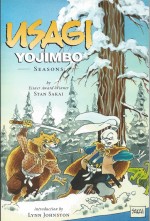
Usagi Yojimbo book 11: Seasons


By Stan Sakai (Dark Horse Comics)
ISBN: 978-1-56971-375-8

Usagi Yojimbo first appeared in Stan Sakai’s The Adventures of Nilson Groundthumper and Hermy, in 1984’s furry ‘n’ fuzzy folk-fest Albedo Anthropomorphics #1. He soon graduated to a stirring solo act in Critters, Amazing Heroes, Furrlough and Munden’s Bar back-up strips in Grimjack.

In 1955, when Sakai was two years old, the family moved from Kyoto, Japan to Hawaii. Growing up in a cross-cultural paradise he graduated from the University of Hawaii with a BA in Fine Arts, before leaving the state to pursue further studies at Pasadena’s Art Center College of Design in California.

His early forays into comics were as a letterer – most famously for the inimitable Groo the Wanderer – before his nimble pens and brushes found a way to express his passion for Japanese history, legend and the filmic works of Akira Kurosawa and his peers, inspirationally transforming a proposed story about a human historical hero into one of the most enticing and impressive fantasy sagas of all time.

And it’s still more educational, informative and authentic than any dozen Samurai sagas you can name…

Although the deliriously expansive period epic stars sentient animals and details the life of a peripatetic Lord-less samurai eking out as honourable a living as possible by selling his sword as a Yojimbo (a bodyguard-for-hire – and, while we’re at it, “Usagi” literally translates as “rabbit”), the milieu and scenarios all scrupulously mirror the Edo Period of Japan – roughly 16th and 17th century AD by our reckoning – whilst simultaneously referencing other cultural icons from sources as varied as Zatoichi to Godzilla.

Miyamoto Usagi is brave, noble, industrious, honest, sentimental, gentle, considerate, artistic, empathetic, long-suffering and conscientious: a rabbit devoted to the tenets of Bushido, he is simply unable to turn down any request for help or ignore the slightest evidence of injustice. As such, his destiny is to be perpetually drawn into an unending panorama of incredible situations.

This evocative and enticing eleventh monochrome medieval masterpiece gathers Dark Horse Comics’ Usagi Yojimbo comicbook (volume 3) #7-12, and the hue-less, line art contents of Usagi Yojimbo Color Special #4 (Green Persimmon).

Following a fondly effusive Introduction from cartoonist Lynn (For Better or For Worse) Johnston, the ever-unfolding adventure resumes with ‘The Withered Field’ as our wandering hero watches swordmaster Nakamura Koji. The former fencing instructor to Lord Hikiji wants to test himself against Ueno, head of the Surodoi School, but the master is absent and his arrogant, haughty students refuse to summon him despite the old man’s succession of victories against them all…

Usagi had also desired to test his skills but instead listens to the incredibly dexterous Koji’s tragic story. Once an important warrior of impeccable status, he was bested in a duel by an unconventional itinerant samurai who rejected the traditional forms of fencing.

Shamed by the defeat Koji took up the Warrior’s Pilgrimage, travelling the land testing and perfecting his skill whilst preparing for a rematch.

As they chat sixteen Surodoi students ambush them, resolved to excise their failure by killing the wanderers. United against the dishonourable attackers, Usagi and Koji efficiently despatch them all and the swordmaster comments on his new friend’s unique combat style…

Once, Miyamoto was simply the son of a small-town magistrate before spending years learning the Way of Bushido from a stern, leonine master who was as much hermit as teacher. The lad learned not just superior technique and tactics, but also Katsuichi‘s creed of justice and restraint which would serve him well throughout his turbulent life…

When Ueno returns he is outraged by his disciples’ presumption and further incensed after finding the bodies of his prodigal pupils. He seeks out Koji and finds him calmly walking with a rabbit ronin. Determined to restore his good name, he grants Koji the long-deferred honour of a duel…

The battle is a wonder of form, grace and precision but upon its grisly conclusion the victorious Koji turns upon Usagi. Having seen his companion fight, the swordmaster has recognised the style which defeated him so long ago and must test himself against it once more.

Unable to dissuade him, the rabbit gives his utmost but is resoundingly defeated. Koji has no intention of killing him and instead tasks Usagi with carrying a message and challenge to his reclusive sensei: the triumphant swordmaster will meet Katsuichi a year hence at a specified place to decide finally and forever whose skill is the greatest…

‘A Promise in the Snow’ then sees the rabbit rover stumble upon a robbery and prevent the death of a merchant. The trader is grievously wounded however and his little daughter Fumiye begs the ronin to carry the rapidly expiring Araki to his home a half-day’s journey away.

The task is an arduous one over avalanche-prone mountains with starving wild beasts and numbing cold sapping his energies and good intentions with every step. Despite nigh-overwhelming odds little Fumiye insistently urges Usagi on, but when he finally brings Araki to safety the rescuer receives a stunning shock…

Political intrigue blossoms once again when a wounded messenger carrying an astounding document staggers into a temple in ‘The Conspiracy of Eight’. Inside Usagi is visiting his new friend Sanshobo and is present when the priest finds a pledge signed by eight High Lords agreeing to rise up against the Shogun. The messenger wears the livery of “Shadow Lord” Hikiji and has been struck down by assassin’s arrows…

Ambitious Hikiji’s name is not amongst the signatories and his role in the scheme cannot be guessed, but Sanshobo knows that the letter will result in great bloodshed whether the conspirators, Shadow Lord or Shogun possesses it. Proof of his contention comes when a band of samurai lay siege to the temple compound, demanding the surrender of the messenger…

As snows fall and temperatures plummet, priest, postulants and ronin enact a furious defence of the sanctuary but ultimately a lone ninja steals the document and brings it to an unsuspected fourth party with her own reasons for keeping it quiet.

Neko ninja clan-chief Chizu secretly prays that this time her erstwhile ally Usagi will keep his nose out of her business …

‘Snakes and Blossoms’ offers a brace of flashback tales wherein the Yojimbo, calmly recuperating as Sanshobo’s guest, finds a moment to share some old stories with his new friend.

‘Hebi’ harks back to a time when the ronin and his crusty companion Gennosuké (an irascibly bombastic, money-mad, bounty-hunting, conniving thief-taking rhino with a heart of gold) were caught in a storm and took shelter in an almost abandoned temple. Gen had to kill a huge, vicious snake to get there but once inside things became even more dangerous as the beast’s demon wife impersonated a nun to get close enough to exact vengeance…

A far more educational parable follows as ‘The Courage of the Plum’ reveals how impulsive student Usagi learned a life-lesson from Katsuichi-sensei one cold spring just as the winter snows began to melt…

After a rousing pin-up the drama recommences with ‘Return to Adachi Plain’ (inked by Sergio Aragonés) as the perpetual nomad’s path brings him back to the battlefield where his karma was decided forever…

Mere months after completing his tutelage with Katsuichi, Usagi was recruited to the personal retinue of Great Lord Mifunė. He advanced quickly and was soon a trusted bodyguard too, serving beside the indomitable and legendary Gunichi. It was a time of great unrest and war was brewing…

In his third year of service, the castle was attacked by Neko ninja assassins and, although the doughty heroes managed to save their master, the Lord’s wife Kazumi and heir Tsuruichi were murdered. Realising ambitious rival Lord Hikiji was responsible, MifunÄ— declared war…

The epic conflict ended on the great Adachigahara Plain when MifunÄ—’s general Todo switched sides and the betrayed Great Lord fell. At the crucial moment Gunichi also broke, fleeing to save his own skin and leaving Usagi to preserve the fallen Lord’s head – and honour – from shameful desecration…

With no master to serve, Usagi became a ronin and began his endless Warrior Pilgrimage…

Far away another portentous interlude occurs as a simple peasant is saved by a dark stranger from a cruel and murderous samurai as they all shared passage between islands in ‘The Crossing’.

Jei is a veritable devil in mortal form, believing himself a “Blade of the Gods”, chosen by the Lords of Heaven to kill the wicked. The maniac makes a convincing case: when he first met Usagi the diabolical spearman was struck by lightning and still survived.

Still pursuing his crusade against evil, Jei has adopted an orphan girl Keiko to aid him, but after saving a life he then perceives it to be an evil one too – as apparently is every other passenger on the unlucky vessel…

A fascinating exploration of warrior spirit is depicted as a defeated general goes deep undercover as farmer in ‘The Patience of the Spider’. Ikeda and his most trusted lieutenants survived the fall of their Lord, adopted a peasant lifestyle and are biding their time until they can rise again to expunge their shameful defeat.

But months turn to decades and the General fully grows into his new role – perhaps too much so…

Usagi resurfaces again when a band of cutthroats at an inn initially select him as a prospective victim before switching sights to another, more affluent-seeming traveller. The rogues soon learn the error of their ways as the enigmatic Oyama Tadanori wipes them out with ease.

Later the stranger encounters Usagi and the ronin recognises ‘The Lord of the Owls’ as an infamous cursed warrior reputed to be able to see death in a person’s eyes. He is not happy to hear the taciturn figure warn him that they will meet again…

More secrets of the Conspiracy of Eight are revealed in ‘The First Tenet’ when Chizu’s deputy Kagemaru exposes her part in the incriminating letter’s theft to Hikiji’s untrustworthy facilitator Lord Hebi. Infuriatingly some wily ninja has doctored the document and the conspirators remain practically anonymous…

Later, as Hebi’s entourage is attacked by assassins, Kagemaru just happens to be nearby with a band of faithful ninjas who rapidly despatch the assailants. It’s not so much the surprise of the counterattack that routs the rogues as shock that the man who hired them is now leading the defence of Hebi…

Attention returns to the Yojimbo as he passes the devastated mansion of Lady Takagi and recalls how, in the aftermath of the Dragon Bellow Conspiracy, he, Gen and female warrior Tomoe were rushing back to inform benevolent young Lord Noriyuki that the crisis had been averted.

After battling their way past hostile forces they were offered a night’s respite by the noble lady but ‘The Obakéneko of the Geishu Clan’ was a were-beast intent on murder and worse and it took all the ronin’s might and plenty of luck to survive until daylight…

The spellbinding storytelling concludes with espionage mystery ‘Green Persimmon’ as a dying samurai of Noriyuki’s Geishu clan entrusts Usagi with a strangely glazed ceramic fruit which simply must reach the young Lord at all costs.

The fragile porcelain artefact attracts the attention of numerous thugs, cutthroats and hired killers but as the Yojimbo carves his way across the country he is unable to fathom its purpose. Only when he meets Tomoe does the Green Persimmon surrender its incredible secret…

This medieval monochrome masterwork concludes with a ‘Gallery’ of seven superb covers to wrap things up with artistic aplomb.

Despite changing publishers a few times the Roaming Rabbit has been in continuous publication since 1987, with over 30 books and collections so far. He has guest-starred in many other series (most notably Teenage Mutant Ninja Turtles and its TV incarnation) and even almost made it into his own small-screen show.

There are high-end collectibles, art prints, computer games and RPGs, a spin-off sci-fi comics serial and lots of toys. Sakai and his creation have won numerous awards both within the Comics community and amongst the greater reading public.

Fast-paced yet lyrical, informative and funny, Usagi Yojimbo also bristles with tension and thrills and frequently breaks your heart with astounding tales of pride and tragedy.

Simply bursting with veracity and verve, it is the perfect comics epic: a monolithic magical saga of irresistible appeal to delight devotees and make converts of the most hardened haters of “funny animal” stories.
© 1996, 1997, 1999, 2004 Stan Sakai. Usagi Yojimbo is a registered trademark of Stan Sakai. All rights reserved.

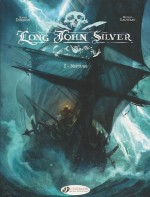
Long John Silver volume II: Neptune


By Xavier Dorison & Mathieu Lauffray, translated by Jerome Saincantin (Cinebook)
ISBN: 978-1-84918-072-6

British and European comics have always been far more comfortable with period-piece strips than our American cousins and much more imaginative when reinterpreting classical fiction for jaded comicbook audiences. The happy combination of familiar exoticism, past lives and world-changing events blended with drama, action and, most frequently, broad comedy has resulted in a uniquely narrative art form suited to beguiling readers of all ages and tastes.

Our Franco-Belgian brethren in particular have made an astonishing success out of repackaging days-gone-by but this particularly enchanting older-readers yarn forgoes the broad bellylaughs whilst extending the adventures of literature’s greatest rogue into a particularly engaging realm of globe-girdling thriller.

Robert Louis Stevenson’s Treasure Island was originally serialised from 1881-1882 in Young Folks magazine as Treasure Island or, the mutiny of the Hispaniola, pseudonymous penned by one “Captain George North”.

It was collected and published as a novel in May 1883 and has never been out of print since. A landmark of world storytelling, Treasure Island has been dramatised too many times to count and adapted into all forms of art. Most significantly, the book created a metafictional megastar – albeit at best an anti-hero – as immortal as King Arthur, Robin Hood, Sherlock Holmes, Tarzan or Superman. Almost everything the public “knows” about pirates devolves from the book and its unforgettable, show-stealing one-legged star…

Writer Xavier Dorison was born in Paris in 1970 and graduated business school before moving into storytelling. He works as an author, film writer, lecturer and movie script doctor. He began the award-winning Long John Silver in conjunction with preferred collaborator Mathieu (Prophet) Lauffay in 2006, with the last volume released in 2013.

Lauffay is also a Parisian born in 1970. He spends his days illustrating, drawing comics, crafting RPGs and working as a concept designer for movies. His art has graced such international items as Dark Horse Comics’ Star Wars franchise, games like Alone in the Dark, the album Lyrics Verdun, February 21, 1916 – December 18, 1916, Tarzan and many more…

Their continuation of the piratical prince is a foray into far more mature arenas set some years after the affair of the Hispaniola and ranges far and wide: from foggy, oppressive England to the vast, brooding inner recesses of the Amazon.

What has Gone Before: 1785 and treasure-hunting Lord Byron Hastings has finally found the lost city of Guiana-Capac but now needs further funds to exploit this promising City of Gold.

In England, his profligate and wanton wife Lady Vivian has been enjoying herself too much and is with child by lecherous neighbour Lord Prisham. With a baby in her belly and a husband gone three years, she is considering having Byron declared dead and undertaking a hasty remarriage…

Suddenly shattering those plans is her despised brother-in-law who turns up with an old native named Moxtechica bearing a message and map from her long-lost husband. Prudish and cruel Royal Naval officer Edward Hastings delights in telling the scheming strumpet he abhors that his brother has succeeded and now orders her to sell everything… including all the treasured family possessions, manor house and lands she brought to the marriage…

Byron has named Edward sole Proxy and the martinet delights in giving the high-born trollop Vivian her marching orders. He strongly urges her to confine herself to a convent and save them all further shame and disgrace…

Raging in front of her conniving maid Elsie, the Lady considers a number of retaliatory tactics before settling upon the most bold, dangerous and potentially rewarding. After announcing to the stunned Edward that she will accompany him to South America and reunite with her beloved husband, the fallen noblewoman seeks out a doctor to take care of the “problem” she is – for the moment at least – still secretly carrying…

Dr. Livesay is a decent, god-fearing soul who has led a quiet, prosperous life since his adventures on Flint’s Island. However, it is not her current condition which has brought Vivian to the physician’s door, but rather persistent tales of a scurrilous former acquaintance; a formidable, peg-legged rogue with a reputation for making life’s difficulties disappear…

Against his better judgement, Livesay capitulates to Lady Vivian’s urgings, introducing her to retired sea-cook John Silver. Amidst the (alleged) ex-pirate’s inner circle of scary-looking confederates she relates the story of the Spaniard Pizarro‘s discovery of a City of Gold and how, centuries later, her husband has reclaimed it.

The rest of her sorry tale tumbles out. She plans to travel there with a few capable men – and the far-from-willing Elsie – to make those riches her own. She needs Silver and his colleagues to infiltrate Edward’s crew, seize the ship he has chartered and complete the voyage under her command…

Unable to convince Vivian to desist or Silver to reject her offer, Livesay reluctantly joins them in vain hopes that he can keep the debased woman from mortal harm. Silver is hiding a debilitating and soon-to-be-fatal case of malaria, but still orchestrates his own hiring before packing the Neptune with suitable scoundrels and compelling Lady Vivian to sign a sacrosanct Pirates Contract. With all the various schemers believing their own plans are proceeding satisfactorily, the Neptune sets off for the Americas, but at the last moment Silver suffers a major setback when rival rogue Paris inveigles his way into the crew…

Volume two commences with the voyage well under way and the crew – Silver’s men, Paris’ contingent and even Captain Edward Hastings’ innocent hires – all slowly succumbing to the Sea Cook’s glib tongue and fascinating tales of the Red Brotherhood. Only Hastings’ lieutenants Dantzig and Van Horn have any inkling of the battle of wills occurring below decks, but the shaky détente is shattered after duplicitous Elsie tries to expose Lady Vivian’s plans only to suffer a tragic “accident” when a huge load of storage barrels falls upon her.

Hastings knows all too well that his ship is filled with men just waiting for him to pilot them to the mouth of incomprehensible wealth. Thus he rules with a rod of iron and full naval discipline just to stay alive.

Boy seaman Jack O’Kief is a protégé of Paris, but Silver has developed a fondness for the lad. That relationship is tested to the limit when Hastings declares Jack responsible for the maid’s death and has him brutally flogged to force the Sea Cook’s hand.

A vicious and prolonged battle of wills follows, pushing the crew to the edge of mutiny as Hastings stalls in making final landfall and Jack’s life slowly ebbs away…

Tensions come to a tragic head as a colossal storm pushes the Neptune inexorably towards its foregone destination and another death sparks the inevitable mutiny, appalling bloodshed and a red-handed settling of many scores…

Literally above it all, the shaman Moxtechica rides out the tempest above and the savage battle of the white men below, patiently waiting to see what the calm of dawn will bring…

To Be Continued…

Tense, evocative, suspenseful and shockingly powerful, these further exploits of Long John Silver are a modern masterpiece of adventure fiction worthy of Stevenson’s immortal adventure which should even convince a few more folks to actually read the original novel. © Darguad, Paris, 2008 by Dorison & Lauffray. All rights reserved. English translation © 2011 Cinebook Ltd.

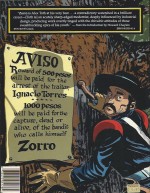
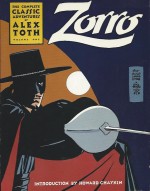
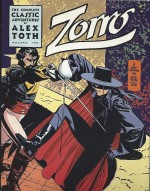
Zorro – the Complete Classic Adventures volumes One & Two


By Alex Toth & anonymous (Eclipse Books)
ISBNs: 0-913035-41-6 and 0-913035-51-3

Alex Toth was a master of graphic communication who shaped two different art-forms and is largely unknown in both of them.

Born in New York in 1928, the son of Hungarian immigrants with a dynamic interest in the arts, Toth was something of a prodigy and after enrolling in the High School of Industrial Arts doggedly went about improving his skills as a cartoonist. His earliest dreams were of a quality newspaper strip like Milton Caniff’s Terry and the Pirates, but his uncompromising devotion to the highest standards soon soured him on newspaper strip work when he discovered how hidebound and innovation-resistant the family values-based industry had become whilst he was growing up.

Aged 15, he sold his first comicbook works to Heroic Comics and after graduating in 1947 worked for All American/National Periodical Publications (who would amalgamate and evolve into DC Comics) on Dr. Mid-Nite, All Star Comics, the Atom, Green Lantern, Johnny Thunder, Sierra Smith, Johnny Peril, Danger Trail and a host of other features. On the way he dabbled with newspaper strips (see Casey Ruggles: the Hard Times of Pancho and Pecos) but was disappointed o find nothing had changed…

Continually striving to improve his own work he never had time for fools or formula-hungry editors who wouldn’t take artistic risks. In 1952 Toth quit DC to work for “Thrilling” Pulps publisher Ned Pines who was retooling his prolific Better/Nedor/Pines comics companies (Thrilling Comics, Fighting Yank, Doc Strange, Black Terror and many more) into Standard Comics: a publishing house targeting older readers with sophisticated, genre-based titles.

Beside fellow graphic masters Nick Cardy, Mike Sekowsky, Art Saaf, John Celardo, George Tuska, Ross Andru & Mike Esposito and particularly favourite inker Mike Peppe, Toth set the bar high for a new kind of story-telling: wry, restrained and thoroughly mature; in short-lived titles dedicated to War, Crime, Horror, Science Fiction and especially Romance.

After Simon and Kirby invented love comics, Standard, through artists like Cardy and Toth and writers like the amazing and unsung Kim Aamodt, polished and honed the genre, turning out clever, witty, evocative and yet tasteful melodramas and heart-tuggers both men and women could enjoy.

Before going into the military, where he still found time to create a strip (Jon Fury for the US army’s Tokyo Quartermaster newspaper The Depot’s Diary) he illustrated 60 glorious tales for Standard; as well as a few pieces for EC and others.

On his return to a different industry – and one he didn’t much like – Toth resettled in California, splitting his time between Western/Dell/Gold Key, such as these Zorro tales and many other movie/TV adaptations, and National (assorted short pieces such as Hot Wheels and Eclipso): doing work he increasingly found uninspired, moribund and creatively cowardly. Eventually he moved primarily into TV animation, designing for shows such as Space Ghost, Herculoids, Birdman, Shazzan!, Scooby-Doo, Where Are You? and Super Friends among many others.

He returned sporadically to comics, setting the style and tone for DC’s late 1960’s horror line in House of Mystery, House of Secrets and especially The Witching Hour, and illustrating more adult fare for Warren’s Creepy, Eerie and The Rook. He redesigned The Fox for Red Circle/Archie, produced stunning one-offs for Archie Goodwin’s Batman or war comics (whenever they offered him a “good script”) and contributed to landmark or anniversary projects such as Batman: Black and White.

His later, personal works included Torpedo for the European market and the magnificently audacious swashbuckler Bravo for Adventure!

Alex Toth died of a heart attack at his drawing board on May 27th 2006 but before that the kids he’d inspired (mostly comics professionals themselves) sought to redress his shameful anonymity with a number of retrospectives and comics compilations. One of the first and best was this Eclipse Books twin set, gathering his many tales for Dell featuring Disney’s TV iteration of the prototypical masked avenger.

In 2013, Hermes Press released a lavish complete volume in full colour but, to my mind, these black and white books (grey-toned, stripped down and redrawn by the master himself) are the definitive vision and the closest to what Toth originally intended, stripped of all the obfuscating quibbles and unnecessary pictorial fripperies imposed upon his dynamic vision by legions of writing committees, timid editors and Disney franchising flacks.

One the earliest masked heroes and still phenomenally popular throughout the world, “El Zorro, The Fox” was originally devised by jobbing writer Johnston McCulley in 1919 in a five part serial entitled ‘The Curse of Capistrano’. He debuted in the All-Story Weekly for August 6th and ran until 6th September. The part-work was subsequently published by Grossett & Dunlap in 1924 as The Mark of Zorro and further reissued in 1959 and 1998 by MacDonald & Co. and Tor respectively.

Famously, Hollywood royalty Douglas Fairbanks and Mary Pickford read the ‘The Curse of Capistrano’ in All-Story Weekly on their honeymoon and immediately optioned the adventure to be the first film release from their new production company/studio United Artists.

The Mark of Zorro was a global movie sensation in 1920 and for years after, and New York-based McCulley subsequently re-tailored his creation to match the so-different filmic incarnation. This Caped Crusader aptly fitted the burgeoning genre that would soon be peopled by the likes of The Shadow, Doc Savage and the Spider.

Rouben Mamoulian‘s 1940 filmic remake of The Mark of Zorro further ingrained the Fox into the world’s psyche and, as the prose exploits continued in a variety of publications, Dell began a comicbook version in 1949.

When Walt Disney Studios began a hugely popular Zorro TV show in 1957 (resulting in 78 half-hour episodes and four 60 minute specials before cancellation in 1961) the ongoing comics series was swiftly redesigned to capitalise on it and the entertainment corporation began a decades-long strip incarnation of “their” version of the character in various quarters of the world.

This superb set reproduces the tales produced by Toth for Dell Comics; firstly as part of the monumental try-out series Four-Color (issues #882, 920, 933, 960, 976 & 1003), and thereafter as a proven commodity with his own title – of which the restless Toth only drew #12. Other artists on the series included Warren Tufts, Mel Keefer and John Ushler and the Dell series was subsequently relaunched in January 1966 under the Gold Key imprint, reprinting (primarily) the Toth drawn material in a 9-issue run than lasted until March 1968.

Zorro – the Complete Classic Adventures Volume One opens with an effusive and extremely moving ‘Introduction by Howard Chaykin’ before steaming straight into the timeless wonder, but I thought that perhaps a brief note on the scripts might be sensible here.

As part of Disney’s license the company compelled Dell to concentrate on adapting already-aired TV episodes complete with florid, overblown dialogue and stagy, talking head shots which Toth struggled mightily – and against increasingly heated resistance from writers and editors – to pare down and liven up. Under such circumstances it’s a miracle that the strips are even palatable, but they are in fact some of the best adventure comics of the practically superhero-free 1950s.

Sadly, all the covers were photo-shots of actor Guy Williams in character so even that graphic outlet was denied Toth – and us…

One bonus however is that the short, filler stories used to supplement the screen adaptations were clearly generated in-house with fewer restrictions, so here Toth’s brilliance shines through…

The origin and set-up for the series came with Four-Color #882 (February 1958) in ‘Presenting Señor Zorro’. Retelling the first episode of the TV show, it introduces dashing swordsman Don Diego De La Vega, returning from Spain in 1820 to his home in Pueblo De Los Angeles in answer to a letter telling of injustice, corruption and tyranny…

With mute servant Bernardo – who pretends to be also deaf and acts as his perfect spy amongst the oppressors – Diego determines to assume the role of a spoiled and cowardly fop whilst creating the masked identity of El Zorro “the Fox” to overthrow wicked military commander and de facto dictator Capitan Monastario.

Shrugging off the clear disappointment of his father Don Alejandro, Diego does nothing when their neighbour Ignacio “Nacho” Torres is arrested on charges of treason but that night a masked figure in black spectacularly liberates the political prisoner and conveys him to relative safety and legal sanctuary at the Mission of San Gabriel…

The second TV instalment became the closing chapter of that first comicbook as ‘Zorro’s Secret Passage’ finds Monastario suspicious that Zorro is a member of the De La Vega household and stakes the place out. When the Commandante then accuses another man of being the Fox, Diego uses the underground passages beneath his home to save the innocent victim and confound the dictator…

Four-Color #920 (June 1958) adapted the third and fourth TV episodes, beginning with “Zorro Rides to the Mission” which became ‘The Ghost of the Mission Part One’ as Monastario discovers where Nacho Torres is hiding and surrounds the Mission. Unable to convince his lancers to break the sacred bounds of Sanctuary, the tyrant settles in for a siege and ‘The Ghost of the Mission Part Two’ sees him fabricate an Indian uprising to force his way in. Sadly for the military martinet Diego has convinced his bumbling deputy Sergeant Demetrio Garcia that the Mission is haunted by a mad monk…

Despite appearing only quarterly, Zorro stories maintained the strict continuity dictated by the weekly TV show. “Garcia’s Secret Mission” became ‘Garcia’s Secret’ in Four-Color #933 (September 1958) and saw Monastario apparently throw his flunky out of the army in a cunning plot to capture the Fox. Once again the ruse was turned against the connivers and El Capitan was again humiliated.

The last half of the issue saw a major plot development, however, as TV instalment “The Fall of Monastario” became ‘The King’s Emissary’ wherein the Commandante tries to palm off ineffectual Diego as Zorro to impress the Viceroy of California only to find himself inexplicably exposed, deposed and arrested…

The rest of this initial outing comprises a quartet of short vignettes commencing with ‘A Bad Day for Bernardo’ (Four-Color #920) wherein the unlucky factotum endures a succession of mishaps as he and Zorro search for a missing señorita and almost scotch her plans to elope, whilst Four-Color #933 provided the tale of youngster Manuelo, who ran away to become ‘The Little Zorro’. Happily Diego is able to convince the lad that school trumps heroism… in this case…

In ‘The Visitor’ (Four-Color #960, December 1958) Diego and Bernardo find a baby on their doorstep and help the mother to free her husband from jail before the volume concludes with ‘A Double for Diego’ (Four-Color #976, March 1959) wherein Sgt. Garcia – now in temporary charge of Los Angeles – seeks Diego’s help to capture Zorro, necessitating the wily hero trying to be in two places at once…

Zorro Volume Two leads off with ‘A Foreword’s Look Back and Askance’ by Alex Toth, who self-deprecatingly recaps his life and explains his artistic philosophy, struggles with Dell’s editors and constant battle to turn the anodyne goggle-box crusader back into the dark and flamboyant swashbuckler of the Mamoulian movie…

Four-Color #960 (December 1958) has TV tales “The Eagle’s Brood” and “Zorro by Proxy” transformed into visual poetry when a would-be conqueror targets Los Angeles as part of a greater scheme to seize control of California. With new Capitan Toledano despatched to seek out a vast amount of stolen gunpowder, ‘The Eagle’s Brood’ infiltrate the town, sheltered by a traitor at the very heart of the town’s ruling elite…

Made aware of the seditious plot, Zorro moves carefully against the villains, foiling their first attempt to take over and learning the identity of an untouchable traitor…

The saga resumed and concluded in ‘Gypsy Warning’ (Four-Color #976, adapting “Quintana Makes a Choice” and “Zorro Lights a Fuse”) as Zorro foils a plot to murder pro tem leader Garcia and stumbles into the final stages of the invasion of Santa Barbara, San Diego, Capistrano and Los Angeles…

With The Eagle temporarily defeated, short back-up ‘The Enchanted Bell’ (Four-Color #1003, June 1959) sees Zorro prevent the local tax collector confiscating a prized bell beloved by the region’s Indians to prevent a possible uprising, after which the lead story from the same issue details how ‘The Marauders of Monterey’ (adapting “Welcome to Monterey” and “Zorro Rides Alone”) lure officials from many settlements with the promise of vitally needed supplies and commodities before robbing them.

Sadly for them, Los Angeles sent the astute but effete Don Diego to bid for the goods and he had his own solutions for fraud and banditry…

After more than a year away Toth returned for one last hurrah as ‘The Runaway Witness’ (Zorro #12, December 1960/February 1961) found the Fox chasing a frightened flower-girl all over the countryside. Justice rather than romance was on his mind as he sought to convince her to testify against a powerful man who had murdered his business partner… This stunning masterclass in comics excellence concludes with ‘Friend Indeed’ from the same issue wherein Zorro plays one of his most imaginative tricks on Garcia, allowing the hero to free a jail full of political prisoners…

Full-bodied, captivating and beautifully realised, these immortal adventures of a global icon are something no fan of adventure comics and thrilling stories should be without.
Zorro ® and © Zorro Productions. Stories and artwork © 1957, 1958, 1959, 1960, 1961Walt Disney Productions This edition © 1986 Zorro Productions, Inc.

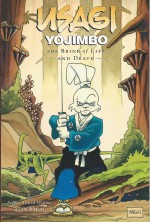
Usagi Yojimbo book 10: The Brink of Life and Death


By Stan Sakai (Dark Horse Comics)
ISBN: 978-1-56971-259-7

Usagi Yojimbo (“rabbit bodyguard”) first appeared as a background character in Stan Sakai’s The Adventures of Nilson Groundthumper and Hermy, which premiered in 1984 amongst assorted furry ‘n’ fuzzy folk Albedo Anthropomorphics #1. He subsequently graduated to a solo act in Critters, Amazing Heroes, Furrlough and the Munden’s Bar back-up series in Grimjack.

In 1955, when Sakai was two years old, the family moved from Kyoto, Japan to Hawaii. Growing up in a cross-cultural paradise he graduated from the University of Hawaii with a BA in Fine Arts, before leaving the state to pursue further studies at Pasadena’s Art Center College of Design in California.

His early forays into comics were as a letterer – most famously for the inimitable Groo the Wanderer – before his nimble pens and brushes found a way to express his passion for Japanese history, legend and the filmic works of Akira Kurosawa and his peers, inspirationally transforming a proposed story about a human historical hero into one of the most enticing and impressive fantasy sagas of all time.

And it’s still more educational, informative and authentic than any dozen Samurai sagas you can name…

Although the deliriously peripatetic and expansive period epic stars sentient animals and details the life of a peripatetic Lord-less Samurai eking out as honourable a living as possible by selling his sword as a Yojimbo (bodyguard-for-hire), the milieu and scenarios all scrupulously mirror the Feudal Edo Period of Japan (roughly 16th – 17th century AD by our reckoning) whilst simultaneously referencing other cultural icons from sources as varied as Zatoichi to Godzilla.

Miyamoto Usagi is brave, noble, industrious, honest, sentimental, gentle, artistic, empathetic, long-suffering and conscientious: a rabbit devoted to the tenets of Bushido, he is simply unable to turn down any request for help or ignore the slightest evidence of injustice. As such, his destiny is to be perpetually drawn into an unending panorama of incredible situations.

This evocative and enticing tenth black-&-white blockbuster collects yarns from Dark Horse Comics’ Usagi Yojimbo series (volume 3), #1-6 plus additional tales from issues #13, 15 and 16 from the previous Mirage iteration, aligning epic sagas of intrigue with brief vignettes attending to more plebeian dramas and even the occasional supernatural thriller, all tantalisingly tinged with astounding martial arts action and drenched in wit, irony, pathos and even true tragedy…

Following a heartfelt and enthusiastic Introduction from comics author Kurt Busiek, the ever-unfolding yarn resumes with a handy recap in ‘Origin Tale’ summarising the valiant wanderer’s fraught life to date before ‘Kaisō’ finds Miyamoto Usagi befriending a seaweed farmer who’s experiencing a spot of bother with his neighbours…

At peace with himself amongst hard-toiling peasants, Usagi becomes embroiled in their escalating battle with a village of rival seaweed sellers – previously considered helpful and friendly – and soon realises scurrilous merchant Yamanaka is fomenting unrest between his suppliers to make extra profit…

‘A Meeting of Strangers’ in a roadside hostelry introduces a formidable female warrior to the constantly expanding cast as the Lepine Legend graciously offers a fellow weary mendicant the price of a drink. A professional informer then sells Usagi out to the still-smarting Yamanaka and the lethally capable Inazuma has ample opportunity to repay her slight debt to the Rabbit Ronin when he’s ambushed by an army of hired brigands…

Far away a portentous interlude occurs as a simple peasant and his granddaughter are attacked by a band of bandits. The belligerent scum are about to compound extortion and murder with even more heinous crimes when a stranger with a ‘Black Soul’ stops them…

Jei is a veritable devil in mortal form, believing himself a “Blade of the Gods”, chosen by the Lords of Heaven to kill the wicked. The maniac makes a convincing case: when he stalked Usagi the manic monster was struck by a fortuitous – or possibly divinely sent – lightning bolt and still survived.

Still keen to continue his crusade, the monster deals most emphatically with the criminals before allowing orphaned granddaughter Keiko to join him…

Despite – or perhaps because – it is usually one of the funniest comics on the market, occasionally Usagi Yojimbo can brilliantly twist readers’ expectations with tales that rip your heart apart.

Such is the case with ‘Noodles’ as the nomadic Ronin meets again street performer, shady entertainer and charismatic pickpocket Kitsune who has begun plying all her antisocial trades in a new town just as eternally-wandering Usagi turns up.

The little metropolis is in uproar at a plague of daring robberies and when the inept men employed by Yoriki (Assistant Commander) Masuda try – and painfully fail – to arrest the long-eared stranger as a probable accomplice, the ferociously resistant ronin earns the instant enmity of the pompous official.

Following the confrontation, a hulking, mute soba (buckwheat noodle) vendor begins to pester the still-annoyed rabbit and eventually reveals he’s carrying the elegant Kitsune in his baskets…

Astounded the Yojimbo renews his acquaintance with her before the affable thieves go on their way, but trouble and tragedy are just around the corner…

The town magistrate is leaning heavily on his Yoriki to end the crime wave but has no conception that Masuda is actually in the pay of a vicious gang carrying out most of the thefts. What they all need a convincing scapegoat to pin the blame on and poor dumb peasant Noodles is ideal – after all, he can’t even deny his guilt…

With a little sacrificed loot planted, he becomes the perfect patsy and before Usagi and Kitsune even know he’s been taken, the simple fool has been tried and horrifically executed…

‘Noodles Part 2’ opens as they frantically dash for the public trial and almost immediate crucifixion but pickpocket and ronin can do nothing to save the innocent victim. All they can do is swear to secure appropriate vengeance and justice…

In sober mien the rabbit roves on, stumbling into a house of horror and case of possession as ‘The Wrath of the Tangled Skein’ finds Usagi returning to a region plagued by demon-infested forests. Offered hospitality at a merchant’s house he subsequently saves the daughter from doom at the claws of a demonic Nue (tiger/fox/pig/snake devil).

He is almost too late however and only alerted to a double dose of danger when a Bonze (Buddhist Priest) arrives to exorcise the poor child… just like the one already praying over the afflicted waif upstairs…

This duel with the forces of hell leads into ‘The Bonze’s Story’ as Usagi strikes up a friendship with the true priest and learns how misfortune and devotion to honour compelled elite samurai Sanshobo to put aside weapons and war in search of greater truths and inner peace…

Political intrigue and explosive espionage resurface in ‘Bats, the Cat, & the Rabbit’ as Neko ninja chief Chizu re-enters Usagi’s life, fleeing a flight of rival Komori (bat) ninjas. The winged horrors are determined to take a scroll containing the secrets of making gunpowder and after a tremendous, extended struggle the exhausted she-cat cannot believe her rabbit companion is willing to hand it over. She soon shrugs it off. After all the Komori have fallen into her trap and quickly regret testing the purloined formula …

The peripatetic Yojimbo then walks into a plot to murder Great Lord Miyagi involving infallible unseen assassin Kuroshi at ‘The Chrysanthemum Pass’. He is simply aiding karma to a just outcome despite overwhelming odds and a most subtle opponent… This chronicle then sees a return engagement with the lethally adept Inazuma when ‘Lightning Strikes Twice’…

The hunted woman is always at the heart of a storm of hired blades trying to kill her, but during one peaceful moment she finds a little time to share with a fellow swordsmaster the instructive tale of a dutiful daughter who married the wrong samurai and, by exacting rightful vengeance upon his killer, won the undying hatred of a powerful lord…

Despite changing publishers a number of times, the Roaming Rabbit has been in continuous publication since 1987, with more than 30 collections and books to date. He has guest-starred in many other series (most notably Teenage Mutant Ninja Turtles and its TV incarnation) and nearly made it into his own small-screen show.

There are high-end collectibles, art prints, computer games and RPGs, a spin-off sci-fi comics serial and lots of toys. Sakai and his creation have won numerous awards both within the Comics community and amongst the greater reading public.

Fast-paced yet lyrical, informative and funny, the saga alternately bristles with tension and thrills and frequently crushes your heart with astounding tales of pride and tragedy, evil and duty.

Bursting with veracity and verve, Usagi Yojimbo is the perfect comics epic: a monolithic magical saga irresistibly appealing that will delight devotees and make converts of the most hardened haters of “funny animal” stories.
© 1998 Stan Sakai. Usagi Yojimbo is a registered trademark of Stan Sakai. All rights reserved.
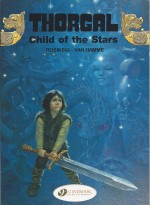
Thorgal volume 1: Child of the Stars/Aaricia


By Rosiński & Van Hamme, translated by Luke Spear (Cinebook)
ISBN: 978-1-905460-23-6

One of the best and most celebrated adventure series of all time, Thorgal manages the ultimate magic trick of being able to both please critics and sell bucketloads. The series debuted in iconic French weekly Tintin in 1977 with the inevitable album compilations beginning three years later. The expansive generational saga has a truly international following in fourteen languages, has generated many spin-off series and naturally offers a strong presence in the global gaming arena.

Narratively, Thorgal offers the best of all amazing worlds with an ostensibly starkly historical milieu of bold Viking adventure glibly yet seamlessly encompassing chilling science fiction elements, monstrous horror, social satire, political intrigue, soap opera, Atlantean mystique and mythically mystical fantasy standards such as gods, monsters, dwarves and demons.

Created by Belgian writer Jean Van Hamme (Domino, XIII, Largo Winch, Blake and Mortimer) and Polish illustrator Grzegorz Rosiński (Kapitan Żbik, Pilot Śmigłowca, Hans, The Revenge of Count Skarbek) the feature grew into a generational saga over the decades with the creative duo completing 29 albums between 1980 and 2006 when Van Hamme moved on. Thereafter the scripting duties fell to Yves Sente who has collaborated on a further five collections to date.

By the time Van Hamme departed the feature had expanded to cover not only the life of the titular hero and his son Jolan but also other valiant family members in a number of spin-off series (Kriss de Valnor, Louve, La Jeunesse de Thorgal) under the umbrella title Les Mondes de Thorgal – all eventually winning their own section of albums.

In 1985 American publisher Donning released a superb series of oversized hardcover book translations but Thorgal never really found an English-speaking audience until Cinebook began its own iteration in 2007.

Although the original French series wanders back and forth through the hero’s life, this first British volume opts for a strictly chronological beginning and even doubles the pleasure by reprinting both the seventh (L’enfant des étoiles, 1984) and fourteenth (Aaricia, 1989) Le Lombard volumes, revealing the star’s origins and a few early adventures as well as the story of his divinely-destined bride-to-be…

Child of the Stars opens with ‘The Lost Drakkar’ as an expedition led by seemingly accursed Viking leader Leif Haraldson founders in stormy seas. Only fifteen men remain of the 120 who set out and wily, ambitious Gandalf the Mad convinces the survivors that the crew’s priest is right. Leif must be sacrificed to angry sea-god Aegir.

With everyone against him Leif prepares to sell his life dearly when the fates intervene. Thor‘s constant storms suddenly subside and their drakkar (ship) pulls through eerie mists into a warm sunlit bay.

The relieved mariners are further stunned to find a strange metal chest unlike anything they have ever beheld, lying on the beach. It contains a baby boy and jubilant chief Haraldson instantly adopts the foundling, naming the child Thorgal Aegirsson after the two forgiving gods who spared them…

The story resumes with ‘The Metal that Didn’t Exist’ by voyaging a thousand years into the past when demon-snake Nidhogg tricked Ivaldi, King of the Dwarves into wagering his name on a game of draughts (they called it “checkers”).

When the gloating serpent won, it allowed the humiliated artificer one last chance: Ivaldi could buy back his name – and power – if he produced a jewel made from a metal that did not exist. He even offered a grace period of one millennium to work in…

The mortified and terrified dwarf nation immediately set their youngest, boldest son to search the world for the impossible and 999 years later the weary, footsore mite wandered into a Haraldson’s Northern Viking village and saw a small dark-haired boy wearing an amulet made of something that had never originated on our world…

Excited Tjahzi explained his plight to the solitary lad and offered him all the wealth of the dwarvish realm but Thorgal refused, instead generously offering to give him the necklace. The astounded seeker instantly set off for home but his travels had exhausted him and he collapsed.

Thorgal picked up Tjahzi and began to carry him towards the distant mountains, telling the aged mite of how the amulet came from the strange “raft” he was found in as a baby…

As they slipped between worlds into the gods’ realm the boy grew – or shrank – to the same size as his diminutive companion but their epic journey was soon interrupted by the giant Hjalmgunnar, The hungry horror would have eaten them if not for the Winged Cats of Frigg but the goddess’ envoys were far less effective against a swarm of flying Vampire-Snakes…

The tiny travellers soon realised their mission was of great import to the major powers of the universe when, as they travelled a subterranean frozen river to the Dwarf Lands, a monstrous many-limbed monster serpent attacked.

Nidhogg was too arrogant, however, permitting the impetuous human boy to grow into his destined mature warrior form to duel more fairly. The intentionally cruel gesture and Thorgal’s dauntless courage allowed Tjahzi to slip by and deliver the unknown amulet to Ivaldi in time – at the cost of the boy-hero’s life.

Frigg, however, would not let such an injustice stand…

Little Thorgal awoke back in his village with the other children shouting. The wife of Gandalf had just been delivered of a baby girl. The little miracle was to be named Aaricia and when she was born she had a teardrop pearl gripped in each tiny fist…

Years later when Thorgal was just approaching adolescence his incredible history was finally revealed in ‘The Talisman’. Following a strange persistent call inside his head the boy voyaged across the country to a distant mountain where a bizarre hermit waited.

Thorgal had grown increasingly apart from the other children. Vile Gandalf had led a campaign to ostracise the foundling and the kids all called the child “bastard” and claimed he was not a true Viking.

The sage vaguely promised all the answers the wanderer wanted, but was astounded when the boy offered his most prized possession in return: a peculiar disc of unknown material given him by foster-father Leif Haraldson. The artefact had been inside the odd “raft” the baby was in and kept by the chief until Thorgal came of age…

The hermit did something to it and then had the boy meditate. Soon Thorgal’s thoughts are in the past and in the stars as an incredible story unfolds…

Years past a ship from the stars came to Earth. The awesomely powerful beings aboard had originated on Earth in eons past before migrating to the heavens, but even though they had returned in glory, many had not escaped the personal tyrannies of greed, jealousy, ambition and lust for power…

There was dissent and rebellion. The starmen battled and died. Soon only a baby in a lifeboat remained…

Former leader Xargos regretfully closed the psycho-transmitter and then removed all the restored memories he had shared with his grandson. The sage felt that with everything gone and the boy clearly not manifesting his race’s sometimes-latent psychic abilities Thorgal’s future would be kinder if he lived and died as an ordinary mortal…

Fourteenth collection Aaricia also contained a selection of short pieces and opens here with a fantastic trip as a sad little girl goes looking for her Mummy only to encounter some friendly “undergrowth Elves” who offer to take her where she wants to be…

As the entire village searches for Aaricia, ever-solitary Thorgal breaks off from the rest and follows a trail only he can discern. The little girl is almost in the arms of her recently dead mother when he arrives to drive off the vile demonic Nixes who have lured her to ‘Odin’s Mountain’…

‘First Snow’ details how, when Haraldson dies, Gandalf makes a cautious power-grab. With the Northern Vikings about to enter the overarching Nordic alliance The Althing as a recognised kingdom, the usurper is terrified that the outsider bastard will become ruler and summarily seizes all Leif’s lands and possessions.

Only Aaricia’s intervention and the arrival of the Althing’s astute adjudicator prevents monstrous murder, but Thorgal is nevertheless left an outcast in his own country…

Years later the outraged boy is denied the universal training all growing warriors are heir to: condemned to become a mere Skald (travelling musician). Although the princess Aaricia still loves him her intended chafes at such injustice and eventually invokes the right of ‘Holmganga’: challenging Gandalf’s son Bjorn to a death-duel for the right to be raised as a true man…

The usurper king sees an opportunity to get rid of the only threat to his rule, and secretly hires assassins to ensure Thorgal’s doom, but the scheme founders when adoring Aaricia – determined to marry Thorgal when they are of age – takes matters into her own inspired hands…

The sagas conclude here with the astounding tale of ‘Tjahzi’s Tears’ as lost and blinded minor poet-god Vigrid washes up in his ramshackle flying Drakkar long enough for the curious princess to climb aboard. Thus begins a fantastic voyage as the girl is wafted away by the tragic nomad and resolves to guide the lost god back to Asgard, despite the attacks of monsters and devils.

Encountering incredible creatures and perilous places, child and despondent deity persevere over uncanny distances, overcoming a host of perils until she sacrifices her greatest treasure – the teardrop pearls she was born holding – in a moment of sheer imaginative ingenuity…

Sublimely rendered, astonishingly inventive and ferociously intoxicating, the enchantingly wondrous world of Thorgal is every fan’s perfect dream of fantasy unbound.
Original edition © Rosiński & Van Hamme 1984-1989 Les Editions du Lombard (Dargaud- Lombard). English translation © 2007 Cinebook Ltd.

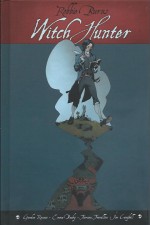
Robbie Burns: Witch Hunter


By Gordon Rennie, Emma Beeby, Tiernen Trevallion, Jim Campbell & Jerry Brannigan (Renegade Arts Entertainment)
ISBN: 978-0-99215-085-3

Win’s Christmas Gift Recommendation: a graphic joy beyond compare… 10/10

Robert Burns was born in 1759 in Alloway. His father was a farmer who went to great lengths to ensure that his children were properly educated. Robert was schooled in the classics, French and Latin and began his creative writing when he was fifteen.

He led a successful, tempestuous life – particularly favouring boozy carousing and roistering escapades with the ladies – and died in 1796 aged 37.

As well as his dialectical and vernacular poetry, Burns selflessly preserved a wealth of traditional Scottish songs and folklore – particularly the bizarre arcane bestiary of supernatural entities God-fearing folk of the 18th century believed in – and is more popular today than he has ever been.

He is the only poet in history to have his own globally celebrated holiday, with his birth anniversary on January 25th an affair universally honoured by food, drink, recitations and well-loved scary stories…

This stunning re-imagining of the venerable wordsmith by scripters Gordon Rennie (Necronauts, Cabalistics Inc., Judge Dredd) and Emma Beeby (Doctor Who, Judge Dredd), breathtakingly illustrated by relative newcomer Tiernen Trevallion (2000AD, Judge Dredd) and lettered by Jim Campbell, owes as much to the modern fashion for stylish tongue-in-cheek horror comedies like Shaun of the Dead, Lesbian Vampire Killers and I Sell the Dead as the beguiling and frequently fantastical works of the poet, but the skilful interweaving of Burns’ immortal lines with a diabolically clever but simple idea make this tale an unforgettable treat whether pages or screens float your particular boat…

Think of it this way: in all those sterling supernatural sonnets and sagas, Burns wasn’t reinterpreting his elders’ supernatural folk tales or exercising a unique imagination, he was simply quoting from his diary…

The wee drama unfolds one night in Ayrshire in 1779 when rascally young gadabout Robbie finds himself on the wrong end of an angry man’s fist after playing fast and loose with the irate hulk’s intended bride. However, even though all the lassies fall for the blithe blather of the self-proclaimed poet, the battered man himself knows he has not yet found his true muse…

Half-drunk and well-thumped, the farmer’s son heads his horse for home but is drawn to uncanny lights emanating from haunted, drear abandoned old Alloway Kirk. Dangerously enthralled he then espies a scene out of Hell itself as witches and demons cavort in a naked ecstasy of dark worship to the satanic master “Old Clootie”…

The lad’s enrapt attention is only broken by a heavy pistol shoved in his ear by a stealthy pair also watching the shocking ritual. Old Mackay is a daunting figure kitted out like a wrinkled human arsenal but Robbie’s attention cannot stray from the dangerous codger’s comely companion Meg, the most astounding woman he has ever seen.

Unfortunately the confrontation between the mortal voyeurs has resulted in Burns’ “innocent” blood being spilled and the satanic celebrants have caught wind of it…

Soon all the denizens of Hell are howling after the ‘mazed mortals but things are not as they seem. The outlandish pair are actually Witch Hunters, ferociously skilled in sending all Satan’s minions back to the Inferno and always armed to the teeth with a fantastic array of ingeniously inventive ordnance…

Having fought free of the black Sabbat, the mortals take flight with the screaming witches in pursuit and when one grabs Robbie as he rides pillion on Meg’s horse, the dazed, half-soused lad blasts the beast with one of his companions’ blessed flintlock pistols.

Tragically in the selfsame altercation the pursuing she-devil had opportunity to mark him with her talons and the would-be poet promptly sobers up when he is informed that he has only three days left to live…

With mounting terror he learns that most mortals so infected become willing thralls of the hellions, but when a seductive minion of The Pit comes for him the next night, the scribbler somehow fends it off long enough for the suspiciously near-at-hand Meg to spectacularly despatch it back to the brimstone realms…

Concluding that’s there might be something of worth to the Burns boy, Mackay and Meg resolve to teach him how to be a true Witch Hunter so that he can defend himself when the horrors come in full strength to collect the Devil’s due. Of course that’s only three days hence…

Renegade are a publisher who value fact as well as fiction and this superb full-colour hardback comes with a fine selection of factual features beginning with a lavish history and appreciation of Scotland’s greatest poet in Robbie Burns: a Biography’ by author and historian Jerry Brannigan as well as ‘Selected Poems’ which provides a tantalising entrée into the uniquely impassioned and eerie world of the grand imagineer with a sampling of some of his most famous works embellished and beguilingly illustrated with a wealth of Trevallion’s pencils sketches of Bogles and Brownies, Spunkies and Sirens and even senior Witch Hunter Mackay.

The rhythmic reveille includes Scots Wha Hae, the totally crucial, groundbreaking spooky saga Tam o’ Shanter (A Tale), the evocative A Red, Red Rose, A Man’s A Man For A’ That, the delirious Address To The Deil and most moving lament Ae Fond Kiss, And Then We Sever…

Smart, action packed, skilfully suspenseful, uproariously funny, divinely irreverent and genuinely scary or sad by turn, Robbie Burns Witch Hunter is a gloriously compelling and truly mesmerising romp: a doom-laden, wisecracking rollicking love story no sensitive soul or jaded comics fan could possibly resist. It’s even educational too…
Robbie Burns: Witch Hunter © 2014 Renegade Arts Entertainment, Gordon Rennie, Emma Beeby and Tiernen Trevallion.

To learn more and obtain copies check out Turnaround or Amazon.