Morbius: Preludes and Nightmares


By Roy Thomas, Gerry Conway, Mike Friedrich, Joe Keatinge, Dan Slott, Gil Kane, Ross Andru, Paul Gulacy, Valentine DiLandro, Marco Checchetto & various (MARVEL)
ISBN: 978-1-3029-2592-5 (TPB/Digital edition)

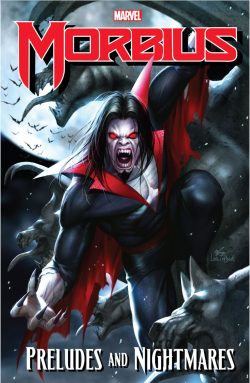
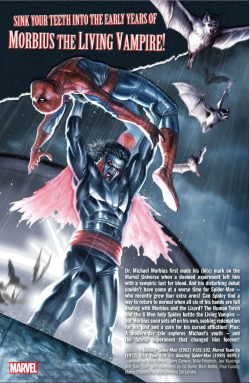
The transition of Marvel’s print canon to whatever passes for celluloid this century seems unstoppable and with their pioneering hero/villain Michael Morbius now a big screen presence, the company fast-tracked a few archival collections to anticipate/support the release. The most useful for casual readers is undoubtedly this slim, sleek tome: an introductory primer perfect for film fans hunting up a little comic book context. It re-presents Amazing Spider-Man #101-102 and 699.1; Marvel Team-Up #3-4; (Adventure into) Fear #20, and fact-packed excerpts from the Official Handbook of the Marvel Universe A-Z #7, spanning October 1971 to February 2013, mixing the origin and earliest 1970s appearances with a relatively latter-day reappraisal.

A fuller archival treatment of his scattered career can be found in a brace of Epic Collections, and I’ll get around to them in the fullness of time.

It begins with The Amazing Spider-Man #101, the second chapter in an anniversary trilogy tale begun by Stan Lee, Gil Kane & Frank Giacoia which saw the wallcrawler accidentally mutate himself, gaining four extra arms…

Now Roy Thomas takes over with ‘A Monster Called… Morbius!’ as the 8-limbed hero desperately seeks a way to reverse his condition. Whilst hiding in Dr. Curt Connors‘ Long Island home/lab, he stumbles across a murderous costumed horror who drinks human blood. The newcomer has just reached shore, from a ship that he left a charnel house…

Making matters even worse is Connors’ sudden arrival in the scaly savage form of The Lizard. Suddenly surprised and always enraged, the saurian attacks, set on killing all intruders…

Amongst the many things banned by the Comics Code Authority in 1954 were horror staples zombies, werewolves and vampires, but changing tastes and rising costs of the early 1970s were seeing superhero titles dropping like flies in a blizzard.

With interest in suspense and the supernatural growing globally, all comics publishers were pushing to re-establish scary comics again, and the covert introduction of a “Living Vampire” in superhero staple Spider-Man led to another challenge to the CCA, the eventually revision of the Code’s horror section and a resurgent rise of supernatural heroes and titles.

For one month Marvel also experimented with double-sized comicbooks (DC’s switch back to 52-page issues lasted almost a year – August 1971-June 1972 cover-dates). Thus, Amazing Spider-Man #102 featured an immense 3-chapter blockbuster brawl beginning with ‘Vampire at Large!’ wherein the octo-webspinner and anthropoid reptile joined forces to hunt a science-spawned bloodsucker after discovering a factor in the bitey brute’s saliva could cure both part-time monsters’ respective conditions.

‘The Way it Began’ abruptly diverges from the main narrative to present the tragic secret origin of Nobel Prize winning biologist Michael Morbius and how be turned himself into a haunted night-horror in hopes of curing a fatal blood disease, before ‘The Curse and the Cure!’ brought the tale to a blistering conclusion and restored the status quo and requisite appendage-count.

Gerry Conway assumed the writer’s role for the third appearance of the living (not dead; never ever dead but living), breathing humanoid predator who drank blood to live, as Marvel Team-Up # 3 (July 1972, illustrated by Rossa Andru & Giacoia) found Spidey and Human Torch Johnny Storm hunting the resurgent Morbius after he attacks student Jefferson Bolt and passes on his plague of thirst. The conflicted scientist still seeks a cure and tracks old colleague Hans Jorgenson to Peter Parker’s college, but his now-vampiric servant Bolt wants just what all true bloodsuckers want in ‘The Power to Purge!’…

The new horror-star was still acting the villain in MTU #4 as the Torch was replaced by most of Marvel’s sole mutant team (The Beast having gone all hairy – and solo – in another science-based workaround to publish comic book monsters who were anything but supernatural) in ‘And Then… the X-Men!’

This enthralling thriller was illustrated by magnificent Gil Kane at the top of his form and inked by Steve Mitchell with the webslinger and X-Men at odds while both hunting the missing Jorgenson. After the unavoidable butting of heads, the heroes united to overcome Morbius and left him for Professor Charles Xavier to contain or cure…

As superheroes continued to decline and horror bloomed, Morbius established himself in Marvel’s black-&-white magazine title Vampire Tales, but returned to four-colour publishing with (Adventure into) Fear #20 (cover-dated February 1973). The title had previously hosted the macabre Man-Thing, and his/its promotion to a solo title gave Morbius opportunity to spread his own wings.

Spawned by scripter Mike Friedrich and artist Paul Gulacy, Jack Abel & George Roussos, ‘Morbius the Living Vampire!’ revealed how he escaped the X-Men and fled to Los Angeles and lived (whenever possible) off victims who deserved his voracious bite. The initial tale also set up a bizarre relationship with Rabbi Krause and Reverend Daemon who sought to cure him, before one was exposed as a human devil, catapulting Morbius into intergalactic conflict that had shaped humanity over millennia. That saga also is fully detailed in the Epic Collections, but frustratingly not here…

Brushing past decades of history and character development, there’s a huge jump to the twenteens and a more nuanced revision of the origin to close this book’s story section, as The Amazing Spider-Man # 699.1 (February 2013, by Joe Keatinge, Dan Slott, Valentine DiLandro & Marco Checchetto) finds Morbius in supermax penitentiary The Raft, ruminating on his childhood in Greece, living with an imminently fatal but unpredictable blood condition, but still finding love, friendship and adventure.

Sadly, as we already know, his Nobel Prize winning research only led to the death of his greatest friend and colleague, the abandonment of his true love and an unlife sentence as a rampaging killer…

Rounding out the red reading, fact-filled picture-packed pages from The Official Handbook of the Marvel Universe A-Z #7, offering dry history and statistics from those intervening years.

A compelling and beguiling bunch of beginnings well told and superbly illustrated, this treat is superficially entertaining but won’t satisfy those with a deep thirst for true knowledge…
© 2021 MARVEL

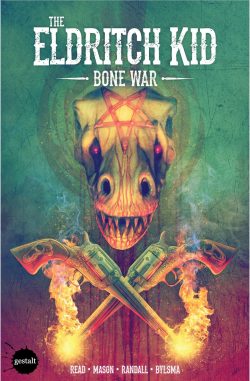
The Eldritch Kid™ volume 2: Bone War 


By Christian D. Read, Paul Mason, Justin Randall & Wolfgang Bylsma (Gestalt Publishing) 
ISBN: 978-1-922023-92-6 (TPB/Digital edition) 

Felt like a scary western today. Dug this one up… 

There was a time, not so very long ago, when all of popular fiction was bloated and engorged with tales of Cowboys and Indians. As always happens with such periodic populist phenomena – such as the Swinging Sixties’ Super-Spy Boom, the Vampire Boyfriend or recent Misunderstood Teens vs Corrupt Adult Dystopias trends – there was a goodly amount of momentary merit, lots of utter dross and a few spectacular gems. 

Most importantly, once such surges peter out, there’s also always a small cadre of frustrated devotees who mourn the passing and resolve to do something to venerate or even revive their lost and faded favourite fad… 

After World War II, the American family entertainment market – for which read comics, radio and the rapidly burgeoning television industry – were comprehensively enamoured of the clear-cut, simplistic sensibilities and easy, escapist solutions offered by Tales of the Old West: at that time already a firmly established standby of paperback publishing, movie serials cinematic blockbusters and low-budget B-feature films. 

I’ve often ruminated on how and why, simultaneously, the dark, bleakly nigh-nihilistic and left-leaning Film Noir genre quietly blossomed alongside that wholesome rip-snorting range-&-rodeo revolution, seemingly only for a cynical minority of entertainment intellectuals who somehow knew that the returned veterans still hadn’t found a Land Fit for Heroes… but perhaps that’s a thought for another time and a different review. 

Even though comics encompassed Western heroes from the get-go (there were cowboy strips in the premier issues of both New Fun and Action Comics and even Marvel Comics), the post-war boom years saw a vast outpouring of titles with gun-toting heroes ousting the rapidly-dwindling supply of costumed Mystery Men. True to formula, most of these pioneers ranged from transiently mediocre to outright appalling… 

Despite minor re-flowerings in the early 1970s and mid-1990s, Western strips have largely vanished from funny book pages: apparently unable to command enough mainstream support to survive the crushing competition of garish wonder-men and furiously seductive futures. 

Europe and Britain also embraced the Sagebrush zeitgeist, producing some extremely impressive work, before France, Belgium and Italy made the genre emphatically their own by the end of the 1960s. They still make the best straight Western strips in the world for an avid audience unashamedly nurturing an appetite for them… 

Fantasy and Horror stories, on the other hand, have never really gone away and this utterly outrageous and supremely entertaining sequel sagebrush saga from Australian raconteur Christian Read his latest visualiser Paul Mason (with colourist Justin Randall and letterer/editor Wolfgang Bylsma) superbly blends time-honoured tropes of the wild west with sinister sorcerous sensibilities to create a bewitching alternate reality where dark bloody deeds are matched by dire demonic forces and decent guys called upon to combat them have to dabble in the diabolical too… 

Once upon a time in the west, the world changed and magic – although always real and rare – became part and parcel of everyday life… 

Without preamble the adventuresome action opens with a gunfight against an extremely unpleasant and grudge-bearing witch…  

Our narrator is an urbane and erudite Oxford-educated shaman detailing his life following his return to the land of his birth. His recollections began in the previous volume and began in Spring 1877: the great Indian Wars were over. Custer was dead but so was Crazy Horse. The Whites were greedily covering the entire country and an educated man with the wrong skin tones was reduced to playing scout for a bunch of barely literate morons wagon-trekking across the plains to California. They need him but regard their supremely capable guide with suspicion, disdain and barely-disguised disgust… 

Wicasa Waken, outcast Shaman of the Oglala Lakota – AKA Ten Shoes Dancing of the mighty Sioux and lately graduated Master of Arts and Literature, Oxford, England (1875) – always knew devil magic when he smelled it, but – since his teachers taught him to treasure human life – he remained faithful to their training and always sought to do good. That got a lot harder after saving a strange white from five-headed snakes and zombies … 

Once recovered, the “victim” eagerly joined the fight: his accursed guns making short work of the ravening Heyokas and Ten Shoes Dancing realised he had made the rather prickly acquaintance of a modern Western Legend and celebrated dime novel hero – The Eldritch Kid. 

Sadly like most heroes finally-met, he’s a surly, taciturn, creepy freak. basking in hero-worship, hot vittles and wanton female attention… 

It’s not just this becoming-nation America that is awash with blood and wickedness. The entire world is swamped with boggles, spectres and far worse, but since the War Between the States, the Kid had achieved a certain notoriety for dealing harshly and permanently with all things supernatural and predatory. 

Nevertheless, he’s a mean, mercenary bastard and a tough man to like for the philosophically inclined, poetry-loving Ten Shoes, but circumstances keep them together. Faced with daily mystic mayhem, the mismatched heroes bond even after the Lakotan learned his personal patron god Lord Hnaska was deeply troubled by the cold, dark deity sponsoring the magic-guns toting Kid. Of course, the Great Spirit was far more concerned with the crawling things that hungered for human morsels, and allowed a loveless alliance to be forged. Eventually, the Kid finally opened up enough to share the history that made him the most feared gunhawk in the West. 

In 1865 Camp Elmira, New Jersey held Confederate prisoners.. The detention centre was a hellhole even by human standards, but when a demon began taking inmates, one of the terrified, beaten, sitting duck captives was offered a deal by an ancient northern god. Odin, grim King of Death, was unhappy with beasts and night things increasingly infesting Earth and offered a trade: power for service… 

After a suitably painful and gory “offering” the prisoner was given just enough of a supernatural advantage to kill the monsters – human and otherwise – and escape. Wielding a brace of Rune-Pistols, he’s been doing his Lord’s work ever since… 

That mission continues here as the Diabolist Duo inconclusively clash with bounty hunting old enemy Jacinta Gun-Gunn, and in the aftermath are recruited by former palaeontologist Mr. Othniel. He wants them to steal back his greatest discovery, the full and bejewelled skeleton of a lost prince of a civilisation that perished millions of years previously.  

The astounding artefact was swiped by his rival “Doc” Drinker, but theirs is not a regular scientific dispute. Othniel is a necromancer who survived his own decapitation and now resides a head in a jar, and Madam Drinker travels with a coterie of witches and unruly women. Both parties clearly have secret agendas but Ten Shoes Dancing and the Eldritch provisionally accept the generous commission because of the most pertinent fact: the skeleton has come back to arcane unlife and recalled revenant subjects from its long-fallen, mystically malign dinosaur empire of Tzenshaitchan to raise fresh Hell across the Badlands… 

Thanks to timely assistance from the Lakotan’s Frog-God patron, our heroes are made aware of the true situation and switch sides when  a better offer is made, but they are still bushwacked by Drinker’s presumed ally the Ani Kutani Witch Tsintah who has her own sinister scheme in play and even nastier masters to answer to… 

With dinosaur skeletons tearing the countryside up, the gunslingers are kept too busy to stop Othniel building himself a newer and more deadly body and the witch summoning the almighty horror called the Priest King and restoring an even earlier age of bloody sacrifice and life-extending butchery… 

And as the battle intensifies and all the arcane ages of terror converge to create a charnel ground of warfare, humanity’s deity Odin arrives… 

Ragnarok, anyone? 

The tantalising conclusion is supplemented by a cover/chapter break gallery by Nichola Scott, Douglas Holgate, Emily K. Smith & James Brouwer; original art pages from Mason and Read’s original script pages.  

Rowdy, rousing, purely bonkers and spectacularly action-packed, The Bone War is a sharp, satisfying and mordantly funny yarn to delight lovers of genre fiction and witty mash-ups. Black hats, white hats, lost worlds, haunts and horrors, stunning visuals and macabre twists – what more could you possibly ask for? 

Apparently, another sequel, so hopefully I’ll be getting to that too in the fullness of time… 
© 2017-2019 Christian Read, Paul Masan & Gestalt Publishing Pty Ltd. All rights reserved. 

A1 – The World’s Greatest Comics 


By various (Atomeka/Titan Comics) 
ISBN: 987-1-78276-016-0 (HB) 

We were saddened to learn of the sudden death of Garry Leach on March 26th. An extremely talented artist best known for Illustrating Marvelman/Miracleman, Dan Dare, and The V.C.’s, he was also a dedicated mover and shaker behind the scenes; quietly helping many other creators on the way to their own fame and glory. Our condolences go out to his friends and family, and here’s a review of one his most important and significant ventures… 

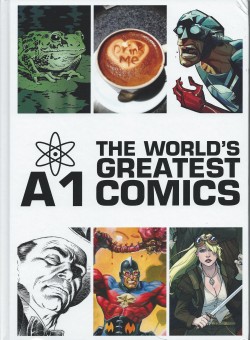
A1 began in 1988 as an anthology showcase dedicated to comics creativity. Freed from the usual strictures of mainstream publishers, the project consequently attracted many of the world’s top writers and artists to produce work at once personal and experimental, comfortingly familiar and, on occasion, deucedly odd. 

Editors Garry Leach & Dave Elliott periodically returned to their baby and in 2013 the title and concept were resurrected under the aegis of Titan Comics to provide more of the same. 

Similarly committed to past excellence and future triumphs – and following the grandest tradition of British comics – this classic compendium offered the same eclectic mix of material old and new… 

After a colossal 2-page dedication/thank you to everyone from Frank Bellamy to Face Ache in ‘The Dream Days are Back: The One’s Especially For You…’ the cartoon carnival commences with a truly “Golden Oldie” as Joe Simon & Jack Kirby (and inked by Al Williamson) provide science fiction classic ‘Island in the Sky’ – which first surfaced in Harvey Comic’s Race for the Moon #2 September, 1958. Here an expired astronaut returns from death thanks to something he picked up on Jupiter… 

Each tale here is accompanied by fulsome creator biographies and linked by factual snippets about most artists’ “drug of choice”. These photographic examples of coffee barista self-expression (with all ‘Latte Art’ courtesy of Coffee Labs Roasters) are followed by illustrator Alex Sheikman & scripter Norman Felchle’s invitation to the baroque, terpsichorean delights of the ‘Odd Ball’. 

The fantastic gothic revisionism resumes after another coffee-break as the sublime Sandy Plunkett details in captivating monochrome the picaresque perils of life in a sprawling urban underworld with his ‘Tales of Old Fennario’. 

‘Odyssey: A Question of Priorities’ by Elliot, Toby Cypress & Sakti Yuwono is a thoroughly up-to-date interpretation of pastiche patriotic avenger Old Glory, who now prowls modern values-challenged America, regretting choices he’s made and the timbre of his current superhero comrades… 

‘Image Duplicator’ by Rian Hughes & Dave Gibbons is, for me, the most fascinating feature included here, detailing and displaying comics creator’s admirable responses to the appropriation and rapine of comic book images by “Pop” artist Roy Lichtenstein. 

In a move to belatedly honour the honest jobbing creators simultaneously ripped off and denigrated by the “recontextualisation” and transformation to High Art, Hughes & Gibbons approached a number of professionals from all sectors of the commercial arts and asked them to re-appropriate Lichtenstein’s efforts. 

The results were displayed in the exhibition Image Duplicator with all subsequent proceeds donated to the charity Hero Initiative which benefits comic creators who have fallen on hard times. 

In this feature are the results of the comic book fightback with contributions from Hughes, Gibbons, FuFu Frauenwahl, Carl Flint, Howard Chaykin, Salgood Sam, Mark Blamire, Steve Cook, Garry Leach, Dean Motter, Jason Atomic, David Leach, Shaky Kane, Mark Stafford, Graeme Ross, Kate Willaert & Mitch O’Connell. 

Master of all funnybook trades, Bambos Georgiou offers his 2011 tribute to DC’s splendidly silly Silver Age in the Curt Swan inspired ‘Weird’s Finest – Zuberman & Batguy in One Adventure Together!’ and Dominic Regan crafts a stunning Technicolor tornado of intriguing illumination as Doctor Arachnid has to deal with cyber Psychedelia and a divinely outraged ‘Little Star’… 

Bill Sienkiewicz’s ‘Emily Almost’  first appeared in the original A1 #4; a bleak paean to rejection seen here in muted moody colour, after which Scott Hampton revisits the biblical tale of ‘Daniel’ and Jim Steranko re-presents his groundbreaking, experimental multi-approach silent story ‘Frogs!’ before following up with ‘Steranko: Frogs!’ – his own treatise on the history and intent behind creating the piece 40 years ago… 

‘Boston Metaphysical Society’ is a prose vignette of mystic Steampunk Victoriana written by Madeleine Holly-Rosing from her webcomic, ably illustrated by Emily Hu, whilst ‘Mr. Monster’ by Alan Moore & Michael T. Gilbert (with inks from Bill Messner-Loebs) is a reprint of ‘The Riddle of the Recalcitrant Refuse!’ first found in #3 (1985) of the horror hunter’s own series. It recounts how a dead bag-lady turns the city upside out when her mania for sorting junk transcends both death and our hero’s best efforts… 

‘The Weirding Willows: Origins of Evil’ by Elliot, Barnaby Bagenda & Jessica Kholinne is one of the fantasy features from the later A1 iteration – a dark reinterpretation of beloved childhood characters like Alice, Ratty, Toad and Mole, which fans of Bill Willingham’s Fables should certainly appreciate… 

‘Devil’s Whisper’ by James Robinson & D’Israeli also came from A1 #4, and features Matt Wagner’s signature creation Grendel …or does it? 

Stechgnotic then waxes lyrical about Barista art in ‘The Artful Latte’ after which ‘Melting Pot – In the Beginning’ by Kevin Eastman, Eric Talbot & Simon Bisley ends the affair; revisiting the ghastly hellworld where the gods spawned an ultimate survivor through the judicious and repeated application of outrageous bloody violence. 

Of course it’s a trifle arrogant and rather daft to claim any collection as “The World’s Greatest Comics” and – to be honest – these weren’t. There’s no such thing and never can be… 

However, this absorbing, inspiring oversized collection does contain plenty of extremely good, wonderfully entertaining material by some of the best and most individualistic creators to have graced our art form. 

What more can you possibly need? 
A1 Annual © 2013 Atomeka Press, all contents copyright their respective creators. ATOMEKA © 2013 Dave Elliott & Garry Leach. 

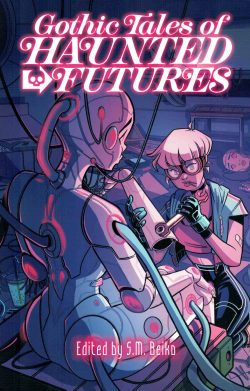
Gothic Tales of Haunted Futures


By Trina Robbins, Anne Timmons & Scott A. Ford; Letty Wilson; Luz Bianca & Kaylee Rowena; Mikaela Lucido & Jade Zhang; Leizl Buenaventura & Saida Temofonte; Cameron Lucente; Jamie Isfeld; Cait Zellers; Sztehlo; Leonie O’Moore & Skylar Partridge; Arlo Everett, B. Sparks & Paul Coy; Allison Pang & Irma ‘Aimo’ Ahmed; Matt McGrath & V. Gagnon; Joyce Chau; Skylar Kardon; Merissa Mayhew & Lyndon Radchenka: edited by S.M. Beiko (Renegade Arts Entertainment)
ISBN: 978-1-989754-03-0 (TPB) eISBN: 978-1-989754-04-7 (digital)

Sometimes, it’s all about enthusiasm and the urge to create and collaborate. Here, I suspect someone said “there’s not enough romance comics” and someone else said “I like scary stories” and another person chipped in “what about science fiction?” and the next thing you know, there’s an entire anthology of spooky, futuristic love stories all mashed-up for discerning comics tastes, just waiting to be kick-starter-ed…

The result is utterly wonderful…

Following an inspirational Foreword by editor S.M. Beiko, we take off for the future with veteran cartoonist Trina Robbins in collaboration with Anne Timmons, Scott A. Ford & Lyndon Radchenka, who reveal a patient devotion that outlasts the grave on the ‘Ghost Planet’, after which a moody illustration from Mika segues into Letty Wilson’s ‘Glasshouse’, which finds an unexpected bountiful blessing from a passing stranger delivered to a strange community in dire need of renewal…

Luz Bianca & Kaylee Rowena recount a fateful chance encounter ‘In the Shadow of the Moon’, before Mikaela Lucido & Jade Zhang update the old chestnut of party kids and dangerous dares in ‘Bloody Mary and the Smart Mirror’, after which Leizl Buenaventura & Saida Temofonte detail how a doomed astronaut finds a spectral reason to live after a visitor helps him go ‘Home’..

‘Under the Bed’ depicts a grim battle between life and death by Cameron Lucente, and following a moody spot illo from Katie Fleming, an unexpected down side to social media relationships is highlighted by Jamie Isfeld’s ‘@LissaTruLuv’…

Alaire Racocot’s monochromatic night illustration leads to Cait Zeller’s colourful tale of ‘The Lichtenberg Lady’ lighting up the lonely nights of a solitary lightning strike survivor, after which a lonely soul rediscovers past passion through musical recordings in ‘Ghosting’ (by Sztehlo) whilst – following a chaotic clinch courtesy of Kielamel Sibal – Leonie O’Moore, Skylar Partridge & Lyndon Radchenka find love for an ancient creature at the bottom of the sea in ‘Sunken Scream’…

A hard science veneer burnishes quasi-spiritual romp ‘Slow Orbit’ by Arlo Everett, B. Sparks & Paul Coy, as an aging computer exorcist looks for an exit strategy that will keep her breathing in deep space and finds love is the answer, before more potent pictorial moments of madness – by Caeles and Seren Krakens – convey us to ‘A Certain Tea House’ where Allison Pang & Irma ‘Aimo’ Ahmed reveal the regrets, ruminations and revenge of an aged spaceport courtesan who repays an old debt with her last breaths…

Matt McGrath, V. Gagnon & Lyndon Radchenka then detail the First Contact repercussions of ancient civilisation ‘The Crowned Ones’ as they impinge on the life of a lost human explorer, after which Joyce Chau reveals how a certain ‘Gap’is closed when a space scavenger awakens a long-depowered and rather clingy automaton, and Skylar Kardon & Lyndon Radchenka’s ‘New Blood’ details how even in Tomorrow’s City of Lights, the erotic allure of a vampire is more than some mortals can withstand…

Merissa Mayhew ends the emotional narratives with a story of hope sustained and finally fulfilled in ‘Until One Day’ as frustrated Josephine endures constant death and rebirth to finally be with the woman of her dreams…

Topped off with a brace of (possibly cover?) illustrations from Nicholai Avigdor Melamed and Cameron Lucente; full ‘Creators’ biographies, and list of ‘Backers’ who contributed to this book’s publication, Gothic Tales of Haunted Futures is a delicious compote of dark passions, sinister fancies and sardonic experiences, perfect for stirring passions and pleasing the eyes.

Gothic Tales of Haunted Futures © 2020 S.M. Beiko. Individual © belongs to each creator in this book. All rights reserved.

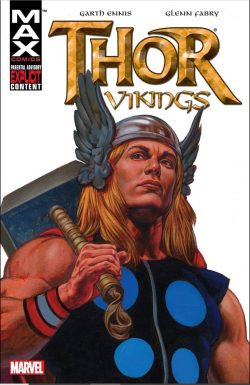
Thor: Vikings


By Garth Ennis, Glenn Fabry & various (Max Comics/ MARVEL)
ISBN: 978-0-7851-1175-7 (TPB)

It’s the anniversary year of Marvel’s thunder god. Here’s a strange saga sparked during that time that will delight some and annoy the leather pants off others. Still, in my fathers’ Valhalla there are many mansions… unless the drunken warriors have wrecked them…

In the middle of 1962, Stan Lee & Jack Kirby launched their latest offbeat superhero creation in anthology monsters-and-mysteries title Journey into Mystery #83. The tale introduced disabled American doctor Donald Blake who took a vacation in Norway only to encounter the vanguard of an alien invasion fleet.

Fleeing in terror, he was trapped in a cave wherein lay an old, gnarled walking stick. When, in helplessness and frustration, the puny human smashed the cane into the huge boulder obstructing his escape, Blake’s insignificant frame was transformed into the bold and brawny Norse God of Thunder, Thor!

The series grew from formulaic beginnings battling aliens, commies and cheap thugs into a vast, panoramic and breathtaking cosmic playground for Kirby’s burgeoning imagination. Anthological Journey into Mystery inevitably became Mighty Thor where, after years of bombastic adventuring, the inconsistencies of the Blake/Thor relationship were re-examined and finally clarified to explain how an immortal godling could also be locked within a frail short-lived mortal.

That startling saga took the immortal hero back to his long-distant youth and finally revealed that the mortal surgeon was no more than an Odinian construct designed to teach the Thunder God humility and compassion…

As decades passed the series underwent numerous reboots and re-imaginings to keep the wonders of fabled Asgard appealing to an increasingly jaded readership. An already exceedingly broad range of scenarios spawned even greater visual variety after the Thunderer’s introduction to the pantheon of cinematic Marvels with his ongoing triumphs making him a bona fide blockbuster movie star. To be frank, there were always comics ventures that allowed for some fairly broad interpretations of the god and his universe, such as this rousing yarn…

In this scintillating gore-spattered traditional fantasy yarn – collecting Thor: Vikings #1-5, which originally ran from July- November 2003 – scripter Garth Ennis  and illustrator Glenn Fabry indulge their inner barbarians with a yarn strictly not for the young or sensitive…

In 1003 AD, pitiless reiver Harald Jaekelsson has just finished destroying the village of Lakstad when its shaman curses the lawless raiders who have destroyed his family and friends.

Maybe, if Harald hadn’t butchered him at that moment, allowing the elders’ blood to feed the runestone he held, the sadistic killer’s ship and crew would not have spent the next thousand years crossing the ‘Endless Ocean’ to the New World…

On finally arriving in the port of New York, the undead accursed monsters set about their old ways of rapine and slaughter, before their rampage is briefly halted by a challenge from the sky as Thunder God Thor demands their surrender…

Sorcery-stained zombie lord Harald is unimpressed and as his undead crew grotesquely devastate Manhattan, he savagely beats the god nigh unto death. With his longship now sailing the skies above the city, the northman basks in carnage in his new-won ‘Kingdom of Iron’, unaware that the Thunderer still lives and has been joined by Sorcerer Supreme Doctor Strange…

As Harald builds his throne on the city’s highest tower, the magical medic sees to Thor and marshals resources to battle a foe that outmatches him in mystic might. ‘Time Like a River’ finds the embattled heroes exploring chronal echoes, seeking a solution to the old wise man’s curse… and finding it in the blood he spilled casting it.

To counter Harald’s horde, Strange searches history for the old man’s bloodkin, and plucks them from their own times to battle the rapacious revenants. Outcast and frustrated Viking battle-maiden Sigrid, Teutonic knight Magnus of the Danesand disillusioned Luftwaffe Ace Oberstleutnant Erik Lonnroth arrive in the ravaged city just after the Marines are slaughtered and Mighty Avengers admit defeat and regroup.

Horrified by the atrocities being perpetrated, the time-strayed trio determine to ‘Fight the Good Fight’, suitably enhanced by Strange’s sorceries…

As Jaekelsson squats on his high seat, the heroes go to work with a will, and soon the Viking lord is compelled to join the battle. Once more easily outmatched by the ruthless reiver, the outraged god needs all he’s got to win the day and save his people in ‘See You in Valhalla’…

Although shocking at the turn of the century, the Asgardians and greater Marvel pantheon have by now fully integrated into our movie-led culture, and contemporary readers won’t be taken aback at the themes and uncompromising action scenes so lovingly crafted here. Thor: Vikings is bold and brutal, filled with action and leavened with dark, dark humour and well worth any thunder follower’s time and attention.
© 2021 MARVEL

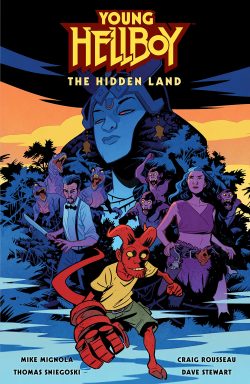
Young Hellboy: The Hidden Land


By Mike Mignola, Thomas Sniegoski, Craig Rousseau, Dave Stewart & Clem Robins (Dark Horse Books)
ISBN: 978-1506723983 (HB) eISBN: 978-1-50672-399-0

Towards the end of World War II an uncanny otherworldly baby was confiscated from Nazi cultists by American superhero The Torch of Liberty and a squad of US Rangers, moments after his eldritch nativity on Earth. The good guys had interrupted a satanic ritual predicted by parapsychologist Professor Trevor Bruttenholm and his associates, who were waiting for Hell to literally come to Earth…

The heroic assemblage was stationed at a ruined church in East Bromwich, England when the abominable infant with a huge stone right hand materialised in an infernal fireball. “Hellboy” was subsequently raised by Bruttenholm, and grew into a mighty warrior engaged in fighting a never-ending secret war against the uncanny and supernatural. The Prof assiduously schooled and trained his happy-go-lucky foundling whilst forming and consolidating an organisation to destroy arcane and occult threats – the Bureau for Paranormal Research and Defense.

After years of such devoted intervention, education and warm human interaction, in 1952 the neophyte hero began hunting down agents of the malign unknown, from phantoms to monsters as lead agent for the BPRD. Hellboy rapidly became its top operative; the world’s most successful paranormal investigator. As decades passed, Hellboy gleaned snatches of his origins and antecedents, learning he was a supposedly corrupted beast of dark portent: a demonic messiah destined to destroy the world and bring back ancient powers of evil. It is a fate he despised and utterly rejected…

It was also a far cry from those halcyon early days, where the devil child grew up in a nurturing if always weird environment and had a fair few fantastic adventures…

This cheery cheeky romp by Mignola, Tom Sniegoski and illustrated by Craig Rousseau gathers 4-part miniseries Young Hellboy: The Hidden Land and delivers a rollicking round of old-world fantasy fun.

In 1947 the hero-struck, comic-consuming little imp is accompanying extremely patient father figure Bruttenholm on an archaeological dig when their plane is brought down by a fellow passenger. This religious fanatic thinks he’s saving humanity from the infernal, but his actions land the survivors on a desolate atoll stuffed with ape people, giant monsters and worse. It’s also on the other side of a dimensional barrier… and for a very good reason…

Separated from the Prof by humongous crabs, dinosaurs, a colossal ape and that really persistent Christian, the little demon almost dies when he’s suddenly saved by a dream…

It’s actually a jungle girl who turns out to be long-missing aviatrix Scarlet Santiago, the “Sky Devil” who’s in all his favourite reading matter…

Although she keeps a big secret from the boy, she introduces him to the monkey folk who rescued her long ago, even as that pesky fanatic answers another clarion call, and awakens the reason the island has been hived off from reality for eons. All too soon an antediluvian vampire queen is marauding again, orchestrating the revival of her empire of blood and working out the fine detail involved in getting back to the earth that so long go banished her…

Can the assorted good guys, jungle girls, great apes and simian shamans stop her before everyone gets it in the neck?

Read on…

Epic and outrageous in the best Willis O’Brien and Ray Harryhausen manner, this manic masterpiece is augmented by a copious ‘Young Hellboy: The Hidden Land Sketchbook’ – annotated by Katii O’Brien – which closes this treasure hoard of hairsbreadth escapes by revealing story-layouts, doodles, roughs, designs and pencilled pages, all accompanied by creator comments and garnished with a full cover and variants gallery by Mignola, Dave Stewart, Rachele Aragno, Wylie Beckert and Anthony Carpenter.

This is another perfect example of comics storytelling at its very best: offering astounding supernatural spectacle, amazing arcane action, momentous mystical suspense and simply huge hairy handfuls of honest fun – something every fear fan and adventure aficionado will enjoy.
Young Hellboy™ and © 2021 Mike Mignola. Hellboy™ and all other prominent featured characters are trademarks of Mike Mignola. All rights reserved.

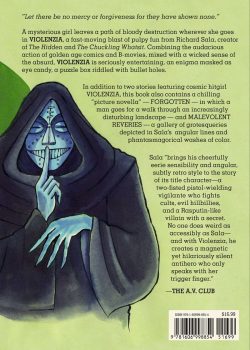
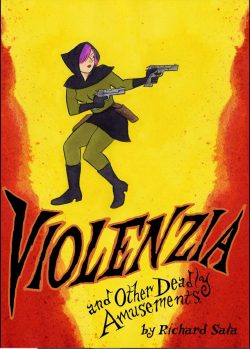
Violenzia and Other Deadly Amusements


By Richard Sala (Fantagraphics Books)
ISBN: 978-1-60699-885-4 (TPB)

Richard Sala was a lauded and brilliantly gifted exponent and comics creator who deftly blended beloved pop culture artefacts and conventions – particularly cheesy comics and old horror films – with a hypnotically effective ability to tell a graphic tale.

A child who endured sustained paternal abuse, Sala grew up in Chicago and Arizona. Retreating into childish bastions of entertainment, he eventually escaped family traumas and as an adult earned a Masters Degree in Fine Arts. He became an illustrator after rediscovering a youthful love of comic books and schlock films that had brightened his youth.

His metafictional, self-published Night Drive in 1984 led to appearances in legendary 1980s anthologies Raw, Blab! and Prime Cuts, with animated adaptations produced for Liquid Television.

He died in 2020 aged 65, but his work remains welcomingly atmospheric, dryly ironic, wittily quirky and mordantly funny; indulgently celebrating childhood terrors, gangsters, bizarre events, monsters and manic mysteries, with a host of women as his stars of choice: girl sleuth Judy Drood, the glorious trenchant storybook investigator Peculia and this particular femme so very fatale…

Sala’s art is a joltingly jolly – if macabre – joy to behold and shone on many out-industry projects such as his work with Lemony Snickett, The Residents and even Jack Kerouac: illustrating the author’s outrageous Doctor Sax and The Great World Snake.

This compelling mystery melange from 2015 combines a quartet of short comics treats commencing with the eponymous ‘Violenzia’: a vividly coloured and constructed pastiche of Hammer Horror films of a mystery maid and her gleaming guns, rousing villagers and pitilessly dealing with a sinister murder cult in the manner they deserve all while getting ever-closer to a very familiar monk-like mastermind…

That smartly witty twisty tale segues to an eerie sepia sampled soliloquy, poetically and despondently following a foredoomed soul retracing his steps until horrifying recalling what he’d ‘Forgotten’…

Macabre musings in the mode of a child’s alphabet primer, ‘Malevolent Reveries – An Alphabetical Exhibition’ mixes rhyme with crafty pictures of the artist’s cartoon canon of characters from ‘An Afternoon of Appalling Apparitions’ to ‘Zero Hour on Zombie Island’ cannily calm the nerves before climactic chills are unleashed when ‘Violenzia Returns’. This time her gunsights are set on the Council of Augers and her dogged pursuit throws up some sudden surprises and a whiff of doomed romance; or possibly just doom…

Clever, compelling and staggeringly engaging, this fabulous farrago of fantastic fiends and ferocious fights (also available in digital formats) is a perfect introduction to Sala’s worlds: a sublimely nostalgic escape hatch back to days when unruly children scared themselves silly under the bedcovers at night, and an ideal gift for idle moments for the big kid in your life – whether he/she/they are just you, imaginary or even relatively real…

Violenzia and Other Deadly Amusements © 2015 Richard Sala. This edition © 2015 Fantagraphics Books All rights reserved.

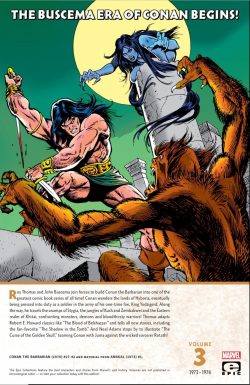
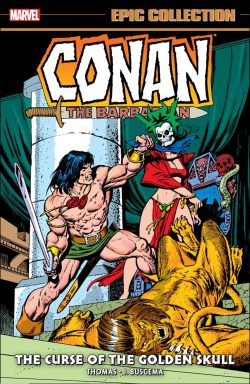
Conan the Barbarian Epic Collection volume 3 1973-1974: The Curse of the Golden Skull


By Roy Thomas, John Buscema, Neal Adams, Rich Buckler, Ernie Chan & various (Marvel)
ISBN: 978-1-3029-2655-7 (TPB)

Win’s Christmas Gift Recommendation: Savagely Sensational Sagas for All Seasons… 8/10

During the 1970’s the American comic book industry opened up after more than 15 years of calcified publishing practises in response to the censorious, self-inflicted Comics Code Authority: created to police product after the industry suffered its very own McCarthy-style 1950s Witch-hunt.

One of the first genres revisited was Horror/Mystery comics and from that sprang translated pulp star Conan the Cimmerian; initially crafted by Roy Thomas & Barry Windsor-Smith. Despite some early teething problems – including being cancelled and reinstated in the same month – the comic adventures of Robert E. Howard’s wandering warrior quickly became as big a success as the revived prose paperbacks which had heralded a world resurgence in tales of fantasy and the supernatural.

After decades away, the brawny brute recently returned to the Aegis of Marvel, who’s first bite of the cherry was retroactively subtitled “the Original Marvel Years” due to the character’s sojourn with other publishers and intellectual properties rights holders.

This third compendium of action fantasy reprints Conan the Barbarian #27-42 plus material from the first Annual and spans June1973 to May 1973 – a period when he was becoming the darling of the Comics world and when artist John Buscema made the hero his very own.

Story content was evermore redolent of pulp-oriented episodic action – much of it based on Thomas’ adaptations of Howard’s (and sometimes, other writers) “heroic” rather than fantasy fiction. Also on show is the inking of long-time Conan illustrator Ernie Chan, using at this time for reasons unimportant now the pen-name “Ernie Chua”.

First up is ‘Blood of Bel-Hissar’: a tight, taut tale of banditry, treacherous hill-chieftains and jinxed gems set in the aftermath of the recently ended War of the Tarim, followed by a gripping jungle-set horror story. ‘Moon of Zembabwei’sees the Cimmerian battling rival thief Thutmekri, witch-dancers and a golden monster ape before ‘Two Against Turan’has the sell-sword joining the army of Howard’s analogue of an Arabic super-state (and how prescient was that?).

Effete and ineffectual King Yildiz – father of Conan’s greatest human enemy, Yezdigerd – features in a tale displaying all of the barbarian’s most compelling qualities as he rescues agitator and new drinking buddy Ormraxes from the city’s torturers: a mistake that almost costs him his life…

Closely following is ‘Hand of Nergal’: another mystic adventure and one not taken directly from a Howard original, although it is derived from a Lin Carter novelette based on Howard’s notes. When Yildiz’s legions clash with the armies of a rebel satrap, sole survivor Conan is eventually pitted against the sorcery-possessed revolutionary and trapped at ground-zero of a clash between elder gods/demons…

Sporting a stunning Windsor-Smith cover, Conan the Barbarian Annual #1 was a reprint vehicle. It’s represented here by the aforementioned pic and text feature ‘The Hyborian Page’ before we head back to the monthly mag where #31 sees Thomas, Buscema & Chan at their brutal best. ‘Shadow in the Tomb’ has become an iconic Conan scenario due to the movies, but it’s a fairly standard monster and mayhem yarn where the allure of sudden wealth awakens something old, arcane and angry…

Further deviating from the prose canon, what follows is a 3-chapter epic based on the novel Flame Winds by Norvell W. Page – author of most of the 1930s pulp adventures of The Spider – with Thomas substituting Conan for wandering crusader Prester John, and setting the tale in Howard’s fabulous and fabled analogue of ancient China: ‘Khitai’.

Beginning in ‘Flame Winds of Lost Khitai’ with the unwelcome Barbarian caught in a war between the seven ruling sorcerers of the city of Wan Tengri, expanding ferociously into urban unrest and eldritch carnage in ‘Death and 7 Wizards’ and cataclysmically concluding with Conan confronting ‘The Temptress in the Tower of Flame!’ and overturning millennia of oppressive civilisation, this roaring romp deals out politics, magic and greed for Conan to overcome before he decides the Orient is not for him…

Heading towards the middle east with aggravating new flunky Bortai, he is driven by desert raiders into trackless wastes to discover a shattered abandoned city. A skeleton grasping an azure gem should be warning enough, but greed overwhelms common sense and before long ‘The Hell-Spawn of Kara-Shehr’ is loosed on the Barbarian and those who still pursue him. That yarn was freely adapted from Howard’s The Fires of Assurbanipal, but ‘Beware the Hykranians Bearing Gifts…’ is all-original: finding Conan finally back in Aghraphur and reporting to King Yildiz, just in time to save the impotentate from mystic assassination, after which Neal Adams steps in to spectacularly limn ‘The Curse of the Golden Skull’ with Conan and new comrade Juma captured by a mad wizard keen on creating a dynasty with the princess they’re bodyguarding.

His Lemurian arts and monsters eventually prove no match for brawny thews and determination after which Buscema and Chan return for Thomas’ spin on Howard’s The House of Arabu. ‘The Warrior and the Were-Woman’, sees the barbarian involved in petty palace politics and targeted by the mate of a monster he recently despatched, and is followed by epic all-original yarn ‘Dragon from the Inland Sea’ wherein Conan sets out to rescue a sacrificial maid from a very determined, very big lizard: a tale with mythological antecedents graced with Buscema inking his own pencils …

Chan is back in in #40 inking Rich Buckler’s pinch-hitter pencilling on ‘The Fiend from the Forgotten City’. Plotted by Michael Resnick, it sadly suffers a notable lack of panache and verve but still provides a solid tale of treachery and tomb-raiders, after which Buscema, Chan & Thomas reunite for new tale ‘The Garden of Death and Life’, as the nomadic mercenary lands in a nameless desert village sustained by a monstrous predatory tree…

We close for now on the ‘Night of the Gargoyle’ – adapted from Howard’s The Purple Heart of Erlik – bringing the action to a halt to a close on a spooky note as Conan returns to thieving and attracts the extremely unwanted attention of mystic adept Lun-Faar and his menagerie of horrors…

These classic tales are burnished by more behind the scenes extras such as a picture feature on the 1974 Conan commemorative coin and Marvel Value Stamp, plus contemporary house ads, 4 Buscema pencil pages and a previous Omnibus Collection cover by Dale Keown & Jason Keith.

Stirring, evocative, and deeply satisfying on a primal level, this is one of the best volumes in a superb series of a paragon of adventurers. What more does any red-blooded, action-starved fan need to know?
© 2021 Conan Properties International, LLC (“CPI”)

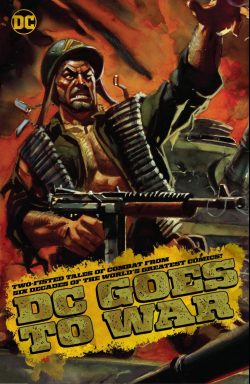
DC Goes to War


By Will Eisner, Bob Powell, Jon L. Blummer, Joe Simon & Jack Kirby, Robert Kanigher, Ed Herron, Len Wein, Marv Wolfman, David Michelinie, Chuck Dixon, Garth Ennis, Chuck Cuidera, John Severin, Joe Kubert, Jerry Grandenetti, Mort Drucker, Russ Heath, Jack Abel, Alex Toth, Gerry Talaoc, Judith Hunt, Sam Glanzman, Eduardo Barreto, Chris Weston, Christian Alamy & various (DC Comics)

ISBN: 978-1-7795-0015-1 (HB)

Win’s Christmas Gift Recommendation: Blockbuster Thrills No Movie Could Match… 9/10

For America, the genre of war comics only really took in 1950, as the Korean War scared the pants off a world still recovering from WWII. Even so, while war was current affairs, publishers didn’t shirk making stories and heroes amidst the bomb blasts and strafing runs…

Many publishers fed the trend, but although a firm fan fave, the sector soon settled into mediocrity. However, after the meteoric rise and sudden demise of EC Comics in the mid-1950’s and prior to the game-changing Blazing Combat, the only sure place to find controversial, challenging, exceptional and entertaining combat comics was DC.

In fact, even whilst Archie Goodwin’s stunning but tragically mis-marketed quartet of classics were waking up a generation, the home of Superman, Batman and Wonder Woman (herself a true “war baby”) was a veritable cornucopia of gritty, intriguing and beautifully illustrated battle tales presenting combat on a variety of fronts and from many differing points of view.

As the Vietnam War escalated, 1960s America increasingly endured a Home Front death-struggle pitting deeply-ingrained Establishment social attitudes against a youth-oriented generation with a radical new sensibility. In response, DC/National Periodical Publications’ military-themed comic books became even more bold and innovative…

That stellar creative period came to an end as all strip trends do, but a few of the more impressive and popular features (Sgt. Rock, Haunted Tank, The Losers) survived well into the second superhero revival.

Currently, English-reading fans of the genre are grievously underserved in both print and digital formats, but this magnificent hardback and digital compendium is hopefully the vanguard of a change of fortune…

Re-presenting material from Military Comics #1; All-American Comics #48; Boy Commandos #1; Our Army at War#67, 83, 233, 235; Our Fighting Forces #49, 102; Star Spangled War Stories #87, 183; G.I. Combat #87; Showcase#57; Weird War Stories #3; The Losers Special #1; Sgt. Rock Special #2 and Enemy Ace: War in Heaven #1-2 spanning August 1941, this epic package chronologically samples the company’s wide and deep well of war tales…

Tales of ordinary guys in combat began with the industry itself and although mostly sidelined during the capes-&-cowls war years, they quickly re-asserted themselves again once the actual fighting stopped. Those early days of the industry were awash with both opportunity and talent, and these factors coincided with a vast population hungry for cheap entertainment. Comics had no acknowledged fans or collectors; only a large, transient clientele open to all varied aspects of yarn-spinning and tale-telling – a situation which persisted right up to the end of the 1960s. Thus, the action here starts before it started for America…

Even though loudly isolationist and more than six months away from active inclusion in the Second World War, creators like Will Eisner and publishers like Everett M. (“Busy”) Arnold felt Americans were ready for the themed anthology title Military Comics.

Nobody was ready for Blackhawk.

Military Comics #1 launched on May 30th 1941 (August cover-dated) and included in its line-up Miss America, Jack Cole’s Death Patrol, Fred Guardineer’s Blue Tracer, X of the Underground, The Yankee Eagle, Q-Boat, Shot and Shell, Archie Atkins and Loops and Banks (by “Bud Ernest” – actually aviation-nut and unsung comics genius Bob Powell).

None of the strips – not even Cole’s surreal and suicidal team of hell-bent fliers – had the instant cachet and sheer appeal of Eisner & Powell’s “Foreign Legion of the Air”, led by the charismatic Dark Knight of the airways known only as Blackhawk.

Happy Anniversary “Magnificent Seven”!

Chuck Cuidera, famed for creating Blue Beetle for Fox, drew ‘The Origin of Blackhawk’ wherein a lone pilot fighting the Nazi invasion of Poland in 1939 is shot down by Nazi Ace Von Tepp, only to rise bloody and unbowed from his plane’s wreckage to form the World’s greatest team of airborne fighting men…

This mysterious paramilitary squadron of unbeatable fliers, dedicated to crushing injustice and smashing the Axis war-machine, battled on all fronts during the war and stayed together to crush Communism, international crime, Communism and every threat to democracy from alien invaders to supernatural monsters – and more Communism – becoming one of the true milestones of the US industry.

There were many melodramatic touches that made the Blackhawks so memorable in the eyes of a wide-eyed populace of thrill-hungry kids. There were the cool, black leather uniforms and peaked caps. The unique, outrageous – but authentic – Grumman F5F-1 Skyrocket planes they flew from their secret island base, and of course, their eerie battle-cry “Hawkaaaaa!”

But perhaps the oddest idiosyncrasy to modern readers was that they had their own song (would you be more comfortable if we started calling it an international anthem?) which Blackhawk, André, Stanislaus, Olaf, Chuck, Hendrickson and Chop-Chop would sing as they plummeted into battle…

This is a good place to remind everyone that historically, war comics have never been a place with comfortable depictions of race, ethnicity or creed. Please treat the material as necessarily historically authentic or simply find other more evolved and comfortable books to read…

Quality Comics adapted well to peacetime demands: Plastic Man and Doll Man lasted far longer than other superhero titles, whilst the rest of the line adapted into tough-guy crime, war, western, horror and racy comedy titles. The Blackhawks soared to even greater heights, starring in their own movie serial in 1952. However, the hostility of the marketplace to mature-targeted titles after the adoption of the self-censorious Comics Code was a clear sign of the times. In 1956 Arnold sold most of his comics properties and titles to DC and set up as a general magazine publisher.

Many of the purchases were a huge boost to National’s portfolio, with titles such as G.I. Combat, Heart Throbs and others running into the 1980s whilst the appeal and potential of characters such as Uncle Sam, assorted Freedom Fighters, Kid Eternity and others keep them coming back to this day…

Next up is Jon L. Blummer’s Hop Harrigan, America’s Ace of the Airways. He debuted in All-American Comics #1 in April 1939 as a dashing aviator: becoming a radio show phenomenon and ultimately a movie serial star. Harrigan was a serving pilot throughout the war and in this tale from All-American Comics #48 March 1943 tests a secret weapon launched from a B-24 bomber to inflict hell on the Japanese.

When Timely Comics failed to make good on financial obligations, Captain America creators Joe Simon & Kirby jumped ship to National/DC, who welcomed them with open arms. After establishing themselves with The Sandman and Manhunter, they returned to the “Kid Gang” genre they had created with The Young Allies and devised a juvenile Foreign Legion entitled The Boy Commandos.

These bellicose brats initially shared – or stole – some of the spotlight from Batman & Robin in flagship title Detective Comics before and whilst their solo title became one of the company’s top three sellers.

Frequently cited as the biggest-selling American comic book in the world at that time, Boy Commandos was such a success that the editors – knowing “The Draft” was lurking – green-lit the completion of a wealth of extra material to lay away for when their star creators were called up. S&K produced so much four-colour magic in a phenomenally short time that Publisher Jack Liebowitz suggested they retool some of it into adventures of a second kid gang… and thus was born Home Front heroes The Newsboy Legion…

We never learn how American Captain Rip Carter got to command a British Commando unit nor why he was allowed to bring a quartet of war-orphans with him on a succession of deadly sorties into “Festung Europa”, North Africa, the Pacific or Indo-Chinese theatres of war. All we had to do was realise that cockney urchin Alfy Twidgett, French lad Pierre –latterly and unobtrusively renamed Andre Chavard – little Dutch boy Jan Haasen and rough, tough little lout Brooklyn were fighting the battles we would, if we only had the chance…

Boy Commandos #1 (Winter 1942-1943) here visits ‘The Town that Couldn’t be Conquered!’ as Rip leads the lads back to Jan’s home village to terrify the rapacious occupiers and start a resistance movement…

National/DC were one of the last publishers to fully embrace the end of decade combat trend, converting superhero/fantasy adventure anthology Star Spangled Comics into Star Spangled War Stories the same month it launched Our Army at War (both cover-dated August 1952). All-American Comics was repurposed as All-American Men of War one month later as the “police action” in Korea escalated.

They grew the division slowly but steadily, adding Our Fighting Forces #1 (November 1954) – just as EC’s groundbreaking war comics were vanishing – and in 1957 added G.I. Combat to their portfolio when Quality Comics quit the funnybook business.

As the 1950s closed however, the two-fisted anthologies all began incorporating recurring characters such as Gunner and Sarge – and latterly Pooch – from Our Fighting Forces #45 on (May 1959) – soon to be followed by Sgt.  Rock and The Haunted Tank. Ultimately, all war titles had a lead star or feature to hold the fickle readers’ attention.

The potency of the anthological model is demonstrated here by ‘Push-Button War!’ by Ed Herron & John Severin from Our Army at War #67, (February 1958) as a bombardier learns how the rest of his flight crew do their deadly jobs after which Our Army at War #83 (June 1959) depicts the birth of a legend…

Crafted by Robert Kanigher & Joe Kubert, ‘The Rock and the Wall!’ was actually the fourth appearance of a character undergoing constant revision. G.I. Combat #68 has an anonymous boxer who simply refused to be beaten. When ‘The Rock!’ enlisted in the US Army, that Horatian quality attained mythic proportions as he held back an overwhelming Nazi attack by sheer grit and determination, remaining bloody but unbowed on a field littered with dead and broken men.

Dubbed “Rocky”, the character returned as a sergeant in Our Army at War #81, again facing superior forces as ‘The Rock of Easy Co.!’ in a brief but telling vignette before finally winning a personal and extremely individualistic identity in the next issue. This was ‘Hold Up Easy!’: another harsh and declarative mini-epic from Kanigher which saw hard-luck heroes Easy Company delayed and then saved by callow replacements who eventually came good…

Only now can we see the story reprinted here as the true debut of the immortal everyman hero. Kanigher & Kubert’s ‘The Rock and the Wall!’ features a tough-love, battlefield tutor shepherding his men to competence and survival amidst the constant perils of war. Here the grizzled noncom meets a rival for his men’s admiration in the equally impressive Joe Wall…

Sgt Rock and the “combat-happy Joes” of Easy Company are one of the great and enduring creations of the American comic-book industry. The gritty meta-realism of Robert Kanigher’s ordinary guys in life-or-death situations captured the imaginations of generations of readers, young and old. So pervasive is this icon of comic book combat, that’s it’s hard to grasp that Rock is not an immortal industry prototype like Superman, Batman and Wonder Woman – with us since the earliest moments of the industry – but is, in fact, a late addition to and child of the Silver Age of Comics.

For most fans, DC’s war comics are synonymous with two names. Individually and in partnership, Kanigher & Kubert built the combat division.

Robert Kanigher (1915-2002) was one of the most distinctive authorial voices in American comics, blending rugged realism with fantastic fantasy in his signature war comics, as well as horror stories, westerns and superhero titles likeTeen Titans, Hawkman, Metal Men, Batman plus other too numerous to cover here. A restlessly creative writer, he frequently used his uncanny but formulaic adventure arenas as a testing ground for future series concepts. Among the many epochal war features he created were Sgt. Rock, The War that Time Forgot, The Haunted Tank, The Losers and the controversial star of this stupendously compelling war-journal.

He sold his first stories and poetry in 1932, wrote for the theatre, film and radio, joined the Fox Features shop and created The Bouncer, Steel Sterling and The Web, whilst providing scripts for Blue Beetle and the original Shazam!-shouting Captain Marvel.

In 1945, he settled at All-American Comics as both writer and editor, staying on when the company amalgamated with National Comics to become the forerunner of today’s DC. He wrote Flash and Hawkman, created The Black Canaryand many memorable female villains such as Harlequin and Rose and the Thorn. This last turbulent terror he redesigned during the relevancy era of the early 1970s into a schizophrenic crime-busting vigilante who haunted the back of Superman’s Girlfriend Lois Lane – which he also scripted.

When the taste for mystery-men faded at the end of the 1940s, Kanigher moved seamlessly into adventure, westerns and war yarns: becoming in 1952 writer/editor of the company’s combat titles.

As well as scripting for All-American War Stories, Star Spangled War Stories and Our Army at War, he created Our Fighting Forces in 1954 before adding G.I. Combat to his burgeoning portfolio when Quality sold their titles to DC in 1956. This was whilst still working on Wonder Woman, Johnny Thunder, Rex the Wonder Dog, Silent Knight, Viking Prince and so many others.

In 1956 he scripted ‘Mystery of the Human Thunderbolt’ – the first story of the Silver Age which introduced Barry Allen as the new Flash to the hero-hungry kids of the world. Drawn by Carmine Infantino, the risky experiment included multi-talented veteran Joe Kubert as inker for the crucially important debut issue…

Kubert was born in 1926 in rural Southeast Poland (which became Ukraine and might be Outer Russia by the time you read this). At age two, his parents took him to America and he grew up in Brooklyn.

His folks encouraged Joe to draw from an early age and the precocious kid began a glittering career at the start of the Golden Age, before he was even a teenager. Working and learning at the Chesler comics packaging “Shop”, MLJ, Holyoke and assorted other outfits, he began his close association with National/DC in 1943, whilst still dividing his time and energies between Fiction House, Avon, Harvey and All-American Comics, where he particularly distinguished himself on The Flash and Hawkman.

In the early 1950s he and old school chum Norman Maurer were the creative force behind publishers St. Johns: creating evergreen caveman Tor and launching the 3D comics craze with Three Dimension Comics.

Joe never stopped freelancing, appearing in EC’s Two-Fisted Tales, Avon’s Strange Worlds, Lev Gleason Publications & Atlas Comics until 1955 when, with the industry imploding, he took a permanent position at DC, only slightly diluted whilst he illustrated the contentious and controversial newspaper strip Tales of the Green Berets (from 1965 to 1968). An elder statesman of the industry, he was creating new works and passing on knowledge and experience through his world-famous Joe Kubert School until his death in August 2012.

Here ‘Blind Gunner’ from Our Fighting Forces #49, (September 1959 by Kanigher & Jerry Grandenetti) revisits Pacific Theatre warriors Gunner and Sarge as the sharpshooter looses his sight and is paired up with an astounding – and scene-stealing – K-9 star… “Pooch”.

With Mort Drucker, Kanigher then hits a ‘T.N.T. Spotlight!’ (Star Spangled War Stories #87, November 1959) as French Resistance leader Mlle Marie defeats a Nazi manhunt and retains her reputation for ruthless infallibility before we witness the birth of another genuine phenomenon.

In G.I. Combat #87 (April/May 1961), Kanigher & Russ Heath launched one of the strangest and most beloved war series ever conceived. ‘Introducing – the Haunted Tank’ sees boyhood friends Jeb Stuart Smith, Arch Asher, Slim Strykerand Rick Rawlins all assigned to the same M-3 Stuart Light Tank, named for the legendary Confederate Army General who was a genius of cavalry combat. During a patrol they somehow destroy an enemy Panzer even though they were all knocked unconscious…

Narrated by Jeb in the Commander’s spotter-position (head and torso sticking out of the top hatch and completely exposed to enemy fire whilst driver Slim, gunner Rick and loader Arch remain inside), he recounts how a ghostly voice offered advice and prescient, if veiled, warnings, all while enduring the jibes of fellow soldiers who drive bigger, tougher war machines. Eventually the little tank proves its worth and Jeb wonders if he imagined it all due to shock and his injuries, but we know better – as decades of further exploits proved…

The war department was always pushing envelopes and experimenting and the next star is one of the most notorious and remarkable.

Enemy Ace first appeared as a back-up in flagship title Our Army at War in tales loosely based on “Red Baron” Manfred von Richthofen. The stories were a magnificent, thought-provoking examination of and tribute to the profession of soldiering, whilst simultaneously condemning the madness of war, produced by dream team Kanigher & Kubert during a period when the ongoing Vietnam conflict was beginning to tear American society apart.

An immediate if seminal hit, the series told bitter tales of valour and honour from the point of view of German WWI fighter pilot Hans von Hammer: a hidebound, noble warrior fighting for his country in a conflict that was swiftly excising all trace of such outmoded concepts from the business of government sanctioned mass-killing.

Mere months later, he starred in a brace of full-length thrillers for prestigious try-out vehicle Showcase. Issue #57 (July/August 1965) here declares him ‘Killer of the Skies!’: recapitulating all that had gone before whilst introducing a potential equal in the form of Canadian ace “The Hunter”. A new wrinkle was added to the mix as Von Hammer now perpetually agonised and bemoaned his inability to save the human conveyor belt of naive, foolish replacement pilots to his Jagdstaffel from killing themselves through enthusiasm, bravado and youthful stupidity…

Eventually the real war hit DC’s comic pages as Capt. Hunter began a personal crusade in Vietnam. Green Beret Captain Phil Hunter debuted in Our Fighting Forces #99, drawn to the conflict to find his twin brother Nick: shot down and now M.I.A. ‘Cold Steel for a Hot War!’ comes from Our Fighting Forces #102 (August 1966 by Kanigher & Jack Abel) and sees the obsessed warrior training child soldiers beside enigmatic turncoat femme fatale Kewpie Doll…

Whilst the Vietnam War escalated, 1960s America increasingly endured a Home Front death-struggle pitting deeply-ingrained Establishment social attitudes against a youth-oriented generation with a radical new sensibility. In response DC’s military-themed comics became even more bold and innovative. However, the sudden downturn in superheroes led to some serious rethinking. Although war titles maintained and even built sales, they beefed up the anthological elements and began expressing anti-war sentiments…

Sgt, Rock increasingly became a mouthpiece for such sentiment: experiencing the horror and stupidity of fighting and revealing what lay behind the glory and patriotic fervour. Kanigher & Kubert’s ‘Head-Count!’ (Our Army at War #233, June 1971) detailed a new replacement to Easy Co who used the conflict to feed his own sick appetites, after which Kanigher & Alex Toth reveal how boyhood dreams turn to nightmares in shocking US Civil War vignette ‘The Glory Boys!’ (Our Army at War #235, August 1971)

The theme is revisited in ‘The Pool…’ from Weird War Stories #3 (January/February 1972): an early tale by relative newcomers Len Wein & Marv Wolfman, ably illustrated by Heath which shows how both cavemen tribes and modern soldiers battle eternally to possess the only source of water in a trackless wasteland…

Times and tastes constantly evolved, and simple fighting was no longer satisfactory…

One of the very best concepts ever devised for a war comic, The Unknown Soldier was a spin-off, first appearing as a walk-on in a 1966 Sgt. Rock story (Our Army at War #168, by Kanigher & Kubert). His later series featured a faceless super-spy and master-of-disguise whose forebears had proudly fought and died in every American conflict since the birth of the nation.

The strip became one of DC’s most popular and long-lived: Star Spangled morphed into Unknown Soldier in 1977 with #205: only folding in 1982 (#268) when sales of traditional comic books harshly declined. Since then the character has frequently been rebooted and reinvented: each iteration moving further and further way from the originating concept.

His origin revealed how two inseparable brothers joined up in the days before America was attacked and were posted together to the Philippines just as the Japanese began their seemingly unstoppable Pacific Campaign. Overwhelmed by a tidal wave of enemy soldiers one night the brothers held their jungle posts to the last and when relief came only one had survived, his face a tattered mess of raw flesh and bone…

As US forces retreated from the islands the indomitable survivor was evacuated to a state-side hospital. Refusing medals, honours or retirement, the recuperating warrior dedicated his remaining years to his lost brother Harry and determinedly retrained as a one-man-army intelligence unit. His unsalvageable face swathed in bandages, the nameless fighter learned the arts of make-up, disguise and mimicry, perfected a broad arsenal of fighting skills and offered himself to the State Department as an expendable resource who could go anywhere and do anything.

After a long run by numerous stellar creators, shifting fashions provoked a shift in emphasis. Relative neophytes David Michelinie & Gerry Talaoc came aboard with SSWS #183, resulting in an evocative change of direction with ‘8,000 to One’.

The horror boom peaked in 1974 and new editor Joe Orlando capitalised on that fascination with a few startling changes – the most controversial being to expose the Unknown Soldier’s grotesque, scar-ravaged face – presumably to draw in monster-hungry fear fans…

The story itself goes back to the Immortal G.I.’s earliest days as an American agent as he’s despatched to Denmark to rescue a ship full of Danish Jews destined for Hitler’s death camps. Disguised as SS Captain Max Shreik, the Soldier is forced to make an unconscionable choice to safeguard his mission. The degree and manner of graphic violence was also exponentially increased to accommodate the more mature readership as the Soldier took a very personal revenge…

Another result of changing tastes was teaming older strip stars. The Losers were an elite unit of American soldiers formed by amalgamating three old war series together. Gunner and Sarge – supplemented by Fighting Devil Dog Pooch – were Pacific-based Marines, debuting in All-American Men of War #67 (March1959). They ran for 50 issues in Our Fighting Forces (#45-94, May1959-August 1965), whilst Captain Johnny Cloud – Navajo Ace and native American fighter pilot – shot down his first bogie in All-American Men of War #82. He flew solo until issue #115 (1966), whilst the final component of the Land/Air/Sea team was filled by Captain Storm, a disabled PT Boat commander (he had a wooden leg) who had his own 18 issue title from 1964 to 1967. All three series were created by warlord Kanigher.

They had all pretty much passed their sell-by dates when they teamed-up as guest-stars in a Haunted Tank tale in 1969 (G.I. Combat #138 October), but these “Losers” found a new resonance together in the relevant, disillusioned, cynical Vietnam years, and their rather nihilistic, doom-laden anti-hero adventures took the lead spot in Our Fighting Forces#123 (January/February 1970), written by Kanigher with art from giants like Ken Barr, Russ Heath, Sam Glanzman, John Severin and Joe Kubert.

With the tag-line “even when they win, they lose” they saw action all over the globe, winning critical acclaim and a small, passionate following until #181 (September/October 1978) – when the comic was cancelled – and one last hurrah in 1982’s Unknown Soldier #265.

When DC revised its entire continuity in 1985 for Crisis on Infinite Earths a final tale was devised by Kanigher, Judith Hunt, Sam Glanzman & Mike Esposito in a one-shot. The Losers Special #1 saw the doomed heroes perish saving the war effort by destroying a German missile base. That’s not a spoiler: It’s comics and they haven’t all stayed dead…

Readers’ understanding and appreciation of war stories constantly matured over the decades and by the time of ‘Hammer and Anvil’ (Sgt. Rock Special #2, 1992 by Chuck Dixon & Eduardo Barreto) the tales were practically indistinguishable from film or TV fare. Seldom a matter of good versus evil, here, war itself and weather are the enemy as Easy Company endure the horrors of Bastogne and clash with Nazi infiltrators indistinguishable from G.I.’s at the Battle of the Bulge…

Ending this sortie of superb classics is a brilliant extrapolation by modern day keeper of the war flame Garth Ennis, ably assisted by Christian Alamy, Chris Weston & Russ Heath. Released in 2001 as a 2-issue miniseries, Enemy Ace: War in Heaven takes another look at the flyer on the other side, now transplanted to World War II and a far less defensible position…

Bavaria 1942, and 46 years old Baron Hans von Hammer is visited by an old flying comrade urging him to come out of retirement and serve his country. No lover of Nazism, the old ace has remained isolated until now, but Germany’s attack on Russia has proven a disastrous blunder, and this last plea is a much warning as request.

Neophyte pilots on the Eastern Front need his experience and leadership, whereas Hitler’s goons don’t need much excuse to remove a dissident thorn…

Based loosely on the lives of such German pilots as Adolf Galland, book 1 – rendered by Weston – finds von Hammer as indomitable as ever in the killer skies but unable to stomach the increasing horror and stupidity of the conflict and its instigators. The phrase “My Country, Right or Wrong” leaves an increasingly sour taste in his mouth as the last of his nation’s young men die above Soviet fields…

Book 2 is set in 1945 with Germany on the brink of defeat and von Hammer flying an experimental jet fighter (a Messerschmitt 262, if you’re interested): shooting down not nearly enough Allied bombers to make a difference and still annoying the wrong people at Nazi High Command.

He knows the war is over but his sense of duty and personal honour won’t let him quit. He is resigned to die in the bloody skies that are his second home, but is shot down and parachutes into a concentration camp named Dachau…

With art from comics legend Russ Heath, this stirring tale ends with a triumph of integrity over patriotism: a perfect end to the war record of a true soldier and another compelling, deeply incisive exploration of war, its repercussions, both good and bad, and the effects that combat has on singular men. This should be mandatory reading for every child who wants to be a soldier…

With covers Will Eisner & Gil Fox, Simon & Kirby, Grandenetti, Kubert, Dan Brereton and Alamy, this monument to combat comics is a stunning example of passion in play and a clarion call to publishers to return to their archives and release many more such tomes.
© 1941, 1943, 1958, 1959, 1961, 1965, 1966, 1971, 1972, 1974, 1985, 1994, 2001, 2020 DC Comics. All Rights Reserved.

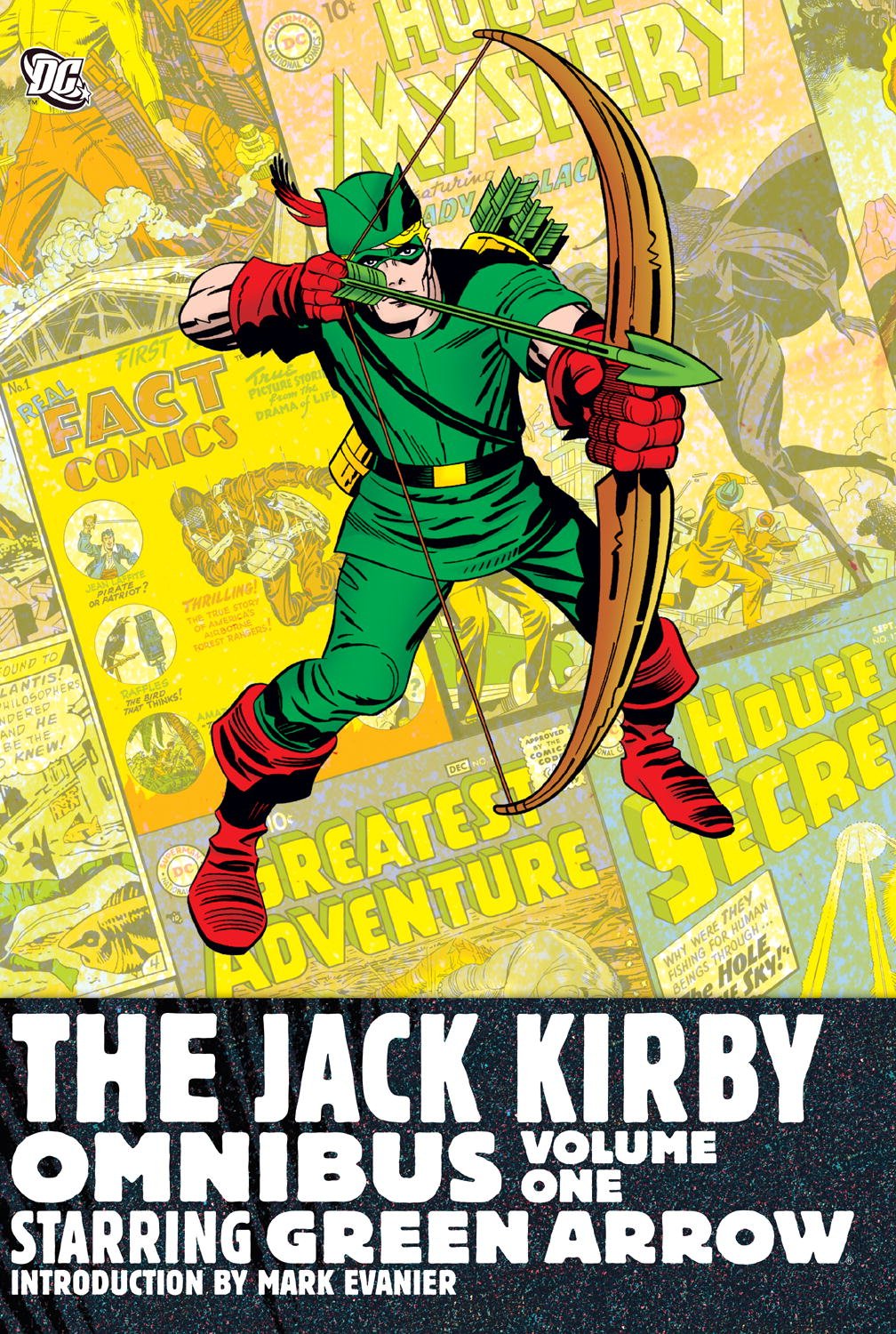
The Jack Kirby Omnibus Volume One: Green Arrow and others


By Jack Kirby, with Joe Simon, France E. Herron, Dave Wood, Bill Finger, Robert Bernstein, Frank Giacoia, Roz Kirby & various (DC Comics)
ISBN: 978-1-4012-3107-1 (HB)

Win’s Christmas Gift Recommendation: Evergreen Action and Moody Mystery for All Seasons… 9/10

Green Arrow is one of DC’s Golden All-Stars. He’s been a fixture of the company – in many instances for no discernible reason – more or less continually since his 1941 debut in More Fun Comics #73. Many Happy Returns, Emerald Archer!

In those distant heady days, origins weren’t as important as image and storytelling, so creators Mort Weisinger & George Papp never bothered. The first inkling of formative motivations came in More Fun Comics # 89 (March 1943) wherein Joe Samachson & Cliff Young detailed ‘The Birth of the Battling Bowman‘ (and a tip of the feathered hat to Scott McCullar for bringing that tale to my belated attention).

With the secret revealed, it was promptly ignored for years, leaving later workmen France Herron, Jack Kirby and his wife Roz to fill in the blanks again…

Jack Kirby was – and remains – the most important single influence in the history of American comics. There are millions of words written – such as those here by former Kirby assistant Mark Evanier in the revelatory and myth-busting Introduction to this gloriously enthralling full-colour hardback compilation – about what the King has done and meant, and you should read those too, if you are at all interested in our medium.

Tragically this particular tome is not available digitally yet, but that will just make it an even more impressive gift this year…

For those of us who grew up with his work, his are the images which furnish and clutter our interior mindsets. Close your eyes and think “robot” and the first thing that pops up is a Kirby creation. Every fantastic, futuristic city in our heads is crammed with his chunky, towering spires. Because of Jack we all know what the bodies beneath those stony-head statues on Easter Island look like, and we are all viscerally aware that you can never trust great big aliens parading around in their underpants…

When comic books began, in a remarkably short time Kirby and his creative partner Joe Simon became the wonder-kid dream-team of the new-born industry. After generating a year’s worth of the influential monthly Blue Bolt, and dashing off Captain Marvel Adventures (#1) for Fawcett, Martin Goodman appointed Simon editor at Timely, where “S&K” created a host of iconic stars like Red Raven, the first Marvel Boy, Hurricane, The Vision, The Young Allies, immortal villain The Red Skull and of course million-selling mega-hit Captain America (and Bucky AKA today’s Winter Soldier).

When Goodman failed to make good on his financial obligations, Simon & Kirby were snapped up by National DC, who welcomed them with open arms and a fat chequebook. Bursting with ideas the staid company were never really comfortable with, the pair were initially an uneasy fit, and were given two moribund strips to play with until they found their creative feet: Sandman and Manhunter.

They turned both around virtually overnight and, once established and left to their own devices, switched to the “Kid Gang” genre they had pioneered at Timely. Joe & Jack created wartime sales sensation The Boy Commandos and Homefront iteration the Newsboy Legion before being called up to serve in the war they had been fighting on comicbook pages since 1940.

When they returned it was to a very different funnybook business, and soon they left National to create their own little empire.

Simon & Kirby heralded and ushered in the first American age of mature comics – not just by inventing the Romance genre, but with all manner of challenging modern material about real people in extraordinary situations. They saw it all disappear again in less than eight years. Their small stable of magazines – generated for an association of interlinked companies known as Prize/Crestwood/Pines/Essenkay/Mainline Comics – blossomed and as quickly wilted when the industry abruptly contracted throughout the 1950s. After years of working for others, Simon & Kirby had finally established their own publishing house, producing comics for a far more sophisticated audience, only to find themselves in a sales downturn and awash in public hysteria generated by an anti-comicbook pogrom.

Hysterical censorship-fever spearheaded by US Senator Estes Kefauver and opportunistic pop psychologist Dr. Frederic Wertham led to witch-hunting Senate hearings. Caving in, publishers adopted a castrating straitjacket of draconian self-regulation. Horror titles produced under the aegis and emblem of the Comics Code Authority were sanitised and anodyne affairs in terms of Shock and Gore, even though the market’s appetite for suspense and the uncanny was still high. Crime comics vanished and mature themes challenging society’s status quo were suppressed…

Simon quit the business for advertising, but Kirby soldiered on, taking his skills and ideas to a number of safer, if less daring, companies. As the panic subsided, Kirby returned briefly to DC where he worked on mystery tales and Green Arrow (a back-up strip in Adventure Comics and World’s Finest Comics) whilst concentrating on his long-dreamed-of newspaper strip Sky Masters of the Space Force.

During that period, he also re-packaged a super-team concept that had been kicking around in his head since he and Joe had closed their innovative, ill-timed ventures. At the end of 1956, Showcase #6 (a try-out title that launched many DC mainstays) premiered the Challengers of the Unknown. After 3 more test issues they won their own title, with Kirby in command for the first 8. Then a legal dispute with Editor Jack Schiff kicked off and the King was gone…

During that brief 3-year period (cover-dated 1957-1959), Kirby also crafted a plethora of short comics yarns which this fabulous tome re-presents – in originally-published order. It comprises superhero, mystery and science fiction shorts from Tales of the Unexpected #12, 13, 15-18, 21- 24; House of Mystery #61, 63, 65, 66, 70, 72, 76, 84, 85; House of Secrets#3, 4, 8, 12; My Greatest Adventure #15- 18, 20, 21, 28; Adventure Comics #250-256 and World’s Finest Comics # 96-99: a lost gem from All-Star Western #99 plus 3 quirky vignettes by Simon & Kirby from 1946-1947 for Real Fact Comics #1, 2 and 6.

Records are sparse and scanty from those days when no creator was allowed a by-line, so many of these stories carry no writer’s credit (and besides, Kirby was notorious for rewriting scripts he was unhappy with drawing) but Group Editor Schiff’s regular stable of authors included Dave Wood, Bill Finger, Ed Herron, Joe Samachson, George Kashdan, Jack Miller and Otto Binder, so feel free to play the “whodunit” game…

National DC Comics was relatively slow in joining the post-war mystery comics boom, but as 1951 closed they at last launched a gore-free, comparatively straight-laced anthology which nevertheless became one of their longest-running and most influential titles: The House of Mystery (cover-dated December 1951/January 1952). Its success inevitably led to a raft of similar creature-filled fantasy anthologies such as Sensation Mystery, My Greatest Adventure, House of Secrets and Tales of the Unexpected.

With the Comics Code in full effect, plot options for mystery and suspense stories were savagely curtailed: limited to ambiguous, anodyne magical artefacts, wholesomely education mythological themes, science-based miracles and criminal chicanery. Although marvellously illustrated, stories were rationalistic, fantasy-adventure vehicles which dominated until the early 1960s when superheroes (reinvigorated after Julius Schwartz reintroduced the Flash in Showcase #4, October 1956) usurped them…

In this volume, following that aforementioned Introduction – describing Kirby’s 3 tours of duty with DC in very different decades – the vintage wonderment commences with another example of the ingenious versatility of Jack & Joe.

Originating in the wholesome and self-explanatory Real Fact Comics, ‘The Rocket-Lanes of Tomorrow’ (#1, March/April 1946) and ‘A World of Thinking Robots’ from #2 (May/June 1946) are forward-looking, retro-fabulous graphic prognostications of the “World that’s Coming”. A longer piece from #6 (July/August 1947) details the history and achievements of ‘Backseat Driver’ and road-safety campaigner Mildred McKay.

These were amongst the very last strips the duo produced for National before moving to Crestwood/Pines, so we skip ahead a decade and more for Jack’s return in House of Secrets #3 (March/April 1957) where ‘The Three Prophecies’reveals an eerie tale of a spiritualist conman being fleeced by an even more skilful grifter… until Fate takes a hand…

Mythological mysticism informs the strange tale of ‘The Thing in the Box’ (House of Mystery #61, April 1957) wherein a salvage diver is obsessed with a deadly casket his captain is all too eager to dump into the ocean.

From the same month, Tales of the Unexpected #12 focuses on ‘The All-Seeing Eye’ as a journalist responsible for many impossible scoops realises the potential dangers of the ancient artefact he employs far outweigh its benefits …

In House of Secrets #4 (May/June 1957) the ‘Master of the Unknown’ seems destined to take the big cash prize on a TV quiz show until the producer deduces his uncanny secret, after which ‘I Found the City under the City’ (My Greatest Adventure #15, from the same month) details how fishermen recover the last testament of a lost oceanographer and read of how he intended to foil an impending invasion by aquatic aliens…

From May 1957, France E. Herron & Kirby investigated ‘The Face Behind the Mask’ (Tales of the Unexpected #13): a gripping crime-caper in involving gullible men, a vibrant femme fatale and the quest for eternal youth. There was no fakery to ‘Riddle of the Red Roc’ (House of Mystery #63, June) as a venal explorer hatches and trains the invulnerable bird of legend, creating an unstoppable thief before succumbing to his own greed, after which My Greatest Adventure #16 (July/August) features a truly eerie threat as an explorer is sucked into a deadly association creating death and destruction to learn ‘I Died a Thousand Times’…

That month, Unexpected #15 offered ‘Three Wishes to Doom’: a crafty thriller proving that even with a genie’s lamp, crime does not pay, after which weird science transforms a rash scientist into ‘The Human Dragon’ (HoM #65 August, with George Roussos inking his old pal Jack), although his time to repent is brief as a criminal mastermind capitalises on his misfortune…

There’s an understandable frisson of foreshadowing to ‘The Magic Hammer’ (Tales of the Unexpected #16 August) as it relates how a prospector finds a magical mallet capable of creating storms and goes into the rainmaking business… until the original owner turns up…

A smart gimmick underscores a tantalising tale of plagiarism and possible telepathy in ‘The Thief of Thoughts’ (HoM #66 September) whilst straight Sci Fi tropes inform the tale of a hotel detective and a most unusual guest in ‘Who is Mr. Ashtar?’ (Tales of the Unexpected #17, September) before My Greatest Adventure #17 September/October 1957) reveals how aliens intent on invasion brainwash a millionaire scientist to eradicate humanity in ‘I Doomed the World’.Happily one glaring error was made…

In Tales of the Unexpected #18 (October), Kirby shows how an astute astronomer saves us all by outwitting an energy being with big appetites in ‘The Man Who Collected Planets’, after which MGA #18 (November/December 1957) ushers in the comic book Atomic Age with ‘I Tracked the Nuclear Creature’ detailing how a hunter sets out to destroy a macabre mineral monster created by uncontrolled fission…

A new year dawned with Roussos inking ‘The Creatures from Nowhere!’ (HoM #70, January 1958) as escaped alien beasts rampage through a quiet town, and HoS #8 (January/February) finds greed, betrayal, murder and supernatural suspense are the watchwords when a killer tries to silence ‘The Cats who Knew Too Much!’

Tales of the Unexpected #21 (also January) sees a smart investor proving too much for apparent extraterrestrial ‘The Mysterious Mr. Vince’, whilst a month later Unexpected #22 sees an ‘Invasion of the Volcano Men’ start in fiery fury and panicked confrontations before resolving into an alliance against uncontrolled forces of nature.

Kirby never officially worked for National’s large Westerns division, but apparently his old friend and neighbour Frank Giacoia did, and occasionally needed Jack’s legendary pencilling speed to meet deadlines. ‘The Ambush at Smoke Canyon!’ features long-running cavalry hero Foley of the Fighting 5th single-handedly stalking Pawnee renegades in a somewhat standard sagebrush saga scripted by Herron and inked by Giacoia from All-Star Western #99 (February/March 1958).

Meanwhile in House of Mystery #72 (March) a shameless B-Movie Producer seemingly becomes ‘The Man who Betrayed Earth’ whilst in MGA #20 (March/April), interplanetary bonds of friendship are forged when space pirates kidnap assorted sentients and a canny Earthling saves the day in ‘I Was Big-Game on Neptune’…

Inadvertent cosmic catastrophe is narrowly averted in Tales of the Unexpected #23 (March) when one man realises how to make contact with ‘The Giants from Outer Space’, after which issue #24 (April) slips into wild whimsy as ‘The Two-Dimensional Man!’ strives desperately to correct his incredible condition before being literally blown away…

When an early space-shot brings back an all-consuming horror in MGA #21 (May/June 1958), a brace of boffins realise‘We Were Doomed by the Metal-Eating Monster’ before ‘The Artificial Twin’ (HoM #76, July) combines mad doctor super-science with fraud and deception and House of Secrets #12 (September) sees one frantic man struggling to close ‘The Hole in the Sky’ before invading aliens use it to conquer mankind…

Also scattered throughout this extraordinary compendium of the bizarre is a stunning and bombastic Baker’s Dozen of Kirby’s fantastic covers from the period, but for most modern fans the real meat is the short, sharp sequence of superhero shockers that follow…

On his debut, Green Arrow proved quite successful. With boy partner Speedy, he was one of precious few masked stalwarts to survive beyond the Golden Age. His blatant blend of Batman and Robin Hood seemed to have very little going for itself, but the Emerald Archer always managed to keep himself in vogue. He carried on adventuring in the back of other heroes’ comic books, joined the Justice League of America just as their star was rising and later became – courtesy of Denny O’Neil & Neal Adams – the spokes-hero of the anti-establishment generation, during the 1960-70’s “Relevancy Comics” trend.

Later, under Mike Grell’s stewardship and thanks to epic miniseries Green Arrow: the Longbow Hunters, he at last became a headliner: re-imagined as an urban predator dealing with corporate thugs and serial killers rather than costumed goof-balls. This version, more than any other, informs and underpins the TV incarnation seen in Arrow.

After his long career and numerous venue changes, by the time of Schwartz’s resurrection of the Superhero genre the Battling Bowman was a solid second feature in Adventure and World’s Finest Comics where, as part of the wave of retcons, reworkings and spruce-ups DC administered to their remaining costumed old soldiers, a fresh start began in the summer of 1958.

Part of that revival happily coincided with Kirby’s return to National Comics.

As revealed in Evanier’s Introduction, after working on anthological stories for Schiff, the King was asked to revise the idling archer and responded by beefing up the science fictional aspects. When supervising editor – and creator – Weisinger objected, changes were toned down and Kirby saw the writing was on the wall. He lost interest and began quietly looking elsewhere for work…

What resulted was a tantalisingly short run of 11 astounding action-packed, fantasy-filled swashbucklers, the first of which was scripted by Bill Finger as ‘The Green Arrows of the World’ (Adventure Comics #251, July 1958) sees costumed archers from many nations attending a conference in Star City. They are blithely unaware that a fugitive criminal with murder in his heart is hiding within their masked midst…

August’s #251 takes a welcome turn to astounding science fiction as Kirby scripted and resolved ‘The Case of the Super-Arrows’ wherein the Amazing Archers take possession of high-tech trick shafts sent from 3000 AD. World’s Finest Comics #96 (writer unknown) then reveals, ‘Five Clues to Danger’ – a classic kidnap mystery made even more impressive by Kirby’s lean, raw illustration and wife Roz’s sharp inking.

A practically unheard-of continued case spanned Adventure #252 and 253 as Dave Wood, Jack & Roz posed ‘The Mystery of the Giant Arrows’ before GA and Speedy briefly became ‘Prisoners of Dimension Zero’ – a spectacular riot of giant aliens and incredible exotic other worlds, followed in WFC #97 (October 1958) with a grand old-school crime-caper in Herron’s ‘The Mystery of the Mechanical Octopus’.

Kirby was having fun and going from strength to strength. Adventure #254 featured ‘The Green Arrow’s Last Stand’ (by Wood): a particularly fine example with the Bold Bowmen crashing into a hidden valley where Sioux braves thrive unchanged since the time of Custer. The next issue saw the heroes battling a battalion of Japanese soldiers who refused to surrender their island bunker in ‘The War That Never Ended!’ (also by Wood).

December’s WFC #98 almost ended the heroes’ careers in Herron’s ‘The Unmasked Archers’ wherein a private practical joke causes the pair to inadvertently expose themselves to public scrutiny and deadly danger…

As previous stated, in the heady early days origins weren’t as important as just plain getting on with it. The definitive version was left to later workmen Herron, Jack & Roz (in Kirby’s penultimate tale), filling in the blanks with ‘The Green Arrow’s First Case’ as the superhero revival hit its stride. It appeared in Adventure Comics #256, cover-dated January 1959 and this time the story stuck, becoming – with numerous tweaking over successive years – the basis of the modern Amazing Archer of page and screen.

Here we learned how wealthy wastrel Oliver Queen was cast away on a deserted island and learned to use a hand-made bow and survive. When a band of scurvy mutineers fetched up on his desolate shores, Queen used his newfound skills to defeat them and returned to civilisation with a new career and purpose…

Kirby’s spectacular swan-song came in WFC #99 (January 1959) with ‘Crimes under Glass’. Written by Robert Bernstein, it sees GA and Speedy confronting crafty criminals with a canny clutch of optical armaments, before the Archer steadfastly slid back into the sedate, gimmick-heavy rut of pre-Kirby times…

The King had moved on to other enterprises – Archie Comics with Joe Simon and a little outfit which would soon be calling itself Marvel Comics – but his rapid rate of creation had left a number of completed tales in DC’s inventory pile which slowly emerged for months thereafter and neatly wrap up this comprehensive compendium of the uncanny.

From My Greatest Adventure #28 (February 1959) ‘We Battled the Microscopic Menace!’ pits brave boffins against a ravening devourer their meddling with unknown forces had unleashed, whilst a month later HoM #84 depicted a terrifying struggle against ‘The Negative Man’ as an embattled researcher fought his own unleashed energy doppelganger.

It all ends in an unforgettable spectacular as House of Mystery #85 (April 1959) awakens ‘The Stone Sentinels of Giant Island’, who rampage across a lost Pacific island and threaten the brave crew of a scientific survey vessel… until one wise man deduces their incredible secret…

Jack Kirby was and is unique and uncompromising: his words and pictures are an unparalleled, hearts-and-minds grabbing delight no comics lover could resist. If you’re not a fan or simply not prepared to see for yourself what all the fuss has been about then no words of mine will change your mind.

That doesn’t alter the fact that Kirby’s work from 1937 to his death in 1994 shaped the American comics scene and the entire comics planet: affecting billions of readers and thousands of creators in every arena of artistic endeavour for generations. He still wins new fans and apostles every day, from the young and naive to the most cerebral of intellectuals. His work is instantly accessible, irresistibly visceral, deceptively deep and simultaneously mythic and human.

This collection from his transformative middle period exults in sheer escapist wonderment, and no one should miss the graphic exploits of these perfect adventures in that ideal setting of not-so-long-ago in a simpler, better time and place than ours.
© 1946, 1947, 1957, 1958, 1959, 2011 DC Comics. All Rights Reserved.