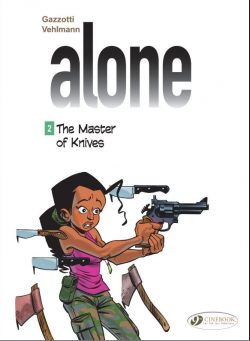
Alone volume 2: The Master of Knives


By Gazzotti & Vehlmann, translated by Jerome Saincantin (Cinebook)
ISBN: 978-1-84918-206-5 (PB Album)

Fabien Vehlmann was only born in 1972, yet his prodigious canon of work (from 1998 to the present) has earned him the soubriquet of “the Goscinny of the 21st Century”. He entered the world in Mont-de-Marsan and grew up in Savoie, studying business management before taking a job with a theatre group.

In 1996, after entering a writing contest in Le Journal de Spirou, Vehlmann caught the comics bug and two years later published – with illustrative collaborator Denis Bodart – a mordantly quirky and sophisticated portmanteau period crime comedy entitled Green Manor. From there on, his triumphs grew to include – many amongst others – Célestin Speculoos for Circus, Nicotine Goudron for l’Écho des Savanes and a stint on major-league property Spirou and Fantasio…

Bruno Gazzotti is Belgian, born in 1970 and a former student of Institut Saint Luc in Liège. Another artist addicted to comics from his earliest years, he started getting paid to draw them in 1988, after being hired by Spirou editor Patrick Pinchart on the strength of his portfolio alone. Before long he was illustrating Le Petit Spirou with Tome & Janry.

In 1989, he and Tome created New York Cop Soda, which kept Gazzotti busy until 2005, when he resigned to co-create award-winning feature Seuls…

Originally released in January 2006, Seuls – La disparition began a superb example of how to craft a thriller suitable for kids: evoking the eerie atmosphere of TV series Lost and the most disturbing elements of Philip Wylie’s The Disappearance and William Golding’s Lord of the Flies. In a post-virus, Lockdown-besieged world, it also has eerie echoes of how humans deal with enforced isolation…

Debut volume The Vanishing showed us how an ordinary bustling town, with simple folk going about their business overnight became an empty mausoleum, with a small cross-section of kids left behind to survive or die.

The scant remainers comprise Ivan, an imaginative child of wealth who wants for nothing but never saw his dad and Leila, a born engineer, inventor and tinkerer. Her poor but honest dad always found time to play and critique her latest gadget…

Studious Camille was over-focussed on exams and achievement whilst Terry is pretty much still a baby: refusing to obey orders and throwing tantrums if he doesn’t get his way.

Typically, even in an ideal environment, not all children lived comfortable lives. Dodzi was in the protective services system. His early life made him tough and resilient but couldn’t stop the other young inmates handing him a beating on this ominous, odd-feeling night before everything changed…

When it happened, the kids wandered a terrifyingly quiet and forbidding city until finding each other. All the adults were gone, and all their child pals. The internet was down, with only static from TVs and radios. Above, fearsome storm clouds hung low and ominous. As they went wild with freedom and panicked from anxiety, eventually Dodzi brutally enforced calm and lead them away to find a succession of temporary – albeit palatial – refuges to regroup and think… After an uncanny series of encounters with escaped circus animals, the little band settle in the towering Majestic Hotel and Master of Knives (originally released as Seuls: Le Maître des couteaux) opens with Dodzi scouting the empty metropolis and helping Leila consolidate supplies for a long stay in the lap of luxury. His nervousness remains high as there are still close calls with the liberated beasts in the streets, but the younger kids seem to have adapted well. It certainly helps that they are hoarding every toy and treat they can find in abandoned shops and houses…

Ivan has a plan to occupy him too: systematically calling every phone number in the phone book. No luck yet, though…

Things start to go south swiftly after he finds his father’s pistol and tempts Leila into a spot of target practice on the roof. As Dodzi furiously confiscates the lethal toy, he has no idea that he has become the chosen prey of a mysterious stalker. As the cloaked pursuer slowly enacts a chilling campaign of terror, the stressed leader agonisingly discovers he is not the only obsession of the terrifying, nebulous figure clad in cloaks and draped in blades and daggers…

As the other kids obliviously fritter away the day, Dodzi is remorselessly hunted over the rooftops by the manic killer. When he briefly eludes the hunter, the Master simply doubles back to menace the children in the hotel. A shocking confrontation then ensues, which sees the tables turned but only at the cost of Dodzi’s closely withheld secrets being exposed to all…

In the painful aftermath, the days of innocence are discarded and the little orphan family prepare to hit the open road to find out if other cities have been emptied too…

To Be Continued…

This spooky, powerful and often shocking tale of mystery and imagination sees bereft children facing increasingly daunting physical hazards and an escalating series of events which can have no logical or rational explanation, and the tension simply amplifies with every instalment. Alone became one of the biggest critical and commercial comics hits of the decade and if you love eerie enigmas and powerful tale-telling, you’ll buy this and successive releases to see why…
© Dupuis 2007 by Gazzotti & Vehlmann. All rights reserved. English translation © 2014 Cinebook Ltd.

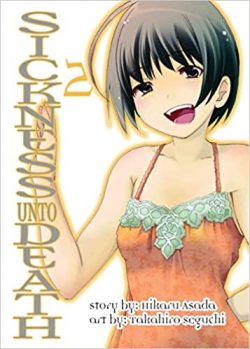
Sickness Unto Death volumes 1 & 2


By Hikaru Asada & Takahiro Seguchi (Vertical)
ISBN: 978-1-939130-09-9(tankōbon PB vol. 1) 978-1939130105(tankōbon PB vol. 2)

Here’s an intriguing and tragically underrated and sadly forgotten saga deftly examining the devastating effects of despair that still has plenty to say and much to offer…

Takahiro Seguchi’s gripping psychological melodrama Sickness Unto Death is a bleak and enthralling, emotionally complex tale of love, compulsion and dependency, transformed into spellbinding comics by artist Hikaru Asada.

Inspired by Danish philosopher Søren Kierkegaard’s treatise Sygdommen til Døden (The Sickness Unto Death – a Christian existentialist examination of the “Sin of Despair”), this extremely accessible tale began in 2009 as Shi ni Itaru Yamai; serialised in Hakusensha’s fortnightly Seinen magazine Young Animal.

This translated version opens with a Professor standing beside a student over the grave of his first case – and greatest love…

A flashback begins revealing how, as a young man, Kazuma Futaba came to the city to study clinical psychology, and how he was lucky to find lodgings in an old house. However, on his way there he encountered a young girl with white hair suffering a crushing anxiety attack in the street. Although everybody ignored the crippled creature, he rushed to her assistance and happily complied with her desperate need to be held.

‘Emiru’ was impossibly cold to the touch and although both were merely 18 years old, she seemed inexorably gripped by an ancient despondency and overwhelming gloom…

After she recovered, he hurried on to find his new digs in a vast old house, meeting the butler Kuramoto who reveals the place belonged to the orphan Emiru Ariga, a beautiful, vivacious creature who had within the last two years suddenly succumbed to a crushing ‘Despair’ so great it had bleached her hair, triggered drastic weight-loss, weakened her heart and caused her body temperature to fall to far below normal. He describes it as a “terminal illness of the spirit”. She now spends most of her time locked in her room, drawing monsters and waiting to die…

Intrigued, desperate to help but painfully aware of how inexperienced he is, Futaba examines the compliant, barely-living corpse and determines to somehow help her. At least she shows some animation when he is near. Both Kuramoto and his young mistress want Futaba to fix her…

In ‘Haunted Mansion’ the relationship develops further as the student transfers what he learns by day at school into evening therapy. Emiru seems brighter, even though she believes the house harbours ghosts…

When Kuramoto is called away for a few days, he leaves Futaba in charge, but after the frail girl spends too long in a bath, the boy panics. Breaking in, he sees her painfully thin, nude form for the first time. Embarrassed and confused, he dashes away and stumbles upon a mystery room, its door nailed shut with heavy planks.

Emiru sees ghosts: a crying, lonely child and a monster with teeth but no face…

Her sleep is perpetually disturbed, and Futaba – after learning about Night Terrors in class – agrees to ‘Sharing a Bed’, even though he is no longer certain his own motives are strictly professional. Nevertheless, resolved to save her he begins a ‘Psych Assessment’, gathering facts and personal history, but learns little more than once she was normal and then, suddenly, she wasn’t…

Emiru is increasingly time-locked in lengthy periods of despair, weeping outside the barred room; her traumatic nights eased by Kazuma’s platonic presence, although she feels the spectral presence of ‘The One in the Mansion’ whenever he goes away…

In the present, Professor Futaba and student Minami – who thinks she too can see a ghost in the abandoned dwelling – explore the deserted, decrepit mansion which housed his greatest regret. When they stop at a monster drawing scrawled on a wall, it takes him back to those troubled years…

A setback in Emiru’s recovery occurs when another ghost sighting unleashes a wave of depression and young Futaba learns of her carefree ‘High School Years’ from fellow psych student Koizumi – a former classmate of Emiru when she a healthy, happy, raven-haired ball of wild energy, fun and adventure…

Koizumi ardently believes she became burdened with some terrible secret that overnight transformed her into the frail, fading creature Futaba describes, prompting the floundering lad to confer with his tutor Professor Otsuki. The mentor responds by lending him a copy of Kierkegaard’s infamous tract…

For such a weakened patient, even a cold might be fatal, but with Futaba at her side Emiru pulls through. However, after recovering, she entices him into crossing a ‘Forbidden Line’ but neither as therapist nor lover is young Futaba assured of securing her ‘Happiness and Beauty’ until and unless he can her unburden her obsessive soul of the dark secret strangling it from within…

Beguiling and hypnotic, this exceptional medical mystery/ghostly love story is far from the familiar – to Western eyes at least – explosive bombast and action slapstick normally associated with Japanese comics. As such it might just make a few manga converts amongst die-hard holdouts who prefer sensitive writing, deep themes and human scale to their comics.

Moody, moving and far more than just another adult manga, Sickness Unto Death is that rarest of things: a graphic novel for people who don’t think they like comics…
© 2010 Hikaru Asada. © 2010 Takahiro Seguchi. All rights reserved.

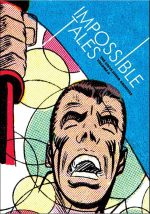
Impossible Tales: The Steve Ditko Archives volume 4


By Steve Ditko & various, edited by Blake Bell (Fantagraphics Books)
ISBN: 978-1-60699-640-9 (HB)

Once upon a time the short complete tale was the sole staple of the comic book profession, where the plan was to deliver as much variety as possible to the reader. Sadly, that particular discipline is all but lost to us today…

Steve Ditko (November 2nd 1927 – c. June 29th 2018) was one of our industry’s greatest talents and probably America’s least lauded. His fervent desire was to just get on with his job telling stories the best way he could. Whilst the noblest of aspirations, that dream was always a minor consideration and frequently a stumbling block for the commercial interests which for so long controlled all comics production and still exert an overwhelming influence upon the mainstream bulk of Funny book output. Let’s see what happens in the months to come now that COVID19 has wrought its horrific effects on the industry…

Before his time at Marvel, the young Ditko mastered his craft creating short stories for a variety of companies and it’s an undeniable joy to be able to look at this work from a such an innocent time. Here he was just breaking into the industry: tirelessly honing his craft with genre tales for whichever publisher would have him, utterly free from the interference of intrusive editors.

This fourth fantastic full-colour deluxe hardback – and potently punchy digital treasure trove – reprints another heaping helping of his ever more impressive works: published between July 1957 and March 1959, and all courtesy of the surprisingly liberal (at least in its trust of its employees’ creative instincts) sweat-shop publisher Charlton Comics. Some of the issues here were actually put together under the St. John imprint, but when that company abruptly folded, much of its already prepared in-house material – even entire issues – were purchased and published by clearing-house specialist Charlton with almost no editorial changes.

And, whilst we’re being technically accurate it’s also important to note that the eventual publication dates of the stories in this collection don’t have a lot to do with when Ditko rendered these mini-masterpieces: Charlton paid so little, the cheap, anthologically astute outfit had no problem buying material it could leave on a shelf for months – if not years – until the right moment arrived to print…

All the tales and covers reproduced here were drawn after implementation of the draconian, self-inflicted Comics Code Authority rules which sanitised the industry following Senate Hearings and a public witch-hunt. They are uniformly wonderfully baroque and bizarre fantasies, suspense and science fiction yarns, helpfully annotated with a purchase number to indicate approximately when they were actually drawn.

Sadly, there’s no indication of how many (if any) were actually written by Ditko, but as at the time the astoundingly prolific Joe Gill was churning out hundreds of stories per year for Charlton, he is always everyone’s first guess when trying to attribute script credit…

Following an historically informative Introduction and passionate advocacy by Blake Bell, the evocative tales of mystery and imagination commence with ‘The Menace of the Maple Leaves’, an eerie haunted woods fable from Strange Suspense Stories #33 (August 1957), closely followed a darkly sinister con-game which goes impossibly awry after a wealthy roué consults a supposed mystic to regain his youth and vitality before being treated in ‘The Forbidden Room’ (Mysteries of Unexplored Worlds #4 July 1957)…

From November 1957, Do You Believe in Nightmares? #1 offers a bounty of Ditko delights, beginning with the stunning St. John cover heralding a prophetic ‘Nightmare’; the strange secret of a prognosticating ‘Somnambulist’ and the justice which befalls a seasoned criminal in ‘The Strange Silence’ – all confirming how wry fate intervenes in the lives of mortals.

‘You Can Make Me Fly’ then goes a tad off-topic with a tale of brothers divided by morality and intellect after which the issue ends with a dinosaur-packed romp courtesy of ‘The Man Who Crashed into Another Era’…

Next up is a tale from one of Charlton’s earliest star characters. Apparently the title came from a radio show which Charlton licensed, and the lead/host/narrator certainly acted more as voyeur than active participant, speaking “to camera” and asking readers for opinion and judgement as he shared a selection of funny, sad, scary and wondrous human interest yarns all tinged with a hint of the weird and supernatural. When rendered by Ditko, whose storytelling mastery, page design and full, lavish brushwork were just beginning to come into its mature full range, the Tales of the Mysterious Traveler were esoteric and utterly mesmerising…

From issue #6 (December 1957), ‘Little Girl Lost’ chills spines and tugs heartstrings with the story of a doll that loved its human companion, followed by a paranoid chase from Strange Suspense Stories #35 (December 1957) as ‘There it is Again’ sees a scientist dogged by his most dangerous invention…

Unusual Tales #10 (January 1958) provides a spooky cover before disclosing the awesome secret of ‘The Repair Man from Nowhere’ and – following wickedly effective Cold War science fiction parable ‘Panic!’ from Strange Suspense Stories #35 – resumes with ‘A Strange Kiss’ that draws a mining engineer into a far better world…

Out of This World #6 (November 1957) provides access to ‘The Secret Room’ which forever changes the lives of an aging, destitute couple. Then cover and original artwork for Out of This World #12 (March 1959) lead to a tale in which a ruthless anthropologist is brought low by ‘A Living Doll’ he’d taken from a native village…

Returning to Tales of the Mysterious Traveler #6 results in three more captivating yarns. ‘When Old Doc Died’ is perhaps the best in this book, displaying wry humour in the history of a country sawbones who is only content when helping others, whilst ‘The Old Fool’ everybody mocked proves to be his village’s greatest friend, and ‘Mister Evriman’ explores the metaphysics of mass TV viewing in a thoroughly chilling manner…

The dangers of science without scruple informs the salutary saga of a new invention in ‘The Edge of Fear’ (Unusual Tales #10, January 1958), after which the cover of This Magazine is Haunted #14 (December 1957) ushers us into cases recounted by ghoulish Dr. Haunt; specifically, a scary precursor to cloning in ‘The Second Self’ and a diagnosis of isolation and mutation which afflicts ‘The Green Man’…

The cover and original art for giant-sized Out of This World #7 (February 1958) precedes ‘The Most Terrible Fate’ befalling a victim of atomic warfare whilst ‘Cure-All’ details a struggle between a country doctor and a sinister machine which heals any ailment.

We return to This Magazine is Haunted #14 as Dr. Haunt relates a ghastly monster’s progress ‘From Out of the Depths’ before ‘The Man Who Disappeared’ tells his uncanny story to disbelieving Federal agents. Out of This World #7 in turn provides an ethereal ringside seat from which to view a time-traveller’s ‘Journey to Paradise’…

From Tales of the Mysterious Traveler #7 (March 1958), ‘And the Fear Grew’ relates how an Australian rancher falls foul of an insidiously malign but cute-looking critter, after which ‘The Heel and the Healer’ reveals how a snake-oil peddler finds a genuine magic cure-all, whilst ‘Never Again’ (Unusual Tales #10 again) takes an eons-long look at mankind’s atomic follies and ‘Through the Walls’ (Out of This World #7) sees a decent man framed and imprisoned, only to be saved by the power of astral projection…

Out of This World #12 (March 1959) declared ‘The World Awaits’ when a scientist uncovers an age-old secret regarding ant mutation and eugenics, Mysteries of Unexplored Worlds #7 (February 1958) exposes ‘The Angry Things’ which haunt a suspiciously inexpensive Italian villa, and the gripping cover to Tales of the Mysterious Traveler #10 (November 1958) segues into the unsuspected sacrifice of a jazz virtuoso who saves the world in ‘Little Boy Blue’…

A tragic orphan finds new parents after ‘The Vision Came’ (Tales of the Mysterious Traveler #8, July 1958) before Dr. Haunt proves television to be a cause of great terror in ‘Impossible, But…’ (from This Magazine is Haunted volume 2 #16, May 1958) – an issue which also discloses the world-changing fate of a Soviet scientist who became ‘The Man from Time’…

Another selfless inventor chooses to be a ‘Failure’ rather than doom humanity to eternal servitude in a stunning yarn from Strange Suspense Stories #36 (March 1958), whilst the luckiest man alive at last experiences the downside of being ‘Not Normal’ (Tales of the Mysterious Traveler #7) after which Unusual Tales #11 – from March 1958 – reveals the secret of Presidential statesmanship to a young politician in ‘Charmed, I’m Sure’, and exposes a magical secret race through an author’s vacation ‘Deep in the Mountains’…

This mesmerising collection concludes with the suitably bizarre tale of Egyptian lucky charm ‘The Dancing Cat’ (Strange Suspense Stories #37, July 1958) to ensure the spooky afterglow remains long after the final page and leaves you hungry for more mystic merriment and arcane enjoyment…

This sturdily capacious volume has episodes that terrify, amaze, amuse and enthral: utter delights of fantasy fiction with lean, stripped down plots and simple dialogue that let the art set the tone, push the emotions and tell the tale, from times when a story could end sadly as well as happily and only wonderment was on the agenda, hidden or otherwise. The stories display the sharp wit and contained comedic energy which made so many Spider-Man/J. Jonah Jameson confrontations an unforgettable treat a decade later, making this is cracking collection not only superb in its own right but as a telling examination into the genius of one of the art-form’s greatest stylists.

This is a book serious comics fans would happily kill or die or be lost in time for…
This edition © 2013 Fantagraphics Books. Introduction © 2013 Blake Bell. All rights reserved.

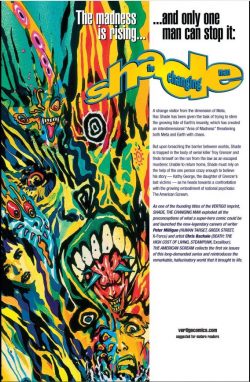
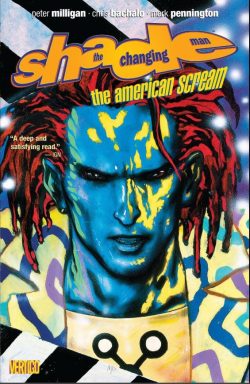
Shade, the Changing Man volume: The American Scream


By Peter Milligan, Chris Bachalo, Mark Pennington & various (DC/Vertigo)
ISBN: 978-1-4012-0046-6 (TPB)

Even before DC hived off its “Mature Readers” sophisticated horror/hero series to become the backbone of the self-sustaining Vertigo line in 1993, the company had begun to differentiate between standard all-ages superhero sagas, new stand-alone concepts such as Gilgamesh II, Skreemer, Haywire or World Without End and edgy, off-the-wall, quasi-costumed fantasy and supernatural suspense titles as Doom Patrol, Black Orchid, Animal Man, Sandman, Hellblazer and Swamp Thing. Perhaps the most radical and challenging was a darkly psychedelic reworking of Steve Ditko’s lost masterpiece of modern paranoia Shade the Changing Man.

In the original 1977 mainstream series Rac Shade was a secret observer from the other-dimensional Meta-Zone. Framed for terrorism and sedition, he went rogue; using untried stolen technology to combat a wave of insanity that emanated from “the Area of Madness” within the Zero-Zone separating his world from ours. Said madness threatened both universes and Shade was resolved to stop it, despite the best efforts of sinister self-serving forces from Earth and Meta determined to destroy him.

When Peter Milligan, Chris Bachalo & Mark Pennington began to rework the character, much of Ditko’s original concept remained but was brutally tweaked for the far more cynical and worldly readers of the Blank Generation…

This collection – available in old-fashioned trade paperback and almost otherworldly digital formats – re-presents the first six issues of the new Shade from July to December 1990 and begins by introducing deeply disturbed Kathy George, patiently awaiting the final sanction on spree-killer Troy Grenzer.

Years previously, the unrepentant psycho-killer butchered her parents – and almost her too – and when her black boyfriend tackled the knife-wielding manic the Louisiana police shot her saviour instead of the white assailant…

Now in the final hours before Grenzer finally sits in the electric chair on ‘Execution Day’, Kathy is experiencing wild hallucinations. That’s nothing new: following the deaths of everyone she’d ever loved, Kathy was committed to an asylum until her inheritance ran out. Then she was released, apparently “too poor to be crazy” anymore.

Becoming a thief and a grifter, she wandered America until a radio report informed her Grenzer was about to be put to death. Inexplicably, Kathy found herself heading back to Louisiana…
On Death Row, things aren’t going according to plan. Bizarre lights, strange visions and electrical phenomena interrupt the execution and, as a fantastic reality-warping explosion occurs, Grenzer’s body vanishes…

On a hillside overlooking the prison, Kathy is pursued by an animated electric chair and Grenzer materialises in her car – only he claims not to be the serial killer but Rac Shade: a secret agent from another dimension who left his own body in an otherworldly Area of Madness to mentally occupy the now-vacant corpse of the serial killer.

It isn’t the craziest thing Kathy has ever heard, and even if it isn’t true, at least she has a chance to personally kill the man who destroyed her life…

As the drive away together, insane things keep happening. Shade explains that his transition to Earth caused a rupture in the fabric of the universes – a trauma in Reality…

Slowly acclimatising, Shade explains his original body is clad in experimental technology and his “M-Vest” connects his subconscious to the chaos of the Madness zone. His job was to come here and stop a plague of materialised insanity threatening both worlds, but now he’s actually given it easier access to ours…

After a climactic struggle with her own ghosts and traumas, Kathy reluctantly agrees to help the semi-amnesiac Shade in his mission.

Meanwhile at a Mental Hospital, uncanny events culminate in a ghastly reordering of people and matter itself: a horrific nigh-sentient phenomenon dubbed “the American Scream” breaks through from somewhere else and threatens all life and rationality on Earth. With casual daydreams, flights of fantasy and vicious whims increasingly given substance and solidity, the government – well aware of the crisis – dispatched Federal Agents Stringer and Conner to investigate…

The quest proper begins as the fugitives from justice troll through the hinterlands of American Culture and its Collective Unconscious, ending up in Dallas where obsessed author Duane Trilby, determined to discover ‘Who Shot JFK?’, finds himself conversing with the tarnished martyr himself. As the murdered president returns to the scene of the crime, the city starts to literally unravel, with a giant idolatrous bust of the victim bursting through the tarmac of Dealey Plaza, incessantly screaming for answers…

The chaos affects Shade, as the last vestiges of Grenzer’s personality repossess the body they share, determined to at last add Kathy to his tally of victims, even as Agents Stringer and Conner – convinced she is connected to Grenzer’s abrupt disappearance from his own execution – follow her to Texas. With madness rampant, Shade and Kathy are drawn into Trilby’s materialisation of events, becoming JFK and Jackie, inexorably heading toward death in that open-topped car…

The measured insanity escalates in ‘All the President’s Assassins!’ as Trilby saves Shade/JFK and slowly reveals his own personal tragedy: one which drove him to solve an impossible conundrum and avoid an agonising admission…

All the while, the Metan’s consciousness is being dragged into a succession of traumatised participants before realising he must defeat this outbreak of the American Scream quickly or surely fragment and die…

Escaping into his own past on Meta in ‘Mad, Bad and Dangerous to Know’, Shade physically re-experiences his early life, whilst in Dallas Stringer and Conner apprehend Kathy.

A lovelorn, impressionable poet, young dropout Rac Shade was tricked into becoming an agent and sent to Earth because it was apparently the source of devastating waves of insanity plaguing Meta, but en route he was sucked into the Area of Madness, meeting the American Scream face to face…

Falling back to Earth, Rac frees Kathy and they flee, arriving in Los Angeles in time to struggle with the dark underbelly of the film industry as it comes to murderous, sadistic life and starts stalking the stars and moguls who create the vicious yet glorious land of dreams. First singled out are the cast and crew of in-production zombie epic Hollywood Monsters, who endure shame and career destruction as impossible film-clips of their deepest secrets and darkest transgressions manifest. Soon after, mutilations and deaths begin, before a psychedelic crescendo is reached in ‘Hollywood Babble On II’ with Shade and Kathy fighting their way through a physically-realised and highly biased history of Tinsel Town triumphs and travesties, before finally seizing control of the noxious narrative and beating the Madness at its own game…

Sporting a stunning cover gallery by Brendan McCarthy, this terrifying tome is darkly ironic and blackly comedic, whilst gripping and dripping with razor-edged social commentary. Shade, the Changing Man added a sparkling brew of sardonic wit to the horror and action staples of the medium and remains one of the most challenging and intriguing series in comics history. Check it out.
© 1990, 2003, 2009 DC Comics. All Rights Reserved.

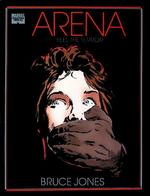
Arena – A Marvel Graphic Novel


By Bruce Jones (Marvel)
ISBN: 978-0-87135-557-7

In  the early 1980s Marvel led the publishing pack in the development of high quality original graphic novels: mixing out-of-the-ordinary Marvel Universe tales, new in-continuity series launches, creator-owned properties, licensed assets, movie adaptations and even the occasional creator-owned property in extravagantly expansive packages (a square-ish standard page of 285 x 220mm rather than the now customary elongated 258 x 168mm) that felt and looked instantly superior to the average comicbook no matter how good, bad or incomprehensible (my way of saying outside your average Marvel customer’s comfort zone) the contents might be.

By 1990 Marvel’s ambitious line of outré all-area epics had begun to stall and some less-than-stellar tales were squeaking into the line-up. Moreover, the company was increasingly relying on hastily turned out cinema adaptations with built-in fan appeal and safe in-continuity stories offering established and company copyrighted characters rather than creator-owned properties and original concepts. The once-unmissable line began to have the appearance of an over-sized, over-priced clearing house for leftover stories.

So this stunning suspense saga counts as one of the last – and very best – indie/mainstream fiction experiments from before the rot set in; a creepy, clever, sexy thriller from screenwriter,  novelist, artistic Everyman and ardent EC fan Bruce Jones which sets up shop in Stephen King and Ray Bradbury territory to deliver an overwhelmingly impressive rollercoaster of shocks and twists.

Sharon and her 12 year old daughter Lisa are driving through the majestic rural backwoods of America. It’s a pretty acrimonious journey and when the opportunity presents itself Mom takes a break and goes for a refreshing dip in a mountain pool whilst daughter stays in the car sulkily playing with her toy planes.

Sharon’s idyllic moment is shattered when she sees a jet crash scant yards away. However she can’t find any wreckage or even the slightest sign of it. Lisa saw and heard nothing and neither did the sinister voyeur who had been spying on them…

Rushing back to his shack simpleminded Lem tells his demented Granny about the strange woman. The old crone smells opportunity: if they can capture her and if she’s fertile they can sell her babies in the Big City… and even if she’s not big brother Rut will have a new plaything for awhile…

Lost in the deep woods Lt. Roberts, USAF crawls out of her crashed plane and hears voices. Sharon and the downed pilot start talking and realise that although they can’t see each other they are standing side by side. They’re invisible because they’re separated by two decades…

Somehow the mountain and forest are one huge time-warp… and increasingly, various eras are overlapping. Even though Sharon can only talk to Roberts, dinosaurs and cavemen are chaotically roaming over the hills, endangering both women in their own time-zones…

At that moment Lem and Rut strike, snatching Sharon. locking her up ready to make some money-spinning young ‘uns. From the car little Lisa sees her mother taken and twenty years in the future pilot Lisa Roberts suddenly remembers the horrifying moment her mother was killed by Hillbilly rapist psychopaths…

The time-shifts briefly stabilise and the two Lisas meet…

With beasts and worse roaming the woods the elder Lisa realises she has a chance to unmake the worst day of her life, but there are complications she could never have imagined in store for her and the girl she used to be…

Sultry, sinister and devilishly cunning, this chronal conundrum is beautifully illustrated by Jones and his corkscrew plot is packed full of genuine surprises. Don’t think you’ve guessed the ending because you most likely haven’t…

A perfect sci fi movie-in-waiting, this terse and evocative yarn follows all the rules for a great screen shocker without ever having to “dumb-down” the temporal mechanics in deference to the Great Un-read in the popcorn seats.

Smart, seductive storytelling for sharp-witted punters, this is book long overdue for re-release, but until that happy future materialises, this remains a time-lost gem you should track down however long it takes…
© 1989 Bruce Jones. All Rights Reserved.

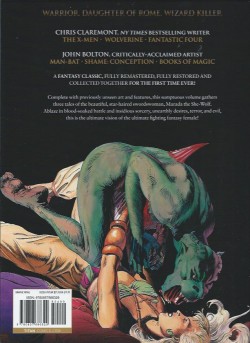
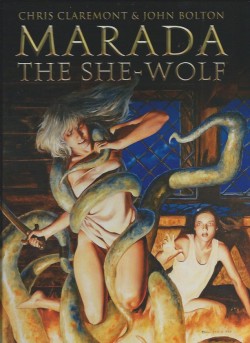
Marada the She-Wolf


By Chris Claremont & John Bolton (Titan Books)
ISBN: 987-0-85768-632-9 (HB) (TPB)

Scantily clad hot chicks swinging swords have been a staple of fantasy comics from their very inception. It’s a meme that has endured even as we (some of us anyway) grew up a bit and discovered it’s just as prevalent in the movies and on TV. If it going to be a thing, at least let’s see it done properly and probably nobody has done it better – certainly visually – than Chris Claremont and John Bolton.

This recycled yet supremely satisfying, luxuriously oversized (302 x 226 mm) hardback compilation of their collaborative fantasy saga will satisfy all aficionados of wild adventure and stirring sagas – especially in a world where faux historical dramas like Game of Thrones and The Witcher are still garnering interest in “Things Old, Things Forgotten”…

As detailed in Jo Duffy’s Introduction and collection Editor Steve Cook’s background essays ‘Birth of a Warrior’, ‘The Art of War’, ‘Epic Tales’ and ‘Legacy’, these stories – set in the cosmopolitan days of Imperial Rome – originated in Epic Illustrated (Marvel’s 1980’s response to Heavy Metal magazine) beginning with #10, February 1982.

Originally the strip appeared in beautiful monochrome wash-&-line, and although I would have preferred them to have been left that way for this collection, Bolton’s sensitive conversion of the art to painted colour is lush, lovely and stunningly effective.

By the way, that possibly waspish crack about recycling doesn’t just refer to the art, superb though it is. The original story started life as a Red Sonja yarn for monochrome anthology Bizarre Adventures, before Claremont & Bolton reworked the thing and, by inserting the whole kit and caboodle into the “real” world of the Ancient Roman – albeit embroidered with Celtic myth and legend – and added a satisfying layer of dramatic authenticity to the mix which still leaves it head-and-shoulders above all other Sword and Sorcery “Bad Girls” tales, as well as most fantasy fiction…

The literary pre-game warm-up also includes an effusive memo from the author as ‘Claremont on Bolton’ offers more creative insight on why these seldom-seen stories are just so darn good before the wonderment unfolds in the initial tale ‘Marada the She-Wolf: The Shattered Sword’.

The ferociously independent warrior woman is a wandering mercenary whose grandfather was Julius Caesar. When her parents fell into political disfavour, she was whisked from the Eternal City to live free and grow wild. Now, years later in the deserts near Damascus she is rescued from slavers by charismatic Warrior-Magician Donal MacLlyanllwyr. Strangely, the indomitable Marada he remembers is gone and all he liberates is a broken doll, traumatised by some unspoken horror and utterly devoid of will and spirit…

Mystically transporting her to the arboreal citadel of Ashandriar, amidst the misty hills of distant Britain, the baffled soldier seeks the aid of patron sorceress Rhiannon to diagnose, if not cure, her malady.

As Marada gradually recovers, she forms a bond with Donal’s daughter Arianrhod; a girl of vast, if unschooled, magical power. Before long, the ghastly secret of Marada’s malaise is revealed when a demonic creature invades the mystic keep, killing Donal and abducting Arianrhod.

Enraged and desperate, Marada braves Hell itself and slashes her way through an army of devils to rescue the child she now considers as much daughter as friend from a wizard and demon conclave. They initially broke the warrior woman as part of a convoluted scheme to reign on Earth…

The re-galvanised She-Wolf is ultimately victorious, but the horrific confrontation leaves her and Arianrhod stranded in East Africa. With no other option, the triumphant duo begin the long exhausting walk home to Albion…

From Epic #12, ‘Royal Hunt’ is a shorter, self-contained tale wherein Marada and Arianrhod, after escaping the Infernal Realm, are taken by Ashake, barbaric Empress of Amazonian nation of Meroë. The Battle Queen offers her captives the dubious distinction of being the quarry in a hunt (a competent if cheekily uninspired variation of Richard Connell’s landmark 1924 short story – and equally influential 1932 movie – The Most Dangerous Game).

Sadly, both predator and prey are unaware malign male mercenaries are lurking about, with the worst of all intentions for the unsuspecting women. Hard-fought combat and the sudden intervention of the sneaking male scum makes allies of Ashake and Marada, leading to the voyagers’ final tale, ‘Wizard’s Masque’ (Epic Illustrated #23-24, April & June 1984) which finds the long-lost Europeans aboard merchant ship Raven, bound for Roman port Massilia. However, impetuous Arianrhod gets bored with their slow progress and tries a transportation spell, opening a portal to nether realms and letting something really ghastly out of hell…

Beating the beast back, Marada falls though the gap in reality to materialise on an Arabic pirate ship currently engaged in a life-and-death clash with soldiers of an Eastern Kaydif. Her sudden presence turns the tide and soon she is partner to flamboyant corsair Taric Redhand, who swears to get her back to her home and lost “daughter”…

Typically, Marada has also been noticed by sinisterly seductive sorcerer Jaffar Ibn Haroun Al-Rashid. Although he purports to be a friend – and potential lover – able to reunite her with The Raven, he conceals a connection to the same demonic alliance that originally targeted the She-Wolf in faraway Rome. He is also, in all things, a creature of passion and self-serving convictions, capable of absolutely anything to achieve his own ends…

Ultimately however, the wanderer knows she can only depend upon herself to find her way back to Arianrhod and home…

Moody, passionate and powerfully evocative, this is a classic work of comics fantasy that will certainly all delight fans of the genre.
© & ™ 2013 John Bolton and Christ Claremont. All rights reserved.

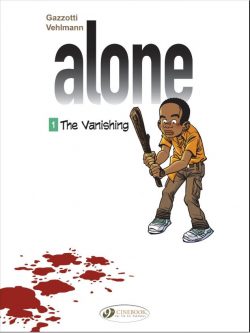
Alone volume 1: The Vanishing


By Gazzotti & Vehlmann, translated by Jerome Saincantin (Cinebook)
ISBN: 978-1-849181-96-9 (PB Album)

Fabien Vehlmann was only born in 1972 yet his prodigious canon of work (from 1998 to the present) has earned him the soubriquet of “the Goscinny of the 21st Century”. He entered the world in Mont-de-Marsan and grew up in Savoie, growing up to study business management before taking a job with a theatre group.

In 1996, after entering a writing contest in Le Journal de Spirou, he caught the comics bug and two years later published – with illustrative collaborator Denis Bodart – a mordantly quirky and sophisticated portmanteau period crime comedy entitled Green Manor. From there on his triumphs grew to include – many amongst others – Célestin Speculoos for Circus, Nicotine Goudron for l’Écho des Savanes and major-league property Spirou and Fantasio…

Bruno Gazzotti is Belgian, born in 1970 and was a student of Institut Saint Luc in Liège. Another artist addicted to comics from his earliest years, he started being paid to draw them in 1988, after being hired by Spirou editor Patrick Pinchart on the strength of his portfolio alone. Before long he was illustrating Le Petit Spirou with Tome & Janry. In 1989, he and Tome created New York Cop Soda, which kept Gazzotti busy until 2005, when he resigned to co-create award-winning feature Seuls…

Released in January 2006, Seuls – La disparition is a superb example of a kids’ thriller suitable for all ages: evoking the eerie atmosphere of TV series Lost and the most disturbing elements of Philip Wylie’s The Disappearance and William Golding’s Lord of the Flies.

Translated as The Vanishing, the first chapter show us peeks of an ordinary bustling town, with simple folk going about their business. Our swift glimpses show us a cross section of kids: Ivan, an imaginative child of wealth who wants for nothing but never sees his dad any more and Leila, a born engineer, inventor and tinkerer. Her poor but honest dad always has time to play and critique her latest gadget…

Camille is studious and over-focussed on exams and achievement and Terry is pretty much still a baby. He certainly acts like one, trying to stay up late, binge watching TV and throwing tantrums if he doesn’t get his way.

Sadly, not all children in town have such typical lives. Dodzi has just been taken into the system. His early life has made him tough and resilient but won’t stop the other young inmates handing him a beating on this ominous, odd-feeling night…

Next morning dawns overcast and forbidding. The city is quiet. Roaming empty streets, Dodzi calls out to anybody who can hear and is met – or actually run over – by Leila and Terry on her bike. They are all pretty scared and have seen nobody else at all…

No one else is around. All the adults have gone, and all their child pals. The internet is down, television and radio only blare out static. Above, fearsome storm clouds gather. Within minutes fear turns to panic and violence but eventually Dodzi brutally enforces calm and leads them away, only to stumble into Camille being attacked by a dog. As the tough guy tries to fight it off, the rabid beast senses something in the shadows of an alley and flees…

As they wander, someone watches the waifs and after they joyously blow off steam in a fountain, they meet final lost boy Ivan. He invites them back to his mansion on the edge of town where they find food while being subjected to his theories on what’s happened: everything from a shared dream to an extinction event to the possibility that they’re dead and in hell…

Needing more information, Dodzi and Leila try to drive one of many cars on the estate while the smaller ones sort out a proper meal, but neither task goes well. The cooking is a disaster while the near-lethal reconnaissance only finds more empty streets, wrecked shop fronts and wild animals in the streets. While the motoring minors seek to evade two rhinos, Terry and Camille are almost eaten by a white tiger that’s got through the estate gates…

When Dodzi and Leila return – and following a burst of viciously released tensions – the kids modify and weaponize a 4 by 4 and head back to town. Ivan’s dad owns the tallest building in the city: somewhere stuffed with resources and easily fortified and defended…

As the first day alone ends, the kids are bloated with vending machine snacks and playing in the vast office block’s upper reaches, but de facto leader Dodzi is still uneasy.

When Leia reports little Terry is missing, he heads out to search and finds to his horror where all the animals have come from: a scene of destruction that distracts him enough that a hidden stalker almost takes him.

Thankfully, the others have ignored his orders and followed so it isn’t Dodzi that dies…

Thus begins a spooky, powerful and often shocking tale of mystery and imagination with the bereft children facing increasingly daunting physical hazards and an escalating series of events which can have no logical or rational explanation…

Alone rapidly became one of the biggest critical and commercial comics hits of the decade and if you love eerie enigmas and powerful tale-telling, you’ll soon be buying this and seeing why for yourself…
© Dupuis 2006 by Gazzotti & Vehlmann. All rights reserved. English translation © 2014 Cinebook Ltd.

Obscura


By Luke Cartwright & Lukasz Wnuczek (Marcosia)
ISBN:978-1-64764-746-9 (HB)

We haven’t looked at a really engrossing horror yarn for simply ages, so it’s a good thing that this stunning dose of macabre graphic gothic mania plunked down in my review copies vestibule…

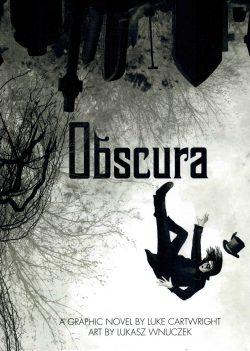
Obscura comes from and is about the Land Down Under (Tasmania actually!): an act of love and perseverance begun in 2012 but finally perfected and released last year by author Luke Cartwright and illustrator Lukasz Wnuczek. It’s presented here for your delectation and elucidation (and probably trepidation)…

Set on the island of Van Diemen’s Land (a former Crown prison colony and site of one of the British Empire’s most appalling atrocities: just look up the Black War if you have the stomach), it opens in 1870 with the rather outré preoccupations of master William Morier. The 12-year old is already a gifted cosmetician and mortician like his father, but his odd-yet-comfortable life is ruined by a double blow: meeting with the spiritualist children Catherine and Annabel White and a scandal involving body-snatching and the local medical school.

The White girls are controversial celebrities in the township, a place even more death-obsessed than most Victorian enclaves. When Annabel ends up on the Morier mortuary slab, dead from causes unknown, William’s path in life is forever altered…

A crafty tale within a tale, the drama resumes a decade later. As well as burying bodies, William is a gifted photographer and, after discussing the profitability of his wife’s childhood scams, sets upon a new enterprise, for his need is great and urgent.

Catherine Morier (nee White) suffers a dire medical malady and her doting husband needs plenty of cash to pay for an operation. His solution is Spirit Photography: combining portraits of living clients with the ghosts of departed loved ones who still cling unseen to them.

Sadly, not everyone’s a believer. A certain policeman keeps hanging around, especially after one of the captured phantasms is seen working in a local shop…

As William gets deeper and deeper into the fraudulent hole he’s dug for himself, the walls between chicanery, criminality, murder and the inescapable horror of the true Unknown start to blur and bleed together…

Mordant and compelling, this bleak tale is rendered in mesmerising monochrome tones and washes (almost like daguerreotypes, maybe?), building a noir edifice of stark choices and unlikely outcomes for the protagonists whom it’s simply impossible to dislike. Especially effective is the period language, which is authentic sounding, remarkably restrained and deliciously sparse. Cartwright is a writer who knows when to let Wnuczek’s pictures do the talking.

A decidedly effective dalliance with the dark and one no lover of period thrillers and slyly witty horror should miss.
Text & illustrations © Luke Cartwright & Lukasz Wnuczek 2019

Showcase Presents The Phantom Stranger volume 1


By Mike Friedrich, John Broome, France Herron, Bob Kanigher, Mike Sekowsky, Denny O’Neil, Gerry Conway, Jack Oleck, Len Wein, Steve Skeates, Mark Hanerfield, John Albano, Jerry Grandenetti, Leonard Starr, Carmine Infantino, Sy Barry, Bill Draut, Frank Giacoia, Neal Adams, Murphy Anderson, Curt Swan, Jim Aparo, Tony DeZuñiga, Jack Sparling & various (DC Comics)
ISBN: 978-1-4012-1088-5 (TPB)

Since 1936 DC Comics have published an incalculable wealth of absolutely wonderful comics tales in a variety of genres and addressing a wide variety of age ranges and tastes.

Sadly, unlike rival Marvel, these days they seem content to let most of it languish beyond the reach of fans, so as a new decade – possibly or last – unfolds, I’ll be continuing my one-person campaign to remind them and inform you that – like The Truth – the Fiction is also Out There… even if only still available in older collections…

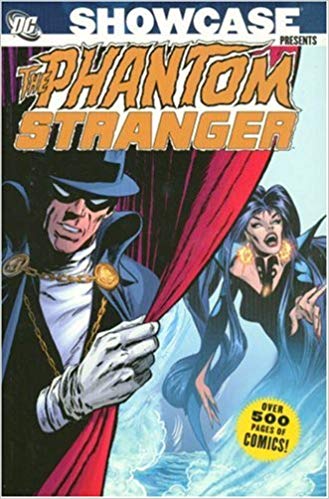
Spanning the end of 1968 to October 1972, this mammoth monochrome tome collects Showcase #80 and Phantom Stranger #1-21, attempting to blend the rising taste for blood and horror with more traditional masked mystery man derring-do…

The Phantom Stranger was also one of the earliest transitional heroes of the Golden Age of comics, created at the very end of the first superhero boom as readers moved from costumed crimefighters to other genres such as mystery, crime, war and western tales. A trench-coated, mysterious know-it-all, with shadowed eyes and hat pulled down low, he would appear, debunk a legend or foil a supernatural-seeming plot, and then vanish again.

He was coolly ambiguous, never revealing whether he was man, mystic or personally paranormal. Probably created by John Broome & Carmine Infantino, who produced the first story in Phantom Stranger #1 (August/September 1952) and most of the others, the 6-issue run also boasted contributions from Jack Miller, Manny Stallman and John Giunta. The last issue was cover-dated June/July, 1953, after which the character vanished.

Flash-forward to the end of 1968. The second superhero boom is rapidly becoming a bust, and traditional costumed heroes are dropping like flies. Suspense and mystery titles are the Coming Thing and somebody has the bright idea of reviving Phantom Stranger. He is the last hero revival of DC’s Silver Age and the last to graduate to his own title during the star-studded initial run of Showcase, appearing in #80 (cover-dated January/February 1969) before debuting in his own comic three months later. This time, he found an appreciative audience, running for 41 issues over seven years.

Rather than completely renovate the character, or simply run complete reprints as DC had when trying to revive espionage ace King Faraday (in Showcase #50-51), Editor Joe Orlando had writer Mike Friedrich and artist Jerry Grandenetti create a contemporary framing sequence of missing children for 1950s tale ‘the Three Signs of Evil’, and – in a masterstroke of print economy – introduced (or rather reintroduced) another lost 1950s mystery hero to fill out the comic, and provide a thoroughly modern counterpoint.

Dr. Terrence Thirteen is a parapsychologist known as the Ghost Breaker. He had his own feature in Star-Spangled Comics #122-130 (November 1951 to July 1952). With fiancée (later wife) Marie he roamed America debunking supernatural hoaxes and catching mystic-themed fraudsters, a vocal and determined cynic who was imported whole into the Showcase try-out as a foil for the Stranger. Reprinted here was origin tale ‘I Talked with the Dead!’ by an unknown writer – probably “France” Herron – with art by Leonard Starr & Wayne Howard.

Despite this somewhat choppy beginning, the try-out was a relative success and (Follow Me… For I Am…) The Phantom Stranger launched with a May/June 1969 cover-date. In another framing sequence by Friedrich & Bill Draut, a tale of impossible escape from certain death is revealed in ‘When Ghosts Walk!’, a 1950s thriller from John Broome, Carmine Infantino and Sy Barry, followed by an all new mystery ‘Defeat the Dragon Curse… or Die!’ Firmly establishing that the supernatural is real, Friedrich & Draut pit the Stranger and Dr. 13 against each other as well as an ancient Chinese curse.

‘The Man Who Died Three Times’ in the second issue relates a mystery with a mundane yet deadly origin, with the incorporated reprint Stranger tale ‘The House of Strange Secrets’ (Broome, Infantino and Barry) and Dr. 13’s ‘The Girl Who Lived 5,000 Years’ both providing the uneasy chills that Friedrich & Draut’s by-the-numbers tale do not.

Issue #3 once again employs frightened kids as a vehicle to encapsulate vintage thrillers in a tale with a sinister carnival component. The Stranger relives ‘How Do You Know My Name?’ (by Broome & Frank Giacoia) whilst Dr. 13 proves once more that there are ‘No Such Thing as Ghosts!’ (Herron & Starr).

With such a formularised start it’s a miracle the series reached the landmark issue #4 where Robert Kanigher & Neal Adams (who had been responsible for the lion’s share of eerie, captivating covers thus far) produced a much more proactive hero in the mystery triptych ‘There is Laughter in Hell This Day!’, ‘There is Laughter in Hell Tonight!’ and ‘Even the Walls are Weeping!’

Stalwart Bill Draut provided inks for this classy classic in which Terry Thirteen becomes a far more militant – and consequently frustrated – debunker of the Stranger’s “hocus-pocus” when Tala, the demonic Queen of Evil and Mistress of Darkness escapes her ancient tomb to bedevil the modern world with only the Phantom Stranger and an eclectic gang of runaway teens to oppose her.

This new combative format and repositioning of the book was presumably for the benefit of older kids. The protagonist teens were a strange composite of counter-culture stereotypes named Spartacus (black kid), Attila (greasy biker), Wild Rose (blonde flower child) and Mister Square (conformist drop-out) who feel a little forced now but were the saving of the book, as was the dropping of 17-year old reprints. From now on the stranger would really battle the Dark Powers and Dr. 13 would assume the metaphorical role of a blustering, officious parent who had no idea what was really going on.

An added bonus in this cracking issue was a nifty 3-page horror vignette from Kanigher and the wonderful Murphy Anderson entitled ‘Out of This World’.

Anderson returned to ink the unique Mike Sekowsky in Phantom Stranger # 5, a full-length ghostly thriller featuring more of Tala’s handiwork in ‘the Devil’s Playground!’, topped off with another horror short by Kanigher, credited to Sekowsky here but actually a fine example of Curt Swan’s subtle mastery, especially as it’s inked by Anderson.

Sekowsky wrote and illustrated the next issue, under inks from Vince Colletta. ‘No. 13 Thirteenth Street’ is a Haunted House tale with those meddling kids and Dr. 13 getting underfoot in a delightfully light and whimsical diversion before Kanigher and Tala return in #7’s dark saga ‘The Curse!’, wherein both the Stranger and Terry Thirteen are right and the solution to madness and sudden deaths is both fraud and the supernatural!

This issue is particularly important in that it features the debut of up-and-coming Jim Aparo as illustrator. Over the next few years his art on this feature would be some of the very best in the entire industry.

Issue #8 unearthed an early arctic eco-thriller with supernatural overtones as Denny O’Neil described the tragic ‘Journey to the Tomb of the Ice Giants!’ whilst Dr. 13 returned to his own solo feature to deal with ‘The Adventure of the Brittle Blossom!’ Sekowsky scripted #9’s ‘Obeah Man!’ a tense shocker of emerging nations and ancient magic which showed Aparo’s superb versatility with exotic locales.

Young Gerry Conway wrote ‘Death… Call Not My Name!’ for #10, introducing another stylish returning villain in immortal alchemist Tannarak, whilst finding room for a quickie as the Stranger proves to be no match for ‘Charlie’s Crocodile.’ Phantom Stranger #11 (Conway & Aparo) details a colossal new threat as evil-doers everywhere begin to vanish in ‘Walk Not in the Desert Sun…’ before Kanigher returns with a classy haunted love-story in ‘Marry Me… Marry Death!’ in #12. This issue also offers another debunking solo stand for the Ghost Breaker in Jack Oleck and Tony DeZuñiga’s ‘A Time to Die’.

Science meets supernature in #13 when death stalks a research community in ‘Child of Death’ and Dr. 13 survives an encounter with ‘the Devil’s Timepiece’: both scripts from Kanigher with art by Aparo and DeZuñiga respectively.

Len Wein wrote possibly the spookiest ever adventure to feature Phantom Stranger in #14’s ‘The Man with No Heart!’: a story which resolves forever the debate about the dark hero’s humanity whilst introducing another long-term adversary for our delectation. The Ghost Breaker has his own brush with super-science – but definitely not the supernatural, no sir! – in Wein & DeZuñiga’s ‘The Spectre of the Stalking Swamp!’ – a tale that actually pushes the Stranger off his own front cover!

Issue #15 returns him to the Dark Continent as a robotics engineer is caught up in revolution in Wein & Aparo’s ‘The Iron Messiah’ whilst Kanigher & DeZuñiga send Dr. 13 up against ‘Satan’s Sextet’. On a roll now, the Phantom Stranger creative team surpass themselves with each successive issue, beginning with an ancient horror captured as an ‘Image in Wax’, nicely balanced by sneaky murder mystery ‘And the Corpse cried “Murder!”’ (Wein & DeZuñiga).

‘Like a Ghost from the Ashes’ debuts a nominal love-interest in blind psychic Cassandra Craft as well as reintroducing an old foe with new masters in the first chapter of an extended saga – so extended it pushed Ghost Breaker out of #17 altogether. He was back in the back of the next issue in Steve Skeates & DeZuñiga’s tense phantom menace ‘Stopover!’, with the artist drawing double duty by illustrating lead strip ‘Home is the Sailor’: a gothic romance with a sharp twist in the tail.

Old enemies resurface in ‘Return to the Tomb of the Ice Giants!’ as does artist Aparo, whilst Skeates & DeZuñiga’s ‘The Voice of Vengeance’ proves to be another stylish murder mystery in spook’s clothing. ‘A Child Shall Lead Them’ is written by Kanigher, who easily adapts to the new style to craft a tense, powerful chase thriller as all and sundry search for the newest incarnation of a High Lama murdered by magic. Two short suspense tales top off the issue, both illustrated by the veteran Jack Sparling: ‘The Power’, scripted by Mark Hanerfield and John Albano’s ‘A Far Away Place’.

Phantom Stranger #21 completes this superb collection of menace and magic with Wein and Aparo’s ‘The Resurrection of Johnny Glory’ wherein a reanimated assassin finds a good reason to stay dead whilst Dr. 13 debunks one final myth in ‘Woman of Stone’, prompting the question “why don’t killers use guns anymore?”

The DC Showcase compendia were a brilliant and economical way to access superb quality comics fare, and these black and white telephone books of wonderment still offer tremendous value for money. If you’re looking for esoteric thrills and chills this first Phantom Stranger volume has it all. If you’re not a fan yet give it a chance… you will be.
© 1969-1972, 2006 DC Comics. All Rights Reserved.

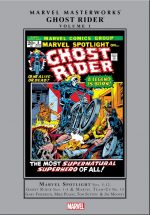
Marvel Masterworks: Ghost Rider volume 1


By Roy Thomas, Gary Friedrich, Marv Wolfman, Doug Moench, Len Wein, Mike Ploog, Tom Sutton, Jim Mooney, Herb Trimpe, Ross Andru & various (Marvel)
ISBN: 978-1302918170 (HB)

At the end of the 1960s American comicbooks were in turmoil, much like the youth of the nation they targeted. Superheroes had dominated for much of the decade; peaking globally before explosively falling to ennui and overkill. Older genres such as horror, westerns and science fiction returned, fed by radical trends in movie-making where another, new(ish) wrinkle had also emerged: disenchanted, rebellious, unchained Youth on Motorbikes seeking a different way forward.

Green Lantern/Green Arrow, Jack Kirby’s Jimmy Olsen, Captain America and many others all took the Easy Rider option to boost flagging sales (and if you’re interested the best of the crop was Mike Sekowsky’s tragically unfinished mini-masterpiece of cool Jason’s Quest in Showcase). Over at Marvel, a company still reeling from Kirby’s defection to DC/National in 1970, canny Roy Thomas green-lighted a new character who combined the freewheeling, adolescent-friendly biker-theme with the all-pervasive supernatural furore gripping the entertainment fields.

Back in 1967, Marvel published a western masked hero named Ghost Rider: a shameless, whole-hearted appropriation of the cowboy hero creation of Vince Sullivan, Ray Krank & Dick Ayers (for Magazine Enterprises from 1949 to 1955), who utilised magician’s tricks to fight bandits by pretending to be an avenging phantom of justice.

Scant years later, with the Comics Code prohibition against horror hastily rewritten – amazing how plunging sales can affect ethics – scary comics came back in a big way and a new crop of supernatural superheroes and monsters began to appear on the newsstands to supplement the ghosts, ghoulies and goblins already infiltrating the once science-only scenarios of the surviving mystery men titles.

In fact, the lifting of the Code ban resulted in such an avalanche of horror titles (new stories and reprints from the first boom of the 1950s), in response to the industry-wide down-turn in superhero sales, that it probably caused a few more venerable costumed crusaders to – albeit temporarily – bite the dust.

Almost overnight nasty monsters (and narcotics – but that’s another story) became acceptable fare within four-colour pages and whilst a parade of pre-code reprints made sound business sense, the creative aspect of the contemporary fascination in supernatural themes was catered to by adapting popular cultural icons before risking whole new concepts on an untested public.

As always in entertainment, the watch-world was fashion: what was hitting big outside comics was to be incorporated into the mix as soon as possible. When proto-monster Morbius, the Living Vampire debuted in Amazing Spider-Man #101 (October 1971) and the sky failed to fall in, Marvel moved ahead with a line of shocking superstars – beginning with a werewolf and a vampire – before chancing something new with a haunted biker who could tap into both Easy Rider‘s freewheeling motorcycling chic and the prevailing supernatural zeitgeist.

The all-new Ghost Rider debuted in Marvel Spotlight #5, August 1972 (preceded by western hero Red Wolf in #1 and the aforementioned Werewolf by Night in #2-4).

This sturdy hardback and equivalent yet barely tangible digital compendium collects those earliest flame-filled exploits: adventures from Marvel Spotlight #5-12, Ghost Rider #1-5 and a terror-tinged Marvel Team-Up (#15), spanning August 1972 to November 1973 and supplemented by an informative Introduction from then editorial head honcho Roy Thomas on how the series came to be. At the collection’s conclusion there’s also an effusive Afterword by Mike Ploog as he relates ‘My Ride with the Ghost Rider’…

The comics thrills, spills and chills begin with that landmark first appearance introducing stunt biker Johnny Blaze, his fatally flawed father-figure Crash Simpson and Johnny’s devoted girlfriend: sweet innocent Roxanne Simpson.

Plotted by Thomas, scripted by Gary Friedrich and stunningly illustrated by Ploog, ‘Ghost Rider’ sees carnival cyclist Blaze sell his soul to the devil in an attempt to save his foster-father Crash from cancer. As is the way of such things, Satan follows the letter but not spirit of the contract and Simpson dies anyway, but when the Dark Lord later comes for Johnny his beloved virginal girlfriend Roxanne intervenes. Her purity prevents the Devil from claiming his due and, temporarily thwarted, Satan spitefully afflicts Johnny with a body that burns with the fires of Hell every time the sun goes down…

Haunting the night and terrorising thugs and criminals at first, the traumatised biker soon leaves the Big City and heads for the solitary deserts where – in ‘Angels From Hell’ – the flaming-skulled fugitive joins a biker gang led by enigmatic Curly Samuels: a resurrected agent of Satan attempting to destroy the protective Roxanne and claim Blaze’s soul.

No prizes for guessing Curly’s true identity then, since the next chapter (inked by Frank Chiaramonte) is entitled ‘Die, Die, My Daughter!’

The origin epic concludes with a monumental battle against ‘…The Hordes of Hell!’ (offering a rather uncomfortable artistic collaboration by Ploog & Jim Mooney), resulting in a torturous Cold War détente between the still nightly-transforming Blaze and the Lord of Lies, as well as the introduction of a new eldritch enemy in Native American Witch Man Snake-Dance…

With Marvel Spotlight #9 the tragically undervalued Tom Sutton takes over the pencilling – with inks by Chic Stone – for ‘The Snakes Crawl at Night…’ as Medicine Man magic and demonic devil-worship combined to torment Blaze just as Roxanne goes west to look for him. To further confound the accursed cyclist, Satan decrees that although he must feel the pain, no injury will end Johnny’s life until his soul resides in Hell… which comes in very handy when Roxanne is sacrificed by Snake-Dance and the Ghost Rider has to battle his entire deviant cult to rescue her…

In #10, ‘The Coming of… Witch-Woman!’ (Friedrich, Sutton & Mooney) opens with Blaze a fugitive from the police and rushing the dying Roxanne to hospital. Meanwhile, on the Reservation tensions remain high as Snake-Dance’s daughter Linda Littletrees reveals her own connection to Satan, culminating in a devastating eldritch assault on Blaze in #11’s ‘Season of the Witch-Woman!’ (inked by the incomparable Syd Shores).

That cataclysmic conflict continued into Ghost Rider #1 (September 1973), which further extends the escalating war between Blaze and the Devil whilst introducing a new horror-hero who would take over the biker’s vacant slot in Spotlight.

Linda Littletrees isn’t so much a Satan-worshipping witch as ‘A Woman Possessed!’, but when her father joins fiancé Sam Silvercloud in calling Boston-based exorcist Daimon Hellstrom for help, they are utterly unprepared for the kind of assistance the demonologist offers.

With Roxanne slowly recovering and Blaze still on the run, Ghost Rider #2 depicts the bedevilled biker dragged down to Hell in ‘Shake Hands With Satan!’ (Mooney & Shores) before the saga concludes in Marvel Spotlight #12 with the official debut of ‘The Son of Satan!’ by Friedrich, Herb Trimpe & Frank Chiaramonte, which reveals Daimon Hellstrom’s long-suppressed inner self to be a brutal scion of the Infernal Realm eternally at war with his fearsome father.

The liberated Prince of Hell swiftly rushes to Blaze’s aid – although more to spite his sire than succour the victim – and, with his own series off to a spectacular start, continues to take the pressure off the flaming-skulled hero. From Ghost Rider #3’s ‘Wheels on Fire’ (Friedrich, Mooney & John Tartaglione) a fresh direction is explored with more mundane menaces and contemporary antagonists such as the thuggish gang of biker Big Daddy Dawson – who has kidnapped the still frail Roxanne…

Blaze also learns to create a spectral motorcycle out of the Hellfire that perpetually burns through his body: a most useful trick considering the way he gets through conventional transport…

Eager to establish some kind of normal life, the wanted fugitive Blaze accepts a pardon by the State Attorney General in GR #4’s ‘Death Stalks the Demolition Derby’ (inked by Vince Colletta) in return for infiltrating a Las Vegas showman’s shady operation, leading to another supernatural encounter, this time against a demonic gambler dubbed Roulette in ‘And Vegas Writhes in Flame!’ by the transitional creative team of Marv Wolfman, Doug Moench, Mooney & Sal Trapani.

Closing up the show here – and slightly out of chronological order – is a yarn where Ghost Rider and Spider-Man battled a demented biker bad-guy. Marvel Team-Up #15 (November 1973 and by Len Wein, Ross Andru & Don Perlin) introduces lame-duck villain The Orb who had been maimed and disfigured years previously in a confrontation with Crash Simpson and now seeks belated revenge against his heirs in ‘If an Eye Offend Thee!’ He’d have been smarter to wait until Blaze’s roadshow was far away from superhero-stuffed New York City and its overly protective friendly neighbourhood webslinger…

Adding extra cachet following Ploog’s afterword are the August 1972 Marvel Bullpen Bulletins page announcing the debut of the Biker Ghost Rider and stunning selection of original art pages, cover and design sketches by Ploog, Chiaramonte, John Romita, Mooney & Shores, Gil Kane & Frank Giacoia and Andru & Perlin plus an eerie back-cover from FOOM #7 featuring early Ploog visualisations of the Blazing Biker.

In the 1990s The Original Ghost Rider reprinted these classic tales and the 13 covers by Mark Teixeira, Jimmy Palmiotti, Javier Saltares, Andy Kubert, Joe Quesada, Jan Anton Harps, Kevin Maguire, Brad Vancata, Mark Pacella, Jeff Johnson, Dan Panosian, Ploog, Klaus Janson, Michael Bair, Darick Robertson, Chris Bachalo, Kris Renkewitz & Andrew Pepoy suitably bring the fearsome fun to close for now…

One final note: backwriting and retcons notwithstanding, the Christian boycotts and moral crusades of 1980s and 1990s compelled the criticism-averse and commercially astute corporate Marvel to “translate” the biblical Satan of the early episodes into generic – and presumably more palatable or “acceptable” – demonic creatures such as Mephisto, Satanish, Marduk Kurios and other equally naff, low-rent downgrades.

However, the original intent and adventures of Johnny Blaze – and spin-offs Daimon Hellstrom and Satana (respectively the Son and Daughter of Satan), tapped into the late 1960’s global fascination with Satanism, Devil-worship and all things Spookily Supernatural which had begun with such epochal releases as Rosemary’s Baby (Roman Polanski’s 1968 film more than Ira Levin’s novel), so please remember these aren’t your feeble bowdlerised “Hell-lite” horrors here. These tales are about the real-deal Infernal Realm and a good man struggling to save his soul from the baddest of all bargains – as much as the revised Comics Code would allow – so brace yourself, hold steady and accept no supernatural substitutes…
© 2019 MARVEL.