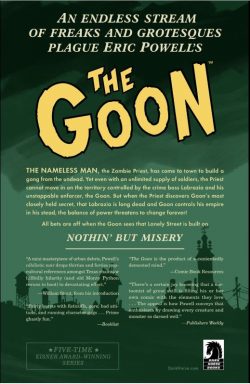
The Goon volume 1: Nothin’ But Misery


By Eric Powell (Dark Horse Books)
ISBN: 978-1-59582-624-4

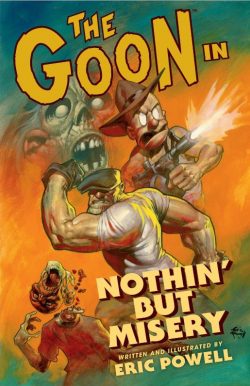
Before Dark Horse picked up The Goon, Eric Powell self-published a number of issues of this splendidly eccentric, side-splitting retro-feature, and these are presented here (mostly) in colour for the first time.

Lord knows how long he’d been working on the thing prior to publication because this is one of those rare Athenaic occasions when the creation springs forth fully formed without the usual noodging and twiddling that customarily occurs as a strip progresses until it settles into a stride.

This initial collection – available in paperback and digital formats – gathers and resurrects The Goon #1-4 and the Goon Color Special, (originally published by Albatross Exploding Funny Books in 2002) plus a short story from the last issue of anthology title Dark Horse Presents.

It opens with engaging Introduction ‘Down at the End of Lonely Street’ courtesy of comix and illustration legend William Stout, citing the series’ apparent antecedents and themes before the full colour, thirties-style pulp fun begins with that Dark Horse Presents outing…

Just in case you were wondering: Operating in the milieu of bootlegging American gangsterism and oozing Weird Tales style ambience, The Goon is a hulking, two-fisted brawler just getting along as best he can in the seamy underbelly of the city.

He and his pal Franky do jobs for reclusive gang-boss Labrazio, work their own scams when they can and look after their friends. They also hate zombies and know the true secret of the never-seen crime overlord…

This makes for a pretty eventful life since Labrazio’s biggest rival is The Nameless Man, an immortal witch-priest whose army of the undead keeps trying to escape from their rightful ghetto bastion on Lonely Street to take over the whole city or at least its rackets….

‘Die, Fish, Die!’ recapitulates all that in a darkly hilarious clash between The Goon and Franky on one side and a monstrous piscine leg-breaker and his scaly minions on the other…

The saga properly begins with the pals hunting a big score of legendary size and infamy.

The astounding Matheson Collection is the unholy grail of lost loot and our un-Made Men want it, but they never reckoned on the hellish house and the coterie of traumatised child phantoms that haunt it…

The second issue pitted the feisty felons against The Nameless Man’s demonic sponsor Evets and a reanimated marsh monster before Goon and Franky find a new and gruesome ally in their war against zombie mobsters. ‘Buzzard! The Creature that Feeds on the Flesh of the Dead!’ is a walking tragedy with an even bigger grudge against the necromancer of Lonely Street…

Add travesty to mawkish sentiment and the result is ‘The Goon: A Christmas Story’ as our guys and helpful werewolf Merle go hunting for abducted kids. When they find the nippers have been consumed by Santa’s carnivorous helpers, the boys need the help of an extra-special ally…

Then, when ever-ambitious Franky is targeted by deviant magician The Moonlight Firefly, the crusty sidekick is subjected to the lewd attentions of relentless, shameless tormenting harpies until his big buddy steps up and steps in, after which the narrative tomfoolery concludes with violent vignette ‘The Goon in… Attack of the One-Eyed Scumbag from Outer Space’.

When you’re as big and mean and handy with your fists as out leading man, the action is over before you know it…

Adding to the surreal cavalcade is a sprinkling of outrageous faux adds for such must-have items as the Billy Lobotomy Kit, Mega Body Pill, Psychic Seal Hotline and much more whilst wrapping up the macabre mirth is a Gallery of The Goon: a flurry of fan art by like-minded pros Michael Avon Oeming, Guy Davis, Mike Hawthorne, Kyle Hotz and Christophe Quet…

This spectacular pop-culture spoof and anthemic tribute to the gory glory days of EC comics offers thrill-a-minute craziness as these not-so-Wise (but extremely tough) Guys tackle flesh-eaters, Cthuluistic hell-shamblers, twisted ghosts, space horrors and every type of thug and monster, armed with nothing more than fists, gats, dirty vests and attitude, all in the name of an easy life.

Powell is a sharp, economical writer with a great ear for period dialogue and a truly surreal sense of humour. This is supplemented by the ability to draw like a cross between Jack Kirby and Wally Wood. Wonderful, wonderful stuff. How have you missed this?
™ & © 2011 Eric Powell. All Rights Reserved.

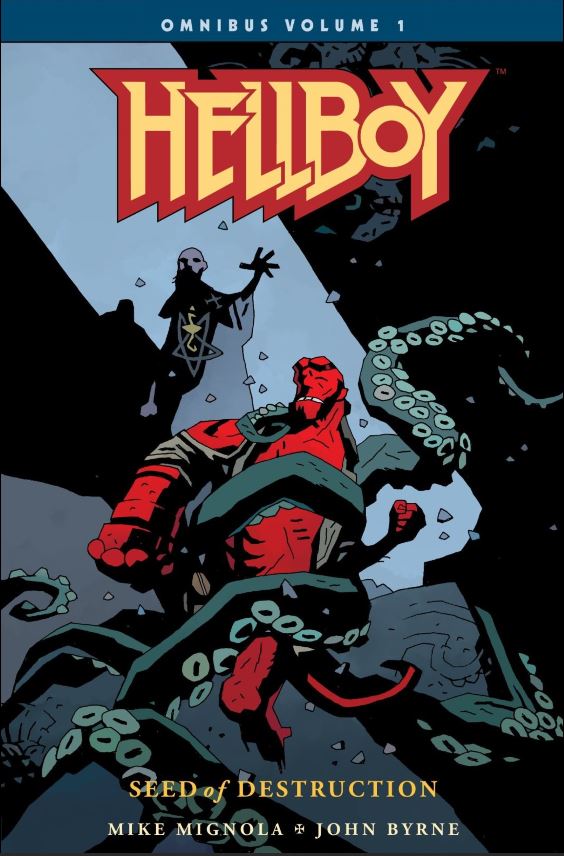
Hellboy Omnibus volume 1: Seed of Destruction


By Mike Mignola, with John Byrne, Mark Chiarello, Matt Hollingsworth, James Sinclair, Dave Stewart, Pat Brosseau & various (Dark Horse Books)
ISBN: 978-1-50670-666-5                  eISBN: 978-1-50670-687-0

Hellboy was first seen 25 years ago in the 1993 San Diego Comic Con programme. Happy Birthday, Big Red.

After the establishment of the comicbook direct market system, there was a huge outburst of independent publishers in America and, as with all booms, a lot of them went bust. Some few however were more than flash-in-the-pans and grew to become major players in the new world order.

Arguably, the most successful was Dark Horse Comics who fully embraced the shocking new concept of creator ownership (amongst other radical ideas). This concept – and their professional outlook and attitude – drew a number of big name creators to the new company and in 1994 Frank Miller & John Byrne formally instituted the sub-imprint Legend for those projects major creators wanted to produce their own way and at their own pace.

Over the next four years the brand counted Mike Mignola, Art Adams, Mike Allred, Paul Chadwick, Dave Gibbons and Geof Darrow amongst its ranks; generating a wealth of superbly entertaining and groundbreaking series and concepts. Unquestionably the most impressive, popular and long-lived was Mignola’s supernatural thriller Hellboy.

As previously cited, the monstrous monster-hunter debuted in San Diego Comic-Con Comics #2 (August 1993) before formally launching in 4-issue miniseries Seed of Destruction (with Byrne scripting over Mignola’s plot and art). Colourist Mark Chiarello added layers of mood with his understated hues.

That story and the string of sequels that followed are re- presented here in a new trade paperback offering earliest longform triumphs of the Scourge of Sheol – The Wolves of Saint August; The Chained Coffin; Wake the Devil and Almost Colossus – in the first of an omnibus sequence to be accompanied by a companion series of tomes featuring all the short stories.

Crafted by Mignola, scripter John Byrne and colourist Mark Chiarello, the incredible story begins with a review of secret files. On December 23rd 1944 American Patriotic Superhero The Torch of Liberty and a squad of US Rangers interrupted a satanic ritual predicted by Allied parapsychologist Professors Trevor Bruttenholm and Malcolm Frost.

They were working in conjunction with influential medium Lady Cynthia Eden-Jones. They were all waiting at a ruined church in East Bromwich, England when a demon baby with a huge stone right hand appeared in a fireball. The startled soldiers took the infernal yet seemingly innocent waif into custody.

Far, far further north, off the Scottish Coast on Tarmagant Island, a cabal of Nazi Sorcerers roundly berated ancient wizard Grigori Rasputin whose Project Ragna Rok ritual seemed to have failed. The Russian was unfazed. Events were unfolding as he wished…

Five decades later, the baby has grown into a mighty warrior engaging in a never-ending secret war: the world’s most successful paranormal investigator. Bruttenholm has spent the years lovingly raising the weird foundling whilst forming an organisation to destroy unnatural threats and supernatural monsters – The Bureau for Paranormal Research and Defense. “Hellboy” is now its lead agent…

Today, the recently-returned, painfully aged professor summons his surrogate son and warns him of impending peril wrapped in obscured reminiscences of his own last mission. The Cavendish Expedition uncovered an ancient temple submerged in arctic ice, but what occurred next has been somehow stricken from Bruttenholm’s memory. Before he can say more the mentor is killed by a rampaging plague of frogs and enraged Hellboy is battling for his life against a demonic giant amphibian…

Following fact-files about Project Ragna Rok and ‘An African Myth about a Frog’ Chapter Two opens at eerie Cavendish Hall, set on a foetid lake in America’s Heartland. Matriarch Emma Cavendish welcomes Hellboy and fellow BPRD investigators Elizabeth Sherman and Dr. Abraham Sapien but is not particularly forthcoming about her family’s obsession.

Nine generations of Cavendish have sought for and sponsored the search for the Temple at the Top of the World. Three of her own sons were lost on the latest foray, from which only Bruttenholm returned, but her story of how founding patriarch Elihu Cavendish‘s obsession infected every male heir for hundreds of years imparts no fresh insights.

She also says she knows nothing about frogs, but she’s lying and the agents know it…

As they retire for the night, Hellboy’s companions prepare for battle. Liz is a psychic firestarter but is still taken unawares when the frogs attack and the Dauntless Demon fares little better against another titanic toad-monster.

Of Abe there is no sign: the BPRD’s own amphibian has taken to the dank waters of the lake in search of long-buried answers…

And then a bald Russian guy claiming to know the truth of Hellboy’s origins appears and monstrous tentacles drag the hero through the floor…

Chapter Three opens in a vast hidden cellar where Rasputin explains he is the agent for undying and infinite antediluvian evil: seven-sided serpent Ogdru-Jahad who sleeps and waits to be reawakened. Hellboy was summoned from the pit to be the control interface between the great beast and the wizard as he oversaw the fall of mankind, but when the BPRD agent refuses his destiny – in his own obtuse, obnoxious manner – Rasputin goes crazy…

Overwhelmed by the Russian’s frog servants, Hellboy is forced to listen to the story of Rasputin’s alliance with Himmler and Hitler and how they sponsored a mystic Nazi think-tank to conquer the Earth. Of how the mage manipulated the fanatics, found the Temple at the Top of the World and communed with The Serpent and of how the last Cavendish Expedition awoke him. Of how he used them to trace the crucial tool he had summoned from Hell half a century ago…

And then the raving Russian reveals how his infernal sponsor Sadu-Hem – intermediary of The Serpent – has grown strong on human victims but will become unstoppable after feasting on Liz’s pyrokinetic energies…

With all hell literally breaking loose, the final chapter finds Rasputin exultantly calling upon each of the seven aspects as Hellboy attempts a desperate, doomed diversion and the long-missing Abe Sapien finally makes his move, aided by a hidden faction Rasputin had not anticipated…

The breathtaking conclusion sees the supernal forces spectacularly laid to rest, but the defeat of Sadu-Hem and his Russian puppet only opens the door for other arcane adversaries to emerge…

Bombastic, moody, laconically paced, suspenseful and explosively action-packed, Seed of Destruction manages the masterful magic trick of introducing a whole new world and making it seem like we’ve always lived there.

‘The Wolves of Saint August’ originally ran in Dark Horse Presents #88-91 during 1994, before being reworked a year later for the Hellboy one-shot of the same name. Mignola handles art and script with James Sinclair on colours and Pat Brosseau making it all legible and intelligible.

Set contemporarily, the moody piece sees the red redeemer working with BPRD colleague Kate Corrigan to investigate the death of Hellboy’s old friend Father Kelly in the Balkan village of Griart. It’s not long before they realise the sleepy hamlet is a covert den of great antiquity where a pack of mankind’s most infamous and iniquitous predators still thrive…

Mignola has a sublime gift for setting tone and building tension with great economy. It always means that the inevitable confrontation between Good and Evil has plenty of room to unfold with capacious visceral intensity. This clash between unfrocked demon and alpha lycanthrope is one of the most unforgettable battle blockbusters ever seen…

In 1995 Dark Horse Presents 100 #2 debuted ‘The Chained Coffin’. Here Hellboy returns to the English church where he first arrived on Earth in 1943. Fifty years of mystery and adventure have passed, but as the demon-hunter observes ghostly events replay before his eyes he learns the truth of his origins. All too soon, Hellboy devoutly wishes he had never come back…

Wake the Devil offered a decidedly different take on the undying attraction of vampires when a past case suddenly became active again. Hellboy and fellow outré BPRD agents Liz Sherman and Abe Sapien were still reeling from losing their aged mentor whilst uncovering mad monk Rasputin’s hellish scheme to rouse sleeping Elder Gods he served.

Moreover, the apparently undying wizard – agent for antediluvian infinitely evil seven-sided serpent Ogdru-Jahad who-sleeps-and-waits-to-be-reawakened – was responsible for initially summoning Hellboy to Earth as part of the Nazi’s Ragna Rok Project …

Now the Russian’s clandestine alliance with Himmler, Hitler and their mystic Nazi think-tank is further explored, as somewhere deep inside Norway’s Arctic Circle region, a driven millionaire visits a hidden castle.

He is seeking the arcane Aryans long-closeted within, eager to deliver a message from “The Master”. In return the oligarch wants sanctuary from the imminent end of civilisation…

In New York City a bloody robbery occurs in a tawdry mystic museum and the BPRD are soon being briefed on legendary Napoleonic soldier Vladimir Giurescu. It now appears that the enigmatic warrior wasn’t particularly wedded to any side in that conflict and was probably much older than reports indicated…

More important is the re-examined folklore which suggests Giurescu was mortally wounded many times but, after retreating to a certain castle in his homeland, would always reappear: renewed, refreshed and deadlier than ever.

In 1882 he was in England and clashed with Queen Victoria’s personal ghost-breaker Sir Edward Grey, who was the first to officially identify him as a “Vampire”. In 1944 Hitler met with Vladimir to convince the creature to join him, but something went wrong and Himmler’s envoy Ilsa Haupstein was ordered to arrest Giurescu and his “family”.

The creatures were despatched in the traditional manner and sealed in boxes… one of which has now been stolen from that museum. Moreover, the murdered owner was once part of the Nazi group responsible for Ragna Rok…

The BPRD always consider worst-case scenarios, and if that box actually contained vampire remains…

The location of the bloodsucker’s fabled castle is unknown, but with three prospects in Romania and only six agents available, three compact strike-teams are deployed with Hellboy in solo mode headed for the most likely prospect…

Although not an active agent, Dr. Kate Corrigan wants Hellboy to take especial care. All the indications are that this vampire might be the Big One, even though nobody wants to use the “D” word…

In Romania, somehow still youthful Ilsa Haupstein is talking to a wooden box, whilst in Norway her slyly observing colleagues Kurtz and Kroenen are concerned. Once the most ardent of believers, Ilsa may have been turned from the path of Nazi resurgence and bloody vengeance…

Her former companions are no longer so enamoured of the Fuehrer’s old dream of a vampire army either. Leopold especially places more faith in the creatures he has been building and growing…

Over Romania, Hellboy leaps out of the plane and engages his experimental jet-pack, wishing he was going with one of the other teams… and even more so after it flames out and dies…

At least he has the limited satisfaction of crashing into the very fortress Ilsa is occupying…

The battle with the witch-woman’s grotesque servants is short and savage and as the ancient edifice crumbles, Chapter Two reveals how on the night Hellboy was born, Rasputin suborned Ilsa and her companions…

He made them his devout disciples for the forthcoming awakening of Ogdru-Jahad, saving them from Germany’s ignominious collapse. Now the Russian’s ghost appears to her and offers another prophecy and a great transformation…

Deep in the vaults, Hellboy comes to and meets a most garrulous dead man, unaware that in the village below the Keep the natives are recognising old signs and making all the traditional preparations again…

Hellboy’s conversation provides lots of useful background information but lulls him into a false sense of security, allowing the revenant to brutally attack and set him up for a confrontation with the ferocious forces actually responsible for the vampire’s power…

Battling for his life, Hellboy is a stunned witness to Giurescu’s resurrection and ultimate cause of his latest demise, whilst far above, Rasputin shares his own origins with acolyte Ilsa, revealing the night he met the infamous witch Baba Yaga…

Nearly three hundred miles away, Liz and her team are scouring the ruins of Castle Czege. There’s no sign of vampires but they do uncover a hidden alchemy lab with an incredible artefact in it…a stony homunculus.

Idly touching the artificial man Liz is horrified when her pyrokinetic energies surge uncontrollably into the creature and it goes on a destructive rampage…

With the situation escalating at Castle Giurescu, Hellboy decides to detonate a vast cache of explosives with the faint hope that he will be airlifted out before they go off but is distracted by a most fetching monster who calls him by a name he doesn’t recognise before trying to kill him.

If she doesn’t, the catastrophic detonation might…

As the dust settles and civil war breaks out amongst the Norway Nazis, in Romania Ilsa makes a horrific transition and Hellboy awakes to face Rasputin, even as the BPRD rush to the rescue.

Tragically Abe Sapien and his squad won’t make it before the revived and resplendent Giurescu takes his shot and the world’s most successful paranormal investigator is confronted and seduced by uncanny aspects of his long-hidden infernal ancestry…

With all hell breaking loose, the displaced devil must make a decision which will not only affect his life but dictate the course of humanity’s existence…

The breathtakingly explosive ending also resets the game for Rasputin’s next scheme, but the weird wonderment rolls on in a potent epilogue wherein the mad monk visits his macabre patron Baba Yaga for advice…


The story-portion of this magnificent terror-tome concludes with 1997’s 2-part miniseries ‘Almost Colossus’ wherein traumatised pyrokinetic Liz awaits test results.

During her mission to Castle Czege the artificial man she discovered inadvertently drained Liz’s infernal energies, bringing it to life and causing hers to gradually slip away. Now, Hellboy and Corrigan are back in that legend-drenched region, watching a graveyard from which 68 bodies have been stolen…

Elsewhere, the fiery homunculus is undergoing a strange experience: he has been abducted by his older “brother” who seeks, through purloined flesh, blackest magic and forbidden crafts to perfect their centuries-dead creator’s animation techniques.

Before the curtain falls, Hellboy, aided by the ghosts of repentant monks and the younger homunculus, is forced to battle a metal giant determined to crown itself the God of Science, saving the world if he can and Liz because he must…

Wrapping up the show are a wealth of arty extras, beginning with the 1991 convention illustration he created because he wanted to draw a monster. From tiny acorns…

Following on – with author’s commentary – is a horror hero group shot that is Hellboy’s second ever appearance and a brace of early promo posters, and the full colour Convention book premiere appearance as ‘Hellboy – World’s Greatest Paranormal Investigator’ battles a giant demon dog, courtesy of Mignola & Byrne.

Hellboy Sketchbook then shares a treasure trove of drawings, designs and roughs from the early stories again, fully annotated to round out the eerie celebratory experience.

Available in paperback and digital formats, this bombastic, moody, suspenseful and explosively action-packed tome is a superb scary romp to delight one and all, celebrating the verve, imagination and, now, longevity of the greatest Outsider Hero of All: a supernatural thriller no comics fan should be without.
Hellboy™ Seed of Destruction © 1993, 2018 Mike Mignola. Hellboy, Abe Sapien, Liz Sherman and all other prominently featured characters are trademarks of Mike Mignola. All rights reserved.

Albion: Origins


By Tom Tully, Scott Goodall, Ken Mennell, Solano Lopez, Eric Bradbury & various (Titan Books)
ISBN: 978-1-84576-172-1

Here’s a truly superb collection of British comic strips from the glory days of the 1960s courtesy of Titan Books and originally released to support and cash in on the profile-raising American Albion miniseries and collection.

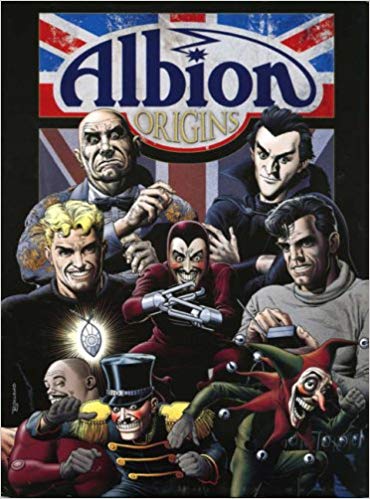
In this stunning, non-nonsense monochrome hardback are four complete early exploits of some of Britain’s weirdest comic strip heroes.

Kelly’s Eye featured ordinary, thoroughly decent chap Tim Kelly who came into possession of the mystical “Eye of Zoltec”: a fist-sized gem that kept him free from all harm… as long as held on to it.

You won’t be surprised to discover that, due to the demands of weekly boys’ adventures, Tim lost, dropped, misplaced and was nefariously deprived of that infernal talisman pretty darned often – and always at the most inopportune moment…

The moody and compelling artwork of Argentinean Francisco Solano Lopez was the prime asset of this series, with the story reprinted here being about a Seminole Indian uprising threatening modern Florida. Complete with eerie evil witch doctor, supernatural overtones from a demonic drum and consumer America imperilled, this story is a classic. Tom Tully & Scott Goodall were the usual scripters for this little gem of a series.

And yes, due to the pressure of these weekly deadlines, occasionally fill-in artists had to pinch-hit in most British strip-series every now and then. Such was the breakneck pacing though, that us kids hardly even noticed and I doubt you will either. Still. If you are eagle-eyed, you might spot such luminaries as Reg Bunn, Felix Carrion, Carlos Cruz, Franc Fuentesman, and Geoff Campion in this volume. But you probably won’t…

House of Dolman was a curious and inexplicably absorbing blend of super-spy and crime-buster strip from Tully and utterly wonderful master illustrator Eric Bradbury. Dolman’s cover was as a shabby ventriloquist (I digress, but an awful lot of “our” heroes were tatty and unkempt – we had “Grunge” down pat decades before the Americans made a profit out of it!) who designed and constructed an army of specialised robots which he disguised as his puppets.

Using these as his shock-troops, the enigmatic Dolman waged a dark and crazy war against the forces of evil…

Featured here are a number of his complete 4-page thrillers wherein he defeats high-tech kidnappers, rascally protection racketeers, weapons thieves, blackmailers and the sinister forces of arch super-criminal ‘The Hawk’.

Janus Stark was a fantastically innovative and successful strip. Created by Tully for the relaunch of Smash in 1969, the majority of the art was from Solano Lopez’s studio, providing an aura of eerie, grimy veracity well suited to this tale of a foundling who grew up in a grim orphanage only to become the greatest escapologist of the Victorian age.

The Man with Rubber Bones also had his own ideas about retribution and justice and would joyously sort out those scoundrels the Law couldn’t or wouldn’t touch. A number of creators worked on this feature, which survived until the downsizing of the publisher’s comics division in 1975 – and even beyond – since Stark escaped oblivion by emigration.

When the series ended in Britain it was continued in French publications – even unto Stark’s eventual death and succession by his son. Here though, we get to see his earliest feats and I for one was left hungry for more. Encore!

The last spot in this sturdy hardback treasury falls to the Spooky Master of the Unknown Cursitor Doom. This series is the unquestioned masterpiece of Eric Bradbury – an artist who probably deserves that title as much as his visual creation.

Writer Ken Mennell, who usually invented characters for other writers to script, kept Doom for himself and the result is a darkly brooding Gothic thriller quite unlike anything else in comics then or since. If pushed, I’ll liken it most to William Hope Hodgson’s Karnacki the Ghost Breaker novelettes – although that’s more for flavour than anything else and even that doesn’t really cover it.

Doom is a fat, bald, cape-wearing foul-tempered know-it-all who just happens to be humanity’s last-ditch defence against the forces of darkness. With his strapping and rugged young assistant Angus McCraggan and Scarab, a trained raven (or is it, perhaps, something more?), Cursitor crushed without mercy any threat to humanity’s wellbeing.

Re-presented here is the ‘Dark Legion of Mardarax’ wherein a cohort of Roman soldiers extracted from the mists of antiquity rampages across the British countryside, intent on awaking an ancient and diabolical monstrosity from the outer Dark!

Perhaps these tales are a thrill for me because I first read them when I was just an uncomprehending nipper, but I don’t think so. It’s a tremendous thrill now to realise that despite all the age, wisdom, and sophistication I can now muster, that these strips really were – and are – as great if not better, than most of the comics I’ve seen in fifty-plus years of reading. Don’t take my word for it: track down this book and see if you’re not as hungrily avid for more of the same…
© 2005 IPC Media Ltd. All rights reserved.

Werewolf by Night – the Complete Collection volume 1


By Gerry Conway, Len Wein, Marv Wolfman, Roy & Jean Thomas, Mike Ploog, Werner Roth, Ross Andru, Tom Sutton, Gil Kane, Gene Colan & various (Marvel)
ISBN: 978-1-30290-839-3

Inspiration isn’t everything. In 1970, as Marvel consolidated its position of market dominance – even after losing their two most innovative and inspirational creators, Steve Ditko and Jack Kirby – they did so with a wave of new young talent but less by experimentation and more by expanding proven concepts and properties.

The only real exception to this was the mass creation of horror titles in response to the industry down-turn in superhero sales – a move expedited by a rapid revision in the wordings of the increasingly ineffectual Comics Code Authority rules.

Almost overnight nasty monsters (and narcotics – but that’s another story and a different review) became acceptable fare within four-colour pages and whilst a parade of 1950s pre-code reprints made sound business sense (so they repackaged a bunch of those too) the creative aspect of the contemporary fascination in supernatural themes was catered to by adapting popular cultural icons before risking whole new concepts on an untested public.

As always, the watchword was fashion: what was hitting big outside comics was to be incorporated into the print mix and shared universe mix as readily as possible. When proto-monster Morbius, the Living Vampire debuted in Amazing Spider-Man #101 (October 1971) and the sky failed to fall in, Marvel moved ahead with a line of scary superstars – beginning with a werewolf and a vampire – before chancing something new in a haunted biker who could tap into both Easy Rider’s freewheeling motorcycling chic and the supernatural zeitgeist.

Werewolf By Night debuted in Marvel Spotlight #2 (preceded by western masked hero Red Wolf in #1, and followed by the afore-hinted Ghost Rider) although the series title, if not the actual star character, was cribbed from a classic pre-Comics Code short suspense-thriller from Marvel Tales #116, July 1953.

Marvel always favoured a long-time tradition of using old (presumably already copyrighted) names and titles when creating new series and characters. Hulk, Thor, Magneto, Doctor Strange and many others all got nominal starts as throwaways in some anthology or other…

This copious compendium collects – in paperback or eBook formats – the early adventures of a young West Coast lycanthrope and comprises the contents of Marvel Spotlight #2-4, Werewolf by Night volume 1 #1-15; a guest-shot in Marvel Team-Up #12 and material from the appropriate half of a horror crossover with Tomb of Dracula #18, cumulatively spanning February 1972 through 1974.

Following an informative, scene-setting Introduction by long-term Marvel Editor Ralph Macchio, the moonlit madness begins with the landmark first appearance, introducing teenager Jack Russell, who is suffering some sleepless nights…

‘Werewolf by Night!’ (Marvel Spotlight #2, February 1972), was written by Gerry Conway and moodily illustrated by Mike Ploog from an outline by Roy & Jeanie Thomas, describing the worst day of Jack’s life – his 18th birthday – which begins with nightmares and ends in something far worse.

Jack’s mother and little sister Lissa are everything a fatherless boy could hope for but new stepfather Philip and creepy chauffeur Grant are another matter…

That night at his party Jack has a painful seizure and flees into the Malibu night to transform for the first time into a ravening vulpine man-beast. The next morning, he awakes wasted on the beach to discover that his mother has been gravely injured in a car crash. Something had happened to her brakes…

Creeping into her hospital room he is astonished as she relates the story of his blood-father; an Eastern European noble who loved her deeply but locked himself away three nights every month…

The Russoff line was cursed by the taint of Lycanthropy: every child doomed to become a wolf-thing under the full-moon from the moment they reach eighteen years of age. Jack was horrified and then realised how soon his sister would reach her own majority…

With her dying breath Laura Russell made her son promise never to harm his stepfather, no matter what…

Scenario set, with the traumatised wolf-boy transforming for three nights every month, the weird, wild wonderment began in earnest with the beast attacking Grant the chauffeur – who had doctored those car-brakes – but refraining, even in vulpine form, from attacking Philip Russell…

The second instalment sees the reluctant nocturnal predator rescue Lissa from a sick and rowdy biker gang (they were everywhere back then) and narrowly escape the police only to be abducted by a sinister dowager seeking knowledge of a magical tome called the Darkhold. The eldritch spell-book is the apparent basis of the Russoff curse, but when Jack can’t produce the goods he’s left to the mercies of ‘The Thing in the Cellar!’…

Surviving more by luck than power, Jack’s third try-out issue fetches him up on an ‘Island of the Damned!’: introducing aging writer Buck Cowan, who became Jack’s best friend as they jointly investigate the wolf-boy’s stepfather.

The elder Russell had apparently sold off Jack’s inheritance, leaving the boy nothing but an old book. Following a paper trail to find proof Philip had had Laura Russell killed leads the pair to an offshore fortress, a dungeon full of horrors and a ruthless mutant seductress…

That episode ended on a cliffhanger, presumably as added incentive to buy Werewolf by Night #1 (September 1972), wherein Frank Chiaramonte took over inking with ‘Eye of the Beholder!’

As ruthless freak Marlene Blackgar and her monstrous posse capture the entire Russell family looking for the Book of Sins, once more a fearsome force of supernature awakes to accidentally save the day as night falls…

With ‘The Hunter… and the Hunted!’ Jack and Buck deposit the trouble-attracting grimoire with Father Joquez, a Christian monk and scholar of ancient texts, but are still hunted because of it. Jack quits the rural wastes of Malibu for a new home in Los Angeles, trading concrete for forests but life is no easier.

In #2, dying scientist Cephalos tries to harness Jack’s feral life-force to extend his own and lives but briefly to regret it. Meanwhile Joquez succeeds in translating the Darkhold, but his accomplishment allows an ancient horror to possess him in WbN #3 during ‘The Mystery of the Mad Monk!‘ Whilst the werewolf is saddened to end such a noble life it feels far happier dealing with millionaire sportsman Joshua Kane, who desires a truly unique head mounted on the wall of his den in the Franke Bolle inked ‘The Danger Game’.

Half-naked, exhausted and soaked to his now hairless skin, Jack must next deal with Kane’s psychotic brother who wants the werewolf for his pet assassin in ‘A Life for a Death!’ (by Len Wein & Ploog) after which ‘Carnival of Fear!’ (Bolle inks again) finds the beast – and Jack, once the sun rises – a pitiful captive of the mystic Swami Calliope and his deadly circus of freaks.

The wolf was now the subject of an obsessive police detective too. “Old-school cop” Lou Hackett is an old buddy of trophy-hunter Joshua Kane and every bit as charming, but his off-the-books investigation has hardly begun when the Swami’s plans fall apart in the concluding ‘Ritual of Blood!’ (inked by Jim Mooney).

The beast is safely(?) roaming loose in the backwoods for #8’s quirky monster-mash just as an ancient demon possesses a cute little bunny in ‘The Lurker Behind the Door!‘ (Wein, Werner Roth & Paul Reinman), before neatly segueing to a slight but stirring engagement in Marvel Team-Up #12 wherein Wein, Conway, Ross Andru & Don Perlin expose a ‘Wolf at Bay!’

When webspinning wallcrawler meets the Werewolf they initially battle each other – and ultimately malevolent mage Moondark – in foggy, fearful San Francisco before Jack heads back to LA and ‘Terror Beneath the Earth!’

Here Conway, Tom Sutton & George Roussos delve into an impeding and thoroughly nefarious scheme by business cartel the Committee. These out-of-the-box commercial gurus somehow possess a full dossier on Jack Russell’s night-life and hire a maniac, sewer-dwelling sound engineer to execute their radical plan to use monsters and derelicts to boost sales in a down-turned economy.

However, the bold sales scheme to frighten folk into spending more is ended before it begins since the werewolf proves to be far from a team-player in the wrap up ‘The Sinister Secret of Sarnak!’

Werewolf by Night #11 revelled in the irony as Marv Wolfman signed on as writer for ‘Comes the Hangman’ – illustrated by the incredible Gil Kane & Sutton – in which we learn something interesting about Philip Russell and the Committee, whilst Jack’s attention is distracted by a new apartment, a very odd neighbour and a serial kidnapper abducting young women to keep them safe from “corruption.”

When the self-deluded hooded hero snatches Lissa, he soon finds himself hunted by a monster beyond his wildest dreams…

Concluding chapter ‘Cry Werewolf!’ brings in the criminally underappreciated Don Perlin as inker. In a few short months he would become the strip’s penciller for the rest of the run, but before that Ploog & Chiaramonte returned for another session, introducing a manic mystic and a new love-interest (not the same person) in #13’s ‘His Name is Taboo’.

An aged sorcerer coveting the werewolf’s energies for his own arcane purposes, the magician is stunned when his adopted daughter Topaz finds her loyalties divided and her psionic abilities more help than hindrance to the ravening moon-beast.

‘Lo, the Monster Strikes!’ pits the wolf against Taboo’s undead – but getting better – son and sees revelation and reconciliation between Philip and Jack Russell. As a result, the young man and new girlfriend Topaz set off for Transylvania, the ancestral Russoff estate and a crossover confrontation with the Lord of Vampires.

Tomb of Dracula #18 (March 1974) begins the clash in ‘Enter: Werewolf by Night’ (Wolfman, Gene Colan & Tom Palmer) as Jack and Topaz investigate a potential cure for lycanthropy, only to be attacked by Dracula. Driven off by the girl’s psychic powers the Count realises the threat she poses to him and determined to slay her…

It concludes with Werewolf by Night #15 and the ‘Death of a Monster!’ (Wolfman, Ploog & Chiaramonte) as the battle of beasts resolves into a messy stalemate, but only after Jack learns of his family’s long connection to Dracula…

Supplemented with an unused Ploog cover for Marvel Spotlight#4, Gil Kane’s pre-corrections cover to ToD #18 and previous collection covers by Ploog & Dan Kemp, this first volume also includes a wealth of original art pages (20 in total) by Ploog, Sutton and Andru. A moody masterpiece of macabre menace and all-out animal action, this compilation covers some of the most under-appreciated magic moments in Marvel history: tense, suspenseful and solidly compelling. If you must have a mixed bag of lycanthropes, bloodsuckers and moody young misses, this is a far more entertaining mix than many modern movies, books or miscellaneous matter…
© 1972, 1973, 1974, 2017 Marvel Characters, Inc. All rights reserved.

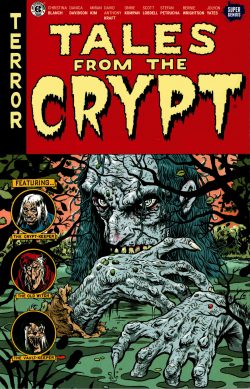
Tales from The Crypt volume 1


By Christina Blanch, Danica Davidson, David Anthony Kraft, Onrie Kompan, Scott Lobdell, Stefan Petrucha, Bob Camp, Dean Haspiel, Russ Heath, Miran Kim, Steve Mannion, John McCrea, Jolyon Yates, Bernie Wrightson & various (Super Genius/Papercutz)
ISBN: 978-1-62991-460-2

The EC comics of the Pre-Comics Code 1950s were possibly the most influential genre strips of all time. Their Crime, (anti-)War, Science Fiction and especially Horror anthologies targeted mature readers before the term even existed, purveying sophisticated, cynical, satirical, sardonic and always sublimely illustrated stories. These changed the lives of not only comics creators in waiting, laying the groundwork for the Underground Comix and counter-culture movements, but also spread far beyond the world of funny-book fans to influence novelists and film-makers.

The most influential of all was premiere title Tales from The Crypt. As well as spawning numerous companion mags and an avalanche of knock-offs, it inspired forays into movies (Amicus Productions produced Tales from The Crypt in 1972 and The Vault of Horror the following year, directed by Freddie Francis and based on two paperback reprint collections issued in 1965 by Ballentine Books) as well as many television iterations.

The hallowed title inspired George A. Romero and Stephen King to synthesise their personal fond childhood memories into Creepshow: a stylish portmanteau film using a horror comic-book as a maguffin and framing sequence for five darkly comedic tales of supernatural come-uppance.

The format of infernal introducer and short sharp shocker is eternally evergreen and although EC might be defunct as a publisher, it’s influence as a creative force remains strong as ever, and not only in the perpetual run of archival reprint volumes from Dark Horse, Fantagraphics, Gladstone, Russ Cochran and others. In 2007, Papercutz revived the title and brand for a fresh run of parlous parables and fearsome fables from the likes of Kyle Baker, Don McGregor, Joe R. Lansdale and more.

This iteration lasted until 2010, but has now been gloriously, gore-iously revived under Papercutz’ mature Super Genius imprint, with the signature horror-hosts – the Crypt-Keeper, Vault-Keeper and Old Witch – back in the house to leaven the dread proceedings with wry insights and lethally dreadful puns. What more could a certified “GhouLunatic” want?

Well, how about some vintage yet unseen 1970’s classic chillers by the greatest horror artist never to work for EC…?

Collecting the contents of the first two issues from 2017, this gruesome grimoire of graphic excess opens with ‘Stake-Out’: a deliciously dark spoof to get the ball rolling written and drawn by Bernie Wrightson for fanzine I’ll Be Damned #2 in July 1970 and remastered here by colourist Laurie E. Smith and letterer Tom Orzechowski.

Tapping into truly contemporary modern terrors, ‘Die-Vestment!’ by Stefan Petrucha, Jolyon Yates & JayJay Jackson then looks a little into a future where the world’s richest and most despised man extends his life by swindling the poor out of their organs. However, even he can’t survive without a modicum of public approval, so he listens to the PR consultant hired to soften his image. Big mistake…

David Anthony Kraft & Miran Kim detail the problems of wage-slave Marty whose daily grind and lovelorn life both spiral downwards after the undead infest his workplace in ‘Zombie Bank’, after which Scott Lobdell, John McCrea & Dee Cunliffe further pursue financial woes when the partners in an exploitative corporation are systematically wiped out by ‘The Were-wolf of Wall Street’ …

Social media, body-shaming and cyber-bullying come under the spotlight in Danica Davidson, Yates & Jackson’s ‘Picture Perfect’ after a vicious High School Mean Girl picks on the wrong victim, whilst in Christina Blanch & Kim’s ‘Undertow’ death, madness and retribution grow from the tragic consequences of a day at the beach…

Wrightson again exerts his gothic mastery in ‘Feed It’ – coloured up here from an original appearance in black-&-white magazine Web of Horror #3 (April 1970) – and advocating the wisdom of good pet care before the sinister storytelling ceases with grotesque social commentary and black comedy in ‘Leather or Not’ by Blanch & Kim. In the future, the rich will still want the most desirable fashions, even if the skins and hides now being trapped and traded are young, poor, pretty and human…

Also offering a stylish gallery of 8 covers and variants by Kim, Yates, Bob Camp, Dean Haspiel, Russ Heath, Kyle Baker & Steve Mannion, this casque of brash, irreverent and deeply disturbing yarns is a true treat for fright-fans of every vintage and a fine addition to the annals of an undying tradition of dark delights.
Tales from The Crypt © 2017 William M. Gaines, Agent, Inc. The EC logo is a registered trademark of William M. Gaines, Agent, Inc. and used with permission. “Stake-Out” and “Feed It” are © 1969, 1970, 2017 Bernie Wrightson. The Crypt-Keeper™, The Old Witch™ and the Vault-Keeper™ are registered trademarks of William M. Gaines, Agent, Inc. and used with permission.

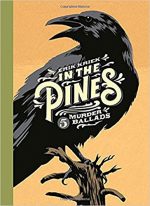
In the Pines – 5 Murder Ballads


By Erik Kriek (Canongate Books)
ISBN: 978-1-8689-214-0

If you don’t know what a murder ballad is you should start this sublime hardcover anthology by reading Jan Donkers’ superb background essay at the back of the book before treating yourself to the grim graphic glories crafted by Dutch artisan and illustrator Erik Kreik.

In ‘Murder Ballads’ you will learn the history of the ancient musical sub-genre as well as the direct genealogy of the quintet of sordid, sorry sagas adapted from sound to stunning words and pictures here…

However – and just because it’s you – the term generally applies to folk music story-songs from many countries dealing with love, crime, sex, social transgressions and unnatural death…

In 2016 Erik Kreik (creator of silent superhero spoof Gutsman; Little Andy Roid; Het Onzienbare/From Beyond) – adapted a number of vintage and modern Murder Ballads into strip format. A huge fan of all forms of popular Americana, he also covered the songs with his band The Blue Grass Boogiemen on a CD naturally entitled In the Pines – 5 Murder Ballads.

The book won Germany’s 2016 Rudolf Dirks Award and the spin-off garnered Album of the Year 2017 from Dutch Comics.

Amsterdam-born Kriek is a graduate of the Rietveld Academy for Art and Design and a hotly in-demand illustrator of books (including Holland’s Tolkien and Harry Potter editions), magazines, apparel, skateboards, et cetera and can turn his hand to many styles and disciplines. Gutsman was reconceived as a soundless mime ballet in 2006 and his collection of Lovecraft adaptations Het onzienbare, en andere verhalen H. P. Lovecraft has been republished in many languages…

He has just released first children’s book Mika, the Little Bear That Didn’t Want to Go To Sleep…

Now a multi-national phenomenon, In the Pines delivers its moody messages of ill-starred love in dreamy, two-coloured episodes. American fans will recognise the drawing style as echoing the very best EC horror tales by “Ghastly” Graham Ingels or the early Bernie Wrightson. The concert of terror opens with ‘Pretty Polly and the Ship’s Carpenter’: a much-covered traditional ditty (The Byrds; Judy Collins; The Stanley Brothers) rendered here in green and black on white crisp white pages. It details the doomed fate of a young man who fled to sea to escape his sins, only to see them resurface in death for his shipmates in a seemingly supernatural storm…

Tinted in sepia, ‘The Long Black Veil’ is a relatively modern song: composed and written by Marijohn Wilkin & Danny Dill in 1959 and most notably recorded by Lefty Frizzell, The Band, Johnny Cash, Mick Jagger, Nick Cave and many others. It reveals how a farmer is faced with a staggering choice: hang for a murder he did not commit or betray the confidence of the adulterous women who is his only alibi…

Racially-charged and rendered in tones of muddy ochre, ‘Taneytown’ was originally written by Steve Earle: a synthesis of so many lynching incidents that shame and blight the history of early 20th century America. Here a young black man, sick of the life he’s subjected to in rural Maryland, takes the knife his negro war hero father used in the trenches of the Great War and heads for trouble in the whitest part of town…

Written by singer Gillian Welch, ‘Caleb Meyer’ is adapted in tones of chilling aquamarine and presents a young wife betrayed, terrorised and assaulted who wins for herself a potent dose of ironic retribution…

Closing the graphic grimoire in tones of watered down blood, ‘Where the Wild Roses Grow’ is based on the song created by Nick Cave and The Bad Seeds for their 1996 album Murder Ballads. Sung as duet with Kylie Minogue, the song was based on traditional air Down in the Willow Garden.

The story seen here presents a complex web of trauma and tension involving a murderous escaped convict, a gang of hidden outlaws, lost treasure, a solitary house in the deep woods and a protective mother conveniently absent.

However, neither the rapidly pursuing posse nor the vile-intentioned villain have any idea what young Elisa is truly capable of, or why her father called her his “wild rose”…

Making something compelling and beautiful from the worst aspects and acts of human behaviour is no mean feat, either in song or pictures, but In the Pines accomplishes the deed with gripping style, vibrant polish and immense charm. This is a book every lover of human foibles will adore: Potent and evocative with a sly gift to captivate and transport the reader just as the music intoxicates the mind’s eye through the ears.

One last note: Kriek relaxes in Irish bars – possibly drinking but mostly singing and playing the banjo – so my hopes are high that he’s got many more songs yet to draw…
© Erik Kriek, 2016. “Murder Ballads” © Jan Donkers. 2016All rights reserved.
In the Pines – 5 Murder Ballads will be published on February 1st 2018.

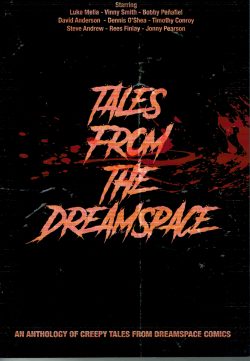
Tales from the Dreamspace


By Luke Melia, Vinny Smith, Bobby Peñafiel, David Anderson, Dennis O’Shea, Timothy Conroy, Steve Andrews, Rees Finlay, Jonny Pearson & various (Dreamspace Comics/CreateSpace Independent Publishing Platform)
ISBN: 978-1-97629-398-6

As I’ve frequently proclaimed, I’m a huge fan of creators with the drive and dedication to take control of their own destinies and that’s why it’s such a delight to see another splendid home-grown tome from Luke Melia and his trusty band of cartoon collaborators.

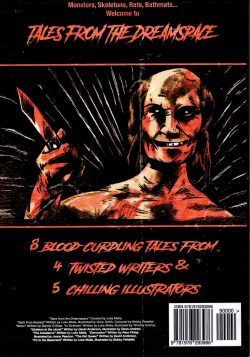
Comprising comic strips, illustrated prose pieces and a scattershot selection of short, sharp, mood-setting epigrams, this particular package of perils stems from a communal spooky story session which grew into an online competition and resulted in the blood-curdling book of fearsome phantasms before us today.

Committed to full-colour paperback form as a macabre and unsettling graphic grimoire, the uneasy experiences begin with the true story of Dreamspace’s inception, after which a few tone-teasing text titbits lead into a darkly twisted hostage situation with ‘It’s in the Basement’.

Scripted by Luke Melia and illustrated by Bobby Peñafiel, the monster is designed by Christopher Wallace. It’s not what you’re thinking…

Following more zingy scary word-salads, Melia then segues into prose to propose a morally confounding challenge with a devastated mother failing in her own eyes and subsequently taking horrific steps to correct ‘The Imbalance’ before David Anderson & Steve Andrews resort to potent monochrome to expose – and expedite – a distressingly Kafkaesque ‘Skeleton in the Closet’…

The micro-yarns are by many and varied contributors and suitably divide all the longer tales, which resume now with Dennis O’Shea’s prose piece ‘Motel’ revealing the awful aftermath of a well-nasty Boy’s Night Out, whereas coal black humour and sordid surreality colour an extended strip-saga splatter-fest of misbegotten youth, vengeance paid in full and the ‘Bath time Bastard’, courtesy of Melia, Vinnie Smith & Peñafiel…

Anderson switches to prose mode for a macabre tale of dystopian survival in ‘The Rat Queen’ after which Rees Finlay & Jonny Pearson illumine a shocking plunge into detention, demonic delirium and ‘Damnation’ before Melia & Timothy Conroy revisit Beauty and the Beast via the wedding vows with ‘In Sickness’ to bring the shock therapy to a close…

Like previous outings Oculus and The White Room of the Asylum, this compendium of bloody wit, dark humour and caustic circumstance is judiciously rendered in a range of palettes from full colour to black & red to overwhelmingly stark black-&-white, all combining to highlight the morbid power of narrative in service to night terrors: a menu of compulsive and terrifying tales you’d be absolutely crazy to miss, but wisest to peruse with the doors locked and all the lights on.
© 2017 Luke Melia. All rights reserved.

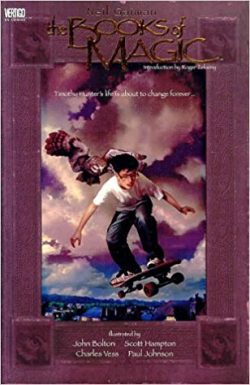
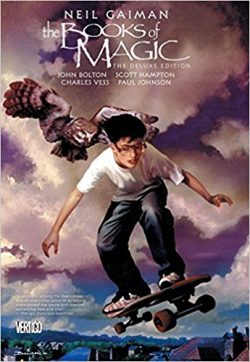
The Books of Magic


By Neil Gaiman, John Bolton, Scott Hampton, Charles Vess & Paul Johnson (DC/Vertigo)
ISBN: 978-1-4012-3781-3 (HB)                :978-1-4012-4686-0 (PB)
:978-1-85286-470-5 (Titan Books Edition)

Way back when Neil Gaiman was just making a name for himself at DC, he was asked to consolidate and rationalise the role of magic in that expansive shared universe. Over the course of four Prestige Format issues a quartet of mystical champions (thereinafter known as “the Trenchcoat Brigade”) took a supposedly typical London schoolboy on a Cook’s Tour of Time, Space and Infinite Dimensions in preparation for his long-anticipated ascendancy. This meant becoming the most powerful wizard of the 21st Century, and an overwhelming force for either Light or Darkness.

Shy, bespectacled Timothy Hunter is an inoffensive lad unaware of his incredible potential for Good or Evil (and yes, I know who he looks like but this series came out eight years before anybody had ever heard of Hogwarts, so get over it).

In an attempt to keep him righteous, the self-appointed mystic guides provide him and – through literary extension – us, with a full and dangerously immersive tutorial in the history and state of play of “The Art” and its major practitioners and adepts.

However, although the four guardians are not unanimous or even united in their plans and hopes for the boy, the “other side” certainly are. If Hunter cannot be turned to the Dark, he has to die…

Thus, following an Introduction by master fantasist Roger Zelazny, the thaumaturgical thrills begin in Book I, painted by John Bolton.

Here the Phantom Stranger conducts his youthful charge on a trip through ‘The Invisible Labyrinth’ revealing to Tim the history of magic with introductions to Lucifer, Atlantis, and other Ancient Empires, Jason Blood and the boy Merlin as well as mid-20th century crime-busting mystics Zatara and Sargon the Sorcerer.

Scott Hampton picks up the brushes for the second chapter, wherein irrepressible urban trickster-wizard John Constantine hosts a trip to ‘the Shadow World’ of the then-established DCU: introducing the wide-eyed lad to contemporary paranormal players such as Deadman, Madame Xanadu, the Spectre, Doctor Fate, Baron Winter (of Night Force fame), Dr. Terry Thirteen (AKA the Ghost-Breaker) and mystic super-hero Zatanna, who boldly organises a trip to a mage’s bar where the likes of Tala, Queen of Darkness and the diabolical opportunist Tannarak attempt to take matters – and Tim – into their own wicked hands…

For his third work-experience trip, Dr. Occult (created by Jerry Siegel & Joe Shuster years before Superman debuted) escorts the messianic boy on a voyage to the outer lands and Realms of Faerie, courtesy of Charles Vess in ‘The Land of Summer’s Twilight’. This ethereal, beautifully evocative segment would inform much of Timothy Hunter’s later life in the Vertigo comicbook series and graphic collections that inevitably spun off from this saga. Cameos here include Warlord/Travis Morgan, Nightmaster, Amethyst and Gemworld, Etrigan the Demon, Cain, Abel and the (Gaiman-originated) Sandman Morpheus.

Bringing the initial educational experience to a close, ‘The Road to Nowhere’ is painted by Paul Johnson and concludes the peregrinations as ruthlessly fanatical zealot Mister E whisks our astounded boy to the end of time, where the sightless fanatic attempts to twist Tim to his own bleak, black agenda. Beyond Darkseid and the climactic battles and crises of our time; progressing even forward past the Legion of Super Heroes, to the end of Order and Chaos, unto the moment Sandman’s siblings Destiny and Death switch off the dying universe, Tim sees how everything ends before returning to make his choice: Good or Evil; Magic or mundane?

Books of Magic still stands a worthy primer for newcomers who need a little help with decades of back-story which cling to so many DC tales, even today. Despite an “everything and the kitchen sink” tone, this is still a cracking good yarn (available in hardback, trade paperback, eBook and even a British edition from Titan Books), offers useful grounding for all things supernaturally DC and still has overwhelming relevance to today’s much rebooted continuity.

© 1990, 1991, 1993, 2014 DC Comics. All Rights Reserved.

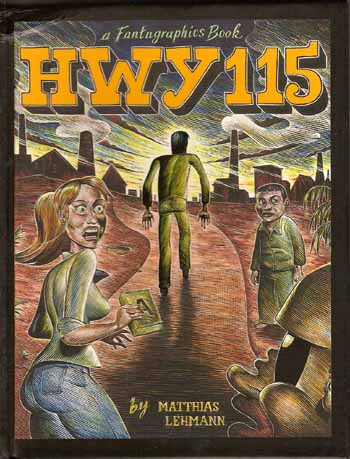
HWY.115


By Matthias Lehmann (Fantagraphics Books)
ISBN: 978-1-56097-733-9 (HB)

This stirring and deeply disturbing, psycho-thriller combines the not-so dissimilar forms of road movies and buddy flicks with straight crime thrillers as hardboiled private detective René Pluriel hits the highways of France in pursuit of the deadly “Heimlich Killer”.

He hasn’t gone far before he picks up flamboyant hitch-hiker Agatha, who reveals that she too is a detective on the trail of the notorious serial murderer.

As they wend their way through the back roads and, consequently, history of France, diligently interviewing the killer’s associates and survivors, they build a tense picture not just of their quarry but also of each other, and inevitably realise that the conclusion of the quest won’t be happy for everybody.

Lehmann’s dark voyage is gripping and often surreal, and the tension is augmented by the spectacular, moody art, stylishly etched in a powerful scraperboard style. The narrative is blistered with flashbacks, literary diversions and hallucinogenic asides that amplify the dissociative feel of this ostensibly simple tale. This award-winning fear-fable was the author’s first original graphic novel and it remains a bravura performance almost impossible to top; I eagerly await the attempt.
Characters, stories & art © 2006 Actes Sud. All Rights Reserved. This edition © 2006 Fantagraphics Books.

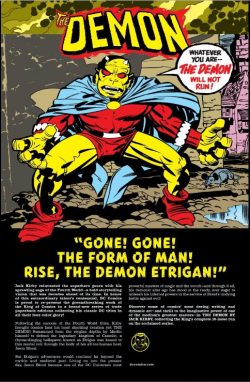
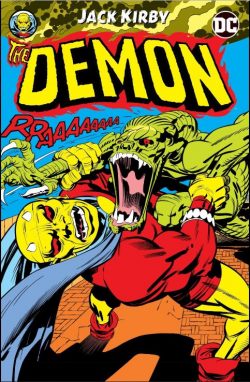
The Demon by Jack Kirby


By Jack Kirby & Mike Royer (DC Comics)
ISBN: 978-1-4012-7718-5

Win’s Christmas Gift Recommendation: A Christmas Chiller to Warm the Coldest Nights… 9/10

Jack “King” Kirby shaped the very nature of comics narrative. A compulsive storyteller, Jack was an astute, spiritual man who had lived through poverty, gangsterism, the Depression and World War II. He had seen Post-War optimism, Cold War paranoia, political cynicism and the birth and death of peace-seeking counter-cultures. He was open-minded and utterly wedded to the making of comics stories on every imaginable subject.

He began at the top of his game, galvanising the comicbook scene from its earliest days with long-term creative partner Joe Simon: creating Blue Bolt, drawing Captain Marvel and adding lustre to Timely comics with creations such as Red Raven, Hurricane, Captain America and The Young Allies.

In 1942 Simon & Kirby moved to National/DC and hit even more stellar highs with The Boy Commandos, Newsboy Legion, Manhunter and The Sandman before the call of duty saw them inducted into the American military.

On returning from World War II, they reunited and formed a creative studio working primarily for the Crestwood/Prize publishing outfit where they invented the entire genre of Romance comics. Amongst that dynamic duo’s other concoctions for Prize was a, noir-ish, psychologically underpinned supernatural anthology Black Magic and its short-lived but fascinating companion title Strange World of Your Dreams.

All their titles eschewed traditional gory, heavy-handed morality plays and simplistic cautionary tales for deeper, stranger fare, and until the EC comics line hit their peak were far and away the best and most mature titles on the market.

Kirby understood the fundamentals of pleasing his audience and always strived diligently to combat the appalling state of prejudice about the comics medium – especially from industry insiders and professionals who despised the “kiddies world” they felt trapped in.

When the 1950s anti-comics comics witch hunt devastated the industry, Simon & Kirby parted ways. Jack went back to DC briefly and created newspaper strip Sky Masters of the Space Force before partnering with Stan Lee at the remains of Timely Comics to create the monolith of stars we know as Marvel.

After more than a decade there he felt increasingly stifled and side-lined and in 1970 accepted an offer of complete creative freedom at DC. The jump resulted in a root and branch redefinition of superheroes in his quartet of interlinked Fourth World series.

After those controversial, grandiose groundbreaking titles were cancelled Kirby looked for other concepts to stimulate his vast creativity and still appeal to an increasingly fickle market. General interest in the Supernatural was rising, with books and movies exploring the unknown in gripping and stylish new ways, and the Comics Code Authority had already released its censorious choke-hold on mystery and horror titles, thereby saving the entire industry from implosion when the superhero boom of the 1960s fizzled away.

At DC’s suggestion Kirby had already briefly returned to his supernatural experimentation in a superb but poorly received and largely undistributed monochrome magazine. Spirit World launched in the summer of 1971, but as before, editorial cowardice and back-sliding scuppered the project before it could get going. You can see what might have been in a collected edition re-presenting the sole published issue and material from a second, unreleased sequel in the recent Jack Kirby’s Spirit World…

With most of his ideas misunderstood, ignored or side-lined by the company Kirby opted for more traditional fare. Never truly defeated though, he cannily blended his belief in the marketability of the mystic unknown with flamboyant super-heroics to create another unique and lasting mainstay for the DC universe: one that lesser talents would make a pivotal figure of the company’s continuity.

This Trade Paperback (and eBook) compilation gathers the entire eerie 16-issue run from August/September 1972 through January 1974 and opens with a fulsome Introduction detailing how The Demon came to be from Kirby’s then-assistant Mark Evanier before the astounding adventures begin…

Inked by Mike Royer, The Demon #1 introduces a howling, leaping monstrosity (famously modelled after a 1939 sequence from Hal Foster’s Arthurian epic Prince Valiant) battling beside its master Merlin as Camelot dies in flames: a cataclysmic casualty of the rapacious greed of sorceress Morgaine Le Fey.

Out of that apocalyptic destruction, a man arises and wanders off into the mists of history…

In our contemporary world (or at least the last quarter of the 20th century) demonologist and paranormal investigator Jason Blood has a near-death experience with an aged collector of illicit arcana. This culminates in a hideous nightmare about a demonic being and the last stand of Camelot.

He has no idea that Le Fey is still alive and has sinister plans for him…

And in distant Moldavia, strange things are stirring in crumbling Castle Branek, wherein lies hidden the lost Tomb of Merlin…

Blood is wealthy, reclusive and partially amnesiac, but one night he agrees to host a small dinner party, entertaining acquaintances Harry Mathews, psychic UN diplomat Randu Singh, his wife Gomali and their flighty young friend Glenda Mark. The soiree does not go well.

Firstly, there is the painful small talk, and the sorcerous surveillance of Le Fey, but the real problems start when an animated stone giant arrives to “invite” Blood to visit Castle Branek. This shattering voyage leads to Merlin’s last resting place but just as Blood thinks he may find some answers to his enigmatic past, Le Fey pounces. Suddenly he starts to change, transforming into the horrific beast of his dreams…

Issue #2 – ‘My Tomb in Castle Branek!’ – opens with wary villagers observing a terrific battle between a yellow monster and Le Fey’s forces, but when the Demon is defeated and Blood arrested, only the telepathic influence of Randu in America can help him. Le Fey is old, dying, and needs Merlin’s grimoire, the Eternity Book, to extend her life.

Thus, she manipulates Blood – who has existed for centuries unaware that Merlin’s hellish Attack Dog the Demon Etrigan is chained inside him – to regain his memories and awaken the slumbering master mage. It looks like the last mistake she will ever make…

Kirby’s tried and trusted approach was always to pepper high concepts throughout blazing, breakneck action, and #3 was one the most imaginative yet.

‘The Reincarnators’ finds Blood back in the USA, aware at last of his tormented history, and with a small but devoted circle of friends. Adapting to a less lonely life, he soon encounters a cult able to physically regress people to a prior life – and use those time-lost beings to commit murder…

The Demon #4-5 comprise one single exploit, wherein a simple witch and her macabre patron capture the reawakened, semi-divine Merlin. ‘The Creature from Beyond’ and ‘Merlin’s Word’s… Demon’s Wrath!’ introduced cute little monkey Kamara the Fear-Monster (later used with devastating effect by Alan Moore in Saga of the Swamp Thing #26-27) and features another startling “Kirby-Kreature” – Somnambula, the Dream-Beast…

It seems odd in these blasé modern times but The Demon was a controversial book in its day – cited as providing the first post-Comics Code depiction of Hell and one where problems were regularly solved with sudden, extreme violence.

‘The Howler!’ in issue #6 is a truly spooky yarn with Blood hunting a primal entity of rage and brutal terror that transforms its victims into murderous lycanthropic killers, whilst #7 debuts a spiteful, malevolent young fugitive from a mystical otherplace.

‘Witchboy’ Klarion and his cat-familiar Teekl were utterly evil little sociopaths in a time where all comicbook politicians were honest, cops only shot to wound and “bad” kids were only misunderstood: another Kirby first…

An extended epic, ‘Phantom of the Sewers’ skilfully combines movie and late-night TV horror motifs in the dark and tragic tale of actor Farley Fairfax, cursed by the witch he once spurned. Unfortunately, Glenda Mark is the spitting image of the departed Galatea, and when, decades later, the demented thespian kidnaps her (in ‘Whatever Happened to Farley Fairfax?!!’) to raise the curse, it could only end in a flurry of destruction, death, consumed souls and ‘The Thing That Screams’…

This 3-part thriller is followed by another multi-part masterpiece (The Demon #11-13). ‘Baron von Evilstein’ is a powerful parable about worth and appearance featuring the ultimate mad scientist and the tragic, misunderstood monster he so casually builds. It’s a truth that bears repeating: ugly doesn’t equal bad…

Despite all Kirby’s best efforts The Demon was not a monster hit – unlike his science-fiction disaster drama Kamandi – and by #14 it’s clear that the book was in its last days. Not because the sheer pace of imagination, excitement and passion diminished – far from it – but because the well-considered, mood-drenched stories were suddenly replaced by rocket-fast eldritch romps populated with returning villains.

First back was Klarion the Witchboy who creates a ‘Deadly Doppelganger’ to replace Jason Blood and kill his friends in #14-15, before the series – and this wonderful treasury of wicked delights ended in a climactic showdown with the ‘Immortal Enemy’ Morgaine Le Fey…

Kirby carried on with Kamandi, returned to The Sandman, explored WWII in The Losers and created the magnificent Omac: One Man Army Corps, but still could not achieve the all-important sales the company demanded. Eventually he returned to Marvel and new challenges such as Black Panther, Captain America, 2001: A Space Odyssey, Devil Dinosaur, Machine Man and especially The Eternals.

As always in these wondrously economical collections it should be noted that the book comes stuffed with un-inked pencilled pages and roughs in bonus feature ‘The Art of Jack Kirby’, and Evanier’s fascinating, informative Introduction is, as ever, a fact-fan’s delight.

Jack Kirby was and is unique and uncompromising: his words and pictures are an unparalleled, hearts-and-minds grabbing delight no comics lover could resist. If you’re not a fan or simply not prepared to see for yourself what all the fuss has been about then no words of mine will change your mind.

That doesn’t alter the fact that Kirby’s work from 1937 to his death in 1994 shaped the entire American comics scene and indeed the entire comics planet – affecting the lives of billions of readers and thousands of creators in all areas of artistic endeavour for generations and still winning new fans and apostles every day, from the young and naive to the most cerebral of intellectuals. His work is instantly accessible, irresistibly visceral, deceptively deep and simultaneously mythic and human.

He is the King and time has shown that the star of this book is one of his most potent legacies.
© 1972, 1973, 1974, 2017 DC Comics. All Rights Reserved.