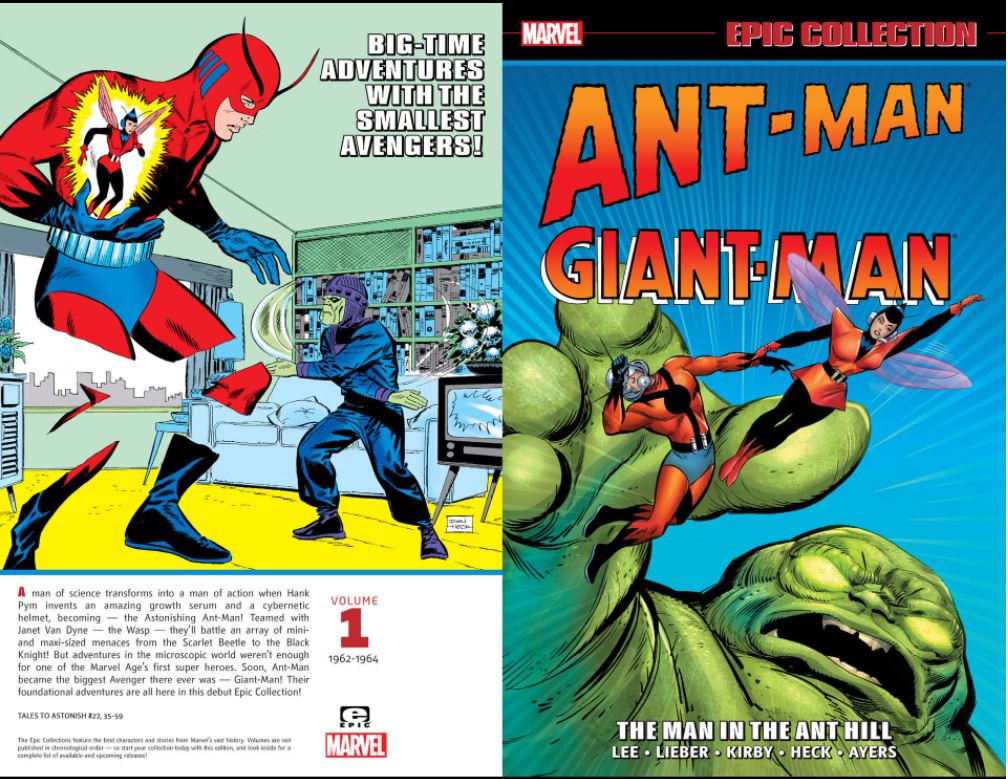
Ant-Man/Giant-Man Epic Collection volume 1 1962-1964: The Man in the Ant-Hill


Stan Lee, Larry Lieber, Ernie Hart, Jack Kirby, Don Heck, Dick Ayers, Sol Brodsky, Steve Ditko, Paul Reinman, Chic Stone, & various (Marvel)
ISBN: 978-0-7851-9850-5 (TPB/Digital edition) 

Dates and debuts are big deals to comics fans, and this year is a major one for Marvel Anniversaries, if not always first appearances. Here’s a classic case-in-point… 

If you’re of a particularly picky nature – and what true fan isn’t? – you could consider The Astonishing Ant-Man to be the second superhero of the Marvel Age. He first popped up in Tales to Astonish #27 (cover-dated January 1962 but on sale from the end of September 1961), in one of the splendidly addictive men-vs-monsters anthology titles that dominated in those heady days of Science Fiction Double-Feature B-Movies. 

This eclectic episodic, entomologically edifying and endearing compendium gathers pertinent portions of Tales to Astonish #27 and a majority of the succeeding series (which ran from #35-69: September 1962 to July 1965). Sadly the little dramas herein terminate with #59 (September 1964). 

These itty-bitty sagas reveal scintillating solo outings of a brilliant but troubled scientist who became an unlikely, uncomfortable and ultimately mentally unstable champion, and begin with what was just supposed to be another throwaway filler thriller… 

A cover-featured 7-page short introduced Dr Henry Pym, a maverick scientist who discovers a shrinking potion and became ‘The Man in the Anthill!’, discovering peril, wonder and even a kind of companionship amongst the lowliest creatures on Earth and under it… 

Plotted by Stan Lee, scripted by his brother Larry Lieber and stunningly illustrated by Jack Kirby & Dick Ayers, the engaging piece of fluff owed more than a little to classic B-movie The Incredible Shrinking Man… 

Obviously, Pym struck a chord with someone since, as the DC Comics-inspired superhero boom flourished, he was rapidly retooled as a full-fledged costumed do-gooder, debuting again mid-year (#35, cover-date September 1962) in ‘The Return of the Ant-Man’ by Lee, Lieber, Kirby & Ayers. The plot concerned a raid by Soviet agents (this was during the height of Marvel’s ‘Commie-Buster’ period when every other villain was a Red somebody or other and rampaging socialism was a cultural bête noir) with Pym imprisoned in his own lab. 

Forced to return to the abandoned shrinking gases and cybernetic devices he’d built to communicate with ants, Dr. Pym soundly trounced the spies and resolved to use his gifts for the good of Mankind. 

The same creative team produced the next four adventures, starting with ‘The Challenge of Comrade X!’ (TTA #36) as an infallible Soviet superspy was dispatched to destroy the Tiny Terror, after which Ant-Man was temporarily ‘Trapped by the Protector!’ – a cunning jewel-thief and extortionist who ultimately proved no match for the little wonder. 

‘Betrayed by the Ants!’ featured the debut of intellectual archfoe Egghead: a maverick and mercenary research scientist who attempted to usurp the hero’s control of insects whilst ‘The Vengeance of the Scarlet Beetle!’ saw a return to scary monster stories as a radioactively mutated, super-smart bug sought to eradicate humanity, with only Pym able to stop him… 

Sol Brodsky replaced Ayers as inker on ‘The Day that Ant-Man Failed!’ (TTA #40), with a deadly Hijacker robbing trucks and pushing the inventor to new heights of ingenuity, after which Kirby too moved on: his lavishly experimental perspectival flamboyance replaced by the comforting realism and enticing human scale of Don Heck who limned a classy alien invasion yarn in ‘Prisoner of the Slave World!’ before depicting a mesmerising menace who could control people with ‘The Voice of Doom’ (TTA #42). 

The following issue H. E. Huntley (AKA veteran writer/artist Ernie Hart) replaced Lieber as scripter with ‘Versus the Mad Master of Time’: a run-of-the-mill mad – or rather disgruntled and misguided – scientist yarn. The next issue (#44) saw Kirby return to pencil a significant change to the series…. 

‘The Creature from Kosmos’ (inked by Heck) introduced The Wasp – Pym’s bon vivant crime-fighting partner Janet Van Dyne – in a double-length tale featuring a murderous alien marauder who killed her father. There was even a fresh secret origin for Ant-Man: a rare and uncharacteristic display of depth revealing Pym was a widower. When his Hungarian wife Maria was murdered by Communist agents, it irrevocably changed a young scientist from a sedentary scholar into a driven man of action…. 

Ant-Man used his discoveries to endow Janet with the power to shrink and fly and she became his crime-fighting partner. Together they overcome ‘The Terrible Traps of Egghead’ (Lee, Huntley & Heck) before travelling to Greece to thwart another alien invasion ‘When Cyclops Walks the Earth!’ 

Back in the USA, the Diminutive Duo battle mystic trumpeter Trago in ‘Music to Scream By’ and defeat an avaricious weapons designer who builds himself a unique warsuit to become super-thief ‘The Porcupine!’: all serving as placeholders before the next big change came with Tales to Astonish #49’s ‘The Birth of Giant-Man!’. 

Lee scripted and Kirby pencilled how Pym learned to enlarge as well as reduce his size, just in time to tackle trans-dimensional kidnapper The Eraser. In the next issue Steve Ditko inked The King in ‘The Human Top’: first chapter of a continued tale which showed our hero struggling to adapt to his new strength and abilities. 

Concluding episode ‘Showdown with the Human Top!’ was inked by Ayers who would draw the bulk of the succeeding stories until the series’ demise. Also with this issue (TTA #51) back-up feature The Wonderful Wasp Tells a Tale began; blending sci-fi vignettes narrated by the heroine, fact-features and solo adventures. The first is space thriller ‘Somewhere Waits a Wobbow!’ by Lee, Lieber & George Roussos in Marvel mode as “George Bell”. 

The super-hero adventures settled into a predictable pattern from then on: individually effective enough but uninspired when read in quick succession. First up is a straight super-villain clash as ‘The Black Knight Strikes!’ (Lee & Ayers: TTA #52), supplemented by Wasp’s homily ‘Not What They Seem!’. Issue #53 led with another spectacular battle-bout ‘Trapped by the Porcupine!’ and finished with Wasp yarn ‘When Wakes the Colossus!’ (Lee, Lieber & Heck) before #54 found Heck briefly reinstated to illustrate the Crusading Couple’s catastrophic trip to South of the Border Santo Rico but finding ‘No Place to Hide!’ The taut tale of being trapped and powerless in a banana republic run by brutal commie agent El Toro was neatly counterbalanced by Wasp’s sci fi saga ‘Conquest!’ (Lee, Lieber & Brodsky). 

An implacable former foe defeated himself in ‘On the Trail of the Human Top!’ when the psychotic killer stole Giant-Man’s size changing pills in #55, following which Lee, Lieber & Bell produced Wasp’s tale of ‘The Gypsy’s Secret!’ 

A criminal stage conjuror was far more trouble than you’d suspect in ‘The Coming of The Magician!’: even successfully abducting the Wasp before his defeat, which she celebrated by regaling readers with tall tale ‘Beware the Bog Beast!’ (Lee, Lieber & Paul Reinman) after which #57 featured a major guest-star as the size-changing sweethearts set out ‘On the Trail of the Amazing Spider-Man!’ courtesy of Lee, Ayers & Reinman, with Egghead waiting in the wings and pulling strings, before the Wasp actually enjoyed a complete solo adventure with ‘A Voice in the Dark!’ by Lee, Lieber & Chic Stone. 

These were not only signs of the increasing interconnectivity Lee was developing but also indicated the strip was losing impetus. In a market rapidly drowning in superheroes, Giant Man was not selling as well as he used to or should… 

Captain America cameo-ed in #58’s epic Africa-based battle with a giant alien in ‘The Coming of Colossus!’, supplemented by Wasp’s lone hand played against an old foe in ‘The Magician and the Maiden!’ 

The last tale in this collection and beginning of the end for Giant-Man came in Tales to Astonish #59 and ‘Enter: the Hulk!’ with the Avengers inadvertently prompting the Master of Many Sizes to hunt down the Green Goliath. Although Human Top orchestrated a blockbusting battle, Lee was the real mastermind since, with the next issue, The Hulk would co-star in his own series and on the covers whilst Giant-Man’s adventures shrank back to a dozen or so pages. Ten issues later Hank and Jan would retire, making way for amphibian antihero Namor, the Sub-Mariner… 

(Gi)-Ant-Man and the Wasp did not die, but instead joined a vast cast of characters Marvel kept in relatively constant play through team books, via guest shots and in occasional re-launches and mini-series. 

Despite variable quality and treatment, the eclectic, eccentric and always fun exploits of Marvel’s premier “odd couple” remain an intriguing and engaging reminder that the House of Ideas didn’t always get it right, but generally gave their all to entertaining their fans. 

Marvel Comics initially built its fervent fan base through strong and contemporarily relevant stories and striking art, but most importantly by creating a shared continuity that closely followed the characters through not just their own titles but also through the many guest appearances in other comics. Such an interweaving meant that even today completists and fans seek out extraneous stories to get a fuller picture of their favourite’s adventures. 

In such an environment, series like these Epic Collections are an economical and valuable commodity approaching the status of a public service for collectors.  

By turns superb, stupid, exciting and appalling, this Epic encounter epitomises the best and worst of Early Marvel (with the delightful far outweighing the duff). It certainly won’t appeal to everybody, but if you’re a Fights ‘n’ Tights fan with a forgiving nature or a movie-goer looking for extra input, the good stuff here will charm, amaze and enthral you whilst the rest could just be considered as a garish garnish providing added flavour…
© 1962, 1963, 1964, 2015 Marvel Characters, Inc. All rights reserved. 

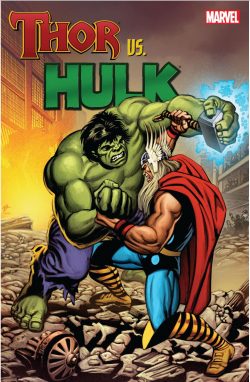
Thor vs. Hulk


By Stan Lee, Jack Kirby, Roy Thomas, Steve Englehart,Bill Mantlo, Peter David, Erik Larsen, Jeph Loeb, Jeff Parker, Peter B. Gillis, Jim Shooter, Sal Buscema, M.C. Wyman, Angel Medina, Jorge Lucas, Ed McGuinness, Gabriel Hardman & Ron Wilson & various (Marvel)
ISBN: 978-0-7851-8515-4 (TPB/Digital edition)

It bears repeating: on an inescapable primal level, comic books are all about one question; “who’s strongest/who would win if…?

The Incredible Hulk and Mighty Thor share their 60th anniversary this year, and whether in print, in animations or in blockbuster movies, that eternal question has been asked but never answered to anyone’s satisfaction whenever applied to the modern iteration of the age-old mythic war between gods and monsters.

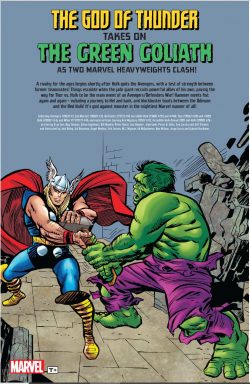
Packed with potent past clashes from the very start, this titanic tome opens with an erudite Introduction from former editor Ralph Macchio (no, the other one) outlining the concussive delights that follow. Contained herein are bouts and sagas first seen in Avengers #3; Journey into Mystery #112; Sub-Mariner #35; Defenders #10; Incredible Hulk #255, 440; Thor #385, 489; Incredible Hulk Annual 2001; Hulk (2008) #5-6, 26; and What If? #45, spanning cover-dates January 1964 – December 2010, but there’s no time for nonsense or niceties as the action opens at full throttle with Stan Lee, Jack Kirby & Paul Reinman revealing how in Avengers #3 ‘The Avengers Meet… Sub-Mariner!’

The previous issue saw latent animosities between Iron Man, Giant-Man, Wasp, and Thor lead to the aggressively volatile Hulk quitting the team in disgust. He returned as an outright villain in partnership with the vengeful prince of devastated Atlantis in a globe-trotting romp delivering high-energy thrills and one of the best battle scenes in comics history as the assorted titans clashed in abandoned World War II tunnels beneath the Rock of Gibraltar. Naturally, there was no clear winner when Thunderer and Gamma Goliath briefly battled…

The true birth of this particular grudge match came via a potent flashback in Journey into Mystery #112 (January 1965) which gave the readers what they had been clamouring for with ‘The Mighty Thor Battles the Incredible Hulk!’: a glorious gift to all those fans who perpetually asking the question “who’s stronger…?”

Possibly Kirby & Chic Stone’s finest artistic moment, it detailed a private duel between the two super-humans appearing off-camera during the free-for-all between The Avengers, Sub-Mariner and the Jade Juggernaut.

Jumping to a new decade, we see the solitary green gargantuan reconsidering his position on teamwork as a 2-part tale heralded the formation of a new supergroup. The Defenders’ story officially begins with Sub-Mariner #34-35 (February & March 1971: with only the latter included here).

The Prince of Atlantis was an early advocate of the ecology movement, and here (rather fractiously) recruited Hulk and The Silver Surfer to help him destroy an American nuclear weather-control station. Concluding in ‘Confrontation’ (by Roy Thomas, Sal Buscema & Jim Mooney) the misunderstood trio battled a despotic dictator’s forces, the US Army, UN defence forces and the mighty Avengers to prevent the malfunctioning station from accidentally vaporising half the planet, offering the emerald berserker another shot at that long-haired upstart who claimed to be the strongest one there is…

When the Defenders formed, their clandestine nature and line up (avowed antisocial menaces Sub-Mariner, Hulk, Valkyrie and enigmatic Doctor Strange) allowed mystic villains Loki and Dormammu to foment a war between the non-team and The Avengers that became a classic crossover event when that was a rare thing…

It lead to ‘Breakthrough! in Defenders #10 (November 1973) as Steve Englehart, Sal Buscema & Frank Bolle lavished many pages on epic standoff ‘The Incredible Hulk Vs. Thor’ before the inevitable joining together of warring camps in ‘United We Stand!’ That’s a great story you will need to seek out elsewhere as here we’re all about the bash… no trouble…

Courtesy of Bill Mantlo & Sal B, Incredible Hulk #255 (January 1980) detailed Thunder Under the East River!’ as reasons for the inescapable rumble become harder to manufacture. Here, the monster’s meanderings in New York and innate simmering belligerence are sufficient to spark off another blockbusting brouhaha while Thor #385 (November 1987) saw Jim Shooter provide a plot for Stan Lee to script, while Erik Larsen & Vince Colletta handled all the bellicose pictorial breakages in another city-set smash-up in ‘Be Thou God or Monster!’

After Image Comics’ debut compelled the Big Two (that would be DC and Marvel) to chase their deconstructivist, edgy style in the mid-1990s, radically reimagined Hulk and Thor bouts took on added grit and grimness. The changes were first seen in Thor #489’s ‘Hel and High Water’ (August 1995 by Thomas, M. C. Wyman & Mike DeCarlo) as a Hulk with Banner’s intellect rescued the Thunderer from beyond Death’s grasp, yet still ended up trading blows, whilst Incredible Hulk #440 (April 1996) featured Peter David, Angel Medina & Robin Riggs’ ‘The Big Bang’ as Thor strove against evil Future Hulk The Maestro with the world at stake and the lethal Leader pulling the strings…

Harking back to glory days, Incredible Hulk Annual 2001 (by Larsen, Jorge Lucas, Al Milgrom, Al Vey & Greg Adams) pastiched and homaged classic Kirby Kaos in ‘The Hammer Strikes’ as Thor drags the Jade Juggernaut across time and space in an extended clash but finds nowhere where their struggle will not create carnage and catastrophe…

Years passed and it transpired that green was not the only gamma wavelength to bear bitter fruit…

Cover-dated October & November 2008 and crafted by Jeph Loeb, Ed McGuinness, Mark Farmer & Dexter Vines, Hulk (volume 2) #5-6 detailed a no-holds barred battle between Thunder God and a ruthless Red Hulk (AKA General Thaddeus “Thunderbolt” Ross) in ‘Rolling Thunder’ before concluding with ‘Blood Red’ with the original Green Goliath and Avengers stepping in stop the carnage. Hulk #26 (December 2010, by Jeff Parker & Gabriel Hardman) then provides a notional rematch as prelude to cosmic shenanigans in ‘Scorched Earth Part II’…

Wrapping up the furious fisticuffs is an out of chronology tale from What If? #45 (June 1984) by Peter B. Gillis, Ron Wilson, Ian Akin & Brian Garvey, wherein Banner’s worst nightmare came true in ‘What If the Hulk Went Berserk?!’ Set in the early months after the Gamma bomb mutated the scientist, it thrillingly details the alternate Earth deaths of most of the budding Marvel Universe before Thor even arrives…

Adding to the beefy brilliance is a range of Classic Battles’ as depicted by Frenz & Milgrom (from Incredible Hulk #393), Arthur Adams & Laura Martin (Avengers Classic #3), Kirby, Reinman & Paul Mounts (Avengers Epic Collection #1) and John Romita Sr. & Richard Isanove (Avengers/Defenders War TPB), and cover sketches for (Red) Hulk #6 by Ed McGuinness.

Vivid, vibrant and valiantly irresistibly vicarious, these fabulous forays are primal yet perfect examples of superhero stories’ Prime Directive and deliver all the pictorial punch and panache any Fights ‘n’ Tights fiend could hope for.
© 2017 Marvel Characters, Inc. All rights reserved

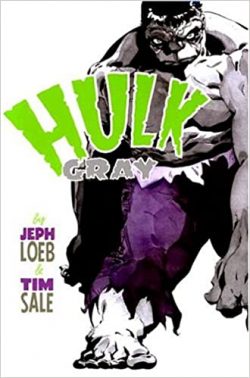
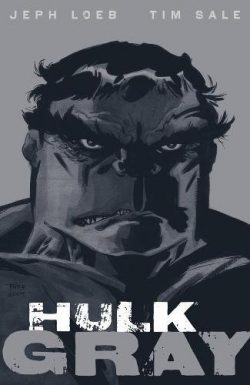
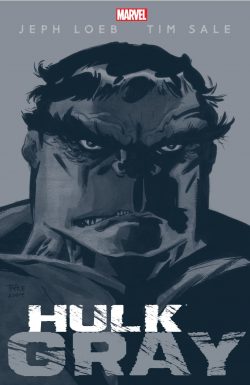
Hulk: Gray


By Jeph Loeb, Tim Sale & various (MARVEL)
ISBN: 978-0-7851-1314-0 (HB) 978-0-7851-1346-1 (TPB/Digital edition)

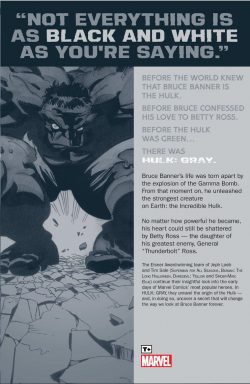
Once upon a time, military scientist Bruce Banner was caught in a Gamma Bomb blast of his own devising. As a result, stress and sundry other triggers regularly caused him to mutate into a gigantic green monster of impossible strength and fury. Alternately – often simultaneously – cast as both mindless monster and unlikely hero, he rampaged across the fictional landscape for decades, becoming one of Marvel’s most successful comic book features and one of its earliest multi-media megastars.

An incredibly popular character in global pop culture, the Hulk has periodically undergone radical changes in scope and format to keep his stories fresh and his exploits explosively compelling…

After Daredevil: Yellow and Spider-Man: Blue, Jeph Loeb & Tim Sale set their colour-coded retrofitters’ sights squarely on The Incredible Hulk‘s genesis and natal formation, primarily focussing on the at-this-time-still-nocturnally manifesting monster and rapidly evolving relationships with obsessive monster-hunter General Thaddeus “Thunderbolt” Ross and his conflicted daughter Betty.

Primarily set during The Incredible Hulk #1 and before the second issue saw him adopt traditional green hues, this in-filling saga offers an examination of classic themes “loving the monster” and “who is the real monster?”, by digging deeper into key relationships: Betty and Bruce; Betty and her dad; Bruce and her dad; Rick Jones and Bruce; Rick Jones and the Hulk; Betty and the Hulk …but not yet Bruce and the Hulk…

Originally a 6-issue miniseries, this collection offers a delightful Introduction from Marie Severin (detailing the debt this tale owes to her comedic creation the Inedible Bulk) before segueing to the office of super-psychiatrist Dr. Leonard Samson where an agitated Bruce Banner is sharing a moment from his earliest post-transformation days…

The saga unfolds in carefully curated limited colour segments and reveals how the bellicose General swiftly descends into obsessional paranoia as Banner and new comrade Rick try to understand the sundown transformations that bring forth an innocent with the power of a battleship…

The unleashed beast consistently targets Betty, and Rick finds himself torn between helping the scientist who saved his life and shielding the lethal innocent he nightly becomes. The former juvenile delinquent is increasingly aware that they might be two different people, not one who is periodically damaged and wounded…

The emotional turmoil boils over when Rick is arrested and brutalised by General Ross, resulting in a savage rescue by the grey goliath, Betty Ross’ abduction and an – unrecorded – first clash between The Hulk and Tony Stark. The military consultant quickly learns he will need to build back better if his new invention Iron Man is going to have any hope of surviving the world of Marvels developing around him…

Sadly, although spectacularly evocative and cathartic for old souls like me, there’s no real tension in this saga because even the freshest newcomers already know the inevitable romantic outcomes, but if you just fancy a memory-lane ramble with modern adornments, this is a slight but pleasantly rewarding diversion. Loeb & Sale have a strong track record with retrofitting, rationalising and re-examining pivotal moments of comic book icons: especially distilling turning point for iconic characters into material palatable to modern readers, but here it’s simply a waste of their time and talent.

The original tales are simply still better than the rehashing here. By no means their best efforts, it comes perilously close to being maudlin but at least offers plenty of cathartic chills and bombastic thrills while offering observations about the nature of monsters and who truly qualifies for the title…

Although Sale’s art is always a joy to behold, and Loeb’s gift for dialogue is undiminished Hulk: Gray falls short of their best. A solid, casual affair but not a patch on the real thing, but at least if you’re eager to learn more about the creative process, there’s a copious ‘Sketch Book’ section which includes detailed commentary from all concerned in the saga…
© 2002, 2003, 2004 Marvel Characters, Inc. All rights reserved.

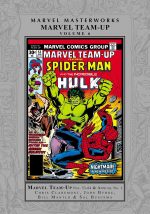
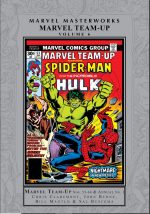
Marvel Team-Up Marvel Masterworks volume 6


By Bill Mantlo, Chris Claremont, Sal Buscema, John Byrne, Keith Giffen & various (Marvel)
ISBN: 978-1-3029-2931-2 (HB)

The concept of team-ups – an established star pairing or battling (usually both) with new or less well-selling company characters – has been with us since the earliest days of comics, but making the brief encounter/temporary alliance a key selling point really took hold with DC’s The Brave and the Bold before being taken up by their biggest competitor.

Marvel Team-Up was the second regular Spider-Man title, launching at the end of 1971. It went from strength to strength, proving the time had finally come for expansion and offering a regular venue for uncomplicated action romps to supplement the House of Ideas’ complex sub-plot fare in regular books. However, even in the infinite Marvel Multiverse, certain stars shine more brightly than others and some characters turn up in team-ups more often than others…

In recent years, carefully curated themed collections from the back-catalogue have served to initiate new readers intrigued by Marvel’s Movie and TV endeavours, but there’s no real substitute for seeing Marvel’s continuity unfolding in chronological and this compelling hardback/eBook compilation gathers the contents of Marvel Team-Up #53-64; MTU Annual #1 and includes a pertinent debut from Marvel Premiere #31; collectively covering August 1976 to December 1977.

Following Chris Claremont’s Introduction offering fond remembrances of the times and key writer Bill Mantlo, open with an epic length adventure from Marvel Team-Up Annual #1 by Mantlo, Sal Buscema & Mike Esposito (from a plot by Mantlo, Claremont & Bonnie Wilford).

‘The Lords of Light and Darkness!’ sees Spider-Man and the then-newly minted and revived X-Men, Banshee, Wolverine, Nightcrawler, Storm, Colossus, Phoenix and Cyclops helping Charles Xavier combat a pantheon of scientists mutated by atomic accident and elevated to minor godhood.

Like most deities, the puissant ones believed they knew what was best for humanity…

Mantlo then teamed with John Byrne & Frank Giacoia to bring closure to a tale begun – and left hanging – in August 1976’s Marvel Premiere #31, which can be found at the back of this book.

Marvel Team-Up #53 detailed a ‘Nightmare in New Mexico!’ as The Hulk meets troubled and AWOL gene-splicing experiment Woodgod as the tragic construct flees from corrupt Army Colonel Del Tremens. By the time the wallcrawler drops in, the fugitive outcasts have joined forces leaving him a  ‘Spider in the Middle!’ (inked by Esposito).

As Tremens seeks to suppress the calamitous crisis – and his own indiscretions – by killing everyone, the final scene sees the webspinner trapped in a rocket and blasted into space…

Marvel Team-Up #55 revealed a ‘Spider, Spider on the Moon!’ (Mantlo, Byrne & Dave Hunt) with returned cosmic Avenger Adam Warlock intercepting the ship before assisting the Arachnid and mysterious alien The Gardener against The Stranger: all seeking possession of the Golden Gladiator’s life-sustaining Soul Gem…

Back on Earth but still a trouble-magnet, in #56 Spider-Man assists Daredevil against ‘Double Danger at the Daily Bugle!’ (Mantlo, Sal B & Hunt) when Electro and Blizzard take the entire Newsroom hostage, after which Claremont assumed full scripting duties, laying the groundwork for a complex extended thriller embroiling the still-naïve hero in a deadly espionage plot.

With artists Sal Buscema & Dave Hunt, Claremont began redefining the Widow’s ways in Marvel Team-Up #57 (May 1977). ‘When Slays the Silver Samurai!’ sees Spidey saved from lethal ambush by the Black Widow, implausibly holding up a collapsing building, and reluctantly taking possession of a strange statuette that he soon forgets all about. That’s an oversight he’ll later regret…

In #58, the webspinner aids Ghost Rider against The Trapster in ‘Panic on Pier One!’ (Pablo Marcos inks) before he can investigate further.  Another distraction comes when MTU #59 declares ‘Some Say Spidey Will Die by Fire… Some Say by Ice!’ (Claremont, Byrne & Hunt) when veteran Avenger Yellowjacket is apparently murdered by rampaging mystery maniac Equinox, the Thermo-Dynamic Man. The Amazing Arachnid is hard-pressed to stop the traumatised Waspexacting bloody vengeance in concluding episode ‘A Matter of Love… and Death!’ in MTU #60…

The secret of the clay artefact is revealed in #61 as Human Torch Johnny Storm joins his creepy-crawly frenemy in battle against the Super-Skrull and learns ‘Not All Thy Powers Can Save Thee!’, with the furious clash calamitously escalating to include Ms. Marvel Carol Danvers with the next issue’s ‘All This and the QE2’…

Despite the very best efforts of Claremont & Byrne, their Kung Fu fantasy Iron Fist never quite achieved the kind of sales traction that rewarded their collaboration on the X-Men. The living weapon lost his circulation battle with issue #15 of his own title. Although ending in spectacular fashion, the cancellation was clearly unplanned, as two major subplots went unresolved: private detective Misty Knight had disappeared on an undercover assignment to investigate European gang-boss John Bushmaster and K’un Lun kid Danny Rand was suffering repeated attacks on his chi by the enigmatic and murderous Steel Serpent…

Frustrated fans didn’t have to wait long for a resolution. Marvel Team-Up was becoming the creative team’s personal clearing house for unresolved plot-lines. Issues #63 & 64 exposed the secret of the sinister K’un Lun pariah on the ‘Night of the Dragon’ before Rand and Spidey – with the assistance of Daughters of the Dragon Misty Knight and Colleen Wing– finally ended his threat in blistering martial arts manner with ‘If Death Be My Destiny!’

This epic tome is packed with rarely-seen extras, beginning with the contents of the Marvel Comics Memory Album Calendar 1977, released in late 1976 and preceded here by a ‘Special F.O.O.M. Preview!’ from the fabled fan-mag’s #16 (December 1976) issue. The Calendar pages follow, written by Roy Thomas and limned by Jack Kirby, John Romita Sr., Joe Sinnott, Ed Hannigan, Frank Giacoia, Gil Kane, John Buscema, Ron Wilson, Gene Colan, Jack Abel, Ross Andru & Mike Esposito, George Pérez, Tom Palmer, P. Craig Russell and John Verpoorten.

As an added treat, the debut/origin of “The Man-Brute Called Woodgod” (Marvel Premiere #31, August 1976) comes next as Mantlo, Keith Giffen and Klaus Janson explore the merits, ethics and repercussions of manufacturing life and meddling with nature. ‘Birthday!’ finds a modern-day faun rampaging through the ruins of a murdered town, searching for meaning and answers from the savage military men and technicians whose only solution to oversight and potential censure is murder and cover-ups…

The sinister science project saga is supplemented by F.O.O.M. #13’s interview ‘Woodgod Wanderings’ plus a gallery of Byrne original art pages.

These tales are of variable quality but all have an honest drive to entertain and please, whilst artistically the work – particularly action-man-on-fire Byrne – is superb, and most fans will find little to complain about. Although not perhaps a book for casual or more maturely-oriented readers there’s lots of fun on hand and young readers – or Marvel Cinematic supporters – will have a blast, so why not consider this tome for your “Must-Have” library? © 2021 MARVEL

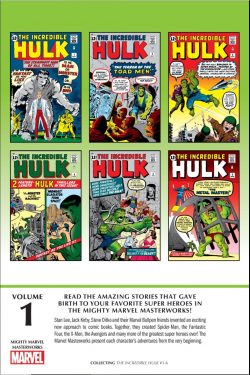
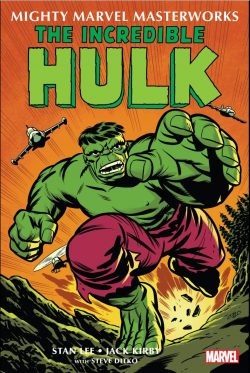
Mighty Marvel Masterworks The Incredible Hulk volume 1: The Green Goliath


By Stan Lee & Jack Kirby, with Steve Ditko & various (MARVEL)
ISBN: 978-1-3029-3180-3 (TPB)

Their stories are timeless and have been gathered many times before, but today I’m once more starting with format. The Mighty Marvel Masterworks line launched with economy in mind: classic tales of Marvel’s key creators and characters re-presented in chronological order. It’s been a staple since the 1990s, but always in lavish, hardback collectors editions. These editions are cheaper, on lower quality paper and – crucially – smaller, about the dimensions of a paperback book.

Your eyesight might be failing and your hands too big and shaky, but at 152 x 227mm, they’re perfect for kids. If you opt for the digital editions, that’s no issue at all…

1962 was a big year for burgeoning Marvel with plenty of star debuts who all celebrate six decades of glory this year. Most oldsters will cite the Amazing Spider-Man as the most significant premier, but this guy can probably claim equal star status…

Spanning May 1962 to March 1964, and collecting the Jade Juggernaut’s earliest appearances and first run, this tiny-yet-titanic Trade Paperback tome (also available in digital editions) gathers Incredible Hulk #1-6: a short, bright burst of monster chic that was ahead of its time but nonetheless laid the ground for more than half a century of cathartic fun…

The Incredible Hulk was Marvel’s second superhero title, although technically Henry Pym debuted earlier in a throw-away yarn from Tales to Astonish #27 (January 1962). However, he didn’t become actually become a costumed hero until the autumn, by which time Ol’ Jade Jaws was not-so-firmly established.

Firmly channelling comics’ still-popular atomic monster trend, The Hulk smashed right into his own bi-monthly comic but, despite some stunning action romps by Young Marvel’s finest creators, crashed right out again. After six issues, the series was cancelled and Editor Stan Lee retrenched, making the Gruff Green Giant a perennial guest-star in other Marvel titles until such time as he could restart the drama in their new “Split-Book” format. That came when the monster stomped into Tales to Astonish where Ant/Giant-Man was proving to be a character who had outlived his time.

Without more preamble then, let’s go…

Cover-dated May 1962, the Incredible Hulk #1 sees puny atomic scientist Bruce Banner – sequestered on a secret military station in the desert – perpetually bullied by bombastic base commander General “Thunderbolt” Ross as the clock counts down to the world’s first Gamma Bomb test. Besotted with Ross’s daughter Betty, Dr. Banner stoically endures the General’s constant jibes as the timer ticks on and tension increases.

In the final moments, Banner spots a teenager lollygagging at Ground Zero and frantically races to the site to drag the boy away. Unknown to everyone, the assistant he’s entrusted to delay the countdown has an agenda of his own…

Rick Jones is a wayward but good-hearted kid. After initial sassy-mouthing, he lets himself be pushed into a safety trench, but just as Banner prepares to join him The Bomb detonates…

Somehow surviving the blast, Banner and the boy are secured by soldiers, but that evening, as the sun sets the scientist undergoes a monstrous transformation. He grows larger; his skin turns a stony grey…

In six simple pages that’s how it all starts, and no matter what any number of TV or movie reworkings or comic book retcons and psycho-babble re-evaluations would have you believe, it’s still the best and most primal take on the origin. A good man, an unobtainable girl, a foolish kid, an unknown enemy and the horrible power of destructive science unchecked…

Written by Lee, drawn by imaginaut-on-fire Jack Kirby and inked by veteran Paul Reinman, ‘The Coming of the Hulk’barrels right along with the man-monster and Jones subsequently kidnapped by Banner’s Soviet counterpart the Gargoylefor a rousing round of espionage and Commie-busting.

For the second issue, the plot concerns invading aliens, and the Banner/Jones relationship settles into a traumatic nightly ordeal as the good doctor transforms as darkness comes, and is locked into an escape-proof cell whilst the boy stands watch helplessly. Neither ever considers telling the government of their predicament…

‘The Terror of the Toad Men’ is formulaic but viscerally and visually captivating as Steve Ditko inks Kirby: imparting a genuinely eerie sense of unease to the artwork. Incidentally, this is the story where the Hulk inexplicably (to us readers at the time) changed to his more accustomed Green persona.

Although cleverly back-written years later as a continuing mutation, the answer was simply commercial: the grey tones of the monster printed unreliably and erratically on the cheap newsprint pages, causing problems for production colourists so it was arbitrarily changed to the simple and more traditional colour of monsters: a far more tractable shade of green…

The third issue presented a departure in format as issue-long, chaptered epics gave way to complete short stories. Dick Ayers inked Kirby in the transitional ‘Banished to Outer Space’, which radically altered the relationship of Jones and the monster, and the story thus far was reprised in 3-page vignette ‘The Origin of the Hulk’. A Marvel mainstay of villainy debuted in ‘The Ringmaster’, with the Emerald Apparition literally (please note a term used correctly here) mesmerised into working for a band of criminal performers we now know as the Circus of Crime…

The Incredible One goes on an urban rampage in #4’s first tale ‘The Monster and the Machine’ before sneaky Commies masquerade as invading aliens in second escapade ‘The Gladiator from Outer Space!’

The Incredible Hulk #5 is a joyous exemplar of cataclysmic Kirby action, introducing immortal villain Tyrannus and his under-earth empire in ‘The Beauty and the Beast!’, after which those pesky and incorrigible Commies come in for another drubbing when our Jolly Green freedom-fighter prevents the invasion of Lhasa by ‘The Hordes of General Fang!’; a barely disguised poke at China’s still ongoing occupation of Tibet.

Despite the sheer verve and bravura of these simplistic classics – some of the greatest, most rewarding comics nonsense ever produced – the Hulk series was not doing well, and Kirby moved on to more appreciated arenas. Steve Ditko handled all the art chores for final issue #6: another full-length epic and an extremely engaging one. He would be the penciler when the Monster eventually regained his own solo series…

‘The Incredible Hulk Vs the Metal Master’ offers astonishing action, sly and subtle sub-plots and a thinking man’s resolution, but nonetheless the title (temporarily) died with the issue. After shambling around the nascent Marvel universe for a year or so, first as the odd man out in the Avengers and thereafter as a misunderstood villain/menace, the Hulk eventually got another shot at the big time in Tales to Astonish…

The rest is history and the momentous meat of another volume and review, but this jade-hued journal closes with some welcome traditional extras: original art pages from Kirby and Ditko and a contemporary house ad.

Hulk Smash!

He always was, and with material like this he always will be.
© 2021 MARVEL

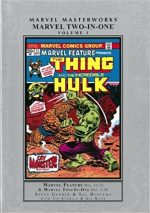
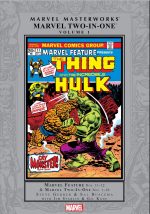
Marvel Two-in-One Masterworks volume 1


By Steve Gerber, Len Wein, Mike Friedrich, Chris Claremont, Jim Starlin, Gil Kane, Sal Buscema, George Tuska, Herb Trimpe, Bob Brown & various (Marvel)
ISBN: 978-0-7851-6633-7 (HB)

Imagination isn’t everything. As Marvel slowly grew to a position of dominance in the wake of losing their two most innovative and inspirational creators, they did so less by risky experimentation and more by expanding and exploiting proven concepts and properties.

The only real exception to this was their en masse creation of horror titles in response to the industry down-turn in super-hero sales – a move expedited by a rapid revision in the wordings of the increasingly ineffectual Comics Code Authority rules.

The concept of team-up books – an established star pairing, or battling – and usually both – with less well-selling company characters, was not new when Marvel decided to award their most popular hero the lion’s share of this new title, but they wisely left their options open by allocating an occasional substitute lead in the Human Torch. In those long-lost days, editors were acutely conscious of potential over-exposure – and since super-heroes were actually in a decline, they may well have been right.

After the runaway success of Spider-Man‘s collaborations in Marvel Team-Up, the House of Ideas reinforced the trend with a series starring bashful, blue-eyed Ben Grimm – the Fantastic Four‘s most iconic member – beginning with two test runs in Marvel Feature before graduating to its own somewhat over-elaborate title.

This compelling compendium – available in hardback and digital formats – gathers the contents of Marvel Feature #11-12 and Marvel Two-In-One #1-10, covering September 1973 – July 1975, and opens with a Roy Thomas Introduction explaining how it was Stan’s idea…

Then the much told tales take centre stage with a perennial favourite pairing and the Thing once more clashing with The Incredible Hulk in ‘Cry: Monster! by Len Wein, Jim Starlin & Joe Sinnott (from MF #11).

Here, Kurrgo, Master of Planet X and the lethal Leader manipulate both blockbusting brutes into duking it out – ostensibly to settle a wager – but with the mighty minded, misshapen masterminds each concealing hidden agendas…

That ever-inconclusive yet cataclysmic clash leaves Ben stranded in the Nevada desert where Mike Friedrich, Starlin & Sinnott promptly drop him in the middle of the ongoing war against mad Titan Thanos with Iron Man helping Ben crush monstrous alien invaders in ‘The Bite of the Blood Brothers!’ (Marvel Feature #12, November 1973): another spectacular and painfully pretty all-action punch-up.

Still stuck in the desert when the dust settles, Ben laboriously treks to a minor outpost of civilisation just in time to be diverted to Florida for the grand opening of his own title. Cover-dated January 1974, Marvel Two-In-One #1 sees Steve Gerber, Gil Kane & Sinnott magnificently detail the ‘Vengeance of the Molecule Man!’, with Ben learning some horrifying home truths about what constitutes being a monster after battling with and beside ghastly, grotesque anti-hero Man-Thing.

With the second issue Gerber cannily trades a superfluous supporting character from his Man-Thing series to add some much-needed depth to the team-up title. ‘Manhunters from the Stars!’ pits Ben, old enemy Namor, the Sub-Mariner (another series Gerber was currently writing) and the Aquatic Avenger’s feisty and single-minded cousin Namoritaagainst each other as well as aliens hunting the emotionally and intellectually retarded superboy Wundarr. Another dynamically, intoxicating tale illustrated by Kane & Sinnott, this case also leaves the Thing as de facto guardian of the titanic teenaged tot…

Sal Buscema signed on as penciller with #3 as the Rocky Ranger joins the Man Without Fear ‘Inside Black Spectre!’: a crossover instalment of the extended epic then playing out in Daredevil #108-112 (in case you’re wondering, this action-packed fight-fest occurs between the second and third chapters) after which ‘Doomsday 3014!’ (Gerber, Buscema & Frank Giacoia) finds Ben and Captain America visiting the 31st century to save Earth from enslavement by the reptilian Brotherhood of Badoon, leaving Wundarr with Namorita for the foreseeable future…

The furious future-shocker concludes in MTIO #5 as the original Guardians of the Galaxy (not the movie group) climb aboard the Freedom Rocket to help our time-lost heroes liberate New York before returning home. The overthrow of the aliens was completed by another set of ancient heroes in Defenders #26-29 (which is also the subject of a different review)…

Marvel Two-In-One #6 began a complex crossover tale with the aforementioned Defenders as Dr. Strange and the Thing witness a cosmic event which begins with a subway busker’s harmonica and leads inexorably to a ‘Death-Song of Destiny!’ (Gerber, George Tuska & Mike Esposito) before Asgardian outcasts Enchantress and the Executioner attempt to seize control of unfolding events in #7’s ‘Name That Doom!’ (pencilled by Sal Buscema).

As they are thwarted by Grimm and the valiant Valkyrie, there’s enough of an ending here for casual readers, but fans and completists will want to hunt down Defenders #20 or Defenders Masterworks link please volume 3 for the full story…

Back here, however, MTIO #8 teams Grimm and supernatural sensation Ghost Rider in a quirkily compelling Yuletide yarn. ‘Silent Night… Deadly Night!’ – by Gerber, Buscema & Esposito – finds the audacious Miracle Man trying to take control of a very special birth in a stable…

Gerber moved on after plotting Thor team-up ‘When a God goes Mad!’ for Chris Claremont to script and Herb Trimpe & Joe Giella to finish: a rushed and meagre effort with the Puppet Master and Radion the Atomic Man making a foredoomed power play, before issue #10 concludes this initial compendium.

Crafted by Claremont, the still much-missed Bob Brown & Klaus Janson, it is a slice of inspired espionage action-intrigue with Ben and the Black Widow battling suicidal terrorist Agamemnon who plans to detonate the planet’s biggest nuke in blistering thriller ‘Is This the Way the World Ends?’.

These stories from Marvel’s Middle Period are of variable quality but nonetheless represent an honest attempt to entertain and exhibit a dedicated drive to please. Whilst artistically the work varies from adequate to utterly superb, most fans of the frantic Fights ‘n’ Tights genre would find little to complain about.

Although not really a book for casual or more maturely-oriented readers there’s still buckets of fun on hand and young readers will have a blast, so why not to add this colossal comics chronicle to your straining superhero bookshelves?
© 2020 MARVEL

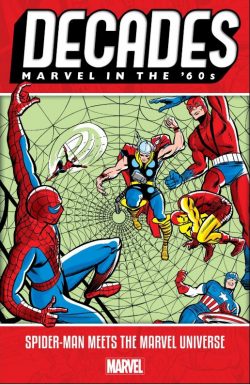
Decades: Marvel in the ’60s – Spider-Man Meets the Marvel Universe


By Stan Lee, Steve Ditko, Roy Thomas, Jack Kirby, Don Heck, Dick Ayers, John Romita Sr, Gene Colan, Werner Roth & various (Marvel)
ISBN: 978-1-3029-1660-2 (TPB)

The Amazing Spider-Man was first seen in the middle of 1962, so expect plenty of wallcrawling reviews over the next twelve months, and if any of us make it to the end I’m sure we’ll all be well-versed in Arachnid Lore with our book shelves (physical or digital) positively groaning with sublimely re-readable tales and tomes…

For Marvel, it’s always been all about the team-ups…

In the company’s 80th Anniversary year of 2019, they published plenty of reprint material in archival formats designed to highlight specific triumphs of the House of Ideas. One of the mot interesting was the Decades project: collecting material from each era seen through a themed lens. For the 1960s – with so very much astounding innovation to be proud of – the editors opted to re-present critical confrontations of the company’s signature star with the other breakthrough characters that formed the bedrock of the Marvel Universe. After all, it’s always been all about the team-ups…

Within this trade paperback/digital delight – in full or in extract – are bombastic battles and eccentric encounters between the wondrous wallcrawler and the other growing stars of the ever-expanding firmament, culled from Amazing Spider-Man #1, 8, 14, 16; Amazing Spider-Man Annual #2; Fantastic Four #73; Fantastic Four Annual #1; Strange Tales Annual #2; Tales to Astonish #57; The Avengers #11; The Avengers Annual #3; Daredevil #16, 17, 27 and The X-Men #35 spanning March 1963 to 1968. The curated cruise begins with a context-setting Introduction from Jess Harrold, before we see a skinny kid in a costume meet his heroes for the first time…

Marvel is often termed “the House that Jack Built” and Kirby’s contributions are undeniable and inescapable in the creation of a new kind of comic storytelling, but there was another unique visionary toiling at Atlas-Comics-as-was, one whose creativity and even philosophy seemed diametrically opposed to the bludgeoning power, vast imaginative scope and clean, broad lines of Jack’s ever-expanding search for the external and infinite.

Steve Ditko was quiet and unassuming, voluntarily diffident to the point of invisibility, but his work was both subtle and striking: simultaneously innovative and meticulously polished. Always questing for the ideal, he explored the man within. He saw heroism and humour and ultimate evil all contained within the frail but noble confines of humanity. His drawing could be oddly disquieting… and, when he wanted, decidedly creepy.

Crafting extremely well-received monster and mystery tales for and with Stan Lee, Ditko had been rewarded with his own title. Amazing Adventures/Amazing Adult Fantasy featured a subtler brand of yarn than Rampaging Aliens and Furry Underpants Monsters: an ilk which, though individually entertaining, had been slowly losing traction in comics ever since DC had successfully reintroduced costumed heroes.

Lee & Kirby had responded with Fantastic Four and the ahead-of-its-time Incredible Hulk but there was no indication of the renaissance ahead when officially just-cancelled Amazing Fantasy featured a brand new and rather eerie adventure character…

It wasn’t a new story, but the setting was familiar to every kid reading it and the artwork was downright spooky. This wasn’t the gleaming high-tech world of moon-rockets, mammoth monsters and flying cars… this stuff could happen to anybody…

The debut of Spider-Man and his pathetic, loser, young alter ego Peter Parker was a landmark moment. The hard luck hero effortlessly made the jump to his own title. Holding on to the “Amazing” prefix to jog reader’s memories, the bi-monthly Amazing Spider-Man #1 arrived with a March 1963 cover-date and two complete stories. It also prominently featured the aforementioned FF and took the readership by storm. Excerpted here are the 5 pages wherein the cash-strapped youngster breaks into the Baxter Building determined to get himself hired by the team and ends battling his idols…

That’s followed by a back-up story from 1963’s Fantastic Four Annual #1 which expanded the incident into a proper yarn. ‘The Fabulous Fantastic Four Meet Spider-Man sees Kirby redraw the moment with Ditko inking and it is superb, smartly segueing into the lead feature from the same year’s Strange Tales Annual #2. This terrific romp from Lee, Kirby & Ditko depicts an early Marvel Misapprehension as the wallcrawler is framed by international art thief and disguise-master The Fox, and hot-headed Johnny Storm determines to bring the aggravating arachnid to justice. Guess how that works out…

Cover-dated January 1964, Amazing Spider-Man #8 led with a battle against the computer dubbed the Living Brain, but you’ll need to look elsewhere for that. An extra vignette in that issue provided another Lee/Kirby/Ditko delight. ‘Spiderman Tackles the Torch!’ is a 6-page comedy romp wherein a boisterous and envious wall-crawler gate-crashes a beach party thrown by the flaming hero’s girlfriend… with suitably explosive consequences.

Marvel’s growing band of stars were pooping up everywhere in others titles by this time, and the next snippet – 5 pages culled from Amazing Spider-Man #14 (July 1964) – sees the webspinner’s battle against the Green Goblin and Enforcers interrupted by the Incredible Hulk who delivers an unforgettable lesson in staying in your own weight class. That same month, Tales to Astonish #57 saw Giant-Man and the Wasp ‘On the Trail of the Amazing Spider-Man!’ – courtesy of Lee, Dick Ayers & Paul Reinman – with sinister mastermind Egghead pulling strings to make the complete strangers into mortal enemies…

September 1964 found Amazing Spider-Man #16 extending the wallcrawler’s circle of friends and foes whilst battling the Ringmaster and his Circus of Evil and encountering freshly minted fellow loner hero in a dazzling and delightful‘Duel with Daredevil’ (Lee & Ditko), after which The Avengers #11 (by Lee, Don Heck & Chic Stone) details how ‘The Mighty Avengers Meet Spider-Man!’ This is a clever and classy cross-fertilising tale featuring time-bending tyrant Kang the Conqueror who attempts to destroy the team by insinuating within their serried ranks a robotic duplicate of the outcast hero.

Next up is arguably Ditko’s greatest artistic triumph of this era: the lead tale from Amazing Spider-Man Annual #2 (October of that year and filled out with vintage Spidey classics).

Ditko was on peak form: fast enough to handle two monthly strips, and at this time also blowing away audiences with another ill-fitting, oddly tangential superhero. The disparate crusaders met in ‘The Wondrous World of Dr. Strange!’: an entrancing fable unforgettably introducing the Amazing Arachnid to arcane realities and metaphysical mysteries as he joins the Master of the Mystic Arts to battle power-crazed mage Xandu in a phantasmagorical, dimension-hopping masterpiece involving ensorcelled zombie thugs and the stolen Wand of Watoomb. After this, it was clear that Spider-Man could work in any milieu and that nothing could hold him back…

Now sporting his signature all-red outfit, the Man Without Fear re-encountered Spider-Man in Daredevil #16-17 (May & June 1966 and crafted by Lee, John Romita the elder and inker Frank Giacoia) as ‘Enter… Spider-Man!’ introduces diabolical criminal mastermind Masked Marauder who has big plans; the first of which is to get DD and the wallcrawler to kill each other…

With chapter ‘None are so Blind…’ opens a convoluted a sub-plot which would lead to some of the highest and lowest moments of the early Daredevil series – such as Spidey accusing Law-firm partner Foggy Nelson of being the Scarlet Swashbuckler and Matt Murdock inventing a twin brother Mike – but the art is superb and the action is nonstop, so there’s not much to complain about…

Next comes Amazing Spider-Man Annual # 3 and ‘…To Become an Avenger!’ with the World’s Mightiest Heroes offering the webspinner membership if he can capture and bring them the Hulk. As usual, all is not as it seems but the action-drenched epic, courtesy of Lee, Romita (on layouts), Don Heck, & Mike Esposito is the kind of guest-heavy, power-punching package that made these summer specials such a prize…

Jumping to April 1967, Daredevil #27 (Lee, Gene Colan & Giacoia) closes a chapter as a leaner, moodier Man Without Fear manifested. Earlier episodes saw the hopeless romantic triangle of Murdock, best friend Foggy and their secretary Karen Page become a whacky quadrangle by introducing fictitious twin Mike Murdock. Now he would be “exposed” as Daredevil to divert suspicion from the blind attorney who actually battled all those weird villains…

Well that happened, and – still skulking in the background – arch-villain Masked Marauder slowly honed in on DD’s actual alter ego. He got closest in ‘Mike Murdock Must Die!’ after Stilt-Man teams with the Marauder before Spider-Man abrasively helped out in a brief cameo to take down the long-legged loon…

Cover-dated August 1967, The X-Men #35 finally found Marvel’s top teens in the same story. At that time the mutant heroes were hunting secret cabal Factor Three who had used robot arachnoids to kidnap Professor X.

When ally Banshee is captured mid-sentence during a crucial communication with the team in ‘Along Came A Spider…’(by Roy Thomas, Werner Roth & Dan Adkins) everybody’s favourite wallcrawler is mistaken for a foe. After the desperate, distraught mutants find the hero amidst robot wreckage, he is forced to battle for his life against the increasingly unstable teens…

Ending this chronological collaboration excursion is Fantastic Four #73 (April 1968) which carried an instant-classic crossover that overlapped an ongoing Thor storyline and conclusion to a long-running Daredevil story wherein the sightless crusader is ousted from his own body by Doctor Doom. After warning the FF of imminent attack, the Swashbuckler subsequently defeats Doom on his own, but neglects to tell the heroes of his victory…

Thus, outmatched and unable to convince them any other way, DD enlists currently the de-powered Thunder God and ever-eager webspinner in to solve the problem Marvel style – with a pointless, spectacular and utterly riveting punch-up – in ‘The Flames of Battle…’

These timeless team-ups of Marvel’s original loner comprise a superb catalogue of splendid triumphs to be enjoyed over and over again. How can you not?
© 2019, MARVEL

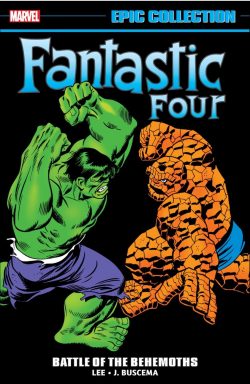
Fantastic Four Epic Collection volume 7: Battle of the Behemoths 1970-1972


By Stan Lee, Archie Goodwin, John Romita, John Buscema, Jack Kirby, Joe Sinnott, John Verpoorten, Frank Giacoia, Jim Mooney & various (Marvel)
ISBN: 978-1-3029-2913-8 (TPB)

Win’s Christmas Gift Recommendation: Fantastic Fight Fuelled Fun… 8/10

It’s still 60 glorious years of the team who changed comics forever, so let’s revisit some more Mighty Marvel Magic…

Cautiously bi-monthly and cover-dated November 1961, Fantastic Four #1 (by Stan Lee, Jack Kirby, George Klein & Christopher Rule) was raw and crude even by the ailing company’s standards: but it seethed with rough, passionate and uncontrolled excitement. Thrill-hungry kids pounced on its dynamic storytelling and caught a wave of change starting to build in America. It and succeeding issues changed comics forever.

As seen in the groundbreaking premier issue, maverick scientist Reed Richards, his fiancée Sue Storm, their close friend Ben Grimm and Sue’s annoying teenaged brother survived an ill-starred private space-shot after Cosmic Rays penetrated their ship’s inadequate shielding.

All permanently mutated: Richards’ body became elastic, Sue became (even more) invisible, Johnny Storm burst into living flame whilst tragic Ben shockingly devolved into a shambling, rocky freak. After the initial revulsion and trauma passed, they solemnly agreed to use their abilities to benefit mankind. Thus was born The Fantastic Four.

Throughout the 1960s the FF was indisputably the core title and most consistently groundbreaking series of Marvel’s ever-unfolding web of cosmic creation: a forge for new concepts and characters. Kirby was in his creative prime: continually unleashing his vast imagination on plot after spectacular plot, whilst Lee scripted some of the most passionate superhero sagas ever seen.

Both were on an unstoppable roll, at the height of their powers and full of the confidence only success brings, with The King particularly eager to see how far the genre and the medium could be pushed… which is rather ironic since it was the company’s reticence to give the artist creative freedom which led to Kirby’s jumping ship to National/DC in the first place…

And then, he was gone…

With this collection from “The World’s Greatest Comics Magazine” a new style develops. Without Kirby’s restless imagination the rollercoaster of mind-bending High Concepts gave way to more traditional tales of characters in conflict, with soap-opera leanings and super-villain-dominated Fights ‘n’ Tights dramas.

This blockbuster bonanza compendium – also available in digital editions – gathers issues #105-125 (spanning December 1970-August 1972) and opens with The Monster in the Streets!’…

Scripted by Lee and illustrated by John Romita & inker John Verpoorten, this is a low-key yet extremely effective suspense thriller played against a resuming subplot of Johnny’s failing romance. When his Inhuman girlfriend Crystal is taken ill – preparatory to writing her out of the series completely – Reed’s diligent examination reveals a potential method of curing the misshapen Thing of his rocky curse.

Tragically, as Ben is prepped for the radical process, a mysterious energy-beast starts tearing up the city. By the time ‘The Monster’s Secret!’ is exposed in #106, the team strongman is almost dead and Crystal is gone… seemingly forever.

Veteran inker Joe Sinnott returns in #107 for ‘And Now… the Thing!’ as John Buscema assumes the illustrator’s reins over Kirby’s other masterpiece (he had already been drawing Thor for four months – starting with #182).

Here and now the unfortunate man-monster gains the power to become human at will. It seems the best of all possible outcomes but something isn’t quite right…

However, before Reed can investigate an old foe pops up again. Sort of…

Fantastic Four #108 was something of a surprise to fans. ‘The Monstrous Mystery of the Nega-Man!’ “reintroduced” a character never seen before.

This was done by recycling large portions of a recently-rejected Kirby & Sinnott tale and adding new framing sequences illustrated by Buscema and Romita. The mysterious Janus had tapped into the antimatter power of the Negative Zoneonce before and “now” resurfaces to steal more by crashing through the portal in Reed’s lab. Unfortunately, this attracts the attention of extinction-event predator Annihilus, who had long sought entry into our life-rich universe…

Forced to follow the utterly mad scientist, Reed, Ben and Johnny once again face ‘Death in the Negative Zone!’ (Lee. Buscema& Sinnott) before FF #110 sees – thanks to a little arcane assistance from sorceress/babysitter Agatha Harkness – Reed escape doom in the anti-cosmos only to realise that “cured” Ben has become lethally sociopathic: a threat to all humanity in ‘One from Four Leaves Three!’

Able to switch between human and monster forms, ‘The Thing… Amok’ rampages through New York, with Mr. Fantastic and the Human Torch desperately trying to minimise the damage their deranged friend inflicts on the city even as increasingly marginalised Sue Richards is packed off to tend baby Franklin beside eldritch governess Harkness…

With all of New York apparently against them, the embattled heroes are on the ropes when the Incredible Hulk joins the fracas for #112’s Battle of the Behemoths!’.

As Sue finally and rebelliously returns, The Thing seems to have perished in the brutal battle that ensued when the monsters met, but once again Reed saves – and cures – his best friend just as another menace materialises…

‘The Power of… the Over-Mind!’ reveals another insidious cosmic menace, presaged and prophesised by an ominous warning from omniscient alien spectator The Watcher.

The psionic super-menace further incites civilian antipathy towards the FF in But Who Shall Stop the Over-Mind?’ (inked by Frank Giacoia) before manifesting and physically trouncing the team.

With #115,  Stan Lee surrendered scripting to Archie Goodwin, who promptly revealed ‘The Secret of the Eternals’ (not the earthly proto-gods and blockbuster movie icons created by Kirby, but an entirely different ancient alien race) in a visually stunning sequence limned by Buscema & Sinnott, culminating in Reed being taken over by the Over-Mind and turning on his erstwhile comrades…

The saga concludes with double-sized Fantastic Four #116’s ‘The Alien, the Ally, and… Armageddon!’ as the defeated, embattled heroes – unable to access any superhero assistance – recruit arch foe Doctor Doom to lead them in final battle against the seemingly unbeatable Over-Mind. They are nonetheless crushed and only saved at the crucial moment by a most unexpected saviour in ‘Now Falls the Final Hour!’…

Having helped save the world – and with time on his hot little hands – the heartsick Human Torch heads for the Himalayas and a long-delayed rapprochement with lost girlfriend Crystal in FF #117.

Months previously she had been forced to abandon human civilisation because modern pollutants poisoned her system, but when blazing mad Johnny battles his way into her hidden homeland in ‘The Flame and the Quest!’, he is horrified to discover that she had never arrived back in the Great Refuge of Attilan…

Flying back to New York, Johnny consults part-time nanny and career-sorceress Agatha Harkness who traces Crystal to the Central American dictatorship of Terra Verde. Arriving there exhausted and expectant, Johnny finds his love is the mesmerised slave of arcane alchemist Diabolo.

The mystic has convinced the populace – and Crystal herself – that she is a reborn goddess he needs to seize control in ‘Thunder in the Ruins!’ (inked by Jim Mooney). He would have succeeded too, if not for that flaming kid…

The issue included an intriguing vignette starring the Thing: ‘What Mad World?’ (Goodwin, Buscema & Mooney) finds the Tragic Titan afforded a glimpse of an alternate Earth where an even greater mishap occurred after the fateful spaceflight which created the team…

The Black Panther – cautiously renamed Black Leopard for contemporary political reasons – guest-starred in #119’s ‘Three Stood Together!’ as inker Sinnott returned and Roy Thomas scripted a damning, if shaded, indictment of South Africa’s apartheid regime.

When the heroic ruler of jungle wonderland Wakanda is interned in white-ruled state Rudyarda, Ben and Johnny fly in to bust him out and clash with old enemy Klaw who is attempting to steal a deadly new super-weapon…

Fantastic Four #120 heralded an extended and somewhat overlong epic by Stan Lee which began with ‘The Horror that Walks on Air!’ as a seemingly omnipotent invader claiming to be an angel scours and scourges Earth before declaring humanity doomed.

The tale vividly yet laboriously continues in ‘The Mysterious Mind-Blowing Secret of Gabriel!’ with the recently reunited, utterly overmatched quartet saved by the late-arriving Silver Surfer before facing off against world-devouring ‘Galactus Unleashed’. The end comes and humanity survives another day thanks to Reed who again outsmarts the cosmic god and prevents the consumption of ‘This World Enslaved!’

Although beautifully illustrated, the hackneyed saga was a series low-point, but Lee was back on solid dramatic ground with #124’s ‘The Return of the Monster’ and concluding episode ‘The Monster’s Secret!’, wherein the mystery menace Reed once dubbed ‘the Monster from the Lost Lagoon’ resurfaces to haunt a Manhattan hospital, steal drugs and kidnap Sue… but only for the best and most noble of reasons…

His depredations are soon halted and explained, concluding this tome on a rare quiet note but more calamity was still to come…

Did I say concluding? Not quite; as there’s still room for the Romita/Verpoorten cover to all-reprint Fantastic FourAnnual #8 plus the Kirby & Vince Colletta cover to 1971’s Annual #9; a stunning house ad; original art pages by Romita and Buscema, uncorrected cover proofs; the rare misprinted pink-&-green cover for FF #110 and 6 previous collection covers by Alan Davis & Steve Buccellato to delight and enthral…

Although sacrificing spectacle and wonder for simple continuous conflict, the Fantastic Four remained at the heart of the Marvel Universe for decades, offering furious Fights ‘n’ Tights thrills to delight and beguile. Why not check out how and why?
© 2021 MARVEL.

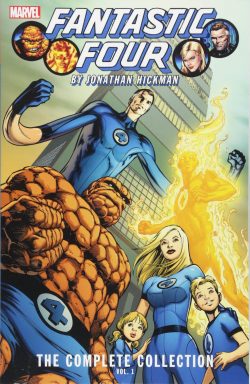
Fantastic Four by Johnathan Hickman – The Complete Collection volume 1


By Jonathan Hickman with Sean Chen, Lorenzo Ruggiero Adi Granov, Dale Eaglesham, Neil Edwards, Andrew Currie, Paul Neary, Scott Hanna & various (Marvel)
ISBN: 978-1-3029-1336-6 (TPB)

Win’s Christmas Gift Recommendation: World’s Greatest Comic Conceptualists… 9/10

The Fantastic Four is generally considered the most pivotal series in modern comic book history, introducing both a new style of storytelling and a decidedly different manner of engaging the readers’ impassioned attentions.

More family than team, the roster has changed continuously over the years but always returning to the original configuration of Mister Fantastic, Invisible Woman, the Thing and Human Torch, who together formed the vanguard of modern four-colour heroic history.

The quartet are also known as maverick genius Reed Richards, his wife Sue, their trusty college friend Ben Grimm and Sue’s obnoxious younger brother Johnny Storm; driven survivors of an independently-funded space-shot which went horribly wrong after Cosmic Rays penetrated their ship’s inadequate shielding.

When they crashed back to Earth, the foursome found that they had all been hideously mutated into outlandish freaks. Richards’ body became elastic, Sue gained the power to turn invisible and, eventually, project force-fields, Johnny could turn into living flame, and poor, tormented Ben was mutated into a horrifying brute who, unlike his comrades, could not return to a semblance of normality on command.

The series has always been more about big ideas than action/adventure, and that was never more true than in this compilation when the FF were steered by writer, artist designer and stellar modern imagineer Jonathan Hickman (Nightly News; Pax Romana; East of West; Infinity; House of X; Secret Wars).

This chronological compilation opens during the Dark Reign that followed a successful conquest of Earth, when the draconian Federal mandate known as the Superhuman Registration Act led to Civil War between costumed heroes. Tony Stark was hastily appointed the US government’s Security Czar – a “top cop” in sole charge of the beleaguered nation’s defence and freedom. As Director of high-tech enforcement agency S.H.I.E.L.D. he became the very last word in all matters involving metahumans and the USA’s vast costumed community…

Stark’s subsequent mismanagement of various crises led to the arrest and assassination of Captain America and an unimaginable escalation of global tension and destruction, culminating in the Secret Invasion by shape-shifting alien Skrulls. Discredited and ostracised, he was replaced by apparently rehabilitated, recovering schizophrenic Norman Osborn – the original Green Goblin – who assumed full control of the USA’s covert agencies and military resources, disbanded S.H.I.E.L.D. and placed the nation under the aegis of his own new organisation H.A.M.M.E.R.

The erstwhile villain had first begun his climb back to respectability after taking charge of the Thunderbolts Project: a penal program which offered a second chance to super-criminals who volunteered to undertake Federally-sanctioned missions…

Not content with legitimate political and personal power, Osborn also secretly conspired with a coalition of major malevolent masterminds to divvy up the world between them. The Cabal was a Star Chamber of super-villains working towards mutually self-serving goals, but such egomaniacal personalities could never play well together for long and cracks soon began to show, both in the criminal conspiracy and Osborn himself…

As another strand of his long-term plan, the Homeland Metahuman Security overlord fired Iron Man‘s Mighty Avengers and created his own, more manageable team consisting of compliant turncoats, tractable replacements and outright impostors. Constantly courting public opinion, Osborn launched his Avengers whilst systematically building up a personally loyal high-tech paramilitary rapid-response force.

During this Dark Reign, the rapidly destabilising madman – through means fair and foul – officially worked to curb the unchecked power and threat of meta-humanity, whilst his clandestine cabal of dictators divvied up the planet between them. The repercussions of Osborn’s rise and fall were felt throughout and featured in many series and collections covering the entire Marvel Universe.

Reed Richards had been a major supporter of Stark and key proponent of the Superhuman Registration Act even though his actions tore his family apart; driving his wife Sue and brother-in-law Johnny Storm into the opposing camp of costumed resistors dubbed the Secret Avengers. His best friend Ben Grimm – unwilling to choose sides – left the country to become an exile in France…

This collection opens with 5-issue miniseries Dark Reign: Fantastic Four and portions of Dark Reign: The Cabal (spanning May to September 2009): exploring and explaining Mister Fantastic’s side of the argument, as well as the terrifying motivations which prompted his uncharacteristic behaviour even as the still-wounded family painfully try to reconcile in their old home The Baxter Building……

The drama begins with a prelude a week after the Skrull invasion as Earth’s greatest mind constructs a colossal interdimensional transit threshold. ‘The Bridge’ – illustrated by Sean Chen & Lorenzo Ruggiero – is a pathway to alternate Earths. Demoralised and confused, Richards wants to explore all the other Earths to see if the Civil War and subsequent tragedies which followed happened elsewhere and how a plurality of other Mr. Fantastics dealt with it.

He needs to know how to prevent such a catastrophe ever happening again, but only just convinces Sue, Ben and Johnny that he must go before the metaphorical roof caves in…

Acting with sublime overconfidence and seemingly blessed by good fortune, Osborn chooses that moment to invade the Baxter Building with his H.A.M.M.E.R. troops, determined to shut down the Fantastic Four and confiscate all their incredible technologies.

Outraged and ready for trouble, Invisible Woman, the Torch and the Thing head for the ground floor just as Osborn’s men cut power to the building. The resultant surge in energy interacts with Reed’s Bridge and collapses space-time. When the elevator doors open they find themselves in another realm: a primitive jungle where men, dinosaurs and space gods co-exist…

With the adults out of action, children Franklin and Valeria take charge of the situation, bluffing the H.A.M.M.E.R. heavies into leaving, but little Val knows it’s only a matter of time until Osborn comes in person. She might be only three, but she’s already as smart as her father…

Setting to, Val begins repairing the building’s electrical and defence systems even as somewhen else her devoted guardians battle hordes of time-lost terrors and, in a region where all places meet, her dad views universe after universe and sees few happy outcomes…

As hours pass in the normal world, Sue, Johnny and Ben are bounced from one bizarre alternity to the next, gradually gathering a stout band of like-minded heroes about them.

In fact they are strange variations of themselves: a gentle, noble erudite Thing, chamberlain to the court of the Virgin Queen; a blazing pirate Torch on a flying galleon, sharp-shooting sheriff Black Susan from an extremely wild, Wild West frontier town and so many more, all assisting as they determinedly fight their way to somewhere they can get home from…

After a night on their own, Val and Franklin are awoken by Security Czar Osborn and his forces, accompanied by Dark Avenger “heavy” Spider-Man (actually deranged impostor Scorpion possessed by the Venom symbiote). In a moment of sublime bravado, the forces of Big Bad Government are stalled and legally finessed by the really annoying little girl…

In Collapsed Time, Sue, Johnny and Ben inexorably carve their way through a cascade of colliding realities whilst, in No Space, Reed – having analysed an infinity of alternate Earths – is forced to accept a truly humbling hypothesis…

His switching off The Bridge instantly returns the displaced FF to the Baxter Building where Osborn, having lost all patience, is trying to shoot the kids. After a brief but brutal battle the Federal forces are routed. When Osborn tries to shoot Reed in the back after surrendering, Franklin displays a burst of the dormant power which will make him the terror of reality in years to come…

In the tense aftermath of a temporary, portent-laden standoff, Mister Fantastic dismantles The Bridge at Sue’s insistence, but keeps from her the incredible beings he met before returning and the new resolution he has made: a decision that will also have devastating repercussions for all the universes in the months to come…

Rounding out this spectacular segue into the unknown is a sinister snippet from Dark Reign: The Cabal. ‘And I’ll Get the Land’ (limned by Adi Granov) gives a salutary glimpse into the scary mind of Doctor Doom as he negotiates a side deal with fellow Cabal associate Sub-Mariner whilst pondering what to do with maniac upstart Osborn once his usefulness is ended…

The wonderment resumes with Hickman’s initial arc on the monthly Fantastic Four title – #570 to 574 from October 2009 to February 2010 and dubbed Solve Everything. These first forays of a truly mind-boggling confirmed Hickman as someone who truly lived up to the series’ “Big Sky Thinking” antecedents…

Illustrated by Dale Eaglesham ‘Is It Playing God If You’re Truly Serious About Creation?’ sees certified super-genius Richards – driven by childhood memories of his demanding father – face the greatest challenge and most beguiling seduction of his fantastic life.

After foiling the latest mad assault by scientific criminal Bentley Wittman – AKA the Wizard – involving giant robots piloted by hideously modified clones of the deranged hyper-intellectual, Wittman upsets and destabilises the victorious Richards by challenging him to examine some cold hard facts. He postulates that the world is broken and about to tear itself apart, but everyone is too busy applying band-aids to try fixing it…

The exchange stays with Richards. Even as the family goes about its usual business, Mister Fantastic discusses things with 3-year old Valeria – a prodigy even smarter than he is – before retiring to his private lab to mull things over.

The Room of 100 Ideas is the place where Richards has made his greatest breakthroughs and triumphs, the sanctum from which he has changed the world over and over again, but it also harbours one last dream and goal – Idea 101: Solve Everything…

Now, he contacts a mysterious inter-dimensional organisation of intellectual supermen to help him fix the world and at last discovers that the benevolent Council is completely composed of alternate Earth iterations of himself, all waiting patiently for him to join their elevated ranks. The self-appointed champions of rationality and guardians of the multiverse feel it is time he lived up to his true potential. He is sorely tempted…

The grand tour of perfect possibilities continues in ‘You Stood Beside Me, Larger Than Life and Did the Impossible’ as the newcomer proves his worth by killing a planet-devouring Galactus and army of Silver Surfers on Earth 2012, all before popping home to touch base with his friends and family at breakfast.

They’re preparing for Franklin’s birthday and, even though Richards cannot share his new experiences, Sue knows something big is troubling him. After a frank but vague discussion, the distracted super-mind promises to have everything sorted one way or another in seven days…

His time “in the lab” actually finds him travelling to every incredible corner of Creation where his agglomerated alternates police and improve the lot of all humanities. Over and again their combined efforts have created a fantastic technological paradise but still Richards has unresolved, inexplicable reservations, especially at night in bed, thinking about his family and recalling conversations with his own father…

The intellectual idyll is rudely shattered in ‘We Are Men We Have No Masters’ when the multiversal Council is attacked by Celestials: Space Gods intent on taking control of all realities. The apocalyptic battle decimates the ranks of the Richards before a solution and ultimate victory is achieved. As the cosmic dust settles, Reed at last makes his decision – the only one a really smart man can…

Originally published as ‘Adventures on Nu-World’ (and illustrated by Neil Edwards & Andrew Currie) the next tale focuses on the Thing and Human Torch as they take a long-anticipated vacation-break on an artificial resort much like a cosmic Las Vegas, blithely unaware of two extremely important facts…

The first is that Reed and Sue’s kids have stowed away aboard their transport, but probably more critical is the realisation that the man-made world is in the midst of civil war prompted by the entire planet having slipped into the event horizon of a Black Hole…

With a host of guest including Skaar, Son of Hulk, ‘These Are the End Times’ follows the slow procession and brutal struggle to total obliteration, highlighting the astounding gifts of toddler Valeria who secretly solves the problem and gets (almost) everyone home safely…

The story portion of this splendid celebration of all things Fantastical continues with ‘All Hope Lies With Doom’(Edwards & Currie again) as the boy’s birthday finally arrives and the extended family – including Dragon Man, uncle Spider-Man, the kids from Power Pack and mutant orphans Artie and Leech – enjoy the party of a lifetime. It’s only slightly spoiled when a time-travelling raider crashes the affair, and he’s soon sent packing by the adults – but not before he delivers a secret warning to Valeria and a unique gift for the birthday boy.

Valeria isn’t worried: after all, if there’s one person she can trust, it’s her grown up brother Franklin…

Originally collected as graphic compilation Prime Elements, FF #575 to 578 (October 2009-February 2010) follows, as the author and illustrator Dale Eaglesham set the scene for future epics with a series of exploratory fables classified as ‘This is a Summoning’…

It begins as the Mole Man dumps mutated moloids on the Richards’ clan, alerting them to ‘The Abandoned City of the High Evolutionary’ deep beneath the world. Here, hyper-evolved beings are apparently running rampant and will soon be let loose on the surface world…

Alerted to secrets in the Earth, the team head into the oldest lake in existence in #576, encountering incredible ancient beings who claim to be ‘The Old Kings of Atlantis’…

In #577, the secrets of primordial Kree genetic tampering seems to signal the end for the lunar colony of Black Bolt: revealing links to four other cosmic species and the rise of all-conquering ‘Universal Inhumans’…

The innovation revolution then concludes – for now – with #578 as ‘The Cult of the Negative Zone’ ominously reveals that the insectoid hordes of Annihilus have established a deadly fifth column on Earth, but are unable to maintain dominance in the antimatter realm that spawned them. Are they then prepared for an assault by the new Inhuman alliance’s war-hungry Light Brigade?

Fast-paced, action-drenched, profoundly imaginative and wickedly funny, this sharp sortie into strange worlds includes a covers-&-variants gallery by Simone Bianchi & Simone Peruzzi; Pasqual Ferry & Dave McCaig; Alan Davis, Mark Farmer; Marko Djurdjevic, Jelena Kevic Djurdjevic, Daniel Acuña, John Rausch, Javier Rodriguez, Eaglesham & Paul Mounts, John Cassaday & Laura Martin, Marcelo Dichiara, Christopher Jones & Sotocolor, to deliver the perfect package for all tried-and-true Fights ‘n’ Tights aficionados with a hunger for mind-expanding marvels…

Smart, tense, thrilling and exhibiting genuine warmth and humanity, this is a grand starting point for new or returning readers with a view to recapturing the glory days of fantasy and science fiction, and especially a different kind of Fights ‘n’ Tights theatre…
© 2019 MARVEL

Captain America Marvel Masterworks volume 12


By Roy Thomas, Steve Gerber, Don Glut, Roger McKenzie, Scott Edelman, David Anthony Kraft, Peter B. Gillis, Roger Stern, David Michelinie, Sal Buscema, George Tuska, Dave Cockrum, John Buscema, Bob Budiansky, Steve Leialoha, Mike Zeck & various (Marvel)
ISBN: 978-1-3029-2210-8 (HB)

Created by Joe Simon & Jack Kirby in an era of ferocious patriotic fervour and carefully-manipulated idealism, Captain America was a dynamic and exceedingly bombastic response to the horrors of Nazism and the threat of Liberty’s loss.

He quickly lost focus and popularity after hostilities ceased: fading during post-war reconstruction to briefly reappear after the Korean War: a harder, darker sentinel ferreting out monsters, subversives and the “commies” who lurked under every American bed. Then he vanished once more until the burgeoning Marvel Age resurrected him just in time to experience the Land of the Free’s most turbulent and culturally divisive era.

The old-world hero quickly became a mainstay of the Marvel Revolution during the Swinging Sixties, but lost his way somewhat after that, except for a glittering period under scripter Steve Englehart. Eventually however he too moved on and out in the middle of the 1970s.

Meanwhile, after nearly a decade drafting almost all of Marvel’s triumphs, Jack Kirby had jumped ship to arch-rival DC in 1971, creating a whole new mythology and dynamics pantheon before accepting that even he could never win against any publishing company’s excessive pressure to produce whilst enduring micro-managing editorial interference.

His eventual return was much hyped at the time but swiftly became controversial as his intensely personal visions paid little lip service to company continuity and went explosively his own way. Whilst his new works quickly found many friends, his tenures on those earlier inventions drastically divided the fan base. Kirby was never slavishly wedded to tight continuity and preferred, in many ways, to treat his stints on Cap and the Panther as creative “Day Ones”. This was never more apparent than in the pages of Captain America, and you can judge his endeavours in other collections.

This collection – available in hardback and digital editions – features a return to house continuity: abruptly returning the patriotic paragon fully to Marvel’s restrictively overarching, interlinked continuity. Gathered within are Captain America #215-230 (cover-dated November 1977 to February 1979), plus a bonus crossover tale from Incredible Hulk #232, preceded by an informative Introduction by Don Glut, one of many who sought to fill the King’s boots in the months following his departure.

When Kirby moved on it left a desperate gap in the schedules. Captain America #215 saw Roy Thomas, George Tuska & Pablo Marcos respond by revisiting the hallowed origin story for the latest generation with ‘The Way it Really Was!’: reiterating simultaneously the history of the heroes who had inherited the red, white & blue uniform whilst Steve Rogerswas entombed in ice and ending with our hero desperately wondering who the man beneath his mask might truly be…

For all that, #216 was a deadline-filling reprint of November 1963’s Strange Tales #114, represented here by Gil Kane’s cover and a framing sequence from Thomas, Dave Cockrum & Frank Giacoia.

Thomas, Glut, John Buscema & Marcos actually began ‘The Search for Steve Rogers!’ in #217, with S.H.I.EL.D.’s record division, where the Falcon is distracted by a surprising job offer. Nick Fury, busy with the hunt for capitalist cabal The Corporation, asks Cap’s partner to supervise the agency’s newest project: the SHIELD Super-Agents…

These wonders-in-training consist of Texas Twister, Blue Streak, The Vamp and a rather mature-seeming Marvel Boy, but the squad are already deeply flawed and fatally compromised…

Issue #218 sees Cap targeted by a Corporation agent: fed data which bends his legendarily-fragmented memory back to his thawing from the ice. Heading north to retrace his original journey, Cap spends ‘One Day in Newfoundland!’ (Glut, Sal Buscema & John Tartaglione), uncovering a secret army, an unremembered old foe and a colossal robotic facsimile of himself…

In #219, ‘The Adventures of Captain America’ (Glut, Sal B & Joe Sinnott) reveals how, during WWII, Cap and junior partner Bucky were ordered to investigate skulduggery on the set of a movie serial about them and exposed special effects wizard Lyle Dekker as a highly-placed Nazi spy.

Now in modern-day Newfoundland, that warped genius has built a clandestine organisation with one incredible purpose: revealed in ‘The Ameridroid Lives!’ (inked by Tartaglione & Mike Esposito) as the captive crusader is mind-probed and dredges up shocking submerged memories.

In 1945, when he and Bucky were chasing a swiftly-launched secret weapon, the boy (apparently) died and Rogers fell into the North Atlantic: frozen in a block of ice until found and thawed by the Avengers. At least, he always thought that’s how it happened…

Now as the probe does its devilish work, Captain America finds that he was in fact picked up by Dekker after the spy was punished by the Red Skull and exiled for his failures. Deciding to work only for his own interests, Dekker then attempted to transfer Cap’s power to himself and it was only in escaping the original Newfoundland base that Rogers crashed into the sea and froze…

In the Now, the vile scheme is finally accomplished: Cap’s energies are replicated in a 15-foot-tall super-android with aging Dekker’s consciousness permanently embedded in its metal and plastic brain.

…And only then does the fanatic realise he’s made himself into a monster at once unique, solitary and utterly apart from humanity…

The deadline problems still hadn’t eased and this episode is chopped in half with the remainder of the issue affording Falcon a short solo outing as ‘…On a Wing and a Prayer!’ by Scott Edelman, Bob Budiansky & Al Gordon finds the Pinioned Paladin hunting a mad archer who has kidnapped his avian ally Redwing…

The remainder of the Ameridroid saga appears in #221 as Steve Gerber and David Kraft co-script ‘Cul-De-Sac!’, wherein the marauding mechanoid is finally foiled – by reason not force of arms – whilst ‘The Coming of Captain Avenger!’(Edelman, Steve Leialoha & Gordon) provides another space-filling vignette with former sidekick Rick Jones given a tantalising glimpse of his most cherished dreams…

Captain America #222 sees Gerber fully in the writer’s seat as ‘Monumental Menace!’ (Sal B, Tartaglione & Esposito) relocates “The Search for Steve Rogers” storyline to Washington DC. As our hero examines army records at the Pentagon, the Corporation’s attempts to destroy him become more pronounced and bizarre. After escaping an animated, homicidal Volkswagen, Steven Grant Rogers learns at last that he was born the son of a diplomat and lost a brother at Pearl Harbor (all these revelations were later rather ingeniously retconned out so don’t worry about spoilers).

However, contemporary events spiral and Liberty’s Sentinel is attacked by the Lincoln Memorial, sacrilegiously brought to lethal life…

The madness continues as the hulking, monstrous horror responsible screams ‘Call Me Animus’ before unleashing a succession of blistering assaults resulting in hundreds of collateral casualties before being finally repulsed…

The epic is again interrupted as Peter Gillis, Mike Zeck, Esposito & Tartaglione contrive a thrilling mystery with a battered, partially amnesiac Cap awakening in a river with a new face. Investigating what happened, the sinister trail leads Cap to guest-villains Senor Suerte and Tarantula in ‘Saturday Night Furor!’…

The Search for Identity saga resumes in #225 with ‘Devastation!’ (Gerber, Sal Buscema, Esposito & Tartaglione) as Fury gives Captain America access to incarcerated mind-master Mason Harding (inventor of the “Madbomb”, as seen in previous collections), who uses his embargoed technology to unlock the Avenger’s closed memories at long last…

Sadly, the cathartic shock has terrifying repercussions. Although Rogers regains many memories, the machines somehow denature the Super-Soldier serum in his blood and he is forced to ask ‘Am I Still Captain America?’ when his perfect warrior’s frame reverts to the frail, sickly mess it used to be.

New scripter Roger McKenzie begins his superb run of tales – with Sal B, Esposito & Tartaglione still illustrating – as SHIELD puts all its resources into restoring the One-Man Army before being suddenly brought low by an invasion of body-snatching Red Skulls.

Back in fighting trim, the incursion is rapidly repelled by the resurgent Patriotic Paragon in ‘This Deadly Gauntlet!’ but the aftermath sees the too-often compromised Peacekeeping agency mothball many of its facilities. During the closure and destruction of the Manhattan branch, Cap is ambushed by The Constrictor in #228’s ‘A Serpent Lurks Below’, but subsequently provides the first real lead on the Corporation…

The trail leads back to Falcon and the Super Agents, and with ‘Traitors All About Me!’, Cap exposes the rotten apples working for elusive boss Kligger – and another enemy force – leading to an ‘Assault on Alcatraz!’ (McKenzie, Roger Stern, Sal B & Don Perlin) to rescue hostage friends and end the Corporation’s depredations in Captain America #230…

While this slowly-unfolding epic was entertaining readers here, fans of The Hulk were reading of equally shady shenanigans in his title (and Kirby’s Machine Man) where the Corporation’s West Coast Chief Curtiss Jackson was ruthlessly enacting his own perfidious plans. This volume concludes in a crossover conclusion from Incredible Hulk #232 as parallel plotlines converge into bombastic action-extravaganza ‘The Battle Below’ by Stern, David Michelinie, Buscema & Esposito…

Also displaying house ads, original art pages, covers and sketches, these are thoughtful yet fast-paced, action-packed, totally engrossing fights ‘n’ tights masterpieces no fan should ignore and above all else, more fabulously fun tales of a true American Dream in his anniversary year…
© 2011 MARVEL