
Martin Brown’s Lesser Spotted Animals


By Martin Brown (David Fickling Books)
ISBN: 978-1-910200-53-7 (HB) 978-1-910989-56-2 (PB)

It’s a beautiful, wonderful world which we humans – sadly, the temptation to say You Humans grows stronger in me every day – don’t appreciate enough. Thankfully, there are still many studious, thoughtful types – many of them rather artistic in temperament – who are aware of the astounding fascinations of flora and fauna for the public, and remain joyously eager to share what they know.

Available in hardcover and paperback, this glorious book is the phenomenally compelling and generally hilarious efforts of one of the best of them…

Martin Brown hails from Melbourne (that’s in Australia where they have loads of amazing, little-known and generally deadly bugs and critters) but made his name as a designer, cartoonist and illustrator in the United Kingdom (not so many dangerous beasts, but far too many idiots).

After training as a teacher and working for television in Oz, Brown put on a backpack and travelled around the world for a bit. He stopped when he got to Britain, and lived by doing drawings: greetings cards, cartoons, magazines and book illustrations. The books included Coping with Parents (by Peter Corey), Philip Pullman’s New Cut Gang and a series of popular children’s tomes written by Terry Deary entitled Horrible Histories. Those light-hearted factoid files sold upwards of 20 million copies…

Brown draws good and he draws funny: very, very funny.

A couple of years back, the artist compiled a bright and breezy bestiary of the creatures less well-represented on TV and in environmental and ecological campaigns: animal underdogs – although there’s not one of those included here – that always get pushed out of the limelight by glamour-pusses like Lions, and Tigers and Bears.

Oh. Why?

It’s certainly not because they’re dull, boring or inconsequential…

Martin Brown’s Lesser Spotted Animals is an award-winning graphic treatise which highlights and introduces a host of creatures that will take your breath away: described and delineated with wit, empathy and proper facts like Size; What they eat; Where they live; their Status (from Critically Endangered to We don’t know) as well a specific fact on each that will delight or disgust, depending on your age or maturity…

Fabulously, hilariously illustrated, please meet here and be besotted by the Numbat, Cuban Solenodon, Lesser Fairy Armadillo, Zorilla, Silvery Gibbon, Dagger-Toothed Flower Bat, Long Tailed Dunnart, Russian Desman, Speke’s Pectinator, the Onager, Banded Linsang, Yellow-Footed Rock-Wallaby, Gaur, Sand Cat, Southern Right Whale Dolphin, Three Monkeys (Red-Faced Spider Monkey, Grey-Shanked Douc Langur and Golden Snub-Nosed Monkey), Hirola, Crabeater Seal, Ili Pika, Zebra Duiker and Black-Footed Ferret: all topped off with an extremely accessible Glossary…

Sure, you can look them all up online but there they’ll just be cute or awesome, not funny…

An utterly enticing piece of work that could only be improved by an accompanying set of badges, greetings or post cards…
Text and illustrations © 2016 Martin Brown. All rights reserved.

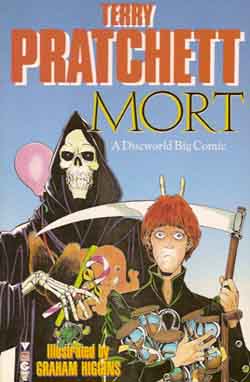
Mort: A Discworld Big Comic


By Terry Pratchett & Graham Higgins (VG Graphics/Gollancz)
ISBN: 978-0-57505-697-8 (HB)                    978-0-57505-699-2 (PB)

Us old codgers have always maintained that a good comic needs a good artist and this superb adaptation of Terry Pratchett’s fourth Discworld novel proves that point.

Just in case you’ve been living on another world: The Discworld is a flat planet supported on the backs of four elephants standing on the shell of a giant turtle swimming across the universe. Magic works there and the people are much too much like us.

This, of course, makes it an ideal location for spleen-venting, satire, slapstick and social commentary…

Scripted by the so-very-much-missed author and brilliantly illustrated by Graham Higgins, it tells a complex and darkly witty tale of Death (big grim chap, carries a scythe, nobody gets his jokes, always has the last laugh) and hapless, literal-minded, sort-of-useless young oaf Mort, whom he hires as his apprentice.

Of course, that’s not all there is to it, with sub-plots including an orphaned princess and her dangerously ambitious guardian, Death’s vacation, the daughter he adopted and the mystery of his most peculiar servant Albert to season a very impressive spin on a very familiar myth.

Higgin’s light, dry touch adds volumes of texture to the mix, and his deft sense of timing and comedy pacing – reminiscent of Hunt Emerson – marvellously match Pratchett’s unmistakable, acerbic dialogue and plot.

Incomprehensibly unavailable digitally and only physically in editions from the last century, if you have to have adaptations of great novels, this is how they should be done.
Text © 1994 Terry and Lyn Pratchett. Illustrations © 1994 Graham Higgins. All Rights Reserved

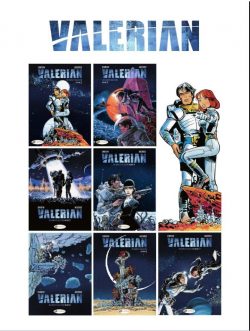
Valerian – The Complete Collection volume 4


By J.-C. Méziéres & P. Christin with colours by E. Tranlé: translated by Jerome Saincantin (Cinebook)
ISBN: 978-1-84918-391-8

Valérian: Spatio-Temporal Agent first took to the skies and timestream in 1967 in the November 9th edition of Pilote (#420): in an introductory tale which ran until February 15th 1968. Although a huge hit, graphic album compilations only began with second tale – The City of Shifting Waters – as the creators concerned considered the first yarn more a work-in-progress and not quite up to their preferred standard.

You can judge for yourself by getting hold of the first hardcover compilation volume in this cinematic tie-in sequence. Or you can consider yourself suitably forward-looking and acquire one of the eBook editions…

The groundbreaking series followed a Franco-Belgian mini-boom in science fiction comics triggered by Jean-Claude Forest’s 1962 creation Barbarella. Other notable hits of the era include Greg & Eddy Paape’s Luc Orient and the cosmic excursions of Philippe Druillet’s Lone Sloane, which all with Valérian in the vanguard – boosted public reception of the genre and led, in 1977, to the creation of dedicated fantasy periodical Métal Hurlant.

Valérian and Laureline (as the series became) was a light-hearted, wildly imaginative time-travel adventure-romp (a bit like Doctor Who, but not really so much), drenched in wry, satirical, humanist and political social commentary. The star – at least initially – was an affable, capably unimaginative by-the-book cop tasked with protecting universal timelines and counteracting paradoxes caused by casual, incautious or criminally minded chrononauts…

In the course of that debut escapade, Valerian picked up impetuous, sharp-witted peasant lass Laureline, who originated in the 11th century before becoming our hero’s assistant and deputy. In gratitude for truly invaluable assistance, he brought her back to the 28th century super-citadel and administrative capital, Galaxity, where the feisty firebrand took a crash course in spatiotemporal ops before accompanying him on his cases…. luckily for him.

This fabulous fourth oversized hardback compendium – also available digitally – once again boasts a wealth of text features, beginning with Stan Barets’ deconstructive assessment ‘Whimsical Stories with Strong Themes…’ More follows with further discourse, all supplemented with photos sketches, designs and reference material in ‘Towards the End of History?’, ‘Constantly Renewed Questions’ and retrospective overview ‘Châtelet Station: A Great Spatial and Temporal Shift’. Glittering prizes are assessed in ‘The Consecration of Angoulême’ and are followed by ‘Space Grunts’: a short complete war story from Metal Hurlant, highlighting the creative highpoints and methodology of author/illustrator Méziéres before the main event kicks off…

The opening shot in the series’ first truly extended saga, Châtelet Station Destination Cassiopeia, was originally serialised in the monthly Pilote (#M47 to M50: 21st March to June 27th 1978) before being collected later that year as 8th album Métro Châtelet Direction Cassiopée. The story concluded in follow-up album Brooklyn Line Terminus Cosmos which happily follows…

It all begins with the partners far apart in time and space. Laureline pensively journeys to the fabulous Cassiopeia system, just for once enjoying the many wonders of space as she travels at sub-light speed through the phenomenally populous yet cosmically fragile region.

Her trip to Solum is broken up by many stopovers as she cautiously gathers snippets of gossip which cohere to reveal an unsettling trend: subtly voiced concerns that some merchants are pushing strange and dangerous technologies on buyers extremely unsuited to possess them…

Although separated by centuries and light-years, Laureline and Valerian are enjoying impossibly intimate contact. Thanks to Terran ingenuity – and recent neurosurgeries – the partners are telepathically linked and sharing information on the mission.

His mission is playing out in Paris of 1980, where Valerian idly observes the variety of human types frequenting the café he impatiently haunts; constantly reminded how little he knows or understands the people and history of his birthworld.

Things aren’t helped by the volubly affable, infuriatingly unrushed and always tardy Mr. Albert. Galaxity’s man-in-the-moment is a sort of human X-Files: investigating, sifting and collating incalculable amounts of data on everything Fringe, Strange or Whacky which occurs in the 20th century he has adopted as a home-away-from-home.

Breaking contact with Laureline, Valerian learns from the verbose nerd that appalling, monstrous manifestations have been terrorising the world and now this city’s subway system. Sensing action at last, the impulsive hero rushes to the site of the latest occurrence, abandoning Albert to follow up on something which has piqued the elder’s scholarly curiosity. Both are blithely unaware that a suspect band of not-so-ordinary Parisians with similar interests are mere metres ahead of them…

What Valerian confronts is a horrific thing out of the inferno, but even it is not immune to the futuristic weaponry he’s carrying in kit form. All he has to do is assemble it before being eaten…

In the aftermath, Albert acts quickly to extract the wounded hero from hospital before doctors and cops start asking too many of the right questions. Later, over a luxurious dinner, the epicurean investigator shares a sheaf of files and clippings of monster and UFO sightings which only hint at why Valerian is stuck in a temporal backwater whilst his partner is covering colossal Cassiopeia alone…

Synching up again later despite constant headaches, Valerian hears Laureline tell of the incredible inhabitants of Solum and her candid interview with the living memory of the race, as well as sundry other wonders before contact is explosively ended by a phone call from Albert warning him that he is being watched…

After deftly dodging his tail, Valerian receives a most distressing communication from Laureline. Her pleasant chat with the memory of Solum has uncovered news of a planet which long ago endured a similar plague of mysterious manifestations. It doesn’t exist anymore…

Therefore, she’s off to incomprehensibly vile universal garbage dump Zomuk in pursuit of another promising lead, but before Val can warn her to stay away from the junk world, mind-contact is lost…

At that 20th century moment, Val and Mr. Albert are embarking on a bus ride to rural wetland idyll Doëre-la Rivière in search of marsh-monsters and dragons, only to surprisingly discover no accommodation available in the usually dead-in-the-off-season resort.

All rooms have been taken by scientists working for W.A.A.M (World American Advanced Machines): a mega-corporation in contention with the ubiquitous multinational Bellson & Gambler.

Both companies keep cropping up in Albert’s files of the weird and unexplained…

Soon the mismatched spatio-temporal operatives are trudging through acres of misty mire, encountering young Jean-René who offers to lead them to the infamous monster everybody is searching for.

When they find the Brobdingnagian beast, only Valerian’s disintegrator saves their lives. They quickly return to Albert’s paper-&-scrap-packed Paris flat, where the quirky researcher decides its time his impatient young colleague meets the secret source: a bizarre modern mystic and seer named Chatelard who cannily points out affinities between the manifestations met so far and the classical ancient concept of The Four Elements…

He also points out that one could call highly ranked corporate businessmen the “hidden high priests of today’s world”, whilst mentioning that a pretty blonde woman from abroad recently offered him a lot of money for the same insights…

Later, as Albert sifts through the precious papers, reviewing all he has on Bellson & Gambler, frantic Valerian finally re-establishes contact with Laureline, just as she concludes an epic struggle against ghastly odds and enters a hidden shrine to gaze upon fantastic representations of Four Elemental Forces which underpin the universe…

Once again contact is broken and in a petulant rage the astral adventurer storms out into the Parisian night. Utterly oblivious to the fact that he is being followed by enigmatic figures in an expensive automobile, he accepts a lift from a pretty girl in a sports car…

To Be Concluded…

Bold, mind-boggling and moodily mysterious, this splendid change of pace accentuates the deadly dangers which underscore this astonishingly imaginative series; eschewing the usual concentration on witty japery and politico-philosophical trendiness in favour of mounting suspense, bubbling paranoia and stark suspense with mesmerising effect…

Brooklyn Line Terminus Cosmos was the tenth Cinebook translation: originally serialised in Pilote #M70 – M73 (March to June 1980) before being released as an album.

After a full recap the story resumes some relative hours later as Laureline finally wakes her slumbering, cosmically distant partner. She is psychically aware of the woman sleeping beside him and takes great pleasure in razzing him on his conquest “in the line of duty”…

Fun over, Laureline imparts crucial information: the puissant yet debased ancients of Zomuk now seemingly worship two strange new godlike beings and are sharing with them the awesome power of Elemental artefacts they have preserved for centuries. Sadly, she suspects the lordly strangers are far from divine and have extremely venal – if not outright criminal – motives for their attentiveness.

Moreover, when the deities started squabbling over the potent offerings, the native Zoms start smelling rats too…

As Laureline tracks the impostors deep into a region dominated by astral pirates and fugitives, Valerian returns to his new companion, suspicious that she also is not what she seems…

He’s not wrong. The highly competent Miss Cynthia Westerly is highly placed in one of the corporations pursuing the uncanny phenomena plaguing Paris, but is oblivious to the fact that the big oaf she thought safely seduced and abandoned is actually following when she heads for the Pompidou Centre to attempt capture of the next Elemental manifestation.

As he trails her, Valerian becomes aware that her rivals are in pursuit and plays a very deft trick to throw them all off guard…

Rendezvousing with Albert, the Spatio-Temporal Agent gets his hands on the surprisingly compact “Creature of Air and Dreams” before anybody else, but the brief contact leaves him changed and damaged…

As Albert hustles him away, Valerian slips into tenuous contact with Laureline but the communication is oddly garbled, since his consciousness is simultaneously wandering the timelines: glimpsing events from his past and many which have yet to occur…

His bewildering loss of temporal continuity continues even as Albert drags the dazed hero onto a jet, heading for a final confrontation with the warring corporate cliques. The entire journey is punctuated with bizarre visions which Laureline is forced to share, and on arrival in New York Albert takes the debilitated agent to see an old friend: aged Kabbalah scholar Schlomo Meilsheim who has some ideas on a remedy for the increasingly escalating condition…

The situation has not gone unnoticed by the voracious corporations either. With their grand schemes of profitable new proprietary energy sources threatened, they have instigated a mass convocation of every fringe scientist, modern mystic, seer, religious nut and new age quack in the country: a last-ditch attempt to regain control of those elemental forces currently tormenting Valerian…

Naturally Schlomo is invited too and brings his friends along to the desolate, snow-swept reaches of Brooklyn. When Val wanders off, terse communication with Laureline reveals the truth about his latest visions and the dangers she’s been battling single-handed in pursuit of the faux gods.

Now as Elementals catastrophically manifest amongst the massed mystics, she enacts a bold plan to cut off the problem at source; severing the uncanny connection between devastating forces devised by the Zoms and its unfortunate link to unwary, unhappy 20th century Earth…

Sly, subtle, brilliantly mind-boggling and moodily mysterious, this sharp saga is a trans-time tale of subtle power, dripping with devilish wit, but no matter how trenchant, barbed, culturally aware or ethically crusading, Valerian and Laureline yarns never allow message to overshadow excitement or entertainment. This is one of the most memorable romps you could ever imagine and there’s even better to come…

Les Spectres d’Inverloch originally appeared in Pilote #M110-117, (spanning July 1983 to February 1984) and opens here as Laureline enjoys the comforts of a palatial manor in Scotland, somewhere at the tail end of the 20th century. Unflappable dowager Lady Charlotte is a most gracious host and happily shares every benefit of life in Clan McCullough, even though her young charge can’t help but wonder why she has to cool her heels with the old biddy in this odd time and place…

Once again, the Spatio-Temporal partners-in-peril are separated by eons and light years. Valerian is at the other end of everything: impatiently stuck on water-world Glapum’t, trying to capture a hulking aquatic beast who easily defies his every stratagem. Finally, once brute force, commando tactics and super-science have all proved ineffectual, the frustrated agent tries bribery. Naturally, the tasty morsels he offers are heavily drugged…

However, as he carries the second phase of his orders, a real problem crops up. Valerian can’t establish contact with Galaxity…

Far ago and elsewhere, London is enduring a paralysing wave of industrial actions. The strikes are particularly galling to volubly affable, infuriatingly unrushed and always tardy Mr. Albert. Galaxity’s 20th century information gatherer/sleeper operative is trying to get to Scotland, but wonders if he’s ever going to get out of the English capital…

On far-flung Rubanis, dictatorial secret police chief Colonel Tlocq is having a duel of wits with the engagingly ruthless data-brokers known as the Shingouz. Naturally, the spymaster is utterly outmanoeuvred by the devious little reptiles who gleefully take off with the secret they required. All-in-all, they are rather enjoying working for Earth…

Way back in West Virginia, Lady Charlotte’s husband Lord Seal is consulting with the CIA. The dapper Briton is a past master of “tradecraft” and remains unperturbed even after reviewing the terrifying situation facing both Communist Bloc and Free World. Something is making all persons in charge of nuclear weapons – politicians and military alike – go mad. There have been numerous near-misses and even a couple of swiftly hushed-up actual disasters on both sides of the Iron Curtain. Moreover, the Americans have got hold of strange little devices used to cause the insanity. Somebody is deliberately trying to spark atomic Armageddon…

Only the veteran spy’s swift actions prevent the entire assembly going the same way, when a concealed insanity-gadget goes off during their top-secret meeting…

As Seal jets off home, the scene switches to Galaxity. The super-city, impregnable bastion of human dominance, is deserted. Only its supreme master remains, and as the fortress and Terran empire start dissolving into nothingness, he makes a desperate jump into time…

On a clear autumn afternoon, Lady Charlotte and Laureline are enjoying the view from Castle Inverloch’s rear windows when the immaculate, lovingly-manicured-for-centuries lawns are wrecked by the crash-landing of a Shingouz shuttle. Naturally, the visitors are granted every gracious vestige of hospitality, even after Lord Seal arrives in flamboyantly bombastic fashion and sees what’s become of his beloved grass…

Aplomb and grace under pressure alone cannot account for the elderly couple’s acceptance, and when Albert pops in and Valerian shows up – much to the detriment of what remains of the lawns – it becomes clear that the elderly gentry know much more about the workings of the universe than everybody else in this century…

Even the previously-captive Glapumtian – who likes to be called “Ralph” – has a part to play in the baffling, pre-ordained proceedings.

What exactly that means starts to become clear after Lord and Lady Seal introduce their outré guests to the legendary ghost of Inverloch. Valerian usually just calls him “boss”…

Soon the Spatio-Temporal Agents are being made painfully aware of a monumental threat to the universe which has already unmade the events leading to the birth of Galaxity and the Terran Empire and which now poses a threat to all that is…

To Be Concluded…

Smart, subtle, complex and frequently hilarious, this sharp trans-time tale beguilingly lays the groundwork for an epic escapade. This is one of the most memorable romps Méziéres & Christin ever concocted, and heralded the start of a whole new way to enjoy the future…

The Wrath of Hypsis concludes a landmark tale and marks a turning point in the ongoing epic. Initially every Valérian adventure began as a serial in Pilote before being collected in album editions, but after this adventure from 1985, the publishing world shifted gears. From the next tale and every one thereafter, the mind-bending sagas were released as all-new complete graphic novels. The switch in dissemination affected all popular characters in French comics and almost spelled the end of periodical publication on the continent…

One clarification: canonically, “Hypsis” is counted as the twelfth tale, due to the collected albums being numbered from The City of Shifting Waters: the second actual story but the first to be compiled in book form. When Bad Dreams was finally released as a European album in 1983, it was given the number #0.

Les Foudres d’Hypsis originally appeared in Pilote #M128-135, (January to September 1985): an action-packed yet trenchant romp resetting a growing paradox that had been slowing building since The City of Shifting Waters…

In previous volume The Ghosts of Inverloch, Galaxity was eradicated from reality by agents unknown, leaving only the Chief of the Spatio-Temporal Service to plunge back in time to 1986: the chronal crisis-point which triggered the disaster.

Spatio-Temporal partners-in-peril Valerian and Laureline joined him by extremely convoluted paths after gathering a trio of Shingouz traders and affable, aquatic super-mathematician Ralph from different eras and galactic backwaters.

They all met up at Inverloch Castle, far from escalating petty crises and a mounting unrest afflicting Earth that would soon peak with the melting of the polar ice-caps, destruction of modern human civilisation and consequent birth-pangs of Galaxity.

The Scottish citadel was home to British intelligence supremo Lord Seal, his brilliant wife Lady Charlotte and guest Mr. Albert. This distinguished, exceptional band had gathered to prevent Earth’s devastation but Galaxity’s sudden disappearance added even greater urgency to the mission…

The tale continues here as the strange crew review the worsening situation. Nuclear powers across Earth are experiencing inexplicable, potentially fatal malfunctions. Alien objects keep appearing in random locations and – thanks to the extraterrestrial input of Seals visitor’s – they can now lay blame upon the machinations of Hypsis: an enigmatic planet constantly perambulating from system to system, quadrant to quadrant…

Seal’s contacts have narrowed down the potential crisis point to one of a number of ships in the Arctic. Soon the odd allies are covertly heading north in British weather ship HMS Crosswinds…

Thanks to Ralph’s talents and growing friendship with a pod of Orcas, the maritime search is gradually narrowed down and before long Crosswinds closes in on a quaint schooner named Hvexdet… and none too soon.

The time-displaced Chief has locked himself in his cabin, Valerian is wracked by nightmares of vanished Galaxity and numerous doomed Earths whilst the gambling-addicted Shingouz have almost won or traded everything aboard ship not bolted down or welded on…

Cornering the Hvexdet in a field of pack ice, dauntless Captain Merryweather gives orders to ram, spooking the schooner into blasting off into space and instituting devastating retaliation. It’s what the Chief has been waiting for. With Crosswinds sinking and the crew heading for the lifeboats, he orders Valerian, Laureline, Seal, Albert, the Shingouz and Ralph to join him in the astroship: following the invaders’ flight to find nomadic Hypsis…

Pursuit is erratic and convoluted until Valerian has the idea of linking Ralph to the ship’s systems to predict Hvexdet’s final destination. It works perfectly and before long the astroship touches down on a strange, rocky world with immense towers dotting the landscape.

And that’s where things get really strange as Valerian learns why Earth was scheduled for nuclear meltdown, meets the incredible true owners of the troubled birthplace of humanity and watches in astonishment as Albert, Laureline and the Shingouz negotiate an unbelievable deal which saves Earth, but not (necessarily) his beloved and much-missed home Galaxity…

Astute fans will realise that this ripping yarn was writer Pierre Christin and artist Jean-Claude Méziéres’ way of rationalising the drowned Earth of 1986 (as seen in 1968 adventure The City of Shifting Waters) with the contemporary period that they were now working in. It also gave them an opportunity to send Valerian and Laureline in a new direction and uncharted creative waters…

To Be Continued…

Smart, subtle, complex and frequently hilarious, these sharp trans-time tales beguilingly blend outrageous satire with blistering action, and deft humour with cosmic apostasy: utterly reenergising what was already one of the most thrilling sci fi strips in comics. The Wrath of Hypsis and its successors are the most memorable romps Méziéres & Christin ever concocted, heralding the start of a whole new way to go back to the future…

These stories are some of the most influential comics in the world, timeless, thrilling, funny and just too good to be ignored. The time is now and there’s no space large enough to contain the sheer joy of Valerian and Laureline, so go see what all the fuss is about right now…
© Dargaud Paris, 2017 Christin, Méziéres & Tran-Lệ. All rights reserved. English translation © 2018 Cinebook Ltd.


Pogo Bona Fide Balderdash: The Complete Syndicated Comic Strips volume 2


By Walt Kelly, edited by Carolyn Kelly (Fantagraphics Books)
ISBN: 978-1-60699-584-6 (HB)

Now is a strange, insane and dangerous time in politics and world affairs… but when hasn’t that been true?

Walter Crawford Kelly Jr. was born in 1913 and started his cartooning career whilst still in High School, as artist and reporter for the Bridgeport Post. In 1935, he relocated to California and joined the Disney Studio. He worked on short cartoon films and such major features as Dumbo, Fantasia and Pinocchio until the infamous animator’s strike in 1941.

Refusing to take sides, Kelly moved back East and into comicbooks – primarily for Dell Comics who held the Disney funnybook license, amongst so many others – at that time.

Despite his glorious work on such popular people-based classics as the Our Gang movie spin-off, Kelly preferred and particularly excelled with anthropomorphic animal and children’s fantasy material.

For the December 1942-released Animal Comics #1 the other Walt created Albert the Alligator and Pogo Possum: sagaciously retaining the copyrights in the ongoing saga of two affable Bayou critters and their young African-American pal Bumbazine.

Although the black kid soon disappeared, the animal actors stayed on as stars until 1948 when Kelly moved into journalism, becoming art editor and cartoonist for hard hitting, left-leaning liberal newspaper The New York Star.

On October 4th 1948, Pogo, Albert and an ever-expanding cast of gloriously addictive characters began their second careers, in the more legitimate funny pages, appearing in the paper six days a week until the periodical folded in January 1949.

Although ostensibly a gently humorous kids feature, by the end of its run (reprinted in full at the back of Pogo: the Complete Syndicated Comic Strips volume 1) the first glimmers of the increasingly barbed, boldly satirical masterpiece of velvet-pawed social commentary began to emerge…

When The Star closed Pogo was picked up for mass distribution by the Post-Hall Syndicate, launching on May 16th 1949 in selected outlets. A colour Sunday page debuted January 29th 1950: both produced simultaneously by Kelly until his death in 1973 (and even beyond, courtesy of his talented wife and family).

At its height the strip appeared in 500 papers in 14 countries and the book collections – which began in 1951 – eventually numbered nearly 50, collectively selling over 30 million copies… and all that before this Fantagraphics series began…

In this second of a proposed full dozen volumes (available in resoundingly comforting hardcover editions and as eBook tomes) reprinting the entire canon of the Okefenokee Swamp citizenry, probably the main aspect of interest is the personable Possum’s first innocently adorable attempts to run for Public Office. This was a ritual which inevitably and coincidentally reoccurred every four years, whenever the merely human inhabitants of America got together for raucous caucuses and exuberant electioneering.

It’s remarkable – but not coincidental – to note that by the close of this two-year period, Kelly had increased his count of uniquely Vaudevillian returning characters to over one hundred. The likes of Solid MacHogany, Tamananny Tiger, Willow McWisper, Goldie Lox, Sarcophagus MacAbre, sloganeering P.T. Bridgeport, bull moose Uncle Antler and a trio of brilliantly scene-stealing bats named Bewitched, Bothered and Bemildred, amongst so many others, would pop up with varying frequency and impact over the following decades…

This colossal and comfortingly sturdy landscape compilation (three-hundred-and fifty-six 184 x 267mm pages) includes the monochrome Dailies from January 1st 1951 to December 31st 1952, plus the Sundays – in their own full-colour section – from January 7th 1951 to December 28th 1952: all faithfully annotated and listed in a copious, expansive and informative Table of Contents.

Supplemental features comprise a Foreword from pioneering comedy legend Stan Freberg, delightful unpublished illustrations and working drawings by Kelly, more invaluable context and historical notes in the amazing R.C. Harvey’s ‘Swamp Talk’ and a biographical feature ‘About Walt Kelly’ from Mark Evanier.

In his time, satirical mastermind Kelly unleashed his bestial spokes-cast on such innocent, innocuous sweethearts as Senator Joe McCarthy, J. Edgar Hoover, the John Birch Society, Richard Nixon and the Ku Klux Clan, as well as the less loathsome likes of Hubert Humphrey, Lyndon B. Johnson and – with eerie perspicacity – George W. Romney, U.S. Secretary of Housing and Urban Development, Governor of Michigan and father of some guy named Mitt…

This particular monument to madcap mirth and sublime drollery of course includes the usual cast: gently bemused Pogo, boisterous, happily ignorant alligator Albert, dolorous Porkypine, obnoxious turtle Churchy La Femme, lugubrious hound Beauregard Bugleboy, carpet-bagging Seminole Sam Fox, pompous (doesn’t) know-it-all Howland Owl and all the rest: covering not only day-to-day topics and travails like love, marriage, weather, fishing, the problem with kids, the innocent joys of sport, making a living and why neighbours shouldn’t eat each other, but also includes epic and classic sagas: the stress of Poetry Contests, hunting – from a variety of points of view – Christmas and other Public Holidays, incipient invasion, war and even cross-dressing, to name but a few…

As Kelly spent a good deal of 1952 spoofing the electoral race, this tome offers a magical, magnificent treatment of all the problems associated with grass (and moss) roots politics: dubious campaign tactics, loony lobbying, fun with photo ops, impractical tactical alliances, glad-handing, a proliferation of political promos and ephemera, how to build clockwork voters – and candidates – and of course, life after a failed run for the Presidency…

As the delicious Miz Ma’m’selle Hepzibah would no doubt say: plus çachange, plus c’est la même chose…

Either I heard it somewhere or I’m just making it up, but I gather certain embattled Prime Ministers and Presidents are using the cartoons as tactical playbooks and there’s a copy in every gift bag handed out at Davos…

Gosh, I hope so…

Kelly’s uncontested genius lay in his seemingly effortless ability to lyrically, vivaciously portray – through anthropomorphic affectation – comedic, tragic, pompous, infinitely sympathetic characters of any shape or breed, all whilst making them undeniably human. He used that blessed gift to blend hard-hitting observation of our crimes, foibles and peccadilloes with rampaging whimsy, poesy and sheer exuberant joie de vivre.

The hairy, scaly, feathered slimy folk of the surreal swamp lands are, of course, inescapably us, elevated by burlesque, slapstick, absurdism and all the glorious joys of wordplay from puns to malapropisms to raucous accent humour into a multi-layered hodgepodge of all-ages delight. Tragically, here at least, we’ve never looked or behaved better…

This stuff will certainly make you laugh; it will probably provoke a sentimental tear or ten and will certainly satisfy your every entertainment requirement.

Timeless and magical, Pogo is a weeny colossus not simply of comics, but of world literature and this magnificent collection should be the pride of every home’s bookshelf, right beside the first one.

…Or, in the popular campaign parlance of the critters involved: “I Go Pogo!” and so should you.
POGO Bona Fide Balderdash and all POGO images, including Walt Kelly’s signature © 2012 Okefenokee Glee & Perloo Inc. All other material © 2012 the respective creator and owner. All rights reserved.

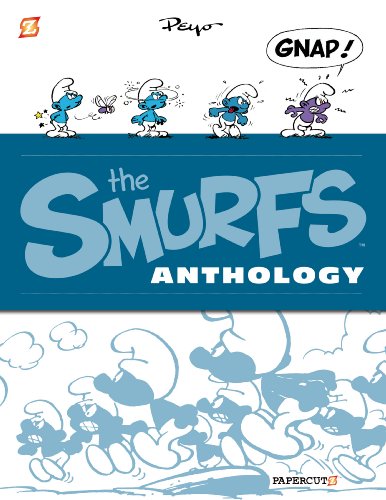
The Smurfs Anthology volume 1


By Yvan Delporte & Peyo, smurflated by Joe Johnson (Papercutz/NBM)
ISBN: 978-1-59707-417-9

Pierre Culliford was born in Belgium in 1928 to a family of British origin living in the Schaerbeek district of Brussels. An admirer of the works of Hergé and American comics in Mickey, Robinson and Hurrah!, he developed his own artistic skills but the war and family bereavement forced him to forgo further education and find work.

After toiling as a cinema projectionist, in 1945 the eager teen joined C.B.A. animation studios, where he met André Franquin, Morris and Eddy Paape. When the studio closed, Pierre briefly studied at the Brussels Academy of Fine Arts before moving full-time into graphic advertising.

In his off hours he began submitting comic strips to the burgeoning post-war comics publishers. His first sale was in April 1946: Pied-Tendre, a tale of American Indians in Riquet, the comics supplement to the daily L’Occident newspaper. Further sales to other venues followed and in 1952 his bold young knight Johan found a permanent spot in Le Journal de Spirou. Retitled Johan et Pirlouit – after the inclusion of a scene-stealing comedy foil – the strip prospered and, in 1958 introduced a strange bunch of blue woodland gnomes called Les Schtroumpfs.

Culliford – now using the childhood nom de plume Peyo – would gradually succumb to popular demand and turn those adorable little mites (known to us and most of the world as The Smurfs) into an all-encompassing global empire, but before being sucked onto that relentless treadmill, he still found time to create a few other noteworthy strips such as titanic tyke Benoît Brisefer (translated recently as Benny Breakiron), and also stuck with Johan until 1977 (13 albums-full) when the pressure of creating more Smurf stuff grew too much. Even then his son Thierry with artist Alain Maury revived the series, bring the count to 17 albums

Yvan Delporte (24th June 1928-5th March 2007) was a Belgian comics writer whose greatest gift was an invisible one. He was editor of Le Journal de Spirou between 1955 and 1968: shaping strips and creator’s during Europe’s golden age of excellence. One feature he did script was Peyo’s spin-off fantasy Les Schtroumpfs, and he also found a bit of time to write René Follet’s Steve Severin and co-create Franquin’s Gaston Lagaffe and Idées noires.

We English-speakers mostly have visions of the Smurfs fostered and shaped by the animated shows, films and toys, but the comics – although aimed at an all-ages audience – were packed with social commentary and sly satire that can still take the breath away if you’re a parent reared on anodyne censored US cartoon fodder.

Thanks to the efforts of US publisher Papercutz, those gloriously outrageous medieval masterworks are available to discerning fans, both as individual albums and in superb, anthologically robust, full-colour hardback (and eBook) compilations, kitted out and filled with little extras such historical essays and all presented in the original publication order Peyo dictated. A huge bonus as far as I’m concerned is the inclusion of original artwork and (French) covers of the period…

First album ‘The Purple Smurfs’ comes with a comprehensive Introduction by Smurfologist Matt. Murray explaining the tone of those distant times and how we post-PC patrons got here from original 1959 solo saga ‘Les Schtroumpfs noirs‘…

Full of fun, action, slapstick and frenetic thrills, the eponymous lead tale – by Delporte & Peyo; as are all the entries here – reveals how the idyllic hidden mushroom-styled village of the little blue folk falls to a rapidly-spreading plague. The horrific ailment is transmitted by irresistible biting and characterised by a radical shift in colouration and behaviour. Soon, only wise wizardly patriarch Papa Smurf is left to combat the Smurfie Apocalypse, and he’s running out of options…

Two shorter yarns follow as ‘The Flying Smurf’ finds one little slacker absconding from walnut-gathering duties to pursue ever more complex and obsessive ways to soar like a bird in the sky after which ‘The Smurfnapper’ finds archenemy sorcerer Gargamel and his cat Azrael hunting for the last crucial ingredient to create a Philosopher’s stone. It’s a Smurf, of course, but catching and keeping one of the little blue perishers are two entirely different things…

The second album is quite infamous in certain circles and very much a product of its era: one generation since WWII ended and right in the midst of escalating Cold War tensions. Following another Matt. Murray Introduction, discussing the heavy political and social implications of Le Schtroumpfissime, ‘The Smurf King’ details how, when Papa Smurf goes on an extended provisions hunt, his decision not to leave anyone in charge leads to rapid and radical political unrest. A half-assed and wholly inept attempt to elect a new boss goes typically awry until one bright spark realizes he can get others to vote for him by lying, making promises he can’t keep and applying heavy doses of flattery.

Soon, he’s living in a palace built by the suckers and indulging in all the perks of totalitarianism, but some Smurfs are muttering discontent and forming a rebel army…

Social satire gives way to surreal whimsy ‘The Smurfony’ then details the formation of an orchestra. One poor Smurf though has plenty of enthusiasm but no talent and his efforts make him extremely unwelcome… until Gargamel returns with soporific sound sorcery and only a bit of discord can save the day…

As previously stated, the Smurfs debuted in La Flûte à six trous, a 1958 tale of feudal comedy-adventurers Johan and Peewit. The little guys were phenomenally popular and reappeared many times before winning their own series, and when that finally happened the origin tale was rushed into album form as the third Schtroumpfs book release, suitably reimagined as La Flûte à six Schtroumpfs.

In ‘The Smurfs and the Magic Flute’ court jester Peewit – another would-be musician whose melodies induce pain and hysteria – gets hold of a flute with six holes that forces all who hear it to dance uncontrollably until they pass out. His pranks are disruptive enough but the instrument is then stolen by vile villain Matthew Oilycreep, who goes on a plundering spree, amassing stolen wealth to buy an army of mercenaries to take over the kingdom.

Young knight Johan and Peewit re at a loss to stop the usurper until they are approached by little blue men who tell them an incredible tale and invite them back to their mystical home.

They have all the answers and a plan but there’s no time to waste if disaster is to be avoided…

Wrapping up with ‘The Aftersmurf’ from Papercutz Smurf-in-Chief Jim Salicrup, this stunning collection of fun and fantasy is a magnificent example of all-ages comics wonderment no serious aficionado could do without.

Go on, You Smurf you want to…
© Peyoâ„¢ 2013 – licensed through Lafig Belgium. English translation © 2013 by Papercutz. All rights reserved.

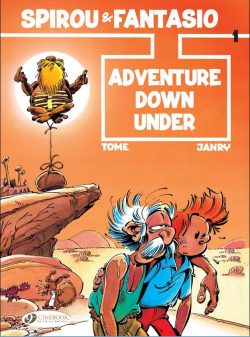
Spirou and Fantasia volume 1: Adventure Down Under


By Tome & Janry, translated by Jerome Saincantin (Cinebook)
ISBN: 978-1-84918-011-5

For most English-speaking comic fans and collectors Le Journal de Spirou is probably Europe’s biggest secret. The character is a rough contemporary – and bald commercial response – to Hergé’s iconic superstar Tintin, whilst the comic he has headlined for decades is only beaten in sheer longevity and creativity by our own Beano and Dandy.

First conceived at Belgian Printing House by Jean Dupuis in 1936, a magazine targeting a juvenile audience debuted on April 21st 1938 (three and a bit months before DC Thomson’s Beano, but still beaten by The Dandy which launched on December 4th 1937). It was edited by Charles Dupuis (a mere tadpole, only 19 years old himself) and took its name from the lead feature, which recounted the improbable adventures of a plucky bellboy/lift operator employed by the Moustique Hotel: a reference to the publisher’s leading magazine, Le Moustique.

With his pet squirrel, Spip (who joined the cast on June 8th 1939; he’s the longest running character in the strip after Spirou himself, so happy 80th anniversary, little dude!) the plucky kid was the idea of French artist Robert Velter, who signed himself Rob-Vel.

A Dutch language edition – Robbedoes – debuted a few weeks later and ran more-or-less in tandem with the French parent comic until it’s cancellation in 2005.

Although some home-grown product crept in, the bulk of the comic was taken up with cheap American reprint imports: Red Ryder by Fred Harman, William Ritt & Clarence Gray’s Brick Bradford and Siegel & Shuster’s landmark creation Superman. Most prominent were ‘Tif et Tondu’ by Fernand Dineur (which ran until the1990s) and ‘L’Epervier Blue’ by Sirius (Max Mayeu), and they were soon supplemented by comic-strip wunderkind Joseph Gillain – “Jije”. During World War II Jije legendarily drew the entire comic by himself, continuations of the banned US imports included, as well as assuming production of the Spirou strip where he created the current co-star Fantasio.

Except for a brief period when the Nazis closed the comic down (September 1943 to October 1944 when the Allies liberated Belgium) Spirou and its boyish star – now a globe-trotting reporter – have continued their weekly exploits in unbroken four-colour glory.

Among the other myriad major features that began within those pages are ‘Jean Valhardi’ (Jean Doisy & Jije), ‘Blondin et Cirage’ (Victor Hubinon), Buck Danny, ‘Jerry Spring’, ‘Les Schtroumpfs’ (AKA the Smurfs), Gaston Lagaffe (here seen as Gomer Goof) and a certain laconic cowboy named Lucky Luke.

Spirou the character (the name translates as both “squirrel” and “mischievous”) has starred in the magazine for most of its life, evolving – under a succession of creators – into a simultaneously urbane yet raucous fantasy/adventure hero with the accent heavily on light humour.

With comrade and rival Fantasio and crackpot inventor the Count of Champignac, Spirou travels to exotic places, uncovering crimes, revealing the fantastic and garnering a coterie of exotic arch-enemies.

During the War, when Velter went off to fight, his wife Blanche Dumoulin took over the strip using the name Davine, assisted by Luc Lafnet. Dupuis assumed control of and rights to the strip in 1943, assigning it to Jije who handed it to his assistant André Franquin in 1946. It was the start of a golden age.

Among Franquin’s innovations were villains Zorglub and Zantafio, Champignac and one of the first strong female characters in European comics, rival journalist Seccotine (renamed Cellophine in this current English translation), but his greatest creation – one he retained on his departure in 1969 – was the incredible magic animal Marsupilami (first seen in Spirou et les héritiers in 1952). The little perisher is now a star of screen, plush toy store, console and albums all his own.

From 1959 writer Greg and background artist Jidéhem assisted Franquin, but by 1969 the artist had reached his Spirou limit and resigned, taking his mystic yellow monkey with him. He was succeeded by Jean-Claude Fournier who updated the feature over the course of nine stirring adventures that tapped into the rebellious, relevant zeitgeist of the times with tales of environmental concern, nuclear energy, drug cartels and repressive regimes.

As the series entered the 1980s Spirou seemed to stall: three discrete creative teams alternated on the serial: Raoul Cauvin & Nic Broca, Yves Chaland and the creators of the graphic novel under review here: Philippe Vandevelde writing as Tome and artist Jean-Richard Geurts AKA Janry.

These last adapted and referenced the beloved Franquin era and revived the feature’s fortunes, producing 14 wonderful albums between 1984 and 1998. This one, Spirou et Fantasio 34 – Aventure en Australie from 1985, was their second.

Since their departure Lewis Trondheim, and the teams of Jean-Davide Morvan & Jose-Luis Munuera and Yoann & Vehlmann, have brought the official album count to 55 (there also are a bunch of specials, spin-offs and one-shots, official and otherwise)…

Without further ado we plunge straight into the bizarre, treasure-hunting drama as dire doings Down Under segue into Spirou and Fantasio arriving home exhausted from their latest assignment. They are intercepted by Cellophine at the airport: odd things are occurring in the depths of the Outback and the always-newsworthy Count of Champignac is right at the heart of it. Instantly awake again, all three jet out to Australia where nefarious deeds are occurring at the desolate Albuh Opal Mine.

The crazy inventor is there on the verge of a fabulous and incredible discovery far more precious than jewels, but the ruthless miners don’t seem that impressed, although they are worried by disappearing diggers, inexplicable accidents, men driven crazy and, if some observers are to be believed, levitating aborigines…

This classy blend of thrilling mystery, weird science, light adventure and broad slapstick remains a pure refreshing joy in a market far too full of adults-only carnage and testosterone-fuelled breast-beating. Easily accessible to readers of all ages drawn with all the welcoming style and panache that makes Asterix, Lucky Luke and Iznogoud so compelling and readily available in both paperback album and eBook formats, this is a cracking read and the start of a long line of translated epics that should be as much a household name as those series – and even Tintin himself…
Original edition © Dupuis, 1985 by Tome & Janry. All rights reserved. English translation 2009 © Cinebook Ltd.

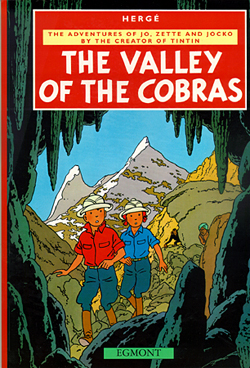
The Adventures of Jo, Zette & Jocko: The Valley of the Cobras


By Hergé, translated by Leslie Lonsdale-Cooper & Michael Turner (Egmont UK/Mammoth)
ISBN: 978-1-4052-1244-1 (HB)                    978-0-74970-385-1 (PB)

George Remi, world famous as Hergé, had a long creative connection to Catholicism. At the behest of Abbot Norbert Wallez, editor of Belgian Catholic newspaper Le XXe Siécle, he had created Tintin before moving on to such strips as the mischievous Quick and Flupke, Tim the Squirrel in the Far West’, ‘The Amiable Mr. Mops’, ‘Tom and Millie’ and ‘Popol Out West’ – all while continuing and expanding the globe-trotting adventures of the dauntless boy reporter and his faithful little dog.

In 1935, between working on serialised Tintin epics The Blue Lotus and The Broken Ear, Remi was approached by Father Courtois, director of the French weekly newspaper Coeurs Vaillants (Valiant Hearts). The paper already carried the daily exploits of Hergé’s undisputed star-turn, but Courtois also wanted a strip depicting solid family values and situations that the seemingly-orphaned and independent boy reporter was never exposed to.

He also presumably wanted something less subversive than the mischievous, trouble-making working-class boy rascals Quick and Flupke…

The proposed feature needed a set of characters typifying a decent, normal family: A working father, a housewife and mother, young boy, a sister, even a pet. Apparently inspired by a toy monkey called Jocko, Hergé devised the family Legrand.

Jacques was an engineer, and son Jo and daughter Zette were average kids; bright, brave, honest, smart and yet still playful. Mother stayed home, cooking and being rather concerned rather a lot. They had a small, feisty monkey for a pet – although I suspect as Jocko was tailless, he might have been a baby chimpanzee, which “As Any Fule Kno” is actually a species of ape.

The first adventure was a two-volume treasure: ‘The Secret Ray’ – only once published in English and consequently rarer than Hen’s teeth or monkey feathers. A ripping yarn of scientific bandits, gangsters, mad professors, robots and, regrettably, some rather ethnically unsound incidences of cannibal savages, this is very much a product of its time in too many respects.

Although Hergé came to deeply regret (and wherever possible amend) his many early uses of that era’s racial stereotyping, the island dwelling natives in Le “Manitoba” Ne Répond Plus and L’ Éruption Du Karamako (which originally ran in Coeurs Vaillants from January 19th 1936 to June 1937) will now always be controversial.

It’s a true pity that such masterful and joyous work has to be viewed with caution, read strictly in context and must be ascribed subtext and values which may never have been intended, merely because the medium is pictorial and its meaning passively acquired rather than textual, and which can therefore only be decoded by the conscious effort of reading.

I also wonder how much was a quiet, sensitive artist led by an aggressively proselytising, missionary Church’s doctrine and policy…

How much Church opposition was there to Mussolini’s invasion of Ethiopia in October 1935 for example? And don’t get me started on Nazi Germany and the Vatican…

Sorry. Rant brakes have been applied now…

The last completed adventure of the boldly capable Legrand family came out in the 1950’s, when Hergé was at the peak of his creative powers. Although he found the concept a difficult one to work with, devoid of the opportunities for satire or social commentary, the wholesome derring-do of this series still provides thrilling and funny entertainment for kids of all ages.

Whilst vacationing in the Alps, Jo and Zette inadvertently fall foul of the whimsical and capricious Maharajah of Gopal, who is infuriated that they are better skiers than he. Matters only worsen when Jo accidentally hits the Maharajah with a snowball.

The spoiled, rich bully’s appalling behaviour escalates until eventually their father Jacques administers a long overdue spanking to the middle-aged potentate which completely changes his attitude. The much friendlier Maharajah promptly commissions the engineer to construct a bridge across the fabled Valley of the Cobras that divides his mountainous kingdom.

As the family embark for the sub-continent, all are unaware that the villainous Prime Minister of Gopal has colluded with a greedy Fakir to sabotage the project…

Begun in 1939 but shelved for nearly two decades, this is still a light exuberant romp, full of thrills and packed with laughs, executed with the captivating artistry that has made Tintin a global phenomenon. This is a book any child will adore and it baffles me why it and its companion volumes are out of print. Hopefully not for long though
© 1957, 2007 Editions Casterman, Paris & Tournai. All rights reserved. English text © 1986, 2005 Egmont UK Limited. All rights reserved.

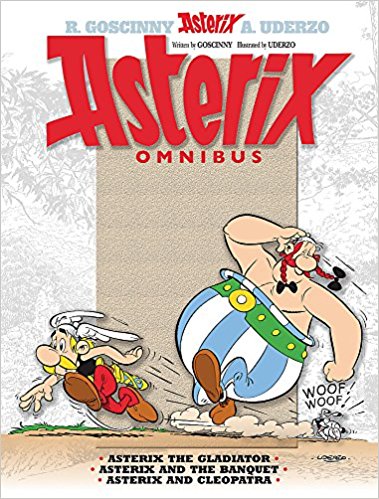
Asterix Omnibus volume 2: Asterix the Gladiator, Asterix and the Banquet, Asterix and Cleopatra


By René Goscinny & Albert Uderzo, translated by Anthea Bell & Derek Hockridge (Orion Childrens Books)
ISBN: 978-1-4440-0424-3

It’s been a painful year for lovers of comics, with many of our greatest practitioners – famous or otherwise – leaving us. I’m going to spend the remainder of the year dwelling on them and recommending examples of their work we can read to commemorate them in the best way possible… through enjoyment.

Suffolk-born Anthea Bell OBE came from prestigious stock. She was born in 1936 and translated numerous works from history books such as WG Siebald’s Austerlitz to the works of Hans Christian Andersen to fantasies such as Cornelia Funke’s Inkworld books Either singly or with Derek Hockridge, however, she found true immortality: translating thousands of pages of European comics and Bande Dessinée. She was a smart and dedicated woman and brilliantly adroit with worlds and concepts in many tongues. Her creative punning and naming techniques in the Asterix books garnered praise all over the world and many aficionados believe the strip is actually funnier in English than in any other language.

I can certainly confirm that’s the case with German…

Among her many triumphs are the aforementioned Asterix, Le Petit Nicolas, Lieutenant Blueberry and Iznogoud.

She died on 18th October 2018 and can never be replaced.

Asterix the Gaul is probably France’s greatest literary export: a wily wee warrior who resisted the iniquities, experienced the absurdities and observed the myriad wonders of Julius Caesar’s Roman Empire with brains, bravery and a magic potion which bestowed incredible strength, speed and vitality.

One of the most popular comics in the world, the chronicles have been translated into more than 100 languages; 8 animated and 3 live-action movies, assorted games and even into a theme park (Parc Astérix, near Paris). More than 325 million copies of 34 Asterix books have been sold worldwide, making Goscinny & Uderzo France’s bestselling international authors.

The diminutive, doughty hero was created as the transformative 1960s began by two of the art-form’s greatest masters, René Goscinny & Albert Uderzo and even though their perfect partnership ended in 1977 the creative wonderment still continues – albeit at a slightly reduced rate of rapidity.

When Pilote launched in 1959 was Asterix was a massive hit from the start. For a while Uderzo continued working with Charlier on Michel Tanguy, (Les Aventures de Tanguy et Laverdure), but soon after the first epic escapade was collected as Astérix le gaulois in 1961 it became clear that the series would demand most of his time – especially as the incredible Goscinny never seemed to require rest or run out of ideas (after the writer’s death the publication rate dropped from two books per year to one volume every three to five).

By 1967 the strip occupied all Uderzo’s time and attention. In 1974 the partners formed Idéfix Studios to fully exploit their inimitable creation and when Goscinny passed away three years later Uderzo was convinced to continue the adventures as writer and artist, producing a further ten volumes since then.

Like all great literary classics, the premise works on two levels: for younger readers as an action-packed comedic romp of sneaky, bullying baddies regularly getting their just deserts and as a pun-filled, sly and witty satire for older, wiser heads, enhanced here by the brilliantly light touch of the translators who played such a massive part in making the indomitable Gaul so very palatable to the English tongue.

Launched in Pilote #1 (29th October 1959, with the first page appearing a week earlier in a promotional issue #0, June 1st 1959), the stories were set on the tip of Uderzo’s beloved Brittany coast in the year 50BC, where a small village of redoubtable warriors and their families resisted every effort of the all-conquering Roman Empire to complete their conquest of Gaul. Unable to defeat these Horatian hold-outs, the Empire resorted to a policy of containment and the little seaside hamlet is perpetually hemmed in by the heavily fortified garrisons of Aquarium, Laudanum, Petibonum and Barbaorum (the latter two becoming Compendium and Totorum for us Brits).

The Gauls don’t care: they daily defy the world’s greatest military machine by just going about their everyday affairs, protected by a magic potion provided by the resident druid and the shrewd wits of a rather diminutive dynamo and his simplistic best friend…

With these volumes a key pattern was established: the adventures would henceforth – like a football match – alternate between Home and Away, with each globe-trotting escapade balanced by an epic set in and around he happily beleaguered Gaulish village (if you’re counting, home tales were odd numbered volumes and travelling exploits even-numbered…)

Asterix the Gladiator debuted in Pilote #126-168 (1963) with the canny rebel and his increasingly show-stealing pal Obelix (who had fallen into a vat of potion as a baby and was a genial, permanently superhuman, eternally hungry foil to the smart little hero) despatched to the heart of the Roman Empire on an ill-conceived mission of mercy…

When Prefect Odius Asparagus seeks to give Julius Caesar a unique gift he decides upon one of the indomitable Gauls who had been giving his occupying forces such a hard time.

Thus, he has village Bard Cacofonix abducted and bundled off to Rome. Although in two minds about losing the raucous harpist, pride wins out and the villagers mount a rescue attempt, but after thrashing the Romans again they discover that their lost comrade is already en route for the Eternal City…

Asterix and Obelix are despatched to retrieve the missing musician and hitch a ride on a Phoenician galley operated under a bold new business plan by captain/general manager Ekonomikrisis. On the way to Italy the heroes first encounter a band of pirates who would become frequent guest-stars and perennial gadflies.

The pirates were a creative in-joke between the close-knit comics community: Barbe-Rouge or Redbeard was a buccaneering strip created by Charlier & Victor Hubinon that also ran in Pilote at the time.

As Asterix and Obelix make friends among the cosmopolitan crowds of Rome, Caesar has already received his latest gift. Underwhelmed by his new Bard, the Emperor sends Cacofonix to the Circus Maximus to be thrown to the lions just as his chief of Gladiators Caius Fatuous is “talent-spotting” two incredibly tough strangers who would make ideal arena fighters…

Since it’s the best way to get to Cacofonix, our heroes join the Imperial Gladiatorial school; promptly introducing a little Gallic intransigence to the tightly disciplined proceedings. When the great day arrives, the lions get the shock of their lives and the entertainment-starved citizens of Rome “enjoy” a show they will never forget…

As always, the good-natured, comedic situations and sheer finesse of the yarn rattles along, delivering barrages of puns, oodles of insane situations and loads of low-trauma slapstick action, marvellously rendered in Uderzo’s expansive, authentic and continually improving big-foot art-style.

Asterix and the Banquet originated in Pilote #172-213 (1963), inspired by the Tour de France cycle race.

After being continually humiliated by the intractable Gauls coming and going as they please, Roman Inspector General Overanxius instigates a policy of exclusion and builds a huge wall around the little village, determined to shut them off from their country and the world. Modern world leaders might get a clue from this book, here… if they read books. Even books with pictures…

Incensed, Asterix best the smug Prefect that Gauls can go wherever they please and to prove it invites the Romans to a magnificent feast where they can sample the culinary delights of various regions. Breaking out of the stockade and through the barricades, Asterix and Obelix gather produce from as far afield as Rotomagus (Rouen), Lutetia (Paris, where they also picked up a determined little mutt who would eventually become a star cast-member), Camaracum (Cambrai) and Durocortorum (Rheims), easily evading or overcoming the assembled patrols and legions of man-hunting soldiers. However, they don’t reckon on the corrupting power of the huge – and growing – bounty on their heads and some Gauls are apparently more greedy than patriotic…

Even with Asterix held captive and all the might of the Empire ranged against them, Gaulish honour is upheld and Overanxius, after some spectacular fights, chases and close calls, eventually is made to eat his words – and a few choice Gallic morsels – in this delightful, bombastic and exceedingly clever celebration of pride and whimsy.

Asterix and Cleopatra ran from 1963-1963 in issues #215-257 and, although deriving its title from Shakespeare’s Antony and Cleopatra, is actually a broad visual spoof of the 1963 movie blockbuster Cleopatra (the original collected album cover was patterned on the film poster).

Rome is a big empire to run but Caesar always has time to spare for the fascinating Queen of Egypt – even though she can be a little overbearing at times…

When Caesar calls her people decadent, Cleopatra announces that her Egyptians will build a magnificent palace within three months to prove their continued ingenuity and vitality.

Her architect Edifis is less confidant and subcontracts the job, recruiting his old friend Getafix the Druid to help, with Asterix, Obelix and faithful pooch Dogmatix coming along to keep him out of trouble…

After another short, sharp visit with the pirates, the voyagers reach the Black Lands only to find the building site an utter shambles. Edifis’ arch rival Artifis has stirred up unrest among the labourers and consequently sabotaged the supply-chain, entombing the visitors in a deadly tourist-trap and even frames Edifis by attempting to poison the Queen.

For all these tactics the ingenious Gauls have a ready solution and the Palace construction continues apace, but when Caesar – determined not to lose face to his tempestuous paramour – sends his Legions to destroy the almost-completed complex, it’s up to the two smallest, smartest warriors to come up with a solution to save the day, the Palace and the pride of two nations…

Outrageously fast-paced and funny and magnificently illustrated by a supreme artist at the very peak of his form, Asterix and Cleopatra is one of the very best epics from a series that has nothing but brilliant hits.

This is supremely enjoyable comics storytelling and if you’re still not au fait with these Village People you must be as Crazy as the Romans ever were…
© 1964-1965 Goscinny/Uderzo. Revised English translation © 2004 Hachette. All rights reserved.

Merry Christmas, Boys and Girls!

In keeping with my self-imposed Holiday tradition here’s another pick of British Annuals selected not just for nostalgia’s sake but because it’s my house and my rules…

After decades when only American comics and memorabilia were considered collectable or worthy, the resurgence of interest in home-grown material means there’s lots more of this stuff available and if you’re lucky enough to stumble across a vintage volume or modern facsimile, I hope my words convince you to expand your comfort zone and try something old yet new…

Still topping my Xmas wish-list is further collections from fans and publishers who have begun to rescue this magical material from print limbo in (affordable) new collections…

Great writing and art is rotting in boxes and attics or the archives of publishing houses, when it needs to be back in the hands of readers once again. As the tastes of the reading public have never been broader and since a selective sampling of our popular heritage will always appeal to some part of the mass consumer base, let’s all continue rewarding publishers for their efforts and prove that there’s money to be made from these glorious examples of our communal childhood.

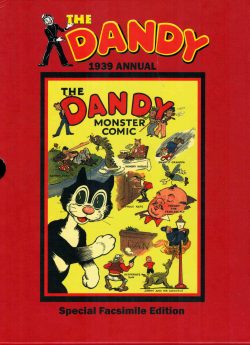
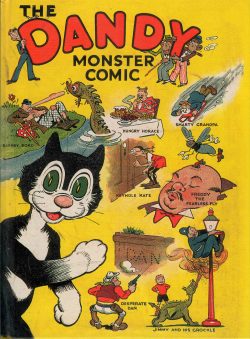
The Dandy Monster Comic (Dandy Annual 1939 Special Facsimile Edition)

By Many and various (DC Thomson & Co/Aurum Press)
ISBN: 978-1- 84513-217-0

This one’s actually older than me – at least in its original incarnation…

Until it folded and was reborn as a digital publication on 4th December 2012, The Dandy was the third longest running comic in the world (behind Italy’s Il Giornalino – launched in 1924 – and America’s Detective Comics in March 1937).

Premiering on December 4th 1937, The Dandy broke the mould of traditional British predecessors by using word balloons and captions rather than narrative blocks of text under the sequential picture frames.

A colossal success, it was followed eight months later (on July 30th 1938) by The Beano and together they completely revolutionised the way children’s publications looked and, most importantly, how they were read.

Over the decades the “terrible twins” spawned a bevy of unforgettable and beloved household names who delighted generations of avid and devoted readers, and the end of year celebrations were graced with bumper bonanzas of the comics’ weekly stars in extended stories in magnificent bumper hardback annuals.

As WWII progressed, rationing of paper and ink forced the “children’s papers” into an alternating fortnightly schedule: on September 6th 1941 only The Dandy was published. A week later just The Beano appeared. They only returned to normal weekly editions on 30th July 1949…

As of this grand festive feast however that’s all in the future. Here, masterfully restored, is a treasure trove of joyous pranks and all-ages adventure to delight and enthral. It should be noted however, that all this buffoonery and jolly japery was crafted at a time socially far-removed from our own, and there are some terms and racial depictions that wouldn’t be given houseroom in today’s world. That was then, this is now, and that’s another thing you can be grateful for…

It all opens in classis DCT manner with the entire cast chowing down to a monumental feast – a staple reward of those leaner, impoverished times – before James Crichton’s ‘Korky the Cat’ kicks things off with spot of calamitous dockside fishing after which ‘Jimmy and his Grockle’ – a kind of Doberman dragon – foils a dognapping ring. Illustrated by James Clark, the strip was recycled from prose “Boys Paper” The Rover (where it was “Jimmy Johnson’s Grockle” in 1932).

Most pages come with riddles, jokes or single panel gags and many of the strips are delivered in the signature two colour process that typifies British Annuals and as usual none of the writers are named and precious few of the artists are credited. As always, I’ve offered a best guess as to whom we should thank, and of course I would be so very happy if anybody could confirm or deny my suppositions…

The prolific Allan Morley then details how ‘Keyhole Kate’ falls foul of a burglar and cowboy superman ‘Desperate Dan’ – by indisputable key man Dudley D. Watkins – braves harsh winter clime, before Morley’s ‘Freddy the Fearless Fly’ thwarts a human bully and thrashes a predatory spider.

These colossal tomes were all about variety and value for money and next up is a heavily-illustrated prose story enthrallingly detailing the feudal adventure of young shepherd-boy Gingan‘s dragon-slaying quest with magical weapon ‘The Sword of Crad’ after which wandering tramp ‘Barney Boko’ comes a-cropper after defacing public property in a wordless strip from John R. Mason.

As depicted by the superb Eric Roberts, ‘Podge’s Frame-Up’ sees the junior entrepreneur confusing art galleries with glaziers whilst nattily-dressed ‘Archie the Ape’ deals with a hungry lion and ‘Smarty Grandpa’ (by Watkins and a double for strip veteran Pa Broon) has a racially-charged moment at a minstrel show before anthropomorphic tortoise ‘Dan the Night-watchman’ confronts a gang of thieving rats…

‘The Boy that Beat the Band’ is another prose drama (illustrated by Fred Sturrock?) with a young orphan acrobat saving a disabled boy and rewarded with his heart’s desire – a job – after which Jack Glass’ text-block and pic strip ‘The Daring Deeds of Buck Wilson’ sees the singing cowboy battle kidnappers before the animal antics in ‘Bamboo Town’ see daring duo Bongo and Pongo organise a therapeutic gymnasium in a typically busy romp limned by Charlie Gordon.

Sam Fair’s ‘Wig and Wam the Skookum Kids’ were prank-playing Red Indian lads who here trick the Big Chief into baiting a bear before ‘Flippy the Sea Serpent’ – by Frank Minnitt – settles the hash of a snooty octopus whilst Smarty Grandpa fails to steal a pie…

Boneless Bill was a long-running but sadly anonymous strip starring an affable contortionist. Here he astounds an army recruiting officer before ‘Marmaduke Mean the Miser’ pays painfully for stealing a little lad’s Dandy comic before ‘Hungry Horace’ (Morley) finds his appetite briefly diminished after illicitly tapping the wrong barrel and a cunning old codger prevents a mugging in ‘Old Beaver’s Brainwaves’.

‘Wee Tusky’ was long-running prose feature and here the baby elephant’s propensity for trouble leads to deadly danger but secures him a human friend in the end, after which Roberts’ ‘Helpful Henry’ adjusts seating arrangements despite his history of calamitous consequences just as pompous (idiot) detective ‘Trackem Down’ botches another “case”…

Korky the Cat masters the fundamentals of golf whilst Jimmy and his Grockle find fun – and bananas – at the docks, after which Keyhole Kate’s snooping drenches a helpful bystander and Desperate Dan proves that building sites can be dangerous places… at least for other people…

After another get-rich-quick scheme from Podge, sausage-snaffling ‘Dipper the Dodger’ falls foul of the law. Probably drawn by James Jewell, Dipper is a dead ringer for Beano and The People’s Journal cartoon stalwart Wee Peem (“He’s a Proper Scream”), so there might have been some cross-pollination back then.

Freddy the Fearless Fly turns arsonist to escape a spider’s trap before Helpful Henry learns the perils of electricity, after which Jimmy Denton tries rodeo riding to save the ranch with the invaluable assistance of ‘White Star’s Star Turn’ in a prose thriller that leads seamlessly to Podge setting up his own postal service before ‘Bobby, the Boy Scout’ goes too far in his scheme to help a hobo…

Boneless Bill artfully apprehends a thief and Archie the Ape find busking hazardous to health, whilst Hungry Horace loses his lunch to a quick-witted sprinter, but savvy navies ‘Nick & Nack’ find a smart way to keep the cops from confiscating their grub.

Interfering busybodies Bobby, the Boy Scout and Helpful Henry both get it wrong again, after which we head west to see Wig and Wam the Skookum Kids prank their dad yet again even as Desperate Dan falls asleep in the park but still causes chaos

‘Willing Willie and his Pa’ experience decorating woes before we revisit the days of the Raj in prose thriller ‘Pam the Peace-Maker’ wherein a little girl prevents an outbreak of war after which Helpful Henry confuses radio and electric irons and Korky triumphs over a tiger when he goes on safari.

Jimmy and his Grockle clash violently with shopkeepers and Old Beaver’s Brainwaves sees the gamey geezer getting back at the thug who pinched his job after which itinerant Barney Boko pays through the nose for watching football without a ticket.

Dipper the Dodger meets a theatrical strongman and the Bamboo-Town boys convene a swimming class that would certainly have benefitted ‘Sandy Starfish, the Shipwrecked Sailor’ before Fred Sturrock illustrates a prose battle of wits between stubborn old men in ‘The House that Jack the Joker Built’.

More musical mayhem from Archie the Ape precedes Hungry Horace outwitting municipal bylaws in search of a big scoff, even as Podge dupes another crowd of sensation hungry oafs and Helpful Henry wrecks a house before it’s even built: a trick even Desperate Dan can’t match, even if he wasn’t so thirsty…

Mini vignettes for Podge, Barney Boko and Boneless Bill lead into a riotous schoolboy romp in prose – probably illustrated by George Ramsbottom – that I want you to be grown up about. ‘Invisible Dick Spoofs the Spoofer’ is a smart tale from a venerable feature that ran in The Rover for years and when he turns the tables on a cruel stage magician humiliating his school chums you should be proud and not titter or snigger…

A rapid-fire tranche of cartoon antics, starring Bobby the Boy Scout, Podge, Marmaduke Mean the Miser, Flippy the Sea Serpent, Boneless Bill and Willing Willie and his Pa, lead us to another text tale as animal-raised orphan ‘Buffalo Boy’ discovers toffee and begins his slow march back to civilisation…

From here it’s cartoon strip all the way with Korky, Keyhole Kate, Freddy the Fearless Fly, Helpful Henry, Wig and Wam the Skookum Kids, Smarty Grandpa and Dipper the Dodger all doing what they do best before Bamboo-Town brings down the curtain as Bongo and Pongo build an all-animal skating rink…

A marvel of nostalgia and timeless comics wonder, the true magic of this facsimile edition is the brilliant art and stories by a host of talents that have literally made Britons who they are today, and bravo to DC Thomson for letting them out for a half-day to run amok once again.

The DANDY is a trademark of and © D. C. Thomson & Co. Ltd. 2006. Associated characters, text and artwork © D. C. Thomson & Co. Ltd. 2006. All rights reserved.

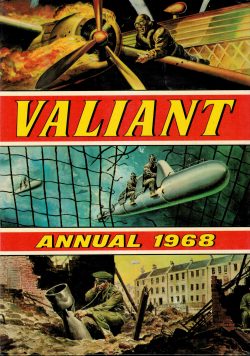
Valiant Annual 1968

By Many & various (Fleetway)
No ISBN

From the late 1950s and increasingly through the 1960s, Scotland’s DC Thomson steadily overtook their London-based competitors – monolithic comics publishing giant Amalgamated Press.

Created by Alfred Harmsworth at the beginning of the twentieth century, AP perpetually sought to regain lost ground, and the sheer variety of material the southerners unleashed as commercial countermeasures offered incredible vistas in adventure and – thanks to the defection of Leo Baxendale and Ken Reid to the enemy – eventually found a wealth of anarchic comedy material to challenge the likes of the Bash Street Kids, Dennis the Menace, Minnie the Minx and their unruly ilk.

During the latter end of that period the Batman TV show sent the entire world superhero-crazy. Amalgamated had almost finished absorbing all its other rivals such as The Eagle‘s Hulton Press to form Fleetway/Odhams/IPC and were about to incorporate American superheroes into their heady brew of weekly thrills.

Once the biggest player in children’s comics, Amalgamated had stayed at the forefront of sales by latching onto every fad: keeping their material contemporary, if not strictly fresh. The all-consuming company began reprinting the early successes of Marvel comics for a few years; feeding on the growing fashion for US style adventure which had largely supplanted the rather tired True-Blue Brit style of Dan Dare or DC Thompson’s Wolf of Kabul.

Even though sales of all British comics were drastically declining, the 1960s were a period of intense and impressive innovation with publishers embracing new sensibilities; constantly trying new types of character and tales. At this time Valiant and its stable-mate Lion were the Boys’ Adventure big guns (although nothing could touch DC Thomson’s Beano and Dandy in the comedy arena).

Valiant was conceived as a “Boys’ Paper” in 1962 as the indigenous comics industry struggled to cope with a sudden importation of brash, flashy, full-colour comics from America. A weekly anthology concentrating on adventure features and offering a constantly changing arena of action, the magazine was the company’s most successful title for over a decade: absorbing many less successful periodicals between its launch and eventual amalgamation into new-styled, hugely popular Battle Picture Weekly in 1976.

There were 21 Annuals between 1964 to 1985, combining original strips with prose stories; sports, science and general interest features; short humour strips and – increasingly from the 1970s onwards – reformatted reprints from IPC/Fleetway’s vast back catalogue.

From their creative heyday (this book would have been on sale from the autumn of 1967) and sporting a gripping Don Lawrence cover, the all-boys excitement begins with a frontispiece spread of medal-winning British hero war heroes: a typical illustrated historical feature of the era.

The drama continues with a fictionalised full-colour tale of smugglers and the development of the customs men in ‘Contraband’ before ‘Kelly’s Eye’ – sublimely painted by Carlos Cruz (I think) – sees the indestructible adventurer saving beleaguered Coroba from revolutionaries and radioactive doom.

Kelly’s Eye featured ordinary, thoroughly decent chap Tim Kelly who came into possession of the mystical “Eye of Zoltec”: a fist-sized gem that kept him free from all harm… as long as held on to it.

You won’t be surprised to discover that, due to the demands of weekly boys’ adventures, Tim lost, dropped, misplaced and was nefariously deprived of that infernal talisman pretty darned often – and always at the most inopportune moment…

The moody and compelling artwork of Argentinean Francisco Solano Lopez was the prime asset of this series, with Tom Tully and Scott Goodall the usual scripters for this little gem of a series.

Resorting to economical monochrome, we come to ‘The House of Dolmann’. The weekly strip was a curious and inexplicably absorbing blend of super-spy and crime-buster strip from Tully and utterly wonderful master illustrator Eric Bradbury. Dolman’s cover was as a shabby ventriloquist (I digress, but an awful lot of “our” heroes were tatty and unkempt – we had “Grunge” down pat decades before the Americans made a profit out of it!) who designed and constructed an army of specialised robots which he disguised as his puppets.

Using these as his shock-troops, the enigmatic Dolman waged a dark and crazy war against the forces of evil…

Here, he and his hand-crafted squad hunted a scientific maniac pulling satellites out of the sky with a super-magnet.

The first photo/fact feature of the book is a thinly-disguised infomercial for a popular outdoor activity charity, propounding readers get ‘Outward Bound – to Adventure’ after which ‘The Steel Claw’ battles a madman and his gang determined to destroy Britain’s navy (illustrated, it seems to me, by Massimo Belardinelli).

One of the most fondly-remembered British strips of all time, the Steel Claw, ran from 1962- 1973 with Jesús Blasco and his small family studio enthralling the nation’s children through the breakneck adventures of scientist, adventurer, spy and even costumed superhero Louis Crandell. Initially written by novelist Ken Bulmer, the majority of the character’s career was scripted by Tully. Crandall had an artificial hand packed with gimmicks and possessed the disquieting ability to turn invisible whenever he was electrocuted…

‘The Astounding Jason Hyde’ was a series that ran in prose form, written by Barrington J. Bayley with spot illos from Bradbury. Hyde was a blind telepath with an “X-Ray mind” who here tracks missing potholers to an unsuspected cave civilisation populated by brutes and monsters…

After all that action and suspense it’s past time for some light relief and a brace of comedy capers follows: frenetic trend-chasers and backyard inventors ‘The Nutts’ cause carnage with their climate-challenging antics in a superb extended yarn from Spanish cartoonist Ángel Nadal whilst the astoundingly slick and wonderful ‘Sporty’ by Reg (Sporting Sam) Wootton learns a lesson about truth in advertising…

Appalling racist by today’s standards, ‘Captain Hurricane’ was a hugely popular strip for its entire decades-long run. Written by Scott Goodall or Jon Rose, he was originally drawn by R. Charles Roylance, but I think it’s either Jack Pamby or Fred T. Holmes limning this bizarre yarn as – thanks to skiving batman Maggot Malone – the marines are forced to fight their way through Japanese-controlled Malayan jungles to Singapore, armed with nothing but cricket equipment……

Brilliant Reg Parlett’s ‘The Crows’ see the youngest corvid cavorting with bats before – in scintillating pink duo-tones – ‘The Wild Wonders’ (Mike Western and probably Tully on script) offer comedic drama capers. Here Rick and Charlie Wilde and their long-suffering guardian Mike Flynn face ski-slope thrills with a side-order of kidnap and skulduggery… Shipwrecked on remote Worrag Island in the Hebrides, two toddlers were raised by animals and survived to become almost superhuman specimens. When rescued by Olympic swimmer Mike they became sporting sensations able to out-compete most adult athletes in any discipline. They could also talk to animals…

‘Tatty-Mane, King of the Jungle’ offers raucous animal antics as the regal rogue seeks to update his look, but the artist remains a mystery to me. Likely candidates include Nadal or Martz Schmidt (suggested by Steve Holland – you really should read his Bear Alley blog)…

A ‘Sporting Roundabout’ of facts lead into a prose tale of exploration and treasure hunting – illustrated by Weston – with the good guys using an ambulatory super-jeep dubbed ‘The Jungle Walker’ after which venerable schoolboy comedy property ‘Billy Bunter’ quits school and heads out to sea, encountering spies in a quirky yarn possibly illustrated by Parlett but it seems reminiscent of Frank Minnitt to me…

‘Legge’s Eleven’ was a typical example of the humorous freak-show football strip. Lanky player-manager Ted Legge took over failing Rockley Rangers and fields a team of misfits and individualists he struggles to make work together. Here the lads are trapped in a spiral of superstition and missing mascots in the run-up to a crucial international second leg…

Following ‘The Crows’ fowling up a wildlife film, ‘Operation “Rescue”’ (by Mike White?) recreates the 1957 efforts to save Royal Army Air Servicemen lost in the jungles outside Kuala Lumpur before a double dose of ‘“Horse” Laughs’ gags segues into a photo-packed footballing essay on ‘Great Moments with Great Clubs’.

Back in comics, ‘Captain Hurricane’ and crew are in the Western Desert in 1940, battling Italian infantry even as Maggot Malone spreads disorder with his latest fad: weightlifting…

‘Sporty’ disastrously discovers Squash and ‘The Nutts’ cause carnage on a film set before ‘Billy Bunter’s enforced diet creates carnage for the entire county after which another ‘Sporting Roundabout’ leads to a prose thriller about a multi-talented circus performer battling crooks attempting to fix his championship boxing match in ‘The Flying Fighter’.

‘Gabby McGlew – his yarns aren’t true’ is an example of recycled Buster strip Barney Bluffer by Nadal with boastful braggart channelling his inner Baran Munchausen after which photo-history feature ‘A Champion Champion’ details the career and achievements of Henry Cooper before everything wraps up with what I’m sure is another re-tread, even if I can’t find out where.

‘No. 13 Grimm Street’ sees Fleet Street reporter “Hack” Mackenzie struggling to solve a spree of daring art robberies and a house that seems to vanish at will: the answer to both mysteries leads to madness and death…

Eclectic, wide-ranging and always of majestically high quality, this blend of fact, fiction, fun and thrills is a splendid evocation of lost days of joy and wonder. We may not be making books like this anymore but at least they’re still relatively easy to track down. Of course, what’s really needed is for some sagacious publisher to start re-issuing them…
© Fleetway Publications Ltd., 1967

Star Trek Annual 1976

By John David Warner, Allan Moniz, Alberto Giolitti & various (World Distributors)
SBN: 7235-0325-7

British Comics have always fed heavily on other media and as television grew during the 1960s – especially the area of children’s shows and cartoons – those programmes increasingly became a staple source for the Seasonal Annual market. There would be a profusion of stories and strips targeting not readers but young viewers and more and more often the stars would be American not British.

Much of this stuff wouldn’t even be as popular in the USA as here, so whatever comic licenses existed usually didn’t provide enough material to fill a hardback volume ranging anywhere from 64 to 160 pages. Thus, many Annuals such as Daktari, Champion the Wonder Horse, Lone Ranger and a host of others required original material or, as a last resort, similarly-themed or related strips.

This book was produced in a non-standard UK format, with limited but full-colour for both the American comics reprints and the remainder: brief prose pieces, puzzles, games and fact-features on related themes. As for the writers and artists of the originated material your guess is, sadly, as good as or better than mine, but almost certainly generated by the wonderful Mick Anglo’s publishing/packaging company Gower Studios (these yearly slices of screen-to-page magic were an intrinsic part of growing up in Britain for generations and still occur every year with only the stars/celebrity/shows changing, not the package.

Star Trek launched in the USA on September 8th 1966, running until June 3rd 1969: three seasons comprising 79 episodes. A moderate success, the show only really achieved its stellar popularity after going into syndication; appearing in all American local TV regions perpetually throughout the 1970s and beyond.

It was also sold all over the world, popping up seemingly everywhere and developing a fanatically devoted fanbase.

Comicbook franchising specialist Gold Key produced a series which ran for almost a decade beyond the show’s cancellation. Initially these were controversially quite dissimilar from the screen iteration, but by the time of the tales in this sturdy Holidays hardback (reprinting Gold Key’s Star Trek issues #27and #30 from November 1974 and May 1975), quibbling fans had little to moan about and a great deal to cheer as the series was the only source of new adventures starring the beloved crew of the Starship Enterprise.

John David Warner scripted ‘Ice Journey’ and it was illustrated by the ever-amazing Alberto Giolitti. Here the Enterprise is conducting a highly-suspect population survey on sub-arctic world Floe I which soon drops Captain Kirk, Mr. Spock and evolutionary specialist Dr. Krisp into the middle of a eugenics-fuelled race war…

Dividing the tale are a brace of UK generated features a compendium of ‘Star Facts’ offering seven salient snippets of astronomical amazement and a ‘Cosmic Crossword’ to challenge your knowledge of the infinite unknown.

Following the conclusion of ‘Ice Journey’, there’s a board game to play at ‘Warp Factor Eight’ before a second serving of ‘Star Facts’ ushers in another comics adventure.

Bisected by an illustrated glossary of ‘Space Age Vocabulary’, Death of a Star’ (by Allan Moniz & Giolitti) comes from Star Trek #30 and finds Enterprise on site to observe a star going nova. The ship is subsequently catapulted into calamity as sensors pick up a planet full of life-readings where none should be. Moving swiftly to evacuate the endangered beings, the crew are astonished to discover only one creature: an old woman who claims to be the dying sun…

Thanks to the vagaries of image licensing, one thing you won’t find herein is a single photograph of any cast member, but there are plenty of nostalgia-tinged, all-ages sci fi thrills and dashing derring-do to delight not just TV devotees and comics fans but also any reader in search of a pictorially powerful grand adventure.
© MCMLX, MCMLXI, MCMLXXII, MCMLXXV Paramount Pictures Corporation.
(These days Star Trek and related marks are trademarks of CBS Studios, Inc.) All Rights Reserve

When I Was a Kid – Childhood Stories by Boey


By Cheeming Boey (Last Gasp)
ISBN: 978-0-86719-785-3

Unless your life’s even more unpredictable than mine, all the preparations and frantic panics should be sorted by now and it’s too late to pick up any meaningful gifts that aren’t actually immaterial and/or downloadable.

So, with that in mind, why not calmly ponder the meaning of it all and lay plans for next time?

As this little lost gem proves, the whole histrionic drama of the season is about making memories for those around you… good and bad. Why not strive to make them ones you and yours can share with friends instead of the police or EMTs?

The ability to go back into our childhoods and relive those bizarre, baffling and brilliantly fierce thoughts and every brand-new-day discoveries is a wondrous mixed blessing, but being able to share those recaptured experiences with jaded world-weary adults is a truly miraculous gift and thus utterly evergreen.

One of the most effective and memorable collections generated by an august crowd of halcyon salad-days wranglers comes from Malaysian animator, illustrator, educator, video game developer and cartoonist Cheeming Boey – who also produces gallery art on Styrofoam coffee cups and created an autobiographical webcomic about his life in America, entitled I Am Boey.

You should really check it out…

As a kind of prequel to his blog – if indeed growing up can be considered an introduction to a main event – Boey collected a huge number of visual memoirs and epigrams about his im-maturing years in Asia, bundling them up in a beguiling tome (and a rapidly released sequel) emphasising both the exoticism of life in Malaysia and the universal similarities and solidarities of being a kid.

Warm, sensitive, intimate, uproarious, disarmingly honest as well as on occasion brutal, shocking and sad, these 103 visual monologues (with heart-warming family photos scattered throughout) are invitations into a world of wonder, rivalry, confusion, punishment, resentment, humiliation, anticipation, frustration, greed, glee and always the security of family.

They all begin with “When I was a kid…” and prove that, apart from the odd surface detail, every happy, loving childhood is identical…

The stand-out incidents include such salutary universal reminiscences as ‘My First Pet’, ‘Baby Powder’, ‘Bedtime Stories’, ‘Bad for your Eyes’, ‘Grandma’s Leg’, ‘Nasal Noodles’, ‘R-Rated’, ‘Stealing Money’, ‘Sunday Cartoons’, ‘Not a Genius’ and of course ‘Failing Math’ but with such a wide catalogue to choose from, every little cartoon episode will resonate with somebody. Especially you. Particularly now…

And just in case I’ve made a convert – this one is available as an eBook if you need it right away…
© 2011, 2013 Cheeming Boey. All rights reserved.