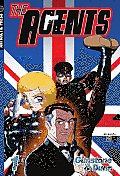
The Agents


By Ben Dunn & Kevin Gunstone (AP Pocket Manga)
ISBN: 1-932453-64-4

After decades of homegrown comics product America finally began to grow aware of other country’s graphic treasures through of all things television, when in the late 1960s imported cartoons from Japan first began appearing as part of Saturday morning programming. With shows like Astroboy, Marine Boy, Speed Racer and others reshaping a nation’s most malleable minds, it wasn’t too long before Western anime lovers also branched out into the scrupulously stylised world of manga too…

By the 1980s translated works were increasingly dominating the US and world markets and devotees also found a burgeoning and impressive subgenre market of cross-cultural, fan-turned-pro material we now know as OEL (“Original English Language”) or Amerimanga.

Probably the most adept and successful of these new creators is Ben Dunn, who was born in Taiwan in 1964, where he was exposed early and often to the fabulous alternatives of the East, before returning to Kentucky and Texas. He founded his own publishing house Antarctic Press in 1984 during the first days of the black and white comics boom, and with both timing and raw talent on his side created a series of wonderful trans-Pacific series which combined the best of American and Japanese art style and storytelling philosophy.

Among his best known creations are Ninja High School and Warrior Nun Areala and Marvel tapped his expertise when they launched their own “Mangeverse” sub-imprint in 2000.

A man of diverse interests, Dunn also cites the fabulous Film and TV fantasy adventures of the Swinging Sixties as a major interest and influence, as can be seen in this pocket collection of a six-issue miniseries he produced with writer Kevin Gunstone for Image in 2004.

The Agents is set in an alternative future: a glorious and outrageous homage to Thunderbirds, Joe 90, Captain Scarlet, The Prisoner, Green Hornet, and such superspy stalwarts as Derek Flint, James Bond, John Steed & Emma Peel and Lady Penelope CreightonWard as well a dozens of lesser lights from that unforgettable age of heroes…

The action opens in ‘You Only Live Once’ as thirty years from now veteran agent Nigel Cord is called back to active service when the only super-villain to have ever outwitted him makes the world an incredible offer.

Three decades ago criminal mastermind Professor Daedalus nuked Washington DC and Moscow and took over Paraguay in the aftermath. With both global Super Powers reeling Great Britain stepped in to assume the role of World Policeman and civilisation has been in a spiral of escalating scientific terrorism ever since. Now the dying megalomaniac is offering his technological marvels in return for one last confrontation with his arch nemesis…

Meanwhile irreplaceable Boy Savant Mike 70 has gone missing and masked sidekick Haiku, without the fortifying influence of his mentor the Red Wasp is losing his edge in the unceasing battle to reclaim the streets of New York from gangsters and anarchists whilst spymaster Lady Pippa seems intent only on drinking herself to death and bedding the new recruits ‘On His Majesty’s Secret Agency’…

There are other factors in play such as the deadly C.A.B.A.L. assassin Kristal Veil and her increasingly erratic paymasters, whilst secretive crisis-management organisation the Tomahawks use advanced technology to fight disasters but do nothing to fix the political inconsistencies which cause them.

‘The Spy Who Saved Me’ finds Cord and Veil as guests of the dying Daedalus whilst the C.A.B.A.L. war among themselves and ‘Her Majesty’s Secret Agent’ reveals that the New World Order is riddled with moles and traitors…

With global Armageddon minutes away the action and intrigue accelerates to a fatal climax in ‘Thundercrack’ before ‘Our Man Cord’ finally saves the day – if not the status quo…

With all such nostalgic pastiches of bygone glories there’s an overwhelming temptation to tweak the source material for modern consumption – or perhaps just to show how clever we all are these days – but The Agents generally resists that urge, preferring to present a full-on, exuberant and magically honest appreciation of great times gone by.

Drawn in monochrome manga style but still genuinely Vista-Visioned and happily Super-Marionated, this lost delight might just be the best paean to lost days any wistful, thrill-starved baby-boomer could desire… and it’s even available as an ebook.

Story © Kevin Gunstone. Art © Ben Dunn. All rights reserved.

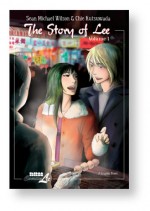
The Story of Lee volume 1


By Seán Michael Wilson & Chie Kutsuwada (NBM/ComicsLit)
ISBN: 978-1-56163- 594-8

Here’s a lovely simple treat for romantics everywhere and manga fans in particular and, like the subject matter itself, the product of more than one country. Written by British émigré and current resident of Japan Seán Michael Wilson and illustrated by Manga Shakespeare artist Chie Kutsuwada, The Story of Lee follows the budding romance of a dedicated but restless Hong Kong girl as she meets and falls for a young Scottish poet and teacher.

Lee is a young woman with frustrated dreams dutifully working in her father’s shop in Hong Kong. The situation is uncomfortable: the elder means well, but he disapproves of almost everything she does and is not reluctant to tell her so. Even as he chides and disparages Lee his constant pushing for her to achieve something whilst staying true to his old-fashioned ideas is pulling her apart. Moreover, Wang, the nice, proper Chinese boy he perpetually and insistently forces upon her, is creepy and just turns her off.

Lee has a secret: she is a closet poet and besotted with western culture, particularly pop music. In these unwelcome fascinations she is clandestinely supported by her frail and aging grandmother and her unconventional Uncle Jun, a globe-trotting playboy who long ago abandoned convention and tradition to follow his dreams to America.

Lee is 24 and being gradually worn away when the gorgeous temporary teacher Matt MacDonald wanders into the store. He is Scottish; polite, charming, exotic and, as Lee discovers when empting the wastepaper basket, a sensitive and talented poet…

Soon Lee is defying her father as her relationship with Matt inexorably deepens, but when tragedy strikes her life is further complicated as Matt prepares to leave for home. And then he drops the bombshell and asks her to go with him…

Never strident but compellingly seditious, this charming tale uses the powerful themes of cultural differences, mixed-race-relationships, family pressures and the often insurmountable barrier of generational gulf warfare to weave an enchanting tale of desire, duty and devotion.

It all ends on a gentle cliffhanger and I can’t wait to see how it all resolves in the next volume… So will you when you pick up on this mature, addictive story.

©Seán Michael Wilson & Chie Kutsuwada.

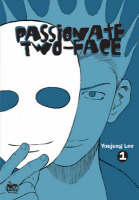
Passionate Two-Face Book 1


By Youjung Lee (NetComics)
ISBN: 978-1-60009-177-3

Here’s an intriguing change of pace from the usual manga/manhwa love story: one aimed at a slightly older and more discerning audience.

Sangbaek Oh is a thoughtful young food science student desperately in love with Hyeji Min, the girl next door. He’s adored her since elementary school and now, back from his first term at University, he can’t wait to see his girl again. Unfortunately the boy’s got it bad, spying on her with high-powered binoculars, whilst his vapid, shallow parents blather on oblivious to his distressing preoccupation.

Of course spies often see things they shouldn’t and the hormone-crazed Sangbaek is devastated when his observations catch Hyeji getting distressingly intimate with some scumbag playboy in her own bedroom. The swine doesn’t even treat her decently: he’s a callous bully – but really good-looking…

Crushed, but deciding to play it cool, the lovelorn fool pretends nothing has happened when he goes out with Hyeji next day, but his discoveries have turned his creepily innocent interest into something far more carnal. His mind aflame with licentious images, he is utterly unprepared for the next blow. His truly beloved knows about his habits and doesn’t want to see him anymore – especially as she is preparing for her new career as a movie actress…

Sangbaek is destroyed and throws himself into an alligator pit at the Zoo, but when even they reject him (being too well-fed by their conscientious keepers) he notices, just before passing out, an old man taking photos of his distress.

As Hyeji pursues her disdainful new man Sangbaek regains consciousness in the home of the old photographer and his juvenile delinquent daughter Mihee. It transpires that the guy is a movie make-up artist who was captivated by the dumped lad’s agonised expressions. Moreover he knows Hyeji’s new beau – Gobong Choi, “the virgin hunter” owner and producer of soft-porn studio Climax Productions. Moreover, that inveterate womaniser is looking for fresh talent as he prepares to begin making far harder films…

Determined to save Hyeji from the path of inevitable degradation, Sangbaek confronts the sleazebag and gets thoroughly beaten up although he does manage to rescue the drunken, unconscious girl from Gobong’s clutches. After a night of terrific temptation and sweet childhood memories whilst she gradually sobers up, she delivers the ultimate rejection…

His life shattered Sangbaek can only watch from afar as Hyeji follows her wrong path. However when the papers begin advertising for a co-star to “work” with the new starlet the make-up man and his daughter offer him an incredible chance to be with his degraded love once more. They can make him a new face and he can win Hyeji back. He knows it will work; after all, hasn’t the old man being running around Seoul for weeks, perfectly disguised as Sangbaek and getting off with lots of young women?

The plan set, the make-up master exacts a strange price. He will turn Sangbaek into the most handsome actor in the world, but in return he must surrender all rights to his own face and original identity…

Thought-proving, darkly funny and just a little bit scary, this is a compelling fantasy tale of love, desire and obsession that is both extremely engaging and terrifically appealing. Even if you aren’t a fan of manga or the far edgier Korean manhwa equivalent, this enticing adult romance series might just change you forever…
© 1997 Youjung Lee. All Rights Reserved. English text © 2007 NetComics.

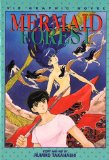
Mermaid Forest


By Rumiko Takahashi, translated by Matt Thorn (Viz)
ISBN: 978-1-56931-047-5

Rumiko Takahashi is one of the most successful comics creators of all time and indisputably the best selling woman in the field (170 million volumes – and rising – of her assorted inventions sold to date) with many awards to her name.

Born in 1957, she enrolled in a manga school whilst at university and began producing Dōjinshi (self-published stories) in 1975, under the tutelage of Manga genius Kazuo Koike. Three years later she sold her first professional story; the award-winning science fiction comedy Urusei Yatsura (34 volumes). Her next big series was rom-com Maison Ikkoku (15 volumes) and she continued both series simultaneously until 1987, whilst also producing a vast array of extremely popular short stories and mini-series.

In 1984 she tried something new: an occasional sequence of interlinked gothic-love horror short-stories that would become known as the Mermaid Saga which appeared at uneven intervals over the next decade.

In 1994 Viz Communications began collecting and translating the nine graphic novelettes for the English speaking world, and this first volume presents the first three in a stunning display of visual virtuosity and macabre menace.

‘A Mermaid Never Smiles’ begins in a remote rural village in modern Japan as beautiful maiden Mana calls out petulantly to her servants. Meanwhile miles away a derelict young man wanders aimlessly, searching for something. His name is Yuta and there’s something rather odd about him…

Mana’s attendants are all women and they are waiting for something. When one performs a unique sacrifice the assembled harridans decree that Mana is ready at last for her great purpose…

When Yuta stumbles into the village he is swiftly killed by the old ladies but doesn’t stay dead for long. Escaping from his grave Yuta confronts the women and rescues the far from grateful Mana, who has no idea that she has been farmed like a veal calf by her sevants, with but one purpose…

On the run Yuta explains the legend of Mermaids: eating their flesh can, if one is fortunate, impart immortality and invulnerability. More common is the slow transformation into ghastly monsters, called “Lost Souls”. Most likely though, is a swift and very painful death from the malignant meat…

Years ago Yuta unwittingly consumed mermaid flesh and has spent half a lonely millennium seeking a cure to his lonely un-aging existence. An old wise-woman told him the only solution was to find a live mermaid and ask her for a method to end his interminable life.

However he has cause to regret his wish when he discovers that all the old women are aged mermaids and Mana has been bred for years as a means by which they can regain the lost youth. Horrified and reluctantly heroic Yuta knows he must foil the plan at all costs – but it won’t be easy or pretty…

‘The Village of the Fighting Fish’ takes us back centuries to Feudal Japan and two island communities at war. Eking out their harsh existence with occasional piracy, the fisher-folk of Toba are being slowly squeezed by their ruthless rivals on Sakagami Island. Moreover, the Tobans leader is dying and his valiant daughter O-Rin is having trouble filling his sandals…

She thinks nothing of it when a dead body washes up; that’s just a sign of the times, but when the corpse comes back to life the sinister, manipulative wife of the Sakagami chieftain seeks him out. It appears she too is hunting for a mermaid, just like the un-killable stranger Yuta…

With a ruthless agenda of her own Isago stirs the bubbling pot of tension until war is inevitable, just as the restless wander Yuta dares to dream that he might risk loving again, but once more the terrible lure of mermaid flesh and supernatural longevity prove to be more curse than blessing and horrifying bloodshed is the inevitable result…

We return to contemporary Japan for the concluding tale as Mana and Yuta find an isolated village near deep woods and stop their wandering for the night. However the naive girl is utterly unaware of the modern world and walks into a near fatal accident.

Taken to the local cottage hospital the severely injured girl mysteriously goes missing, and when Yuta discovers the woodland called the ‘Mermaid Forest’ he fears the worst. His investigations uncover yet another tragic family destroyed by the mermaid curse that has tainted so many lives…

Kindly old Dr. Shiina has kept a dark secret for decades and now, with the girl Mana, he hopes to correct an ancient wrong, but no-one who has tasted mermaid flesh has ever ended happily and as Yuta hopelessly battles yet more Lost Soul horrors, the undying hero knows that this time will be no different…

This bleak supernatural tale of jealousy, twisted love and dark devotion is a spectacular and oppressive epic of understated horror, beautifully realised and movingly effective. One of the best mature manga tales ever produced, it can – and should – be read by older kids too, but please be aware that Japanese social conventions regarding casual nudity are not the same as ours and if you don’t want to see naked bodies you should read something else.
© 1994 Rumiko Takahashi/Shogakukan, Inc. All rights reserved.

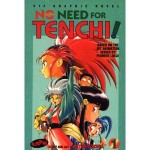
No Need For Tenchi! volume 1


By Hitoshi Okuda, translated by Fred Burke (Viz Graphic Novel)
ISBN: 978-1-56931-180-6

This bright and breezy adventure comedy is a rare reversal of the usual state of affairs in that the TV anime came first and the manga serial was a spin-off.

Tenchi Muyo! Ryo-Ohki debuted in 1992-1993 as a six-part TV cartoon series (termed an OVA or Original Video Animation in Japan) that proved so blisteringly popular that even before the original season concluded further specials and episodes were rushed into production. Over the next decade or so two more seasons appeared as well as spin-off shows and features (for a total of 98 episodes all told), plus games, toys, light novels and, of course, a comic book series. The translation most commonly accepted for the pun-soaked title is No Need For Tenchi but equally valid interpretations include Useless Tenchi, No Heaven and Earth and This Way Up.

The assorted hi-jinks of the TV show resulted in three overlapping but non-related continuities, with the Hitoshi Okuda manga serials stemming directly from the first season. Okuda eventually produced two comics sagas in this format: Tenchi Muyo! Ryo-oh-ki which began in 1994 and features in this volume under review and the follow-up Shin Tenchi Muyo! which I’ll get to one fine day…

The strip debuted in the December 16th 1994 Shōnen anthology (comics pitched at 10-18 year old males) Comic Dragon Jr. It ran until Jun 9th 2000, generating 12 collected volumes of classic laughs and thrills. The stories are generally regarded as non-canonical by fans of the various TV versions but of course we don’t care about that since the printed black and white tales are so much fun and so well illustrated…

This first volume collects the first seven issues of the pioneering Viz comicbook Tales of Tenchi, which did so much to popularise Manga in the English-speaking world, and opens with a thorough and fascinating recap of that first TV season – from which all the succeeding manic mirth and mayhem proceeds – before cracking on to bolder and better bewilderments starring the entire copious cast on all new adventures and exploits…

Tenchi Masaki is an ordinary boy living peacefully in the countryside with his father Nobuyuki and grandfather Katsuhito, until one day he breaks opens an ancient shrine and lets a demon out. The hell-fiend Ryoko tries to kill him but a magic “Lightning Eagle Sword” helps him escape. The demon follows him though, demanding the sword and things get really crazy when a spaceship arrives revealing Ryoko is in fact a disgraced alien pirate from the star-spanning Jurai Empire.

Starship Ryo-oh-ki is full of attractive, shameless, immensely powerful warrior-women including Princesses Ayeka, her little sister Sasami and supreme scientist Washu. This gaggle of violently disruptive visitors moves in with Tenchi and family, causing nothing but trouble and embarrassment, and soon the boy and his sword are being dragged all over the cosmos in the sentient Ryo-oh-ki (who, when not on duty, prefers the form of a cute rabbit/cat hybrid critter).

Ayeka and Sasami both harbour feelings for the hapless Tenchi but things get really complicated when grandfather Katsuhito is revealed to be Yosho, a noble Prince of the Jurai. It appears Tenchi and those darned space girls are all related…

Tales of Tenchi opened with ‘The Genius’ as the lad, currently studying Jurai warrior training under his grandfather’s diligent tutelage, falls foul of the alien princesses’ growing boredom, until Ryoko attacks again, precipitating a devastating battle that threatens to burn the entire landscape to ashes. But is the aggressor really the demon pirate?

In ‘Double Trouble’ the other Ryoko tries to take Tenchi’s sword – in actuality a puissant techno-artefact known as the Master Key – before being defeated by the original, but at the cost of shock-induced amnesia. ‘Under Observation’ depicts some outrageous and inadvisable potential cures for the distressed Ryoko as the refugees all decompress, but when the defeated doppelganger’s master Yakage arrives the entire extended family are threatened. The terrifying star-warrior challenges Tenchi to a duel…

Part 4 ‘Plunder’ is one colossal hi-energy clash as the boy valiantly demonstrates all he has learned to drive off the intruder, but only after the villain takes Ayeka hostage, demanding a rematch in 10 days time…

Intensifying his training in ‘Practice Makes Perfect’ Tenchi prepares for the upcoming battle whilst Ryoko pursues Yakage into space, unaware that super-scientist Washu has hidden herself aboard the pursing ship…

‘A Good Scolding’ reveals some intriguing history regarding the assorted super-girls whilst Tenchi trains for the final confrontation and the concluding chapter ‘Relationships’ brings the initial volume to a spectacular climax whilst still leaving a cliffhanger to pull you back in for the next addictive instalment…

Blending elements of Star Wars: A New Hope with classic Japanese genre favourites (fantasy, action, fighting, embarrassment, loss of conformity and hot chicks inexplicably drawn to nerdy boys), this sensational romp also includes a couple of comedy vignettes starring ‘The Cast of No Need For Tenchi’ in fourth-wall busting asides, to suitably top off a delightfully undemanding fun-fest which will satisfy not just manga maniacs but also any lover of fanciful frivolity and sci fi shenanigans.
© 1994 by Hitoshi Okuda/Kadokawa Shoten Publishing Co Ltd., Tokyo. NO NEED FOR TENCHI! is a trademark of Viz Communications Inc.

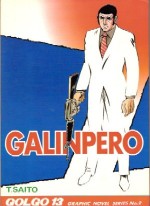
Golgo 13 volumes 1-4


By Takao Saito, translated by Patrick Connolly (LEED Publishing)
ISBNs: 4-947538-57-0, 4-947538-59-7, 4-947538-61-9 & 4-947538-62-7

Almost from its very beginnings the Manga marketplace addressed the needs of a broad audience and adult-oriented material was always a confirmed and successful part of the Japanese publishing landscape. One of the earliest stars of this arena was the incredible, prolific Takao Saito, who began in 1969 to document the gritty adventures of the world’s greatest hitman.

Golgo 13 is a man of mystery: an ice-hearted assassin for hire who picks his assignments depending on a private code of honour: meticulous, remorseless, infallible. He never fails and is always at the heart of whatever real-world political or social scandal his creator happened upon.

The cognomen Golgo denotes hints of a Biblical connection to crucifixion site Golgotha and other Christian iconography, but is only one of this darkly Bond-like protagonist’s many names. However “Duke Togo” – his most common pseudonym – is Japanese through and through and there is no hint of a religious sensibility (except possibly Old Testament style vengeance) – only a truly remorseless social conscience.

The strip debuted in the January 1969 issue of Shogakukan’s premier title Big Comic and has run more or less continually ever since, with compilation sales topping 200 million copies, with attendant immensely popular films, anime, TV series and video game adaptations. Golgo’s monthly strip adventures have been collected into 155 tankobon editions (the term means discrete or stand alone edition, but the manga industry has adopted the term to describe a collected book length volume irrespective of whether or not the story within concludes).

In 1986 just as the western world was beginning to franchise and translate selected manga properties LEED Publishing and Vic Tokai Electronics Corporation repackaged a selection of Golgo 13 tales into four spectacularly addictive English language editions to promote one of the aforementioned games, but regrettably failed to capture the attention of the sci-fi and superhero besotted comics buying public. In 1991 LEED tried again in conjunction with Viz Media via a three issue miniseries entitled Golgo 13: The Professional, but once more the super-assassin failed to hit his mark.

A couple of years ago they tried again as part of the Viz Signature imprint, and here the jury is still out…

Takao Saito was born in 1936 and grew into a tough kid and brilliant storyteller. Eschewing a boxing career he began working in the relatively new field of Manga in 1955 with the adventure strip Baron Air, displaying a love of gritty adventure and science fiction over the next fifteen years. He formed Saito Production in 1960 and in 1971 he began a second career as a teacher of the comic arts.

The four volumes covered here show creator and character at the very peak of their game. The first ‘Into the Wolves’ Lair: The Fall of the Fourth Reich’ includes a fold-out “dossier” on Golgo 13 before launching into a stunning 120 page saga as the Israeli intelligence service Mossad hire the unstoppable hitman to invade and destroy an impregnable fortress in Buenos Aires where the implacable mastermind behind the Nazi holocaust has engineered a new army of fascist psychopaths to once more menace humanity.

A hallmark of Saito’s process is the meticulous attention to detail and the tension-building way his protagonist plans every mission: as engrossing a factor as the inevitable explosive culmination of each mission. The preparation pays off when the one man death squad blazes effortlessly through the Nazi’s final Festung but even so there’s one last surprise in store…

This 17 chapter epic is balanced with a shorter, five part, but no less topical tale. ‘Fighting Back‘ is set in Afghanistan during the then on-going Soviet Occupation, and details a specialist Russian force hunting the assassin who killed the General-Director of Military Political Affairs with an impossible 1km rifle shot through the windscreen of a moving armoured vehicle…

Tough and dedicated soldiers, the soldiers track the killer through the rocky passes and isolated villages until they make a huge mistake and catch him…

Book 2, ‘Galinpero’ is set in the Amazon River Basin and sees the enigmatic anti-hero accept a commission from a dead man. Agreeing to hunt down a pack of government-sponsored diamond miners-come-slavers using the natives to enrich themselves before slaughtering all witnesses, once more G13’s careful planning and apparent insanity lead to a particularly mordant demonstration of cosmic justice spectacularly appeased.

The killer’s technical proficiency is displayed in ‘110º: The One-Ten Angle’ as Golgo is hired to kill the man who raped and murdered a Saudi Arabian princess. When her distraught father discovers the culprit is the Crown Prince (the victim’s own cousin) he tries to cancel the hit and suppress a scandal, even sending his own assassins after the mercenary mastermind. Securing the prince deep within the imperial palace he feels secure that nothing can reach the tarnished target – but G13 never fails…

Crafty, sly and deftly understated, this gripping thriller combines modern geo-political double-dealing with the most ancient of motives and actions…

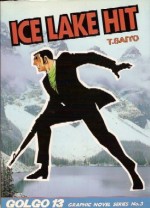
‘Ice Lake Hit’ leads off the third volume and finds “Duke Togo” hunting Moose in the arctic Northwest Territories of Canada. When he makes an impossible shot it quickly attracts the suspicions of the Game Warden and local Mounties, but the visitor’s real prey are more than capable of shooting back…

In a veritable bloodbath the story of a CIA traitor and a Soviet spy-ring emerges, but as ever careful planning and uncanny skill are more than a match for mere guns and numerical superiority…

The second tale deals with the legal and illicit trade in horsemeat to Japan and sees a motorbike-riding G13 stalking a gang of modern rustlers terrorisingTexas. ‘Machine Cowboy’ finds Togo employed by a widow whose one true love was taken from her, and  even if the cops are reluctantly prepared to investigate the murder of her ranch foreman they won’t do anything to find the killers of her beloved steed Whitey – but Golgo 13 will…

Produced for adults, all these tales are casually steeped in nudity, torture and brutal graphic violence, but the content and heartfelt outrage Saito imbues this tale with make it easily the most disturbing story many readers will ever experience.

The final volume is also an ecological nightmare scenario. ‘The Ivory Connection’ begins when unchecked elephant poaching in Uganda prompts members of the World Wildlife Fund to hire G13 to cull the offending culprits (and wouldn’t it be nice to think that all our past donations were as sensibly used?). The trail leads from British mercenaries through African civil wars to the medicine monsters of the Chinese triads, but as ever the ice-man has just the plan to handle all his opposition…

This book ends with ‘Scandal! The Unpaid Reward’ and pits Togo against a West German kingmaker who wants his political rival not only dead but his victim’s party utterly humiliated and discredited. Set at the height of the Cold War this tense thriller perfectly illustrates why, if you hire the world’s greatest assassin, it’s imperative to pay him what you promised once he’s accomplished his mission…

Like most tankobon editions each volume in this too-brief series (which reads from left to right in the Western manner), begins with a painted colour section which devolves into two tone (black and red) before eventually resolving into standard monochrome for the bulk of each book, but readers of British comics shouldn’t have any problems with that, and these savage, addictive, so very clever and compelling tales are worth a little time and effort. Track him down: you won’t regret it…
© 1986, 1987 Saito Production Co., Ltd. All rights reserved.

Twin Spica volumes 1 & 2


By Kou Yaginuma, translated by Maya Rosewood (Vertical)
ISBNs: 978-1-934287-84-2 & 978-1-934287-86-6

The mystery and imagination of space travel, so much a component of immediate post-World War II industrial society, returns in all its resplendent wonder and glory in this freshly translated new manga series from young talent Kou Yaginuma who first stormed to public attention with the poignant short story ‘2015 Nen no Uchiage Hanabi’ (‘2015: Fireworks’, published in Comics Flapper magazine, June 2000) before turning the subject, themes and characters into a longer epic combining hard science and fiction with lyrical mysticism and traditional school days growth pangs

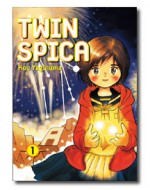
2024AD: Asumi Kamogawa is a teenaged girl who has always dreamed of going into space. From her earliest moments the lonely child has gazed up at the stars with her imaginary friend Mr. Lion, staring at the heavens, and especially at the twinkling glow of Virgo and the alluring binary star Spica. An isolated, serious child, she lives with her father, a labourer who once worked for the consortium which built the space rockets for Japan’s Space Program.

In 2010, when Asumi was a year old the first Japanese space launch ended in complete disaster when the ship, dubbed Shishigō (“The Lion”), exploded and crashed to earth on the city of Yuigahama. Hundreds of people were killed and injured, including Asumi’s mother. Maimed and comatose, she took years to die and the trauma broke her grieving husband and utterly traumatised the infant Asumi.

In response to the disaster Japan founded an astronaut and space sciences training school and as the first volume opens Asumi discusses with her imaginary friend the best way to tell her dad that she has secretly taken the entrance exam. Tomoro Kamogawa is a no fan of the space program, having lost his wife, his engineering job and his pride to the race for space. He has raised his daughter alone by working two and often three menial jobs at a time for over a decade.

The problem is taken out of her hands when he opens her results letter and sees that she has been accepted for the next intake for the Tokyo National Space School. After initial resistance he surprises Asumi by not only allowing her to go, but also by giving her all his savings to pay her expenses. Arriving in Tokyo, Asumi moves into the dilapidated campus dormitory with a few other students too poor to live in private lodgings. A further surprise comes when she discovers that Shinnosuke Fuchuya, the boy who teased and bullied her all through school, has also been accepted for the Astronaut course. When questioned he grunts that he’d rather do anything other than run the family fireworks shop…

The course is heavily over-subscribed so the candidates are winnowed out by spending the first week in an adaptability stress test: three to a room, in complete isolation, taking mental and physical tests to determine how they would cope with conditions similar to an extended stay in a space capsule. Tiny Asumi (only four feet, eight inches tall) is placed with the jolly Kei Oumi and chilly, acerbic Marika Ukita whilst Fuchuya’s team is cursed with spooky, ultra-cool style-icon Shu Suzuki…

It quickly becomes clear that the tutors are being devious and the tests are actually designed to measure not just their survival capabilities but also their ability to get on in a crisis. As the week progresses tempers fray and Asumi suffers a flashback to the aftermath of The Lion’s crash…

Only thirteen teams make it through the test. However, even though she is a survivor, worse is to come for the young Asumi…

This first volume includes that painfully powerful and wistful tale‘Fireworks: 2015’, the first of five introductory stories the artist produced for Seinen (manga for older readers; mostly males aged 18-30) publication Comics Flapper. Asumi is a troubled little girl: always running away and even stealing the ashes of her mother, who has just died after years in a coma following the crash of the space rocket onto Yuigahama city.

On her travels the little girl meets a man with a lion’s head, who seems to know her teacher Suzinari. Deeply concerned for Asumi, Suzinari also has problems of her own. She still desperately misses her fiancé, who piloted The Lion and died in the tragic explosion five years previously…

‘Asumi’ is another prequel tale, showing the miserable, melancholic period immediately following the disaster. Bullied in elementary school the little stargazer runs away and gets lost in the wild woods, before chief miscreant Fuchuya heroically saves her from drowning. But were the people Asumi met just hallucinations of an oxygen-starved brain or something far more meaningful and miraculous…?

The first book ends with the vignette ‘Another Spica’ wherein wannabe manga artist Yaginuma is working part-time on a soft-drink stand one Christmas when he sees a little girl who twinkled like the stars and a man with a lion’s head…
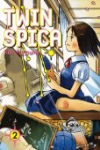
The second volume follows space cadet Asumi as she adjusts to life in Tokyo: moving into women’s dorm “The Seagull”, making friends, starting classes and scraping by on her meager funds. An assiduous student, she nevertheless incurs the hostility of the astrophysics lecturer Professor Sano. Unknown to her Sano has bad history with her father and will seemingly do anything to thwart her dreams…

Asumi is far smaller than all the other candidates and though determined to succeed in the arduous physical and mental training incurs real problems in the swimming classes due to her near-drowning as a child. Moreover her size means she will need a custom-made pressure suit – giving Sano an opportunity to force her out by citing budget restrictions.

When this doesn’t work he steps up his campaign and really turns the screw on the unsuspecting Asumi, revealing a shocking secret about her father…

This volume also contains prequel stories of Asumi’s early life and in ‘Campanella’s Forest (referencing author Kenji Miyazawa’s novel Night on the Galactic Railroad) and exploring the past of the astronaut who piloted The Lion and highlighting Suzinari’s relationship with him. Meanwhile, Asumi has got lost again and stumbled upon something wonderful in the woods…

Tomoro Kamogawa is the tragic star of ‘Our Stars, Leaf Stars’. In the wake of the Lion disaster Asumi’s father was assigned by the corporation who built the ship to head the reparations committee. Guilt-wracked and himself bereaved, the devastated engineer had to visit and apologize to each and every survivor or victim’s grieving family. Meanwhile, little Asumi has found a new friend: another little girl forever scarred by the crash.

And as always the faithfully attendant Mr. Lion looks sadly on …

The volume concludes with a second ‘Another Spica’ episode as the cartoonist relates the time he worked in a shopping mall and had to dress up in a monkey suit, as that girl and that lion-headed guy simply looked on and mocked…

Twin Spica ran for eight enchanting years (September 2001 to August 2009): sixteen full volumes tracing the path of Asumi and her friends from starry-eyed students to fulltime astronauts and the saga spawned both anime and live action TV series.

This delightful comicbook epic has everything: plenty of hard science to back up the savvy extrapolation, a believable, likable cast, an enduring mystery, tender moments, isolation and teen angst, dawning true friendships, all wrapped up in a joyous coming-of-age drama with supernatural overtones and gobs of pure sentiment.

This tale reinvigorates the magical allure of the Wild Black Yonder for a new generation and is a treat no imagineer with head firmly in the clouds can afford to miss…

These books are printed in the Japanese right to left, back to front format.

© 2010 by Kou Yaganuma/Media Factory. Translation © 2010 Vertical, Inc. All Rights Reserved.

Nightschool: The Weirn Books volume 1


By Svetlana Chmakova (Yen Books)
ISBN: 978-0-7595-2859-8

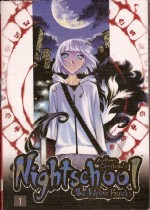
The sub-genre of supernatural students and spooky schooldays has come a long way since the days of the Worst Witch or even Buffy of Sunnydale High, but this tantalising and impressive entry from Svetlana Chmakova (whose delightful series Dramacon introduced her as a major talent in the international manga world) which stands head and shoulders above the crowd and simply cries out for greater exposure.

PS 13W is just an ordinary High School during the day, but when darkness falls the place is sublet to an entirely different faculty teaching a far more bizarre and dangerous student body (well, different anyway – I’ve seen the everyday shamble of oiks, nerds, preppies and deviants that tumble out of our local educational establishment come chucking out time only to stampede past my front door on their way to celebrate their temporary freedom in mischief, malice and mishap…)

Because this Nightschool caters to such a diverse and often predatory catchment, the usual staff of wizardly teachers and assistants is generally supplemented by a Night Keeper – a supernatural security agent who keeps the peace and minimises collateral damage when students and staff – witches, warlocks (collectively known as Weirn), werewolves, vampires and every shade of juvenile haunt and horror – join in the business of Education.

Sadly the latest Keeper, thoroughly modern Miss Sarah Treveney has something of a punctuality problem… Although the school caters for a broad spectrum of monsters, Sarah’s sister Alexius has to be home-schooled due to an unspecified secret problem, and splitting her time between teaching Alex the magic of the Weirn all day and working all night is taking its toll…

The peace that keeps mortals safe from the assorted eldritch tribes is due to an ancient pact: A Treaty administered by an enigmatic cult of young warriors called Hunters who prowl the city dealing with supernatural threats. They are led by a charismatic teacher called Daemon. Later volumes will eventually reveal a history of ancient strife and impending chaos, but for this first collection (comprising the first six months of the strip) they simply patrol and police the places where rogue night creatures prowl…

When Daemon’s team rescue a young Seer, Marina, from unscrupulous mortals seeking to exploit her prophetic abilities she warns him that a long-dormant menace is breaking the seals which have kept it safely imprisoned for centuries…

Unknown to Sarah, little sister is not the housebound claustrophobe she imagines. Driven by urgings beyond her comprehension Alex often roams the night with only her astral familiar to protect her from mortals and monsters – or is it the other way round?

When she invades a cemetery Alex stumbles across a romantic vampiric tryst and Daemon’s Hunter team in the process of ending it. Suddenly all parties are attacked by Rippers – mindless devolved Nosferatu, all claws and teeth and burning lethal hunger…

When the spectacular battle ends Alex is gone and although more than a match for any known magical threat, three of the Hunters lie mysteriously comatose. The younger Treveny wakes safely at home with no recollection of how she returned, but at the Nightschool things aren’t going so well for Sarah.

Making inroads with the staff and students the Night Keeper thinks she might just make a real go of her job, but when a kid she doesn’t recognize lures her into a horrifying trap she disappears from sight and memory of everybody who once knew her. Moreover, all physical evidence of her existence is fading too. At home Alex sees a photograph gradually disappear and realises she must to something. Girding herself she enrolls in the midnight high school, as all over the cities something very nasty is stalking the Hunters…

This is the merely the opening stage of a much larger and more complex epic, (which has been and is still steadily progressing in monthly installments in the Japanese magazine Yen Plus since August 2008), so it might be preferable to pick up the first three volumes – all that has been collected into books so far – and tackle them at once.

However, the sheer exuberance and quality of storytelling and art here is enough to carry this first book; blending mystery, comedy and spellbinding action with a huge cast of engaging characters. Fun, thrilling and wonderfully addictive.

© 2009 Svetlana Chmakova. All Rights Reserved.

Goosebumps Graphix 2: Terror Trips


Adapted by Jill Thompson, Jamie Tolagson & Amy Kim Ganter (Graphix/Scholastic)

ISBN: 978-0-439-85780-2

How to get children reading has been a desperate quest of educators and parents for decades and the role of comics in that drive has long been a controversial one. Excluding all the arguments over whether sequential narrative hinders, harms or perhaps helps, the only other option was to produce material youngsters might actually want to read.

Enter R.L. Stine in 1992, who wrote sixty-two light-hearted, child-friendly supernatural horror thrillers over the next five years that took the world by storm, spawning movies, TV shows, games and a host of imitators, reconfiguring the iconography of the classic tales of mystery and imagination into modern romps to engage youngsters in the greatest thrill of all – total absorption in the magic of stories. In its various incarnations and reboots Goosebumps has sold more than 300 million copies.

In 2006 Scholastic began a series of themed graphic novel adaptations, using top comicbook and manga talent to convert three books per volume into hip and striking cartoon yarns. I’ve picked the second “Goosebumps Graphix” edition for no other reason than my complete devotion to the work of one of the artists involved (eventually I’m sure I’ll get around to the others…)

Terror Trips leads off with ‘One Day at Horrorland’ (the sixteenth novel in the prose series) adapted and illustrated by the utterly superb Jill Thompson, who despite her incredible body of work, ranging from Sandman to Wonder Woman and her fabulous Scary Godmother books and films is some how still not a household name.

When a day-trip to Zoo Gardens with their parents goes awry, Lizzy, brother Luke and their friend Clay find themselves lost and alone in the best – or perhaps worst – scary theme park ever. If she wasn’t such a big girl now and didn’t know better, Lizzy might almost believe all those monsters and death-traps were real…

Multi-media artist Jamie Tolagson (The Crow, The Dreaming, Books of Magic) translated the truly creepy ‘A Shocker on Shock Street’ (novel #35) with stunning effect. Under-aged horror movie mavens Erin and Josh think they’ve seen everything, but when Erin’s movie director and FX designer dad invites the pair to the studio to see the new “Shock Street” theme park they’re in for the most startling surprise of their young lives – and so is the reader…

The third and final jaunt into jeopardy is ‘Deep Trouble’ (novel #19) adapted by Amy Kim Ganter, manga and webcomic artist (see Sorcerers & Secretaries for a delightful example of her firm grip on fantasy). Here she relates the time William Deep Jr. accompanied his marine biologist father on an expedition to discover if mermaids actually existed. Unfortunately, the worst beasts in the oceans are usually greedy humans, but the sea still had a few undiscovered horrors of its own lying hidden beneath the surface…

This splendid selection is delivered in a variety of black and white styles, and each tale is augmented by a feature explaining the working process of the artists as they translated the story into comics form. Both the novels and comic books are readily available so why not save yourself the cost of outrageous dental bills this Halloween by stocking up on comic chillers such as this and handing out stuff to chew over rather than simply swallow – and remember, if used correctly books are not fattening…?

© 2007 Scholastic Inc. All Rights Reserved.
Crouching Tiger, Hidden Dragon volumes 1 & 2


By Wang Du Lu, adapted by Andy Seto (ComicsOne Corp.)
ISBN’s: 978-1-58899-999-3 and 978-1-58899-175-1

Hong Kong comics are beautiful. They’re produced using an intensive studio art-system under the aegis of a master storyteller acting like a tactician and commanding general; which means any individual page might be composed of numerous graphic styles and techniques: literally anything that will get the job done.

And that job is to enhance not nuances of plot but rather details of the dynamic action and poetic mysticism/philosophy of Kung Fu that my western sensibilities just aren’t attuned to. They are astounding to look at, but I don’t expect them to make much sense.

However in this series, adapting an earlier part of the epic tale (a mere part of which inspired the phenomenal Ang Lee movie) the non-stop kinetic hurly burly is nicely tempered by a more universal narrative form that shouldn’t deter even the most hidebound Gwailo like me.

The original saga forms a sequence of five “Wuxia” novels by author Wang Du Lu known as the Crane-Iron Pentalogy which Andy Seto adapted into a twelve volume series of graphic novels. Wuxia is generally translated as “martial arts literature” with Xia denoting “honorable” or “chivalrous” and wu “soldier”, “warrior” or “military.” The film mostly worked from the fourth novel, so this interpretation could be construed as a prequel of sorts.

Chinese languages are hard to master because the tongue is filled with willful ambiguity. Almost pun-like, one translation of Crouching Tiger, Hidden Dragon is “dangerous or talented individuals concealed from view” and the names of the lead characters are also coded symbols for their symbolic characteristics… Don’t let that deter you though, this is classical storytelling winningly wedded to non-stop crackerjack action, magnificently illustrated.

In the first volume masked thieves steal the mighty Green Destiny sword from the palace in Beijing despite the best efforts of master guard Yu Gan Cheung – called “Golden Spear”. Tasked with retrieving the invaluable blade Golden Spear prevaricates. His wife Jeng Ho has called him to help her finally avenge the slaying of her father…

Meanwhile in Hebei Province aged Master Grand Yu knows his prowess is failing, but is proud that his beautiful daughter Yu Shu Lien will soon be an even greater Kung Fu practitioner than he ever was. Whilst travelling to a festival the family is attacked by Jeng’s siblings the Ho brothers, determined to have vengeance for the death of their sire at Grand Yu’s hands.

Elderly and overmatched, Yu is saved by the fantastic fighting skills of his daughter, but the Ho clan are determined to destroy the old Master, if not with Kung Fu then by bribing the corrupt local judges…

Meanwhile Wudan disciple (if regular Shoalin Kung Fu concentrates on outer or corporeal strength Wudan teaches the harnessing of inner strength – Chi: nobody messes with Wudan Masters…) Li Mu Bai is looking for a wife and an emissary tells him of Grand Yu’s accomplished young daughter…

Travelling to Hebai Li challenges Shu Lien to a spectacular duel and finds her satisfactory, but although he would be welcome as a son-in-law Grand Yu has to decline the marriage offer as the girl is already betrothed to another. Decent and honorable Li Mu Bai decides to wander the world alone but the Ho brothers scurrilous plans to destroy the Yu clan draw him inexorably back to the girl he desires above all others…

Volume 2 finds Li following a gang of riders. His sensitive nature instantly knew they planned evil and his honorable spirit drove him to help whomever they wished to harm. Grand Yu’s family are being attacked again by the murderous Ho brothers and Shu Lien has her hands full battling the deadly Jeng Ho when Li arrives to turn the tide.. The combat abruptly ends when the local authorities arrest everybody.

Old Yu is severely drained by the conflict and fares badly under questioning. Moreover the corrupt officials seem to favour the bigger bribes of the Ho faction. Things look bleak for the Yu clan, and Li volunteers to bring more money but before he can leave the old Master passes away.

Although he desperately wants Shu Lien for himself Li promises to convey the girl and her mother to the arranged husband Master Yu picked for her, but when the party arrives more trouble awaits. Shu Lien is betrothed to Chou Mong, the son of a wealthy lord, but the bridegroom-to-be has gone missing. A troublesome son, he was always getting into shameful situations and has now vanished…

Honouring their obligation, the Mongs welcome Shu Lien and her mother into the household until the groom’s whereabouts can be established. The noble Li determines to find the wastrel and return him to his intended bride: the honour-bound but extremely reluctant Shu Lien…

Li’s search takes him to Biejing where the Wudan adept encounters and trounces a terrifying gang of bandits who are holding to ransom all roads into the city…

These digest-sized tomes pack a lot into their pages. As well as the lush and lovely, if panoramically rambling, tale and non-stop breathtaking fight scenes there are also enticing previews of other oriental epics, creator profiles, biographies, art and information pages on the character’s weapons, honorariums from the author’s widow and even Andy Seto’s diary.

Superhero fans might be amazed at the variety of powers a lifetime of knuckle push-ups and bowing can produce, but these tales are wedded to the concept of training and will creating miracles. They are, however, irresistibly exuberant, beautifully illustrated and endlessly compelling. If you’re an open-minded fan, you may find yourself carried away on an incredible tide of non-stop action, apparently shallow characterisation (at least to Western eyes – for the target market the pictures are everything: how a participant looks is his/her interior and exterior) and immense scope of this colossus of a tale.
© 2002, originated by Seto Kim Kiu. All Rights Reserved.