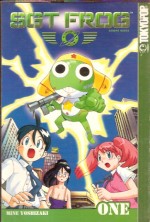
Sgt. Frog Volume 1


By Mine Yoshizaki, translated by Yuko Fukami (Tokyopop)
ISBN: 978-1-59182-703-0

Another monumentally popular manga saga of recent years is this broad, archetypically Japanese fantasy comedy with all the prerequisite elements for success. Keroro Gunsō, Sergeant Keroro or here Sgt. Frog is the mildly malevolent destabilising element that disrupts the life of schoolboy Hinata, just as he’s making the thoroughly distressing move from Elementary to Middle School.

As leader of the school’s Occult club Fuyuki is open to most new and fantastic experiences but even he is given pause when he and his obnoxious “oh-so-perfect” older sister Natsumi accidentally capture a frog-like alien hiding in their house. The revelation panics the orbiting Keronian battle fleet and sends it scuttling away in panic, abandoning all their hidden operatives and leaving them to fend for themselves.

Leader of an elite platoon of infiltrators Keroro offers his surrender but doesn’t really mean it, intending to overcome the primitive earthlings or “Pokopenians” when their guard is down. But as the days pass the little monster gradually “goes native”, succumbing to the constant mental abuse of Natsumi, the grinding drudgery of imposed household chores and the addictive delights of television, the internet, pop music and Gundam model kits. Besides, Fuyuki confiscated his all-purpose Kero Ball super-weapon and the Pokopenians’ mother Aki is a super-hottie MILF who edits manga comics…

A lot of the added-value, in-joke pop-references will have been lost to most English-speaking readers: casualties of both the translation process and the passage of time, but some of the Frog’s wider word-play and constant harping on Bandai model kits, Gundam, Space Battleship Yamato, Dragon Ball, Neon Genesis Evangelion and other ubiquitous elements of modern Japanese fan-culture will still resonate I’m sure…

A further complication occurs when wealthy Mimoka Nishizawa, a shy classmate of Fuyuki’s – who secretly has the biggest crush on him – is found to be in possession of another abandoned platoon member, the highly devoted and incredibly destructive Private Tamama. Mimoka is unable to tell Fuyuki of her feelings and her frustrations usually manifest in psychotic, explosives rages and ultra-violent tantrums…

This first volume features the first dozen episodes or “encounters” and follows the gradually unfolding epic as Keroro’s glittering past and future plans are exposed, with loads of the brutal slapstick, dire puns, situational embarrassments and social gaffe ironies beloved of Manga humour books, but there’s also some touching moments and poignant touches as the ever-expanding cast (which includes ghosts and ancient gods of destruction) go about their lives unaware that everybody’s playing a double game…

Debuting in boys weekly Shonen Ace to immediate success, naturally the series has made the jump to television, movies, computer and even role-playing games. The collected, translated volumes number 18 and counting, comprising an exceedingly engaging light and fluffy concoction that will charm and delight genre fans and casual reader equally.

This book is printed in the ‘read-from-back-to-front’ manga format.

© 1999 Mine Yoshizaki. English text © 2004 TokyoPop Inc.

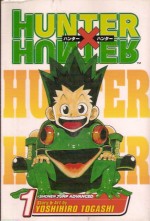
Hunter x Hunter Volume 1: The Shonen Jump Advanced Edition


By Yoshiro Togashi (Viz)
ISBN:  978-1-59116-753-2

It’s been a while since I reviewed manga graphic novels in any breadth or depth so I’m going to start again, but as there’s simply so much new material around I’ve opted to concentrate more on older series with a few volumes under their belts, occasionally leavened with whatever new material catches my eye – or that publishers send us.

Moreover, I’m no expert, so these will be thoughts restricted to the simple perspective of an interested casual collector, and measured against all other illustrated stories and not other manga/anime. There are plenty of specialist sites to cater for that and they’re there at the touch of a search engine…

Hantā Hantā (which I translate as either Hunter times Hunter or Hunter Versus Hunter; someone who actually speaks Japanese may not concur) first appeared in Weekly Shonen Jump in March 1998, before exploding into 27 volumes of manga, an anime series and three cartoon movies (so far) and primarily tells the extremely engaging and phenomenally extended tale of young Gon Freecss; a gifted twelve-year-old lad abandoned by his father, who dumped the kid on an aunt in the agrarian backwater of Whale Island before disappearing.

Gon is an exceptional child with a restless nature, big dreams and some uncanny abilities. In the alternate world of fantastic creatures that Gon inhabits the best job in the world is that of the Hunter: incredible Renaissance Men who combine the talents of detectives, treasure hunters, archaeologists, assassins, bounty hunters and repo-men with astounding physical prowess, travelling the world for profit or sheer scientific curiosity. If somebody wants something Hunters will get it.

One day Gon meets a hunter who reveals something the lad had already deduced. His missing father Ging was one of the greatest Hunters of all, and is still alive somewhere. Gon immediately resolves to become a Hunter too, but things are not that simple…

Hunters must pass a horrendous exam, and just getting to that exam is one of the most difficult tasks imaginable. Undeterred, Gon says his goodbyes to Aunt Mito, not realising his assessment has already begun. Taking ship to the mainland he joins dozens of other candidates including enigmatic orphan Kurapika and brash Leorio, the only two hopefuls not to fall at the first hurdle.

Reaching Dolie Harbour the three would-be Hunters endure a number of tests and challenges just to find the Examination site: and that’s where the real testing of their worth and character begins…

Nearly 50 million copies of Hunter x Hunter have been sold thus far, and it’s no surprise. This is a perfect example of the “young hero’s path to destiny” fantasy adventure that Japanese creators do so very well, blending action, humour, unashamed sentiment and wondrous imagination into a seamless, supremely readable confection that is impossible to put down and always leaves the reader hungry for more. Gon and his comradely rivals strive to overcome all obstacles, each blessed with their unique talents and motivations and the tale fairly rattles along until the abrupt cliffhanger end hits like a thunderbolt.

Superbly entertaining, you’re best advised to read this gem a half-dozen volumes at a time.

This book is printed in the ‘read-from-back-to-front’ manga format.

© 1998 POT (Yoshiro Togashi). All Rights Reserved.

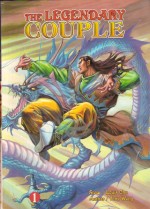
The Legendary Couple Book 1


By Louis Cha, Tony Wong & various, translated by Stuart Young (ComicsOne)
ISBN: 978-1-58899-191-1

If you’ve never experienced the unique manner in which Hong Kong comics are told and count yourself more of an art-buff than story junkie then the non-stop action and blistering, bewildering pace of these lush and lavish martial arts mystic mysteries could be a way to renew jaded appetites.

Whether original yarns, adaptations of legends and myths or novels such as celebrated Chinese writer Louis Cha’s book Return of the Condor Heroes which forms the basis of this staggering generational saga of love and vengeance, all stories for this market involve dastardly plots, glorious heroes and increasingly puissant combat philosophers and savants of spiritual mayhem battling interminably and usually with no discernible victors or victims.

Crafted in a variety of artistic styles including pen-and-ink, crayon, painted art, even photography, this is an exotic and frenetic comicbook about fighting, heavily influenced by the mystical component of Kung Fu. If you prefer a semblance of realism in your fiction this rollercoaster romp is not for you. This is Fighting Fantasy.

Superhero fans might be amazed at the variety of powers a lifetime of knuckle push-ups and bowing can produce, but these tales are wedded to the concept of training and will creating miracles. They are, however, irresistibly exuberant, beautifully illustrated and endlessly compelling. If you’re an open-minded fan, you may find yourself carried away on this relentless tide of non-stop action and shallow characterisation (at least to Western eyes – for the target market the pictures are everything: how a participant looks is his/her interior and exterior).

I’ve said it before and it’s still true. Hong Kong comics are beautiful. They’re produced using an intensive studio art-system that means any individual page might be composed of numerous graphic styles and techniques: literally anything that will get the job done.

And that job is to enhance not so much nuances of plot but rather details of the mysticism/philosophy of Kung Fu that my western sensibilities just aren’t attuned to. They are astounding to look at, but I don’t expect them to make much sense.

In this first of six volumes we are introduced to an army of warriors and fighting masters; living pin-ups spouting impressive genealogies, greatest hits and their duelling preferences and specialisations before getting down to the spectacular business of determining just whose Kung Fu and what secret techniques is the mightiest.

The slim narrative thread is provided by the tragic tale of Yang Guo; separated from his beloved Xiao Longnu for 16 years during the Song Dynasty of old China, and who spent the intervening time overcoming harsh odds and perfecting his abilities. Now with reunion in sight both lovers wonder if their passion has survived the years…

None of which is particularly germane here as almost the entire volume is a prequel, which introduces the myriad forces and players, brought together by the bloody vengeance spree of Chuo Lee, driven to madness when the noble Yuan Lu spurned her attentions, preferring the genteel Guan Ho instead. Chuo Lee, bloody rampage of murder and destruction earned her the name Fairy Qilan – the Red Snake Fairy.

Her depredations draw a number of disparate individuals fated to clash and love and die…

Because that’s fundamentally what this genre is about: glorious, lavish, mind-blowing exhibitions of Kung Fu excellence. Like much of the region’s classic cinema, all other considerations are suborned to the task of getting the fighting started and to keeping it going. If you’re looking for intense personal investiture, sharp dialogue or closure, look elsewhere. If, however, you want Good Guys thumping Bad Guys in extended, eye-popping ways, you might want to give this a go. Be warned though, it is by nature and design, a never-ending battle…

© 2002 JD Global IP Rights Limited. All rights reserved.

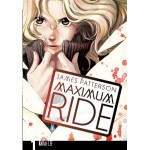
James Patterson’s Maximum Ride Book 1


Adapted by NaRae Lee (Arrow Books)
ISBN: 978-0-099-53836-3

When young Max dreams of being chased by mysterious beastmen her method of escape is to sprout wings and fly like an angel. However, when she wakes up and rejoins the rest of the little gang of juvenile misfits she lives with we discover that Maximum Ride’s nightmares are merely memories…

Among his many works James Patterson’s has written seven teen novels (beginning in 2005 and still proceeding) starring a band of human/bird hybrid kids on the run from mysterious forces. This manga adaptation gets underway as we’re introduced to that band of youngsters hiding out in a dilapidated house, whilst “the Erasers” – artificial werewolves and high-tech mercenaries – hunt them down.

Four years previously they were brought to their isolated hideaway by Jeb Batchelder who rescued them from their creators in the sinister complex known as “The School”. After years in hiding with them, one day Jed disappeared and Max, as the eldest, became a sort of den-mother for the brood…

Although beautifully illustrated and captivatingly well-paced, too much of this first adapted volume is spent trying not to not reveal the secret of the human/avian heroes, but for the sake of expediency I’m going to risk a little spoiler. They have highly efficient and totally concealable wings, hollow bones, improved lungs, hearts, muscles and eyesight. They are human hawks, and may even have other dormant powers and abilities…

The kids are the result of rogue scientific research but have fled from their creators, who want them back and are slowly closing in. When Eraser raiders capture the youngest girl, Angel, the rest of “The Flock” – Fang, Iggy, Nudge and Gasman – stop hiding and decide to get her back. With Max leading they return to civilisation and begin the search for their sister and their origins…

Along the way Max is separated from the rest and wounded, but finds help in the form of Ella Martinez and her mother. As a vet, Ella’s mum has access to some impressive equipment and while patching up Max’s wing discovers that the little hawk-girl has an electronic transmitter embedded deep within her, far too deep for anyone to remove…

Hard on the heels of this revelation the Erasers move in and the entire Flock is captured. Looked in an interrogation cell, Max fears the worst when suddenly a face from the past surprises her with the biggest shock of all – the incredible purpose for which the hybrids were created…

The scenario and atmosphere of Patterson’s series about The Flock will feel very familiar to any comics fan who has read X-Men and its myriad mutant offshoots, and this book is compiled of chapters that originally appeared in the manhwa magazine Yen-Plus. The tale is a fine example of the sort of “Us against the World” orphan-fiction young readers seem naturally drawn to: fast-paced, emotive, evocative, cute and thrilling.

Accompanied by a welcome cartoon afterword by Korean artist Narae Lee, who can’t be much older than the target audience, this is a solid read and great fun, but be warned, is only the trip of a huge iceberg. There’s lots more to come before just the first prose novel is completely adapted, so impatient readers might want to wait until they can pick up a bunch of the graphic novels all at once (volumes #3 and 4 are still forthcoming from a scheduled set of 10). However if you want to beat the rush before the forthcoming movie franchise kicks off you could get a flying start by buying this book now…

© 2009 SueJack, Inc. Illustrations © 2009 Hachette Book Group, Inc. All rights reserved.

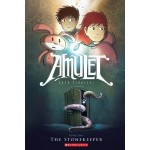
Amulet Book 1: The Stonekeeper


By Kazu Kibuishi (Scholastic)
ISBN: 978-0-439-84681-3

Picture books and illustrated stories for children have been a staple of the publishing game since the Victorians, so the modern trend towards actual graphic narratives was an inevitable but nonetheless welcome accomplishment. However the wholesome and comfortable adventures of Babar, Tim All Alone, Captain Pugwash and their like have new rivals these days, thanks mostly to the cultural invasion of Japanese anime to our TV screens and a long-overdue Western acceptance of manga-style storytelling.

For example this delightful little strip saga, cut fully from the same cloth as The Spiderwick Chronicles and spookily touching base with darkest Narnia and the best of Alan Garner, joins a growing library of trans-Atlantic, pan-Pacific fantasy thrillers for younger readers, albeit with lush, glossy colours to lure in European consumers still uncomfortable with the linear purity and monochrome aesthetic of traditional Eastern comics.

Amulet is the first in a sequence of junior graphic novels, and opens with a horrific personal tragedy as little Emily sees her father die in a ghastly car crash. Two years later she and her little brother Navin are taken to live in their great grandfather’s ramshackle, spooky old house. Still grieving, the family are making a go of it, but the dilapidated pile is just not right: there are eerie voices, odd noises and happenings – and far too often the kids are seeing something moving at the furthest corners of their eyes…

Great Grandpa Silas vanished one night never to be seen again, and Emily is convinced that she can see cloudy phantoms just when and where she isn’t looking. Whilst helping mom clean, the kids happen upon an ingeniously hidden necklace which Emily swiftly appropriates. She begins to think twice when its ornate stone starts talking to – or rather lecturing – her…

Soon the house goes into full-on haunted mode and when mom investigates the cellar she is consumed by a monster and stored for later digestion. Emily and Navin give chase and soon are lost in a fantastic subterranean world where they encounter incredible beasts, dark elves and a giant figure who turns out to be Miskit, a cute helpmate built by the missing Silas.

Long ago the solitary inventor crossed over to this land of Alledia and learned the secrets of The Stones; mighty mystical artifacts that could be more curse than blessing. Building himself a small army of companions he decided to stay, but the land was a place in turmoil. Whoever holds the Stones could rule this entire world and do anything they wanted. That’s good to know since Emily’s Amulet is becoming more bossy than helpful, and the more she uses its incredible forces the more it needs her to…

This time Emily has the ability to save her mother: even if she might have to fully embrace the power of the amulet, and take on a destiny she doesn’t want…

This is a dark and compelling adventure blending traditional children’s story elements such as fairies and magic with contemporary kids-scape paraphernalia like giant robots, cartoon animals, rocket-ships, bug-eyed monsters, cute-eyed bugs and alternate Earths in a zippy rollercoaster ride of laughter, tears and terrors. This volume is a self-contained tale but the ending of this adventure leads directly to the next…

And you will want to see them all. Stirring stuff for older readers and any fantasy fan with a tinge of darkness in their collector’s souls…
© 2008 Kazu Kibuishi. All Rights Reserved.

Black Jack volume 10


By Osamu Tezuka (Vertical)
ISBN: 978-1-934287-74-3

In a creative career that produced over 700 hundred different series and more than 150,000 pages (many of them only now finally becoming available to people who can’t read Japanese), Osamu Tezuka captivated generations of readers across the world with tales of history, fantasy, romance and startling adventure. Perhaps his most intriguing creation is Black Jack, an underground surgeon who overcame horrendous childhood injuries and, despite carrying many scars within and without, roams the globe, curing anybody who can pay his deliberately daunting, exorbitant prices – usually cash, but sometimes in more exotic or metaphysical coin.

He is the ultimate loner, except for Pinoko, a little girl he literally built from the organic scraps of an early case. Unlicensed by any medical board on Earth, he holds himself to the highest ethical standards possible… his own. All the troubles and wonders of this world can be found in medical dramas, and here elements of rationalism, science-fiction, kitchen sink drama, spiritualism, criminality, crushing sentimentality and shining human frailty are woven into an epic of Magical Realism to rival the works of Fuentes and Gabriel García Márquez.

Black Jack is at once a lone wolf hero, troubled genius, passionate outsider and amoral humanitarian combining the indomitable will of Doc Savage with the intellect of Sherlock Holmes and ambivalent, intuitive drive of Dr. Gregory House. Hideously scarred, viciously spurning all human comfort, the unlicensed mercenary medic endures public condemnation and professional scorn, as he continually confronts the cutting edges of medicine and reality.

His esteemed creator Osamu Tezuka was born in Qsaka Prefecture on 3rd November 1928, and as a child suffered from a severe illness. The doctor who cured him inspired him to study medicine, and although the cartoonist began his professional drawing career while at university, he persevered with his studies and qualified as a doctor too.

Facing a career crossroads, Tezuka’s mother advised him to do the thing that made him happiest. He never practiced medicine but the world was gifted with such classic cartoon masterpieces as Tetsuwan Atomu (Astro-boy), Kimba the White Lion, Buddha, Adolf and literally hundreds of other graphic narratives. Along the way Tezuka incidentally pioneered, if not actually invented, the Japanese anime industry.

Equally able to speak to the hearts and minds of children and adults, Osamu Tezuka’s work ranges from the charming to the disturbing, even terrifying. In 1973 he turned his storyteller’s eye to his past college studies and created Burakku Jakku, a lone-wolf doctor living beyond society’s boundaries and rules:  a heartless mercenary miracle-worker for the right price yet still a deeply human if wounded soul who works his surgical wizardry from behind icy walls of cool indifference and casual hostility…

This tenth volume begins with ‘Avina’s Isle’ a fantastic doomed romance as a pearl diving South Sea native risks everything to marry his princess, utterly unaware of the sinister forces arrayed against him. There are some injuries no scalpel or suture can remedy…

‘The Mask Chosen’ is a revelatory tale of vengeance that cuts to the heart of Black Jack’s frightful past as the surgeon’s missing father emerges after decades with an outrageous request, whilst ‘Revenge is My Life’ shows a different side to Man’s basest instinct in a passionate, convoluted story which sees the Surgical Samurai go to superhuman lengths to repair a shattered woman with every reason to hate him.

Possibly the most moving Black Jack story yet translated, ‘Unfinished House’ reveals why a man with all the cash that the rogue doctor has earned still lives in a ramshackle hovel, a powerful tale of debts honoured and obligations met. ‘Strangers at Sea’ is a tense nautical crime drama mystically transformed by the expansive, all-encompassing, uncompromising love Dolphins display for mankind. Bring tissues: many tissues.

‘Pinoko Returns’ stars the doctor’s big-hearted little assistant who adopts a thieving conman, only to suddenly disappear without trace. Black Jack, the man with no emotions, must weigh his heart’s greatest desire against the slimmest chance of finding his pestiferous creation…

Years before drug mules became a common storytelling Maguffin ‘The Man Who Threw Up Capsules’ used the phenomenon to weave a complex tale of corrupt family practitioners and the price paid for social prestige, whilst ‘Flesh And Blood’ returns Black Jack to his dying father’s side and introduces a sister he never knew he had. Of course it cannot end well…

‘Burglary’ shows the power and weakness of utter devotion as the Super Surgeon is asked to reconstruct the unique prosthetic limbs of a total amputee. But who would steal such intensely personal items and why does Lady Jane not want her arms and legs back? ‘Ashes and Diamonds’ is a much less disturbing story: a cool, cynical caper starring a young, idealistic doctor hired by a rich old man to check the infamous medical maverick’s work. It seems the billionaire paid Black Jack a fortune to implant billions in gems inside his failing body, and now he needs to know if the notoriously greedy mercenary medic did so or just kept the loot for himself…

In Hawaii Black Jack survives a ‘Hot Night’ when an unlovable Vietnam veteran requests his expertise after he nearly killed for the third time, ‘Ransom’ sees an incomprehensible relationship blossom between a vicious kidnapper and his victim whilst ‘Mannequin and Officer’ is a story that could only happen in Japan, as a cop develops a peculiar affection for a traffic dummy. Luckily Black Jack owes him a favour…

‘Playing Doctor’ ends this volume on a high and happy note as a school bully and his favourite victim join forces to cure a little girl. Bu then, she has never met the real Black Jack…

One thing should always be remembered when reading these stories: despite all the scientific detail, all the frighteningly accurate terminology and trappings, Black Jack isn’t medical fiction; it’s an exploration of ethics and morality with medicine raised to the level of magic… or perhaps duelling. This is an epic of personal combats, a lone gunfighter battling hugely oppressive counter-forces (the Law, the System, casual human cruelty, himself) to win just one more victory: medicine as mythology, won by a Ronin with a fast car and a Gladstone bag.

Thrilling, charming, bitterly insightful and overwhelmingly moving, these addictive magical stories of a medical wizard in a cruel, corrupt and ultimately unknowable universe will shake all your preconceptions of what storytelling can be…

This book is printed in the Japanese right to left, back to front format, and also contains an excerpt from the forthcoming new edition of Osamu Tezuka’s landmark graphic biography Buddha.

© 2009 by Tezuka Productions. Translation © 2009 Vertical, Inc. All Rights Reserved.

Black Jack volume 9


By Osamu Tezuka (Vertical)
ISBN: 978-1-934287-73-6

The art form of sequential narrative doesn’t have too many Great Names. There are plenty of superb creators; multi-disciplined or single focussed, who have contributed to the body of the art form, but we don’t have a wealth of Global Presences whose contributions have affected generations of readers and aspirants all over the World, like a Chaplin, Capra, Korda, Kurasawa or Hitchcock. There’s just Hergé and Jack Kirby and Osamu Tezuka.

In a creative career that produced over 700 hundred different series and more than 150,000 pages (many of them only now finally becoming available to people who can’t read Japanese), Osamu Tezuka captivated generations of readers across the world with tales of history, fantasy, romance and startling adventure. Perhaps his most intriguing creation is Black Jack, who overcame horrendous injuries as a child, and although still carrying many scars within and without, roams the globe, curing any who can pay his deliberately daunting, exorbitant prices – usually cash, but sometimes in more exotic or metaphysical coin.

The rogue super surgeon is the ultimate loner, except for Pinoko, a little girl he literally built from the scraps of an early case. Unlicensed by any medical board on Earth, he holds himself to the highest ethical standards possible… his own. All the troubles and wonders of this world (and sometimes other ones) can be found in medical dramas, and here elements of rationalism, science-fiction, kitchen sink drama, spiritualism, criminality, crushing sentimentality and shining human frailty are woven into an epic of Magical Realism that rivals the works of Fuentes and Gabriel García Márquez.

The drama begins with another challenging exploration of duty and honour in ‘Teacher and Pupil’ wherein a schoolboy attempts suicide rather than face one more day with his monstrous bully of a teacher. The reaction and response of the educational martinet will truly surprise you, as Tezuka once more shows his deep understanding of all aspects of human nature.

By the time of the stories collected in this stunning ninth volume, a strong internal continuity has been established and many of the tales cannot be properly enjoyed without reference to earlier episodes. ‘Pinoko Lives’ is a fascinating sequel to ‘Teratoid Cystoma’, the third tale in volume 1 wherein the scalpel-wielding ice-man moves Heaven and Earth to hunt down a mystery patient he once operated upon. With the surplus organs he removed from her he constructed his assistant Pinoko, but now this faithful, flighty friend is dying from the need for a highly specialized blood transfusion…

‘Eyewitness’ is a startling tale of sacrifice as a blinded survivor of a bombing has her sight restored just long enough to identify the culprit, ‘As He Wills’ sees the surgical samurai fail to save a criminal’s life but perform a minor miracle with his soul, whilst in ‘The Promise’ Black Jack defies the authorities and destiny to save the life of a desperate Muslim terrorist. As ever, however, please don’t assume that you know what’s really going on…

‘Three-Legged Race’ is a poignant tear-jerker about fathers and sons that incorporates terror, blackmail and patricide into a stirring feel-good tale (!), ‘A Question of Priorities’ is a taut, satirical eco-fable wherein Black Jack is sued for the order in which he treated a politician, a baby and a cat all injured in a shooting incident and You Did It!’ is the most extraordinary dissertation on the drives and repercussions of revenge that you will ever see…

The usual tables are somewhat overturned in ‘Gunshot Wound’ when the rogue surgeon is shot and has to talk a medical charlatan through an operation to save his own life, whilst in ‘Mistress Shiraha’ Black Jack battles his greatest foe: religion and mysticism. ‘Gift to the Future’ is a sad and gentle romance in which he plays a pivotal yet peripheral role, finding a potentially happy ending for two lovers who are both terminal patients.

‘Sun Dolls’ is a delightfully human tale of a child’s hero worship as Black Jack temporarily joins a family practice, and in ‘Third Time’s the Charm’ he gets one last chance to fix a race car driver’s heart. The last story ‘Guinea Pig’ virtually defies description as a boy dying of kidney disease develops an almost supernatural – and relentlessly tragic – attachment to the lab animal that will be dissected to diagnose his condition. Good thing Black Jack always works to his own unique rule-book…

This volume also contains an excerpt from the forthcoming ‘Ode to Kirihito’ an earlier Tezuka medical manga and one aimed at a more mature audience. I can’t wait to see how that reads…

Thrilling, heart-warming, bitterly insightful and utterly addictive, these magical stories of a medical wizard in a cruel, corrupt and ultimately mysterious world will shake all your preconceptions of what storytelling can be…

This book is printed in the Japanese right to left, back to front format.

© 2009 by Tezuka Productions. Translation © 2009 Vertical, Inc. All Rights Reserved.

Black Jack volume 8


By Osamu Tezuka (Vertical)
ISBN: 978-1-934287-61-3

There aren’t many Names in comics. Lots of creators; multi-disciplined or single focussed, who have contributed to the body of the art form, but we don’t have many Global Presences whose contributions have affected generations of readers and aspirants all over the World, like a Mozart or Michelangelo or Shakespeare. There’s just Hergé and Jack Kirby and Osamu Tezuka.

In a creative career that produced over 700 hundred different series and more than 150,000 pages (many of them only now finally becoming available to people who can’t read Japanese), Osamu Tezuka captivated generations of readers across the world with tales of history, fantasy, romance and startling adventure. Perhaps his most intriguing creation is Black Jack, who overcame horrendous injuries as a child, and although still carrying many scars within and without, roams the globe, curing any who can pay his deliberately daunting, exorbitant prices – usually cash, but sometimes in more exotic or metaphysical coin.

He is the ultimate loner, except for Pinoko, a little girl he literally built from the scraps of an early case. Unlicensed by any medical board on Earth, he holds himself to the highest ethical standards possible… his own. All the troubles and wonders of this world (and sometimes other ones) can be found in medical dramas, and here elements of rationalism, science-fiction, kitchen sink drama, spiritualism, criminality and human frailty are woven into an epic of Magical Realism that rivals the works of Fuentes and Gabriel García Márquez.

The powerful ‘What Lurks the Mountain’ kicks off this superb selection of medical miracles, as the surgical superman goes to the aid of a peasant family only to be bitten by the rabid dog that has brought them to the brink of death. When the mutt’s rich owner won’t play ball Black Jack concocts his own cure for arrogance…

‘Fits’ begins as a broadly comic duel between the doctor and his nigh-artificial protégé Pinoko, but takes an abrasive turn into psychosurgery whilst in ‘A Wrong Diagnosis’ an old med school mate wheedles and shames the rogue surgeon into correcting someone else’s big mistake.

‘The Tattooed Man’ is a tale that could only happen in Japan as the unlicensed doctor is summoned to a Yakuza lord’s house. The Oyabun is long-dead, but if Black Jack’s treatment damaged his tattoos, vengeance will reach out from beyond the grave…

‘Abnormal Pregnancy’ too is an eerily unique tale of honour and horror, and I’m not divulging anything about such a stunning saga of weird science.

When the surgeon is beaten and robbed in the Pyrenees fate makes fools of bandits and victim alike in ‘On the Way’ whilst ‘Cold Disdain’ sees our hero once more frustrating the arrogance and pride of the medical procession that scorns him, but when he receives ‘A Visit from a Killer’ he finds that he has far too much in common with the hitman who can only succeed if the miracle surgeon isn’t around to heal his intended target.

‘Accident’ is a heartbreaking tragedy of love lost and found, with the surgical outcast reduced to a walk-on part, ‘One Hour to Death’ features the bizarre alliance of Black Jack and the mercy-killer Dr. Kiriko, when a desperate child steals the euthanizer’s latest pain – and life – ending drug, and the secret surgeon has to solve an impossible mystery in ‘Random Killer’ as an Alaskan town is plagued with an outbreak of invisible decapitations!

‘Pinoko Goes West’ puts the spotlight on Black Jack’s young assistant as a failed procedure forces her beloved master to go on the run, ‘Swapped’ puts parental love and duty on trial and this volume concludes as we step into the realm of meta-fiction when the surgical samurai is compelled, against his previously sacrosanct medical judgement, to keep a writer alive long enough to complete his magnum opus in ‘Finish.’

This is an epic of personal combat, with the lone gunfighter battling hugely oppressive counter-forces (the Law, the System, himself) to win just one more victory: medicine as mythology, experienced by a Ronin with a Gladstone bag.

An annoying sidebar I feel compelled to repeat here: For many years broad, purely visual racial stereotypes were common “shorthand” in Japanese comics – and ours, and everybody else’s. They crop up here, but please remember that even at the time these stories originated from they were not charged images; Tezuka’s depictions of native Japanese are just as broad and expressionistic. A simple reading of the text should dispel any notions of racism: but if you can’t get past these decades-old images, just put the book down. Don’t buy it. It’s your loss.

Thrilling, heart-warming, bitterly insightful and utterly addictive, these incredible stories of a medical wizard in a crass, pompous and hostile world will shake all your preconceptions of what storytelling can be…

This book is printed in the Japanese right to left, back to front format.

© 2009 by Tezuka Productions. Translation © 2009 Vertical, Inc. All Rights Reserved.

Black Jack volume 7


By Osamu Tezuka (Vertical)
ISBN: 978-1-934287-60-6

Black Jack is at once a lone wolf hero, troubled genius, passionate outsider and amoral humanitarian combining the indomitable will of Doc Savage with the intellect of Sherlock Holmes and ambivalent, intuitive drive of Dr. Gregory House. Hideously scarred as result of extensive childhood surgery, the unlicensed mercenary medic endures public condemnation and professional scorn, experiencing every genre of storytelling as he continually confronts the cutting edges of medicine.

His esteemed creator Osamu Tezuka was born in Qsaka Prefecture on 3rd November 1928, and as a child suffered from a severe illness that made his arms swell. The doctor who cured him inspired him to study medicine, and although the cartoonist began his professional drawing career while at university, he persevered with his studies and qualified as a doctor too.

Facing a career crossroads, Tezuka’s mother advised him to do the thing that made him happiest. He never practiced medicine but the world was gifted with such classic cartoon masterpieces as Tetsuwan Atomu (Astro-boy), Kimba the White Lion, Buddha, Adolf and literally hundreds of other graphic narratives. Along the way Tezuka incidentally pioneered, if not actually invented, the Japanese anime industry.

Equally able to speak to the hearts and minds of children and adults, Osamu Tezuka’s work ranges from the charming to the disturbing, even terrifying. In 1973 he turned his storyteller’s eye to his college studies and created Burakku Jakku, a lone wolf surgeon living beyond society’s boundaries and rules:  a scarred, heartless mercenary miracle-worker if the price is right, yet still a deeply human wounded soul who works his surgical wizardry from behind icy walls of cool indifference and casual hostility…

One thing should always be remembered when reading these stories: despite all the scientific detail, all the frighteningly accurate terminology and trappings, Black Jack isn’t medical fiction; it is an exploration of ethics and morality with medicine raised to the level of magic… or perhaps duelling.

This is an epic of personal combats, a lone gunfighter battling hugely oppressive counter-forces (the Law, the System, casual human cruelty, himself) to win just one more victory: medicine as mythology, won by a Ronin with a fast car and a Gladstone bag. Elements of rationalism, science-fiction, kitchen sink drama, spiritualism and even the supernatural appear in this saga of Magical Realism that rivals the works of Fuentes and Gabriel García Márquez. But overall these are dramatic, highly addictive comics tales of heroism; and ones that that will stay with you forever.

Volume 7 begins with ‘Guys and Birds’ and pursues a favoured theme in Tezuka’s work: the moral superiority of animals to base humanity, as Black Jack operates on a small boy beloved by the bird of the marshlands. When crooked speculators try to kill the boy for the land rights his feathered friends fight even harder than the super-surgeon to save him…

‘The Gray Mansion’ is a classical gothic horror story which finds him attempting to fix a hideously malformed burns victim despite knowing that his insane patient intends to commit murder as soon as he is again able to grasp a weapon, and ‘A Cat and Shozo’ examines love and madness as the rogue surgeon heals a traumatised man who has replaced his dead family with a pack of devoted felines…

‘The Two Pinokos’ provides another glimpse of the doctor’s past as he sees once more the little girl who provided the template for his own assistant (rebuilt from leftover organs: see Black Jack volume 1 for details). What a shame she and her entire village are dying from toxic waste pollution… ‘Unexploded Bomb’ also looks back as the diagnostic ronin takes a dark revenge on the corrupt officials whose greed destroyed his mother and set him upon his lonely path, whilst ‘Younger Brother’ finds him masquerading as another man’s son, to provide a different kind of medical comfort.

‘High and Low’ is a delightful change of tone as, against all odds, human nature and past experience a lowly worker and a millionaire businessman honour their debts to each other, ‘Goribei of Senjogahara’ is a heart-jarring tale of survival and bestiality, featuring an ape gone rogue and a professional hunter and ‘The Kuroshio: a Memoir’ probes the nature of glory and debts not honoured when a celebrity danger-man puts his latest TV stunt ahead of common humanity…

‘Black and White’ again finds Black Jack caught between feuding gangsters, but this time he’s also competing against a decent young doctor who is everything he once aspired to be, ‘A Hill for One’ has him again champion the rights of a noble beast against repulsive men and in ‘Cloudy, Later Fair’ he has to operate on a mountainside where every move of his scalpel could call down a lethal lightning strike.

The book closes with ‘Hurricane’ as a dying millionaire’s family abandons surgeon and patient to a killer storm and ‘Timeout’ sees the doctor perform a medical miracle but still fail to win justice or peace for his patient…

For many modern readers the highly stylised semi-comical “cartoonish” illustration that Osamu Tezuka chose to work in has proved a conceptual hindrance, not only for these astounding adventures in medical meta-fiction, but for many other of his incredible stories of heroism and fantasy. But in these days of vast art-teams, computer enhancements and a zillion colour effects these carefully crafted black and white pages use a simple symbology, concise, almost diagrammatic illustration (for the graphic scenes of surgery – squeamish folk consider yourselves warned!) and deft design to tell tales that only the most sophisticated consumer can fully appreciate: not because they’re difficult or obscure, but because they hit home and hit hard every time…

The pictures may be soft, seductive and welcoming but the content – and intent – are as hard and uncompromising as a surgeon’s scalpel…

This book is printed in the Japanese right to left, back to front format.

© 2009 by Tezuka Productions. Translation © 2009 Vertical, Inc. All Rights Reserved.

Town of Evening Calm, Country of Cherry Blossoms


By Fumiyo Kouno (jaPress/Last Gasp)
ISBN: 978-0-86719-721-1

First published in 2003/2004 in Japan’s Weekly Manga Action YÅ«nagi no Machi, Sakura no Kuni (Town of Evening Calm, Country of Cherry Blossoms) is an award-winning (2004 Grand Prize for manga, Japan Media Arts Festival and the 2005 Tezuka Osamu Cultural Prize Creative Award) collection of interlinked, generational short stories dealing with the aftermath of the atom bombing of Hiroshima, and particularly the treatment of bomb-affected survivors (“hibakusha”) by a culture that has traditionally shunned imperfection and studiously ignored unpleasant truths. The tale was made into an award-winning feature film and radio serial in 2007.

The project was instigated by an editor rather than Fumiyo Kouno, who is a native of modern Hiroshima, but never considered herself as being affected by the ghastly events of August 6th 1945.

The first story ‘Town of Evening Calm is set in 1955, and follows teenager Minami Hirano as she goes about her daily life in the slowly recovering city. She lives with her ailing mother and sister in a seedy shack, and thinks of those she’s lost: father and two sisters to the bomb and baby brother Asahi who was mercifully staying with rural relatives when the bomb hit.

She hasn’t seen him since: her aunt thought it best to keep the healthy boy away, and subsequently adopted him. The surviving family bravely struggle as seamstresses and clerks, trying to save enough money to visit him. Minami has an admirer; a shy young man named Yutaka Uchikoshi, who tries to shower the quietly independent girl with presents, but ten years after the bomb, the explosion is inexorably still claiming victims. As tragedy looms Minami is unaware that her long-lost brother is coming to see her…

The follow-up ‘Country of Cherry Blossoms’ is divided into two separate tales. The first is set in Tokyo in 1987 with tomboy schoolgirl Nanami Ishikawa railing against her life. She is Asahi’s daughter – a second generation victim – and has never met her hibakusha relatives, but when her brother Nagio is hospitalised she sneaks into his room with new friend Toko Tone and showers him with cherry blossom petals to show him the spring he’s missing, unaware that his asthmatic condition is considered by many to be the taint of the bomb…

Admonished by her grandmother she goes on about her life, but as the family moves nearer the hospital she abruptly loses touch with Toko…

Part two takes up the story in 2004. Asahi has recently retired and moved in with Nanami, when medical graduate Nagio mentions that he has seen Toko at the hospital where he works. Nanami has other things to worry about: Asahi is disappearing for days at a time and she thinks he might be senile…

One day she follows him, and just as years before with Nagio, Toko, a virtual stranger, appears and shares her journey and revelations. The troubled old man is travelling to the rebuilt Hiroshima, driven by an irresistible impulse, and as they follow him Nanami discovers that real reason Toko stopped seeing her family…

Pensive, serene and deftly sensitive, almost elegiac, this book deals with uncomfortable issues by advocating tolerance, understanding and endurance rather than the bombastic unyielding defiance of Keiji Nakazawa’s landmark Barefoot Gen, and the message hits home all the harder for it.

Initially reluctant to produce a work about Hiroshima, Fumiyo Kouno found a strong voice within – and her own unrealised, unexpressed attitudes – when faced with the behaviour still directed toward hibakusha more than five decades later. As she states in the afterword of this superb commemorative hardcover it was “unnatural and irresponsible for me to consciously try to avoid the issue” and she decided that “drawing something is better than drawing nothing at all.”

This quietly magnificent tribute to the truism that “Life goes on” and the proposition that even polite and passive intolerance should always be resisted is a book every politician in the world should read. It also holds a harsh lesson every cosy, comfortable family in existence needs to absorb.
© 2003 Fumiyo Kouno. All Rights Reserved.