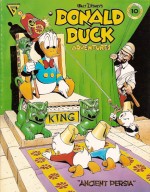
Walt Disney’s Donald Duck Adventures: Ancient Persia


By Carl Barks (Gladstone Comic Album #10)
No ISBN: 0-944599-08-7

Carl Barks was the greatest armchair (or at least drawing board) explorer of his generation. A voracious researcher who loved adventure and exploration, when he worked, history, geography and the natural world were as much his tools as pen and brush. All his fabulous tales were screened through a captivating lens of wonder and excitement and carried on a riotous wave of outrageous comedy that appealed equally to fun-starved fans of all ages. They still do.

From the 1940’s to the1960s Barks worked in productive seclusion writing and drawing a brilliantly timeless treasure trove of golden yarns ostensibly for kids, creating a Duck Universe of memorable and highly bankable characters like Uncle Scrooge McDuck, Gladstone Gander, the Beagle Boys, Gyro Gearloose, and Magica De Spell to augment the stable of cartoon properties from the Disney Studio, but his most exciting works inevitably involved the rowdy, know-it-all nephews of Donald Duck: Huey, Dewey and Louie.

Their usual assigned roles was as sensible, precocious and a little bit snotty kid-counterfoils to their “unca” whose irascible nature caused him to act like a overgrown brat most of the time, but they too often fell prey to a perpetual temptation to raise a ruckus…

Gladstone Publishing began re-releasing Barks material and a selection of other Disney comics strips in the late 1980s and this album is another of the very best. Whilst producing all that landmark material Barks was just a working guy, drawing eye-catching covers, illustrating other people’s scripts when necessary and yet, still setting the bar for his compatriots with utterly perfect comics tales that added to the burgeoning canon of Donald Duck and other Disney properties. His output was incredible both in terms of quantity and especially in its unfailingly high quality.

Printed in the large European oversized format (278mm x 223mm) this wild ride reprints one of his earliest masterpieces with the lead tale from Dell Four Color Comics Series II #275 (from May 1949) and sees the author accessing contemporary mores in an eerie epic that sampled the sinister delights of horror movies – albeit seductively tempered with Barks’ winningly absurd humour…

Donald and his nephews – mostly the nephews – are troubled by the haunting presence of a lurking stranger in the neighbourhood, but when the kids begin spying on him they all end up shanghaied – Donald too – to Iraq, where the sinister villain forces them to dig in the trackless desert.

He might be crazy but he’s not uninformed and soon the Duck’s have uncovered the lost city of Itsa Faka, but the sinister scientist won’t stop yet. Archaeology isn’t his only speciality: the city holds the secret of raising the dead and he wants it badly. As usual there’s a moral and it’s “be careful what you wish for” as the ancient Persians revive and the luckless Donald is mistaken for the rascally Prince Cad Ali Cad, who jilted the daughter of King Nevvawaza millennia ago.

Thinking the Cad has returned the undead family prepares to conclude the thwarted nuptials – and they won’t take no for an answer…

Fast paced and wildly over-the-top, this sharp tale skates perilously close to being really scary, but as ever, the madcap humour keeps everything addictively comforting and compelling.

Also included here are two short fantasy fables featuring Donald and the boys, beginning with ‘Super Snooper’ a brilliant spoof of costumed comicbook crime-busters from Walt Disney Comics & Stories #107 (September 1949) and a fabulous untitled science-fictional yarn (Walt Disney Comics & Stories #199 April 1957)where the gang are hooked up to Gyro Gearloose’s Imagining Machine for a startling tour of familiar places made new again by dint of the fact that the spectators have been reduced to the size of bugs. Shades of the Incredible Shrinking Ducks!

With another single-page gag (from Dell Four Color Comics #263 February 1950) to round off the madcap merriment this is another superlative treat for fans of comics in their purest and most enticing form.

Even if you can’t find this specific volume (and trust me, you’ll be glad if you do) Barks’ work is readily accessible through a number of publications and outlets and everything he’s ever done is well worth reading. No matter what your age or temperament if you’ve never experienced his captivating magic, you can discover “the Hans Christian Andersen of Comics” simply by applying yourself and your credit cards to any search engine.
© 1988, 1957, 1950, 1949 The Walt Disney Company. All Rights Reserved.

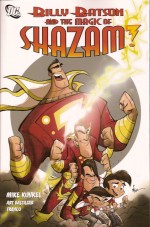
Billy Batson and the Magic of Shazam!


By Mike Kunkel, Art Baltazar, Franco, Byron Vaughns, Ken Branch & Stephen DeStefano (DC Comics)
ISBN: 978-1-4012-2248-2

After the runaway success of Jeff Smith’s magnificent reinvention of the original Captain Marvel (see Shazam! The Monster Society of Evil) it was simply a matter of time before this latest iteration won its own title in the monthly marketplace. What was a stroke of sheer genius was to place the new Billy Batson and the Magic of Shazam! under the bright and shiny aegis of the company’s young reader imprint – what used to be the Cartoon Network umbrella.

Here, slightly askew of the mainstream DC Universe, these frantically ebullient and utterly contagious tales of the orphan Batson and his obnoxious, hyperactive little sister, both gifted by an ancient mage with the powers of the gods, can play out in wild and wooly semi-isolation hampered by nothing except the page count…

Billy Batson is a homeless kid with a murky past and a glorious destiny. One night he followed a mysterious figure into an abandoned subway station and met the wizard Shazam, who gave him the ability to turn into an adult superhero called Captain Marvel. Gifted with the wisdom of Solomon, the strength of Hercules, the stamina of Atlas, the power of Zeus, the courage of Achilles and the speed of Mercury, the lad was sent into the world to do good, a good if immature boy in a super man’s body.

Accompanied by the talking tiger-spirit Mr. Tawky Tawny, Billy tracked down his missing little sister, but whilst battling evil genius Dr. Sivana (US Attorney General and would-be ruler of the universe) he impetuously caused a ripple in the world’s magical fabric through which monsters and ancient perils occasionally slip through. Now, the reunited orphans are trying to live relatively normal lives, but finding the going a little tough.

Firstly, without adults around, Billy often has to masquerade as his own dad and when he’s not at school he’s the breadwinner, earning a living as a boy-reporter at radio and TV station WHIZ. Moreover little Mary also has access to the Power of Shazam, and she’s a lot smarter than he is in using it… and a real pain in Billy’s neck.

Mike Kunkel, inspired creator of the simply lovely Herobear and the Kid, leads off this collection (gathering the first six issues of the monthly comic-book for readers of all ages) writing and drawing a breakneck, riotous romp that reintroduces the new Marvel Family to any new readers and, by virtue of that pesky rift in the cosmic curtain, recreates the Captain’s greatest foe: Black Adam. This time the evil predecessor of the World’s Mightiest Mortal is a powerless but truly vile brat: a bully who returns to Earth after millennia in limbo ready to cause great mischief – but he can’t remember his magic word…

This hilarious tale has just the right amount of dark underpinning as the atrocious little thug stalks Billy and Mary, trying to wheedle and eventually torture the secret syllables from them, and when inevitably Black Adam regains his mystic might and frees the sinister Seven Deadly Evils of Mankind from their imprisonment on the wizard’s Rock of Eternity the stage is set for a classic confrontation.

Pitched perfectly at the young reader, with equal parts danger, comedy, sibling rivalry and the regular outwitting of adults, this first story screams along with a brilliantly clever feel-good finish…

With issue #5 the writing team of Art Baltazar and Franco (responsible for the incomparably compulsive madness of Tiny Titans) took over, and artists Byron Vaughns and Ken Branch handled the first bombastic tale as convict Doctor Sivana unleashes the destructive giant robot Mr. Atom to cover his escape from prison.

The story-section concludes with another funny and extremely dramatic battle – this time against primordial super-caveman King Kull, who wanted to reconquer the planet he ruled thousands of years ago. Older fans of gentle fantasy will be enthralled and delighted here by the singular art of Stephen DeStefano, who won hearts and minds with his illustration of Bob Rozakis’ seminal series Hero Hotline and ‘Mazing Man (both painfully, criminally overdue for graphic novel collections of their own…)

Billy Batson and the Magic of Shazam! is an ideal book for getting kids into comics: funny, thrilling, beautifully, stylishly illustrated and perfectly in tune with what young minds want to see. With a gloriously enticing sketches section and a key code for those pages written in the “Monster Society of Evil Code” this is an addictive treat for all readers who can still revel in the power of pure wonderment and still glory in an unbridled capacity for joy.

© 2008, 2009 DC Comics. All Rights Reserved.

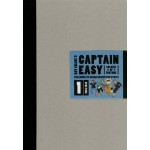
Roy Crane’s Captain Easy, Soldier of Fortune: The Complete Sunday Newspaper Strips volume 1


By Roy Crane (Fantagraphics Books)
ISBN: 978-1-60699-161-9

Modern comics evolved from newspaper comic strips, and these pictorial features were until relatively recently utterly ubiquitous and hugely popular with the public – and highly valued by publishers who used them as an irresistible sales weapon to guarantee and increase circulation and profits.

It’s virtually impossible for us to today to understand the overwhelming power of the comic strip in America (and the wider world) from the Great Depression to the end of World War II. With no television, broadcast radio far from universal and movie shows at best a weekly treat for most folk, household entertainment was mostly derived from the comic sections of daily and especially Sunday Newspapers. “The Funnies” were the most common recreation for millions who were well served by a fantastic variety and incredible quality.

From the very start humour was paramount; hence the terms “Funnies” and “Comics”, and from these gag and stunt beginnings – a blend of silent movie slapstick, outrageous fantasy and the vaudeville shows – came a thoroughly entertaining mutant hybrid: Roy Crane’s Wash Tubbs.

Debuting on April 21st 1924 Washington Tubbs II was a comedic gag-a-day strip not much different from family favourite Harold Teen (by Crane’s friend and contemporary Carl Ed). Tubbs was a diminutive, ambitious young shop clerk when it began in 1924, but gradually the strip moved into mock-heroics, then through light action to become a full-blown, light-hearted, rip-roaring adventure series with the introduction of ancestral he-man and prototype moody swashbuckler Captain Easy in the landmark episode for 6th May, 1929.

As the tales became more exotic and thrill-packed the globe-trotting little dynamo clearly needed a sidekick who could believably handle the combat side of things, and thus in the middle of a European war Tubbs liberated a mysterious fellow American from a jail cell and history was made. Before long the mismatched pair were travelling companions, hunting treasure, fighting thugs and rescuing a bevy of startlingly comely maidens in distress…

The two-fisted, bluff, completely capable and utterly dependable, down-on-his-luck “Southern Gentleman” was something not seen before in comics, a raw, square-jawed hunk played straight rather than the buffoon or music hall foil of such classic serials as Hairsbreadth Harry or Desperate Desmond. Moreover Crane’s seductively simple blend of cartoon exuberance and design was a far more accessible and powerful medium for action story-telling than the somewhat static illustrative style favoured by artists like Hal Foster: just beginning to make waves on the new Tarzan Sunday page.

Tubbs and Easy were as exotic and thrilling as the Ape Man but rattled along like the tempestuous Popeye, full of vim, vigour and vinegar, as attested to by a close look at the early work of the would-be cartoonists who followed the strip with avid intensity: Floyd Gottfredson, Milton Caniff, Jack Kirby, Will Eisner and especially young Joe Shuster…

After a couple of abortive attempts starring his little hero, Crane bowed to the inevitable and created a full colour Sunday page dedicated to his increasingly popular hero-for-hire. Captain Easy debuted on 30th July 1933, in wild and woolly escapades set before his fateful meeting with Tubbs,

This first volume begins with the soldier of fortune undertaking a mercenary mission for the Chinese government to spy on the city of ‘Gungshi.’ In the heyday of popular exploration and aviator exploits the bold solo flight over the Himalayas to Chinese Turkestan was stirring enough but when Easy infiltrated the hidden citadel it heralded the beginning of a rollercoaster romp with sword wielding Mongols, sultry Houris, helpless dancing girls, fabulous beasts and wicked bandits: captivating entire families across the planet, week after addictive week.

With an entire page and vibrant colours to play with, Crane’s imagination ran wild and his fabulous visual concoctions achieved a timeless immediacy that made each page a unified piece of sequential art. The effect of the pages can be seen in so many strips since especially the works of such near-contemporaries as Hergé and giants in waiting like Charles Schulz.

These pages were a clearly as much of joy to create as to read. In fact, the cited reason for Crane surrendering the Sunday strip to his assistant Les turner in 1937 was the NEA Syndicate abruptly demanding that all its strips be henceforward produced in a rigid panel-structure to facilitate them being cut up and re-pasted as local editors dictated. Crane just walked away, concentrating on the daily feature. In 1943 he left the Syndicate to create the pilot strip Buz Sawyer.

At the end of the blockbuster epic Easy is a hero to the people of Gungshi, if not the aristocracy, who plot to oust him via the subtlest of means. The second adventure ‘The Slave Girl’ began on 21st January 1934, and found the occidental hero bankrupted to save the beautiful Rose Petal from the auction block, a chivalrous gesture that led to war with the rival city of Kashno, and a brutally hilarious encounter with South Sea pirates…

In an era where ethic stereotyping and casual racism were acceptable if not mandatory, the introduction of a vile and unscrupulous yank as the exploitative villain was and is a surprising delight. Rambling Jack is every inch the ugly, greedy American and by contrasting Easy’s wholesome quest to make his fortune with the venal explorer’s rapacious ruthlessness, Crane makes a telling point for the folks back home. It also makes for great reading as Chinese bandits also enter the fray, determined to plunder both cities and everybody in-between…

With the help of a lost British aviator Easy is finally victorious, but on returning to his Chinese employers he spots something whilst flying over the Himalayas that radically alters his plans…

‘The Sunken City’ is an early masterpiece of pictorial fiction, as Easy recruits comedy stooge ‘arry Pippy, a demobbed cockney British Army cook, to help him explore a drowned city he had spotted from the air, lost for centuries in a hidden inland sea. However, simply to get there the pair must trek through wild jungles where they encounter blowpipe-wielding cannibals and the greatest threat the valiant rogue has ever faced…

If I’ve given the impression that this has all been grim and gritty turmoil and drama thus far, please forgive me: Roy Crane was a superbly irrepressible gag-man and this enchanting serial abounds with breezy light-hearted banter, hilarious situations and outright farce – a sure-fire formula modern cinema directors plunder to this day. Easy is the Indiana Jones, Flynn (the Librarian) Carsen and Jack (Romancing the Stone) Cotton of his day and clearly blazed a trail for all of them.

Using a deep sea diver’s suit the pair explore the piscine wonders and submerged grandeur of the lost city, encountering some of the most magical and fanciful sea beasts ever recorded in comics before literally striking gold, but when the cannibals attack their treasures are lost and Easy finds himself captive and betrothed to the most hideous witch hag imaginable…

Risking everything the desperate treasure-seekers make a break for it only to re-encounter ‘The Pirates’ (April 14th -July 7th 1935), but before they get too far the husband-hungry witch and her faithful cannibals come after him, leading to a brutal, murderous conclusion.

After years in the Orient Easy and Pippy have a hankering for less dangerous company and make their way to Constantinople and Europe, but trouble was never far from the mercenary and in ‘The Princess’ (14th July – December 1st 1935) his gentlemanly instincts compel him to rescue a beautiful woman from the unwelcome attentions of munitions magnate Count Heyloff, a gesture that embroiled the Captain in a manufactured war between two small nations.

This tale clearly addressed the contemporary American sentiment that another world conflict was brewing and it’s obvious that Crane’s opinion was the deeply held common conviction that the whole international unrest was the result of rich men’s greedy manipulations…

Dark, bittersweet and painfully foreboding this yarn sees Easy become the target of Heyloff’s vengeance and the entire air force for the tiny underdog nation of Nikkateena in their bitter struggle for survival against the equally-duped country of Woopsydasia. Crane kept the combat chronicle light but on occasion his true feelings showed through in some of the most trenchant anti-war art ever seen.

This superb hardback and colossal initial collection is the perfect means of discovering or rediscovering Crane’s rip-snorting, pulse-pounding, exotically racy adventure trailblazer. The huge pages in this volume (almost 14 ½ by 10½ inches or 21x14cm for the younger, metric crowd) also contain a fascinating and informative introductory biography of Crane by historian Jeet Heer, a glowing testimonial from Charles “Peanuts” Schulz, contemporary promotional material, extra drawings and sketches and a fascinating feature explaining how pages were coloured in those long-ago days before computers…

This is comics storytelling of the very highest quality: unforgettable, spectacular and utterly irresistible. These tales rank alongside her best of Hergé, Tezuka and Kirby and led irrefutably to the creations of all of them. Now that you have the chance to experience the strips that inspired the giants of our art form, how can you possibly resist?

Captain Easy Strips © 2010 United Features Syndicate, Inc. This edition © 2010 Fantagraphics Books, all other material © the respective copyright holders. All rights reserved.

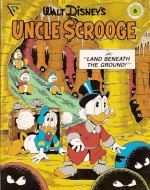
Walt Disney’s Uncle Scrooge: the Land Beneath the Ground


By Carl Barks (Gladstone Comic Album #6)
ISBN: 0-944599-05-2

One of the greatest storytellers America has ever produced, Carl Barks’ early life is well-documented elsewhere if you need detail, but in brief, he started as a jobbing cartoonist, before joining Disney’s studio in 1935, toiling in-house as a animator before quitting in 1942 to work exclusively and anonymously in comic books.

Until the mid-1960s he worked in productive seclusion creating a huge canon of extremely funny adventure yarns for kids and crafting an unmistakable Duck Universe of memorable and highly bankable characters such as Gladstone Gander (1948), The Beagle Boys (1951), Gyro Gearloose (1952), and Magica De Spell (1961) to augment the cartoon screen actors of the Disney Studio. His greatest creation was undoubtedly the crusty, energetic, paternalistic, money-mad Fantasticatrillionaire Scrooge McDuck: the irrepressible star of this show.

So potent were his creations that they fed back into Disney’s animation output itself, even though his brilliant comic work was done for the licensing company Dell/Gold Key, and not directly for the studio. Whereas all the creators working for the publisher were of impressive quality and dedicated to their craft Barks was always head and shoulders above his peers – a fact he was entirely unaware of.

Whilst producing all that landmark innovative material Barks was just a working guy, generating covers, illustrating other people’s scripts when necessary and contributing story and art to the burgeoning canon of Donald Duck and other Big Screen characters, but his output was incredible both in terms of quantity and especially in its unfailingly high quality.

Most notably, Barks’ was a fan of wholesome action, unsolved mysteries and epics of exploration, and this led to him perfecting the art of the blockbuster tale, blending wit, history, plucky bravado and sheer wide-eyed wonder into rollicking rollercoaster romps that utterly captivated readers of every age and vintage. Without the Barks expeditions there would never have been an Indiana Jones…

Gladstone Publishing began re-releasing Barks material (as well as a selection of other Disney comics strips) in the late 1980s and this album is one of most impressive and memorable of all his classic adventure tales. Printed in the large European oversized format (278mm x 223mm) it reprints the lead feature from Uncle Scrooge #13 (1956): a spectacular visual feast and a brilliantly sly commentary on the pitfalls of property. The version included in this volume was also a magnificent gift even for fans already familiar with the saga.

When Barks began the tale the quarterly Uncle Scrooge comicbook was a 32 page publication with no ads or extras, but as he was completing the issue Dell informed him that due to editorial changes he had to cut the tale to 27 pages. The radical change was caused by US Post Office regulations: to obtain second class mailing status (i.e. cheaper postal rates) magazines had to carry at least two discrete features with different characters. Thus the creator had to chop out five pages from the now-finished story, and provide a back up feature… which is how Gyro Gearloose first got his own regular strip.

For this 1988 edition an extra two pages had been recovered and reconstructed from the artist’s files. Barks’ edited his own work mercilessly in the final stages, a job he simplified by crafting his stories in “modules” – every page and each scene was designed and laid out in two-panel tiers (or “banks”) so that he could take out 2, 4, 6 or even 8 frames and still reconfigure his pages around the larger splash panels. That his stories read so seamlessly is a testament to just how good a writer he was…

‘The Land Beneath the Ground’ begins as the Mallard Magnate frets about his colossal money bin. Duckburg has been plagued with earthquakes recently and he is terrified that a major temblor will crack his vault like an egg, sending his cash on a one way trip to the centre of the Earth.

So worried is he that the miser actually pays for an exploratory shaft to be excavated: this deepest hole in the world will tell him if the land beneath him is bedrock solid enough to survive the worst quake imaginable.

However once the shaft has been completed strange inexplicable occurrences begin, and soon no miner will go near the place. With no experts to examine the hole, McDuck blackmails Donald, Huey, Dewey and Louie into becoming his exploration team, but before they can begin the eerie events escalate and they are all plunged into a dark and incredible world…

When this tale was written Alfred Wegener hadn’t even published his first thoughts on his groundbreaking theory of Plate Tectonics and Continental Drift, and the possible causes of earthquakes were still a hotly debated question, so the fantastic solution proffered by Barks must have taken the breath away from all his readers. Far below the world we know two amicable rival races, the Terries and the Fermies, spend all their time in sporting competition and their only game is causing Earthquakes!

Barks easily leaped from suspense to social satire – and back – in his entrancing entertainments and as the undergrounders willfully continue their games the inevitable happens and Scrooge’s impossibidillions soon erupt from his broken money-bin down into the depths! How the situation is rectified with order (and wealth) fully restored was one of the most logical yet scathingly funny resolutions in comics, and one that all money-mad-men would do well to heed…

The balance of the book is filled with another uncanny outing, albeit from a later time, (Uncle Scrooge #30, 1960) with Scrooge and his reluctant Duck brethren in the deserts of North Africa looking for a site to store the oil from his drilling business. With riches coming out of the Earth this time ‘Pipeline to Danger’ is another fast-paced parable from the glamorous glory-days of the petroleum wildcatting business, with plenty of big engineering kit suddenly, perplexingly useless as McDuck’s company tries to construct a storage silo in the bed of an ancient meteor crater.

Unknown to all, the crater is the ancient, ancestral home to a tribe of wild Bedouin Ducks, but no one has ever seen them. After all, they, their camels and flocks are only a few inches tall…

This unlikely yarn is a true delight, showing the seldom seen brave and honorable side of a character too often likened to the unsavoury face of rampant capitalism – and it’s a jolly hoot of a comedy-thriller to boot!

Even if you can’t find this particular volume (and I’m sure you will) Barks’ work is now readily accessible through a number of publications and outlets. No matter what your age or temperament if you’ve never experienced his captivating magic, you can discover “the Hans Christian Andersen of Comics” simply by applying yourself and your credit cards to any search engine. The rewards are just waiting for you to dig them up…
© 1988, 1960, 1956 The Walt Disney Company. All Rights Reserved.

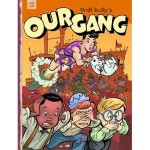
Walt Kelly’s Our Gang volume 4 1946-1947


By Walt Kelly (Fantagraphics Books)
ISBN: 978-1-60699-322-4

The Our Gang (later to be known as the Li’l Rascals) movie shorts were one of the most popular series in American Film history. Beginning in 1922 they featured the fun and folksy humour of a bunch of “typical kids” (atypically though, there was full racial equality and mingling – but the little girls were still always smarter than the boys) having idealised adventures in a time both safer and more simple. The rotating cast of characters and slapstick shenanigans were the brainchild of film genius Hal Roach (he directed and worked with Harold Lloyd, Charley Chase and Laurel and Hardy amongst many others) and these brief cinematic paeans to a mythic childhood entered the “household name” category of popular Americana in amazingly swift order.

As times and tastes changed Roach was forced to sell up to the celluloid butcher’s shop of MGM in 1938, and the features suffered the same interference and loss of control that marred the later careers of the Marx Brothers, Laurel and Hardy and Buster Keaton.

In 1942 Dell released an Our Gang comic-book written and drawn by Walt Kelly who, consummate craftsman that he was, restored the wit, verve and charm of the cinematic glory days with a progression of short tales that elevated the lower-class American childhood to the mythic peaks of Dorothy in Oz or Huckleberry Finn.

Over the course of the first eight issues (see Walt Kelly’s Our Gang volume 1) the master raconteur moved beyond the films – good and otherwise – to build an idyllic story-scape of games and dares, excursions, adventures, get-rich-quick-schemes, battles with rival gangs and especially plucky victories over adults: mean, condescending, criminal or psychotic. Given more leeway, Kelly eventually in-filled with his own characters, but for this book aficionados and purists can still thrill to the classic cast.

This long-awaited fourth collection gathers the adventures from issues #24 to #30 (July 1946l -January 1947), and finds Kelly inserting more of himself into the mix. Here the light-hearted yarns often evolved into full-blooded dramas, with murderous returning villains and bold excursions far beyond what modern parents would allow their cosseted darlings to experience, all based on Kelly’s great fondness for the wholesome adventures of daring youth written by Horatio Alger and Oliver (the Rover Boys, Bobbsey Twins, Tom Swift) Optic.

The entrancing full colour fun leads off with riotous rumbles as Buckeye and Red Macdougal build a fake teleportation machine to prank Froggy, only to have two burglars steal the cardboard contraption thinking it the real deal, and thereafter the entire gang gets into serious danger when The Barrel returns.

The Hispanic master-criminal wants revenge for the way the kids foiled his counterfeiting ring, but luckily the old circus entertainer Professor Gravy is around – with his lion and tiger…

A rare (for the era) continued storyline begins with #26 as Froggy, Macdougal and Julip the goat join the Professor on his showboat for a summer of entertaining the river towns. Unfortunately the fugitive Barrel is also on board, incognito and desperate to skip town…

By the next issue the kids have taken care of their arch-enemy (for the meantime) and Julip takes centre-stage – or deck – when he swallows a talking toy parrot and the Professor thinks he’s found the showbiz sensation of the century: a hilarious tale that introduces as memorable new cast member, blustery lady-wrestler Guinevere.

As the kids continue their parent-free working vacation the showboat takes on two new passengers; a thoroughbred race horse and his owner trying to avoid thieves keen on stealing the elite hayburner. If I just mention that this is the same week that the boys are trying to perfect their pantomime-horse act I suspect you can guess where this tale is heading…

The two-fisted dénouement of that escapade left the riverboat high and dry on a reef, and in #29 the stranded cast decides that they will trap the horse-thieves who escaped capture during the battle that led to the crash. This is a dark tale indeed as Macdougal is kidnapped and shot, but the bonny lucky lad soon turns the tables on the villains thanks to some ghastly green flares and a handy graveyard…

This volume ends as the boys return to school and plunge straight into Baseball woes as old rival Feeny of the Gashouse gang frames the bespectacled Froggy. Banned by his teacher from playing in a vital match, the little wise guy needs somebody to pretend to be his mother and get him out of an unjust punishment. It’s a measure of his tenacity if not faith, when three separate versions of his mom turn up at the game…

Today’s comics have nothing like these magical masterpieces to offer to contemporary audiences. Many readers might not even be able to appreciate the sheer beauty, narrative charm and lost innocence of this style of children’s story: sumptuous confections from a true legend of our art-form with truly universal appeal.

If so I genuinely pity them, because this is work with heart and soul, drawn by one of the greatest exponents of graphic narrative America has ever produced. Be assured however, that their loss need not be yours…

© 2010 Fantagraphics Books. All Rights Reserved.

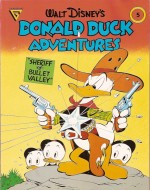
Walt Disney’s Donald Duck Adventures: Sheriff of Bullet Valley – Gladstone Comic Album #5


By Carl Barks (Gladstone)
ISBN: 0-944599-04-4

From the 1940’s until the mid-1960s Carl Barks worked in productive seclusion writing and drawing a brilliantly timeless treasure trove of comedic adventure yarns for kids, creating a Duck Universe of memorable and highly bankable characters like Uncle Scrooge McDuck, Gladstone Gander, the Beagle Boys, Gyro Gearloose, and Magica De Spell to augment the stable of cartoon properties from the Disney Studio, but his most exciting works inevitably involved the rowdy, know-it-all nephews of Donald Duck: Huey, Dewey and Louie.

Their usual assigned roles was as sensible, precocious and a little bit snotty kid-counterfoils to their “unca” whose irascible nature caused him to act like a overgrown brat most of the time, but they too often fell prey to a perpetual temptation to raise a ruckus…

Gladstone Publishing began re-releasing Barks material and a selection of other Disney comics strips in the late 1980s and this album is another of the very best. Whilst producing all that landmark material Barks was just a working guy, drawing unforgettable covers, illustrating other people’s scripts when necessary and always contributing perfect comics tales to the burgeoning canon of Donald Duck and other Big Screen characters. His output was incredible both in terms of quantity and especially in its unfailingly high quality.

Printed in the large European oversized format (278mm x 223mm) this terrific tome reprints the lead tale from Dell Four Color Comics Series II #199 (October 1948) and draws much of its unflagging energy and trenchant whimsy from Barks’ own love of cowboy fiction – albeit seductively tempered with his self-deprecatory sense of absurd humour – for example, a wanted poster on the jailhouse wall portrays the artist himself and offers the princely sum of $1000 and 50¢ for his inevitable capture…

Donald is an expert on the Wild West – he’s seen all the movies – so when he and the boys drive through scenic Bullet Valley, a wanted poster catches his eye and his imagination. Soon he’s signed up as a deputy, determined to catch the rustlers who have been plaguing the locals. Unfortunately for him the good old days never really existed and today’s bandits use radios, trucks and Tommy-guns to achieve their nefarious ends. Can Donald’s impetuous boldness and the nephew’s brains defeat the ruthless high-tech raiders?

Of course they can…

Also included here is a delightful comedy of farmyard errors from Daisy Duck’s Diary (Dell Four Color Comics Series II #1150 December 1960) which pits the well-meaning busybody against luck-drenched Gladstone Gander in ‘Too Much Help’ whilst Donald and the nephews also find themselves at odds with the self-same fowl of fabulous good-fortune in an untitled tale from Walt Disney Comics & Stories #212 (May 1958), wherein he and Gladstone race around the world in rocket-ships, courtesy of that feathered modern Edison Gyro Gearloose, whilst the little ducky boys can only watch in nervous anticipation of disaster…

Even if you can’t find this specific volume (and trust me, you’ll be glad if you do) Barks’ work is now readily accessible through a number of publications and outlets and every one of his works is well worth reading. No matter what your age or temperament if you’ve never experienced his captivating magic, you can discover “the Hans Christian Andersen of Comics” simply by applying yourself and your credit cards to any search engine.

Always remember, a fan’s got to do what a fan’s got to do…
© 1988, 1960, 1958, 1948 The Walt Disney Company. All Rights Reserved.

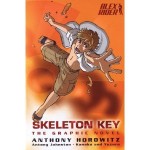
Skeleton Key: the Graphic Novel – an Alex Rider Adventure


By Anthony Horowitz, adapted by Antony Johnston, Kanako & Yuzuru Takasaki (Walker Books)
ISBN: 978-1-4063-1345-2

If America is the spiritual home of the superhero, Britain is Great because of spies and detectives. Our popular literary heritage is littered with cunning sleuths and stealthy investigators from Sherlock Holmes, Sexton Blake, Campion and Lord Peter Wimsey to the Scarlet Pimpernel, George Smiley and Harry Palmer.  And Bond: James Bond…

In 2000 Anthony Horowitz produced Stormbreaker, the first of eight (and counting…) rip-snorting teen novels featuring 14 year old orphan Alex Rider: a smart, fit, sports-mad lad like any other, who suddenly discovers that his guardian Uncle Ian has also died. Moreover the deceased gentleman was apparently a spy of some distinction and had been surreptitiously teaching the lad all the skills, techniques and disciplines needed to become a secret agent…

Soon MI6 are knocking on his door…

As well as a major motion picture and video game, the books (the first three so far) have also been adapted to the comics medium; their easy blend of action, youthful rebellion and overwhelmingly comfortable 007-style pastiche winning many fans in the traditionally perilous older-boys book market. They’re really rather good…

I’m reviewing this particular graphic novel simply because it caught my eye on my last trip to the local library (how soft modern kids do have it; when I was a portly nipper you had to sneak comics into the place and read them concealed behind gigantic atlases or art books), but even though I’ve previously ignored them I can honestly say now that I’ll be seeking out the previous adaptations and eagerly waiting forthcoming ones…

Alex is a highly effective but reluctant agent, preferring the normal life of his boarding school to the clandestine machinations of espionage. However his occasional paymasters at MI6 are always looking for ways to exploit his obvious talents. A seemingly innocent offer to work as a ball-boy at the Wimbledon Tennis tournament leads to him foiling a huge gambling scam by a Chinese Triad.

Unfortunately this makes him a target for Triad vengeance, so his “boss” Mr. Crawford suggests a little trip to Cuba until the heat dies down.

Roll Credits…

Alex soon discovers he has been “borrowed” by the CIA to add camouflage to a reconnaissance mission involving Alexei Sarov, an old Stalinist Soviet general who is up to something particularly nasty with stolen atomic weapons from his isolated fortress on the Cayo Esqueleto or “Skeleton Key”.

Tasked with finding out what the old soldier is planning, the American agents at first make him less than welcome, resenting his presence and not trusting a “mere kid”, but I’m sure they changed their minds around about the moment when they got murdered…

Now the only operative in the game, Alex is soon captured by Sarov who proves to be an unbeatable opponent. Moreover he has a most unique fate planned for the boy after his plans for global annihilation are achieved: he wants to adopt him…

This is an immensely entertaining romp, hitting all the thrill-buttons for an ideal summer blockbluster, even though it’s told – and very convincingly – from the viewpoint of an uncertain boy rather than a suave, sophisticated adult. Donkin’s adaptation is sharp and witty, capturing the insecurities and verve of the young hero perfectly whilst the art by sisters Kanako & Yuzuru Takasaki is in a full-colour, computer-rendered manga style that might not please everybody but does work exceedingly well in conveying the softer moments as well as the spectacular action set-pieces.

Be warned however, even though this is a kid’s book there is a substantial amount of fighting and a large bodycount, and the violence is not at all cartoony in context. If you intend sharing the book with younger children, read it yourself first.

These books and their comic counterparts are a fine addition to our fiction tradition. Alex Rider will return… why don’t you join him?

Text and illustrations © 2009 Walker Books Ltd. Based on the original novel Skeleton Key © 2002 Anthony Horowitz. All rights reserved.

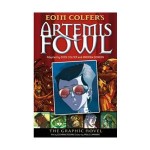
Artemis Fowl: the Graphic Novel


By Eoin Colfer & Andrew Donkin, illustrated by Giovanni Rigano, colour by Paolo Lamanna (Puffin Books)
ISBN: 978-0-141-32296-4

I just couldn’t let Puffin Books’ 70th anniversary pass without a congratulatory comment, and this exceedingly entertaining adaptation of one of the best children’s novels (and how I wish that didn’t sound like that makes kids fiction somehow less valid than “grown up” books) of recent years is a perfect way so to do.

Puffin Books began in 1939, the brainchild of Allan Lane who had revolutionised the world four years previously with the launch of Penguin Books, successfully establishing the mass-market paperback. Despite war-time paper shortages Puffin grew from strength to strength, especially when journalist Kaye Webb took over as editor in 1961, introducing a higher rate of illustration to the books, widening the parameters of the kids market by commissioning a huge variety of new authors and in 1967 creating the world’s greatest and best book society – the Puffin Club.

If you grew up in Britain over the last fifty years you have read one of the books she was responsible for. …

Webb passed away in 1996 but her innovative influence still permeates Puffin, as can be seen in the captivating adventures of Artemis Fowl II, criminal mastermind, scion of Ireland’s greatest family of rogues and villains and probably the greatest intellect on the planet. He inherited the family business when his father mysteriously vanished on a caper, a loss from which Artemis’ mother has never recovered.

This Machiavellian anti-hero is a teenager so smart that he has deduced that fairies and mystical creatures actually exist and he spends this first book stealing their secrets to replenish the family’s depleted fortunes and fulfil his greatest heart’s desire…

His greatest ally is Butler, a manically loyal and extremely formidable hereditary retainer who is a master of physical violence. The first of the six novels published thus far is here adapted by the author and Andrew Donkin, and illustrated in a kind of Euro-manga style that won’t suit everybody but which nevertheless perfectly captures the mood and energy of the original. This lavish adventure is also interspersed with comprehensive and clever data-file pages (by Megan Noller Holt) to bring everybody up to full speed on this wild, wild world…

Fowl is utterly brilliant and totally ruthless. Once determining that the mythological realm of pixies, elves, ogres and the like are actually a highly advanced secret race which predated humanity and now dwells deep underground, he “obtains” and translates their Great Book and divines all their secrets of technology and magic.

Fowl has a plan for the greatest score of all time, and knows that he cannot be thwarted, but he not reckoned on the wit, guts and determination of Holly Short, an elf who works for the Lower Elements Police Reconnaissance Force. She is the only female LEPRecon allowed to work on the surface and has had to prove herself every moment of every day…

Combining sinister mastery, exotic locales, daring adventure, spectacular high fantasy concepts and appallingly low puns and slapstick, this tale has translated extremely well to the comics medium (but that’s no reason not to read the books too) with a clever plot and characters that are both engaging and grotesquely vulgar – perfect fare for kids. I especially admire the kleptomaniac dwarf Mulch Diggum, whose species’ self-defence mechanism consists of overwhelming explosive flatulence…

Farting, fighting and fantasy are pretty much the perfect combination for kid’s fiction and boys especially will revel in the unrestrained power of the wicked lead character. This is a little gem from a fabulously imaginative creator and an unrelentingly rewarding publisher. Long may you all reign…
Text © 2007 Eoin Colfer. Illustrations © 2007 Giovanni Rigano. All rights reserved.

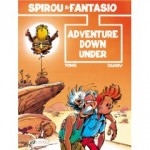
Spirou and Fantasia: Adventure Down Under


By Tome & Janry, translated by Jerome Saincantin (Cinebook)
ISBN: 978-1-84918-011-5

For most English-speaking comic fans and collectors Spirou is probably Europe’s biggest secret. The character is a rough contemporary – and bald commercial  response – to Hergé’s iconic superstar Tintin, whilst the comic he has headlined for decades is only beaten in sheer longevity and creativity by our own Beano and Dandy.

Conceived at Belgian Printing House by Jean Dupuis in 1936, a magazine targeting a juvenile audience debuted on April 21st 1938 (three and bit months before DC Thomson’s Beano, but still beaten by The Dandy which launched on 4th December 1937), it was edited by Charles Dupuis (a mere tadpole, only 19 years old, himself) and took its name from the lead feature, which recounted the improbable adventures of a plucky Bellboy/lift operator employed by the Moustique Hotel (a reference to the publisher’s chief magazine, Le Moustique). With his pet squirrel, Spip (joining the cast on June 8th 1939, he’s the longest running character in the strip after Spirou himself) he was the idea of French artist Robert Velter,  who signed himself Rob-Vel.

A Dutch language edition Robbedoes’ debuted a few weeks later and ran more-or-less in tandem with the French parent comic until it was cancelled in 2005.

The bulk of the comic was taken up with cheap American imports: Red Ryder by Fred Harman, William Ritt & Clarence Gray’s ‘Brick Bradford’ and Siegel & Shuster’s landmark creation ‘Superman’ although home-grown product crept in too. Most prominent were ‘Tif et Tondu’ by Fernand Dineur (which ran until the1990s) and ‘L’Epervier Blue’ by Sirius (Max Mayeu) and they were soon joined by comic-strip wunderkind Joseph Gillain – “Jije” (during World War II Jije legendarily drew the entire comic by himself, banned US imports included, as well as assuming production of the Spirou strip where he created the current co-star Fantasio).

Except for a brief period when the Nazis closed the comic down (September 1943 to October 1944 when the Allies liberated Belgium) Spirou and its boyish star – now a globe-trotting reporter – have continued their weekly exploits in unbroken four-colour glory.

Among the other myriad major features that began within those pages are ‘Jean Valhardi’ (by Jean Doisy & Jije), ‘Blondin et Cirage’ (Victor Hubinon), ‘Buck Danny’, ‘Jerry Spring’, ‘Les Schtroumpfs’, ‘Gaston Lagaffe’ and a certain laconic cowboy named ‘Lucky Luke’.

Spirou the character (the name translates as both “squirrel” and “mischievous”) has starred in the magazine for most of its life, evolving under a series of creators into an urbane yet raucous fantasy/adventure hero with the accent heavily on light humour. With comrade and rival Fantasio and crackpot inventor the Count of Champignac, Spirou travels to exotic places, uncovering crimes, revealing the fantastic and garnering a coterie of exotic arch-enemies.

During the War when Velter went off to fight, his wife Blanche Dumoulin took over the strip using the name Davine, assisted by Luc Lafnet. Dupuis assumed control of and rights to the strip in 1943, assigning it to Jije who handed it to his assistant André Franquin in 1946. It was the start of a golden age.

Among Franquin’s innovations were the villains Zorglub and Zantafio, Champignac and one of the first strong female characters in European comics, rival journalist Seccotine (renamed Cellophine in this current English translation), but his greatest creation – one he retained on his departure in 1969 – was the incredible magic animal Marsupilami (first seen in Spirou et les héritiers in 1952), now a star of screen, plush toy store, console and albums all his own.

From 1959 the writer Greg and background artist Jidéhem assisted Franquin but by 1969 the artist had reached his Spirou limit and resigned, taking his mystic yellow monkey with him. He was succeeded by Jean-Claude Fournier who updated the feature over the course of nine stirring adventures that tapped into the rebellious, relevant zeitgeist of the times with tales of environmental concern, nuclear energy, drug cartels and repressive regimes.

As the series entered the 1980s it seemed to stall: three discrete creative teams alternated on the serial: Raoul Cauvin & Nic Broca, Yves Chaland and the creators of the graphic novel under review here: Philippe Vandevelde writing as Tome and artist Jean-Richard Geurts AKA Janry. These last adapted and referenced the beloved Franquin era and revived the feature’s fortunes, producing fourteen wonderful albums between 1984 and 1998. This one, ‘Adventure Down Under’ from 1985, was their second.

Since their departure Lewis Trondheim and the team of Jean-Davide Morvan & Jose-Luis Munuera have brought the official album count to fifty (there also are a bunch of specials, spin-offs and one-shots, official and otherwise)…

As Spirou and Fantasio arrive home exhausted from their latest assignment they are intercepted by Cellophine at the airport: odd things are occurring in the depths of the Outback and the always-newsworthy Count of Champignac is right at the heart of it. Instantly awake again all three fly to Australia where nefarious deeds are occurring at the desolate Albuh Opal Mine.

The crazy inventor is there on the verge of a fabulous and incredible discovery far more precious than jewels, but the ruthless miners don’t seem that impressed, although they are worried by disappearing diggers, inexplicable accidents, men driven crazy and, if some observers are to be believed, levitating aborigines…

This classy blend of thrilling mystery, weird science, light adventure and broad slapstick is a pure refreshing joy in a market far too full of adults-only carnage and testosterone-fuelled breast-beating. Easily accessible to readers of all ages and drawn with all the welcoming style and panache that makes Asterix, Lucky Luke and Iznogoud so compelling, this is a cracking read and hopefully the start of a long line of translated epics that will become as much a household name as those series – and even Tintin himself…

Original edition © Dupuis, 1985 by Tome & Janry. All rights reserved. English translation 2009 © Cinebook Ltd.

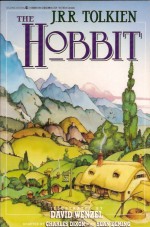
The Hobbit


By J.R.R. Tolkien, adapted by Charles Dixon & Sean Deming, illustrated by David Wenzel (Eclipse Book)
ISBN: 1-56060-054-3-1295

I’m a great believer in art remaining true to its roots: Nobody writes a novel with the ultimate intention of it becoming a lousy movie, nor a song or symphony merely to sell the ring-tone rights (maybe these days they do – it would certainly explain why there are so many bad books and crap tunes. Just call me the last of the dewy-eyed idealists, then).

So just to keep things straight: even though I’m about to review the graphic novel adaptation – and favourably – Read the Book. Even though there’s been a stage play, a radio drama, an animated feature and (soon) a two-film franchise – Read the Book.

Every time you see something leap the creative hurdle from original artwork to another, different, separate medium: Read the Book. Or comic or play or song or…

The Hobbit was first published in 1937 to world-wide success and acclaim. It won the New York Herald-Tribune Award for best juvenile fiction, was nominated for a Carnegie Medal and is rightly considered to be a classic of World Literature. In my overblown and utterly personal opinion it completely outclasses and knocks spots off the sequel Tolkien’s publishers demanded. You ought to read that too: it’s called Lord of the Rings.

In 1989 Eclipse Comics produced a three-part prestige miniseries adapting the Hobbit, which was then collected into a successful graphic novel that helped break the then-new format out of the comics fan ghetto. Since the company’s demise the collection has been re-issued by HarperCollins (1998, ISBN: 978-0-26110-266-8) and other companies and is relatively easy to find.

I’m sticking with the original here simple because it has the wonderful painted cover by David Wenzel gracing it. The story itself, of how a sedate and sedentary little Halfling called Bilbo Baggins is cajoled by the wizard Gandalf into leaving his complacent life of middle class prosperity for the seductive lure of adventure, is as enchanting as it ever was.

The diminutive Hobbit agrees, somewhat reluctantly, to become a Thief/Burglar for 14 disinherited dwarfs who yearn to liberate their ancestral home – and treasure – from the awesome dragon Smaug, and incorporates all the fascinating ephemerals that have graced Western mythology and tale-telling for centuries. (Read the Book).

Tolkien’s text is sensitively abridged rather than adapted by Chuck Dixon and Sean Deming, who strove to retain as much of the original as possible, whilst the illustration is by turns pretty, jolly, enthralling and when the dragon, goblins, trolls and especially Gollum appear, wholesomely terrifying. Wenzel started out as a wanna-be comics artist before moving into the field of fantasy and especially children’s illustration in the 1980s where he worked with icons like Rudolph the Red Nosed Reindeer and creators like Maurice Sendak, but he returned to comics for this project: probably his greatest achievement and one he’d dreamed of for much of his career (See Middle Earth: the World of Tolkien Illustrated)…

This is a truly magical interpretation of the classic and one that any devotee will find hard to dislike. If you are a lover of traditional fantasy you should get a copy – after you’ve Read the Book.

© 1989, 1990 the Estate of J.R.R. Tolkien. Based on The Hobbit © 1965 by J.R.R. Tolkien. Illustration © 1989, 1990 David Wenzel. Adaptation © 1989, 1990 Charles Dixon & Sean Deming. All Rights Reserved.