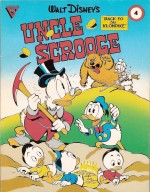
Walt Disney’s Uncle Scrooge in The Mines of King Solomon – Gladstone Comic Album #1


By Carl Barks & anonymous (Gladstone)
No ISBN

The greatest surprise about this magnificent slice of all-ages-adventure is just how long it took to make the blindingly obvious connection between the epitome of the American self-made man – okay, Duck – and the most ubiquitous legend of lost and illimitable wealth. ‘The Mines of King Solomon’ is magical mystery and exotic derring-do wrapped up in the author’s sly wit, uproarious slapstick and down-home, simple morality: in other words, pure Carl Barks.

One of the greatest storytellers America has ever produced, Barks’ early life is well-documented elsewhere if you need detail, but in brief, he started as a jobbing cartoonist, before joining Disney’s studio in 1935, toiling in-house as a animator before quitting in 1942 to work exclusively and anonymously in comic books.

Until the mid-1960s he worked in productive seclusion writing and drawing a vast array of comedic adventure yarns for kids, creating a Duck Universe of memorable – and highly bankable – characters like Gladstone Gander (1948), the Beagle Boys (1951), Gyro Gearloose (1952), and Magica De Spell (1961) to augment the stable of cartoon actors from the Disney Studio. His greatest creation was undoubtedly the crusty, energetic, paternalistic, money-mad gazillionaire Scrooge McDuck: the star of this show.

So potent were his creations that they fed back into Disney’s animation output itself, even though his brilliant comic work was done for the licensing company Dell/Gold Key, and not directly for the studio.

Throughout this period Barks was blissfully unaware that his work (uncredited by official policy as was all the company’s cartoon and comicbook output), was nevertheless singled out by a rabid and discerning public as being by “the Good Duck Artist.” When some of his most dedicated fans finally tracked him down, his belated celebrity began.

Gladstone Publishing began re-releasing Barks material – and a selection of other Disney comics strips – in the 1980s and this album is another one of the best. Whilst producing all that landmark innovative material Barks was just a working guy, generating covers, illustrating other people’s scripts when necessary (as here in the intriguing supplementary “team-up” with Grandma Duck) and contributing story and art to the burgeoning canon of Donald Duck and other Big Screen characters.

Printed in the large but increasingly scarce European oversized format (278mm x 223mm) this glorious gem reprints the contents of Uncle Scrooge #19 (1957) wherein the Mallard Magnate decides to personally check all his global money-making ventures, and dragoons Donald Duck and his nephews into tagging along to be his unpaid dogs-bodies.

At his glass factory in Sweden he discovers that the supply of sand has dried up, and Duck-of-Action that he is, flies straight to the Sinai desert to discover why. And thus begins an absorbing trek through epochs ancient and modern that leads, via bandits, beasts and general bedlam, to the uncovering of the most spectacular treasures of the ages…

Barks drew ‘Honey of a Hen’ for an unnamed scripter (from Four Color Comics #1010, better known as Grandma Duck’s Farm Friends, 1959) wherein the mighty Management Mogul fails to optimise productivity on the old biddy’s small-holding, but it’s all the great man himself for the remaining stories; two Scrooge single-page gag strips from Uncle Scrooge #19 and #21 and a painfully funny yarn from Walt Disney Comics and Stories #227 (1958), once again pitting the irascible Donald against his nephews in their most obnoxious mode as veteran know-it-alls of the Junior Woodchucks.

No one has ever bettered Barks at blending humour with drama and charm with action and even if you can’t find this particular volume, his work is now readily accessible through a number of publications and outlets. So if you’ve denied yourself his captivating brand of magic, no matter what your age or temperament you can easily experience the magic of the man Will Eisner called “the Hans Christian Andersen of Comics.”

You poor fools, what are you waiting for?

© 1987, 1959, 1958, 1957 The Walt Disney Company. All Rights Reserved.

Wallace & Gromit in A Grand Day Out – hardback graphic novel


By Nick Park, illustrated by David Lopez (Egmont)
ISBN: 978-1-4052-4532-6

Hard though it is to believe, Wallace and Gromit have been delighting us for twenty years and this delightful commemorative edition celebrates the fact in fine style by coming full circle. According to Nick Park’s informative Foreword the ingenious, quintessentially English cheese-loving duo were originally conceived as an art school graphic novel, before the Plasticene lure of movement and sound diverted the concept to the world of animation.

David Lopez sensitively adapts with a soft, water-coloured grace the classic tale of an ingenious man and his dog on an epic hunt for cheese that leads them to the moon and a unique confrontation with the dreamy robot that guards its edible treasures.

Lovingly rendered, perfectly timed, the skilful blend of low comedy and whimsy is just as memorable in two dimensions as four, and this book is going to make a lot of kids – of all ages – wonderfully happy.

Is it ever too soon to start recommending what to buy for Christmas? If not then consider this a “must have”…

© and ™ Aardman Animations Ltd. 2009

Arthur Spiderwick’s Field Guide to the Fantastical World Around You


By Tony DiTerlizzi & Holly Black (Simon & Shuster UK)
ISBN: 978-1-41690-136-5

One of the most charming and readable children’s stories of recent vintage (the first volume was published in 2003 and I’ll get to them one day…) recounts the adventures of three American kids who stumble into a forgotten and dangerous world of unseen Fairy Magic. The adventures of the Grace children even emerged relatively unscathed from the transition to the big screen in a winning adaptation entitled The Spiderwick Chronicles.

Modern marketing being what it is, a lot of peripheral material has been generated to accompany the books and it’s one of these I want to bring to your attention. Arthur Spiderwick’s Field Guide to the Fantastical World Around You is a fabulous confection, purporting to be the actual tome created by an inquisitive naturalist nearly a century ago, listing in magnificent taxonomical detail and gloriously illustrative manner all the unnatural and supernormal creatures that live beyond the range of normal human sight.

Although Tony DiTerlizzi and Holly Black are deliberately vague as to who does what to craft these tales the former is credited as illustrator, so I’m assuming the Manticore’s share of the superb paintings and drawings in this volume are his and the explanatory notes Ms Black’s – and frankly astonishing it all is.

Divided into Around the House and Yard, In Fields and Forests, In Lakes, Streams and the Sea, In the Hills and Mountains, In the Sky and Outside at Night this beautiful bestiary covers every invisible wonder from Banshees to Will-o’-the Wisps, Dragons to Unicorns and all European ethereals in between.

This is a book to inspire dreaming and creativity in kids of any age, produced with all the tricks and magic of 21st century printing and paper-technology. A true and total delight.
© 2005 Tony DiTerlizzi & Holly Black. All Rights Reserved.

Walt Disney’s Donald Duck – Gladstone Comic Album #2


By Carl Barks (Gladstone)
No ISBN:

Carl Barks is one of the greatest storytellers America has ever produced, and was just getting the public recognition he’d always deserved when he died in 2000, a few months shy of his hundredth birthday.

His early life is scrupulously well-documented elsewhere if you need detail, but in brief, Barks started as a jobbing cartoonist, then worked as a animator at Walt Disney’s studio before quitting in 1942 to work in comics. With studio partner Jack Hannah he adapted a Bob Karp script for an unmade cartoon short into the comicbook Donald Duck Finds Pirate Gold which was published as Dell Four Color Comics Series II #9 in October of that year. Although not his first published comics work, it was the story that shaped the rest of his career.

Until the mid-1960s Barks worked in productive seclusion writing and drawing a vast array of comedic adventure yarns for kids, creating a Duck Universe of characters like Gladstone Gander (1948), the Beagle Boys (1951), Gyro Gearloose (1952), and Magica De Spell (1961) to augment the stable of cartoon actors from the Disney Studio. His greatest creation was the crusty, paternalistic, money-mad bajillionaire Scrooge McDuck.

So magical were his creations that they actually influenced the animation output of the parent company itself, even though his work was actually done for the licensing company Whitman/Dell/Gold Key, and not directly for Disney.

Throughout this period Barks was blissfully unaware that his work, uncredited by official dictat (as was all the company’s output cartoon or comicbook), was nevertheless singled out by a rabid and discerning public as being by “the Good Duck Artist.” When some of his most dedicated fans finally tracked him down, his belated celebrity began. As well as justice being served it also led to an awful lot of great work now being conscientiously reprinted by an adoring and grateful band of well-intentioned aficionados.

Gladstone Publishing began re-releasing classic Barks material – and a selection of other Disney comics work – in a variety of formats beginning in the 1980s and this album is another one of my favourites. Whilst producing all that landmark innovative material Barks was just a working Joe, producing covers to spec, illustrating other people’s scripts when necessary as well as contributing story and art to the burgeoning canon of Donald Duck and other Big Screen characters.

In the wonderfully enlarged but increasingly scarce European oversized format (278mm x 223mm) this glorious little gem reprints the contents of Four Color Comics #108, probably best known as Donald Duck and the Terror of the River!! (1945) wherein The Duck and his nephews accidentally buy a houseboat and decide to experience the dream-adventure of an idyllic holiday down the Ohio and Mississippi Rivers. After many typically Donald-like mishaps their dream finally starts to come true – only to be threatened by a gigantic and voracious river-serpent!

Barks always excelled at blending comedy with drama and charm with action and this is one of his very best as the feisty kids solve the mystery (this story is a perfect template of what’s kept Scooby Doo in yummy snacks for all those years) of the predatory sea-beast whilst “Unca Donald” gets to be a fairly respectable hero as well as the irascible old goat we all know and love.

From the same comicbook comes the 10 page full-on gag feature ‘Seals are So Smart!’ as Huey, Dewey and Louie discover a trained seal when out beachcombing, but ever cocky and always avaricious Donald sees a chance to make a fast buck, and the book finishes in style with Donald as ‘Camp Counselor’ (from Walt Disney’s Vacation Parade # 1, 1950), an 8 page laugh-riot as the kids’ smug camping superiority (they are, after all, superior products of the Junior Woodchuck scouting program) gets a little dented by their uncle’s rather cruel practical joking

Thankfully even if you can’t find this particular volume, Barks’ work is now readily accessible through a number of publications and outlets. So if you’ve never experienced his captivating brand of magic, no matter what your age or temperament you can easily experience the magic of the man Will Eisner called “the Hans Christian Andersen of Comics.”

© 1987, 1950, 1946 The Walt Disney Company. All Rights Reserved.

Captain Pugwash: A Pirate Story


By John Ryan (Puffin)
ISBN: 978-1-84507-919-2

John Ryan was an artist and storyteller who straddled three distinct disciplines of graphic narrative, with equal qualitative if not financial success.

The son of a diplomat, Ryan was born in Edinburgh on March 4th 1921, served in Burma and India and after attending the Regent Street Polytechnic (1946-48) took up a post as assistant Art Master at Harrow School from 1948 to 1955. It was during this time that he began contributing strips to Fulton Press publications, in the distaff alternative Girl but especially the legendary Eagle.

On April 14th 1950 Britain’s grey, post-war gloom was partially lifted with the first issue of a new comic that literally shone with light and colour. Avid children were soon understandably enraptured with the gloss and dazzle of Dan Dare, Pilot of the Future, a charismatic star-turn venerated to this day. The Eagle was a tabloid-sized paper with full colour inserts alternating with text and a range of various other comic features. “Tabloid” is a big page and one can get a lot of material onto each one. Deep within, on the bottom third of a monochrome page was an eight panel strip entitled Captain PugwashThe story of a Bad Buccaneer and the many Sticky Ends which nearly befell him. Ryan’s quirky, spiky style also lent itself to the numerous spot illustrations required throughout the comic every week.

Pugwash, his harridan of a wife and the useless, lazy crew of the Black Pig ran until issue 19 when the feature disappeared. This was no real hardship as Ryan had been writing and illustrating ‘Harris Tweed – Extra Special Agent’ a full page (tabloid, remember, an average of twenty panels a page, per week!) from The Eagle #16. Tweed ran for three years as a full page until 1953 when it dropped to a half page strip and was repositioned as a purely comedic venture.

In 1956 the indefatigable old sea-dog (I mean old Horatio Pugwash but it could so easily be Ryan: an unceasing story-peddler with a big family, he also found time to be the head cartoonist for the Catholic Herald for forty years) made the jump to children’s picture books.

A Pirate Story (first published by Bodley Head before switching to the children’s publishing specialist Puffin) was the first of a huge run of children’s books on a number of different subjects. Pugwash himself starred in 21 tomes; there were a dozen books based on the animated series Ark Stories, as well as Sir Prancelot and a number of other creations. Ryan worked whenever he wanted to in the comic world and eventually the books and the strips began to cross-fertilise.

The first Pugwash is very traditional in format with blocks of text and single illustrations that illuminate a particular moment. But by the publication of Pugwash the Smuggler (1982) entire sequences are lavishly painted comic strips, with as many as eight panels per page, and including word balloons. A fitting circularity to his careers and a nice treat for us old-fashioned comic drones.

When A Pirate Story was released in 1957 the BBC pounced on the property, commissioning Ryan to produce five-minute episodes (86 in all from 1957 to 1968, which were reformatted in full colour and rebroadcast in 1976). In the budding 1950s arena of animated television cartoons Ryan developed a new system for producing cheap, high quality animations to a tight deadline. He began with Pugwash, keeping the adventure milieu, but replaced the shrewish wife with a tried-and-true boy assistant. Tom the Cabin Boy is the only capable member of a crew which included such visual archetypes as Willy, Baranabas and Master Mate (fat, thin and tall – all dim) instantly affirming to the rapt, young audience that grown-ups are fools and kids do, in fact, rule.

Ryan also drew a weekly Pugwash strip in the Radio Times for eight years, before going on to produce a number of other animated series including Mary, Mungo and Midge, The Friendly Giant and Sir Prancelot as well as adaptations of some of his many children’s books. In 1997 an all new CGI-based Pugwash animated TV series began.

That first story sets the scene with a delightful clown’s romp as the so-very-motley crew of the Black Pig sailed in search of buried treasure, only to fall into a cunning trap set by the truly nasty Cut-Throat Jake. Luckily Tom, the Cabin Boy, was as smart as his shipmates and Captain were not…

John Ryan returned to pirate life in the 1980s, drawing three new Pugwash storybooks: The Secret of the San Fiasco, The Battle of Bunkum Bay and The Quest for the Golden Handshake as well as a thematic prequel in Admiral Fatso Fitzpugwash, in which it is revealed that the not-so-salty seadog had a medieval ancestor who became First Sea Lord, despite being terrified of water…

The most recent edition of A Pirate Story (2008 from Frances Lincoln Children’s Books) came with a free audio CD, and just in case I’ve tempted you beyond endurance here’s a full list (I think) of the good(?) Captain’s exploits: Captain Pugwash: A Pirate Story (1957), Pugwash Aloft (1960), Pugwash and the Ghost Ship (1962), Pugwash in the Pacific (1963), Pugwash and the Sea Monster (1976), Captain Pugwash and the Ruby (1976), Captain Pugwash and the Treasure Chest (1976), Captain Pugwash and the New Ship (1976), Captain Pugwash and the Elephant (1976), The Captain Pugwash Cartoon Book (1977), Pugwash and the Buried Treasure (1980), Pugwash the Smuggler (1982), Captain Pugwash and the Fancy Dress Party (1982), Captain Pugwash and the Mutiny (1982), Pugwash and the Wreckers (1984), Pugwash and the Midnight Feast (1984), The Battle of Bunkum Bay (1985), The Quest of the Golden Handshake (1985), The Secret of the San Fiasco (1985), Captain Pugwash and the Pigwig (1991) and Captain Pugwash and the Huge Reward (1991)

We don’t have that many multi-discipline successes in comics, so why don’t you go and find out why we should celebrate one who did it all, did it first and did it well? Your kids will thank you and if you’ve any life left in your old and weary adult fan’s soul, you will too…

© 1957, 2009 John Ryan and presumably the Estate of John Ryan. All rights reserved.

Paper Dolls from the California Girls


By Trina Robbins (Eclipse Books)
ISBN: 0-913035-57-2

I haven’t looked at anything for the sheer fun of it for awhile so here’s a delightful peculiarity from the 1980s: an example of an old hobby that’s just crying out to become the next big fad. As a follow-up to her wacky, wise and wonderful Paper Dolls from the Comics (ISBN: 0-913035-20-3) cartoonist Trina Robbins turned her designing eye on her own strip: California Girls.

One of the last serious attempts at creating a fun comicbook for young girls, the series featured the everyday lives of Maxine and Maureen Muldoon, twins who attend Hollyhock High School with their gal-pals. While not to every fan’s taste the strip consisted of fashion, comedy and everyday adventure, carried out with Robbins’ slick wit and accessible style.

The newspaper comic strip was a powerful and ubiquitous tool used to raise circulation and promote customer loyalty in the first half of the twentieth century, and as well as laughs, thrills and escapism creators frequently added games, cut-out collectible premiums and paper toys to their output in their efforts to win and keep an audience that consisted of the entire family, not just adolescent males of all ages.

One of the most popular and effective – even to this day (don’t take my word for it, crank up that search engine and see for yourself), was the addition of favourite characters in their underwear, with additional clothes you could “dress” them in. You could even design your own outfits for them. The common belief was that young children and girls loved this kind of “dress-up” play, but I suspect many young men also joined in the fun.

This practise migrated to comicbooks, and every youngster and girl friendly title from Sugar and Spike to Millie the Model had their own paper-doll pages. As I’ve mentioned elsewhere, even my exceptionally smart and utterly sensible wife is not immune to the seditious allure of these things.

So grab your crayons to decorate the monochrome pages (there’s a glorious full-colour centre section too), snag some scissors – don’t run! – and revel in the modes and fashions of the 1980s West Coast. And remember if you do come across a copy of this joyous little gem, with today’s scanning and reprographic advances you can easily duplicate all the pages and go mad without destroying this fun and funky little package…
© 1988 Trina Robbins. All Rights Reserved.

Iznogoud volume 2: The Caliph’s Vacation


By Goscinny & Tabary, translated by Anthea Bell & Derek Hockridge (Cinebook)
ISBN: 978-905460-61-8

During his lifetime (1926-1977) René Goscinny was one of the most prolific, and is still one of the most read, writers of comic strips the world has ever seen. Among his most popular series are Lucky Luke, Le Petit Nicolas and of course Asterix the Gaul. In 1962, scant years after the Suez crisis, the French returned to the deserts when he teamed with Jean Tabary to produce imbecilic Arabian potentate Haroun el-Poussah but it was the villainous foil, power-hungry vizier Iznogoud that stole the show – possibly the conniving little devil’s only successful scheme.

Les Aventures du Calife Haroun el Poussah was created for Record with the first instalment appearing in the January 15th issue in1962. A modest success, it was transferred to Pilot: a magazine created and edited by Goscinny where it was redeveloped to give more emphasis to the scurrilous little weasel who had increasingly stolen the show.

With the emphasis shifted to the shifty shrimp the revamped series, retitled Iznogoud, commenced in Pilote in 1968, becoming a huge favourite, with 27 albums to date, a long-running TV cartoon show and even a live action movie in 2005. When Goscinny died in 1977 Tabary took over writing the strip as well, moving to book-length complete tales, rather than the compilations of short punchy stories that typified their collaborations.

Like all the best storytelling, Iznogoud works on two levels: as a comedic romp of sneaky baddies coming a cropper for younger readers, and as a pun-filled, witty satire for older, wiser heads, much like its more famous cousin Asterix – and also translated here by the master translators Anthea Bell & Derek Hockridge who made the indomitable little Gaul so very palatable to the English tongue. Here their famed skills conjure up the best – and least salacious – bits of the legendary “Carry On films”…

Iznogoud is Grand Vizier to Haroun Al Plassid, Caliph of Ancient Baghdad, but the sneaky little toad has loftier ambitions, or as he is always shouting “I want to be Caliph instead of the Caliph!”

The vile vizier is “aided” – that’s sarcasm, that is – in his schemes by bumbling and reluctant assistant Wa’at Alahf, and in this second delightful translation from CineBook (which was originally the third album Les vacances du calife (1968, Dargaud), they begin their latest campaign of insurrections with ‘Summer Vacation or Never Say Die.’ As the holidays come round again the vizier persuades the Caliph to forego his usual Summer Palace in favour of a quiet bed-sit by the seaside, where an unwary ruler could easily drown or be buried in the sand or lost at sea or be eaten by sharks or…

As usual the plans go painfully awry and it’s back to Baghdad for ‘Good Sports in the Caliphate’ as a hapless magician/weatherman accidentally creates enough snow in the desert to open a ski resort. It doesn’t take much – it never does – to convince Haroun to sample the chilly thrills of skiing, snowboarding, crevasses and avalanches but as usual it’s not the Big Chief who sustains any crippling injuries.

The vacation theme continues with ‘The Caliph’s Cruise’ but after booking passage for Haroun with the unluckiest sea captain alive, the vile vizier doesn’t get off the ship quickly enough and the selection of cannibals, monsters, savages and sea creatures the voyagers encounter find him a far more suitable subject for their unique attentions, whilst in the concluding tale ‘Lihkwid’s Bottle or the Bottle of Lihkwid’ a travelling merchant provides an infallible elixir that will transform the affable potentate into a louse – but only if Iznogoud can trick him into drinking all three gallons of the foul-tasting stuff…

Snappy, fast-paced slapstick and painfully punny word-play abound in these mirthfully infectious tales, and this series is a household name in France; where the name has even entered common usage as a term for a certain type of politician: over-ambitious, unscrupulous – and often of diminutive stature.

When first released here in the 1970s, Iznogoud made little impression but hopefully this snazzy new incarnation of gloriously readable and wonderfully affordable comedy vignettes can finally find an audience among today’s more internationally aware comics-and-cartoon savvy British Kids Of All Ages.

I’m already one of them: How about you…?

© 1968 Dargaud Editeur Paris by Goscinny & Tabary. All Rights Reserved.

The Rainbow Orchid Volume 1 (the Adventures of Julius Chancer)


By Garen Ewing (Egmont UK)
ISBN:  978-1-4052-4853-2

Finally getting what he deserves is creator Garen Ewing whose delightful pastiche of the adventure genre pioneered by Hergé at last gets the full-colour album treatment with the first volume of The Rainbow Orchid.

The character of plucky young daredevil Julius Chancer and his adventuresome pals began popping up around 2003 in a self-published mini-comic and a few other small press publications (Gosh, I wish there was a less loaded or pejorative term for magazines produced by devoted, if unpaid, creators) and has been unfolding online ever since to rapturous praise from industry and public alike. Now Egmont, who also publish Tintin, (last time I mention him, I promise) have picked up the series and we should see this fabulous tale of old fashioned derring-do become a solid reader favourite on its own merits.

In a tale delightfully reminiscent of Margery Allingham’s Albert Campion tale ‘Look to the Lady/the Gyrth Chalice Mystery’ (and wasn’t he originally a pastiche of Lord Peter Wimsey?) and with just a hint of Conan Doyle’s Professor Challenger stories, this first of three volumes set in 1920s Britain introduces Julius Chancer, young but capable assistant to Sir Alfred Catesby-Grey, renowned historical researcher and gentleman breeder of orchids.

Sir Alfred is approached by Lord Reginald Lawrence, scion of an ancient and noble house, who has been tricked into an impossible wager by the dastardly entrepreneur Urkaz Grope. At stake is the “Trembling Sword of Tybalt Stone” a priceless antique that has been the seat of the family’s honour since 1445, and without which Lord Lawrence would have to surrender all his estates and titles…

To win the wager Lawrence needs an example of Iriode Orchino – the rainbow orchid, a mythical bloom last seen by Alexander the Great over two thousand years ago. Although Catesby-Grey pooh-poohs the whole story, Julius remains hopeful, perhaps as tempted by the prospect of adventure and paid bills as by the urgings of plucky Lady Lily, Lawrence’s daughter and a silent film actress recently returned from Hollywood to the bosom of Empire.

Grope is an ominous presence throughout, with a highly secret agenda of his own and no principles at all, whilst the vulgarly intrusive journalist William Pickle has no decency, no morals and definitely no fear as he sniffs out news and controversy like an obsessed ferret, whilst Lily’s Movie Publicity Agent Nathaniel Crumpole always seems in the thick of whatever trouble is brewing – can even an American be that determinedly naive?

The boy Chancer determines to risk all in tracking down the orchid and despite a series of viciously calculated ploys by Grope and his gang of cutthroats sets off with Lily and Crumpole for Karachi and the fantastic flower’s last known whereabouts…

Enchantingly engaging, astonishingly authentic and masterfully illustrated in the legendary Ligne Claire style, this is a wonderful tale that ranks amongst the very best all-ages graphic narratives and although the wait for the next volume might seem interminable the online presence and added value items which can be found at www.rainboworchid.co.uk should keep your bated breath puffing along until then.

Magic, pure graphic magic. Where else could you get hot fresh nostalgia, just like your granddad used to love?

© 2009 Garen Ewing. All Rights Reserved.

Lucky Luke: Billy the Kid


By Morris & Goscinny, translated by Luke Spear (CineBook)
ISBN: 978-1-905460-11-3

It’s hard to think of one of Europe’s most beloved and long-running comics character’s being in any way controversial, but when the changing times caught up with the fastest gun in the West (“so fast he can outdraw his own shadow”) and Lucky Luke moved with them, the news made headlines all over the world.

Lucky Luke is a rangy, laconic, good, natured cowboy who roams the fabulously mythic Old West, having light-hearted adventures with his horse Jolly Jumper and Rantanplan (“dumbest dog in the West” and a charming spoof of cinema canine Rin-Tin-Tin), interacting with a host of historical and legendary figures of the genre.

His continued exploits over more than 60 years have made him the best-selling comic character in Europe, (more than 300 million albums in 30 languages thus far), with spin-off games, computer games, animated cartoon and even live-action movies.

He was created by Belgian animator, illustrator and cartoonist Maurice de Bévère – who signed himself Morris – for the 1947 Annual (L’Almanach Spirou 1947) of Le Journal de Spirou, launching into his first adventure Arizona 1880′ on December 7th 1946.

Before then, while working at the CBA (Compagnie Belge d’Actualitiés) cartoon studio Morris met future comics super-stars Franquin and Peyo, and worked for weekly magazine Le Moustique as a caricaturist (to my eyes Lucky Luke looks uncannily like the young Robert Mitchum who graced so many mid-1940s B-movie Westerns).

He quickly became one of “la Bande des quatre” or Gang of Four, which comprised the creators Jijé, Will and his old comrade Franquin, and who were the leading proponents of the loose and free-wheeling artistic style known as the “Marcinelle School” which dominated Spirou in aesthetic contention with the “Ligne Claire” style used by Hergé, EP

Jacobs and other artists in Tintin Magazine.

In 1948 the Gang (all but Will) visited America, meeting US creators and sightseeing, and Morris stayed for six years, meeting René Goscinny, scoring some work from the newly formed EC sensation, Mad, and making copious notes and sketches of the swiftly disappearing Old West. His research henceforward resonated on every page of his life’s work.

Working alone until 1955 when he reunited with Goscinny (see our recent Iznogoud review for the low-down on that most prolific of comics writers) Morris produced another nine albums worth of affectionate sagebrush parody before, working in perfect unison, Luke attained the dizzying heights of superstardom, commencing with ‘Des rails sur la Prairie’ (Rails on the Prairie), which began in Spirou on August 25th 1955.

In 1967 the straight-shooter switched teams, leaving Spirou for Goscinny’s magazine Pilote with the tale ‘La Diligence’ (the Stagecoach). Goscinny produced 45 albums with Morris before his death, from when Morris continued both alone and with other collaborators. Morris died in 2001 having drawn fully 70 adventures, plus the spin-off adventures of Rantanplan, and the team of Achdé and Laurent Gerra took over franchise, producing another three tales to date. In a most peculiar aside I feel I must mention that Morris was apparently voted the “79th Greatest Belgian” in the 2005 Walloon election of De Grootste Belg. If so, I demand a recount…

Lucky Luke first appeared in Britain syndicated in the weekly comic Film Fun and again in 1967 in Giggle where he was renamed Buck Bingo. In all these venues as well as the numerous attempts to follow the English-language successes of Tintin and Asterix albums from Brockhampton and Knight Books, Luke had a trademark cigarette hanging insouciantly from his lip, but in 1983 Morris – no doubt amidst both pained howls and muted mutterings of “political correctness gone mad” – substituted a piece of straw for the much-traveled dog-end, which garnered him an official tip of the hat from the World Health Organization.

The latest attempt to bring Lucky Luke to our shores and shelves comes from Cinebook, and the first of the twenty (and counting) available albums is Billy the Kid, Morris and Goscinny’s eleventh collaboration.

As Luke rides into the troubled town of Fort Weakling he finds the populace cowed and broken by the vile depredations of the infamous William Bonney. The desperado robs the bank every couple of days, and the stage coach every time it leaves town, helps himself to caramels without paying, and won’t let the saloon serve anything but drinking chocolate.

His deadly aptitude with a six-gun means that no one will swear out a complaint let alone testify against the vicious little bully, and when Luke accepts the job of sheriff it takes brains and cunning rather than his legendary skill with a shooting iron to free the town from the tiny grip of the world’s meanest 12 year old…

Although the dialogue is a trifle stiff in places, this is a grand old hoot in the tradition of Destry Rides again and Support Your Local Sheriff (or perhaps Alias Smith and Jones or Evil Roy Slade are more your style?) superbly executed by master storytellers, and a wonderful introduction to a unique genres for kids of all ages.

And in case you’re worried, even though the interior art still has our hero chawin’ on that ol’ nicotine stick, trust me, there’s very little chance of anyone craving a quick snout, but quite a high probability that they’ll want more Lucky Luke Albums…
© Dargaud Editeur Paris 1971 by Goscinny & Morris. © Lucky Comics. English translation © Cinebook Ltd.

Connective Tissue


By Bob Fingerman (Fantagraphics Books)
ISBN: 978-1-60699-143-5

The always innovative and entertaining Bob Fingerman turns his post-modern attentions to the burgeoning sector of illustrated novellas (picture books for grown-ups) with this classy, sassy and wickedly beguiling blend of Alice in Wonderland, Stranger in a Strange Land and Clerks with just a dash of Allan Moyle’s hugely underrated 1995 movie Empire Records.

There’s a whole other class in the world, eternally young, worldly-wise and yet unaccountably innocent. They dress oddly, know cool but useless things, don’t care about pension plans or job security and work only to live their outside lives. They are the disaffected tribe who work for minimum wage in the odd corners of modern retail: record stores, non-chain book shops, computer games stores, comic shops…

They’re not an underclass, just a different one.

Darla Vogel earns her living at Kwok’s Video rental store. As a cool and rudely healthy chick in a venue that attracts a lot of loners and weirdoes she often finds herself the object of fumbling attention and unwanted gifts, but one particular night when she gets home she finds herself abducted via a poster on her wall into a disturbing new universe: bleakly undulating, slightly skewed, grossly organic and filled with far too much of the wrong kind of nakedness. Darla wants to go home…

Fingerman takes a classic plot with a much funnier and more feisty heroine, adds a dollop of queasy otherworldliness, peppers it all with dry wit and an avalanche of contemporary references – everything from celebrity gossip to comic strips – before adding his own subversively funny tone-and-wash illustrations (a delightful remembrance of the best Mad Magazine pages) to produce a runaway delight for adult lovers of the outré and outrageous.

Get it: it’s good!

© 2009 Bob Fingerman. All Rights Reserved.