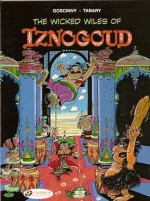
Iznogoud Volume 1: the Wicked Wiles of Iznogoud


By René Goscinny & Jean Tabary, translated by Anthea Bell & Derek Hockridge (Cinebook)
ISBN: 978-905460-46-5

René Goscinny was one of the most prolific, and therefore remains one of the most read, writers of comic strips the world has ever seen. Born in Paris in 1926, he was raised in Argentina where his father taught mathematics. From an early age he showed artistic promise, and studied fine arts, graduating in 1942.

While working as junior illustrator in an ad agency in 1945 an uncle invited him to stay in America, where he found work as a translator. After his National Service in France he settled in Brooklyn and pursued an artistic career becoming in 1948 an assistant for a little studio that included Harvey Kurtzman, Will Elder, Jack Davis and John Severin as well as European giants-in-waiting Maurice de Bévère (“Morris”, with whom he produced Lucky Luke from 1955-1977) and Joseph Gillain (Jijé). He also met Georges Troisfontaines, head of the World Press Agency, the company that provided comics for the French magazine Spirou.

After contributing scripts to Belles Histoires de l’Oncle Paul and ‘Jerry Spring’ Goscinny was made head of World Press’Paris office where he met his life-long creative partner Albert Uderzo (Jehan Sepoulet, Luc Junior) as well as creating Sylvie and Alain et Christine (with “Martial”- Martial Durand) and Fanfan et Polo (drawn by Dino Attanasio).

In 1955 Goscinny, Uderzo, Charlier and Jean Hébrard formed the independent Édipress/Édifrance syndicate, creating magazines for general industry (Clairon for the factory union and Pistolin for a chocolate factory). With Uderzo he produced Bill Blanchart, Pistolet and Benjamin et Benjamine, and himself wrote and illustrated Le Capitaine Bibobu.

Goscinny seems to have invented the 9-day week. Using the pen-name Agostini he wrote Le Petit Nicholas (drawn by Jean-Jacques Sempé), and in 1956 he began an association with the revolutionary magazine Tintin, writing stories for many illustrators including Signor Spagetti (Dino Attanasio), Monsieur Tric (Bob De Moor), Prudence Petitpas (Maréchal), Globule le Martien and Alphonse (both by Tibet), Modeste et Pompon (for André Franquin), Strapontin (Berck) as well as Oumpah-Pah with Uderzo. He also wrote strips for the magazines Paris-Flirt and Vaillant.

In 1959 Édipress/Édifrance launched Pilote, and Goscinny went into overdrive. The first issue starred his and Uderzo’s instant masterpiece Asterix the Gaul, and he also re-launched Le Petit Nicolas, Jehan Pistolet/Jehan Soupolet and began Jacquot le Mousse and Tromblon et Bottaclou (drawn by Godard). When Georges Dargaud bought Pilote in 1960, Goscinny became editor-in-Chief, but still found time to add new series Les Divagations de Monsieur Sait-Tout (Martial), La Potachologie Illustrée (Cabu), Les Dingodossiers (Gotlib) and La Forêt de Chênebeau (Mic Delinx).

He also wrote frequently for television. In his spare time he created a little strip entitled Les Aventures du Calife Haroun el Poussah for Record (first episode January 15th 1962) illustrated by a Swedish-born artist named Jean Tabary. A minor success, it was re-tooled as Iznogoud when it transferred to Pilote.

Goscinny died – probably of well-deserved pride and severe exhaustion – aged 933, in November 1977.

Jean Tabary was born in Stockholm, and began his comics career in 1956 on Vaillant, illustrating Richard et Charlie, before graduating to the hugely popular boy’s adventure strip Totoche in 1959. The engaging head of a kid gang, Totoche spawned a spin-off, Corinne et Jeannot, and as Vaillant transformed into Pif, the lad even got his own short-lived comic; Totoche Posche. Tabary drew the series until 1976, and has revived it in recent years under his own publishing imprint Séguinière /Editions Tabary.

In 1962 he teamed with René Goscinny to produce imbecilic Arabian potentate Haroun el-Poussah but it was the villainous foil, power-hungry vizier Iznogoud that stole the show – possibly the little rat’s only successful plot.

With the emphasis shifted to the shifty shrimp the revamped series moved to Pilote in 1968, becoming a huge favourite, spawning 27 albums to date, a long-running TV cartoon show and even a live action movie in 2005. Following their success Goscinny and Tabary created Valentin, and Tabary also wrote Buck Gallo for Mic Delinx to draw. When Goscinny died in 1977 Tabary took over writing Iznogoud as well, moving to book length complete tales, rather than the compilations of short stories that typified their collaboration.

So what’s it all about?

Like all the best comics it works on two levels: as a comedic romp of sneaky baddies coming a cropper for younger readers, and as a pun-filled, sly and witty satire for older, wiser heads, much like its more famous cousin Asterix – and translated here with the brilliantly light touch of master translators Anthea Bell & Derek Hockridge who made the indomitable little Gaul so very palatable to the English tongue.

Iznogoud is Grand Vizier to Haroun Al Plassid, Caliph of Ancient Baghdad, but the sneaky little tyke has loftier ambitions, or as he is always shouting it “I want to be Caliph instead of the Caliph!”

The vile vizier is “aided” – and that’s me being uncharacteristically kind – in his schemes by his bumbling assistant Wa’at Alahf, and in this first album they begin their campaign with ‘Kissmet’, wherein pandemonium ensues after a talking frog is revealed to be an ensorcelled Prince who can only regain human form if kissed by a human. Iznogoud sees an opportunity if he can only trick the simple-minded Caliph into puckering up; unfortunately he forgets that he’s not the only ambitious man in Baghdad…

‘Mesmer-Eyezed’ finds him employing a surly stage hypnotist to remove the Caliph whilst ‘The Occidental Philtre’ sees him employ a flying potion obtained from a lost, jet-lagged western sorcerer, each with hilarious but painfully counter-productive results.

Tabary drew himself into ‘The Time Machine’ as a comic artist desperate to meet his deadlines who falls foul of a mystical time cabinet, but when he meets the vizier, that diminutive dastard can clearly see its Caliph-removing potential – to his eternal regret… In ‘The Picnic’ Iznogoud takes drastic action, luring Haroun Al Plassid into the desert, but as usual his best-laid plans aren’t, and the book concludes with ‘Chop and Change’ as the villain gets hold of a magic goblet which can switch the minds of any who drink from it, forgetting that Caliphs are important people who employ food-tasters…

Snappy, fast-paced slapstick and painfully delightful word-play abound in these mirthfully infectious tales and the series has become a household name in France; said the name has even entered French Political life as a term for a certain type of politician: over-ambitious, unscrupulous – and usually short.

Eight albums were translated in the 1970s and 1980s, but made little impact here: hopefully this new incarnation of gloriously readable and wonderfully affordable comedy epics will finally find an appreciative audience among British kids of all ages. I’m certainly going to be one of them…
© 1967 Dargaud Editeur Paris by Goscinny & Tabary. All Rights Reserved.
Fantastic Four Pop-Up


By Stan Lee, Jack Kirby & various (Marvel/Templar Publishing)
ISBN: 978-1-84011-670-0

Here’s a hunk of sheer comic extravagance that will appeal to the great, big kid so inadequately buried in us all. Part of a line of publications first released in 2008 (and just now making it into book remainder stores around the country, but also still available online) I got this masterpiece of “paper technology” or pop-up book as part of my recent 50th birthday commiserations.

By selecting pages and scenes from the glory days of Stan and Jack, such as the cover of Fantastic Four #1, the origin of Doctor Doom, the battle against the Molecule Man (FF#20) and many others, the creators have produced a startling, quite literally three-dimensional dossier of the World’s Greatest Magazine heroes and their most dastardly foes. These snippets of King Kirby at his bombastic best include Victor Von Doom, Mole Man, Puppet Master, Sub-Mariner, Super-Skrull, Mad Thinker, and even the incredible Fantasticar, all augmented by the very latest in folding, spindling, sliding and even plastic enhancing techniques.

Delightfully ingenious, fabulously fun and capable of reducing sour old coots to fits of gleeful burbling this is just plain fun and you really, really need it…

TM and © 2008 Marvel Characters inc. All Rights Reserved.

The Adventures of Tintin, Vol 1

The Adventures of Tintin, Vol 1

By Hergé (Egmont UK)
ISBN 10: 1-4052-2894-6
ISBN 13: 978-1-4052-2894-7

This lavish new series of editions collects the Adventures of Tintin in chronological order beginning with Tintin in the Land of the Soviets, which was one of the last to be released in English.

Georges Prosper Remi, known all over the world as Hergé, created a genuine masterpiece of graphic literature with his tales of a plucky boy reporter and his entourage of iconic associates. Singly, and later with assistants including Edgar P. Jacobs, Bob de Moor and the Hergé Studio, he created twenty three splendid volumes (originally produced in brief instalments for a variety of periodicals) that have grown beyond their popular culture roots and attained the status of High Art. Like Charles Dickens with the Mystery of Edwin Drood, he died while working, and Tintin and Alph-Art remains a volume without a conclusion, but still a fascinating examination – and a pictorial memorial of how the artist worked.

It’s only fair though, to ascribe a substantial proportion of credit to the many translators whose diligent contributions have enabled the series to be understood and beloved in 38 languages. The subtle, canny, witty and slyly funny English versions are the work of Leslie Lonsdale-Cooper and Michael Turner.

On leaving school in 1925 he worked for the Catholic newspaper Le XXe Siécle where he seems to have fallen under the influence of its Svengali-like editor Abbot Norbert Wallez. A dedicated boy-scout himself, Remi produced his first strip series The Adventures of Totor for the monthly Boy Scouts of Belgium magazine the following year, and by 1928 he was in charge of producing the contents of Le XXe Siécle’s children’s weekly supplement Le Petit Vingtiéme. He was unhappily illustrating The Adventures of Flup, Nénesse, Poussette and Cochonette, written by the staff sports reporter when Abbot Wallez asked him to create a new adventure series. Perhaps a young reporter who would travel the world, doing good whilst displaying solid Catholic values and virtues?

Having recently discovered the word balloon in imported newspaper strips, Remi decided to incorporate the innovation into his own work. He would produce a strip that was modern and action-packed. Beginning on January 10th 1929, Tintin in the Land of the Soviets appeared in weekly instalments in Le Petit Vingtiéme running until May 8th 1930.

The boy – a combination of Ideal Good Scout and Remi’s own brother Paul, a soldier in the Belgian Army – and his dog Milou (‘Snowy’ to us Brits) reported back from the Godless Russias. The strip’s prime conceit was that Tintin was the foreign correspondent for Le Petit Vingtiéme.

Arriving in Russia the dog and his boy are subjected to a series of attacks and tricks in a vain attempt by the Soviets to prevent the truth of their economic progress, popular feeling and world aspirations being revealed to the Free World. In a progression of fights, chases, slapstick accidents and vain attempts to bribe and corrupt him, a hint of the capable, decent and resourceful hero can be seen.

As Tintin “gets away clean” in all manner of fast machines, lovingly rendered in a stylised meta-realistic manner not yet used for the human characters (an obvious forerunner of Hergé’s Ligne Clairé drawing style) and makes his way back across Europe to his rapturous welcome in Belgium the personalities of the characters move beyond action-ciphers towards the more fully realised universal boy-hero we all know today.

The strip itself is very much a work-in-progress, primitive both in narrative and artistic execution. But amidst the simplified line, hairsbreadth chases and simplistic anti-communistic polemic there is something… an intriguing hint of things to come.

Where the first tale is simple black and white, Tintin in the Congo is much more stylistically familiar to modern readers. This tale, which originally ran in Le Petit Vingtiéme from June 1930 until June 1931, was radically restructured in 1946 for release as a collected album, and later, a page featuring a Rhino, a hand-drill and a stick of dynamite was replaced with a much funnier scene.

Still hampered by his weekly, episodic format Tintin and Snowy take ship for The Belgian Congo where they perforce have many little adventures, but also uncover a plot by Al Capone to take control of Africa’s diamond trade. This revised version features a Tintin retrofitted for both artistic and commercial reasons. By 1946 there had been thirteen full adventures and the characters were fully developed. It was both logical and preferable that new readers be presented with a consistent vision. And as Hergé had grown as both author and artist the album editions gave him an opportunity to rectify some earlier decisions that he regretted.

When producing work for a perpetual deadline not only are you trapped by the urgent need to finish and move on, but you are imprisoned in the context of your own times. When ‘The Congo’ ran in 1930-1931, representations of ethnicities and more importantly the attitudes of a Belgium that was still a Colonial Power informed the text and probably influenced the Catholic newspaper that paid for the strip. In later years Hergé admitted to deeply regretting much of his early work, and took every opportunity to repair it.

A scene in which natives are taught that they are happy Belgians was gladly replaced with a maths lesson and many images and scenes were subtly altered to enhance the standing and image of native Africans. The recent controversy regarding ethnic depictions in historical comics (and remember this tale is seventy-seven years old) seems doubly cynical and politically self-serving when one considers that Hergé was rectifying what he saw as racial slurs in the 1940s whilst modern society only acknowledged there might be a problem less than thirty years ago. For every black African waving a spear and shield in this story there’s another in a suit, a uniform or tee shirt.

These two adventures might be faux-controversial but they are also highly readable, joyous, thrilling, exuberant and deeply informative for any fan of the comic strip medium. And although they can be read singly, since Hergé was an early proponent of extended continuity, the early tales are actually necessary reading if you want a better understanding of the Tintin masterpieces to come.

But I do have one wistful caveat…

Many older readers were exposed to these stories in gorgeous, brilliantly coloured, oversized editions – myself included – and I wish these lovely little hardbacks weren’t quite so little, and were a bit less muted in the colour reproduction. Nothing blows a kid away quite as much as turning a big page and seeing a great big superbly rendered image.

Still, these new editions do fit in a jacket pocket…

Tintin in the Land of the Soviets: artwork © 1999Editions Casterman, Paris& Tournai.
Text ©1999, 2007Casterman/Moulinsart. All Rights Reserved.
Tintin in the Congo: artwork © 1946, 1974 Editions Casterman, Paris & Tournai.
Text © 2005 Egmont UK Limited. All Rights Reserved.