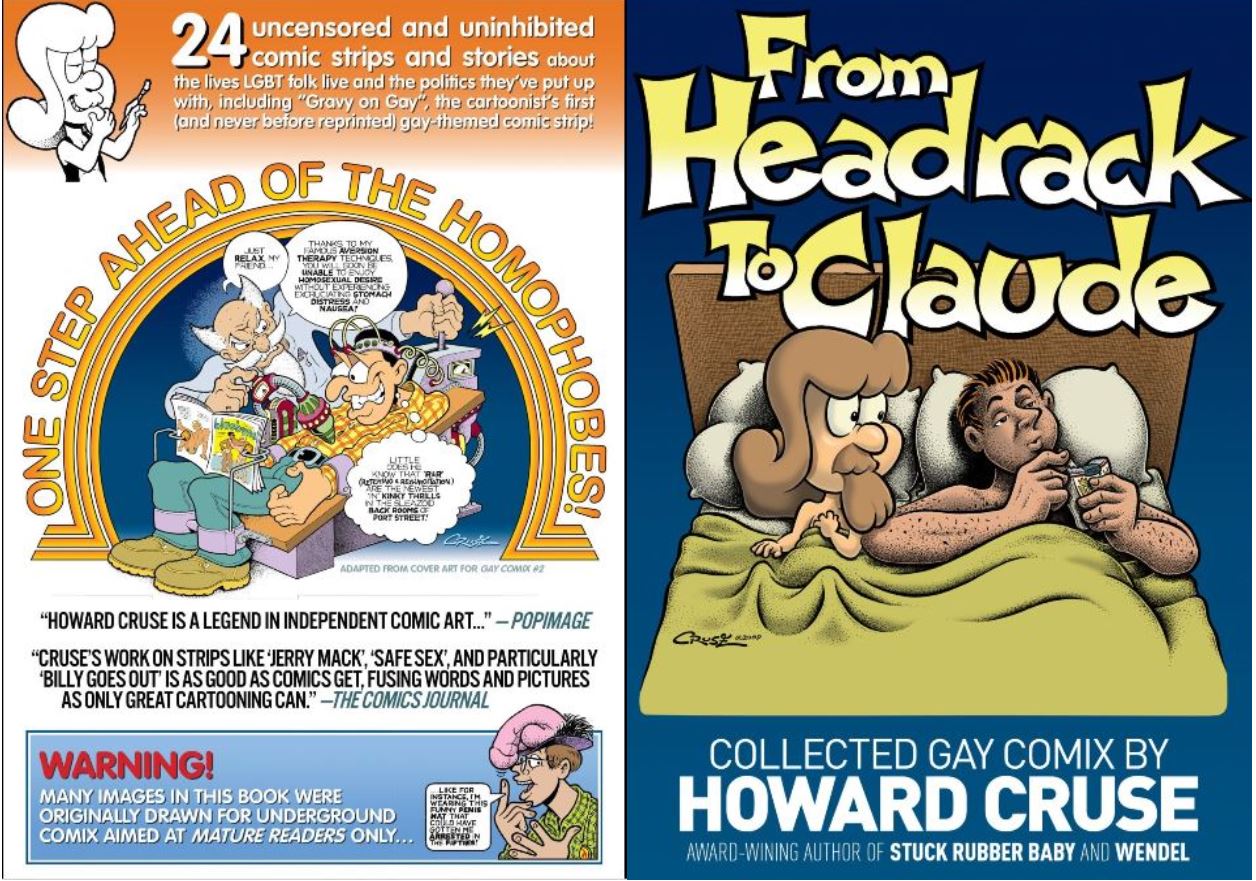
From Headrack to Claude – Collected Gay Comics of Howard Cruse


By Howard Cruse (Nifty Kitsch Press/Northwest Press)
ISBN: 978-0-578-03251-1 (TPB/Digital edition)

It’s long been an aphorism – if not an outright cliché – that Gay comics – can we be contemporary and say LGBTQIA+? – have long been the only place in the graphic narrative business to see real romance in all its joy, pain, glee and glory.

It’s still true: an artefact, I suppose, of a society seemingly obsessed with demarcating and separating sex and love as two utterly different and possibly even opposing principles and activities. I’d like to think that here in the 21st century – at least in the more sensible, civilised parts of it – we’ve outgrown the juvenile, judgemental, bad old days and can simply appreciate powerfully moving and/or funny comics about people of all sorts without any kind of preconception.

Sadly, that battle’s nowhere near won yet and in truth it all looks pretty bleak unless you’re a fundamentalist zealot or bigot. Hopefully, compendia such as this will aid the fight, if only we can get the other side to read them…

To facilitate that, after this archive was originally self-published in 2008 it was rendered fully digital – with updates and extra material – from those wonderful people at Northwest Press. Oh, and there’s an abundance of sex and swearing on view, so if you’re the kind of person liable to be upset by words and pictures of an adult nature (such as joyous, loving fornication between two people separated by age, wealth, social position and race who happily possess and constantly employ the same range of naughty bits on each other) or sly mockery of deeply-held, outmoded and ludicrous beliefs then best retreat and read something else.

In fact, just go away: you have no romance in your soul or love in your heart.

Howard Cruse (May 2nd 1944-November 26th 2019) enjoyed a remarkable cartooning career spanning decades that overlapped a number of key moments in American history and social advancement. Beginning as a hippy-trippy, counter-culture, Underground Comix star with beautifully drawn, witty, funny (not always the same thing in those days – or now, come to think of it) strips, his work evolved over years into a powerful voice for change in both sexual and race politics. Initially as strips in magazines but ultimately through such superb collections and Original Graphic Novels as Wendel and Stuck Rubber Baby: an examination of oppression, tolerance and freedoms in 1950s America.

Since then he has become a columnist, worked on other writers’ work, illustrated an adaptation of Jeanne E. Shaffer’s The Swimmer With a Rope In His Teeth and continued his own unique brand of cartoon commentary.

Born the son of a Baptist Minister in Birmingham, Alabama, Cruse grew up amid the instinctive race-based privilege and smouldering intolerance of the region’s segregationist regime: an atmosphere that shaped him on a primal level. In the late ‘60s, he escaped to Birmingham-Southern College to study Drama: graduating and winning a Shubert Playwriting Fellowship to Penn State University.

Campus life never really suited him and he dropped out in 1969. Returning to the South, he joined a loose crowd of fellow Birmingham Bohemians; allowing room to blossom as a creator. By 1971, Cruse was drawing a spectacular procession of strips for an increasingly hungry and growing crowd of eager admirers. Whilst working for a local TV station as both designer and children’s show performer, he created a kid’s newspaper strip about talking squirrels Tops & Button, and still found time to craft the utterly whimsical and bizarre tales of a romantic quadrangle. Intended for the more discerning college crowd he remained in contact with, these strips appeared in a variety of college newspapers and periodicals and starred a very nice young man and his troublesome friends…

In 1972 the strip was “discovered” by publishing impresario Denis Kitchen who began disseminating Barefootz to a far broader audience via such Underground periodical publications as Snarf, Bizarre Sex, Dope Comix and Commies From Mars: all published by his much-missed Kitchen Sink Enterprises.

Kitchen also hired Cruse to work on an ambitious co-production with rising powerhouse Marvel Comics: attempting to bring a (somewhat sanitised) version of the counter-culture’s cartoon stars and sensibilities to the mainstream. The Comix Book was a traditionally packaged and distributed newsstand magazine that only ran to a half-dozen issues. Although deemed a failure, it provided the notionally more wholesome and genteel Barefootz with a larger audience and yet more avid fans…

As well as being an actor, designer, art-director and teacher, Cruse appeared in Playboy, The Village Voice, Heavy Metal, Artforum International, The Advocate and Starlog and countless other publications, yet the tireless story-man found the time and resources to self-publish Barefootz Funnies: two comic collections of his addictively whimsical strip in 1973.

For us, a captivatingly forthright grab-bag and memoir gathers the snippets and classics left out of previous must-have collections The Compete Wendel and Early Barefootz, with Cruse tracing his development through cartoons and strips all thoroughly and engagingly annotated and contextualised by the author himself: fondly, candidly revisited against a backdrop of the men he loved at the time.

Acting as an historical place-setter, Cruse’s informative Preface sets the ball rolling, laconically tracing his artistic career and development through domestic autobiographical strip ‘Communique’ (from Heavy Metal) to unveil home life at the time. A more detailed exploration overview of the Queer comics scene follows in ‘From Miss Thing to Jane’s World’ before the book truly begins.

For a better, fuller understanding you’ll really want to see the aforementioned Wendell and Barefootz collections, but for now we relive history in first chapter Artefacts & Benchmarks Part 1: 1969-76, blending contextualising prose recollection with noteworthy strip ‘That Night at the Stonewall’s’, advertising art, abortive newspaper strip sample, an episode of Tops & Button, and other published work, plus gay sitcom feature ‘Cork & Dork’.

An early example of advocacy comes from wry cartoon homily ‘The Passer-By’ before further reminiscences and picture extracts take us to an uncharacteristically strident and harsh breakthrough.

Preceded by explanatory sidebar ‘Backstory: Gravy on Gay’, we are formally introduced to Barefootz’s, way-out friend confidante – and openly gay hippy rebel – Headrack in ‘Gravy on Gay’: wherein – the laid-back easy-going artist is confronted with the ugly, mouthy side of modern living as voiced by obnoxious jock jerk Mort

The march of progress continues in Artefacts & Benchmarks Part 2: 1976-80, detailing a variety of comics jobs from Dope Comix and Snarf to the semi-legitimacy of Playboy and Starlog. It also features the first meeting with life partner – and ultimately, husband – Eddie Sedarbaum before My Strips from Gay Comix 1980-90 traces his editorial career on the landmark anthology through reprints of his own strip contributions.

It begins in ‘Billy Goes Out’: recalling the joyous – or it that empty and tedious? – hedonistic freedoms of the days immediately before the AIDS crisis…

Incisive cloaked autobiographical fable ‘Jerry Mack’ takes us inside the turbulent mind of an ultra-closeted church minister in full regretful denial, after which further heartbreak is called up in devious tragedy ‘I Always Cry at Movies’ before home chores are dealt with in a manly manner in ‘Getting Domestic’.

Historical and political insight comes in ‘Backstory: Dirty Old Lovers’ before the outrageous and hilarious antics of the oldest lovers in town scandalise the Gay community in ‘Dirty Old Lovers’, whilst the thinking behind clarion call ‘Safe Sex’ is detailed in a ‘Backstory’ article prior to a straightforward examination of Acquired Immune-Deficiency Syndrome and its effects on personal health and public consciousness…

Surreal comedy infuses the tale of a man’s man and his adored ‘Cabbage Patch Clone’ after which faux ad ‘I Was Trapped Naked inside the Jockey Shorts of the Amazing Colossal Man!’ and Matt Groening spoof ‘Gay Dorks in Fezzes’ closes this chapter to make way for Topical Strips 1983-93.

With Cruse’s particular brand of “Gay” commentary/advocacy reaching more mainstream audiences through publications like The Village Voice, a ‘Backstory’ relates the author’s ultimately unnecessary anxiety over inviting in the wider world through polemical sally ‘Sometimes I Get So Mad’ and wickedly pointed social and media satire ‘The Gay in the Street’. That oracular swipe and ‘1986 – An Interim Epilogue’ are also deconstructed by Backstory segments (the latter being a 2-page addendum created for the Australian release of ‘Safe Sex’ in Art & Text magazine) before ‘Backstory: Penceworth’ shares one of British Prime Minister Margaret Thatcher’s vilest moments.

In 1988, her government attempted to set back sexual freedom to the Stone Age (or Russia, Turkey, Nigeria and other uncivilised countries today) by prohibiting the “promotion of homosexuality”. The British law – (un)popularly known as Clause 28 – was resisted on many fronts, including benefit comic AARGH (Artists Against Rampant Government Homophobia). Invited to contribute, Cruse channelled Hillaire Belloc’s Cautionary Verses and excoriatingly assaulted the New Nazism with ‘Penceworth’: a charming illustrated poem like a spiked cosh snuggled inside a rainbow coloured velvet slipper…

Luxuriating in righteous indignation and taking his lead from the New York Catholic Church’s militant stance against the LGBT community, Cruse then illuminated a supposed conference between ‘The Kardinal & the Klansman in Manning the Phone Bank’ and targeted similar anti-gay codicils in America’s National Endowment for the Arts in ‘Homoeroticism Blues’

Another Backstory explains how and why a scurrilous article in Cosmopolitan resulted in ‘The Woeful World of Winnie and Walt’ – a complacency-shattering tale in Strip AIDS USA, pointedly reminding White Heterosexuals that the medical horror wasn’t as discriminating as they would like to believe…

That theme is revisited with the kid gloves off in ‘His Closet’, after which ‘Backstory: Rainbow Curriculum Comix’ clarify how School Board rabble-rouser Mary Cummings set back decades of progress in American diversity education through her oratorical witch hunts. Cruse’s potent responses ‘Rainbow Curriculum Comix’ and ‘The Educator’ follow…

The artist’s Late Entries 2000-08 round off the historical hay ride: snippets including a full-colour rebuttal from Village Voice to Dr. Bruce Bagemihl’s study on animal homosexuality. ‘A Zoo of Our Own’ is accompanied by a fulsome Backstory and followed by wryly engaging modern fable ‘My Hypnotist’ and semi-autobiographical conundrum ‘Then There Was Claude’ before the bemused wonderment wraps up with prose article ‘I Must Be Important …Cause I’m in a Documentary (2011)’ and a superb Batman pin-up/put down…

This is a sublime and timeless compilation: smart, funny, angry when needful and always astonishingly entertaining. Read it with Pride.
© 1976-2008 Howard Cruse. All rights reserved.
For further information and great stuff check out Howardcruse.com


Stumptown volume 2: The Case of the Baby in the Velvet Case


By Greg Rucka, Matthew Southworth, Rico Renzi & various (Oni Press)
ISBN: 978-1-93496-89-7 (HB) 978-1-620104-80-4 (TPB) eISBN: 978-1-62010-032-5

Plenty of superhero, supernatural and sci fi comics make the jump to TV and movies these days, but not so many crime sagas. One that did came from ever-entertaining, prodigiously prolific, multi award-winning Greg Rucka.

A screenwriter (The Old Guard) and novelist (Atticus Kodiak crime sequence, Jad Bell series and a whole bunch of general thrillers), he also crafts astounding graphic thrillers like Whiteout, Queen & Country, Lazarus or The Old Guard whilst excelling on major properties and characters including Star Wars, Batman, Gotham Central (co-scripted by Ed Brubaker), Superman, Wonder Woman, Grendel, Elektra, The Punisher, Wolverine and Lois Lane. He has been a major contributor to epic events such as 52, No Man’s Land, Infinite Crisis and New Krypton.

To my mind this most engaging original comicbook concept features a non-traditional private eye barely getting by in the writer’s own backyard: Portland Oregon – AKA “Stumptown”…

The series launched in November 2009 as a 6-issue miniseries, with modern day Portland a vibrant and integral character in the story. A huge hit, the series was indefinitely extended and ran until #19. The TV show launched September 25, 2019 and was equally entertaining and initially successful, before dying after one superb season during the worst days of the pandemic.

Fronted by Kelly Sue DeConnick’s Introduction ‘On Stumptown’ and illustrated by Matthew (Savage Dragon, Ares, Infinity Inc.) Southworth and supplemental colourist Rico Renzi, the daily grind resumes with ‘The Case of the Baby in the Velvet Case’. Here we meet again Dexadrine Callisto Parios, independent private detective and sole owner/primary operative of Stumptown Investigations.

Professionally, things are on the up. “Dex” now has an actual office to work out of, but still struggles with bills, two mortgages, a gambling problem, impulse control and dangerously implacable ethics. She’s also caring for dependent brother Ansel and ignoring other people’s opinions of her bisexuality – or more likely her attitude to them shoving their noses into problems she doesn’t want to confront yet…

After a missing persons case struck far too close to home made her name, briefly secured her future and brought her to the unwelcome attention of billionaire crime-boss/legit businessman Hector Marenco, Dex hoped life would settle down to regular PI gigs: cheating spouses, lost wills and the like.

In fact, there is a lot of that, like the potentially rewarding work-pilferage job she turns down after learning it would be for one of Marenco’s shady enterprises…

Suddenly, things get complicated and crazy again when a living legend walks through the door of her new office. Miriam “Mim” Bracca is a local legend made good globally and her band Tailhook are the epitome of wild success and excess. The megastar has a unique problem though: someone has stolen her baby…

The sweet child in question is a 1977 Gibson Les Paul, perfectly restored and utterly adored. It’s her favourite guitar: more crucial to her life and wellbeing than all her internal organs combined. The sweet precious vanished during or after the last gig and she doesn’t care if it’s just lost or been stolen. Mim will pay anything to get her true and perfect soulmate back…

Parios is astounded and reminds the star that the police work for free. Bracca however, has just ended an affair with Detective Tracy Hoffman (Dex’s inside pal on the Portland Police Bureau) and resoundingly rules that out…

Swallowing a huge amount of sheer fan froth, Dex gets down to business: checking Mim’s mental state and physical dependencies. Once convinced she’s serious, it’s all about the process, and Dex looks into just how much Mim Bracca’s go-to guitar is worth on the open market before interviewing the other band members, roadies and crew. It all seems silly but straightforward: a simple case of following well-rehearsed steps until the axe is recovered or uncovered, but there are levels of betrayal, criminality and deception in play that will make this job lethally risky business…

Dex gets her first inkling visiting Mim’s personal guitar manager Fabrizio Pullano, who she finds being beaten up by manically violent and remarkably dumb skinheads prepared to torture and kill to find the guitar. Being smart and handy, she soon sends them packing, and learns she’s in the middle of a covert DEA operation. Obnoxiously abrasive agent Cathy Chase and her so-mellow associate Mike Vela try to arrest, implicate and then co-opt her…

No stranger to legal officialdom and blinkered procedures, Dex correctly assesses there’s a lot more going on than a missing instrument, and despite hot Tailhook drummer “Click” Mayes being far more open and forthcoming than he needs to be in his interview, she leaps to an obvious conclusion…

A confrontation with her client convinces her that if drugs are being smuggled on Tailhook tours, the band know nothing about it, but Dex’s notion that she’s now got it all sussed bar some legwork evaporates when she gets home and finds Ansel and neighbour Grey playing with “Baby”.

An unidentified stranger left the hot item at Her House (!) in an obvious attempt to deliver a threat and end her involvement, but a quick examination of the case proves her suspicions and Parios knows this isn’t over at all…

In fact, the return of Baby triggers a rapid spiral of manic events as Tracy Hoffman confronts her old lover, the DEA try to arrest everybody, and viciously stupid skinheads Brad and Mick burst in guns blazing and spark one of the most spectacular car chases in comics…

Insanely, when the dust settles, the mystery remains. No one admits to taking Baby in the first place and Dex has to think again…

Happily, she deduces whoactuallydunnit just in time, and is there when the drug smugglers, their skinhead clients and the enigmatic mystery supplier move to recover their product and seek redress for their trouble. With a fluid and potentially deadly standoff resulting, Parios – as always – hangs tough, thinks fast and exploits her gift for making plans on the fly…

A superbly stylish thriller perfectly exploiting the nature of Oregon myth and culture, this yarn perfectly captures a magical place and its self-appointed shop-soiled white knight. Extras include Artifacts of Stumptown – a feature on Southworth’s art process plus promo posters.

Rucka excels in capturing character in meaningful but believable ways that add to understanding whilst always advancing the plot. Ansel (a superbly positive take on a neuro-atypical character: living with Downs Syndrome but realistically rendered, sensitively realised and fully participatory) is used to great effect and, as always, serves to ground Dex’s more dangerous impulses.

…And it’s all clever, witty fast paced and superbly action-packed. If you love crime drama, detective fiction, strong female role models or just bloody great storytelling, you need to pay a visit to Stumptown.
Stumptown volume 2: The Case of the Baby in the Velvet Case ™ & © 2013 Greg Rucka & Matthew Southworth. All rights reserved.

Wandering Son volume one


By Shimura Takako, translated by Matt Thorn (Fantagraphics Books International)
ISBN: 978-1-60699-416-0 (HB)

Huge fan though I am of the ubiquitous digest-sized monochrome format that makes up the greatest part of translated manga volumes, there’s a subtle enhanced superiority to these hearty and satisfyingly substantial oversized hardback editions from Fantagraphics’ manga line (see also Moto Hagio’s A Drunken Dream and Other Stories) that just adds extra zest to any work of pictorial narrative.

It’s just a shame the story still isn’t accessible digitally or that the remaining volumes (as far as I know, we got to Book 8 before everything paused) still languish untranslated for us who don’t speak Japanese….

Especially effective and affecting, Wandering Son was this second intriguing offering from the good FBI, following two youngsters mutually experiencing the most difficult times of their lives…

Shuichi Nitori is a boy freshly transferred into a new school. He’s starting Fifth Grade and on the cusp of puberty. He’s also in a bit of a quandary. Slim, androgynous and, to be frank, rather pretty, he is constantly thinking about wearing girls’ clothes…

On his first day, he is befriended by Yoshino Takatsuki; a tall, burly tomboy harbouring similar secret yearnings. Her instinctive friendliness towards Shuichi is shared by pretty Saori Chiba, who is happy with her own gender but troubled in almost everything else. Always over-eager to please, she is a ball of inexplicable guilty feelings and – even at her young age – is considering converting to Christianity…

From the start, both girls encourage Shuichi to submit to his urges. Yoshino’s clueless mother keeps buying dresses which the despairing daughter just gives to her confused new pal, whilst Saori, also acutely aware of the Nitori boy’s underlying otherness, actively encourages him to cross-dress. She even buys him an extravagant frock for his birthday, almost killing their budding friendship stone-dead.

It is Saori who successfully suggests the unsuspecting class perform The Rose of Versailles as their end-of-term play, with all the girls playing the male roles and vice versa…

(The Rose of Versailles is a monumentally popular Shoujo manga tale – later, a movie and musical – by Riyoko Ikeda, telling the story of Lady Oscar: a girl whose soldier father raises as a man. She/He eventually becomes a dashing Palace Guard and the darling of Marie Antoinette’s Court.)

Both Shuichi and Yoshino are hard-pressed to deny their overwhelming mutual need: boy wants to be girl and girl, boy. Inevitably, their need proves too great and both succumb. Yoshino has her hair cut and goes out in her brother’s school uniform, only to be chatted up by an older woman in a burger bar. Shuichi’s periodic capitulations are less public, but increasingly important to his happiness and wellbeing – and to be honest he does make an astonishingly pretty girl, more so even than Roger Taylor in that Queen Video – although utterly pure, innocent and raunch-free…

Nevertheless, no matter how much Shiuchi and Yoshino wish they could exchange gender, time and biology inexorably march on and the changes of puberty are causing their treacherous bodies to horrifyingly and inescapably betray them…

From any other culture this type of story would be crammed with angst and agony: gratuitously filled with cruel moments and shame-filled subtext, but instead Takao Shimura (Even Though We’re Adults, Sweet Blue Flowers) crafts a genteel, winningly underplayed and enchantingly compulsive school saga that is filled with as much hope and positivity as drama.

As Hōrō Musuko the tale began in Comic Beam monthly in December 2002, running until 2013 and eventually collected as 15 volumes. It is resplendent in its refined charm and exudes assured contentment, presenting a very personal linked history in an open-minded spirit of childlike inquiry and accepting optimism that make for a genuine feel-good experience.

But of course there is more to come in the unavoidably difficult futures of Shuichi and Yoshino…

This moving, gently enticing tome also includes a helpful watercolour character chart, a pronunciation guide for Japanese speech and ‘Snips and Snails, Sugar and Spice’, a fantastically useful guide to Japanese honorifics by translator Matt Thorn, explaining social, gender and age ranking/positions so ingrained in the nation’s being. Trust me, in as hide-bound and stratified a culture as Japan’s, this background piece is an absolute necessity…

The comics portion of this volume is printed in the traditional back-to-front, right-to-left format.
© 2003 Takako Shimura. All rights reserved.

Represent!


By Christian Cooper, Jesse J. Holland, Regine Sawyer, Nadira Jamerson, Tara Roberts, Dominike “Domo” Stanton, Onyekachi Akalonu, N. Steven Harris, Justin Ellis, Frederick Joseph, Gabe Eltaeb, Dan Liburd, Keah Brown, Camrus Johnson, Alitha E. Martinez, Mark Morales, Doug Braithwaite, Eric Battle, Brittney Williams, Yancey Labat, Valentine De Landro, Travel Foreman, Keron Grant, Koi Turnbull, Don Hudson, Tony Akins, Moritat & various (DC Comics)
ISBN: 978-1-77951-419-6 (HB/Digital)

Originally published digitally in 14 chapters from September 2020 to June 2021, Represent! was – in the words of Executive Editor Marie Javins – “designed to showcase and introduce creators traditionally underrepresented in the mainstream comics book medium.” As such it was part of a greater effort by that mainstream – which contemporaneously sparked a similar project from the House of Ideas that became a string of one-shot anthologies known as Marvel Voices

Operating in conjunction with writers, artists and other creatives of colour (both In- and especially Out-Industry) allowed greater leeway and by displaying editorial willingness to address issues, themes and opinions – and even formerly entirely-ignored and marginalised sectors of society – the series was not dictated to by commercial economics and a militant fanbase addicted to continuity.

The results were admittedly mixed, but generally the freedom elevated the material to the levels of the best of adult European comics…

Here, the result is an engaging trek through history, studied observation, personal anecdote and even fantasy, with perspectives seldom – if ever – seen in your everyday funnybook. It could not possibly all be to everyone’s taste, but this weary, aged, comfortably privileged-yet broken English white boy found plenty to enjoy and much to ponder…

Exploring all aspects of the non-white American experience, from inner-imaginative landscapes and escapes to personal ideologies, each literary-leaning comics tales comes with a brief bio of the writer (sometimes that’s also the illustrator) and unless stated otherwise is lettered by the tireless Deron Bennett.

Not so Chapter 1:‘It’s a Bird’, which sees Robert Clark put words to a heartwarming tale of family and generational birdwatching written by 1990s comics creator Christian Cooper (Star Trek, The Darkhold, Excalibur and Marvel’s first openly gay writer/editor). The modern day rights activist is here supported by illustrated by Alitha E. Martinez (Heroes, World of Wakanda, Iron Man, Mighty Crusaders, Batgirl) & Emilo Lopez.

Editor, Educator, broadcaster, historian and author Jesse J. Holland (Black Panther: Who is the Black Panther?, Star Wars: The Force Awakens – Finn’s Story, The Invisibles: The Untold Story of African American Slaves in the White House) unites with British born Doug Braithwaite (Hulk, Captain America, Justice, Judge Dredd, The Punisher) & colourist Trish Mulvihill to relate a true tale. In disjointed yet carefully tailored flashbacks, a saga of endurance on a farm in rural Mississippi from 1980 to now unfolds: tracing the lives of the Hollands – a family still working land secured by ancestor and freed slave Conklin Holland in 1899…

‘Food for Thought’ comes courtesy of award-winning writer, small press publisher, essayist and journalist Regine Sawyer, with Eric Battle (Kobalt, Hardware, Batman, Wonder Woman, Spider-Man, Green Arrow, Green Lantern, Flash, Walking Dead) & Bryan Valenza rendering joyous reminiscences of a daughter shopping, cooking, talking and learning with her father in Queens, NYC, after which journalist Nadira Jamerson joins Brittney Williams (Goldie Vance, Betty & Veronica, Rugrats, Shade the Changing Girl, Lois Lane and the Friendship Challenge, Patsy Walker, A.K.A. Hellcat) & Andrew Dalhouse on the harrowing, but ultimately triumphant, journey of a black mother fighting a hostile medical system to secure an accurate diagnosis of a mystery ailment. Sometimes, all that’s necessary is to find someone to ‘Believe You’

Chapter 5 declares ‘My Granny Was a Hero’ as Tara Roberts – educator, writer, editor and fellow of both MIT’s Open Documentary Lab and the National Geographic Storytelling project – unites with Yancey Labat (DC Superhero Girls, Legion of Super-Heroes) & colourist Monica Kubina as a little girl in 1983 changes her idol from Wonder Woman to someone far closer to home after learning how her own family unwillingly “came to America” from Cameroon in 1860…

Coloured by Emilio Lopez, ‘The Lesson’ is otherwise an all-Dominike “Domo” Stanton (Moon Girl & Devil Dinosaur, Starbrand & Nightmask, Nubia & the Amazons) affair about violent high school days and one crucial path to escape, before writer/journalist Onyekachi Akalonu connects with Valentine De Landro (Bitch Planet, Marvel Knights: 4, X-Factor, Silver Surfer: Ghost Light, Black Manta) & Marissa Louise to offer social context on repressed young black lives by advocating ‘Fight Fires with Spray Cans’

Coloured by Walt Barna, Chapter 8 stands ‘In Defense of Free Speech’ as 20-year comics veteran N. Steven Harris (Aztek: The Ultimate Man, Batman: Officer Down, Deadpool, X-Force, Generation X, The Wild storm: Michael Cray, Indigo Clan) recalls a time when college lectures on black culture and experience required volunteer security teams to be heard at all…

‘Weight of the World’ – by writer/editor/media producer Justin Ellis (Problem Areas, How to Fix a Drug Scandal, The Cruelty of Nice Folks), Travel Foreman (Cla$$war, Doctor Spectrum, Immortal Iron Fist, Star Wars, Black Cat) & Rex Lokus – explores the pressures family can innocently inflict on a black kid graduating high school… and how the right librarian at the right moment can turn the page on the future…

For ‘The Flightless Bird’, prominent activist, philanthropist and bestselling author Frederick Joseph collaborates with Keron Grant (Fantastic Four, Kaboom, Son of Vulcan, Spider-Man/Doctor Octopus, New Mutants) on a tale of introspection and hope when a young man is diagnosed with a killer disease.

Gabe Eltaeb (Aquaman, Batman, Star Wars) then exposes an ‘American Mongrel’ with middle school kid Abdul learning some painful truths in 1991 as his mixed Hispanic/Iraqi heritage make him an instant and easy target during the first Iraq war. Thankfully, his grampa has seen all this before…

Celebrated sports science specialist Dan Liburd asks Koi Turnbull (Fathom, Wolverine: Dangerous Games, Superman Confidential) & Tony A?ina to join him at ‘The Water’s Edge Within Reach’; exploring the assumed limits of human aspiration and physical achievement via a career in “ironman” eventing, before journalist, actor, screenwriter and author Keah Brown (The Pretty One, Sam’s Super Seats) luxuriates in superhero excess with Don Hudson (Nick Fury/SHIELD, Forever Amber, Scalped, Curse of Brimstone) & Nick Filardi. They enquire ‘Who Hired the Kid?’: debuting a sheer escapist delight in time-travelling, monster-fighting schoolgirl adventurer “The Vet”…

The wonderment concludes by going out big with actor, director, animator and comics writer Camrus Johnson joining Tony Akins (Terminator, Star Wars, Hellblazer: Papa Midnight, Fables, Jack of Fables, House of Mystery, Wonder Woman), Moritat (Harley Quinn, The Spirit, Elephantmen, All Star Western, Hellblazer, Batman, Sheena: Queen of the Jungle, Transmetropolitan) & colourist Dee Cunniffe for ‘I’ll Catch up’. It finds the author in painful nostalgia mode, recalling how his big brother Mo used to visit in New York every summer, teaching the kid all the tricks of staying alive and protesting in a white world whilst still making his voice heard and his opinions count…

The stories are augmented by Darran Robinson’s iconic ‘Cover Gallery’ and supplemented by fascinating ‘layouts’ of various stories as crafted by Braithwaite, Harris & Akins…

Visually compelling, extremely well-executed, imaginative, purely poetic and operating with a degree of allegory seldom seen in regular comics whilst offering a wide and disparate use of the medium, Represent! is stunning, intriguing and entertaining but still feels something of a mixed bag… but then, it’s not really meant for me, is it?

If you’re like me, get it read and learn something…
© 2021 DC Comics, All Rights Reserved.

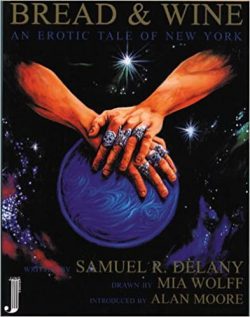
Bread & Wine – An Erotic Tale of New York


By Samuel R. Delaney & Mia Wolff (Fantagraphics Books)
ISBN: 978-1-60699-632-4 (HB/Digital edition)

The demands of drama dictate that true love never runs smooth but that’s not the case in real life. The trade-off is that those actual romances which stand the test of time and tedium are painfully devoid of the remarkable circumstance and miraculous “gosh-wow” moments of fiction.

But this remarkable account proves That Ain’t Necessarily So…

In 1999, independent publisher Juno released a small graphic novel memoir, written by Samuel R. Delaney and illustrated by Mia Wolff (Catcher, Above and Below: the Voyages of Virgilio), recounting how a celebrated gay black literary giant, college professor and social theoretician with a mantelpiece overstocked by awards, and a teenaged daughter in tow, met and romanced one of society’s most outcast and forgotten souls.

At time of publication, they had been a couple for some years and are together still. Julia Roberts and Richard Gere won’t be in their movie and not a single dragon or muscle car will have to die…

Following an Introduction from Alan Moore, this mainstream edition reveals how “Chip” Delaney took a walk on New York’s Upper West Side, bought a book from homeless vendor Dennis Rickett and struck up a conversation with the kind of person most people refuse to acknowledge the very existence of…

In seamlessly seductive understated style, the words and pictures detail how gradually, gently, unsurprisingly they became first friends and then lovers.

In the manner of all lasting true romances, this is the history of two full equals who accidentally find each other, not some flimsy rags-to-riches Cinderella tale of predestination and magical remedies. The brilliance and position of one is perfectly complemented by the warmth, intelligence and quiet integrity of the other, and although far from smooth – or rose scented or tinted – their path to contentment was and is both tension-fraught and heart-warming.

Oh, and there’s sex: lots of rapturously visualised sex, so if you’re the kind of person liable to be upset by pictures of joyous, loving fornication between two people separated by age, wealth, social position and race who happily possess and constantly employ the same type of rude bits on each other, then go away and read something else.

In fact, as I keep on saying, just please, GO AWAY.

And that’s all the help you get from me. This lyrical, beguiling tale is embellished throughout with interwoven extracts from the poem Bread and Wine by German lyric poet Friedrich Hölderlin and realised in a mesmerising organic monochrome variety of styles by artist and Delaney family friend Mia Wolff, and you really need to have it unfold for you without my second-hand blether or kibitzing…

This is one of the sweetest, most uplifting comics love stories ever written: rich with sentiment, steeped in literary punch and beautiful to behold. Moreover, this lavish, stout and steadfast tome also includes a celebratory commentary by Chip, Dennis and Mia as well as other protagonists in the Afterword. There’s also a sketch-packed, earnest and informative interview with the creative participants.

Strong, assertive, uncompromising and proudly unapologetic, this is love we should all aspire to, and Bread & Wine is another graphic novel every adult should know.
Introduction © 2013 Alan Moore. Contents © 2013 Samuel R. Delaney & Mia Wolff. This edition © 2013 Fantagraphics Books. All rights reserved.

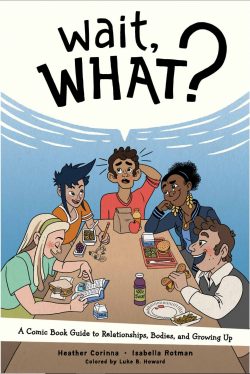
Wait, What? – A Comic Book Guide to Relationships, Bodies, and Growing Up


By Heather Corinna, Isabella Rotman, Luke B. Howard & various (Limerence Press)
ISBN: 978-1-62010-659-4 (PB) eISBN: 978-1-62010-660-0

Comic strips have long been acknowledged as an incredibly powerful tool to educate, rendering tricky or complex issues easily accessible. They also have an irresistible capacity to affect and change behaviour and have thus been used for centuries by politicians, religions, the military and commercial concerns to modify how we live our lives. Call it visual nudge-theory…

Here’s a splendid example of the art form using those great powers for good.

Sometimes it looks like the entire world’s political and moral leaders are seeking to re-mystify the most basic human experience by obfuscating all knowledge of it – leaving our most vulnerable at the mercy of their own basic instincts, wicked exploitation, cruel misinformation and simple ignorance. So if school, church and parental guardians can’t deliver, where can the new and confused go to learn about sexual interactions?

The Comic Book Guide to Relationships, Bodies, and Growing Up begins with an introductory message from Scarleteen – a sex and relationships information, education and support organisation/resource aimed at young people. As official consultants on this project, they start the ball rolling with ‘sex ed for the real world’, detailing the work and purpose of the project and other places the confused or cautious might seek advice and help.

Like many other Limerence publications, this one uses strips, games, puzzles, debate and tutorials – delivered via an engagingly diverse cartoon cast – to explore a variety of potential situations, share vital information (that my generation got from a succession of embarrassed and unwilling teachers despite what our parents thought or said) and proffer advice on where to obtain more.

The publisher’s sequence of informational comics and books has an admirable record of confronting uncomfortable issues with taste, sensitivity and breezy forthrightness: offering solutions or starting points as well as awareness and solidarity. Crucially here, that comes wrapped up in a blanket of reassurance and accepting non-judgement. The message is that every one of us is different and brings something unique to the table…

‘So Who’s at the Lunch Table?’ introduces Rico, Malia, Max, Sam and Alexis: generalised teen spokes-people representing a variety of races, backgrounds, ambitions and sexualities. There is also a narrative usher to authorially move things along …the sublimely neutral Weird Platypus

The mess and muddle around Sex is systematically tackled, beginning with an assault on the myth of timing and physical development in ‘Due Dates’: explaining biology, emotional maturity and even consent and opportunity, whilst contributing numerous anecdotes and opinions in ‘What Do You Think and Where Are You At?’

The carefully manufactured war between media, self-aspiration and everyday life is deconstructed in ‘IRL: in real life’ confirming that “the way things are in media are not necessarily how they ACTUALLY ARE”, after which we gain great graphic and factual clarity in ‘What is Puberty?’

The chapter details the basic ‘Stages of Puberty’, initially concentrating on ‘For Every Body’ before affording specialist data with ‘If You’ve got a Vagina’ and ‘If You’ve got a Penis’

‘You’re a Man/Woman Now!’ then busts some fallacies on the subject to reveal ‘These Things Don’t Actually Mean Very Much About Growing Up’

The next topic opens with overview ‘Ohhh Yeah, Real Mature!’: asking the gang ‘What Does Maturity Mean to You?’ before plunging into the charged subject of ‘Masturbation!’

Expanding into lesson and anecdotal discourse, we learn ‘Masturbation is Healthy – and nothing to be ashamed of’ and sensibly enquire ‘Why Do People Masturbate’ before tackling an increasingly serious problem in ‘Weird Genitals!: Worried Your genitals look weird? Feeling like other people’s do???’

This section is augmented by ‘A Whole Bunch of Genitals’ in a gallery display plus a join-the-dots activity page cheekily page proving ‘Genitals come in all sorts of different sizes, shapes and colors’

The major issue of Difference is laid out and explained in ‘Boys vs. Girls’, covering every aspect of possible confusion and contention via sports or toys to genderised colours, cunningly rationalised by a series of non-binary paper-dolls and clothing outfits with gender-fluid Max guiding us in making declarations and identifications…

A seemingly overwhelming youthful hurdle is cut down to size in ‘What is a Crush?’ with hapless cisgendered heterosexual Rico pointing out some pitfalls, assisted by his tablemates answering the question ‘Have You Ever Had a Crush?’ and ‘Do You Really want to Be Someone’s Partner, Girlfriend or Boyfriend?’ Whilst exploring ‘Promises and Dating’ and negotiating a bewildering maze entitled ‘As If There Was Only One Path!’ we learn how to end relationships kindly and safely in ‘It’s Okay To Go’

The mysteries and challenges of informed choice are explored in ‘By Invitation Only’ – reinforced by a ‘Consent Word Search’ – before we move on to the bit every parent always freaks out over…

What defines intimacy and sexual behaviour is debated and explored in ‘It’s Not Sex, It’s Just Messing Around’, pictorially questioning ‘Why Do People Have Sex Together’, ‘So What’s the Difference between Sex and “Messing Around”’ and gaming out ‘If it Wasn’t a Choice’

Graphs and statistics are deployed for ‘How Do You Know When You’re Ready for Sex Stuff’, backing up the cartoon wisdom of vox-pop ‘When Do You Think You Will Be Ready for Sex Stuff’ and pivotal enquiry ‘Why is Sex Such a Big Deal?’: only pausing to ask ‘Are You… Gay? Straight? Both? Neither?’ and if it even matters…

A ‘Sexual Orientation Crossword’ – with handy ‘Sexual Orientation Word Bank’ – introduces a new (and increasingly toxically contentious contemporary topic) in ‘Sexual Identity Isn’t a Lifelong Commitment’, with pictured points of view culminating in a space for readers to verbalise their own thoughts, after which the end approaches as we ponder ‘What Does it Mean to be a Virgin?’

Here Malia, Rico and Sam deconstruct the term from widely differing starting points, whilst ‘I Hate That Word!’ examines the infinitely loaded term’s accusatory and demeaning contexts before unleashing ‘A Note About Double Standards’

When beginning or even just anticipating a sexual life, support is crucial and a trustworthy network is a must if it’s possible at all. ‘Assemble Your Superteam!’ offers some sage advice on how in ‘Your Sidekick’, ‘Your Parental Figure’, ‘Your Mentor’ and ‘Your League’. The process is reinforced by another Wordsearch – ‘Find all the people you could maybe talk to!’ – before neatly segueing into ‘Know Your Community Resources!’ and affirming questionnaire ‘Who is on your Superteam?’

The cerebral sex session ceases with ‘In Conclusion: What is One Last Thing You Want to Leave Everyone With?’, supplemented by ‘Dear You’: a direct message from the creators that endeth the lessons…

Cartoonist Isabella Rotman (A Quick & Easy Guide to Consent, Bodies, and Growing Up; Not on My Watch: The Bystanders Handbook for the Prevention of Sexual Violence; You’re So Sexy When You Aren’t Transmitting STIs) and New Orleans colourist Luke Howard have crafted a cogent and compelling primer covering the irrefutable basics for a wide and varied range of potential users, with the facts and messaging scripted by author, educator and youth advocate Heather Corinna (S.E.X.: The All-You-Need-To-Know Sexuality Guide to Get You Through Your Teens and Twenties; Our Bodies Ourselves).

Identifying as Queer and disabled, Corinna is the founder, designer and director of Scarleteen and Rotman became the organisation’s artist in residence in 2013.

A comprehensive ‘Glossary’ of pertinent terms opens a section of codicils including ‘I Can’t Keep Up With the Slang!’ – an advisory on changing trends in talk about sex; ‘Puzzle Solutions’; creators bios and appreciation ‘We are so grateful for:’ after which ‘More Cool Things!’ offers a bibliography and listings of other resources online, organisational and other for kids and adults to further explore…

This book is a bright and breezy primer covering the irrefutable basics on beginning one’s sexual life and confirming a gender that most suits each individual. By sharing facts and honest opinions it may hopefully help readers safely navigate all manner of relationship and explore the spectrum of experiences that should be available us all…
Wait, What? – A Comic Book Guide to Relationships, Bodies, and Growing Up is ™ & © 2019 Heather Corinna and Isabella Rotman. All rights reserved.

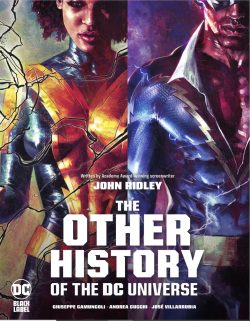
The Other History of the DC Universe


By John Ridley, Giuseppe Camuncoli, Andrea Cucchi, José Villarrubia & various (DC Comics)
ISBN: 978-1-7795-1197-3 (HB/Digital edition)

Win’s Christmas Gift Recommendation: Hard-Hitting, Strong Medicine… 9/10

The evolution and assimilation of non-white, non-standard characters – defined and othered by skin colour, religion, ethnicity and who loves whom – has been in most mass media what author and screenwriter John Ridley (12 Years a Slave; Future State: The Next Batman) has described as “measured progressiveness”.

That’s especially true in comics, where incremental firsts have been applauded – and rightly so, as the industry has always been at the forefront of progressive thinking and action – but has also suffered from a tickbox mentality where true change has been slow to materialise and hard to sustain. We can say “first black superhero”, “first gay hero”, “first interracial marriage” or “first same-sex kiss” , but other than offering a glimmer of acceptance, and recognition, what has changed?

It’s certainly better than an all-white, all-male milieu where “different” equates to “lesser than”, where more than 50% of the populace and who knows how much of the readership doesn’t conform to proposed norms and are reduced to eye-candy, plot props and useless bystanders (not even competent villains who at least have agency!). For the longest time these attitudes were tacitly enshrined on funnybook pages – and not even for sinister reasons – but what appears to simply be an unconscious acceptance of an unchallenged status quo…

You can read other books or even some previous posts here from the last month for background, if you want, but here and now, I’m pointing you towards a fascinating and gripping series recently collected as an answer to that situation.

Here Ridley – with illustrators Giuseppe Camuncoli, Andrea Cucchi, José Villarrubia and letterer Steve Wands – re-examines and deconstructs DC’s record of Diversity progress via all those slow incremental steps and breakthroughs: interpreting through the eyes and attitudes of the revolutionary characters the company added but with modern sensibilities and opinions in play…

Filtered from a socio-political perspective and assessment of those times – but not in the comfortably parochial “everything’s basically fine” tones of a white, male middle class parental audience-placator – you’ll learn a different history: one told not under Comics Code Restrictions, or commercial interests sanitising culture and attitude to keep (covertly and actively) racist authorities from embargoing titles but as heroic individuals finally telling their sides of a well-known story.

Published under DC’s Black Label mature reader imprint it begins with the story of Black Lighting in Book One – 1972-1995: Jefferson Pierce. Here we see the inner workings of an African American former Olympian who became a school teacher and vigilante to save lives and how it destroyed and damaged his family, after which Book Two – 1970-1989: Karen Beecher-Duncan & Mal Duncan recounts in their words how being the tokens on a team of white privileged teen super do-gooders shaped their lives and relationship.

A far darker divergence is applied to Japanese warrior/assassin Katana in Book Three – 1983-1996: (plus the kanji for Yamashiro Tatsu), exploring the tragic Japanese widow’s reinventions from faithful wife/widow to murderous killer and lethal weapon to nurturing superhero and beyond…

The lecture continues with the tale of a Gay Latinx cop who inherited the role of DC’s most mysterious avenger in Book Four – 1992-2007: Renee Montoya, before The Question resolves into second generation angst and answers for Book Five – 1981-2010: Anissa Pierce. Here Black Lightning’s actual legacy and effect on DC continuity is reappraised through the eyes of his superhero children Thunder and Lightning, with religion and sexual orientation also coming under fire.

All we’ve seen before is summed up with no obfuscations or confusions, but you might want to reread or acquaint yourself with the original material as seen in various volumes of Black Lightning, Teen Titans, The Outsiders as well as selected continuity highpoints of Green Lantern, Batman, Cosmic Odyssey, Crisis on Infinite Earths, Death of Superman. Don’t let the reading list deter you though: you could simply plunge right in and wing it. The material, its tone and reinterpretation are carefully orchestrated and fully approachable for any level of fan from veteran adept to casual film watcher…

Ridley enacts a miraculous slice of sleight of hand here, examining simultaneously the actual published comics as accepted DC lore but also the redefining times they were created in and filling out the characters in modern terms – quite a feat of meta-realism…

The covers are by Camuncoli & Marco Mastrazzo with Jamal Campbell producing some stunning variants, but the true attraction of The Other History of the DC Universe is the knowledge that times and attitudes have changed enough that this book is even possible. Read it and see…
© 2021 DC Comics. All Rights Reserved.

Sheets


By Brenna Thummler (The Lion Forge/Cub House/Oni Press)
ISBN: 978-1-941302-67-5 (TPB/Digital edition)

Win’s Christmas Gift Recommendation: Spirited Fun for All… 9/10

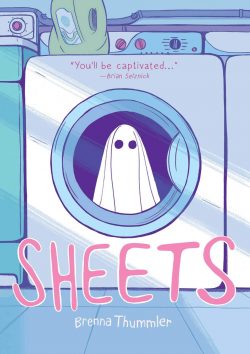
Gloom, doom and death cling to Marjorie Glatt like static. The weary youngster is bullied at school and harassed at home. That’s because she spends every waking moment trying to keep the family business going under ever-escalating pressure. The laundromat was her mom’s refuge, dream and legacy, where they all lived safe, happy and warm above the washers and driers.

…And then Mom drowned.

Situated on a quiet bend of the coast, Finster Bay is like any other small town: everybody lives for themselves and is only concerned with what they want and need, and no one sees how 13-year-old Marj is daily being sucked ever-downwards. Since the funeral she’s now stuck with school, keeping a home and even feeding the family since dad had his breakdown and withdrew from reality.

The Glatts are deep in debt and Marj’s little brother Owen is a typical boy brat who won’t help unless he’s bribed…

The rich mean girls have singled her out for special attention and nasty yoga guy Nigel Saubertuck keeps breaking in, terrorising her by sabotaging all her attempts to turn Glatt’s (formerly Delaway’s) Laundry around. He even smugly boasts of it, saying he’ll take their prime location for his proposed spa centre and make them all work for him folding towels…

That’s not even worst of it, either. Adding to Marj’s woes is the distraction of inexplicably attentive cute boy Colton possibly?/perhaps?/maybe/surely it can’t be? liking her: a novelty that consequently attracts more the full venom fand disdain of obnoxious classmate Tessi Waffleton.

The fact that Marjorie is developing a full blown compulsive aversion to water after seeing her mother drown is mere icing on the cake, but as the floundering girl slowly sinks under impossible adult responsibilities, her stressed teen’s life gets even more complicated after Wendell starts causing trouble…

Finster Bay is a town doubly populated. Existing alongside the self-obsessed adults and kids is an unseen legion of dead people. The Bay is a “Land of Ghosts” and Wendell is having a hard time adjusting to not being alive anymore. A determined and inspired fabulist liar, the little apparition refuses to interact in the support group (DYE: Dead Youth Empathetics), hasn’t read the Book of Ghost Law he was given and won’t even keep clean the standard-issue white shroud which confines and contains all that’s left of him.

He also died in water, and has an unrecalled deep connection to Marjie…

When Mr. Saubertuck makes his big move, surreptitiously adding red dye to the Glatt washers, he’s thinks he’s finally driven Marjorie to surrender. However, he’s shockingly confronted by Wendell! The slimy schemer hasn’t reckoned on an army of spooks coming to her aid, even as she at last realises the free-floating annoyance that has immensely added to her distress…

In the meantime, Marj has been doing some deep diving at the Library and has deduced that the overly-familiar little spectre is the little kid who saved her when she was lost years ago…

Wistful, charming, sadly poignant and unafraid to address both lighter and the darkest issues, Sheets is a sweetly refreshing tale of determination, discovery and enduring friendship, with illustrator-turned-author Brenna Thummler (Anne of Green Gables) delivering a remarkable and enchanting modern fable that has already spawned a sequel, and should be a favourite for generations to come.

This book was released by Lion’s Forge in 2018, and is available in digital formats, but is also schedule for re-release in January 2023 from Oni Press.
© 2018 Brenna Thummler. All rights reserved.

Luisa: Now and Then


By Carole Maurel, adapted by Mariko Tamaki & translated by Nanette McGuiness (Humanoids/Life Drawn)
ISBN: 978-1-59465-643-9 (TPB/Digital edition)

Win’s Christmas Gift Recommendation: Beguiling Fantasy Unwrapped… 9/10

The concept of time travel is infinitely appetising and irresistibly seductive. The literary conceit offers limitless potential for stories ranging from colossal cosmic Armageddons to last-chance salvation gambits; all of history and the imagination as playground and stage; the use of past and future as a Petrie dish for social satire and cultural exploration, and even fantastical magical quests course-correcting lives and providing deeply personal, painfully intimate second chances for the confused, bewildered or simply lovelorn.

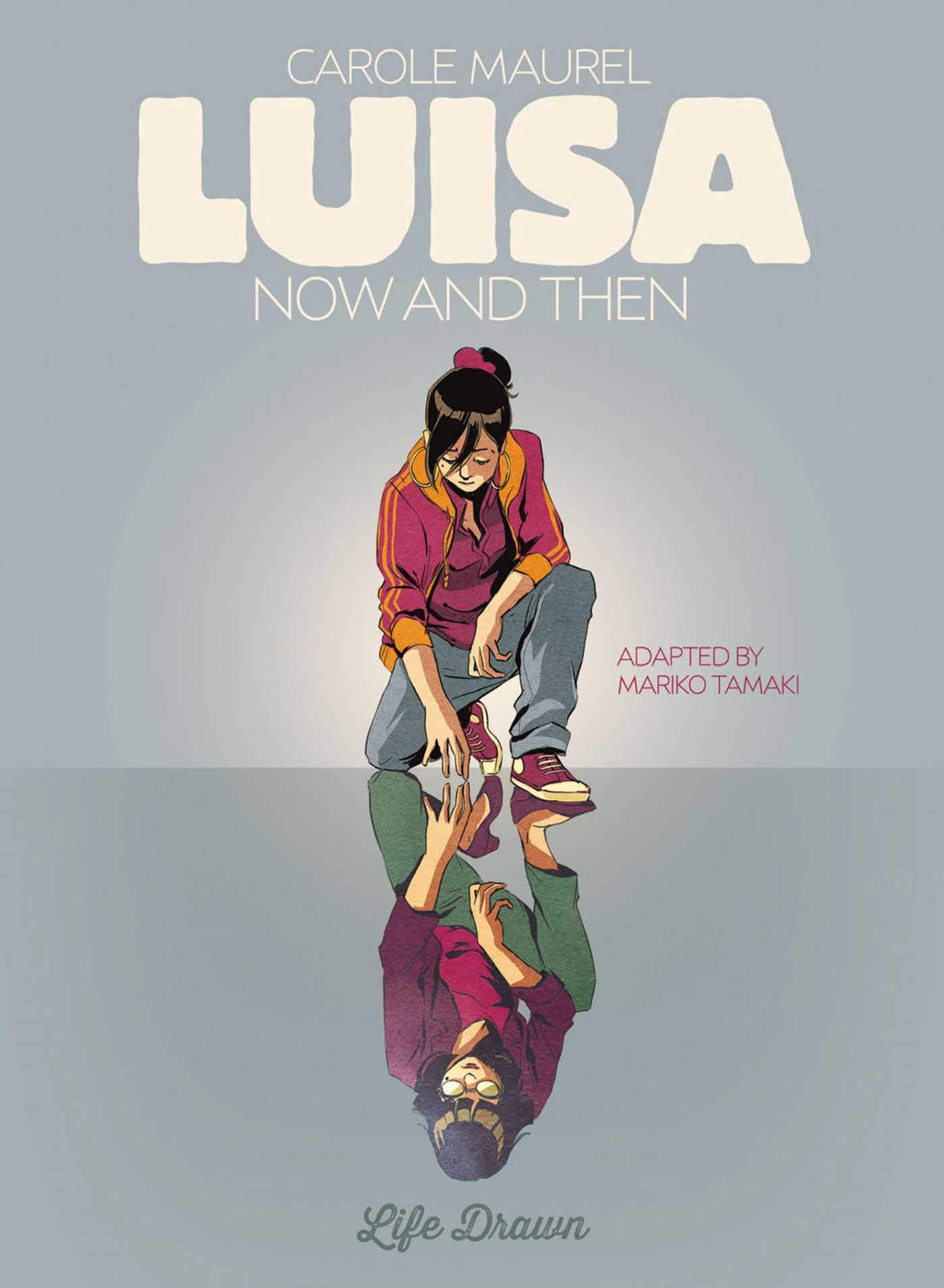
Luisa, Ici et là is one of the latter: a compelling and beguiling small story and little miracle by Carole Maurel that first appeared in 2016 and finds us English-speakers courtesy of Humanoid’s Life Drawn imprint.

It’s a sweet and oft-told tale given a stylish and welcoming contemporary gloss thanks to its wonderfully engaging lead character(s) who transforms a regulation coming-of-age parable into a heart-warming plea for understanding and – where necessary – forgiveness.

It begins as 15-year old Luisa Arambol gets off a bus. Exhausted and frustrated by discord at home in Chartres, she’s fallen asleep, missed her stop and awoken in Paris. She’s not aware of it yet, but she’s also journeyed from 1995 to 2013…

Across town, 33-year old Luisa Arambol is bitching to friend and workmate Farid. He’s heard it all before: the job sucks, she’s getting old, she drinks too much and has accomplished nothing. Worst of all, yet another man didn’t work out…

After panicking whilst trying to buy a phonecard – even the money is different here and everyone has a phone in their pocket now! – young Luisa is rescued by concerned observer Sasha who tries to help out the increasingly distressed kid. The child wants to ring her mother but cannot get through and is spiralling…

Hearing her talk and seeing what she’s wearing and carrying, Sasha soon suspects something incredible has occurred. After all, what teenager doesn’t recognise a computer tablet?

A quiet chat stabilises the kid long enough for Sasha to learn that Luisa has an aunt living in the same building she’s just moved into. It turns out Aurelia Arambol’s fifth floor flat is directly opposite Sasha’s new home, but it’s no longer occupied by the odd, ostracised single lady nobody back home will ever talk about. Little Luisa gets a big shock when that door opens and she meets her world-weary, dream-crushed, spinster older self.

Moreover, both versions instantly and instinctively realise who the other is…

Once upon a time an ambitious schoolgirl had dreams of being an art photographer but life has whittled that dream down to something far more mundane. Full grown her was left the flat by Aurelia – for reasons she still can’t fathom – and her spiky, frosty, naturally defensive state is inexplicably heightened by Sasha. Despite herself, older Luisa can’t stop staring at her new neighbour, even taking covert pictures of her, and is deeply troubled by an erotic dream featuring her…

When the object of her fascination is abruptly called away, Luisa reluctantly takes charge of the underage runaway and the situation worsens. Shared stories of mutual pasts and futures take a wild turn as aspects of their so-different personalities begin to transfer. Now-Luisa rediscovers her endless, long-vanished joie-de vivre and party spirit – and even 20-20 vision – and seems to look younger every day, just as Then-Luisa becomes sullen, responsibility-burdened, grey-haired, morose and short-sighted. Moreover, when they touch, their bodies seem to merge and coalesce…

And so begins a clash of wills and resolution of long-unfinished business found to have started on the day teen Luisa cruelly spurned an innocently impulsive overture from “out” and persecuted classmate Lucy.

That event was exacerbated by increased bullying at school and brutally reinforced at home by her own mother’s rigorous rejection of such shocking deviant behaviour as utterly unnatural, sparking a decades-long crusade to find Luisa a man…

Confused and upset, little Luisa acted up, got on a bus and ended up now while her older self just lived a lie for years…

The merging and trading of characteristics lends urgency to affairs before a long-deferred and dreaded confrontation with the Luisas’ mother generates surprising revelations about Aurelia, exposes the unknown fate of Lucy and prompts a complete revision of those attitudes that have shaped and repressed the modern-day doppelganger…

Addressing her family’s ingrained bigotry and intolerance and at last acknowledging and accepting she doesn’t just like boys or have to settle for a man is merely the first step in Luisa’s reunification and readjustment, auguring massive changes for all and forever that will begin when her fresher self at last boards a bus for home…

Refreshingly honest, charmingly blunt and captivatingly funny whist maintaining a sensitive neutrality of opinion – or prejudice – over sexuality and choices, Luisa: Now and Then sparkles with wit and charm: a sophisticated yet simple saga of self-examination that will delight all who read it, embracing the fanciful whimsy of cinema classics like The Enchanted Cottage or the Peter Ustinov’s 1948 film Vice Versa.
Luisa, Ici et là © 2016 La Boîte à Bulles et Carole Maurel. All rights reserved.

Rogan Gosh: Star of the East


By Pete Milligan & Brendan McCarthy with Tom Frame (Vertigo/Little, Brown & Co)
ISBN: 978-1-56389-143-4 (Vertigo TPB) 1-85386-253-3 (Little, Brown PB)

It feels like a cop-out and total dereliction of duty, but none the less true that some graphic novels simply defy categorisation and defeat the reviewers’ dark arts: they just have to be read, experienced and judged on a personal basis. We could stop there and it’s over to you…

However, should you require more…

Rogan Gosh is a short serial by Pete (Skin; John Constantine, Hellblazer; Strange Days; The Human Target; Batman; Red Lanterns; Shade, the Changing Man; Enigma; The Extremist; X-Statix; Johnny Nemo, Bad Company) Milligan and Brendan (Dream Gang; Mad Max: Road Fury; Judge Dredd; Spider-Man: Fever; ReBoot; Zaucer of Zilk; Skin; Swimini Purpose; Strange Days; Sometime Stories) McCarthy with notable contributions from letterer/colourist Tom Frame.

It first appeared in short-lived, controversial, cutting edge, experimental British comic magazine Revolver – specifically issues #1-6 spanning July-December of the Fleetway Publication. It was later collected into a graphic album by DC/Vertigo in 1994. I’m pretty sure there was also a Fleetway collection, but if so, it’s nigh impossible to find now, and that was a lifetime ago, so I might be dreaming of another reality…

Like companion/precursor title Crisis, Revolver’s brief was to make comics for people who had outgrown funny picture stories and adults who claimed to have never read them. It was supposed to be political, fashionable, contemporary and contentious, and it succeeded over and over again, in strips like Dare, Purple Days, Happenstance and Kismet, God’s Little Acre, Pinhead Nation and Plug Into Jesus.

For many, the jewel in the crown was a bizarre and beautiful, sardonically surreal saga incorporating English curry houses, karmic renewal and exploration, science fiction iconography, cultural commentary and (in)appropriation, ferociously irreverent satirical comedy, and – apparently – concealed creator autobiography. It referenced Indian philosophy and religions, British colonial history and modern urban street life in an onrushing miasma of visual and ideological concepts that blew the mind and generated outrageous belly laughs. There were loads of guns and rockets and tons of sex too…

Like many Milligan & McCarthy creations the strip is often described as “post-modern psychedelia”, evolving from channelled childhood experiences of two white art school kids who had grown up amidst the burgeoning fallout of the Desi Diaspora. That’s when families from the countries of the Asian sub-continent – specifically Pakistan, Bangladesh and India – migrated to western countries like Britain, bringing new thought, music, fashions, scents and especially food to broaden and enrich an evolving multiculture. There were even comics unlike any we’d ever seen before when cruising the streets of Southall or Brick Lane…

Proud products of such an environment and rising superstars thanks to 2000AD, writer Milligan and co-plotter/illustrator McCarthy had planned to deliver a kind of “Bollywood Blade Runner”, but the story sort of got away from them… as is often the case with passion projects…

I’m feeling truly redundant trying to precis the plot, but for the sake of form, try this…

The universe exists on many levels and at all times. In Raj-era India Rudyard Kipling has shamed himself with a native houseboy and now roams the streets of Lahore, seeking a holy man to save his sanity and reputation by putting him in touch with the fabled Karmanauts.

His quest succeeds and the author is – via drugs and magic and ancient wisdom – elevated to a state where he witnesses a future where laddish London oaf Dean Cripps escapes stroppy girlfriend Mary Jane to go for a curry at the magnificent Star of the East in Stoke Newington.

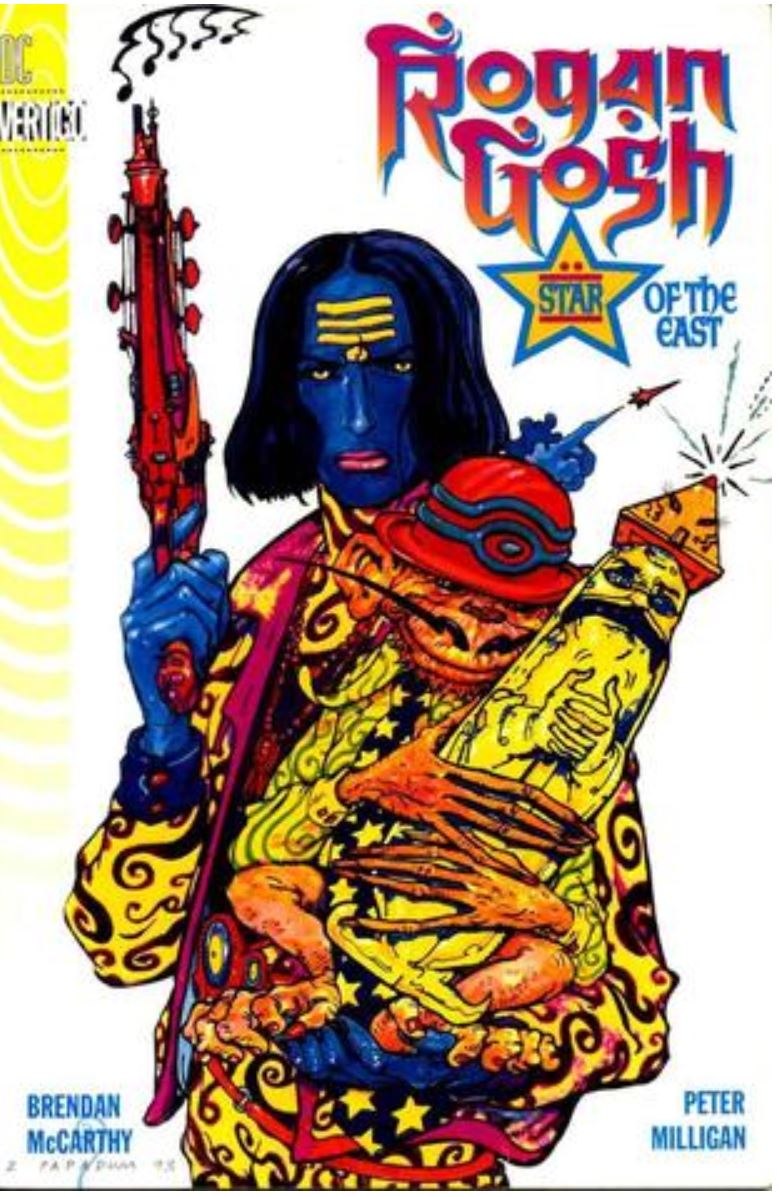
When Dean feels a frisson of connection with beautiful waiter Raju Dhawan, the energy unleashes time-travelling wonder warrior Rogan Gosh just in time to defend enlightenment and all realities from the clandestine attacks of destructive Kali and her malign vampiric agent the Soma Swami

It all gets a bit strange after that, what with audacious experimental love, devastation and recreation, Karma Kops, and that pest monkey god Hanuman, but rest assured that by the end, what you presume to be the regulation natural universe is back near where it belongs…

Although the story and events might bewilder, what is beyond question is the astounding art by Brendan McCarthy: utilising a blend of pen, paint and early digital technology to create a lush and vibrant homage to the startlingly bright colours of the subcontinent and plush décor of favourite London curry houses and tapping the wellsprings of a fevered and sublimely seasoned imagination to beguile the eyes. This stuff is just so damn pretty…

Hard to find in its original form, the entire trip is reprinted in 2013 anthology The Best of Milligan & McCarthy beside lots of other great stuff like Freakwave, Paradax! and Skin. The collection (which is on my to-do list…) is also available in digital format so there’s no need to wait.

Your destiny awaits, you only have to choose to embrace it…
™ & © 1990, 1994, 2013 Peter Milligan & Brendan McCarthy. All rights reserved.