Spider-Man: Blue


By Jeph Loeb & Tim Sale (Marvel)
ISBN: 978-0-7851-1071-2

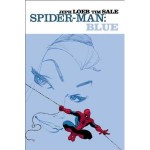
In Spider-Man: Blue Jeph Loeb and Tim Sale set their nostalgia-filled sights on the beginning of Peter Parker’s tragically brief romance with Gwen Stacy, encompassing the transitional period when Steve Ditko’s creepy, plucky outsider grew into the wholesome, straight-shooting, hard-luck hero designed by John Romita Senior.

Reprinting the 6-issue miniseries from 2002, this slight if readable epic reconstitutes pertinent snippets from Amazing Spider-Man # 39-49, plus a smidgeon of #63, as, on a gloomy Valentine’s Day, happily married Peter records a message to a dead once-girlfriend he hasn’t really gotten over. In the form of a reminiscence of those days when he first emerged from his solitary shell, Parker recalls how he found – and lost – a few friends and inadvertently met his future wife Mary Jane, all whilst pursuing a pure, innocent and unlikely love with a seemingly unattainable dream…

Along the way he also fought a formidable array of super-foes, including The Green Goblin, the Rhino, the Lizard, two different Vultures and Kraven the Hunter, uncomfortably re-imagined here as the kind of sinister, brooding mastermind that he simply could not ever have been.

Sadly, there’s no real tension in the saga because even the newest readers already know the inevitable romantic outcomes whilst the attempt to weave a number of isolated super-baddie clashes into a vast master-plan over and above what Lee and Romita envisioned is clumsy and ill-considered. Don’t take my word for it: the original tales are readily available for your perusal and delectation in such sterling volumes as Essential Spider-Man volumes 2 and 3, as well as assorted Marvel Masterworks and collections, should you feel the need to contrast and compare…

Jeph Loeb and Tim Sale have a prodigious track record with simultaneously retrofitting, rationalising and re-examining the pivotal moments of many comic-book icons: especially distilling the key moments of iconic characters and careers into material palatable to modern readers, but here it’s simply a waste of their time. The originals are simply still better than the slow, shallow rehashing here.  This is not one of their better efforts, and often comes perilously close to being simply maudlin far too often for comfort.

Although Sale’s art is always a joy to behold, and Loeb’s gift for dialogue is undiminished Spider-Man: Blue falls short of their best. A solid, casual affair but not a patch on the real thing …

© 2002, 2003, 2004 Marvel Characters, Inc. All Rights Reserved.

The Incredible Hulk


By Stan Lee, Jack Kirby, Steve Ditko & various (Lancer US/Four Square UK)
“ISBNs” 72-124 (Lancer) and 1808 (Four Square)

This is one solely for chronic nostalgics, consumed collectors and historical nit-pickers, and is all about memories and the purity of the line – and possibly nasty, mean profiteering publishers…

One thing you could never accuse entrepreneurial maestro Stan Lee of was reticence, especially in promoting his burgeoning line of superstars. In the 1960s most adults, including the people who worked in the field, considered comic-books a ghetto. Some disguised their identities whilst others were “just there until they caught a break.” Stan, Jack and Steve had another idea – change the perception.

Whilst Kirby and Ditko pursued his imagination waiting for the quality of the work to be noticed, Stan pursued every opportunity to break down the ghetto walls; college lecture tours, animated shows (of frankly dubious quality at the start, but always improving), foreign franchising and of course getting their product onto “real” bookshelves in real book shops.

There had been a revolution in popular fiction during the 1950s with a huge expansion of cheap paperback books: companies developed extensive genre niche-markets, such as war, western, romance, science-fiction and fantasy. Hungry for product for their cheap ubiquitous lines, many old novels and short stories collections were republished, introducing a new generation to such authors as Robert E. Howard, Otis Adelbert Kline, H.P. Lovecraft, August Derleth and many others.

The paperback itself was not new: pioneered by German company Albatross Books in 1931 – not too long before the birth of the comic book itself – their abortive efforts were picked up and successfully adapted by publisher Allen Lane in England. In 1935 they launched Penguin Books, which in one go combined conspicuous, memorable design, genre-coding, brand awareness and product collectability in ten distinctive reprinted titles. The revolution had begun…

They were cheap, throwaway books – one could even buy them at Woolworth’s of all places, my dear! – and after some  initial resistance the market grew hugely. The hoi-polloi could now afford to read anything they pleased. In America Robert de Graf linked up with Simon & Shuster in 1939 to create the remarkably similar Pocket Books line.

The war slowed everything down by rationing paper, but also increased the acceptance of these easily portable diversions, and by the end of the affair a number of powerful reprint publishers were dominating the cheap end of the US market: Ace, Avon, Bantam, Dell – and yes, most of those companies dabbled in comic-books too…

That market changed forever in 1950 when comics and magazine publisher Fawcett established Gold Medal Books and began publishing original works in softcover.

They were so successful that they severely wounded the entire magazine market and actually killed “the Pulps”.

The hunger for escapist fiction was insatiable. Bantam Books had specialised in superhero fiction since 1964 when they began reprinting the earliest pulp adventures of Doc Savage, and they seemed the ideal partner when Marvel on the back of the “Batmania” craze, began a short-lived attempt to “novelise” their comic book stable with The Avengers Battle the Earth-Wrecker and Captain America in the Great Gold Steal.

Far more successful were various publisher’s repackaging of their actual comics stories in cheap and cheerful softcovers: Archie produced the memorable High Camp Superheroes, Tower collected the adventures of their big two Dynamo and No-Man, DC (then National Periodical Publications) released a number of Batman books and an impressive compendium of Superman stories and Marvel, punching far above their weight, unleashed a storm of paperbacks featuring a huge number of their new stars, Fantastic Four, Spider-Man, Daredevil, Thor and of course the Incredible Hulk.

Now during the heady, turbulent Sixties pulp heroics seemingly returned: imaginative “Thud and Blunder” fantasy tales that were the epitome of “cool”, and Marvel’s canny pursuit of foreign markets instantly paid big dividends.

Their characters, creators and stories were very familiar to British readers, appearing both in Odhams‘ weekly comics Wham!, Pow!, Smash!, Fantastic and Terrific, but also – since 1959 – in the black and white monthly anthologies published by Alan Class…

So when Lancer began releasing Marvel’s Mightiest early adventures in potent and portable little collections it was simple to negotiate British editions for those editions.

A word about artwork here: modern comics are almost universally full-coloured in Britain and America, but for over a century black and white was the only real choice for most mass market publishers – additional (colour) plates being just too expensive for shoe-string operations to indulge in. Even the colour of 1960s comics was cheap and primitive, and solid black line, expertly applied by master artists, was the very life-force of sequential narrative.

These days computer enhanced art can hide a multitude of weaknesses – if not actual pictorial sins – but back then companies lived or died on the draughting skills of their artists: so even in basic black and white – and the printing of paperbacks was as basic as the accountants and bean-counters could get it – the Kirby’s and Ditko’s and Wally Wood’s of the industry exploded out of those little pages and electrified the readership. I can’t see that happening with many modern artists deprived of their slick paper and 16 million colour palettes…

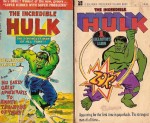
One word of warning to potential readers and collectors of these books: the US and UK editions can vary significantly – which is why I’ve selected the Incredible Hulk for this review. The American Lancer edition with the Kirby cover, published in 1966, represents in truncated, resized form two stories from The Incredible Hulk #3 (September 1962)‘Banished to Outer Space’ which radically altered the relationship the monster and his teen sidekick Rick Jones, and the first appearance of the Circus of Crime in ‘The Ringmaster’, by Lee Kirby and Dick Ayers, and then jumps via a brief bridging sequence from The Incredible Hulk #6 (March 1963) to the Steve Ditko run from Tales to Astonish.

These are ‘The Incredible Hulk’ (Tales to Astonish #60, October 1964) by Lee, Steve Ditko and comics veteran George Roussos – under the pseudonym George Bell – which found Bruce Banner still working for General “Thunderbolt” Ross, and still afflicted with uncontrollable transformations into a rampaging, if well-intentioned, engine of destruction. The episodes were set in the Arizona/New Mexico deserts, with Cold War espionage and military themes as the narrative backdrop…

This is followed by ‘Captured at Last’ the concluding part of a battle with a spy in an indestructible battle suit, and then the Hulk’s greatest foe is introduced in ‘Enter… the Chameleon’ (not him but his boss and taken from TtA #62): stuffed with action and suspense but the real stinger is the final panel that hints at the mastermind behind all the spying and skulduggery – the enigmatic Leader – who would become the Hulk’s ultimate and antithetical nemesis.

Thus far this book and the UK Four Square paperback released in 1967 are all but identical – covers excluded of course – and apart from a Kirby pin-up page and ads for the Thor, Spider-Man and Fantastic Four companion volumes, that’s where Britain’s Hulk stops dead, whereas the Lancer volume has another full episode to go.

‘A Titan Rides the Train!’ provides an origin for the super-intellectual Leader as well as setting up a plotline where new cast member Major Glen Talbot begins to suspect Banner of being a traitor. Both editions end on frustrating cliffhangers but at least you get one more astonishing tale in the Lancer book.

Nowadays all these adventures are readily available (in colour in the Marvel Masterworks: Incredible Hulk 1962-1964 or as dynamic monochrome treasures in Essential Hulk) but for we surviving baby-boomers the sheer thrill of experiencing these books again is a buzz you can’t beat. Moreover there’s still something vaguely subversive about seeing comics in proper book form, as opposed to the widely available, larger and more socially acceptable graphic novels. Strip art might finally be winning the war for mainstream public recognition, but we’ve all lost some indefinable unifying camaraderie of outsider-hood along the way…

These paperbacks and all the others are still there to be found by those who want to own the artifact as well as the material: I suspect that whether you revere the message or the medium that carries it pretty much defines who you are and how you view comics and the world.

Wanna try and guess where I stand, True Believer…?
© 1966 and 1967 the Marvel Comics Group. All Rights Reserved.

Captain Britain: the Siege of Camelot


By various (Marvel/Panini UK)
ISBN: 978-1-84653-433-1

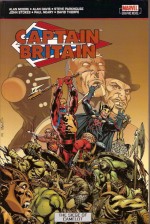
This fourth wonderful volume collecting the complete adventures of Marvel’s Greatest British super-hero gathers together the remaining black and white episodes of The Black Knight strip from Hulk Comic (# 42-55 and 57-63, 1979) in which Captain Britain co-starred, before going on to his peripatetic wanderings through a number of UK titles beginning with Marvel Super Heroes #377-389 and continuing in The Daredevils #1-11. Eventually he got his own second short-lived title, but that’s a bunch of tales for another time and hopefully a future graphic novel review…

The Lion of Albion was in character limbo until March 1979, when a new British weekly, Hulk Comic, launched with an eclectic, if not eccentric, mix of Marvel reprints the editors felt better suited the British market. There were some all-new strips featuring Marvel characters tailored, like the reprints, to appeal to UK kids.

The Hulk was there because of his TV show, Nick Fury (drawn by the incredibly young Steve Dillon) – because Brits love their spies, and the all-original period pulp thriller Night Raven by David Lloyd, John Bolton and Steve Parkhouse. Hidden deep within and almost trying not to be noticed was The Black Knight.

The Knight was a sometime member of the super-team The Mighty Avengers but in this engrossing epic, costumed shenanigans were replaced by a classical fantasy quest which began in modern Britain but soon evolved into a desperate search through the Tolkien-esque (or perhaps Alan Garner derived) myth-scape of legendary England in a last ditch attempt to save the soul of the land by locating the spirit of our Arthurian/Celtic roots. At that time the addled wits and broken soul of Captain Britain would also be restored…

This comprehensive volume continues and concludes the quest with the discovery of Camelot, the rebirth of the legendary King (originally seen in issues #42-55 and #57 through 63 at which time Hulk Comic folded) and a cataclysmic last battle with the forces of evil. These two and three page episodes are a truly classy act executed with great panache by writer Steve Parkhouse and John Stokes (with occasional penciling from the multi-talented Paul Neary) which captured the imagination of the readership, becoming the longest-running original strip in the comic (even The Hulk itself reverted to reprints by #28) and often stole the cover spot from the lead feature.

After a brief informative afterword and some impressive colour covers – including a pin-up of Captains Britain and America by Jack Kirby – the drama resumes with the return of Captain Britain, revamped and redesigned by Editor/plotter Neary and a new creative team; neophytes writer Dave Thorpe and artist Alan Davis for the monthly reprint anthology Marvel Super-Heroes (#377, September 1981).

Lost in the gaps between alternate worlds the hero and his elf sidekick Jackdaw are drawn back to Earth but upon arrival they discover it is a hideous parody of Britain, bleak, distressed, hopeless and depressed – a potent analogue of the country Margaret Thatcher was then dismantling. Thorpe’s desire to inject some subversive social realism into the feature – and the resistance he endured – is documented in his commentary in this volume but suffice to say that although the analogies and allegories are there to be seen, pressure was exerted to keep the strip as escapist as possible, and avoid any controversy…

That’s not to say that the awkward-but-improving-with-every-page tales weren’t a dynamic, entertaining breath of fresh air, with striking superhero art delivering a far more British flavour of adventure. In short order the confused Captain met anarchic bandits The Crazy Gang, reality-warping mutant Mad Jim Jaspers, British Nazis and a truly distressed population in ‘Outcasts’ (MSH #378), an animated rubbish monster (‘The Junkheap that Walked Like a Man’ (#379), and was introduced to the pan-Reality colossus The Dimensional Development Court and its sultry, ruthless operative Opal Luna Saturnyne, who intended to compulsorily evolve the whole dimension, beginning with ‘In Support of Darwin!’, ‘Re-Birth!’, ‘Against the Realm’ and ‘Faces of Britain!’ #380-383).

‘Friends and Neighbours’ is a pretty-looking and thoroughly de-clawed examination of sectarianism and racism (see Thorpe’s commentary for clarification) which was followed in #385 by an “untold tale” by Neary and Davis. To get the saga back on track this diversion related an event that occurred in Limbo – the ‘Attack of the Binary Beings!’

Now deeply involved in Saturnyne’s plan to make humanity evolve (just like forcing Rhubarb) Captain Britain was trapped in a clash between the underclasses and the government in Thorpe’s last story ‘If the Push Should Fail?’ which heralded the beginning of Alan Moore’s landmark tenure on the character.

Marvel Super-Heroes #387 is the first of the full-colour tales in this volume (presumably thanks to the frequent reprinting of these stories in America), and instantly kicks the series into high gear with ‘A Crooked World’ as the dying dimension unleashes its greatest weapon: a relentless, unstoppable artificial killer called the Fury.

Killing Jackdaw, reintroducing Jim Jaspers and setting the scene for a monolithic epic in ‘Graveyard Shift’ by vaporising Captain Britain, the series then folded.

After a brief text interlude from Mr. Moore (from Marvel Super-Heroes #389) the saga started again in a new home, as the lead feature in The Daredevils #1, with a revelatory new origin ‘A Rag, a Bone, a Hank of Hair…’ and a rebuilt hero returned to his own Earth just in time to see that world assaulted by another reality-warping Jim Jaspers intent on destroying all superbeings in ‘An Englishman’s Home…’

In issue #3 Brian Braddock’s sister Betsy reappeared in ‘Thicker than Water’ a purple-haired telepath being hunted by an assassin destroying all the old esper-agents recruited by British covert agency S.T.R.I.K.E – and yes she is the girl who became Psylocke of the X-Men. The battle against the killer Slaymaster concluded in a spectacular in-joke clash among the shelves of the Denmark Street Forbidden Planet – in 1982 arguably the country’s best fantasy store – so any old fans might want to try identifying the real staff members who “guest-star” – in ‘Killing Ground.’

Keen on creating a cohesive Marvel UK universe the Alan’s brought back another creation for their next tale. The Special Executive was a team of time-travelling mercenaries introduced in Dr. Who Monthly #51 (April, 1981), and in ‘Target: Captain Britain – Recommendation: Executive Action’ saw the legion of super-weirdoes dispatched to Braddock Manor to forcibly bring the hero as a witness in the trial of Saturnyne by the Supreme Omniversal Tribune in ‘Judgement Day’.

Meeting a number of alternate selves such as Captains Albion and England was disturbing enough but the trial was a sham, merely rubber-stamping the accession of Saturnyne’s successor Mandragon. His first act was to destroy the tainted universe that failed to evolve in The Push. Unfortunately for everybody the Fury survived, falling into another universe where it began again to eradicate all heroes…

Issue #7 ‘Rough Justice’ found Britain and the Special Executive in the middle of a pan-dimensional brawl to save Saturnyne whilst back on (his own) Earth, a woman was plagued by dreams of the Fury and Jaspers. In ‘Rivals’ the defenders finally escape back home to find the woman – Captain UK of the recently destroyed alternate universe – waiting with a warning and a prediction…

The Daredevils #9, ‘Waiting for the End of the World’ begins the final story-arc in this volume (and starts a plot picked-up by Chris Claremont for about ten years worth of X-Men and Excalibur storylines), a fascinating compelling war against an invincible, implacable foe, which was truly shocking at the time and still carries a potent emotional punch now, as cast-members and fan-favourites were slaughtered in the Fury’s unstoppable onslaught.

‘The Sound and the Fury’ continues the murderous mayhem before a surprise hero saves the day in the epic ‘But They Never Really Die’ to perfectly wrap up the story just in time for the Captain and his surviving crew to return in his own comic.

With the inclusion of some insightful and elucidating text pieces and plenty of cover reproductions this fourth volume of the chronicles of Captain Britain sees the character finally reach the heights of his potential. Here is not only a wonderful nostalgic collection for old-timers and dedicated fans but also a book full of the best that comics can offer in terms of artistry, imagination and gripping creative energy.

Some of the very best material produced by Marvel, this is a book every reader must have…

© 1979, 1980, 1981, 1982, 1983, 2009 Marvel Entertainment, Inc. and its subsidiaries, licensed by Marvel Characters, Inc. All Rights Reserved. (A British edition from PANINI UK LTD)

Iron Man: Enter: the Mandarin


By Joe Casey & Eric Canete (Marvel)
ISBN: 978-0-7851-2522-5

With the blockbuster sequel to the Iron Man movie imminently expected, there’s a lot of shiny glittery product out there devoted to the Golden Avenger and this impressive reworking of Tales of Suspense #50-55, which introduced his greatest foe, is still available and probably one of the most accessible to new readers as well as being a cast-iron cracker in its own right (and for a highly recommended look at those original masterpieces see Marvel Masterworks: Iron Man 1963-1964 – other reprint editions are available…).

The excellent Joe Casey has taken the events of that landmark sequence created by Stan Lee and Don Heck and first published from February to July 1964, at the height of the Cold War, and by refocusing on the villain rather than the hero has managed the tricky task of updating without radically counteracting or denying what has gone before.

Originally released as a six issue miniseries it shows how the oriental mastermind was a Chinese aristocrat who discovered ten rings in the belly of a crashed spacecraft, but due to his arrogance simply retired to await the moment when the world would eventually become his. Calling himself The Mandarin he idled away his days until the communist government provoked him into an angry life. Unfortunately, this unforeseen activity provoked American intelligence agency S.H.I.E.L.D. into action too…

Convincing weapons-technocrat Tony Stark to investigate, they are unaware that they are sending Armoured Avenger Iron Man to a meeting with destiny: his initial clash with the Chinese warlord will set the Mandarin on an obsessive, aggressive vendetta against both Stark Industries and the entire debased modern world…

As well as featuring a delightfully entertaining take on supporting cast favourites Pepper Potts and Happy Hogan this epic includes skirmishes with the deadly Scarecrow, Crimson Dynamo and the Mandarin’s own son, but the real graphic rewards come in the form of the spectacular, devastating clashes with the inimical Master of Menace that open and close this great tale, illustrated with clunky, retro-magnificence (think of Art Deco with all the nuts and bolts on show) by Eric Canete (whose sketchbook of covers is also included at the back of the book), winningly coloured by Dave Stewart.

Enter: the Mandarin is quite simply one of the best Iron Man books in years. What are you waiting for…?

© 2007, 2008 Marvel Publishing, Inc. All Rights Reserved.

Iron Man Vs. Whiplash


By Marc Guggenheim, Brannon Bragga, Briones & Steve Mutti (Marvel/Panini UK)
ISBN: 978-1-84653-460-8

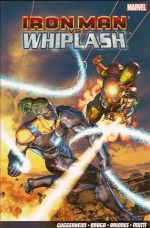
In the mainstream Marvel universe the citizenry are recovering from an interminable series of major catastrophes such as the Civil War and a Secret Invasion by shape-shifting Skrulls. In this heady age of confusion technical wizard and billionaire weapon-smith Tony Stark has been revealed to the world as the armour-clad superhero Iron Man.

After a similarly-armoured invader destroys a village full of Russian dissidents in a high-tech bloodbath captured on Stark-constructed satellites and seen around the world, the bewildered inventor finds himself on trial for crimes against humanity. Accused of acting as a mercenary for the Russian government Stark has been perfectly framed. Found guilty, he is to be interned for life when lucky disaster strikes.

The village of Volstok was full of discredited scientists and anti-Putin agitators when the Iron assassin struck, and one of them managed to fatally damage the attacker. This survivor used the fragments to create his own armoured energy weapons, and crazed by a need for revenge, goes after Stark as the deadly Whiplash.

In prison, Stark has been busy. Knowing he can’t prove his innocence from behind bars he has constructed a ramshackle suit of armour from odds and ends he has scrounged or stolen. When the vengeance hungry Whiplash attacks, Stark seizes his chance and escapes after an inconclusive clash with the Russian.

With his faithful assistant Pepper in tow Stark goes on the run, ferreting out the hideous secret of the men who destroyed his reputation, but even cleared of the crime he has made an implacable enemy in Whiplash, who holds his inventions, if not his actions, as responsible as the Russian government for the Volstok massacre.

This simple, uncomplicated action-yarn is a palatable piece of eye-candy, capably concocted by scripters Marc Guggenheim and TV writer/producer Brannon Braga (Star Trek, Threshold, 24, Flash Forward), enticingly realised by artists Phillippe Briones & Andrea Muti and colourist Matt Milla. Originally released as a four-issue miniseries, this book happily falls into a category of accessibility that will please fans of the film franchise who don’t want or need to bone up on Iron Man’s near fifty year publishing history.

Fast and furious fun and frolics with an iron-clad satisfaction guarantee…
™ and © 2010 Marvel Entertainment LCC and its subsidiaries. All Rights Reserved. A British edition released by Panini UK Ltd.

Captain America Reborn


By Ed Brubaker, Bryan Hitch, Alex Ross, Paul Dini & various (Marvel/Panini UK)

ISBN: 978-1-84653-440-9
Captain America was created by Joe Simon and Jack Kirby at the end of 1940, and launched in his own title (Captain America Comics, #1 cover-dated March 1941) with overwhelming success. He was the absolute and undisputed star of Timely (Marvel’s early predecessor) Comics’ “Big Three” – the other two being the Human Torch and the Sub-Mariner – and one of the first to fall from popularity at the end of the Golden Age.

When the Korean War and Communist aggression dominated the American psyche in the early 1950s he was briefly revived – as were the Torch and Sub-Mariner – in 1953 before sinking once more into obscurity until a resurgent Marvel Comics once more brought him back in Avengers #4. It was March 1964 and the Vietnam conflict was just beginning to pervade the minds of the American public…

This time he stuck around, first taking over the Avengers, then winning his own series and title. He waxed and waned through the most turbulent period of social change in US history but always struggled to find an ideological place and stable footing in the modern world. Eventually, whilst another morally suspect war raged in the real world, during the Marvel event known as Civil War he became a rebel and was assassinated on the steps of a Federal Courthouse.

Nobody really believed he was dead.

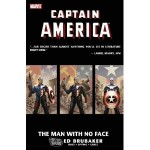
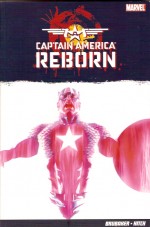
Marvel’s extended publicity stunt came to a dramatic close with the inevitable return of the original Star-Spangled Avenger in an impressive and highly readable – if necessarily convoluted – tale from Ed Brubaker, Bryan Hitch and Butch Guice, released as the six-issue miniseries Captain America Reborn, but before that, years of cross-company plot threads and side-stories came to a formidable close in the anniversary issue Captain America #600. All those wide-ranging, far-flung bits and bobs are gathered together for your convenience in this classy tome.

The action starts with an impressive potted biography ‘Origin’ by Alex Ross, Paul Dini and Todd Klein (which first appeared in Captain America: Red, White and Blue, September 2002) after which Brubaker, scripts ‘One Year Later’ (Captain America #600) for Guice, Howard Chaykin, Rafael Albuquerque, David Aja and Mitch Breitweiser to illustrate, summing up the heroes origins, career and impact on the world up to his “death”, whereupon his long-dead sidekick Bucky (surprise, surprise!) took over the role…

With all the dominoes in place the moment is ripe for the true hero’s return – and since his mind and body have been lost in time all the while there’s a glorious opportunity to examine some key moments in the old soldier’s decades-long history as the Avengers, Nick Fury, Dr. Doom, Sub-Mariner, Norman (Green Goblin) Osborn and the undying Red Skull all seek to manipulate his return for their own ends. Incisive, clever, all-encompassing and beautifully realised by Hitch and Guice Captain America Reborn is a grand example of the Deus ex Machina revival as only comics can produce it.

Overcoming all odds Cap is back: but now that he is what’s to become of him?

This impressive and entertaining book also includes a fan’s dream of added value inducements: an article by surviving original creator Joe Simon, a “Reborn” variant cover gallery (20 different covers for six issues!) and a far-too small but incredibly impressive complete reproduction of every Cap cover since March 1941, as well as a few surprise extras.

If you are a fan of the superhero genre this is a thoroughly enjoyable recap and reboot that proves that new and old can work together; let’s hope the new old Captain America can find enough of an audience to keep him occupied…
™ and © 2010 Marvel Entertainment LCC and its subsidiaries. All Rights Reserved. A British edition released by Panini UK Ltd.

Ultimate Armour Wars


By Warren Ellis & Steve Kurth (Marvel/Panini UK)
ISBN: 978-1-84653-441-6

The Marvel Ultimates project began in 2000 with a thoroughly modernizing refit of key characters and concepts to bring them into line with contemporary “ki-dults” – perceived to be a separate buying public to we baby-boomers and our declining descendents who seemed content to stick with the various efforts that sprang from the fantastic talents of Kirby, Ditko and Lee. Eventually this streamlined new universe became as crowded and continuity-constricted as its predecessor and in 2008 the cleansing publishing event “Ultimatum” culminated in a reign of terror which apparently (this is comics, after all) killed three dozen odd heroes and villains and millions of ordinary mortals.

Although a huge seller (in contemporary terms, at least) the saga was largely trashed by the fans who bought it, and the ongoing new “Ultimatum Comics” line is quietly back-pedalling on its declared intentions…

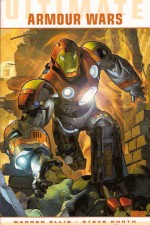
The key and era-ending event was a colossal tsunami that drowned the superhero-heavy island of Manhattan and this post-tidal wave collection (assembling issues #1-4 of the miniseries Ultimate Comics Armor War – and yes, it has been spelled differently for this British Edition) picks up the story of the survivors as well as the new world readjusting to their altered state.

Young Tony Stark is a tech-genius weapon-smith – and amiable drunk – from a family of armaments manufacturers. When the wave hit, his greatest treasure was lost in his state-of-the-art Manhattan Corporate HQ. A public figure in his trademarked Iron Man war-suit, he is down to his last few million bucks and sifting through the wreckage of his building when a cybernetic super-thief called The Ghost steals his precious strongbox, and would have killed the billionaire brat if not for the intervention of Justine Hammer, daughter of Stark’s greatest enemy: a girl dying from her father’s abusive attempts to giver her marketable super-powers.

Wearing a suit painfully similar to the Iron Man suit the Ghost vanishes, leaving Stark with the realisation that his technology has been pirated and sold to unscrupulous monsters. Although spoiled and dissolute even Stark can’t drink enough to wash away all the blood his inventions could spill if he doesn’t take control back…

With Justine in tow he follows the bloody trail, finding and neutralising all illicit incidences of his armour from malevolent arms dealer Dr. Faustus to deviant Balkan mad scientist Bram Velsing to the ever-OTT Metropolitan Police Force (who use their Stark-based tin-suits to quell political protest and civil disobedience… same as it ever was…)

Eventually the trail leads to the shocking mastermind behind the plot, with plenty of twisty-turny revelations in store – or not, depending on how astute you are, how much attention you’ve been paying and of course on whether you’ve read the original tale this was based on (see the graphic novel Iron Man: the Armor Wars as well as our review of same).

Visually stunning (True Brits especially will revel in the spectacular battle in the skies over London) thanks to artist Steve Kurth and the colouring magic of Guru EFX, Warren Ellis’s tale is sharp and witty, if fairly predictable: heavy on attitude and action, and over almost too quickly, leaving the reader genuinely hungry for more…

Once removed from the market hype and frantic, relentless immediacy of the sales arena there’s a chance to reassess these tales on merit alone, and given such a opportunity you’d be foolish not to take a good hard look at this solid, accessible superhero yarn.
™ and © 2010 Marvel Entertainment LCC and its subsidiaries. All Rights Reserved. A British edition released by Panini UK Ltd

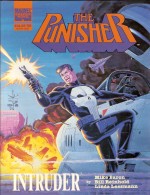
Punisher: Assassin’s Guild


By Jo Duffy, Jorge Zaffino & Julie Michel (Marvel)
ISBN: 978-0-87135-460-8

Frank Castle saw his family gunned down in Central Park after witnessing a mob hit, and thereafter dedicated his life to destroying criminals. His methods are violent and permanent.

Debuting as a villain in Amazing Spider-Man #129 (February 1974), the Punisher was created by Gerry Conway, John Romita Sr. and Ross Andru, a reaction to such popular prose anti-heroes as Don Pendleton’s Mack Bolan: the Executioner and other returning Viet Nam vets who all turned their training and talents to wiping out organised crime. It’s intriguing to note that unlike most heroes who debuted as villains (Wolverine comes to mind) the Punisher actually became more immoral, anti-social and murderous, not less: the buying public shifted its communal perspective – Castle never toned down or cleaned up his act…

After bouncing around the Marvel universe for many years a 1986 miniseries by Steven Grant and Mike Zeck swiftly led to overnight stardom and a plethora of “shoot-’em-all and let God sort it out” antics that quickly boiled over into tedious overkill, but along the way a few pure gems were cranked out, such as this clever, darkly funny graphic novel from the hugely underrated Jo Duffy and much missed Argentinean artist Jorge Zaffino.

Zaffino died of a heart attack in 2002, aged 43, having been “discovered” in the late 1980s by Eclipse Comics who published the dystopian science fiction thriller Winter World he created with writer Chuck Dixon.

Zaffino’s style of dark, oppressive, macho illustration was seen in America in Batman: Black and White, Savage Sword of Conan, Shadowline: Critical Mass, Terror, Inc., Clive Barker’s Hellraiser, The ‘Nam and Punisher: Kingdom Gone as well as my personal favourite, the crime/horror one-shot Seven Block. Throughout this period he was maintaining a full-time career in his homeland, particularly on the adventure series Wolf, and as a gallery painter.

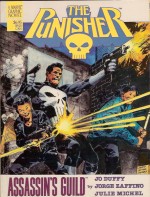
Frank Castle is pursuing his favourite occupation wiping out scum when he accidentally crosses paths with a rather unique band of paid killers working out of a Japanese restaurant. These assassins are skilled, imaginative, highly professional and mostly kids. Investigating with a view to permanently stopping them he discovers that their motives and ethics aren’t so far removed from his own and moreover that they all have their eyes on the same target…

Sardonic, brutal and powerfully effective this is a top-notch yarn that moves effortlessly from Noir to adventure-caper to tragedy and back again, a genuinely accessible thriller for all genre fans – especially Yakuza gangster movies. Still readily available in the so-satisfying oversized European format (284m x 215m) this hard, fast and deliciously sharp extravaganza has everything that made the Punisher so popular, without any of the charmless excesses that scuppered the first, over-exploited run. This is an unreconstructed guilty pleasure and you know you want it…
© 1988 Marvel Entertainment Group, Ltd. All rights reserved.

Ultimate Spider-Man Volume1: The New World According to Peter Parker


By Brian Michael Bendis & David Lafuente with Justin Ponsor (Marvel/Panini UK)
ISBN: 978-1-84653-443-0

The Marvel Ultimates project began in 2000 with a thoroughly modernizing refit of key characters and concepts to bring them into line with contemporary “ki-dults” – perceived to be a separate buying public to those baby-boomers and their declining descendents who seemed content to stick with the various efforts that sprang from the fertile, febrile gifts of Kirby, Ditko and Lee. Eventually the streamlined new universe became as crowded and continuity-constricted as its predecessor and in 2008 a publishing event dubbed “Ultimatum” culminated in a reign of terror which apparently (this is comics, after all) killed three dozen odd heroes and villains and millions of ordinary mortals.

Although a huge seller (for modern comics at least) the saga has been largely slated by the fans who bought it, and the ongoing new “Ultimatum Comics” line is quietly back-pedalling on its declared intentions…

The key and era-ending event was a colossal tsunami that drowned the superhero-heavy island of Manhattan and this post-tidal wave collection (assembling issues #1-6 of the relaunched Ultimate Comics Spider-Man) picks up the story of the survivors slowly readjusting to their altered state.

Peter Parker is sixteen years old, a perennial hard-luck kid and loser and canny geek just trying to get by. Between High School and slinging fast food (Burger Frog is his only source of income since the Daily Bugle got hit) he still finds time to fight crime although his very public heroics during the crisis have made him a beloved hero of police and citizenry alike – which is the creepiest thing he has ever endured.

He lives in a big house with his Aunt May, and despite his low self-image has stellar hottie Gwen Stacy for a devoted girlfriend, and is daily enduring the teen-angsty situation of equally stellar hottie Mary Jane Watson (his ex-squeeze) being constantly around and acting all grown-up about it. He briefly dated mutant babe Kitty Pride: remember when not having any girlfriend was the definition of “loser”?

As New York slowly recovers a new villain with a purloined name is carefully positioning himself to take full control – which he commences by murdering one of Spidey’s greatest surviving foes – whilst the wallcrawler is occupied with a resurgent pack of increasingly violent street crimes. One thing the wave didn’t wash away was greed and stupidity…

As the mastermind’s wicked plans near brutal fruition Spider-Man is being secretly helped by a new young crusader who seems determined to avoid observation at all costs, but Peter’s real problems begin when old superhero chums start returning. Kids like the Human Torch and Iceman are completely alone in the aftermath, and with schools and accommodation stretched to breaking point, what can a sweet old lady like May do but open her doors to them? His secret identity was constantly threatened before; how can he possibly conceal his adventurous life when two such famous characters suddenly move in…?

Combining smart dialogue and teen soap opera dynamics with spectacular action – beautifully rendered by artist David Lafuente and colourist Justin Ponsor – this is a surprisingly compelling and enjoyable costumed drama with plenty of laughs that easily rises above its troubled origins. Absolutely worth any jaded superhero fan’s time and money and well on the way to becoming a palpable sleeper hit…
™ and © 2010 Marvel Entertainment LCC and its subsidiaries. All Rights Reserved. A British edition released by Panini UK Ltd

Ka-Zar: Guns of the Savage Land – A Marvel Graphic Novel


By Chuck Dixon, Timothy Truman, Gary Kwapisz & Ricardo Villagrán (Marvel)
ISBN: 0-87135-641-4

Beginning as a knock-off Tarzan in a lost sub-polar realm of swamp-men and dinosaurs Ka-Zar eventually evolved into one of Marvel’s more complex – if variable – characters. Wealthy heir to one of Britain’s oldest noble families, his best friend is a sabre-tooth tiger, his wife is feisty super-heroine Shanna the She-Devil and his brother is a homicidal super-scientific bandit.

Lord Kevin Plunder is perpetually torn between the clean life-or-death simplicity of the jungle and the bewildering constant compromises of modern civilisation. As this enjoyable, under-appreciated tale unfolds it is clear that the dichotomy is driving him crazy…

Sociologist and Native American Wyatt Wingfoot (associate of the Fantastic Four and sometime paramour of the She-Hulk) is called to a hospital to consult on an enigmatic dying man. The fatally radioactive John Doe has walked out of heart of the Nevada desert, and has clearly lived in place no hint of civilisation has ever touched. He speaks nothing but an unknown tongue that might just be the basis of all Indian language.

Is it possible he has come from the fabled Hopi legend-land Sibopay, Third World of Creation, far under the Earth? Could it be that the South Polar Savage Land extends as far as America? Luckily, the burly researcher knows of an expert in subterranean lost worlds…

Seemingly shaken from his bipolar fugues by the promise of adventure, Ka-Zar is eager to find out, and with Zabu and Shanna joins Wingfoot in a borrowed flying Fantasticar on a voyage of primal discovery to an unspoiled realm that promises to cure all his soul’s ills.

Little does the Lord of the Savage Jungle suspect that a rapacious energy conglomerate has already found his lost promised land, and is well on the way to eradicating both native dinosaur wildlife and the innocent proto-Indians of Sibopay. Nor does anybody realise just how much civilisation has poisoned Ka-Zar’s heart and soul…

This is a grand old-fashioned “Lost World” romp of giant beasts, scurrilous greedy men and noble savages, skillfully paying tribute to those wonderful old Gold Key/Dell series like Turok, Son of Stone and Kona, Monarch of Monster Island (Sam Glanzman’s adventure masterpiece which is long overdue for the deluxe archive treatment) gloriously reveling in the age-old battles of old against new, greed versus contentment, and man against beast.

Dixon and Truman perfectly blend Marvel continuity with classic adventure themes, and Gary Kwapisz’s solid storytelling is magically elevated by Ricardo Villagrán’s lush yet gritty painting. A little outside the company’s regular – if complex – comfort zone, this is a rousing tale any newcomer could enjoy without recourse to decades of back-story.
© 1990 Marvel Entertainment Group, Inc. All Rights Reserved.