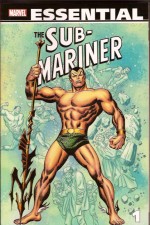
Essential Sub-Mariner vol.1


By Stan Lee, Gene Colan, Bill Everett & various (Marvel)
ISBN: 978-0-7851-3075-8

Prince Namor, the Sub-Mariner is the hybrid offspring of a sub-sea Atlantean princess and an American polar explorer; a man of immense strength, highly resistant to physical harm, able to fly and exist above and below the waves. Created by young, talented Bill Everett, Namor technically predates Marvel/Atlas/Timely Comics. He first caught the public’s attention as part of the fire vs. water headlining team in Marvel Comics #1 (October 1939 and soon to become Marvel Mystery Comics) alongside The Human Torch, but had originally been seen in a truncated version in the black and white Motion Picture Funnies, a weekly promotional giveaway handed out to moviegoers earlier in the year.

Quickly becoming one of the company’s biggest draws Namor gained his own title at the end of 1940 (cover-dated Spring 1941) and was one of the last super-characters to go at the end of the first heroic age. In 1954, when Atlas (as the company then was) briefly revived its “Big Three” (the Torch and Captain America being the other two) costumed characters, Everett returned for an extended run of superb fantasy tales, but even so the time wasn’t right and the title sunk again.

When Stan Lee and Jack Kirby began reinventing comic-books in 1961 with Fantastic Four, they revived the all-but forgotten amphibian as a troubled, semi-amnesiac, but decidedly more regal and grandiose anti-hero embittered at the loss of his sub-sea kingdom (seemingly destroyed by American atomic testing) whilst simultaneously besotted with the FF‘s Sue Storm (as seen in Essential Fantastic Four volume 1). He knocked around the budding Marvel universe for a few years, squabbling with other assorted heroes such as the Hulk, Avengers and X-Men, before securing his own series as part of “split-book” Tales to Astonish. This volume collects that entire run, issues #70-101, Daredevil #7, Tales of Suspense #80, Iron Man and the Sub-Mariner one-shot and the first issue of Sub-Mariner‘s second solo title.

As a prequel to the Tales to Astonish serial he had one last guest shot as a misunderstood bad-guy in Daredevil #7, (April 1965). The issue is a perfect comicbook and a true landmark: to my mind one of the Top Ten Marvel Tales of all Time. Lee and creative legend Wally Wood concocted a true masterpiece with ‘In Mortal Combat with… Sub-Mariner!’ as Prince Namor of Atlantis, recently reunited with the survivors of Atlantis, travelled to the surface world to sue mankind for their crimes against his people. He engages the services of Matt Murdock; little suspecting the blind lawyer is also the acrobatic Man without Fear.

Whilst awaiting a hearing at the UN Namor is informed by his love interest Lady Dorma that his warlord, Krang, has usurped the throne in his absence. The tempestuous monarch cannot languish in a cell when the kingdom is threatened so he fights his way to freedom through the streets of New York, smashing National Guard and the dauntless Daredevil with supreme ease. The hopelessly one-sided battle with one of the strongest beings on the planet shows the dauntless courage of DD and the innate nobility of a “villain” far more complex than most of the industry’s usual fare at the time.

A few months later Tales to Astonish #70 heralded ‘The Start of the Quest!’ as Lee, Gene Colan (in the pseudonymous guise of Adam Austin) and Vince Colletta saw the Sub-Mariner returned to an Atlantis under martial law, and rejected by his own people. Imprisoned, the troubled Prince was freed by the oft-neglected and ignored Lady Dorma. As the pompous hero began a mystical journey to find the lost Trident of King Neptune, which only the rightful ruler of Atlantis could hold, he was unaware that the treacherous Krang allowed him to escape the better to destroy him with no witnesses.

The search took Namor through a series of fantastic adventures and pitted him against a spectacular array of sub-sea horrors: a giant octopus in ‘Escape… to Nowhere’, a colossal seaweed man in ‘A Prince There Was’, a wizard and energy-sapping diamonds in ‘By Force of Arms!’ but as the end approached in ‘When Fails the Quest!’, with revolution in Atlantis, Namor sacrificed his kingdom to save Dorma from troglodytic Faceless Ones.

Issue #75 ‘The End of the Quest’, found the Prince battling his way back to Atlantis with a gravely injured Dorma, and the saga concluded in ‘Uneasy Hangs the Head…!’ as the status quo was restored and Namor finally assumed his throne. Back in charge the Prince once more turned his thoughts to peace with the surface world and undertook ‘To Walk Amongst Men’ but his mission was derailed when he encountered a deep-sea drilling platform and promptly found himself battling the US military and retired Avengers Henry Pym and Janet Van Dyne. That fracas was abruptly curtailed in #78’s ‘The Prince and the Puppet’ as an old adversary once again seized control of the amphibian’s fragile mind.

‘When Rises the Behemoth’ found Namor battling the Puppet Master’s control and the US Army in the streets of New York, before returning to confront a cataclysmic doomsday monster in Atlantis, (inked by the brilliant Bill Everett), and Dick Ayers stepped in to ink the tense conclusion in #80’s ‘To the Death!’, wherein Warlord Krang returned and blackmailed Dorma into betraying her beloved Prince.

Heartbroken and furious, Namor followed them to New York in ‘When a Monarch Goes Mad!’ (TTA#81) in a violent melodrama that crossed over into the Iron Man feature in sister title Tales of Suspense #80. ‘When Fall the Mighty!’ (Lee, Colan and Jack Abel, using the pen-name Gary Michaels) was a spectacular combat classic which only got more incredible as it continued in Tales to Astonish #82. Colan was a spectacular illustrator, but no one could ever match Jack Kirby for bombastic battle scenes, and when the former contracted flu after delivering two pages The King stepped in to produce some of the finest art of his entire Marvel career, fully displaying ‘The Power of Iron Man’…

Kirby stayed on for #83 ‘The Sub-Mariner Strikes!’ wherein the enraged prince finally confronted Krang and Dorma, only to once again lose his memory and become the pawn of would-be conqueror Number 1 of the Secret Empire in ‘Like a Beast at Bay’ (Colan & Ayers), regaining his senses just in time to terrorise a New York already reeling from the Incredible Hulk’s mindless depredations in ‘…And One Shall Die!’ (inked again by Everett) before ‘The Wrath of Warlord Krang!’ (Lee, Jerry Grandenetti and Everett) resulted in the metropolis being inundated in an artificial tsunami. Naturally blamed for the catastrophe Namor faced a ‘Moment of Truth’ as he finally dealt with Krang and reconciled with Dorma, a conclusion made doubly delightful as Wild Bill Everett at last took full artistic charge of his greatest creation.

Tales to Astonish #88 saw the sub-sea barbarian Attuma attack once more when ‘A Stranger Strikes From Space!’, a tale concluded in ‘The Prince and the Power!’, and Namor’s greatest Golden Age rival returned in ‘To Be Beaten by Byrrah!’ as the Prince’s ruthless cousin used gutter politics to oust the Sub-Mariner, only to receive his comeuppance in ‘Outside the Gates Waits Death!’ : this latter seeing the inking debut of Dan Adkins.

Illustrating in a style that owed everything to Wally Wood, Adkins took over the pencilling too in #92’s ‘It Walks Like a Man!’ This tale of atomic pollution is a terse foretaste of the Sub-Mariner’s later role as eco-warrior, and the concluding part features Roy Thomas’ first script for the aquatic antihero in ‘The Monarch and the Monster!’

Namor was dragged into a surface tyrant’s war in ‘Helpless, at the Hands of Dragorr!’ (Thomas and Everett), and veteran scripter Raymond Marais joined Thomas, Everett & Colletta on ‘The Power of the Plunderer!’, before assuming sole scripting for the ‘Somewhere Stands Skull Island. This troubled tale of the antediluvian Savage Land continued in #97’s ‘The Sovereign and the Savages’ courtesy of Thomas and unsung star Werner Roth – who had actually taken over the art halfway through the previous episode. Inked by Adkins, the Plunderer’s assault on Atlantis was finally foiled in ‘…To Destroy the Realm Eternal!’, but had precipitated a similar attack on Namor’s homeland by a US atomic submarine in ‘When Falls the Holocaust!’ (by Archie Goodwin and Dan Adkins) in issue #99.

Marvel’s “split-books” had been devised as away to promote their burgeoning stable of stars whilst labouring under a highly restrictive distribution deal which limited the number of titles they could release each month. In 1968 the company ended this commitment and expanded exponentially. In the months leading up to that virtual relaunch a number of bold experiments occurred: the most impressive of which was the first actual meeting of the monstrous stars of Marvel’s antihero title since they had won their own series.

Tales to Astonish #100, by Lee, Marie Severin and Adkins had Namor’s plan to recruit the Hulk as an ally go spectacularly awry when the Puppet Master fomented a near-disaster that almost levelled Miami in ‘Let There Be Battle!’, a tale that took 22 pages to unfold. The final issue of Astonish introduced a villain who would alter forever the perception of the Sub-Mariner. ‘…And Evil Shall Beckon’ by Goodwin, Colan & Adkins saw the antihero plagued by visions of a bestial foe who threatened his throne and people, drawing Namor to a confrontation in the Polar regions where the first Atlantis had been built…

For reasons never disclosed (and I shall charitably keep my assumptions private) the Golden Avenger and Prince of Atlantis both had to wait a month before getting their own first issues, necessitating one last split-book. Iron Man and Sub-Mariner #1 (April 1968) carried the middle parts of two epics that each concluded in memorable debut issues, but the amphibian’s contribution ‘Call Him Destiny …or Call Him Death!’ by Thomas, Colan and Frank Giacoia, did no more than whet the appetite by revealing half an origin and seemingly killing the lead character.

Sub-Mariner #1 (May1968, by Thomas, John Buscema & Giacoia), however more than made up for the confusion as Namor’s true origin and the reason for his bouts of amnesia were explained by the super-telepath Destiny, as ‘Years of Glory… Day of Doom!’ recapped Sub-Mariner’s gloriously checkered past whilst setting up another epic quest that would prove amongst this venerable character’s very best. That however is the subject of another volume.

These tales feature some of Marvel’s very best artists at their visual peak, and although a few of the stories no longer bear a critical scrutiny, the verve and enthusiasm still shine through. A vicarious thrill and fan’s delight, this volume also includes a half-dozen pages of original art and covers, a map of Atlantis and two text pages recounting the history of Namor and his most prominent Atlantean co-stars. Many early Marvel Comics are more exuberant than qualitative, but this volume, especially from an art-lover’s point of view, is a wonderful exception: a historical treasure that fans will find delightful.

©1965, 1966, 1967, 1968, 2009 Marvel Characters, Inc. All Rights Reserved.
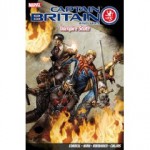
Captain Britain and MI13: Vampire State


By Paul Cornell, Leonard Kirk, Mike Collins & others (Marvel/Panini UK)
ISBN: 978-1-84653-439-3

There’s an old maxim of the industry that’s usually applied to war comics which goes something like this: when it’s for Britain it’s “how we won the War”, and when it’s for America it’s “how He won the War”,  which although obnoxious and rather insulting does illustrate a signal difference in approach and reader expectation.

It’s one that is most apparent in this final collection of the excellent superhero espionage thriller featuring a hodge-podge of Marvel’s UK-based champions. Although Captain Britain is the named lead he is one of the least used characters in the ensemble show, regularly yielding focus to team-mates such as mutant spymaster Peter Wisdom, sometime Avenger Black Knight, WWII veteran (and vampire) Spitfire, spirit of Albion Dr. Faiza Hussain and spooky “Big Gun” Blade the Vampire Slayer.

This time the multiracial, multi-species, multi-purpose super-team are faced with utter Armageddon as Count Dracula attempts to turn Britain into a homeland for vampires, using all his arcane resources and Marvel’s Nosferatu back-catalogue to supplement his ranks. It’s a great read for all but the added value for long-term fans – especially of those quirky Marvel UK creations – is immense as minor characters and forgotten folk literally litter every page.

Dark, shocking and completely compelling, this is the way all comics blockbusters should be handled: with wit and sensitivity to bolster the spectacle, and high concept body-count. This book collects issues #10-15 and the Annual wherein writer Paul Cornell has constructed a solid British war story utilising monsters and superheroes to superb collaborative effect, magnificently complimented by regular artist Leonard Kirk, Mike Collins Ardian Syaf, Adrian Alphona, Jay Leisten, Robin Riggs, Craig Yeung and Livesay. It is a pure backs-to-the wall excitement and the perfect end to a hugely underrated series.

Buy enough copies (and of previous collections Captain Britain and MI13: Secret Invasion and Captain Britain and MI13: Hell Comes to Birmingham) and there’s every chance of a comeback, no?

© 2009 Marvel Entertainment, Inc. and its subsidiaries. Licensed by Marvel Characters B.V. All Rights Reserved.

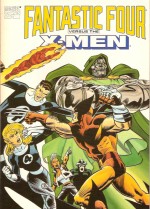
Fantastic Four versus the X-Men


By Chris Claremont, John Bogdanove & Terry Austin (Marvel)
ISBN: 0-87135-650-3

Here’s a good solid yarn from simpler times which serves as the perfect introduction to two fully developed franchises, but still won’t leave you reeling under an avalanche of new names and concepts. Originally released as a four issue miniseries in 1987, this intriguing mystery looks deep into the character of possibly the oldest character in the Marvel universe and turns its most trusted hero into a potential monster.

Everybody knows that Reed Richards is the smartest man on the planet, and how he took his three most trusted companions on a trip into space. Once there the ever-present cosmic rays mutated the quartet into the super-powered freaks now known as the Fantastic Four. How could such a colossal intellect forget something as basic as radiation shielding?

This tale takes place at a time when the mutant heroes and public fugitives called X-Men are being led by Magneto, and is the culmination to a story-arc where young Kitty Pryde is dying: her ability to pass through matter out of control and her body gradually drifting to unconnected atoms.

When Sue Richards finds an old journal belonging to her husband the trust and loyalty that bind the FF together is shattered. The book reveals that the younger Reed had in fact deduced the transformative power of cosmic rays and manufactured the entire incident to create a team of super-warriors. All the years of misery and danger have been a deliberate, calculated scheme by a ruthless mind that could only see life in terms of goals and outcomes.

When the X-Men bring their medical emergency to the FF, Reed, protesting his innocence to a family and team who no longer trust him and with his confidence shattered, falters. He knows that he didn’t plan to mutate his team, but he did make a mistake that altered their lives forever. What if he makes another blunder with Pryde’s cure?

And then Doctor Doom steps in…

This is a superb adventure stuffed with guest-stars that moves beyond gaudy costumes and powers to display the core humanity of Reed Richards and the true depths of evil his greatest enemy can sink to. As an example of sensitive character writing it has few equals and the stylish illustration of Jon Bogdanove is captivating to behold. Long overdue for reprinting this is a tale for all drama lovers, not just the fights ‘n’ tights crowd.
© 1987, 1990 Marvel Entertainment Group, Inc. All Rights Reserved.

Essential Godzilla


By Doug Moench, Herb Trimpe & various (Marvel)
ISBN: 978-0-7851-2153-4

What’s big and green and leaves your front room a complete mess? No, not a Christmas tree, but (arguably) the world’s most famous monster. In 1976 manga and anime were only starting to creep into global consciousness and the most well known popular culture Japanese export was a colossal radioactive dinosaur that regularly rampaged through the East destroying cities and fighting monsters even more bizarre and scary than it was.

At this time Marvel was well on the way to becoming the multi-media corporate giant of today and was looking to increase its international profile. Comic companies have always sought licensed properties to bolster their market share and in 1977 Marvel truly landed the big one with a two year run of one of the world’s most recognisable characters. They boldly broke with tradition by dropping him solidly into real-time contemporary company continuity.

Gojira first appeared in the eponymous 1954 anti-war, anti-nuke parable directed by Ishiro Honda for Toho Films; a symbol of ancient forces roused to violent reaction by mankind’s incessant meddling. The film was re-cut and dubbed into English with a young Raymond Burr inserted for US audience appeal, and the brobdignagian beast renamed Godzilla. He has smashed his way through 27 further Japanese movies, records, books games, many, many comics and is the originator of the manga sub-genre Daikaijû (giant strange beasts).

The Marvel interpretation began with ‘The Coming!’ by Doug Moench, Herb Trimpe & Jim Mooney (#1 August 1977) as the monstrous aquatic lizard with radioactive fire breath erupted out of the Pacific Ocean and rampaged through Alaska.

Superspy organisation S.H.I.E.L.D. is quickly dispatched to stop the monster, and Nick Fury calls in Japanese experts Dr. Yuriko Takiguchi, his grandson Robert and their eye-candy assistant Tamara Hashioka. After an inconclusive battle of ancient strength against modern tech Godzilla returns to the sea, but the seeds have been sown and everybody knows he will return.

In Japan many believe that Godzilla is a benevolent force destined to oppose true evil, young Robert among them, and he gets the chance to expound his views in #2’s ‘Thunder in the Darkness!’ (inked by Frank Giacoia and George Tuska) as the monolithic saurian resurfaces in Seattle, and nearly razes the place before being lured away by S.H.I.E.L.D. ingenuity.

Veteran agents Dum-Dum Dugan, Gabe Jones and Jimmy Woo are seconded to a permanent anti-lizard force until the beast is finally vanquished, but there are lots of free-lance do-gooders in the Marvel universe and when the Green Goliath takes offence at San Francisco’s Golden Gate Bridge, the Champions – a short-lived team consisting of Angel, Iceman, Ghost Rider, Black Widow and Hercules – in ‘A Tale of Two Saviours’ (with the solids inks of Tony DeZuniga adding a welcome depth to the art) the humans spend more time fighting each other than the monster.

There’re only so many cities even the angriest dinosaur can trash before tedium sets in so writer Moench begins his first continued story in #4 with ‘Godzilla Versus Batragon!’ (guest-pencilled by the superb Tom Sutton, inked by DeZuniga), wherein deranged scientist Dr. Demonicus enslaves Aleutian Islanders to grow his own world-wrecking giant horrors – until the real thing shows up…

The story concludes in ‘The Isle of Lost Monsters’ (inked by a fresh-faced Klaus Janson) and #6, ‘A Monster Enslaved!’ begins another extended epic as Herb Trimpe returns and Godzilla as well as the general American public were introduced to another now common Japanese innovation.

Giant, piloted battle-suits (Mecha) first appeared in Go Nagai’s 1972 manga classic Mazinger Z, (and Marvel would do much to popularise the sub-genre in their follow-up licensed comic Shogun Warriors, based on an import toy rather than movie or comic characters but by the same creative team as Godzilla), and here young Rob Takiguchi steals S.H.I.E.L.D.’s latest weapon, a giant robot codenamed Red Ronin, to aid the Big Guy when he is finally captured.

Fred Kida stirringly inked the first of a long line of saurian sagas with #7’s ‘Birth of a Warrior!’ and the uneasy giant’s alliance ends in another huge fight in the final chapter ‘Titan Time Two!’ ‘The Fate of Las Vegas’ (Trimpe and Kida) in Godzilla #9 is a lighter morality tale as the monster destroys Boulder Dam and floods the modern Sodom and Gomorrah, but it’s soon back to big beastie bashing in ‘Godzilla vs Yetrigar’, another multi-part mash-up that concludes in ‘Arena for Three!’ as Red Ronin returns to tackle both large lizard and stupendous Sasquatch.

The first year ends with #12’s ‘The Beta-Beast!’, the first chapter in an invasion epic. Shanghaied to the Moon, Godzilla is co-opted as a soldier in a war between alien races who breed giant monsters as weapons, and when the battle transfers to Earth in ‘The Mega-Monsters from Beyond!’, Red Ronin joins the fray for the blockbusting conclusion ‘The Super-Beasts’ (this last inked by Dan Green). Afterwards, loose in cowboy country, Godzilla stomps into a rustling mystery and modern showdown in ‘Roam on the Range’ and ‘The Great Godzilla Roundup!’ before the final story arc begins.

‘Of Lizards, Great and Small’ in #17 begins with a logical solution to the beast’s rampages as superhero Ant-Man’s shrinking gas is used to reduce Godzilla to a more manageable size, but when the diminished devastator escapes from his cage and becomes a ‘Fugitive in Manhattan!’ it’s all hands on deck whilst the city waits for the gas’ effects to wear off. ‘With Dugan on the Docks!’ sees the secret agent battle the saurian on more or less equal terms before the Fantastic Four step in for ‘A Night at the Museum.’

The FF have another humane solution and dispatch Godzilla to an age of dinosaurs in #21’s ‘The Doom Trip!’, which allows every big beast fan’s dream to come true as the King of the Monsters teams up with Jack “King” Kirby’s uniquely splendid Devil Dinosaur – and Moon Boy – in ‘The Devil and the Dinosaur!’ (inked by Jack Abel) before returning to the 20th century and his full size for a spectacular battle against the Mighty Avengers in ‘The King Once More’.

The story and series concluded in #24 (July 1979) with the remarkably satisfying ‘And Lo, a Child Shall Lead Them’ as all New York’s superheroes prove less effective than an impassioned plea, and Godzilla departs for new conquests and other licensed outlets.

By no means award-winners or critical masterpieces these stories are nonetheless a perfect example of what comics should be: enticing, exciting, accessible and brimming with “bang for your buck.” Moench’s oft-times florid prose and dialogue meld perfectly here with Trimpe’s stylised interpretation, which often surpasses the artist’s excellent work on that other big, green galoot.

These are great tales to bring the young and disaffected back to the comics fold and are well worth their space on any fan’s bookshelf.

© 1977, 1978, 1979, 2006 Toho Co., Inc. All Rights Reserved. Godzilla, King of the Monsters ® Toho Co., Inc.

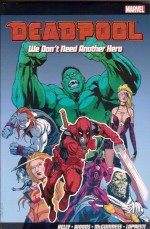
Deadpool: We Don’t Need Another Hero


By Joe Kelly, Ed McGuiness & various (Marvel/Panini UK)
ISBN: 978-1-84653-427-0

Bloodthirsty and stylish killers and mercenaries have long made for popular protagonists. Deadpool is Wade Wilson (and yes he is a thinly disguised knockoff of DC’s Slade Wilson AKA Terminator: get over it – DC did), a hired killer and survivor of genetics experiments that has left him a scarred, grotesque bundle of scabs and physical unpleasantries but practically invulnerable and capable of regenerating from any wound.

The wisecracking high-tech “merc with a mouth” was created by Rob Liefeld and Fabian Nicieza and first appeared in New Mutants #97, another product of the Canadian “Weapon X” project that created Wolverine and so many other second-string mutant and cyborg super-doers. He got his first shot at solo stardom with a couple of miniseries in 1993 (see Deadpool: the Circle Chase & Sins of the Past) but it wasn’t until 1997 that he finally won his own title.

This collection gathers the first ten outrageous fun and fury filled issues (#1-9 plus issue minus 1) as well as the combination Daredevil & Deadpool Annual 1997) and features a frenetic blend of light-hearted, surreal, fighting frolics and incisive, poignant relationship drama that is absolutely compulsive reading for dyed-in-the-wool superhero fans who might be feeling just a little jaded with four-colour overload.

It all kicks off with a extra-sized spectacular ‘Hey, It’s Deadpool!’ by Kelly, McGuiness, Nathan Massengill and Norman Lee which reintroduces the mouthy maniac, his “office” and “co-workers” at the Hellhouse where he picks up his contracts and also affords us a glimpse at his private life in San Francisco where he has a house and keeps a old, blind lady as a permanent hostage. This is not your average hero comic…

The insane action part of the tale comes from the South Pole where the Canadian government has a super-secret gamma weapon project going, guarded by the Alpha Flight strongman Sasquatch. Somebody is paying good money to have it destroyed…

‘Operation: Rescue Weasel or That Wacky Doctor’s Game!’ finds the slightly gamma-irradiated hitman still mooning over lost love Siryn (barely legal mutant hottie from X-Force) when his only friend and tech support guy Weasel goes missing, snatched by ninjas working for super-villain Taskmaster – and just when Deadpool’s healing ability is on the fritz, whilst #3’s ‘Stumped! Or This Little Piggie Went… Hey! Where’s the Piggy?!’ ramps up the screwball comedy quotient as Siryn convinces the merciless merc to turn his life around, which he’ll try just as soon as he tortures and slowly kills the doctor who experimented on him all those years ago…

The turnabout storyline continues in ‘Why is it, to Save Me, I Must Kill You?’ featuring a hysterically harrowing segment where Wilson has to get a blood sample from the Incredible Hulk, and concludes in #5’s ‘The Doctor is Skinned!’ wherein T-Ray, his biggest rival at Hellhouse, moves to become the company “top gun”…

Flashback was a company-wide publishing event wherein Marvel Stars revealed an unknown tale from their past, with each issue that month being numbered # -1. Deadpool’s contribution was a darker than usual tale from Kelly, Aaron Lopresti and Rachel Dodson, focusing on para-dimensional expediter Zoe Culloden, a behind the scenes manipulator who has been tweaking Wilson’s life for years. ‘Paradigm Lost’ looks at some formative moments from the hitman’s past and possibly reveals the moment when – if ever – the manic murderer started to become a better man…

Another extended story arc begins with Deadpool #6 and ‘Man, Check Out the Head on that Chick!’ as the gun (sword, grenade, knife, garrote, spoon…) for hire accepts a contract to spring a woman from a mental asylum. Of course it’s never cut-and-dried in Wade’s World, and said patient is guarded by the distressingly peculiar villainess the Vamp (who old-timers will recall changes into a giant, hairy naked telepathic cave-Man when provoked… cue poor taste jokes…).

It just gets worse in ‘Typhoid… It Ain’t Just Fer Cattle Any More or Head Trips’ as the captive chick turns out to be the murderous multiple personality psycho-killer Typhoid Mary (extra inking support from Chris Lichtner) whose seductive mind-tricks ensnare Deadpool and drag him into conflict with the Man Without Fear in the concluding Daredevil & Deadpool Annual 1997.

Did I say “concluding”? Typhoid isn’t that easy to get rid of and Deadpool #8 (by Kelly, Pete Woods, McGuiness, Shannon Denton, John Fang, Massengill and Lee) found her still making things difficult for Wilson in ‘We Don’t Need another Hero…’ as the merc is forced to confront true madness… or is it true Evil?

There’s a return to lighter, but certainly no traumatic fare in the last tale ‘Ssshhhhhhhhhh! or Heroes Reburned’ (with ancillary pencils by Shannon Denton) as Deadpool reassumes his pre-eminent position at Hellhouse just in time to be suckered into a psychological ambush by utterly koo-koo villain Deathtrap – clearly a huge fan of Tex Avery and Chuck Jones cartoons…

Although staying close to the X-franchise that spawned him, Deadpool is a welcome break from the constant sturm und drang of his Marvel contemporaries: weird, wise-cracking, and profoundly absurd on a satisfyingly satirical level. This is a great reintroduction to comics for fans who thought they had outgrown the fights ‘n’ tights crowd.

© 1997, 2009 Marvel Entertainment, Inc and its subsidiaries. All Rights Reserved. A British Edition Released by Panini UK Ltd.

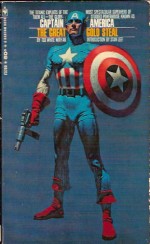
Captain America: the Great Gold Steal


By Ted White (Bantam Books)
ISBN: F3780

One thing you could never accuse Stan Lee of was reticence, especially in promoting his burgeoning line of superstars. In the 1960s most adults, including the people who worked in the field, considered comic-books a ghetto. Some disguised their identities whilst others were “just there until they caught a break.” Stan and Jack had another idea – change the perception.

Whilst Jack pursued his imagination waiting for the quality of the work to be noticed, Stan pursued every opportunity to break down the ghetto walls, college lecture tours, animated shows (of frankly dubious quality at the start, but always improving), and of course getting their product onto “real” bookshelves in real book shops.

In the 1960s on the back of the “Batmania” craze, many comics publishers repackaged their old comics stories in cheap and cheerful paperbacks, but to my knowledge only monolithic DC and brash upstart Marvel went to the next level and commissioned all-new prose novels starring their costumed superstars.

The iconic Captain America was given the solo prose treatment following on from his starring role in Avengers Battle the Earth-Wrecker with relative newcomer and devoted fanboy Ted White given the assignment of a lifetime.

Ted White won the 1968 Hugo Award for Best Fan Writer, and had been a dedicated music, science-fiction and comic-book devotee for most of his young life, winning much acclaim as an amateur author. He had published fanzines since 1953, written for many others and organized the 1967 World Science Fiction convention in New York City.

Beginning professional life as a music critic in 1959 he soon broke into another beloved field when he collaborated with Marion Zimmer Bradley on ‘Phoenix’ which eventually became his novel Phoenix Prime. Other novels followed and he became a respected SF editor too. In 1970 he contributed the opening article to the landmark paperback All in Color for a Dime, often credited with establishing the legitimacy of comicbook criticism.

The Great Gold Steal is a delightful blend of James Bond and Doc Savage, with the Sentinel of Liberty tracking three nefarious villains – the Eagle, the Starling and the Raven – as they instigate a bold plan to steal America’s entire bullion reserves. But behind their bold scheme is another villain, one who has a far longer history with the Star-Spangled Avenger…

Fast-paced, exuberant and deftly plotted, this tale is a huge amount of fun, written by a man clearly in love with his job and possessed by a deep love of the parent material (I certainly can’t think of another novelisation that footnotes specific issues of the parent comicbook as a source and encourages book readers to read comics). This is a terrific little read that deserves another release…
© 1968 Marvel Comics Group. All rights reserved.

Captain America – Operation: Rebirth


By Mark Waid, Ron Garney & various (Marvel)
ISBN: 0-7851-0219-1             ISBN13: 978-0-7851-3126-7

The Sentinel of Liberty has been with us in one incarnation or another since the comic-book’s earliest light, a genuine icon of the wider public, but despite the noblest endeavours of many very talented creators has more often than not been a rather unsuccessful series for Marvel, and regularly one of the company’s poorest sellers.

In 1995 after a truly heroic and generally under-appreciated run, scripter Mark Gruenwald surrendered his post, going out on a high note by actually killing Captain America, as the super-serum that made him the world’s most perfect physical specimen degraded in his bloodstream, causing a total bodily collapse. This cleared the decks for a spectacular relaunch from Mark Waid and Ron Garney, (assisted by inkers Scott Koblish, Mike Manley and Denis Rodier) in issues #445-448.

Snatched from the jaws of death by his greatest enemy and his murdered true love, the Star-Spangled Avenger exploded back into action against the foes he was literally created to defeat when a Nazi cult attempted to resurrect Adolf Hitler and reconfigure the entire world using the reality bending Cosmic Cube.

With only the self-serving Red Skull and embittered, abandoned Sharon Carter beside him the hero was reborn in a dynamic thriller that instantly recaptured the vast energy of the character and perfectly displayed the mythic magical quality of Captain America, triggering a mini-renaissance that was thrown away when Marvel sublet him to the unreliable and inexplicably popular Rob Liefeld a year later.

Fast, pretty and utterly compelling Operation: Rebirth is a perfect superhero adventure and possibly the Last Hurrah of Silver Age Marvel’s most enthralling hero.
© 1995, 1996, 2008 Marvel Characters, Inc.  All Rights Reserved.
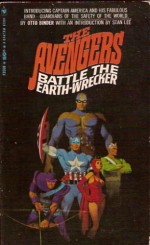
The Avengers Battle the Earth Wrecker


By Otto Binder (Bantam Books)
ISBN: F3569

One thing you could never accuse Stan Lee of was reticence, especially in promoting his burgeoning line of superstars. In the 1960s most adults, including the people who worked there, considered comic-books a ghetto. Some disguised their identities whilst others were “just there until they caught a break.” Stan and Jack had another idea – change the perception.

Whilst Jack passionately pursued his imagination waiting for the quality of the work to be noticed, Stan sought every opportunity to break down the ghetto walls: college lecture tours, animated TV shows (of frankly dubious quality at the start, but always improving), and of course getting their product onto “real” bookshelves in real book shops.

In the 1960s on the back of the “Batmania” craze, many comics publishers repackaged their old comics stories in cheap and cheerful paperbacks, but to my knowledge only monolithic DC and brash upstart Marvel went to the next level and commissioned all-new prose novels starring their costumed superstars. The publisher Bantam Books had been specialising in superhero fiction since 1964 when they began reprinting the 1930s pulp novels of Doc Savage, so they must have seemed the ideal partner in this frankly risky enterprise.

The first of these novels was an unlikely choice, considering the swelling appeal of both Spider-Man and The Fantastic Four, but I imagine that the colourful team of adventurers selected was one that Lee was happy to let another writer work on, and perhaps it was even a way of defending their trademark in all arenas (after all the British TV series The Avengers was screening in America to great success (necessitating Gold Key’s comic book tie-in being titled John Steed and Emma Peel).

Whatever the reason, The Avengers Battle the Earth-Wrecker launched with little fanfare (I don’t even recall an ad in the comic-books themselves, at a time when company policy dictated that changing one’s socks got a full write-up on the “Marvel Bullpen Bulletins Page”) and it didn’t garner a lot of praise…

Which is actually a real shame, as it’s a pretty good yarn extremely well told by pulp and comics veteran Otto Binder, whose Adam Link prose stories inspired Isaac Asimov’s ‘I, Robot’ tales whilst his Captain Marvel, Superman, Captain America and uncounted other comics scripts inspired just about everybody.

The heroic team, consisting of Goliath, the Wasp, Hawkeye, Iron Man and Captain America (but not Quicksilver or the Scarlet Witch who both look so good on that spiffy painted cover) are called upon to battle Karzz, a monstrous alien mastermind from the future who has travelled back in time to eradicate the entire Earth, in a fast-paced thriller that barrels along in fine old style, and doesn’t suffer at all from the lack of pulse-pounding pictures.

This is, of course, only really a treat for the most devout fan, either of the Marvel Universe or the vastly underrated work of one of the true pioneers of two genres. At least it’s not that hard to track down if you’re intrigued and hungry for something a little bit old-school and a little bit different…
© 1967 Marvel Comics Group. All rights reserved.

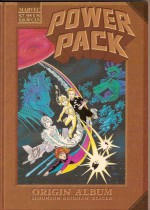
Power Pack Origin Album


By Louise Simonson, June Brigman & Bob Wiacek (Marvel)
ISBN: 0-87135-385-7             ISBN13: 978-0-87135-385-6

By the mid 1980s Marvel was far down a corporate growth-path and headed towards a period of truly dire product; lackluster, unimaginative, uninspired and woefully “safe”, but there was still some spirit of creative adventure to be found – and supported. A perfect example is this is the incredibly appetizing “fun-book” Power Pack which gave a bunch of super-powered kids a brief chance to shine in a world dominated by adults and where every super-powered kid had a grown-up somewhere calling the shots and saving the day…

High above Earth a sentient spaceship and its benevolent alien pilot were shot down whilst attempting to warn the world of impending doom. The aggressors were lizard-like marauders called Snarks determined to steal a new scientific principle discovered by physicist Dr. James Power, whilst the noble Kymellian Aefyre Whitemane sought to quash a secret that had nearly eradicated his own race…

At their isolated Virginia beach-house Power and his wife Margaret are kidnapped by the Snarks, but their four kids Alex, Julie, Jack and Katie, who had seen the Kymellian ship crash, were absent when the lizards attacked, and sheltered by the heroic Whitemane. He reveals that their father’s Anti-Matter energy converter can destroy worlds, but before he can save their parents he dies of his wounds.

The distraught and horrified kids discover they have inherited his fantastic abilities (one each) and with the assistance of Friday, the Kymellian’s “Smart-ship” the now super-powered pre-teens set out to save their parents – as well as the galaxy – and all before bed-time!

‘Power Play’, ‘Butterfingers’, ‘Kidnapped!‘ and ‘Rescue’, the first four issues of the monthly comic book (cover-dated August to November 1984) form a perfect modern fairytale, with classic goodies and baddies, rollicking thrills and adventure and most importantly brave and competent heroes who are still recognizably, perfectly realized children, not adults in all-but-name…

This charming thriller, first collected in 1988 was a rare, creatively unique high point in the company’s output (although it wasn’t long before the kids were subsumed into the greater mutant-teen morass of the X-Men franchise) and it still stands as a sensitive and positive example of plucky kids overcoming all odds to match Peter Pan, Swallows and Amazons, Huckleberry Finn or the very best of Baum’s Oz books.

Superbly observed, magically scripted and beautifully drawn this is a book that every comic loving parent will want their kids to read…
© 1988 Marvel Entertainment Group Inc. All Rights Reserved.

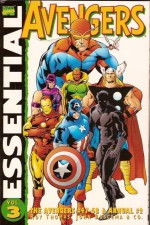
Essential Avengers volume 3


By Roy Thomas, John Buscema, Gene Colan, Barry Smith & various (Marvel)
ISBN: 978-0-7851-0787-3

Slightly slimmer than the usual phonebook sized tome, this third collection of the Mighty Avengers’ world-saving exploits (here reproducing in crisp, stylish black and white the contents of issues #47-68 of their monthly comic book and their second summer Annual) established Roy Thomas as a major creative force in comics and propelled John Buscema to the forefront of fan-favourite artists. These compelling yarns certainly enhanced the reputations of fellow art veteran Don Heck and Gene Colan and made the wider comics world critically aware of the potential of John’s brother Sal Buscema and original British Invader Barry Smith…

With the Avengers the unbeatable and venerable concept of putting all your star eggs in one basket always scored big dividends for Marvel even after the all-stars such as Thor and Iron Man were replaced and supplemented by lesser luminaries and Jack Kirby moved on to other Marvel assignments and other companies. With this third volume many of the founding stars regularly began showing up as a rotating, open door policy meant that almost every issue could feature somebody’s fave-rave, and the amazingly good stories and artwork were certainly no hindrance either.

Opening this fun-fest is ‘Magneto Walks the Earth!’ from Avengers #47 by writer Roy Thomas (who wrote all the stories contained here), illustrated by John Buscema and George Tuska wherein the master of magnetism returns from enforced exile in space to put his old gang together by recruiting mutant Avengers Quicksilver and the Scarlet Witch… whether they’re willing or otherwise…

Tuska assumes full art chores for the second chapter in this saga, ‘The Black Knight Lives Again!’ which introduced a brand new Marvel Superhero, whilst furthering a sub-plot featuring Hercules’ return to an abandoned Olympus and #49, (pencilled and inked by Buscema) concluded the Mutant trilogy with ‘Mine is the Power!’ clearing the decks for the 50th issue tussle as the team rejoins Hercules to restore Olympus by defeating the mythological menace of Typhon in ‘To Tame a Titan!’

Reduced to just Hawkeye, the Wasp and a powerless Goliath the Avengers found themselves ‘In the Clutches of the Collector!’ in #51 (illustrated by Buscema and Tuska), but the brief return of Iron Man and Thor swiftly saw the Master of Many Sizes regain his abilities in time to welcome new member Black Panther in the Vince Colletta inked ‘Death Calls for the Arch-Heroes’ which premiered obsessive super-psycho the Grim Reaper.

Next follows the slightly disconcerting cross-over/conclusion to an epic X-Men clash with Magneto from (issues #43-45) that dovetailed neatly into a grand Avengers/mutant face-off in the Buscema-Tuska limned ‘In Battle Joined!’ whilst issue #54 kicked off a mini-renaissance in quality and creativity with ‘…And Deliver Us from the Masters of Evil!’, which re-introduced the Black Knight and finally gave Avengers Butler a character and starring role, but this was simply a prelude to the second instalment which debuted the supremely Oedipal threat of the Robotic Ultron-5 in ‘Mayhem Over Manhattan!’ (inked by the superbly slick George Klein).

Captain America’s introduction to the 1960s got a spectacular reworking in Avengers #56 as ‘Death be not Proud!’ accidentally returned him and his comrades to the fateful night when Bucky died, which segued neatly into 1968’s Avengers Annual #2 (illustrated by Don Heck, Werner Roth and Vince Colletta). ‘…And Time, the Rushing River…’ found Cap, Black Panther, Goliath, Wasp and Hawkeye returned to a divergent present and compelled to battle the founding team of Iron Man, Thor, Hulk, Giant-Man and the Wasp to correct reality itself.

Buscema and Klein were back for the two-part introduction of possibly the most intriguing of all the team’s roster. ‘Behold… the Vision!’ and the concluding ‘Even an Android Can Cry’ retrofitted an old Simon and Kirby hero from the Golden Age – an extra-dimensional mystery-man – into a high-tech, eerie, amnesiac, artificial man with complete control of his mass and density, and played him as the ultimate outsider, lost and utterly alone in a world that could never, never understand him.

As the adventure and enigma unfolded it was revealed that the nameless Vision had been built by the relentless, remorseless robotic Ultron-5 to destroy the Avengers and especially his/its own creator Henry Pym. Furthermore the mechanical mastermind had used the brain pattern of deceased hero-Wonder Man (see Essential Avengers) as a cerebral template, which may have been a mistake since the synthetic man overruled his programming to help defeat his maniac maker.

Avengers #59 and 60, ‘The Name is Yellowjacket’ and ‘…Till Death do us Part!’ (the latter inked by Mike Esposito moonlighting as Mickey DeMeo) saw Goliath and the Wasp finally marry after the heroic Doctor Pym was seemingly replaced by a new insect-themed hero, with a horde of heroic guest-stars and the deadly Circus of Evil in attendance, followed in swift succession by yet another crossover conclusion.

‘Some Say the World Will End in Fire… Some Say in Ice!’ wrapped up a storyline from Doctor Strange #178 wherein a satanic cult unleashed Norse demons Surtur and Ymir to destroy the planet, and the guest-starring Black Knight hung around for ‘The Monarch and the Man-Ape!’ in Avengers #63; a brief and brutal exploration of African Avenger the Black Panther’s history and rivals.

The next issue began a three-part tale illustrated by Gene Colan whose lavish humanism was intriguingly at odds with the team’s usual art style. ‘And in this Corner… Goliath!’, ‘Like a Death Ray from the Sky!’ and ‘Mightier than the Sword?’ (the final chapter inked by Sam Grainger) was part of a broader tale; an early crossover experiment that intersected with both Sub-Mariner and Captain Marvel issues #14, as a coterie of cerebral second-string villains combined to conquer the world by stealth.

Within the Avengers portion of proceedings Hawkeye revealed his civilian identity and origins before forsaking his bow and trick-arrows, becoming a size-changing hero, and subsequently adopting the vacant name Goliath.

The last three issues reprinted here also form one story-arc, and gave new kid Barry Smith a chance to show just how good he was going to become.

In ‘Betrayal!’ (#66, inked by the legendary Syd Shores) the development of a new super metal, Adamantium, triggers a back-up program in the Vision who is compelled to reconstruct his destroyed creator, whilst in ‘We Stand at… Armageddon!’ (inked by Klein) Adamantium-reinforced Ultron-6 is moments away from world domination and the nuking of New York when a now truly independent Vision intercedes before the dramatic conclusion ‘…And We Battle for the Earth’ (with art from young Sal Buscema and Sam Grainger) sees the team, augmented by Thor and Iron Man, prove that the only answer to an unstoppable force is an unparalleled mind…

To compliment these staggeringly impressive adventures this book also includes ‘Avenjerks Assemble!’ by Thomas, John Buscema and Frank Giacoia: a short spoof from company humour mag Not Brand Echh, the five page full-team entry from the Official Handbook of the Marvel Universe and a beautiful terrific team pin-up.

As the halcyon creative days of Lee and Kirby drew to a close, Roy Thomas and John Buscema led the second wave of creators who built on and consolidated that burst of incredible imagineering into a logical, fully functioning story machine that so many others could add to. These terrific transitional tales are exciting and rewarding in their own right but also a pivotal step of the little company into the corporate colossus.

© 1967, 1968, 2001 Marvel Characters, Inc. All Rights Reserved.