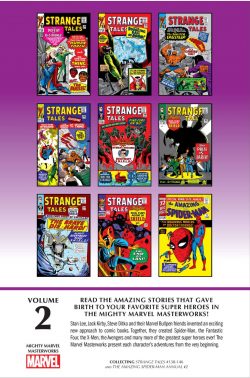
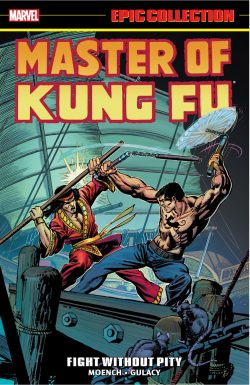
Master of Kung Fu Epic Collection volume 2: Fight Without Pity


By Doug Moench, Paul Gulacy, Sal Buscema, Keith Pollard, Jim Craig & various (MARVEL)
ISBN: 978-1-3029-0135-6 (TPB/Digital edition)

Win’s Christmas Gift Recommendation: All-Out Action Blockbusterism… 9/10

Comic books have always operated within outworld popular trends and fashions – just look at what got published whenever westerns or science fiction dominated on TV – so when the ancient philosophy and discipline of Kung Fu made its mark on western entertainment, it wasn’t long before all those kicks and punches found their way onto four-colour pages of America’s periodicals. Early starter Charlton Comics added Yang and House of Yang to the pioneering Judo Joe and Frank McLaughlin’s Judomaster; DC debuted Richard Dragon and rebooted Karate Kid; Atlas/Seaboard opened (and as quickly closed again) The Hands of the Dragon and Marvel converted a developing proposed literary adaptation into an ongoing saga about a villain’s son.

A month after it launched, a second orient-inspired hero debuted with Iron Fist: combining combat philosophy, high fantasy and magical forces with a proper superhero mask and costume…

Although largely retrofitted for modern times, inspirational Master of Kung Fu star Shang-Chi originated with a lot of tricky baggage. He launched in the autumn of 1973, cashing in on a contemporary craze for Eastern philosophy and martial arts action that generated an avalanche of “Chop Sockey” movies and a controversial TV sensation entitled Kung Fu. You may recall that the lead in that western-set saga was a half-Chinese Shaolin monk, played – after much publicised legal and industry agitation – by a white actor…

At Marvel, no one at that time particularly griped about the fact that Shang-Chi was designed by editor Roy Thomas and artisans Steve Englehart, Jim Starlin & Al Milgrom as a naive innocent (also half Chinese, with an American mother) thrown into tumultuous modern society as a rebellious but involved counterpoint to his father: an insidious scheming fiend intent on global domination. Back then, securing rights to a major literary property and wrapping new comics in it was an established practise. It had worked spectacularly with Conan the Barbarian and horror stars like Dracula and Frankenstein. The same process also brilliantly informed seminal science fiction icon Killraven in War of the Worlds and plenty more…

These days we comics apologists keep saying “it was a different era”, but I genuinely don’t think anyone in the editorial office paused for a moment of second thoughts when their new Kung Fu book secured the use one of literature’s greatest villains as a major player. Special Marvel Edition #15 (cover-dated December 1973 so Happy 50th Anniversary) launched to great success, and an overarching villain already a global personification of infamy… Fu Manchu.

Arthur Henry Sarsfield Ward AKA Sax Rohmer’s ultimate embodiment of patronising mistrust and racist suspicion had been hugely popular since 1913’s The Mystery of Dr. Fu-Manchu. The prime archetype for mad scientists and the remorseless “Yellow Peril” threatening civilization, the character spread to stage, screen, airwaves and comics (even appropriating the cover of Detective Comics #1, heralding an interior series that ran until #28), but most importantly, became the visual affirmation and conceptual basis for countless evil “Asiatics”, “Orientals” and “Celestials” dominating popular fiction ever since.

In recent years we’ve all (well, mostly all) acknowledged past iniquities and Shang-Chi has been fully reimagined, with that paternal link downplayed and ultimately abandoned – as much for licensing laws as social justice. And cultural respect.

Like most comics companies, Marvel employed plenty of “Yellow Peril” knock-offs and personifications – including Wong Chu; Plan Tzu (AKA the Yellow – or latterly Golden Claw); Huang Zhu; Silver Samurai; Doctor Sun, ad infinitum: all birds of another colour that are still nastily pejorative shades of saffron. Perhaps this is just my white guilt and fanboy shame talking. These stories, crafted by Marvel’s employees were – and remain – some of the best action comics you’ll ever encounter, but never forget what they’re actually about -distrust of the obviously other…

Without making excuses, I should also state that despite the casual racism suggested by legions of outrageously exotic, inscrutable lemon-hued bad guys haunting this series at every level, Master of Kung Fu did sensitively address issues of race and honestly attempt to share non-Christian philosophies and thought whilst, most importantly, offering potently powerful role models to kids of Asian origins. So at least there’s that …

Packed with stunning adventure and compellingly convincing drama, this second collection gathers Master of Kung Fu #29-53 and Master of Kung Fu Annual #1 (collectively spanning June 1975-August 1977). Written entirely by Doug Moench, surrendering to his love of spy fiction it opens without a preamble in the middle of a mighty struggle…

Previously: the series launched in bimonthly reprint title Special Marvel Edition as The Hands of Shang Chi: Master of Kung Fu and by the third issue (April 1974) became exclusively his. Origin episode ‘Shang-Chi, Master of Kung Fu!’ introduced a vibrant, brilliant young man raised in utter isolation in the style and manner of imperial China. Reared by monks and savants, the boy is the result of a match between a physically perfect American woman and “misunderstood patriot” Fu Manchu: a noble hero unfairly hunted and slandered by corrupt western governments and the communist usurpers now blasphemously controlling the world’s greatest empire.

His son was schooled to respect and obey his sire, trained to perfection in martial arts: designed as the ultimate warrior servant and the doctor’s devoted personal weapon against lifelong enemies Sir Dennis Nayland Smith and Doctor Petrie.

On reaching maturity, Shang – whose name means “the rising and advancing of a spirit” – was despatched to execute Petrie. However, after the obedient weapon completes his mission, he subsequently questions his entire life and the worldly benefit of killing an elderly, dying man. An emotional confrontation with Nayland Smith – who endured daily agonies from being maimed at the Devil Doctor’s command – further shakes the boy’s resolve and eventually Shang’s sublime education demands he reassess everything his father has taught him…

After invading the villain’s New York citadel and crushing his army of freaks and monsters, Shang Chi faces his father and rejects all he stands for. The battle lines of an epic family struggle were drawn…

Banished from his cloistered childhood home and environs, the philosophically minded innocent was forced to adapt rapidly to frenetic constant violence in the modern world and eventually accepted shelter with Nayland Smith in return for (espionage) services rendered…

A turning point in his rising and advancement came in MOKF #29 (cover-dated June 1975) as Shang finds a reason to abandon his pacifistic aspirations and become involved in western affairs after seeing firsthand the harm drugs cause. He joins Nayland Smith’s team – Petrie,  Blackjack Tarr and Clive Reston (descendent of a famed “Consulting Detective” and a Double-0 operative “on Her Majesty’s Secret Service”) – to cripple the drug trade.

The entire series was slowly morphing into a James Bond pastiche and with this mission to end effetely urbane drug dealer/ covert nuclear terrorist Carlton Velcro, illustrator Paul Gulacy began a visual progression that would make him one of most watched and admired artists of the era as he referenced movie star and set pieces throughout the saga.

‘The Crystal Connection’ begins with Reston undercover at Velcro’s French coast fortress, playing heroin buyer Mr Blue until Shang and Tarr can infiltrate and secure the dope stocks . Nobody was expecting the massive defences, an army of killers led by deadly assassin Razor-Fist and a nuclear arsenal hidden below ‘A Gulf of Lions’ (#30, inked by Dan Adkins), with the pitched battle ranging far and wide as Razor Fist’s defeat led to Shang clashing with whip-wielding panther woman Pavane before a truly explosive conclusion in ‘Snowbuster’

‘Assault on an Angry Sea!’ was a hasty fill-in illustrated by Sal Buscema & Mike Esposito as Shang returns to London by ship and is drawn into the hunt for an undercover courier who is unaware that counteragents intend to intercept and end them. A proper mystery yarn, Chi has many suspects and can’t tell friend from foe from target, but triumphs nonetheless…

MOKF #33 resumes the Moench/Gulacy filmic fun-fest as ‘Wicked Messenger of Madness’ introduces seductive, conflicted agent Leiko Wu as both romantic interest and wedge between Shang Chi and his colleagues, as a robotic mannequin fails to assassinate Nayland Smith thanks to martial arts mastery but opens the door to a complex web of lies, double-dealing, insane artificial intelligences and a doomsday weapon.

The robot was a tool of agent Simon Bretnor, revealed too late as narcissistic hired killer and would-be world conqueror Mordillo who wants a space weapon using the ozone layer and sunlight to ravage sites on Earth. The plans for it are encoded in Wu’s brain, but by the time she realises her current boyfriend Bretnor is the bad guy Leiko’s his prisoner on a manically murderous version of Fantasy Island

As Shang and Resto race to the madly modified atoll-turned-playground-of-peril, Wu is attempting to reason with the crazed Mordillo, but gets more sense from his Pinocchio-like robot sidekick Brynocki who is trying to mediate the ‘Cyclone at the Center of a Madman’s Crown!’ She does, however, learn her captor had a connection to Pavane and Carleton Velcro and holds Chi responsible for a huge loss of face and fortune…

Another spectacular conclusion comes when manic and martial artist clash in the skies above the island as the villain briefly unleashes his stolen Solar Chute and rains destruction down on the island in ‘Death-Hand and the Sun of Mordillo’

What feels like a reformatted leftover from the Giant-Size Master of Kung Fu era follows in #36 and 37 (January & February 1976, by Moench, Keith Pollard & Sal Trapani) as Shang enters a magical maze of mystery: seeking to defend a carnival of freaks voluntarily living in ‘Cages of Myth, Menagerie of Mirrors!’ from ninjas and their leader Darkstrider who weaves a ‘Web of Dark Death!’

Moench, Pollard, John Tartaglione & Duffy Vohland then continue the fantasy themes in Master of Kung Fu Annual #1 and a team-up with fellow transplanted warrior Iron Fist. Danny Rand and Shang are tricked into entering another dimension and invading ‘The Fortress of S’ahra Sharn!’ by trickster wizard Quan-St’ar, whose true goal is the destruction of immortal city K’un-Lun, but he made one big mistake…

At their creative peak Moench & Gulacy started an epic, ambitious, truly sophisticated and industry-changing run in MOKF #38 (March 1976). Here Shang Chi reluctantly accepts a rescue mission to extract an agent from Hong Kong, meeting lies, passion, disinformation and deadly love in ‘Cat’. Nayland Smith has again orchestrated events to satisfy his own agenda and saving Julia leads Chi into a ‘Fight Without Pity’ against an opponent who might well be his superior in combat ability and also holds the moral high ground…

The landmark clash is simply prologue to an extended, character driven serial that opens at ‘The Murder Agency’ (#40 with Gulacy inking himself) as the on-fire creators pioneer storytelling techniques later employed in Christopher Nolan’s Memento. A traitor in British Intelligence is murdering agents and the information Nayland Smith wanted from Julia should have given them vital advantage. However, as Shang again quits all “games of death and deceit” he, Tarr and Leiko are attacked by apparently Chinese agents masquerading as “Oriental Expediters”.

After helping to defeat the attackers, Wu leaves on a similar extraction mission and suggests that the embattled operatives re-enlist disgraced former agent and current drunken sot James Larner. When they try, he’s got a new pal also boozing himself to death… Reston…

That’s when another well-armed gang burst in guns blazing, laying down their lives simply to bait a trap the agents can’t afford to avoid…

With the spy saga solidly underway everything suddenly screeched to a halt as a deadline crunch necessitated another fill-in moment, with Moench, Sal Buscema & Esposito revealing a childhood moment in ‘Slain in Secrecy, and by Illusion!’ Here Shang recalls reluctant clashes with childhood companion M’nai – AKA Si Fan assassin Midnight – to prove Fu Manchu’s hallowed home harboured a thief and traitor…

Inked by Tom Sutton, the main event resumes in #42 with a welter of flashbacks, cross-cuts and flash forwards as ‘The Clock of Shattered Time’ introduces an electrically enhanced martial arts assassin who almost kills Chi. Shock-Wave has a strong but top-secret connection to Nayland Smith and nearly succeeds in blowing up the spy chief too…

As the MI5 mole and Shock-Wave set more bombs, MOKF #43 sees a changed and vengeful Shang Chi win a rematch with the amplified assassin in ‘A Flash of Purple Sparks’. As Leiko Wu escorted her own living package across Europe with the Oriental Expediters chasing them all the way to an MI5 safehouse in Switzerland, Shang was waiting, but his triumph was short-lived as Leiko’s charge revealed who was behind all the deaths and the Oriental Expediter organisation, and that in London another of his allies had fallen…

The drama kicked into overdrive with a long-anticipated event. Cover-dated September 1976, #44 heralded ‘The Return of Fu Manchu, Prelude: “Golden Daggers (A Death Run)”’ as the scattered British agents head for home under a hail of gunfire and assorted ambushes. At last revealed is how the Devil Doctor’s recalcitrant first-born Fah Lo Suee is at war with their father for control of his empire.

She originally debuted in third novel The Si-Fan Mysteries / The Hand of Fu-Manchu in 1917 (or fourth outing The Daughter of Fu-Manchu in 1931, depending on who you ask) and was a minor character here since Master of Kung Fu #26, but here steps into the spotlight after Nayland Smith is finally downed by his most trusted ally…

On the back foot and losing, Fah Lo Suee seeks alliances and her brother’s aid in ‘Part One (Shang Chi): “The Death Seed!”’ while Fu Manchu is occupied with resurrecting his founding ancestor to be his new – loyal – son/enforcer. In London, Larner saves Nayland Smith even as Reston, Shang and Wu reunite and rebuff the “daughter of the Devil” – and that’s when Clive makes a big mistake and is taken by Fah Lo Suee…

Inked by Pablo Marcos, ‘Part Two (Clive Reston): “The Spider Spell!”’ divides attention between the British agent’s trial and eventual triumph and Fu resurrecting legendary warlord Shaka Kharn, whilst ‘Part Three (Leiko Wu): “Phantom Sand”’ details how she and Shang infiltrate a fantastic city at the north pole in advance of what’s left of the team joining them to destroy the citadel. Before that, though, the final clash between father and daughter again confirms the total mastery of the malevolent mandarin…

The true appalling scope of the Devil Doctor’s ambitions are exposed in ‘Part Four (Black Jack Tarr): “City in the Top of the World”’ as the schemer prepares to leave Earth and cull its population by 90% as Shang duels resurrected revenant Shaka Kharn, and battles his way aboard his sire’s space shuttle even as his companions destroy the base at the cost of another valiant soul in ‘Part Five (Sir Dennis Nayland Smith): “The Affair of the Agent Who Died!”’

The astounding saga – and Gulacy’s interior involvement – ends with #50 with the villain speaking for himself as his plans and perhaps his over-extended life are ended in ‘Part Six (Fu Manchu): “The Dreamslayer!”’

Master of Kung Fu #51 saw Jim Craig join Moench & Marcos, taking over the art for ‘Epilogue: “Brass and Blackness!” (A Death Move!!)’ infilling details of interments and getting back to Earth where the unhappy warrior again quit the spy world…

The final tale here (#52, May 1977) is one more fill-in as Moench & Pollard reintroduce Groucho Marx tribute Rufus T. Hackstabber who invites our baffled battler to ‘A Night at the 1001 Nights!’ in search of family (such as reprobate/WC Fields analogue Quigley J. Warmflash), riches and safety from mercenaries led by Si-Fan general Tiger-Claw

Ernie Chan’s cover to MOKF #53 (which reprinted #20) leads into an extras section including Gil Kane & Adkins’ covers to Savage Fists of Kung Fu tabloid collectors edition, house ads and 10 pages of original art, unused and modified covers. The published ones throughout were crafted by Kane, Adkins, Sal Buscema, Rich Buckler, Dave Cockrum, Marie Severin, Chan, Gulacy, John Romita Jr., Ron Wilson & Jack Abel, Al Milgrom, Esposito, Joe Sinnott, Frank Giacoia and Klaus Janson.

In recent years, Shang Chi’s backstory has been adapted and altered. His father was understandably reinvented as Zheng Zu, Mr. Han, Chang Hu, Wang Yu-Seng and The Devil Doctor so depending on your attitude, you have the ultimate choice and sanction of not buying or reading this material. If you do – with eyes wide open and fully acknowledging that the past is another place that we can now consign to history – your comics appreciation faculties will see some amazing stories incredibly well illustrated: ranking amongst the most exciting and enjoyable in Marvel’s canon.
© 2018 MARVEL.
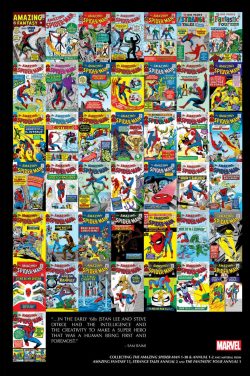
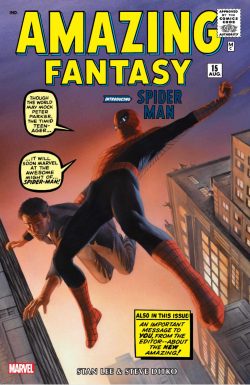
The Amazing Spider-Man Omnibus volume 1


By Stan Lee & Steve Ditko with Jack Kirby, Art Simek, Sam Rosen, Jon D’Agostino, John Duffy, Ray Holloway & various (MARVEL)
ISBN: 978-1-3029-4563-3 (HB/Digital edition)

Win’s Christmas Gift Recommendation: Utter Entertainment Perfection… 10/10

The Amazing Spider-Man celebrated his 60th anniversary in 2022. However, I’m one of those radicals who feel that 1963 was when he was really born, so let’s close this year with one last acknowledgement of that…

Marvel is often termed “the House that Jack Built” and King Kirby’s contributions are undeniable and inescapable in the creation of a new kind of comic book storytelling. However, there was another unique visionary toiling at Atlas-Comics-as-was: one whose creativity and philosophy seemed diametrically opposed to the bludgeoning power, vast imaginative scope and clean, gleaming futurism that resulted from Kirby’s ever-expanding search for the external and infinite.

Steve Ditko was quiet and unassuming, diffident to the point of invisibility, but his work was both subtle and striking: innovative and meticulously polished. Always questing for affirming detail, he ever explored the man within. He saw heroism and humour and ultimate evil all contained within the frail but noble confines of humanity. His drawing could be oddly disquieting… and, when he wanted, decidedly creepy.

Crafting extremely well-received monster and mystery tales for and with Stan Lee, Ditko had been rewarded with his own title. Amazing Adventures/Amazing Adult Fantasy featured a subtler brand of yarn than Rampaging Aliens and Furry Underpants Monsters: an ilk which, though individually entertaining, had been slowly losing traction in the world of comics ever since National/DC had successfully reintroduced costumed heroes.

Lee & Kirby had responded with The Fantastic Four and so-ahead-of-its-time Incredible Hulk, but there was no indication of the renaissance ahead when officially just-cancelled Amazing Fantasy featured a brand new and rather eerie adventure character…

This compelling compilation re-presents the rise of the wallcrawler as originally seen in Amazing Fantasy #15, The Amazing Spider-Man #1-38, Amazing Spider-Man Annual #1 & 2 plus material from Strange Tales Annual #2 and Fantastic Four Annual #2 collectively spanning cover-dates August 1962-July 1966). It is lettered throughout by unsung superstars Sam Rosen, Art Simek, Jon D’Agostino, John Duffy and Ray Holloway and sadly an anonymous band of colourists. As well as a monolithic assortment of nostalgic treats at the back, this mammoth tome is dotted throughout with recycled Introductions from Stan Lee, taken from the first four Marvel Masterworks editions devoted to the webspinner and includes editorial announcements and the ‘Spider’s Web’ newsletter pages for each original issue to enhance that wayback machine experience…

The wonderment came and concluded in 11 captivating pages: ‘Spider-Man!’ tells the parable of smart but alienated Peter Parker, a kid bitten by a radioactive spider on a high school science trip. Discovering he has developed arachnid abilities – which he augments with his own natural engineering genius – he does what any lonely, geeky nerd would do when given such a gift – he tries to cash in for girls, fame and money.

Creating a costume to hide his identity in case he makes a fool of himself, Parker becomes a minor celebrity – and a vain, self-important one. To his eternal regret, when a thief flees past, he doesn’t lift a finger to stop him, only to find when he returns home that his Uncle Ben has been murdered.

Crazy for vengeance, Parker stalks the assailant who made his beloved Aunt May a widow and killed the only father he had ever known, only to find that it is the felon he couldn’t be bothered with. Since his irresponsibility led to the death of the man who raised him, the boy swears to always use his powers to help others…

It wasn’t a new story, but the setting was one familiar to every kid reading it and the artwork was downright spooky. This wasn’t the gleaming high-tech world of moon-rockets, giant monsters and flying cars – this stuff could happen to anybody…

Amazing Fantasy #15 came out the same month as Tales to Astonish #35 (cover-dated September 1962) – the first to feature the Astonishing Ant-Man in costumed capers, but it was also the last issue of Ditko’s Amazing playground. With this volume you’ll find the ‘Fan Page – Important Announcement from the Editor!’ that completely misled fans as to what would happen next…

The tragic last-ditch tale struck a chord with readers and by Christmas a new comic book superstar was ready to launch in his own title, and Ditko eager to show what he could do with his first returning character since the demise of Charlton action hero Captain Atom.

Holding on to the “Amazing” prefix memories, bi-monthly Amazing Spider-Man #1 arrived with a March 1963 cover-date and two complete stories. It also prominently featured the Fantastic Four and took the readership by storm. The opening tale, again simply entitled ‘Spider-Man!’, recapitulated the origin whilst adding a brilliant twist to the conventional mix.

Now the wall-crawling hero was feared and reviled by the general public thanks in no small part to newspaper magnate J. Jonah Jameson who pilloried the adventurer from spite and for profit. With time-honoured comic book irony, Spider-Man then had to save Jameson’s astronaut son John from a faulty space capsule in extremely low orbit…

Second yarn ‘Vs the Chameleon!’ finds the cash-strapped kid trying to force his way onto the roster – and payroll – of the FF whilst elsewhere a spy perfectly impersonates the webspinner to steal military secrets: a stunning example of the high-strung, antagonistic crossovers and cameos that so startled jaded kids of the early 1960s. Heroes just didn’t act like that and they certainly didn’t speak directly to the fans as in ‘A Personal Message from Spider-Man’ that’s reprinted here…

With his second issue, our new champion began a meteoric rise in quality and innovative storytelling. ‘Duel to the Death with the Vulture!’ catches Parker chasing a flying thief as much for profit as justice. Desperate to help his aunt make ends meet, Spider-Man starts taking photos of his cases to sell to Jameson’s Daily Bugle, making his personal gadfly his sole means of support.

Matching his deft comedy and moody soap-operatic melodrama, Ditko’s action sequences were imaginative and magnificently visceral, with odd angle shots and quirky, mis-balanced poses adding a vertiginous sense of unease to fight scenes. But crime wasn’t the only threat to the world and Spider-Man was just as (un)comfortable battling “aliens” in ‘The Uncanny Threat of the Terrible Tinkerer!’

Amazing Spider-Man #3 introduced possibly the apprentice hero’s greatest enemy in ‘Versus Doctor Octopus’: a full-length saga wherein a dedicated scientist survives an atomic accident only to discover his self-designed mechanical “waldoes”/tentacles have permanently grafted to his body. Power-mad, Otto Octavius initially thrashes Spider-Man, sending the lad into a depression until an impromptu pep-talk from Human Torch Johnny Storm galvanises the arachnid to one of his greatest victories. Also included is a stunning ‘Special Surprise Bonus Spider-Man Pin-up Page!’…

‘Nothing Can Stop… The Sandman!’ was another instant classic wherein a common thug gains the power to transform to sand (in another pesky nuclear snafu), invades Parker’s school, and must be stopped at all costs, after which1963’s Strange Tales Annual #2 featured ‘The Human Torch on the Trail of the Amazing Spider-Man!’

This terrific romp from Lee & Kirby with Ditko inking details how the wallcrawler is framed by international art thief The Fox, instigating an early “Marvel Misunderstanding Clash” and is followed by short story ‘The Fabulous Fantastic Four meet Spider-Man!’: re-examining in an extended re-interpretation that first meeting from the premiere issue of the wallcrawler’s own comic and taken from Fantastic Four Annual #1.

With Ditko on pencils and inks again, Amazing Spider-Man #5 saw the webspinner ‘Marked for Destruction by Dr. Doom!’ – not so much winning as surviving his battle against the deadliest man on Earth. Presumably he didn’t mind too much, as this marked the transition from bi-monthly to monthly status for the series. In this tale Parker’s nemesis, jock bully Flash Thompson, first displays depths beyond the usual in contemporary comicbooks, beginning one of the best love/hate buddy relationships in popular literature…

Eventual mentor Dr. Curtis Connors debuts in #6 when Spidey comes ‘Face-to-face With… The Lizard!’ as the wallcrawler fights far from the concrete canyon comfort zone of New York – specifically in the murky Florida Everglades. Parker was back in the Big Apple in #7 to breathtakingly tackle ‘The Return of the Vulture’ in a full-length action extravaganza.

Fun and youthful hi-jinks were a signature feature of the series, as was Parker’s budding romance with “older woman” Betty Brant, Jameson’s secretary/PA at the Bugle. Youthful exuberance was the underlying drive in #8’s lead tale ‘The Living Brain!’ wherein an ambulatory robot calculator is tasked with exposing Spider-Man’s secret identity before running amok at beleaguered Midtown High, just as Parker is finally beating the stuffings out of bully Flash Thompson.

This 17-page triumph was accompanied by ‘Spiderman Tackles the Torch!’: a 6-page vignette drawn by Kirby and inked by Ditko, wherein a boisterous wallcrawler gate-crashes a beach party thrown by the flaming hero’s girlfriend – with suitably explosive consequences…

Amazing Spider-Man #9 is a qualitative step-up in dramatic terms, as Aunt May is revealed to be chronically ill and adding to Parker’s financial woes. Action is supplied by ‘The Man Called Electro!’ – an accidental super-criminal with grand aspirations.

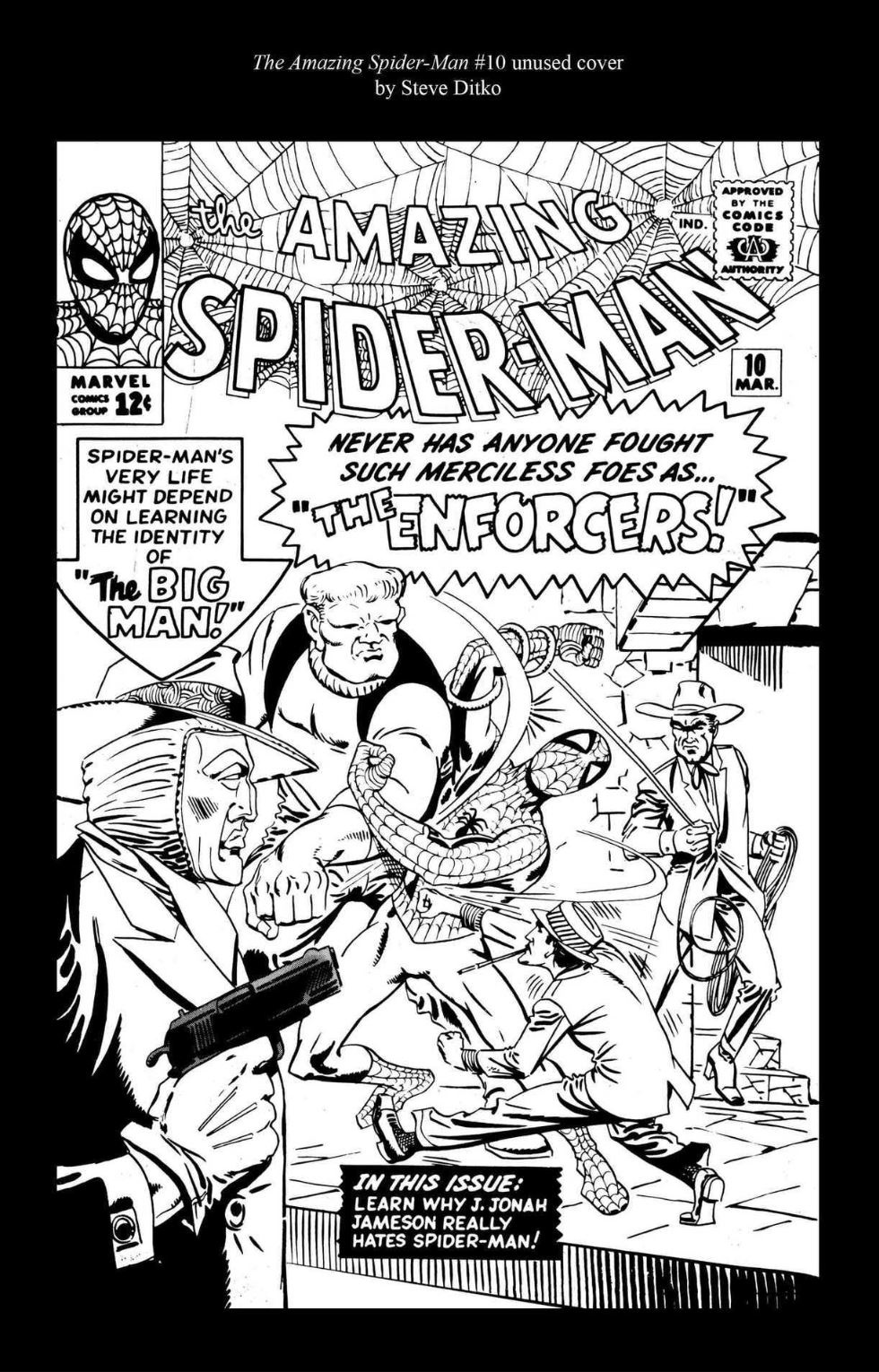
Spider-Man was always a loner, never far from the streets and small-scale-crime, and with this tale – wherein he also quells a prison riot single handed – Ditko’s preference for tales of gangersterism starts to proliferate: a predilection confirmed in #10’s ‘The Enforcers!’ (AKA Fancy Dan, Montana and The Ox). This is a classy mystery with a masked mastermind known as The Big Man, using a position of trust to organise all New York mobs into one unbeatable army against decency.

Longer plot-strands are also introduced as Betty mysteriously vanishes, although most fans remember this one for the spectacularly climactic 7-page fight scene in an underworld chop-shop that has still never been beaten for action-choreography.

The wonderment intensifies (after a Lee Introduction) with a magical 2-part yarn. ‘Turning Point’ and ‘Unmasked by Dr. Octopus!’ sees the lethally deranged and deformed scientist return and the disclosure of a long-hidden secret which had haunted Parker’s girlfriend Betty Brant for years.

The dark, tragedy-filled tale of extortion and excoriating tension stretches from Philadelphia to the Bronx Zoo and cannily tempers trenchant melodrama with spectacular fight scenes in unusual and exotic locations, before culminating in a truly staggering super-powered duel as only Ditko could orchestrate it.

A new super-foe premiered in Amazing Spider-Man #13 with ‘The Menace of Mysterio!’ as publisher J. Jonah Jameson hires a seemingly eldritch bounty-hunter to capture Spider-Man before eventually letting slip his own dark criminal agenda, whilst #14 offers an absolute milestone in the series as a hidden criminal mastermind manipulates a Hollywood studio into making a movie about the wall-crawler. Even with guest-star opposition The Enforcers and Incredible Hulk, ‘The Grotesque Adventure of the Green Goblin’ is most notable for introducing Spider-Man’s most perfidious and flamboyant enemy.

Jungle superman and thrill-junkie (and modern movie star!) ‘Kraven the Hunter!’ makes Spidey his intended prey at the behest of embittered former-foe the Chameleon in #15, and promptly pops up again in the first Amazing Spider-Man Annual (1964) that follows.

A timeless landmark and still magnificently thrilling battle, tale, the ‘Sinister Six’ begins after a band of villains comprising Electro, Kraven, Mysterio, Sandman, Vulture and Dr Octopus abduct May Parker and Betty, forcing Spider-Man to confront them without his powers – lost in a guilt-fuelled panic attack.

A staggeringly compelling Fights ‘n’ Tights saga, this influential tale featured cameos (or, more honestly, product placement segments) by every other extant hero of the budding Marvel universe.

Also included in the colossal comic compendium were special feature pages on ‘The Secrets of Spider-Man!’ and comedic short ‘How Stan Lee and Steve Ditko Created Spider-Man’ plus a gallery of pin-up pages featuring ‘Spider-Man’s Most Famous Foes!’ – (the Burglar, Chameleon, Vulture, Terrible Tinkerer, Dr. Octopus, Sandman, Doctor Doom, The Lizard, Living Brain, Electro, The Enforcers, Mysterio, Green Goblin and Kraven the Hunter) – as well as pin-ups of Betty and Jonah, Parker’s classmates and house, and even heroic guest stars…

Amazing Spider-Man #16 extended that circle of friends and foes as the webslinger battles The Ringmaster and Circus of Evil, meeting a fellow loner hero in a dazzling ‘Duel with Daredevil’. This delightful diversion segued into an ambitious 3-part saga, beginning in Amazing Spider-Man #17 wherein our rapidly-maturing hero touches emotional bottom before rising to triumphant victory over all manner of enemies in ‘The Return of the Green Goblin!’, as the wallcrawler endures renewed print assaults in the Daily Bugle from its rabid publisher just as his enigmatic veridian archvillain opened a sustained war of nerves and attrition, using The Enforcers, Sandman and an army of thugs to publicly humiliate the hero. To exacerbate matters, Aunt May’s health took a drastic downward turn…

Resuming with ‘The End of Spider-Man!’ and explosively concluding in triumphal big finish ‘Spidey Strikes Back!’ – featuring a turbulent team-up with friendly rival the Human Torch – this extended tale proved fans were ready for every kind of narrative experiment (single issue or two stories per issue were still the norm in 1964) and Stan & Steve were more than happy to try anything.

With ‘The Coming of the Scorpion!’, Jameson let his obsessive hatred for the cocky kid crusader get the better of him: hiring scientist Farley Stillwell to endow a private detective with insectoid-based superpowers. Sadly, the process drove mercenary Mac Gargan mad before he could capture Spidey, leaving the webspinner with yet another lethally dangerous meta-menace to deal with…

That issue closed with pin-up of ‘Peter Parker and Ol’ Webhead’ before #21 highlights a hilarious love triangle in ‘Where Flies the Beetle’ as the Torch’s girlfriend uses Peter Parker to make the flaming hero jealous. Unfortunately, the Beetle – a villain with high-tech insect-themed armour – is simultaneously stalking Doris Evans as bait for a trap. As ever, Spider-Man was simply in the wrong place at the right time, resulting in a spectacular fight-fest.

This issue also offers a stunning and much reprinted Ditko Marvel Masterwork Pin-up of ‘Spider-Man’ before ASM #22 preeeeeeeesents… ‘The Clown, and his Masters of Menace!’: affording a return engagement for the Circus of Crime with splendidly outré action and a lot of hearty laughs provided by increasingly irreplaceable supporting stars Aunt May, Betty Brant and Jameson, before #23 delivers a superb thriller blending the mundane mobster and thugs that Ditko loved to depict with the more outlandish threat of a supervillain attempting to take over all the city’s gangs.

‘The Goblin and the Gangsters’ is both moody and explosive, the supervillain’s plot foiled by a cunning competitor and the driven hero’s ceaseless energy, and this tale is complemented by a Ditko Marvel Masterwork Pin-up of ‘Spidey’ that amazingly features all the supporting cast and every extant villain in his rogue’s gallery…

Another recurring plot strand debuted in #24, as a dark brooding tale had the troubled boy question his own sanity in ‘Spider-Man Goes Mad!’. The sinister stunner sees a clearly delusional wallcrawler seeking psychiatric help, but there’s more to the matter than simple insanity, as an insidious old foe unexpectedly returns, employing psychological warfare…

Amazing Spider-Man #25 once more sees our obsessed publisher take matters into his own hands. ‘Captured by J. Jonah Jameson!’ introduces Professor Smythe – whose dynasty of robotic Spider-Slayers would bedevil the webslinger for years to come – hired to remove Spider-Man for good.

Issues #26 & 27 comprise a captivating 2-part mystery and deadly duel between Green Goblin and an enigmatic new criminal. ‘The Man in the Crime-Master’s Mask!’ and ‘Bring Back my Goblin to Me!’ together form a perfect arachnid epic, with soap-opera melodrama and screwball comedy leavening tense crimebusting thrills and all-out action.

ASM #28’s ‘The Menace of the Molten Man!’ is a tale of science gone bad and remains remarkable today not only for spectacular action sequences – and possibly the most striking Spider-Man cover ever produced – but also as the story in which Peter Parker graduates from High School.

Ditko was on peak form and fast enough to handle two monthly strips. At this time he was also blowing away audiences with another oddly tangential superhero. Two extremely disparate crusaders met in ‘The Wondrous World of Dr. Strange!’: lead story in the second super-sized Spider-Man Annual (released in October 1965 and filled out with vintage Spidey classics). The entrancing fable unforgettably introduced the Amazing Arachnid to arcane other realities as he teamed up with the Master of the Mystic Arts to battle power-crazed mage Xandu in a phantasmagorical, dimension-hopping masterpiece involving ensorcelled zombie thugs and the stolen Wand of Watoomb. After this, it was clear that Spider-Man could work in any milieu and nothing could hold him back…

Also from that immensely impressive landmark are more Ditko pin-ups via ‘A Gallery of Spider-Man’s Most Famous Foes’ – highlighting such nefarious ne’er-do-wells as The Circus of Crime, The Scorpion, The Beetle, Jonah’s Robot and The Crime-Master.

Back in the ever-more popular monthly mag, ASM #29 warned ‘Never Step on a Scorpion!’ as the lab-made larcenous lunatic returned, seeking vengeance on not just the webspinner but also Jameson for turning a disreputable private eye into a super-powered monster…

Issue #30’s off-beat crime-caper then cannily sowed seeds for future masterpieces as ‘The Claws of the Cat!’ depicted a city-wide hunt for an extremely capable burglar (way more exciting than it sounds, trust me!), plus the introduction of an organised gang of thieves working for mysterious new menace The Master Planner.

Sadly, by this time of their greatest comics successes, Lee & Ditko were increasingly unable to work together on their greatest creations. Ditko’s off-beat plots and quirky art had reached an accommodation with the slickly potent superhero house-style Kirby had developed (at least as much as such a unique talent ever could). The illustration featured a marked reduction of signature line-feathering and moody backgrounds, plus a lessening of concentration on totemic villains, but – although still very much a Ditko baby – Amazing Spider-Man‘s sleek pictorial gloss warred with Lee’s scripts. These were comfortably in tune with the times if not his collaborator.

Lee’s assessment of the audience was probably the correct one, and disagreements with the artist over editorial direction were still confined to the office and not the pages themselves. However, an indication of growing tensions could be seen once Ditko began being credited as plotter of the stories…

After a period where old-fashioned crime and gangsterism predominated, science fiction themes and costumed crazies returned full force. As the world went gaga for masked mystery-men, the creators experimented with longer storylines and protracted subplots. When Ditko abruptly left, the company feared a drastic loss in quality and sales but it didn’t happen. John Romita (senior) considered himself a mere “safe pair of hands” keeping the momentum going until a better artist could be found, but instead blossomed into a major talent in his own right, and the wallcrawler continued his unstoppable rise at an accelerated pace.

Change was in the air everywhere. Included amongst the milestones for the ever-anxious Peter Parker collected here are graduating High School, starting college, meeting true love Gwen Stacy and tragic friend/foe Harry Osborn, plus the introduction of nemesis Norman Osborn. Old friends Flash Thompson and Betty Brant subsequently begin to drift out of his life…

‘If This Be My Destiny…!’ in #31 details a spate of high-tech robberies by the Master Planner culminating in a spectacular confrontation with Spider-Man. Also on show is that aforementioned college debut, first sight of Harry and Gwen, with Aunt May on the edge of death due to an innocent blood transfusion from her mildly radioactive darling Peter…

This led to indisputably Ditko’s finest and most iconic moments on the series – and perhaps of his entire career. ‘Man on a Rampage!’ shows Parker pushed to the edge of desperation as the Planner’s men make off with serums that might save May, resulting in an utterly driven, berserk wallcrawler ripping the town apart whilst trying to find them.

Trapped in an underwater fortress, pinned under tons of machinery, the hero faces his greatest failure as the clock ticks down the seconds of May’s life…

This in turn generates the most memorable visual sequence in Spidey history as the opening of ‘The Final Chapter!’ luxuriates in 5 full, glorious pages to depict the ultimate triumph of will over circumstance. Freeing himself from tons of fallen debris, Spider-Man gives his absolute all to deliver the medicine May needs, and is rewarded with a rare happy ending…

Russian exile Kraven returns in ‘The Thrill of the Hunt!’, seeking payback for past humiliations by impersonating the webspinner, after which #35 confirms that ‘The Molten Man Regrets…!’: a plot-light, inimitably action-packed combat classic wherein the gleaming golden bandit foolishly resumes his career of pinching other people’s valuables…

Amazing Spider-Man #36 offers a deliciously off-beat, quasi-comedic turn in ‘When Falls the Meteor!’, with deranged, would-be scientist Norton G. Fester calling himself The Looter to steal extraterrestrial museum exhibits…

In retrospect these brief, fight-oriented tales, coming after such an intricate, passionate epic as the Master Planner saga should have indicated something was amiss. However fans had no idea that ‘Once Upon a Time, There was a Robot…!’ – featuring a beleaguered Norman Osborn targeted by his disgraced ex-partner Mendel Strom, and some eccentrically bizarre murder-machines in #37 and the tragic tale of ‘Just a Guy Named Joe! – wherein a hapless sad-sack stumblebum boxer gains super-strength and a bad-temper – would be Ditko’s last arachnid adventures.

And thus an era ended…

As added enticements – and alone worth the price of this collection of much-reprinted material – is a big gallery of extras beginning with ‘…Does Whatever a Spider Can: A Lee/Ditko Amazing Spider-Man Lexicon’ and a selection of essays by Arlen Schumer, Jon B Cooke and Blake Bell including Lee’s ‘The World’s Best-Selling Swinger’. Also on view is the entire debut tale from AF #15, in original art form, taken from the Library of Congress where it now resides, fully curated and commented upon by historian and scholar Blake Bell. Also on view are unused Ditko covers, sketches, layouts and early monochrome pin-ups (33 pages in total), unretouched cover art for AS #11 & 35, and a barrage of pulse-pounding house ads, “Bullpen Bulletin” pages plus a photo-feature on the Marvel Bullpen circa 1964.

The treats go on with rare Ditko T-shirt designs, posters and ad art, plus a range of Marvel Masterworks covers with Kirby and Ditko’s original images enhanced by painters Dean White and Paul Mounts. Also included are a cover gallery for 1960s reprint vehicle Marvel Tales (#1-28 by Ditko and latterly Marie Severin) as well as Mighty Marvel Masterworks collection covers by Michael Cho and Alex Ross’ Omnibus cover art. Although other artists have inked his narratives, Ditko handled all the art on Spider-Man and these lost gems demonstrate his fluid mastery and just how much of the mesmerising magic came from his pens and brushes…

Full of energy, verve, pathos and laughs, gloriously short of post-modern angst and breast-beating, these fun classics – also available in numerous formats including eBook editions – are quintessential comic book magic constituting the very foundation of everything Marvel became. This classy compendium is an unmissable opportunity for readers of all ages to celebrate the magic and myths of the modern heroic ideal: something no serous fan can be without, and an ideal gift for any curious newcomer or nostalgic aficionado.

Happy Unbirthday Spidey and many, many more please…
© 2022 MARVEL.

Doctor Strange Masterworks volume 4


By Roy Thomas, Stan Lee, Gardner Fox, Barry Windsor-Smith, Archie Goodwin, Gene Colan, Marie Severin, Herb Trimpe, Don Heck, Sam Kweskin, Frank Brunner, P. Craig Russell, Jim Starlin & various (Marvel)
ISBN: 978-0-7851-3495-4 (HB/Digital Edition)

Win’s Christmas Gift Recommendation: Arcane Anniversary Astonishment… 9/10

When the budding House of Ideas introduced a warrior wizard to their burgeoning pantheon in the summer of 1963, it was a bold and curious move. Anthologically, bizarre adventures and menacing aliens were still incredibly popular, but most dramatic mentions of magic or the supernatural (especially vampires, werewolves and their equally eldritch ilk) were harshly proscribed by a censorship panel which dictated almost all aspects of story content – the self-inflicted Comics Code Authority.

That eldritch embargo probably explains writer/editor Stan Lee’s low key introduction of Steve Ditko’s mystic adventurer: an exotic, twilight troubleshooter inhabiting the shadowy outer fringes of society.

Within a year of Fantastic Four #1, long-lived monster-mystery anthology Strange Tales became home for the blazing boy-hero Human Torch (from #101, cover-dated October 1962), launching Johnny Storm on a creatively productive but commercially unsuccessful solo career.

In 1963, Tales of Suspense #41 saw new sensation Iron Man battle a crazed scientific wizard dubbed Doctor Strange, and with the name in copyrightable print (a long-established Lee technique: Thorr, The Thing, Magneto, The Hulk and more had been disposable Atlas “furry underpants monsters” long before they became in-continuity Marvel characters), preparations began for a truly different kind of hero.

The company had already devised a quasi-mystic troubleshooter for a short run in Amazing Adventures (volume 1 #1-4 & #6, spanning June-November 1961). The precursor was balding, trench-coated savant Doctor Droom – retooled in the 1970s as Doctor Druid when his exploits were reprinted. Psychiatrist, sage and paranormal investigator, he tackled everything from alien invaders to Atlanteans (albeit not the ones Sub-Mariner ruled). He was subsequently retro-written into Marvel continuity as an alternative candidate for Stephen Strange’s ultimate role as Sorcerer Supreme.

The man we know debuted in Strange Tales #110 (July 1963). After a shaky start, the Master of the Mystic Arts became an unmissable icon of cool counter-culture kids who saw in Ditko’s increasingly psychedelic art, echoes and overtones of their own trippy explorations of other worlds. That might not have been the authors’ intention but it certainly helped keep the mage at the forefront of Lee’s efforts to break comics out of the “kids-stuff” ghetto.

After Ditko abruptly left the company at the height of his fame and success in early 1967, the feature went through a string of creators before Marvel’s 1968 expansion allowed a measure of creative stability as the mystic master won his own monthly solo title in a neat moment of sleight of hand by assuming the numbering of Strange Tales. Thus, this enchanting full colour compilation gathers Doctor Strange #180-183 (May-November 1969) whereupon he became one of the earliest casualties of a superhero implosion heralding the end of the Silver Age. Also included are guest appearances in Sub-Mariner #22 and Incredible Hulk #126 (both 1970), prior to the sorcerer’s return in Marvel Feature #1 (December 1971) and a second bite of the cherry as star of Marvel Premiere #3-8 (July 1972 through May 1973).

Those complex, convoluted, confusing times are better explained in Roy Thomas’ Introduction before the drama resumes with #180’s ‘Eternity, Eternity!’

Previously, Dr. Stephen Strange had joined Black Night Dane Whitman and assorted Avengers in saving Earth from doom by Asgardian demons Surtur and Ymir and here – thanks to Thomas, Gene Colan & Tom Palmer – suffers nightmares and dire premonitions on New Year’s Eve before learning that the guiding spirit of creation has been enslaved by sadistic dream demon Nightmare

After a Colan pin-up of the good doctor and his closest associates, ‘If a World Should Die Before I Wake…’ follows the mage into the dreamlands and beyond to rescue the lynchpin of reality where he is defeated and despatched to uncharted regions. In the miasma he makes an unlikely ally as concluding episode ‘And Juggernaut Makes Three!’ sees Eternity liberated, Nightmare defeated and Stephen Strange rewarded by the reality-warping over-god by being unmade and recreated in a new identity. In the minds of humanity, Dr. Stephen Sanders is nothing to do with recently outed, publicly vilified masked mystic Dr. Strange…

The radical reset was too little too late and Dr. Strange #183 (November 1969) was the final issue. In ‘They Walk by Night!’, Thomas, Colan & Palmer introduced a deadly threat in the Undying Ones, an elder race of devils hungry to reconquer the Earth.

The story went nowhere until Sub-Mariner #22 (February 1970 by Thomas, Marie Severin & Johnny Craig) as ‘The Monarch and the Mystic!’ brought the Prince of Atlantis into play, as told in a sterling tale of sacrifice wherein the Master of the Mystic Arts seemingly dies holding the gates of Hell shut with the Undying Ones pent behind them.

The extended saga then concluded on an upbeat note with The Incredible Hulk #126 (April 1970) ‘Where Stalks the Night-Crawler!’ by Thomas & Herb Trimpe, wherein a New England cult dispatches helpless Bruce Banner to the nether realms in an attempt to undo Strange’s sacrifice.

Luckily cultist Barbara Norris has last minute second thoughts and her sacrifice frees the mystic, seemingly ending the threat of the Undying Ones forever. At the end of the issue Strange retired, forsaking magic, although he changed his mind before too long as the fates – and changing reading tastes – called him back to duty.

Cover dated December 1971, Marvel Feature #1 bombastically introduced the trio of antiheroes united as The Defenders, and just how Strange resumed his mystic arts mantle was tucked into a heady 10-page thriller at the end, proving that not all good things come in large packages. Crafted by Thomas, Don Heck & Frank Giacoia, ‘The Return’ finds medical consultant Stephen Sanders back in Greenwich Village where his old Sanctum Sanctorum is home to an incredible impostor posing as his former self. It takes the intervention of his sagacious mentor The Ancient One to restore his forsaken skills before the conundrum is solved and a villain unmasked…

Back in arcane action, Dr. Strange took up residence in Marvel Premiere, beginning with #3 (July 1972) as Stan Lee, Barry Windsor-Smith & Dan Adkins employ cunning, misdirection and an ancient enemy to attack the mage in ‘While the World Spins Mad!’

That visual tour de force segued into an epic Lovecraftian homage/pastiche beginning in MP#4 when Archie Goodwin, Smith & Frank Brunner detail how Strange’s attempt to aid embattled Ethan Stoddard remove a ghastly malefic contagion from his New England hometown of Starkesboro goes awry. Shamelessly plundering Lovecraft’s literary lore for a graphic gothic masterpiece attempt leads to a severely weakened Master of the Mystic Arts ambushed by the victims he helped and offered as a sacrifice in ‘The Spawn of Sligguth!’

Written by Gardner F. Fox with art by Sam Kweskin (as Irv Wesley) & Don Perlin, and incorporating themes inspired by Robert E. Howard, the dark tale unfolds as Strange breaks free and learns that ‘The Lurker in the Labyrinth!’ is merely a herald for a greater primordial evil about to reawaken before facing another of its vanguard in #6’s ‘The Shambler from the Sea!’ (Fox, Brunner & Sal Buscema). With faithful allies Wong and Clea drawn into the weird war against now-exposed malignant mega-manipulator Shuma-Gorath, Strange’s latest triumph/close shave directs the secret heroes to Stonehenge…

Marvel Premiere #7 highlights ‘The Shadows of the Starstone!’ courtesy of Fox, P. Craig Russell, Mike Esposito Giacoia & Dave Hunt, as new players Henry Gordon and enigmatic medium Blondine join the human resistance just in time to combat latest horror Dagoth, but quickly enough to save Strange from a thaumaturgical boobytrap…

The serialised shocks pause with #8 (May 1973, by Fox, Jim Starlin, Giacoia & Hunt) as animated mansion Witch House assaults the assembled humans until Strange puts an end to the matter. Resolved to work alone he heads back to Stonehenge and employs ancient forces to defeat an army of devils and follow their trail to another world. However, even after destroying their lord he is marooned there by ‘The Doom that Bloomed on Kathulos!’

To Be Continued…

Although the comics spellbinding ends here, there are still treats and surprises in store, beginning with the first cover to Doctor Strange #180 by Colan & Palmer. It had been lost in the post for years and required fast action to be replaced back in 1968. Also on offer are production art proofs and pre-editorial changes: a fascinating glimpse at the tricks behind the comics wonderment, and maybe the biggest Biographies section you’ve ever seen…

The Wizard of Greenwich Village has always been an acquired taste for superhero fans, but the pioneering graphic bravura of these tales and the ones to come in the next volume left an indelible mark on the Marvel Universe and readily fall into the sublime category of works done “ahead of their time”. Many of us prefer to believe Doctor Strange has always been the coolest of outsiders and most accessible fringe star of the Marvel firmament (and now we have mega-blockbuster movies to back us up, so Yar Boo Sucks to them naysayers!). This glorious grimoire is a miraculous means for fans to enter his world once more and the perfect introduction for recent acolytes or converts created by the movie iteration.
© 2016 Marvel Characters, Inc. All rights reserved.

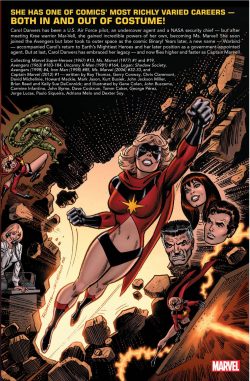
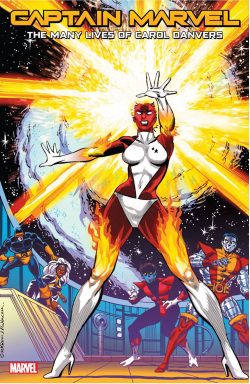
Captain Marvel: The Many Lives of Carol Danvers


By Roy Thomas, Gerry Conway, Chris Claremont, David Michelinie, Howard Mackie & Mark Jason, Kurt Busiek, John Jackson Miller, Brian Reed, Kelly Sue DeConnick, Gene Colan, John Buscema, Carmine Infantino, John Byrne, Dave Cockrum, Tomm Coker, George Pérez, Jorge Lucas, Paulo Siqueira, Adriana Melo, Dexter Soy & various (MARVEL)
ISBN: 978-1-3029-2506-2 (TBP/Digital edition)

Win’s Christmas Gift Recommendation: A Miraculous Ascension to Marvel At… 8/10

In comic book terms, the soubriquet “Marvel” carries a lot of baggage and clout, and has been attached to a wide number of vastly differing characters over many decades. In 2014, it was inherited by comics’ first mainstream first rank Muslim superhero, albeit employing the third iteration of pre-existing designation Ms. Marvel.

Career soldier, former spy and occasional journalist Carol Danvers – who rivals Henry Pym in number of secret identities – having been Binary, Warbird, Ms. Marvel again and ultimately Captain Marvel – originated the role when her Kree-based abilities first manifested. She experienced a turbulent superhero career and was lost in space when Sharon Ventura became a second, unrelated Ms. Marvel. This iteration gained her powers from the villainous Power Broker, and after briefly joining the Fantastic Four, was mutated by cosmic ray exposure into a She-Thing

Debuting in a sly cameo in Captain Marvel (volume 7 #14, September 2013) and bolstered by a subsequent teaser in #17, Kamala Khan was the third to use the codename. She properly launched in full fight mode in a tantalising short episode (All-New MarvelNow! Point One #1) chronologically set just after her origin and opening exploit. We’ll get to her another day soon, but isn’t it nice to see her annoying trolls on screen as well as in print?

Here we’re focusing on Carol Danvers in many of her multifarious endeavours, glimpsed via a wide set of comics snapshots spanning cover-dates March 1968 to September 2012, and comprising Marvel Super-Heroes #13, Ms. Marvel #1, 19, Avengers #183-184, Uncanny X-Men #164, Logan: Shadow Society, Avengers (1998) #4, Iron Man (1998) #85, Ms. Marvel (2006) #32-33, and Captain Marvel (2012) #1.

She began as a supporting character as the House of Ideas pounced on finally vacant property title Captain Marvel and debuted in the second instalment. Marvel Super-Heroes #13 picks up where the previous issue ended. That was ‘The Coming of Captain Marvel!’ – derived directly from Fantastic Four #64-65, wherein the quartet defeated a super-advanced Sentry robot marooned on Earth by a mythical and primordial alien race the Kree. They didn’t stay mysterious for long and despatched a mission to spy on us…

Dispatching a surveillance mission, the Kree had to know everything about us. Unfortunately, the agent they chose – Captain Mar-Vell – was a man of conscience, whilst his commanding officer Colonel Yon-Rogg was his ruthless rival for the love of the ship’s medical officer Una. No sooner has the dutiful operative made a tentative planet-fall and clashed with the US Army from a local missile base than the instalment – and this preamble – ends.

We begin here as Roy Thomas, Gene Colan & Paul Reinman took over for ‘Where Stalks the Sentry!’ as the spy assumes the identity of recently killed scientist Walter Lawson to infiltrate that military base and immediately arouses the suspicions of security Chief Carol Danvers. He is horrified to discover the Earthlings are storing the Sentry defeated by the FF on site. Yon-Rogg, sensing an opportunity, reactivates the deadly mechanoid. As it goes on a rampage, only Mar-Vell stands in its path…

Over many months Mar-Vell and Danvers sparred and shuffled until she became a collateral casualty in a devastating battle between the now-defected alien and Yon-Rogg in Captain Marvel #18 (November 1969). Caught in a climactic explosion of alien technology (latterly revealed to have altered her biology), she pretty much vanished until revived in Ms. Marvel #1 (January 1977). Crafted by Gerry Conway, John Buscema & Joe Sinnott, ‘This Woman, This Warrior!’ heralded a new chapter for the company and the industry…

Here irrepressible and partially amnesiac Danvers has relocated to New York to become editor of “Woman”: a new magazine for modern misses published by Daily Bugle owner J. Jonah Jameson. Never having fully recovered from her near-death experience, Danvers left the military and drifted into writing, slowly growing in confidence until the irascible publisher made her an offer she couldn’t refuse…

At the same time as Carol is getting her feet under a desk, a mysterious new masked “heroine” (sorry, it was the 70s!) started appearing and as rapidly vanishing, such as when she pitches up to battle the sinister Scorpion as he perpetrates a brutal bank raid.

The villain narrowly escapes to rendezvous with Professor Kerwin Korwin of Advanced Idea Mechanics. The skeevy savant promised to increase Scorpion’s powers and allow him to take long-delayed revenge on Jameson – whom the demented thug blames for his freakish condition…

Danvers has been having premonitions and blackouts since the final clash between Mar-Vell and Yon-Rogg and has no idea she transforms into Ms. Marvel during fugue state episodes. Her latest vision-flash occurs too late to save Jameson from abduction, but her “Seventh Sense” does allow her to track the villain before her unwitting new boss is injured, whilst her incredible physical powers and knowledge of Kree combat techniques enable her to easily trounce the maniac.

Danvers eventually reconciles her split personality to become a frontline superhero and is targeted by shape-shifting mutant Mystique in a raid on S.H.I.E.L.D. to purloin a new super-weapon. This triggers a blockbuster battle and features the beginnings of a deadly plot originating at the heart of the distant Kree Imperium…

The scheme culminates with our third tale as ‘Mirror, Mirror!’ (Chris Claremont, Carmine Infantino & Bob McLeod) sees the Kree Supreme Intelligence attempts to reinvigorate his race’s stalled evolutionary path by kidnapping Earth/Kree hybrid Carol Danvers. However, with both her and Captain Marvel hitting hard against his emissary Ronan the Accuser, eventually the Supremor and his plotters take the hint and go home empty-handed…

Avengers #183-184 from May and June 1979 then see her seconded onto the superteam by government spook Henry Peter Gyrich just in time to face The Redoubtable Return of Crusher Creel!’ Courtesy of David Michelinie, John Byrne, Klaus Janson & D(iverse) Hands, a breathtaking all-action extravaganza sees Ms. Marvel replace the Scarlet Witch just as the formidable Absorbing Man decides to leave the country and quit being thrashed by heroes. Sadly, his departure plans include kidnapping a young woman “for company”, leading to a cataclysmic showdown with the heroes resulting in carnage, chaos and a ‘Death on the Hudson!’

Carol was later attacked by young mutant Rogue, and permanently lost her powers and memory. Taken under the X-Men’s wing she went into space with The Starjammers and was eventually reborn as cosmic-powered adventurer Binary: the exact how of which can be seen in Claremont, Dave Cockrum & Bob Wiacek’s ‘Binary Star!’ from Uncanny X-Men #164 (December 1982)…

Jumping to December 1995, one-shot Logan: Shadow Society – by Howard Mackie, Mark Jason, Tomm Coker, Keith Aiken, Octavio Cariello & Christie Scheele – delves into Danvers’ early career as set pre-debut of the Fantastic Four. She links up with a sometime associate to counter a new and growing menace… something called “mutants”. She has no idea about the truth of her savagely efficient partner Logan but certainly understands the threat level of the killed called Sabretooth

Following the Heroes Return event of 1997, a new iteration of The Avengers formed and in #4 (May 1998), Kurt Busiek, George Pérez, Al Vey & Wiacek decree there are ‘Too Many Avengers!’ prompting a paring down by the founders and admission of Carol in her newest alter ego Warbird, just in time to trounce a few old foes, whilst Iron Man #85/430 (August 2004, by John Jackson Miller, Jorge Lucas &Antonio Fabela), sees the beginning of the end in a prologue to the Avengers Disassembled event as Warbird is caught up in the breakdown…

Brian Reed, Paulo Siqueira, Adriana Melo, Amilton Santos, Mariah Benes & Chris Sotomayor then collaborate on a revelatory dip into the early life of USAF officer Major Carol Danvers as a chance encounter with boy genius Tony Stark gets her captured by the Taliban, tortured and turned into a secret agent in ‘Ascension’ and ‘Vitamin’: a brace of epic gung ho Top Gun meets Jason Bourne tales from Ms. Marvel (2006) #32-33 (December 2008 & January 2009), before this collection reaches its logical conclusion with her being officially proclaimed “Earth’s Mightiest Hero” in Captain Marvel #1 (September 2012) as Kelley Sue DeConnick, Dexter Soy & Joe Caramagna depict Carol’s embracing her past lives to accept the legacy, responsibility and rank of her universe-saving Kree predecessor…

With covers and variants by Colan, John Romita & Dick Giordano, John Romita Jr. & Joe Rubinstein, Pérez & Terry Austin, Cockrum & Wiacek, Coker & Aiken, Pérez & Tom Smith, Steve Epting & Laura Martin, David Yardin & Rain Berado, Ed McGuinness, Dexter Vine, Javie Rodriguez and Adi Granov, plus dozens of sketches, layout and original art pages, this epic retrospective is a superb short cut to decades of astounding adventure.

In conjunction with sister volume Captain Marvel vs Rogue (patience!, we’ll get to that one too) these tales are entertaining, often groundbreaking and painfully patronising (occasionally at the same time), but nonetheless, detail exactly how Ms. Marvel in all her incarnations and against all odds, grew into the modern Marvel icon of affirmative womanhood we see today.

In both comics and on-screen, Carol Danvers is Marvel’s paramount female symbol and role model. These exploits are a valuable grounding of the contemporary champion but also stand on their own as intriguing examples of the inevitable fall of even the staunchest of male bastions: superhero sagas…
© 2020 MARVEL.

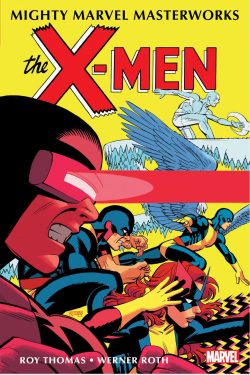
Mighty Marvel Masterworks X-Men volume 3: Divided We Fall


By Roy Thomas, Werner Roth, Dick Ayers, John Tartaglione, Art Simek, Joe Rosen & various (MARVEL)
ISBN: ?978-1-3029-4901-3 (TPB/Digital edition)

Win’s Christmas Gift Recommendation: Celebrate in X-quisite Classical Style… 9/10

These stories are timeless and have been gathered many times so here’s my now-standard advisory on format.

The Mighty Marvel Masterworks line is designed with economy in mind. Classic tales of Marvel – such as the birthday boys and girl on show today – have been an archival book staple since the 1990s, but always in lavish, expensive hardback collectors’ editions. The new tomes are far cheaper, on lower quality paper and smaller, about the size of a paperback book.

Your eyesight might be failing and your hands too big and shaky, but at 152 x 227mm, they’re perfect for kids. If you opt for the digital editions, that’s no issue at all…

Way back in 1963 things really took off for the budding Marvel Comics Group as Stan Lee & Jack Kirby expanded their meagre line of action titles: putting a bunch of relatively new super-heroes (including hot-off-the-presses Iron Man) together as The Avengers; launching a decidedly different war comic in Sgt. Fury and his Howling Commandos and creating a group of alienated heroic teenagers united to fight a rather specific, previously unperceived threat to humanity. Those halcyon days are revisited in this splendid trade paperback/eBook compilation, gathering from May 1966 to February 1967, the contents of X-Men #20-29.

Way back in the summer of 1963, the premiere issue had introduced Cyclops/Scott Summers, Iceman/Bobby Drake, Angel/Warren Worthington III and The Beast/Henry “Hank” McCoy: extremely special students of Professor Charles Xavier. This brilliant, driven, charismatic and wheelchair-bound telepath was dedicated to brokering peace and integration between the masses of humanity and the emergent off-shoot race: human mutants called Homo Superior. The story saw the students welcome newest classmate Jean Grey, who would be codenamed Marvel Girl. She possessed the ability to move objects with her mind.

No sooner has the Professor explained their mission than an actual Evil Mutant – Magneto – singlehandedly took over American missile base Cape Citadel. A seemingly unbeatable threat, the master of magnetism was nonetheless driven off in under 15 minutes by the young heroes on their first combat mission…

These days, young heroes are ten-a-penny, but it should be noted that these kids were among Marvel’s first juvenile super-doers (unless you count Spider-Man or Human Torch Johnny Storm) since the Golden Age, so it’s perhaps unsurprising that in early tales the youngsters regularly benefitted from a little adult supervision, such as is the case in the landmark tale that opens this book…

With Werner Roth & Dick Ayers making the pictures, in X-Men #20, the writing reins were turned over to Roy Thomas, who promptly jumped in guns blazing with ‘I, Lucifer…’: an alien invasion yarn starring Xavier’s arch-nemesis as well as old adversaries Unus the Untouchable and the Blob. Most importantly, it revealed in passing how Professor X lost the use of his legs.

With canny concluding chapter ‘From Whence Comes Dominus?’, Thomas & Roth completely made the series their own: blending juvenile high spirits, classy superhero action and torrid soap opera with beautiful drawing and stirring adventure.

At this time Marvel Comics had a vast and growing following among older teens and college kids, and the youthful Thomas spoke and wrote as they did (or maybe a little better?). Coupled with his easy delight in large casts, this would increasingly make X-Men a most welcoming read for any educated adolescent – like you or me…

As suggested already, X-Men was never one of young Marvel’s top titles, but it found a devout and dedicated following, with the frantic, freakish energy of Jack Kirby’s heroic dynamism comfortably transiting into the slick, sleek attractiveness of Roth as the fierce tension of hunted, haunted juvenile outsider settled into a pastiche of college and school scenarios familiar to the students who were the series’ primary audience.

The action continues with a crafty 2-parter resurrecting veteran Avengers villain Count Nefaria who employs illusion-casting technology and a band of other heroes’ second-string foes (The Unicorn, Porcupine, Plantman, Scarecrow and Eel, if you’re wondering) to hold Washington DC hostage and frame the X-Men for the entire scheme.

‘Divided… We Fall!’ and ‘To Save a City!’ form a fast-paced, old-fashioned Goodies vs. Baddies battle with a decided sting in the tail. Moreover, the tale concludes with Marvel Girl yanked off the team when her parents insist she furthers her education by leaving the Xavier School to attend New York’s Metro University…

Illustrated by Roth & Ayers she is off the team and packed off to college but here visits her old chums to regale them with tales of life outside. Her departure segues neatly into a beloved plot standard – Evil Scientist Grows Giant Bugs – when she enrols and meets an embittered recently-fired professor, leading her erstwhile comrades to confront ‘The Plague of… the Locust!’

Perhaps X-Men #24 isn’t the most memorable tale in the canon but it still reads well and has the added drama of Jean Grey’s departure crystallizing the romantic rivalry for her affections between Cyclops and Angel: providing another deft sop to readers as it enabled many future epics to include Campus life in the action-packed, fun-filled mix…

Somehow Jean still managed to turn up in every issue even as ‘The Power and the Pendant’ (#25, October 1966) finds the boys tracking new menace El Tigre. This South American hunter is visiting New York to steal the second half of a Mayan amulet which willgrant him god-like powers…

Having soundly thrashed the male X-Men, newly-ascended and reborn as Kukulkan, the malign meta returns to Amazonian San Rico to recreate a fallen pre-Columbian empire with the heroes in hot pursuit. The result is a cataclysmic showdown in ‘Holocaust!’ which leaves Angel fighting for his life and deputy leader Cyclops crushed by guilt…

Issue #27 see the return of some old foes in ‘Re-enter: The Mimic!’ as the mesmerising Puppet Master pits power-duplicating Calvin Rankin against a team riven by dissention and ill-feeling, before ‘The Wail of the Banshee!’ sees Rankin join the X-Men in a tale introducing the sonic-powered mutant (eventually to become a valued team-mate and team-leader) as a deadly threat.

This was the opening salvo of an ambitious extended epic featuring a global coalition of sinister, mutant-abductors… Factor Three.

This turbulent tome terminates with John Tartaglione replacing Ayers as regular inker beginning with bright and breezy thriller ‘When Titans Clash!’, wherein the power-duplicating Super-Adaptoid almost turns the entire team into super-slaves before ending the Mimic’s career…

Supplemented by original art – an unused Roth cover for X-Men #25 – these charming idiosyncratic tales are a million miles removed from the angst-ridden, breast-beating, cripplingly convoluted X-brand of today’s Marvel, and in many ways are all the better for it. Superbly rendered, highly readable adventures are never unwelcome or out of favour and it should be remembered that everything here informs so very much of the mutant monolith. These are stories for dedicated fans and the rawest converts. Everyone should have this book.
© 2023 MARVEL

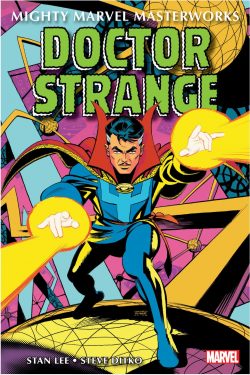
Mighty Marvel Masterworks Doctor Strange volume 2: The Eternity War


By Stan Lee & Steve Ditko, Art Simek, Sam Rosen & various (Marvel)
ISBN: 978-1-3029-4887-0 (PB/Digital edition)

Win’s Christmas Gift Recommendation: Magical Marvel Unleashed… 10/10

When the emergent House of Ideas introduced a warrior wizard to their burgeoning pantheon in the summer of 1963 it was a bold and curious move. Bizarre adventures and menacing monsters were still incredibly popular, but most mention of magic or the supernatural (especially vampires, werewolves and their eldritch ilk) were harshly proscribed by a censorship panel dictating almost all aspects of story content. Almost a decade after a public witch-hunt led to Senate hearings on the malign influences of words and pictures in sequence, comics were ferociously monitored and adjudicated by the draconian Comics Code Authority. Even though some of the small company’s strongest sellers were still mystery and monster mags, their underlying themes and premises were almost universally mad science and alien wonders, not necromantic or thaumaturgic terrors.

Companies like ACG, Charlton and DC – and Atlas/Marvel – got around edicts against mystic thrills and chills by making all reference to magic benign or even humorous; the same tone adopted by TV series Bewitched about a year after Doctor Strange debuted. That eldritch embargo probably explains writer/editor Stan Lee’s low-key introduction of Steve Ditko’s mystic adventurer: an exotic, twilight troubleshooter inhabiting the shadowy outer fringes of society…

Prior to being Marvel, the company had already published a quasi-mystic precursor: balding, trench-coated savant. Doctor Droom – later rechristened (or is that re-pagan-ed?) Dr. Druid – had an inconspicuous short run in Amazing Adventures (volume 1 #1-4 & #6: June-November 1961).

He was a psychiatrist, sage and paranormal investigator tackling everything from alien invaders to Atlanteans (albeit not the ones Sub-Mariner rules). Droom was subsequently retro-written into Marvel continuity as an alternative candidate and precursor for Stephen Strange‘s ultimate role as Sorcerer Supreme.

After a shaky start, the Master of the Mystic Arts became an unmissable icon of the cool counter-culture kids who saw, in Ditko’s increasingly psychedelic art, echoes and overtones of their own trippy explorations of other worlds. That might not have been the creators’ intention but it certainly helped keep the mage at the forefront of Lee’s efforts to break comics out of the “kids-stuff” ghetto…

This enchanting full colour paperback compilation – also available as a digital download – gathers the spectral sections of Strange Tales #130-146 and Amazing Spider-Man Annual #2: spanning cover-dates March 1965 to July 1966. With no fuss or muss, a classic extended saga opens with ‘The Defeat of Dr. Strange’ as an enigmatic outer-dimensional sponsor enters into a pact with arch-foe Baron Mordo. He will be supplied with infinite power and ethereal minions in return for the death of Earth’s magical guardian. With the Ancient One assaulted and in a deathly coma, Strange is forced to go on the run: a fugitive hiding in the most exotic corners of the globe as remorseless, irresistible forces close in all around him…

A claustrophobic close shave trapped aboard a jetliner in in #131’s ‘The Hunter and the Hunted!’ expands into cosmic high gear a month later as Strange doubles back to his sanctum and defeats the returning foe The Demon only to come ‘Face-to-Face at Last with Baron Mordo!’ Crumbling into weary defeat as the villain’s godly sponsor is revealed, the hero is hurled headlong out of reality to materialise in ‘A Nameless Land, A Timeless Time!’ before confronting tyrannical witch-queen Shazana.

Upon liberating her benighted realm, Strange resumes being the target of relentless pursuit: recrossing hostile dimensions and taking the fight to his foes in ‘Earth Be My Battleground’.

Returning to the enclave hiding his ailing master, Strange gleans a hint of a solution in the mumbled enigmatic word “Eternity” and begins searching for more information as, in the Dark Dimension, a terrified girl seeks to sabotage Dread Dormammu’s efforts to empower Mordo…

As the world went superscience spy-crazy and Nick Fury Agent of S.H.I.E.L.D. took over the lead spot with Strange Tales #135, the Sixties also saw a blossoming of alternative thought and rebellion. Doctor Strange apparently became a confirmed favourite of the blossoming Counterculture Movement and its recreational drug experimentation subculture. With Ditko truly hitting his imaginative stride, it’s not hard to see why. His weirdly authentic otherworlds and demonstrably adjacent dimensions were utterly unlike anything anyone had ever seen or depicted before…

‘Eternity Beckons!’ as Strange is lured to an ancient castle where an old ally betrays him and, after again narrowly escaping Mordo’s minions, the Mage desperately consults the aged senile Genghis in #136: a grave error in judgement. Once more catapulted into a dimension of deadly danger, Strange barely escapes a soul-stealing horror after discovering ‘What Lurks Beneath the Mask?’

Back on Earth and out of options, the Doctor is must test his strength against the Ancient One’s formidable psychic defences to learn the secret of Eternity in ‘When Meet the Mystic Minds!’ Barely surviving the terrible trial, he uses newfound knowledge to translates himself to a place beyond reality and meet the embodiment of creation in ‘If Eternity Should Fail!’

His quest for solutions or extra might failed, he despondently returns to Earth to find his mentor gone and his unnamed female friend prisoners of his worst enemies in anticipation of a deadly showdown…

Strange Tales #139 warns ‘Beware…! Dormammu is Watching!’, but as Mordo – despite being super-charged with the Dark Lord’s infinite energies – fails over and again to kill the Good Doctor, the Overlord of Evil loses all patience, dragging all concerned into his domain.

Intent on making a show of destroying his mortal nemesis, Dormammu convenes a great gathering before whom he will smash Strange in a duel using nothing but ‘The Pincers of Power!’ He is again bathed in ultimate humiliation as the mortal mage’s wit and determination score a stunning triumph in concluding episode ‘Let There Be Victory!’

As the universes tremble, Doctor Strange wearily heads home, blithely unaware his enemies have laid one last trap. The weary victor returns to his Sanctum Sanctorum; unaware his foes have boobytrapped with mundane explosives.

Scripted by Lee and plotted and illustrated by Ditko, Strange Tales #142 reveals ‘Those Who Would Destroy Me!’ as Mordo’s unnamed disciples prepare one final stab at the Master of the Mystic Arts. They would remain anonymous for decades, only gaining names of their own – Kaecillius, Demonicus and The Witch – upon their return in the mid-1980s.

Here, however, they easily entrap the exhausted wizard warrior, imprisoning him with a view to plundering all his secrets. It’s a big mistake as – in the Roy Thomas dialogued sequel ‘With None Beside Me!’ – Strange outwits and subdues his captors…

In #144 Ditko & Thomas take the heartsick hero ‘Where Man Hath Never Trod!’ Although Dormammu was soundly defeated and humiliated before his peers and vassals, the demonic tyrant takes a measure of revenge by exiling Strange’s anonymous female collaborator to realms unknown. Now, as the Earthling seeks to rescue her while searching myriad mystic planes, he stumbles into a trap laid by the Dark One and executed by devilish collector of souls Tazza

On defeating the scheme, Strange returns to Earth and almost dies at the hands of far weaker, but sneakier, wizard Mister Rasputin in a yarn scripted by Dennis O’Neil. The spy and swindler uses meagre mystic gifts for material gain but happily resorts to base brutality ‘To Catch a Magician!’

All previous covers had been Kirby S.H.I.E.L.D. affairs but finally, with Strange Tales #146, Strange and Ditko won their moment in the sun. Although the artist would soon be gone, the Good Doctor remained, alternating with Fury’s team until the title ended.

Ditko & O’Neil presided over The End …At Last!’ as deranged Dormammu abducts Strange before suicidally attacking the omnipotent embodiment of the cosmos called Eternity.

The cataclysmic chaos ruptures the heavens over infinite dimensions and when the universe is calm again both supra-deities are gone. Rescued from the resultant tumult, however, is the valiant girl Strange had loved and lost. She introduces herself as Clea, and although Stephen despondently leaves her, we all know she will be back…

This sideral swansong was Ditko’s last hurrah. Issue #147 saw a fresh start as Strange went back to his Greenwich Village abode under the auspices of co-scripters Lee & O’Neil, with comics veteran Bill Everett suddenly and surprisingly limning the arcane adventures. More of that next time.

Before that though there are still treats in store, beginning with a pinup published in 1967’s Marvel Collectors’ Item Classics #10 before we revel in one last Lee/Ditko yarn to enthral and beguile: Although a little chronologically askew, it is very much a case of the best left until last.

In October 1965 ‘The Wondrous World of Dr. Strange!’ (from Amazing Spider-Man Annual #2) was the astonishing lead feature in an otherwise vintage reprint Spidey comic book. The entrancing fable unforgettably introduced the webslinger to arcane adventuring and otherworldly realities as he unwillingly teams up with the Master of the Mystic Arts to battle power-crazed wizard Xandu: a phantasmagorical, dimension-hopping masterpiece involving ensorcelled zombie thugs and the purloined Wand of Watoomb

After this story it was clear Spider-Man worked in any milieu and nothing could hold him back – and the cross-fertilisation probably introduced many fans to Lee & Ditko’s other breakthrough series.

But wait, there’s even more! Wrapping up the proceeding is a contemporary T-shirt design by Ditko, and the briefest selection of original art.

Doctor Strange has always been the coolest of outsiders and most accessible fringe star of the Marvel firmament. This glorious grimoire is a magical method for old fans to enjoy his world once more and the perfect introduction for recent acolytes or converts created by the movie iteration to enjoy the groundbreaking work of two thirds of the Marvel Empire’s founding triumvirate at their most imaginative.
© 2023 MARVEL.

Ghost Rider Marvel Masterworks volume 3


By Jim Shooter, Roger McKenzie, Gerry Conway, Don Glut, Don Perlin. Jim Starlin, Don Heck, Gil Kane, Tom Sutton & various (MARVEL)
ISBN: 978-1-3029-2214-6 (HB/Digital edition)

At the end of the 1960s American comic books were in turmoil, much like the youth of the nation. Superheroes had dominated for much of the previous decade; peaking globally before explosively falling to ennui and overkill. Established genres such as horror, war, westerns and science fiction returned, fed by contemporary events and radical trends in movie-making where another, new(ish) wrinkle had also emerged: disenchanted, rebellious, unchained Youth on Motorbikes seeking a different way forward.

Green Lantern/Green Arrow, Jack Kirby’s Jimmy Olsen, Captain America and many others all took the Easy Rider option to boost flagging sales (and if you’re interested, the best of the crop was Mike Sekowsky’s tragically unfinished mini-masterpiece of cool Jason’s Quest in Showcase). Over at Marvel – a company still reeling from Kirby’s defection to DC/National in 1970 – canny Roy Thomas green-lighted a new character who combined the freewheeling, adolescent-friendly biker-theme with the all-pervasive supernatural furore gripping the entertainment fields.

Back in 1967, Marvel published a western masked hero named Ghost Rider: a shameless, whole-hearted appropriation of the cowboy hero creation of Vince Sullivan, Ray Krank & Dick Ayers (for Magazine Enterprises from 1949 to 1955), who utilised magician’s tricks to fight bandits by pretending to be an avenging phantom of justice.

Scant years later, with the Comics Code prohibition against horror hastily rewritten – amazing how plunging sales can affect ethics – scary comics came back in a big way. A new crop of supernatural superheroes and monsters began to appear on the newsstands to supplement the ghosts, ghoulies and goblins already infiltrating the once science-only scenarios of the surviving mystery men titles.

In fact, softening the Code ban resulted in such an avalanche of horror titles (new material and reprints from the first boom in the 1950s), in response to the industry-wide down-turn in superhero sales, that it probably caused a few more venerable costumed crusaders to – albeit temporarily – bite the dust.

Almost overnight, nasty monsters became acceptable fare for four-colour pages and whilst a parade of pre-code reprints made sound business sense, the creative aspects of the fascination in supernatural themes was catered to by adapting popular cultural icons before risking whole new concepts on an untested public.

As always in entertainment, the watchword was fashion: what was hitting big outside comics was incorporated into the mix as soon as possible. When proto-monster Morbius, the Living Vampire debuted in Amazing Spider-Man #101 (cover-dated October 1971) and the sky failed to fall in, Marvel moved ahead with a line of shocking superstars – beginning with a werewolf and a vampire – before broadening the scope with a haunted biker to tap into both Easy Rider’s freewheeling motorcycling chic and the prevailing supernatural zeitgeist.

Preceded by western hero Red Wolf in #1 and the aforementioned Werewolf by Night in #2-4, the all-new Ghost Rider debuted in Marvel Spotlight #5 (August 1972) and this sturdy hardback and equivalent digital compendium collects a third heaping helping of his flame-filled early exploits: specifically Ghost Rider #21-35, plus added attraction Marvel Premiere #28, spanning December 1976 to April 1979, and is preceded by an informative Introduction from Ralph Macchio.

What Has Gone Before: Carnival trick cyclist Johnny Blaze sells his soul to the devil in an attempt to save his foster-father Crash Simpson from cancer. As is the way of such things, Satan follows the letter but not spirit of the contract and Simpson dies anyway. When the Dark Lord later comes for his prize, Blaze’s beloved virginal girlfriend Roxanne Simpson intervenes. Her purity prevents the Devil from claiming his due and, temporarily thwarted, Satan spitefully afflicts Johnny with a body that burns with the fires of Hell every time the sun goes down…

After dancing with the Devil and assorted demons for months, and even dabbling with team superheroics on the Champions, Johnny has moved to Hollywood and works as stuntman on the Stuntman TV show: a hazardous gig that has brought him into a romantic dalliance with starlet Karen Page, a team-up with Daredevil and many clashes with supervillains.

As the action opens in GR #21’s ‘Deathplay!’, Gerry Conway, Kil Kane & Sam Grainger build on the trend as manic hireling The Gladiator attacks the Delazny Studio seeking a deadly weapon left by a sinister hidden foe.

After spectacularly repelling the armoured assassin, Blaze does a little digging into the studio and its staff only to clash with another veteran villain – The Eel, abruptly reinforced by Gladiator seeking a rematch. Thrashing them both only gets him in more trouble with the cops and – on the run again – he finally faces the criminal mastermind who has orchestrated many months of woe and learns ‘Nobody Beats the Enforcer!’ (Conway, Don Glut, Don Heck & Keith Pollard). The ganglord has his fingers dug deep into the studio and seeks ultimate power in LA, but somehow Blaze is always in his way, such as here, foiling the costumed killer’s attempt to steal a deadly ray concealed in a ring.

Attempts to further integrate Ghost Rider with mainstream Marvel continuity intensify with the arrival of new scripter – and actual motorbike afficionado – Jim Shooter. With Dons Heck and Newton illustrating, ‘Wrath of the Water Wizard!’ sees the embattled biker battling a hydrokinetic hoodlum at the Enforcer’s behest, only to be betrayed and beaten in anticipation of a blockbusting clash in Shooter, Heck & Dan Green’s ‘I, The Enforcer…!’

Cover-dated August 1977, Ghost Rider #25 presaged a return to wandering ways as Shooter, Heck & Tony DeZuñiga’s ‘Menace is a Man Called Malice!’ finds the infernal antihero implicated in an arson attack on a wax museum before battling a high tech madman. Blaze’s diabolical overreaction in victory signalled dark days ahead…

Don Perlin began his long association with the Spirit Cyclist in #26 as ‘A Doom Named Dr. Druid!’ (words by Shooter & inks by Grainger) as recently-revived and revised proto Marvel superhero Anthony Druid (who as Dr. Droom actually predates Fantastic Four #1) hunts a satanic horror and attacks the Ghost Rider. Only after beating the burning biker does the parapsychologist learn the dreadful mistake he’s made, but by then Blaze’s secret is exposed, his Hollywood life ruined and the end of an era looms…

Back on the road again Johnny encounters two fellow travellers, aimless and in trouble when he pals up with disgruntled former Avengers Hawkeye and time-displaced Matt Hawk The Two-Gun Kid. Crafted by Shooter, Perlin & Green ‘At the Mercy of the Manticore!’ sees Blaze save the heroes from The Brand Corporation’s bestial cyborg monstrosity, but drive them away with his demonic other half’s growing propensity for inflicting suffering…

Still roaming the southern deserts, Blaze is targeted once again by his personal Captain Ahab in ‘Evil is the Orb!’ (Roger McKenzie, Perlin, Tom Sutton, Owen McCarron & Pablo Marcos). His vengeance-crazed rival abducts Roxie and mesmerises a biker gang to do his dirty work but hasn’t reckoned on an intervention by Blaze’s buddy Brahma Bill

What seemed an inevitable team-up at last occurred in #29 as “New York Tribe” McCarron, DeZuñiga, & Alfredo Alcala augment McKenzie & Perlin for a saga of sorcerous subterfuge as Johnny Blaze is abducted and inquisition-ed by Doctor Strange. Sadly, it’s all a trick by the Mage’s greatest foe who turns Ghost Rider into a ‘Deadly Pawn!’, rigging a murderous retaliation and death duel between ‘The Mage and the Monster!’ as delivered by McKenzie, Perlin & Jim Mooney.

The clash concluded in an extreme expression of ‘Demon’s Rage’ (#31, with illustrator Perlin co-plotting with McKenzie and Bob Layton inking) as the diabolical scheme is exposed and expunged just in time for the fugitive Johnny Blaze to be captured by a mystical Bounty Hunter

A story tragically similar to Blaze’s own unfolds in McKenzie, Perlin & Rick Bryant’s ‘The Price!’ before Blaze postpones his dark destiny yet again, only to plunge into a super-science hell to contest a medley of western biker and dystopian tropes run amok in ‘…Whom a Child Would Destroy!’ With both chapters uniquely enhanced by an all-Perlin art job, the mutagenic tragedy catastrophically concludes with ‘The Boy Who Lived Forever!’ before this collection closes with a long-deferred, primal thrill-ride.

Commissioned years earlier, ‘Deathrace!’ is a true Jim Starlin gem with Death and the Devil battling our hero in a war of wheels and will, with Steve Leialoha and pals updating and embellishing what we’d call today a Grindhouse shocker…

A big bonus section opens with another, much reprinted yarn. Courtesy of Bill Mantlo, Frank Robbins & Steve Gan is an attempt to create a team of terrors long before its time. Marvel Premiere #28 (February 1976) introduced the initial iteration of The Legion of Monsters in ‘There’s a Mountain on Sunset Boulevard!’. When an ancient alien manifests a rocky peak in LA, the Werewolf by Night Jack Russell, the macabre Man-Thing, current Hollywood stuntman/Ghost Rider Johnny Blaze and living vampire Morbius are irresistibly drawn into a bizarre confrontation which could have resulted in the answer to all their wishes and hopes, but instead only leads to destruction, death and deep disappointment…

With covers by Jack Kirby, Frank Giacoia, Al Milgrom, John Romita Sr., Steve Leialoha, Kane & Dave Cockrum, George Pérez & Rudy Nebres, Sal Buscema, Ernie Chan, Rich Buckler, Robbins, Pollard, Layton, Bob Budiansky, Bob Wiacek, Perlin, and Nick Cardy, other assets include a June 1978 house ad for all of Marvel’s supernatural series, original art pages and covers by Kirby, Romita Sr., DeZuñiga, Perlin & Alcala and Chan, as well as fascinating art edits by Milgrom & Michael Netzer to Starlin’s ‘Deathrace!’ story and the unused cover he originally drew for it.

These tales return Ghost Rider to his roots, and imminent threat of the real-deal Infernal Realm: portraying a good man struggling to save his soul from the worst of all bargains – as much as the revised Comics Code would allow – so brace yourself, hold steady and accept no supernatural substitutes…
© 2021 MARVEL.

Marvel Adventures Spider-Man: Peter Parker vs The X-Men


By Paul Tobin, Matteo Lolli, Ben Dewey, Christian Nauck, Terry Pallot & various (Marvel)
ISBN: 978-0-7851-4116-7 (Digest PB/Digital edition)

In 2003 the House of Ideas instituted a Marvel Age line: an imprint updating classic original tales and characters for a newer, younger readership. The enterprise was modified in 2005, with core titles reduced to Marvel Adventures: Fantastic Four and Marvel Adventures: Spider-Man. The tone was very much that of the company’s burgeoning TV cartoon franchises, in delivery if not name.

Supplemental series including Super Heroes, The Avengers, Hulk and Iron Man chuntered along merrily until 2010 when they were cancelled. In their place came new volumes of Marvel Adventures: Super Heroes and Marvel Adventures: Spider-Man. Most of the re-imagined tales were collected in gleefully inviting digest-sized compilations and digitised like this torrid tome. It re-presents #58-61 – the final four stories – from February to May 2010, and all scripted throughout by Paul (No Romance in Hell, Plants vs Zombies) Tobin.

What You Need to Know: 16-year-old Peter Parker has been the mysterious Spider-Man for little more than six months. In that time, he has constantly prowled the streets and skyscrapers of New York, driven to fight injustice. However, as a kid just learning the ropes, he’s pretty much in over his head all the time.

The most persistent major hassle is the all-pervasive Torino crime-family, whose goombahs and street-thugs perpetually attack the wallcrawler on sight, spurred on by a $500,000 bounty on the kid’s web-covered head…

Peter’s civilian life is pretty complicated too, but of great help and constant comfort is High School classmate Sophia Sanduval – the extremely talented Chat – who can communicate with animals and knows Peter’s secret…

Following a handy introductory recap page, we open with him ‘Wanted’ (illustrated by Matteo Lolli & Terry Pallot) when the protracted vendetta against the Torinos is suddenly punctuated by wanted posters for the webslinger on every tree, fence and lamppost. During another brutal but pointless clash with the mobsters, the harassed hero is aided by a very capable masked woman in a red dress who introduces herself as the Blonde Phantom. She’s behind the find-Spidey posters but only because she wants to offer him a job with her Blonde Phantom Detective Agency…

Cautiously hearing her out, Spidey shares his strange and complex personal life with the sultry sleuth, telling her about Chat and how Gwen Watson claims to be going out on dates with his alter ego, something Peter adamantly denies. He doesn’t even have time for the girlfriend he’s got…

Gwen’s dad is Police Captain George Stacy – who also knows the boy’s secret and allows him to continue his vigilante antics. The senior cop acts as a mentor and sounding board, but has some very hard words concerning anyone taking money for doing good deeds. Peter kind-of agrees with him, but Aunt May is in desperate need of cash to repair the foundations of her house…

Conflicted Peter still hasn’t decided to meet up with Blonde Phantom, but as another band of Torinos jump them, the resulting battle reminds him that the last time he took money for being Spider-Man, Uncle Ben died…

The guilt-ridden kid sadly declines the glamorous gumshoe’s offer but is later astounded when Captain Stacy provides a welcome – and acceptably legitimate – financial solution to May’s money woes.

Blonde Phantom isn’t too disappointed either: she got Chat’s contact details out of Peter before they parted…

Pencilled by Ben Dewey, eponymous epic ‘Peter Parker vs. the X-Men’ finds the wallcrawler and Chat having an earnest heart-to-heart about their relationship – and Gwen’s persistent and insistent claims to still be going out on dates with Peter – when alarmed squirrels warn them that they are being spied on by a stranger with “three big fingers”. A rapid and thorough investigation results in nothing but a strange whiff of sulphur…

After they go their separate ways, the hero is again ambushed by Torinos, but one of them – later revealed as the grandson of The Family’s Big Boss Berto – helps him escape. George Stacy later warns him the increasingly impatient mobsters have finally hired some specialist help: engaging the services of super-assassin Bullseye – the Man who Never Misses…

Bewildered and extremely nervous our hero heads home only to find Wolverine spying on him. When the Arachnid attacks the clawed mutant he is assaulted by a whole squad of X-Men, and only after a frantic fray discovers they’ve come to offer help to a fellow mutant…

When he finally convinces them that he isn’t a Homo Superior kid, the embarrassed outsider heroes realise that mutant detector Cerebro must have been registering the girl he was with… the one who talks to pigeons and squirrels…

With pencils by Christian Nauck, ‘I’ve Got a Badge!’ focuses on the return of teenaged thief/mutant mindbender Silencer as Chat – now in training with the Blonde Phantom Detective Agency – explains to a baffled Peter that she can’t remember being his girlfriend, even though all her animal associates assure her it’s totally true.

Mysteries begin to unravel after Captain Stacy offers Spider-Man a Consultant position with the NYPD, asking him to help apprehend Silencer… who has been robbing the city blind.

Whilst searching for her and dreaming of a life where cops aren’t always after him, young Torino kid Carter takes an opportunity during one more gang hit to warn the wallcrawler Bullseye is after him…

Heading for Chat’s place, Peter finds Silencer in residence and calls in the cops, only to discover the bandit is actually his girlfriend’s BFF Emma Frost

Choosing to help Emma escape, Peter sacrifices his chance for an easier life, and discovers to his dismay in the concluding chapter Emma is also behind all his romantic woes, meddling with both Gwen and Chat’s minds because she wants the webslinger for herself. Of course, the animals know what’s going on and when they tell Chat the fur – and webbing – flies…

Never the success the company hoped, Marvel Adventures was superseded in 2012 by specific comics tied to Disney XD television shows designated as “Marvel Universe cartoons”, but these collected stories remain an intriguing, amazingly entertaining and more accessible means of introducing the character and concepts to kids born two generations or more away from the originating events.

Fast-paced, enthralling and impressive, these Spidey super stories are intensely enjoyable yarns, although parents should note that some of the themes and certainly the violence might not be what everybody considers “All-Ages Super Hero Action” and might perhaps better suit older youngsters…
© 2009, 2010 Marvel Characters, Inc. All rights reserved.

Daredevil Epic Collection volume 6: Watch Out For Bullseye (1974-1976)


By Steve Gerber, Tony Isabella, Marv Wolfman, Chris Claremont, Gerry Conway, Len Wein, Bob Brown, Gene Colan, Don Heck, Sal Buscema & various (MARVEL)
ISBN: 978-1-3029-4867-2 (TPB/Digital edition)

Matt Murdock is a blind lawyer whose remaining senses hyper-compensate, enabling him to accomplish astonishing acrobatic feats, and making him a formidable fighter and a living lie-detector. Very much a second-string hero in his formative years, Daredevil was nonetheless a striking and popular one, due in large part to the roster of brilliant artists who had illustrated the strip. He only really came into his own, however, after artist Gene Colan signed up for the long haul…

DD battled thugs, gangsters, an eclectic mix of established and new super-villains and even the occasional monster or alien invasion. He quipped and wise-cracked his way through life and life-threatening combat, utterly unlike the grim, moody quasi-religious metaphor he became under modern authorial regimes.

In these tales from an era when relevancy, social awareness and political polarisation was shifting gradually back to science fiction and fantasy, the Man Without Fear was also growing: becoming in many ways the judicial conscience of a generation turning its back on old values…

Covering March 1974 – April 1976 this compilation chronologically curates Daredevil #108-132, plus a crossover into Marvel Two-in-One #3 wherein twin storylines converged and concluded. This tome sees cultural gadfly Steve Gerber taking the odd couple into strange territory before later scribes reset things on a more traditional Marvel trajectory…

After spending years in a disastrous on-again, off-again relationship with his secretary Karen Page, Murdock took up with former client/exotic émigré and notorious celebrity dubbed The Black Widow. Natasha Romanoff/Natalia Romanova is a Soviet-era Russian spy who came in from the cold and stuck around to become one of Marvel’s earliest and most successful female stars.

She started life as a svelte, sultry honey-trap during Marvel’s early “Commie-busting” days, targeting Iron Man in her debut exploit (Tales of Suspense #52, April 1964) before subsequently being redesigned as a torrid tights-&-tech supervillain. Eventually, she defected to the USA, falling for an assortment of Yankee superheroes before enlisting as an agent of S.H.I.E.L.D., freelance do-gooder and occasional Avenger.

Throughout her career she has always been considered ultra-efficient, coldly competent, deadly dangerous and yet somehow cursed to bring doom and disaster to her paramours. As her backstory evolved, it was revealed that Natasha had undergone experimental processes which enhanced her physical capabilities and lengthened her lifespan, as well as assorted psychological procedures which had messed up her mind and memories…

Following a period of cosmic intensity which saw them battling aliens and monsters in San Francisco as part of the first war against Thanos, a new direction began in #108 after DD rebukes the Widow for using increasingly excessive force on the thugs they stalked. In ‘Cry… Beetle’ (by Gerber, Bob Brown & Paul Gulacy) their heated arguments are forcibly curtailed when Matt’s oldest friend – and current New York DA Franklin “Foggy” Nelson – is shot and she refuses to rush back to the East Coast beside Murdock. If she had, the Widow might have helped against the mechanised marauder and mystery troops from a new terrorist organisation…

In #109, Matt meets Foggy’s radical student sister Candace and learns of a plot by the mysterious criminal gang Black Spectre seek to steal government printing plates but – rapidly en route to stop the raid – the Scarlet Swashbuckler is intercepted by a larcenous third party whose brutal interference allows the sinister plotters to abscond with the money-making plates. Even the cops can’t slow the bludgeoning rematch against the Beetle in ‘Dying for Dollar$!’ (Brown & Heck), but as the exo-skeletoned thugs break away in Manhattan, in San Francisco Natasha is attacked by vicious albino mutant Nekra, Priestess of Darkness, who tries to forcibly recruit her into Black Spectre.

After tracking down and defeating the Beetle, DD meets Africa-based hero Shanna the She-Devil, unaware the fiery American ex-pat is seeking bloody vengeance against the same enemies who have attacked Foggy, Natasha and the US economy…

The next chapter came in Marvel Two-in-One #3 (May 1974, by Gerber, Sal Buscema & Joe Sinnott), providing a peek ‘Inside Black Spectre!’ as destabilising attacks on prosperity and culture foment riot in the streets of the beleaguered nation. Following separate clue trails, The Thing joins the Man without Fear to invade the cabal’s aerial HQ, but are improbably overcome soon after discovering the Black Widow has defected to the rebels…

Daredevil #110 sees the return of Gene Colan – inked by Frank Chiaramonte – as the perfidious plot develops in ‘Birthright!’, revealing Black Spectre to be an exclusively female-staffed organisation, led by pheromone-emitting male mutant Mandrill. One of the first “Children of the Atom”, the ape-like creature had suffered appalling abuse and rejection until finding equally ostracised Nekra. Once they met and realised their combined power, they swore to make America pay…

Brown & Jim Mooney render ‘Sword of the Samurai!’ in #111, with DD and Shanna attacked by a formidable Japanese warrior, even as the She-Devil discloses her tragic reasons for hunting Nekra and Mandrill. When she too is taken by Black Spectre – who want to dissect her to discover how she can resist Mandrill’s influence – DD is attacked again by the outrageously powerful sword-wielding Silver Samurai

Triumphing over impossible odds, DD infiltrates the cabal’s flying fortress in #112 to spectacularly conclude the insurrection in ‘Death of a Nation?’ (Colan & Frank Giacoia), which finds the mutant duo seemingly achieving their ultimate goal by desecrating the White House and temporarily taking (symbolic) control of America.

… But only until Shanna, freshly-liberated Natasha and the fighting mad Man Without Fear marshal their utmost resources…

Even with his epic over, Gerber kept popping away at contemporary socio-political issues, as with #113’s ‘When Strikes the Gladiator!’ (Brown & Vince Colletta), opening with the Widow calling it a day, continues with Candace arrested for treason, teases with her then being kidnapped by one of DD’s most bloodthirsty foes and climaxes with the creation of a major new villain and an attack by one of Marvel’s most controversial monster heroes…

Ted Sallis was a government scientist hired to recreate the Super-Soldier serum that created Captain America. Due to corporate interference and what we today call “mission creep”, the project metamorphosed into a fall-back plan to turn humans into beings able to thrive in the most polluted, toxic environment…

When Sallis was subsequently captured by spies and consumed his serum to stop them from stealing it, he was transformed into a horrific mindless Man-Thing and vanished into the swamps of Florida…

Idealistic journalism student Candace had uncovered illicit links between Big Business, her own university and the Military’s misuse of public funds in regard to the Sallis Project, but when she attempted to blow the whistle, the government decided to shut her up. More worryingly, sinister scientific mastermind Death-Stalker imagined far more profitable uses for a solution that made unkillable monsters…

Trailing Candy’s abductors to Citrusville, Florida, Daredevil is ambushed by Gladiator and his macabre employer, but saved after a furious fracas by the mysterious muck-monster in #114’s ironically entitled ‘A Quiet Night in the Swamp!’ (Brown & Colletta). Death-Stalker unfortunately escapes to New York, trying to kill Foggy and restart the clandestine Sallis Project. Though DD foils the maniac in #115’s ‘Death Stalks the City!’, the staggering duel ends inconclusively and the potential mass-murderer’s body cannot be found…

Colan & Colletta reunited for ‘Two Flew Over the Owl’s Nest!’ as Daredevil jets back to San Francisco to reconcile with Natasha, only to blunder into the latest criminal enterprise of one of his oldest enemies. This time however, The Owl isn’t waiting to be found, launching an all-out attack on the unsuspecting and barely reconciled heroic couple.

Chris Claremont scripted the conclusion over Gerber’s plot, with Brown & Colletta back on the art as Natasha and Shanna desperately hunt for the missing Man without Fear, before the avian arch-criminal can add him to a pile of purloined personalities trapped in his diabolical computerised ‘Mind Tap!’

With Gerber moving on to other projects, a little messy creative shuffling results in #118’s ‘Circus Spelled Sideways is Death!’ (Gerry Conway, Don Heck & Colletta). Here Daredevil leaves Natasha, resettles in New York and promptly battles the infamous but always-inept Circus of Crime and their latest star turn – bat-controlling masked nut Blackwing, after which Tony Isabella takes the authorial reins with a clever piece of sentimental back-writing. Rendered by Brown & Heck, ‘They’re Tearing Down Fogwell’s Gym!’ sees Murdock negotiating a plea deal for Candace, whilst the man who trained his boxer father Battling Jack Murdock comes by with a little problem. It seems a crazy crooked doctor is offering impossible muscle and density boosting treatments that turns bantamweight pugilists into unstoppable rock-hard heavyweight brutes…

Crafted by Isabella, Brown & Colletta, Daredevil #120 began an extended saga focussing on the re-emergence of the world’s most powerful secret society. … And a Hydra New Year!’ sees Black Widow hit New York for one last attempt to make the rocky relationship work, only to find herself – with Matt and Foggy – knee-deep in Hydra troops at a Christmas party.

The resurgent terrorist tribe has learned America’s greatest security agency needs to recruit a legal expert as one of their Board of Directors and – determined to prevent the accession of ‘Foggy Nelson, Agent of S.H.I.E.L.D’ at all costs – have dispatched the formidable wild man El Jaguar and an army of masked thugs to stop him before he can start. Thankfully, Nick Fury and his crack commandos arrive in time to drive off the attackers but the rumour is true and Foggy is now a marked man…

The revived organisation has scoured the ranks of the criminal classes (and Marvel’s back catalogue) for its return and B-Listers like Dreadnought, Commander Kraken, Man-Killer, Mentallo, The Fixer, Blackwing and many other not-so golden oldies who happily toil for the enigmatic new Supreme Hydra as he strives to take out increasingly harried Foggy. Eventually, they succeed in capturing the portly District Attorney and the Widow goes off the deep end in #122’s ‘Hydra-and-Seek’, turning New York into a war-zone as she hunts for clues, culminating in a brutal showdown and ‘Holocaust in the Halls of Hydra!’

The times, mood and scripter were changing however, and the next two issues turn to darker, more gothic dramas, beginning with #124 and the advent of a vigilante killer patterned on an old pulp fiction hero.

Written by Len Wein & Marv Wolfman and illustrated by Colan (with Klaus Janson inking) ‘In the Coils of the Copperhead!’ courts controversial gritty realism then remaking Batman over at DC Comics as the Widow finally really and truly walks, leaving the frustrated hero to bury himself in the mystery of a murdering madman savagely overreacting to petty crime and leaving a trail of bodies behind him…

Foggy meanwhile is up for re-election and losing on all counts to too-good-to-be true Blake Tower. Sadly, Matt can’t offer any help or support as he seeks the secret of the vigilante. The resultant clash doesn’t go the Scarlet Swashbuckler’s way either, and he starts #125 with the terrifying realisation that ‘Vengeance is the Copperhead!’ (by Wolfman, Brown & Janson) before achieving a last-minute, skin-of-the-teeth hollow victory…

As writer and editor, Wolfman began a long-term revision as ‘Flight of the Torpedo’ (Brown & Janson) introduces insurance agent/gone-to-seed football hero Brock Jones who – in classic Hitchcockian manner – stumbles into a plot to control the world and inherits a rocket-powered super-suit coveted by enemy agents. Unfortunately, DD has just been almost killed by the rocket suit’s previous owner and, blithely unaware, seeks to renew the brutal grudge fight…

The battle escalates in #127 as ‘You Killed That Man Torpedo… and Now You’re Going to Pay!’ sees inevitable misunderstanding escalate with both weary warriors losing all perspective. Only when they almost kill a family of innocent bystanders are they shamed into a ceasefire…

Guilt-ridden and remorseful, Murdock swears off swashbuckling in #128, until uncanny events dictate and demand the return of the Man Without Fear. ‘Death Stalks the Stairway to the Stars!’ introduces a mysterious figure literally walking into intergalactic space and features the return of teleporting psychopath Death-Stalker in pursuit of ancient objects of power. However, the real inducements to intrigue are Matt’s pushy, flighty girlfriend Heather Glenn and the increasing efficacy of attack ads targeting Foggy. Not only do they slanderously belittle the incumbent DA, but – 40 years before our own problems with “Fake News” – increasingly challenge consensus reality with absurd and scurrilous statements about all authority figures…

The media maelstrom intensifies even as Murdock scours the city for his latest client in ‘Man-Bull in a China Town!’ with “leaked” films “proving” both John F. and Robert Kennedy are still alive. Rampaging monster Man-Bull escapes court during his lawyer’s summing up and stalks the city, aided and abetted by one of DD’s oldest enemies, but ultimately cannot escape a dreadful fate…

Urban voodoo and a slickly murderous conman infest #130 as ‘Look Out, DD… Here Comes the Death-Man!’ finds the prestigious blind lawyer opening a storefront legal services operation for the disadvantaged, even as the misinformation campaign peaks. Meanwhile, brutal Brother Zed demands a human sacrifice and a terrified mother finds her only hope is a human devil in red…

Closing this spectacular compilation is the 2-part debut of a villain who would become one of the most popular psycho-killers in the business. ‘Watch Out for Bullseye… He Never Misses!’ sees wealthy men very publicly targeted for extortion by a mystery murderer who can turn any object – from paper plane to garbage can – into a deadly weapon. Hunted by the Man Without Fear, the lethal loon turns the table on DD in ‘Bullseye Rules Supreme!’, until a final fateful battle settles the case and begins a lifelong obsession for both men…

Supplementing the furious fun are contemporaneous features from Marvel’s F.O.O.M. magazine #13 (March 1976) spotlighting the Scarlet Swashbuckler. Following a stunning cover by Colan, numerous articles explore the character – such as ‘(but first a word from our sponsors’, ‘Through the eyes of a Beholder’ (by Naomi Basner & Chris Claremont, featuring Colan pencil art and gorgeous model sheets crafted by Wally Wood when he took over the strip) and Basner’s ‘The Women in Daredevil’s Life’.

‘Buscema’s Bullpen’ offers art from the illustrator’s then students – and yes, some of them went on to far greater things! – after which Claremont interviews Stan Lee & Wolfman in ‘A Talk with the Men Behind the Man Without Fear’. A Daredevil Checklist segues into Gil Kane’s cover sketch for Giant-Size Daredevil #1; a repro of the published image and images from the 1975 Mighty Marvel Calendar.

Both issues #120 and 121 were supplemented by text pages outlining the convoluted history of Hydra and they’re reprinted here too to keep us all in the arcane espionage loop, before a selection of original art pages by Brown and Janson and house ads remind just how good this hero can look…

As the social upheaval of the 1970s receded, these fabulous fantasy tales strongly indicated the true potential of Daredevil was in reach. Their narrative energy and exuberant excitement are dashing delights no action fan will care to miss. These beautifully illustrated yarns may still occasionally jar with their earnest stridency and dated attitudes, but the narrative energy and sheer exuberance of such classic adventures are graphic joys no action fan will care to miss. And the next volume heads even further into uncharted territory…
© 2023 MARVEL.

Marvel Platinum: The Definitive Iron Man Reloaded


By Stan Lee, Archie Goodwin, Mike Friedrich, Tony Isabella, Len Kaminski, Matt Fraction, Don Heck, George Tuska, Greg LaRocque, Kev Hopgood, Salvador Larroca, Carmine di Giandomenico, Nathan Fox, Haim Kano & various (Marvel/Panini UK)
ISBN: 978-1-84653-529-1 (TPB)

It’s hard to encapsulate six decades of excellence but as the Golden Avenger celebrates his anniversary, here’s a rare old gem from ten years gone, still readily available, that has a pretty good go at just that…

Produced under the always intriguing Marvel Platinum/Definitive Editions umbrella, this treasury of tales gathers a some of the more impressive but happily less obvious landmarks from the Steel Sentinel’s extensive canon; this time cannily focusing on sinister mastermind, ultimate arch-enemy The Mandarin.

Contained herein are high-tech hi-jinks from Tales of Suspense #50, Iron Man volume 1, #21-22, 68-71, 291 & 500, Marvel Team-Up #146 and Iron Man volume 5 #19, (listed on Marvel’s Database as Invincible Iron Man volume 1 #19), cumulatively spanning 1964 to 2011, and offering a fair representation of what is quite frankly an over-abundance of riches to pick from…

Arch-technocrat and supreme survivor Tony Stark has changed his profile many times since debuting in Tales of Suspense #39 (cover-dated March 1963) when, as a VIP visitor in Vietnam observing the efficacy of the munitions he had designed, he was critically wounded and captured by sinister, cruel Communists.

Put to work building weapons with the dubious promise of medical assistance on completion, Stark instead created the first Iron Man suit to keep himself alive and deliver him from his oppressors. From there it was a simple jump to full time superheroics as a modern Knight in Shining Armour…

Since then the inventor/armaments manufacturer has been a liberal capitalist, eco-warrior, space pioneer, Federal politician, affirmed Futurist, Statesman and even Director of the world’s most scientifically advanced spy agency, the Strategic Hazard Intervention Espionage Logistics Directorate, and, of course, one of Earth’s most prominent superheroes with The Mighty Avengers…

For a popular character/concept lumbered with a decades-long pedigree, radical reboots were and are a painful but vital periodic necessity. To keep contemporary, Stark’s origin and Iron Man’s continuity have been drastically revised every so often with the crucible trigger event perpetually leapfrogging to America’s most recent conflicts. As always, change is everything but, remember, these aren’t just alterations, these are upgrades…

After a mandatory introduction from co-originator Stan Lee, the star-studded action begins with ‘The Hands of the Mandarin!’ from Tales of Suspense #50 wherein the wonderful Don Heck returned as regular penciller and occasional inker after a brief absence, and Lee introduced The Golden Avenger’s first major menace. This was a contemporary Fu Manchu who terrified the Red Chinese so much they manoeuvred him into attacking America in the hope that one threat would destroy the other. Please, if you can, remember that these were simpler, less evolved and far more casually racist times than today…

In response, the Golden Avenger invades the mastermind’s Chinese citadel where, after a ferocious but futilely inconclusive fight, he simply goes back home to the Land of the Free. The furious Mandarin holds a grudge, however, and would make himself arguably Iron Man’s greatest foe.

Of course, whilst Stark was the acceptable face of 1960s Capitalism – a glamorous millionaire industrialist, scientist and a benevolent all-conquering hero when clad in the super-scientific armour of his alter-ego – the turbulent tone of the 1970s soon relegated his suave, “can-do” image to the dustbin of history. With ecological disaster and social catastrophe from the myriad abuses of big business manifestly the new zeitgeists of the young (and how right they were!), the Metal Marvel and Stark International were soon confronting tricky questions from their increasingly politically savvy readership. With glamour, money and fancy gadgetry not quite so cool anymore, the questing voices of a new generation of writers began posing uncomfortable questions in the pages of a series that was once the bastion of militarised America…

Iron Man #21-22 (January & February 1970, by Archie Goodwin, George Tuska & Mike Esposito-as-Joe Gaudioso) found the multi-zillionaire trying to get out of the arms business and – following a heart transplant – looking to retire from the superhero biz. African-American boxer Eddie March became ‘The Replacement!’ as Stark, free from the heart-stimulating chest-plate which had preserved him for years, was briefly tempted by a life without strife. Unknown to all, Eddie had a major health problem of his own…

As Stark pursued a romantic future with business rival Janice Cord, her chief researcher and would-be lover Alex Niven was revealed as a Russian fugitive using her resources to rebuild the deadly armour of the Crimson Dynamo. Niven easily overcame the ailing substitute Avenger and, when Soviet heavy metal super-enforcer Titanium Man resurfaced with orders to arrest the defector, a 3-way clash ensued. Stark was forced to take up his metal burden again – but not before Eddie was grievously injured and Janice killed in #22’s classic tragedy ‘From this Conflict… Death!’

Stark’s romantic liaisons always ended badly. Four years later he was ardently pursuing Roxie Gilbert, a radical pacifist and sister of his old enemy Firebrand. She, of course, had no time for a man with so much blood on his hands…

Iron Man #68-71 (June to November 1974) was the opening sortie in a multi-part epic which saw mystic menace The Black Lama foment a war amongst the World’s greatest villains with ultimate power and inner peace as the promised prize. Crafted by Mike Friedrich, Tuska & Esposito, it began in Vietnam on the ‘Night of the Rising Sun!’ as the Mandarin struggled to free his mind (at that time trapped in the dying body of Russian villain the Unicorn).

Roxie had dragged Stark to the recently “liberated” People’s Republic in search of Eddie March’s lost brother: a POW missing since the last days of the war. The Americans were soon separated when Japanese ultra-nationalist, ambulatory atomic inferno and sometime X-Man Sunfire was tricked into attacking the Yankee Imperialists. The attack abruptly ended when Mandarin shanghaied the Solar Samurai and used his mutant energies to power a mind-transfer back into his own body.

Reborn in his original form, the deranged dictator began his campaign in earnest, eager to regain his castle from rival “oriental overlord” Yellow Claw. First, though, he had to crush Iron Man who – in ‘Confrontation!’ – had tracked him down and freed Sunfire A bombastic battle ended when the Golden Avenger was rendered unconscious and thrown into space…

‘Who Shall Stop… Ultimo?’ found the reactivated giant robot-monster attacking Mandarin’s castle even as the tyrant duelled the Claw to the death, with Iron Man and Sunfire arriving too late and left to mop up the contest’s survivor in ‘Battle: Tooth and Yellow Claw!’

‘Hometown Boy’ (September 1984, by Tony Isabella, Greg LaRocque & Esposito) comes from the period when Stark again succumbed to alcoholism and lost everything, whilst friend and bodyguard Jim Rhodes took over the role of Golden Avenger. As Stark tried to make good with a new start-up company, this engaging yarn from Marvel Team-Up #146 sees the substitute hero still finding his ferrous feet whilst battling oft-failed assassin Blacklash at a trade fair in Cleveland, as much hindered as helped by visiting hero Spider-Man

Despite successfully rebuilding his company, Stark’s woes actually increased. Iron Man #291 (April 1993) found the turbulent technocrat trapped in total body paralysis: using a neural interface to pilot the armour like a telemetric telepresence drone. He had also utterly alienated Rhodes who had been acting as his proxy in a tailored battle suit dubbed War Machine

Concluding an extended epic saga, ‘Judgment Day’ by Len Kaminski & Kev Hopgood explosively revealed how the feuding friends achieved a tentative rapprochement whilst battling a legion of killer robots and death dealing devices programmed to hunt down Rhodes at all costs…

From December 2009 comes Invincible Iron Man #19, courtesy of Matt Fraction & Salvador Larroca. At this time, Federal initiative the Superhuman Registration Act led to Civil War between costumed heroes and Stark was appointed the American government’s Security Czar: “top cop” in sole charge of a beleaguered nation’s defence and freedom. As Director of high-tech enforcement agency S.H.I.E.L.D., he was also the last word in all matters involving metahumans and the USA’s vast costumed community…

However, his heavy-handed mismanagement of various crises led to the arrest and the assassination of Captain America and an unimaginable escalation of global tension and destruction, culminating in an almost-successful Secret Invasion by shape-shifting alien Skrulls.

Discredited and ostracised, Stark was replaced by rehabilitated villain and recovering split-personality Norman Osborn (the original Green Goblin), who assumed full control of the USA’s covert agencies and military resources. He disbanded S.H.I.E.L.D. and placed the nation under the aegis of his new umbrella organisation H.A.M.M.E.R.

Osborn was still a monster at heart, however, and wanted total power. Intending to appropriate all Stark’s technological assets, the “reformed” villain began hunting the fugitive former Avenger. Terrified that not only his weaponry but also the secret identities of most of Earth’s heroes would fall into a ruthless maniac’s hands, Stark began to systematically erase all his memories, effectively lobotomising himself to save everything…

‘Into the White (Einstein on the Beach)’ delivers the conclusion of that quest as Stark, little more than an animated vegetable wearing his very first suit of armour, faced his merciless adversary in pointless futile battle, whilst in America faithful aide Pepper Potts, The Black Widow and S.H.I.E.L.D.’s last deputy director Maria Hill raided Osborn’s base to retrieve a disc with Tony’s last hope on it and simultaneously engineer the maniac’s ultimate defeat…

The comics portion of this winning compilation concludes with the lead tale from Iron Man #500 (March 2011) wherein a mostly recovered Stark is plagued by gaps in his mostly restored memory.

‘The New Iron Age’ by Matt Fraction, Carmine di Giandomenico, Nathan Fox, Haim Kano & Salvador Larroca, is a clever, twice-told tale beginning when Stark approaches sometime ally and employee Peter Parker in an effort to regain more of his lost past. Stark is plagued by dreams of a super-weapon he may or may not have designed, and together they track down the stolen plans for the ultimate Stark-tech atrocity which has fallen into the hands of murderous anti-progress fanatics resulting in a spectacular showdown of men versus machines…

Contiguously and interlaced throughout the tale are dark scenes of the near future where the Mandarin has conquered the world, enslaved Tony Stark and his son Howard and, with the ruthless deployment of Iron Man troopers and that long-ago-designed super weapon, all but eradicated humanity.

With Earth dying, rebel leader Ginny Stark leads the suicidal Black Widows armed with primitive weapons in one last charge against the dictator, aided by two traitors within the Mandarin’s household and guided by a message and mantra from the far forgotten past…

The book concludes with covers from Jack Kirby, Tuska, Esposito, Jim Starlin, Dave Cockrum, Ron Wilson, John Romita Sr., LaRoque, Bob Layton, Hopgood & Larroca, plus a dense and hefty 21 pages of text features, including ‘The Origin of the Mandarin’ by Mike Conroy and history, background and technical secrets of Crimson Dynamo, Justin Hammer, Happy Hogan, Mandarin, Pepper Potts, Stark Industries, Titanium Man and War Machine.

A thoroughly entertaining accompaniment tailored to the cinematic Marvel Fan, this is also a splendid device to make curious movie-goers converts to the comic incarnation: another solid sampling to entice the newcomers and charm the veteran Ferro-phile.
© 2013 Marvel. Licensed by Marvel Characters B.V. through Panini S.p.A. All rights reserved. A British Edition published by Panini Publishing, a division of Panini UK, Ltd.