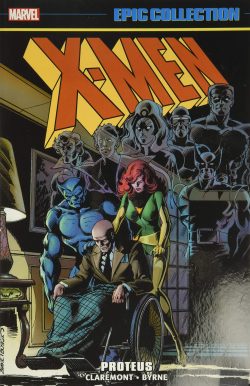
X-Men Epic Collection volume 5: Proteus 1978-1979


By Chris Claremont, John Byrne, Terry Austin, George Pérez, Michael Netzer, Rick Buckler & various (Marvel)
ISBN: 978-1-3029-2252-8 (TPB)

In the autumn of 1963, The X-Men #1 introduced Scott (Cyclops) Summers, Bobby (Iceman) Drake, Warren (Angel) Worthington, Jean (Marvel Girl) Grey and Hank (The Beast) McCoy: very special students of Professor Charles Xavier.

The teacher was a wheelchair-bound telepath dedicated to brokering peace and integration between the masses of humanity and the emergent off-shoot race of mutants dubbed Homo superior; considered by many who knew him as a living saint.

After nearly eight years of eccentrically spectacular adventures the mutant misfits virtually disappeared at the beginning of 1970 during another periodic downturn in superhero comics sales. Just like in the closing years of the 1940s, mystery men faded away as supernatural mysteries and traditional genre themes once more dominated the world’s entertainment fields…

Although the title was revived at the end of the year as a cheap reprint vehicle, the missing mutants were reduced to guest-stars and bit-players throughout the Marvel universe and the Beast was refashioned as a monster fit for the global uptick in scary stories until Len Wein & Dave Cockrum revived and reordered the Mutant mystique with a brand-new team in Giant Size X-Men #1 in 1975.

To old foes-turned-friends Banshee and Sunfire was added one-shot Hulk hunter Wolverine, and all-original creations such as demonic-seeming German teleporter Kurt Wagner/ Nightcrawler; African weather “goddess” Ororo Monroe AKA Storm; Russian farmboy Peter Rasputin who transformed at will into a living steel Colossus and bitter, disillusioned Apache superman John Proudstar who was cajoled into joining the makeshift squad as Thunderbird.

The revision was an instantaneous, incontrovertible hit. With Wein’s editorial assistant Chris Claremont writing the series from the second story onwards, the Uncanny X-Men reclaimed their own comicbook within months (#94). It quickly became the company’s most popular – and highest quality – title.

Cockrum was succeeded by John Byrne and as the team roster shifted and changed the series rose to even greater heights, culminating in the landmark (and with this tome, imminently ensuing) Dark Phoenix storyline which saw the death of arguably the book’s most beloved and imaginative character.

In the aftermath team leader Cyclops left, but the epic cosmic saga also seemed to fracture the epochal working relationship of Claremont & Byrne. Within months of publication, they went their separate ways: Claremont staying with the mutants whilst Byrne moved on to establish his own reputation as a writer on series such as Alpha Flight, Incredible Hulk and especially his revolutionised and freshly-groundbreaking Fantastic Four…

After Apache warrior Thunderbird became the team’s first fatality, the survivors slowly bonded, becoming an infallible fighting unit under the brusque and draconian supervision of Cyclops.

This monolithic trade paperback – and eBook – compilation is the ideal artefact for newbies, neophytes and even old lags nervous about reading such splendid yarns on fragile, extremely valuable newsprint paper. It celebrates the unstoppable march to market dominance through the pivotal early stories: specifically, X-Men #111-128 and Annual #3 of the decidedly “All-New, All-Different” ones, plus crossover yarns from Marvel Team-Up #89 and The Incredible Hulk Annual #7 – all cumulatively spanning June 1979-March 1980.

The drama kicks off with that Hulk Annual as ‘The Evil That is Cast…’ by Roger Stern, Byrne & Bob Layton finds retired X-Men Angel and Iceman targeted by a madly-mutated, mutant-hunting Sentinel Master Mold, who has merged with a manic former foe. Happily, the peripatetic pistachio powerhouse is on hand to balance the odds…

Meanwhile, the modern members are the subject of ‘Mindgames’ (Claremont, Byrne & Terry Austin) with Avenging alumnus The Beast visiting a circus in search of the new team. They have been missing for weeks…

His presence disrupts a devilish scheme by mutant hypnotist Mesmero to subjugate the heroes through false memories and implanted personalities, but the reawakened stalwarts’ vengeance is forestalled as their greatest enemy ambushes them…

X-Men #112 finds the revived and furious heroes fighting but failing, leaving ‘Magneto Triumphant!’ With his enemies helplessly imprisoned miles beneath Antarctica, a valiant turnabout and escape results in tense, action-packed battle bonanza ‘Showdown!’ On the Polaric tyrant’s return – after terrorising the humans of Australia – the X-Men have broken free and are waiting for him…

In the apocalyptic battle which follows the base is utterly destroyed and Magneto grievously wounded. With boiling lava flooding everywhere, only Beast and recently-ascended Phoenix Jean Grey manage to reach the surface to realise, in horror, that they are the only survivors.

They could not be more wrong…

Unable to go up, their fellow champions tunnel downwards and ‘Desolation!’ turns to joy as they emerge into the antediluvian wilderness dubbed the Savage Land. Linking up with old ally Ka-Zar, the X-Men slowly recover in a dinosaur-filled, elysian paradise. The idyll is rudely shattered when former foe Karl Lykos succumbs to his old addiction and absorbs their mutant energies to become lethal leather-winged predator Sauron…

His ‘Visions of Death!’ are readily dispelled by the assembled heroes, but he’s just the first course in a campaign of terror as crazy, colonialising barbarian queen Zaladane revives proto-god Garokk as the figurehead of her army of conquest…

When the insane imperialists’ eco-meddling disrupts the tropical climate of the sub-polar region, Ka-Zar and the X-Men invade their noxious citadel ‘To Save the Savage Land’. The brutal battle demands the best and worst from the young warriors before the job is done…

With the distasteful task completed, the mutants opt for a perilous sea-passage back to the outside world…

Uncanny X-Men #117 begins with their rescue by an Antarctic exploration vessel, heralding a slow torturous voyage to Japan, before lapsing into an untold tale of Charles Xavier in his globe-trotting days prior to losing the use of his legs. ‘Psi War!’ is full of clever, in-filling insights as it details how the dispirited, restless young telepath fetches up in Cairo and meets his first “Evil Mutant”…

Amahl Farouk uses psionic abilities to rule the city’s underworld: a depraved, debauched monster who thinks he is beyond justice. The enraged, disgusted Xavier defeats the beast and in doing so find his life’s purpose…

A revelatory 2-part epic follows as the X-Men – still believed dead by Xavier, Jean and the wider world – arrive in Agarashima, just as the port is being devastated by a vast firestorm. Inked by Ricardo Villamonte, ‘The Submergence of Japan!’ sees tectonic terrorist Moses Magnum undertake a most audacious blackmail scheme, countered by the valiant mutants who briefly reunite with old – and still belligerently surly – comrade Sunfire.

Perhaps he is just surprised to discover Wolverine has unsuspected connections to Japan and has turned the head of local highborn maid Lady Mariko. A bigger surprise awaits the American specialist the government have brought in. Misty Knight is Jean Grey’s roommate in Manhattan and grieved with her at the X-Men’s reported deaths. Now she has to tell Cyclops his girl has moved on and Professor X has quit Earth for the Shi’ar Empire…

Of course, all that is moot if they can’t stop Magnum and his Mandroid army sinking Japan into the Pacific, but after a catastrophic conflict inside a volcano there’s a seasonal reunion in store for all in the Austin-inked ‘Twas the Night Before Christmas…’

Marvel further expands its borders with the introduction of a foreign super-squad in ‘Wanted: Wolverine! Dead or Alive!’, as enigmatic wild man Logan – accompanied by Cyclops, Nightcrawler, Storm, Colossus, Banshee and Nightcrawler – returns from bombastic battle and heartbreak in Japan only to be herded into Canadian airspace so the Ottawa government can reclaim their former property…

Forced down by a magical tempest, the X-Men are soon on the run in Calgary, ambushed by the aforementioned Alpha Flight – specifically battle-armoured Vindicator, gamma-powered, super-strong Sasquatch, First Nations magician Shaman, shapeshifting Snowbird and mutant speedster twins Northstar and Aurora: all ordered to repossess at any cost former special operative and top agent “The Wolverine”…

After a brutal but inconclusive clash at the airport, the X-Men fade into the city but only after Wolverine and Nightcrawler are captured…

The retaliation results in a ‘Shoot-Out at the Stampede!’, with the mutants confronting their pursuers while Shaman’s eldritch blizzard spirals out of control, threatening to destroy the entire province. Even after Storm fixes the problem, the Canadians are adamant, so to end hostilities Wolverine surrenders himself in return for his comrades’ safe passage.

Of course, he never promised to stay arrested…

The drama resumes with Byrne producing light breakdowns and regular inker Terry Austin stepping up to produce full art finishes for issue #122’s ‘Cry for the Children!’ as the long-gone heroes finally return to the Xavier School only to find it boarded up and deserted.

Months previously, following the catastrophic battle against Magneto, heartbroken Professor X had grieved for his fallen pupils and left Earth to be with his fiancée Empress Lilandra of the far-flung extragalactic Shi’ar Imperium. In the interim, Jean Grey – reborn as the cosmic-powered Phoenix – went globetrotting to bury her woes. She is currently in Scotland, unaware that she has been targeted by one of the team’s oldest enemies for a cruel assault…

As the weary team slowly settle in at the mansion again, attempting to return to previous routines, psychological stress testing shows Russian teen Colossus has second thoughts about deserting his family and country…

In New York, Storm is tracing her roots, visiting the old home of her American father, only to find it now a vile junkie squat filled with doped-up, feral kids who viciously attack her. Stabbed and bleeding, she lashes out and only the sudden arrival of hero for hire Luke Cage and his friend Misty Knight prevents a tragedy. None of them are remotely aware that they have been targeted by the world’s most outrageous hit-man…

With Byrne back in full penciller mode, #123 includes a cameo from Spider-Man as jolly psycho-killer Arcade picks off the oblivious mutants and runs them through his fatal funfair Murder World in ‘Listen… Stop Me if You’ve Heard It… But This One Will Kill You!’: subjecting the abductees to perils mechanical and psychological.

The former proves understandably ineffectual, but family guilt and cunning conditioning soon transform the already homesick and despondent Colossus into a vengeful mind-slave dubbed The Proletarian, determined to smash his former comrades in concluding chapter ‘He Only Laughs When I Hurt!’ Happily, his inner child and the assorted heroes’ gifts and training prove too much for the maniacal killer clown…

Marvel Team-Up #89 then diverts to a follow-up as Claremont, Michael Nasser/Netzer, Rick Buckler & Josef Rubinstein depict a ‘Shoot-Out over Center Ring!’ as the wallcrawler and former acrobat Kurt Wagner again clash with Arcade and assassin Cutthroat at the circus…

X-Men Annual #3 then offers a fantastic interlude as extradimensional barbarian warlord Arkon the Magnificent returns to Earth courtesy of Claremont, George Pérez & Austin. ‘A Fire in the Sky!’ sees him again seeking to save his unstable world of Polemachus from eternal darkness. Last time, Avenger Thor provided the lightning necessary to illuminate his realm, but with the Asgardian unavailable, Arkon decides Storm will do. He never learned how to ask, though, and his violent abduction of his target provokes a furious response from her mutant comrades…

With Byrne back drawing, Jean re-enters the picture in X-Men #125, when her stay with geneticist Moira MacTaggertleads to the release of a long-secret family shame in ‘There’s Something Awful on Muir Island!’ Throughout her long holiday, Phoenix has been gradually weakened and psychically seduced by a psionic predator: groomed for a life of refined cruelty and debauchery by a man calling himself Jason Wyngarde. His intention is to create a callous and wicked “Black Queen” for the mysterious organisation known as the Hellfire Club…

At the other end of the galaxy, Charles Xavier reviews records of how Phoenix once reconstructed the entire fragmenting universe and is gripped with terror at the thought of all that power in the hands of one frail human personality, whilst in his former home the Beast checks a tripped alarm and discovers his long-mourned friends are all alive.

The reunited comrades’ first thought is to tell Jean the incredible news, but no sooner is a transatlantic call connected than a scream echoes out and the line goes dead…

Issue #126 resumes frantic hours later as the X-Men approach Muir Island in their supersonic jet. With all contact lost and no telepath aboard, Cyclops assumes the worst and the squad infiltrate in battle formation, only to find a withered corpse and badly shaken comrades Lorna Dane, Havok, Madrox, Moira and Jean slowly recovering from a psionic assault. In ‘How Sharper Than a Serpent’s Tooth…!’ Dr. MacTaggert bitterly reveals the attacker is a psychic bodysnatcher imprisoned on Muir for years. He’s also her son…

Rapidly burning out one of Madrox’s duplicate bodies, the monster has already reached the Scottish mainland, but as the mutants disperse to hunt him down Jean is hampered by a torrent of seductive mirages projected by the smugly confidant Wyngarde, allowing predatory Proteus to ambush the X-Men and attempt to possess Wolverine.

It is his first mistake. Metal has an inimical effect on the formless horror and the feral fury’s Adamantium skeleton forces him to flee his victim in screaming agony. It is then the creature unleashes his most terrifying power: warping reality to drive Wolverine and Nightcrawler to the brink of madness. Only the late-arriving Storm prevents their immediate demise but soon she too is at the edge of destruction…

‘The Quality of Hatred!’ finds the badly shaken team undergoing desperate “tough-love” remedies from Cyclops to regain combat readiness, whilst Moira tries to make up for her dangerous sentimentality by putting a bullet into her deadly offspring.

Frustrated by the idealistic Cyclops but having divined the path Proteus is taking, she then heads for Edinburgh and an unpleasant reunion with her former husband: brute, bully, Member of Parliament and father of most merciless monster the world has yet produced…

As Jean finally shrugs off her distractions and telepathically homes in on Proteus, the team swing into action a little too late: the sinister son has possessed his scurrilous sire and created an unstoppable synthesis of world-warping abomination…

With Edinburgh and perhaps the entire world roiling and rebelling as science goes mad, X-Men #128 sees the valiant champions strike back to spectacularly triumph in ‘The Action of the Tiger!’ : scoring a hard-fought but bittersweet victory…

Also offering original art, fanzine covers, portfolio pages, previous collection artwork and a barrage of house ads, this is a stunning treasure trove of action and adventure. For many fans these tales – and those in the next volume – comprise the definitive X-Men look and feel: some of the greatest stories Marvel ever published; entertaining, groundbreaking and utterly intoxicating. These stories are an invaluable grounding in contemporary fights ‘n’ tights fiction no fan or casual reader can afford to ignore.
© 2020 MARVEL.

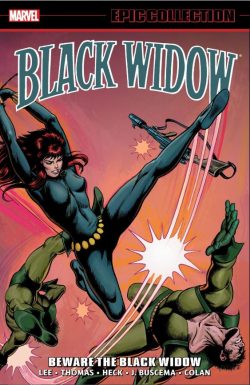
Black Widow Epic Collection volume 1: Beware the Black Widow 1964-1971


By Stan Lee, Don Rico & Don Heck, Roy Thomas, Gary Friedrich, Mimi Gold, Gerry Conway, Jack Kirby, John Buscema, John Romita, Gene Colan, Bill Everett & various (Marvel)
ISBN: 978-1-3029-2126-2 (TPB)

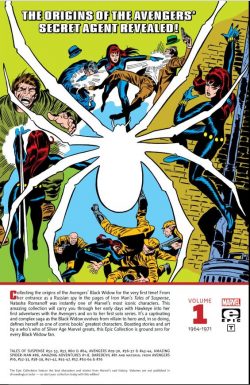
After a truly interminable time of waiting, the Black Widow movie is scheduled for general release on July 9th, so lets all take a look at her comic path from wicked wanton to war-weary world-saver courtesy of a carefully curated Epic Collection, gathering the majority of her earliest appearances.

Natasha Romanoff (sometimes Natalia Romanova) is a Soviet Russian spy who came in from the cold and stuck around to become one of Marvel’s earliest female stars. The Black Widow started life as a svelte, sultry honey-trap during Marvel’s early “Commie-busting” days, targeting Tony Stark and battling Iron Man in her debut (Tales of Suspense #52, April, 1964).

She was subsequently redesigned as a torrid tights-&-tech super-villain before defecting to the USA, falling for an assortment of Yankee superheroes – including Hawkeye and Daredevil – before finally enlisting as an agent of S.H.I.E.L.D., setting up as a freelance do-gooder and joining/occasionally leading the Avengers.

Throughout her career she has always been considered ultra-efficient, coldly competent, deadly dangerous and yet somehow cursed to bring doom and disaster to her paramours. As her backstory evolved, it was revealed that Natasha had undergone experimental processes which enhanced her physical capabilities and lengthened her lifespan, as well as assorted psychological procedures which had messed up her mind and memories…

Traditionally a minor fan favourite, the Widow only really hit the big time after Marvel Movie franchise was established, but for us unregenerate comics-addicts her print escapades have always offered a cool, sinister frisson of delight.

This expansive trade paperback and digital compilation gathers the contents of Tales of Suspense #52-53, 57, 60, 64; Avengers #29-30, 36-37, 43-44; Amazing Spider-Man #86; Amazing Adventures #1-8 and Daredevil #81, plus pertinent excerpts from Avengers #16, 32-33, 38-39, 41-42, 45-47, 57, 63-63 & 76, cumulatively spanning April 1964 to November 1971.

The action opens as a sexy Soviet operative Natasha and her hulking sidekick Boris (yes, I know: simpler times) is despatched to destroy recent defector Anton Vanko and his American protectors Tony Stark and Iron Man. ‘The Crimson Dynamo Strikes Again!’ (drawn by Don Heck and scripted, like the next issue, by “N. Kurok” – actually veteran creator Don Rico) sees the hero quickly dispose of the armoured Russian heavy while underestimating the far greater threat of the Soviet Femme Fatale.

With Tales of Suspense #53, she was a headliner. In ‘The Black Widow Strikes Again!’ she steals Stark’s anti-gravity ray yet ultimately fails in her sabotage mission, fleeing Russian retribution until resurfacing in ToS #57.

The Black Widow returned to beguile disgruntled budding superhero ‘Hawkeye, The Marksman!’ (Stan Lee & Heck) into attacking the Golden Avenger in #57, with no appreciable effect.

Tales of Suspense #60 featured an extended plotline with Stark’s “disappearance” leading to Iron Man being ‘Suspected of Murder!’. Capitalizing on the chaos, lovestruck Hawkeye and the Widow struck again, but another failure led to her being recaptured and re-educated by enemy agents…

Abruptly transformed from fur-clad seductress into a gadget-laden costumed villain, she returned in #64’s ‘Hawkeye and the New Black Widow Strike Again!’ (Lee, Heck & Chic Stone). Her failure led to big changes as pages from Avengers #16 reveal her punishment and Hawkeye’s reformation and induction into the superteam.

Jump forward more than a year and Avengers #29 as Quicksilver and the Scarlet Witch prepare to retire: returning to Europe to reinvigorate their fading powers even as ‘This Power Unleashed!’ brings back Hawkeye’s lost love: a brainwashed nemesis resolved to destroy the team.

Recruiting old foes Power Man and the Swordsman as cannon-fodder, she is foiled by her own incompletely submerged feelings for Hawkeye, after which ‘Frenzy in a Far-Off Land!’ sees dispirited colossus Henry Pym embroiled in a futuristic civil war amongst a lost south American civilisation while a temporary détente between Hawkeye and the Widow seems set to fail…

Extracts from Avengers #32-33 (with Heck providing raw, gritty inks over his own pencils in ‘The Sign of the Serpent!’ and concluding chapter ‘To Smash a Serpent!’) sees her own recovery begin as Natasha independently infiltrates a racist secret society before joining the Avengers to destroy the hatemongering snakes…

Her international credentials are exploited when long-missing Scarlet Witch and Quicksilver return, heralding an alien invasion of the Balkans in ‘The Ultroids Attack!’ and ‘To Conquer a Colossus!’ (Avengers #36-37). Newly cured, programming-free and reformed, she is the crucial factor in repelling an extraterrestrial invasion: a sinister, merciless Black Widow whose willingness to apply lethal force ultimately saves the day and the Earth……

Extracts from Avengers #38, 39, 41 and 42 detail how she then forsakes her new heroic reputation to go undercover for SHIELD, infiltrating a Communist Chinese super-weapon project as a supposed Soviet agent. In #43’s complete tale ‘Color him… the Red Guardian!’ (Roy Thomas, John Buscema & George Roussos) her origins and reasons for the title “widow” are revealed before – reacting to a world-threatening superweapon – the Avengers storm in for the fight of their lives as the saga climaxes in ‘The Valiant Also Die!’ (inked by Vince Colletta), a blistering all-out clash to save humanity from mental conquest…

The fractured relationship between Hawkeye and the Widow plays out in snippets from Avengers #45-47, #63 and 64 as her growing ties to SHIELD lead to an heartbreaking split with the Avenging Archer in #76 and the prospect of a new beginning for the Russian misfit…

It comes in Amazing Spider-Man #86 as ‘Beware… the Black Widow!’ affords John Romita & Jim Mooney a chance to redesign, redefine and relaunch the super-spy in an enjoyable if formulaic Lee-scripted misunderstanding/clash-of-heroes yarn with an ailing webspinner never really endangered. The entire episode was actually a promotion for the Widow’s own soon-to-debut solo series…

The Black Widow‘s first solo series, appeared in “split-book” Amazing Adventures #1-8: mini-epics paying dues the superspy’s contemporary influences… Modesty Blaise and Emma Peel (that lass from the other Avengers…)

It all begins with ‘Then Came…The Black Widow’ (Amazing Adventures #1, August 1970 by Gary Friedrich, John Buscema & John Verpoorten) wherein Natasha comes out of self-imposed retirement to be a socially-aware crusader: defending low-income citizens from thugs and loan sharks. One act of charity leads her to help activists ‘The Young Warriors!’ as their attempts to build a centre for underprivileged kids in Spanish Harlem are countered by crooked, drug-dealing property speculators…

Gene Colan & Bill Everett assume art duties from #3’s ‘The Widow and the Militants!’, with her actions and communist past drawing hostile media attention, more criminal attacks and ultimately precipitating an inner-city siege, before the ‘Deadlock’ (scripted by Mimi Gold) comes to a shocking end…

Roy Thomas steps in for a bleakly potent Christmas yarn as ‘…And to All a Good Night’ sees Natasha and faithful retainer/father figure Ivan meet and fail a desperate young man, only to be dragged into a horrific scheme by deranged cult leader the Astrologer who plans to hold the city’s hospitals to ransom in ‘Blood Will Tell!’ (art by Heck & Sal Buscema).

Convinced she is cursed to do more harm than good, the tragic adventurer nevertheless inflicts ‘The Sting of the Widow!’(Gerry Conway, Heck & Everett) on her ruthless prey and his kid warriors, after which the series wraps up in rushed manner with a haphazard duel against Russian-hating super-patriot Watchlord in the Thomas-scripted ‘How Shall I Kill Thee? Let Me Count the Ways!’

The formative tales conclude here with ‘And Death is a Woman Called Widow’ (Daredevil #81, by Conway, Colan & Jack Abel), which sees infamous defector Natasha Romanoff burst onto the scene to save the Man Without Fear from ubiquitous manipulator Mr. Kline and deadly predator The Owl: exposing the mastermind behind most of DD and the Widow’s recent woes and tribulations…

Rounding out the comics experience here are bonus pages including a stunning pin-up of the bodacious Black Widow by Bill Everett; house ads and a huge gallery of original art pages by John Buscema, Verpoorten, Heck, Colan and Everett – including restored artworks edited for overly-salacious content that revealed a little too much of the sexy spy, and toned down for eventual publication…

These beautifully limned yarns might still occasionally jar with their earnest stridency and dated attitudes, but the narrative energy and sheer exuberant excitement of the adventures are compelling delights no action fan will care to miss …
© 2020 MARVEL.

Golden Age Captain America Marvel Masterworks volume 1


By Joe Simon & Jack Kirby with & various (Marvel Comics)
ISBN: 978-0-7851-1619-2 (HB) 978-0785157939 (TPB)

Arguably the biggest anniversary in this year of comics milestones is this guy. Whatever your real-world politics, this is a fictive icon without peer – unless you count Wonder Woman, Archie Andrews or the others as your favourite. Maybe we should just celebrate them all like Catholics and Saints…

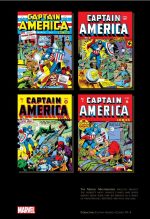
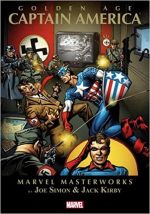
Golden Age Captain America Marvel Masterworks volume 1- available in hardback, trade paperback and as an eBook – reprints the first four issues of original title Captain America Comics (cover-dated March to June 1941) and are a landmark combination of passion, enthusiasm and creative quality seldom seen at Marvel’s brash predecessor Timely Comics, who generally settled for any two out of three…

However, for true fans the groundbreaking and exceptional patriotic material generated by Joe Simon & Jack Kirby is not really the lure here… the real gold nuggets for us old sods are those rare back-up features from the star duo and their small team of talented youngsters. Reed Crandall, Syd Shores, Alex Schomburg and the rest worked on main course and filler features such as Hurricane, the God of Speed and Tuk, Caveboy: strips barely remembered, yet still brimming with the creative fires of legends in waiting.

Devised at the end of 1940 and boldly launched in his own monthly title with none of the publisher’s customary cautious shilly-shallying, Captain America Comics #1 was cover-dated March 1941 and was an instant monster, blockbuster smash-hit. The bombastic Sentinel of Liberty was instantly the absolute and undisputed star of Timely’s “Big Three” – the other two being the Human Torch and Sub-Mariner (as seen in Marvel Mystery Comics) – and one of the first to fall from popularity at the end of the Golden Age.

In comparison to their contemporaries at Quality, Fawcett, National/All American and Dell, or Will Eisner’s The Spirit newspaper strips, the standard of most Timely periodicals was woefully lacklustre in both story and – most tellingly – art. That they survived and prospered is a Marvel mystery, but a clue might lie in the sheer exuberant venom of their racial stereotypes and heady fervour of jingoism at a time when America was involved in the greatest war in world history. I suspect given the current tone of the times politically, such sentiments might be less controversial now than they have been for quite a while…

Nevertheless, the first ten Captain America Comics are the most exceptional comics in the fledgling company’s history, and I can’t help but wonder what might have been had National (née DC) been wise enough to hire Simon & Kirby before they were famous, instead of after that pivotal first year?

Of course, we’ll never know and although they did jump to the majors after a year, Simon & Kirby’s visual dynamism became the aspirational and approved house-style for superhero comics at the company they left and their banner-bedecked creation became the flagship icon for them and the industry.

Following a revelatory look back from Golden Age maven and comics scribe supreme Roy Thomas, this initial volume opens with ‘Case No. 1: Meet Captain America’ by Simon & Kirby (with additional inks by Al Liederman) wherein we see how scrawny, enfeebled young patriot Steven Rogers, continually rejected by the US Army, is recruited by the Secret Service.

Desperate to counter a wave of Nazi-sympathizing espionage and sabotage, this passionate young man is invited to become part of a clandestine experimental effort create physically perfect super-soldiers. However, when a vile Nazi agent infiltrates the project and murders its key scientist, Rogers became the only successful graduate and America’s not-so-secret weapon.

Sent undercover as a simple private, Rogers soon encounters Bucky Barnes: a headstrong, orphaned Army Brat who becomes his sidekick and costumed confidante. All of that is perfectly packaged into mere seven-and-a-half pages, with untitled ‘Case No. 2’ taking just as long to resoundingly defeat Nazi showbiz psychics Sando and Omar as they spread anxiety and fear amongst the gullible Americans.

‘Captain America and the Soldier’s Soup’ is a rather mediocre and unattributed prose tale promptly followed by splendidly sinister 16-page epic ‘Captain America and the Chess-board of Death’, with our heroes thrashing more macabre murdering Nazi malcontents before facing the groundbreaking introduction of the nation’s greatest foe.

Solving ‘The Riddle of the Red Skull’ proves to be a thrill-packed, horror-drenched master-class in comics excitement…

The first of the B-features follows as Hurricane (“Son of Thor” and last survivor of the Greek Gods – don’t blame me, that’s what it says) sets his super-fast sights on ‘Murder Inc.’ in a rip-roaring but clearly rushed battle against fellow-immortal Pluto (so not quite the last god either; nor exclusively Norse or Greek…) who is once again using mortals to foment pain, terror and death…

Hurricane was a rapid reworking and sequel to Kirby’s ‘Mercury in the 20th Century’ from Red Raven Comics #1 (August 1940) whereas ‘Tuk, Caveboy: Stories from the Dark Ages’ is all-original excitement starring a teenaged boy in 50,000 BC raised by a beast-man. The wild child is resolved to regain the throne of his antediluvian kingdom Attilan from the usurpers who stole it…

This is an imaginative barbarian spectacular owing much to Tarzan and The Land that Time Forgot, but certainly delivers the thrills we might want…

Historians believe Kirby pencilled this entire issue and although no records remain, inkers as diverse as Liederman, Crandall, Bernie Klein, Al Avison, Al Gabrielle, Syd Shores and others may have been involved in this and subsequent issues…

Captain America Comics #2 screamed onto the newsstands a month later, boldly opening with monster mash-up ‘The Ageless Orientals Who Wouldn’t Die’: blending equal amounts of horror and jingoism into a terrifying thriller with a ruthless American capitalist exposed as the true source of a rampage against the nation’s banks…

‘Trapped in the Nazi Stronghold’ sees Cap and Bucky in drag and in Europe to rescue a pro-British financier kidnapped by the Nazis, whilst ‘Captain America and the Wax Statue that Struck Death’ returned to movie-thriller themes in the tale of a macabre murderer with delusions of world domination.

The Patriotic Partners deal with saboteurs in prose piece ‘Short Circuit’ before Tuk tackles monsters and mad priests in ‘The Valley of the Mist’ (by either the King and a very heavy inker or an unnamed artist doing a passable Kirby impression) whilst Hurricane – now “Master of Speed” – swiftly and spectacularly expunges ‘The Devil and the Green Plague’ deep in the fetid heart of the Amazon jungles.

CAC #3 led with 17-page epic ‘The Return of the Red Skull’ with the scarlet scoundrel booting Adolf Hitler off the cover-spot he’d hogged in #1 and #2 as Kirby opened up his layouts to enhance the mesmerising graphic action with a veritable production line of creators (including Ed Herron, Martin A, Burnstein, Howard Ferguson, William Clayton King, and possibly George Roussos, Bob Oksner, Max Elkan and Jerry Robinson) joining the creative team.

Despite eye-shattering scale and spectacle united with non-stop action and eerie mood as key components of the Sentinel of Liberty’s exploits, horror elements dominated ‘The Hunchback of Hollywood and the Movie Murder’ wherein a patriotic film is plagued by sinister and disturbing “accidents”…

Stan Lee debuts with text tale ‘Captain America Foils the Traitor’s Revenge’ before Simon & Kirby – and friends – recount ‘The Queer Case of the Murdering Butterfly and the Ancient Mummies’ in a riotous blending of eerie Egyptian antiquities and myths with a thoroughly modern costumed psychopath.

Tuk (drawn by either Mark Schneider – or perhaps Marcia Snyder) reaches ‘Atlantis and the False King’, after which Kirby contributes a true tale in ‘Amazing Spy Adventures’ whilst Hurricane confronts ‘Satan and the Subway Disasters’with devastating and final effect…

The final issue in this fabulous curated chronicle opens with ‘Captain America and the Unholy Legion’ as the star-spangled brothers-in-arms crush a murderous conspiracy of beggars terrorising the city, before taking on ‘Ivan the Terrible’ in a time-bending vignette and thereafter solving ‘The Case of the Fake Money Fiends’.

Their all-action exploits culminate in magnificent fashion when our heroes then expose the horrendous secret of ‘Horror Hospital’…

Lee-scripted text tale ‘Captain America and the Bomb Sight Thieves’ leads to young Tuk triumphing over ‘The Ogre of the Cave-Dwellers’ before Hurricane brings down a final curtain on ‘The Pirate and the Missing Ships’.

An added and very welcome bonus for fans is the inclusion of all the absolutely beguiling house-ads for other titles and upcoming Cap books; contents pages; Sentinels of Liberty club bulletins; assorted pin-ups; merchandise and memorabilia and Joe Simon’s Afterword ‘My Bulletin Board’…

Despite in many ways having a much shallower vintage well to draw from, this particular tome from the House of Ideas is a book that will always stands amongst the very best that the Golden Age of Comics can offer and should be on every fan’s “never-miss” bookshelf.
© 2018 MARVEL. All rights reserved.

Fantastic Four: First Family


By Joe Casey, Chris Weston, Gary Erskine & various (Marvel)
ISBN: 978-0-7851-1703-2 (TPB)

The Fantastic Four is regarded as the most pivotal series in modern comic book history, introducing both a new style of storytelling and a decidedly different manner of engaging the readers’ impassioned attentions. In a year bursting with comics anniversaries, the FF are certainly the most significant, having debuted at the end of 1961 to revolutionise the American industry and spearhead a global change in the art form. They have endured upheaval and change but have never stopped influencing comics and the lager world of far-flung fantasy.

More a family than a team, the roster has changed constantly over years before inevitably returning to the original configuration of Mister Fantastic, Invisible Woman, The Thing and the Human Torch.

The quartet are actually maverick genius Reed Richards, his wife Sue, Reed’s college friend Ben Grimm and Sue’s obnoxious, impetuous younger brother Johnny Storm; survivors of an independent, non-governmental space-shot which went horribly wrong once ferociously mutative Cosmic Rays penetrated their ship’s inadequate shielding.

When they crashed back to Earth, the foursome found that they had all been hideously changed into outlandish freaks. Reed’s body became elastic and Sue gained partial control of energies that allowed her to turn invisible and latterly form force-fields. Johnny could transform into self-perpetuating living flame, but poor, tormented Ben was reduced to a horrifying brute who, unlike his comrades, could not return to a semblance of normality on command.

The sheer simplicity of four archetypes – mercurial boffin, self-effacing distaff, solid, tragic everyman and hot-headed youth – uniting to triumph over accident and adversity shone under Stan Lee’s irreverent humanity coupled to Jack Kirby’s rampant imagination and sense of adventure.

After decades of erratic quality and floundering plotlines following the original creators’ departures, Marvel’s First Family began a steady climb in quality at the beginning of the 21st century culminating in their own troubled film franchise.

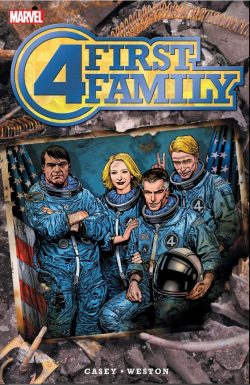
To augment increased casual interest, in 2006 a canny, edgy retelling of the team’s earliest days was produced as a 6-issue miniseries by scripter Joe Casey in conjunction with illustrators Chris Weston & Gary Erskine, re-examining the quartet’s coming to terms with their new status in terms far more in keeping with the cynical, jaded modern world…

Available in trade paperback and digital editions, First Family opens with ‘There’s Was a Crash…’ as USAF General Walter Montgomery is called to a top secret military installation where four survivors of a fallen space-shot are being held. They were human once, but have been hideously mutated by Cosmic rays.…

The boy keeps bursting into flames, whilst his older sister is totally transparent. The pilot has become a rock-like atrocity while the General’s old friend Dr. Richards has been reduced to a catatonic mound of shapeless flesh. His coma has nothing to do with the accident, however. The scientist is locked into a cerebral mindscape where he is being lectured to by a fifth cosmic ray survivor…

This entity is explaining some facts of life. The facility they are in is an Air Force base designed to hold a variety of incredibly mutated humans. Apparently, this is not the Government’s first cosmic rodeo…

In ‘Late-Night Creeping’, Sue Storm surreptitiously escapes her cell to check on her companions, but boyfriend Reed is still beyond reach, deep inside his own head. Dr. Franz Stahl is currently explaining to him that a fallen meteor supercharged with C-radiation has been transforming humans under USAF supervision for months and that his own forced evolution is the most significant result.

Seeing Richards as a kindred spirit, the mind-ghost shares his radical theories of evolutionary dominance with his fellow future man, but Richards remains stubbornly unconvinced…

‘The Afterburn’ sees Ben Grimm’s fiancée run screaming from him, prompting a minor riot. This allows Stahl to take matters into his own psychic hands, instigating a further distracting crisis. Provoking one of his fellow monstrous transformees to go on a ‘Cosmic Ray Rampage’, the doctor escapes whilst our super-powered quartet gamely assist the soldiers in stopping the unholy horror.

In return Montgomery agrees to release them on their own recognizance with assurances of Federal backing…

‘Remember the Alamo’ occurs just after the events of Fantastic Four #1, beginning as the heroes escape the atomic destruction of the Mole Man‘s Monster Island. Reed later briefs Montgomery and they make plans to formalise the quartet into a proper team. However, Reed is still being regularly mentally shanghaied by Stahl, whose agenda to improve humanity begins with the culling of his own disappointingly mundane family in ‘Domestic Disturbance’…

‘The Homecoming Dance’ sees Ben indulging in disastrous drinks in his old neighbourhood even as Johnny, Reed and Sue all realise their old “normal” lives are forever denied them.

A Mole Man monster resurfaces in New York ready for ‘Round Two’ whilst Franz again tries to convince Richards to aid his plan to forcibly fix mankind, with Sue increasingly concerned that her man has lost all interest in a normal domestic future…

After Montgomery situates the four in a fabulous new, government-funded HQ – The Baxter Building – the misfits quickly begin to fall apart in ‘The Ties That Bind’ meaning no one is available when Stahl – intent on taking the life-warping meteor – invades the Air Force’s clandestine Cosmic facility in ‘Evolutionary Modern.’

‘Cold, Hard…’ finds Sue, Johnny and Ben discussing Reed’s intermittent distraction and underhandedness even as the subject of their grievances has opted to tackle Franz in ‘Alone + Easy Target’…

As they rush to save him, Reed is locked in psychic combat with Stahl, who has used the meteor to mutate Air Force personnel into a legion of monsters: the first step in his proposed ‘Extinction Event’ for humanity. The battered hero is losing, however, until his cosmic comrades fight their way in and are pulled into the mental arena of ‘Signs and Salvation’to tip the balance…

The titanic battle ends with a ‘Mind’s Eye Open’ leaving the quartet closer than ever and set upon ‘Finding Destiny’together…

Dark, grimly post-modern and disregarded by many purists, First Family nevertheless offers a compelling reinterpretation and rationalisation of epochal events from simpler times framed in the context of a far more cynical century, and is certainly inviting to fans of a more grounded, less optimistic society. It’s also a pretty good yarn for open-minded readers who love the baroque theatrics of modern, film-fuelled superhero stories.
© 2006, 2017 Marvel Characters, Inc. All rights reserved.
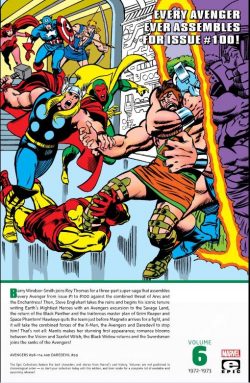
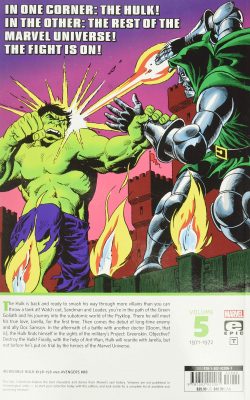
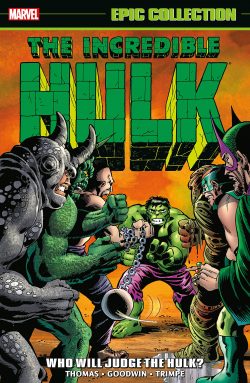
Incredible Hulk Epic Collection volume 5: Who Will Judge the Hulk? 1971-1972


By Roy Thomas, Harlan Ellison, Gary Friedrich, Gerry Conway, Len Wein, Chris Claremont, Archie Goodwin, Herb Trimpe, Sam Grainger, Sal Buscema, Dick Ayers, John Severin & various (Marvel)
ISBN: 978-1-3029-2206-1 (TPB)

Bruce Banner was a military scientist caught in a gamma bomb detonation of his own devising. As a result of ongoing mutation, stress and other factors cause him to transform into a giant green monster of unstoppable strength and fury.

After an initially troubled few years the gamma-irradiated gargantuan finally found his size-700 feet and a format that worked, becoming one of young Marvel’s most popular features. After his first solo-title folded, The Hulk shambled around the slowly-coalescing Marvel Universe as guest star and/or villain du jour, until a new home was found for him in “split-book” Tales to Astonish: sharing space with fellow misunderstood misanthrope Namor the Sub-Mariner, who proved an ideal thematic companion from his induction in #70.

As the 1970s opened the Incredible Hulk had settled into a comfortable – if excessively and spectacularly destructive – niche. The globe-trotting formula saw tragic, haunted Banner hiding and seeking cures for his gamma-transformative curse, alternately aided or hunted by prospective father-in-law US General “Thunderbolt” Ross and a variety of guest-star heroes and villains.

Herb Trimpe had made the character his own, displaying a penchant for explosive action and an unparalleled facility for drawing technology – especially honking great ordnance, vehicles and robots. Scripter Roy Thomas – unofficial custodian of Marvel’s burgeoning shared-universe continuity – played the afflicted Jekyll/Hyde card for maximum angst and ironic heartbreak even as he continually injected the Jade Juggernaut into the lives of other stalwarts of Marvel’s growing pantheon…

This chronologically-curated trade paperback and digital compendium re-presents issues #139-156 plus a crossover tale from Avengers #88, encompassing cover-dates April 1971 to October 1972, and opens without delaying preamble as the Hulk – returned to Earth after an epic outer space excursion – encounters an old enemy in ‘…Sincerely, the Sandman!’(Thomas, Trimpe & Sam Grainger) wherein the vicious villain turns Banner’s true love Betty Ross to brittle, fragile glass, after which #139’s ‘Many Foes Has the Hulk!’ looks in on archfoe The Leader‘s latest attempt to kill his brutish nemesis: employing illusion and exhaustion, as seemingly hundreds of old villains attack the man-monster all at once…

A landmark crossover follows as Harlan Ellison, Thomas, Sal Buscema & Jim Mooney craft ‘The Summons of Psyklop!’for Avengers #88 (May 1971) wherein an insectoid servant of the Elder Gods abducts the Hulk to fuel their resurrection…

This leads directly into Incredible Hulk #140 and ‘The Brute that Shouted Love at the Heart of the Atom’ (pencilled & inked by Grainger over Trimpe’s layouts). Trapped on a sub-atomic world, Banner’s intellect and the Hulk’s body are reconciled, and he becomes a barbarian hero to an appreciative populace, and lover of perfect princess Jarella, only to be snatched away by Psyklop at the moment of his greatest happiness.

The sudden return to full-sized savagery is the insectoid’s undoing and the Hulk resumes his ghastly existence… at least until #141 when an experimental psychologist provides a means to drain the Hulk’s gamma-energy and utilise it to restore crystalline, petrified Betty. He even uses the remaining gamma force to turn himself into a superhero in ‘His Name is … Samson!’ (with wonderful John Severin inking).

Next is a satirical poke at the “Radical Chic” movement through the return of “feminist” villain Valkyrie, with the Hulk made a media cause celebre by Manhattan’s effete elite in the wryly charming ‘They Shoot Hulks, Don’t They?’ Don’t fret, there’s plenty of monumental mayhem as well…

Picking up the pace comes an inevitable but long-delayed clash as the Green Goliath battles Doctor Doom in a 2-part epic begun by Thomas, Dick Ayers & Severin wherein fugitive Banner finds ‘Sanctuary!’ in New York City’s Latverian Embassy. The deal is a bad one, however, since the Iron Dictator enslaves the Gamma scientist for his bomb-making knowledge, in an attempt to make his awesome alter ego into an unstoppable war machine…

The scheme goes awry in ‘The Monster and the Madman!’ (scripted by Gary Friedrich over Thomas’ plot), as brainwashed Banner shucks his mind-warped conditioning – thanks to Doom’s conflicted consort Valeria – just in time for the Hulk to deliver a salutary lesson in mayhem throughout the dictator’s domain.

Incredible Hulk #145 is a double-length package finding the man-monster invading a film-set in Egypt and accidentally awakening a prehistoric alien war-weapon in ‘Godspawn’. Crafted by Thomas, Len Wein, Trimpe & Severin, it offers plenty of joyfully mindless Hulk Smash action and a portion of pathos, even as, back in the USA, the military – in the form of Ross and Major Glenn Talbot – open dedicated anti-Hulk base “Project Greenskin”…

Gerry Conway scripted Thomas’ plot for ‘And the Measure of a Man is… Death!’, wherein the Jade Juggernaut faces sandstorms, bitter memories and the Israeli army in the deserts of Northern Egypt, even as in America the Hulk-buster base has already been infiltrated by android facsimiles constructed by the Hulk’s greatest foe.

Drawn instinctively homeward, the Gamma Goliath reaches the base just as said infiltration threatens the US President himself, leading to a catastrophic clash between the brute and The Leader in ‘The End of Doc Samson!’. The issue (#147) also includes a moving and powerful vignette ‘Heaven is a Very Small Place!’ wherein Thomas, Trimpe & Severin take the tormented titan to the very edge of paradise before horrifying reality again reasserts itself…

Archie Goodwin debuted as scripter – with a little plotting assistance from a very junior Chris Claremont – in ‘But Tomorrow… the Sun Shall Die!’ as lost love Jarella voyages to Earth and a longed-for reunion, just as Banner is apparently cured of his curse by radical solar-energy experimentation. Sadly, the princess from the micro-verse accidentally brings with her a super-assassin determined to end her life at all costs and the double voyage somehow sparks the sun into going nova…

Forced to become the monster once again to save his beloved, the Hulk is captured by Ross’s forces only to escape when an ancient threat crashes back to Earth in #149, hungry for radiation to survive in ‘… And Who Shall Claim This Earth His Own? The Inheritor!’

After dispatching that creepy crawler, the Gamma Goliath wanders into the wilderness where he encounters on-sabbatical X-Man Alec Summers. He had banished himself – with girlfriend Lorna Dane visiting at just the wrong moment – to the deserts of New Mexico, terrified of his uncontrollable cosmic power in #150’s ‘Cry Hulk, Cry Havok!’ When Lorna clashes with a menacing biker gang and an Emerald Giant violently protective of his privacy, Summers finally proves himself against the rampaging but easily distracted titan…

‘When Monsters Meet!’ then pits the Hulk against a flesh-consuming radioactive horror resulting from a disastrous cancer cure derived from Banner’s blood, before Friedrich, Dick Ayers & Frank Giacoia ask ‘But Who Will Judge the Hulk?’, as helpless, freshly captured Banner is sent to trial for the destruction wrought by his emerald alter ego. The guest-star-studded 2-parter concludes in suitable calamity and chaos in #153’s ‘My World, My Jury!’, which includes additional art by Trimpe & Severin.

After explosively escaping the kangaroo court, the fugitive fury discovers ‘Hell is a Very Small Hulk!’ (Goodwin, Trimpe & Severin) when he swallows a defective shrinking formula. The serum was created and discarded by the Astonishing Ant-Man, but any risk is acceptable in Hulk’s forlorn attempts to rejoin Jarella in her subatomic world.

Snatched up by the face-shifting Chameleon and assembled hordes of Hydra, the diminished brute still manages to quash their treasonous schemes – at the apparent cost of his life.

In actuality, the Hulk is shrinking in sporadic bursts, propelled into a succession of micro-worlds, including an impossible “Earth” where Nazis seemingly won WWII. ‘Destination: Nightmare!’ reveals the incredible truth: meddling by a cosmic entity named Shaper of Worlds who tempts the Green Gargantuan with an empty paradise, before another shrinking spasm happily deposits Hulk on Jarella’s world in time for ‘Holocaust at the Heart of the Atom!’ (inked by Sal Trapani): pitting the monster against his worst nightmare – himself – before once again losing his true love to the vicissitudes of cruel fate and cosmic chance…

To Be Continued…

Wrapping up the smashing fun are the covers to reprint collections Incredible Hulk Annual #3 and 4; original artwork and covers by Trimpe & Grainger, Ayers & Severin, Trimpe & Severin and a fascinating glimpse into editorial thinking in creating a cover…

The Hulk is one of the most well-known comic characters on Earth, and these stories, as much as the movies, TV shows and action figures, are the reason why. For an uncomplicated, honestly vicarious experience of Might actually being Right, you can’t beat these evergreen classics.
© MARVEL 2021

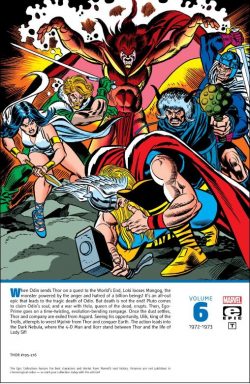
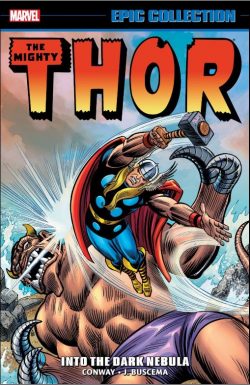
The Mighty Thor Epic Collection volume 6: Into the Dark Nebula 1972-1973


By Gerry Conway, Stan Lee, Len Wein, John Buscema, Don Perlin, Marie Severin, Sal Buscema & various (Marvel)
ISBN: 978-1-3029-2248-1 (TPB)

With the constantly expanding Marvel Universe growing ever more interconnected as it matured, characters literally tripped over each other in New York City and its environs, but such was seldom the case with Thor.

The Asgardian milieu and the soaring imagination of Jack Kirby had long drawn the Thunder God away from mortal realms into stunning new landscapes. When the unthinkable happened and the increasingly discontented King of Comics jumped ship from the House of (His) Ideas for arch-rival DC in 1970 an era ended. Left to soldier on, Stan Lee called in top artist John Buscema to carry a seemingly unbearable burden and after initial loss of focus and impetus – a new type of tale began to emerge…

In case you came in late: disabled doctor Donald Blake took a vacation in Norway only to stumble into an alien invasion. Trapped in a cave, he found an ancient walking stick which, when struck against the ground, turned him into the Norse God of Thunder! Within moments he was defending the weak and smiting the wicked.

Months swiftly passed with the Lord of Storms tackling rapacious extraterrestrials, Commie dictators, costumed crazies and cheap thugs, but these soon gave way to a vast kaleidoscope of fantastic worlds and incredible, mythic menaces.

This bombastic transitional compendium (available in trade paperback and digital formats) reprints Mighty Thor #195-216, spanning January 1972 to October 1973, with the puissant Thunder God going both forward and back between mortal and godly realms. By the time of these monthly episodes, the Thunderer and select Asgardian companions were slowly devolving into a muddled, self-doubting band of fantasy spacemen roving the outer limits of the Marvel Universe under the earnest governance of young science fiction novelist Gerry Conway and a dedicated, talented but still unsettled string of artists. Now, at last, a new path was being forged…

Illustrated by John Buscema & Vince Colletta, the action resumes with ‘In the Shadow of Mangog!’: the first chapter of another extended odyssey wherein Thor and friends are dispatched to the ends of the Universe. In another righteous rage, All-Father Odin had banished second son Loki to a fantastic world, momentarily forgetting that once there, the Prince of Evil might possibly awaken the most vicious, unbeatable monster in the Asgardian universe ….

Now the Storm God and Warriors Three Fandral the Dashing, Voluminous Volstagg and Hogun the Grim find themselves lost ‘Within the Realm of Kartag!’ and facing slug-men and bewitching temptress Satrina, even as the All-Father and the hosts of the Shining City struggle to hold the liberated Mangog at bay. Meanwhile, on planet Blackworld, Lady Sif and her muscular shield-maiden Hildegarde undertake another Odinian quest and find themselves caught up in a time-bending nightmare…

Thor #197 witnesses the heroes overcoming all odds to find ‘The Well at the Edge of the World!’: meeting the conniving, all-powerful Norns and recruiting colossal former foe Kartag for their desperate return and rescue mission to shattered Asgard.

On Blackworld, Sif and Hildegarde encounter monsters and men making uncontrollable evolutionary leaps towards an unguessable future, but find an unlikely ally and guide in aged sailor Silas Grant…

The male heroes return to find Asgard in flaming ruins and the cataclysmic confrontation with Mangog nearing its apocalyptic end, whilst on Blackworld, Sif, Hildegarde and Silas met alien Rigellian Colonizer Tana Nile and the horrendous creature behind the evolutionary jumps. Simultaneously, the battle in Asgard reaches a horrific climax when Mangog is at last defeated ‘…And Odin Dies!’

For #199, the ravaged home of the gods comes adrift in a dimensional void, allowing Thor – clutching to a desperate last hope – to cocoon his deceased father in a timeless force energy field. This prevents Death Goddess Hela from claiming his soul, but sadly, she isn’t the only deity hungry for the All-Father’s spirit. ‘If This Be Death…!’ sees Grecian-Roman netherlord Pluto invading the broken realm to take Odin into his own dire domain.

…And, on Blackworld, Tana Nile hints at the origin of the monstrous Ego-Prime, and how it can force such terrifying uncontrollable time-warps. Back in free-floating Asgard, things go from bad to worse as brave Balder‘s beloved Karnilladeserts him, just as invincible Pluto bests Hela and aims a killing blow at Thor…

The denouement was postponed as anniversary issue #200 hit the pause button to flashback to an earlier age. Crafted by Stan Lee, Buscema & John Verpoorten, ‘Beware! If This Be… Ragnarok!’ spectacularly depicts the mythologised fall of the gods through the mystic visions of Volla the Prophetess, with only a bridging Prologue and Epilogue – by Conway & Buscema – revealing how the Norns save Thor’s life for the concluding battle against Pluto which resumes in #201 (with Jim Mooney providing lush finished art over Buscema’s layouts).

As Hela relinquishes her claim to the father of the gods and Odin enjoys a miraculous ‘Resurrection!’ on Earth, absentee Asgardians Heimdall and Kamorr seek out certain mortals for another Odinian master-plan, even before the battle with Pluto is fully concluded…

As they scour Midgard, on Blackworld Ego-Prime advances the in-situ civilisation to the point of atomic Armageddon. Sif barely transports her companions to Earth in time to escape thermonuclear conflagration. Luckily Thor, Balder, and the Warriors Three are in Manhattan to meet the refugees, since the deadly, now self-evolving, Ego-Prime has followed the fugitives…

Thor #202 boasts ‘…And None Dare Stand ‘Gainst Ego-Prime!’ (Colletta inks) although Silas, Tana Nile and the assembled Asgardians try their best as the now-sentient shard of Ego, the Living Planet rampages through the city. As it makes monsters and shatters entire streets, Odin calmly observes the carnage whilst Heimdall and Kamorr gather their human targets for the concluding ‘They Walk Like Gods!’

Odin’s complex machinations are finally exposed as Ego-Prime inadvertently creates a new race of 20th century deities. Sadly, the All-Father’s single-minded scheme appals his son and weary, war-weary subjects, and their wholly understandable rebukes lead to their all being ‘Exiled on Earth!’ in #204 (Buscema & Mooney) and immediately targeted by satanic tempter Mephisto…

Soon, only the Thunderer is left to beat the devil: recklessly invading his private hell and gloriously liberating hundreds of demon-possessed humans from ‘A World Gone Mad!’ (Colletta inks). Their triumphant return, however, is merely to Midgard, not the gleaming spires of forbidden Asgard…

A new chapter opens when the Earthbound godling clashes brutally but inconclusively with an uncharacteristically out-of-control Absorbing Man Crusher Creel, just as Thor’s greatest enemy resurfaces in #206’s ‘Rebirth!’

After a destructive but inconclusive clash in the city, Thor tracks Creel to Rutland, Vermont just in time for the annual Halloween festival. Here Thor, Sif and Hildegarde clash with malign Loki and his all-powerful ‘Firesword!’ in an action-heavy duel elevated by a plethora of quirky comic creator cameos (thanks to the divine Marie Severin adding her caricaturing brilliance to Buscema & Colletta’s workmanlike illustration). Another extended sub-plot opens here as Sif vanishes, spirited away to the ends of the universe by lovelorn Norn Queen Karnilla …

Sci fi themes predominate #208 as ‘The Fourth-Dimensional Man!’ manifests, pilfering the Thunderer’s ambient Asgardian energies to save his own world from disaster. Sadly, they are insufficient and malevolent Mercurio is compelled to tap his source directly, resulting in battle without mercy as Thor’s noble spirit gradually gives way to the despair of exile and constant loss…

Ceaselessly searching for Sif, Thor stops over in London (albeit not one any Briton would ever recognise, though) in #209. It’s just long enough to accidentally awaken a sleeping alien dormant since the building of Stonehenge, and the resultant clash between Thunder God and Demon Druid devastates much of England in ‘Warriors in the Night!’, after which our globe-girdling hero is ambushed in Red China by Mao’s soldiers in #210’s (Buscema, Don Perlin & Colletta)‘The Hammer and the Hellfire!’

The People’s Army are merely the action appetiser, however, since ultimate Troll Ulik has decided to conquer both his own people and Earth: moving pre-emptively to remove his greatest foe from the equation…

With New York City invaded by Troll warriors, #211 highlights ‘The End of the Battle!’ as fellow exiles and the Warriors Three join the fray.

The fighting-mad Asgardians rout the underworld insurgents just as a now utterly insane Balder resurfaces, warning that Asgard has been conquered.

With the Realm Eternal emptied of gods and occupied by sleazy lizard-men, Thor and his companions are soon hot on the trail of their missing race. Guided by saurian rogue Sssthgar and his serpentine horde, the heroes undertake a ‘Journey to the Golden Star!’ in #212 to discover their liege and kin meek chattels on a slaver’s auction block…

Scripted by Len Wein over Conway’s plot, ‘The Demon Brigade!’ depicts Thor betrayed by the Lizard Lord and embroiled in a civil war between slaver races, before exposing Sssthgar’s secret and freeing his debilitated father. He also obtains a lead to the whereabouts of Sif and Karnilla, consequently plunging the dedicated band recklessly ‘Into the Dark Nebula!’ (Conway, Sal Buscema & Jim Mooney) to rescue the missing warrior maidens from asteroid miners who had purchased them.

They find their quarry besieged by the 4D Man and his army, who are intent on acquiring a malign, sentient source of infinite power, but events take an uncanny turn when ‘The God in the Jewel’ (John Buscema & Mooney) absorbs the women into its crystalline mass and flies off, intent on dominating all life in the universe…

Forced to become allies of convenience, the Asgardians and Mercurio strive together ‘Where Chaos Rules!’, resolved to freeing the captives and stop the rapacious gem god. Sadly, even after eventual victory leaves them all tenuous comrades, Thor’s trials are not done…

To Be Continued…

Also included is a lengthy gallery of original art pages and covers to delight and charm fans

The tales gathered here might lack the sheer punch and verve of The King, but fans of cosmic Fights ‘n’ Tights fantasy – whether graphic or cinematic – will find this tome stuffed with intrigue and action aplenty, magnificently rendered by artists who, whilst not possessing Kirby’s vaulting visionary passion, were every inch his equal in craft and dedication. This chronicle is an absolute must for all fans of the medium and far-flung fantasy thrills.
© 2020 MARVEL

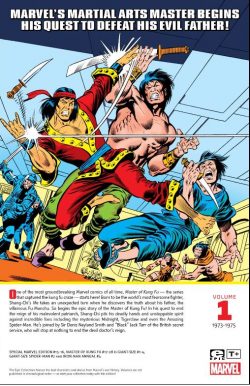
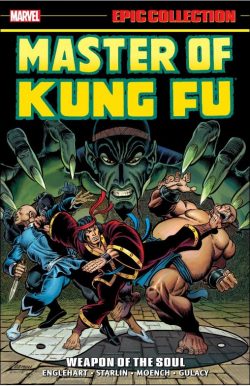
Master of Kung Fu Epic Collection volume 1: 1973-1975 Weapon of the Soul


By Steve Englehart, Jim Starlin, Doug Moench, Gerry Conway, Len Wein, Roger Stern, Paul Gulacy, Ron Wilson, Al Milgrom, Ross Andru, Keith Pollard, Alan Weiss, Walter Simonson, John Buscema, Ed Hannigan, Aubrey Bradford, P Craig Russell, Frank McLaughlin, Jeff Aclin & various (Marvel)
ISBN: 978-1-3029-0135-6 (TPB)

Comic books have always operated within the larger bounds of popular trends and fashions – just look at what got published whenever westerns or science fiction dominated on TV – so when the ancient philosophy and discipline of Kung Fu made its unstoppable mark on domestic western entertainment, it wasn’t long before all those kicks and punches found their way onto four-colour pages of America’s periodicals. Early starter Charlton added Yang and House of Yang to the pioneering Judo Joe and Frank McLaughlin’s Judomaster; DC debuted Richard Dragon and rebooted Karate Kid; Atlas/ Seaboard opened The Hands of the Dragon and Marvel rapidly converted a proposed literary adaptation into an ongoing saga about a villain’s son. A month after it launched, a second orient-tinged hero in Iron Fist: combining combat philosophy, high fantasy and magic powers with a proper superhero mask and costume…

At their core, comics are just another mass-media entertainment form, but even (or do I mean especially?) the most frivolous fun for the largest audiences may carry at its heart cultural and social iniquity, easily-exploitable prejudices and dangerously-pernicious stereotyping and profiling. With that in mind, here’s a thorny subject for all concerned, on so many levels…

After the sublime success and cultural phenomenon of the Black Panther movie, people of colour finally had a heroic icon and cultural touchstone of their very own. The glorious and affirmative characters and stories were based on comics generated over many years by a multitude of talented, well-meaning creators, all originating at a company that was generally liberal, socially aware and earnestly seeking to address issues of prejudice and inclusivity whenever and wherever they found them.

That was black folk sorted, right? However, people of Asian ancestry still cry out for something of relevance and meaning to them. That’s why there’s a blockbuster Shang-Chi movie heading towards our screens in September.

It’s also notionally based on some incredible comics by a variety of gifted individuals and teams, but the white world in general and Marvel in particular have a different kind of history with those of Asian heritage…

Although largely retrofitted for modern times, inspirational Master of Kung Fu star Shang-Chi comes with a lot of tricky baggage. He debuted in the autumn of 1973, cashing in on a 1970s craze for Eastern philosophy and martial arts action which generated an avalanche of “Chop Sockey” movies and a controversial TV sensation entitled Kung Fu. You may recall that the lead in that western-set saga was a half-Chinese Shaolin monk, played – after much publicised legal and industry agitation – by a white actor…

At Marvel, no one at that time particularly griped about the fact that Shang-Chi was designed by editor Roy Thomas and artisans Steve Englehart, Jim Starlin & Al Milgrom as a naive innocent (also half Chinese, with an American mother) thrown into tumultuous modern society as a rebellious but involved counterpoint to his father: an insidious scheming fiend intent on global domination.

Back then, securing rights to a major literary property and wrapping new comics in it was an established practise. It had worked spectacularly with Conan the Barbarian and horror stars like Dracula and Frankenstein. The same process also brilliantly informed seminal science fiction icon Killraven in War of the Worlds and plenty more…

These days we comics apologists keep saying “it was a different era”, but I genuinely don’t think anyone in the editorial office paused for a moment of second thoughts when their new Kung Fu book secured the use one of literature’s greatest villains as a major player. Special Marvel Edition #15 (cover-dated December 1973) launched to great success, and the overarching villain was already a global personification of infamy …Fu Manchu.

Arthur Henry Sarsfield Ward AKA Sax Rohmer’s ultimate embodiment of patronising mistrust and racist suspicion had been hugely popular since 1913’s The Mystery of Dr. Fu-Manchu. The prime archetype for mad scientists and the remorseless “Yellow Peril” threatening civilization, the character spread to stage, screen, airwaves and comics (even appropriating the cover of Detective Comics #1, heralding an interior series that ran until #28), but most importantly, became the visual affirmation and conceptual basis for countless evil “Asiatics”, “Orientals” and “Celestials” dominating popular fiction ever since.

In recent years as we’ve all (well, mostly all) acknowledged past iniquities, Shang-Chi has been reimagined, with that paternal link downplayed or abandoned – as much for licensing laws as social justice.

For the movie, the villainous sire is now The Mandarin, but that only reminds us that, over its decades of existence, Marvel has employed plenty of “Yellow Peril” knock-offs and personifications – including Wong Chu; Plan Tzu (AKA the Yellow – or latterly GoldenClaw); Huang Zhu; Silver Samurai; Doctor Sun ad infinitum: all birds of another colour that are still nastily pejorative shades of saffron. Perhaps this is just my white guilt and fanboy shame talking. These stories, crafted by Marvel’s employees were – and remain – some of the best action comics you’ll ever encounter, but never forget what they’re actually about… distrust of the obviously other…

Without making excuses, I should also state that despite the easy, casual racism suggested by legions of outrageously exotic, inscrutable bad guys haunting this series at every level, Master of Kung Fu did sensitively address issues of race and honestly attempt to share non-Christian philosophies and thought whilst, most importantly, offering potent and powerful role models to kids of Asian origins. So at least there’s that to defend…

Packed with stunning adventure and compellingly convincing drama, this trade paperback and digital collection gathers far-ranging appearances from Special Marvel Edition #15-16; Master of Kung Fu #17-28; Giant-Size Master of Kung Fu #1-4; Giant-Size Spider-Man #2, plus material from Iron Man Annual #4 (collectively spanning December 1973-August 1977) and it opens without a preamble in the middle of a mighty battle…

‘Shang-Chi, Master of Kung Fu!’ introduces a vibrant, brilliant young man raised in utter isolation in the style and manner of imperial China. Reared by monks and savants, the boy is the result of a match between a physically perfect American woman and misunderstood patriot Fu Manchu: a noble hero unfairly hunted and slandered by corrupt western governments and the communist usurpers now blasphemously controlling the world’s greatest empire.

This son was schooled to respect and obey his sire, trained to perfection in martial arts: designed as the ultimate warrior servant and the doctor’s devoted personal weapon against lifelong enemies Sir Dennis Nayland Smith and Doctor Petrie.

On reaching maturity, Shang – who’s name means “the rising and advancing of a spirit” – is despatched to execute Petrie, but after the obedient weapon executes his mission, he subsequently questions his entire life and the worldly benefit of killing an elderly, dying man. An emotional confrontation with Nayland Smith – who endures the daily agonies of being maimed at the Devil Doctor’s command – further shakes the boy’s resolve and eventually Shang’s sublime education demands that he reassess everything his father has taught him…

After invading the villain’s New York citadel and crushing his army of freaks and monsters, Shang Chi faces his father and rejects all he stands for. The battle lines of an epic family struggle are drawn…

Focusing on the madness of modern living, outcast misfit Shang navigates the perils of New York City in the next episode, before reluctantly fighting his childhood companion M’nai in ‘Midnight brings Dark Death!’ It’s another bittersweet betrayal, since Midnight has always known of Fu’s true nature and happily acted as his infallible assassin… until now…

The series had launched in bimonthly reprint title Special Marvel Edition as The Hands of Shang Chi: Master of Kung Fu and by the third issue (April 1974) it became exclusively his. Issue #17’s ‘Lair of the Lost!’ introduced (a painfully, equally stereotypical) True Brit foe who would soon become a trusted ally.

Blackjack Tarr seeks vengeance for his old ally Petrie; luring Shang Chi to a private murder mansion. However, the battle royal ends with all concerned re-evaluating their positions and agreeing to unite to defeat the actual enemy of all humanity…

Scripted by Englehart and inked by Milgrom, #18 was the true turning point in the series. Newcomer Paul Gulacy became penciller, blending a love of popular cinema with a vivid illustration style based on the comics designs of Jim Steranko. ‘Attack!’ sees Shang taking his war to Fu Manchu and his complex, convoluted secret society of assassins and acolytes, invading Fu’s New York base to deliver a salutary declaration of war before undertaking his first mission for spymaster Nayland Smith.

Despatched to Florida to intercept mysterious smugglers and an unknown cargo, the Master of Kung Fu foils a scheme to poison America’s gasoline supply, defeats a supernaturally enhanced Dacoit (look it up: Rohmer’s literary creation enlisted almost every Asian subculture into an admittedly beguiling army of oriental killers faithfully aligned against white imperialism) and escapes a hallucinogenic ambush…

Promoted to monthly with #19 (August 1974), the next chapter sees the hero’s full initiation into the Marvel Universe with a crossover. ‘Retreat’ depicts the still-drugged Shang lost in the Everglades, hunted by assassins and clashing with the monstrous Man-Thing. There’s even a cheeky acknowledgement of the series’ antecedents with a cameo starring a certain TV Sino-American wandering philosopher…

Gerry Conway scripts ‘Weapon of the Soul’ as Mafia boss Demmy Marston targets Shang Chi in an effort to curry favour with Fu Manchu before Doug Moench begins his long association with the series in concluding chapter ‘Season of Vengeance…’ (illustrated by Ron Wilson & Milgrom) clearing the decks for explosive action and epic adventure by demonstrating why Fu is the most dangerous ally an ambitious crook could ever encounter…

By this time – the summer of 1975 – the series was one of Marvel’s most successful, spawning guest shots and extra issues galore. Cover-dated September 1974, Giant-Size Master of Kung Fu #1 offered even more martial arts mayhem in a quarterly spin-off that opened with ‘Death Masque!’ (Moench, Gulacy & Dan Adkins). To celebrate Shang’s birthday, his father orchestrates a terrifying gauntlet of killers, even as the son infiltrates his administrative Council of 7: the Si-Fan…

The double-sized issue also offers apparent change-of-pace yarn ‘Frozen Past, Shattered Memories’ (Moench & P. Craig Russell) as Shang fails to foil a museum robbery; a fact page on ‘Shaolin Temple Boxing’ by comic book Kung Fu pioneer Frank McLaughlin and a parable on racism and psychopathy in Moench, Wilson & Mike Esposito’s ‘Reflections in a Rippled Pool!’

In quick order, Giant-Size Spider-Man #2 (October 1974, by Len Wein, Ross Andru & Milgrom) reinforced the hero’s crossover credentials as ‘Masterstroke!’ finds the wondrous webslinger drawn into battle with the Master of Kung Fu after Fu Manchu frames Spider-Man for attacking Chinese-Americans and sabotaging New York’s power grid. Eventually the duped heroes clear the air Marvel-style in ‘Cross… and Double-Cross!’ before uniting to foil the madman’s true scheme to mindwipe America from the ‘Pinnacle of Doom!’

MOKF #22 (November) sets up the next phase of Shang’s life as a secret agent. In ‘A Fortune of Death!’ (Moench, Gulacy & Dan Adkins) he saves Nayland Smith and Blackjack Tarr while foiling another attempt to destroy America’s complacency and security before Giant-Size Master of Kung Fu #2 (December 1974, by Moench, Gulacy & Jack Abel) declares ‘The Devil-Doctor’s Triumph’ with romantic distraction Sandy Chen enticing our young lonely warrior before tragically teaching him the power of deceit while courting his aid to rescue her father from his father…

With Gulacy going from strength to strength in the Giant-Size tales, Al Milgrom & Klaus Janson stepped in for Moench’s next twisty epic; beginning in MOKF #23 as Shang agrees to quash his father’s potential alliance with a Nazi war criminal, necessitating a lethal voyage up the ‘River of Death!’ The bloody debacle goes completely off-script in ‘Massacre Along the Amazon!’ (Milgrom, Alan Weiss, Starlin, Walt Simonson & Sal Trapani) as Si-Fan, neo-Nazis and indigenous forest people clash, leading to Shang running a savage gauntlet in brutal conclusion ‘Rites of Courage, Fists of Death!’ (Gulacy & Trapani).

Vince Colletta inks Giant-Size Master of Kung Fu #3 (March 1975) as ‘Fires of Rebirth’ introduces British agent Clive Reston (an homage to and descendent of literary icons like James Bond and Sherlock Holmes) as both sides in the unending war seek the last remaining stock of Fu Manchu’s immortality-inducing Elixir Vitae. The hunt catastrophically encompasses Central Park West, the British Museum and Buckingham Palace, involving lethal Phansigars, reanimated Neanderthals and potential new archnemesis Shadow-Stalker before delivering an utterly life-altering surprise to Shang-Chi…

Digging deeper into Romer’s novels, Moench increasingly capitalizes on Fu Manchu’s expansive cast with Master of Kung Fu #26. Limned by Keith Pollard & Trapani, ‘Daughter of Darkness!’ features the Devil Doctor’s recalcitrant first-born Fah Lo Suee (who debuted in either third book The Si-Fan Mysteries/The Hand of Fu-Manchu in 1917 or fourth outing The Daughter of Fu-Manchu in 1931, depending on who you ask) and the son of former valiant Brit Shan Greville and her latest treacherous scheme to supplant her sinister sire using an ancient Egyptian relic…

John Buscema & Frank Springer unite to depict Moench’s ‘Confrontation’ as the family war intensifies over possession of the last dregs of Elixir Vitae and conflicted Shang is pressed to pick a side after the collateral death of an innocent bystander after which Wilson, Ed Hannigan & Aubrey Bradford join Moench and Trapani for #28 as ‘A Small Spirit Slowly Shaped…’ finds Shang Chi invading his childhood home in Honan to save Nayland Smith from his ascendant sister…

Slightly askew of the tight continuity, Giant-Size Master of Kung Fu #4 (June 1975) absurdly enquires ‘Why a Tiger-Claw?’ in a surreal comedy thriller from Moench, Pollard & Trapani as Shang encounters Groucho Marx tribute and living force of irascible nature Rufus T. Hackstabber when a mundane bank robbery leads to a rebellious Si-Fan assassin with a personal agenda and big ambitions…

Wrapping up the martial arts mastery is a short piece from Iron Man Annual #4 (August 1977): an out-of-place Kung Fu vignette by Roger Stern, Jeff Aclin & Don Newton. ‘Death Lair!’ stars the long dead but never forgotten Midnight on a mission of murder for Fu Manchu and targeting Vietnamese rival and old Iron Man enemy Half-Face…

Adding value to the package are Starlin & Milgrom’s original art for the cover of Special Marvel Edition #15; Roy Thomas’ editorial from that issue and assorted house ads, a spoof ad from official fanzine F.O.O.M. and an unused Starlin & Milgrom cover for #17.

In recent years, Shang Chi’s backstory has been forced to adapt and alter. His father has been reinvented as Zheng Zu, Mr. Han, Chang Hu, Wang Yu-Seng and The Devil Doctor and in the end, you have the ultimate choice and sanction of not buying or reading this material.

If you do – with eyes wide open and fully acknowledging that the past is another place that we can now consign to history – your comics appreciation faculties will see some amazing stories incredibly well illustrated: ranking amongst the most exciting and enjoyable in Marvel’s canon.
© 1973, 1974, 1975, 1977, 2018 Marvel Characters, Inc. All rights reserved.
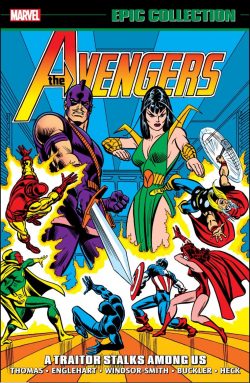
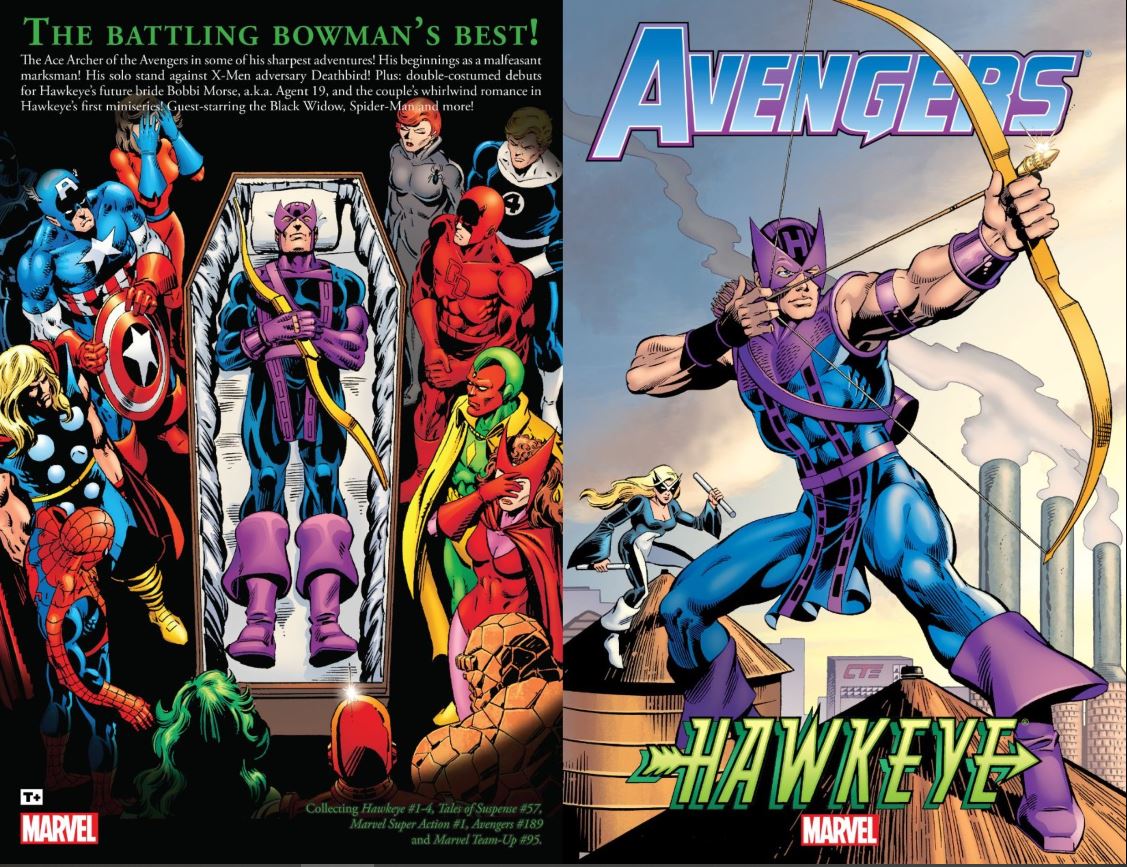
Avengers: Hawkeye


By Mark Gruenwald, Brett Breeding & Danny Bulanadi, with Stan Lee & Don Heck; Mike Friedrich, George Evans & Frank Springer, Steven Grant, John Byrne & Dan Greene, Jimmy Janes & Bruce Patterson & various (Marvel)
ISBN: 978-0-7851-3723-8 (TPB)

Clint Barton is probably the world’s greatest archer: swift, ingenious, unerringly accurate and augmented by a fantastic selection of multi-purpose high-tech arrows. Other masked bow persons are available…

Following an early brush with the law and as a reluctant Iron Man villain beginning in 1964, he reformed to join the Mighty Avengers where he served with honour and distinction, despite always feeling overshadowed by his more glamorous, super-powered comrades.

Long a mainstay of Marvel continuity and probably Marvel’s most popular B-list hero, the Battling Bowman has risen to great prominence in recent years, boosted no doubt by his filmic incarnation.

This brash and bombastic collection – available in paperback and digital formats – re-presents breakthrough miniseries Hawkeye #1-4 and debut from Tales of Suspense #57 (September 1964) plus the first costumed appearance of occasional wife and frequent paramour Bobbi “Mockingbird” Morse from Marvel Super Action #1 (January 1976) and a more-or-less solo outing for each from Avengers #189 (November 1979), and Marvel Team-Up #95 (July 1980) respectively.

Written and drawn by the hugely underrated and much-missed Mark Gruenwald, ably assisted by inkers Brett Breeding & Danny Bulanadi and running from September to December 1983, Hawkeye was one of Marvel’s earliest miniseries and remains one of the very best adventures of Marvel’s Ace Archer.

Much like the character himself, this project was seriously underestimated when first released: most industry pundits and the more voluble fans expected very little from a second-string hero drawn by a professional writer. Guess again, suckers!

In opening chapter ‘Listen to the Mockingbird’, he is moonlighting as security chief for electronics corporation Cross Technological Enterprises when he captures a renegade S.H.I.E.L.D. agent, who reveals that his bosses are all crooks, secretly involved in shady mind-control experiments.

After some initial doubt, Barton teams with a svelte and sexy super-agent in ‘Point Blank’ to foil the plot, gaining in the process a new costume and instant rogues’ gallery of archfoes such as Silence, Oddball and Bombshell in third chapter ‘Beating the Odds’.

As the constant hunt and struggle wears on, Barton succumbs to – but is not defeated by – a physical handicap and wins a wife (not necessarily the same thing) in explosive conclusion ‘Till Death us do Part…’ wherein the sinister mastermind behind it all is finally revealed and summarily dealt with.

In those faraway days both Gruenwald and Marvel Top Gun Jim Shooter maintained that a miniseries had to deal with significant events in a character’s life, and this bright and breezy, no-nonsense, compelling and immensely enjoyable yarn certainly kicked out the deadwood and re-launched Hawkeye’s career. In short order from here the bowman went on to create and lead his own team: The West Coast Avengers, gain his own regular series in Solo Avengers and Avengers Spotlight and his own series, consequently becoming one of the most vibrant and popular characters of the period and today as well as a modern-day action movie icon…

Hard on the heels of the epic comes ‘Hawkeye, the Marksman!’ (by Stan Lee & Don Heck from Tales of Suspense #57) wherein villainous spy the Black Widow resurfaces to beguile an ambitious and frustrated neophyte costumed vigilante hero into attacking her archenemy. Despite a clear power-imbalance, the former carnival archer comes awfully close to beating the Golden Avenger …

Augmented by a Howard Chaykin frontispiece from black-&-white magazine Marvel Super Action #1 (January 1976), former Ka-Zar romantic interest Dr. Barbera Morse is reinvented by Mike Friedrich, George Evans & Frank Springer ‘Red-Eyed Jack is Wild!’. Using unwieldy nomme de guerre Huntress, Morse devotes herself to cleaning up corruption inside S.H.I.E.L.D., no matter what the cost…

Avengers #189 then reveals how Hawkeye got his job at CTE as ‘Wings and Arrows!’ (by Steven Grant, John Byrne & Dan Green) pits the new security chief against alien avian interloper Deathbird, before Huntress becomes Mockingbird for MTU #95. Crafted by Grant, Jimmy Janes & Bruce Patterson ‘…And No Birds Sing!’ ends the long-extant S.H.I.E.L.D. corruption storyline as Morse and Spider-Man join forces to expose the true cancer at the heart of America’s top spy agency…

Packed with terrific tales of old-fashioned romance, skulduggery and derring-do, this book is a no-nonsense example of the straightforward action-adventure yarns that cemented Marvel’s reputation and success. But oh, the tension, the tension…
© 2015 Marvel Characters, Inc. All rights reserved.
The Spectacular Spider-Man: Lo, This Monster


By Stan Lee, Larry Lieber, John Romita Sr., Jim Mooney, Bill Everett & various (Marvel)
ISBN: 978-1-3029-2064-7 (TPB)

The Amazing Spider-Man was always a character and concept which matured with – or perhaps just slightly ahead – of its fan-base. That thought might well have contributed to a rare Marvel misstep during the 1960s as the House of Ideas increasingly challenged the dominance of DC; finally collected here in its own nostalgia-soaked trade paperback and digital tome for your delight and delectation…

After a shaky start, the Wondrous Wallcrawler quickly became a sensational “must-see” with kids of all ages. Before long, the quirky, charming, thrillingly action-packed comics drama would become the model for an entire generation of younger heroes impatiently elbowing aside the (relatively) staid thirty-something mystery-men of previous publications and hallowed tradition.

You know the story: Peter Parker was a smart-but-alienated teenager bitten by a radioactive spider during a high school science trip. Discovering he’d developed astonishing arachnid abilities – which he augmented with his own natural chemistry, physics and engineering genius – the Parker did what any lonely, geeky nerd would do with such newfound prowess: he tried to cash in for girls, fame and money.

Crafting a costume to hide his identity in case he made a fool of himself, Parker became a minor media celebrity – and a criminally self-important one. To his eternal regret, when a thief fled past him one night, he didn’t lift a finger to stop him, only to find when he returned home that his beloved guardian uncle Ben Parker had been murdered.

Crazed and vengeful, Peter hunted the assailant who’d made doting Aunt May a widow and killed the only father he had ever known. When, to his horror, he discovered it was the self-same felon he had neglected to stop, and that irresponsibility had resulted in the death of the man who raised him, the traumatised boy swore to forevermore use his powers to help others…

Since that night, the Wondrous Wallcrawler has tirelessly battled miscreants, monsters and madmen, with a fickle, ungrateful public generally baying for his blood even as he saves them.

Already the darlings of college campuses and media intelligentsia, the Amazing Arachnid’s rise increased pace as the Swinging Sixties closed, with Peter and his ever-expanding cast of comrades well on the way to being household names. Stan Lee’s scripts were completely in tune with the times – as perceived by most kids’ parents at least – and an increasing use of soap opera plots kept older readers glued to the series even if the bombastic battle sequences didn’t.

In 1968, the company finally broke free of a restrictive distribution deal and exponentially expanded. All these factors combined to prompt a foray into the world of oversized mainstream magazines (as successfully developed by James Warren with Eerie, Creepy and Vampirella) which could be higher priced and produced without restrictive oversight from The Comics Code Authority. The result was the quarterly Spectacular Spider-Man #1-2 (July-November 1968): a genuinely wonder-filled thrill for 9-year-old me, but clearly not the mainstream mass of Marvel Mavens…

Re-presented here are both issues, material from the unpublished third and a variety of background supplements, beginning with that first bombastic booklet.

Following a painted cover – Marvel’s first – by John Romita (senior) and illustrator Harry Rosenbaum, the main feature of Spectacular Spider-Man #1 was ‘Lo, This Monster!’ by Lee, John Romita (senior) & Jim Mooney: an extended, political thriller with charismatic reformer Richard Raleigh tirelessly campaigning to become Mayor, but targeted and hunted by a brutish titan seemingly determined to keep the old political machine in place at all costs…

Rendered in moody wash tones, the drama soon disclosed a sinister plotter directing the monster’s campaign of terror… but his identity was the last one Spidey expected to expose…

Also included in the magazine and here was a retelling of the hallowed origin tale as described above. ‘In the Beginning…’ is crafted by Lee, with brother Larry Lieber’s pencils elevated by inks-&-tones from the legendary Bill Everett. Rounding out the experience is a tantalising ‘Next issue’ ad which neatly segues into an all-Romita painted cover and the magazine experiment’s premature the conclusion…

Three months later The Spectacular Spider-Man #2 came out. It was radically different from its predecessor. To offset disappointing sales, Marvel had swiftly switched to a smaller size and added comic book colour. It also sported a Comics Code symbol.

A proposed third issue which would have debuted the Prowler never appeared. It was to be the last attempt to secure ostensibly older-reader shelf-space until the mid-1970s. At least the story in #2 was top-rate…

Following monochrome recap ‘The Spider-Man Saga’ Lee, Romita & Mooney dealt with months of foreshadowing in the monthly comic book series by finally revealing how Norman Osborn had shaken off selective amnesia and returned to full-on super-villainy in ‘The Goblin Lives!’

Steeped in his former madness and remembering Peter Parker was Spider-Man, Osborn plays cat and mouse with his foe, threatening all the hero’s loved ones until a climactic closing battle utilising hallucinogenic weapons again erases the Green Goblin personality… for the moment…

A full colour teaser for never-seen #3’s “The Mystery of the TV Terror!” leads off the extra features, followed by a Dean White version of #2’s cover which fronted 2012’s Marvel Masterworks: The Amazing Spider-Man vol 7 and house ads from various 1968 Marvel comics for Spectacular Spider-Man #1 & 2.

Also included are Romita’s original pencils for the covers of both, with the painted end-products by Harry Rosenbaum and Romita respectively and a 1988 text feature from Marvel Visions #29 detailing ‘The Greatest Comics Never Seen’, and offering sketches and unused pages of the antihero we know as The Prowler (who was legendarily invented by schoolboy John Romita Jr.).

This book is Marvel and Spider-Man at their peak. If you fancy a taste of something simultaneously tried-&-true and spectacularly radical, this might be the book for you.
© 2019 MARVEL

Namor, the Sub-Mariner Epic Collection volume 1 1962-1966: Enter the Sub-Mariner


By Stan Lee & Jack Kirby, Larry Lieber, Gene Colan, Dick Ayers, Wallace Wood & various (Marvel)
ISBN: 978-1-3029-2836-0 (TPB)

Prince Namor, the Sub-Mariner is the offspring of a water-breathing Atlantean princess and an American polar explorer: a hybrid being of immense strength; highly resistant to physical harm; able to fly and exist above and below the waves. Created by young, talented Bill Everett, Namor technically predates Marvel/Atlas/Timely Comics.

He first caught the public’s attention as part of the fire vs. water headlining team in Marvel Comics #1 (October 1939 and soon to become Marvel Mystery Comics). He shared honours and top billing with The Human Torch, but had originally been seen (albeit in a truncated monochrome version) in Motion Picture Funnies: a promotional giveaway handed out to moviegoers earlier in the year.

Quickly becoming one of the company’s biggest draws, Namor gained his own title at the end of 1940 (cover-dated Spring 1941) and was one of the last super-characters to go at the end of the first heroic age.

In 1954, when Atlas (as the company then was) briefly revived its costumed character “Big Three” (the Torch and Captain America being the other two), Everett returned for a run of superb fantasy tales, but even so the time wasn’t right and the title sunk again.

When Stan Lee & Jack Kirby started reinventing comic-books in 1961 with the Fantastic Four, they revived the all-but-forgotten awesome amphibian as a troubled, semi-amnesiac, and decidedly more regal, if not grandiose, antihero. The returnee despised humanity; embittered at the loss of his sub-sea kingdom (seemingly destroyed by American atomic testing) whilst simultaneously besotted with the FF‘s Sue Storm.

Namor knocked around the budding Marvel universe for a few years, squabbling with other assorted heroes such as the Hulk, Avengers and X-Men, before securing his own series as one half of Tales to Astonish.

Marvel’s “split-books” had been devised as a way to promote their burgeoning stable of stars whilst labouring under a highly restrictive distribution deal limiting the number of titles they could release per month. In 1968 the company ended this commitment and expanded exponentially.

This first celebratory volume – available in trade paperback and eBook formats collects all those early 1960’s guest shots in one tumultuous tome. Here you’ll find Fantastic Four # 4, 6, 9, 14, 27, 33 and Annual #1; Strange Tales #107 & 125; Avengers #3-4; X-Men #6, Daredevil #7 and the first arc of his own series from Tales to Astonish #70-76. These span May 1962 – February 1966 and open without preamble on that fateful first encounter in this cataclysmic clutch of curated classics…

Crafted by Lee Kirby & Sol Brodsky, Fantastic Four #4 proudly shouted ‘The Coming of the Sub-Mariner’, reintroducing (or introducing) the all-powerful amphibian Prince of Atlantis. The star of Timely’s Golden Age had been lost since 1955 – almost a lifetime for the kids believed to be the prime consumer of comics.

A victim of amnesia, the relic recovers his memory thanks to some rather brusque treatment by teen delinquent and AWOL Human Torch Johnny Storm. Namor rapidly returns to his sub-sea home only to find it destroyed by atomic testing. A monarch without subjects, he swears vengeance on humanity and attacks New York City with a gigantic monster. After its demise amidst a mass of collateral destruction, Sub-Mariner espies and falls for the Invisible Girl: a fascination that will fuel many a monumental battle…

This saga is when the Fantastic Four series truly kicked into high-gear and Reed Richards was the star of the pin-up section reprinted here…

FF #5 debuted the diabolical Doctor Doom who returned in the next issue after duping and teaming up with a reluctant Sub-Mariner to attack the quarrelsome quartet heroes as ‘The Deadly Duo!’ – inked by new regular embellisher Dick Ayers.

Issue #9 declared ‘The End of the Fantastic Four’ as Sub-Mariner Prince Namor returns to exploit another brilliant innovation in comic storytelling. When had a super-genius superhero ever messed up so much that the team had to declare bankruptcy? When had costumed crimefighters ever had money troubles at all? The eerily prescient solution was to “sell out” and make a blockbuster movie – giving Kirby a rare chance to demonstrate his talent for caricature…

Of course, Sub-Mariner’s film project is simply a ruse to divide and conquer and everything is settled with bombastic action and typically off-kilter romantic twist…

The saga is topped off with a Fantastic Four Feature Page explaining ‘How the Human Torch Flies!’

By this time kid-friendly teen Johnny Storm had been awarded a solo-starring lead series in former mystery anthology Strange Tales. Scripted by Larry Lieber and limned by Ayers, #107 featured a splendidly mindless punch-up with the ‘Sub-Mariner’ – a tale powerfully reminiscent of the spectacular and immensely popular Golden Age battles of their publishing forebears.

It’s back to Fantastic Four next as #14 (Lee, Kirby & Ayers) features the return of ‘The Sub-Mariner and the Merciless Puppet Master!’: with one vengeful fiend the unwitting mind-slave of the other, after which 1963’s Fantastic Four Annual #1 offers a spectacular 37-page epic battle as, finally reunited with their wandering prince, the warriors of Atlantis invade New York City and the rest of the world in ‘The Sub-Mariner versus the Human Race!’ by Lee, Kirby & Ayers.

A monumental tale by the standards of the time, the saga saw the FF repel the undersea invasion through valiant struggle and brilliant strategy, and includes the secret history of the secretive race Homo Mermanus. Nothing is really settled except a return to the original status quo, but the thrills are intense and unforgettable…

Also included is a rousing pin-up of Namor from ‘A Gallery of the Fantastic Four’s Most Famous Foes!’.

By now Marvel had many more superheroes and Namor met some in Avengers #3. In the previous issue, the volatile Hulk quit the nascent team in disgust, only to return here as an outright villain in partnership with ‘Sub-Mariner!’ (by Lee, Kirby & Paul Reinman). This globe-trotting romp delivers high-energy thrills and one of the best battle scenes in comics history as the assorted titans clash in abandoned World War II tunnels beneath the Rock of Gibraltar.

Inked by George Roussos, Avengers #4 was a groundbreaking landmark as Marvel’s greatest Golden Age sensation returned in another increasingly war-torn era. ‘Captain America joins the Avengers!’ has everything that made the early tales so fresh and vital. The majesty of a legendary warrior returned in our time of greatest need: stark tragedy in the loss of his boon companion Bucky, aliens, gangsters, the menacing majesty of Sub-Mariner and even subtle social commentary capped by vast amounts of staggering Kirby Action.

The creators had hit on a winning formula by including other stars in guest-shots – especially as readers could never anticipate if they would fight with or beside the home team. FF #27 again finds the undersea anti-hero in amorous mood, but after abducting Sue, he finds the boys have called in called in Doctor Strange, Master of the Mystic Arts to aid them in ‘The Search for Sub-Mariner!’

Delivered by Lee & Kirby, X-Men #6 features ‘Sub-Mariner Joins the Evil Mutants!’: a self-explanatory tale of gripping intensity elevated to magical levels of artistic quality as superbly slick inker Chic Stone adds crisp clarity to proceeding when potential mutant Namor is duped into joining malevolent Magneto and his sinister brotherhood. The issue also incorporates a stunning ‘Special Pin-up page’ starring “Cyclops”.

Impetus was building and support growing for renewed sub-sea skirmishes starring Namor, and Strange Tales #125 (October 1964) presented another bombastic battle between the old adversaries as the Torch and Thing picked a fight with the sea lord in ‘The Sub-Mariner Must Be Stopped!’ courtesy of Lee, Ayers & Reinman.

The princely PR campaign then blossomed into unlikely alliance as FF #33 saw the team ‘Side-by-Side with Sub-Mariner!’ (Lee, Kirby & Stone): bringing the aquatic antihero one step closer to his own series as they lend surreptitious aid to the embattled undersea monarch against deadly barbarian Attuma and supplemented by a glorious Kirby & Stone ‘Prince Namor Pin-up’.

As previously stated, prior to Tales to Astonish, Namor appeared in numerous titles as guest villain du jour. One last guest shot with Namor acting as a misunderstood bad-guy was Daredevil #7 (April 1965): a tale that qualifies as a perfect comic book and a true landmark – to my mind one of the Top Ten Marvel Tales of all Time.

Here, Lee and creative legend Wally Wood concocted a timeless masterpiece with ‘In Mortal Combat with… Sub-Mariner!’ as Prince Namor of Atlantis – recently reunited with the survivors of his decimated race – returns to the surface world to sue mankind for their crimes against his people. To expedite his claim, the Prince engages the services of Matt Murdock‘s law firm; little suspecting the blind lawyer is also the acrobatic Man without Fear.

Whilst impatiently awaiting a hearing at the UN, Namor is informed by his lover Lady Dorma that his warlord Krang has stolen the throne in his absence. The tempestuous monarch cannot languish in a cell when the kingdom is threatened, so he fights his way to freedom through the streets of New York, smashing battalions of National Guard and the dauntless Daredevil with supreme ease.

The hopelessly one-sided battle with one of the strongest beings on the planet shows the dauntless courage of DD and the innate nobility of a “villain” far more complex than most of the industry’s usual fare at the time.

Augmented by a rejected Wood cover repurposed as ‘A Marvel Masterwork pin-up: Namor and D.D.’ this yarn is merely a cunning prequel…

A few months later Tales to Astonish #70 heralded ‘The Start of the Quest!’ as Lee, Gene Colan (in the pseudonymous guise of Adam Austin) & Vince Colletta set the Sub-Mariner to storming an Atlantis under martial law. The effort is for naught and the returning hero is rejected by his own people. Callously imprisoned, the troubled Prince is freed by the oft-neglected and ignored Lady Dorma…

As the pompous hero begins a mystical quest to find the lost Trident of King Neptune – which only the rightful ruler of Atlantis can hold – he is unaware that treacherous Krang allowed him to escape, the better to destroy him with no witnesses…

The serialised search carries Namor through a procession of fantastic adventures and pits him against a spectacular array of sub-sea horrors: a giant octopus in ‘Escape… to Nowhere’; a colossal seaweed man in ‘A Prince There Was’ and a demented wizard and energy-sapping diamonds in ‘By Force of Arms!’

As the end approaches in ‘When Fails the Quest!’, revolution grips Atlantis, and Namor seemingly sacrifices his kingdom to save Dorma from troglodytic demons the Faceless Ones.

In issue #75 ‘The End of the Quest’ finds the Prince battling his way back into Atlantis with a gravely-injured Dorma, before the saga calamitously concludes in ‘Uneasy Hangs the Head…!’ with the status quo restored, Namor again on the stolen throne and further danger and drama to come…

Supplemented with House ads, a full cover gallery, unseen, unused and original artwork pages and more, this assemblage of tales feature some of Marvel’s very best artists at their visual peak, with creative verve and enthusiasm shining through.

Perhaps more vicarious thrill than fan’s delight, many early Marvel Comics are more exuberant than qualitative, but this volume, especially from an art-lover’s point of view, is a wonderful exception: a historical treasure that fans will find irresistible.
© 2021 MARVEL.