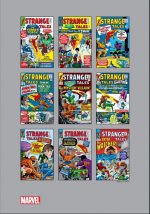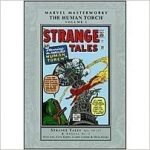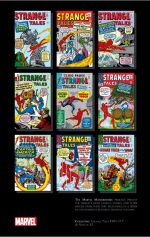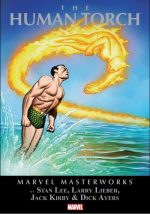
The Human Torch Marvel Masterworks volume 2

By Stan Lee, Larry Ivie, Dick Ayers, Bob Powell, Jack Kirby, Carl Burgos & various (Marvel)
ISBN: 978-0-7851-3505-0 (HB)

Win’s Christmas Gift Recommendation: Evergreen Superhero Frolics… 9/10

Hot on the heels of the Fantastic Four’s stunning success, Stan Lee & Jack Kirby spun the team’s most colourful and youngest member into his own series, eager to recapture the 1940s glory days when the Human Torch was one of the company’s “Big Three” superstars.

This captivating, esoteric and joyously exuberant collection of pure 1960s superhero shenanigans gathers those the latter end of those eclectic but crucial yarns from Strange Tales #118 to 134, (spanning March 1964 to July 1965) and comes with an evocative Introduction from Bruce Canwell before all the hot action kicks off…

Filled with fabulous classics of old school Marvel Fights ‘n’ Tights mayhem and mirth, this particular compendium (available in scarce but sturdy Hardback and assorted eBook formats) is a perfect antidote to angst overload.

Within a year of FF #1, magic-&-monsters anthology Strange Tales became the home for our hot-headed hero as issue #101 saw mostly-typical teenager Johnny Storm start an ancillary solo career. The non-stop riot of adventure begins here with Stan Lee & Dick Ayers highlighting the return of envy-obsessive hyper-intellectual the Wizard who has yet another go at the Flaming Kid in ‘The Man Who Became the Torch!’, an act which consequently nearly kills the Thing and Reed Mister Fantastic Richards besides.

A first brush with Marvel’s soon-to-be core readership came in #119. ‘The Torch Goes Wild!’ details how Commie AgentRabble Rouser mesmerises decent citizens, making them surly and rebellious, after which Jack Kirby pops back for #120 as ‘The Torch Meets Iceman!’: a terrific action-extravaganza with Ayers inks that pretty much closes the glory days of this strip. From then on, despite every gimmick – and occasional burst of sheer inspiration the Bullpen could muster – a slow decline sets in as quirky back-up strip Doctor Strange grew in popularity and cover space…

ST #121 sees Johnny as ‘Prisoner of the Plantman!’ (by Lee & Ayers) and #122 finds a thug, a conman and a crooked yogi all augmented by Dr. Doom and mustered as a woefully inadequate Terrible Trio ordered to launch an ill-conceived attack in ‘3 Against the Torch!’

Strange Tales #123 has a creepy inventor build himself an impressive insectoid exo-suit to get rich the easy way, as – in an effort to boost ratings – The Thing becomes a permanent fixture in ‘The Birth of the Beetle!’

This saga was most notable for the pencil job by Golden Age Human Torch originator Carl Burgos, after which Johnny and Ben tackle a fully re-designed ‘Paste-Pot Pete’ (Ayers inked by Paul Reinman) before going after another old adversary in ‘The Sub-Mariner Must Be Stopped!’

‘Pawns of the Deadly Duo!’ host a fresh assault by the Puppet Master, allied to the Mad Thinker in a smart yarn, after which #127 pits Ben and Johnny against a bizarre and baffling puzzle thanks to ‘The Mystery Villain!’

After a stunning Kirby pin-up of the Thing, the Fantastic Two then unwillingly battle ‘Quicksilver and the Scarlet Witch’in #128 (this one inked by Frankie Ray, AKA Frank Giacoia), as the Homo Superior siblings make an abortive first attempt to quit Magneto‘s Brotherhood of Evil Mutants, after which ‘The Terrible Trio!’ once more fail to impress or assassinate our heroes…

Pop culture at its most opportunistic reeled and staggered with #130 in ‘Meet the Beatles’ (not villains, but actually some sort of popular musical combo of the times, whom they actually didn’t meet at all), although sublime Golden Age artist Bob Powell (with inking from Chic Stone) did take over the art chores for the comedy of errors/crime caper.

Ayers returned to ink #131, a frankly dire Lee script entitled ‘Bouncing Ball of Doom!’, with the Mad Thinker siccing a cybernetic bowling bowl on our torrid twosome before Larry Ivie scripts a capable Space Race thriller in ‘The Sinister Space Trap!’ (inked by Mike Esposito under his Mickey DeMeo alias).

Lee returned for the last two Torch tales in ST #133 and #134: beginning with sharp-looking saga ‘The Terrible Toys’, wherein Puppet Master tries a new modus operandi and closing with ‘The Challenge of… The Watcher!’ (inked by the majestic Wally Wood) wherein Torch and Thing are transported to ancient Camelot to battle time-reaver Kang the Conqueror.

It was clear the writer’s mind was elsewhere, most likely with the new Nick Fury, Agent of S.H.I.E.L.D. strip that would replace the FF pair from Strange Tales #135 onwards.

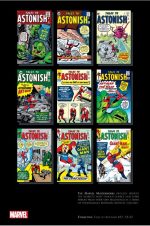
Wrapping up this memory lane meander is a tantalising cover gallery from the 1974-75 reprint series of Golden and Silver Age Torch Tales, rendered by John Romita, Joe Sinnott, Larry Lieber, Ron Wilson, Frank Giacoia, Gil Kane, Al Milgrom &Vince Colletta, to complete your visit with the hottest duo in early Marvel history.

It’s remarkable to note that as the parent Fantastic Four title grew in scope and quality, the Human Torch’s own series diminished. Perhaps there is something to be said for concentrating one’s efforts or not overexposing your stars. Maybe it was just having Kirby do some plotting? Here, however, what was originally a spin-off for younger readers faded as Marvel found its voice and its marketplace, although there would be periodic efforts to reinvigorate the Torch.

Perhaps the historic value supersedes the quality of most of these strange tales, but there’s still a great deal that’s great about this series and Costumed Drama devotees with a sense of tradition and love of fun will find this book irresistible and unmissable.
© 2020 MARVEL.

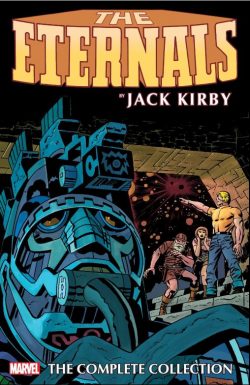
The Eternals by Jack Kirby: The Complete Collection


By Jack Kirby & various (Marvel)
ISBN: 978-1-3029-2200-9 (TPB)

Win’s Christmas Gift Recommendation: Monumental Marvel Magic for Movie-Oriented Fun Seekers… 9/10

Jack Kirby was – and remains – the most important single influence in the history of American comics. There are millions of words about what the man has done and meant, and you should read those if you are at all interested in our medium.

Naturally, I’m adding my own two-bobs’-worth, pointing out what you probably already know: Kirby was a man of vast imagination who translated big concepts into astoundingly potent and accessible symbols for generations of fantasy fans. If you were exposed to Kirby as an impressionable kid, he owns you for life. To be honest, the same probably applies whatever age you jump aboard the “Kirby Express”…

For those of us who grew up with Jack, his are the images which furnish our interior mindsets. Close your eyes and think “robot” and the first thing that pops up is a Kirby creation. Every fantastic, futuristic city in our heads is crammed with his chunky, towering spires. Because of Jack, we all know what the bodies beneath those stony-head statues on Easter Island look like, we’re all viscerally aware that you can never trust great big aliens parading around in their underpants and, most importantly, we know how cavemen dress and carnosaurs clash. Kirby’s creations are magical: they all inspire successive generations of creators to pick up the ball and keep running with it…

In the late 1930s, it took a remarkably short time for Kirby and his creative partner Joe Simon to become the wonder-kid dream-team of the newborn comic book industry. Together they produced a year’s worth of pioneering influential monthly Blue Bolt; dashed out Captain Marvel Adventures (#1) for overstretched Fawcett and – after Martin Goodman appointed Simon editor at Timely Comics – co-created a host of iconic characters such as Red Raven, the original Marvel Boy, Mercury, Hurricane, The Vision, Young Allies and of course million-selling mega-hit icon Captain America.

When Goodman failed to make good on his financial obligations, Simon & Kirby were snapped up by National/DC, who welcomed them with open arms and a fat chequebook. Bursting with ideas the staid company were never really comfortable with, the Dynamism Duo were initially an uneasy fit, and were given two moribund strips to play with until they found their creative feet: These were Sandman and Manhunter and they are an amazing feat of breathtaking bravura.

Both features turned both around virtually overnight and, once established, were parcelled off to studio staff as S&K switched to the “Kid Gang” genre they had pioneered at Timely. Joe ‘n’ Jack created wartime sales sensation Boy Commandos and Homefront iteration the Newsboy Legion, before being called up to serve in the war they had been fighting on comic pages since 1940.

Once demobbed, they returned to a very different funnybook business and soon left National to create their own little empire…

Simon & Kirby heralded and ushered in the first American age of mature comics – not just by inventing the Romance comic, but with all manner of challenging modern material about real people in extraordinary situations – before seeing it all disappear again in less than eight years.

Their small stable of magazines – generated for the association of companies known as Prize, Crestwood, Pines, Essenkay and/or Mainline Comics – blossomed and as quickly wilted when the industry abruptly contracted throughout the 1950s. After years of working for others, Simon & Kirby had finally established their own publishing house, producing comics for a far more sophisticated audience, only to find themselves in a sales downturn and awash in public hysteria generated by an anti-comicbook pogrom.

Hysterical censorship-fever spearheaded by US Senator Estes Kefauver and opportunistic pop psychologist Dr. Frederic Wertham led to witch-hunting Senate hearings. Caving in, publishers adopted a castrating straitjacket of draconian self-regulatory rules. Horror titles produced under the aegis and emblem of the Comics Code Authority were sanitised and anodyne affairs in terms of Shock and Gore, even though the market’s appetite for suspense and the uncanny was still high. Crime comics vanished and mature themes challenging an increasingly stratified and oppressive society were suppressed…

Simon quit the business for advertising, but Jack soldiered on, taking his skills and ideas to a number of safer, if less experimental, companies. As the panic abated, Kirby returned briefly to DC Comics where he worked on mystery tales and Green Arrow (at that time a mere back-up, page-filler in Adventure Comics and World’s Finest Comics) whilst concentrating on his long-dreamed-of newspaper strip Sky Masters of the Space Force.

During that period Kirby also re-packaged an original super-team concept that had been kicking around in his head since he and Joe had closed their studio. At the end of 1956, Showcase #6 premiered the Challengers of the Unknown…

After three more test issues the “Challs” won their own title with Kirby in command for the first eight issues. Then a legal dispute with Editor Jack Schiff exploded and the King was gone…

He found fresh fields and an equally hungry-for-change new partner in Stan Lee at ailing Atlas Comics (which had once been mighty Timely) and there created a revolution in superhero comics storytelling…

After just over a decade of never-ending innovation and crowd-pleasing wonderment, Kirby felt increasingly stifled. His efforts had transformed the little publisher into industry-pioneer Marvel but now felt trapped in a rut. Thus, he moved back to DC for another burst of sheer imagination and pure invention.

Kirby always understood the fundamentals of pleasing his audience and strived diligently to combat the appalling state of prejudice about the comics medium – especially from industry insiders and professionals who despised the “kiddies’ world” they felt trapped in.

After his controversial, grandiose Fourth World titles were cancelled, Kirby looked for other concepts which would stimulate his own vast creativity yet still appeal to a market growing evermore fickle. His follow-ups included science fiction themed heroes Kamandi and OMAC, supernatural stalwart The Demon, a run of war stories starring The Losers, and even a new Sandman, co-created with Simon, but although the ideas kept coming (Atlas, Kobra, Dingbats of Danger Street), yet again editorial disputes ended up with him leaving for promises of more creative freedom elsewhere…

Jack Kirby’s return to Marvel in 1976 was much hyped at the time but again turned out to be controversial. His new works and creations found friends rapidly, but his return to earlier creations Captain America and Black Pantherdivided the fanbase.

Kirby was never slavishly wedded to tight continuity, and preferred, in many ways, to treat his stints on titles as another “Day One”: a policy increasing at odds with the close-continuity demanded by a strident faction of the readership…

They were apparently blind to the unfettered, joyous freedom of imagination run wild, the majesty of pulse-pounding thrills and galvanising BIG ART channelling BIG IDEAS!

The end of the 1970s saw Kirby drift into animation: designing characters and scenarios for shows such as Turbo-Teen, Thundarr the Barbarian and even The New Fantastic Four. His comics efforts included graphic novel The Hunger Dogs and Super Powers for DC, and an adaptation of movie The Black Hole for syndicated strip Walt Disney’s Treasury of Classic Tales.

However, his most memorable move was to validate the newly-minted Independent Comics/Direct Sale Market sector where he launched bombastic sci fi shockers Captain Victory and the Galactic Rangers and Silver Star for distributor-turned-publisher Pacific Comics.

For Eclipse, he co-created with Steve Gerber the industry-excoriating symbol of creative rebellion Destroyer Duck (part of a grass-roots campaign that ultimately destroyed the iniquitous work-for-hire business model that had made creators little more than indentured servants for decades).

Let’s return to that final tenure at Marvel though. Despite his ideas frequently clashing with the company continuity, and being editorially sabotaged, his new ideas found an appreciative audience. 2001: A Space Odyssey, Devil Dinosaur and Machine Man broke new ground but his greatest and final contribution was undoubtedly his treatment of a contemporary crypto-science fad: The Eternals…

Now with a blockbuster Marvel movie just waiting on the shelf for punters to come watch it, the eccentric original feature has been squeezed into a trade paperback and digital Complete Collection (containing issues #1-20 and Eternals Annual#1 from June 1976 to January 1978), and is just crying out for you to come get it…

Written and drawn by Kirby withs inks by John Verpoorten, it all begins on ‘The Day of the Gods’, as anthropologist Doctor Damian and his daughter Margo are steered by mysterious guide Ike Harris through an incredible South American temple to discover that aliens inspired and educated the ancients…

Simultaneously, half a world away, diabolical monsters emerge from millennia of self-isolation to resume a war that spans the length of human existence…

And so begins a frantic scrabble as history is rewritten and humanity learns terrible truths: how giant aliens had visited Earth in ages past, sculpting proto-hominids into three distinct species: Human Beings; monstrous, genetically unstable Deviants and god-like super-beings who called themselves Eternals. Moreover, those humungous Space Gods have returned once again to check up on their experiment…

Remember Ike? His real name is Ikaris and he’s an Eternal monitoring how ‘The Celestials!’ will react as they set up to assess their experiment. As a country-sized ship enters Earth orbit, a cadre of mountain-sized aliens set up a monitoring station in the ruins, ignoring humanity, Deviants and Eternals alike, but the monstrous faction who once subjugated mankind and inspired most of our infernal mythology have resolved to destroy their creators whatever the cost…

The plan involve provoking humanity into rash attacks and their warlord Kro unleashes hell as ‘The Devil in New York!’Sadly for him and his vile minions, Ikaris has just left potentially orphaned Margo with capricious party-loving Sersi at her Manhattan apartment just in time to be truly ticked off by ‘The Night of the Demons!’

Mike Royer takes over as series inker with #5 as the solitary Eternals finally respond by having a committee meeting in their isolated citadel ‘Olympia!’ In the meantime, Sersi, Margo and Ikaris have been abducted to the Deviants’ undersea city, invoking a brutal response from warrior princess Thena, excitable speedster Makkari and a novel one from supreme Eternal Zuras who calls a press conference to explain Earth’s real history in ‘Gods and Men at City College!’

As ‘The Fourth Host’ take their mysterious measurements around the world, spy agency SHIELD infiltrates the Space God compound and almost triggers Armageddon, even as in Deviant Lemuria clandestine war within the ruling family endangers ‘The City of Toads’, while introducing two more tormented characters who fit no mould or definition.

The first is comely Ransak, and the other horrific Karkas: but which one is ‘The Killing Machine!’ too savage even for the Deviant arena?

The question remains unanswered as a curious Celestial invades the city in ‘Mother!’ sparking catastrophe and mass evacuation, even as the still-gathering Eternals debate their future in Olympia. The world’s doom-clock then jumps closer to midnight as the Soviets respond precipitately in ‘The Russians are Coming!’ just as the godly Eternals form a psychic gestalt to meet the Space Gods on more equal terms in ‘Uni-Mind!’

An extra-length diversion follows as The Eternals Annual #1 pits recently-relocated Ransak and Karkas against ‘The Time Killers’, after which the mind-blowing Story of Us resumes with human ‘Astronauts’ breaking into the Celestial orbiter, and proving an unreasonable response from the youngest Eternal and a forgotten colossus of human legend…

Presumably in response to publisher pressure, Kirby almost perpetrates a guest appearance from the mainstream Marvel Universe as a college experiment unleashes uncanny cataclysm in ‘Ikaris and the Cosmic Powered Hulk’: a brutal battle leaving the local environs a ‘Disaster Area’ and uncovering a lost terror of antiquity imprisoned in a subterranean ‘Big City Crypt’…

The awesome menace ignores the best the Eternals can muster, but ultimately falls to ‘Sersi the Terrible’, precipitating another crisis as sly, scheming Druig disregards the concerns of his fellow immortals and attempts ‘To Kill a Space God!’, before falling to the sheer determination of Ikaris in ‘The Pyramid’…

And then it stopped. Never a comfortable fit with the rest of the Marvel Universe, the comic explored Kirby’s fascinations with Deities, Space and Supernature through the lens of very human observers. Once the series ended and Kirby left, other creators greedily co-opted the concept – with mixed success – into the company’s mainstream continuity. The concept remade the greater continuity and there’s been duff and excellent reinterpretations ever since.

No matter their merits though, nothing has ever matched The King’s verve, passion or scope and scale…

This volume also includes unused art and covers, character designs, original art pages, pages of Kirby pencils, promotional house ads and editorial pages, plus a gallery of covers from previous collections.

Jack Kirby’s commitment to wholesome adventure, breakneck action and breathless wonderment, combined with his absolute mastery of the comic page and unceasing quest for the Next Big Thrill always makes for a captivating read. His comics should be compulsory for all and found in every home…
© 2020 MARVEL

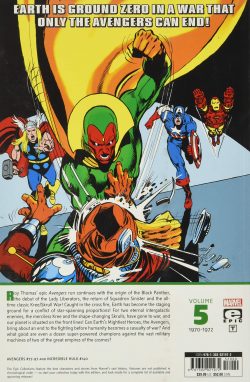
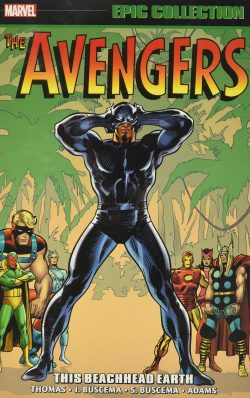
Avengers Epic Collection volume 5 1970-1972: This Beachhead Earth


By Roy Thomas, Harlan Ellison, John Buscema, Sal Buscema, Frank Giacoia, Herb Trimpe, Sam Grainger, Neal Adams & various (Marvel)
ISBN: 978-1-3029-2197-2 (TPB)

Win’s Christmas Gift Recommendation: Matchless Blockbuster Action… 9/10

One of the most momentous events in Marvel Comics history occurred in 1963 when a disparate array of individual heroes banded together to stop the Incredible Hulk.

The Avengers combined most of the company’s fledgling superhero line in one bright, shiny and highly commercial package. Over the decades the roster has unceasingly changed, and now almost every character in their universe has at some time numbered amongst their colourful ranks…

The Avengers always proved that putting all one’s star eggs in on single basket paid off big-time; even when all Marvel’s all-stars such as Thor, Captain America and Iron Man were absent, it merely allowed the lesser lights of the team to shine more brightly.

Of course, all the founding stars regularly featured due to a rotating, open door policy which meant that most issues included one of any reader’s favourites. The increasingly bold and impressively ambitious stories and artwork were no hindrance either.

This robust trade paperback and eBook compilation gathers the astounding contents of Avengers issues #77-97, plus a crossover classic from Incredible Hulk #140, collectively spanning June 1970 – March 1972: a riot of informed social commentary and astounding cosmic calamity which confirmed scripter Roy Thomas as a major creative force in comics whilst simultaneously demonstrating the potential the “debased” medium could aspire to.

At the time Thomas’ bold experiment was rightly considered the most ambitious saga in Marvel’s brief history: astounding sagas of tremendous scope which dumped Earth into a cosmic war the likes of which comics fans had never before seen.

“The Kree/Skrull War” set the template for all multi-part crossovers and publishing events from that point onwards and was followed by more astounding epics proving that more and better was to come…

This epochal tome opens ss the tone of the times shifted and comics titles entered a period of human-scaled storytelling dubbed “Relevancy” and here – crafted by Thomas, John Buscema & Tom Palmer – a far more mundane and insidious menace manifests as billionaire financier Cornelius Van Lunt manoeuvres to bankrupt Avengers (currently Cap, Black Panther, Goliath, the Vision, Scarlet Witch and Quicksilver) sponsor Tony Stark, compelling the team to become the mystery magnate’s ‘Heroes for Hire!’

Sal Buscema then popped in to pencil ‘The Man-Ape Always Strikes Twice!’ as the embattled champions are targeted by a coterie of vengeful villains competing to join a new league of evil, spectacularly culminating in a grand clash with the aforementioned anthropoid, the Swordsman, Power Man, Living Laser and the Grim Reaper in ‘Lo! The Lethal Legion!’, which concluding chapter heralded the artistic return of Big Brother John….

Next is the debut of the company’s first Native American costumed hero in ‘The Coming of Red Wolf!’ (Thomas, John B & Palmer) wherein the Avengers are drawn into a highly personal and decidedly brutal clash between ruthless entrepreneur Cornelius Van Lunt and an Indian tribe he is defrauding and persecuting.

The dramatic dilemma divides the team and concludes with Vision, Scarlet Witch and Goliath aiding Red Wolf in concluding episode ‘When Dies A Legend!’, whilst the remaining team plus Iron Man and Thor pursue super crime combine Zodiac and the Black Panther pursues what he believes is a personal quest beside Daredevil. (This last tale occurred in DD #69 but is not included here.)

Crucially, the malevolent mega-mob move first, taking the island of Manhattan ‘Hostage!’, leaving only the solitary sightless vigilante Man Without Fear free to save the day, after which Militant Feminism raises its disconcertingly strident head as the Wasp, Black Widow, Scarlet Witch and Madame Medusa are seduced into joining a new team called the Lady Liberators (yes, I know how all that sounds now but the all-male creative team meant well…).

However, The Valkyrie who declares ‘Come on in… the Revolution’s Fine!’ has her own dark secret and sinister agenda which has nothing to do with justice or equality…

Avengers #84 features part-time paladin Black Knight who has become addicted to the bloodthirsty hunger of his Ebony Blade, resulting in an otherworldly confrontation with alternate-Earth barbarian king Arkon the Magnificent and his latest paramour the Enchantress in ‘The Sword and the Sorceress!’ The resulting acrimonious clash subsequently drops half the team in a parallel existence with no apparent way back…

In ‘The World is Not for Burning!’ (inked by Frank Giacoia), Vision, Scarlet Witch and Quicksilver’s efforts to return home leave them stranded on an Earth where the Squadron Supreme are the World’s Greatest Heroes and a solar Armageddon is only hours away…

Illustrated by Sal B & Jim Mooney, ‘Brain-Child to the Dark Tower Came…!’ sees the extremely reluctant trans-Earth allies unite to save a very different world while, back home, the Black Panther reprises his bombastic origin before taking leave of his comrades to assume the throne of his hidden African nation in ‘Look Homeward, Avenger’ (Giacoia & Sal B).

Novelist Harlan Ellison was a very vocal comics fan in the 1970s and occasionally collaborated on Marvel tales. Avengers #88 began a radical adaptation of one his best short stories, heralding ‘The Summons of Psyklop’ (Ellison & Thomas, Sal Buscema & Mooney) wherein an experiment to cure the Hulk of his destructive nature leads to the Jade Juggernaut’s abduction by a preternatural entity.

The saga concluded in Incredible Hulk #140 (Ellison & Thomas, Herb Trimpe & Sam Grainger) as ‘The Brute… That Shouted Love… at the Heart of the Atom!’ finds the man-monster experiencing true love and idyllic peace in a sub-molecular paradise, only to lose it all when the demonic Psyklop finally tracks him down…

A major turning point in Marvel history begins relatively quietly as marooned Kree warrior Captain Marvel is finally freed from imprisonment in a ghastly antimatter universe. Mar-Vell was originally sent as a spy to Earth but quickly went native to become a protector of humanity. After an intergalactic mission to save his former masters, he was flying back to Earth when suddenly sucked into the anti-matter hell of the Negative Zone…

The trapped warrior found a loophole through long-dormant Kree artefacts and Nega-bands. Inextricably bonding to professional human side-kick Rick Jones, he could switch places whenever danger loomed, but was drawn back into the dread domain after three hours.

Following interminable, agonising months when Rick refused to trade atoms with his alien alter ego, ‘The Only Good Alien…’ (#89, with art by Sal B & Grainger) sees the bonded brothers finally separate just as, in the distant Kree Empire, the ruling Supreme Intelligence is overthrown by his enforcer Ronan the Accuser…

On Earth, the rebellion results in the activation of a long-dormant robotic Kree Sentry which attacks Mar-Vell and the Avengers before enacting a deep-programmed protocol to devolve humanity to the level of Neanderthals in concluding chapter ‘Judgment Day’ (drawn and inked by “Our pal Sal”).

Even with Ronan taking personal charge of a compromised polar base, the scheme to eradicate humanity is narrowly defeated in ‘Take One Giant Step… Backward!’, but the cat is let out of the bag about the panic-inspiring notion that extraterrestrials lurk among us. Moreover, public opinion rapidly turns against the heroes for concealing the threat of repeated alien incursions…

In a powerful allegory of the anti-Communist witch-hunts of the 1950s, the epic expands in issue #92 (Sal B & George Roussos) as ‘All Things Must End!’ reveals riots in American streets and a political demagogue capitalising on the crisis. Subpoenaed by the authorities, castigated by friends and public, Vision, Scarlet Witch and Quicksilver are ordered to disband by founding fathers Thor, Iron Man and Captain America.

Or are they…?

The plot thickens as Neal Adams & Tom Palmer assume art chores for double-sized Avengers #93 and ‘This Beachhead Earth’. Here the Vision is nigh-fatally attacked and those same founding fathers evince no knowledge of having benched the regular team.

With original Ant-Man Henry Pym undertaking ‘A Journey to the Center of the Android!’ to save the Vision’s artificial life, the Avengers become aware of not one, but two, hostile alien presences on Earth: bellicose Kree and sinister, seditious shape-shifting Skrulls. The shocking revelation triggers a War of the Weirds!’ on our fragile globe.

Acting too late, the human heroes are unable to prevent mutant siblings Scarlet Witch and Quicksilver as well as their protector Mar-Vell from being abducted by the Super-Skrull…

With more stunning Adams art, ‘More than Inhuman!’ in issue #94 entangles the long-hidden race of advanced beings called Inhumans in the mix, disclosing that their advanced science and super-powers are the result of genetic meddling by the Kree in the depths of prehistory. Now, with Inhuman king Black Bolt missing and his mad, malign brother Maximus in charge, the Kree are calling in those ancient markers…

Second chapter ‘1971: A Space Odyssey’ (pencilled by John Buscema) focuses on Mar-Vell as he is increasingly pressured to reveal military secrets to his shape-shifting captors. The Skrulls are ready to launch a final devastating all-out attack on their eons-old rivals, even as on Earth ‘Behold the Mandroids!’ sees the American authorities attempting to arrest all costumed heroes…

In Avengers #95 ‘Something Inhuman This Way Comes…!’ coalesces the disparate story strands as aquatic Inhuman Triton helps defeat US government robotic Mandroids before beseeching the beleaguered heroes to find his missing monarch and rescue his people from the pressganging Kree.

After so doing, and with a solid victory under their belts at last, the Avengers head into space to liberate their kidnapped comrades and save Earth from becoming collateral damage in the impending cosmos-shaking clash between Kree and Skrulls…

‘The Andromeda Swarm!’ (with additional inking from Adams and Al Weiss) is perhaps the Avengers’ finest hour, as a small, brave band of valiant heroes hold off an immense armada of star-ships, losing one of their own in the conflict. Meanwhile the Supreme Intelligence is revealed to have been pursuing its own clandestine agenda all along, after having bewildered sidekick Rick Jones abducted to further its terrifyingly ambitious plans….

The astounding final episode ‘Godhood’s End!’ (John B & Palmer) brings the uncanny epic to a climactic close with a literal Deus ex Machina as the Supremor‘s master-plan is finally revealed. However, the war is actually ended by the most unlikely of saviours and an avalanche of costumed heroes: an action overload extravaganza which has never been surpassed in the annals of Fights ‘n’ Tights fiction…

This titanic tome is packed with extra treats, including the covers of all-reprint Avengers Annual #4 and a selection of House Ads, as well as a self-portrait of John Buscema and some of his creations. Also on view is a wealth of original art from him and Adams, plus the covers and new bridging material created by Alan Zelenetz, Walt Simonson & Palmer for the 1983 Kree-Skrull War starring the Avengers reprint miniseries and previous collection covers.

Roy Thomas and his artistic collaborators were always at the forefront of Marvel’s second generation of creators: brilliantly building on and consolidating Lee, Kirby and Ditko’s initial burst of comics creativity whilst spearheading and constructing a logical, fully functioning wonder-machine of places and events that so many others could add to.

These terrific tales are ideal examples of superheroes done exactly right and also act as pivotal points as the underdog company evolved into a corporate entertainment colossus. There are also some of the best superhero stories you’ll ever read…
© 2020 MARVEL.

The Human Torch Marvel Masterworks volume 1


By Stan Lee & Jack Kirby, Larry Lieber, Robert Bernstein, Ernie Hart, Jerry Siegel, Dick Ayers & various (Marvel)
ISBN: 978-0-7851-2070-4 (HB) 978-0-7851-8781-3 (TPB)

Win’s Christmas Gift Recommendation: Timeless Superhero Entertainment… 9/10

Hot on the heels of the stunning success of Fantastic Four, Stan Lee & Jack Kirby spun the most colourful and youngest member of the team into his own series, hoping to recapture the glory of the 1940s when the Human Torch was one of the company’s “Big Three” superstars.

This captivating, esoteric and joyously exuberant collection of pure 1960s superhero shenanigans gathers those eclectic but crucial yarns – no less than five major Marvel villains debuted in blistering battle against the Flaming Kid – from Strange Tales #101 to 117, as well as the bombastic lead tale from Strange Tales Annual #2 (spanning October 1962 through February 1964) and comes with a fantastically informative Introduction from artist/inker Dick Ayers before all the hot action kicks off…

Filled with fabulous classics of old school Marvel Fights ‘n’ Tights mayhem and mirth, this particular compendium (available in scarce but sturdy Hardback, reassuring trade paperback and assorted eBook formats) is a perfect antidote to angst overload.

Within a year of FF #1, the magic-&-monsters anthology title Strange Tales became the home for our hot-headed hero as issue #101 saw mostly-typical teenager Johnny Storm started an ancillary solo career in the eponymous ‘The Human Torch’.

Scripted by Larry Lieber (over a plot by his brother Stan) and spectacularly illustrated by Jack Kirby & Dick Ayers, the plucky lad here investigates sabotage at a new seaside amusement park and promptly discovers Commie-conniving, thanks to a Red spy called the Destroyer. Starting a recurring pattern, Kirby would pencil the first few adventures before moving on, after which inker Ayers assumed control of the series’ look for most of its run – although The King would generate some of the best covers of his Marvel career throughout the Torch’s tenure in Strange Tales.

An odd inconsistency or, more likely, tension and drama-inducing gimmick did crop up here. Although public figures in the Fantastic Four, Johnny and his sister Sue live part-time in the Long Island hamlet of Glenville and, despite the townsfolk being fully aware of her as the glamorous and heroic Invisible Girl, they seem communally oblivious to the fact that her baby brother is the equally famous Torch.

Many daft-but-ingenious pages of Johnny protecting his secret identity would ensue before the situation was brilliantly resolved…

Although something of a hit-or-miss proposition in itself, the strip was – as previously mentioned – the starting point for many of Marvel’s best bad-guys. The first of these appeared in the very next issue. ‘Prisoner of the Wizard’ (Lee, Lieber, Kirby & Ayers) sees a spiteful, publicity-hungry intellectual giant determined to crush the Torch to prove his superiority to the callow kid who steals all the newspaper headlines…

The same creative team then produced Sci Fi captivating classic ‘Prisoner of the 5th Dimension’, wherein Johnny defeats an imminent invasion and frees a captive populace from tyranny before a month later easily trashing adhesive-toting adversary ‘Paste-Pot Pete!’ (later revamped as the terrifying Trapster). He then teams with sister Sue to tackle the perilous ‘Return of the Wizard’.

When Kirby moved on to engineer and design a host of fresh characters and concepts (occasionally returning as necessity or special events warranted), Ayers assumed full art duties with Strange Tales #106 (March 1963). This Lee & Lieber yarn was notable in that it revealed that the entire town of Glenville had always known the Torch’s secret identity, but were just playing along to keep him happy…

When Carl Zante AKA the Acrobat knocks on Johnny’s door and offers him a better-paying gig in ‘The Threat of the Torrid Twosome’, the kid’s head is swelled and swayed, but he soon learns he’s been played by a master conman and diabolical bandit…

This first hint of tongue-in-cheek whimsy presaged an increasing lightness of touch which would come to characterise the Marvel style as much as the infighting between team-mates. The villainous Zante would return for another milestone in issue #114…

Issue #107 was Lieber’s last, and Ayers drew a splendid punch-up with the ‘Sub-Mariner’ a tale reminiscent of the spectacular and immensely popular Golden Age battles of their publishing forebears. Veteran writer Robert “Berns” Bernstein scripted the next two – frankly daft – sagas over Lee’s plots, but the saving grace of both ‘The Painter of a Thousand Perils!’ (empowered by an alien art kit which brought illustrations to life in ST #108) and ‘The Sorcerer and Pandora’s Box’ (#109, with monstrous demons attacking humanity) was the brief return of Kirby as penciller.

H.E. Huntley (Ernie Hart) typed the words for Ayers to illumine in ‘The Human Torch vs. the Wizard and Paste-Pot Pete!’: a cunning clash presaging the villains’ eventual evolution into FF’s evil counterparts the Frightful Four.

In #111 the Torch made short work of ‘Fighting to the Death with the Asbestos Man!’ – yet another demented scientist experiencing the travails and tragedies of simpler times.

Strange Tales #112 (scripted by Jerry Siegel under pen-name Joe Carter) introduced murderous electrical marauder the Eel, who accidentally swiped and activated a miniature A-Bomb in tense, multifaceted thriller ‘The Human Torch Faces the Threat of the Living Bomb!‘, after which1963’s Strange Tales Annual #2, featured ‘The Human Torch on the Trail of the Amazing Spider-Man!’

This terrific romp from Lee, Kirby & Steve Ditko details how the wallcrawler is framed by international art thief The Fox, whilst back in regular comic book Strange Tales #113, “Carter” created another long-term, always-employed villain in ‘The Coming of the Plantman!’

November’s Strange Tales #114 then changed the face of the Marvel Firmament forever…

Written by Lee himself and illustrated by Kirby & Ayers, it featured the return of the third of Timely Comics’ Golden Age Big Three – or at least an impersonation of him by the insidious Acrobat – in a blockbusting battle entitled ‘The Human Torch meets…Captain America!

Here’s a quote from the last panel…

“You guessed it! This story was really a test! To see if you too would like Captain America to Return! As usual, your letters will give us the answer!” I wonder how that all turned out?

Lee took over as full scripter with ST #115’s ‘The Sandman Strikes!’, wherein Johnny impersonates Spider-Man to defeat granular gangster Flint Marko, after which the Torrid Teen and team-mate Ben Grimm battle each other while ‘In the Clutches of the Puppet Master!’ (#116, with Ayers inked by George Roussos in his own secret identity of George Bell).

Ending this initial offering with #117, ‘The Return of the Eel! sees the vengeful reprobate prove far more of a challenge this time, thanks to some careful planning and Johnny’s own impetuosity…

Wrapping up this memory lane meander are some rousing house ads and a marvellous gallery of original art pages from Ayers.

It’s interesting to note that as the parent Fantastic Four title grew in scope and quality the Human Torch’s own series diminished. Perhaps there is something to be said for concentrating one’s efforts or not overexposing your stars. What was originally a spin-off for the younger audience faded as Marvel found its voice and its marketplace, although there would be periodic efforts to reinvigorate the Torch.

Sadly, the historic value sometimes supersedes the quality of these strange tales, but there’s still a great deal to enjoy about this series and Costumed Drama devotees with a sense of tradition and love of fun will find this book irresistible and unmissable.
© 2020 MARVEL

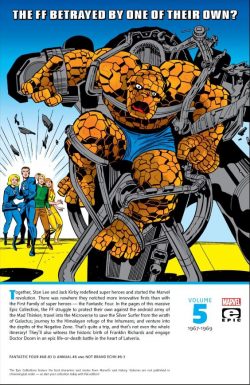
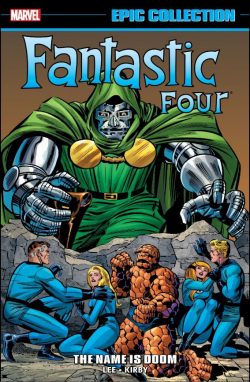
Fantastic Four Epic Collection volume 5 1967-1969: The Name is Doom


By Stan Lee & Jack Kirby, Marie Severin, Joe Sinnott, Tom Sutton & various (Marvel)
ISBN: 978-1-3029-2203-0 (TPB)

Win’s Christmas Gift Recommendation: Groundbreaking Blockbuster Entertainment… 10/10

Concocted by Stan Lee & Jack Kirby (with inks by George Klein & Christopher Rule), Fantastic Four #1 (bi-monthly and cover-dated November 1961) was crude, rough, passionately uncontrolled excitement unlike anything young fans had ever seen before.

Thrill-hungry kids pounced on it and the raw storytelling caught a wave of change starting to build in America. It and succeeding issues changed comicbooks forever.

This full-colour compendium – also available as a digital download – gathers issues #68-87, Annual #6 and material from Not Brand Echh #6 & 7 (cumulatively spanning November 1967- June 1969): an astounding progression of landmark tales as Stan & Jack cannily built on that early energy to consolidate the FF as the leading title and most innovative series of the era.

As seen in the ground-breaking premier issue, maverick scientist Reed Richards, his fiancée Sue Storm, their close friend Ben Grimm and Sue’s teenaged brother survived an ill-starred private space-shot after Cosmic Rays penetrated their ship’s inadequate shielding and mutated them all.

Richards’ body became elastic, Sue gained the power to turn invisible, Johnny Storm could turn into living flame whilst tragic Ben shockingly devolved into a shambling, rocky freak. After the initial revulsion and trauma pass, they solemnly agree to use their abilities to benefit mankind and thus was born The Fantastic Four.

Throughout the 1960s the FF was the indisputable central title and most consistently groundbreaking series of Marvel’s ever-unfolding web of cosmic creation: a forge for new concepts and characters at a time when Kirby was in his creative prime and continually unleashing his vast imagination on plot after spectacular plot whilst Lee scripted some of the most passionate superhero sagas ever seen.

Both were on an unstoppable roll, at the height of their creative powers, and full of the confidence that only success brings, with The King particularly eager to see how far the genre and the medium could be pushed…

Without preamble the wonderment commences with FF #68 (inked as ever by the remarkable Joe Sinnott), wherein the Mad Thinker resurfaces to enact his latest scheme, ‘His Mission: Destroy the Fantastic Four!’ beginning as the cogitating criminal replaces a famous doctor to subvert a potential cure for The Thing’s irradiated condition.

Phase two involves a mind-warping scheme turning the rocky stalwart against his comrades, progressing in ‘By Ben Betrayed!’ as the newly malevolent Grimm tries to mercilessly murder his comrades before being temporarily driven away.

Desperately searching for their brainwashed friend, the FF quickly capture the Thinker and free Ben’s shackled mind in ‘When Fall the Mighty!’, but the victory leaves the heroes unconscious with only Sue conscious to tackle the villain’s last-ditch killer android in ‘…And So It Ends…’

Having plucked victory from certain doom, a fresh drama opens with the team in crisis. With a baby due, Reed and Sue resign, leaving Ben, Johnny and his Inhuman girlfriend Crystal to hold the fort just as cosmic calamity comes calling.

In ‘Where Soars the Silver Surfer!’ the sky-born wanderer imprisoned on Earth by world-devouring Galactus goes cage-crazy and attacks humanity, forcing an intervention by the supposedly aloof Watcher and Reed’s return, after which FF#73 offers a classic crossover and the conclusion to a long-running Daredevil story wherein the sightless crusader is ousted from his own body by Iron Tyrant Doctor Doom. After warning the FF of the imposter’s imminent attack, the Man without Fear subsequently defeats Doom on his own but neglects to tell the heroes of his victory…

Outmatched and unable to convince them any other way, DD enlists currently de-powered Mighty Thor and the ever-eager Spider-Man in to solve the problem Marvel style – with a spectacular, pointless and utterly riveting punch-up – in ‘The Flames of Battle…’…

The Surfer resurfaces in #74’s ‘When Calls Galactus’ as the planet-eater returns to Terran skies demanding his one-time herald once more become his food-finding slave. However, despite his increasingly violent and world-shaking probing, and the FF’s holding action against the ravenous invader’s robotic Punisher, Galactus cannot locate his quarry…

That’s because the Surfer has already – and utterly obliviously – departed for ‘World Within Worlds!’, forcing Reed, Ben and Johnny to follow if humanity is to be saved from cosmic consumption. When the pioneering micronauts are subsequently attacked by sadistic alien Psycho Man, our heroes are then ‘Stranded in Sub-Atomica!’

As they struggle to survive, Galactus applies ever-more pressure in ‘Shall Earth Endure?’ until the now-fully-apprised Surfer turns himself in to save Earth by finding the great Devourer an alternative snack. His reward is to be summarily returned to captivity here as soon as ungrateful Galactus finishes feeding (just in time to begin his own landmark series – but that’s the subject of another review…)

Meanwhile, after trashing Psycho Man and getting home, Reed and the gang risk another attempt to cure Ben Grimm in FF #78. The procedure goes tragically awry in ‘The Thing No More!’, due to inopportune interference from old foe The Wizard before, in #79, a now human Ben chooses to return to his rocky state to save his friends from the bludgeoning Android Man, resolved to possibly remain ‘A Monster Forever?’.

A brief change of pace then takes the team to the tribal homelands of old friend Wyatt Wingfoot to solve an eerie mystery and save the Indian oil fields from deadly subversion ‘Where Treads the Living Totem!‘ before the sixth Annual features – at long last – the birth of Reed and Sue’s baby (known to us now as Franklin Richards).

Unfortunately, the happy event almost never happens since the transformative cosmic rays which gave the team their powers have affected the pregnancy…

Desperate for a miracle cure, Reed, Ben and Johnny scour the antimatter Negative Zone and are confronted by a monstrous creature named Annihilus whose cosmic energies are the only thing that can prevent the death of Sue and her unborn child. ‘Let There Be… Life!’ is a groundbreaking 48-page epic that is as stunning to read now as it ever was: passionate, thrilling and mind-boggling in its visual intensity.

With Sue adapting to motherhood, faithful Crystal elects herself the first new official member of the FF and promptly shows her mettle by pulverizing the incorrigible glutton-for-punishment Wizard in #81’s all-action romp ‘Enter… the Exquisite Elemental!’

Fantastic Four #82 sees Mrs Richards retire to tend her infant son and Crystal officially inducted as her replacement. Before long, however, the substitute’s violent past reasserts itself as her deranged cousin Maximus again attempts to conquer mortal humanity.

‘The Mark of… the Madman!’ sees the quirky quartet invade hidden Inhuman enclave Attilan to aid the imprisoned Royal Family in overcoming an entire race of subjugated super-beings before trouncing the insane despot in ‘Shall Man Survive?’

All-out action then gives way – at least initially – to tense suspense for the start of a 4-part epic starring the team’s greatest foe. ‘His Name is Doom!’ finds Reed, Ben, Johnny and Crystal making their way home after failing to capture Maximus, only to be intercepted by Nick Fury and the super-spies of S.H.I.E.L.D., looking for a favour…

Steel-Shod Dictator Victor Von Doom has apparently devised unstoppable super-robots and Fury needs the FF to infiltrate the sovereign state of Latveria to ferret them out. However, it’s impossible to sneak up on the most paranoid man in the world and the heroes are easily intercepted and captured by the totalitarian tyrant’s security team.

‘Within This Tortured Land’ opens with them as “guests” in Doom’s picture-book Ruritanian paradise, but even with their powers hypnotically cancelled out, the valiant heroes soon discover the cruel iron within their velvet prison once the Monarch of Latveria begins testing his deadly “Doombots” on his own subjects… and them.

When the automatons go berserk the entire postage-stamp kingdom is imperilled in ‘The Victims!’ and only the last-minute arrival of Invisible Girl Sue Richards allows the team and the villagers to survive Doom’s cataclysmic failsafe plan.

The shocking final confrontation and conclusion manifest in ‘The Power and the Pride!’, wrapping up the saga in a bombastic blend of super-science, soap opera and mesmerising melodrama seldom seen in comicbooks before or since.

After all that searing drama and tension, we end on a comedic note as this enticing tome includes a brace of pertinent parodies from Marvel’s spoof title Not Brand Echh. The opening is from #6 (the “Big, Batty Love and Hisses issue!” of February 1968) revealing how ‘The Human Scorch Has to… Meet the Family!’: a snappy satire on romantic liaisons from Lee, Kirby & Tom Sutton. It’s counterbalanced by a boisterous but non-canonical retelling of ‘The Origin of the Fantastical Four!’ (April’s #7, courtesy of Lee, Kirby, Marie Severin & Sutton).

Art lovers and history buffs can also enjoy a boundless hidden bounty at the end of this volume as we close with fascinating freebies in the form of original art covers for #71 – both the finished article and a stunning pencil rough inexplicably rejected at the time – plus a wealth of pencilled pages and a brace of cover reproductions from previous collections.

Epic, revolutionary and unutterably unmissable, these are the stories which made Marvel the unassailable leaders in fantasy entertainment. They remain some of the most important superhero comics ever crafted. Verve, conceptual scope and sheer enthusiasm shine through on every page and the wonder is there for you to share. If you’ve never thrilled to these spectacular sagas then this book of marvels is the perfect key to another – far brighter – world and time.
© 2020 MARVEL.

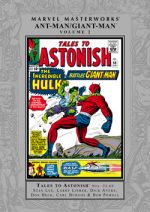
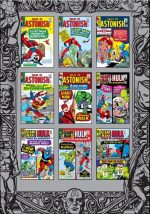
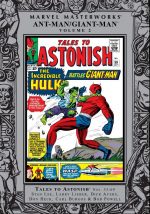
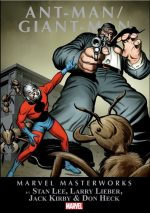
Ant-Man/Giant-Man Marvel Masterworks volume 2


By Stan Lee, Larry Lieber, Leon Lazarus, Al Hartley, Dick Ayers, Don Heck, Steve Ditko, Carl Burgos, Bob Powell & various (Marvel)
ISBN: 978-0-7851-2911-0 (HB)

Win’s Christmas Gift Recommendation: A Little Bit of Vintage Wonderment… 8/10

If you’re of a particularly picky nature – and what comic fan isn’t? – you might consider the Astonishing Ant-Man one of the earliest heroes of the Marvel Age of Comics. He first appeared in Tales to Astonish #27 (cover-dated January 1962), in one of the splendidly addictive men-vs-monsters anthology titles that dominated in those heady days of Science Fiction Double-Feature B-Movies.

As superheroes proliferated to explosively dominate the early 1960s, he was rapidly retooled and recycled to become a key pillar of the company’s powerhouse pantheon… but not for long…

This second episodic, eclectic and entomologically edifying compendium – available in hardback and digital formats – gathers the pertinent portions of Tales to Astonish #53-69: spanning March 1964 to July 1965 and tracing the first gradual decline and fall of the “Man of Many Sizes”. The comic adventures herein are preceded by a typically voluble Stan Lee Introduction before the action and drama recommences.

TTA #53 led with a spectacular battle-bout rematch as our hero and his partner Janet Van Dyne are ‘Trapped by the Porcupine!’ (by Lee & Dick Ayers) and closed with the Wonderful Wasp narrating short fantasy yarn ‘When Wakes the Colossus!’ (actually crafted by Lee, Larry Lieber & Don Heck).

The next issue saw Heck illustrate the Crusading Couple’s catastrophic trip to Santo Rico and finding ‘No Place to Hide!’: trapped and powerless in a South American banana republic run by brutal commie agent El Toro. This was neatly counter-balanced by the Wasp’s sci fi saga ‘Conquest!’ by Lee, Lieber & Sol Brodsky.

An implacable old foe defeated himself in ‘On the Trail of the Human Top!’ when the psychotic mutant killer steals Giant-Man’s size-changing pills in #55, following which Lee, Lieber & George Bell produce the Wasp’s fable ‘The Gypsy’s Secret!’

A larcenous stage conjuror proves far more trouble than you’d suspect in ‘The Coming of The Magician!’ – even successfully abducting the Wasp before his defeat, which Jan celebrated by regaling us all with tall tale ‘Beware the Bog Beast!’ (Lee, Lieber & Paul Reinman) after which TTA #57 featured a big guest-star as the size-changing sweethearts set out ‘On the Trail of the Amazing Spider-Man!’, courtesy of Lee, Ayers & Reinman, with sinister savant Egghead waiting in the wings and pulling strings. A minor landmark occurred in the back of that issue as the Wasp participated in a complete solo adventure. ‘A Voice in the Dark!’, by Lee, Lieber & Chic Stone, saw Jan defeat a big burly jewel thief. It was precious little to crow over, but Marvel had finally let a lady loose on her own with no apparent riot or collapse of the macho social order. Things would certainly get better… but not soon…

These were not only signs of the increasing interconnectivity Lee was developing but also indicated that the strip was losing impetus. In a market increasingly flooded with superheroes, the adventures of Giant-Man were not selling as well as they used to or should…

Captain America cameo-ed in #58’s epic Africa-based battle with a giant alien in ‘The Coming of Colossus!’ (Lee, Ayers & Reinman), supplemented by the Wasp’s second lone hand, played this time against an old enemy in ‘The Magician and the Maiden!’ by Lee & Lieber.

The beginning of the end for Giant-Man came in Tales to Astonish #59 and ‘Enter: The Hulk!’ (Lee, Ayers & Reinman), with the Avengers inadvertently prompting the Size-Shifting Sentinel to hunt down the Green Goliath. Although the Human Top engineered the blockbusting battle, Lee was the real mastermind as, one month later, The Hulk began co-starring in his own series and on the covers, whilst Giant-Man’s adventures shrank back to a dozen or so pages. Ten issues later Hank and Jan would retire making way for amphibian antihero Namor, the Sub-Mariner…

Before then though there’s a rousing house ad and comic fact-feature ‘Let’s Learn About Hank and Jan’, leading to the first half-sized yarn. Produced by Lee, Ayers & Reinman, Tales to Astonish #59’s ‘The Beasts of Berlin!’ was a throwback in many ways to the daft old days, as the duo smuggle themselves over the Wall and into the Russian Sector to battle Commie Apes (no, really!) behind the Iron Curtain.

The writing was on the wall by issue #61. With the Hulk already most prominent on the covers, hastily-executed stories and a rapid rotation of artists, it was obvious Giant-Man was waning. ‘Now Walks the Android’ was a fill-in rather rapidly illustrated by Steve Ditko & George (Bell) Roussos, starring Egghead and his latest technological terror-weapon after which ‘Versus the Wonderful Wasp’ (by Golden Age icon Carl Burgos & Ayers) recycles an ancient plot wherein a thief steals Giant-Man’s costume and equipment, leaving the mere girl to save the day…

‘The Gangsters and the Giant’ in #63 – by Lee, Burgos & Stone – incestuously reproduces the plot of #37 with the gem-stealing Protector here re-imagined as “the Wrecker” and comes with a Marvel Masterwork pin-up of the Diminutive Duo by Chic Stone. ‘When Attuma Strikes’ (Burgos & Reinman) offers a crumb of imagination and wit as Hank and Jan split up and the heartbroken lass gets herself abducted by an undersea tyrant. This last was scripted by incredibly under-appreciated and almost anonymous comics veteran Leon Lazarus.

One last attempt to resuscitate the series came with the addition of another Golden-Age legend. Bob Powell signed on as artist for issue #65’s ‘Presenting the New Giant-Man’ (scripted by Lee, inked by Heck) wherein the Master of Many Sizes built a better costume and powers, but almost dies at the hands of a cat and spider he accidentally enlarges in the process.

With a fresh new look, the last five issues are actually some of the best tales in the run, but it was clearly too late.

Frankie (Giacoia) Ray inked Powell for ‘The Menace of Madam Macabre’, with a murderous oriental seductress attempting to steal Pym’s secrets, and Stone applied the brushes for ‘The Mystery of the Hidden Man and his Rays of Doom!’, wherein a power-stealing alien removes Hank Pym’s ability to shrink, before the series concludes with a powerfully impressive 2-parter in Tales to Astonish #68 and 69. ‘Peril from the Long-Dead Past’ and ‘Oh, Wasp, Where is Thy Sting?’, were inked by Vince Colletta and John Giunta respectively.

So far along was the decline that Al Hartley had to finish what Stan Lee started: concluding a tense and thrilling tale of the Wasp’s abduction by the Human Top and the abrupt retirement of the weary, shell-shocked heroes at the saga’s end.

(Gi)-Ant-Man and the Wasp did not die, but instead joined the vast cast of characters which Marvel kept in relatively constant play through team books, via guest shots and in occasional re-launches and mini-series.

Despite variable quality and treatment, the eclectic, eccentric and always fun exploits of Marvel’s premier “odd couple” remain an intriguing and engaging reminder that the House of Ideas didn’t always get it right, but generally gave their all to entertaining their fans.

By turns superb, stupid, exciting and appalling this tome and these tales epitomise the best and worst of Early Marvel (with the delightful far outweighing the duff) and certainly won’t appeal to everybody, but if you’re a Fights ‘n’ Tights fan with a forgiving nature the good stuff here will charm, amaze and enthral you whilst the rest could just be considered as a garish garnish to provide added flavour…
© 2020 MARVEL.

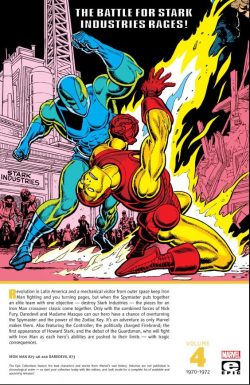
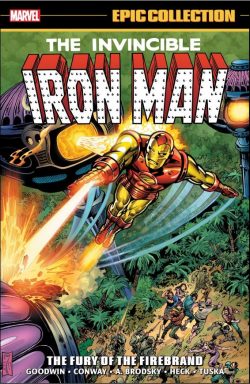
Iron Man Epic Collection volume 4 1970-1972: The Fury of the Firebrand


By Archie Goodwin, Gerry Conway, Allyn Brodsky, Mimi Gold, Robert Kanigher, Gary Friedrich, Johnny Craig, Don Heck, George Tuska, Herb Trimpe, Gene Colan & various (Marvel)
ISBN: 978-1-3029-2207-8 (TPB)

Win’s Christmas Gift Recommendation: A Glittering Bauble of Shiny Nostalgic Marvel Madness… 8/10

Created in the aftermath of the Cuban Missile Crisis and at a time when “Red-baiting” and “Commie-bashing” were American national obsessions (just like now), the emergence of a brilliant new Thomas Edison, using Yankee ingenuity and invention to safeguard and better the World, seemed inevitable. Combined with the then-sacrosanct belief that technology and business could solve any problem with the universal imagery of noble knights battling evil, the concept behind the Invincible Iron Man seems an infallibly successful proposition.

Of course, where once Tony Stark was the acceptable face of 1960s Capitalism: a glamorous millionaire industrialist/inventor and a benevolent all-conquering hero when clad in the super-scientific armour of his metal alter-ego, the tumultuous tone of changing times soon resigned his suave, playboy image to the dustbin of history and, with ecological disasters and social catastrophe from the abuse of industry and technology the new mantras of the young, the Golden Avenger and Stark International were soon confronting some tricky questions from the increasingly socially conscious readership.

All of a sudden maybe that money and fancy gadgetry weren’t quite so fun or cool anymore…?

This sterling hardback – and eBook – compilation covers the period May 1970 through May 1972, re-presenting Iron Man #25-46 and incorporating a tumultuous team-up with the Man Without Fear from Daredevil #73 which held a key portion of a rather complex comics crossover.

Imminently departing scripter Archie Goodwin pins Iron Man’s new Green colours to the comic’s mast in #25’s stunning eco-parable ‘This Doomed Land… This Dying Sea!‘, ably assisted by EC legend Johnny Craig, whose slick understated mastery adds a sheen of terrifying authenticity to proceedings. Here, the Armoured Avenger clashes and ultimately teams with veteran antihero Namor the Sub-Mariner, before being compelled to destroy one of his own hyper-polluting facilities, consequently overruling and abandoning his company’s previous position and business model…

Tragically, his attempts to convince other industry leaders to do likewise meets with the kind of reaction that tragically then (and again now) typifies America’s response to the real-world situation…

Original Iron Man artist Don Heck returned for the fantasy-fuelled romp ‘Duel in a Dark Dimension!’ (scripted by Goodwin and inked by Craig) with guest villain The Collector kidnapping Stark’s right-hand man Happy Hogan in a convoluted scheme to secure an extradimensional super-sword…

America’s mounting racial tensions took centre-stage in ‘The Fury of the Firebrand!’, introducing an inflammatory radical with a secret and highly personal hate-filled agenda aimed squarely at Stark and the fat cats he represented. The incendiary fiend was also a human napalm grenade…

Goodwin bowed out with #28’s riotous return match ‘The Controller Lives!’, wherein the mind parasite attacks Stark and SHIELD agent Jasper Sitwell through an old girlfriend, after which Mimi Gold scripted an old-fashioned commie-buster yarn, drawn by Heck and inked by Chic Stone in #29, with Iron Man liberating a tropical paradise from its enslaving socialist overlords in ‘Save the People… Save the Country!’.

Impressive new kid on the block Allyn Brodsky took over as scripter with #30’s ‘The Menace of the Monster-Master!’: a rousing rampage full of Maoist menace with a giant lizard ravaging Japan until the Golden Avenger steps in, taking charge and exposing a cunning plot…

Far more intriguing is ‘Anything… For the Cause!’ wherein back-to-nature hippie protesters and outraged teen radicals are manipulated by an unscrupulous local businessman. This social drama also adds cool young Irish science nerd Kevin O’Brian to the regular cast.

IM #32’s ‘Beware… The Mechanoid!’ (illustrated by George Tuska & “Joe Gaudioso”) then relates a salutary tale of a benign alien explorer making the tragic mistake of exploring America whilst disguised as a black man…

Heck & Gaudioso (actually moonlighting Mike Esposito) handled the art for ‘Their Mission: Destroy Stark Industries!!’as corporate raider Spymaster unleashes his Mission: Impossible-inspired team The Espionage Elite to deprive America of both the inventor and his company. This fast-paced thriller concluded in bombastic finale ‘Crisis… and Calamity!!’with the near-death of a cast regular, signalling the advent of a darker, more driven Armoured Avenger…

Something of a comics wunderkind at this time, Gerry Conway assumed the writer’s reins in Iron Man #35 as the traumatised hero understandably seeks ‘Revenge!’ on Spymaster before being distracted by an ongoing battle between Daredevil, Nick Fury, Madame Masque and the global criminal network Zodiac – all contesting ownership of an extra-dimensional wish-granting super-weapon.

That battle spills over into Daredevil #73 and a mass abduction into another dimension in ‘Behold… the Brotherhood!’(by Conway, Gene Colan & Syd Shores) before messily and inconclusively concluding halfway through Iron Man #36 (Heck & Esposito). The remainder of the issue and battle for the Zodiac Key is necessarily shelved as the Steely Centurion is waylaid by terra-forming aliens in ‘…Among Men Stalks the Ramrod!’

Incapacitated and with his recently transplanted new heart critically damaged, Stark reveals his secret to Kevin O’Brian ‘In This Hour of Earthdoom!’ (Jim Mooney inks) before rapidly retrenching, recuperating and ultimately repelling the invaders. The fantastic fantasy drama pauses here for a hard-boiled and pleasantly low-key diversion in the form of an engaging gangster caper from Conway, Tuska & Esposito wherein Iron Man is forced to respond quite assertively ‘When Calls Jonah…!’

Conway resumes the mad science tales – with Herb Trimpe illustrating – in ‘A Twist of Memory… a Turn of Mind!’, wherein insidious oriental mastermind White Dragon (Yes, I know, but social relevance clearly advanced at its own piecemeal rate and racial profiling was less obvious than poisoned air and rivers…) deviously turns Stark into a brainwashed pawn, thereby inadvertently enslaving the Golden Avenger too.

Devoted assistant Kevin O’Brian comes to the rescue, but is led down a path to inevitable doom when he assists his mind-locked employer in a torturous ‘Night Walk!’ (by Tuska & Jim Mooney) to save his sanity and defeat the sinister foe.

Simultaneously, Marianne Rodgers, a woman they both love, begins a slow glide into madness as her telepathic powers gradually grow beyond her control and start eating at her mind…

Issue #41 continued a convoluted storyline dealing with mystery mastermind Mr. Kline. (For the full story you should also track down contemporaneous Daredevil and Sub-Mariner issues: you won’t be any the wiser but at least you’ll have a full set…)

Next, ‘The Claws of the Slasher!’ sees squabbling saboteurs target Washington DC during a Senate investigation into Stark Industries; accidentally triggering a psychic transformation in Marianne, who temporarily morphs into a mind-warping harpy in ‘When Demons Wail!’ (inked by Frank Giacoia). The clash culminates in a blockbusting, extra-long battle against psionic godling Mikas in ‘Doomprayer!’ (with Mooney inks). During that cataclysmic conflict O’Brian dons his own super-armour to join the fray as The Guardsman; causing his own mental state to rapidly deteriorate and making his eventual showdown with Stark utterly unavoidable…

Plotted by Conway, scripted by DC A-Lister Robert Kanigher and illustrated by Tuska & Vince Colletta, Iron Man #44 finds Stark near death after his last battle. In ‘Weep for a Lost Nightmare!’, he is watched over by Kevin and Marianne as Kline dispatches a robotic copy of old adversary The Night Phantom to finish the ailing hero off. The tale was truncated midway and completed in the next issue – presumably due to deadline problems.

Gary Friedrich scripted concluding chapter ‘Beneath the Armour Beats a Heart!’ in #45, after which Stark faces a revolt by his own Board of Directors who convince the jealousy-consumed O’Brian to stand with them.

When student protestors invade the factory, greed-crazed capitalist and reactionary revolt instigator Simon Gilbertconvinces O’Brian to don his Guardsman suit and teach the kids a lesson, leading to a horrific escalation in ‘Menace at Large!’ (inked by John Verpoorten) wherein Iron Man intervenes to save lives and causes the fully-amok O’Brian’s death…

To Be Continued…

The galvanised wonderment also includes the covers of Iron Man Annuals #1 and 2, a selection of house ads and a gallery of original art covers and interior pages by Marie Severin & Sam Grainger, Sal Buscema, Tuska and Frank Giacoia, to wrap up this collection with the Golden Gladiator carefully politically repositioned at a time when Marvel solidly set itself up at the vanguard of a rapidly changing America increasingly at war with itself.

With this volume Marvel further entrenched itself in the camp of the young and the restless, experiencing first hand, and every day, the social upheaval America was undergoing. This rebellious teen sensibility and enhanced political conscience permeated the company’s publications as their core audience evolved from Flower Power innocents into a generation of acutely aware activists. Future tales would increasingly bring reformed capitalist Stark into many unexpected and outrageous situations…

But that’s the meat of another review, as this engrossing graphic collection is done. From our distant vantage point the polemical energy and impact might be dissipated, but the sheer quality of the comics and the cool thrill of the eternal aspiration of man in perfect partnership with magic metal remains. These superhero sagas are amongst the most underrated but impressive tales of the period and are well worth your time, consideration and cold hard cash…
© 2020 MARVEL.

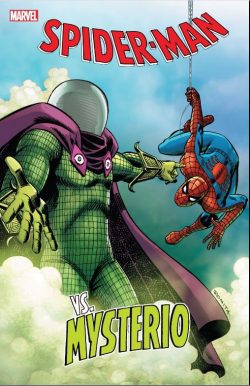
Spider-Man Vs. Mysterio


By Stan Lee & Steve Ditko, Gerry Conway, Roger Stern, Howard Mackie, Peter David, Dan Slott, John Romita Sr., Ross Andru, John Romita Jr., Marie Severin, Alex Saviuk, Todd Nauck & Marcos Martin, with Don Heck, Javier Pulido & various (Marvel)
ISBN: 978-1-3029-1871-2 (TPB)

Win’s Christmas Gift Recommendation: Fabulous Fights ‘n’ Tights Fantasy… 8/10

Heroes are only truly defined by their enemies and superheroes doubly so, with the added proviso that costumed crusaders generally have a rogue’s gallery of fantastic foes rather than just one arch-nemesis. Even so, there’s always one particular enemy who wears that mantle: Moriarty for Sherlock Holmes; Blofeld for James Bond; Luthor for Superman.

Spider-Man has always had two top contenders… but Mysterio was never one of them.

However, this nifty trade paperback (and eBook) compilation gathers many of the now-cinematic evil enigma’s key and most entertaining clashes with the Wondrous Wallcrawler, tracing his devious development whilst offering an uncomplicated, no-frills thrill-ride of frantic spills and chills, equally appetising to film-inspired new meat and grizzled old veterans of the Fights ‘n’ Tights arena.

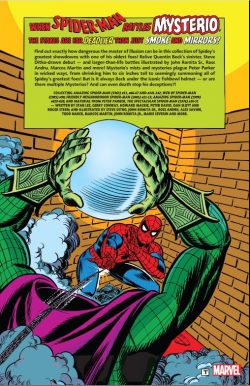
Collecting Amazing Spider-Man #13, 66-67, 141-142, 618-620; Web of Spider-Man #90; Friendly Neighborhood Spider-Man #11-13 and Peter Parker, The Spectacular Spider-Man #50-51 – collectively spanning June 1964 to April 2010 – the moody menace manifests sans preamble in ‘The Menace of… Mysterio!’ (by Stan Lee & Steve Ditko from Amazing Spider-Man #13).

Here a chilling super-foe premiers in the form of a seemingly eldritch mercenary hired by publisher J. Jonah Jameson to capture Spider-Man. Eventually, however, the bizarre bounty-hunter reveals his own dark criminal agenda and is exposed as a scientific trickster not a mystic marauder…

When Ditko quit Marvel the webspinner’s adventurers were limned by John Romita and a succession of stellar associates. One of most spectacular collaborations came in Amazing Spider-Man #66-67 (November & December 1968) as Lee scripted a psychedelic blockbuster for Romita, Don Heck & inkers Mike Esposito (Mickey Demeo) and Jim Mooney to illuminate. This time, the psychotic special-effects mastermind returns seeking loot and vengeance in ‘The Madness of Mysterio!’ as the master of FX illusions engineers his most outlandish stunt, with the wallcrawler subjected to a bizarre form of mind-bending resulting in an all-out action-packed brawl entitled ‘To Squash a Spider!’.

Perhaps more interestingly, this yarn introduces Randy Robertson, college student son of the Daily Bugle’s city editor and one of the first young black regular roles in Silver Age comics.

Lee and his staff were increasingly making a stand on Civil Rights issues at this time of unrest and Marvel would blaze a trail for African American and other minority characters in their titles. There would also be a growth of student and college issues during a period when American campuses were coming under intense media scrutiny…

Jump forward a few years to February & March 1975 and Amazing Spider-Man #141-142 and – as Peter Parker comes to terms with the death of first love Gwen Stacy – a long-running comedy thread ends with the frankly ridiculous Spider-Mobile crashing into the harbour, thanks to a series of apparent hallucinations, but the wallcrawler barely has time to care as a supposedly long-dead enemy returns in ‘The Man’s Name Appears to be… Mysterio!’

Despite the psychological assaults escalating and Parker continually questioning his own sanity, the mystery is solved through rational deduction and violence in ‘Dead Man’s Bluff!’, with all entertainment coming courtesy of Gerry Conway, Ross Andru & Esposito…

Even more years later, a fanciful piece of classic Spider-history is unpicked by Roger Stern John Romita Jr. & Mooney in Peter Parker, The Spectacular Spider-Man #50 and 51 (from January & February 1981) as ‘Dilemma’ and ‘Aliens and Illusions!’ (the latter pencilled by Marie Severin) reveal how special effects guru Quentin Beck was secretly battling the Amazing Arachnid long before he adopted his luminous fishbowl hat and green tights…

Crafted by Howard Mackie, Alex Saviuk & Sam de la Rosa, Web of Spider-Man #90 (November 1992) was part of the wallcrawler’s 30th anniversary celebrations. ‘The Spider’s Thread’ again delves into secret personal history as the hero’s old theatrical agent returns, presaging a manic series of attacks from an army of impossible foes… until Spidey discerns his real enemy in ‘Sleight of Mind!’…

Set during the first superhero Civil War, 3-parter ‘I Hate a Mystery’ is by Peter David, Todd Nauck, Robert Campanella, & Rodney Ramos and comes from Friendly Neighborhood Spider-Man #11-13 (October-December 2006). Peter Parker has recently gone public with his identity after acquiescing to the Super Human Registration Act, but his life as a high school science teacher is shattered by press intrusion and the vengeful acts of three separate but equally unhappy Mysterios…

The dramatic quotient of this collection cranks into overdrive for concluding extended epic ‘Mysterioso’, originally seen in Amazing Spider-Man #618-620 (March & April 2010), by writer Dan Slott and art team Marcos Martin, Javier Pulido & Javier Rodriguez. Divided into ‘Un-Murder Incorporated’, ‘Re-Appearing Act’ and ‘Smoke & Mirrors’, the wallcrawler’s war against Mr. Negative and an army of old enemies takes an even darker turn after Aunt May is turned evil and a seemingly undead Mysterio is hired by cyborg mafioso Silvermane to destroy his bitter rival Hammerhead. The chaotic final clash is even more confused and cataclysmic and leaves us all on a tense cliffhanger…

Adding extra sheen are info pages, cover reprints (from Spider-Man Classics, Marvel Tales and others), variant covers and pin-ups by Ditko, Dwayne Turner, Romita Sr. and Jr. and Joe Quinones, plus Marvel Handbook fact-pages on all three villains who have thus far played Mysterio.

Epic and engaging, this grab-bag of aerial assaults and titanic tussles is pure comicbook catharsis: fast, furious fun and thrill-a-minute-melodrama no fights ‘n’ Tights fan could resist.
© 2019 MARVEL.

Ant-Man/Giant-Man Marvel Masterworks volume 1


By Stan Lee, Larry Lieber, Jack Kirby & Dick Ayers, with Ernie Hart, Don Heck & various (Marvel)
ISBN: 978-0-7851-2049-0 (HB) 978-0-7851-6768-6 (TPB)

Win’s Christmas Gift Recommendation: Nostalgic Marvel Mayhem… 8/10

Marvel Comics initially built its fervent fan base through strong, contemporarily relevant stories with strikingly illustrated art, but most importantly by creating a shared continuity closely following the characters through not just their own titles but also through frequent guest appearances in other comics. Such interweaving meant that even today completists seek out extraneous stories for a fuller picture of their favourite’s adventures. The quest was not helped by the House of Ideas releasing vintage tales in any kind of chronological order, and Henry Pym (in all his many costumed iterations) was one of the last Marvel Superheroes to get the prestigious Masterworks treatment. The movie franchise might also have had something to do with it…

If you’re of a particularly picky nature – and what comic fan isn’t? – you could consider the Astonishing Ant-Man to be one of the earliest heroes of the Marvel Age of Comics. He first appeared in Tales to Astonish #27 (cover-dated January 1962), in one of the splendidly addictive men-vs-monsters anthology titles that dominated in those heady days of Science Fiction Double-Feature B-Movies.

This episodic, eclectic and entomologically edifying compendium – available in hardback, trade paperback and digital formats – gathers pertinent portions of January 1962 cover-dated Tales to Astonish #27 and the first tranche of the succeeding superhero series that eventually followed. Included herein are the relevant contents of issues #35-52, spanning September 1962 to February 1964, preceded by a fascinating and informative Introduction from Dick Ayers who inked the debut tale and was artistically associated with the characters for much of the run.

The itty-bitty sagas reveal the scintillating solo outings of a brilliant but troubled scientist who became an unlikely, uncomfortable and even mentally unstable superhero and here begins with what was just intended to be another throwaway filler thriller…

The initial 7-page short introduces Dr Henry Pym, a maverick scientist who discovers a shrinking potion and becomes ‘The Man in the Anthill!’: discovering peril, wonder and even a kind of companionship amongst the lowliest creatures on Earth… and under it…

This engaging piece of fluff, which owed more than a little to classic movie The Incredible Shrinking Man, was plotted by Stan Lee, scripted by Larry Lieber and stunningly illustrated by Jack Kirby & Dick Ayers.

Clearly, the character struck a chord with someone since – as the DC Comics-inspired superhero boom flourished – Pym was rapidly retooled as a full-fledged costumed do-gooder, debuting again with TTA #35 in ‘The Return of the Ant-Man’(Lee, Lieber, Kirby & Ayers). The plot concerns a raid by Soviet agents (this was during the height of Marvel’s “Commie-Buster” period when – a bit like now – every other villain was a Red somebody or other and rampaging socialism was a cultural bête noir) wherein Pym is captured and held prisoner in his own laboratory. Forced to disinter the abandoned shrinking gases and cybernetic devices he’d ambitiously built to communicate with ants, Dr. Pym soundly trounces the spies and resolves to use his powers for the good of Mankind…

The same creative team produced the next four adventures, beginning with ‘The Challenge of Comrade X!’ (#36) as an infallible Soviet super-spy is dispatched to destroy the Diminutive Daredevil, after which Ant-Man is temporarily ‘Trapped by the Protector!’ – a cunning jewel-thief and extortionist who ultimately proves no match for the Tiny Titan.

‘Betrayed by the Ants!’ features the debut of intellectual arch-foe Egghead, a maverick and mercenary research scientist who attempts to usurp the hero’s control of insects whilst ‘The Vengeance of the Scarlet Beetle!’ sees a momentary return to scary monster stories as a radioactively mutated, super-intelligent bug seeks to eradicate humanity with only Pym capable of stopping him…

Sol Brodsky replaced Ayers as inker for ‘The Day that Ant-Man Failed!’ in #40, as a deadly Hijacker robbing freight trucks pushes the shrinking inventor to new heights of ingenuity, after which Kirby moved on: his lavishly experimental perspectival flamboyance replaced by the comforting realism and enticing human scale of Don Heck who limned a classy alien invasion yarn in ‘Prisoner of the Slave World!’ before depicting a mesmerising menace who controls people with ‘The Voice of Doom’ in TTA #42.

The following issue H. E. Huntley (AKA veteran writer/artist Ernie Hart) replaced Lieber as scripter with ‘The Mad Master of Time’: a run-of-the-mill mad – or, rather, disgruntled and misguided – scientist yarn. With the next issue (#44) Kirby returned to pencil a significant change to the series….

Inked by Heck, ‘The Creature from Kosmos’ introduces The Wasp – Pym’s bon vivant crime-fighting partner Janet Van Dyne – in a double-length tale featuring a murderous alien marauder who kills her father. There was even an expanded secret origin for Ant-Man: a rare and uncharacteristic display of depth revealing that Pym was actually a tragic widower. When his Hungarian wife Maria was murdered by Communist agents, it irrevocably changed the young scientist from a sedentary scholar into a driven man of action….

Ant-Man uses his discoveries to endow bereaved and vengeful Janet with the power to shrink and grow wings and she becomes his crime-fighting partner. In double-quick time they overcome ‘The Terrible Traps of Egghead’ (Lee, Huntley & Heck) before travelling to Greece to thwart another alien invasion ‘When Cyclops Walks the Earth!’

Back in the USA, the Diminutive Duo battle magic trumpeter Trago in ‘Music to Scream By’ and defeat an avaricious weapons designer who builds himself a unique battle suit to become super-thief ‘The Porcupine!’: all serving as placeholding before the next big change which manifests with Tales to Astonish #49’s ‘The Birth of Giant-Man!’.

Lee scripted and Heck inked Kirby who had returned to pencil the epic story of how Pym learns to enlarge as well as reduce his stature, just in time to tackle the threat of trans-dimensional kidnapper The Eraser. In the next issue Steve Ditko inked The King in ‘The Human Top’, the first episode of a 2-part tale showing how our hero struggles to adapt to his new strength and abilities.

The blistering conclusion ‘Showdown with the Human Top!’ was inked by Ayers who would go on to draw the bulk of the succeeding stories until the series’ demise. Moreover, with this issue (#51) back-up feature The Wonderful Wasp Tells a Tale began. It initially mixed sci-fi mystery vignettes narrated by the heroine, fact-features and solo adventures, before evolving into Marvel’s first female starring solo feature. Here however Janet is simply a whimsical narrator detailing chilling space thriller ‘Somewhere Waits a Wobbow!’ (actually related by Lee, Lieber & George Roussos in his Marvel identity of George Bell).

The super-hero adventures settled into a rather predictable pattern from then on: individually effective enough but rather samey and uninspired when read in quick succession. You’ll need the next volume for most of those but here at least the comics craziness concludes with a straightforward super-villain clash as TTA #52 ‘The Black Knight Strikes!’ (Lee & Ayers) is supplemented by the Wasp’s crime & punishment homily ‘Not What They Seem!’…

Despite variable quality and treatment, the eclectic, eccentric and always fun exploits of Marvel’s original “little guy” and premier “odd couple” remain an intriguing and engaging reminder that the House of Ideas didn’t always get it right, but generally gave their all to entertaining fans.

By turns superb, stupid, enthralling and merely engaging, this tome is augmented by house ads and a gallery of original art pages by Kirby & Brodsky and Don Heck, epitomising the best and worst of Early Marvel (with the delightful far outweighing the duff). It certainly won’t appeal to everybody, but if you’re a Fights ‘n’ Tights fan with a forgiving nature or a movie-goer looking for extra input, the good stuff here will charm and amaze you whilst the rest could just be considered as a garish garnish to provide added flavour…
© 2020 MARVEL.

Marvel Team-Up Marvel Masterworks volume 5


By Bill Mantlo, Gerry Conway, Roger Stern, Sal Buscema, Ron Wilson, George Tuska & various (Marvel)
ISBN: 978-1-3029-2218-4 (HB)

Win’s Christmas Gift Recommendation: Simply Superb Merry Marvel Madness … 8/10

In the 1970s, Marvel grew to dominate the comic book market despite losing their two most innovative and inspirational creators. They did so less by experimentation and more by expanding proven concepts and properties. The only real exception to this was the mass creation of horror titles in response to the industry down-turn in super-hero sales – a move expedited by a rapid revision in the wordings of the increasingly ineffectual Comics Code Authority rules.

The concept of team-up books was not new when Marvel awarded their most popular hero the lion’s share of this new title, but they wisely left their options open by allocating an occasional substitute lead in the Human Torch. In those long-lost days, editors were acutely conscious of potential over-exposure – and since super-heroes were actually in a decline at that time, they may well have been right.

Nevertheless, after abortive companion title Spectacular Spider-Man (created for the magazine market in 1968) died after two issues, Marvel Team-Up was the second full Spider-Man title. Debuting in March 1972, it was a resounding hit.

This fifth fabulous compilation (in hardback and digital formats) gathers material from MTU #41-52, plus a crossover from Marvel Two-in-One #17, and a rare seasonal sage from tabloid rarity Marvel Treasury Edition #13, cumulatively spanning January-December 1976. The book opens with an informative assessment and appreciation from historian and archivist Bruce Canwell in his Introduction before we plunge into the many-starred dramas…

A major attraction of those early comics combos was an earnest desire to get things “done in one”, with tales that concentrated on plot and resolution with the guest du jour. Here, however, neophyte scripter Bill Mantlo begins an era of closer continuity with an extended time travel epic that took taking the wallcrawler to the farthest, weirdest corners of Marvel’s ever-expanding universe…

With artists Sal Buscema & Mike Esposito in control of the horizontal and vertical, a truly impressive and ambitious multi-part epic opens with the Amazing Arachnid visiting the past and a number of alternate tomorrows beginning with ‘A Witch in Time!’

Here mutant Avenger Scarlet Witch is abducted from her rightful time and place by infamous witch-hunter Cotton Matherwho uses Doctor Doom‘s time machine to drag her back to Salem, Massachusetts in 1692. Her plight is observed by Spider-Man who naturally follows, but after failing to save her, the webspinner is himself accused of infernal sorcery in that rabid Massachusetts township…

Whilst Mather fans hysterical flames of paranoia, the Avenger’s synthezoid husband time-travels to her side in #42’s ‘Visions of Hate!’, only to fall before the witchfinder’s mysterious power too. As the innocents of Salem prepare themselves for death, our heroes make their escape only to fall to Mather’s hitherto unseen benefactor The Dark Rider.

Just as the master manipulator reveals himself, however, the stakes change again when a severely affronted Victor Von Doom appears, angrily demanding to know who’s been playing with his toys in #43’s ‘A Past Gone Mad!’

The frantic battle against an immortal chronal predator seems predestined to fail until the time-tides are unexpectedly turned in MTU #44 with the last-minute arrival of mind-goddess Moondragon, but in the aftermath Spider-Man tragically discovers that history is well-nigh impossible to alter in ‘Death in the Year Before Yesterday!’

The arachnoid adventurer is the last to return to the 20th century but his departure in issue #45 results in deadly diversions and understandable ‘Future-Shock!’ as he overshoots his home time and lands in devastated (and now defined as an alternate future) New York City circa 2019 where Warrior of the Worlds Killraven helps him survive numerous attacks by mutants and Martians in terrifying tripods before sending the spider back on his way home..

Unfortunately, before he gets there the wallcrawler experiences another shocking stopover in ‘Am I Now or Have I Ever Been?’, with cyborg warrior Deathlok saving him from a mutant hive-mind in a Manhattan shattered by war a mere fifteen years after his own lost and longed-for era…

A scared, sad and sobered Spider-Man finally makes it home in Marvel Two-In-One #17 just in time for a crossover with Ben Grimm AKA the Thing. The blockbuster opens with ‘This City… Afire!’ by Mantlo, Sal B & Esposito where, after battling beside Ka-Zar in the dinosaur paradise of the Savage Land, big Ben is ignominiously returned to the Big Apple by mutated madman Basilisk. This manic malcontent has manifested an erupting volcano in the Hudson River and it needs to go…

Already reeling, Spidey swings into action for the cataclysmic conclusion in Marvel Team-Up #47 where Mantlo, Ron Wilson & Dan Adkins render the spectacular clash of heroes who boldly proclaim ‘I Have to Fight the Basilisk!’

Proving there’s no rest for the wicked or the righteous, MTU #48 begins another suspenseful extended saga when ‘Enter: the Wraith!’ (Mantlo, Sal B & Esposito) introduces Police Captain Jean DeWolff whilst Spidey and Iron Man struggle to stop a mad bomber using model planes to destroy city landmarks and Stark International properties. As the heroes fruitlessly pursue leads, the enigmatic Wraith turns his attention upon them, proving to be not only connected to Jean but some kind of psionic metahuman…

With Iron Man again the guest-star, issue #49 reveals that ‘Madness is All in the Mind!’ as the masked maniac resumes his irresistible psychic assaults: explosively attacking Manhattan even as the tragic story of Jean’s Police Commissioner dad and murdered cop brother comes out…

However, the connection between them and the unstoppable villain is only exposed after the webslinger and Golden Avenger recruit Master of Mystic Arts Doctor Strange who applies his unique gifts to the problem in #50’s ‘The Mystery of the Wraith!’

The saga concludes with Marvel Team-Up #51 and ‘The Trial of the Wraith!’: a legal confrontation steered by a most unusual panel of judges whose hidden abilities are not enough to prevent one last crack of the whip by the unrepentant renegade…

The thrills, spills and chills are followed with blatant fill-in ‘Danger: Demon on a Rampage!’: a rather rushed but action-heavy pairing of Spidey and Captain America from Gerry Conway, SB & Esposito which sees the heroes unite to take down Gallic mercenary Batroc and an enraged monster that has somehow slipped out of an adjacent dimension…

The bulging bonus section begins with a house ad for the Mighty Marvel Bicentennial Calendar of 1976 which follows in its entirety, featuring the artistic excellence of John Romita Sr, Frank Robbins & Frank Giacoia, Herb Trimpe, Bob Brown, Gil Kane, John Buscema, Ross Andru, Joe Sinnott, Sal Buscema, Frank Brunner, Jim Starlin & Alan Weiss, and Jim Mooney.

After original art and covers from the text of this collection, Gil Kane’s sketches and finished art for the covers and frontispieces of Marvel Treasury Edition #9 (Giant Superhero Team-Up) and Marvel Treasury Edition #13 (Giant Superhero Holiday Grab-Bag) precede a delightful lost gem from the latter: an all-new clash between the Fantastic Four and Avengers by Roger Stern, George Tuska & Don Perlin. Thankfully, as the battle – with snowballs in Central Park – escalates, Daredevil, the Defenders and Champions are on hand to maintain the proper seasonal spirit…

These stories all have an honest drive to entertain and most fans of the genre would find little to complain about. Although not really a book for casual or more maturely-oriented enthusiasts, there’s plenty of fun on hand here and younger readers will have a blast, so there’s no reason not to add this tome to your comics library…
© MARVEL 2020 Marvel.