
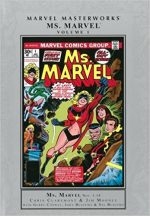
Marvel Masterworks Ms. Marvel volume


By Gerry Conway, Chris Claremont, John Buscema, Sal Buscema, Carmine Infantino & various (Marvel)
ISBN: 978-0-7851-8811-7

Until relatively recently American comics and especially Marvel had very little in the way of positive female role models and almost no viable solo stars. Although there was a woman starring in the very first comic of the Marvel Age, the Invisible Girl took years to become a potent and independent character in her own right.

The company’s very first starring heroine was Black Fury, a leather-clad, whip-wielding crimebuster lifted from a newspaper strip created by Tarpe Mills in April 1941. She was repackaged as a resized reprint for Timely’s funnybooks and renamed Miss Fury for a four-year run between 1942 and 1946 – although the tabloid incarnation survived until 1952.

Fury was actually predated by the Silver Scorpion who debuted in Daring Mystery Comics #7 (April 1941), but she was relegated to a minor position in the book’s line-up and endured a very short shelf-life.

Miss America first appeared in the anthology Marvel Mystery Comics#49 (November1943), created by Otto Binder and artist Al Gabriele. After a few appearances, she won her own title in early 1944. Miss America Comics lasted but the costumed cutie didn’t, as with the second issue (November1944) the format changed, becoming a combination of teen comedy, fashion feature and domestic tips magazine. Feisty take-charge super-heroics were steadily squeezed out and the publication is most famous now for introducing virginal evergreen teen ideal Patsy Walker.

A few other woman warriors appeared immediately after the War, many as spin-offs and sidekicks of established male stars such as female Sub-Mariner Namora (debuting in Marvel Mystery Comics #82, May 1947 and graduating to her own three issue series in 1948). She was followed by the Human Torch‘s secretary Mary Mitchell who, as Sun Girl, starred in her own 3-issue 1948 series before becoming a wandering sidekick and guest star in Sub-Mariner and Captain America Comics.

Masked detective Blonde Phantom was created by Stan Lee and Syd Shores for All Select Comics #11 (Fall 1946) and sort-of goddess Venus debuted in her own title in August 1948, becoming the gender’s biggest Timely/Atlas/Marvel success until the advent of the Jungle Girl fad in the mid-1950s.

This was mostly by dint of the superb stories and art from the great Bill Everett and by ruthlessly changing genres from crime to romance to horror every five minutes…

Jann of the Jungle (by Don Rico & Jay Scott Pike) was just part of an anthology line-up in Jungle Tales #1 (September 1954), but she took over the title with the eighth issue (November 1955).

Jann of the Jungle continued until issue June 1957 (#17) and spawned a host of in-company imitators such as Leopard Girl, Lorna the Jungle Queen and so on…

During the costumed hero boom of the 1960s Marvel experimented with a title shot for Madame Medusa in Marvel Super-Heroes (#15, July 1968) and a solo series for the Black Widow in Amazing Adventures # 1-8 (August 1970-September 1971). Both were sexy, reformed villainesses, not wholesome girl-next-door heroines… and neither lasted alone for long.

When the costumed crazies craze began to subside in the 1970s, Stan Lee and Roy Thomas looked into creating a girl-friendly boutique of heroines written by women. Opening shots in this mini-liberation war were Claws of the Cat by Linda Fite, Marie Severin & Wally Wood and Night Nurse by Jean Thomas and Win Mortimer (both #1’s cover-dated November 1972).

A new jungle goddess Shanna the She-Devil #1 – by Carole Seuling & George Tuska – debuted in December 1972; but despite impressive creative teams none of these fascinating experiments lasted beyond a fifth issue.

Red Sonja, She-Devil with a Sword, caught every one’s attention in Conan the Barbarian #23 (February 1973) and eventually won her own series whilst The Cat mutated into Tigra, the Were-Woman in Giant-Size Creatures #1 (July 1974) but the general editorial position was that books starring chicks didn’t sell.

The company kept trying and eventually found the right mix at the right time with Ms. Marvel who launched in her own title cover-dated January 1977. She was followed by the equally copyright-protecting Spider-Woman in Marvel Spotlight #32 (February 1977, and securing her own title 15 months later) and Savage She-Hulk (#1, February 1980). She was supplemented by the music-biz sponsored Dazzler who premiered in Uncanny X-Men #130 the same month, before inevitably graduating to her own book.

Ms. Marvel was actually Carol Danvers, a United States Air Force security officer first seen in Marvel Super-Heroes #13 (March 1968): the second episode of the saga of Kree warrior Mar-Vell, who had been dispatched to Earth as a spy after the Fantastic Four repulsed the aliens Kree twice in two months…

That series was written by Roy Thomas and illustrated by Gene Colan with the immensely competent Carol perpetually investigating Mar-Vell’s assumed and tenuous cover-identity of Walter Lawson for months.

This was until Danvers was caught up in a devastating battle between the now-defecting alien and his nemesis Yon-Rogg in Captain Marvel #18 (November 1969).

Caught in a climactic explosion of alien technology, she pretty much vanished from sight until Gerry Conway, John Buscema & Joe Sinnott revived her for ‘This Woman, This Warrior!’ (Ms. Marvel#1, January 1977) as a new chapter began for the company and the industry…

This sturdy hardcover volume (or enthralling eBook if you prefer), collecting Ms. Marvel #1-14, opens with a handy reminiscence from primary scribe Gerry Conway in ‘Welcome to the Greenhouse’ before the game-changing dramas commence…

The irrepressible and partially amnesiac Danvers has relocated to New York to become editor of “Woman”: a new magazine for modern misses published by Daily Bugle owner J. Jonah Jameson.

Never having fully recovered from her near-death experience, Danvers had left the military and drifted into writing, slowly growing in confidence until the irascible publisher had made her an offer she couldn’t refuse…

At the same time as Carol was getting her feet under a desk, a mysterious new masked heroine begins appearing and as rapidly vanishing, such as when she pitches up to battle the sinister Scorpion as he perpetrates a brutal bank raid.

The villain narrowly escapes to rendezvous with Professor Kerwin Korwin of AIM (a high-tech secret society claiming to be Advanced Idea Mechanics). The skeevy savant has promised to increase the Scorpion’s powers and allow him to take long-delayed revenge on Jameson – whom the demented thug blames for his freakish condition…

Danvers has been having premonitions and blackouts since her involvement in the final clash between Mar-Vell and Yon-Rogg and has no idea she is transforming into Ms. Marvel. Her latest vision-flash occurs too late to save Jameson from abduction but her “Seventh Sense” does allow her to track the villain before her unwitting new boss is injured, whilst her incredible physical powers and knowledge of Kree combat techniques enable her to easily trounce the maniac.

Ms. Marvel #2 announces an ‘Enigma of Fear!’ and features a return engagement for the Scorpion as Korwin and AIM make Ms. Marvel their latest science project. Whilst the Professor turns himself into an armoured assassin codenamed Destructor, Carol’s therapist Mike Barnett achieves an analytical breakthrough with his patient and discovers she is a masked metahuman even before she does. Although again felling the Scorpion, Ms. Marvel is ambushed by the Destructor, but awakes in #3 (written by Chris Claremont) to turn the tables in ‘The Lady’s Not For Killing!’

Travelling to Cape Canaveral to interview old friend Salia Petrie for a women-astronauts feature, Danvers is soon battling an old Silver Surfer foe on the edge of space, where all her occluded memories return just in time for a final confrontation with the Destructor. In the midst of the devastating bout she nearly dies after painfully realising ‘Death is the Doomsday Man!’ (with Jim Mooney taking over pencils for Sinnott to embellish).

The Vision guest-stars in #5 as Ms. Marvel crosses a ‘Bridge of No Return’. After Dr. Barnett reveals he knows her secret, Carol is forced to fight the Android Avenger when AIM tricks the artificial hero into protecting a massive, mobile “dirty” bomb, after which ‘…And Grotesk Shall Slay Thee!’ pits her against a subterranean menace determined to eradicate the human race, culminating in a waking ‘Nightmare!’ when she is captured by AIM’s deadly leader Modok and all her secrets are exposed to his malign scientific scrutiny.

Grotesk strikes again in #8 as ‘The Last Sunset…?‘ almost dawns for the entire planet, whilst ‘Call Me Death-Bird!’ (illustrated by Keith Pollard, Sinnott & Sam Grainger) introduces a mysterious, murderous avian alien who would figure heavily in many a future X-Men and Avengers saga, but who spends her early days allied to the unrelenting forces of AIM as they attacked once more in ‘Cry Murder… Cry Modok!’ (with art by Sal Buscema & Tom Palmer).

Frank Giacoia inks #11’s ‘Day of the Dark Angel!’ wherein supernal supernatural menaces Hecate, the Witch-Queen and the Elementals attack the Cape, tragically preventing Carol from rescuing Salia Petrie and her space shuttle crew from an incredible inter-dimensional disaster…

The astonishing action continues in ‘The Warrior… and the Witch-Queen!’ (Sinnott inks) before ‘Homecoming!’ (Mooney & Sinnott) explore Carol’s blue-collar origins in Boston as she crushes a coupler of marauding aliens before the all-out action and tense suspense concludes as ‘Fear Stalks Floor 40’ (illustrated by Carmine Infantino & Steve Leialoha) with the battered and weary warrior confronting her construction worker, anti-feminist dad even as she is saving his business from the sinister sabotage of the Steeplejack….

This comprehensive chronicle also includes ‘Ms. Prints’ – Conway’s editorial on the hero’s origins from Ms. Marvel #1, original character sketches by John Romita Senior, a house ad, unused cover sketches by John Buscema and Marie Severin plus pages of original art by Sal B, Giacoia & Sinnott and Infantino & Leialoha.

Always entertaining, often groundbreaking and painfully patronising (occasionally at the same time), the early Ms. Marvel, against all odds, grew into the modern Marvel icon of capable womanhood we see today in both comics and on screen. These adventures are a valuable grounding of the contemporary champion but also still stand on their own as intriguing examples of the inevitable fall of even the staunchest of male bastions – superhero sagas…
© 1977, 1978, 2014 Marvel Characters, Inc. All rights reserved.
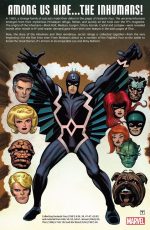
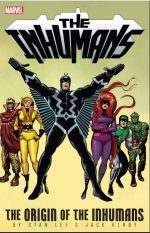
The Inhumans: The Origins of the Inhumans


By Stan Lee & Jack Kirby, with Chic Stone, Vince Colletta, Frank Giacoia, Joe Sinnott, Tom Sutton & various (Marvel)
ISBN: 978-0-7851-8497-3

Debuting in 1965 and conceived as yet another incredible lost civilisation during Stan Lee & Jack Kirby’s most fertile and productive creative period, The Inhumans are a race of incredibly disparate (generally) humanoid beings genetically altered in Earth’s pre-history, and consequently evolving into a technologically-advanced civilisation far ahead of emergent Homo Sapiens.

They isolated themselves from the world and barbarous dawn-age humans, first on an island and latterly in a hidden valley in the Himalayas, residing in a fabulous city named Attilan.

The mark of citizenship is immersion in the mutative Terrigen Mists which further enhance and transform individuals into radically unique and generally super-powered beings. The Inhumans are necessarily obsessed with genetic structure and heritage, worshipping the ruling Royal Family as the rationalist equivalent of mortal gods.

With a new TV series in the offing it’s worth taking a look at how the voluntary mutants joined the Marvel universe and this trade paperback compilation – also available as a digital edition – scrupulously compiles teasing early appearances from Fantastic Four #36 and 38, the extended introductory saga from FF #41-47, 54 and 62-65, and a team-up tale from Fantastic Four Annual.

Also included are pertinent extracts from FF #48, 50, 52 and 56-61 plus the entire Tales of the Uncanny Inhumans back-up series from Thor #146-153 and a moment of spoofing light-relief from Not Brand Echh #6, cumulatively spanning March 1965 to May 1968.

The first inkling of something epic in the wind came from Fantastic Four #36 and the introduction of a new female super-villain as part of the hero-team’s theoretical nemeses ‘The Frightful Four!’

A sinister squad comprising evil genius The Wizard, shapeshifting Sandman and gadget fiend The Trapster (he was still Paste Pot-Pete here, but not for long) was supplemented by enigmatic outsider Madame Medusa, whose origins were to have a huge impact on the heroes in months to come.

The heroes ‘Defeated by the Frightful Four!’ in FF# 38: a momentous tale with a startling cliff-hanger that marked Chic Stone’s departure in landmark manner.

Vince Colletta assumed the inking chores for a bombastic run which perfectly displays the indomitable power and inescapable tragedy of the brutish Ben Grimm in a tense and traumatic trilogy in which the Frightful Four brainwash The Thing. turning him against his teammates. It starts in # 41 (August 1965) with ‘The Brutal Betrayal of Ben Grimm!’, continues in rip-roaring fashion with ‘To Save You, Why must I Kill You?’ and concluded in bombastic glory with #43’s ‘Lo! There Shall be an Ending!’

The next issue was a landmark in many ways. Firstly, it saw the arrival of Joe Sinnott as regular inker, a skilled brush-man with a deft line and a superb grasp of anatomy and facial expression, and moreover an artist prepared to match Kirby’s greatest efforts with his own.

Some inkers had problems with just how much detail the King would pencil in; Sinnott relished it and the effort showed. What had been merely wonderful now became incomparable…

‘The Gentleman’s Name is Gorgon!’ introduced a mysterious powerhouse with metal hooves instead of feet: a hunter implacably stalking Madame Medusa.

His rampage through New York embroils the Human Torch – and subsequently the whole team – in her frantic bid to escape, and that’s before monstrous android Dragon Man shows up to complicate matters. All this was merely a prelude: with the next episode readers were introduced to a hidden race of superbeings who had secretly shared the Earth with us for millennia.

‘Among us Hide… the Inhumans’ revealed that Medusa was part of the Royal Family of Attilan: rulers of a hidden race of paranormal beings. She had been on the run ever since a coup deposed the true king.

Black Bolt, Triton, Karnak and the rest would quickly become mainstays of the Marvel Universe, but their bewitching young cousin Crystal and her giant teleporting dog Lockjaw were the real stars here. For young Johnny Storm, it was love at first sight, and Crystal’s eventual fate would greatly change his character, giving him a hint of angst-ridden tragedy that resonated greatly with the generation of young readers who were growing up with the comic…

‘Those Who Would Destroy Us!’ and ‘Beware the Hidden Land!’ (FF #46 and 47) saw the heroes unite with the Royal Inhumans as Black Bolt battled to regain his throne from his brother Maximus the Mad, only to stumble into the usurper’s plan to wipe humanity from the Earth.

Ideas just seem to explode from Kirby at this time. Despite being halfway through one storyline, FF #48 trumpeted ‘The Coming of Galactus!’ with the first Inhumans saga swiftly wrapped up by page 7, and the entire race sealed by Maximus behind an impenetrable dome called the Negative Zone (later retitled the Negative Barrier to avoid confusion with the gateway to sub-space that Reed Richards worked on for years).

Those pages and further excerpts from #50 and 52 advancing the “Inhumans-in-a-bottle” plot are included here, but you’ll need to seek elsewhere for the Galactus saga…

I suspect this experimental – and vaguely uncomfortable – approach to narrative mechanics was calculated and deliberate, mirroring the way TV soap operas were increasingly delivering their interwoven storylines, and was introduced as a means to keep readers glued to the series.

They needn’t have bothered. The stories and concepts were enough…

The next full story followed the Torch and college pal Wyatt Wingfoot as they sought a way to sunder the barrier and reunite Johnny with Crystal. This led to the unearthing of the lost tomb of Prester John in #54’s ‘Whosoever Finds the Evil Eye…!’

This became a running sub-plot with the Inhumans increasingly striving to break out whilst, on the other side of the Great Barrier, Johnny and Wyatt wandered the wilds also seeking a method of liberating the Hidden City.

The next major development occurs in snippets from FF #55-61 as Black Bolt finally liberates his imprisoned people by utilising the immeasurable power of his devastating voice: an uncontrollable sonic shockwave which can destroy everything – including the impenetrable energy barrier and the city trapped within it…

Free to follow her heart, Crystal finds Johnny just as Mr. Fantastic is lost in the antimatter hell of the Negative Zone’s sub-space corridor.

‘…And One Shall Save Him!’ (FF #62, May 1967) spotlights aquatic Inhuman Triton who guides the FF’s leader back to Earth after trapped, inadvertently bringing back with them a terrifying brute who quickly teams up with earthly enemy the Sandman. The battle against ‘Blastaar, the Living Bomb-Burst!’ is fast and furious and mirrors the Royal Family’s explorations of the world beyond Attilan and subsequent explosive clash with agents of a totalitarian nation…

In ‘The Sentry Sinister’ – a frenetic romp pitting the team against a super-scientific robot buried for millennia by an ancient star-faring race – the first inkling of the Inhumans’ true origins can be found…

This tropical treat expands the burgeoning interlocking landscape to an infinite degree by introducing the imperial Kree who would grow into one of the fundamental pillars supporting the continuity of the Marvel Universe.

Although regarded as long-dead, the Kree themselves resurfaced in the very next issue as the team are attacked by an alien emissary ‘…From Beyond this Planet Earth!’

The formidable Ronan the Accuser turns up to investigate what could possibly have destroyed a Kree Sentry. Simultaneously, as Johnny and Crystal’s romance grows more serious, her sister and cousins meet the Black Panther to share the stage with the Fantastic Four in that year’s Annual (#5, and inked by Frank Giacoia), wherein sinister sub-microscopic invader Psycho-Man attempts to ‘Divide… and Conquer!’, pitting his emotion-bending alien technology against both the King of the Wakandas and the Royal Family of Attilan until the Fab Four can pitch in…

The Annual also included the now customary Kirby pin-ups: stunning shots of Inhumans Black Bolt, Gorgon, Medusa, Karnak, Triton, Crystal and Maximus plus a colossal group shot of Galactus the Silver Surfer and others – all included here at no extra cost…

That same month the hidden race won their first solo feature: a series of complete, 5-page vignettes detailing some of the tantalising backstory so effectively hinted at in previous appearances. ‘The Origin of… the Incomparable Inhumans’ – by Lee, Kirby & Sinnott from Thor 146 (November 1967) – ranges back to the dawn of civilisation where cavemen flee in fear from technologically advanced humans who live on an island named Attilan.

In that futuristic metropolis, wise King Randac finally makes a decision to test out his people’s latest discovery: genetically mutative Terrigen rays…

The saga expands a month later in ‘The Reason Why!’ as Earth’s duly-appointed Kree Sentry visits the island and reveals how his master in ages past experimented on an isolated tribe of primitive humanoids. Now observing their progress, the menacing mechanoid learns that the Kree lab rats have fully taken control of their genetic destiny and must now be considered Inhuman…

Skipping ahead 25,000 years, ‘…And Finally: Black Bolt!’ reveals how a baby’s first cries wreck the city and reveal the infant prince was an Inhuman unlike any other…

Raised in isolation, the prince’s 19th birthday then marks his release into the city and contact with the cousins he has only ever seen on video systems. Sadly, the occasion is co-opted by envious brother Maximus who tortures the royal heir to prove Bolt cannot be trusted to maintain ‘Silence or Death!’

Thor #150 (March 1968) saw the start of a continued tale as ‘Triton’ left the hidden city to explore the human world only to be captured by a film crew making an underwater monster movie. Allowing himself to brought back to America, the canny manphibian escapes when the ship docks and becomes an ‘Inhuman at Large!’

The story – and series – concluded with Triton on the run and acting as a fish out of water ‘While the City Shrieks!’ before returning to Attilan with a damning assessment of the human race…

Rounding off the thrills and chills is a snippet from Not Brand Echh #6 (the “Big, Batty Love and Hisses issue!” from February 1968) wherein ‘The Human Scorch Has to… Meet the Family!’: a snappy satire on romantic liaisons from Lee, Kirby & Tom Sutton, appended with creator biographies and House Ads for the Inhumans’ debut.

These are the stories that introduced another strand of outsiders to the maverick Marvel universe and cemented Kirby’s reputation as an innovator beyond compare. They also helped the company to overtake all its competitors and are still some of the best stories ever produced: as exciting and captivating now as they ever were. This is a must-have book for all fans of graphic narrative or potential fans of Marvel’s next cinematic star vehicle.
© 1965, 1966, 1967, 1968, 2017 Marvel Characters, Inc. All rights reserved.
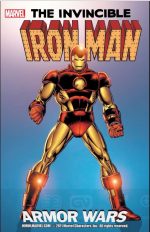
Iron Man: Armor Wars


By David Michelinie, Mark D. Bright, Bob Layton, Barry Windsor Smith & various (Marvel)
ISBN: 978-0-7851-1250-8

For many years Anthony Stark was the modern Thomas Edison; a glamorous genius-inventor and (largely) self-made billionaire. However, for much of the time he secretly moonlights as a super-hero. Unknown to all but his closest friends and allies, Stark dons a self-created suit of futuristic armour packed with his ingeniously-crafted technological marvels, making him the master of any situation, the Invincible Iron Man.

The innovations he has created to build his armour are so ground-breaking that he has never dared patent them because they have the potential to cause great harm.

In this classic and often-reprinted saga (also available in a digital edition) we see that after years of valiant crusading and the overcoming of great personal hardships, Stark’s life comes crashing down around him when he discovers his secrets have been compromised…

Collaboratively crafted by David Michelinie, Mark D. Bright & Bob Layton and latterly known as The Armor Wars, the epic serial comprises Iron Man #225-232 – spanning December 1987 to July 1988 – and begins with ‘Stark Wars!’ as the inventor examines the battle-suit of defeated foe Force and realises that the murderous weaponry and defensive systems are based on his own top-secret technology…

Researching further he discovers that not only do many tech-enhanced villains use his discoveries but so do government and military units. Plagued with guilt at the untold blood spilled with his inventions, Stark resolves to make amends by reclaiming or destroying all incidences of his stolen secrets, bringing him into conflict with his country, his friends and his comrades in the Avengers. Unwilling to compromise, unable to accept the new status quo, Iron Man’s attempts to salve his conscience can only lead to tragedy and disaster…

Diligent investigation reveals the proprietary gimmicks and systems have leaked far and wide, augmenting the capabilities of numerous criminals, mercenaries and military specialists…

Killers all…

As well as locating the source of the initial leak, Stark and his trusted team must take back or destroy every iota of his stolen ordnance if the man is to sleep with a clear conscience ever again…

With the help of Ant-Man Scott Lang, a virus is uploaded to eat all digital records and instances of Stark-tech, but the job of negating actual armoured users is one only Iron Man can accomplish…

Nobody cares when the hero starts tackling villains such as Stilt-Man, The Maulers or Controller, but real trouble comes knocking when Stark mistakenly attacks federal agent and fellow Avenger Stingray in ‘Glitch’ and goes after SHIELD operatives in ‘The Last Mandroid’ and US military personnel in ‘Who Guards the Guardsmen?’ – a clash that causes a mass escape at super-prison The Vault and brings him into conflict with one of his oldest allies: Steve Rogers, the former Captain America…

In ‘Red Snow’ Stark’s West Coast Avengers allies finally demand an explanation and the end of the war but are utterly ignored. Instead Iron Man invades Russia to confront Crimson Dynamo and Titanium Man, resulting in an international incident and the first fatality of the campaign…

Shaken but obsessively undeterred, Iron Man soldiers on with everybody now against him until the unthinkable happens after the US Army bring in a new armoured titan dubbed Firepower.

The tech colossus constructed by Stark’s bitter rival Edwin Cord proves everything the military was hoping for, but as ‘The Day the Hero Died’ ends, the authorities quickly realise that with Iron Man gone nothing can stop Cord and Firepower from doing whatever they want…

Having barely escaped with his life Tony Stark strongly considered quietly retiring, but with the world again imperilled gets back to his drawing board to build something new and better and save the day once more in ‘Reborn Again’…

However, even after his triumphant re-emergence, the psychological cost of his actions must be dealt with in the startling ‘Stark Wars: Epilogue – Intimate Enemies’ by Michelinie, Barry Windsor-Smith & Layton

This enthralling yarn is a compelling examination of honour, heroism and sacrifice exposing the dark side of vigilantism and cost of integrity, deeply embedded in Marvel continuity, with lots of guest-stars and plenty of action. A solid example of what super-hero comics are all about, this classic Fights ‘n’ Tights thriller is pure evergreen Marvel escapism.
© 1987, 2011 Marvel Characters, Inc. All rights reserved.
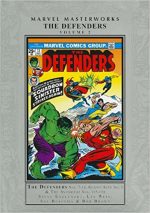
Defenders Masterworks volume 2


By Steve Englehart, Tony Isabella, Len Wein, Sal Buscema, Bob Brown, Jim Starlin & various (Marvel)
ISBN: 978-0-7851-4216-4

The Defenders were the last of the big star-name conglomerate super-groups, and would eventually number amongst their membership almost every hero – and some few villains – in the Marvel Universe. No real surprise there, since the initial line-up was composed of the company’s major league bad-boys: misunderstood and mad, outcast and bad and so often actually dangerous to know.

The genesis of the team derived from their status as publicly distrusted “villains”, and they never achieved the “in-continuity” fame or acceptance of other teams, but that simply seemed to leave the creators open to taking a few more chances and playing the occasional narrative wild card.

This second sterling and sturdy hardcover (and eBook) masterworks collection assembles a veritable host of Fights ‘n’ Tights wonders from a large list of sources: Defenders #7-16, Giant Sized Defenders #1 and Avengers #115-118, encompassing cover-dates August 1973 to October 1974 and commences after author Steve Englehart shares recollections of his groundbreaking tenure in an informative Introduction, after which Defenders #7 jumps right in as Len Wein co-scripts with Englehart and Frank Bolle inks Sal Buscema in ‘War Below the Waves!’

Here tempestuous ex-Avenger Hawkeye temporarily climbs aboard the “non-team” bandwagon to help defeat the undersea threat of Attuma and soviet renegade the Red Ghost; a bombastic battle to usurp the Sub-Mariner of his titles and kingdom concluded a month later in ‘…If Atlantis Should Fall!’ with Englehart once more providing all the words and Frank McLaughlin inking…

Since Defenders #4 the forward-thinking scripter had been putting players in place for a hugely ambitious cross-over experiment: one that would turn the comics industry on its head, and next here comes a little prologue taken from the end of Avengers #115 which finally set the ball rolling.

Drawn by Bob Brown & Mike Esposito, ‘Alliance Most Foul!’ sees interdimensional despot the Dread Dormammu and Asgardian god of Evil Loki unite to search for an ultimate weapon to give them final victory against their foes. They resolve to trick the Defenders into securing the six component parts by “revealing” that the reconstructed Evil Eye could restore the petrified Black Knight.

That plan was initiated at the end of Defenders #8: a brief opening chapter in ‘The Avengers/Defenders Clash’ entitled ‘Deception!’ as a message from the spirit of the Black Knight is intercepted by the twin entities of evil, leading directly to ‘Betrayal!’ in Avengers #116 (by Englehart Brown & Esposito) wherein the World’s Mightiest Heroes – hunting for their missing comrade – “discover” their old enemies Hulk and Sub-Mariner may have turned the Black Knight to stone.

This and third chapter ‘Silver Surfer Vs. the Vision and the Scarlet Witch’ see the rival teams split up: one to gather the scattered sections of the Eye and the other to stop them at all costs…

Defenders #9 (with Buscema & McLaughlin art) begins with tense recap ‘Divide …and Conquer’ before ‘The Invincible Iron Man Vs. Hawkeye the Archer’ and ‘Dr. Strange Vs. the Black Panther and Mantis’ sheds more suspicion and doubt on the vile villains’ subtle master-plan…

Avengers #117 ‘Holocaust’, ‘Swordsman Vs. the Valkyrie’ and crucial turning point ‘Captain America Vs. Sub-Mariner’ (Brown & Esposito) lead to the penultimate clash in Defenders #10 (Buscema & Bolle) in ‘Breakthrough! The Incredible Hulk Vs. Thor’ and the inevitable joining together of the warring camps in ‘United We Stand!’, but tragically too late as Dormammu seizes the reconstructed Evil Eye and uses its power to merge his monstrous realm with Earth.

Avengers #118 delivers the cathartic climactic conclusion in ‘To the Death’ (Brown, Esposito & Giacoia) wherein all the heroes of the Marvel Universe resist the demonic invasion as Avengers and Defenders plunge deep into the Dark Dimension itself to end forever the threat of the evil gods (or for the moment, at least…).

With the overwhelming cosmic threat over the victorious Defenders attempt to use the Eye to cure their petrified comrade, only to discover that his spirit has found a new home in the 12th century. In #11’s ‘A Dark and Stormy Knight’ (Bolle inks), the group battle black magic during the Crusades, fail to retrieve the Knight and acrimoniously go their separate ways – as did overworked departing scripter Englehart…

With issue #12 Len Wein assumed the writer’s role, starting a run of slightly more traditional costumed capers as Sal Buscema & Jack Abel illustrated the return of the mind-bending Xemnu in ‘The Titan Strikes Back!’ against a pared-down cast consisting of Strange, Valkyrie and the Hulk.

A bona fide hit, the non-team were part of a big experiment in extra-value comics that began with opens with Giant Sized Defenders #1 (July1974): a stunning combination of highly readable reprints wrapped in a classy framing sequence by Tony Isabella, Jim Starlin & Al Milgrom. The vintage thrills commence with Stan Lee, Jack Kirby & Dick Ayers’ ‘Banished to Outer Space’ from The Incredible Hulk #3, followed by magnificent 1950s Bill Everett Sub-Mariner fantasy-feast ‘Bird of Prey!’

From there the focus switches to Dr. Strange and the Denny O’Neil/Steve Ditko mini-masterpiece ‘To Catch a Magician!’ (Strange Tales #145) before the concoction concludes with a blockbusting battle as the star trio, sorcerer’s apprentice Clea and the valiant Valkyrie dispatch a self-inflicted mystic menace.

After a splendid double-page pin-up by Sal Buscema the regular epics resume for a spectacular Saves-the-World struggle against the villainous Squadron Sinister that opens in ‘For Sale: One Planet… Slightly Used!’ (featuring an early inking job for Klaus Janson) and concludes in the Dan Green-embellished ‘And Who Shall Inherit the Earth?’ as Marvel’s Batman-analogue Nighthawk unites with the Defenders to defeat his murderous former team-mates and aquatic alien marauder Nebulon, the Celestial Man.

Defenders #15 initiates a two-part duel with manic mutant Magneto who first institutes a ‘Panic Beneath the Earth!’ – courtesy of Wein, Buscema & Janson – leading X-Men mentor Charles Xavier to enlist the outcast heroes’ aid. The concluding clash includes the insidious Brotherhood of Evil and ‘Alpha, the Ultimate Mutant’ (inked by Esposito) as well as the apparent end of true master of evil…

Also included here are behind-the-scenes treats including contemporary house ads, creator biographies and previous collection covers by Carlos Pacheco, John Romita and Richard Isanove.

For the longest time, The Defenders was the best and weirdest superhero comicbook in the business, and if you love superheroes but crave something just a little different these yarns are for you… and the best is still to come.
© 1973, 1974, 2011 Marvel Characters, Inc. All rights reserved.
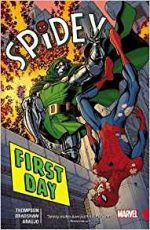
Spidey volume 1: First Day


By Robbie Thompson, Nick Bradshaw, André Lima Araújo & various (Marvel)
ISBN: 978-0-7851-9675-4

Since its earliest days the company now known as Marvel has always courted the youngest comicbook consumers. Whether through animated tie-ins and licensed properties such as Terrytoons Comics, Mighty Mouse, Duckula, assorted Hanna-Barbera and Disney licenses and a myriad of others, or original characters such as Tessie the Typist, Millie the Model, Homer the Happy Ghost and Calvin, the House of Ideas has always understood the necessity of cultivating the next generation of readers.

These days, however, kids’ interest titles are on the wane and, with the Marvel Universe’s characters all over screens large and small, the company usually prefers to create child-friendly versions of its own proprietary pantheon, making that eventual hoped-for transition to more mature comics as painless as possible.

In the 1980s Marvel published an entire line of kiddie titles through its Star Comics line and in 2003 the company created a Marvel Age line which updated and retold classic original tales by Stan Lee, Jack Kirby and Steve Ditko and mixed it in with the remnants of its manga-inspired Tsunami imprint: again all intended for a younger readership.

The experiment was tweaked in 2005, becoming the Marvel Adventures line, with titles reflecting the most popular characters and whatever was on TV screens at the time.

In 2012 these were superseded by specific comicbook titles tied to Disney XD TV shows designated as “Marvel Universe cartoons”.

Today’s featured item – Spidey: First Day – is a horse of a different colour: similar but different…

Rather than simply crafting a wallcrawler for younger sensibilities, this iteration – presumably sparked by the teenaged, light-adventure version seen in the Spider-Man: Homecoming movie – innovates and modernizes by looking back and succeeds in recapturing a sense of the madcap gaiety that counterbalanced the action and pathos of the earliest Lee/Ditko stories. This series is all about thrills and fun…

Scripted throughout by Robbie Thompson and re-presenting Spidey #1-6 (originally released from February to July 2016), the non-stop, youngster-appropriate mayhem commences with a fresh introduction to ‘The Amazing Spider-Man’, illustrated by Nick Bradshaw and colourists Jim Campbell & Rachelle Rosenberg

Firmly set in The Now, our hero is still (or rather once again) a callow schoolboy, fighting crime and making enemies between classes. He’s also a crimefighting sensation of the internet and social media when he puts on his blue-&-red duds. As ever news magnate J. Jonah Jameson is there to vilify the webslinger at every opportunity…

Sadly, thanks to the kid’s double life, Peter Parker‘s grades – except for science and maths – are tanking now, and the secret superhero is forced to accept Popular Girl Gwen Stacy as a much-needed history tutor.

Not only is she the hottest girl in school but she also decks Flash Thompson with one punch after the jocks starts bullying “Puny” Parker again…

Things really kick off later, on a field trip to techno-industrial wonderland Oscorp, when a madman calling himself Doctor Octopus busts in and the neophyte Spider-Man is compelled to intervene and drive the maniac away.

That’s when uber-creepy Norman Osborn introduces himself to Peter, predicting big things for Peter…

The really smart trick in this series is that battles with other supervillains such as Kraven the Hunter and Mysterio are backdrop: referenced simply as having occurred in other moments, allowing Peter Parker’s life and character room to develop, with only new battles dictating how certain villainous players have evolved from standard Spider-Man mythology…

A month later Peter is still coming to terms with his double life when ‘Enter the Sandman’ finds him battling a grittily shapeshifting bank robber, after which New York is overrun by tiny reptiles as old ally Dr. Curt Connors is once again tragically transformed into the ravenous ravening Lizard…

In Spidey #4 André Lima Araújo assumes the art duties with ‘Doomsday Off!’ as Peter stumbles into an art robbery. He might even have stopped the thief… if the bad guy hadn’t been Doctor Doom! Tracking down the ultimate villain does no good and Spidey is once again soundly thrashed, but after the Amazing Arachnid gets a pep talk from a little kid, he tries again and achieves a partial victory…

‘Dead End’ (with Java Tartaglia joining the colouring squad) sees the first inconclusive confrontation with a major nut job called the Green Goblin after which the ebullient effervescent escapades conclude with a first team-up in ‘Making the Grade’, as the mysterious Spider-Man intervenes when flying felon The Vulture burgles Stark Industries.

The Invincible Iron Man shows up but naturally gets the wrong idea – as does SHIELD agent Phil Coulson – before the situation is straightened out. One crisis over and feeling cocky, the very junior hero – smitten with Gwen Stacy – even asks the Armoured Avenger for dating tips but that doesn’t go so well…

Featuring a covers and variants gallery by Bradshaw, Lima Araújo, Skottie Young, Humbert Ramos & Edgar Delgado, Oliver Coipel, Julian Totino Tedesco and Gyimah Gariba, this a sublimely refreshing reinterpretation of an evergreen heroic icon offering an intriguing and certainly more culturally accessible means of introducing character and concepts to kids born two and three generations or more away from those far-distant 1960s originating events. These Spidey super-stories are outrageously enjoyable yarns, and well worth seeking out.
© 2016 Marvel Characters, Inc. All rights reserved.
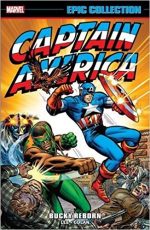
Captain America Epic Collection volume 3: Bucky Reborn


By Stan Lee, Gene Colan, John Romita Sr., Joe Sinnott, Frank Giacoia, Wally Wood, Dick Ayers, Tom Palmer, Bill Everett & various (Marvel)
ISBN: 978-1-3029-0419-7

During the Marvel Renaissance of the early 1960’s Stan Lee & Jack Kirby tried the same tactic that had worked so tellingly for DC Comics, but with mixed results. After all, Julie Schwartz had scored incredible successes with his revised versions of National’s Golden Age greats, so it seemed natural to try and revive the characters that had dominated the Timely/Atlas stable in those halcyon days.

A new youthful Human Torch premiered as part of the revolutionary Fantastic Four, and in the fourth issue of that title the Sub-Mariner resurfaced after a twenty-year amnesiac hiatus (everyone concerned had apparently forgotten the first abortive attempt to revive an “Atlas” superhero line in the mid-1950s).

The Torch was promptly given his own solo feature in Strange Tales from issue #101 on and in #114 the flaming teen fought an acrobat pretending to be Captain America. With reader-reaction strong, the real deal returned in Avengers #4 and, after a captivating and centre-stage hogging run in that title, was granted his own series as half of the “split-book” Tales of Suspense with #59 (cover-dated November 1964). From there on, the only way was up…

This resoundingly resolute full-colour Epic Collection re-presents Captain America #120-#139 spanning December 1969 to June 1971 and opens after the Sentinel of Liberty thwarts the Red Skull’s greatest vengeance scheme: having just trained a future partner in the form of Sam Wilson AKA the Falcon…

As 1970 dawned Marvel imposed a moratorium on continued stories for most of their titles, and Cap – having returned to his hectic twin lives as SHIELD Agent and mighty Avenger – here hops on the disaffected youth/teen revolt bandwagon for a series of slight but highly readable puff-pieces promising nothing but delivering much.

Kicking off is ‘Crack-up on Campus!’ by Stan Lee, Gene Colan & Joe Sinnott; an odd mélange of student radicalism and espionage that sees itinerant Steve Rogers become a Physical Education teacher to foil a scheme by the sinister Modok and his AIM cohorts.

A demented bio-chemist then rediscovers the Super Soldier serum that had originally created Captain America in ‘The Coming of the Man-Brute!’ Sadly, the demented boffin picks the wrong candidate to become his Blockbuster stooge…

Spider-Man’s old sparring partner mugs the wrong guy in #122’s ‘The Sting of the Scorpion!’ and falls before Cap’s bludgeoning fists before issue #123 taps into the seemingly eternal “battle of the sexes” zeitgeist with ‘Suprema, The Deadliest of the Species!’ turning her espionage-tinged attentions to the Star-Spangled Avenger…

AIM returns with their latest hi-tech human weapon in ‘Mission: Stop the Cyborg!’ before Captain America #125 dips into more sensational contemporary headline fare when the Sentinel of Liberty is ‘Captured… in Viet Nam!’… although the mystery villain du jour is anything but politically motivated…

Frank Giacoia returned to ink the Avenger’s long-anticipated reunion with his erstwhile associate and partner in #126’s ‘The Fate of… the Falcon!‘: gleefully tapping into the blossoming “blaxsploitation” trend to recount an entertaining (although, sadly, not always intentionally) caper of gangsters and radicals in funky old Harlem that still has a kick to it. Just play the (original) theme from Shaft whilst reading it…

Still working off-the-books for super-scientific government spy-agency S.H.I.E.L.D. (which back then stood for Supreme Headquarters International Espionage Law-enforcement Division) Cap demands ‘Who Calls Me Traitor?’ (#127, July 1970, by Lee, Colan & Wally Wood), which finds the veteran hero framed and manipulated by friend and foe alike in the search for a double agent in the ranks, after which the embittered Avenger drops out and decides to “discover America” – as so many kids were doing – on the back of a freewheeling motorcycle.

‘Mission: Stamp Out Satan’s Angels!’ (inked by Dick Ayers) finds the Red, White and Blue wanderer barely clear the city limits before encountering a nasty gang of bikers terrorising a small-town rock festival, before his oldest enemy resurfaces to exact ‘The Vengeance of… the Red Skull’ as a simple by-product of his plane to start a Middle East war…

Issue #130 finds Cap ‘Up Against the Wall!’ as old foe Batroc the Leaper leads the Porcupine and Whirlwind in a fully paid-for ambush by villain unknown just as the Sentinel of the establishment is attempting to defuse an imminent college riot. The mysterious contractor then resorts to a far subtler tactic: launching a psychological assault in ‘Bucky Reborn!’…

With the mystery manipulator exposed, the tragic true story behind the resurrected sidekick comes out in ‘The Fearful Secret of Bucky Barnes!’– a powerful, complex drama involving ruthless science terrorists A.I.M., their murderous master Modok and even Doctor Doom…

Back in New York, Advanced Idea Mechanics again feature prominently in #133 as Modok foments racial unrest by sending a killer cyborg to create ‘Madness in the Slums!’, allowing Cap to reunite with his protégé the Falcon – whose name even began appearing on the cover from the next issue.

Operating as full-fledged official partners, the dynamic duo battle ghetto gangsters in ‘They Call Him… Stone-Face!’ (Captain America and the Falcon #134, with Ayers inking), before the Avenger introduces his new main man to S.H.I.E.L.D. in the chilling ‘More Monster than Man!’ (inked by Tom Palmer). Here a love-struck scientist turns himself into an awesome anthropoid to steal riches, only to end up in ‘The World Below’ (with the legendary Bill Everett applying his brilliant inks to Colan’s moody pencils) as a collateral casualty of the Mole Man‘s latest battle with Cap.

With the Falcon coming to the rescue, the Star-Spangled Avenger is back on the surface when his new partner vaingloriously opts ‘To Stalk the Spider-Man’ – a typical all-action Marvel misunderstanding that is forestalled just in time for Stone-Face to return in #138’s ‘It Happens in Harlem!’ as John Romita the elder resumed his illustrative association with Captain America for the beginning of a lengthy and direction-changing saga…

Which will have to wait for the next volume to continue…

Rounding out the riotous adventure, bonus extras include the cover to the all-reprint Captain America Annual #1, assorted house ads, a selection of Colan’s original art pages and covers, rejected covers and sketches by Marie Severin…

Any retrospective or historical re-reading is going to turn up a few cringe-worthy moments, but these tales of matchless courage and indomitable heroism are fast-paced, action-packed and illustrated by some of the greatest artists and storytellers American comics has ever produced.

As the nation changed Captain America was finally discovering his proper place in a new era and would once more become unmissable, controversial comicbook reading, as we shall see when I get around to reviewing the next volume…
© 1969, 1970, 1971, 2017 Marvel Characters, Inc. All rights reserved.
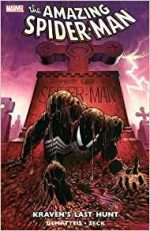
Amazing Spider-Man: Kraven’s Last Hunt


By J.M. DeMatteis, Mike Zeck, Bob McLeod & various (Marvel)
ISBN: 978-0-7851-2330-9 (HC)                    978-0-7851-3450-3 (TPB)

A character with the longevity and sheer number of separate venues to shine in as Spider-Man throws up a lot of dross over the decades, but is also infinitely evergreen when thoughtfully handled by top flight creators. Sometimes the writers and artists involved don’t even realise at the time that their crafting something memorable and timelessly special…

Kraven’s Last Hunt (originally collected as Spiderman: Fearful Symmetry) is just such a saga and is thankfully handily available in a variety of formats from spiffy hardback to cheap’n’cheerful trade paperback – and now even as a digital edition for all true sons and daughters of the 21st century…

Heck, there’s even a picture-free novelisation by Neil Kleid out there, but perhaps that’s a step too far for most comics addicts…

The eerie psycho-drama originally ran in the October and November 1987 issues of Web of, Amazing, and Peter Parker, the Spectacular Spider-Man; following darkly obsessed and suicidal Russian émigré Kraven the Hunter as years of rivalry and constant defeats are turned around, leading the aging monster inexorably to his greatest triumph and ultimate downfall.

In the process the sinister stalker conquers, inters and Oedipally replaces his arch-nemesis, before inevitably succumbing to his own tragic just deserts.

After years of pointless struggle, Kraven here is back-written into an intrinsically noble but twisted relic of a bygone era, whose compulsion to defeat Spider-Man spirals into a demented desire to consume and then become him. The Hunter’s initial success only serves to highlight the fundamental differences between him and his prey, such as how each man deals with the savagely cannibalistic rat/man hybrid Vermin who brutally rampages through the rain-soaked and terrified city in a compelling and efficient sub-plot, or with those ordinary people who impinge upon the lives of protagonist and antagonist equally.

After years of generally C-List villainy, Kraven’s latest plan initial succeeds in ‘Coffin’ (Web of Spider-Man #31) after the Hunter ritualistically devours his foe’s totems before ambushing the webspinner…

In ‘Crawling’ (Amazing Spider-Man #31), sewer-dwelling psychopath Vermin begins brutally marauding through a sodden city, drawing delusional “Spider the Hunter” – now wearing his foe’s pelt (for which read Spider-Man costume) – into conflict. Kraven is attempting to take his beaten enemy’s place even as newlywed Mary Jane Watson-Parker starts really worrying over the current whereabouts of her husband…

When she sees Spider-Man savagely thrashing a pack of street thugs, she knows the man standing before her isn’t Peter…

‘Descent’ (Peter Parker, the Spectacular Spider-Man #131) sees Kraven capture Vermin and finally acknowledge that his own victory is not what he wanted, before seemingly dead and buried Peter Parker literally resurfaces in ‘Resurrection’ (WoS #31) to battle his own shattering psychological demons. Final scores are settled in ‘Thunder’ (ASM #32), before all the horror comes to a shocking halt in PPSS #132’s epic confrontation ‘Ascending’…

Despite its heavy psychological underpinnings, Fearful Symmetry/Kraven’s Last Hunt is a gripping helter-skelter thrill ride, simultaneously moody and fast-paced. Writer J.M. DeMatteis curtails his tendency to overwrite, stifles his leanings toward snappy one-liners or maudlin sentimentality and lets terror and trauma rule, giving art team Mike Zeck & Bob McLeod plenty of opportunities to impress with traditional yet spectacular comic art set-pieces.

This series electrified Spider-Man fans when it first appeared and it has lost none of its power today. This is a must-have item for any fan of the Amazing Arachnid or the superhero medium.
© 1989, 2013 Marvel Characters, Inc. All rights reserved.
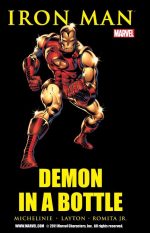
Iron Man: Demon in a Bottle


By David Michelinie, John Romita Jr., Bob Layton & various (Marvel)
ISBN: 978-0-7851-3095-6(HB)                 978-0-7851-2043-8(TPB)

Tony Stark is a millionaire inventor who moonlights as a superhero: wearing a suit of armour stuffed with his own ingenious creations. The supreme technologist hates to lose and constantly upgrades his gear, making Iron Man is one of the most powerful characters in the Marvel Universe. However, at the time of these tales (reprinting Iron Man #120-128 spanning March to November 1979), the unrelenting pressure of running a multi-national corporation and saving the world daily has started to show itself in the subtle increase in Tony Stark’s partying – and drinking.

This light, breezy compilation contains some of the best mainstream super-hero sagas of the 1980s but is also regarded as one of the most remarkable, transformative and powerfully redemptive tales of the period (crafted by David Michelinie, John Romita Jr., Carmine Infantino and Bob Layton), as an epic battle of Good against Evil became seditiously relevant to the readership through its full-on confrontation of a modern social evil.

Following an already stellar run of stories, ‘The Old Man and the Sea Prince!’ (by Michelinie, Romita Jr. & Layton) found the Armoured Avenger battling amphibian superman and sometime ally the Sub-Mariner before uniting against officious military martinets intent on dislodging aged hermit Hiram Cross from the strategically useful island he lived on.

And unsuspected in the background, financial predator Justin Hammer continued his preparations to destroy Iron Man and break Stark’s financial empire…

His first strike was to override the amazing armour in the middle of an underwater duel in ‘A Ruse by Any Other Name…’ but even with that handicap, Stark and his allies Bethany Cabe and Jim Rhode managed to expose unscrupulous conglomerate Roxxon as the cause of all Hiram’s woes… not that it did them any good…

Infantino then pencils a refitted recap of Iron Man’s origins in ‘Journey’ before Hammer steps up his campaign in #123’s ‘Casino Fatale!’ (Michelinie, Romita Jr. & Layton) as a small army of hired villains attack the hero in Atlantic City just when the Iron Man suit is at its most gremlin-afflicted…

The assault escalates in ‘Pieces of Hate!’ (“Layton & Friends” sharing inking duties) but even after scoring an incredible, improbable victory Stark is left reeling when Hammer plays his ace. Taking full control of Iron Man’s armour, the evil plutocrat makes Stark the unwilling accomplice and murder weapon in a monstrous crime, pushing the hero over the edge and into a spiral of despair…

After his super-sophisticated suit “malfunctions” again, killing a foreign ambassador at a major diplomatic function the disgraced and grieving Stark surrenders the armour to the authorities. However, undaunted and finally aware of what’s been going on, he enlists new Ant-Man Scott Lang to his small band of allies and goes undercover to find his hidden enemy in #125’s ‘The Monaco Prelude’.

Nonetheless, the villain seems triumphant when ‘The Hammer Strikes!’, abducting the heroes and gloatingly revealing his dastardly scheme. However, the smirking monster has grievously underestimated his rival’s capabilities and the power of Iron Man in the spectacular final clash ‘…A Man’s Home is His Battlefield!’…

Tragically, when the dust settles and the bad guys are all disposed of, Stark has time to obsess over the lives lost and turns to the booze that has increasingly been his only solace in the past months…

The fall and rise of a hero is a classic plot, and it’s seldom been better used in the graphic narrative medium and never bettered in the super-hero field than in ‘Demon in a Bottle’ as the traumatised hero plumbs the depths of grief and guilt, buries himself in pity, and alienates all his friends and allies before an unlikely intervention forces him to take a long, hard look at his life and actions…

Available in hardback, trade paperback and as an eBook, Iron Man: Demon in a Bottle is a complex and very mature tale for kids of all ages, and an unforgettable instance of Triumph and Tragedy perfectly told. If you have let this tale pass you by, you are the poorer for it and should amend that situation as soon as possible.
© 1984, 2006 Marvel Characters, Inc. All rights reserved.
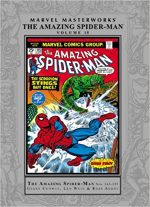
Amazing Spider-Man Masterworks volume 15


By Gerry Conway, Len Wein, Archie Goodwin, Ross Andru, Gil Kane, Sal Buscema & various (Marvel)
ISBN: 978-0-7851-6631-3

After a shaky start in 1962 The Amazing Spider-Man quickly rebounded, rapidly proving a sensation with kids of all ages and rivalling the creative powerhouse of Lee & Kirby’s Fantastic Four. Soon the quirky, charming, action-packed comicbook soap-opera would become the model for an entire generation of younger heroes elbowing aside the staid, (relatively) old costumed-crimebusters of previous publications.

Previously: Peter Parker was a smart yet alienated kid bitten by a radioactive spider during a school science trip. Discovering astonishing arachnid abilities – which he augmented with his own natural chemistry, physics and engineering genius – the kid did what any lonely, geeky nerd would do with such newfound prowess: he tried to cash in for girls, fame and money.

Making a costume to hide his identity in case he made a fool of himself, Parker became a minor media celebrity – and a criminally self-important one. To his eternal regret, when a thief fled past him one night he didn’t lift a finger to stop him, only to find when he returned home that his guardian uncle Ben Parker had been murdered.

Crazed with a need for vengeance, Peter hunted the assailant who had made his beloved Aunt May a widow and killed the only father he had ever known, finding, to his horror, that it was the self-same felon he had neglected to stop. His irresponsibility had resulted in the death of the man who raised him, and the traumatised boy swore to forevermore use his powers to help others…

Since that night the Wondrous Wallcrawler has tirelessly battled miscreants, monsters and madmen, with a fickle, ungrateful public usually baying for his blood even as he perpetually saves them.

The Amazing Spider-Man was always a comicbook that matured with – or perhaps just slightly ahead of – its fan-base, and this 15th exceptionally enthralling full-colour compendium of chronological web-spinning adventures confirms that notion as the World’s Most Misunderstood Hero survives one of the most macabre and Byzantine vengeance plots ever conceived. Further backing up the thought is author Gerry Conway’s farewell Introduction – ‘All Things Must Pass’ – which candidly revealed why after killing Peter’s one true love the editors and especially publisher moved heaven and earth to bring her back…

With the material in this sturdy Hardcover compilation (and latterly eBook) Stan Lee’s hand-picked successor Conway moved on after reaching a creative plateau giving way to fresh authorial guide Len Wein. However, scripts continued to blend contemporary issues (which of course often feel quite outdated from here in the 21st century) with soap opera subplots to keep older readers glued to the series as the outrageous adventure and bombastic battle sequences beguiled the youngsters.

Thematically, there’s further decline in the use of traditional crimes and gangsters, as super-science, outlandish villains and monsters took centre stage, but the most sensational advance was an insidious scheme which would reshape the nature of the web-spinner’s adventures for decades to come…

For all that, the wallcrawler was still indisputably mainstream comics’ voice of youth; defining being a teenager for young readers of the 1970s, tackling incredible hardships, fantastic foes and the most pedestrian and debilitating of frustrations.

High School nerd Peter Parker had grown up and gone to college. Because of his guilt-fuelled double-life he struggled there too, developed a stress ulcer but found true love with policeman’s daughter Gwen Stacy…

This volume – spanning April 1975 to April 1976 – re-presents Amazing Spider-Man #143-155, Annual #10 and opens with Amazing Spider-Man #143 ‘…And the Wind Cries: Cyclone!’ (Conway Ross Andru, Frank Giacoia & Dave Hunt).

Peter Parker is in Paris to deliver a ransom and save kidnapped publisher J. Jonah Jameson but soon calls in his arachnid alter ego to deal with a hyper-fast French super-villain. The story is fairly run-of-the-mill but the real kicker comes from an overly-fond farewell expressed by “casual chum” Mary Jane Watson: a kiss that finally shifts traumatised, depressed Peter’s thoughts from his beloved, recently murdered Gwen…

The creative team capitalised on the situation when Pete returns to New York and his – rather extraordinary – daily travails as #144 launched ‘The Delusion Conspiracy’, whilst #145 focuses on a baffled girl’s confusion and terror at everyone’s reactions when she comes home and the entire world screams ‘Gwen Stacy is Alive …and, Well…?!’

With Gwen somehow resurrected and Peter on the edge of a breakdown, Aunt May is hospitalised just in time for another old foe to strike again in ‘Scorpion… Where is Thy Sting?’, but the real kick in the tale is irrefutable scientific and medical reports proving the increasingly bewildered Miss Stacy is not an impostor but the genuine article…

In Spider-Man #147 Peter finds some answers as further tests prove Gwen is actually a true human clone (remember, this was new and cutting-edge stuff in 1975) but all too soon he’s distracted by another foe bad-guy with a grudge and hungry to prove ‘The Tarantula is a Very Deadly Beast’ (illustrated by Andru, Esposito & Hunt).

It’s all part of a convoluted and utterly Byzantine revenge scheme conceived by a malign old enemy. When the hero is ambushed by a mesmerised Gwen at the behest of the archfiend, ‘Jackal, Jackal, Who’s Got the Jackal?’ (art by Andru, Mike Esposito & Hunt) at last discloses some shocking truths about one of Peter’s most trusted friends before the Delusion Conspiracy explosively concludes with #149’s ‘Even if I Live, I Die!’ (Andru & Esposito).

Learning that he and Gwen had been covertly cloned by their biology teacher Miles Warren, the Amazing Arachnid has to defeat his alchemical double in a grim, no-holds-barred identity-duel, with neither sure who’s the real McCoy. The battle eventually results in the copy’s death… maybe…, perhaps… probably…

That moment of doubt over who actually fell informs anniversary issue Amazing Spider-Man #150, as Archie Goodwin, Gil Kane, Esposito & Giacoia take the hero down memory lane and up against a brigade of old antagonists to decide whether ‘Spider-Man… or Spider-Clone?’ survived that final fight, before debuting regular scripter Len Wein joins Andru & John Romita Sr. to launch a new era of adventure…

After disposing of his duplicate’s corpse in an incineration plant, Spider-Man finds time to let Peter reconnect with his long-neglected friends. However, a jolly party is soon disrupted as blackouts triggered by a super-menace lead the wallcrawler down into the sewers for a ‘Skirmish Beneath the Streets!’, resulting in our hero almost drowning and nearly being ‘Shattered by the Shocker!’(Esposito & Giacoia inks) in a conclusive and decisive return engagement…

A moving change-of-pace tale then finds a blackmailed former football star giving his all to save a child in ‘The Longest Hundred Yards!’ (Andru & Esposito) but it is left to Spider-Man to make the computer-crook culprits pay, after which #154 reveals ‘The Sandman Always Strikes Twice!’ (art by Sal Buscema & Esposito) – albeit with little lasting effect – until devious murder-mystery ‘Whodunnit!’ (Buscema & Esposito again) cunningly links three seemingly unconnected cases in a masterful “Big Reveal”…

This copious compendium then concludes with some contemporary house ads, an editorial explanation of the original “Clone Saga” and biographies. Despite some qualifications this is a superb selection starring an increasingly relevant teen icon and symbol. Spider-Man was and still is a crucial part of many youngsters’ existences: living a life as close to theirs as social mores and the good taste allow.

Blending cultural veracity with glorious art and making a dramatic virtue of the confusion, awkwardness and sense of powerlessness most of the readership experienced daily resulted in an irresistibly intoxicating read, delivered in addictive prime time melodrama moments, but none of that would be relevant if the stories weren’t so compellingly entertaining.

This action-packed collection comprises one of the most momentous periods in Spider-Man’s astounding life and is one every Fights ‘n’ Tights fanatic should see…
© 1975, 1976, 2011, 2015 Marvel Characters, Inc. All rights reserved.
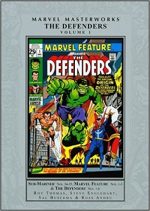
Defenders Masterworks volume 1


By Roy Thomas, Steve Englehart, Sal Buscema, Ross Andru & various (Marvel)
ISBN: 978-0-7851-3044-4 (HC)

Last of the big star conglomerate super-groups, the Defenders would eventually count amongst its membership almost every hero – and a few villains – in the Marvel Universe. No surprise there then, as initially they were composed of the company’s bad-boy antiheroes: misunderstood, outcast and often actually dangerous to know.

For Marvel, the outsider super-group must have seemed a conceptual inevitability – once they’d finally published it. Apart from Spider-Man and Daredevil all their superstars regularly teamed up in various mob-handed assemblages and, in the wake of the Defenders’ success, even more super-teams comprising pre-existing characters were rapidly mustered. These included the Champions, Invaders, New Warriors and so on – but none of them had any really Very Big Guns…

For kids – of any and all ages – there is a positively primal fascination with brute strength and feeling dangerous, which surely goes some way towards explaining the perennial interest in angry tough guys who break stuff as best exemplified by Prince Namor, the Sub-Mariner and the Incredible Hulk. When you add the mystery and magic of Doctor Strange, the recipe for thrills, spills and chills becomes simply irresistible…

Although the genesis of the team may have derived from their status as publicly distrusted but well-selling “villains”, originator Roy Thomas shares his own recollections and deeper ruminations in an informative Introduction which namechecks a pivotal continued experimental crossover which didn’t make the cut in this sterling and sturdy hardcover (and eBook) compendium.

I only mention it as the sinister antagonists of those tales play a crucial role in the later stories that do appear here; namely Sub-Mariner #34-35, Marvel Feature #1-3 and Defenders #1-6, spanning February 1971 through June 1973…

So, for fuller enjoyment, you might want to track down Dr. Strange #183(November 1969), Sub-Mariner #22 (February 1970) and Incredible Hulk #126 (April 1970) – Essential Defenders volume 1 has those plus all these and much more, but only in stark monochrome reproduction – which collectively detailed how ancient necromantic threat the Undying Ones returned to bedevil Earth…

An elder race of demons hungry to reconquer humanity, they clashed with Stephen Strange, but as his series unexpectedly ended with that issue the story went nowhere until the Sub-Mariner #22 brought the Prince of Atlantis into the mix. A sterling tale of sacrifice in which the Master of the Mystic Arts seemingly died holding the gates of Hell shut with the Undying Ones pent behind them then concluded on an upbeat note in Incredible Hulk #126, after a New England cult dispatched helpless Bruce Banner to the nether realms in an attempt to undo Strange’s heroic gesture.

Luckily cultist Barbara Norris had last-minute second thoughts and her own sacrifice freed the mystic, seemingly ending the threat of the Undying Ones forever. At the end of that issue Strange retired, forsaking magic, although he was back before too long as the fates – and fickle reading tastes – called him back to duty.

The Defenders’ story officially begins here with Sub-Mariner #34-35 of his own title (February and March 1971). The Prince of Atlantis had become an early advocate of the ecology movement, and here he took the next step in their evolution by fractiously recruiting Hulk and the Silver Surfer to help him destroy an American Nuclear Weather-Control station.

In ‘Titans Three’ and the concluding ‘Confrontation’ (by Thomas, Sal Buscema & Jim Mooney) the always-misunderstood trio battled a despotic dictator’s forces, the US Army, UN defence forces and the mighty Avengers to prevent the malfunctioning station from accidentally vaporising half the planet…

With that debacle smoothed over life resumed its usual frenetic pace for the Hulk and Namor until giant-sized try-out comic Marvel Feature #1 (December 1971) presented ‘The Day of the Defenders!’ wherein a mysteriously returned Dr. Strange recruited the Avenging Son and the Jade Giant to help him stop the deathbed doom of crazed super-mind Yandroth.

Determined to not go gently into the dark, the Scientist Supreme had built an Omegatron weapon programmed to obliterate the Earth as soon as Yandroth’s heart stopped beating and only the brute strength of the misunderstood misanthropes could possibly stop it…

Naturally the fiend hadn’t told the whole truth but the day was saved – or at least postponed – in a canny classic from Thomas, Ross Andru & Bill Everett.

Clearly and immediately destined for great things, the astounding antiheroes returned in Marvel Feature #2 (March 1972) with Sal Buscema replacing Everett as inker for late Halloween treat ‘Nightmare on Bald Mountain!’

By capturing arch-foe Dr. Strange, extra-dimensional dark lord Dormammu sought to invade our realm through a portal in Vermont, only to be savagely beaten back by the mage’s surly sometime comrades, whilst in #3 (June 1972) Thomas, Andru & Everett reunited to revive an old Lee/Kirby “furry underpants” monster in ‘A Titan Walks Among Us!’

Xemnu the Titan was an alien super-telepath seeking to repopulate his desolate homeworld by stealing America’s children until thrashed by the Defenders, but older fans recognised him as the cover-hogging star of Journey into Mystery #62 (November 1960) where he acted as a road-test for a later Marvel star in a short tale entitled ‘I Was a Slave of the Living Hulk!’…

An assured hit, The Defenders exploded swiftly into their own title (cover-dated August 1972), to begin a bold and offbeat run of reluctant adventures scripted by super-team wunderkind Steve Englehart. As a group of eclectic associates occasionally called together to save the world (albeit on a miraculously monotonous monthly basis) they were billed as a “non-team” – whatever that is – but it didn’t affect the quality of their super-heroic shenanigans.

With Sal Buscema as regular penciller an epic adventure ensued with ‘I Slay by the Stars!’ (inked by Giacoia) as sorcerer Necrodamus attempted to sacrifice Namor and free those pesky Undying Ones; a mission that promptly led to conflict with an old ally in ‘The Secret of the Silver Surfer!’ (inked by John Verpoorten) before concluding in the Jim Mooney-inked ‘Four Against the Gods!’

Here the Defenders took the war to the dimensional dungeon of the Undying Ones and rescued the long-imprisoned and now utterly insane Barbara Norris.

Clearly a fan of large casts and extended epics, Englehart added a fighting female to the non-team with ‘The New Defender!’ (inked by new regular Frank McLaughlin) as Asgardians exiles Enchantress and Executioner embroiled the antiheroes in their long-running and lethal love-spat. The fallout included bringing the Black Knight briefly into the mix and turning Barbara into the latest incarnation of Feminist Fury (these were far less enlightened days) The Valkyrie.

Defenders #5 began a long-running plot thread that would have major repercussions for the Marvel Universe. The denouement of the previous tale had left the Black Knight an ensorcelled, immobile stone statue, and, as Strange and Co. searched for a cure, the long defused Omegatron suddenly resumed its countdown to global annihilation in ‘World Without End?’

This initial collection then concludes with the increasingly isolationist Silver Surfer momentarily “rejoining” in #6 to share ‘The Dreams of Death!’ as new lightweight magic menace Cyrus Black attacked, and was as rapidly repulsed…

After a spiffy team pin-up by Sal Buscema, a revelatory Afterword by Steve Englehart segues into a brief bonus feature including unpublished cover art, contemporary house ads and creator biographies.

For a brief while The Defenders would be one of the best and weirdest superhero comics in the business, but to get there you really need to observe this unruly, uncomfortable selection of misfit heroes in their salad days here. At least the fact that their widespread and far-reaching origins are still so eminently entertaining should be both a relief and delight.

Go on, Enjoy, Pilgrim… the best is yet to come…
© 1970, 1971, 1972, 1973, 2009, 2016 Marvel Characters, Inc. All rights reserved.