Essential Fantastic Four volume 4


By Stan Lee, Jack Kirby, Joe Sinnott & various (Marvel)
ISBN: 978-0-7851-1484-X

This fabulous fourth black-and-white compendium of the classic and landmark “Stan & Jack” Fantastic Four sees the feature achieve its highest potential in a string of superlative tales that proved the bold boast on every cover… “World’s Greatest Comic Magazine!”

Jack Kirby was in his conceptual prime and continually unleashed his vast imagination on spectacular plot after plot whilst Stan Lee scripted some of the most passionate superhero sagas that Marvel – or any publisher, for that matter – has ever seen. Both were on an unstoppable roll, at the height of their creative powers, and full of the confidence that only success brings, with Kirby in particular eager to see how far the genre and the medium could be pushed.

This volume, covering the early career of comics’ First Family covers Fantastic Four #64-83 (July 1967-February 1969) plus the fifth and sixth annuals, a bombastic blend of super-science, soap opera and stunning action that has seldom been equaled and never bettered.

The magic commences with ‘The Sentry Sinister’ (inked as always by Joe Sinnott) a frenetic adventure romp which pitted the team against a super-scientific robot buried for millennia by an ancient star-faring race. This tropical treat expanded the burgeoning interlocking landscape to an infinite degree by introducing the imperial Kree who would grow into one of the fundamental pillars supporting the continuity of the Marvel Universe.

Although regarded as long-dead the Kree themselves resurfaced in the very next issue as the team was attacked by an alien emissary ‘…From Beyond this Planet Earth!’ The formidable Ronan the Accuser turned up looking to see what could possibly have destroyed his Sentry. Simultaneously The Thing’s blind girlfriend Alicia was abducted by a super scientific stranger…

The mystery of her disappearance was revealed in #66 in ‘What Lurks Behind the Beehive?’ as the heroes trailed the seemingly helpless girl to a technological wonderland where a band of rogue geniuses had genetically engineered the next phase in evolution but lost control of it even before it could be properly born…

‘When Opens the Cocoon!’ revealed the secret of the creature known only as Him and only Alicia’s gentle nature could placate the nigh-omnipotent creature (who would eventually evolve into the tragic cosmic voyager Adam Warlock), after which the tight continuity gradually paused to allow the Inhumans (a time-lost race of paranormal beings long secluded from mortal men) and the Black Panther to share the stage in that year’s Annual, wherein the sinister invader Psycho-Man attempted to ‘Divide… and Conquer!’

Frank Giacoia actually inked this wrongly attributed yarn that pitted the emotion-bending invader against both the King of Wakanda and the Royal Family of hidden Attilan until the FF could pitch in, delayed as they were by the news that the Sue Richards was pregnant – and soon to confined in the most appallingly sexist manner until the birth…

The Annual also included another comedy insight into the creation of Marvel Epics as Stan, Jack and Frank asked ‘This is a Plot?’ and after the now customary Kirby pin-ups (Inhumans Black Bolt, Gorgon, Medusa, Karnak, Triton, Crystal and Maximus, a colossal group shot of Galactus the Silver Surfer and others and a double page spread of the FF themselves) a rapidly rising star-in-the-making got his first solo appearance in ‘The Peerless Power of the Silver Surfer’ a pithy fable of cruel ingratitude that reintroduced the Mad Thinker’s lethal Artificial Intelligence creation Quasimodo…

In FF #68 the Thinker himself enacted his latest plan and ‘His Mission: Destroy the Fantastic Four!’ as the cogitating criminal replaced a famous doctor and subverted a potential cure for The Thing’s rocky condition into a mind-warping scheme to turn the Thing against his comrades (inked as ever by the remarkable Joe Sinnott). The scheme progressed in ‘By Ben Betrayed!’ as the newly malevolent Grimm attempted to murder the rest of the team only to be driven temporarily away. Desperately searching for him the FF soon captured the Thinker and freed Ben from mind-control in ‘When Fall the Mighty!’ but the victory left the heroes unconscious and only Sue conscious to tackle the villains last-ditch killer android in ‘…And So It Ends…’

With baby on board Reed and Sue resigned, leaving Ben, Johnny and the Inhuman maid Crystal to hold the fort when cosmic calamity came calling. In ‘Where Soars the Silver Surfer!’ the sky-born wanderer imprisoned on Earth by the world-devouring Galactus went cage-crazy and attacked humanity, forcing Reed’s return, whilst #73 presented the conclusion to a long-running Daredevil (see Essential Daredevil volume 2) story wherein the sightless crusader was ousted from his own body by the Iron Dictator Doctor Doom.

Warning the FF of imminent attack the Man without Fear then subsequently defeated Doom – but neglected to tell the heroes of his victory… outmatched and unable to convince them any other way DD enlisted Thor and Spider-Man in ‘The Flames of Battle…’ to solve the problem Marvel style – with a spectacular pointless and utterly riveting punch-up…

The Surfer was back in #74 ‘When Calls Galactus’ as the planet-eater returned to our skies demanding that his one-time herald once more become his food-finding slave, but despite his increasingly violent probings, Galactus cannot locate his target. That’s because the Surfer had departed for ‘World Within Worlds!’ forcing Reed, Ben and Johnny to follow. When attacked by Psycho Man they are ‘Stranded in Sub-Atomica!’ and as they struggle to survive Galactus applies ever-more pressure… ‘Shall Earth Endure?’

Turning himself in to save Earth, the Surfer is summarily returned to his captivity here as soon as ungrateful Galactus is finished feeding, just in time to begin his own landmark series – but that’s the subject of another review, another time…

Meanwhile in FF#78 another attempt to cure Ben Grimm goes awry in ‘The Thing No More!’ due to interference from old foe The Wizard and, in ‘A Monster Forever?’, Ben’s choice to stay a rocky monster and save his friends from the bludgeoning Android Man.

A brief change of pace took the team to the Indian Lands of old friend Wyatt Wingfoot to solve an eerie mystery ‘Where Treads the Living Totem!‘ before the sixth Annual spotlighted the birth of Franklin Richards. Unfortunately however, not before Reed, Ben and Johnny invaded the anti-matter Negative Zone to confront a monstrous creature named Annihilus whose power was the only thing that could prevent the death of Sue and her unborn child. ‘Let There Be… Life!’ is a groundbreaking 48 page epic that is as stunning to read now as it ever was, passionate thrilling and mind-boggling in its visual intensity.

With Sue a new mother faithful Crystal became the first new official member of the team and promptly showed her mettle by pulverizing the incorrigible Wizard in #81’s ‘Enter… the Exquisite Elemental!’ and this volume concludes with a classic two-part clash against the inhuman Maximus as he once more attempted to conquer mortal humanity. ‘The Mark of… the Madman!’ saw the FF come to the aid of the imprisoned Royal Family of Attilan before together trouncing the insane despot in ‘Shall Man Survive?’

Did I say concludes? Not quite as this book still finds room for a selection of 6 original art pages from Kirby and his alternate cover for issue #65, you lucky, lucky people…

These are the stories that confirmed Jack Kirby as the absolute master of superhero storytelling and gave Marvel the push needed to overtake the decades-dominant DC. They’re also some of the very best comics ever produced and as thrilling and compulsive now as they ever were. This is a must-have book for all fans of graphic narrative.

© 1967, 1968, 1969, 2005 Marvel Characters, Inc. All Rights Reserved.
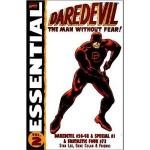
Essential Daredevil volume 2

New, Revised review


By Stan Lee, Gene Colan & various (Marvel)
ISBN 0-7851-905239-1462-9

Marvel Comics built its fan-base through strong and contemporarily relevant stories and art, but most importantly, by creating a shared continuity that closely followed the characters through not just their own titles but also through the many guest appearances in other comics. Such an interweaving meant that even today completists and fans seek out extraneous stories to get a fuller picture of their favourites’ adventures. In such an environment, series such as ‘Essential’ and DC’s ‘Showcase’ are an economical and valuable product that approaches the status of a public service for collectors.

This particular edition, reprinting the exploits of a very different Daredevil to the one radicalised into a grim urban vigilante by Frank Miller and his successors from the 1980’s onwards, covers the period from March 1967 (#26) to January 1969 (#48), and includes the first Annual plus Fantastic Four #73 where a long-running storyline concluded (see what I mean about cross-collecting?).

The adventures are fairly typical 1960’s action-fodder. Matt Murdock is a blind lawyer whose other senses hyper-compensate, making him a formidable acrobat and fighter, and a human lie-detector. Very much a second-string hero for most of his early years, he was nonetheless a popular one, due in large part to the incredibly humanistic art of Gene Colan. He fought gangsters and a variety of super-villains, and even the occasional alien invasion. He also joked and wise-cracked his way through life, unlike the grim and moody quasi-religious metaphor he’s been seen as in latter years.

The action commences with marked improvement in overall story quality as Stan Lee began to use longer soap operatic plot-threads to string together the unique fight scenes of increasingly bold Gene Colan, who was finally shaking off the last remnants of his predecessor’s art style. In a very short time John Romita had made the character his own before moving on to Spider-Man, so when Colan took over he kept the clipped solid, almost chunky lines whilst drawing the Man without Fear, but increasingly drew everything else in his loose, fluid, near-tonal manner.

This clash of visuals was slow to pass but by the time of ‘Stilt-Man Strikes Again’ (DD #26, March 1967) a leaner, moodier hero was emerging. The major push of the next few issues was to turn the hopeless romantic triangle of Matt Murdock, best friend/Law partner Foggy Nelson and their secretary Karen Page into a whacky quadrangle by introducing fictitious twin brother Mike, who would be “revealed” as Daredevil to divert suspicion from the blind attorney who actually battled all those weird villains…

Confused yet…?

Also skulking in the background was arch-villain Masked Marauder who was closing in on DD’s alter ego. He got a lot closer in ‘Mike Murdock Must Die!’ (inked by Frank Giacoia) as Stilt-Man teamed with the Marauder and Spider-Man clashed with old Horn-Head before the villains met their apparent ends.

DD had his first clash with extraterrestrials in #28’s moody one-trick-pony ‘Thou Shalt Not Covet Thy Neighbor’s Planet!’ a Dick Ayers inked thriller wherein the invaders’ blindness rays proved inexplicably ineffective against the Crimson Crime-buster.

John Tartaglione inked the next tale, a solid, action-packed gangster thriller entitled ‘Unmasked!’ whilst issue #30 began a protracted and impressive epic clash with old Thor foes the Cobra and Mister Hyde, complete with Asgardian cameo in ‘…If There Should Be a Thunder God!’

Attempting to catch the criminals DD masqueraded as Thor only to encounter the real McCoy, and was ambushed by the villains once the Thunderer departed. As a result DD lost his compensating hyper-senses and had to undertake a ‘Blind Man’s Bluff!’ which almost fooled Cobra and Hyde… Sadly it all went wrong before it all came right and against all odds Murdock regained his abilities just in time ‘…To Fight the Impossible Fight!’

Daredevil #33 saw the entire cast head to Canada for Expo ’67 (the World’s Fair) encountering another borrowed villain in ‘Behold… the Beetle!’ and its frenetic sequel ‘To Squash the Beetle!’ The first Annual follows; a visually impressive but lacklustre rogues’ gallery riot as five old foes ganged up on Daredevil in ‘Electro and the Emissaries of Evil!’ with the Man without Fear putting a pretty definitive smack-down on the electric felon, the Matador, Gladiator, Stilt-Man and Leapfrog.

Of more interest are the ‘Inside Daredevil’ pages, explaining his powers, how his Billy Club works and the Matt/Mike Murdock situation, with stunning pin-ups of Karen, Foggy, Ka-Zar, DD and a host of old foes. Rounding out the experience is a short comedy tale ‘At the Stroke of Midnight!: an Actual Unrehearsed Story Conference with (and by) Stan and Gene!’

‘Daredevil Dies First!’ pitted the sightless wonder against old Fantastic Four foe Trapster, but Horn-Head was only a stepping-stone in his complex plan to destroy the World’s premier super-team. However DD managed to turn the tables in #36’s ‘The Name of the Game is Mayhem!’ (inked by Giacoia) a clash that left the blind hero weakened and easy prey for another FF arch-foe. Tartaglione returned to ink the startling ‘Don’t Look Now, But It’s… Doctor Doom!’

Helpless before the Iron Dictator DD was trapped in ‘The Living Prison!’ (Giacoia inks) as Doom swapped bodies with the sightless crusader to facilitate an ambush on the FF which culminated in a stupendous Battle Royale in Fantastic Four #73’s crossover conclusion as the Torch, Thing and Mr. Fantastic fought DD, Thor and Spider-Man in ‘The Flames of Battle…’ (by Lee, Jack Kirby & Joe Sinnott). When involved in mind-swap cases it’s always prudent to advise your friends when you regain your original body…

DD finally got to battle some of his own bad-guys in #39 as old foes the Ani-Men returned with a new name and a new boss. ‘The Exterminator and the Super-Powered Unholy Three’ (inked by George Tuska) reintroduced Bird-Man, Ape-Man and Cat-Man in the pay of a criminal genius working with time-based weapons, but the real meat of the tale was Foggy Nelson’s campaign to become New York City’s District Attorney and his revived relationship with ex-con Deborah Harris: now Matt Murdock’s only rival for Karen’s affections was his imaginary twin brother Mike…

That story proceeded in #40, resulting in a spectacular clash ‘The Fallen Hero!’ (inked by Tartaglione) and concluded the only way it could in ‘The Death of Mike Murdock!’ as Matt took advantage of his final battle with the Exterminator to end the charade. He didn’t come clean though, as Daredevil revealed that Mike was only one of a number of Men without Fear in the first part of a prolonged battle with a new nemesis as ‘Nobody Laughs at The Jester!’ (inked by Dan Adkins).

The Malevolent Mountebank only wanted to be more successful as a criminal than he had been as an actor until mayoral candidate Richard Raleigh hired him to spoil incorruptible Foggy Nelson’s campaign for the D.A. post; precipitating a protracted saga which kicked off with a temporarily befuddled DD ‘In Combat with Captain America!’ (inked by Vince Colletta) before being framed for killing the Jester’s alter ego Jonathan Powers in #44’s ‘I, Murderer!’

Defeated by the Jester in ‘The Dismal Dregs of Defeat!’, Horn-Head became a wanted fugitive and after a frenetic manhunt was finally arrested before snatching victory in the thoroughly enthralling conclusion ‘The Final Jest!’ as inker extraordinary George Klein began a long and impressive association with the series.

With the Vietnam War raging a story involving the conflict was inevitable, but #47’s ‘Brother, Take My Hand!’ was so much more than a quick cash-in or even well-meaning examination of contemporary controversy, as Marvel found a new African-American character (one of far too few in those blinkered times).

Newly-blinded veteran Willie Lincoln turned to Matt Murdock and Daredevil for help on his return home. A disgraced cop framed by gang-boss Biggie Benson before joining the army, Lincoln was now back in America to clear his name… at all costs. This gripping, life-affirming crime thriller not only triumphs in Daredevil’s natural milieu of moody urban menace but also sets up a long-running plot that would ultimately change the Man without Fear forever.

The book ends with the return of Stilt-Man in ‘Farewell to Foggy’ as Matt’s oldest friend wins the election for D.A. but acrimoniously turns his back on Murdock, seemingly forever.

This is a good place to end as Stan Lee would hand over the scripting to Roy Thomas soon after this and the social turbulence that marked the end of the 1960s would begin to transform the dashing, wise-cracking Daredevil into something closer to his current dark archetype. But that’s for another volume…

© 1967, 1968, 1969, 2004 Marvel Characters, Inc. All rights reserved.

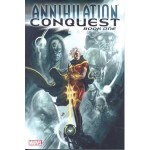
Annihilation Conquest Book 1


By various (Marvel)
ISBN: 978-0-8751-2782-6

Annihilation was another of those company-wide publishing events that “Changed The Marvel Universe Forever” (and don’t they all?) which ran for most of 2006, and involved most of the House of Ideas’ outer space outposts and cosmic characters. Among the stalwarts in play were Silver Surfer, Galactus, Firelord (and a host of previous heralds of the world-eater), Moondragon, Quasar, Star-Lord, Thanos, Super-Skrull, Tana Nile, Gamora, Ronan the Accuser, Nova, Drax the Destroyer, a Watcher and a host of alien civilisations such as the Kree, Skrulls, Xandarians, Shi’ar et al., all falling before a invasion of rapacious negative zone bugs and beasties unleashed by the insectoid horror Annihilus.

If you’re new to the Marvel universe and that bewildering list of daunting data didn’t leave you screaming in frustration, then please read on…

As is usual in these public thinnings of the herd, a number of good guys and bad died and had their trademark assumed by a new and glitzier model whilst some moribund careers got a successful and overdue shot in the arm…

The event spawned a number of specials, miniseries and new titles, (subsequently collected as three volumes plus a Classics compilation that reprinted key appearances of a number of the saga’s major players) and inevitably led to a follow-up event: Annihilation: Conquest.

The first volume of this surprisingly engaging sequel series collects Annihilation: Conquest Prologue, Annihilation: Conquest Quasar #1-4, Annihilation: Conquest Star-Lord #1-4 and Annihilation Saga, opening on a scarred and war-torn realm of known space, decimated and still reeling from the chaos of the Annihilation Wave and its aftermath.

The Kree and Skrull empires are splintered, the Nova Corps of Xandar reduced to a single agent, ancient gods are loose and a sizable portion of the Negative Zone invaders have tenuously established themselves in territories stolen from the billions of dead sentients that once populated the cosmos. The Supreme Intelligence is gone and arch-villain Ronan has become a surprisingly effective ruler of the Kree remnants. Cosmic Protector Quasar is dead and Phyla-Vel, daughter of the first Captain Marvel has inherited both his powers and name…

In ‘Prologue’ (written by Dan Abnett & Any Lanning, illustrated by Mike Perkins and coloured by Guru eFX) Phyla-Vel and psychic demi-goddess Moondragon are working with the pacifist Priests of Pama to relieve the suffering of starving survivors, whilst Peter Quill, one time cosmic champion Starlord, is working with Ronan and the remnants of the warlike Kree on the planet Hala to shore up the battered interstellar defences of the myriad races in the sector.

Quill has brokered an alliance with the Spaceknights of Galador (an old noble cyborg species most famously represented by 1980s hero Rom) that should enhance the all-pervasive etheric war-net, but once uploaded the date instantly causes disastrous problems throughout the system. In seconds all technology in the region is compromised: overruled by a murderous, electronic sentient parasitic species known as the Phalanx, whose cybernetic credo is “peace and order through assimilation”. Once more organic life is facing total extinction…

On planet Pama, Phyla and Moondragon are targeted by enslaved Kree automatons as the Phalanx attempt to destroy any credible resistance before spectacularly cutting off the entire quadrant from the rest of the universe. If life is to survive this threat it must be saved by the champions trapped inside…

The miniseries ‘Starlord’ (written by Keith Giffen, with art from Timothy Green II, Victor Olazaba & Nathan Fairbairn), finds the one-time Cosmic Avenger stripped of his powers and technological enhancements – all now liabilities when facing a predator species that infests electronic devices – and seconded to a Kree resistance division. Here he is tasked with turning Kree prisoners into a Penal Strike Force (a highly engaging intergalactic Dirty Half-Dozen) and taking out the Phalanx base where the invaders are perfecting a more efficient way to assimilate organics into their mechanistic hive-mind.

Once a major bad-guy race in the Marvel mainstream, whoever the Kree consider criminals look surprising like failed heroes to me. Firstly there’s Galactic Warrior Bug (originally from the 1970’s phenomenon Micronauts), the current Captain Universe (ditto), the Shi’ar berserker Deathcry, failed Celestial Madonna Mantis, anamorphic adventure Rocket Raccoon and the gloriously whacky “Kirby Kritter” Groot, a Walking Tree and one-time “Monarch of Planet X.”

With this reluctant team in tow and using natural abilities and decidedly primitive weapons the squad invades Hala, now the central beachhead of the Phalanx, to discover and destroy the augmented assimilation project, but they have drastically underestimated the remorseless ingenuity and creative callousness of the electronic invaders…

Sharp, witty and ingenious, this is a magnificent romp full of thrills and worthy sacrifice that no comic fan could possibly resist, and is promptly followed by the epic tragedy of Phyl-Vel, the new Quasar as she and her lover Moondragon endure a terrible quest to the heart of the imprisoned Quadrant, following a mysterious voice that urges them to save the one being who could possibly turn back the seemingly irresistible tide of Phalanx assimilation.

‘Quasar: Destiny’ (written by Christos N. Gage, illustrated by Mike Lilly, Bob Almond, Scott Hanna, Mark McKenna, Roland Paris & Stephane Peru) sees the couple journey to a hidden world of hope, dogged by the deadly Earth automaton Super-Adaptoid, now a fully-integrated Phalanx super-warrior possessing the powers of the Avengers and Phyla’s father the first Captain Marvel. Moreover, even plagued by overwhelming berserker rages and cut off from her power source, the untried Quasar must succeed before her abilities fade forever…

Little does she realise that Moondragon, her bedrock in these times of overwhelming trouble, is slowly undergoing an inevitable contamination potentially more hideous than Phalanx assimilation…

This epic race across the universe ends in a tragic surprise and one final glimmer of hope for the desperate champions of organic life – which will have to wait until the second volume to flourish or die.

This tome doesn’t end here, though. Rounding out the book is a selection of design sketches from Timothy Green II & Nathan Fairbairn and the invaluable and incisive Annihilation Saga, written by Michael Hoskin – a 34 page text précis using a huge selection of illustrations from the various Annihilation storylines to fill in and bring up to speed any readers (such as myself at the time so I can verify its usefulness and efficacy) who missed the original event.

Artists and writers sampled here include Aleksi Briclot, Nic Klein, Matt Wilson, Andrea DiVito, Laura Villari, Mitch Breitweiser, Scott Kolins, Ariel Olivetti, Kev Walker, Rick Magyar, Renato Arlem, Gregory Titus, Jorge Lucas, Giuseppe Camuncoli, Mike McKone & Sean Chen.

I admit to having a deep-seated antipathy to and suspicion of these vast inter-connected, braided mega series; always worrying that readers are subjected to unnecessary pressure to include titles and tales they normally wouldn’t care to try (and usually subsequently discovering that they needn’t have once the super-sagas are concluded) but every so often the publishing stunt is elevated by sheer quality of material and those rare instances result in pure comics gold. Annihilation: Conquest, with its blend of bombastic derring-do, metaphorical war allegories, dashing adventure, dry humour and Armageddon politics is one such example and I wholeheartedly commend it to your house…

© 2007, 2008 Marvel Characters, Inc. All Rights Reserved.
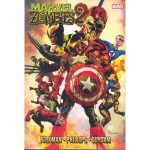
Marvel Zombies 2


By Robert Kirkman, Sean Phillips & Arthur Suydam (Marvel)

ISBN: 978-0-7851-2545-7
With the nights drawing in and assorted haunts roaming the land I thought I’d follow-up a previous graphic novel review with another nervous peek at one of modern Marvel’s most successful niche-franchises: a canny blend of gratuitous sarcasm, knowing, measured respect for canonical comicbook lore and sheer necrophilic bravado starring the departed-but-not-gone denizens of an alternate Marvel Universe.

In Marvel Zombies: Dead Days a dire extra-dimensional contagion ravaged Earth, and heroes, villains and all creatures in-between were eradicated by fearsomely frightful and discomfortingly familiar flesh-eating superheroes who weren’t so different from the ones we all know – except for a rapacious, all consuming taste for living flesh that only paused when there was no-one and nothing left to eat…

Against all odds a small band of mortals and mutants survived the catastrophe and the subsequent manic hunts of the zombies for one last morsel of living meat… until an ill-considered visit by the Silver Surfer and Galactus. These cosmic paragons were, after a cataclysmic struggle, utterly consumed by the undead super-humans, but not before the walking dead’s ranks were reduced to six – Tony Stark, Luke Cage, Giant-Man, Spider-Man, Wolverine and the Hulk.

Engorged on the extra-galactic planet-eater’s cosmic power and with all other food sources apparently consumed the cosmic sextet abandoned Earth: for the next forty tears they scoured their entire dimension, killing and eating every thing and every civilisation they could find, on the way swelling their ranks with the dead infected carcasses of intergalactic powerhouses Gladiator, Phoenix, Firelord and Thanos who had all fallen in battle against the unstoppable horrors.

Now, with the universe emptied of all life, but still just as ravenously, insatiably hungry, the zombies turned back towards Earth, intending to use the Fantastic Four’s old trans-dimensional travel technology to find a new universe – and eat that too.

In four decades the Earth’s meagre survivors had developed into a small but by no means viable colony, led by the aged T’Challa, onetime superhero Black Panther. With the aid of mutant machinesmith Forge he had welded an uneasy alliance between Humans, Homo Superior and another more startling faction: zombies who had lost their appetite for flesh…

It would seem that if the undead don’t taste flesh for long enough the irresistible hunger fades – a fact that was slowly becoming apparent to some of the cosmic zombies making their way back home through a universe cleansed of all life…

Life on Earth was no picnic either. Despite the end of the world, species tension remained undiminished and a civil war was brewing, human against mutant, fomented by the insanely ambitious Malcolm Cortez, leader of the long-gone Magneto’s Acolytes. An assassination attempt on T’Challa precipitated a final crisis, but when the cosmic undead arrived, intent on escaping to fresh hunting grounds, they discovered one last tasty snack just waiting there to tide them over on their intended journey…

However some of the monsters, tempted by the sight of hunger-free zombies battling beside their proposed last meal, change sides…

By no means as bleakly black and comedic as the first volume, this story thunders along as a far more cohesive tragic adventure, with a diminished gratuitous death-toll, coherent characterisation, genuine dramatic tension and spectacular action replacing the shock tactics and mordant slapstick of earlier tales: more a “What If?” crossover than a stand-alone, exploitative event, and the gripping saga ends on a moody downbeat that promises more and even better to come…

This book, reprinting the comicbook miniseries Marvel Zombies 2 #1-5, also includes the wealth of alternate and variant cover reproductions by painter Arthur Suydam whose astounding pastiche images of pictorial landmarks from Marvel’s decades-long-history has done so much to make the series a commercial success.

Although still very much a one-trick pony, there seems to be no way to sate the avid appetite of fans for these tales, which depend greatly on a deep familiarity with the regular Marvel pantheon, a fondness for schlock horror and the cherished tradition of superheroes fighting each other. Not for the squeamish or continuity-purist hardliners, there are certainly loud laughs, poignant pauses and frissons of fear awaiting the open-minded reader…

© 2007, 2008 Marvel Publishing, Inc, a subsidiary of Marvel Entertainment, Inc. All Rights Reserved.

Fire & Water: Bill Everett, the Sub-Mariner and the Birth of Marvel Comics


By Blake Bell (Fantagraphics Books)
ISBN: 978-1-60699-166-4

Win’s Christmas Gift Recommendation: 9/10 Perfect for art lovers, Marvel Zombies, wannabe illustrators and lovers of pure comic magic

There’s currently a delightful abundance of beautiful coffee-table art-books/biographies celebrating the too-long ignored founding fathers and lost masters of American comic books, and this fabulous tome highlights the astounding wizardry of one of the most accomplished draughtsmen and yarn-spinners of that incredibly fertile early period.

As always you can save time and trouble by simply buying the book now rather than waste your valuable off-hours reading my blather, but since I’m going to froth on anyway feel free to accompany me as I delineate just why this tome needs to sit on your “favourites” shelf.

This lavishly illustrated, oversized tome traces the tragic life and awe-inspiring body of work of possibly the most technically accomplished artist of the US comicbook industry: a man of privilege and astonishing pedigree (he was a direct descendent and namesake of iconoclastic poet and artist William Blake) haunted by illness, an addictive personality and especially alcoholism, but a man who nevertheless raised a family, shaped an art-form and left twin legacies: an incredible body of superlative stories and art, and, more importantly, broken lives saved by his becoming a dedicated mentor for Alcoholics Anonymous.

William Blake Everett was born in 1917 into a wealthy and prestigious New England family. Bright and precocious he contracted Tuberculosis when he was twelve and whilst recuperating in Arizona began a life-long affair with and battle against booze. For the rest of his chequered life “Wild Bill” vacillated between magnificent artistic highs and heartbreaking personal lows, covered with chilling frankness in this excellent biography, written in conjunction with the artist’s surviving family.

Although telling, even revelatory and concluding in a happy ending of sorts, what this book really celebrates is not the life but the astounding legacy of Bill Everett. A gifted, driven man, he was a born storyteller who had the sheer naked ability to make all his own worlds real; and for nearly five decades his incredible art and wondrous stories, which began in the heydays of the Pulps (see also Spicy Tales Collection) enthralled and inspired successive generations of fellow dreamers.

His beautiful artwork featured in a variety of magazines before his fortuitous stumbling into the right place at the right time secured Everett’s place in history forever with his creation of the first anti-hero in comics.

Yet even before the advent of the mutant hybrid Sub-Mariner who, along with his elemental counterpart The Human Torch, secured the fortunes of the budding Marvel Comics (covered in a fascinating and detailed account which clears up many controversies that have raged amongst fans ands historians for decades) Everett was a valued and admired writer/artist/letterer/designer whose early seminal triumphs are lovingly covered here in many reproduced strip extracts, sketches and an utterly invaluable collection of original art pages.

Bill Everett was a jobbing cartoonist who drifted into the new world of comicbooks: a budding industry that combined his beloved drawing with his other compulsion – making up stories. The first chronological art selection here features a plethora of his compelling and irresistible covers for Amazing Mystery Funnies, Blue Bolt, Target Comics, Amazing-Man Comics, Victory Comics, Heroic Comics, and the landmark Motion Picture Funnies Weekly (for which he produced not only the pre-Marvel/Timely Sub-Mariner, but also the all-important back cover sales pitch) and many designs and roughs for unpublished titles, interspersed with pages and spreads from early creations Amazing-Man, Dirk the Demon, Skyrocket Steele, Music Master, The Chameleon, Hydroman, Sub-Zero and of course Prince Namor.

The early days of Marvel Mystery Comics and the Sub-Mariner’s own feature title are thoroughly represented with many pages of original art starring not only his aquatic antagonist but also The Fin and Human Torch, and this section is also full of delightful sketches from his four years of service in the Army Corps of Engineers.

The industry had changed radically by the time Everett mustered out: superheroes were on the wane and other genres were rising in popularity. Returning as a freelancer to Marvel/Timely, Everett worked again on Sub-Mariner and even created the sexy spin-off Namora and stillborn kid crusader Marvel Boy, but it was with the series Venus that he moved in a new direction: glamorous, glorious horror.

For over a decade he brought a sheen of irresistible quality to the generally second-rate chillers Timely/Atlas/Marvel generated in competition with genre front-runners EC Comics. It’s easy to see how they could compete and even outlive EC, with these lush and lurid examples of the hundreds of stunning covers and chillingly beautiful interior pages selected from such titles as Mystic, Menace, Astonishing, Adventures into Weird Worlds, Uncanny Tales, Suspense, Marvel Tales, Spellbound, Mystery Tales, Men’s Adventures and others. My only quibble is that unlike the companion volume featuring unsung genius Mort Meskin (see From Shadow to Light) there are no complete stories collected in this otherwise perfect primer.

Despite being unacknowledged as a master of terror, this period was probably Everett’s most technically adroit, but he also excelled in the other genre-ghettoes of the period. His ability to freeze manic action and convey tension into a single image made him the perfect choice for lead cover artist in the burgeoning military comics fields as can be seen in examples from Man Comics, Navy Tales, Battlefield, Navy Action, Navy Combat and others.

Everett truly excelled in the lush, stylistic depiction of action and horror themes – as well as the seductive delineation of sexy women, although he was equally effective in less histrionic arenas such as merchandising art, wholesome western, romances, cartoon and Bigfoot comedy styles, represented here by pages and covers from such diverse publications as Marvin the Mouse, Nellie the Nurse, Cracked, Jann of the Jungle, True Secrets, Girl Confessions, Bible Tales For Young Folk, Tales of Justice, Quick Trigger Western, Yellow Claw, Sports Action, Pussycat and so many others.

His final creative period follows his return to Marvel after time in the commercial art world and covers the creation of Daredevil, unsatisfactory runs on the Hulk, Dr. Strange, Sub-Mariner, Rawhide Kid and others as well as his stints inking Jack Kirby, Gene Colan, Ross Andru, Herb Trimpe, Dan Adkins and Barry Windsor Smith, before, clean and sober after decades, he produced a landmark run on his signature Sub-Mariner.

Tragically, decades of smoking and alcohol abuse had taken its toll, and only four years after turning his life around he died of complications arising from heart surgery, just when he seemed on the cusp of a brilliant creative renewal as remarkable as his meteoric rise in the 1930s and 1940s.

Evocatively written by biographer Blake Bell, with dozens of first hand accounts from family, friends and contemporaries; the sad, unjust life of this key figure of comics art is lovingly recounted here with hundreds of artistic examples from school days, army service, commercial and cartoon illustration and many intimate photographs supplementing the treasure trove of comics images. By tracking Everett’s early career as a pulp magazine illustrator, through his pioneering superhero art to the moody masterpieces of the 1950s and the Pop Art comics renaissance of the his later years, Fire and Water offers an opportunity to revel in the mastery of a truly unique pillar of America’s sequential Art establishment.

Most importantly for collectors and art-fans there is a overwhelming abundance of beautiful comics magic; from compelling page layouts, sketches and compositions to bold, vibrant pencils and slick luscious inking, and for we comics cognoscenti, the jackpot of never-before-seen unpublished pages: penciled, inked and camera-ready art-boards, as well as illustrations, family pieces and examples of his non-comics career

Brilliant, captivating, and utterly unmissable, this is the book Bill Everett deserves – and so do you.

© 2010 Fantagraphics Books. Text © 2010 Stephen Brower. All art © its respective owners and holders. All rights reserved.

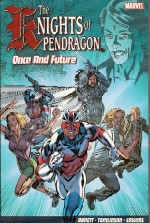
Knights of Pendragon: Once and Future


By Dan Abnett, John Tomlinson, Gary Erskine & Andy Lanning (Marvel/Panini Publishing UK)
ISBN: 978-1-84653-431-7

The world was a rapidly changing place in 1990 and fledgling offshoot Marvel UK was critically rising high thanks to the immensely impressive original Captain Britain material being created by Alan Moore and Alan Davis. On a roll, the company attempted to expand its line with an associated title, once more combining Arthurian fantasy with tried and true Marvel superheroic action. Or so everybody thought…

The Knights of Pendragon prominently featured Captain Britain on the covers but the epic tale that unfolded over the next few months was far more a supernatural horror story in the manner of prophetic TV show “Doomwatch” than a traditional Fights ‘n’ Tights slugfest – even by the often outré British standards.

Steeped in ecological hot-button topics and starring, initially at least, a podgy, over-the-hill welsh copper who had begun life as a authoritarian gadfly before becoming a solid, stolid comrade to Brian Braddock (Cap’s aristocratic Alter Ego), Knights of Pendragon followed Chief Inspector Dai Thomas as he seemingly went off the deep end, plagued by horrific premonitions of grisly massacres that all seemed linked to environmental crimes perpetrated by globe-girdling conglomerate the Omni Corporation. However as the months unfolded a pattern slowly unfolded that indicated something far older and more dangerous than money was flexing long dormant fangs and sinews…

This book gathers issues #1-9, July 1990-March 1991, of the first volume (a second far more traditional series followed in 1993) and sees the saga begin with ‘Brands and Ashes’ as Thomas is summoned by Captain Britain to a meeting of the clandestine agency the Weird Happenings Organisation. It appears the retired cop’s dream of 87 hungry patrons mysteriously suffocating in a spacious, airy well-ventilated burger-bar has come hideously true. Meanwhile Omni Corp exec Grace has sent her dashing leg-breaker Dolph to “reason” with the minister in charge of W.H.O….

As Thomas is briefed on an increasingly large and violent tide of bizarre eco-mysteries, down in Kent something horrible is occurring on an Omni farm using new and lethally dangerous pesticides. Rogue TV journalist Kate McClellan is circling too. She smells a big story and is ruthlessly open-minded. She wants and will publish the truth no matter how strange and impossible it might appear…

Thomas is getting worse. His visions now include blackouts and fugue episodes in which he sees himself as the medieval hero of the ancient epic “Sir Gawain and the Green Knight” battling ogres, villains and monsters.

‘Skin and Bone’ finds him following a lead to Africa where ivory poachers are using helicopters and assault rifles to slaughter elephants in vast numbers. McClellan is there before him and has already discovered a link to smuggled diamonds and Omni but before Thomas can make an arrest the supernal force he is slowly coming to believe in exacts its own bloody justice, whilst ‘Oil and Water’ sees cop and reporter in Florida, investigating another bizarre Omni-related atrocity – smuggling endangered species – when an ambush goes wrong. Any doubt of supernatural involvement is abandoned when they are rescued from certain death by a creature that cannot possibly exist…

Thomas is gradually changing: evolving into a younger, fitter version of himself and the premonitions and dreams of Gawain are occurring more frequently. In ‘Blood and Feathers’, Grace decides to end the old copper’s interference with an elite squad of high tech mercenaries led by Dolph. After smashing another animal smuggling ring – with his bare hands – Thomas and McClellan are attacked in broad daylight. He overcomes the super-commandoes with ease, but the machinations of Grace have made him a liability to W.H.O. and Captain Britain is ordered to bring him in at all costs…

‘Hope and Glory’ reveals Kate is having visions of her own. As Thomas makes his way across Costa Rica hunting the thing that’s hunting Omni’s assorted enterprises, she is arrested by W.H.O. agents. Dai is close to the answers he’s been seeking as he enters an apocalyptic area of jungle deforestation, convinced he is Gawain reborn. The spirit of the planet has given man one final chance to live with, not against, the eco-system, but the forces of progress and destruction are subtle and have turned his greatest friend against him…

After a stupendous battle Thomas is beaten to death by Captain Britain, and in the concluding ‘Once and Future’ Gawain takes full control of his broken body, casually revealing the guilt-wracked superhero to be Lancelot whilst Kate houses the spirit of Guinevere. Attacked by demonic monsters the trio trek through the devastated rain-forest, making a pilgrimage to the home of the embattled animating force called the Green Knight, saving the Green Chapel, mystical heart of the world, from dark forces that have worked through Omni and other modern enterprises which value profit over the planet…

Its mission accomplished, Gawain’s essence leaves Dai’s body, resurrecting and healing him, but there has been no victory, only a truce. The Green Knight will no longer attack human greed and folly directly, but the latest Knights of Pendragon are expected to work in its stead. The second story-arc sees new men of goodwill chosen as hosts for the immortal heroic essences and a redefinition of the vague dark forces they must combat.

In ‘Revelations’ author Ben Gallagher is drawn to a remote Scottish island to bear witness to a brutal slaughter of dolphins, whilst in London a serial killer hunts successful businesswomen and in her technological ivory tower, Omni exec Grace is possessed by the Green Knight’s opposite number, a vile entity calling itself The Bane.

During the Great War the British Empire was championed by a pioneering band of costumed heroes. Union Jack was mere mortal who used brains, brawn and good British ordnance to battle the Hun in two world wars before being succeeded by his son. The third incarnation was Joey Chapman, a true working class hero who here finds himself the next recipient of the spirit of Lancelot.

Kate has a troubled son squirreled away at a remote boarding school. When Cam McClellan goes missing after being possessed by the Merlin analogue known as Herne the Hunter, the situation forces elderly history teacher Peter Hunter to reveal his darkest secret. ‘The Only Child’ describes how in the Great War the schoolmaster was masked mystic superman Albion, but with his surrendered Pendragon force now inhabiting a disturbed child he fears he must reassume the role he gratefully relinquished decades ago.

Captain Britain and Union Jack join the search for Cam but spend more time battling each other than actually helping, leaving the London serial killer free to attack his next target – the world-famous TV journalist Kate McClellan. However, even though the madman is old acquaintance he has not reckoned on her new status as a full-blown Pendragon.

Events take a truly dark turn when Grace arrives at the school to abduct the confused and immensely powerful Cam, intending to corrupt him as once she damned Arthur’s son Mordred…

Gallagher’s sensitively creative yet indomitable nature makes him a perfect host for the returned Sir Percival and in the untitled closing tale he sees the powers arrayed against the returned Knights in full flow, as an innocent dies and entire families of dolphins are sacrificed to the horrific greed and paranoia of humanity and the awful hunger of the Bane

The epic has been building across the nine issues of the series collected here, written with chilling passion by Dan Abnett and John Tomlinson and illustrated with stunning power by then fresh-faced new boy Gary Erskine, suitably inked by near-veteran Any Lanning.

With intriguing and revelatory reminiscences from the writers and original series editor Steve White describing the initial resistance and eventually outright hostility from upper management to the title plus a cover gallery by such leading lights as Alan Davis, Simon Bisley, John Bolton and others, this engrossing and still controversial epic revives a pivotal moment in British mainstream comics and still enthrals two decades later.

Ending on a pensive set of cliffhangers, this absorbing thriller is but half-done, with another utterly fabulous and morally challenging volume still to see. I can’t wait…

© 1990, 1991, 2010 Marvel Entertainment LLC and its subsidiaries. All Rights Reserved. A British edition published by Panini.

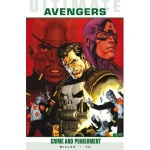
Ultimate Avengers 2: Crime and Punishment


By Mark Millar, Lenil Francis Yu & various (Marvel/Panini UK)
ISBN: 978-1-84653-465-2

Marvel Ultimates began in 2000 as a reconfiguration of key characters and concepts to bring them into line with the tastes of modern readers – perceived as a potentially separate buying public from the baby-boomers and their descendents, who were content to stick with the various efforts that had sprung from the fantastic originating talents of Kirby, Ditko and Lee – and one unable or unwilling to deal with the decades of continuity baggage that had accumulated around the originals.

Eventually this darkly nihilistic new universe became as continuity-constricted as its predecessor and in 2008 the cleansing event “Ultimatum” culminated in a reign of terror which apparently (this is still comics, after all) killed three dozen odd heroes and villains plus millions of lesser mortals. Although a good seller (in contemporary terms, at least) the saga was largely trashed by the fans who bought it, and the ongoing new “Ultimatum Comics” line quietly back-pedalled on its declared intentions…

The key and era-ending event was a colossal tsunami that drowned the superhero-heavy island of Manhattan and this second post-tidal wave collection (assembling issues #7-12 of Ultimate Avengers 2) finds the survivors fully adapted to their dried-out world and back in business.

Before the Deluge Nick Fury ran an American Black Ops team of superhumans called the Avengers, but he was eventually toppled from his position for sundry rule-bending antics – and being caught doing them. Now he’s back, running another black ops team doing stuff real heroes wouldn’t dream of…

His far from happy band of brothers consists of Hawkeye – the man who never misses, James Rhodes: a fanatical soldier wearing devastating War Machine battle armour; Gregory Stark, Iron Man’s smarter, utterly immoral older brother, Nerd Hulk, a cloned gamma-monster with all the original’s power but implanted with Banner’s brain and milksop character and ruthless super-spy Black Widow. You can never have enough super-stooges though, and Fury is actively recruiting…

First on his wish-list is the Punisher, a vengeance-crazed vigilante carving his way through the underworld of three continents. It’s hard to imagine an even colder stone-killer than the standard Marvel Universe Frank Castle but creators Mark Millar, Lenil Francis Yu, Gerry Alanguilan & Laura Martin just about manage. However, his campaign of retribution is promptly stopped cold by Captain America.

Imprisoned by Federal authorities, the Punisher never makes it to prison, and soon after a new masked hero with loads of guns and a big skull on his chest reluctantly joins Fury’s death-squad…

The other newbie is super-gangsta Tyrone Cash, whose recruitment causes a lot more collateral damage. Before being blackmailed onto the team the violence-addicted, invulnerable superhuman had another life: a college professor who researched how to maximise human physical potential. One day he just vanished, leaving a pile of rubble and some very instructive data that his student Bruce Banner developed to its ultimate end… much to the world’s eternal regret.

Though not as strong as the Hulk, Cash is homicidally violent and aggressive, and enjoys breaking stuff and hurting people. Only the greatest threat imaginable could force Fury to keep such a dangerous tool around…

And that happens to be a flaming-skulled mutant biker called Ghost Rider who is relentlessly hunting and killing the Vice President’s oldest buddies and has now set his eyeless sights on the Veep himself… Carving a swathe of fiery destruction that leads to the White House itself, the Ghost Rider is utterly unstoppable. No mutant has ever been as powerful. If the press-ganged team didn’t know better, it would seem that the blazing biker is a real ghost… but there’s no such thing, right?

Trenchant, sardonic and incredibly violent, the traditional super-science scenario takes a big, bold step into the realm of satanic, supernatural horror and, as always, the grim-and-gritty heroes are almost indistinguishable from the genuine bad-guys in this stunningly engrossing, anti-heroic epic. No shining knights here, but plenty of dark ones…

Given some distance and far removed from market hype and the frantic, relentless immediacy of the sales arena there’s a far better chance to honestly assess these tales on merit alone, and given such an opportunity you’d be daft not to take a long hard look at this spectacular, beautifully cynical thriller: another breathtaking, sinisterly effective yarn that could only be told outside the Marvel Universe, but it’s also one that should solidly resonate with older fans who love the darkest side of superheroes and especially those casual readers who know the company’s movies better than the comic-books.

™& © 2010 Marvel Entertainment LLC and its subsidiaries. All Rights Reserved. A British edition published by Panini.

Fall of the Hulks volume 2


By various (Marvel/Panini Publishing UK)
ISBN: 978-1-84653-463-8

In recent years the number of Gamma-mutated monsters rampaging across the Marvel landscape has proliferated to inconceivable proportions. There are assorted Hulks, She-Hulks, Abominations and all kinds of ancillary atomic berserkers roaming the planet so it’s no more than prudent to thin the herd.

The days of Bruce Banner getting angry and going Green are long gone too, so anybody taking their cues from the TV or movie incarnations will be wise to assume a level of unavoidable confusion. Nevertheless this epic story is worth the effort so persist if you can.

Even if you are familiar with Hulk history ancient and modern, you might still founder on the odd point of narrative as this book continues the spectacular saga of the myriad rainbow-coloured gamma-morphs cluttering up the Marvel Universe becoming a brawny army of conquest for the world’s wickedest brain trust. This interim volume collects most – but by no means all – of the issues involved in a major storyline which ran through the various Hulk-related comics during the first half of 2010.

Depending on many lost crannies of lore and broad continuity this book (collecting Incredible Hulk #607-608, Hulk #21, Savage She-Hulks #1 and Red Hulk #2-4) resumes the tale of The Intel, a gang of super-smart bad-guys – the Leader, Egghead, Red Ghost, the Wizard, Mad Thinker and Dr. Doom – who stole the Lost Library of Alexandria, repository of all arcane knowledge, to further their schemes of domination.

Coming together during the early days of the Marvel Universe the cabal also purloined a cosmic-powered Hulk robot designed by Galactus which furthered their long-term plans which included creating a legion of Hulk-like servants, capturing the eight most brilliant men on the planet and of course ruling the world.

Contemporarily if not consequently there are eight Variant Hulks and analogues, but Bruce Banner is not one of them. The mysterious and all-conquering Red Hulk has stolen Banner’s gamma power, leaving nothing but a determined mortal – albeit a brilliant, determined and incredibly driven one. Banner has never been more dangerous…

The origin of the Red Hulk was partially revealed after The Intel replaced Egghead with the biological computer Modok. Events moved swiftly after Dr. Doom betrayed the cabal. Banner joined Red Hulk to stop his assorted foes as the Intel began to capture their intellectual opposite numbers.

Natural enemies, Banner and Red Hulk have become uneasy allies until the Intel are defeated, always pursuing their own agendas and watching each other for the first sign of betrayal. The Intel meanwhile have taken Reed Richards, Dr. Doom, Henry (the Beast) McCoy and T’Challa, the Black Panther and as this volume opens are moving to capture their next target – Henry Pym, size-changing superhero and Earth’s Scientist Supreme in ‘Man With a Plan’.

Chaos builds globally as the assorted Gamma gladiators: Skaar – Son of Hulk, Lyra (Hulk and Thundra’s daughter from an alternate future), Doc Samson, A-Bomb (venerable sidekick Rick Jones transformed into an atomic Abomination), Red She-Hulk and the Red Hulk all clash in interminable, inconclusive battles. Earth’s many costumed champions gather to save the day and Banner gathers his own select team of ruthless Avengers to take the battle to the Intel’s heart…

Doc Samson has been working with the evil geniuses for years and his recent indoctrination of Red She-Hulk has drawn attention from mutant warriors Elektra and Domino. More revelations about Lyra’s origins come to light in ‘The Deal’ whilst Red Hulk’s plan to destroy the cabal comes undone as the superhero assault is thwarted and the rescuers become more super-soldiers for the Intel.

In ‘Mindgame’ Banner’s schemes are no more successful: his team’s raid gathers lots of intelligence but once more The Intel’s forces ultimately overcome all opposition. The only problem they face is the increasing instability of their grotesque pawns – such as the ‘Big, Red, and Deadly!’ She-Hulk.

‘How I Learned to Stop Worrying and Love The A-Bomb’ uncovers more of Samson’s perfidy as Rick Jones realises he has been programmed as a sleeper agent to kill Banner, whilst Lyra clashes with her time-lost mother Thundra and Red She-Hulk in ‘The Savage Sex’ before the book ends on an anticipatory cliffhanger with ‘Best Case Scenario’ as, with the Intel in control of the planet Red Hulk and Banner prepare to bring it all crashing down…

Taken on its own this middle volume sounds utterly incomprehensible: a thin strand of coherent narrative picking its way through a bewildering assortment of block-busting punch-ups and arcane references, but I would advise readers to re-read the previous volume and trust to the writing of Jeph Loeb, Greg Pak, Jeff Parker and Harrison Wilcox, whom I’m sure will produce clarity and closure in the next collection….

Moreover if you’re e a fan of spectacular art the monumental illustrations by Paul Pelletier, Ed McGuinness, Carlos Rodriguez, Fernando Blanco, Ryan Stegman, Salvador Espin with Zach Howard, Vincente Cifuentes, Mark Palmer, Jason Paz, Danny Miki, Tom Palmer and Crimelab Studios are cumulatively breathtaking in scope and power. As always the book includes a gallery of the many cover variants that graced the original comicbook releases

Still flawed, but still not fatally; there’s an ominous gathering impetus that rockets the action (oh, so much action) along here despite all the problems and I’m confident that the conclusion will iron out all my current frowns. However it’s probably sound advice to re-re-read the previous volume before tackling this one and best to study both before the next one comes out…
™& © 2010 Marvel Entertainment LLC and its subsidiaries. All Rights Reserved. A British edition published by Panini.

Essential Luke Cage: Power Man volume 1


By Archie Goodwin, Steve Englehart, George Tuska, Billy Graham & others (Marvel)
ISBN: 978-0-7851-1685-1

As a sickly pale kid growing up in a hugely white area of the Home Counties in the 1960s and 1970s, I got almost all my early experience of black people from television and films (for which I’m most profoundly sorry ) – and, of course, comics – for which I’m not.

Blithely unaware of the struggle for equality in my formative years, the incredible consciousness-raising explosion of Black Power after the 1968 Olympic Games rather politicised me, and even though some comics companies had by this time made tentative efforts to address what were national and socio-political iniquities, issues of race and ethnicity took a long time to filter through to the still-impressionable young minds avidly absorbing knowledge and attitudes via four colour pages that couldn’t even approximate the skin tones of African-Americans.

As with television, breakthroughs were small, incremental and too often reduced to a cold-war of daringly liberal “firsts.” Excluding a few characters in Jungle comic-books of the 1940s and 1950, Marvel clearly led the field with a black member of Sgt. Fury’s Howling Commandos team (the historically impossible Gabe Jones who debuted in #1, May 1963, and was accidentally re-coloured Caucasian at the printers, who clearly didn’t realise his ethnicity), as well as the first negro superheroes Black Panther in Fantastic Four #52 (July 1966), and the Falcon in Captain America #117 (September 1969).

The honour of America’s first Black hero to star in his own title came in a little remembered or regarded title from Dell Comics. Lobo was a gunslinger/vigilante in the old west who sought out injustice just like any cowboy hero would, first appearing in December 1965, created by artist Tony Tallarico and scripter D.J. Arneson.

Arguably a greater breakthrough was Joe Robertson, City Editor of the Daily Bugle, an erudite, brave and magnificently ordinary mortal distinguished by his sterling character, not a costume or skin tone and who first appeared in Amazing Spider-Man # 51 (August 1967), proving in every panel that the world wouldn’t end if black folk and white folk worked and ate together…

This big change slowly grew out of raised social awareness during a terrible time in American history – although Britain had nothing to be smug about either. Race riots had started early in the Sixties here and left simmering scars that only comedians and openly racist politicians dared to talk about. Shows such “Till Death Us Do Part” and “Love Thy Neighbour” made subtly telling headway but still raise a shudder when I see clips today…

Slowly more positive ethnic characters were let in, with DC finally getting a Black hero in John Stewart (Green Lantern #87 December 1971/January 1972), although his designation as replacement Green Lantern might be construed as more conciliatory and insulting than revolutionary. The first DC hero with his own title was Black Lightning, who didn’t debut until April 1977, although Jack Kirby had introduced Shilo Norman as Scott Free’s apprentice (and eventual successor) in Mister Miracle ##15 (August (1973).

As usual it took a bold man and changing economics to really promote change, and with declining comics sales at a time of rising Black Consciousness cash – if not cashing in -was probably the trigger for “the Next Step.” Contemporary “Blacksploitation” cinema and novels had fired up commercial interests throughout America and in that atmosphere of outlandish dialogue, daft outfits and barely concealed – if justified – outrage an angry black man with a shady past and apparently dubious morals debuted as Luke Cage, Hero for Hire in the summer of 1972. A year later the Black Panther finally got his own series in Jungle Action #5 and Blade: Vampire Hunter debuted in Tomb of Dracula #10.

This volume collects the first 27 issues of the breakthrough series and begins with Lucas, a hard-case inmate at brutal Seagate Prison. Like all convicts he claimed to have been framed and his uncompromising attitude made mortal enemies of the savage, racist guards Rackham and Quirt whilst not exactly endearing him to the rest of the prison population such as out and out bad-guys Shades and Comanche either…

‘Out of Hell… A Hero!’ was written by Archie Goodwin and illustrated by George Tuska & Billy Graham (with some initial assistance from Roy Thomas and John Romita senior) and saw a new warden arrive promising to change the hell-hole into a proper, legal penal institution. Prison Doctor Noah Burstein then convinced Lucas to participate in a radical experiment in exchange for a parole hearing, having heard the desperate con’s tale of woe…

Lucas had grown up in Harlem, a tough kid who had managed to stay honest even when his best friend Willis Stryker had not. They remained friends even though they walked different paths – at least until a woman came between them. To get rid of his romantic rival Stryker planted drugs and had Lucas shipped off to jail. While he was there his girl Reva, who had never given up on him, was killed when she got in way of bullets meant for Stryker…

With nothing to lose Lucas undergoes Burstein’s process – an experiment in cell-regeneration – but Rackham sabotages it, hoping to kill the con before he can expose the guard’s illegal treatment of convicts. The equipment goes haywire and something incredible occurs. Lucas, super-strong punches his way out of the lab and the through the prison walls, only to be killed in hail of gunfire. His body plunges over a cliff and is never recovered…

Months later a vagrant prowls the streets of New York City and stumbles into a robbery. Almost casually he downs the felon and accepts a reward from the grateful victim. He also has a bright idea. Super-strong, bullet-proof, street-wise and honest, Lucas would hide in plain sight while planning his revenge on Stryker. Since his only skill was fighting, he became a private paladin – A Hero For Hire…

Making allowances for the colourful, often ludicrous dialogue necessitated by the Comics Code’s sanitising of “street-talking Jive” this is probably the grittiest origin tale of the classic Marvel years, and the tense action continued in ‘Vengeance is Mine!’ as the man now calling himself Luke Cage stalked his target. Stryker had risen quickly in the drugs world, controlling a vast portion of the illicit trade as the deadly Diamondback, and the solitary Cage had a big surprise in store when beautiful Doctor Claire Temple came to his aid after a calamitous struggle.

Thinking him fatally shot her surprise was dwarfed by his own when Cage met her boss. Trying to expiate his sins Noah Burstein had opened a rehab clinic on the deadly streets around Times Square, but his efforts had drawn the attention of Diamondback who didn’t like someone trying to cure his paying customers…

Burstein apparently did not recognise him, and even though faced with eventual exposure and return to prison Cage offered to help the doctors. Setting up an office above a movie house on 42nd Street he met a lad who would become his greatest friend: DW Griffith – nerd, film freak and plucky white sidekick. But before Cage could settle in Diamondback struck and the age-old game of blood and honour played out the way it always does…

Issue #3 introduced Cage’s first returning villain in ‘Mark of the Mace!’ as Burstein, for his own undisclosed reasons decided to keep Cage’s secret, and disgraced soldier Gideon Mace launched a terror attack on Manhattan. With his dying breath one of the mad Colonel’s troops hired Cage to stop the attack, which he did in explosive fashion.

Billy Graham pencilled and inked ‘Cry Fear… Cry Phantom!’ in #4 as a deranged and deformed maniac carried out random assaults in Times Square. Or was there perhaps another motive behind the crazed attacks? Steve Englehart took over as scripter and Tuska returned to pencil ‘Don’t Mess with Black Mariah!’ the sordid tale of organised scavengers which introduced unscrupulous reporter Phil Fox, an unsavoury sneak with greedy pockets and a nose for scandal.

The private detective motif proved a brilliant stratagem in generating stories for a character perceived as a reluctant champion at best and outright anti-hero by nature. It allowed Cage to maintain an outsider’s edginess but also meant that adventure literally walked through his shabby door every issue.

Such was the case of ‘Knights and White Satin’ (by Englehart, Gerry Conway, Graham and Paul Reinman) as the swanky, ultra-rich Forsythe sisters hired him to bodyguard their dying father from a would-be murder too impatient to wait the week it would take for the old man to die from a terminal illness. This more-or less straight mystery yarn (not counting the madman and killer-robots) was followed by ‘Jingle Bombs’, a strikingly different Christmas tale by from Englehart Tuska & Graham, before Cage properly entered the Marvel Universe in ‘Crescendo!’ when he was hired by Doctor Doom to retrieve rogue androids that had absconded from Latveria, subsequently hiding as black men among the shifting masses of Harlem.

Naturally Cage accomplished his mission, only to find Doom had stiffed him for the fee. Big mistake…

Issue #9 ‘Where Angels Fear to Tread!’ saw the enraged Hero for Hire borrow a vehicle from the Fantastic Four and play Repo Man in Doom’s own castle just in time to get caught in the middle of a grudge match between the Iron Dictator and an alien invader called the Faceless One.

It was back to street-level basics in ‘The Lucky… and the Dead!’ as Cage took on a gambling syndicate led by the schizophrenic Señor Suerte who doubled his luck as the murderous Señor Muerte (that’s Mr. Luck and Mr. Death to you), a two-part thriller complete with rigged games and death traps that climaxed in the startling ‘Where There’s Life…!’ as the relentless Phil Fox’s finally uncovered Cage’s secret…

Issue #12 saw the first of many battles against alchemical villain ‘Chemistro!’, whilst Graham assumed full art duties with ‘The Claws of Lionfang’ a killer who used big cats to destroy his enemies, and Cage tackled a hyperthyroid lawyer in ‘Retribution!’ as the tangled threads of his murky past slowly became a noose around his neck…

‘Retribution: Part II!’ saw Graham and new kid Tony Isabella share the writer’s role as those many disparate elements converged to expose Cage, and with Quirt kidnapping his girlfriend, fellow Seagate escapees Comanche and Shades stalking him and the New York cops hunting him, the last thing the Hero For Hire needed was a new super-foe, but that’s just what he got in #16’s ‘Shake Hands With Stiletto!’ by Isabella, Graham and inker Frank McLaughlin.

That dramatic finale cleared up a lot of old business and led to a partial re-branding of the nation’s premier black crusader. From #17 onwards the mercenary aspect was downplayed (at least on the covers) as the comic became Luke Cage, Power Man and Len Wein, Tuska and Graham concocted another tumultuous team-up in ‘Rich Man: Iron Man… Power Man: Thief!’ as the still “For Hire” hero was commissioned to test Tony Stark’s security by stealing his latest invention. Unfortunately neither Stark nor Iron Man knew anything about it…

Vince Colletta joined the team as inker for #18’s ‘Havoc on the High Iron!’ as Cage battled a murderous high-tech Steeplejack and the next two issues offered Cage a tantalising chance to clear his name as ‘Call Him… Cottonmouth!’ introduced a crime-lord with inside information of the frame-up perpetrated by Willis Stryker in issue #1. Tragically the hope was snatched away in the Isabella scripted follow-up ‘How Like a Serpent’s Tooth…’

‘The Killer With My Name!’ (Isabella, Wein, Ron Wilson & Colletta) found Cage attacked by old Avengers villain Power Man who wanted his name back, but who changed his mind after waking up from the resultant bombastic battle, whilst Stiletto returned with his brother Discus in ‘The Broadway Mayhem of 1974’ (Isabella, Wilson & Colletta) to reveal a startling connection to Cage’s origins.

All this carnage had sent sometime romantic interest Claire Temple scurrying for points distant, and with #23 Cage and D.W. went looking for her, promptly fetching up in a fascistic planned-community run by old foe Mace. ‘Welcome to Security City’ (inked by Dave Hunt) led directly into a two-part premier for another African-American superhero as Cage and D.W. traced Claire to the Ringmaster’s Circus of Crime in #24’s ‘Among Us Walks… a Black Goliath!’ by Isabella, Tuska & Hunt.

Bill Foster was another educated black supporting character, a biochemist who worked with Henry Pym (the scientist-superhero known as Ant-Man, Giant-Man, Goliath and Yellowjacket over the decades of his costumed career) when he was trapped as a giant, unable to shrink to normal size. Foster first appeared in Avengers #32 (September 1966, or see Essential Avengers volume 2), before fading from view when Pym regained his size-changing ability.

Here it was revealed that Foster was Claire’s ex-husband, and when his own size experiments trapped him at fifteen feet tall, she had rushed back to his colossal side to help him find a cure. When Cage arrived passions were stoked, resulting in a classic heroes-clash moment until the mesmeric Ringmaster hypnotised the combatants, intent on using their strength to feather his own three-ring nest.

‘Crime and Circuses’ (by Isabella, Bill Mantlo, Wilson and Fred Kida) saw the heroes helpless until Claire came to the rescue before making her choice and returning to New York with Luke. Foster soon gravitated to his own short-run series, becoming Marvel’s fourth African American costumed hero under the heavy-handed and rather obvious sobriquet Black Goliath.

A spoof of popular ’70’s TV show provided the theme for ‘Night Shocker!‘ (Englehart, Tuska & Colletta) as Cage hunted an apparent vampire, and this first black and white volume concludes with a touching human drama as Cage was forced to subdue a tragically simple-minded but super-powered wrestler in ‘Just a Guy Named “X”!’ (by Mantlo, George Pérez and Al McWilliams, all paying tribute to the Ditko classic from Amazing Spider-Man #38).

Perhaps a little dated now, these tales were nonetheless instrumental in breaking down one more barrier in the intolerant, WASP-flavoured American comics landscape and their power if not their initial impact remains undiminished to this day. These are tales well worth your time and money.

© 1972, 1973, 1984, 1975, 2005 Marvel Characters, Inc.  All Rights Reserved.
Lifelike


By Dara Naraghi & various (IDW)
ISBN: 978-1-60010-122-9

We do it for fame, we do it for fortune (or at least to pay bills), we do it for fun and the very best of us make comics because we absolutely have to. Every story we hear, every event we see provokes the reaction “how would I break that down into panels? How many on the page?” All data – from shopping lists to bad TV – is taken in, screened through an internal grid and then we worry about how we’ll draw the damn thing one day…

All creative people are a little bit chained to their art-form, and Dara Naraghi apparently more so than most. As well as his own celebrated BigCityBlues comic he keeps busy adapting licensed properties such as Robert Patterson’s Witch & Wizard novels, Terminator: Salvation, It! The Terror From Beyond Space and Ghostbusters into comics form, writing for DC, Image and IDW and running his own publishing house Ferret Press. He also scripts (and occasionally draws) utterly wonderful tales covering every aspect of the human experience from wild fantasy to chilling slice-of-life in a splendid series of webcomic features.

Wonderfully expansive in narrative scope and illustrated by an astounding gathering of talented graphic artisans, an exemplary bunch of these brief delights has been compiled into a fabulous hardcover compilation. All the stories in this anthology come from that webcomic site and are written (and lettered) by Naraghi, complete with commentary and context on the illustrators interpreting each piece.

The wonderment begins with ‘The Long Journey’ illustrated by Irapuan Luiz, which follows the dramatic escape of a disillusioned Iranian soldier determined to leave the Iran-Iraq War behind him forever. Naraghi is Iranian (born in Tehran in 1971) and no doubt his own journey to the west would make pretty interesting reading, although probably without the telling sting in the tale embedded here…

‘Imaginarians’ winningly crafted by award winning artist Tom Williams, takes a barbed look at how the media deals with artists on the promo circuit whilst equally lauded Marvin Mann’s atmospheric ‘Double Cross at the Double Down’ proves that even if crime doesn’t pay, stories about it definitely do.

‘Art/Life’ rendered by Neil Errar is a feel-good fable about a comics creator we all concur with, Jerry Lange’s moody, misty paint-and-Paintbox (showing my digital age there) treatment examines the exquisite pain of unconditional love lost with ‘Remembrance’ whilst Stephen Spenser Ledford opts for monochrome ink washes to recount a particularly trenchant tale of crime and ‘Punishment.’

Sex and booze and rock ‘n’ roll form the basis of the cheeky dating vignette ‘Intermission’, illustrated by Andy Bennett, whilst Jerry Lange’s watercolour expertise displays a different arena for the relationship dance in ‘Crush’ and ‘Comeback’ by Tim McClurg describes a the meteoric fall from stardom for a has-been actor.

Marvin Mann displays his artistic versatility in ‘Smoke Break’, a heartwarming look at modern life and ‘The Routine’ by Steve Black touchingly reminds us that even small victories count in our work-a-day world, whereas the stunning drawing of Adrian Barbu’s gritty thriller ‘Rooftop Philosophy’ adds acres of edge to a dark tale of criminal Darwinism. Tom Williams astounds again with ‘Skin Deep’ a charming semi-autobiographical shaggy-dog story and pictorial programme ends on a heartwarming high note with ‘Repair’ as Shom Bhuiya treats us to a view of the common man at his very best…

The 14 tales collected in Lifelike demonstrate the sheer breadth that material comics could and should be covering rather than the narrow band of easily defined genres usually seen. This book opens up all of human experience and imagination to the cartoonist’s particular skills and insights. Now it’s up to the rest of us to respond and react…

Created and © 2007 Dara Naraghi. All artwork © 2007 by its respective artist. © 2007 Idea and Design Workshop. All Rights Reserved.

Read Dara’s free webcomic, Lifelike under the Stan Lee’s Sunday Comics banner @ Komikwerks.com.