
Black Jesus volume 1


By Jimmy Blondell & David Krintzman, Nicholas Da Silva & Bigjack Studios (Brazil) (Arcana)
ISBN: 978-1-897548-55-4 (TPB)

I’m always keen to spark a little controversy, so here’s an intriguing parable you probably missed when it launched in 2009…

Superheroes are frequently cited as a new mythology and occasionally comic books have dabbled with the idea that there’s not much difference between gods and metahumans. In a world where unnatural powers are common currency – at least in our fictions and entertainments – what happens when a genuinely different being appears and acts in ways neither the guardians of society nor the laws of physics will tolerate?

Conceived and written by Jimmy Blondell & David Krintzman and illustrated by Nicholas Da Silva (assisted by Brazil’s Bigjack Studios) this gripping thriller has all the facets of a urban/horror/conspiracy thriller but don’t be fooled. There’s more going on here than first appears…

Chris is a young black man in New York City. He’s a bit weird, and not just because of the recurrent nasty visions of cruel hunters slaughtering animals in the Serengeti…

He lives a peaceful life in a city where criminality, intolerance and hostility are everywhere, harming no one and caring for his pigeons in their rooftop roost. He’s got friends, a part-time job and plenty of questions about the strange things that keep happening around him. Case in point: despite never practising, he can score a basket from anywhere on the court without even trying. It’s a trick that’s earned the respect of violent angry young men throughout the neighbourhood, and when he’s not spends time breaking into Central Park Zoo to feed animals, or he’s studying with scholarly Rabbi Goldberg, a man who knows more about the boy’s past than he’s letting on…

His already complex existence takes a frantic turn the day Chris pulls some kids out of a car sinking into the Park Lake. He had to walk across the water to get to them and footage of the rescue made the news everywhere. Thankfully he kept his hoodie up and most viewers don’t know who he is…

That’s not a problem for the devout leader of the Black Christian Gang whose agenda is to reclaim the Messiah for people of colour and destroy forever the myth of a blond, blue-eyed white Christ. He sets his many brothers in the BCG to finding the miracle worker at all costs…

So does black televangelist Reverend Carnivean, whose millions of worshippers, billions of dollars and soaring political ambitions can’t afford any competition. Rather than true believers, he sets his moneymen, whores and assassins to finding the mystery man the media have dubbed Black Jesus…

That becomes even more urgent after a second tragedy strikes and witnesses at a charity gala all report seeing an anonymous young black waiter heal a woman mauled by a lion…

So begins a frantic race to control a potentially divine force or the next stage in human evolution: a trail peppered with bodies and shocking outrages. It doesn’t help that Chris himself has no idea what he truly is…

Understated and thoughtful, Black Jesus is a thriller about being born different (and yes, I do think that’s a metaphor for being black in America today), exploring dangerous ideas about the nature of divinity, poverty, status and belonging, as well as attempting to debunk the biggest and most divisive lie in politico-religious history.

The series was delving into some truly interesting corners before slumping into a hiatus triggered by the project being optioned as movie. Maybe when the film is finished, we can finally see how the comic would have progressed from the conclusion – but not ending – it reached…

Certainly not for everyone, but smart and compelling enough for you perhaps?
© 2009 by Black Jesus LLC. All rights reserved.

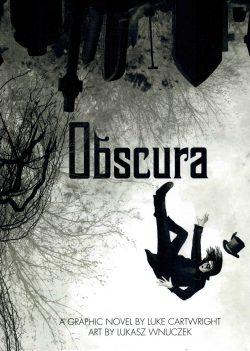
Obscura


By Luke Cartwright & Lukasz Wnuczek (Marcosia)
ISBN:978-1-64764-746-9 (HB)

We haven’t looked at a really engrossing horror yarn for simply ages, so it’s a good thing that this stunning dose of macabre graphic gothic mania plunked down in my review copies vestibule…

Obscura comes from and is about the Land Down Under (Tasmania actually!): an act of love and perseverance begun in 2012 but finally perfected and released last year by author Luke Cartwright and illustrator Lukasz Wnuczek. It’s presented here for your delectation and elucidation (and probably trepidation)…

Set on the island of Van Diemen’s Land (a former Crown prison colony and site of one of the British Empire’s most appalling atrocities: just look up the Black War if you have the stomach), it opens in 1870 with the rather outré preoccupations of master William Morier. The 12-year old is already a gifted cosmetician and mortician like his father, but his odd-yet-comfortable life is ruined by a double blow: meeting with the spiritualist children Catherine and Annabel White and a scandal involving body-snatching and the local medical school.

The White girls are controversial celebrities in the township, a place even more death-obsessed than most Victorian enclaves. When Annabel ends up on the Morier mortuary slab, dead from causes unknown, William’s path in life is forever altered…

A crafty tale within a tale, the drama resumes a decade later. As well as burying bodies, William is a gifted photographer and, after discussing the profitability of his wife’s childhood scams, sets upon a new enterprise, for his need is great and urgent.

Catherine Morier (nee White) suffers a dire medical malady and her doting husband needs plenty of cash to pay for an operation. His solution is Spirit Photography: combining portraits of living clients with the ghosts of departed loved ones who still cling unseen to them.

Sadly, not everyone’s a believer. A certain policeman keeps hanging around, especially after one of the captured phantasms is seen working in a local shop…

As William gets deeper and deeper into the fraudulent hole he’s dug for himself, the walls between chicanery, criminality, murder and the inescapable horror of the true Unknown start to blur and bleed together…

Mordant and compelling, this bleak tale is rendered in mesmerising monochrome tones and washes (almost like daguerreotypes, maybe?), building a noir edifice of stark choices and unlikely outcomes for the protagonists whom it’s simply impossible to dislike. Especially effective is the period language, which is authentic sounding, remarkably restrained and deliciously sparse. Cartwright is a writer who knows when to let Wnuczek’s pictures do the talking.

A decidedly effective dalliance with the dark and one no lover of period thrillers and slyly witty horror should miss.
Text & illustrations © Luke Cartwright & Lukasz Wnuczek 2019

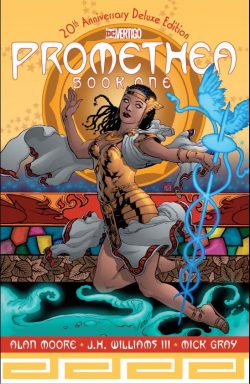
Promethea: Book One – 20th Anniversary Deluxe Edition


By Alan Moore, J H Williams III & Mick Gray, with Charles Vess, José Villarrubia & Jeromy Cox (America’s Best Comics)
ISBN: 978-1-40128-866-2 (HB)

After far too long away, let’s welcome back a notable addition to the canon of not-embarrassing, happily recommendable “Strong Female Characters” in hardback and digital editions that do her justice

I wonder if, when Alan Moore first conceived this series as part of his private superhero universe (now inexorably subsumed into the greater DC cosmology), he realised quite how far he would take this tale, or just how far he and long-haul collaborators J H Williams III & Mick Gray would push the boundaries of Graphic Narrative?

Ignoring the superficial resemblances to Wonder Woman – herself more archetype than property these days, but don’t tell the lawyers I said that – what’s on offer here? Promethea #1-12 are collected in this first Deluxe volume and are preceded by Moore’s introduction: ‘The Promethea Puzzle : An Adventure in Folklore’ (clipped from the first issue)…

Sophie Bangs lives in the big city, in a world of Science Heroes, multi-powered villains and real, scary monsters. She’s a smart kid, if not traditionally pretty, doing teen-age things with her best friend Stacia. She’s also a student researching a term paper on a name that has cropped up in esoteric poems, art and popular culture since the 5th century AD. Sophie seems inexplicably fascinated by and drawn to the concept of Promethea…

After interviewing the widow of the writer of a Promethea comic book, she’s attacked by a shadowy demon and rescued by the widow, who is the comic heroine she’s been researching. It transpires Promethea is a little girl taken into the Immateria, the Realm of Imagination. She became a concept.

Throughout history, she has since become real by incarnating in women who inspire art and creativity. These women – and even some men – have been able to manifest as incarnations of a Spirit of Imagination residing in the greater world of the unconscious. The Immateria is where all Gods, Stories and Ideas dwell. As the shadow-monster returns, Sophia finds her own artistic method of contacting the fable realm and becomes its latest physical incarnation…

Having discovered the metaphysical nature of Promethea Sophie begins to adjust. In real terms that means she can transform into a super-powerful flying Amazon, and perhaps join the legions of Science Heroes who protect – and frequently endanger – the world, but as her story unfolds, she begins to see just how different her version of the old story can be. Sophie is not some frustrated do-gooder suddenly flush with new-found power; she is and always has been concerned with knowing things.

Thus begins a journey of metaphysical as well as metahuman adventure. Sophie fights monsters and meets heroes, but the never-ending battle is not what this series is about. She obsessively wants to know more, and whilst various flamboyant forces array themselves against her, she is constantly seeking deeper answers for questions she never knew she had.

As various real-world forces align themselves in response to the latest resurgence of Promethea, Sophie explores the Immateria, hunting answers and examining the careers of her predecessors. When those antithetical forces attack the hospital where her new friend Barbara is slowly dying, the resultant battle with the forces of Hell reveal just how potent a weapon Promethea can be. The serious reader is advised to examine closely the running sub-plot with hero team The Five Swell Guys and psychotic serial killer The Painted Doll. As well as divertingly action-packed in an otherwise very cerebral tale, the long-running side-bar will have major repercussions in volumes to come.

Having dealt with the demon-horde, and the secret organisation that summoned them, Sophie again deviates from the expected in her dealings with infamous sorcerer Jack Faust, and has a Y2K monster battle before the volume ends with a mystical primer on the history, meaning and symbolism of The Tarot that is the closest I’ve seen the printed page get to a multi-media experience.

Moore’s sly and subversive scripting, in a superhero universe pushed to its illogical extreme, is superbly matched by artists Williams III & Gray, who increasingly raise the bar on graphic creativity and printing technology for a visual experience that is simply staggering to behold.

Adding extra lustre to the affair, Brad Meltzer offers an Afterword asking ‘Who Wants to Read a Fantasy Comic?’ and Moore’s script for issue #3 a fascinating diagnostic appointment with the creative process, augmented by Williams III’s artwork for the issue.

Promethea always had the most experimental aspirations. It will never have universal appeal, but if you are serious about comics it is an experience you owe yourself to try. And don’t be fooled. This book isn’t a lecture or a lesson, it’s a journey…
© 1999, 2000, 2001, 2009, 2019 DC Comics. All Rights Reserved.

The New Adventures of Jesus: The Second Coming


By Frank Stack (Fantagraphics Books)
ISBN: 978-1-56097-780-3 (TPB)

One of the earliest exponents of the US counter-culture, at least in terms of his contributions to Underground Comix, Frank (Foolbert Sturgeon) Stack has sadly missed out on the benefits of fame and notoriety of such contemporaries as Gilbert Shelton and Robert Crumb.

He may well be the perpetrator of the first ever Underground Commix (a split decision with the late Jack Jackson, both of whom released work in 1964 – although a collection of Stack’s delirious doodles was compiled and Xeroxed by Shelton in 1962-3 as “The Adventures of Jesus”) but I’m sure he’s not that bothered.

What is important is that these throwaway scribbles by all these weirdo drop-out freaks changed the nature of comics and did a huge amount to reshape the society they came from and operated within – a bit like old JC himself, in fact…

Stack’s weapon of choice was the divine redeemer Jesus Christ, whom he made the star of an occasional series of strips satirising America. These intermittently appeared between 1964 and (since there’s new material in this collection) the present day.

A lot of the bite may seem dissipated by time, but that simply shows how effective and successful they were – and actually still are. Many people have pondered on what the Messiah would do if he came back today (sadly not enough of them people in power…), but no-one else could deliver the gentle, telling punches of ‘The Dog Messiah’, ‘Jesus Meets the Armed Services’ (released at the height of the Vietnam War, remember, and more pertinent than ever as America and Russia spar to see who’s best at being World Police), ‘Jesus Joins the Academic Community’ or ‘Jesus on Ice’.

In this collected epistle – available in traditional print and the miracle of digital formatting – those fables and parables are supplemented with the all-new ‘Jesus Meets Intellectual Property Rights’ which shows there’s room – and still a crying need for – Stack’s style of commentary.

This collection is extensive, informative (as well as a commentary from Stack, there are pieces from both Crumb and Shelton) but above all fun to read. You might not get Saved but you will get your money’s worth in entertainment, and if you have a soul it will be blessed and maybe even sanctified…
Text & art © 2006 Frank Stack. All Rights Reserved. This edition © 2006 Fantagraphics Books.

Shaft Volume 2: Imitation of Life


By David F. Walker, Dietrich Smith & various (Dynamite Entertainment)
ISBN: 978-1-52410-260-9 (TPB)

For most of modern history black consumers of popular entertainments have enjoyed far too few fictive role models. In the English-speaking world that began changing in the turbulent 1960s and truly took hold during the decade that followed. A lot of the characters stemming from those days come from a cultural phenomenon called Blaxploitation. Although criticised for its seedy antecedents, stereotypical situations and violence, the films, books, music and art were the first mass-market examples of minority characters in leading roles, rather than as fodder, flunkies or flamboyant villains.

One of the earliest movie icons of the genre was the man called Shaft. His filmic debut in 1971 was scripted by journalist and screenwriter Ernest Tidyman (The French Connection; High Plains Drifter; A Force of One) who adapted his own 1970 novel. Tidyman authored six more between 1972 and 1975, with his timeless urban warrior simultaneously starring in numerous films and a (far, far tamer) TV series. He even starred in his own retro-themed, adults-only comic book…

An eighth prose novel – Shaft’s Revenge – was released in 2016, written by David F. Walker. Amongst his many talents – you should hunt down his online culture-crunching ‘zine BadAzzMoFo: you won’t be sorry – Walker numbers writing intriguing, hard-edged comics (Occupy Avengers; Cyborg; Red Sonja, Planet of the Apes, Tarzan on the Planet of the Apes and many more), so in 2014 it was probably inevitable that he be invited to write that long-overdue comics iteration…

Blockbusting premier miniseries Shaft: A Complicated Man – relating the lone wolf’s origins – happily led to this sequel in 2016, illustrated by Dietrich Smith and coloured by Alex Guimarães (Walker lettered the series himself), and whereas that comic book took its look, settings and tone from the novels more than the Richard Roundtree films, this one gradually refocuses and aims for a satisfactory blending of the prose and film iterations.

Originally released as a 4-issue miniseries, Imitation of Life finds the detective ‘Before and After’, regretting his life choices, successes and recent notoriety as the highly publicised rescue of an abducted girl suddenly make him a famous man…

It’s nothing he wanted: he was literally forced to take the job by a big-time mobster no one in their right mind ever refuses, and now after sorting the problem in his inimitably pitiless manner, Shaft is slowly drinking himself to death on the huge fee he also couldn’t safely turn down…

Eventually guilt and boredom compel him to get back in the game and, with no money worries, he can pick and choose from a big list of inquiries. That said, Shaft can’t explain just why he takes on the pointless problems of the Prossers; a hick couple desperate to find their son. Mike is 18; a good-looking homosexual (we say “gay” today) kid swallowed up by the sleaze-peddlers of 1970s Times Square. He’s legal and not even a real missing person, but there’s something Shaft can’t get out of his head about this particular runaway…

Convinced it’s all pointless, Big John hits the appropriate bars and clubs but no one knows anything: they never do. And then a kid named Tito recognizes him and just like that, the violence starts coming…

Surviving a homophobic attack – and teaching a few bigots the cost of intolerance – Shaft finds his case stalled just as shady wannabe filmmakers seeks to hire him to consult on their new (blaxsploitation) flick The Black Dick. It promises to be an easy gig, but they never are…

Before long Shaft is writhing in discomfort as the script ludicrously bastardises his career and reputation, but when Tito turns up and bamboozles the detective into facing off with a Mafia pornographer just as the secret moneyman behind his own filmic fiasco starts demanding an early return on his investment, it stops being a laugh and becomes deadly serious again. Once more, he remembers there’s no such thing as ‘Easy Money’…

As the fictional and real worlds increasingly intersect, Vice cops contact Shaft and he sees that somehow all his irons seem to be stacked in the same fire. When the ludicrous leading man is abducted and troublemaking Tito pops up again with some very dangerous photographs from his own incessant snooping, Shaft discovers in ‘Love & Loss’ just what happened to Mike Prosser and tools up to rescue one bad actor while invading a film set where pornos and snuff films are the preferred hot product…

The strands all pull together in a typically cathartic climax as ‘All the World’s a Stage’ sees order restored, the bad guys dealt with righteously and even sets up a delicious funny ending to usher us out…

Revisiting a foetid cesspool of civic corruption, warring mobsters and get-rich-quick chancers, this tour of a mythic milieu is another wry and intoxicating crime thriller no fan of the genre should miss…
Shaft is ™ and © 2016 Ernest Tidyman. All rights reserved.

Bob Marley in Comics


By Gaets & Sophie Blitman, illustrated by Olivier Desvaux, Ammo, Didier Millotte, Tanguy Pietri, Matthieu Beaulieu, Jena, Efix, Domas, Simon Léturgie, Sarah Williamson, Cyrille Brégère, Julien Modde, Moh, Armel Ressot, Lu-K, Clément Baloup, Joël Alessandra, Julien Atika, Gil & various: translated by Montana Kane (NBM)
ISBN: 978-1-68112-250-2 (HB)

Graphic biographies are all the rage at the moment and this one – originally released on the continent in 2018 – is another cracker likely to appeal to a far larger mainstream audience than comics usually reach. It certainly deserves to as it captivatingly deconstructs the life of a truly unique force in music and popular culture…

If you’ve never heard of Bob Marley or don’t like reggae, you might still want to check this out. The singer was deeply spiritual and it’s never too late to see the light and convert or, failing that, just buy a record…

Gathered in this fetching hardback (or eBook) edition are context-providing essays backing up individual comics sections; each chronological article and comics vignettes written by the ever-informative comics scribe Gaets and journalist/children’s author Sophie Blitman, supported by a veritable legion of illustrators providing vivid and vibrant strips, beginning with ‘From Nesta to Robert’ – limned by Olivier Desvaux.

The early life of the musician introduces us to his mother Cedella Malcolm and the old white soldier she married. With Norval Marley disinherited and promptly absconding, Nesta Robert Marley spent his early years in the rural farming community of Nine Miles in Jamaica until at age six, when he was whisked away to Kingston by his dad… who simply dumped him with another woman and vanished again…

Happily, a few years later Cedella joined the boy who was already showing promise as both a fortune telling mystic and award-winning singer. Rendered in stark monochrome by Ammo, ‘The Rude Boys of Trenchtown’ exposes the appalling poverty Nesta endured and the lasting friendships that privation engendered as they played, made music and hung out together: relationships expanded upon in the essay ‘Growing Up Between Worlds’.

Working in muted full colour, Didier Millotte explores ‘Reggae in the Ghetto’ as Robert Marley – now working as a full-time (14-year-old) welder – and his mates Peter Tosh and Bunny Wailer are taken under the wing of pro musician Joe Higgs who teaches young Marley to play guitar…

‘Making Friends in Trenchtown’ details the development of the musical genre Reggae from Ska and Marley’s growing influence after which Tanguy Pietri illuminates sordid conditions and lack of opportunities which compel him to make music his life in ‘A Ray of Light in the Dark’…

Matthieu Beaulieu reveals the unique way poor Jamaicans consumed pop music in ‘Sound Systems, Ska & Studio One’, how the blossoming star is ripped off for the first – of many – times and how he meets wife-to-be Rita Anderson: a relationship which grows in Jena’s vignette ‘Is This Love?’

Efix delineates Marley’s spiritual growth in historical lecture ‘The Roots of the Rasta Movement’, whilst Domas’ ‘Tuff Gong in Nine Miles’ follows his musical journey to America – until the threat of being drafted into Vietnam – and ultimately to London, where The Wailers become stranded…

Essay ‘The Path to Success’ concentrates upon Marley’s song-writing and musical self-determination which led to the critical meeting with British Producer Chris Blackwell in ‘The Reggae Wave’ (art by Simon Léturgie) and the release of first album Catch a Fire. Now a growing global sensation among young white music fans – as detailed in essay ‘An “International Reggae”’ – Bob Marley and The Wailers retire to Blackwell’s ‘Villa Rasta’ (illustrated by Sarah Williamson), to make more music and bask in fame in their own country whilst enjoying a few rock star trappings of success…

One such is covered in ‘Bob Marley, Rita… And All the Other Women’, recounting the numerous affairs and children the singer indulged in even as the parade of mega-hits began. Cyrille Brégère encapsulates the tone of the times in ‘The Sheriff Died Tonight’ with the financial sharks already circling, as seen in ‘Around the World’ (Julien Modde), leading to the breakup of the founding members…

Throughout this period, Jamaica was descending into political chaos and gangsterism fuelled by economic disparity. This was something no amount of interviews or comments from the pacifist, life-loving musician could affect, but did result in the assassination attempt depicted by Moh in ‘Panic in the Hen House’.

The spark was believed to be proposed peace and reconciliation concert Smile Jamaica, but despite being wounded, three days later the show went on with Marley proudly in the spotlight…

Following more history in ‘The Price of Fame’, Armel Ressot graphically caters a ‘Punk Reggae Party’ as the leading proponents of two landmark musical movements meet and cross pollinate, despite falling foul of British Law, after which ‘From Exile to Exodus’ covers the creation of the classic album before ‘Red Card’ (art by Lu-K) heralds the beginning of the end after an impromptu kickabout in Paris leads to a shocking discovery…

The star’s obsessive passion for the sport of the ghettos is examined in ‘Bob Marley and His Love of Soccer’, as is his refusal to compromise his Rastafari principles by accepting medical treatments unacceptable to his faith. Clément Baloup then pictorially details the escalating civil war in Kingston and Marley’s controversial pre-election solution of a One Love Peace Concert in ‘Ablaze’.

Knowing his end was near, Marley finally visited Ethiopia in 1978 before finishing the album Survival and discovering yet another friend and manager had been stealing from him and his fans. He played controversial concerts in Africa – including the independence ceremony of recently liberated and newly-created Zimbabwe – twice in fact, as the authorities cut the first one short through force of arms – as seen Joël Alessandra’s ‘Roots’.

Penultimate essay ‘For Peace and Unity Among Peoples’ shares his philosophies, awards and legacy, via the peace concerts he headlined, backed up by a moving strip of his final days in ‘All the Way’ (by Julien Atika), after which closing essay ‘Death of the “Pope of Reggae”’ fills in the detail of his passing and ‘What Next?‘ by Gil closes the show with the events of the Tuff Gong’s state funeral and his musical legacy, courtesy of his many children.

Bob Marley in Comics is an astoundingly readable and beautifully rendered treasure for comics and music fans alike: one that resonates with anybody who loves to listen and look. Without it, you’re simply nowhere, man…

© 2016 Petit as Petit. © 2018 NBM for the English translation.
Bob Marley in Comics will be released in the UK in February 2020 and is available for pre-order now. NBM books are also available in digital formats. For more information and other great reads go to NBM Publishing at nbmpub.com

King: A Comics Biography of Martin Luther King – The Special Edition


By Ho Che Anderson (Fantagraphics Books)
ISBN: 978-1-60699-310-1 (HB)

There are books to read, books you should read – and some perhaps, more controversially, that you shouldn’t – and there are important books. The still relatively new field of graphic novels has many of the first but precious few really important books yet.

It’s hard enough to get noticed within the industry (simply excelling at your craft is not enough) but when we do generate something wonderful, valid, powerful, true to our medium yet simultaneously breaking beyond into the wide world and making a mark, the reviews from that appreciative greater market come thick and fast – so I’m not going to spend acres of text praising this superbly comprehensive examination of the man that lived beside – not “behind” or “within” – the modern myth of Martin Luther King, Jr.

Over the course of ten years (1993-2002) Canadian cartoonist Ho Che Anderson struggled to produce three comics books propounding a less hagiographic perspective of a man who was as much sinner as saint, but whose determination, passion, energy and often sheer luck (or divine inspiration?) drove a cleansing wedge into a rotting, repressive, stifled society and succeeded in opening enough doors for America’s racial underclass, so that forty years later a black American could be elected to govern the World’s greatest superpower.

Not that four decades is so brief an interlude. But then again, how many European or white Commonwealth countries can boast that their highest echelons of power have made even that much progress?

In both stark black & white and mesmerising colour, Anderson uses all the strengths and tools of sequential narrative to reveal, relate, question and challenge the oft-recounted facts of the Georgia Pastor’s life in this magnificent volume (available in luxurious hard cover and all-purpose digital editions) which was originally released to celebrate Barack Obama’s – and the American people’s – landmark achievement. From here and now he’s looking to have been the last Great – or even Sane – chief of the Land of the Free

Gathered into one compelling tome is this hard-crafted triptych of issues, including restored extra and deleted scenes; the thematically linked one-shot Black Dogs plus many bonus features, as well as a fascinating overview from Anderson; sketches and reminisces, a treatise on his working practises and a gallery of related art.

This is an authentic historical examination and a perfect example of the comics medium at its most effective – incisive biography not pictorial puff piece – and as important a landmark achievement for our art-form as Maus, American Splendor, Watchmen, Pride of Baghdad and Persepolis.

Whenever and wherever we have to defend our Art from decriers and peddlers of prejudice, King will be one of the handful of examples which cannot be refuted, contradicted or ignored. It’s a book no thinking fan or socially responsible human being can afford to miss.
King: The Special Edition © 2010 Fantagraphics Books. All content © 2010 Ho Che Anderson. All rights reserved.

750cc Down Lincoln Highway


By Bernard Chambaz & Barroux, translated by Joe Johnson (NBM)
ISBN: 978-1-68112-245-8 (TPB)

For such a young country, there’s an astounding amount of vibrant – almost self-perpetuating – mythology underpinning America. Cowboys, Indians, colonialism, Manifest Destiny, gangsterism, Hollywood, food, Rock ‘n’ Roll and even names and places have permeated the imagination of the world. This last even created its own sub-genre: tales of travel and introspection ranging from Kerouac’s On the Road to Thelma and Louise via almost half the “Buddy movies” ever made.

Somehow, these stories always seem to particularly resonate with non-Americans. Scottish, French and Italian consumers are especially partial to westerns and Belgians adore period gangster and tales set in the golden age of Los Angeles. I must admit that during my own times stateside there was always a little corner of my head that ticked off places I’d seen or heard of in film, TV or comics (Mann(Grauman)’s Chinese Theatre, Central Park, Daly Plaza, Empire State Building) or uniquely American moments and activities (pretzel cart, bag of potato chips bigger than my head, bar fight) as I experienced them myself. That’s the true magic of modern legends.

It’s also the theme driving this beautiful travelogue depicting life imitating art…

Available in oversized (288 x 214 mm) paperback and digital formats, 750cc Down Lincoln Highway reveals how a French competitor in the New York Marathon takes a cathartic life detour after getting a “Dear John” text from his apparently no-longer significant other an hour before the start.

Understandably deflated, he hits a bar, discovers bourbon and strikes up a conversation with one of life’s great survivors…

Ed‘s barfly philosophy hits home – as does his description and potted history of the Lincoln Highway – and before long our narrator has hired a motorbike and decided to cross the USA down the historic route from East Coast to West…

Rendered in a dreamy, contemplative wash of greytones, his ride becomes a shopping list of transitory experiences confirming – and occasionally debunking – the fictive America inside his head and his preconceptions of the people who live there.

Putting concrete sounds, tastes, sights and smells to such exotic ports of call as Weehawken, Princeton, Trenton, Philadelphia, Gettysburg, Pittsburgh, Zulu, Fort Wayne, Chicago, Dekalb, Mississippi, Central City, Cheyenne, Salt Lake City, Eureka, Reno, Lake Tahoe, Berkeley and so many other places before reaching the highway’s end at Poteau Terminus, the rider regains his life’s equilibrium and gets on with the rest of his life, happy that the trip and the anonymous people he met have rewarded him with perspective and fresh hope…

Backed up by an extensive map of the trip and garnished with suitable quotes from Abraham Lincoln, this is quite literally all about the journey, not the destination…

Written by award-winning novelist, poet and historian Bernard Chambaz (L’Arbre de vies, Kinopanorama), this beguiling excursion is realised by multimedia artist and illustrator Barroux (Where’s the Elephant?, In the Mouth of the Wolf) and serves as a potent reminder of the power names and supposition can exert on our collective unconsciousness.

It’s also a superbly engaging, warmly inviting graphic meander to a mutual destination no armchair traveller should miss.
750cc Down Lincoln Highway is published on February 17th 2020 and is available for pre-order now. For more information and other great reads go to NBM Publishing at nbmpub.com

Chicken Fat: Drawings, Sketches, Cartoons and Doodles


By Will Elder (Fantagraphics Books)
ISBN: 978-1-56097-704-9 (PB)

Wolf William Eisenberg was born in The Bronx on September 22nd 1921, and you probably have never heard of him. He became a cartoonist, illustrator and commercial artist after changing his name to Will Elder.

Tragically, for many of you, that name won’t ring any bells either, even though he was one of the funniest and most influential cartoonists of the 20th century. Another of those slum kids who changed comics, “Wolfie” studied at New York’s High School of Music and Art – as did future comrades in comedy Al Jaffee, Al Feldstein, John Severin & Harvey Kurtzman.

An artist of astounding versatility, he served in WWII as part of the 668th Engineer Company (Topographical) of the US First Army, instrumental in assuring the success of the Normandy landings. After returning to America, he changed his name and set up the Charles William Harvey Studio with Charles Stern and Kurtzman, operating as a comics shop providing strips and other material for Prize Comics and other publishers.

Elder inked old pal John Severin at EC, and in 1952 when Kurtzman created satire comic Mad, he became a regular contributor of pencils and inks. The spoofs and parodies he crafted for the landmark comic book and sister publication Panic were jam-packed with a host of eye-popping background gags and off-camera shtick, all contributing to the manic energy of the work. He called those extras “chicken fat” and to learn why you should pick up this slim yet satisfying companion collection to comprehensive bio-tome Will Elder: The Mad Playboy of Art. On offer here is a delightful peek at his working process (and outrageous, never-suppressed sense of humour) through roughs, sketches, architectural studies, test runs and abortive strip projects (such as The Inspector, Luke Warm and Adverse Anthony) for numerous clients over the decades, rendered in every medium from loose pencils to charcoal portraits to fully painted finished works, all supplemented by a fulsome Foreword from his son-in-law Gary Vandenbergh and even art from his grandson and successor Jesse Vandenbergh.

A certified touchstone for budding artists, here you’ll see technical illustrations and colour studies, landscapes and murals, as well as candid photos. There are EC model sheets, pop studies confirming Elder’s status as a cultural sponge and perfect mimic of other artist’s styles – a gift Jaffe claimed could have made the cartoonist the “world’s greatest forger”…

Straight magazine illustration lies with a host of sketch research on hundreds of subjects but what most comes out is a never-ending parade of gags and jests, many of which turned up in general interest magazines such as Pageant or Playboy. Elder loved to laugh and he had a very broad and earthy sense of humour so be careful to always swallow what you’re drinking before turning pages here…

As a jobbing cartoonist, Elder was always looking for the next gig and included here are a wonderful assortment of mock – and racy – sci fi pulp covers, star caricatures, political portraits, Time and Newsweek cover roughs and a section devoted to his and Kurtzman’s Goodman Beaver and scathing satirical masterpiece Little Annie Fanny – which Elder limned for 24 years, as well  as wealth of spoofs starring the great and good of comics and the media from Dick Tracy to Popeye to Prince Charles and Lady Diana…

A visual tour de force, this is a perfect illustration of how and why cartoonists are and why we’re so lucky to have them.

All material, unless otherwise noted, is © 2006 Will Elder. Little Annie Fanny © 2006 Playboy Enterprises, Inc. Text © 2006 Gary Vandenbergh. All rights reserved.

AEIOU or Any Easy intimacy


By Jeffrey Brown (Top Shelf Productions)
ISBN: 978-1891830716 (PB)

If you’re a fan of Jeffrey Brown’s cartoon exploits you might understandably admit to a small degree of confusion. In 2012 he scored his first global best-seller with a hilarious spin on the soft and nurturing side of the Jedi experience in Darth Vader and Son, following up with equally charming and hilarious sequels Vader’s Little Princess, Star Wars: Jedi Academy and others. He followed that up by contributing to the franchise’s dramatic comics canon with Star Wars Jedi Academy; Star Wars Jedi Academy: Return of the Padawan and Star Wars Jedi Academy: The Phantom Bully (2013-2015).

He has also directed music videos, created film posters, worked for public radio and co-written the feature film Save the Date.

Before that another Jeffrey Brown was the sharply sparkling wit who crafted slyly satirical all-ages funny stuff for The Simpson’s Treehouse of Horror, Marvel’s Strange Tales, Incredible Change-Bots and similar visual venues.

There is yet another Jeffrey Brown: instigator and frequent star and stooge of such quirkily irresistible autobiographical Indy comics classics as Sulk, Kids Are Weird, Bighead, Little Things, Funny, Misshapen Body, Undeleted Scenesand the four-volume “Girlfriend Trilogy” (of which this is the third), comprising Clumsy, Unlikely, AEIOU and Every Girl is the End of the World for Me…

Whichever Brown’s your preferred choice, he’s a cartoonist of rare insight and unflinching integrity who still makes you laugh out loud when not prompting you to offer a big consoling hug…

Brown was raised in Michigan; relocating to Chicago in 2000 to attend the School of the Arts Institute and study painting. Before graduating he had switched to drawing comics and in 2002 Clumsy was released. A poignant and uncompromising dissection of a long-distance relationship, it quickly becoming a surprise hit with fans and critics alike.

In both paperback and digital formats AEIOU describes a succession of painful torments, frustrations and moments of unparalleled ill-considered anticipation as Brown cherry-picks graphic mementos from another doomed relationship. Still it’s times like that which make us all who we are today…

The material is both delicious and agonising in its forthright simplicity: a sequence of pictorial snippets and vignettes detailing how a meek, directionless, horny, inoffensively average film-fan graduate art-student cautiously navigates his first grown-up intimate relationship after finally losing his virginity: that state of confused and constant longing for the “one and only” we all go through and never successfully navigate…

As is always the case, his prospective partner comes with baggage that is at first beguiling and acceptable but which soon becomes an increasingly major sticking point. Of course, what Jeffrey learns about himself in the process is also exceedingly illuminating…

Everyone who’s had itches to scratch and gone for broke with head and heart befuddled by longing and loneliness has been through this, and for every torrid romance that makes it, there are a million that don’t. Those would be you, me and him…

Drawn in his deceptively effective Primitivist monochrome style with masterful staging, a sublime economy of phrase and a breathtaking gift for generating in equal amounts belly-laughs and those poignant lump-in-throat moments we’ve all experienced and regretted forever-after, this is another potent procession of crystallised moments which establish one awful truth. There might not ever be a “The One”…

Through dozens of individual episodes with titles like We Think You’d Have A Lot of Fun Together’, But Does She LIKE ME Like Me’, ‘The Long Pause Before a First Kiss’,Prettiness’,Grass is Greener’,Between Lovers’, ‘The Difference Between Us’, Anybody Can Draw’, Did You’, Broken’, and Nothing Says I Love You Like’ or ‘Lingering’ we follow an eventful half year and a few portentous aftershocks and the life story moments come with a revelatory suggested Soundtrack Side ‘A’ and Soundtrack Side ‘B’ …

Brimming with remarkable discovery, hopeful confirmation and the shattering angst us oldsters can barely remember now let alone understand, Any Easy Intimacy is a powerful delight for everybody who has confused raging hormones, intimate physical contact and impatient wistfulness with love, and a sublime examination of what makes us human, hopeful and perhaps wistfully incorrigible…
© 2005 Jeffrey Brown. All rights reserved.