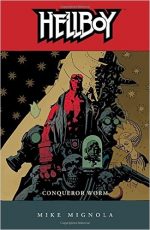
Hellboy volume 5: Conqueror Worm


By Mike Mignola with Dave Stewart & Pat Brosseau (Dark Horse)
ISBN: 978-1-59307-092-2

Hellboy is a creature of vast depth and innate mystery; a demonic child summoned to Earth by Nazi occultists at the end of the Second World War but rescued and reared by Allied parapsychologist Professor Trevor “Broom” Bruttenholm. After years of devoted intervention and education, in 1952 Hellboy began destroying unnatural threats and supernatural monsters as lead agent for the Bureau for Paranormal Research and Defense.

This fifth fearsome grimoire of graphic terrors and grave wit re-presents the award-winning 4-issue miniseries Hellboy: Conqueror Worm, originally seen from May to August 2001 and featuring earth-shattering battles, cosmic revelations and a crucial turning point in the life of the “world’s greatest paranormal investigator”.

Following an effusively appreciative Introduction – ‘Mike Mignola is a Genius’– by fan and filmic collaborator Guillermo Del Toro, the eerie epic begins on March 20th 1939 when Hunte Castle is invaded by a select force of American soldiers intent on disrupting the plans of “Nazi Einstein” Ernst Oeming.

In the Austrian alpine fortress fanatical scientists and occultists are counting down to Earth’s first space shot when the crack unit – led by two-fisted mystery man Lobster Johnson – storm in with explosive repercussions…

Sixty-one years later the ruins are the scene of careful scrutiny by the B.P.R.D.

NASA telescopes have spotted a Nazi-emblazoned capsule rocketing back to Earth, clearly a result of that clandestine commando mission’s ultimate failure. With the fallen Reich’s past track record of supernatural surprises, Director Tom Manning wants Hellboy and former foe-turned-new-recruit Roger the Homunculus to see what lost secrets they can uncover.

Guiding them is a local girl with useful connections. Lisa Karnstein grew up near the ruins and now works for the Austrian Secret Police…

Before they finally set off, Hellboy endures a distasteful interview with his new boss. The B.P.R.D. bigwigs have placed explosives inside Roger – “just in case” – and want the crimson colossus to carry the detonator with him at all times…

Furious but committed, Hellboy storms off and soon the cautious trio are nearing the summit and ominous ruins. Their way is briefly barred by an enigmatic figure begging them to turn back from the haunted site, but it quickly succumbs to Hellboy’s already short fuse and thundering fists. Before long they are picking their way towards the entrance when shots are fired from ambush and Roger plunges off the side of the mountain…

Angrier than ever, Hellboy smashes into the derelict building to discover one of his oldest enemies in charge of a restored Nazi mission control suite.

Herman Von Klempt was there when Oeming took off for the stars in 1939 and in the years since has become a major menace to civilisation through his macabre transplant experiments and cybernetic killer-apes. The latest incarnation of the latter is what smashes Hellboy into unconsciousness…

When the investigator comes to he is trussed into a typically sadistic torture device and as he screams in agony the Nazi is smugly boasting of the fruition of decades of planning. He is also congratulating his devoted mole within the B.P.R.D. operation…

Elsewhere, what remains of Lobster Johnson makes contact with a presumed-lost B.P.R.D. agent and begins a desperate counterstrike which might be mankind’s only chance of survival, even as Von Klempt’s technicians guide the vintage space capsule to a safe descent…

With Hellboy freed and liberally wreaking carnage amidst the mad scientist’s forces, a third faction then enters the fray, offering crucial intelligence into the demon-foundling’s true origins and early life.

Ignoring the many ghosts infesting the castle, he also reveals how the plan was never to send a living human into space, but to deliver a corpse which would be inhabited by an ancient, arcane monstrosity from antediluvian prehistory: a creature whose reign on Earth would signal the end and obliteration of humanity…

Before dying he finally offers a meagre weapon to oppose the beast, but it seems utterly inconsequential compared to the hideous transformative majesty of the chthonic horror Von Klempt calls the Conqueror Worm…

With all sides in play the supernatural action goes into ghastly overdrive as Hellboy and his allies strive to destroy the creeping evil and its insane acolytes. Enemies fall and allegiances shift from moment to moment, but when the gift-weapon is shattered only the greatest sacrifice imaginable can halt the monster’s domination.

Moreover, even after Hellboy’s greatest, most important triumph his anger at humankind’s madness and venality force him to make the most important decision of his unconventional life…

Wrapping up the spectral showcase is an ominous Epilogue revealing how a convocation of the Weird Warrior’s most dangerous enemies results in one less arch enemy but more trouble in store plus an expansive ‘Hellboy Sketchbook’ section, offering a variety of breathtaking drawings and roughs detailing the development and visual evolution of the beasties and bad guys populating the story.

Baroque, grandiose, rocket-paced and genuinely flavoured with the taste of imminent Armageddon, Conqueror Worm is an astounding adventure to enthral horror addicts and action junkies: another lovingly lurid lexicography of dark delights no comics fan or fear fanatic should miss.
™ and © 2001, 2002 and 2003 Mike Mignola. Hellboy is ™ Mike Mignola. Introduction © 2001 Guillermo Del Toro. All rights reserved.

Garth Ennis’ Complete Battlefields volume 2


By Garth Ennis, P. J. Holden, Russ Braun, Carlos Ezquerra, Hector Ezquerra & various (Dynamite Entertainment)
ISBN: 978-1-60690-222-6

Garth Ennis is a devout aficionado of the British combat comics he grew up reading. He’s also a writer with a distinct voice and two discrete senses of humour.

In Battlefields the cruel, surreal ultra-violent gross-out stuff that made Hitman and The Boys such guilty pleasures are generally sidelined to make room for the far more blackly sardonic ironies of Preacher and True Faith.

Ennis practically resurrected the combat genre in US comics through a sequence of superb War Stories co-created with the industry’s top illustrative talent for DC’s mature reader Vertigo imprint, and later crafted more of the same for Dynamite Entertainment through the themed-anthology series Battlefields, beginning in November 2008. Here he continued blending a unique viewpoint (pro-warrior but savagely anti-war) with his love of those British comics strips, and this second Complete Edition gathers three more triptychs set in World War II, all digging deep beyond big-screen glamour glitz to expose the grimy guts of life during wartime in self-contained arenas most of us never gave a second thought to…

Illustrated by P. J. Holden, the horrific madness resumes in 1942 as ‘Happy Valley’, highlights the outrageous behaviour and doomed camaraderie of airmen ‘From a Land Down Under’.

When not pulling stupid pranks or rowdily carousing, the Australians of 444 Squadron spend their nights pounding the German industrial heartland of the Ruhr Valley in their Vickers Wellington bombers…affectionately known as “Wimpys”.

However, one particular crew is more than a bit upset when their top-notch pilot is replaced by fresh-faced Ken Harding; a kid straight out of flight school. However, after the first mission the frequent fliers have cause to reassess the weird little sprog and his raw skill or incredible luck.

The magic happens again after dull times and enforced grounding ‘In Pomgolia’ leads to more nights of sheer terror and exhilaration before the inevitable finally happen in the breathtaking conclusion ‘Who’ll Come on Ops in a Wimpy With Me?’…

In volume one Ennis and his venerable old collaborator Carlos Ezquerra (artistically aided, abetted and inked by his son Hector) introduced a work-shy, callow crew of Londoners manning a Churchill Tank who had to adapt to a new commander in the short squat shape of a foul-mouthed Geordie, who babbled orders in his bizarre northern jibber-jabber no normal bloke could understand…

Now Sergeant Stiles returns in ‘The Firefly and His Majesty’. It’s February 1945, and, riding a brand new Sherman Firefly, he’s part of a push deep into enemy territory. Sadly, a fanatical old adversary piloting Germany’s last super-weapon is ready to offer the invaders a lethal ‘Welcome to the Fatherland’…

Stiles is now part of the Fourth Royal Tank Regiment, having fought his way from Africa all the way up into Italy and fully intends on killing a few more smug “Jormans” before he’s done.

Soon he and his new squad come upon the remains of an American tank column that has been obliterated by two King Panzers. As Stiles tracks one of them he thanks his lucky stars the monster tanks weren’t around until the war was almost won. Still, his Firefly isn’t exactly standard issue either…

As they cautiously hunt for the enemy, the crew share the story of why Stiles hates Tigers so much and why he’s looking for one German tank commander in particular. ‘Soldiers of the Reich’ then sees the over-eager sergeant finally make a mistake which – he judges – makes him no better than the scum he’s hunting…

Filled with righteous fury, Stiles at last confronts his hated enemy in the ruins of a bombed-out cathedral, but after all modern innovations of butchery are exhausted the final terrible battle in the ‘Kingdom of Dust’ is fought and won with the most primitive of weapons…

The final tale in this turbulent tome also features a returning character.

‘Motherland’ is drawn by Russ Braun and returns to the Soviet theatre of war to chart the further exploits of female flyer Anna Borisnova Kharkova. She began defending her country as a night bomber harassing the German invaders as one of the all-woman squadrons dubbed Nachthexen or Night Witches…

Now a Captain, she is part of a vast Flight of fighter pilots harassing the enemy as they retreat from Stalingrad, pushed back by the sheer volume if not quality of the massed Russian war machine. The Soviets are now building up to a mass attack to liberate Kursk, but female pilots still struggle to earn the respect of their arrogant male comrades.

Although she has an ally in Commander Colonel Golovyachev and a friend in her timid mechanic Private Meriutsa (AKA “Mouse”) she has also picked up a ruthless enemy in Political Officer Major Merkulov of the NKVD, whom she caught in a moment  of arrant cowardice under fire…

Anna contents herself with killing Germans whenever she can and is astounded after a spectacularly disastrous sortie to be made a Hero of the Soviet Union for her efforts. The award results in her being removed from combat missions and ordered to school more hopelessly ineffective girls in the intricacies of aerial warfare, but her attempts to protect them are wasted once new Political Officer Captain Bobrov orders the untrained novices into combat…

Rushing after her defenceless charges Anna suddenly finds herself in the greatest and most important battle of her life…

Packed with blistering action, horrific human experiences and breathtaking gallows humour, these amazing tales of ordinary people in extraordinary circumstances come with a fascinating and informative Afterword from the author, script excerpts, recommended further reading, covers by Garry Leach, plus extensive sketchbook sections featuring character designs, layouts, pencils and finished art from Braun, Holden and the Ezquerras.

These are not stories for children. Due to Ennis’s immense skill the carefully constructed moments of tension, terror and relief strike home and strike hard; whether he is aiming for stress-releasing belly laughs,, lambasting the Powers That Be always ready to send fodder to slaughter or, as seen most frequently here, examining in excoriating detail how the acts of war makes mortals into monsters.

These hyper-authentic yarns reek of grim veracity and are a tribute to the spirit of people at their very best and worst. This is war as I fear it actually is, and it makes bloody good reading.
© 2010, 2011 Spitfire Productions, Ltd. All Rights Reserved.

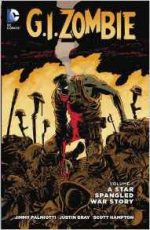
GI Zombie volume 1: A Star Spangled War Story


By Justin Grey, Jimmy Palmiotti, Scott Hampton & various (DC Comics)
ISBN: 978-1-4012-5487-2

When DC controversially rebooted their entire continuity with the New 52 in 2011, most reader and critical attention was focussed on big-name costumed stars, but the move also allowed creators to revisit older genre titles from those eras when superheroes were not the only fruit.

A number of venerable war titles and stars were revisited and re-imagined – even the iconic and presumed sacrosanct Sgt. Rock – and some novel ideas and treatments were realised… although largely ignored by the audiences they were intended for.

One of the most appealing and well-realised appeared in a revitalised Star Spangled War Stories, outrageously blending the global war on terror, current socio-political disaffection and Earth’s ongoing fascination with the walking dead to produce a spectacular, tongue-in-cheek blockbuster romp tailor-made for TV or movies.

Perhaps that was the point all along…

Written by Justin Grey & Jimmy Palmiotti with art from Scott Hampton, the serialised saga from SSWS volume 2 #1-8 (spanning September 2014-May 2015) has been collected in one riotous read, augmented by a smart little epilogue that graced Star Spangled War Stories: Future’s End #1.

The premise is deliciously simple and sublimely subversive. Soldier Jared Kabe has been the Republic’s most secret weapon for decades: an unkillable agent infallibly serving the nation in secret through most of its wars and so many of its unpublicised black-ops counter-strikes against America’s implacable enemies.

And just so we’re on the same page here, he’s unkillable because he’s already dead…

When not battling on numerous officially sanctioned war fronts, this perfect operative has tackled pervasive social ills such as drug cartels and human traffickers, and it’s just this kind of simple mission which leads to an unlife-changing moment as his commanding officer – Codename: Gravedigger – pairs him with maverick – but still breathing – agent Carmen King.

They were only supposed to infiltrate a biker gang militia, but the case takes on a life of its own when the smelly redneck nut-jobs buy medium-range missiles and a deadly bio-agent to use on Washington DC.

After an astounding amount of cathartic bloodshed, Carmen is soon deep undercover, playing house with a slick madman running a clandestine organisation of would-be world conquerors whilst Jared strives to prevent the strike on the government. He succeeds by bringing the missile down in unlucky Sutterville, Tennessee, only to discover to his horror that he has a personal connection to the payload and must face a horrific ‘Small Town Welcome’…

As Jared and Special Forces struggle to contain a spreading contagion, Carmen is deep underground in a sybaritic paradise housing an enclave of wealthy fanatics in Utah, all eager to remake the world to their specifications. Even whilst playing along with the head loon she has one eye on the citadel’s labs and armoury and the other on her ‘Exit Strategy’…

Southern crisis largely contained, Kabe rushes to rendezvous with King and selects a uniquely undead methodology to enter the subterranean fortress; one that offers ‘Door-to-Door Delivery’, but the head paranoid panics and chooses to abandon his base and acolytes in the ‘The Living Desert’. Taking Carmen and a few select, trusted individuals, he flees to San Francisco after first employing his private nuclear option…

‘Two the Hard Way’ sees Jared survive the detonation and another bio-bomb outbreak before heading for the coast where Carmen’s cover has been blown and she is attempting to blast her way out.

With the disclosure of Kabe’s past connections to the madmen in charge, ‘The Final Countdown’ begins with the GI Zombie, Carmen and a dedicated cadre of special agents invading a locked-down fortress determined to prevent the “City by the Bay” becoming another glowing toxic crater…

The main event magnificently completed, there’s a little extra treat for readers: ‘United States of the Dead’ appeared in Star Spangled War Stories: Future’s End #1, set “five years from now” and reveals how a zombie bio-agent has been used to infect Gotham City and how Kabe and Co. must stop the rot to save the world…

With cover and variants by Dave Johnson, Howard Porter and the late, great and already much-missed Darwyn Cooke, this is a fabulous high-velocity action adventure: fast paced, devastatingly action packed and simply dripping with sharp and mordant black comedy moments. This is the kind of graphic extravaganza you use to convert folks who hate comics…
© 2014, 2015 DC Comics. All Rights Reserved.

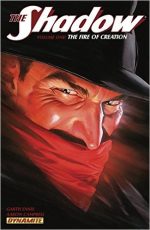
The Shadow volume 1: The Fire of Creation


By Garth Ennis, Aaron Campbell, Carlos Lopez & various (Dynamite Entertainment)
ISBN: 978-1-60690-361-2

In the early 1930s, The Shadow gave thrill-starved readers their measured doses of extraordinary excitement via cheaply produced periodical novels dubbed – because of the low-grade paper they were printed on – “pulps” and, over the mood-drenched airwaves, through his own radio show.

Pulp titles were published in their hundreds every month, ranging from the truly excellent to the pitifully dire, in every style and genre, but for exotic adventure lovers there were two star characters who outshone all others. The Superman of his day was Doc Savage, Man of Bronze, whilst the premier dark, relentless creature of the night dispensing terrifying grim justice was the mysterious slouch-hatted hero under discussion here.

Originally, the radio series Detective Story Hour – based on stand-alone yarns from the Street & Smith publication Detective Story Magazine – used a spooky voiced narrator (variously Orson Welles, James LaCurto and Frank Readick Jr.) to introduce each tale. He was dubbed “the Shadow” and from the very start on July 31st 1930, he was more popular than the stories he introduced.

The Shadow evolved into a proactive hero solving instead of narrating mysteries and, on April 1st 1931, starred in his own pulp series written by the incredibly prolific Walter Gibson under the house pseudonym Maxwell Grant. On September 26th 1937 the radio show officially became The Shadow with the eerie motto “Who knows what evil lurks in the hearts of Men? The Shadow knows!” ringing out unforgettably over the nation’s airwaves.

Over the next eighteen years 325 novels were published, usually at the rate of two a month. The uncanny crusader spawned comic books, seven movies, a newspaper strip and all the merchandising paraphernalia you’d expect of a superstar brand.

The pulp series officially ended in 1949 although Gibson and others added to the canon during the 1960s when a pulp/fantasy revival gripped America, generating reprinted classic stories and a run of new adventures as paperback novels.

As hinted above, in graphic terms The Shadow was a major player. His national newspaper strip – by Vernon Greene – launched on June 17th 1940 and when comicbooks really took off the Man of Mystery had his own four-colour title; running from March 1940 to September 1949.

Archie Comics published a controversial contemporary comicbook in 1964-1965 under their Radio/Mighty Comics imprint, by Robert Bernstein, Jerry Siegel, John Rosenberger and latterly Paul Reinman; and in 1973 DC acquired the rights to produce a captivating, brief and definitive series of classic comic adventures unlike any other superhero title then on the stands.

DC periodically revived the venerable vigilante. After the runaway success of Crisis on Infinite Earths, The Dark Knight Returns and Watchman, Chaykin was allowed to utterly overhaul the vintage feature. This led to further, adult-oriented iterations (and even one cracking outing from Marvel) before Dark Horse assumed the license of the quintessential grim avenger for the latter half of the 1990s and beyond.

Dynamite Entertainment picked up the option in 2011 and, as well as republishing many of those other publisher’s earlier versions, began a series of new monthly Shadow comics. Set in the turbulent 1930s and 1940s these yarns were designed as self-contained story arcs, crafted by some of the top writers in the industry, each taking their shot at the immortal legend, and all winningly depicted by a succession of extremely gifted illustrators. First to fire was the incomparable Garth Ennis who muted his signature black humour for this tale screaming of unrequited injustice…

It begins with a précis of Japan’s official invasion of China in 1937 and the appalling atrocities inflicted by their forces as they began building their “Greater East Asian Co-Prosperity Sphere”, jumping a few years and to the docks of New York City, where a dark angel dispenses bloody judgement to a murderous band of crooked dockworkers.

A little later abrasive, indolent playboy Lamont Cranston joins Washington insider Mr. Landers and his gung-ho young protégé Pat Finnegan at the Algonquin Hotel. They are meeting to discuss an imminent crisis amidst the worsening situation in the East, and how the massacre at the pier was connected to it. Specifically, two of the bodies dropped at the scene were high-ranking Japanese agents…

Despite Finnegan’s outspoken distaste at involving a civilian dilettante, a tale is shared of a rare mineral that both America and Japan will do anything to obtain. Cranston agrees to lead a small party into China to secure the samples (originally dug up by prospecting American geologists before they vanished) for the Land of the Free.

Of great concern is the unspecified part played by Taro Kondo: a formidable and ruthless Major in the Japanese intelligence service that Cranston had some unsavoury dealings with during his younger, less salubrious years in the East…

As Cranston prepares his paramour and assistant Margo Lane for the rigours that lie ahead, she has no conception of how much true horror and mass slaughter the Shadow has foreseen for the years to come…

Whilst Finnegan travels by spartan military plane transport, Cranston and Margo escape his juvenile jingoistic fervour by taking a Pacific Clipper. However their luxurious voyage is abruptly ended when they are attacked by Nazi agents masquerading as rich, indolent vacationers. The bloodbath that results brings down the plane and our heroes barely survive, but they have far greater things to worry about…

Ahead of them Kondo leads ambitious Emperor-lover and sexual deviant General Akamatsu on a tawdry trek to meet Chinese bandit Lord Wong Pang-Yan, descriptively and accurately known to all as “the Buffalo”.

The grotesque and greedy barbarian is their only means of acquiring the mineral they crave, and Kondo is eager to placate his haughty, nauseated superior. After all, they know the Shadow is coming and have other plans in place to deal with him. To soothe the General’s nerves Kondo promises he can behead the double-dealing Buffalo; as soon as they have the enigmatic matter poetically described as the Spirit-Weapon or Fire of Creation…

Since Buffalo Wong originally offered his treasure to many nations, there are a number of expeditions converging on the region. As a Japanese fighter plane removes the Soviet military force from the game, Kondo gloats at another problem solved and returns to placating his aggravating, arrogant superior.

It’s only a minor inconvenience to him that Cranston has survived his German allies’ attack and rendezvoused with the American agent Finnegan in Shanghai…

As the Yankees’ arrangements to use a British Navy vessel to reach Wong’s stronghold are finalised, Kondo’s assassins strike but once again are no match for the mesmerism and gunplay of the Shadow.

To make a point, the Dark Avenger not only eliminates his attackers but weeds out and ends every Japanese and German agent in the city…

At least the delay gives Kondo’s party a good head start. As their sailing boat (an unpowered Junk) navigates the great river, the former smuggler and crimelord passes the time by sharing all he knows about the human monster Kent Allard who was his criminal rival fifteen years previously. He doesn’t know how that despicable rogue became the man now known as Cranston, but is certain he is still the most implacable and remorseless killer on Earth…

Behind them Finnegan, determined to prove his manhood and authority, pushes the British Commander and crew. Resolved to catch Kondo’s military detachment before they reach their ultimate destination, he sees first hand the atrocities the Japanese soldiers casually inflict on “lesser” races, and in his disgust and inexperience leads the gunboat into a lethal trap.

Only he, Margo and the insufferable Cranston survive…

Far ahead of them Kondo and Akamatsu make their final trade with Wong – miracle mineral for gold – and the inevitable double-crossing and bloodletting begins.

What none of the treacherous villains realize is that the vengeful Shadow is already amongst them, cutting down soldiers and bandits like chaff as he patiently, determinedly makes his way to the true cause of all the terror…

At last Kondo realises he has only one card left to play…

Dynamite publish periodicals with a vast array of cover variants and here a vast collected gallery highlights dozens of iconic visions from Alex Ross, Chaykin, John Cassaday, Stephen Segovia, Ryan Sook, Sean Chen, Francesco Francavilla & Jae Lee. Adding to the Bonus Material is Ennis’s script for the first issue, and gloriously gilding the lily is a mountain of powerful pencil studies by Ross and Lee.

Sardonic, brutal and deviously convoluted, The Fire of Creation is a splendid addition to the annals of the ultimate and original Dark Knight, and one no lover of action and mystery can afford to miss.
The Shadow ® & © 2012 Advance Magazine Publishers Inc. d/b/a Conde Nast. All Rights Reserved.


Criminal volume 5: The Sinners


By Ed Brubaker & Sean Phillips (Image Comics)
ISBN: 978-1-63215-298-5

Way back in 2007, Tracey Lawless debuted in the second Criminal story-arc: a tough but comparatively honest guy drawn back from military service and into the underworld to repay his family’s debts.

At that time collaborators Ed Brubaker & Sean Phillips were forging a creative partnership incapable of setting a foot wrong: each stand-alone tale building on the previous exploit, getting tougher, stronger, meaner and better…

Everything is set in and around Center City, a prototypical American everytown which serves as a shared backdrop for various seemingly unconnected ventures. Slowly, however, connections were made and a wider mosaic began to become clearer…

The entire series of compulsive crime capers was repackaged and re-released as a uniform set of trade paperbacks in 2015 with this as the fifth turbulent tome (reprinting the five issue comicbook series Criminal: The Sinners, September 2009-March 2010) as Lawless rears his battered grizzled head once again…

For a year the Lawless has been working off his dad’s and brother Ricky‘s debts to undisputed Boss of Bosses Sebastian Hyde, killing whoever the ruthless bastard tells him to.

At least that was the plan, but Lawless doesn’t like wholesale slaughter and has been quietly choosing who lives or dies. Sure, he’ll cap anybody who really deserves it – and there are plenty of them – but he’s been increasingly finding ways to punish the little people who arouse Hyde’s ire without needing the services of an undertaker afterwards.

Despite himself, Sebastian has a grudging respect for Tracey and has been letting it slide, since Lawless has been his most effective enforcer since he joined the team. He’d probably feel less sanguine if he knew what his star goon was doing with Mrs. Hyde…

Today, however, Hyde has an even bigger problem, one that needs brains not butchery.

All over town well-connected associates considered utterly beyond the reach of the law and even underworld rivals have been hit: not just Sebastian’s crew, but also feared and respected colleagues-in-crime nobody should be able to get near. It’s affecting everyone’s business and has to be stopped. Hyde owns plenty of cops, but this is something he needs sorted by someone he can at least control if not trust…

Tracy is no sleuth, but with no other choice, begins making enquiries into the shootings. Father Grant was a loan-shark and possible serial sexual predator, shielded by both the Church and the Mob; Scotty Adsit ran drugs and collected thumbs from those who baulked him and Big Tom McGinnis was the elder Statesman of the Irish Mafia, capped in his own restaurant rest room with twenty bodyguards just outside. There’s no connection other than that they were all very bad people and in every execution it’s like the killer was invisible…

Further complicating the issue is the arrival of military cop Special Agent Yoakum. Tracey has been AWOL for year now and despite his current untenable situation has no desire to trade it for active service or a stockade…

As he flounders through the darkest regions of the underworld, the death toll mounts. Joe Hill was Sebastian’s top man inside the police force and best hope for a lead, but he was left dead in the gutter before Lawless could meet him. However he provides a first inkling of what’s really going on and an idle comment from a sympathetic Internal Affairs cop forces Lawless to re-examine his assumptions…

In the course of his investigations Tracey met war vet and replacement priest Father Mike, but had no idea that while he was starting to put things together, Sebastian has made a few misapprehensions of his own and is now gunning for his unwilling gunsel…

As the bodycount of untouchables keeps rising, Tracey tracks another potential answer to Chinatown and ends up framed for the death of a Triad Boss, just as Yoakum closes in. All the time the trail keeps coming back to the church and Father Mike, but Tracey is blithely unaware that he has already met the killer – who has also passed sentence on him too – or that Sebastian has decided to cut his losses…

As all the strands converge, the slaughter mounts and when the shooting stops the criminal hierarchy of Centre City has changed forever…

Filled with twists, turns and devious double-cross, this viciously effective sex-&-violence saga offers a stark look at the other side of society: providing an irresistible view of raw humanity. These stories are amongst the very best crime comics ever crafted: ignore them at your peril…
© 2015 Basement Gang Inc. All rights reserved. Criminal™ and all prominent characters, likenesses and logos are trademarks of Ed Brubaker and Sean Phillips.

Hellboy volume 4: The Right Hand of Doom


By Mike Mignola, with Dave Stewart & Pat Brosseau (Dark Horse)
ISBN: 978-1-59307-093-9

Hellboy is a creature of vast depth and innate mystery; a demonic child summoned to Earth by Nazi occultists at the end of the Second World War but rescued and reared by Allied parapsychologist Professor Trevor “Broom” Bruttenholm. After years of devoted intervention and education, in 1952 Hellboy began destroying unnatural threats and supernatural monsters as lead agent for the Bureau for Paranormal Research and Defense.

This forth fearsome grimoire of graphic terrors and grave wit combines some new material with a gathering of shorter satanic sagas garnered from Dark Horse Presents #151, Dark Horse Presents Annual #1998, Gary Gianni’s The Monster Men, Abe Sapien: Dreams of the Dead and Hellboy: Box Full of Evil #1-2, communally spanning 1998-1999 and offering insights into different stages in the unique life of the “world’s greatest paranormal investigator”.

‘Part One: the Early Years’ leads with the mordantly surreal and hilarious ‘Pancakes’ (Dark Horse Presents Annual #1998 and seen in colour for first time) as a certain 2-year old terror enjoys his first taste of a human treat and is forever lost to the Lords of the Realm Infernal, after which Mignola begins his engaging, informative and ongoing directors’ notes on all the spooky stories contained herein…

Based on a 6th century English legend, ‘The Nature of the Beast’ (Dark Horse Presents #151 and also moodily coloured by Dave Stewart for this tome) finds a youthful Hellboy circa 1954, attempting to slay a dragon for a strange group of wise men with a hidden agenda before ‘King Vold’ – created specifically for this volume – sees the monstrous monster hunter in magic-drenched Norway in 1956. He’s been despatched by Professor Bruttenholm to aid scholarly colleague Edmond Aikman in confronting the spirit of a spectral wild huntsman, but once again mystic glamour, the promise of power and the allure of gold have turned a trustworthy ally into a dangerous liability…

Following more of Mignola’s insider information, ‘Part Two: the Middle Years’ begins with ‘Heads’ (a back-up from the March 1998 One-Shot Abe Sapien: Dreams of the Dead) with Hellboy exploring a ramshackle Kyoto dwelling in 1967 and outsmarting a six-pack of particularly gruesome Japanese cannibal monstrosities.

‘Goodbye, Mister Tod’ is likewise a back-up vignette (from Gary Gianni’s the Monster Men, August 1999), set in Portland, Oregon in 1979 with the increasingly world-weary investigator called just too late to help a medium who specialised in materialising ectoplasm. All the paranormal problem-solver can do now though is expel the horrific elder god slowly breaking its way into our reality with one of the grossest tactics ever seen in the annals of ghost-busting…

‘The Vârcolac’ originally appeared as six episodes in promo-pamphlet Dark Horse Extra. Here it’s been extensively redrawn and reformatted to fully feast on the action-packed spectacle of Hellboy battling an ultimate vampire so huge it can “eat the Sun and cause eclipses”…

As Mignola explains for ‘Part Three: the Right Hand of Doom’; after half a decade of tumultuous scene-setting, he finally started to answer some long-extant questions about his infernal foundling.

Answers began seeping out in eponymous short ‘The Right Hand of Doom‘ from Dark Horse Presents Annual #1998 – presented here in colour for the first time – as the BPRD agent meets a priest with a connection to his arrival on Earth during WWII. Adrian Frost has an ancient document depicting Hellboy’s arcane stone appendage and offers to trade it for the true story of his terrestrial nativity and subsequent career.

The cleric learns how a Lord of Hell and an earthly witch spawned a child of diabolical destiny and how the grand plan was derailed by destiny and a human-reared child who moved Heaven and Hell to live his own life…

That background was soon expanded in 2-part 1999 miniseries ‘Box Full of Evil’ when Hellboy and BPRD associate Abe Sapien return to modern-day Britain to assess a mystic burglary. Old enemy Igor Bromhead has used his magic to steal the ancient metal coffer Saint Dunstan used to imprison a devil, but by the time they find him the vile plotter has opened the box and sold its contents to debauched Satanists Count Guarino and Countess Bellona.

Their facile joy is short-lived as the little double-dealer takes possession of the cask’s true treasure. In return for paltry wealth and appalling knowledge, the freed demon shares the secret name and true nature of Hellboy as well as his Abysmally-ordained destiny. It even helps Igor ambush the investigator, usurping both Hellboy’s true power and ascribed role in the destruction of the universe…

With that misappropriated magical might, the demon begins to end creation but has not reckoned on the incredible will and sheer bloody-mindedness of the paranormal troubleshooter, nor those other ancient powers of the Earth who have no intention of dying before their appointed times…

This astounding tale of hell-bent heroism and cosmic doom is then followed by an all-new 4-page epilogue which offers dark portents of further trials for the monster who will always be his own man…

Wrapping up the spectral showcase is a reproduction of the superb and spooky cover of the French collected Box Full of Evil plus a huge ‘Hellboy Sketchbook’ section, offering a variety of breathtaking drawings and roughs spanning 1993 through 1999.

Baroque, grandiose, fast-paced and deceptively witty, these tall tales will captivate adventure and horror addicts in equal amounts, making this another lovingly lurid lexicography of dark delights no comics fan or fear fantasy fanatic should be without.
™ and © 1998, 1999, 2000 and 2003 Mike Mignola. Hellboy is ™ Mike Mignola. All rights reserved.

Breaking The 10 volume 1


By Seán Michael Wilson & Michiru Morikawa (NBM)
ISBN: 978-1-68112-021-8

Scottish émigré and citizen of the world Seán Michael Wilson has a splendid and well-earned reputation for “Deep” comics that tackle real issues (Iraq: Operation Corporate Takeover {with War on Want}, Goodbye God? – an Illustrated Examination of Science Vs Religion with Hunt Emerson) but is equally adept at more straightforward and hugely entertaining strip material (The Story of Lee, AX: Alternative Manga).

Here, those seeming opposites collide and combine in a superbly engaging and wickedly barbed tale of lost love, disillusionment and grief-filled reaction that is both hilariously acerbic and potently thought-provoking.

Aiding and abetting a great deal of impious soul-searching is award-winning manga illustrator and poster artist Michiru Morikawa – who worked with Wilson on Yakuza Moon, Demon’s Sermon, Musashi and The Faceless Ghost – and lends a fine gloss to the proceedings which begin with a robbery…

Devout Christian David is still reeling from the death of his wife and child when he decides to confront God and force him to explain his actions and motivations. With no other recourse the aggrieved sinner starts methodically breaking the Ten Commandments – beginning with ‘Thou shalt not steal’ – but is utterly unaware that two antithetical gentlemen are watching him…

Before long they are at his door, introducing themselves as Mr. Black and Mr. White; offering counsel and unwelcome advice the bereaved David doesn’t want to hear. Nor does he believe they are the supernatural advocates they seem to be as, whilst they bicker over him, it becomes clear to the apostate that they don’t yet know what his game plan actually is…

As David continues his celestial attention-getting campaign in ‘Thou shalt not covet your neighbor’s… (house; thou shalt not covet your neighbor’s wife, nor his male servant, nor his female servant, nor his ox, nor his donkey, nor anything that is neighbor’s)’ through a spot of coldly calculating seduction, White maintains his surveillance whilst Black slacks off and disappears.

Everything is not as it appears: White may well be the agent of an Interventionist creator, but his opposite number claims to be a simple disciple of a modern humanist rationalism rather than an operative of the Infernal Antagonist…

David doesn’t really care: his first two assaults upon scripture have won him nothing but fleeting physical pleasure so he ups the ante by robbing and desecrating a church before ‘Remember the Sabbath day, to keep it holy’ finds him contemplating how best to offend all the Abrahamic religions when there’s already seven-day shopping and the entire world has pretty much abandoned the concept of holy days…

The subversive private war takes on a far more public aspect when the bereft zealot creates an obscene statue and posts pictures on the internet, inviting the world to worship Graven Daven, the Indecent Idol in ‘Thou shalt not make for yourself a graven image’…

As fanatics of every stripe converge on his house, David ignores his constant prating gadflies and tells all in a candid TV interview, and, with the entire world caught up, subsequently moves on to the darker fringes of his scheme.

Firstly he destroys the gullible couple next door by shattering the edict ‘Thou shalt not bear false witness against your neighbors’ before – with God still a no-show and with no hint of an apology or explanation forthcoming – planning his end-game.

It starts during a quiet little chat with the gobsmacked Mr. Black about the big one… the one about killing…

To Be Concluded…

Thought-provoking and deceptively low-key, this repurposing of an age-old question is unlike earlier graphic novels addressing this timeless theme (Eisner’s A Contract with God or Truth Faith by Garth Ennis & Warren Pleece come immediately to mind) as the focus and driver is more about human pain rather than indignation or betrayal. Moreover, by introducing a third philosophical force to counter both God and the Devil, Breaking the 10 moves the debate into fresh territory regarding what makes human beings moral.

Fresh, challenging and superbly enthralling, this is a book no saint or sinner should miss.
© 2016 Seán Michael Wilson & Michiru Morikawa.

Breaking the 10 volume 1 will be in selected retail outlets from June 29th and released on July 21st 2016. It can be pre-ordered now and is also available in all e-book formats.

For more information and other great reads see http://www.nbmpub.com/

Wandering Star


By Teri S. Wood (Dover Comics & Graphic Novels)
ISBN: 978-0-486-80162-9

The 1980s were an immensely fertile time for English-language comics and creators. In America a whole new industry grew around the development of specialist shops as dedicated retail outlets sprung up all over the country. Operated by fans for fans, they encouraged a host of new publishers to experiment with format, genre and content, whilst eager readers celebrated the happy coincidence that for the first time in a long time they seemed to have a bit of extra cash to play with.

Consequently the comics-creating newcomers were soon aggressively competing for the attention and cash of consumers who no longer had to get their sequential art fix from DC, Marvel, Archie and/or Harvey Comics. European and Japanese material started creeping in and by 1983 a host of young companies such as WaRP Graphics, Pacific, Eclipse, Capital, Now, Comico, Dark Horse, First and many others had established themselves and were making impressive inroads.

Most importantly, by avoiding the traditional family-focussed sales points such as newsstands, more grown-up material could be produced: not just increasingly violent or sexually explicit but also more politically and intellectually challenging and even – just occasionally – addressing classic genres with a simple maturity comicbooks had not been allowed to express since the Comics Code shut down EC Comics.

New talent, established stars and different thematic takes on old forms all converged and found a thriving forum hungry for something a little different. Even smaller companies and foreign outfits had a fair shot at the big time and a lot of great publications came – but, almost universally, as quickly went – without getting the attention or success they warranted.

The boom encouraged many would-be creators to take their shot and although the surge led to a spectacular implosive bust, a few truly impressive series weathered the storm and left their mark.

One such was Wandering Star by Teri S. Wood and now the entire epic 21 issue odyssey has been collected in a monumental hardback complete edition, which will hopefully – if belatedly – transform the tale from beloved cult classic to the pioneering trail blazer of comics science fiction it richly deserves to be…

Resa Challender started out as most cartoon aspirants did back then; selling strips to fan press publications (Amazing Heroes), progressing to a regular series gig at one of the smaller companies (Rhudiprrt: Prince of Fur for MU Press) all the while looking for a signature concept to cement inevitable stardom.

For Teri/Resa that was proudly self-professed space opera Wandering Star, which she originally self-published in 1988 without appreciably troubling the comics-buying masses…

That original exuberant, raw-edged first episode is included in the copious Bonus Material section at the back of this book, along with an Afterword from Carla Speed McNeil (and I really must get around to covering her fabulous Finder series sometime soon…), plus a 30-page full-colour section displaying a vibrant gallery of covers and promotional prints created during the series’ original run from 1993-1997.

Nearly 500 pages earlier Maggie Thompson starts the ball rolling with her reminiscence-rich Foreword, recalling the author’s early days and connection to Comics Buyers Guide which Wood expands upon in her own fact-filled Introduction.

When she was ready, Teri S. Wood returned to her 30-page draft of Wandering Star and severely retooled it. The result then launched through her own Pen and Ink Comics for eleven issues of a loudly touted 12 issue maxi-series, before being picked up Sirius Press who took away all the administrative hassles and let her get on with writing and drawing it until its actual conclusion with #21.

I called this a space opera, and it qualifies in the truest sense of the term. The story of an Earthling stuck at a hostile pan-species university who overcomes alien prejudice and with a small group of allies is instrumental in stopping a vast intergalactic war is the very essence of that particular genre, but Wandering Star was different then and still delights today because it avoids all the easy pit-stops and pitfalls of the meme.

There is an overwhelming threat to universal peace, there is a monstrous and dreadful cosmic personal antagonist in the brutal Commander Narz and there is a doughty trusty crew of allies – blind psionic powerhouse Madison, energy being Elli, wise old veteran Graikor, hateful bully turned staunch comrade Mekon Dzn Appogand plus (latterly) fellow human Joey – all frantically hurtling across the cosmos as the embattled heroes try to keep the fugitive vessel Wandering Star out of the clutches of an invading army willing and able to rip the Galactic Alliance to shreds…

From the start Wood opted for emotional involvement rather than over-used action and spectacle to engage her readership; deftly utilising the serial medium to build the characters of her cast and show scary, painful, funny and ultimately intimately revelatory moments.

Stooping to an obvious if rather unfair comparison, it’s something the Star Wars movies could never accomplish and why those characters are so wooden and two-dimensional, whereas TV series like Star Trek, Farscape, Firefly and Killjoys excel at making their players authentic and believable. They use the screen time for interaction not extra action…

That’s not to say that there isn’t plenty of cataclysmic cosmic conflict and ominous, last-ditch battles in store, only that Wood knew from the get-go that people – no matter what shape, colour or construction – are infinitely more interesting than one more exploding planet or deadly astral dreadnought, Most importantly, she knew how to use them and when to expend them for maximum impact…

It all begins on peaceful planet Machavia as history student Aldar tracks down celebrated recluse Casandra Andrews and convinces the aged Earther to share the true story of how thirty years ago a bunch of raw kids on the legendary Wandering Star saved the Galactic Alliance from the seemingly invincible, duplicitous and rapacious Bono Kiro Empire…

Potent, powerful, uplifting and painfully realistic, this is a war story that deals with consequences rather than as simple victories and defeats.

Wandering Star is a true example of sequential narrative as Art. Wood produced it practically as a labour of love; for precious little financial reward or public acclaim. She improved and gained confidence with every page and every issue and she did it because she had a story that wouldn’t let her go until she told it…

And once you read it, it won’t loose its hold on you either…
© 1993, 1994, 1995, 1996, 1997 2016 Teri S. Wood. Foreword © 2016 Maggie Thompson. Afterword © 2016 Carla S. McNeil. All rights reserved.

Wandering Star will be published on June 20th 2016 and is available for pre-order now.

Clumsy


By Jeffrey Brown (Top Shelf Productions)
ISBN: 978-0-97135-976-5

If you’re a fan of Jeffrey Brown’s cartoon exploits you might understandably admit to a small degree of confusion. In 2012 he scored his first global best-seller with a hilarious spin on the soft and nurturing side of the Jedi experience in Darth Vader and Son, following up with equally charming and hilarious sequels Vader’s Little Princess, Star Wars: Jedi Academy and others.

Before that another Jeffrey Brown was the sparkling wit who had crafted slyly satirical all-ages funny stuff for The Simpson’s Treehouse of Horror, Marvel’s Strange Tales and Incredible Change-Bots and similar visual venues.

There is yet another Jeffrey Brown: instigator and frequent star and stooge of such quirkily irresistible autobiographical Indy comics classics as Bighead, Little Things, Funny, Misshapen Body, Undeleted Scenes and the four volume “Girlfriend Trilogy”, comprising Clumsy, Unlikely, AEIOU and Every Girl is the End of the World For Me…

Whichever Brown’s your preferred choice he’s a cartoonist of rare insight and unflinching revelation… who still makes you laugh out loud when not prompting you to offer a big consoling hug…

Brown was raised in Michigan; relocating to Chicago in 2000 to attend the School of the Arts Institute and study painting. Before graduating he had switched to drawing comics and in 2002 Clumsy was released, quickly becoming a surprise hit with fans and critics alike.

The material is both delicious and agonising in its forthright simplicity: a sequence of non-chronological pictorial snippets and vignettes detailing in no particular order how a meek, frumpy, horny, inoffensively charming art-student meets a girl and tries to carry out a long-distance relationship. Every kid who’s gone to college, got a job or joined the services has been through this, and for every romance that makes it, there a million that don’t.

Drawn in a deceptively Primitivist style with masterful staging, a sublime economy of phrase plus a breathtaking gift for generating in equal amounts belly-laughs and those poignant lump-in-throat moments we’ve all experienced and forever-after regretted, this is a skilful succession of stolen moments which establish one awful truth.

We’ve all been there, done that and then hoarded those damned photos we can’t even look at any more…

With titles like ‘My Last Night with Kristyn’, ‘Don’t Touch Me’, ‘I Draw her Naked’, ‘I Farted’, ‘But I Want to Make Love’ and ‘You Can Ask Me’, a mosaic of universal joy and despair forms as we watch Jeff and Theresa meet, blossom, exult, dream, plan and part…

Packed with hearty joyous wonder and brimming with hilarious examples of that continual and seemingly tireless teen-lust us oldsters can barely remember now let alone understand, Clumsy is a magical delight for anybody safely out of their Romeo & Juliet years and a lovely examination of what makes us human, hopeful and perhaps wistfully incorrigible…
© 2002 Jeffrey Brown.

The Shadow: Blood and Judgement


By Howard Chaykin with Ken Bruzenak & Alex Wald (Dynamite Entertainment)
ISBN: 978-1-60690-327-8

I’ve been a fan of The Shadow ever since I picked up a couple of paperbacks as a kid in my local Woolworth’s in the 1960s. Over many decades I’ve followed the various comic and movie interpretations with mixed feelings and general acceptance. However, when Howard Chaykin had a crack at the venerable crime-crusher at the height of the turbulent game-changing 1980’s, I nearly blew a gasket. I was appalled.

And that was the point.

Chaykin has for his entire career lovingly cultivated a reputation as an iconoclast and bombast over many years and the four issue miniseries collected here certainly ruffled a few feathers – those of severe traditionalist me included.

As originally disseminated in the days before comic-books, The Shadow gave thrill-hungry readers their measured doses of extraordinary excitement via cheaply produced periodical novels dubbed “pulps” (because of the low-grade paper they were printed on) and over the mood-drenched airwaves through his own radio show.

Pulps were published in their hundreds every month, ranging from the truly excellent to the pitifully dire, in every style and genre, but for exotic adventure lovers there were two star characters that outshone all others. The Superman of his day was Doc Savage, Man of Bronze, whilst the premiere dark, relentless creature of the night dispensing terrifying grim justice was our mysterious slouch-hatted hero.

Originally the radio series Detective Story Hour – based on stand-alone yarns from the Street & Smith publication Detective Story Magazine – used a spooky voiced narrator (most famously Orson Welles, although he was preceded by James LaCurto and Frank Readick Jr.) to introduce each tale. He was dubbed “the Shadow”, and from the start on July 31st 1930, he was more popular than the stories he introduced.

The Shadow evolved into a proactive hero solving mysteries and, on April 1st 1931, debuted in his own pulp series written by the incredibly prolific Walter Gibson under the house pseudonym Maxwell Grant. On September 26th 1937 the radio show officially became The Shadow with the eerie tag-line “Who knows what evil lurks in the hearts of Men? The Shadow knows!”

From June 17th 1940 he starred in a newspaper strip by Vernon Greene and when comic books took off he had his own four-colour title which ran for 101 issues (March 1940 – September 1949). Years later Archie Comics published a controversial contemporary version in 1964-5 under their Radio/Mighty Comics imprint, written by Robert Bernstein and Jerry Siegel, illustrated by John Rosenberger and latterly Paul Reinman.

In 1973 DC acquired the comic rights and produced a captivating if brief series of classic tales unlike any other superhero title then on the stands.

Grant wrote 282 of 325 novels over the next two decades, which were published twice a month. The series spawned comic books, seven movies, a newspaper strip and all the merchandising paraphernalia you’d expect of a superstar brand. The pulp series also ended in 1949, although many novels have been written (both by Gibson and others) since 1963 when a pulp and fantasy revival gripped America generating reprinted classic stories and a run of new adventures as paperback novels.

Then he was gone again but the mesmerising master of menace always seemed to be lurking in the background…

DC periodically revived their comicbook iterations of the venerable vigilante and in the wake of Crisis on Infinite Earths, The Dark Knight Returns and Watchman tasked one of the comics industry’s most controversial creators with reviving the pre-eminent mystery men of all time…

Fresh from an awe-inspiring, inspirational and transformative run on his creation American Flagg, Howard Chaykin returned to DC to shake up everything with an interpretation which offended fans, purists (still including me) and franchise-owners Conde Nast but which ultimately proved to be just the medicine the property needed to become relevant again.

That crucial year 1949 is the embarkation point for this flashy, savage, witty and completely captivating updating. This is not a reboot. Chaykin was extremely careful to accept and utilise the decades of established canon; deftly accommodating old material whilst infilling information gaps by scrutinising world history and tacitly accepting that a do-gooder who exploited and expended his own agents whilst kidnapping, brainwashing and slaughtering the bad guys wasn’t what most people would consider a hero…

Devised and delivered as a glittering, frenetic avalanche of graphic and text material – spectacularly made comprehensible by the calligraphic skill of lettering wizard Ken Bruzenak and the understated colour-palette of Alex Wald – the story opens with a series of increasingly brutal murders. It doesn’t take long to connect the victims: old people from all walks of life rumoured to have worked with an old urban legend known as The Shadow…

That mystery manhunter vanished in 1949, abandoning his grim crusade to destroy criminals and now (for which read 1986) some hidden mastermind is eliminating every surviving member of his organization. Before long a figure comes out of the closeted east: easily slipping past China’s Bamboo Curtain and returning to blighted, benighted America…

Suddenly amidst a broiling sea of perversion, sex and violent death, The Shadow is back and dealing bloody justice to petty thugs. In a desperate race against time, the impossibly young and still vital Lamont Cranston reunites with his elderly surviving agents to track down his oldest enemy and thwart a deadly plan to bring about nuclear annihilation.

However, as arrogant and officious as ever, the master manipulator is probably in more danger from the colleagues he abandoned than the gun-toting punks and maniacs dogging his smartly-shod heels…

Chaykin even had the chutzpah to provide the eternal Man of Mystery with a Real Origin, something he never really had before…

Bonus features include a cover gallery, Marc Guggenheim’s Foreword ‘Looking Back on the Shadow’ plus ‘The Light Behind The Shadow’: an interview with Chaykin and Joe Orlando which first appeared in the 1987 trade paperback collection.

I don’t know why I used to dislike this book so much: Although I still feel the proper milieu for the character is the iconic era of mobsters, militarists and madmen (by which I mean the 1930s and 1940s) I can see what Chaykin’s getting at. Those threats and motivations were common enough in the Eighties and even more so nowadays.

Perhaps the author’s trademark trick of confronting misogyny, racism and suppressed sexuality by seemingly advocating them just wore a bit thin when applied to such a treasured old friend. There’s certainly a disquieting amount of adult themes, kinky sex and graphic violence on offer…

With sufficient distance however I now find this tale a terrific thrill-ride; stylish and compelling – if a little “in your face” and “on the nose”. Somebody must have liked it back then: Blood and Judgment spawned a fascinating follow-up series (by Andy Helfer, Bill Sienkiewicz, Kyle Baker and others) before DC reverted to The Shadow Strikes: a series safely restored to its natural pre-war time period.

Out of print since 1991 until Dynamite picked up the option in 2011, this is a vital and vigorous read which inspired some of today’s very best creators, and acts as a perfect introduction to the character. You could even complement the experience by tracking down DC’s first experiment with the character – partially collected as The Private Files of the Shadow – and Dynamite’s new edition of The Shadow: Hitler’s Astrologer, before moving on to the new tales currently being published.

After all, a crime fighter this durable has to have something to him…
The Shadow ® & © 2012 Advance Magazine Publishers Inc. d/b/a Conde Nast. All Rights Reserved.