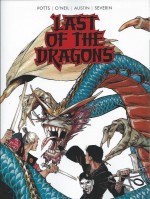
Last of the Dragons


By Carl Potts, Denny O’Neil, Terry Austin, Marie Severin & various (Dover Comics & Graphic Novels)
ISBN: 978-0-486-80357-9

Win’s Christmas Gift Recommendation: Astounding Spectacle and Lasting Amazement… 9/10

The creative renaissance in comics in the 1980s resulted in some utterly wonderful stand-alone sagas which shone briefly and brightly within what was still a largely niche industry before passing from view as the business and art form battled spiralling costs, declining readerships (Curses Be! unto those ever-more available-computer games!) and the perverse and pervasive attitude in the wider world that comicbooks were the natural province of mutants, morons and farm animals (I’m paraphrasing).

Unlike today, way back then the majority of grown-ups considered superheroes as adolescent power fantasies or idle wish-fulfilment for the uneducated or disenfranchised, so an entertainment industry which was perceived as largely made up of men in tights hitting each other got very little notice in the wider world of popular fiction.

That all changed with the rise of comics’ Direct Sales Market. With its more targeted approach to selling; specialist vendors in dedicated emporia had leeway to allow frustrated creators to cut loose and experiment with other genres – and even formats.

All the innovation back then led inexorably to today’s high-end, thoroughly respectable graphic novel market which, with suitable and fitting circularity, is now gathering and re-circulating many of the breakthrough tales from those times, not as poorly distributed serials and sequences, but in satisfyingly complete stand-alone proper books.

Marvel was the unassailable front-runner in purveying pamphlet fiction back then, outselling all its rivals and monopolising the lucrative licensed properties market (like Star Wars and Indiana Jones) which once been the preserve of the Whitman/Dell/Gold Key colossus. This added to a zeitgeist which proved that for open-minded readers, superheroes were not the only fruit…

As the Direct Sales market hit an early peak, Marvel instigated its own creator-owned, rights-friendly fantasy periodical in response to the overwhelming success amongst older readers of Heavy Metal magazine. Lush, slick and lavish, HM had even brought a new, music-&- literature based audience to graphic narratives…

That response was Epic Illustrated: an anthological magazine offering stunning art and an anything-goes attitude – unhindered by the censorious Comics Code Authority – which saw everything from adaptations of Moorcock’s Elric and Harlan Ellison novellas to ‘The Last Galactus Story’, the debuts of comicbook stars-in-the-making like Vanth Dreadstar and Cholly and Flytrap plus numerous stories which would become compelling forerunners of today’s graphic novel industry: serialised yarns of finite duration such as Rick Veitch’s ‘Abraxas and the Earthman’, Claremont & Bolton’s Marada the She-Wolf and a fabulously enchanting East-meets-West period fantasy entitled Last of the Dragons.

The story was conceived by then-newcomer Carl Potts, who plotted and pencilled the globe-trotting saga for Denny O’Neil to script, before inker Terry Austin and colourist Marie Severin finished the art for Jim Novak to inscribe with a flourish of typographical verve.

The classically stylish tale ran intermittently from Epic Illustrated #15 through #20 (spanning October 1982 to the end of 1983) and was collected in 1988 as a Marvel Graphic Novel under the Epic Comics aegis in the expansively extravagant and oversized European Album format: a square, high-gloss package which delivered so much more bang-per-buck than a standard funnybook.

Thankfully Dover have retained those generous visual proportions (their new release is a just as slick and shiny 288 x 208 mm) for this glorious new edition which begins with ‘The Sundering’: opening in slowly-changing feudal Japan of the late 19th century where aged master swordsman Masanobu peacefully meditates in the wilderness…

His Zen-like calm and solemn contemplation are callously shattered when a callow, arrogantly aggressive warrior attacks a beautiful dragon basking nearby in the sun. These magnificent reptiles are gentle, noble creatures but the foolish samurai is hungry for glory and soon wins a bloody trophy…

After the arrogant victor has left Masonobu meets Ho-Kan, a priestly caretaker of Dragons. The youth is overcome with horror and misery at the brutal sacrilege, but worse is to come. When the tearful cleric heads back to his temple home, he stumbles upon a corrupt faction of his brother-monks covertly conditioning young forest Wyrms; shockingly brutalising them to deny their true natures and kill on (human) command…

‘The Vision’ finds traumatised Ho-Kan returned to the temple too late: ambitious, reactionary monk Shonin has returned from a voyage to the outer world wrapt in an appalling revelation. He has divined that the quiescent Dragons must be used to preserve Japan from outside influence – and especially the insidious changes threatened by the encroaching white man’s world. In fact he has already been training the creatures to be his shock-troops.

When the elders object, Shonin’s zealots slaughter all the protesting monks before embarking for the barbarous wilds of America where they will breed and train an army of killer lizards in the lap of and under the very noses of the enemy. Ho-Kan is one of precious few of the pious to escape the butchery and vows to stop the madness somehow…

In a meditative vision he sees Takashi: a half-breed boy whose Christian sailor father abandoned him. The juvenile outcast was eventually adopted by the Iga ninja clan and became a great fighter. Somehow he holds the key to defeating Shonin…

‘The Departure’ reveals how Ho-Kan hires the Iga to stop the corrupted killer-monks but, when he also tries to enlist Masanobu, Shonin’s acolytes capture him. Under torture all is revealed and the debauched clerics then trick the sword-master into fighting the ninjas for them. After despatching all but Takashi, the monks “invite” Masanobu to join them in the West. The elderly swordsman has no idea that the saurian beasts he guards are hopelessly degraded monsters now.

‘The Arrival’ sees the monks and their hidden cargo take ship for California, unaware that an enigmatic “half-breed” has enlisted on a ship closely following behind. Sole surviving Iga ninja Takashi is bound in his duty and hungry for vengeance. He will not be denied…

When the priests disembark on a remote bay on the American coast their intention of slaughtering the sailors and Masanobu goes badly awry when a baby dragon escapes. In the ensuing melee the aged warrior realises the true state of play and flees into the forests.

The Indian tribes of the Californian forests are helpless before the martial arts and war-dragons of Shonin, until – in ‘The Meeting’ – they encounter vengeful Takashi hot on the dragon-lords’ trail. After proving his prowess in combat by defeating the indigenous fighters he joins with the braves, stalking the monks until they encounter Masanobu who is also determined to end this dishonourable travesty once and for all…

All of which results in a tumultuous and breathtakingly spectacular climax in ‘The Decision’ as all the disparate factions collide, meeting one final time to forever decide the fate of a nation, the nature of a species and the future of heroes…

Rounding out this superb resurrection is a splendid and informative treasure trove of extra features comprising creator biographies, sample script pages, art breakdowns layouts, pencilled pages, promo art and portfolio illustrations and an effulgent, fondly reminiscent, informative Afterword from Potts – currently in the laborious process of transferring Last of the Dragons from page to screen…

In its small way, this sublimely engaging prototype martial arts fantasy did much to popularise and normalise the Japanese cultural idiom at a time of great tumult and transition in the comics business but more important than that, it still reads superbly well today.

This is a magically compelling tale for fantasy fans and mature readers: an utterly delightful cross-genre romp to entice newcomers and comics neophytes whilst simultaneously beguiling dedicated connoisseurs and aficionados renewing an old acquaintance.
© 1982, 1988, 2015 Carl Potts. All rights reserved.

Last of the Dragons will be available in shops from and on the internet outside Britain from December 16th 2015 and is available to pre-order on the UK internet for a January 29th 2016 release date.

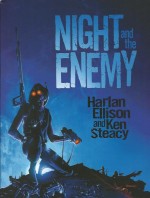
Night and the Enemy


By Harlan Ellison & Ken Steacy (Dover Comics & Graphic Novels)
ISBN: 978-0-486-79961-2

Win’s Christmas Gift Recommendation: Stunning Sci Fi Blockbuster Brilliance… 9/10

Harlan Ellison’s dark and chilling space war tales are always eminently readable.

This gloriously impressive re-issued volume gathers five of the best and most celebrated – all taken from the long-running but intermittent sequence of novellas and short-stories detailing Mankind’s extended intergalactic struggle against a race of star-spanning rivals – adapted in a variety of visual formats by air-brush wizard and aviation-addict Ken Steacy, together with a new prose framing-sequence from the author.

Humanity’s literary battle against the Kyben spanned ten generations and involved all manner of technologies up to and including time-travel. Probably the most famous of them is the award-winning Demon with a Glass Hand, adapted as both an episode of The Outer Limits TV show in 1964 and as one of the very best of the long-gone and much-lamented DC Graphic Novel series, but that’s a graphic extravaganza we’ve already covered elsewhere…

Right here, right now, this classy full-colour album-sized paperback resurrects a glorious artefact first released by Comico and Graphitti Designs in 1987, just as the market for English-language graphic novels was taking off, and piles on the goodies by adding a brace of fabulously informative and keenly reminiscent Introductions: ‘In these Pages, the War Still Wages’ from author Ellison and ‘…As We Go Forward, Into the Past!’ by astoundingly multi-talented adaptor Ken Steacy.

Closing down the show there’s more goodies: an eye-popping glimpse at Steacy’s visual virtuosity in the feature ‘Afterwords & Pictures’ revealing unpublished art, roughs, layouts and finished covers as well as working models and more, plus the original Afterwords ‘War Artist’ and ‘Whispers from the Telling Box’ by Steacy and Ellison respectively from the 1987 edition.

Following a specially created ‘Prologue’ by E & S, the pictorial panoply shifts seamlessly into the earliest tales in the epic conflict, beginning with the apocalyptic ‘Run for the Stars’, a traditional panels and balloons strip describing life and its imminent end on Deald’s World after the hordes of Kyba drop in, followed by ‘Life Hutch’, a grim survival tale combining blocks of text with large images in both lavish colour and stark monochrome highlighting a soldier-survivor’s battle against a malfunctioning robot…

‘The Untouchable Adolescents’ is a bright and breezy art job disguising a tragic and powerful parable of good intentions gone awry, whilst sardonic two-pager ‘Trojan Hearse’ rates just one powerful, lonely illustration for its cunning tale of invasion. ‘Sleeping Dogs’ is a moody epic which fittingly concludes the adaptations with the story of a force of liberating Earth men who trample all over a few aliens in their rush to defeat the Kyben and realise too late they’ve poked the wrong bear…

However fans will be delighted to find this volume also carries an original entry in the annals of the Earth-Kyba conflict with the prose and picture ‘The Few… The Proud’: at the time of this collection’s original release, Ellison’s first new story for the series in fifteen years…

This epic tome was a groundbreaking landmark and the time of its original release and remains an innovative and compelling treat for both old and new fans of the writer, lovers of seductively unconventional graphic narrative and of course comic readers in general.
Written by Harlan Ellison®. © 1987, 2015 The Kilimanjaro Corporation. All Rights Reserved. New material by Harlan Ellison®. © 2015 The Kilimanjaro Corporation. All Rights Reserved. Cover and illustrations © 1987, 2015 Ken Steacy. All Rights Reserved.

Night and the Enemy is available in comic shops and online around the world right now and can be pre-ordered online for a December 25th release in the UK.

21st Century Tank Girl


By Alan Martin, Jamie Hewlett, Philip Bond, Brett Parson, Jim Mahfood, Warwick Johnson-Cadwell, Jonathan Edwards, Craig Knowles & various (Titan Comics)
ISBN: 978-1-78276-661-2

Win’s Christmas Gift Recommendation: Furiously Foul-Mouthed Frolicsome Fun ‘n’ Games… 8/10

Back in the wild and wacky 1980s there was a frantic buzz of feverish creativity in the British comics scene wherein any young upstart could hit the big time.

Possibly the most upstarty of all were art students Jamie Hewlett and Alan Martin (and, associatively, Philip Bond) who prowled the local convention circuit impressing the hell out of everybody with their photocopied fanzine Atomtan. At the back of issue #1 was a pin-up/ad for a dubiously feisty looking young lady with a big, Big, BIG gun and her own armoured transport. And now it’s a whole ‘nother century…

Commissioned by Brett Ewins and Steve Dillon for Deadline, a pop-culture magazine with loads of cool strips, the absurdist tales of a rambunctious, well-armed hottie roaming the wilds of a futuristic Australia with her kangaroo boy-friend Booga caught the imagination of a large portion of the public. There was even a movie…

After many years indolently dallying with a sordid plethora of different publishers, the salty, soldierly slapper found her way to Titan Comics who comprehensively remastered her old adventures and now proudly publish her subsequent outbursts of appealingly appalling new material of a mature and deliberatively offensive nature…

Never particularly enamoured of the concept of internal logic, chronological order, narrative consistency, linguistic restraint or spelling (so if you’re pedantic, be warned!), this latest compote of outrageous and hilarious cartoon phantasmagoria revels in the usual glorious mud-bath of social iconoclasm, in-yer-face absurdity, accumulated decades of British Cultural Sampling and the ever-popular addictive sex ‘n’ violence, but also holds a few shocking surprises, not least of which is the return of originating co-creator Jamie (Gorillaz) Hewlett after twenty years AWOL…

Collecting the 3-issue miniseries from the summer of 2015, this impressively oversized (305 x 216 mm) full-colour hardback album features strips, gag-pages, prose pieces, illustrated poems and loads of pin-ups/covers to astound the multitudes, and opens with a typically inviting Introduction from scripter Alan Martin after which, reunited with fellow instigating wild boy Hewlett, he reveals ‘Space is Ace’ as Tank Girl and Booga, with bosom pals Barney and Jet Girl, perversely invade a strangely erotic asteroid in search of some legendary Udagawa crystals with a most predictable and outrageous outcome…

Following a spoof ‘Drag Tank’ model-kit ad from Brett Parson and poetic aside ‘Your Mission’, the cartoon capers continue in kitsch-drenched nostalgia fest ‘Nanango ’71’ (again pictured by Parson) wherein our cuddly kanga-boy is offered a vast amount of cash to carefully drive a pristine and cherry vintage muscle car across the desert to its frothing new owner.

He really shouldn’t have invited those capricious calamity magnets Tank Girl and Jet Girl along for the ride…

Salutary warning ‘You’re Young Now but Won’t Be for Long’ (art by Jim Mahfood & colourist Justin Stewart) and gag menu ‘Itsnofuckingjoke’ segues neatly into the ever-so-informative ‘Tank Girl War Library: Tank Girl Tactics and Booga Manoeuvres’ and a selection of poster poems/info pages entitled ‘Who Are Tank Girl?’: individually shining a spotlight on Booga, Barney, Jet Girl and Tank Girl, and all illustrated by Warwick Johnson-Cadwell – plus a pin-up of the team on the beach – before Parson’s second issue cover of the girls sharing a shower leads inexorably into poster-poem ‘How Brilliant Are We?’ (Craig Knowles) before Martin, Mahfood & Stewart expose ‘Valleri’.

The undercover cop infiltrating the gang so they can be slaughtered by gun-crazy policemen has an undisclosed past with Tank Girl that nobody knows of and which might just be the advantage needed to help the lovable outlaws swipe the priceless relic God’s Underpants…

‘Colour Me Tank Girl’ offers a little crayon-based relaxation featuring the team’s rampantly rude spaceship after which the Johnson-Cadwell illustrated prose vignette ‘Giraffe’ leads to a wealth of uncanny poetic picto-memories from ‘Tank Girl’s Sundrenched Martian Superholiday’ (Jonathan Edwards), another Johnson-Cadwell pin-up and a hilarious set of stick-on life options courtesy of Tank Girl Inc.‘s ‘Obtuse Ideologies’…

Martin & Parson’s short, sharp comicstrip history of ‘Booga Flakes’ gives way to Johnson-Cadwell’s shocking, silent war epic ‘Tank Girl in Easy’ and a tender loving moment by Parson, highlighting the unique relationship of TG and Booga…

The lovers then explore ‘The Ghost Smell from the Ground’ (Knowles): turning back progress to eradicate a vile super-Shopping Mall and restoring a quaint corner shop before Mahfood limns TG’s mantra to live by and Parson illuminates the tenets of ‘The Church of Booga’. Edwards then returns to delineate our stars’ bitter battles and obscure, surreal search for truth and reliable ammo in ‘Journey to the Centre of the Tank’ – a trip which exposes the harsh potency of 1970s British comedy icons…

A studly kangaroo-cake pin-up of Booga by Philip Bond leads into a prose origin of sorts as we obliquely discover ‘The Name of Tank Girl’; the shock of which is neatly offset by a pack of Parson-produced ’21st Century Bumper Stickers’ and captivating poster for ’21st Century Tank Girl: The Movie’ before diverting back to strip-mode to illustrate Martin’s raucously satirical spoof ‘The Runny Man’ and a brief dose of futurist philosophy, before one last loving pin-up precedes his climactic comics conclusion as ‘Viva Tank Girl’ reveals why Evel Knievel never used tanks when jumping over a row of parked vehicles…

Wildly absurdist, intoxicatingly adorable and packed to the gills with outlandish pictorial pleasures, 21st Century Tank Girl is an ever-so-cool rollercoaster-ride and lifestyle touchstone for life’s incurable rebels and undying Rude Britannians, so if you’ve never seen the anarchic, surreal and culturally soused peculiarity that is Tank Girl, bastard love child of 2000AD and Love and Rockets, you’ve missed a truly unique experience… and remember, she doesn’t care if you like her, just so long as you keep looking.
Tank Girl and all related characters are ™ & © 2014 Jamie Hewlett and Alan Martin. All rights reserved.

21st Century Tank Girl is in comic shops now and can be pre-ordered for a December 1st online release.

The Puma Blues: The Complete Saga in One Volume


By Stephen Murphy & Michael Zulli with Alan Moore and an Introduction by Dave Sim and Afterword by Stephen R. Bissette (Dover Comics & Graphic Novels)
ISBN: 978-0-846-79813-4

Win’s Christmas Gift Recommendation: Epic, Enthralling, Exciting… 10/10

During the 1980s the American comics scene experienced an astounding proliferation of new titles and companies following the birth of the Direct Sales Market. With publishers now able to firm-sale straight to specialised, dedicated-retail outlets rather than overprint and accept returned copies from general magazine vendors, the industry was able to risk and support less generic titles whilst authors, artists and publishers could experiment without losing their shirts.

The huge outpouring of fresh material deriving from the Direct Sales revolution resulted in a plethora of innovative titles and creators – and let’s be honest – a host of appalling, derivative, knocked-off, banged-out trash too. Happily I’m the boss of me and I choose to focus on the great stuff…

The period was an immensely fertile time for English-language comics-creators. Comics shops – run by people in touch with their customers and who actually read and loved at least some of what they sold – sprang up everywhere and host of new publishers began to experiment with format, genre and content, whilst eager readers celebrated the happy coincidence that everybody seemed to have a bit of extra money to play with.

Consequently the new kids were soon aggressively competing for the attention and cash of punters who had grown resigned to getting their sequential art jollies from DC, Marvel, Archie and/or Harvey Comics. European, Japanese and even Canadian material began creeping in and by 1983 a host of young companies such as WaRP Graphics, Pacific, Eclipse, Capital, Now, Comico, Dark Horse, First, Renegade and many others had established themselves and were making impressive inroads.

Most importantly, by avoiding traditional family-focussed sales points like newsstands, more mature material could be produced: not just increasingly violent or sexually explicit but also far more political and intellectually challenging too.

Subsequently, the “kid’s stuff” stigma afflicting comics largely dissipated and America began catching up to the rest of the world, at least partially acknowledging that comics might be a for-real art-form.

New talent, established stars and different takes on old forms all found a thriving forum and marketplace desperate for something a little different. Even tiny companies and foreign outfits had a fair shot at the big time and a lot of great material came – and, almost universally, as quickly went – without getting the attention or success they warranted.

One of the most critically acclaimed and enthralling features was published by the Moses of Independent creators, Dave Sim.

Sim had begun self-publishing Cerebus the Aardvark in 1977 and pretty much trail-blazed the entire phenomenon for the rest of us. Passionately, stridently non-“mainstream”, he soldiered on in complete control of every aspect of his creation and periodically began publishing other titles by creators who impressed him or he simply liked. Eventually, however, Sim ditched a coterie of fine and uniquely different books that were nurtured by his Aardvark-Vanaheim outfit, leaving them with his ex-wife’s new company Renegade and re-concentrated all his efforts on Cerebus once more.

And then in 1985 a couple of casual acquaintances showed Sim the opening instalment of something called The Puma Blues…

The full story – including how that strangely compelling, so-slowly and dreamily unfolding eco-fable became a helpless hostage and collateral casualty in the one-man publishing house’s lengthy battle with an international distributor determined to dictate how creators did business – is related in painful, sordid detail in Sim’s Introduction for this stunningly impressive archival edition – complete with his equally stunning pin-up of the series’ iconic signature invention…

This monolithic monochrome tome gathers and reprints every published issue of The Puma Blues comic (except the non-canonical Benefit Issue #21 which was rushed out in solidarity by incensed fellow creators to generate publicity, support and funds) before finally, after almost 25 years, reuniting writer Stephen Murphy and Michael Zulli to complete their story…

The aforementioned hostage was an eerily beautiful disturbingly pensive oddment which debuted as a black-&white title in June 1986; marrying then-escalating ecological concerns and tropes of science fictive paranoia with scrupulous soul-searching and the eternal quest for place in both family and the world…

The Puma Blues is a tale more about the Why and How of things rather than the usual What of plot and character, so this overview will be brief and short on detail: trust me, you’ll be grateful for my forbearance when you start reading the magnum opus yourself…

Accepting the premise that all Science Fiction – whenever it’s created – is always about Right Here, Right Now, the abiding undercurrent of The Puma Blues is an inexorable slide to tragic, unfixable, unwanted change.

Since the 1970s and proceeding ever more unchecked into the 21st century, nations and human society have been plagued with horrors and disasters exacerbated – if not actually caused – by a world-wide proliferation of lying, greedy, venal, demented and just plain stupid bosses and governments. You could call it retro-futurism now, but tomorrow – as seen from 1986 – at least in terms of society was for many a foredoomed and hopeless place.

Looking at my TV screen or out of a window, I’m not sure that Murphy & Zulli weren’t fundamentally right and doubling as prophets when they set their gentle epic fourteen years into the future…

2000 AD and government agent Gavia Immer (look it up, they’re being very clever) is monitoring changes to flora and fauna in the wilderness Reserve around Quabbin Reservoir, Massachusetts on behalf of the US military.

Still a beautiful, idyllic landscape dominated by ancient apex predators such as mountain lions, despite the perpetual acid rains, ozone layer breaches and the radioactive toxins left after White Supremacists nuked the Bronx, the harsh area monitored by the solitary researcher is the site of some radical changes…

Gavia’s job is not just clerical. His mission is to periodically test the fluctuating PH levels of the lake in between the state’s continual chemical readjustments of the body of water and, whenever he discovers a mutant species – whether “animute” or “biomute” – he has to utilise state-of-the-art technology to instantaneously ship the specimens to a US-Sino laboratory/Reserve somewhere in China.

That hasn’t prevented the hauntingly lovely flying mantas from proliferating and dominating the skies above his head, however…

Gavia’s only contact with the rest of humanity is his TV screen. It delivers reports, interviews and pep talks from his superiors and allows him to talk to his mother. That gives the solitary agent plenty of time to brood about his father’s death and their unresolved issues.

The fanatical film-maker has been gone four years now but Gavia is still drowning in unresolved conflicts, which is probably what prompts his mum to forward tapes of all the strange documentaries he neglected his wife and son to make…

Is Gavia imagining it or is he actually gradually divining some inner cosmic revelation from his dad’s tapes and theories? Their examination of recent historical events draw solid links between the declining state of the world and a (frankly baffling and seemingly implausible) connection to patterns of UFO sightings.

Surely though, his father’s clearly growing obsession with the strange “alien” creatures popularly known as “Greys” must only have his metaphorical way of searching for incontestable Truth?

Nonetheless they slowly begin to have a similar effect on the thinking of the equally soul-searching son…

There’s certainly plenty of room for new answers: the growing dominance of the flying mantas is clearly no longer a secret – as Gavia learns to his regret – after an old soldier and radical “neo-Audubon” named Jack invades the Preserve looking for proof of the flying former fish. Despite himself Gavia lets the affable old coot stay; a decision he soon has cause to regret…

And as animals old and new jostle and tussle to find their niche in the new world order, Gavia sinks further into his father’s videotaped philosophies until he has his revelation and takes off into the heart of America to find out how and why things are falling apart…

Proffering an increasingly strong but never strident message of environmental duty and responsibility, The Puma Blues outlined its arguments and questions as a staggeringly beautiful and compelling mystery play which ran for 23 formal issues, a Benefit special designated “Eat or Be Eaten” and a tantalisingly half-sized #24 before the exigencies of publishing made it extinct.

Before it was squeezed out of existence the saga was collected as two trade paperbacks – Watch That Man and Sense of Doubt – but this monumental tome finally completes the story and then offers a passionate defence and valiant elegiac testimony in ‘Acts of Faith: a Coda’ by devoted follower and occasional contributor Stephen R. Bissette and even finds room to reprint two items from the aforementioned Benefit Issue: a page from ‘Pause’ by Murphy, Zulli & Bissette plus the eerily erotic ‘Acts of Faith’ by Alan Moore, Bissette & Zulli exploring the mating habits of those sky-borne Birostris (look that up too, now I’m being clever…)

The long-delayed walk on the wild side finally concludes with the quasi-theosophical ‘Mobile’: the full contents of Puma Blues #24½ mini-comic by Murphy & Zulli.

Haunting, chilling, beguiling and intensely imposing, this is a massive accomplishment and enduring triumph in comics narrative.
© 2015 Stephen Murphy & Michael Zulli. Introduction by Dave Sim © 2015 to be reciprocally owned by both Stephen Murphy & Michael Zulli. Afterword © 2015 by Stephen R. Bissette. All rights reserve.

The Puma Blues is available in comic shops and online around the world now. It can be pre-ordered online for a December 25th release in the UK.

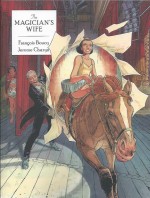
The Magician’s Wife


By Jerome Charyn & François Boucq, with Foreword by Drew Ford (Dover Comics & Graphic Novels)
ISBN: 978-0-486-80049-3

Although all comics evolved from products designed to appeal to a broad variety of age ranges, we have finally reached a stage in our culture where individual stories and collaborations always intended by their creators to appeal to older or intellectually select audiences are now commonplace and acceptable.

What that means in simple terms is that complex, controversial and challenging graphic narratives which have come and largely gone unheralded now have an ideal opportunity to reach the mass audiences they were intended for and who deserve them…

A sublime case-in-point is this astounding, groundbreaking and compellingly wonderful transatlantic collaboration originally released in 1986, and which shone brightly but briefly; winning immense critical acclaim and glittering prizes from the comics cognoscenti yet barely troubling the mass public consciousness within or outside our particular art form’s bubble. Now after nearly thirty years in fabled obscurity it gets another chance to become the universally lauded masterpiece it deserves to be…

La Femme du magicien by American crime author and graphic novelist Jerome Charyn (Johnny One-Eye, I Am Abraham, Citizen Sidel series, Bitter Bronx: Thirteen Stories) and French illustrator François Boucq (Bouncer, Sente, Bouche de diable, Billy Budd, KGB) won numerous awards at the Angoulême International Comics Festival and elsewhere and even enjoyed a rare English Language translation in 1988 before dropping out of comics consciousness. Now their breakthrough masterpiece is back, visually remastered and re-translated by Charyn himself.

Following a piquant personal reminiscence in the Foreword by Dover Editor Drew Ford and intimate insights from the author in ‘A Note to the American Reader’ the twice-told tale begins, draped in dangerous and disturbing overtones of magic realism and tracing a chillingly unique co-dependent relationship between a servant’s daughter and a mercurial, mother-oppressed young man who always wanted to make magic …

Events begin to unfold in Saratoga Springs in 1956 as a weary jockey stumbles into an eerie old house and befriends precocious little Rita, daughter of the cook/housekeeper. The florabundant old pile is redolent of suppressed hostility and perilously-pent tensions, with a macabre old harpy ruling the roost but also teems with strange sights and obscure illusions thanks to the creepy son of the house’s owner.

Edmund is a scary and charming teenager who knows lots of legerdemain and many tricks of the prestidigitator’s art…

Little Rita daily lives with a host of animals (real or imagined?) but is only truly disturbed by Edmund’s outrageous attentions. He says it’s the proper way for a magician to court his future bride…

Feeling distressingly like observers of grooming-in-action, we see the child is fascinated by his hot-and-cold attentions, making her shocking discovery of Edmund’s callous sexual dalliances with her blowsy, lumpen mother all the more hurtful…

Four years later they are in Moscow, having escaped the crushing atmosphere of the old house and the forbidding matriarch. Rita’s mum is Edmund’s Famulus Mrs Wednesday, a living prop and stage assistant enduring a barrage of humiliating transformations and subtly guided and controlled by Edmund’s harsh declarations of love as Rita wonderingly watches from the wings, gradually maturing into a beautiful young toy.

By 1962 she is the centre of attention in theatres all around the world and Edmund’s intentions have become blatant. The grand gesture comes in Paris where in an act of extraordinarily callous cruelty he demotes faithful, doting Mrs Wednesday to the role of Rita’s Dresser and makes the teenaged daughter his co-star and assistant – to the lustful appreciation of the huge theatre audiences who seem captivated by his remarkably imaginative but savagely mortifying conjuring act…

Edmund has been personally educating Rita for years, but something strange happens on stage in London in 1963 when his precious “Miss Wednesday”, in the middle of his signature shameful hypnosis game, suddenly transforms into a monstrous beast apparently beyond the magician’s control…

They married in Munich in 1967 but the wedding night was marred by Rita’s memories of what her husband used to so blatantly do with her mother. Moreover, the axis of power seems to have shifted and Rita is increasingly the one calling the shots…

The crisis comes later when Rita’s mother is found mysteriously dead and the daughter’s long-suppressed passions explode…

Some time afterward, Rita is a waitress in a New York City Diner just trying to forget. Sadly her looks make her a target for both scuzzy lowlifes and simple-minded, paternalistic protectors and only the fact that cops frequent the eatery keep her even marginally safe. Haunted by ghosts and memories, she pushes her luck one night crossing through a park and is attacked by her most persistent admirers. It’s only after she viciously fights them off that a disturbing apparition manifests…

She feels pursued from all sides – by her attackers keen on silencing her, a kindly war veteran who wants to keep her safe and a persistent if painfully familiar vision – and Rita’s life spirals out of control. When Edmund seemingly shows up, a savage monster starts slaughtering visitors to the park and peculiar French detective Inspector Verbone takes an interest in her, apparently possessing impossible secrets and arcane insights when he arrives at her ratty apartment.

When events spiral to a bloody and so very unjust conclusion, Rita flees, taking a bus to Saratoga where she finds some very familiar folk and a cataclysmic, elemental and hallucinatory climax waiting for her…

Bizarre, baroque, phantasmagorical and wickedly playful, this is a story that can’t really be deconstructed, only ridden like a maddened, stampeding horse and then pondered at leisure while your bruises heal. If you like your mysteries complex and inexplicable and your love stories dauntingly bleak and black, you really should make the acquaintance of The Magician’s Wife…
© 1987 Jerome Charyn and François Boucq. Introduction © 2015 Jerome Charyn. Foreword © 2015 Drew Ford. All rights reserved.

The Magician’s Wife will be released November 27th 2015 and is available for pre-order now. Check out www.doverpublications.com, your internet retailer or local comics-store or bookshop.

Two Brothers


By Milton Hatoum, adapted by Fábio Moon & Gabriel Bá (Dark Horse)
ISBN: 978-1-61655-856-7

Win’s Christmas Recommendation: A Stark and Stunning Masterpiece… 10/10

Twin brothers Gabriel Bá and Fábio Moon have been winning awards and garnering critical acclaim ever since they began self-publishing in their native Brazil in 1993. From that time on they have produced remarkable and compelling works for France, Italy, Spain and the USA, ranging from 5 to De:TALES to Casanova to The Umbrella Academy to Daytripper…

Now their masterful graphic collaborations have culminated in a powerful adaptation of iconoclastic contemporary author Milton Hatoum’s generational novel Dois Irmãos (translated as both The Brothers or, as here, Two Brothers)…

Omar and Yaqub were twins born of a classic romance which they quickly stifled and buried. Their affluent tradesman father Halim saw teenaged Zana in her father’s Lebanese restaurant in 1914 and moved Heaven and Earth to win her. And naturally love triumphed and prospered…

Their early days together were filled with passionate excess which the boys’ birth soon ended. It didn’t help that the mother became obsessed with her children, not just the boys but also adopted orphan Indian girl/indentured servant Domingas and, eventually, daughter Rânia. Halim saw them all as intruders, but Zana decreed she would have three children and always got what she wanted…

Primitive, provincial backwater Manaus missed most of the Second World War, but nonetheless Halim insisted on sending his sons to live with relatives in Lebanon. The boys were thirteen and, despite being identical, were completely different.

Yaqub was serious, diligent and honest whilst his younger brother – his mother’s cocksure, blatant favourite since birth – had grown into a spoiled, indolent brat prone to criminality and unreasoning violence.

Omar had even been forgiven for permanently scarring his brother with a broken bottle in a petty dispute over a girl at a family party…

When Halim decreed they would go to abroad for the duration, Zana overruled him and only “the good twin” was banished whilst Omar remained at his mother’s apron strings, growing ever more wild…

At War’s end Yaqub returned, an accomplished and polished young man of 18, a brilliant mathematician and engineer intensely aware that in that troubled house only Domingas and little Rânia were pleased to see him…

The family’s reunion swiftly devolved into animosity, hostility, separation and open warfare. With all the various paths to true tragedy slowly merging together, the Good Son permanently distanced himself from his family and Manaus, becoming a cold monster whilst his brother – forever cosseted and shielded by a mother’s uncompromising, unreasoning, fanatical love – became a maddened beast and hunted criminal…

Narrated by Domingas’ patiently observant son Nael – born either of love with Yaqub or assault by Omar – the chronicle of the rise of the city and fall of the family is a stunning saga of twisted love, familial neglect, self-deception and the sheer destructive power of jealousy. Adding to the distress and tension, the events are depicted in potent snatches of revelation carefully arranged in anachronistic sequences which slowly construct a torturous skeleton of personal catastrophe which proves that family is everything and blood means nothing…

Astonishingly realised in stark monochrome by a pair of visual arts prodigies at the top of their game, Two Brothers is possibly the most evocative and crucial piece of sequential art yet seen in the 21st century.
© 2015 Fábio Moon and Gabriel Bá. “Dois Irmãos” original text © 2000 Milton Hatoum. Adaptation and illustrations © 2015 Fábio Moon and Gabriel Bá.

Gag on This: the Scrofulous Cartoons of Charles Rodrigues


By Charles Rodrigues, edited by Bob Fingerman (Fantagraphics Books)
ISBN: 978-1-60699-856-4

Win’s Christmas Gift Recommendation: Sick, Sick, Sick – the ideal antidote to Seasonal Saccharine Overload… 9/10

Charles Rodrigues (1926-2004) is one of the most influential – and certainly most darkly hilarious – American cartoonists of the last century, but when papers and periodicals began abandoning en masse the grand tradition of spot gags in the 1980s he and his illustrious compatriots began to fade from cultural consciousness. Now it seems almost nobody remembers him but thankfully companies like Fantagraphics are doing their bit to recall and immortalise him and them…

Rodrigues’ surreal, absurd, insane, anarchic, socially disruptive and astoundingly memorable bad-taste gags and strips were delivered with electric vitality and galvanising ferocity in a number of magazines. He was most effective in Playboy, The National Lampoon (from the first issue) and Stereo Review – the pinnacle of a career which began after WWII and spanned nearly the entire last half of the 20th century in every type and style of magazine.

After leaving the Navy and relinquishing the idea of writing for a living, Rodrigues used his slice of the G.I. Bill provision to attend New York’s Cartoonists and Illustrator’s School (now the School of Visual Arts) and in 1950 began schlepping gags around the low-rent but healthily ubiquitous “Men’s Magazine” circuit.

He gradually graduated from girly-mags to more salubrious publications and in 1954 began a lengthy association with Hugh Hefner in his revolutionary new venture, whilst maintaining his contributions to what seemed like every publication in the nation buying panel gags: Esquire to TV Guide, Genesis to The Critic.

He even found time to create three strips for the Chicago Tribune-New York News Syndicate – Eggs Benedict, Casey the Cop and Charlie.

The quiet, genteel, devout Catholic’s lasting monument and undisputed magnum opus, though, was the horde of truly appalling sick, subversive, offensive and mordantly, trenchantly wonderful one-offs he crafted on a variety of favourite themes for The National Lampoon, whose editor Henry Beard sought him out in the earliest pre-launch days of 1969, and offered Rodrigues carte blanche, complete creative freedom and a regular full-page spot.

He stayed aboard from the 1970 debut until 1993, a mainstay of the legendary comics section with sickeningly brilliant results which were recently compiled preceding edition Ray and Joe…

Here bracketed by a copious and informative biography by Editor Bob Fingerman and a heartfelt ‘Introduction’ by brother-doodler and sometime Cartoon Editor at the shockingly indulgent Lampoon Sam Gross, this monumental monochrome collection – presented as a sturdy hardback digest tome – features a staggering selection of explosively hilarious, wittily twisted visual broadsides gathered into a smart procession of tawdry topics…

After starting out lambasting our most basic drives in ‘Dirty Cartoons for Your Entertainment’ and ‘A Peeping Tome’, focus soon shifts to weird fantasy in ‘Moon Madness’ and contemporary traumatic tropes in ‘Assassin’ before going too far, too soon with some ‘Cartoons Even We Wouldn’t Dare Print’…

Because one can never get enough, it’s quickly back to basics with ‘Cartoons of a Sexual Nature’ after which other appetites are quashed with ‘Cuisine de Machine’ exposing the horrors only automats and vending machines can inculcate whilst ‘Would You Want Your Daughter to Marry One?’ deals with freaks and outcasts at their most intimate moments of weakness…

Some truly outrageous innovations are launched and sunk in a large section devoted to ‘Entrepreneurs’ before controversy is courted – and subsequently walks off with a huge settlement – in ‘Goddam Faggots!’ after which more societal hypocrisies are skewered in ‘Handicapped Sports’ and things get good and bloody in ‘Hemophunnies’.

Rodrigues was blessed (or cursed) with a perpetually percolating imagination and eye for the zeitgeist, so the contents of ‘The Celebrity Memorabilia Gallery’ are truly baroque and punishingly peculiar whereas ‘Hire the Handicapped’ merely offers genuinely groundbreaking solutions to getting the less-able back to work before this selection of Good Works concludes with much needed advice on ‘Good Ways to Kill: A Rock Performer!’

Trenchant observation informs the visual catalogue of ‘Man in Morgue’ but it’s just sheer bad taste in play with follow-up chapter ‘Man in Toilet’ and macabre relationship counselling for ‘Men’s Liberation’ (in dealing with wives or mothers).

At the halfway stage of this colossal collection there’s time for ‘More Handicapped Sports’ before poking fun at the blind in ‘Out of Sight’, exploring the particular wrinkles of ‘Senior Sex’ and dutifully re-examining ‘The Seven Deadly & Other Sins’ – which you will recall include Pride, Envy, Anger, Covetousness, Lust, Sloth, Gluttony, Anti-Colostomyism, Conformity, Vomitry, Bitchiness and Dalmatianry – and then galloping off at a strangely artistic tangent to present ‘Sex Cartoons Drawn With a Hunt Pen’…

Scenes (never) overheard at the ‘Sex Change Clinic’ naturally segue into an itemised itinerary of disasters involving ‘Sex Robots’ and naturally culminate in ‘More Cartoons Even We Wouldn’t Dare Print’ and another period of play for ‘Handicapped Sports’…

All aspects of human misbehaviour appealed to Rodrigues’ imagination and many are featured in ‘Sexentrics’ and its playful sequels ‘Sexports’ and ‘Sleazy Sex Cartoons’, all of which quite naturally lead to ‘Life on Death Row’…

Unwholesome variety (and a penchant for conspiracies) is the spice of ‘A Group of Cartoons Requested by S. Gross’ before deviating eastwards to expose ‘Soviet Sex’ and heading back to jail to walk ‘The Last Smile’.

Shambling into the hilarious last lap we endure some ‘Tough Sex’, show ‘Cartoons About the Blind (The Kind They Wish They Could See)’ and get gritty in ‘Sons of the Beaches’ before heading to the ‘…Circus!’ and ending everything with ‘Those Darned Serial Killers!’…

These horrific and hilarious assaults on common decency celebrate and commemorate a lost hero of popular cartooning and consummate professional able to turn his drawing hand to anything to get the job done. This is another astoundingly funny gag-art grimoire brilliantly rendered by a master craftsman and one no connoisseur of black comedy will want to miss.
This edition © 2015 Fantagraphics Book. All strips and graphics by Charles Rodrigues © Lorraine Rodrigues. Introduction © 2015 Sam Gross. Biography © 2015 Bob Fingerman. All rights reserved. This edition © 2011 Fantagraphics Books.

The Complete Adventures of Cholly & Flytrap


By Arthur Suydam with John Workman, Chris Eliopoulos & Annie Parkhouse (Titan Comics)
ISBN: 978-1-78276-767-1

Win’s Christmas Recommendation: Merry, Manic Mayhem… 8/10

Arthur Suydam comes from an impressive American dynasty of acclaimed artists harking back to the birth of the nation, but whereas they excelled in gallery painting and architecture, their polymath descendant has divided his time, talents and energies between sequential art and music.

Probably best known (unless you’ve seen him playing with Bruce Springsteen) today as a creator of stunning Zombie art, Suydam’s other signature graphic enterprise has been the perilously peripatetic and gorily satirical burlesques of an inseparable duo of legendarily post-apocalyptic weirdoes dubbed Cholly & Flytrap.

As noted in this lavish hardcover complete collection, the illustrator, author, designer, screenwriter and composer/musician has, since the 1960s, peddled his anarchically humorous, offbeat confections in such disparate venues as Heavy Metal, National Lampoon, Penthouse Comix and Epic Illustrated (where many of these brutally madcap little graphic novellas first appeared – specifically issues #8, 10, 13, 14 and 34); comicbooks like Tarzan, Conan, Batman, House of Mystery, Walking Dead and Marvel Zombies plus movie spin-offs Aliens and Predator.

He has also produced covers for novels including Max Allan Collins and Mickey Spillane’s collaborative Dead Street and Game-box art for Touch the Dead. Periodically the always-busy Suydam returns to his own uniquely skewed creative projects such as Mudwogs and the mirthfully militaristic muck-ups of his bombastically bloody buddies, teasingly releasing another snippet every so often…

Lavishly grotesque, wickedly wry and surreptitiously subversive, Cholly & Flytrap is a bold blend of dryly witty pastiches combining elements of Moebius’ Arzach, the sci-fi tinged cultural iconoclasm of Vaughn Bode and a surreal anti-war temperament as pioneered by EC Comics which imbues the constant and blackly comic ultra-violence with a hauntingly tragic and educative undertone.

Long ago the space-barge Exodus II crashed on an uncharted world. After untold ages the survivors have bred but never prospered, locked as they are in the constant struggle for survival. It’s not that the planet is particularly inhospitable… it’s just that the denizens – indigenous and not – adore war-making and love killing. Gosh, it’s so very much like Earth…

In the early 1970s Cholly began life as a bat-riding warrior: an inspiration (and eventually poster advert) for the animated Heavy Metal movie, but it was mysteriously transformed into a hot chick on a pterodactyl after acceptance (this sort of inexplicable conceptual metamorphosis happens a lot in film-land), leaving Suydam with the rights to a cool-looking visual and a lot of ideas…

Time passed, Marvel started a creator-owned, rights-friendly fantasy periodical in response to the success of Heavy Metal and that reinvented bat-riding, goggles-wearing avatar of conflict started popping up. Of course, he had evolved slightly whilst the chiropteran had become a colossal, dauntingly naked, bald fat Chinese man. Cholly still rode him like a seasoned Ace, though…

Augmented by a wealth of original art studies, sketches and finished paintings, the ‘Introduction by Max Weinstein’ offers contemporary background, history and critical expression before the exigent exploits (gathered in the order of the 2004-5 repackaged reprints from Image Comics) begin with ‘Chapter 0’ (plotted by Peter Koch) as the restless wanderers haul up at their favourite restaurant for a feed. Impatience, hunger, foreign food cooked by scurrilous talking bugs and honking big guns never make for a sedate evening…

This yarn is neatly stitched together with a later tale (originally entitled ‘A Little Love, a Little Hate!’ from 1981); a frenetic chase/duel between a foul-mouthed, flying-jacketed war-hawk and his slug-like arch-enemy, which showed Cholly’s streetwise cunning in spectacular, over-the-top, take-no-prisoners fashion.

That neatly segues into extended saga ‘The Rites of Spring‘ where Suydam expanded his cast and extemporized on the concept of mortals as organic war machines in a Horatian paean of Thermopylan courage on a world where combat is the natural order.

With Cholly and faithful, mute Flytrap stubbornly holding back a veritable horde of slug-troopers and colossal war-wagons, this is a smart and lusciously graphic feast of visual violence and sassy back-chat…

‘Flightus Interuptus’ follows; an airborne tussle (possibly started before the previous tale?) wherein the high-flying Cholly, sans his humanoid steed, harasses a massive mammary zeppelin-bomber in nothing more than a primitive tri-plane pulled and supported by a brace of the planet’s autonomous, levitating anti-gravity breasts – and no, that’s not a misprint…

Shot down in the throes of victory, the adaptable aviator finds a giant bat to ride (remember kids, recycling even of ideas and art is good for any planet). Sadly the noble beast doesn’t last long before ‘The End’ sees the unseated aviator tooling around the sky with a pair of those flying hooters strapped to his appreciative feet until he encounters a monolithic monster having a furious argument with his own outrageously outspoken boy-bits. Passions aroused and tempers flaring, Cholly is witness to a conflict resolution you simply don’t see every day…

Soldier and human(ish) steed are reunited for ‘Chapter 6’ (with additional text by Bob Burden) as Cholly and a couple of fellow warriors battle slug-troopers to secure a downed freighter’s supplies and end up falling into the oddest sort of hell…

‘The Adventures of Cholly and Flytrap Part II’ commence with their explorations of the scarily Eden-like valley and its buxom, welcoming inhabitants. It’s almost a relief when the Devil pops up to deal with them, but happily Flytrap has a counter to his Final Solution…

The remainder of the comics extravaganza is dedicated to a vast and sprawling pseudo-noir pastiche entitled ‘Center City’, set in a brooding metropolis indistinguishable from 1930 New York or Chicago… except for the aliens, robots, mutants and monsters…

Vile, crippled gang-boss Emiel Luvitz runs the rackets and makes most of his money from the citizens’ gambling on his prize-fighting operation. It helps that he also owns the undisputed “Champ” – slow-witted, gigantic, super-strong Stanley Yablowski – who has never lost a bout or let an opponent live…

Cholly & Flytrap don’t care, they’re only in town long enough to scrape up some ammunition and get drunk, but when The Champ and his minders invade the dive they are patronising, things go south pretty quick.

The hulking bully wants some fun but when he forces the silent Chinaman into an arm-wrestling contest – and loses – all hell breaks loose…

Watching the brief but ferocious struggle is rival mobster and fight-promoter One-Lunger who instantly sees a way to topple Big Wheel Luvitz. Killing Cholly and shanghaiing Flytrap, the callous thug drags the protesting mute all over the world, training and building up the heartbroken yet still-resisting, silent giant into a successful, popular mystery contender who can possibly beat the Champ…

Center City soon becomes a Shakespearian nightmare as Luvitz, seeing foes all around him, begins a paranoia-fuelled campaign of terror, killing or alienating everyone around him even as One-Lunger and his over-the-hill robotic trainer Pop prepare their captive combatant for the grudge match that will settle the fate of the maddened municipality.

What nobody realises yet is that Cholly isn’t actually dead. Slowly stalking the unwary mobsters, he’s anticipating some extreme violence to get his beloved bosom buddy back…

Smart, devious and utterly compelling, this is a splendidly hilarious, wickedly gratuitous OTT tale to make Wagner or Brecht sit up and take notes…

Supplementing the graphic wonderment is a ‘Cover Gallery’, a vast portfolio of monochrome sketches, working drawings and finished paintings, a studious and multi-generational essay on ‘The Suydam Legacy in New York’ plus a photo-packed, celebrity stuffed ‘Biography’ of the dauntingly gifted Arthur…

This is a sumptuous, exuberant and entrancingly daft slab of eye-candy that will astound and delight all canny fantasists.
Cholly and Flytrap ™ & © Arthur Suydam 2015. All Rights Reserved. All other art and trademarks are the property of their individual rights holders.

An Android Awakes


By Mike French & Karl Brown (Elsewhen Press)
ISBN: 978-1-908168-63-4

It’s been a while since we looked at anything experimental so here’s an intriguing blend of illustrated book and graphic narrative which has a lot to recommend it.

In the world that’s coming, human beings are in decline and androids on the ascendant. Sadly our synthetic successors are prey to all the emotional foibles and insecurities we were. They’re very much like us except they can eat rivets and get really hammered on oil…

They especially have an overwhelming desire to experience fiction, even if the powers-that-be are as sleazy, quixotic, unpredictable, small-minded, corporate and blinkered as any meat-and-bone based publisher ever was…

Android Writer PD121928 is part of the Android Publishing Program. The state provides for his needs (drugs, whores, deep-frozen pets and the removal of his wife so that he can achieve the proper frame of artistic angst and squalor) and in return he conceives increasingly outré and wild adventure tales. It’s the same deal for every creative automaton in the system: Filmmakers, photographers, artists, whatever…

He hasn’t sold one yet which is becoming a bit of a problem since Android Writers are only allowed 42 submissions. If they can’t land a publishing contract before getting 42 rejection slips, they’re scrapped and another musing mechanoid gets his shot in the Program…

With the ignominious return of The Eating of Citizen Kane, PD121928 is down to his last 14 lives (a situation not unlike that of the succession of cats periodically thawed out to keep him company. It’s a shame they keep dying or going missing…) and the tension sends him into a paroxysm of creativity with us carried along on the surprisingly brief and exotic adventures of the pantheon of character-creations that have become so very real to the stressed creator…

Through the carefully crafted and impossibly interconnected stories of Finn, The Locust Wife, Abel Ford, Angel UK, Cai Lun, Richard Steinberger, The Great Explorer Umberto Amunsden, Commander Oleg, Aedus Cricklewood, JiéyÇ” The Detective and Mark, via recurrent motifs of mockingbirds and angel fish, the Android Writer pours out and repeatedly risks his life – even entering into unwise liaisons with a human prostitute on the Endangered List – as he struggles to survive and simultaneously wonders why he bothers…

Mike French’s beguiling, fantasy-vignette studded account of a creator-in-crisis is augmented by and combined with a wealth of raw and jarring monochrome illustrations from Karl Brown, but unlike most illustrated tomes these pictures are fully integrated into the text and often supplant the narrative entirely, detailing key moments of specific submissions such as ‘The Amazing Arctic Sinking Man‘, ‘OAP Extraction’, ‘The Antiquity of Zero’, ‘The Great Sea in the Sky’, or ‘The Sacrament of Abel Ford’ with extended sections of mute sequential art just like the heydays of European sci fi comics or classic 2000AD.

And then it’s time for Submission 42 and the desperately spiralling writer has a really different idea…

Overtones of Barrington J. Bayley, Christopher Priest and especially Michael Moorcock (when he was writing Breakfast in the Ruins) give this portmanteau of tales within tales a splendidly refined and timeless feel as a litany of cool ideas and stand-out characters weep out in the truncated (1000 words per…) yet expansively polished format of tomorrow’s word-counted entertainments…

Smart, challenging and well worth any jaded fantasist’s rapt attention.
Text © Mike French 2015. Artwork © Karl Brown 2015. All rights reserved.
An Android Awakes is also available as an eBook (ISBN: 978-1-908168-73-3)

Sven Hassel’s Wheels of Terror: the Graphic Novel


By Sven Hassel, illustrated by Jordy Diago (Weidenfeld & Nicolson)
ISBN: 978-1-60699-878-6

Although his true history remains controversial and hotly contested in his home country, Børge Willy Redsted Pedersen AKA Sven Hazel AKA Sven Hassel is indisputably one of the most influential authors of the late 20th century. The fourteen novels bearing his nom de guerre/plume, based on his war-time experiences as a decorated soldier in the German army (and latterly as a POW), have sold 53 million copies worldwide, published in more than 50 countries, and a fair few of those were to readers who went on to create many of the last forty-five years’ worth of great war comics.

He was born in 1917 and, after turbulent times in the post-war years following his return to his fatherland, left forever his native Denmark in 1964 for Barcelona. He stayed put and peacefully passed away in there in 2012. Now, with his canon once more lined up for screen adaptations, his stories have finally begun the transition to the genre he so particularly inspired: graphic novels.

Published in 1953, Legion of the Damned was a colossal hit, delineating his entire time in the Army of the Reich, including prompt desertion, recapture, confinement and sentencing to a Penal Battalion on the Eastern Front.

The remaining thirteen books are elaborations of that book and period, offering greater depth and many more unforgettable moments of horror and camaraderie, which is presumably why these adaptations – by son Michael and granddaughter Mireia, illustrated with subdued yet expressionistic verve by Spanish artist and photographer Jordy Diago (Fix und Foxi, El Cuervo, the Disney Company) – begin with the second novel.

Wheels of Terror was first released in 1958 and is regarded by many as the ultimate anti-war novel; each chapter a gut wrenching, thought-provoking, seemingly pointless exploit in a never-ending succession of brushes with near-death, human brutality and the appalling consequences of total war as experienced by the diffident narrator and his comrades. Those include charismatic thief Joseph Porta, hulking Tiny, former Foreign Legionnaire Alfred Kalb, elderly Troop Sergeant “The Old ‘Un”, somehow still-religious Möller, aging Bauer, big, steadfast Pluto and the rest…

This oversized (296 x 208 mm) full-colour paperback opens with no preamble or fanfare with ‘Nox Diaboli’ as the old lags are driven into Hamburg during an Allied firebombing raid and used as a clean-up crew during the still on-going devastation. The worst part was probably the children’s home…

‘Furioso’ then pauses to introduce the cast as they return to the Eastern Front, but still lumbered with shifting corpses, “aided” by Russian POWs with whom they have far more in common than any German officer. ‘A Shot in the Night’ then describes an uneventful night in the barracks at the Sennelager Training Grounds involving a near-fatal confrontation with a martinet Sergeant-Major who has no time for convicts and unconventional Commandant Colonel Von Weisshagen. As usual, Porta’s nervy, anarchic impromptu antics turn potential catastrophe into a war-story worth retelling many times over…

Penal battalions get all the choice jobs and ‘State Murder’ describes what happens when the squad are ordered to execute prisoners – even young women – after which ‘Porta as Pope’ finds the still-distraught men gathered to drink and play cards whilst the indefatigable fixer regales his chums with the time he accidentally became padre to the barbarous counterattacking “Ivans” before Sven sneaks away to enjoy an unlikely ‘Love Scene’ with a woman living in the bombed-out ruins…

The account kicks into grim high gear with ‘Return to the Eastern Front’ as the dirty business of trench-fighting resumes in earnest, punctuated with moments of inactivity spiced up by Porta’s ribald stories and songs, but soon the gregarious scene-stealer is risking his life with our narrator at a forward listening post mere metres from the Russians where he learns that ‘At 11.30 AM the Germans Will be Blown Sky High’.

The subsequent devastating clash between advancing Ivans and a doughty crew of German flamethrower operators is appalling to witness and the pointless action soon leads to ‘Close Combat in Tanks’ with the reprobates stuck inside a malfunctioning Tiger, narrowly avoiding being butchered by the advancing enemy before having to fight for their lives in freezing close quarters at apocalyptic atrocity-site ‘Cherkassy’…

A relative moment of calm only gives the squad time to brood and indulge in torture masquerading as interrogation before ‘The Sneaking Death’ sees another firefight erupt, killing a third of the company…

In the bright day of a forest reconnaissance, loquacious Porta describes his favourite meal of ‘Mashed Potatoes with Diced Pork’ to the ones who made it, leading to a shockingly bloodless and almost comic confrontation with a Russki patrol before ‘The Partisan’ sees the scruffy survivors trying to help a girl rescue her already-arrested father from execution. Nazi fanatic Julius Heide then learns to his cost that the scum hate him as much as he despises them…

When the quartermaster asks the starving troops in all seriousness ‘What Do You Want to Eat?’ following an upcoming attack, the wary warriors realise the hell they’re about to enter, resulting in the loss of yet another cast regular, after which a frenzied retreat in tanks is interrupted by more murderous Soviets and a crazy interlude wherein Kalb risks everything to help a Russian woman in the final stages of ‘Childbirth’…

This story doesn’t end; the reader just finds a place to stop watching and that occurs here with ‘Long Live Death’ as the ravaged survivors hide in a trench with Ivans inexorably advancing. The grim moments pass as the convict soldiers observe how proper German officers die before finding two Soviet women soldiers who would rather stay with them than be returned to their male Russian comrades. And then the shooting starts again and your narrator is hit. Fade to black…

Grim, bleak, blackly funny and still ferociously forceful, this pictorial interpretation is a splendid first outing from all involved, deftly negotiating the minefield of how to keep the necessarily horrendous visual aspect from overpowering the events. Purists who love the prose novels might, however, feel cheated that some of the more racy (by today’s standards that might as well read as sexually exploitative) content has been toned down or expurgated, but all in all this is a book to satisfy old fans and make a legion of new ones.
© MHAbooks aps 2015. All rights reserved.