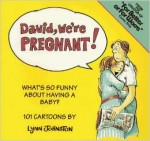
David, we’re PREGNANT!


By Lynn Johnston (Meadowbrook Press)
ISBN: 978-0-67176-018-2

I suspect the world’s about to go into Celeb-Baby Meltdown again so here’s how I shamelessly cash in, since we can’t send nippers up chimneys or down mines anymore…

As Shakespeare would have it “the world must be peopled”, but if we must there’s always room for a little sensible advice and preparation, so here’s an old cartoon book to provide a few laughs along with all the useful tips and calming, shared experiences.

Of course it’s all actually just another excuse for me to bemoan the loss of those once-ubiquitous cheap ‘n’ cheerful gag-packed paperbacks which are now all-but-forgotten fossils of a once mighty industry; pushed to extinction by the more palatable-sounding graphic novels and trade paperback collections.

Lynn Johnston (née Ridgway) is a national treasure of Canada where her cartooning and narrative talents first came to the fore. Born in 1947 in Collingwood, she was raised in North Vancouver, attending Vancouver School of Art before beginning her career as an animator.

In 1969 she married and was working as a medical artist at McMaster University when this project began in most unlikely circumstances. As described by Dr. Murray W. Enkin in his Introduction to David, we’re Pregnant!, whilst he was attending her in the early days of her first pregnancy, she was staring up – as you apparently do – at his blank ceiling and offered to draw some cartoons to comfort and entertain her fellow mums-to-be during such necessary but rather discommoding and undignified moments.

The result was a huge success in his surgery and was transferred in 1973 to a petite cartoon book which became a huge global sensation. It spawned two sequels (Hi Mom! Hi Dad! and Do They Ever Grow Up?) and led in 1978 to her being invited by the mighty Universal Press Syndicate to create a family comic strip.

Enticed by a twenty year contract, she began the still-running For Better or For Worse, based on her own family and soon fame, through massive syndication, best-selling books, and popular TV and movies soon came knocking…

She is one of the most gifted and celebrated cartoonists in the business, with awards including a Reuben from the National Cartoonists Society, Pulitzer nominations, a Gemini Award and a basketful of Honorary Degrees and Doctorates. Johnston holds both The Order of Canada and membership in The Order of Manitoba. She has her own star on Canada’s Walk of Fame and was elected in 2008 to The National Cartoon Museum Hall of Fame.

David, we’re Pregnant! is a solid example of a lost art form: mature-themed gag-collections which were the last commercial gasp in a tradition of pictorial entertainments that began with Punch and evolved into a publishing standby of British and American life for nearly a century before fading away to loiter around bargain bins, jumble sales and junk shops…

As much social satire as self-help, this deliciously addictive art-party traces the vicissitudes of trying to get pregnant, the idiocies of first-time-fathers, “helpful” family members who’ve been there, doctors in all their glory and the shock of realising you’re going to be PARENTS…

Also raising alarm and smiles are panels on the then-revolutionary Lamaze classes, the reactions of older kids to a new sibling, pregnancy clothes, finances, food crazes, quitting smoking and the horrors of getting fat…

Through morning sickness, name selection, waiting for the first kick, expectant mothers-in-law and partners who think they’re funny to delivery and those early times of loud noises, bad smells and no sleep, this splendid tome keeps the entertainment quotient at maximum whilst delivering a bunch of trenchant and even useful home truths…

Cartooning has been magnificently served over the centuries by masters of form, line, wash and most importantly smart ideas, repeatedly poking our funny bones, pricking our pomposities, stroking our happy places and feeding our fascinations. This sort of thing used to be bread ‘n’ butter in our game, so why not find a shy, alluring little bookshelf and start filling it with marvellous evergreen material like this…

David, we’re Pregnant! is a superb example of a major artist in fiendishly clever and beguiling form, generating warmth and fun with easy charm and utter aplomb. If you find this book (or indeed any cartoon compilation) give it a try. They’re a dying breed and you really will miss them once they’re gone…
© 1975 Potlatch Publications. All rights reserved.

The Eldritch Kid: Whisky & Hate


By Christian Read & Michael Maier (Gestalt Publishing)
ISBN: 978-0-980782-35-6

There was a time, not so very long ago, when all of popular fiction was bloated and engorged with tales of Cowboys and Indians.

As always happens with such periodic populist phenomena – such as the Swinging Sixties’ Super-Spy Boom or the recent Vampire Boyfriend trend – there was a goodly amount of momentary merit, lots of utter dross and a few spectacular gems.

Most importantly, once such surges have petered out there’s also always a small cadre of frustrated devotees who mourn its passing and, on growing up, resolve to do something to venerate or even revive their lost and faded favourite fad…

After World War II the American family entertainment market – for which read comics, radio and the rapidly burgeoning television industry – became comprehensively enamoured of the clear-cut, simplistic sensibilities and easy, escapist solutions offered by Tales of the Old West; at that time already a firmly established standby of paperback publishing, movie serials and low-budget feature films.

I’ve often ruminated on how and why simultaneously, the dark, bleakly nigh-nihilistic and left-leaning Film Noir genre quietly blossomed alongside that wholesome rip-snorting range-&-rodeo revolution, seemingly only for a cynical minority of entertainment intellectuals who somehow knew that the returned veterans still hadn’t found a Land Fit for Heroes… but perhaps that’s a thought for another time and a different review.

Even though comics had encompassed Western heroes from the get-go (there were cowboy strips in the premier issues of both Action Comics and Marvel Comics) the post-war boom years saw a vast outpouring of titles with new gun-toting heroes to replace the rapidly dwindling supply of costumed Mystery Men, and true to formula, most of these pioneers ranged from transiently mediocre to outright appalling.

Despite minor re-flowerings in the early 1970s and mid-1990s, Western strips have largely vanished from our funnybook pages: apparently unable to command enough mainstream support to survive the crushing competition of garish wonder-men and the furiously seductive future.

Europe and Britain also embraced the Sagebrush zeitgeist and produced some extremely impressive work, with France and Italy eventually making the genre emphatically their own by the end of the 1960s. They still make the best straight Western strips in the world for an avid audience still possessing a vast appetite for them…

Fantasy and Horror stories, on the other hand, have never really gone away and this superb entertaining entry from Australian graphic raconteurs Christian Read & Michael Maier superbly blends time honoured tropes of the wild west with sinister sorcerous sensibilities to create a bewitching alternate reality where dark bloody deeds are matched by dire demonic forces and the decent guys called upon to combat them have to dabble in the diabolical too…

Following the tantalising Introduction ‘Our shadow goes where we go’ from author K. J. Bishop, the full-colour mystic mayhem begins with the recollections of an Oxford-educated shaman detailing his life following his return to the land of his birth.

Spring 1877 and the great Indian Wars are over. Custer is dead but so is Crazy Horse. The Whites are greedily covering the entire country and an erudite, educated man with the wrong coloured skin is reduced to playing scout for a bunch of barely literate morons wagon-trekking across the plains to California. They need him but regard their supremely capable guide with suspicion, disdain and barely-disguised disgust…

One particular incident of second-guessing his decisions involves a detour around a stony butte that simply reeks of bad magic. Accusing him of leading them into an ambush and other dishonourable deeds, the lazy, work-shy Christians drive him to ignore his instincts and better judgement and reluctantly check out the pinnacle personally…

Wicasa Waken, outcast Shaman of the Oglala Lakota, Ten Shoes Dancing of the mighty Sioux and lately graduated Master of Arts and Literature, Oxford, England 1875, always knew devil magic when he smelled it but, since his teachers taught him to treasure human life, he remained faithful to their training and climbs a mountain into hell…

At the top he encounters five-headed snakes and zombies and a strange white man they were taking their time killing…

Losing their lands to the pale invaders has soured many of his people and allowed a growth of bad spirits and corrupted medicine like the long-fled Bloody Knife to control many points on the map, but the man these horrors are torturing jangle the shaman’s mystic senses in way nothing ever has before.

Piling in he begins killing monsters and the “victim”, once freed, eagerly joins in, his accursed guns making short work of the ravening Heyokas. Soon they are all dispatched and Ten Shoes Dancing – after exorcising and sanitising the spiritually defiled butte – realises he has made the rather prickly acquaintance of a modern Western Legend…

The settlers are ecstatic to have celebrated dime novel hero The Eldritch Kid join their party and, whilst still treating his rescuer like a barely housebroken monkey, fête the grim gunslinger like a messiah.

It’s hard for even the most enlightened man to watch a surly, taciturn, creepy freak basking in hero-worship, hot vittles and wanton female attention…

It’s not just this becoming-nation America that is awash with blood and wickedness. The entire world is swamped with boggles, spectres and worse, but since the War Between the States the Kid has achieved a certain notoriety for dealing harshly and permanently with all things supernatural and predatory.

Nevertheless he’s a mean, mercenary bastard and a tough man to like for the philosophically inclined, poetry-loving Ten Shoes until the wagons arrive at a thriving prairie town that the shaman knows wasn’t there a month previously.

Opting to investigate the bustling hamlet together, the mismatched heroes are soon fighting for their lives against an army of hungry ghosts and the Lakota learns that although his personal patron god Lord Hnaska is grossly offended by the crawling things that hunger for human morsels, he is more worried by the cold, dark deity who sponsors his avatar’s gun-toting partner in peril…

A loveless alliance is forged in that ghastly spirit-trap and, as the wagon train proceeds towards California, the kid finally opens up enough to share the history that made him the most feared gunhawk in the West.

The story began in 1865 at Camp Elmira, New Jersey where Confederate prisoners were held. The detention centre was a hellhole even by human standards, but when a ravenous demon began taking the inmates, one of the terrified, beaten sitting duck captives was offered a deal by an invading ancient northern god…

This grim King of Death was unhappy with the beasts and night things increasingly infesting the Earth and offered a trade: power for service…

After a suitably painful and gory “offering” the prisoner was given just enough of a supernatural advantage to kill the monsters – human and otherwise – and escape. He has been doing his Lord’s work ever since…

At trail’s end the settlers naturally bilk the generally good-natured Ten Shoes who chalks it up to experience. However his new associate still has many secrets unshared and exacts his own brand of instant karma.

…And thus is born another legend of the Wildest West Ever…

Bleak, moody, spectacularly action-packed and cathartic, Whisky & Hate is a smart, blackly funny yarn that will astound lovers of genre fiction and witty mash-ups.

The Western tale has long been a part of world culture and perhaps that fact has relegated the genre in too many minds to the status of a passé fascination of a bygone generation. However this fresh, hypnotically beguiling look at an overexposed idiom prove there’s still meat to found on those old bones, and cow-punching aficionados, fear-fans, lovers of nostalgia-tainted comics and seekers of the wild and new alike can all be assured that this range-riding rollercoaster of thrills and macabre mystery proves that excitement and terror still lurk in those hills and on that horizon…

Black hats, white hats, alternate worlds, haunts and horrors, stunning visuals and macabre twists – what more could you possibly ask for?
© 2011 Christian Read, Michael Maier & Gestalt Publishing Pty Ltd. All rights reserved.

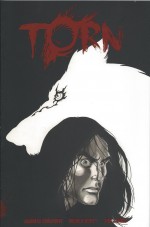
Torn


By Andrew Constant, Nicola Scott & Joh James (Gestalt Publishing)
ISBN: 978-0-9807823-7-0

If you think you’ve seen everything in werewolf comics think again. A wealth of graphic novels from Australian creative powerhouse Gestalt Publishing have just begun hitting our stores and one of the most intriguing features is a gripping, hyper-expressive take on the curse of lycanthropy that will delight fear aficionados.

Written by Andrew Constant (a man who’s worn many occupational hats in his life before settling on comics) ,Torn traces the hellish journey of a devoted father and provider whose cosy life is shattered when his family is slaughtered by a kill-crazy maniac.

As seen in the stunning prologue sequence by Nicola Scott (Wonder Woman, Birds of Prey, Secret Six), the enraged parent takes bloody vengeance on the murderer, but in the struggle becomes infected with his curse.

The maniac was a man, and the wolf who kills him is soon transformed into one of the crazy, bipedal horrors too. Confused, mute and experiencing reality in a way he can’t process, the new creature instinctively heads for the city…

Joh James (Borderlands: Origins, Mars Attacks!) takes over the stark monochrome illustration for the body of the tale as the bewildered outsider forages in alleys and dumps encountering homeless street girl Sarah who takes pity on the naked, inarticulate weirdo.

When she is attacked by a gang who has been periodically raping and abusing her, the stranger turns on her assailants like a rabid animal…

Later, hiding together in a deserted house, the pair form a cautious bond as he scavenges food for her and slowly learns to communicate. Unfortunately, the leader of the packrats has not forgotten Sarah or her protector though, and comes looking for her armed with a big shiny knife…

When the confrontation comes our hero is again triumphant, keeping the blade and allowing his opponents their lives.

However, the shaggy horror who has been patiently stalking him since the woods is not so lenient, and soon gun-happy cops are mistakenly hunting the wild man for an act of incredible butchery.

The follower too was also fantastically transformed by the death of the human in the woods. However, the rage, jealousy and sadistic hunger for inflicting pain is all its own. This relentless hunter has a blood relationship to the manwolf and wants nothing less than to destroy any happiness or form of family his former pack-mate could find on four legs or two…

Vicious, visceral and supremely affecting, this examination of human and animal savagery is a ferociously compelling tragedy that will leave comics and horror fans panting for more.
© 2011 Andrew Constant and Gestalt Publishing, Pty Ltd.

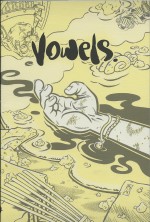
Vowels


By Skye Ogden (Gestalt Publishing)
ISBN: 978-0-9775628-1-7

I’ve long admitted my love for comics in black and white and frequently expressed my admiration for creators who can tell a tale in utter silence, without benefit of text, and when this lavish and splendid digest sized (212 x 144mm) paperback arrived in my Review copies mailbag, it immediately became my favourite example of the form.

Created by Australian cartoonist, designer and illustrator Skye Ogden, Vowels is a phenomenally engaging sequence of five linked fables which mesmerically examines aspects of the human condition, all played out in an oddly welcoming, if harsh, desert landscape that houses hulking cavemen and their suitably formidable women, adorable lizards, wide eyed aliens and, latterly, extremely unpleasant invading soldiery…

This is one of those books you’ll thank me for staying non-specific about, so I’ll only go so far as to say that ‘a’ is a broadly comedic chase vignette starring the aforementioned dawn people and the unlucky reptile, whilst ‘e’ introduces a diminutive alien wanderer to the happy, hirsute couple before following the unhappy voyager into a most peculiar afterlife and rebirth…

In ‘i’ the little guy’s distant relatives take the stage in a bustling marketplace for a dose of Romeo and Juliet frustration and tragedy before overwhelming, abiding loss is expressively characterised in ‘o’ after which the fascinating, universally accessible discussion on the nature of existence concludes with the brutal horrors of war, occupation and vengeance…

Depicted in a beguiling timelessly engaging cartoon style, deliciously reminiscent of the legendary Vaughn Bode and employing all the devastatingly expressive, pantomimic artifices of Charlie Chaplin, Vowels is a masterpiece of the cartoonist’s craft where life, death, love, hate, jealousy, obsession, protectiveness, greed, raw naked aggression and cruelty are pared down to the bone and graphically, forensically explored in a manner which only makes us hungry for more.

Deeply enticing, appealingly slick and intoxicatingly addictive, Vowels is an irresistible torrent of purely visual drama and which will delight all aficionados of the medium who value comics for their own sake, and don’t need a route map or score card to enjoy themselves.
© 2007 Skye Ogden. All rights reserved.

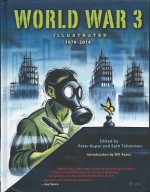
World War 3 Illustrated 1979-2014


By various, edited by Peter Kuper & Seth Tobocman (PM Press)
ISBN: 978-1-60486-958-3

Since the 1980s and proceeding ever more unchecked into the 21st century, nations and human society have been plagued with horrors and disasters exacerbated if not actually caused by a world-wide proliferation of lying, greedy, venal, demented and just plain stupid bosses and governments.

These paragons have finally succeeded in elevating politicians of every stripe to that phylum of generally useless tools and pimples on the butt of humanity once only occupied by ambulance-chasing lawyers, lifestyle coaches and management consultants.

Since then so many apparently entitled and greedy archetypes like bankers, astrologers, wedding planners, doorstep evangelists, CEOs, celebrity gossip columnists, newspaper editors, the shamelessly privileged and all types of psychics have joined their rarefied ranks, and I’m thinking I probably need to either grow my own provably unadulterated coffee or further refine my critical parameters…

The century before ours wasn’t much better, but it did spawn a global awareness of the sheer symbolic power of art to promote debate, action and change. Politically charged, culturally aware imagery has been used over and over again by the underdogs – and, to be honest, the more savvy oppressors – in countless intellectual clashes as irresistible Weapons of Mass Deliberation…

This is a book that should make you angry and inspired. That is its point and purpose…

Created in response to Ronald Reagan’s presidency – possibly the only thing non-Americans can be thankful to the mad, bible-thumping bastard for – World War 3 Illustrated was founded in 1979 by Pratt Institute art students Peter Kuper and Seth Tobocman in the wake of a rising tide of political conservatism, religious fundamentalism and unchecked capitalist autocracy

The magazine quickly became a beacon and rallying point for artistic activists: a collective collaboration galvanising and powerfully polemical, covering a vast procession of issues the political Powers-That-Be and increasingly law-immune Corporate Hegemonies would prefer were never aired or exposed.

Always championing the ever-diminishing rights of the individual over the juggernaut of rapacious commercial expansion and global monetary domination, the magazine brought – and still brings – together creative freedom-fighters who oppose the insidious wave of creeping everyday injustices through art, information and – most effectively of all – opposing views and dissenting opinions.

Now the smart, informed publishing people of PM Press have released a spectacular and sumptuous hardback retrospective of World War 3 Illustrated; re-presenting some of the graphic gadfly’s greatest moments in a stunning collection no self-aware seditionist could afford to miss at a time when individual freedoms and planetary wellbeing have never been more endangered…

One crucial word of clarification: the Third World War hasn’t been declared and has no recognised Theatre of Operations. It’s an ongoing series of perpetual localised skirmishes intended to replace individuality with homogeneity, freedom with conformity, humanity with faceless consumerism and intellect, spontaneity and self-esteem with a slavish devotion to money and oligarchic, board-sanctioned options from a menu of consumerist choices designed to keep the merchant-machine running…

Stuffed with spot-art and themed chapters fronted by double-page Chapter Icons from Kuper, Scott Cunningham, Sabrina Jones, Tobocman, Susan Willmarth, Kevin C. Pyle, Rebecca Migdal, Sandy Jimenez, Ethan Heitner, Nicole Schulman, Christopher Cardinale and Hilary Allison, this grand bible of creative resistance opens with the rousing and informative ‘Introduction: In Cahoots!’ by veteran activist, educator and reformer Bill Ayers before the parade of artistic action gets underway.

Starting World War 3 reveals the way it all began in the essay ‘Manifesto’, by Tobocman & Kuper, before the early forays are revisited in ‘Old Pals’ by Peter Bagge, whilst “Dr. Froydo Baggins” diagnoses the scatological power structure of modern society in ‘Top Feces’ by Isabella Bannerman & Robert Desmond, and Chuck Sperry’s terrifying collage ‘Bud’ is followed by Tobocman’sstate of disunion revelation in ‘The World is Being Ripped’. The chapter is closed by ‘Dove vs. Technology (back cover #8)’ by Aki Fujiyoshi.

Theocracy unbound is the subject of In God We Trust? opening with ‘Rapture’ – Kuper’s terrifying visualisation of an actual speech by Moral Majority founder Jerry Falwell – after which Erik Drooker moodily relates his ‘First Encounter’ with The Lord and Mike Diana explains how ‘Jesus is Suffering for You’…

Ryan Inzana describes his liberating escape from ‘One Nation Under Fear’ before ‘Pope Exposed (back cover #5)’ by David Shannon leads to the pantomimic revelation of ‘Jesus in Hell’ by James Romberger, and Isabelle Dervaux ends things on a blasphemous high note with ‘Walking on Water’.

The war on women is highlighted in Herstories, opening with Isabella Bannerman’s gripping ‘Herstories (cover #16)’ from 1992. This is followed by the evocative ‘Women’s Rights’ by Paula Hewitt Amram and the harrowing ‘Walking Down the Street’ by Sabrina Jones and a truly disturbing glimpse into the pressures on young girls to have sex in ‘K-9’s First Time’ by K-9 & Fly before Jones scores again with ‘Saudi Woman (back cover #14)’ to close the chapter.

Gentrification and the New York Elite’s attempts to forcibly relocate its poor by Fiscal Ethnic Cleansing are spotlighted in Captive City,beginning with the trenchant ‘Ave A’ by Anton Van Dalen and Tobocman’s ‘Why Are Apartments Expensive?’

Drooker then imaginatively shares some cold, harsh facts and statistics in ‘Shelter from the Storm’, whilst Steve Brodner plays Devil’s Advocate in ‘The Pound’ and Mac McGill interprets ‘Memories’ with apocalyptic panache.

Nicole Schulman then reveals why ‘You Can’t Go Home, Again?’ whilst Tobocman declares ‘War in the Neighorhood’ and Jeff Lewis wistfully bemoans how ‘I Was Raised on the Lower East Side’ to suspend the ongoing class war… until next time…

Autobiology focuses on differences of opinion such as the divisive nature of sneakers in ‘Skips’ by Sandy Jimenez, ineffectual relationships in Bannerman’s ‘No Visible Evidence’ and parenting in Scott Cunningham’s ‘Alien Metaphor’, after which Drooker relates a chilling anecdote in ‘The Fall’ and Kuper details how he was called as an expert witness in Mike Diana’s comics obscenity trial in the ‘Sunshine State’…

The misrule of Law comes under excoriating scrutiny in Under Arrest, opening with ‘Police State America’ by Tobocman, detailing how a black woman in New York was gunned down by a SWAT Team for incurring rent arrears, whilst Drooker’s ‘Coup d’Etat of the Spirit’ movingly recalls a friend who got on the wrong side of a police action…

‘Yard In!’, by Mumia Abu-Jamal & Gregory Benton, wryly pinpoints one of the many cruel insanities endured by Death Row inmates before Drooker’s ‘Prison Issue (cover #24)’ leads to Kevin C. Pyle’s revelatory expose of the mean-spirited “Diesel Therapy” used to break prisoners’ spirits ‘On the Road’. Benton then returns to offer a shred of comfort in ‘#AM-8335’.

Sperry opens the chilling Biohazard section with a bleak confrontation of ‘My Mother, My Mother’ before Pyle produces the most horrifying piece in this collection with his documentary detailing of the grotesque criminal acts of the United States Public Health Service which began a near-forty year long, generational study of syphilis by deliberately withholding antibiotic treatments from the African American community of Macon County, Alabama in the shocking tale entitled ‘Pink Medicine’…

Encroaching environmental catastrophe is the meat of Green House, Blue Planet, beginning with Tobocman’s captivating ‘What You Need to Know’, whilst Rebecca Migdal’s ‘The Food Chain (cover #41)’ precedes ‘Someday in the Future’ by Susan Willmarth, revealing how corporate misuse of the drug Diclofenac led to the near extinction of India’s vulture population and the almost complete destruction of the subcontinent’s food chain.

Drooker’s forbidding illustration ‘Moloch’, then leads to ‘Needle Factory’, a bleak cutting whimsy from Felipe Galindo, after which Sue Coe presents a series of ghastly images created in response to the monstrous Deepwater Horizon disaster in 2006 – ‘Murder in the Gulf’, ‘BP Burns Turtles’ and ‘Sold!’

At least Drooker is there to wrap it up with a hope-filled dream of ‘The Jungle’…

We Y New York opens with the ‘9/11 Release Poster’ by Kuper & Sperry, and an autobiographical reverie in ‘9-11-01’ by Fly, before Ward Sutton briefly interjects a sardonic aside with the ‘Fear News Network’ whilst counterculture pioneer and seasoned campaigner Spain Rodriguez tellingly dissects all stripes of ‘Faith-Based Terrorism’ and Mac McGill offers up another evocative expression of architectural Armageddon in ‘IX XI MMI’…

A discussion of Global Economy and the New World Empire begins with a strident lesson from Nichole Schulman in ‘Fossil Fuel’, whilst Kuper examines the concepts of war for oil in ‘Bombs Away’ and Tom Tomorrow lampoons government rhetoric and corporate Thinkspeak in ‘Are You a Real American?’ after which Chuck Sperry creates a visual icon for the new century in ‘Bush Hates Me’ and Tom Tomorrow hilariously peeks in on ‘Bush Dreams’.

The fertile soil is further ploughed by Sabrina Jones with the cruelly poetic ‘Chronicle of the New Crusade’, and Art Spiegelman doles out a strong dose of satire in his oil-mainlining Uncle Sam pastiche ‘Roll Up Your Sleeves, America!’, which is followed by Kuper’s infamous and controversial ‘Richie Bush in Hell’s Bells’ parody.

By brilliantly employing Harvey Comics’ Richie Rich character, the artist engendered the disapproval of US Customs who subsequently seized copies of this strip when it was reprinted in Slovenian magazine Stripburger…

This chapter closes with ‘Talking Liberties (cover #34)’ by Mirko Ilic and a montage of various works and public events in ‘WW3 Arts in Action’.

Promised Land? examines the ongoing Israeli- Palestinian Conflict, beginning with ‘Casting Stones’ by Drooker before Kuper bares his heart and soul recounting his many trips to Israel and how the country devolved to a point and state he could no longer recognise in ‘Promised Land’, after which Sabrina Jones shares her own personal experiences of time in the Holy Land in ‘Fear and Firecrackers’.

‘Art Against the Wall’ is an photo-illustrated essay by Eric Drooker describing the construction, impact upon and creative response to Israel’s “Security Wall” by the Palestinians it imprisons and isolates; a subject then expanded upon in cartoon form in Tobocman’s biting ‘The Serpent of State’…

Iniquities affecting the wider world come to the fore in Going Global, beginning with ‘The Quiet Occupation’ by Nicole Schulman, examining through specific, documented case histories, the incredible “Get Out of Jail Free” policy afforded to the American military in South Korea under SOFA (Status of Forces Agreement).

This appalling legislation has, since 1967, afforded absolute immunity to US personnel facing prosecution for crimes against the indigenous population ranging from theft and environmental damage to rape and murder…

The case of a San Salvadoran kid unfairly deported follows in Carlo Quispe’s ‘Pulgarcito de las Americas’, as does Jordan Worley’s provocative ‘Land and Liberty (cover #27)’, before a selection from Kuper’s visual diary of life in Mexico – specifically the brutal suppression of a Teacher’s strike – rounds out the chapter in ‘Oaxaca, Oaxaca’…

The horrendous scandal of New Orleans’ Federal abandonment is covered in After the Flood, commencing with an emphatic if subjective impression of ‘Katrina’ by McGill, after which volunteer worker Christopher Cardinale records his thoughts and interactions with hurricane survivors in ‘Coming Together’, whilst McGill records the fate of ‘Mrs. Spencer’s Home’ and Tobocman details the resilience of the people who returned in ‘Post Katrina 2nd Line’…

Attempting to end on lighter terms, Modern Times features outrageous and unbelievable exposé ‘On the Tea Party Trail’ by Kuper, then pictorialises the fine, independent folk of ‘Madison Wisconsin’ courtesy of Susan Semensky Bietila, before Tobocman & Jessica Wehrle delve in detail into the early moments of the ‘Occupy the City’ movement capped by another photo feature of ‘WW3 Arts in Action’ and Drooker’s sublime ‘May Day’ poster.

To add context to the collection Time Line then traces the history of World War 3 Illustrated through a short history of the planet since 1970, augmented by a stunning cover gallery of key issues of the magazine…

The most disheartening thing about this magnificent book is the realisation that so many of these issues – such as globalisation, one-percentism, women’s rights to equal pay and control of their own bodies, the maltreatment and exploitation of prison inmates, the disenfranchisement of African Americans and so much more – are still as being as keenly contested today as they ever were… although surely that’s only a reason to fight even harder and more creatively?

This is a book that belongs in every library and on every school bookshelf, and it most certainly needs to be in the hands of every person who dreams of a fairer, better world…

© 2014 World War 3 Illustrated, Inc. All art, photos and text © 2014, to the individual artists. All rights reserved.

Disenchanted volume 1


By Simon Spurrier & German Erramouspe (Avatar Press)
ISBN: 978-1-59291-230-8

Where has all the Magic gone?

If Simon Spurrier and German Erramouspe are to be believed – and they should because they are quite convincing – it hopped and flew out of the rural hills and hedgerows of Albion to resettle in an abandoned tube station below and behind a derelict sex-shop in London…

Disenchanted launched in September 2013 as a web-comic serial, taking a long loving look at Britain’s ancient affiliation with fairies and elves, leprechauns and pixies and, after careful consideration, kneecapping the lot of them before finishing off the twee magic bastards with crowbars, broken bottles and DDT…

Once upon a time the assorted magic races collectively known as the Little People left their old haunts as the Vast Folk increasingly ignored and forgot them. The Goblins were first, moving to the stinking, smoky Big City and laying claim to mothballed and forgotten Wardour Street Station.

They became owners and landlords beneath the feet of mankind, scavenging, supervising and profiting from the sprawling construction of a vast metropolis, assembled from discarded human trash and detritus.

The building of the colossal favela – eventually housing a million disparate souls all struggling to get along and make a life for themselves far from their roots and culture – made the Gob elite rich.

Rich enough, indeed, to move to palatial, elevated exclusive heights because their hidden kingdom soon became a teeming mass of aggression, hostility, criminality and suppressed prejudice waiting to boil over. It’s still growing bigger every day…

Vermintown is the worst of all possible worlds, but now it is home to all kind of creatures who previously despised and shunned each other. The older ones still bemoan and cherish the past; clinging to old customs and beliefs, but their children and grandchildren are different creatures, knowing nothing but urban sprawl, jostling elbows, frayed tempers and cultural pick-and-mix…

Tibitha Leveret is a fairy, the eldest of her kind in Vermintown and regarded by the masses as a Spiritual Leader. However she is plagued by the unshakable conviction that a foolish act in her youth caused the change in Fey fortunes. Head of a large household, she is secretly addicted to drugs and lethally dangerous sexual practises…

Her daughter Sal is a dedicated member of the Vermintown Militia: the officially integrated, racially diverse police force. She is one of the few officers not on the take or on the make… yet.

Her brother Stote is not so morally upstanding, even though he is a Wayfinder and official Community Leader. The single father of two sons has monstrous debts, a crappy job, a growing addiction and a surging, nearly out-of-control hunger for cathartic liberating violence…

Fig and Tael are his boys. Neither has any notion or memory of life outside the city and each struggles in his own way to find an identity or meaning in a world that makes no sense and offers no hope…

I’m reluctant to say any more than that as this shocking, beguiling and oh-so-clever blend of fantasy fable, horror story and crime thriller unfolds like a top-of-the-line soap opera as the three generations of Leverets all struggle to make their way whilst the city inexorably drags them further and further apart and down.

Encompassing the death of wonder, street gangs, political chicanery, mutative killer drugs, organised crime, disenfranchisement, seething ethnic tensions and cultural disassociation, guilty regret, youthful rebellion, social Darwinism, the forbidden allure of unsanctioned and unwise sex and a spiralling, universal fall from grace, Disenchanted is a dark, savage, blackly humorous and ferociously compulsive allegory of urbanisation, enforced ethnic multiculturalism, compromise and survival that will appeal to every lover of modern fantasy with a pinch of brains and an ounce of imagination.

Impressively foul-mouthed, engagingly raunchy and action-packed, the book is bolstered by a series of articles and guidebook entries describing the evolution and make-up of the sleazy super-slum including ‘Vermintown, an Introduction’, ‘The Call to Safety’, ‘Behold: the Shitty City’, ‘A Beginner’s Guide to Vermintown’, ‘The Gobfathers and the Founding of Vermintown’, ‘The Glamoured & the Vastfolk: a Comparative Treatise on Time and Scale’ plus a telling biography of ‘Tibitha Leveret’.

Imagine if On the Waterfront mugged Watership Down whilst hit-and-run victim the Sugarplum Fairy took refuge in Fort Apache: The Fey. Of course that will make no sense at all… unless you get this book…

© 2013 Avatar Press Inc. Disenchanted and all related properties ™ & © 2014 Avatar Press Inc.

Cork High and Bottle Deep


By Virgil Partch, Edited by Jonathan Barli (Fantagraphics Books)
ISBN: 978-1-60699-664-5

Virgil Parch is possibly the greatest of those almost forgotten key men of comedy cartooning: a pervasive creative force who worked away tirelessly for years, making people laugh and slowly, steadily changing the very look and nature of the industry.

Although largely forgotten these days, Virgil Franklin Partch II (1926-2004) is probably one of the most influential and successful of all American cartoonists.

His arch, absurd, rude, sly, subtle, skewed, whacky and astoundingly unique gags, strips, stories and animated shorts were generated with machine gun rapidity from a seemingly inexhaustible well of comedy excess, which could be rendered in a variety of styles which utterly revolutionised the American publishing from the moment in 1941 that the artist switched from a Walt Disney Studio ideas-man to freelance gag-maker.

He is most well regarded for his cavalier abandonment of traditional form and anatomy. Partch is the guy who liberated gag-cartooning from the bonds of slavish attention to body detail: replacing broadly human shape and proportion with a wildly free and frenetic corporeal expressionism – perhaps even symbolism – which captivated legions of fellow artists and generations of fun-starved readers. This is the guy who made 19 fingers on one hand work…

Following 2013’s VIP – The Mad World of Virgil Partch– asuperbly comprehensive art book/biography – comes this themed collection of his most arch, dark and absurd gag panels all devoted to his favourite hobby and avocation: the heroic and determined downing of strong liquor…

This glorious pocket-sized (174 x 174mm) hardback collection gathers – in colour and black-&-white – the vast majority of his hootch-flavoured (and, perhaps, often -inspired) party favours, ranging from the antics of barflies and boozy babes to the aggravated effects of a lifetime of dedicated tippling and how to offset or escape them…

Subtitled “Amidst the stormy seas of booze, with your faithful skipper, the mad Vipper” the first section focuses on the general run of alcohol-induced visions starring blurry, cheery, dreary, maudlin and dumbfounded imbibers of every class and station as well as the long-suffering worldly-wise barkeeps who attend them; an often (literally) staggering precession of invention, surreal acceptance and inevitable regret, ranging from atrocious visual puns to bewilderingly brilliant observations.

The general carousing is followed by a steady stream of themed sections beginning with an astoundingly visually inventive succession of suggestions on The Hangover… and Some Cures, complete with a sneaky subsection of .descriptive diagnoses of particular brain seizures ranging from the ‘Thirsty-Bedouin Hangover’ to the ‘God! Is that Me? or Hallucination Case’…

Assuming you survive that, the blinding switch to full painted colour will shock you sober enough for ‘VIP Views The Drink as seen by…’; a savage selection of interested parties including The Bartender, The Wife and The Guy On the Wagon…

Digging deeper, the artist then invites you to observe fizzy, happy people at ‘Dr. Freud’s Cocktail Party’ displaying Introversion, Exhibitionism , Wish Fulfilment, Hallucination, Rejection and a host of other “isms”, after another large round of general gags and panels runs into ‘VIP’s Tips: How to Taper Off…’

Virgil Partch possessed an eternally refilling reservoir of comedy imagination and a unique visual perspective which made him a true catalyst of cartoon change, and Fantagraphics Books have once again struck pure gold by reviving, commemorating and celebrating this lost legend of cartooning.

Best of all, this is an astoundingly funny collection: a wealth of outrageously funny, deliciously barbed funny drawings and clever ideas as powerfully hilarious now as they ever were, and all brilliantly rendered by a master draughtsman no connoisseur of comedy can afford to miss.

Cheers!

© 2014 Fantagraphics Books. All rights reserved.

Benson’s Cuckoos


By Anouk Ricard, translated by Helge Dascher (Drawn & Quarterly)
ISBN: 978-1-77046-138-3

Here’s another superb example of sophisticated yet simple Euro-cartooning designed to charm and challenge in equal amounts.

Couched in British TV terms, this beautifully bonkers animorphic fable of modern life is akin to watching David Brent guest star in Little Britain whilst apparently coming down off a mixed selection of unsanctioned recreational pharmaceuticals, but for those with better things to do than stay glued to the goggle box, here’s a more informative, longer-winded appreciation…

Anouk Ricard is an extremely gifted storyteller, author, artist and animator who hails from Istres in the South of France. Her creative output ranges from puzzles to films, book and magazine illustration to science tracts and much, much more.

Her comic albums – both for children and adult audiences – have garnered many awards and nominations, with the all-ages Anna and Froga series (2004) and Galaxy Darling (2009, with Hugo Piette in Spirou) particularly popular amongst critics and the public.

She was born in 1970 and graduated from the Arts décoratifs de Strasbourg in 1995 before beginning her multi-directional career. Now based in Lyon, 2012 saw Ricard win a raft of awards and honours for Coucous Bouzon, a wryly surreal anthropomorphic satirical parody on modern day office practice and politics.

The disturbing and hilarious lampoon, delivered as a calculatedly naïve, faux juvenile soap opera melodrama, is now available in English and will presumably be racking up a few more gongs and trophies…

Benson’s Cuckoos produces and distributes those bird-themed clocks loved and loathed in equal amounts by holidaygoers everywhere, and our cautionary tale begins when highly strung Richard (he’s the blue duck on the cover) goes for an interview for an office position which has suddenly and mysteriously become vacant.

The encounter is a nightmare. Mr. Benson is erratic, unfocused and quite emotionally detached – and possibly completely mad. Told to turn up on Monday, Richard leaves the interview unsure whether he has got the job or not…

His first day is even stranger. For starters he has to provide his own computer and the first colleague he meets threatens him sexually…

Dragged into a staff meeting within minutes of setting up, he meets receptionist Sophie who tells him how George – the person he’s replacing – simply vanished one day. She seems nice but won’t let him sit in George’s chair…

The day goes downhill from there and the job appears less and less appealing as the hours pass. Almost everybody is terse and self-absorbed when not outright hostile and Benson roams around wearing strange hats and alternately threatening to fire everybody and over-sharing uncomfortable personal observations.

The next day, pressured for a progress report, Richard opens a fresh can of worms when he innocently asks to see George’s old files. Amidst an aura of sullen intractability, Sophie takes pity on him and passes on an old one but it mysteriously vanishes from his desk before he can read it…

Feeling disturbed he stops in for a session with his analyst but the self-absorbed charlatan just fobs him off with a fresh prescription for antidepressants.

Desperate for a little respite when he arrives home, Richard collapses on the couch and turns on the TV.

There’s a Crimewatch style show on. Lost and Found is featuring the case of a wife whose husband never came home from work. His name was George McCall and he was the Accounts Manager at Benson’s Cuckoos…

The next day the film crew turns up at work and all too soon Richard and Sophie are exposed to the harsh and unjust scrutiny of trial by media…

From there the strange tale inescapably escalates into a bizarre and paranoiac crime-caper punctuated by a succession of further odd events and mysterious disappearances which inexorably reduce our reluctant hero to the status of an alienated, disoriented and powerless player in a grand conspiracy.

Moreover, for Richard and Sophie the course of true love runs anything but smooth before the hyper-surreal and increasingly absurdist drama is concluded…

Moody, calculatedly deranged and feeling like Kafka seen through rainbow-tinted spectacles, Benson’s Cuckoos is a sublime psychological fantasy, an enticingly funny comic treatise on the hidden perils of being a grown up and a grand old-fashioned mystery thriller that will delight any reader smart enough to realise that ducks don’t use computers but can always find some way to get into trouble…

© 2014 Anouk Ricard. Translation © 2014 Helge Dascher. All rights reserved.

The Mythology of S. Clay Wilson volume 1: Pirates in the Heartland


By S. Clay Wilson, edited by Patrick Rosenkranz (Fantagraphics Books)
ISBN: 978-1-60699-747-5

This book is filled with dark, violent sexual imagery and outrageous situations intended to make adults laugh and think.

If the cover and the copy above hasn’t clued you in, please be warned that this book contain nudity, images of extreme violence, sexual intimacy and excess – both hetero- and homo-sexual – and language commonly used in the privacy of the bedroom, drunken street brawls and probably school playgrounds whenever supervising adults aren’t present.

If the mere thought of all that offends you, read no further and don’t buy the book. The rest of us will just have to enjoy some of the most groundbreaking cartoon experiences ever created without you.

Steve Clay Wilson was a pioneering light of America’s transformative Underground Commix movement: an uncompromising, controversial, in-your-face pioneer of the counterculture, constantly challenging attitudes and sensitivities whilst telling the kind of cartoon tales he wanted – or perhaps had – to.

Something of a contradiction to those who knew him, charming, charismatic Wilson lived life to the full and took his art seriously.

And what art! Stark, complex, shocking, incredibly detailed tableaux jumping with modern Rabelaisian content: mesmerising scenes packed with intense multi-layered busyness, crammed with outrageous, iconic characters in constant surging motion – mostly combative and hilariously violent.

The manly hedonistic exuberance of frantic fighters rejoicing in the wild freedom as exemplified by bikers, cowboys, pirates, bull dykes and devils, augmented by other violent ne’er-do-wells, grotesques, human-scaled beasts and things which could be drawn but never described…

His work seethed and abounded with excess: monsters, mutilations, booze and drug-fuelled romps populated with priapic plunderers and ravening beasts, dangerous and disturbed women and always, always unsettling scenes of society’s biggest taboos – sex and personal freedom.

All Americans already worshipped violence; Wilson just pushed the visuals for that sacrament as far as he could into surreal parody…

Everybody who knew Wilson adored him, but around him they were usually a little nervous and stepped lightly…

The modern successor to Peter Bruegel and Hieronymus Bosch moved on to other artistic arenas when the Underground movement foundered but he never toned down his visions. In 2008 he suffered massive brain damage in mysterious circumstances and has been undergoing full-time palliative care ever since.

This intimate and informative oversize (286 x 202mm) hardcover biography and graphic overview is compiled from previous writings and extensive interviews with the people he grew up with and who shared his eventful life.

Moreover each telling anecdote and reminiscence is augmented with photos, paintings, illustrated letters and private or previously unpublished artworks, and each chapter offers a wealth of strips: comprising all of his published comics work from the heady days of America’s counterculture explosion in 1968 to its virtual demise in 1976.

Our history opens with a warm, picture-packed, fact-filled Introduction by college pal and flatmate John Gary Brown before the hagiography of horrors begins with ‘Wilson’s Childhood’.

Described by Robert Crumb as “the strongest, most original artist of my generation” Steven Clay Wilson grew up in down-home Lincoln, Nebraska, thriving on a diet of EC comics (especially Piracy), post-war prosperity and Great Plains sensibilities. His early life was filled with good family, cool pets, cycling, school and drawing.

Lots of drawing (much of it impressively included in the first chapter) takes us out of High School and unto college but before that unfolds there’s a gory welter of early triumphs in the black and white comics section which includes such classics as ‘Shorts in the Bowl’ from Gothic Blimp Works #1, ‘River City Shoot-Out’from the second issue and ‘No Loot for You, Captain Namrooth’ from Gothic Blimp Works #6, all from 1969, followed by a ‘Goodtimes Front Cover’ for May 1st 1970.

The entirety – 26 images – of the mega-successful arts project which became ‘S. Clay Wilson Portfolio Comix’ leads into the strip ‘Afterwards’ from Hydrogen Bomb Funnies, 1970 and the tableaux ‘It’s a Thrill to Kill’ from Thrilling Murder Comics 1971 and ‘The 137th Dream of Lester Gass’ (Illuminations 1971).

A productive strip period begins with ‘Insect Paranoia’ from Insect Fear #1, ‘Insect Angst’ (#2, both 1970) and ‘Insomnia Angst’ (#3, 1972), followed by ‘Boogie Boogie Horror Yarn’ (Laugh in the Dark, 1971) and closes with ‘Whip Tip Tales’ and ‘Soft Core Porn Yarn’from San Francisco Comic Book issues #1 and #3 in 1970.

Wilson’s turbulent brush with art school and academia at the University of Nebraska is detailed in ‘Higher Education’ as is his understandably less than glorious military service and adoption of the drop out life style, all topped off by more manic strips and panels (he called them “Deep Scenes”) beginning with ‘The Hog Ridin’ Fools’ (Zap Comix #2, 1968 and featuring a very early appearance of Wilson’s signature character the Checkered Demon). That issue also provides ‘Just as you said Madge… He’s Shitting’and ‘Head First’, whilst from the third comes ‘Captain Pissgums and His Pervert Pirates’, ‘Gilded Moments’,‘Captain Edwards St. Miguel Tilden Bradshaw and his crew come to Grips with bloodthirsty foe pirates’, ‘Come Fix’and ‘Arnie, my bra ain’t on’.

Wilson drew at a phenomenal rate and Zap Comix #4 1969 unleashed ‘A Ball in the Bung Hole’, an untitled phantasmagorical double-spread, ‘Leather Tits’ and the debut of his occasional lewd lead ‘Star-Eyed Stella’ whilst Zap #5 1970 barely contained ‘Lester Gass the Midnight Misogynist’, ‘Ruby the Dyke Meets Weedman’and ‘Snake Snatch Tale’.

At the end of 1966 Wilson relocated to ‘Lawrence, Kansas’, a burgeoning Midwestern oasis of counterculture thought and self-expression, and a useful place to concentrate his creative energies before his inevitable move to the West Coast. This chapter is abutted by another wave of glorious filth and ferocity comprising non-biblical epic ‘The Felching Vampires Meet the Holy Virgin Mary’ (Felch Cumics 1975), adult fairy tale ‘Puducchio’ from Pork (1974) which also provided a quartet of single frame gags, after which Bent (1971) provides Deep Scene ‘Dwarf Snuffing Station #103’, ‘Pendants’, a return engagement for ‘Star-Eyed Stella’and ‘Nail Tales’.

Declaring “Art is Therapy”, Wilson always saw its creation as a collaborative process: one which demanded a response. On reaching the golden lands of ‘The Barbary Coast’ his artistic jams with the likes of Crumb – who claims the flatlander inspired him to completely release all his artistic inhibitions – and creative compadres like Spain Rodriguez, Rick Griffin, Robert Williams and Victor Moscoso made them royalty in the San Francisco heart of the revolution.

That star-studded, astounding period and how it began to fade makes up the last revelatory chapter in this initial volume and concludes with one last selection of colour and monochrome masterpieces including the eye-popping ‘Deranged doctors perform operational experiments on mutated patients under the antiseptic incandescent gaze of the Big Daddy Devil Doctor’ from Arcade #3, 1975, illustrations for William Burroughs’seminal short story‘Fun City in Badan’ (Arcade #4), ‘The Corpse Gobblin’ Ogre of Columbite Mountain’(Arcade #5), ‘Monster Bride’ (Arcade #6) and ‘Vampire Lust’(Arcade #7, 1976).

Also on show are multi-hued strip ‘Last Foe’ (Apple Pie July 1975), the cover from Zap Comix #3, the front and back covers from S. Clay Wilson Portfolio Comix, Bent and Pork,‘It’s a treat to blast away the flat foot’s feet’ from Tales of Sex and Death #1, (1971), eight-page, in-record minicomic insert ‘The Saga of Yukon Pete’ from the vinyl platter of the same name by Son of Pete and the Muffdivers, wrapping up in fine style with the infernally euphoric ‘Surfsup’ strip from Tales from the Tube #1, 1972.

Scholarly yet surprisingly engaging, this superb collation, contrived and shepherded by Patrick Rosenkranz, offers an amazingly and unforgettable close-up view of one of the most important cartoonists in American history. This is a book no serious lover of the art form or devotee of grown-up comics can afford to miss.

The Mythology of S. Clay Wilson volume one: Pirates in the Heartland © 2014 Fantagraphics Books. All comics and images by S. Clay Wilson © 2014 S. Clay Wilson. All biographical text © 2014 Patrick Rosenkranz. All other material © 2014 its respective creators and owners. All rights reserved.

Glacial Period


By Nicolas De Crécy translated by Joe Johnson (NBM ComicsLit/Louvre: Musée du Louvre Éditions)
ISBN: 978-1-56163-855-0

In 2005 one of the greatest museums in the world began an intriguing ongoing project with the upstart art form of comics; inviting some of the world’s most accomplished masters of graphic narrative to create new works in response to the centuries of acquired treasures residing within the grand repository of arts, history and culture.

The tales are produced in close collaboration with the forward-looking authorities of the Louvre, and always push the envelope of what can be accomplished by master craftsman inspired by their creative antecedents and forebears. These are no thinly-concealed catalogues of exhibition contents gift-wrapped in cartoon terms to gull potential visitors off their couches and into a stuffy edifice of public culture, but vibrant and challenging comics events calculated to make you think again about what creativity and history mean…

The first of those stellar tomes, originally released as Période glaciaire, has been recently repackaged as a deluxe and lavish oversized (286 x 222mm) hardback edition by NBM giving a readers that rarest of things – a second bite of the cherry…

Born in Lyon in September 1966 into a large family of artistic overachievers,Nicolas de Crécy was, in 1987, part of the first graduating class of students from de l’école de Bande dessinée des Beaux-Arts d’Angoulême.

After working at Studios Disney at Montreuil, he published his first album Foligatto in 1991. Since then he has produced more than thirty albums; both one-off books such as Journal d’un fantôme, Escales, Plaisir de myope and La Nuit du grand méchant loup and series/serials such as Léon la came, Monsieur Fruit and Salvatore.

He is justly considered a wünderkind of French comics and his unique take on the role of the Louvre is – typically – boldly off-kilter, ingeniously amusing and fantastically sardonic…

Thousands of years from now Earth is a frozen dustheap. Scrabbling through its barren remains one day comes a turbulent group of scientists and archaeologists. The humans are a tendentious bunch, constantly bickering and pontificating on what the civilisation they are obsessed with understanding was like. Most have their own theories and perhaps only looking for finds to validate their views.

Far more open and philosophical are the tubby talking dogs who act as frontrunners; their hyper-keen noses sniffing out areas where potential finds are buried. Especially sensitive – in every meaning of the term – is Hulk.

The rotund canine rogue can feel the tension in the party and when he sleeps (as often as possible) he has strange dreams and visions of beautiful old things…

When he and official expedition leader Juliette are briefly separated from the group in a storm the ensuing calm reveals an ancient structure freshly uncovered. Soon the humans are all over the “temple” and making grand plans, but the irascible mutt knows this find is mere dross and rubbish…

Another angry discussion results in top historian Paul being left behind to research and catalogue the temple whilst the others press on to uncover the fabled lost metropolis buried somewhere in this desolate region…

Hulk isn’t fooled: he sees that imperious alpha male Gregor has designs on Juliette and is slowly isolating her from the others. After she ignores the canny canine’s warnings, Hulk wanders off into the cold night and next morning impatient Gregor convinces the party to go on without him.

Alone and no longer distracted, Hulk’s incredible faculties detects a faint scent and he begins to dig down. Before long he has broken into a stone vault filled with fascinating artefacts and, as ever, following his nose discovers a mesmerising maze of corridors, revealing incredible facts about the lost civilisation…

Under the cold light skies above, Juliette and Gregor clash over who is truly in charge and poor studious Joseph suffers for his chivalry when he intervenes. Further interpersonal violence is only prevented when the treacherously unstable landscape shifts and from the icy crust an ancient structure begins to inexorably rise.

Hysterically elated, Gregor drags the stunned archaeologists into the fabled metropolis and all are stunned by the images and artefacts they find. Soon they are frantically hypothesising, guessing and just plain spitballing as they plunge deeper and deeper into the still shaky and shifting edifice. Entranced and intoxicated by the panoply of pictures and statues, the humans’ imaginations are running amok…

Soon from outside Esteban calls out to them – he has spotted another glistening building forcing its way out of the snows…

The treasure trove seems unending: a final repository of ancient magnificence that leads them ever inward as the monumental mausoleum inexorably pushes upwards into the dying sunlight.

Elsewhere, deep below them, Hulk is making his own explorations and encounters something uncanny and bizarre. Soon he is conversing with the oldest statues and objet d’art in the vaults of history. The relics know that the Louvre is in its tectonic death throes and need his help to save all the wonderful “living” treasures which have waited here for patient millennia…

Sharing with him the true stories, mistakes and triumphs of the past races of man, dog and anxious, animated exhibits unite in a desperate attempt to save their quintessential timeless splendours from final obliteration…

Accompanied by a formidable and informative List of Works which feature most prominently in this captivating yarn, Glacial Period is a bemusing, wide-eyed and light-hearted epic as well as an utterly engrossing and darkly charming graphic discussion on the nature and value of art and our eternal ever-changing relationship to it. It is also an entrancing, witty literal shaggy dog story in comics form that reads superbly even if you wouldn’t be caught dead in a museum, French or otherwise.

Why not give it a go and see if your cool attitude thaws after all…?
© 2005 Futuropolis/Musée du Louvre Éditions. English Edition © 2006 NBM.