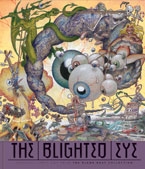
The Blighted Eye – Original Comic Art from the Glenn Bray Collection


By many and various (Fantagraphics Books)
ISBN: 978-1-60699-695-9

When I talk about the field and art form of comics the intent is generally to celebrate and advertise the triumphs and talents of writers and artists – or maybe colourists, letterers or even publishers – but almost never about consumers.

However there are people who just read comics and there are those whose passion for the medium goes even deeper. These individuals have as much – or maybe even more – to do with shaping and promoting our medium than all the rest…

Paramount amongst those is Glenn Bray, whose fascination for illustrated narrative encompasses comics, collector cards, film and wrestling ephemera, music, outsider art and in fact most aspects of popular culture.

He is a driven champion of modern creativity and amongst his greatest passions is an undiagnosed compulsion to collect original art.

Bray was in on the start of the Underground Commix revolution, smuggling comics to stores back when they were still illegal. He’s the guy who first brought Carl Barks out of retirement and bought his very first Duck painting, showed us young kids the astounding art of Basil Wolverton and won belated fame for retired sculptor, draughtsman and philosopher Stanislav Szukalski.

The inveterate fan’s been quietly amassing mementos and knowledge from his California home since 1965 and has subsequently become the premiere cultural archivist, educator, publisher and patron of some of the most influential artists in graphics and sequential art. He also cherishes the works of creators we’ve forgotten and those who should be famous but just aren’t.

Yet.

Moreover, by befriending, interviewing, recording and always freely sharing his collection and studies of the people he’s admired – and often supported – Bray established the basis for most of today’s scholastic and journalistic resources and records, used by practically all of us expounding and propounding the joys of comics and illustrative narrative.

This astounding monolithic hardback (410 gleaming, glossy 302 x 268mm pages with some eye-popping 6-stage fold-outs) is teeming with photos of people, places and things that have captivated the preserver of everything our bigoted teachers, pontificating, bastions of the Old Guard and smug Social Betters always told us had no worth, merit or value…

Most importantly of course (for us here at least) are his hundreds of examples of art – all shot here from the originals in Bray’s frankly unbelievable collection – a veritable museum (and feeling as heavy as one) of genius in your hands: a pantheon of comics achievement, each and every one gathered and preserved for only one reason: because Glenn liked it…

Illustration superstar Robert Williams’ historical biography ‘The Archive of Lost Souls’ starts the show, after which author and publisher Todd Hignite offers an informative commentary in ‘Who Enters Here Leaves Hope Behind’, but the true nature and devotion of the collector really comes through in ‘The Glenn Bray Interview’ by Doug Harvey (artist and Art Critic for the LA Times and Art Issues) before the true wonder unfolds in the exotic, eclectic, picture-packed pages which follow.

This is an imposing and shockingly beautiful compendium no lover of the medium could possibly ignore, and it’s not all Bray has in terms of Art, artefacts, funny books or ephemera. Perhaps there’s a sequel or companion compendium to come…

That’s how I usually wrap up one of these reviews and it should be enough to convince you to get The Blighted Eye immediately if not sooner, but I’d kick myself if I didn’t list the artists whose works appear here.

So, whether a single page and/or panel or many different pieces, each of these masters and journeymen deserve a mention and you can read on or stop here.

Charles Addams, Rick Altergott, Bob Armstrong, Boris Artzybasheff, Carl Barks (so wonderfully many), Art Bartsch, H.M. Bateman Hand Bellmer, Mark Beyer, Jack Bilbo, Gene Bilbrew, Mahlon Blaine, Al Bryant, R.O. Blechman and Charles Burns.

Ernesto Cabral, E.H. Caldwell Studio, Al Capp, Serge Clerc, Dan Clowes, Ron Cobb, Jack Cole (another host of stunning volume and variety), Astley David Montague Cooper, Robert Crumb, Xavier Cugat, Jack Davis, Gene, Kim and Simon Deitch.

Bray was instrumental in popularising the European Krampus tradition and ‘Devil Cards’ features a sub-exhibition of examples of the Christmas Devil by Kim Deitch, Coop, Bob Armstrong, Spain, Mark Beyer, Carol Lay, Charles Burns, Drew Friedman, Rick Griffin, Hunt Emerson, Jan Ross, Gary Leib, Robert Williams, Bill Ward, J.D. King, Evert Geradts, XNO, S. Clay Wilson, Crumb, Ever Meulen, Peter Pontiac, Savage Pencil, Norman Pettingill, Byron Werner & Karl Wills.

The greater precession resumes with Gustave Doré, Pascal Doury, Albert Durbout, Bill Elder, Vince Fago, John Fawcett, Al Feldstein, Virgil Finlay, Kelly Freas, lots more Drew Friedman, Ernst Fuchs, a wealth of Evert Geradts, Eugenie Goldschmeding  Chester Gould and Vernon Grant.

Underground icon Justin Green is followed by a quartet of stylish noir book covers by Gerald Gregg and many pieces by boon companion Rick Griffin plus pieces by Bill Griffith, Milt Gross, George Grosz, Olaf Gulbrannson, V.T. Hamlin, Harman Ising Productions, Yoshifumi Hayashi, Geoffrey Hayes and tragic underground pioneer Rory Hayes.

There’s Russ Heath, Jaime Hernandez, George Herriman, Ryan Heshka, Al Hirshfeld, Alfred Hitchcock (yes really! Him!). Then see some Bill (Smokey Stover) Holman, Lawrence Hubbard, Graham Ingels, Cameron Jamie, Russ Johnson, Daniel Johnston, Andrew Jones, Kaz, Ota Keiti, Hank Ketchum, Frank King, Marian Konarski, Bernie Krigstein and the inimitable Harvey Kurtzman.

Stanley Link, Lippert Pictures, Bobby London, Travis Louie, Jay Lynch, Don Martin, Jefferson Machamer, Donald McGill, Otto Mesmer, Ever Meulen, Zach Mosely, Willard Mullin, Alan Odle, Jim Osborne and much, much Gary Panter.

A stunning selection of vintage Virgil Partch is followed by Mervyn Peake, Savage Pencil and Norman Pettingill. Dutch master Peter Pontiac follows, as does Richard Powers, George Price, Roger Price and Jacques Pyon as well as Gardner Rea, Bruno Richard, W. Heath Robinson and Charles Rodrigues.

See also Jan Ross, Big Daddy Roth, Antonio Rubino, Jenny Ryan and the iconoclastic Johnny Ryan. Bud Sagendorf, F. San Millan, Charles Schneider, Charles Schulz, Jim Shaw, Gilbert Shelton, Marc Smeets, Clark Ashton Smith, Otto Soglow, “Spain” Rodriguez, Irving Spector, Cliff Sterrett, G.E. Studdy, Joost Swarte, Stanislav Szukalski, Richard Taylor, Roy Tomkins, Jill Tipping, Tomi Ungerer and Irving Tripp & John Stanley.

Next follows another fascinating sub-section devoted to ‘Unknown Artists’ listed by a single nom-de-plume – just their work or no name – which includes Bubba ’69, Heilman, J. Ford, D.C. Lucchesi, J. Kennedy, Jaro, Kringo, Mr. Harrell Lee Littrel, P.J. McGivern, David Moore, Panchi, Dennis Rushton, R.H.L., Smith, E.A. Sojay and Weird Wanda (Doreen Ross).

Our voyage of discovery recommences with stuff from Jeffrey Vallance, Hans Van Bentem, Bob Van Den Born, Vica (Vincent Krazousky), George William Wakefield, Ray Walters, Bill Ward, Chris Ware, Byron Werner, a sublime spread of Ogden Whitney ‘Herbie’ pages, Gluyas Williams, Robert Williams, Skip Williamson, Karl Wills, Gahan Wilson, S. Clay Wilson, an apocalyptic selection of Basil Wolverton masterworks, Lawson Wood, Wallace Wood, Jim Woodring, XNO, cartoon colossus Art Young and Bob Zoell.

Surely after reading all that you need some great pictures to look at? So go buy the book and ease your Blighted Eye…

The Blighted Eye © 2014 Fantagraphics Books. All images © 2014 their respective creators or Estates where appropriate. All rights reserved.

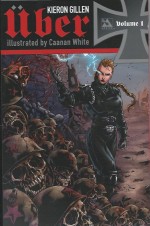
Uber


By Kieron Gillen, Canaan White & Keith Williams (Avatar Press)
ISBN: 978-1-59291-218-6

There’s something of an immediately post-WWII zeitgeist in effect in Britain at the moment: exhibitions, documentaries, a few exceedingly good TV dramas (Bletchley Circle, Murder on the Home Front, Foyle’s War) and even some comics.

Being British, writer Kieron Gillen grew up reading war comics like Battle and so has our peculiarly manic and trenchant viewpoint – engendered by the works of Pat Mills, John Wagner, Tom Tully, Alan Hebden and Gerry Finley-Day – to augment his own uniquely dark and sardonic imagination, previously displayed in strips and comics as varied as Phonogram, Save Point, Dark Avengers: Ares, Thor, Uncanny X-Men, Iron Man and many more.

Now he has applied the implausible metahuman trappings of the American superhero comicbook to the bleak, gritty, apocalyptically human scaled drama of “the Last Good War” to produce a vicious, nasty and utterly enthralling sci-fi-tinged epic of staggering scope and power.

This first full-colour trade paperback compilation, illustrated with stark, gory verve by Canaan White & Keith Williams, collects issues #0-5, and posits a much debated “What If…?” as Germany’s Götterdämmerung is averted at the very last moment by a very nasty miracle…

Blending scrupulous historical research with a canny take on human nature, the story begins with the triumphant Russians barbarously overrunning Berlin on the night of April 24th 1945, even as arch-patriot General Sankt delivers at long last a handful of incomprehensible human weapons to General Heinz Guderian, just as that demoralised, defeated Reichsmann readies himself for the end.

Five days later in a secret base near the Swiss border, a trusted scientist for Projekt U murders her former colleagues and sabotages the outpost before dashing towards the advancing American forces, carrying an incredible secret…

With Hitler putting a gun into his mouth word comes of an impossible turnaround. The human “Battleships” Siegmund, Siegfried and Seiglinde, supplemented by lesser supermen and wonder women, have ravaged and repulsed the despised subhuman Soviets…

The Generals realise even these Wunderwaffen (the result of years of ruthless research) cannot reverse Germany’s fate, but by their ghastly actions and uncanny efforts the nation may be able to negotiate a favourable armistice that won’t leave the country broken forever.

Der Fuhrer, however, totally demented and wantonly vengeful, wants Grand Opera outcomes: Wagnerian Cataclysm and the world made into a rubble heap that would make Berlin seem merely scratched…

The madman appals his closest cronies when he orders Seigfried to execute a million Russian prisoners of war before despatching his ghastly Hell-kinder to destroy Paris and resume his holy war on Russia.

Meanwhile British spy Stephanie has made it back to England – having en route despatched two of the Übermensch she helped create – and convinced Winston Churchill to fast-track the Allies’ own Human Tank project.

To facilitate this, she had brought stolen samples of the transformative crystalline chemical Woden’s Blood and copies of artefacts and documents used by Nazi scientist Professor Metzger.

The ancient – possibly extraterrestrial – inscriptions and records the biochemist was working from go to BletchleyPark where brilliant cryptologist Alan Turing lets his new Electronic Brain loose on deciphering the still untranslated majority of the writings…

Woden’s Blood only upgrades 1 in every 5000 humans, and needs repeated, gradual applications, but even so the harried Allies still find enough volunteers to get the ball rolling, and as weeks pass they slowly become a plausible answer to the now limited and stalled German superhuman project.

In the intervening time, Battleship Sieglinde has led her less-developed and incomplete Mark 2 comrades in the march upon so-recently liberated Paris to carry out Hitler’s demands for punishment. Now as the fanatical Über Soldaten prepare to raze the city they are ambushed by a hastily prepared Expeditionary Force of Anglo American Human Tanks.

They are not enough…

To Be Continued…

Savage, brutal and visually shocking, this stunning, doom-drenched drama crackles with tension, drips with mystery and suspense and comes with a chilling 20+ page gallery of covers, variants and ancillary artwork, and will appeal to lovers of fantasy fiction and unreal war stories alike…

© 2013 Avatar Press Inc. Uber and all related properties ™ & © 2013 Avatar Press Inc.
Uber will be released on April 1st 2014

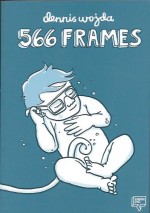
566 Frames


By Dennis Wojda (Borderline Press)
ISBN: 978-0-99269-720-4

Every now and then – but typically, not nearly often enough – the global comics scene throws out a project with the potential to redefine the industry.

Tintin, A Contract with God, Ghost World, Fun Home, Watchmen, Love and Rockets, Lone Wolf and Cub, From Hell, Fax from Sarajevo, Persepolis, Maus and some few others reached vast non comics-reading audiences in their time, serving to justify and legitimise a narrative discipline that had claimed since its creation to be an actual Art Form.

By all accounts author Dennis Wojda – already an established star of the Polish comics establishment – one day decided to do something to creatively stretch himself and opted to turn snippets of his family history into a daily cartoon on his web-page, scheduled to run for the classically significant “a year and a day”.

It proved immensely popular, so much so that publishers expressed interest in a book, but 366 panels weren’t really enough.

No problem: families always have plenty more history…

As you’ll see when you read the book, Wojda was actually born in Stockholm on March 13th 1973, before returning to Poland to become a writer, designer and graphic artist.

He’s appeared in Gazeta Wyborcza, AktiviÅ›cie, Exklusiv, Bravo, Skate, Ha! Arcie, Arena Comics and Jabber, winning plenty of praise and a few awards for such series as Mikropolis (with artist Krzysztof Gawronkiewicz: collected in two volumes as The Tourist Guide and Mohair Dreams), Chair in Hell, The Supernaturals: Miss Hofmokl’s Shoe (with Krzysztof Ostrowski), A European on the Road (written by J. Sanecka) and Ghost Kids: the Ribbon (illustrated by Sebastian Skrobol) amongst others.

At the end of 2013 British publisher Borderline Press sagely added the now expanded 566 Frames to its burgeoning stable of titles, giving English readers the opportunity to see one of the most beguiling and lyrical examples of comics autobiography ever produced…

Mixing time frames and viewpoints – including many wise pronouncements and predictions from his own time as a foetus in the womb – the tale begins and ends with the birth of the author.

In between then Dennis smoothly skips up and down the family tree, describing his pregnant mother’s drive to Sweden so that he could be born with his absent-and-working-abroad father (who was hedonistically trapped being a wandering, semi- failed pop star in Swinging Scandinavia), and the sort-of psychic grandmother who knew how, when and where to meet her…

There are memories – his and his ancestors’ – of little moments and huge crises, parties and pogroms and many, many conquests – both romantic and geopolitical – as an odd assortment of branches and buds thrive and survive under a variety of invaders and overlords from Tsarist Russians to Hitler’s Nazis to Soviet Russians: always finding that whatever may happen, the music of life plays on…

Don’t be fooled, however. This is no idle panegyric about the good old days. There’s a formidable amount of sex, death, struggle, fear, privation, terror, envy and heartbreak to season the surreal whimsy, diverted daydreams, folksy philosophy and chatty monologue…

And music: everything from Polkas to Jazz to Jimi Hendrix…

With only 566 Frames Wojda has worked his own brand of visual Magic Realism (as previously best expressed in English language comics by Gilbert Hernandez) and this wondrous, mesmerising, intoxicating invitation to share a slice of other lives and times is a book no lover of the medium or citizen of the world should miss.
© Dennis Wojda. All rights reserved.

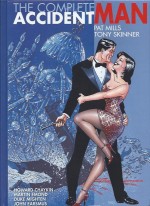
The Complete Accident Man


By Pat Mills, Tony Skinner, Martin Emond, Duke Mighten & John Erasmus (Titan Comics)
ISBN: 978-1-78276-055-9

We have our share of true blue heroes in Britain, but what we really do best are rakish rogues and cast-iron bastards – both in dull old fact and the much safer realm of fiction.

A fair few of the comics kind have stemmed from the febrile mind of Pat Mills, a man whose singular vision has scarred many an impressionable reader’s psyche…

Now one of his most stylish and far-ranging creations – co-crafted with writing partner Tony Skinner – has been awarded some-long delayed and much-deserved star treatment in the form of a lavish oversized colour hardback compilation from Titan Comics.

In many ways Michael Fallon is a product of his times (the 1990s): a ruthless, flashy, grasping Yuppie who thinks he cares about nothing but his job, instant gratification and the gaudy in-your-face trappings of his success.

That’s unpleasant enough if the antagonist is a Banker, a Broker or Hedge Fund Manager, but Mike is a dedicated proud artisan. He makes human impediments go away – and always makes it look like mischance, not murder…

Accident Man debuted in short-lived, creator-owned British independent comic Toxic! (which ran for 31 full-colour issues between March and October 1991). Easily the most popular feature, he also starred in a reprint special – Apocalypse Presents: Accident Man – and in 1993 crossed The Pond for an all-new 3-part monochrome miniseries from American publisher Dark Horse Comics.

This chilling compendium commences with Mills’ Introduction ‘Rhubarb! Rhubarb! Rhubarb!’ describing the convoluted history of the character and teasingly discussing the still-not-made movie, before the cartoon carnage calamitously starts to unfold in the Martin Emond illustrated introductory saga (from Toxic! #1-6) wherein hubristic hitman Fallon explains and simultaneously demonstrates his particular skill-set whilst evoking the golden rules of the job “Never Get Angry. Never Get Involved. Never Get Caught”…

A successful – for which read undetectable – intervention usually fills him with PMT (Post Murder Tension) most successfully expunged through lavish spending and extreme gratuitous physical violence, but these days something’s not right.

The shallow Fashionista didn’t really care when his wife Jill left him to shack up with another woman and join those loony save-the-planet eco nuts in Women Against the Rape of the Planet, but for some strange reason he can’t stop thinking about her now that she’s been killed in a burglary…

He carries on arranging fatal improbabilities but the joie de vivre has gone, and when he finally works out that Jill’s break-in is the M.O. of fellow assassins Chris and Jim it sets him on a bizarre course that leads to an alliance with Hilary – the “Other Woman” – to take profitless vengeance on the corporate scum really responsible…

More or less his old self again Fallon returned in ‘Death Touch’ (Toxic! #10-16, illustrated by Duke Mighten), drowning in natty threads and conspicuous consumption whilst pursuing his craft and studying with a martial arts master who had promised to teach him the legendary art of killing with a time-delayed kung fu punch…

After scooping his fourth consecutive gong for Most Hits in a Year at the annual Golden Coffin Awards, he begins his next commission – a particularly nasty drug dealer with no respect for animals but a sick, devoted and unforgiving family- utterly unaware that his Sensei Sifu Lo has discovered his profession and deemed him unworthy…

John Erasmus took over the art for ‘The Messiah Sting’ (from Toxic! #17-24) as the woman who seduced Jill away cons the Accident Man into doing worse than murder to David Dake – the Junior Minister for the Environment… and for free!

Hilary is a fanatic in the service of WARP and has a baroque plan to punish the ostensibly “Green” Tory politician who actually protects animal torturers and destroys the countryside he’s supposed to be fighting for, but when Mike gets involved it soon devolves into an explosive confrontation with obnoxious American agents, hookers, rival hitmen, a burgeoning criminal turf war, kung fu killers, drug dealers and the destruction of scenic downtown Amsterdam.

And there’s even a sneaky glimpse at out antihero’s early days…

Iconoclastic Howard Chaykin created the risqué and raucous colour covers for the aforementioned Dark Horse miniseries and they seditiously precede the final saga in this magnificent murder file as Mike Fallon takes his particular brand of Olde Worlde charm across the pond – via Concorde, of course – for a job commissioned by a clandestine Government agency: the Special Assassinations Bureau (limned in stark monochrome by Mighten)…

In the Accident Man’s line of business it’s best to be adaptable and always assume everybody is a liar. After an unexpected and exotic liaison with CIA insider Mirror Morgan, Mike hits the Big Apple’s most outrageous sex club and learns his target is a corrupt Senator…

Arranging the improbable with his usual élan, Mike is only seconds away from unknowingly eradicating the chief of the CIA when he spots Mirror with his soon to be tragically deceased mark, and is forced to spectacularly avert his programmed mishap.

CIA boss John Archer is perfectly reasonable and understanding. He knows how easy it is to be duped in the murky world of espionage and international crime. He’s also happy to let Mike go… but only after the misfortune magnate works his magic on the untouchable Capo di Tutti Capo of the Mafia…

And naturally it’s another bloody freebie…

The glitzy sex and shocking violence mounts exponentially as Fallon infiltrates the Mob, winning more enemies than friends along the grisly way, and even after that job’s sorted he still has a bone to pick with the far-from-fair Broker from SAB…

Overwhelmingly violent, manically inventive and ridiculously addictive, this is a lost gem of anarchic, swingeing satire from Mills and Co, and well worthy of this splendid definitive collection. Also included here is a copious Accident Man Sketchbook section featuring cover roughs, page layouts and character designs as well as the now obligatory lowdown on the creative Usual Suspects.

Highly sexed, infallibly capable and ruthless style obsessed, the flashily fashionable assassin is James Bond on the wrong side – his own – and delivers action, intrigue and bold, black humour in astounding amounts…

Don’t leave anything to chance: check him out…
Accident Man is ™ & © 2014 Pat Mills and Tony Skinner. Accident Man Book One © 2014 Pat Mills, Tony Skinner & Martin Emond. Accident Man Death Touch © 2014 Pat Mills, Tony Skinner & Duke Mighten. Accident Man Book Three © 2014 Pat Mills, Tony Skinner & John Erasmus. Accident Man (Dark Horse) Pat Mills, Tony Skinner & Duke Mighten.

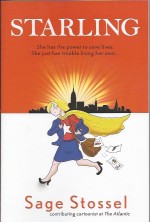
Starling


By Sage Stossel (Penguin/InkLit)
ISBN: 978-0-42526-631-1

Once upon a time only little boys (of any age from 3 to 90) liked superheroes.

That’s all different now.

Just like always, girls eventually steal boy’s stuff and break it or point out how stupid it is and ruin it or decorate and fancy it up so that it makes proper sense and is generally better, but it was still ours first though…

Let’s start again.

Sage Stossel is a children’s book author (On the Loose in Boston, On the Loose in Washington DC, We’re Off to Harvard Square), editorial cartoonist (Sage, Ink.) and Editor at The Atlantic, whose smart, wry, ostensibly innocuous efforts have also appeared in The Boston Globe, CNN Headline News, New York Times Week in Review and scads of other extremely prominent and worthily impressive places.

A native Bostonian, she majored in English and American Literature and Languages at Harvard where she permanently succumbed to the cartooning bug, producing student-life strip Jody for The Harvard Crimson. She was instrumental in creating The Atlantic‘s online iteration.

Starling is her first graphic novel and superbly takes a knowing sideswipe at the world’s newest fiction archetype, cleverly delving deep into the psyche of the kind of person who might actually fight crime if they had superpowers and how such a “career” might actually impact upon a sensible person.

Stossel also manages to tell a winning story about overcoming adversity, finding oneself and even having a shot at achieving true love, all lovingly ladled out in a savvy, self-deprecating, droll, artfully humorous manner…

Amy Sturgess has a secret. Up until now she’s only shared it all with her therapist, but balancing her job in the back-stabbing world of Marketing with the constant demands of the Vigilante Justice Association (who perpetually text her about occurring crimes she’s expected to foil immediately, no matter what she’s doing) is taking its toll.

At the Agency, a conniving male co-worker is actively stealing her work and sabotaging her career. Her cat-hoarder mom lives in a world of her own. Her brother Noah is a druggie lowlife – but at least he’s trying to get his life together, whilst her own (especially as regards dating) is a stalled and floundering disaster…

No wonder she relies so heavily on prescription meds and is plagued by bouts of crippling procrastination…

Things take a tortured upturn when her college sweetheart resurfaces. Russell is married to a wonderful woman (who actually becomes one of Amy’s best friends) but is clearly trying to rekindle those heady student passions with Amy and the situation soon begins to affect both sides of Amy’s work.

B-list costumed crusader Starling even begins to let certain offenders go: robbers stealing from banks who repossessed their homes, a homeless man trying to free his dog from the Animal Control impound…

A crisis point is reached when rival gangs begin a turf war and a modern Artwork is stolen. It doesn’t take much investigation to link Noah to both crimes, but when he disappears and Starling frantically hunts for him, she is incessantly stymied and interrupted by the hunky rogue and illicit gambling organiser Matt McRae.

The enigmatic hustler seems to have connected Amy to Starling and says he only wants to help, but he’s a crook.

A really, really good-looking, apparently unattached crook…

Amy isn’t Wonder Woman or Ms. Marvel. She’s just a well-intentioned young woman who found she was different and got pushed into a second (full time, secret and unpaid) career when she couldn’t even decide on how to make her first one work.

Now she has a really serious crime to solve, a brother to save, a romantic triangle to square and an unsuitable suitor to sort out…

Moe RomCom than Summer Blockbuster, Starling is a slow-paced, lovingly crafted, laconic, ironic and purely humorous tonic for lovers of the medium reared on adolescent wish-fulfilling, juvenile male power-fantasies who now yearn for something a little different, and even deliciously points out all the reasons why superheroes are dumb before wittily showing how that’s not necessarily bad and showing one way of making them better…
© 2013 Sage Stossel.

Mitch O’Connell: World’s Best Artist

Mitch O'Connell ft
By Mitch O’Connell (Last Gasp)
ISBN: 978-0-86719-773-0

Some artists can be said to epitomise an era, their works forever evoking the time and style and flavour of a discreet age, whilst others have the equally impressive gift of being able to recapitulate and reinvent uniquely iconic times in a way that makes them new and fresh again.

Mitch O’Connell is the very best of the latter: a commercial illustrator and canny cultural scavenger whose slick blend of caricature, pop iconography and surreal whimsy samples the Rock & Roll’s 1950s, sexily Swinging Sixties, surreal Seventies, Expressive, obsessive Eighties and anything beyond or between with amazing panache and witty self-absorption.

His slick, inviting style elevates all his works – whether commissioned graphics, narrative expression or “Capital A” art – into unmissable events, and proves that he’s a creator who can readily navigate between unfailing paintslinger-for-hire and hoity-toity, fancy-shmancy gallery godling.

He has been called the “Prince of Pop Art”…

All his works are characterised by unprecedented heights of verve and dash, saucy opportunism, mordant grim wit and acres of cruelly wry, good-natured humour.

He has created stylish comics and graphic novels, compelling illustration, package design, RPG boxes, album, book and magazine covers, posters, tattoo art and even highly personal pieces for gallery shows – and now a superb selection of his 30-plus year career has been herded into an attractive, peculiarly idiosyncratic and extremely funny biography and retrospective art book (so funny, in fact that the publishers thought it wise to cover the book in what feels disturbingly like a wash-&-wear polymer prophylactic, presumably  in case of any spit-take incidents…).

Simply bulging with astounding photos, drawings and full-colour paintings of monsters, sexy devils, naked men and women, cute kitties, famous stars, comics and mercilessly spoofed licensed properties from the Flintstones to Batman, Atom Ant to Elvis, the hysterical historical hagiography opens with ‘Born This Way – On the Right Track Baby’ and a selective glimpse at Li’l Mitchell’s early days of drawing dinosaurs and superheroes…

Some semblance of discipline descends in ‘Draw “Winky” – Art Instruction School’, a trawl through academia including a telling catalogue of grateful acknowledgments listed as ‘You’re the Inspiration’ (an eclectic assemblage which comprises Bernie Wrightson, J.C. Leyendecker, Ivan Albright and Franz Fruzyna amongst others) before venturing out into the harsh and competitive arena of freelance commercial art…

‘Hey!! Kids – Comics’ follows the path from fanzine-maker to participant in the Eighties independent comics publishing boom, depicting his stunning painted covers for such titles as Johnny Dynamite, The Terminator, Speed Racer, The World of Ginger Fox and so many more, plus selected interior pages from Heavy Metal and his own later self-penned works plus early self-advertising successes and his numerous clip art contributions, whilst ‘Fit to Print – Publications’ catalogues a host of glorious efforts for magazines as varied as The Village Voice, Playboy, Chicago Tribune, The Quill, Saturday Evening Post, Seventeen, Rolling Stone and Newsweek as well as a selection of clever contributions to the adult magazine market.

O’Connell has created hundreds of unforgettable posters and album/single covers for musical acts and ‘Rock Icons – Music’ reprints many of the very best from bands like Less Than Jake, Supersuckers, The Ramones and more, after which more bedroom wall-covering wonderment is revealed in ‘Hang-Ups – Posters’ and ‘As Seen on TV – Advertising’ which charts his vast canon of stylish product art: everything from holiday brochures for Las Vegas to fascinating and shocking re-branding exercises for beloved Hanna Barbera and Warner Brothers cartoon icons…

In a surprisingly candid manner, O’Connell relates the familial crisis which overtook him and altered the tone and context of his long and varied career as a Gallery artist in ‘Exhibitionist – Wall Accessories’ whilst ‘Skin Deep – “Flash” Tattoo Art’ delineates his forays into skin-as-canvas before everything wraps up with a beguiling peek at the creator’s home and studio in ‘Magical Mystery Tour – Home Sweet Home’: a wonderland of toys, found objects, old magazines and the world’s largest collection of really scary shop dummies and mannequins…

Beautiful, shocking, funny and engagingly intimate, this huge compendium of glossy, sparkling painting and storytelling is a truly inspirational glimpse at a true creative wunderkind and no lover of pop, kitsch, nostalgia and/or graphic excellence should be deprived of it.
All text and illustrations © 2012 Mitch O’Connell except where otherwise noted. All rights reserved.

Snowpiercer volume 2: The Explorers


By Benjamin Legrand & Jean-Marc Rochette, translated by Virginie Selavy (Titan Comics)
ISBN: 978 -1-78276-136-5

Like the times that produced it, the Franco-Belgian comics classic Le Transperceneige was a troubled and ill-starred beast. The tale was originally conceived by prolific veteran scripter and occasional cartoonist Jacques Lob to be illustrated by his Superdupont collaborator Alexis (Dominique Vallet) but the artist’s untimely death on 7th September 1977 stalled the project until 1982 when painter, comics artist and book illustrator Jean-Marc Rochette (Pinocchio, Le petit poucet, Le chat botté, Candide, Le Dépoteur de Chrysanthèmes, Edmond le Cochon, Requiem Blanc) came aboard.

The delayed apocalyptic epic then ran in À Suivre in 1982 and 1983, with a collected edition published in 1984.

Although popular the sequel was not forthcoming until long after Lob died in 1990, whereafter Benjamin Legrand took up the concept with Rochette, producing two more epic tales of the Last Train to Nowhere…

No stranger to comics, Legrand (Lone Sloane, White Requiem, Gold & Spirit) is also a major mainstream prose author and French-language translator of such luminaries as Milton Caniff, R. Crumb, Robert Ludlum, Tom Wolfe, John Grisham and Nelson DeMille amongst many others. This varied background brought an edgy thriller-writing sensibility to the austere high concept of the original dystopian tomorrow mix…

With the imminent UK release of the movie Snowpiercer, Titan Comics (whose other translated offerings include The Hunting Party, Blueberry and other assorted classics by Enki Bilal, Moebius and others) have brought the entire three album masterpiece to our parochial Anglo-centric attention in two lavishly luxurious monochrome hardbacks. Both of Legrand & Rochette’s cool collaborations are here combined into a stunning collection of bleak and chilling End of the World turmoil: in one stunning, sturdy volume, as a companion to Snowpiercer book 1: The Escape.

In that original tale a new Ice Age had instantaneously descended over Earth and a microcosm of humanity rushed onto a vast vacation super-train repurposed as an ever-running ark of survival. As that monolithic futuristic engine began a never-ending circumambulation on tracks originally designed to offer the idle rich the ultimate pleasure cruise, the people rich, lucky or ruthless enough to secure a place quickly settled into their old pre-disaster niches and original divisive social stratifications.

Life continued for decades in this manner until a bold outcast named Proloff escaped from the sealed nether-end carriages, travelling the length of the 1001 cars pulled by the mysterious miracle of modern engineering. He acquired a romantic companion, clashed with the Military and Elite’s hierarchies, inadvertently sowing deadly discord until he reached the Engine herself and discovered the uncanny secret of the machine called “Olga”…

The drama now resumes in Snowpiercer book 2: The Explorers (originally serialised as Le Transperceneige: L’arpenteur in 1999) with a stunning revelation.

Soon after that train first sealed itself from the world and departed, a second, better equipped life-preserving cortège took off after it. Perpetually trailing the original, the denizens of the second Snowpiercer have also devolved into a far-from-homogeneous society: one also crippled by the overwhelming fear that they will inevitably smash into their forerunner one day…

Snowpiercer 2 has many modifications missing from the original. Designed as an icebreaker, the train also boasts radar detection systems, one-man short-hop flying modules and is able to brake and stop, allowing the hardiest individuals to debark and briefly scavenge amongst the frozen ruins of the world that’s gone…

There’s also a far more savvy autocracy in charge; scrupulously managing the disparate elements of the rolling society. Carefully constructed hologram adventures and TV shows placate passengers of all classes, an oligarchic Council manages every aspect of existence, a religion has been created to dole out hope, passive acceptance and guilt as required and the rulers run a gambling racket which provides a safe outlet for the lowest of the low…

Explorers have a short life expectancy and are highly expendable, but generally bring back far more flashy trinkets for the wealthy than salvaged food, drugs or technology for the masses.

The constant fear of collision has produced malcontents, cynics, terrorists, a huge need for anti-depressants and increasing incidents of a deranged group psychosis in many carriage dwellers. “Cosmosians” are gripped by a sure and certain belief that the entire vehicle is actually a spaceship hurtling through hard vacuum, rather than a wheeled entourage braving mere minus-130 degree wind and snow.

The terrifying panic which resulted from the first test-braking 15 years previously still scars most psyches but life on the rails is generally improving. Council head Kennel is delighted to learn that surface temperatures outside are slowly rising again (-121 in some places!), the birth rate is still successfully and voluntarily restricted whilst recycling, meat and agriculture output are at record levels.

Moreover his own daughter Val is constantly coming up with new and exciting Virtual Environment programs for the winners of the ubiquitous gambling contests to enjoy: histories, fantasies and adventures all enthral the Proles and keep them slavishly betting in hope of winning new and stimulating diversions…

Her latest idea is a bit of a shocker though: she wants to reproduce what the Explorers experience when they leave the train…

Despite her father refusing the request Val decides to go ahead anyway and sneaks back to the carriages where Reverend Dicksen is administering the blessing of Saint Loco upon the suicidal scavengers in preparation for their next foray.

As she spies on them she is accosted by the increasingly unstable Metronome – spiritual leader of the breakaway Cosmosian sect – but ignores his warnings, set on learning more about the anonymous stalwarts who risk their lives for medicines for the masses.

Explorer Puig Vallès is not an idealist. As the third-class grunt fatalistically trudges back from a deep-frozen museum, he is one of only four survivors of yet another art raid, stealing useless treasures for the coffers of the elite “Fronters”. His surly rebelliousness and smart mouth soon get him into hot water and he is arrested…

Uncaring of the trouble he’s in or the cheap price of lower class life, Puig is intercepted by Val, whose status and family connections allow her to do almost anything she desires – even interviewing a disgraced Explorer.

Fate seems to be against her, though, as Puig is promptly announced as a winner in the Lucky Lady lottery. His prize is not a virtual vacation, but the “honour” of piloting one of the deteriorating fliers on an exploratory (AKA suicide) mission to see if Snowpiercer 1 is stalled on the tracks up ahead…

And in a dark and gloomy carriage, Metronome and his acolytes finish a bomb that will divert the hurtling spacecraft from its present course and towards the “promised planet”…

Puig knows he’s been set up to die and breaks free, stealing a gun and running for he knows not where, but is captured after a ferocious fire-fight. Val, meanwhile, has discovered that the train’s archives and historical records have been doctored: there’s evidence of anti-fertility drugs being added to the water, and that momentous day 15 years ago when she personally witnessed the death of Puig’s parents has been somehow deleted…

Near the front, the eternally vigilant “Radarists” have spotted a crisis which needs confirmation. A vast bridge pings back as damaged, but on-site inspection is vital to avoid disaster. Val clandestinely confers with Puig, just before the disgraced Explorer is subjected to a kangaroo court and charged with causing the deaths of the other Explorers in his team.

His guilt a foregone conclusion, he is sentenced to Community Service and ordered to fly a flimsy, malfunctioning scout plane to inspect the failing span ahead of the train.

His terrifying sortie confirms the radar data, and the train frantically brakes to avoid disaster. However, by the time Puig turns the plane back, the Icebreaker has switched to full reverse and is speeding away. Determined not to die, he gives chase in the dying flier, and miraculously travels through a brief burst of sunlight.

Shocked and galvanised he nurses the plane onward, even avoiding anti-aircraft fire from the train and discovers that his rolling home has a super engine at each end…

He threatens to crash the plane into the retreating cars and, as the Council deliberate the potential harm he might cause, Val – listening in on tapped lines – broadcasts the conversation to the entire populace.

Consummate politician Councillor Kennel does the only thing possible: regaining public support by proclaiming Puig a hero and taking him fully into the elite’s confidence by sharing all the Train Elite’s secrets with him.

As a Councillor, the rebel anarchist has no choice but to become a co-conspirator and in a horrifying moment of revelation meets an elderly Explorer who describes how the first “braking” was actually the collision everyone has dreaded for years. The original Snowpiercer is now the rear end of their own vastly snaking train. Every moment of fear and anticipation since than has been manufactured to control the people…

The chilling triptych concludes in the immediately-following Snowpiercer Book 3: The Crossing (serialised in 2000 as Le Transperceneige: La traversée) as Puig chafes under a burden of secrets and his new role as Councillor, but one with far less power than the established members.

At least he no longer fears a collision that can never happen, but his sense of threat has not diminished, but rather widened…

When Metronome’s fanatics finally detonate their bomb at the North End of Upper Second-Class, the explosion wrecks the train braking system. Naturally Puig leads a reconnaissance expedition, allowing adversarial Councillors Reverend Dicksen and fellow hardliner The General opportunity to assassinate the Explorer upstart whilst he is occupied cutting free the destroyed cars, effectively chopping the train – and humanity – in half.

As frantic evacuation procedures take effect, the Reverend dispatches fanatical cold-resistant children he’s been training to dispatch the despised enemy, but even clinging to roof of a rocketing carriage in lethal freezing winds Puig is far harder to kill than anybody realised…

With an Engine at either end, the two halves of the train are quickly separated by frozen miles whilst Puig covertly rejoins wife Val and leads a coup. With Dicksen and the General incarcerated and resources impossibly scant for the people crammed into their half of the train, Kennel then reveals one last piece of potentially life-changing news.

The Radarists have for some time been receiving radio transmissions from across the frozen sea. Perhaps somewhere other pockets of human civilisation exist…

Even if the rails hold firm and bridges are still passable, eventually the truncated train will collide head on with its severed other half if the passengers don’t starve, freeze or kill each other first.

With Councillor Kennel on-side and determined to preserve some vestige of the human race, the Explorer, tantalised by an impossible hope, decides to employ the train’s never-tested Snow Chain technology to leave the tracks completely and take everybody out across the ice-locked, frozen ocean in search of the originators of that beguiling transmission…

Unfortunately the bold strike into the unknown is far less dangerous than the fanatics still riding within, and even the despondent, electronic phantom of Proloff, psychically bonded to the original Snowpiercer engine as a cerebral ghost within the machine, can’t help against the bloody religious uprising fomented by Dicksen, Metronome and the General…

And there are even more deadly revelations and surprises awaiting them in the cold, dark unknown across the sea…

This harsh exploration of society in crisis is a gripping tale depicting different kinds of survival values no reader of fantasy fiction could possibly resist, and one long overdue for major public recognition.

And by reading this volume, you’ll see far more than the movie adaptation could possibly cover…
Transperceneige/Snowpiercer and all contents are ™ and © 2013 Casterman.
Snowpiercer volume 2: The Explorers is scheduled for release on February 25th 2014

Snowpiercer volume 1: The Escape


By Jacques Lob & Jean-Marc Rochette translated by Virginie Selavy (Titan Comics)
ISBN: 978- 1-78276-133-4

All science fiction is social commentary and, no matter when, where or how set, holds up a mirror to the concerns of the time of its creation. Many stories – in whatever medium – can go on to reshape the culture that spawned them.

20,000 Leagues Under the Sea, War of the Worlds, Metropolis, Brave New World, 1984, Dan Dare, Day of the Triffids, Star Trek, Thunderbirds, Dune, Star Wars, Stranger in a Strange Land, Solaris, Alien, Neuromancer and so many others escaped the ghetto of their genre to change the cognitive landscape of the world, and hundreds more such groundbreaking and worthy efforts would do the same if we could get enough people to read or see them.

There’s a reason why the Soviets proscribed many types of popular writing but actively encouraged (certain flavours of) Science Fiction…

And most importantly, when done well and with honesty, all such stories are also incredibly entertaining.

All over the world comics have always looked to the stars and voyaged to the future. Europe especially has long been producing spectacularly gripping and enthralling “Worlds of If…” and Franco-Belgian graphic storytelling in particular abounds with undiscovered treasures.

For every Blake & Mortimer, (Tintin’s) Destination Moon or Barbarella, Valérian & Laureline, The Airtight Garage, Jeremiah, Lone Sloane or Gods in Chaos there is an impossible hidden wealth of others, all perched tantalisingly out of reach for everybody unable or unwilling to read nothing but English.

Now however, with the imminent UK release of the movie Snowpiercer, Titan Comics (whose previous translated offerings include Storm, Towers of Bois-Maury, The Magician’s Wife and assorted classics by Enki Bilal and Moebius amongst others) have brought another long-overlooked masterpiece to our parochial Anglo-centric attention.

The original comics series – a stunning example of bleak Cold War paranoid fantasy – is released in a superb two-volume monochrome hardback set, the first of which is available now.

The original tale was serialised in 1982 in À Suivre and collected two years later as Le Transperceneige, written by Jacques Lob (Ténébrax, Submerman, Superdupont, Blanche Épiphanie, Roger Fringan and more) and rendered by painter/illustrator Jean-Marc Rochette (Le Dépoteur de Chrysanthèmes, Edmond le Cochon, Requiem Blanc, Carla, Les Aventures Psychotiques de Napoléon et Bonaparte, etc.) and the driving central conceit is brilliant and awesome.

In the near future life is harsh, oppressive and ferociously claustrophobic. As eternal winter almost instantaneously descended upon the Earth, fugitive remnants of humanity boarded a vast vacation super-train and began an eternal circumambulation of the iceball planet on railway tracks originally designed to offer the idle rich the ultimate pleasure cruise.

Due to lax security as the locomotive started its unceasing circuit of the globe, rogue elements of the poor managed to board the vehicle, but were forced by the military contingent aboard to inhabit the last of 1001 cars pulled by the miracle of engineering.

Now decades later the self-contained and self-sustaining Engine hurtles through unending polar gloom in a perpetual loop, carrying within a raw, fragmented and declining microcosm of the society that was lost to the new ice age…

All contact with the Tail-enders of the “Third Class” has been suspended ever since they tried to break through to better conditions of the middle and front carriages. Their frantic “Wild Rush” was repelled by armed guards and the survivors – who know that event as “the Massacre” – were kicked back to their rolling slums and sealed in to die…

The story proper begins as Lieutenant Zayim is called to an incident in a toilet. Somehow an individual has survived the minus 30 degree chill, climbed along the outside of the train and broken in to the centre carriages. The desperate refugee should be killed and ejected but the stunned officer receives instruction from his Colonel that the indigent – named Proloff – is to be interviewed by the leaders up in First Class.

Before that, however, the invader must be quarantined as the carriage doctor has no idea what contagions must proliferate in the squalor of the rear. But whilst Proloff is isolated, young idealistic activist Adeline Belleau forces her way into the car.

She is with a humanitarian Aid Group agitating to integrate the abandoned Tail-enders with the rest of the train, but is unceremoniously confined with the Tail-Rat and suffers the same appalling indignities as her unfortunate client…

After a “night” in custody Proloff and Adeline are cautiously escorted by Sergeant Briscard and his men through the strange and terrifying semi-autonomous carriages: each a disparate region of the ever-rolling city, contributing something to the survival of all. Travelling through each car during their slow walk, Proloff sees how humanity has uniquely adapted to the journey to nowhere, but that each little kingdom is filled with people scared, damaged and increasingly dangerous.

In one car they are even attacked by bandits…

He also begins to pick up things: a religion that worships the unlimited life-bestowing power of Saint Loco, rumours that the train is slowing down, reports that a plague has begun in the carriage he broke into. Even Adeline has picked up a cold from somewhere…

As they slowly approach the front, Proloff and Adeline grow closer, uniting against the antipathy of the incrementally better off passengers who all want the Powers-That-Be to jettison the dragging carriages packed with filthy Tail-enders…

When they at last reach the luxurious “Golden Cars” the outcasts are interviewed by military Top Brass and the President himself.

He confirms that the train is indeed slowing down and that the furthest carriages will be ditched, but wants Proloff to act as an emissary, facilitating the dispersal of the human dregs throughout the rest of the train.

Billeted with Al, the timidly innocuous Train Archivist, Historian and Librarian, Proloff quickly confirms his suspicion that he is being played. Whilst deftly avoiding the grilling regarding conditions at the train’s tail, he swaps some theories about how the ice age really began and just how coincidentally lucky it was that this prototype vacation super-train was set up, ready and waiting to save the rich and powerful… and only accidental selections of the rest of humanity…

Stoically taking in the decadent debauchery of the First Class cars, Proloff is ready to die before going back, and when word of plague and revolution provokes an attack by the paranoid autocrats, he and Adeline decide to go even further forward, to see the mighty Engine before they die.

What they find there changes everything for everyone, forever…

This incisive exploration of a delicately balanced ostensibly stable society in crisis is a sparkling allegory and punishing metaphor, playing Hell and poverty at the bottom against wealth in Heaven at the top, all seen through the eyes of a rebel who rejects both options in favour of a personal destiny and is long overdue for the kind of recognition bestowed on that hallowed list of SF greats cited above.

At least with this volume, even if the movie adaptation doesn’t do it, you’ll still have the comics source material to marvel at and adore…
Transperceneige/Snowpiercer and all contents are ™ and © 2013 Casterman.

Wolfsmund volume 3


By Mitsuhisa Kuji, translated by Ko Ransom (Vertical)
ISBN: 978-1935654-96-4

Pseudonymous woman of mystery Mitsuhisa Kuji steps up the pace in this third volume (originally seen in Japanese publication Fellows! from 2009 as Ookami no Kuchi: Wolfsmund and a tankobon edition in 2011) of her gripping and chillingly fatalistic historical drama reinterpreting the legend of William Tell.

Set in 14th century Switzerland, the serial details the struggle of three conquered alpine cantons – Uri, Unterwalden and Schwyz – for freedom and independence from the cruel, oppressive and savagely rapacious Habsburg proto-Empire.

At first this interpretation centred around the monolithic fortress Wolfsmund, situated in the Sankt Gotthard Pass: an impenetrable Keep, barrier and waystation between dangerous mountain passes which dictated and controlled the population’s ability to move – or flee, find allies, gather intelligence or stockpile war materiel.

The triple-castle complex is a crucial trade bottleneck between Germany and Italy, housing a garrison of hard-hearted soldiers commanded by a human devil with an angel’s face.

Wolfram the Bailiff is a sadistic sentinel with an infallible eye for spotting resistance: slaughtering freedom fighters and crushing the people’s hopes with baroque and monstrous flair and ingenuity.

Until now no one has survived falling under his excoriating gaze, but the lust for liberty has grown strong in the hearts of a people pushed too far for too long…

The horrific murderously medieval passion play resumes with ‘Albert and Barbara Part One’ and a spectacular display of martial arts illustration as a brother and sister, creatively maimed on Wolfram’s orders, complete their training of a very special student. Elsewhere in Lugano, on the Italian side of the mountains, the rebel force of “the Eternal Alliance” lay their final plans for taking back their land. Everything depends upon a suicide mission to take the barrier fortress and Walter, the forbidding and guilt-wracked son of the fallen liberator Wilhelm Tell…

The resistance leaders have devised a scheme for the young avenger to climb across the unforgiving mountain peaks whilst his combat-teachers sacrifice themselves as living decoys. Albert and Barbara are keenly resigned to their fate, ignoring Walter’s crushing “Survivor’s Guilt”. He has to get through to coordinate the uprising within the cantons and their lives are just a fair price for victory…

The darkly uplifting parable concludes in ‘Albert and Barbara Part Two’ as the siblings boldly introduce themselves at the gates of Wolfsmund and, by sheer bravado and indomitable courage, invade the castle, chasing Wolfram deep into the bowels of his lair.

Their audacious attack leaves them dead, surrounded by a vast harvest of fallen enemies, and their greatest triumph is that the grinning bailiff’s confident poise is shaken as, in a rush of fury, he realises too late that the true blow against him has been struck elsewhere…

In ‘Walter and the Comrades in Fate’ that realisation is revealed after flashbacks disclose the siblings’ pep talks with the valiant Tell. The scene then switches to show in harrowing detail the mountaineer’s epic re-crossing of the treacherous peaks – an act of unsurpassed heroism balanced by Wolfram’s shrewd assessment that his hidden foe can only be the legendary Wilhelm… or perhaps his missing son…

The closing chapters of this excessively graphic and visually uncompromising saga at last relate a turning of the tide as ‘Hedwig and Wilhelm’ opens with a particularly shocking sequence wherein the sadistic bailiff personally tortures Walter’s mother and younger brother seeking confirmation of his mysterious foe’s identity. The interview proves fruitless and Wolfram feels his master’s growing wrath and impatience when he is summoned to report to the Emperor Leopold…

With rebellion brewing in distant Bavaria the supreme overlord is reluctantly forced to leave the Canton situation in Wolfram’s hands… but he is far from content…

Meanwhile Walter makes his way to the rebel rendezvous where he is informed of his family’s plight. Clandestinely joining the crowds rounded up to observe the macabre and grisly executions, the doom-laden wretch can only watch helplessly as the last of his family are put to death by the grinning monster. He might however draw some shred of solace if he knew the dread which secretly grips the bailiff’s heart…

This volume concludes with the climactic ‘Hilde and the Young Cowhands’ as the long-awaited uprising begins and the populace storms and destroys the barrier station’s Southern fortress. With the castle burning the surviving soldiers flee for Wolfram’s Central Keep, unaware that on the German frontier the Northern Fort is now under attack.

Whilst an enraged mob engages the defenders with a frontal assault, Walter leads another suicidal commando raid, bolstered by the jibes of a wanton woman prepared to sacrifice everything for vengeance…

Hilde is the widow of the leader of a local trades Guild. When her husband fell victim to Wolfram’s games she dedicated herself to avenging him, and with the last of his faithful retainers began a reign of horrific reprisals which earned her the nickname “the Ripper of Schwyz”. Now she and the last two cowhands, infiltrated through the roof of the North Castle by Walter’s climbing skills, grimly make their way down to the ground floor, unstoppable engines of destruction…

When the castle falls, the last Tell understands that he not alone in his guilt, but that some things are greater than human life. And now, with both wings fallen, only Wolfram’s force remains, isolated and trapped in the central keep of Wolfsmund…

To Be Continued…

Never a tale for the faint-hearted, with this volume the saga explodes into stunning savagery, forensically examining the costs of liberty in brutally uncompromising character vignettes and breathtakingly intimate portrayals of death at close quarters.

Harsh, seductively cruel and inspirationally ferocious, this unhappy saga is probably most comfortably enjoyed by older readers and those who already know that not everybody lives happy ever after…

Wolfsmund is printed in the ‘read-from-back-to-front’ manga format.
© 2011 Mitsuhisa Kuji. All rights reserved.

Trans-Dimensional Zombie Bummers volumes 1 & 2


By Maree & J.A.H.N.
ISBNs: 978-1-4947-1244-0 & 978-1-4947-2240-1

In Britain we have a glorious tradition of Gentlemanly Amateur Excellence. In the Good Old Days we decried crass commercial professionalism in favour of gifted tryers: Scientists, Inventors, Sportsmen – even colonialists and missionaries – all those who in their time eschewed tawdry lucre, hefty development budgets and “Practicing Beforehand” (“…which ruins the fun”) in favour of just getting on with it and pluckily “Having-a-Bash”.

And a surprising number of those local heroes soared, like Charles Darwin, Robert Boyle or Henry Fox Talbot, and the tradition continues to this day like Trevor Baylis (inventor of the clockwork radio) and has spread to other areas of endeavour such as Eddie “The Eagle” Edwards or our many self-publishing stars like Eddie Campbell or John Maybury.

With such antecedents it especially generates a manly pang of pride in me when that “Can-Do Spirit” results in good comics…

So despite both creative participants here having non-resident status I’m doing them the honour of according them Notional Nationality status for the duration of this review – or as long as they can handle it…

Candidly drawing on Britain’s the venerable tradition of appalling bad-taste, surreal zaniness and shameless, protracted double entendres, Trans-Dimensional Zombie Bummers takes the topical taste for Zombie Apocalypse fiction and convincingly tweaks, twists and tortures (not to mention folds, spindles and mutilates) the genre and zeitgeist with wit, remorseless, sarcastic invention and cynical, surreal socio-political shots to the ‘nads.

The physical editions (the tomes are as available as Kindle editions and in other formats) are big black-&-white paperback tomes (280 x 207mm) stuffed with sly, wry innuendo and, whilst artist J.A.H.N. might have benefited from better reference material and more drawing time in places, author Maree’s trenchant pacing and remorseless parody riffs carry the tale along with frantic, furious, madcap pace…

The end of everything begins in volume 1: The Thin Goo Line where, in a faraway dimension, the world has collapsed into disaster. On this parallel Earth, vain and foolish geneticists meddled with male mating urges and accidentally spawned a virus which turned men into unthinking, out-of-control anally-fixated undead rapists. Of course, it killed them first…

In the wink of an eye civilisation fell, but one scientist built a trans-dimensional portal, intending to escape, only to fall foul of the rectal Armageddon at the very last minute and on landing transformed in another London as a fully-fledged trousers-down crusty carrier…

In the essentially Third World London Borough of Sutton, the brain-dead and preternaturally horny Apocalypse-beast arrives and immediately assaults an unwary Irishman outside a local hostelry.

Instantly infected, the traumatised Son of Erin is comforted by Basil, Rupert and Mandingo (an out-&-proud Gay Black Police Detective); passing homosexual partygoers who take pity on the stunned and shell-shocked (and dying/mutating) Kerryman. Feeling very out of sorts he goes with them for a medicinal drink or ten at their favourite night-spot…

The taint he carries works with terrifying rapidity and within hours the first victim has himself infected hundreds of eager and willing fun-seekers at the wild and woolly club…

Meanwhile his trans-dimensional transgressor has continued its own mindless rampage, only to be arrested by unbelieving coppers who catch him/it having his way with a doubled-over store mannequin. The green and mouldy incoherent invader is thrown into a cell and largely forgotten as reports rapidly come in concerning a rash of unwholesome acts in the streets…

At Sutton police station “old school copper” (for which read brutal, bigoted, bullying undiagnosed psychopath) Inspector Jake hears of the plague of Sodomy and sends his boys out to crush it, but his Manor is not a happy, rich, fashionable borough like utopian paradisiacal neighbour Croydon and he expects terrific resistance from the surly, unruly multi-cultural hoi-polloi who dwell there…

People like class-traitor Julie, a blue-blooded lass and latter-day chav, married to staunch socialist-liberal ex-aristocrat Dale, wine critic for the Workers Revolution newspaper.

She has unspecified connections to the highest in the land but prefers to slum it with her commie-pinko chums, or ultra-extreme Politically Correct roving reporter Bunting Bell of the BBC.

Jake almost prefers the deranged, greedy fundamentalist cant of Pox News journo P. Chariti, eagerly spreading panic around the globe by perpetually broadcasting scenes of what she is sure is the biblical End of Days.

Julie’s first clash with the Priapic perambulators forces her to reveal her deadly proficiency in ninja fighting arts and, barely escaping the shamblers, she dashes home to save her man from another clutch of zombies even as Inspector Jake’s attempts to reclaim his streets goes very badly wrong and his diminished force of rozzers retreats back behind the firmly clenched doors of the police station.…

With the crisis growing and an exponentially growing wave of bumbies roaming the streets, Mayor Hussein broadcasts a call for all uninfected residents – whatever their gender, race or orientation – to take refuge at the huge and sturdy Grand Mosque on Winnie Street and Jake and his men make a desperate dash to comply.

A couple of social classes away at 10 Downing Street, Prime Minister David Cameroon, Chancellor Assbourn and Homely Secretary Terry Pays are aroused from their posh-boy (and girl) games and appraised of the growing disaster somewhere in one of the poor bits of town…

As the situation worsens the triumvirate of Toffs endure a bollocking in Parliament, and wishy-washy Cameroon decides that they need to be seen doing something. However their publicity-junket to the front lines goes horrifically wrong when their helicopter goes down in hostile territory.

Trapped in Sutton and surrounded by insatiable undead rear-enders, Pays is beginning to regret her obsessive purge of police numbers when the political poltroons are surprisingly saved by turban-wearing, sword-wielding worshippers from the Mosque.

Temporarily secure behind its stout walls, they are soon joined by infamous police-hating lawyers Micky Manksfield and Inman Khant who have rushed to Sutton to make sure the rampaging monsters are not brutalised and framed by the cops…

With the country’s governors lost, Parliament is in uproar and ripe for takeover. The blow comes when Britain’s real masters brutally emerge from their shadows and cow the pewling Parliamentarians at the point of their guns.

The scraggy, reanimated remains of Dorris Stokes, Mary Whitehouse, Claire Rayner and Fanny Craddock are scary enough, but when their squad leader exposes herself as the terrifying Maggie T, the Mother of all Parliaments rocks with horror, shock and – from the simpering mummies-boys of the Tory back-benches – fawning adoration and relief…

At the Winnie Street Mosque, the deflated, unsuspectingly ousted government’s very worst enemy has just fought his way through the anarchy-riven borough to join the unsullied survivors, but Radical Scots Islamist Georgy Goaway and his Unregulated Mini Scab Taliban are not there to save their scalps: quite the opposite in fact…

And back in Proper London, Maggie is back to steer the country through its greatest crisis, but as dawn breaks over Sutton nobody is aware that the Ironed Lady is herself in the clutches of a far darker mistress…

The lewd lunacy escalates into even crazier political capital and horrific hoots in the concluding volume – Trans-Dimensional Zombie Bummers 2: In Sutton, No-One Can Hear You Cream with Jake deploying the nauseating Police Community Support Officers whilst Maggie activates the Metropolitan Police’s long-hidden, obscenely secret doomsday weapon (the last working member of the notorious Special Patrol Group, or Bob as likes to be called) before, in the dead zone, Julie reveals her own clandestine links to Britain’s real rulers and the zombie bottom-feeders try to break out of Sutton and spread their atrocious acts into Croydon and other, lesser realms…

Appallingly bad-taste, brutally non-PC, simultaneously fancifully macabre and punishingly politically astute, this extremely funny story takes on a far more powerful significance if you actually live in or around London.

Although drenched in local colour gone wild and geographical in-jokery of a highly refined kind, this is a tale totally unfettered by the strictures of good taste: sardonically blessed with chapter headings such as ‘Play Fisty For Me’, ‘The Evil Head’ and ‘The Porking Dead’ (apparently some of these are under revision so I’ve spitefully chosen not to share them you: get your own copies) whilst always carefully balancing political pokes with blisteringly vulgar sallies at the insanity of modern life.

Shamefully, laugh-out-loud, spit-take, blasting-coffee-from-your-nose funny and happily reminiscent of Robert Rankin’s wonderful Brentford Triangle novels (but with pictures and many, many more bottoms) and as addictively addled as Whoops Apocalypse (Andrew Marshall & David Renwick’s sublime satirical TV show, not the bowdlerised movie adaptation), Trans-Dimensional Zombie Bummers is the kind of story only certain people will want – or be able – to read, so I hope you’re one of us and not one of them…

It doesn’t say so but I’m going to assume © 2013 Maree & J.A.H.N. or maybe © 2013 Trans-Dimensional Zombie Bummers. All rights reserved in either case.