Kick-Ass

Revised, expanded edition

By Mark Millar, John Romita Jr., Tom Palmer & (Titan Books)
ISBN: 978-0-85768-102-7

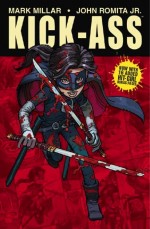
Now that the furore has died down over the first movie and is yet to begin in regard to the sequel, I thought I’d take a look at the marvellously fun, blackly comedic and ultra-violent comedy that is Kick-Ass purely in terms of a reading experience, courtesy of the 2010 British Titan Books edition, which includes – as well as all 8 issues of the creator-owned comicbook miniseries (originally published through Marvel’s Icon imprint) – 15 pages of unseen design sketches, pages in process and assorted unseen artworks featuring the scene-stealing tyke of terror Hit-Girl…

Set in the horribly drab and disappointing real world, it all begins with the trenchant recollections of High School no-hoper Dave Lizewski, a pitifully average and unhappy teenager who loves comicbooks. With no chance of being part of the in-crowd, Dave hangs out with the other geeks, talking TV, movies, funnybooks and girls – and, of course, is besotted with ultra-queen of cool Katie Deauxma – who naturally despises him…

One day he has his big inspiration – he’s going to be a masked superhero. All he needs is a costume and a gimmick. Oh, and a codename too…

Clad in a wetsuit bought online and filled with hope, Dave starts patrolling the streets and promptly gets beaten into a coma by three kids tagging a wall…

After months in hospital and with three metal plates in his skull, Dave eventually returns to school, but the compulsion hasn’t left him and he is soon prowling the city again. Chancing on a mugging the masked moron again piles in and – more by sheer bloody-mindedness than any particular skill or power – manages to drive off the assailants. Moreover, this time his battle was caught on witnesses’ camera-phones and uploaded to YouTube…

An overnight internet sensation and supremely overconfident, Dave, or Kick-Ass, is floating on a cloud. Even Katie seems to have finally noticed him… but only because he’s gay: a rumour that had started when he was found naked and severely battered months ago…

So desperate is Dave that he plays to the rumour and becomes the prom queen’s “gay best friend”, whilst spending solitary moment stalking the streets, alleyways and rooftops in his superhero persona. He even starts a Kick-Ass MySpace page where fans and people in trouble can contact him…

Dave’s life goes into deadly overdrive when he acts on one plea and marches into a grungy apartment determined to talk a lowlife thug out of harassing and stalking his ex-wife. Suddenly confronted with a posse of brutal criminals for whom violence is a way of life, Kick-Ass is being beaten to death when a diminutive 10-year old girl slaughters the entire gang with deadly ease and honking great samurai swords…

Dave can only watch in awe as Hit-Girl glides like a ghost over the rooftops and returns to her burly partner Big Daddy: cool, efficient ninjas of justice and everything he’s aspired to be but could never approach in a million years…

These urban vigilantes are utter ciphers, stalking and destroying the operations of brutal Mafia boss Johnny Genovese with remorseless efficiency and in complete attention-shunning anonymity.

Dave is simply not in their league and doesn’t care for their methods. After all, superheroes don’t kill… Chastened and a little scared, he grudgingly carries on his own small-scale endeavours, drawing some measure of comfort from the growing band of costumed imitators Kick-Ass has inspired and those regular intimate moments when the still blithely ingenuous Katie tells him all her secrets, dreams and desires…

Things start to look up when he meets Red Mist, a fellow adventurer and one with a flashy car and lots of expensive toys. When the pair very visibly become media darlings during a tenement fire, Kick-Ass is visited by Big Daddy and Hit-Girl, who think they’ve found the perfect back-ups to help them finally eradicate the Genovese mob…

After telling Katie the truth, Dave rendezvous with Red Mist for the big push only to find that his partner is Genovese’s geeky, psychotic son, and the whole act has been an elaborate trap to kill the far-too effective and expensively competent Big Daddy and Hit-Girl…

With both his allies apparently dead, Dave is being slowly tortured to death. Kick-Ass can only draw upon his one advantage – his sheer, stupid inability to give up – until the miraculously surviving Hit-Girl comes to rescue with her customary mercilessness…

Bloody, bruised, broken but unbowed, Kick-Ass finally sheds his last superhero scruple and tools up for a blistering bloody showdown in the mobster’s skyscraper fortress…

Appallingly, graphically hyper-violent and atrociously foul-mouthed, Kick-Ass is the ultimate extension of the trend for “realistic” superhero stories and simultaneously a brilliantly engaging and cynically hilarious examination of boyhood dreams and power fantasies, delivered with dazzling aplomb, studied self-deprecation and spellbinding style.

Mark Millar’s compelling script – unlike the movie adaptation – never steps beyond the bounds of possibility and credibility, whilst the stunning art collaboration of John Romita Jr., Tom Palmer and colourist Dean White delivers an all too familiar picture-perfect New York.

Sharp, shocking, superb and with the promise of yet more and even better to come, the graphic novel Kick-Ass is a story not just for comics fans but a genuine treasure for all followers of furious fun and fantasy in any medium.

Kick-Ass comic strip © 2010 Mark Millar and John S. Romita.

Operative: Scorpio


By Jack Herman, Dan Tolentino & Danny Taver (Blackthorne Publishing)
ISBN: 0-932629-15-6

Sometimes I just get a devil in me…

Although I review a broad spectrum of illustrated narratives and comics related books, I generally stick to the rule of thumb that the selection has to have some intrinsic quality or merit. Occasionally however there comes an item that I just can’t rationally recommend but still just… sends me…

As the first contraction of the 1980s independent comics boom began to cut down the plethora of small publishers, Blackthorne moved from canny licensed properties such as California Raisins and Rocky and Bullwinkle, 3-D titles and classic reprints like Tarzan, Dick Tracy and Betty Boop into a line of all-new characters, which might well have hastened their demise.

They also brought out many early graphic novels and Operative: Scorpio might well rank amongst their oddest.

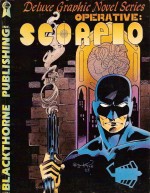
In blocky black and white the confused but compellingly enthusiastic caper details the story of ambitious young thug Carl Manara who takes sole proprietorship of PMD, a new super-addictive drug hitting the streets of a peculiarly Latino Los Angeles, consequently falling foul of the criminal overlord Monticello, whose cabal Blackleague runs the entire country’s illegal enterprises.

Monticello has other problems; specifically a crazy masked martial artist roaming the streets and hitting all his organisations rackets. Scorpio’s campaign is costing him money and the cops – bought or honest – can’t catch the mysterious vigilante…

‘Breaking and Entering’ introduces Police Detective Morgan Pierce, tasked with stopping Manara’s super-drug from causing a bloody turf war. He has no interest in catching Scorpio: in fact he thinks the guy’s a hoax or urban legend…

Pierce has some odd friends he seems embarrassed by: fly-by-night playboy nightclub owner Aristotle, whose clientele ranges from the social elite to the dregs of the city, and disgraced competition martial artist Jay-Daniel Cobra, who only seem to meet with him at the oddest times – whenever no body’s watching…

After some beat cops are killed and civilians come under fire Scorpio gets involved, but Manara has a secret weapon. The designer of the new drug is a highly respected college professor and the only one who knows the formula, protected by a lethal hand-to-hand fighter. When the masked man raids the chemist’s fortress home Scorpio barely survives the encounter.

With war brewing between Manara and Monticello, the upstart’s gang begins selling the new dope out of their car and soon civilians are caught in gang crossfires. The cops won’t touch the dealers – after all they are Homicide Detectives too…

And that’s when the enigmatic Scorpio decides on drastic action: all three of him…

Muddled, manic and utterly mad, this yarn is full of brutal, pell-mell action and short on characterisation but that really doesn’t matter as the drama barrels along, reaching a climax but no real conclusion.

Clearly the opening shot in a longer epic, this dark yarn, with echoes of 1970’s exploitation cinema and Grindhouse movies, was written by Jack Herman, with art by the clearly Latin American or Filipino team of Dan Tolentino & Danny Taver – possibly pseudonyms for three or four different artists in a shared studio.

Even in 1989 the book looked and felt a decade older and I have a sneaking suspicion that it might even be a Mexican digest-comics story surreptitiously picked up and translated: no proof to support the idea but it just has that unshakeable feel to it…

Inexplicably compelling and splendidly fun, this is another guilty pleasure retro-read, best absorbed whilst listening to “Sabotage” by the Beastie Boys… but only at maximum volume.
© 1988 Blackthorne Publishing, Inc. All rights reserved.

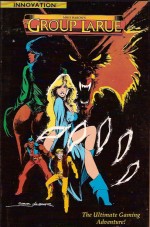
Mike Baron’s The Group LaRue: the Ultimate Gaming Adventure


By Mike Baron, David Campiti, Paul Curtis, Faye Perozich, Andy Kuhn & Chris Tsuda (Innovation)
No ISBN:

Once upon a time Dungeons & Dragons style role playing games were the most compelling and obsessive things kids could do. All over the civilised world bands of youngsters would gather in furtive secrecy to play at being wizards, thieves and heroes with dice and bits of paper. How spoiled modern children must be with their electronic paraphernalia and tolerant parents, but at least it’s not like my distant school days when we just stood in the pouring rain, rolling hoops, hitting each other in the face with 24lb leather footballs and imagined ourselves as heroes by hitting each other with sticks whilst chain-smoking, beer-swilling teachers gazed on uncaringly…

But I digress: the late 1980s were a fertile time for American comics-creators. An entire new industry had been born with the growth of the Direct Sales market and its dedicated specialist retail outlets; new companies were experimenting with format and content, and punters even had a bit of spare cash to play with.

Moreover much of the “kid’s stuff” stigma had finally abated and the country was catching up to the rest of the world in acknowledging that sequential narrative might just be a for-real actual art-form…

Consequently many young start-up companies began competing for the attention and cash of punters who had grown resigned to getting their on-going picture stories from DC, Marvel, Archie and/or Harvey Comics. European and Japanese material had been creeping in and by 1983 a host of young companies such as WaRP Graphics, Pacific, Eclipse, Capital, Now, Comico, Dark Horse, First and many others had established themselves and were making impressive inroads.

New talent, established stars and fresh ideas all found a thriving forum to try something a little different both in terms of content and format. Even smaller companies had a fair shot at the big time and a lot of great material came – and too often, quickly went – without getting the attention or success it warranted.

One of the last to emerge as a contender was Innovation Publishing, founded by David Campiti in 1988, which added canny reprints collections like Bill Ward’s Torchy, Larry Harmon’s Bozo, the World’s Most Famous Clown and Walt Kelly’s Santa Claus Adventures and a judicious accumulation of acquired ongoing titles such as The Maze Agency and Hero Alliance to its deftly imaginative run of original titles like Scarlet Kiss, Cyberpunk, Legends of the Star Grazers, Scaramouch, Straw Men and many others.

The company’s true strength lay in a vibrant specialisation in adapted fantasy properties ranging from Lost in Space, Quantum Leap, Dark Shadows, A Nightmare on Elm Street, Beauty and the Beast and other media sensations to popular literary works such as Terry Pratchett’s The Colour of Magic and The Light Fantastic, Piers Anthony’s Incarnations of Immortality, Gene Wolf’s The Shadow of the Torturer and a welter of blood-drenched vampire epics based on the horror works of Anne Rice.

At its height Innovation ranked fourth in market share behind Marvel, DC and Dark Horse Comics but intriguingly, one of their earliest failures – a troubled series devoted to the magic of RPG – was, in retrospect, amongst the best yarns in their canon…

Devised and scripted by Nexus and Badger creator Mike Baron the short and sweet saga of the Group LaRue told the tale of five role-playing kids who suddenly realised it wasn’t just a game anymore…

This slim full-colour collection gathers the three issue tale beginning with ‘Enter: the Group LaRue!’ by Baron and illustrators Andy Kuhn & Chris Tsuda, as five Minneapolis kids sneaked into an old deserted mansion to play their weekly game only to be interrupted by a real wizard.

When he was killed by a gigantic spear his magic gem exploded and the play-actors suddenly transformed into the characters they were channelling: a psychic Precog, superheroes Spark and Lead Plate, super-genius Scrambler and a flying Werewolf.

This last was Gil La Rue – whose illusionist grandfather built the abandoned mansion years ago, before suddenly vanishing.

The boy took charge when the villains in their planned game scenario manifest and deadly giant bug-men attack the bewildered kids…

Escaping with their lives the disbelieving players regrouped outside the mansion only to discover that Gil’s house had burned down and his whole family were gone…

Staying with best friend Manny Rhodes AKA Lead Plate, Gil deduced that whatever forces they unwittingly unleashed might well be hunting them all…

And that’s when estate executor Bob Whitney arrived, offering to reveal the secrets and reasons for their uncanny transformations. Apparently the elder La Rue belonged to a cult which covertly guards humanity against supernatural invasion, but now only Gil and his friends are left to carry on the interrupted mission…

Baron was gone by the second issue ‘Thrown for a Loup!’ but scripters Campiti & Paul Curtis carried on the saga with Kuhn & Tsuda faithfully continuing the art chores as the kids reluctantly explored the subterranean netherworld beneath La Rue mansion, battling more bug-things and seeking out the evil sorcerer who controlled them, but it’s soon clear that there was far more to good old Bob than met the eye…

The yarn came to an abrupt end with ‘Bug Out!’ (written by Campiti & Faye Perozich) as the team, still trapped in some otherworldly underground dimension learned the kind of man Bob was and a few basic home-truths such as not all monsters look scary, ugly doesn’t mean evil and especially “there’s no place like home”…

Clever, funny, thrilling and gloriously cathartic in a wholesome all-ages way, this old-fashioned adventure fantasy with a thoroughly modern “happy ever after” was fabulously fun and definitely deserved a longer run and a steady creative team behind it.

Even with the action long over there’s still plenty of enjoyment for modern readers and magic loving fans to discover if they can track down this buried treasure
™ and © 1989 Michael Baron. Product package © 1989 Innovative Corp. Part #1 story © 1989 Michael Baron. Part #2-3 story © 1989 Innovative Corp. Artwork © 1989 Andy Kuhn. All rights reserved.

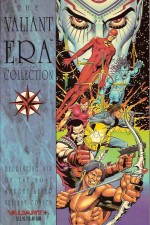
The Valiant Era Collection


By Jim Shooter, Bob Hall, Don Perlin, Steve Ditko, Gonzalo Mayo, Stan Drake & various (Valiant)
No ISBN

During the market-led, gimmick-crazed frenzy of the 1990s amongst the interminable spin-offs, fads and shiny multiple-cover events a new comics company revived some old characters and proved once more that good story-telling never goes out of fashion. As Editor-in-Chief, Jim Shooter had made Marvel the most profitable and high-profile they had ever been and, after his departure, he used that writing skill and business acumen to transform some almost forgotten Silver-Age characters into contemporary gold.

Western Publishing had been a major player since comics’ earliest days, blending a wealth of licensed titles such as TV and Disney titles, Tarzan, or the Lone Ranger with homegrown hits like Turok, Son of Stone and Space Family Robinson. In the 1960s during the superhero boom these adventure titles expanded to include, Brain Boy, M.A.R.S. Patrol Total War (created by Wally Wood), Magnus, Robot Fighter (by the incredible Russ Manning) and in deference to the atomic age of heroes, Nukla and the brilliant Dr. Solar, Man of the Atom. Despite supremely high quality and passionate fan-bases, they never captured the media spotlight of DC or Marvel’s costumed cut-ups. Western shut up their comics division in 1984.

With an agreement to revive some, any or all of these four-colour veterans, Shooter and co-conspirator Bob Layton came to a bold decision and made those earlier adventures part-and-parcel of their refit: acutely aware that old fans don’t like having their childhood favourites bastardized and that revivals need all the support they can get. Thus the old days were canonical: they “happened.”

The company launched with a classy reinterpretation of science fiction icon Magnus, but the key title to the new universe they were building was the broadly super-heroic Solar, Man of the Atom which launched with an eye to all the gimmicks of the era, but also cleverly realised and realistically drawn.

Hit after hit followed and the pantheon of heroes expanded until dire market condition and corporate chicanery ended the company’s stellar expansion. Gradually it fractionated and all but disappeared…

Now with a Bloodshot movie in the offing and reports of the company’s revival here’s a glimpse at one of their too few graphic novel collections from the early days of the format.

The Valiant Era Collection, representing Magnus #12, Solar #10-11, Eternal Warrior #4-5 and Shadowman #8, was released in 1994 as an introductory sampler and canny compendium of first appearances from the company’s burgeoning continuity which gathered a disparate selection of tales which had one thing in common: the debuts of characters that had quickly become “hot”.

In the collector-led era of the early 1990s – before one zillion internet sites and social networking media – many new concepts caught the public’s attention only after publication. The seemingly-savvy snapped up multiple copies of comics they subsequently couldn’t sell and many genuinely popular innovations slipped by unnoticed until too late.

This trade paperback from a company that valued storytelling above all else addressed that thorny issue by simply bundling their own hot and hard to find hits in one book…

‘Stone and Steel’ was written by Faye Perozich and Shooter and illustrated by Gonzalo Mayo, and found Robot-Fighting superman Magnus transported to a timeless dimension where dinosaurs and cavemen existed side by side. Once there he became embroiled in a battle for survival against his old enemy Laslo Noel: a rabid anti-technologist not averse to using modern super-weapons to force his point of view.

The Lost Land had other defenders, most notably two Native American warriors named Turok and his young companion Andar. The pair had been a popular Western Publishing mainstay for over a quarter of a century (see Turok, Son of Stone) and their initial (re)appearance here led to their revival in a succession of titles which even survived the company’s demise as well as a series of major computer and video games.

That spectacular and entrancing epic is followed by a two-part Solar saga which introduced an immortal warrior prince and paved the way for the disclosure of the secret history which underpinned the entire Valiant Universe.

Solar was brilliant nuclear physicist Phil Seleski, who designed a new type of fusion reactor and was transformed into an atomic god when he sacrificed his life to prevent it destroying the world.

His energized matter, troubled soul, coldly rational demeanour and aversion to violence made him a truly unique “hero” but his discovery of hidden meta-humans and a genuine super-villain in the ambitious, mega-maniacal form of ultra psionic Toyo Harada led Solar into a constantly escalating Secret War.

Solar #10, ‘The Man who Killed the World’ by Shooter, Don Perlin, Stan Drake, John Dixon & Paul Autio, introduced a raft of new concepts and characters beginning with troubled teen Geoffry McHenry – the latest in a long line of Geomancers blessed or cursed with the power to communicate with every atom that comprises our planet. When the world screams that a sun-demon is about to consume it Geoff tracks down Seleski only to determine that Solar is not unique and the threat is still at large.

Meanwhile, however, Harada’s Harbinger Foundation has sent all its unnatural resources to destroy the Man of the Atom, supplemented by a mysterious individual named Gilad Anni-Padda, an Eternal Warrior who has been battling evil around the globe for millennia and has worked with a number of Geoff’s predecessors…

The concluding chapter ‘Justifiable Homicides’ (Shooter, Steve Ditko, Ted Halsted & Mayo) finds Geomancer, Gilad and Solar battling for their lives against an army of Harbinger super-warriors but as always with this series, the ending is not one you’ll see coming…

Gilad quickly jumped to his own series and Eternal Warrior #4-5 introduced his immortal but unnamed undying nemesis in ‘Evil Reincarnate’ (Kevin Vanhook, Yvel Guichet & Dixon) a tale of ancient China which segues neatly into a contemporary tale battling the drug-baron who is his latest reborn iteration before the nanite-enhanced techno-organic wonder warrior Bloodshot explodes onto the scene in ‘The Blood is the Life’ (by Vanhook & Dixon); a blockbusting action epic which set up the enhanced assassin’s own bullet-bestrewn series and, tangentially, the 40th century Magnus spin-off Rai…

The final debut in this volume was not for another hero but rather featured the introduction of the Valiant Universe’s most diabolical villain. Shadowman #8 held ‘Death and Resurrection’ (Bob Hall, Guichet & Dixon) and changed the rules of the game throughout the company’s growing line of books.

Jack Boniface was a struggling session saxophonist trying to strike it rich in the Big Easy when he was seduced by Lydia, a mysterious woman he picked up in a club. Her sinister, trysting assault left him unconscious, amnesiac and forever altered by a bite to his neck. Lydia was a Spider Alien: part of a race preying on humanity for uncounted centuries and responsible for creating many of the paranormal humans who secretly inhabit the world.

Her bite forever changed Jack and when darkness falls he becomes agitated, restless and extremely aggressive: forced to roam the Voodoo-haunted streets of New Orleans as the compulsive, impulsive daredevil dubbed Shadowman – a violent, driven maniac, hungry for conflict – but only when the sun goes down…

This tale examines the deadly criminal drug sub-culture of the city as a new narcotic begins to take its toll: a poison which forces its victims to careen through the streets bleeding from every orifice until they die. Witnesses call them “Blood Runners”…

As Shadowman investigates he is unaware that he is a target of the drug’s creator – an ancient sorcerer named Master Darque – and that soon the world will no longer be the rational, scientific place he believed.

Soon Jack will have terrifying proof that magic is both real and painfully close and that the Man of Shadow is not a creature of exotic physics and chemistry but something far more arcane and obscure…

Despite being a little disjointed these stories are immensely readable and it’s a tragedy that they’re not all readily available. Still there are always the back issue comics and the hope that the new revival might spawn a few trade paperback editions. Until then you can still hunt down this and the precious few other collections via your usual internet and comic retailers, and trust me, you really should…
© 1994 Voyager Communications Inc. and Western Publishing Company, Inc. All rights reserved.

StormWatch: Final Orbit


By Warren Ellis, Bryan Hitch & Paul Neary, Michael Ryan & Luke Rizzo and Chris Sprouse & Kevin Nowlan (WildStorm/ DC Comics/Dark Horse Comics)
ISBN: 978-1-84023-381-0

One era ended and another began with the brace of tales collected in this slim tome: a rare positive example of the often vilified (by me particularly) movie property/comicbook crossover events and one which actually impinges on and affects the continuity of one if not both partners in the enterprise.

StormWatch was the UN’s Special Crisis Intervention unit; created to manage global threats and superhuman menaces with international ramifications. From their Skywatch satellite in orbit above Earth they observed, waiting for a member nation to call for help…

The multinational mini-army comprised surveillance and intelligence specialists, tech support units, historians, researchers, detention facilities, combat analysts, divisions of uniquely trained troops, a squadron of state-of-the-art out-atmosphere fighter planes and a band of dedicated superheroes for front-line situations beyond the scope of mere mortals. In the pilot’s seat was the incorruptible overseer codenamed “Weatherman”.

The title was part of the 1990s comics revolution which saw celebrated young creators abandon major “work-for-hire” publishers to set up their own companies and titles – with all the benefits and drawbacks that entailed. Like most of those glossy, formulaic, style-over-content, painfully derivative titles, it started with honest enthusiasm but soon bogged down for lack of ideas.

Warren Ellis took over the moribund morass with issue #37 (collected in assorted graphic novels and reviewed in here recently) and immediately began kicking some life into the title. Soon the series became an edgy, unmissable treatise on modern heroism and the uses and abuses of power. Making the book unquestionably his plaything Ellis slowly evolved StormWatch out of existence, to be reborn as the no-rules-unbroken landmark The Authority.

This volume collects the concluding issues of the comic’s second volume (#11-12) between which a WildC.A.T.s/Aliens one-shot neatly slotted in to change that particular fictional universe forever.

It all begins with ‘No Reason’ (illustrated by Bryan Hitch & Paul Neary and Michael Ryan & Luke Rizzo) as the assembled heroes and foot-soldiers of the UN Crisis Intervention organisation detect an odd asteroid moving towards Earth. Dispatching two shuttles to examine and divert the giant rock before it can fall into our planet’s gravity-well, the explorers soon realise it’s a vessel of unknown origins.

When contact is lost the assorted tensions rise, but the re-routing of the ominous astral intruder goes off as planned and the mysterious moonlet is soon heading into the sun. However only one ship is returning to Skywatch and they aren’t answering the radio…

WildC.A.T.s/Aliens (Ellis, Chris Sprouse & Kevin Nowlan) opens with a StormWatch life-pod crashing into Manhattan: its few battered survivors telling of an alien attack by creatures all fangs and rage and spitting acid. The creatures were unstoppable and as soon as the refugees had escaped Weatherman sealed the space-station in an unbreakable quarantine…

Rogue heroes WildC.A.T.S, fearing the aliens are their marauding Daemonite enemies, decide to break the global protocols and investigate the locked down StormWatch citadel. But the beasts they find there are like nothing they have ever experienced before…

In one of the few comics situations where Ridley Scott and James Cameron’s Aliens truly worked and fully displayed their awesome ferocity, the WildC.A.T.S only just rescue the scant survivors of StormWatch’s 500+ compliment of mortals and metahumans, before sending the irreparably contaminated space station plunging into the sun after the star-rock that brought the Aliens to our doorstep…

With the immediate threat to Earth averted, ‘No Direction Home’ wraps up the tale and the saga of StormWatch as the organisation’s Black Ops unit Jenny Sparks, Jack Hawksmoor and Swift go deep undercover to tie-up all the loose ends preparatory to re-emerging as The Authority…

Combining low key drama and oppressive tension with staggering action and adventure this chilling tale was the perfect palate-cleanser before the landmark step-change of The Authority and their in-your-face, unconventional, uncompromising solutions to traditional costumed crusader problems.

StormWatch: Final Orbit – although certainly not to everybody’s taste – perfectly closes one chapter of the post-modern superhero saga: solidly in tune with the cynical, world-weary predilections of many older fans and late-comers to the medium.

© 1998 WildStorm Productions, an imprint of DC Comics, and Dark Horse Comics. Compilation © 2001 WildStorm Productions, an imprint of DC Comics, and Dark Horse Comics All Rights Reserved.

StormWatch: Change or Die


By Warren Ellis, Oscar Jimenez, Tom Raney, & various (DC/WildStorm)
ISBN: 978-1-84023-631-6

StormWatch was the UN’s Special Crisis Intervention unit; created to manage global threats and superhuman menaces with international ramifications. From their Skywatch satellite in orbit above Earth they observed, waiting for a member nation to call for help…

The multinational mini-army comprised surveillance and intelligence specialists, tech support units, historians, researchers, detention facilities, combat analysts, divisions of uniquely trained troops, a squadron of state-of-the-art out-atmosphere fighter planes and a band of dedicated superheroes for front-line situations beyond the scope of mere mortals. In the pilot’s seat was incorruptible overseer Henry Bendix – “The Weatherman”.

The title sprang from the comics revolution which saw celebrated young creators abandon major “work-for-hire” publishers to set up their own companies and titles – with all the benefits and drawbacks that entailed. As with most of those glossy, formulaic, style-over-content, almost actionably derivative titles, it started with honest enthusiasm but soon bogged down for lack of ideas.

Warren Ellis took over the moribund morass with issue #37 (see the previous collection StormWatch: Force of Nature) and immediately began beating life into the title. Soon “just another high-priced team-book” became an edgy, unmissable treatise on practical heroism and the uses and abuses of power. Making the book unquestionably his plaything Ellis slowly evolved StormWatch out of existence, to be reborn as the no-rules-unbroken landmark The Authority.

This volume collects and concludes the comicbook’s first volume with issues #48-50 and bridges the gap to the second volume’s issues #1-3 with the extremely rare – and short – StormWatch Preview edition, all scripted by Ellis as he re-redefined the masked hero for a new millennium.

The action and suspense begins with ‘Change or Die’ (with art from Tom Raney & Randy Elliott) as the StormWatch team are targeted by a ruthless band of superhumans, led by a long dormant superman who first began fighting social injustice before World War II. After years of planning these underground wonder warriors are boldly using their powers to wipe out all the inequities of the old World Order and build a better world. Of course that means doing away with armies, politicians, all governments and any superheroes who don’t agree with them…

This more than any other is the tale which introduced The Authority – in concept at least – to the comics world, as the ambitious but completely best-intentioned team (including prototype versions of both The Doctor and The Engineer) strike on many fronts, turning deserts into gardens, brutally wiping out brutal dictatorships and revealing all those dirty little secrets to the global populace…

In a bid to save “human civilisation” Weatherman authorises all of StormWatch for a kill mission… but even as Bendix’s true character and plans are revealed the poor suckers on the front line – and even their idealistic antagonists – discover amidst bloody, spectacular battle that the real enemy in the way of a global paradise is, always, human nature…

Following the apocalyptic events which wrapped up the first series ‘Terminal Zone’ (illustrated by Oscar Jimenez & Chuck Gibson) opens with new Weatherman Jackson King and the surviving team members going through their paces in a rather subversive public relations exercise before ‘Strange Weather’ (rendered by the mob-handed art-horde of Jimenez, Michael Ryan, Jason Gorder, Mark McKenna, Richard Friend, Eduardo Alpuente & Homage Studios) launches the new adventures as StormWatch metahumans raid a clandestine US facility illegally weaponising US troops and other lethal biological materials.

It appears that America is willfully breaking UN Resolutions restricting the creation of super-soldiers; but is this the work of militant terrorists and disaffected renegades or does the chain of command reach higher – perhaps to the White House itself?

The team is soon hip-deep in DNA horrors and official hypocrisy when they infiltrate a sleepy Alabama town and the Federal government declares war on StormWatch…

Dark, scary and rabidly political, the tension and intrigue are ramped up to overload, but as always the hip and cynical message is leavened with spectacular action, mind-blowing big science thrills and magically vulgar humour.

Mixing tradition with iconoclastic irreverence this volume cleared the way and set the scene for the landmark step-change of The Authority and although certainly not to everybody’s taste, these perfect post-modern superhero sagas definitely deliver a blast of refreshing cool air for the jaded, world weary older fan.
© 1997, 1998, 1999 WildStorm Productions, an imprint of DC Comics. All Rights Reserved.

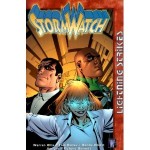
Stormwatch: Lightning Strikes


By Warren Ellis, Tom Raney, Jim Lee & various (DC/WildStorm)
ISBN: 978-1-84023-617-0

StormWatch was a paramilitary Special Crisis Intervention unit tasked with managing global threats and superhuman menaces with international ramifications; operating under the oversight of a UN committee. From their “Skywatch” satellite in geosynchronous orbit above Earth they observed, waiting until a member nation called for help…

The multinational taskforce comprised surveillance and intelligence specialists, tech support units, historians, researchers, detention facilities, combat analysts, divisions of uniquely trained troops, a squadron of state-of-the-art out-atmosphere fighter planes and a band of dedicated superheroes for front-line situations beyond the scope of mere mortals. In the pilot’s seat was incorruptible overseer Henry Bendix – “The Weatherman”.

StormWatch was born during the comics revolution which saw celebrated young creators abandon major “work-for-hire” publishers to set up their own companies and titles – with all the benefits and drawbacks that entailed. As with most of those glossy, formulaic, style-over-content, almost actionably derivative titles, it started with an honest hectic enthusiasm but soon bogged down for lack of ideas.

Warren Ellis took over the ponderous feature with issue #37 (see the previous collection StormWatch: Force of Nature) and immediately began beating life into the title. Soon “just another high-priced team-book” became an edgy, unmissable treatise on practical heroism and the uses and abuses of power. Making the book unquestionably his plaything Ellis slowly evolved StormWatch out of existence, to be reborn as the no-rules-unbroken landmark The Authority.

StormWatch: Lightning Strikes collects issues #43-47 of the comicbook, taking short, hard looks at individual cast members and also features a spectacular gallery of covers and variant-covers by Tom Raney & Randy Elliot, Mark Irwin, Gil Kane and Jim Lee.

The incisive explorations begin with ‘Jack Hawksmoor’, a human subjected to decades of surgical manipulation by aliens to become the avatar of cities. Drawn to the scene of a serial killer’s grotesque excesses Jack uncovers a festering government cover-up which reaches deep into the soul of America’s most revered idols and threatens to rip the country apart if exposed.

But the apparently untouchable murderer will never cease his slaughter-campaign unless someone stops him…

‘Jenny Sparks’ follows the cynical Englishwoman whose electrical powers were an expression of her metaphysical status as incarnate “Spirit of the Twentieth Century”: a captivating pastiche of fantasy through the last hundred years as the jaded hero recounts her life story (see also Jenny Sparks: The Secret History of the Authority) in a dazzling series of pastiches referencing Siegel & Shuster, Frank Hampson’s Dan Dare, Kirby, Crumb and the horrors of Thatcherite Britain in a gripping tale of betrayal, whilst the terse thriller ‘Battalion’ sees StormWatch’s normally non-operational, behind-the-scenes trainer fall into a supremacist terror-plot whilst on leave in Alabama and forced to call on skills and abilities he never thought he’d need again…

‘Rose Tattoo’ was a mute and mysterious sexy super psycho-killer recruited by Bendix as a walking ultimate sanction. When her super-powered team-mates go on a hilarious alcoholic bonding exercise she finally shows her true nature in a tale which foreshadows an upcoming crisis for the entire team… and planet.

Following Raney & Randy Elliot’s sterling run of the previous four tales Jim Lee & Richard Bennett illustrate the concluding ‘Assembly’ as Bendix sends his core-team into the very pits of Hell in a bombastic action-packed shocker that acts as a “jumping-on point” for new readers and a reminder of what StormWatch is and does… preparatory to Ellis kicking the props out from under the readership in the next volume…

One again skilfully mixing the traditional with the outrageous these episodes offered a fresh take on the costumed catastrophe genre that energised once-jaded readers and paved the way for the graphic phenomenon of the Authority. Darkly anarchic, funny and frightening these tales celebrate the best of what has gone before whilst kicking in the doors to a bleaker more compelling tomorrow.

© 1996, 1997, 2000 WildStorm Productions, an imprint of DC Comics. All Rights Reserved.

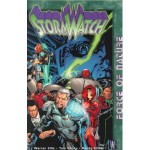
Stormwatch: Force of Nature


By Warren Ellis, Tom Raney& Randy Elliot (DC/WildStorm)
ISBN: 978-1-48023-611-8

StormWatch evolved out of the creative revolution which saw big name creators abandon the major “work-for-hire” publishers and set up their own companies and titles – with all the benefits and drawbacks that entailed. As with most of those glossy, formulaic, style-over-content, almost actionably derivative titles the series started with a certain verve and flair but soon bogged down for a lack of ideas and outside help was called in to save the sinking ships.

Dedicated Iconoclast Warren Ellis took over the cumbersome series with issue #37 and immediately began brutalizing the title into something not only worth reading but within an unfeasibly brief time produced a dark, edgy and genuinely thought-provoking examination of heroism, free will, the use and abuse of power and ultimate personal responsibility. Making the book uniquely his, StormWatch became unmissable reading as the series slowly evolved itself out of existence, to be reborn as the eye-popping, mind-boggling anti-hero phenomenon The Authority.

StormWatch was a vast United Nations-sponsored Special Crisis Intervention unit tasked with managing superhuman menaces with national or international ramifications and global threats, operating under the oversight of a UN committee. They were housed in “Skywatch” a futuristic space station in geosynchronous orbit above the planet and could only act upon specific request of a member nation.

The multinational taskforce comprised surveillance and intelligence specialists, technical support units, historians and researchers, detention technicians, combat analysts, divisions of uniquely trained troops, a squadron of state-of-the-art out-atmosphere fighter planes and a band of deputised superheroes for front-line situations beyond the scope of mere mortals. The whole affair was controlled by incorruptible overseer Henry Bendix – “The Weatherman”.

Referencing a host of fantasy classics ranging from T.HU.N.D.E.R. Agents and Justice League of America to Captain Scarlet and Star Trek: the Next Generation, StormWatch: Force of Nature collects issues #37-42 of the comicbook series and describes how the death of a team-member forces Bendix to re-evaluate his mission and find more effective ways to police the growing paranormal population and the national governments that seek to exterminate or exploit them…

The restructuring begins in ‘New World Order’ as, following the funeral of a fallen comrade, Bendix fires a large number of the superhuman contingent and recruits a trio of new “posthuman” heroes: electric warrior Jenny Sparks, extraterrestrially augmented detective Jack Hawksmoor and psycho-killer Rose Tattoo.

Weatherman’s own chain-of-command has altered too: his new superiors of the UN Special Security Council are all anonymous now and, with the world in constant peril, they have given Bendix carte blanche. He will succeed or fail all on his own…

The super-agents are further restructured: StormWatch Prime is the name of the regular, public-facing metahuman team, whilst Black is the code for a new covert insertion unit. StormWatch Red comprises the most powerful and deadly agents: they will handle “deterrent display and retaliation” – preventing crises by scaring the bejeezus out of potential hostiles…

Meanwhile, as all the admin gets signed off, in Germany a madman has unleashed a weaponized superhuman maniac to spreading death, destruction and disease. Whilst new Prime Unit deals with it Bendix shows the monster’s creator just how far he is prepared to go to preserve order on the planet below…

‘Reprisal’ is a murder investigation. No sooner had one of the redundant ex-StormWatch operatives arrived home than he was assassinated and Jack Hawksmoor, Irish ex-cop Hellstrike and pyrokine Fahrenheit’s subsequent investigation reveals the kill was officially instigated by a friendly government and StormWatch member-state…

Hawksmoor, Jenny Sparks and aerial avenger Swift are dispatched to an ordinary American town with a big secret in ‘Black’ as Amnesty International reports reveal that some US police forces are engaging in systematic human rights abuse. In Lincoln City they’re also building their own metahuman soldiers and testing them on ethnic minorities…

‘Mutagen’ sees the Prime team in action in Britain when terrorists release an airborne pathogen to waft its monstrous way across the Home Counties, turning humans into ghastly freaks for whom death is a quick and welcome mercy. As Skywatch’s Hammerstrike Squadron performs a sterilising bombing run over outraged Albion StormWatch Red arrives in the villains’ homeland to teach them the error of their ways…

In this continuum most superhumans are the result of exposure to a comet which narrowly missed the Earth, irradiating a significant proportion of humanity with power-potential. These “Seedlings’” abilities usually lie dormant until an event triggers them.

StormWatch believed they had a monopoly on posthumans who could trigger others in the form of special agent Christine Trelane, but when she investigates a new potential meta, she discovers proof of another ‘Activator.’

Coming closer to solving a long-running mystery regarding where the American Government is getting its new human weapons, Trelane first has to deal with the worst kind of seedling… a bad one…

This first collection of the Ellis Experiment concludes with the spectacular ‘KodÇ’.’ Japan shudders and reels under the telekinetic assault of cruelly conjoined artificial mutants bred by a backward-looking doomsday-cult messiah so the Prime team is dispatched to save lives and hunt down the instigators in a good old-fashioned, get-the-bad-guys romp which gives the team’s multi-faceted Japanese hero Fuji a chance to shine winningly…

Artfully blending the comfortably traditional with the radically daring these transitional tales offered a new view of the Fights ‘n’ Tights scene that tantalised jaded readers and led the way to the groundbreaking phenomenon of the Authority.

Tom Raney & Randy Elliott’s art is competent but mercifully underplayed – a real treat considering some of the excessive visual flourishes of the Image Era – but the real focus of attention is always the brusque “sod you” True Brit writing which trashes all the treasured ideoliths of superhero comics to such devastating effect.

This is superb action-based comics drama: cynical, darkly satirical, anarchic, alternately rip-roaringly funny and chilling in its examination of Real Politik but never forgetting that deep down we all really want to see the baddies get a good solid smack in the mouth…
© 1996, 1999 WildStorm Productions, an imprint of DC Comics. All Rights Reserved.

Dynamo


By Wally Wood & various (Tower Books)
ISBN: 42-660

I’ve often harped on about the mini-revolution in the “Camp-superhero” crazed 1960s that saw four-colour comicbook classics migrate briefly from flimsy pamphlet to the stiffened covers and relative respectability of the paperback bookshelves, and the nostalgic wonderments these mostly forgotten fancies still afford (to me at least), but here’s one that I picked up years later as a marginally mature grown man.

Although the double-sized colour comicbooks T.H.U.N.D.E.R. Agents, its spin-offs Undersea Agent, Dynamo, NoMan and the magnificent war-comic Fight the Enemy were all distributed in Britain (but not, I believe comedy title Tippy Teen) these monochrome, resized book editions, to the best of my knowledge, were not.

It doesn’t matter: to my delight, it seems that even today the format and not the glow of childhood days recalled is enough to spark that frisson of proprietary glee that apparently only comic fans (and Toy collectors) are preciously prone to.

Of course it doesn’t hurt when the material is as magnificent as this…

The history of Wally Wood’s immortal spies-in-tights masterpiece is convoluted, and once the mayfly-like lifetime of the Tower Comics line ended, not especially pretty as the material and rights bogged down in legal wrangling and petty back-biting, but that doesn’t diminish the fact that the far-too brief careers of The Higher United Nations Defense Enforcement Reserves was a benchmark of quality and sheer bravura fun for fans of both the reawakening superhero genre and the 1960s spy-chic obsession. Their sheer imaginative longevity is attested to by the fact that they’re back again now, courtesy of that Costumed Cut-ups Clearing House, DC Comics…

In the early 1960s the Bond movie franchise went from strength to strength, with action and glamour utterly transforming the formerly understated espionage vehicle. The buzz was infectious: soon Men like Flint and Matt Helm were carving out their own piece of the action as television shanghaied the entire bandwagon with the irresistible Man From U.N.C.L.E. (beginning in September 1964), bringing the whole genre inescapably into living rooms across the world.

Creative maverick Wally Wood was approached by veteran MLJ/Archie Comics editor Harry Shorten to create a line of characters for a new distribution-chain funded publishing outfit – Tower Comics. He, in turn called on many of the industry’s biggest names to produce material for the broad range of genres the company envisioned: Samm Schwartz and Dan DeCarlo handled Tippy Teen – which outlasted all the others – whilst Wood, Larry Ivie, Len Brown, Bill Pearson, Steve Skeates, Dan Adkins, Russ Jones, Gil Kane and Ralph Reese all contributed to the adventure series.

With a ravenous public appetite for super-spies and costumed heroes exponentially growing the idea of blending the two concepts seems a no-brainer now, but those were far more conservative times, so when T.H.U.N.D.E.R. Agents #1 appeared with no fanfare or pre-publicity on newsstands in August 1965 (with a cover off-sale date of November) thrill-hungry readers like little me were blown away. It didn’t hurt either that all Tower titles were in the beloved-but-rarely-seen 80 Page Giant format: there was a huge amount to read in every issue!

All that being said the strips would not be so revered if they hadn’t been so superbly crafted. As well as Wood, the art accompanying the compelling and generally mature stories was by some of the greatest talents in the business: Reed Crandall, Gil Kane, George Tuska, Mike Sekowsky, Dick Ayers, Joe Orlando, Frank Giacoia, John Giunta, Steve Ditko and others.

This slim, seductive digest stars the UN Agency’s Ace troubleshooter and all-round Ordinary Guy Len Brown in five staggering spy thrillers featuring a winning combination of cloak-and-dagger danger, science fiction shocks and stirring super-heroics which also includes the origins of aforementioned fellow operatives NoMan and Menthor.

It all starts with a simple fast-paced introductory tale ‘First Encounter’ by Ivie & Wood, wherein UN commandos failed to save brilliant scientist Professor Emil Jennings from the attack of the mysterious Warlord, but at least rescued some of his greatest inventions, including a belt that increases the wearer’s density until the body becomes as hard as steel, an invisibility cloak and an enigmatic brain-amplifier helmet.

For security purposes these prototype weapons were divided between several agents to create a unit of superior fighting men and counter the increasingly bold attacks of global terror threats.

First chosen was affable file-clerk Len Brown who was, to everyone’s surprise, assigned the belt and the codename Dynamo in a delightfully light-hearted adventure ‘Menace of the Iron Fog’ (written by Len Brown, who had no idea illustrator/editor Wood had prankishly changed the hero’s civilian name as a last-minute gag) which gloriously depicted every kid’s dream as the not-so-smart nice guy got the irresistible power to smash stuff. This cathartic fun-fest also introduced Iron Maiden, a sultry villainess clad in figure-hugging steel who was the probable puberty trigger for an entire generation…

‘T.H.U.N.D.E.R. Agent NoMan Battles the Spawns of the Devil’ follows: the eerie saga of aged Dr. Anthony Dunn who chose to have his mind transferred into an android body, then equipped with the invisibility cape. The author is unknown but the incredible Reed Crandall (with supplemental Wood inks) drew this breathtaking rollercoaster adventure which also found time and space to include a captivating clash with sinister mastermind Demo and his sultry associate Satana who had unleashed a wave of bestial sub-men on a modern metropolis. NoMan had one final advantage: if his artificial body was destroyed his consciousness could transfer to another android body. As long as he had a spare ready, he could never die…

The third agent was chosen in ‘The Enemy Within’ (also with no script credit and illustrated by Gil Kane, Mike Esposito and George Tuska). However here the creators stepped well outside comic-book conventions: John Janus was the perfect UN employee – a mental and physical marvel who easily passed all the necessary tests and was selected to wear the Jennings helmet. Sadly, he was also a deep-cover mole for the Warlord, poised to betray T.H.U.N.D.E.R. at the earliest opportunity…

All plans went awry once he donned the helmet and became Menthor. The device awakened the potential of his mind, granting him telepathy, telekinesis and mid-reading powers – and also drove the capacity for evil from his mind whilst he wore it. When the warlord attacked with a small army and a giant monster, Menthor was compelled by his own costume to defeat the assault. What a dilemma for a traitor to be in…

All the tales in this diminutive paperback gem were taken from the first comicbook issue of T.H.U.N.D.E.R. Agents and although some features were left out, the spectacular old-fashioned team-up of the disparate forces of the Agency, assembled to rescue their prime agent who was ‘At the Mercy of the Iron Maiden’ (by Brown, Wood & Dan Adkins) remains, a magnificent battle blockbuster that still takes the breath away, even resized reformatted and in black and white.

To be honest the sheer artist quality of the creators is actually enhanced by removing the often hit-or-miss colour of 1960s comics, and these truly timeless tales only improve with every reading – and there’s precious few things you can say that about…
© 1965, 1966 Tower Comics, Inc. All rights reserved.

Merry Christmas, Boys and Girls!

In keeping with my own self-created Christmas tradition here’s another selection of British Annuals that contributed to making me what I am today, selected not just for nostalgia’s sake but because they are still eminently palatable and worthy of your attention, even under here in the disconcertingly futurist 21st Century.

After decades when only American comics and nostalgia items were considered collectable, recent years have seen a resurgence of interest in home grown product. If you’re lucky enough to stumble across a vintage volume, I hope my words can convince you to acquire it. However, if I can also create a groundswell of publishers’ attention, maybe a lot of magical material out there in print limbo will resurface in affordable new collections…

Great writing and art is rotting in boxes and attics or the archives of publishing houses, when it needs to be back in the hands of readers once again. On one level the tastes of the public have never been more catholic than today and a sampling of our popular heritage will always appeal to some part of the mass consumer base. Let’s make copyright owners aware that there’s money to be made from these slices of our childhood. You start the petition… I’ll certainly sign it.

Hanna-Barbera’s The Impossibles Annual

By various (Atlas Publishing & Distributing Co.)
No ISBN

British Comics have always fed from other media and as television grew during the 1960s – especially the area of children’s shows and cartoons – those programmes increasingly became a staple source for the Seasonal Annual market. There would be a profusion of stories and strips targeting not readers but young viewers and more and more often the stars would be American not British.

Much of this stuff wouldn’t even be as popular in the USA as here, so whatever comic licenses existed usually didn’t provide enough material to fill a hardback volume ranging anywhere from 64 to 160 pages. Thus many Annuals such as Champion the Wonder Horse or Lone Ranger and a host of others would require original material or as a last resort, similarly themed or related strips. The Impossibles Annual was one of these and used both solutions…

Frankenstein, Jr. and the Impossibles debuted in America in Fall 1966, an early entry in Hanna-Barbera’s line of spoof superheroes cartoons (preceded by Atom Ant and followed by the likes of Captain Caveman and Hong Kong Phooey) and led to a string of straight adventures heroes like Birdman, Johnny Quest and the magnificent Alex Toth-designed Space Ghost.

Frankenstein Jr. was an affable giant robot built by the rather recondite Professor Conroy who went crimefighting with his builder’s spunky son Buzz, whilst The Impossibles were a trio of superheroes who travelled the world defeating evil at the behest of their mysterious handler “Big D”. Their cover was a pop group of the same name, and, since television and comics producers love to hedge their bets, Multi Man Fluid Man and Coil Man bore a more than coincidental resemblance to a certain band from Liverpool who were currently taking the world by storm…

The show ran for two seasons, but Hanna-Barbera’s comicbook connection Gold Key only ever released one issue of Frankenstein Jr. (which included an Impossibles back-up) and the contents of that are all included here, so the British publisher found themselves having to reprint other H-B adaptations as well as paying for new material – in the traditional form of text stories and features.

With typical British eccentricity the B-feature got top billing here so the titular stars don’t actually appear too often in this 64 page nostalgia goldmine, which opens with just such an illustrated prose story (sadly uncredited and anonymous). ‘The Impossibles Cure a Doctor’ is an impressively clever duel with a mad scientist, promptly followed by a Gold Key strip ‘The Impossibles vs. The Mirror-Man’ (probably drawn by unsung genius of cartoon comics Pete Alvarado – but I’m only guessing).

Next up is the first associative fill-in; one of two rewritten strips featuring future family The Jetsons. ‘Auto-Pappy’ (and the subsequent ‘How to Mine a Moon!’ might actually be The Rogue Robot and The Wild Moon Chase from #22 of their own Gold Key comic series, but again I’m positing not positive), after which Big Franky and little Buzz tackled ‘The Image Invasion’.

Next up is a stunning show-stealer from artist Dan Spiegle whose Space Ghost thriller ‘Zorak’s Revenge’ blew my mind over forty years ago and still does the business now. It originally appeared in a one-shot from Christmas of 1966 (cover-dated March 1967, because that’s the way the Americans did things). The all-out action against aliens and monsters is followed by another comedy romp when ‘Frankenstein Jr. Meets the Flea Man’ and that aforementioned Jetsons retread, after which a crossword featuring those fabulous future folks gives us all pause for thought.

The Impossibles Annual ends as it began with another prose piece, but one starring Franky and the boy Buzz as they faced ‘A Spook in his Wheel.’

A lost bauble probably only recalled by increasingly doddery dotards, this book is packed with solid family entertainment from simpler times – and possibly created for simpler kids – but I’d love to be proved wrong..

All other material ™ and © 1968 Hanna Barbera Productions Inc. The Jetsons ™ 1968 Screen Gems, Inc. All rights reserved.

Marvel Comic Annual 1969

By various (World Distributors, Ltd.)
No ISBN

When Stan Lee rejuvenated the American comic-book industry in the early 1960s, his biggest advantage wasn’t the small but superb talent pool available, but rather a canny sense of marketing and promotion. DC, Dell/Gold Key and Charlton all had limited overseas licenses (usually in dedicated black-and-white anthologies liked the much beloved Alan Class Comics such as Suspense) but Lee – or his business managers – went further, sanctioning Marvel’s revolutionary early efforts in regular British weeklies like Pow!, Wham!, Smash! and even the venerable Eagle.

There were two wholly Marvel-ised papers, Fantastic! and Terrific! which ran from 1967 to 1968. These slick format comics featured a number of key Marvel properties, and, appearing every seven days, soon exhausted the back catalogue of the company.

After years of being a guest in other publications Marvel finally secured their own UK Annuals through the publishing arm of World Distributors and this sparkling collection is one of the very best. Completely gone are the text pieces, quizzes and game pages that filled out British Christmas books, replaced with cover-to-cover superhero action produced by the emergent House of Ideas at the very peak of their creative powers and even includes a few almost Golden Age classics. Moreover it’s in full colour throughout – almost unheard of at the time.

A closer look by Marvel scholars would ascertain that all of the strips published here were actually taken from the wonderful 25¢ giants (Marvel Tales, Marvel Collectors Item Classics and Marvel Superheroes) released during the previous year, perfectly portioned out to fit into a book intended for a primarily new and young audience.

Behind the delightful painted cover the enchantment commences with a John Romita drawn Captain America tale from 1954, as the Sentinel of Liberty and Bucky lay waste to a scurvy gang of Red Chinese dope smugglers in ‘Cargo of Death’, promptly followed by a spectacular Thor saga from Lee, Jack Kirby & Chic Stone as the Thunder God tackled ‘The Cobra and Mr. Hyde’ complete with cameo from the mighty Avengers.

The first of two Hulk shorts comes next, another commie-busting classic with science fiction overtones Lee, Kirby & Dick Ayers’s ‘The Gladiator from Outer Space’ is a terrific all-action mini-blockbuster, perfectly complimented by the superbly Lee & Steve Ditko sinister crime Shocker wherein Spider-Man finds himself trapped between ‘The Goblin and the Gangsters!’

Unsung genius Bill Everett provided two superb Sub-Mariner tales, both from the fabulous 1950s, and the secret origin saga ‘Wings on his Feet’ is the first and undeniable best of these, his magical line-work wonderfully enhanced by the bold colour palette and crisp heavy white paper of this comfortingly sturdy tome.

He is followed by a masterful clash of titans as ‘Iron Man Faces Hawkeye the Marksman’ by Lee & Don Heck, before ‘The Hulk Triumphant’ (concluding chapter of the very first appearance wherein the Green Goliath ended the menace of Soviet mutation The Gargoyle) and this Annual ends with an enthralling Everett Sub-Mariner epic as the Prince of Atlantis defeated mad scientists and monsters ‘On a Mission of Vengeance!’

These oft-reprinted tales have never looked better than on the 96 reassuringly solid pages here: bold heroes and dastardly villains running riot and forever changing the sensibilities of a staid nation’s unsuspecting children. Magic, utterly Marvellous Magic!
© 1969 Perfect Film & Chemical Corporation, Marvel Comics Group. All rights reserved.

The Dandy Book 1968


By various (D.C. Thomson & Co.)
No ISBN

For many British fans Christmas means The Beano Book (although Scots worldwide have a pretty fair claim that the season belongs to them with collections of The Broons and Oor Wullie making every December 25th magical) but I’ve done one of those so this year I’m concentrating on a another Thomson cracker that made me the man wot I am. As usual my knowledge of the creators involved is woefully inadequate but I’m going to hazard a few guesses in the hope that someone with better knowledge will correct me when I err.

The Dandy comic actually predated the Beano by eight months, completely revolutionising the way children’s publications looked and most importantly how they were read. Over the decades it too produced a bevy of household names that delighted generations and the end of year celebrations were bumper bonanzas of the comic’s weekly stars in brief and extended stories.

The action here begins on the inside front cover as seminal star Korky the Cat (by Charles Grigg?) got the ball rolling – wrapped up the show at the end – before unique cowboy superman Desperate Dan suffers a prank from his equally rambunctious nephew and niece which literally brings the house down and hard-pressed squaddie Corporal Clott (by Dennis the Menace originator Davy Law or possibly his successor David Sutherland) finds guard duty in the snow a little chilly, taking ludicrous steps to warm up. He was equally ill-considered in his other two appearances this year…

D.C. Thomson were extremely adept at combining anarchic, clownish comedy with solid fantasy adventure tales such as ‘The Island of Monsters’ (illustrated by Paddy Brennan or perhaps Ron Smith) a thrilling castaway yarn as two boys find themselves marooned on a tropical paradise where all the animals suddenly grow to incredible size. He/they might also be the artist on the other science fiction thriller in this volume. ‘Captain Whoosh’ was a jet-pack wearing thief constantly foiled by plucky paperboy Terry Ball who here foils the rocket rogue’s attempts to plunder Moortown’s extremely well-stocked Art Gallery and museum. These picture thrillers usually came in the old-fashioned captioned format, with blocks of typeset text rather than lettered word balloons.

These annuals were traditionally produced in the wonderful “half-colour” that many British publishers used to keep costs down whilst bringing a little spark into our drab and gloomy young lives. This was done by printing sections of the books with two plates, such as blue/Cyan and red/Magenta: The versatility and palette range this provided was astounding. Even now this technique screams “Holidays” to me and my contemporaries, and this volume uses the technique to stunning effect.

The Smasher was a lad from the same mould as Dennis the Menace and in the four episodes here (by Hugh Morren) he carves a characteristic swathe of anarchic destruction, whilst a great deal of material was based on school as seen by both teachers and pupils. ‘Greedy Pigg’ (by George Martin), featured a voracious teacher always attempting to confiscate and scoff his pupils snacks. He fails miserably three times in this book… After a giant rebus crossword quiz by Eric Roberts (or perhaps Tom Williams), Dan returns only to fall foul of tomato growers, whilst Korky accidentally talks himself into a duel and ends up soundly thrashed. The immortal cat fares far better in his spats with be-kilted Highland strongmen, a beach inspector and in an angling competition but comes painfully second to boxing organisers when he tries to view without paying…

There’s one more extra-long Desperate Dan tale (wherein he paints the town red, but not in a good or gentle way) at the end of the book, but before then the magnificent Eric Roberts does double-duty this year with five strips starring perennial bath-dodger Dirty Dick and an extended seasonal saga of Boarding School bright-spark Winker Watson, and still found time and energy to illustrate five giant puzzle-spreads, whilst the inevitable outcomes of the four clashes between Bully Beef and Chips (drawn by Jimmy Hughes) invariably found the underdog’s brain always trumps brutal brawn.

This book is not short on drama or comedy adventure either. ‘Spunky and his Spider’ is the delightful rustic tale of an affable, truanting kid and his devoted, amiable apple-loving, giant antediluvian arachnid by the fabulous Bill Holroyd, who also crafted a hilarious school Christmas party romp starring schoolboy Charley Brand and his robotic pal ‘Brassneck’ and a cheeky sci fi giggle-fest starring alien visitor ‘Super Sam’ and his humongous minder Big Boris on a fact-finding mission to a town near you… As with the thrillers these yarns also came typeset, allowing more of the fabulous artwork to shine through.

‘Randall’s Vandals’, by an artist I don’t recognise, is the story of a canny gamekeeper’s son seeing off a bunch of rowdy big city poachers and everybody’s favourite sheepdog Black Bob tugs at the heartstrings in the book’s only prose story as a wilful lad playing with fireworks renders the legendary Border Collie a (temporarily) ‘Blind Bob!‘ The beautiful illustrations are, as ever, by the great Jack Prout.

Stuffed with activity and gag-pages, and bursting with classic kid’s comedy and adventure this is a tremendously fun book, and even in the absence of the legendary creators such as Dudley Watkins, Leo Baxendale and Ken Reid, there’s still so much merriment on offer I can’t believe this book is over four decades old. If ever anything needed to be issued as commemorative collections it’s such D.C. Thomson annuals as this…

© 1968 D.C. Thomson & Co., Ltd. All rights reserved.