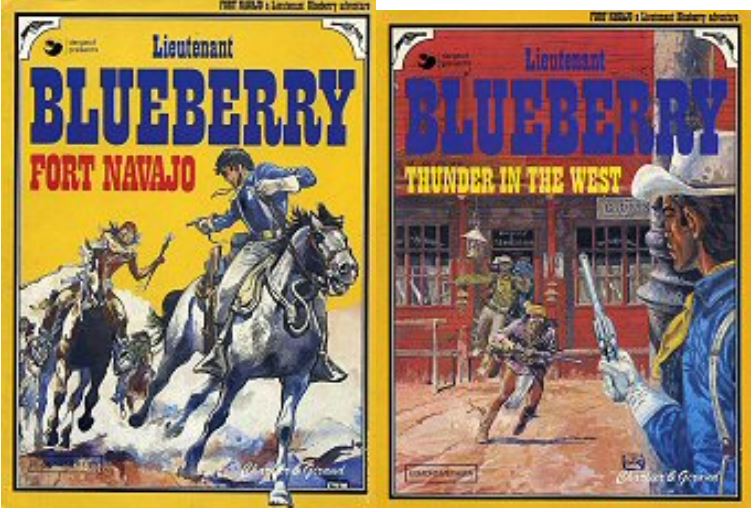
By Charlier & Giraud, translated by Anthea Turner & Derek Hockridge (Egmont/ Methuen)
ISBN: 978-0-41605-370-8 and 978-0-41605-370-X (Album PBs)
This book includes Discriminatory Content produced in less enlightened times.
Franco-Belgian comics have enjoyed a decades-long love affair with the mythos of the American West and responded with some of the most beautiful and exciting graphic narratives in the history of the medium. They have, however, had less success creating characters that have gone on to be global household names. One that did has made that jump is Michel Charlier & Jean Giraud’s immortal bad-ass Blueberry.
Sadly, although many publishers have sporadically attempted to bring him to our thrill-starved shores, there’s no readily available complete catalogue (STILL!) of the quintessential antihero in the English language. Thus, this first of many forthcoming reviews with a brace of albums that are decades old, although they do still turn up in back-issue bins and in second hand or charity shops – if those still exist…
Jean-Michel Charlier was arguably Europe’s most important writer of realistic adventure strips.
Ever.
He was born in Liege, Belgium in 1924 and like so many groundbreaking comics creators, began as an artist, joining the staff of Le Journal de Spirou in September 1944, contributing aviation illustrations, and a strip about gliders co-produced with Flettner. In 1946 Charlier’s love affair with flying inspired him to co-create fighter-pilot strip Buck Danny, providing scripts for star turn artist Victor Hubinon. Before long – and on the advice of prestigious senior illustrator Jijé – Charlier was scripting full time and expanding his portfolio with many other series and serials.
In 1951 he co-created historical series Belles Histoires de l’Oncle Paul which afforded dozens of major artists their big break over the years, and supplemented the series with other strips such as Kim Devil (art Gérald Forton), Jean Valhardi and Marc Dacier (both with artist Paape) and Thierry le Chevalier (with Carlos Laffond), as well as popular scouting series La Patrouille des Castors, illustrated by MiTacq. In conjunction with Goscinny and Uderzo, Charlier founded the business and industry oriented commercial comics agency Edifrance after which Charlier and Goscinny edited the magazine Pistolin (1955-1958) before launching Pilote together in October 1959. For the soon to be legendary periodical Charlier created Tanguy and Laverdure (with Uderzo and later Jijé), Barbe-Rouge (with Hubinon) and Jacques le Gall (with MiTacq). In 1963, after Charlier visited the US he created arguably his most significant character – and Europe’s greatest Western comic – which would eventually be known as Blueberry.
In later years, the engaging antihero supported his own equally successful spin-off La Jeunesse de Blueberry (AKA Young Blueberry, illustrated by Colin Wilson) but Charlier never rested on his laurels, concocting further grittily realistic fare: historical biographies in collaboration with Hubinon (Surcouf, Jean Mermoz, and Tarawa) and Martial (Alain et Christine in Libre Junior, Rosine in Pistolin), Brice Bolt for Spirou with Aldoma Puig, Los Gringos with Victor de la Fuente and many more. He passed away in 1989.
Jean Henri Gaston Giraud was born in the suburbs of Paris on 8th May 1938. Raised by grandparents after his mother and father divorced in 1941, he began attending Institut des Arts Appliqués in 1955, becoming friends with Jean-Claude Mézières who, at 17, was already selling strips and illustrations to magazines such as Coeurs Valliants, Fripounet et Marisette and LJdS. Giraud apparently spent most of his college time drawing cowboy comics and left after a year.
In 1956 he travelled to Mexico, staying with his mother for eight months, before returning to France and a full-time career drawing comics, mostly Westerns such as Frank et Jeremie for Far West and King of the Buffalo, A Giant with the Hurons and others for Coeurs Valliants, all in a style based on French comics legend Joseph Gillain AKA Jijé. Between 1959 and 1960 Giraud spent his National Service in Algeria, working on military service magazine 5/5 Forces Françaises before returning to civilian life as Jijé’s assistant in 1961, working on the master’s long-running (1954-1977) western epic Jerry Spring. A year later, Giraud and Belgian Jean-Michel Charlier launched serial Fort Navajo in Pilote #210. All too soon the ensemble feature threw forth a unique icon in the shabby shape of disreputable, rebellious Lieutenant Mike Blueberry who took over as the star and evolved into one of the most popular European strip characters of all time…
In 1963-1964, Giraud produced numerous strips for satire periodical Hara-Kiri and, keen to distinguish and separate the material from his serious day job, first coined pen-name Moebius…
He didn’t use it again until 1975 when he joined Bernard Farkas, Jean-Pierre Dionnet and Philippe Druillet – all devout science fiction fans – as founders of a revolution in narrative graphic arts created by Les Humanoides Associes. Their ground-breaking adult fantasy mag Métal Hurlant utterly enraptured the comics-buying public and Giraud again wanted to utilise a discreet creative persona for the lyrical, experimental, soul-searching material he was increasingly driven to produce: series such as The Airtight Garage, The Incal and mystical, dreamy flights of sheer fantasy contained in Arzach…
To further separate his creative twins, Giraud worked his inks with a brush whilst the dedicated futurist Moebius rendered his lines with pens. After a truly stellar career which saw him become a household name, both Giraud & Moebius passed away today in 2012.
Fort Navajo and Thunder in the West were originally released in Britain in 1977 by Euro-publishing conglomerate Egmont/Methuen; the first of four full-colour albums which utterly failed to capture the attention of a comics-reading public besotted in equal amounts by Science Fiction in general, Star Wars in specific and new anthology 2000AD in the main. It’s a great shame: if the translated series had launched even a year earlier, I might not be whining about lack of familiarity with a genuine classic of genre comics…
The magic begins in Fort Navajo as clean-cut West Point graduate Lieutenant Craig takes a break from his dusty journey. The stagecoach stopover is just another town on the border between Arizona and New Mexico, but leads to involvement in a brutal battle sparked by a cheating cardsharp. After the gun-smoke clears the military paragon is appalled to discover that the quick-shooting cad at the centre of the chaos is a fellow officer stationed at his new posting.
Further outraged after Lieutenant Mike Blueberry inadvertently insults Craig’s father – a much-decorated general – the pair acrimoniously part company, but are soon reunited on the trail as the scoundrel’s horse dies even as Craig’s stagecoach encounters remnants of settlers slaughtered by marauding Indians…
Dying survivor Stanton informs them that his son has been taken by the Apache. However, Craig’s vow to hunt them down is overruled by Blueberry and the stage crew and passengers. Incensed, the young fool sets off in pursuit of the attackers on his own. Despite his better judgement, Blueberry trails him, cursing all the while. After using an arsenal of canny tricks to repeatedly save Craig from his suicidal notions of heroism, the pair are picked up by a relief column from Fort Navajo led by Major Bascom: a man who sincerely believes the old maxim that the only good Indians are dead ones…
Ignoring orders and the advice of his officers, Bascom decides to pursue the kidnappers and compounds that insubordination by attacking a group of women, children and old men. The massacre would have been total had not Blueberry “accidentally” given the wrong bugle calls and called the cavalry back too soon. Learning quickly, Lieutenant Craig covertly assists the rogue in calling back the troops…
In the aftermath, Bascom demonstrates how unstable he is by trying to execute Blueberry without convening a court martial and goes near-ballistic when Craig prevents him by quoting chapter and verse of the military code. Frustrated on all sides, Bascom can only turn the column back to Fort Navajo and plan revenge on the puppies that baulked his bloodlust. Commanding officer Colonel Dickson is a reasonable man, however, and refuses Bascom’s entreaties. He even tries to broker a “pow-wow” and new treaty with great chief Cochise for the return of the kidnapped boy and to forestall the war Bascom so fervently desires. It’s a valiant effort doomed to failure. The Apache were not responsible for the butchery and abduction at all. The true culprits were Mescaleros from across the Mexican border.
Tragically, when Dickson is bitten by a rattlesnake, Bascom seizes command and uses peace talks to capture Cochise and his delegation. In a flurry of action the aged warrior breaks free and escapes to his waiting armies: determined to make the two-faced soldiers pay for their treachery by bringing blood and vengeance to all of Nevada, Arizona and New Mexico…
The brooding tension resumes in Thunder in the West as affronted tribal chiefs fiercely debate how to liberate the rest of their hostage peace-delegation before their own war-hungry followers start a bloodbath no one can win. At Fort Navajo Blueberry & Craig ponder the coming dawn and are on hand when a tortured settler arrives to warn them every messenger sent for reinforcements has perished, and the savages have taken dozens of new prisoners. The weary soul then delivers an ultimatum and final offer from Cochise: safe passage for the soldiers to Tucson or Albuquerque in return for the captive Indians in their custody. Bascom, clearly beyond all reason, instead threatens to execute the prisoners…
Desperate Blueberry counters with a tactic to forestall the growing certainty of all-out war: attempting to cross the siege lines and reach Tucson for reinforcements. However, before he can start, a fellow officer – “half-breed” scout Lieutenant Crowe – acts precipitately and frees the Indians from the stockade. Whilst Bascom raves and blusters, Blueberry takes off anyway, undertaking an epic journey through hostile territory past hundreds of warriors hungry for blood, not just to call for more troops but to get snakebite antidote for Dickson so that he can end the escalating madness…
Capping peril-filled days of fight & flight, the battered cavalryman successfully crosses searing desert only to stumble into Mexican bandits who almost end his voyage and life… until he turns their own greed against them. Finally, Mike rides into Tucson, only to find the town all but deserted because thousands of Apaches have been approaching the outskirts of town for hours…
Frantically batting his way out of the trap, Mike wearily retraces his route to Fort Navajo. The citadel is deserted except for Crowe, who tells him that after a catastrophic battle he negotiated a truce allowing the white survivors a means of escape. Now the half-breed has a new plan. He and Blueberry will track down the Mescalero renegades who actually started the war by abducting young Stanton…
A feat of staggering bravado, the audacious plan succeeds, but as Blueberry outdistances the outraged renegades and thunders through the mountains with the rescued boy on his horse, he realises Crowe is missing and must go back for him…
To Be Continued…
Although perhaps a tad traditional (and painfully unreconstructed!) for modern tastes and nowhere near as visually or narratively sophisticated as it was to become, this epic opening to the saga of immortal Blueberry is an engaging all-action romp and stunning reaffirmation of the creative powers of Charlier & Giraud. This potent testimony to the undying appeal and inspiration of the Western genre deserves it place on graphic novel shelves and must be seen by all who love comics.
© 1965, 1966 Dargaud Editeur. Text these editions © 1977 by Egmont Publishing Limited, London. All rights reserved.
Today in 1877 was born political cartoonist turned strip star Norman E. Jennett (The Monkey Shines of Marseleen) and in 1935 Bill Holman’s epic strip Smokey Stover debuted.
It’s a remarkable day for departures however, with Tex Willer co-creator Aurelio Galleppini passing on in 1994, Stan Drake (Blondie, Heart of Juliet Jones, Kelly Green) in 1997, historian, founder of the San Francisco Academy of Comic Art & co-editor of The Smithsonian Collection of Newspaper Comics Bill Blackbeard in 2011, as well as historian Don Markstein (Don Markstein’s Toonopedia) and Giraud one year later.