Maroc the Mighty


By an unknown author & Don Lawrence with Alfredo Marculeta (Rebellion Studios/ Treasury of UK Comics)
ISBN: 978-1-83786-517-8 (TPB/Digital edition) 978-1-83786-518-5 (Webshop Edition)

This book includes Discriminatory Content produced in less enlightened times.

For British, commonwealth and European readers of a certain age and prone to debilitating nostalgia, the comic works of Don Lawrence (17th November 1928 – 29th December 2003) are a treat that never pales and always satisfies. His lavish painted-narrative illustration was only ever about two things: boyish wish-fulfilment and staggeringly beautiful images.

Beginning in the 1950s, Lawrence (Marvelman, Wells Fargo, Billy the Kid, Fireball XL5, Olac the Gladiator, The Adventures of Tarzan, The Rise and Fall of the Trigan Empire, adult comedy strip Carrie and multi-volume Dutch magnum opus Storm), inspired a host of artists like Brian Bolland and Dave Gibbons. However, as Lawrence worked into the 1990s, his eyesight was increasingly impaired by cataracts, and he took on and diligently trained apprentices like modern stars Chris Weston and Liam Sharp who collaborated with the venerable mentor on his last Storm stories.

Although magnificent painted fantasies are Don’s everlasting legacy, he was also a supremely gifted master of monochrome illumination and gritty realism. Astoundingly, in Britain most of those pre-colour comics remained unreprinted until relatively recently. Now a regular and recognised wellspring for Rebellion Studios’ Treasury of UK Comics, two volumes of his Karl the Viking have been augmented by a true lost classic: a historical but engagingly daft fantasy that Lawrence was plucked from in midstream to begin the Trigan Empire opus…
The extraordinary adventures of a valiant and benevolent wandering Devonshire yeoman making his way back to England after the Third Crusade never actually carried the hero’s name in the weeklies where it was serialised, but ever since the feature – long mis-attributed to writer Michael Moorcock, but now officially devoid of a credited author – has been called by fans Maroc the Mighty

This brief but bombastic movie-influenced (particularly Ray Harryhausen) skein of sword & Sorcery sagas was first seen in Lion: a triptych of tales spanning 3rd October 1964 to 6th February 1965 (The Hand of Zar); 13th February – May 1st (The Red Knights of Morda) and then May 8th to 3rd July 1965 (The Gigantos), augmented by a short escapade from Lion Annual 1967 as originally released in the autumn of 1966.
Following an enthusiastic and informative Introduction from historian Steve Holland ‘The Hand of Zar’ introduces John Maroc: a doughty English fighter serving the Lords and Nobles of militant Christendom, who now the defeated Christian warriors flee the Holy Land. Sadly, the term “noble” never really applied to aristocratic leader Sir Guy who uses the retreat to pillage and plunder, and when his depredations threaten a helpless Arab boy, outraged Maroc leaps to his defence and must battle his way out with young Ahmid. Fleeing to the mountains they meet an old man who gives the Englishman a golden wrist bracer. The Hand of Zar originally belonged to an ancient “Sun warrior” who fought for justice, and will make Maroc “a giant among men”. It gets the chance almost immediately as Sir Guy’s men ambush them and overwhelm them… until John discovers he has strength enough to snap chains and topple stone pillars…

Over ensuing weeks Maroc and Ahmid thwart Sir Guy’s schemes despite quickly discovering that although the relict imparts incomprehensible strength – and a little enhanced stamina and durability – it only does so as long as it remains in direct sunlight. If clouds appear or night arrives, Maroc is reduced to his ordinary self…

The clashes eventually attract the attention of Richard the Lionheart, who values and admires the efforts of the peasant warrior, but must follow the codes of chivalry and shun him for fighting against his betters, no matter how scurrilous they might be. To make matters worse, Sir Guy accuses the lowly hero of treason and settles a death sentence upon his head…

Their flight across the middle east brings them into extended conflict with all-conquering Warlord Kalin and his war elephants, wicked mountain wizards and dinosaurs, marine slavers, shark packs and reivers, and embroils Maroc and Ahmid in a deadly quest for a mystic artifact – the Stone of Aolath – fighting antediluvian primitives inhabiting The City of the Clouds. Ultimately the legacy of Zar proves unconquerable and the wandering heroes part ways…

One week later, the Englishman abroad reached Spain as The Red Knights of Morda plunged into more of the episodic same. In mountainous, arid Morda Maroc encounters a band of rogue paladins steadily eroding established rule and bleeding the coffers of true local sovereign Don Miguel Y Cipriano. When Maroc befriends the Baron’s son Carlos and charming scoundrel “Ramon the Gypsy”, it begins a brutal, bloody fightback to restore order and justice. The real enemy is a secret society led by evil genius mastermind Satana, and encompasses defeating his colossal enforcer Khala the Strong and legions of fanatical killers, bad knights, huge swamp lizards and more war elephants…

The final Lawrence exploit began in colour on the cover of Lion’s May 8th 1965 issue, with the wanderer still trudging through Spain and abruptly ambushed by archers. Falling victim to the assault he sees with amazement that none of his attackers are over four feet tall…

Explanations by the Minimas lead to the Englishman enlisting to aid the “dwarf folk” against a determined foe sworn to enslave them for their mines – ‘The Gigantos’. Nominative determinism was a major factor at this time in comics and their oppressors are a tribe of oversized tyrants misusing their strength and exploiting equally prodigious wildlife – like giant eagles and bears – to tyrannise the Minimas, but all their might, diabolical traps and the wiles of their leader Pesado – and the active volcano they live in – are insufficient to deter Maroc when he finds injustice festering…

… And that was it for Lawrence’s most superheroic star since Marvelman. From September 18th 1965 fans were periodically gobsmacked and enthralled by The Rise and Fall of the Trigan Empire – and never really looked back. Editors, however, are callous pragmatic folk and established name brand Maroc returned via Lion Annual 1967 in another anonymously scripted, done-in-one tale illustrated by UK comics mainstay Alfredo Marculeta. He was a regular of the era’s weeklies probably most recognisable today for The Rubber Man, a superhero knock-off of Jack Cole’s Plastic Man written by Ken Mennell and running in Smash from #15.

I can’t find out much about him, but his work and overall style look remarkably similar to that of Spanish political exile, cartoonist, caricaturist and comics illustrator Edmundo Marculeta (6th April 1923 – 3rd May 1989 and AKA “Marcouleta”, “Marcouletta”, “Marcou”, “Tony Cranach” & “Boris Tunder”) who worked in Europe and the UK in the 1960s & 1970s on everything from all-ages westerns and historical adventures to adult comics.

Here, those gifts are employed depicting how mighty Maroc is tramping through Germany’s Black Forest and attacked. Losing and winning back the armlet of Zar, he joins ousted prince Johann of Grunde, helping him regain his birthright from usurping murderer Baron Grimm, a tyrant obsessed with gladiatorial contests and animal cruelty…

Based in equal part on cinematic Sword & Sandal and Knight & Ladies epics and a long-cherished movie genre of manly blockbusters to construct a vast sprawling serial of heroic vigilantism, two-fisted warriors, wild beasts, deadly monsters and even occasionally the odd female (very, very occasionally in this instance!) Maroc the Mighty is the quintessential 5-minute read, but with visuals every boy I knew spent hours staring at. Some – who shall remain nameless – might even have traced or copied many of the panels and tableaux for art and history projects, Hem Hem…

Incorporating a tantalising teaser for the next volume and creator biographies, this truly spectacular visual triumph is a monument to British Comics creativity, simultaneously pushing memory buttons for old folk whilst offering a light but beautiful straightforward epic readily accessible to the curious and genre inquisitive alike or anyone who actually saw the latest William Tell movie…

Is that you or someone you know?
Maroc the Mighty is ™ Rebellion Publishing IP Ltd. © 1964, 1965, 1966 & 2025 Rebellion Publishing IP Ltd. All Rights Reserved.

Shazam! Family Archives volume 1


By William Woolfolk, Otto Binder, Joe Millard and many unknown authors, C.C. Beck, George Tuska, Mac Raboy, Al Carreño, Mark Swayze & various (DC Comics)
ISBN: 978-1-4012-0779-3 (HB)

This book includes Discriminatory Content produced in less enlightened times.

One of the most venerated and beloved characters of America’s Golden Age of comic books, Captain Marvel was created in 1940: part of the wave of opportunistic creativity which followed the stunning success of Superman in 1938 and Batman one year later. Although there were many notable similarities in the early months, Fawcett’s champion quickly moved squarely into arenas of light entertainment and even pure comedy, whilst as the years passed the Man of Steel increasingly left whimsy behind in favour of action, drama and suspense.

Homeless orphan and all-around decent kid Billy Batson was selected by an ancient wizard named Shazam to utilise the powers of six ancient gods and heroes in a never-ending battle against injustice. Thereafter he could transform from scrawny, precocious kid to brawny (adult) hero Captain Marvel by speaking aloud the wizard’s acronymic name – invoking the powers of legendary patrons Solomon, Hercules, Atlas, Zeus, Achilles and Mercury.

Publishing house Fawcett had first gained prominence through an immensely well-received magazine for WWI veterans entitled Captain Billy’s Whiz-Bang, before branching out into books and general interest magazines. Their most successful publication – at least until the Good Captain hit his stride – was the ubiquitous boy’s building bible Mechanix Illustrated and, as the comicbook decade unfolded, the scientific and engineering discipline and “can-do” demeanour underpinning MI suffused and informed both the art and plots of the Marvel Family titles.

Captain Marvel was the brainchild of writer/editor Bill Parker and brilliant illustrator Charles Clarence Beck who, with his assistant Pete Costanza, handled most of the art for the series throughout its stellar but too brief run. Before eventually evolving his own affable personality the Captain was serious, bluff and taciturn: a rather charmless powerhouse. Always, junior alter ego Billy was the true star: a Horatio Alger archetype of impoverished, boldly self-reliant and resourceful youth overcoming impossible odds through gumption, grit and sheer determination…

After homeless orphan newsboy Billy was granted access to the power of legendary gods and heroes, he won a job as a roaming radio reporter for Amalgamated Broadcasting and first defeated demonic Doctor Thaddeus Bodog Sivana, setting a pattern that would captivate readers for the next 14 years…

At the height of his immense popularity Captain Marvel – and many of his fellow Shazam!-powered pals – were published twice monthly and outsold Superman, but as the Furious Forties closed, tastes changed, sales slowed and Fawcett saw the way the wind was blowing. In 1953, they settled an infamous, long-running copyright infringement suit begun by National Comics in 1940 and the “Big Red Cheese” vanished – like so many other superheroes – becoming no more than a fond memory for older fans. Fawcett in full bloom, however, was a true publishing innovator and marketing dynamo – now regarded as inventor of many established comic book sales tactics we all take for granted today. This stunning, lavishly sturdy full-colour hardback compendium gathers magnificent examples of the most effective strategy: spin-off characters linked to the primary star. Fawcett was the company responsible for creating crossover-events and in 1942 they devised a truly unforgettable villain and set him simultaneously loose on their stable of costumed champions whilst using his (temporary) defeat to introduce a new hero to their colourful pantheon.

The epic creation of Captain Marvel Jr. and his originating antithesis Captain Nazi were fully covered in Shazam! Archives volume 4 so feel free to go there first…

This subsidiary collection gathers his subsequent appearances as brand new headliner in Master Comics #23-32 (February to November 4th 1942) plus the first issue of his own solo title (Captain Marvel Jr. #1, cover-dated 18th November 1942) and also includes the debut appearance of mighty Miss Mary Marvel who premiered in Captain Marvel Adventures #18 (December 11th 1942). All that and the stunning covers by Beck & Raboy are preceded by an erudite and incisive Foreword from artist, editor, historian – and former student of C.C. Beck – P.C. Hammerlinck, who reveals many secrets of the original comics’ production before the classics commence.

Sadly, although the artists involved are easily recognisable, the identities of these tales’ writers are lost to us but strong possibilities include primarily Rod Reed and Ed “France” Herron (both early editors of Fawcett’s comics line) as well as Bill Parker, Manly Wade Wellman, Joe Millard, Otto Binder and William Woolfolk.

Before the advent of the World’s Mightiest Boy, Bulletman – ably assisted by his companion Bulletgirl – was undoubtedly Fawcett’s runner-up star turn; hogging the covers in monthly Master Comics and carrying his own solo comic title. That all changed with the 21st issue and murderous arrival of Captain Nazi. Hitler’s Übermensch made manifest, the monstrous villain was despatched to America to spread terror and destruction and kill all its superheroes.

The Horrendous Hun stormed in, taking on Bulletman and Captain Marvel who united to stop the Fascist Fiend wrecking New York City. The battle ended inconclusively but restarted when the Nazi nemesis tried to wreck a hydroelectric dam. Foiled again, the monster sought to smash a new fighter plane prototype before Captain Marvel countered him, but was not quick enough to prevent the killer murdering an old man and brutally crushing a young boy.

Freddy Freeman seemed destined to follow his grandfather into eternity, but guilt-plagued Billy brought the dying lad to Shazam’s mystic citadel where the wizard saved his life by granting Freddy access to the power of the ancient gods and heroes. Physically cured – except for a permanently maimed leg – there was a secondary effect: whenever he uttered the phrase “Captain Marvel” Freeman transformed into a superpowered, invulnerable version of his mortal self.

The prototype crossover epic concluded in Master Comics #22 when the teen titan joined Bulletman & Bulletgirl in stopping a string of Captain Nazi-sponsored murders, victoriously concluding with a bold announcement that from the very next issue he would be starring in his own solo adventures. That parade of epic exploits begins in this tome with ‘Captain Nazi’s Assassination Plot’ (Master Comics #23), immaculately rendered by the Alex Raymond-inspired Raboy who would produce for the feature some of the most iconic art of his illustrious career. Sadly, that meant struggling constantly with punishing deadlines and his own impossibly harsh standards. Moreover, the legend abounds that Raboy would rewrite scripts he wasn’t happy with…

Earning a living selling newspapers on street corners, young Freddie spots Captain Nazi again and dogs his corpse-strewn trail as the fascist kills a British agent and attempts to murder President Roosevelt. Then ‘Death by Radio’ introduces sinister serial killer Mr. Macabre who brazenly broadcasts his intention to assassinate former business partners until the young Marvel confronts him. Master Comics #25 sees Freddie investigate a little lad’s broken balloon in Woolfolk & Raboy’s ‘The Case of the Face in the Dark!’, only to stumble upon a cunning plot by the Japanese to invade Alaska. Whereas his senior partner’s tales were always laced with whimsy, Junior’s beautifully depicted exploits were always drenched in angst, tension and explosive action. The climax, which involved the bombastic boy-warrior shredding wave after wave of bombers, is possibly one of the most staggering printed spectacles of the Golden Age…

On a smaller scale, the next issue featured Otto Binder’s ‘The Return of Mr. Macabre!’ as the killer, turned sickly green after a failed suicide attempt, kidnaps a US inventor ferrying vital plans to England. The plot goes well until Macabre’s rendezvous with Captain Nazi in mid-Atlantic is interrupted by Junior, who saves the day by ripping their battleship apart with his bare hands! In a rare display of close continuity, Freddie then carries on to London in MC #27 to counter ‘Captain Nazi and the Blackout Terror’, with the malign master of disguise setting out to neutralise the city’s anti-Blitz protocols. For his service, Freddie is made a special agent for Winston Churchill…

Never captive for long, in the next issue the Hunnish Hauptman spearheads an Atlantic reign of terror and kidnaps America’s chief of War Production, until Junior single-handedly invades ‘Hitler’s Headquarters of Horror’, linking up with a German Resistance movement to free the crucial captive. After such smashing successes it was no surprise that in #29 British Intelligence tapped innocuous Freddie Freeman to infiltrate Hitler’s Fortress Europa and prepare the enslaved populations under ‘The Iron Heel of the Huns’ to rise when the inevitable Allied counterattack came…

MC #30 saw the wonder boy back in the USA, stopping Captain Nazi’s plan to poison an entire military base in ‘Captain Marvel Jr. Saves the Doomed Army’, before malignant Mr. Macabre joins the Japanese to abduct a crucially-placed diplomat in ‘The Case of the Missing Ambassador’ but inevitably tasting frustrating defeat and receiving the sound thrashing he so richly deserves…

With #32, Master Comics became a fortnightly publication, but Freddie barely noticed since he was embroiled in a decidedly domestic atrocity wherein corrupt orphanage officials collected and abused disabled kids to turn a profit in ‘The Cripple Crimes’…

A blockbuster hit, “The Most Sensational Boy in the World” promptly won his own title as 1942 drew to a close, but with Raboy already hard-pressed to draw 14 pages a month to his own exacting standards, Captain Marvel Jr. #1 was illustrated by reliable Al Carreño – a Fawcett regular who had covered almost every character in the company’s stable.

The bumper book – probably scripted by Binder & Joe Millard – began by briefly reprising ‘The Origin of Captain Marvel Jr.’ before depicting ‘Wings of Dazaggar!’ wherein Junior follows Captain Nazi to an occupied West African colony and uncovers a flight of secret super-planes intended to bomb America to dust. After scotching that scheme Freddie is drawn into an eerie murder-mystery as a succession of gangsters and investigative reporters fall victim to ‘The Shadow that Walked!’

Then, thugs snatching beggars off the street to fuel a fantastically callous insurance scam make their biggest mistake by grabbing lame Freddie Freeman as their next patsy in ‘The Case of the Cripple Kidnappers’, before the soaring sagas conclude on a redemptive note as Captain Marvel Jr. “encourages” ‘The Cracked Safecracker’ to renounce his criminal ways and look after his elderly, ailing and extremely gullible parents…

This superb graphic grab-bag concludes with a landmark from ‘Captain Marvel Introduces Mary Marvel’, as capably rendered by Otto Bonder and Fawcett illustration mainstay Mark Swayze as first seen in Captain Marvel Adventures #18 (cover-dated December 11th, 1942). Preceded by a glorious painted cover from Beck of what would become known as The Marvel Family, the story saw boy broadcaster Billy Batson hosting a radio quiz show and finding himself drawn to sweet rich kid Mary Bromfield. During the course of the show – which also includes Freddie Freeman amongst the contestants – Billy is made shockingly aware that Mary is in fact a long-lost twin sister he never knew he had (take that, Luke Skywalker!), but before he can share the knowledge with her, gangsters kidnap her for a hefty ransom. Although Captain Marvel & Junior rescue Mary, they foolishly fall under the sway of the crooks and are astounded when she idly mutters the word “Shazam!”, transforms into the World’s Mightiest Girl and rescues them all…

Crisis over, the trio then quiz the old wizard and learn the secret of Mary’s powers – gifts of a group of goddesses who have endowed the plucky lass with the grace of Selene, strength of Hippolyta, skill of Ariadne, fleetness of Zephyrus, beauty of Aurora (always crucial when battling thugs, brutes and beasts!) and wisdom of Minerva – before welcoming their new companion to a life of unending adventure…

Notwithstanding the acute implied sexism of Mary’s talents coming from goddesses rather the same source as the boys’, her creation was a milestone of progress adding a formidable, unbeatable female role model to the ranks of the almost universally male mystery-man population of comic books.

The original Captain Marvel is a key factor in the development of American comics history and a brilliantly conceived superhero for all ages. These enchanting, compelling tales show why “The Big Red Cheese” and his oddly extended family was such an icon of the industry and proves that such timeless, sublime graphic masterpieces are an ideal introduction to the world of superhero fiction: tales that cannot help but appeal to readers of every age and temperament.
© 1942, 2006 DC Comics. All Rights Reserved.

Eagle Classics: Fraser of Africa


By George Beardmore & Frank Bellamy (Hawk Books -1990)
ISBN: 978-0-94824-832-0 (Tabloid TPB)

This book includes Discriminatory Content produced in less enlightened times.

Frank Alfred Bellamy (21st May 1917 – 5th July 1976) is one of British Comics’ greatest comics artists. In the all-too-brief years of his career he produced magnificent and unforgettable visuals for Eagle, TV21, Radio Times (Doctor Who) before graduating to The Daily Mirror newspaper strip Garth in 1971. He turned that long-running yet lacklustre adventure strip into a magnificent masterpiece of unmissable fantasy, with eye-popping, mind-blowing monochrome art other artists were proud to boast they swiped from. However, after only 17 stories, Bellamy died suddenly in 1976 and it’s absolutely criminal that his work isn’t in galleries, let alone in permanent collected book editions.

Bellamy was born in 1917 but didn’t begin comic strip work until 1953: a strip for Mickey Mouse Weekly. From there he moved on to Hulton Press and drew features starring the Swiss Family Robinson, Robin Hood and King Arthur for Swift – the “junior companion” to Eagle. In 1957, he moved on to the star title, producing standout, innovative work on a variety of strips, beginning with a biography/hagiography of Winston Churchill.

‘The Happy Warrior’ was followed by ‘Montgomery of Alamein’, ‘The Shepherd King – the story of David’, and ‘The Travels of Marco Polo’, from which Bellamy was promptly pulled only a few months in. As Peter Jackson took over the back page historical adventure, Bellamy was on his way to the front cover and The Near Future.

When Hulton were bought by Odhams Press there soon manifested irreconcilable differences between Frank Hampson and the new management. Dan Dare’s creator left his superstar baby and Bellamy was tapped as replacement – although both Don Harley & Keith Watson were retained as his assistants. For a year Bellamy produced “The Pilot of the Future”: redesigning the entire look of the strip at management’s request, before joyfully stepping down to fulfil a lifetime’s ambition.

For his entire life Frank Bellamy had been fascinated – almost obsessed – with Africa. When asked if he would like to draw a big game hunter strip he didn’t think twice. Fraser of Africa debuted in August 1960, a single page per week in the prestigious full-colour centre section. George Beardmore wrote three serials comprising the entire canon, starring Martin Fraser, a rare individual working in modern day Tanganyika’s game reserves.

Bellamy again surpassed himself: consulting with the Hulton Press printers Bemrose over the colours he wanted to use and employing Kenyan farmers as fact & sense checkers to ensure he got everything just right. The result was a new colour palette that burned with the dry, yellow heat of the Veldt and delivered searing authenticity. The strip became the readers’ favourite, knocking Dare from a position previously considered untouchable and unassailable.

Fraser the character is a man out of time. Contrary to modern assumptions, the hunter loved animals, treated “natives” as full equals and had a distinctly 21st century ecological bent. For a Britain blithely rife with institutionalized racism, cheerfully promoting bloodsports and still wondering what happened to The Empire, Fraser’s startlingly “PC” (let’s not say “woke” and ruffle a few gammon feathers…) antics were a thrilling, exotic and salutary experience for us growing lads.

Notwithstanding the high quality and intense drams of the serialised stories, Fraser of Africa is a primarily an artistic landmark. Bellamy’s techniques of line and hatching, in conjunction with sensitive, atmospheric colours, even his staging and layout of pages – which would lead to the majestic Heros the Spartan and eventually the bravura creativity displayed in the Thunderbirds and Captain Scarlet strips for TV21 – all were derived from the joyous stories of the Dark Continent.

In case you still need convincing to seek this out the three tales appearing here are hopefully pretty self-explanatory, beginning with the recovery in bush of a lost American movie star in ‘Lost Safari’ (Eagle Vol.11, #32-11:53 spanning August 6th 1960 through December 31st 1960, and Vol 12, #1-12 from January 4th 1961 to 28 January 1961). That segues neatly into ‘The Ivory Poachers’ (Eagle Vol.12, #5-12, 4th February to 20th May 1961) and a protracted campaign against callous Eurotrash butchering willy nilly across the endangered dwindling veldt.

The saga ended with ‘The Slavers’ (Eagle Vol.12, #21-2:32 from 27th May to August 12th 1961) as Fraser aids Masai warriors targeted by Arab slavers…
Yet another one to add to the “Why Is This Not In Print” pile…
Fraser of Africa ©1990 Fleetway Publications. Compilation © 1990 Hawk Books.

The Shield – America’s 1st Patriotic Comic Book Hero


By Irving Novick, Harry Shorten & various (Archie Comics)
ISBN: 978-1-87979-408-5 (TPB/Digital edition)

This book includes Discriminatory Content produced in less enlightened times.

There are numerous comics anniversaries this year. Some of the most significant will be rightly celebrated, but many are going to be unjustly ignored. As a feverish fanboy wedged firmly in the past, I’m still abusing my privileges to revisit another brilliant vintage book, criminally out of print but at least readily obtainable in digital formats…

Happy Birthday US of America! – even the less reasonable bits…

In the dawning days of the comic book business, just after Superman and Batman had ushered in a new genre of storytelling, many publishers jumped onto the bandwagon and made their own bids for cash and glory. Many thrived and many more didn’t, remembered only as trivia by sad blokes like me. Some few made it to an amorphous middle-ground: Not forgotten, but certainly not household names either…

The Shield was FBI scientist Joe Higgins who created a suit and vitamin supplement system bestowing enhanced strength, speed and durability. These advantages he used to battle America’s enemies in the days before the USA entered World War II. Latterly, he also devised a Shield Formula to increase his powers. Beginning with the first issue of Pep Comics (January 1940) he battled spies, saboteurs, subversive organisations and every threat to American security and well-being and was a minor sensation. He is credited with being the industry’s very first Patriotic Hero, predating Marvel’s iconic Captain America in the “draped in the Flag” field.

Collected here in this Golden-Age fan-boy’s dream (barely available as a trade paperback but also more accessible in digital formats) are the lead stories from monthly Pep Comics #1-5 (January – May 1940) plus three solo adventures from hastily assembled spin-off Shield-Wizard Comics #1 (Summer 1940).

Following a Foreword from Robert M. Overstreet and context-providing Introduction from Paul Castiglia the jingoistic wonderment opens with FBI agent Joe Higgins smashing a “Stokonian” spy and sabotage ring in his mystery man identity of The Shield – ‘G-Man Extraordinary’. Only his boss J. Edgar Hoover knows his dark secret and of the incredible scientific process that has made the young daredevil a veritable human powerhouse.

In Pep #2, as American oil tankers begin vanishing at sea, The Shield hunts down the ray gun-wielding rogues responsible and delivers punishing justice before #3 sees mini parachute mines cause devastating destruction in US waters… until the patriotic paragon locates the undersea base of brilliant science-maniac Count Zongarr and deals out some more all-American retribution…

There’s a whiff of prescience or plain military/authorial foresight to the blistering tale from Pep #4 (May 1940) when dirty, devious, diabolical Mosconians perpetrate a sneak attack on Pearl Harbor. Warned by a clairvoyant vision from new mystery man The Wizard, Higgins hurtles to Hawaii to scotch the plot. When fists and fury aren’t quite enough, the Shield turns an exploding volcano on the murdering backstabbers! Mission accomplished, Higgins takes an ocean liner home in Pep #5, only to have the ship attacked by vengeful Mosconians. After thwarting the sinister ambushers and battling his way home, Joe arrives back in the USA just in time to thwart a tank column attack on Congress!

The blistering pace, energising enthusiasm of the creators and sheer scale, scope and bravura of the Patriotic Paragon’s adventures made him an early hit, and he soon won a second venue for his crusade – the aforementioned Shield-Wizard Comics. The cunningly contrived shared title hit newsstands on June 20th 1940, and opened with the expanded origin for the red, white and blue blockbuster reprinted here.

In 1916 Joe Higgin’s father was a scientist and officer in US Army Intelligence. Whilst working on a formula to make men superhuman, Tom Higgins was attacked by enemy agents and lost his life when they blew up a fleet of ammunition barges. To make matters worse, the innocent dedicated agent was posthumously blamed for the disaster…

Joe grew up with the shame but swore to complete his father’s work and clear his name. By achieving the first – and gaining super-powers – Joe consequently lured out spy master Hans Fritz (who had framed his dad) and accomplished the most crucial component of his crusade: exonerating Tom Higgins. Then, with dad’s old partner J. Edgar as part of the secret, the son joined the FBI and began his work on America’s behalf…

Shield-Wizard #1 contained three complete exploits of the Star-Spangled Centurion, with the second introducing Joe to new partner Ju Ju Watson: a doughty veteran agent dedicated to completing the young operative’s training. Together they investigate a steel mill infiltrated by crooks holding the owner hostage and aiming to purloin the payroll. Young Higgins’ next case involves grisly murder as corpses are found concealed in a floating garbage scow with the trail leading back to vice racketeer Lou Zefke. His ongoing trial is stalling for lack of witnesses, but with only the slimmest of leads and plenty of enthusiasm, The Shield steps in and cleans up the mess…

Raw, primitive and inarguably a little juvenile, these are unadorned, glorious romps from the industry’s exuberant, uncomplicated daw days: Plain-&-simple fun-packed thrills from the gravely under-appreciated Irving Novick (Batman, Flash, Captain Storm, Wonder Woman, countless war comics, The Joker) & Harry Shorten (Archie Comics, Charlton Comics, The Black Hood, T.H.U.N.D.E.R. Agents, There Oughta be a Law!) and others whose names are now lost to history.

Despite absolutely not being to everyone’s taste, for dyed-in-the-woollen-tights superhero freaks, these guilty pleasures are worth a look, affording a rapturous tribute to those less complicated times and folk who always saw simple solutions to complex problems…
© 1940, 2002 Archie Publications In. All Rights Reserved.

New Crusaders Legacy


By Rich Buckler, Ian Flynn, Robert Kanigher, Marty Griem, Lou Manna, Rex Lindsey, Stan Timmons, Bill DuBay, Jr., Rich Margopoulos, David M. Singer, Alex Toth, Carmine Infantino, Steve Ditko, Dick Ayers, Gray Morrow, Alec Niño, Tony DeZuñiga, Louis Barreto, Adrian Gonzales, Ricardo Villagran, Frank Giacoia, Alan Kupperberg, Jerry Gaylord, Ben Bates, Alitha Martinez & many more (Red Circle/Archie Comics)
ISBN: 978-1-936975-22-8 (TPB/Digital edition)

This book includes Discriminatory Content produced in less enlightened times.

In the dawning days of the comic book business, just after Superman and Batman pioneered a new genre of storytelling, many publishers jumped onto the bandwagon and made their own bids for cash and glory. Many thrived and many more didn’t; now relished only as trivia by sad old blokes like me. Some few made it to an amorphous middle-ground: not forgotten, but certainly not household names either.

MLJ were one of the quickest publishers to jump on the Mystery-Man bandwagon, following the spectacular successes of the Man of Tomorrow with their own small yet inspirational pantheon of gaudily clad costumed crusaders, beginning in November 1939 with Blue Ribbon Comics. Soon followed by Top-Notch and Pep Comics, their content was the standard blend of two-fisted adventure strips, prose pieces and gag panels and, from #2 on, superheroes. However, after only a few years Maurice Coyne, Louis Silberkleit and John Goldwater spotted a gap in the blossoming market and in December 1941 nudged aside their masked heroes and action strips to make room for a far less imposing hero; an “average teen” who would have ordinary adventures like the readers, but with triumphs, romance and slapstick emphasised. The teen phenomenon was pure gold and by 1946 the kids had taken over, so MLJ renamed itself Archie Comics; retiring its heroic characters years before the end of the Golden Age and becoming, to all intents and purposes, a publisher of family comedies. Its success, like Superman’s, changed the content of every other publisher’s titles, and led to a multi-media industry including TV shows, movies, a chain of restaurants and even a global pop hit Sugar, Sugar (a tune from their animated show).

By this stage the company had blazed through an impressive pantheon of mystery-men who would form the backbone of numerous future superhero revivals, most notably in the High-Camp/Marvel Explosion/Batman TV show-frenzied mid-60’s era. The heroes impressively resurfaced under the company’s Red Circle imprint during the early days of the Direct Sales revolution of the 1980s, but after a strong initial showing, again failed to sustain the public’s attention.

Archie let them lie fallow (except for occasional revivals and intermittent guest-shots in Archie titles) until 1991, when the company licensed its heroes to superhero specialists DC for a magically fun, all-ages iteration (and where’s that star-studded trade paperback collection, huh?!). Impact Comics was a vibrant, engaging and fun all-ages rethink that really should have been a huge hit but was again cruelly unsuccessful. When the line folded in 1993 the characters returned to limbo. DC had one more crack at them in 2008, incorporating The Mighty Crusaders & Co into their own maturely angst-ridden and stridently dark continuity – with the usual overwhelming lack of success.

Over the last decade the wanderers returned home to Archie in superbly simplistic and winningly straightforward revivals aimed squarely at old nostalgics and young kids reared on action/adventure TV cartoons: brimming with all the exuberant verve and wide-eyed honest ingenuity you’d expect from an outfit which has been pleasing kids for over 80 years.

Released initially online in May 2012 – followed by a traditional monthly print version that September – the first story-arc made it to full legitimacy with a thrill-packed trade paperback collection, equally welcoming to inveterate fanboys and eager newcomers alike. The series introduced a new generation of legacy heroes rising from the ashes of their parents/guardians’ murders to become a team of teenaged gladiators carrying on the fight as New Crusaders.

This collection supplements and follows on from that magical makeover: with mentor The Shield training the potential-filled juniors with the records of their predecessors. The stories included here come from those aforementioned 1980s Red Circle episodes; culled from the

Mighty Crusaders #1, 8, 9; The Fly #2, 4, 6; Blue Ribbon (vol 2) #3, 8, 14; The Comet #1 and Black Hood #2, collectively spanning 1983-1985.

Following an engaging reintroduction and recap, contemporary creative team Ian Flynn, Jerry Gaylord, Ben Bates & Alitha Martinez reveal how the grizzled, flag-draped veteran has trouble reaching his teenaged students until he begins treating them as individuals, and sharing past Crusaders’ cases. Starting with personal recollections of his own early days as America’s first Patriotic superhero in ‘The Shield’ (Mighty Crusaders #8, by Marty Greim, Dick Ayers & Rich Buckler), Joe Higgins explains his active presence in the 21st century, leading into a recapitulation of the first Red Circle yarn.

‘Atlantis Rising’ is from Mighty Crusaders #1, by Buckler & Frank Giacoia, which saw psionic plunderer Brain Emperor and immortal antediluvian Eterno the Conqueror launching a multi-pronged attack on the world. They are countered by an army of costumed champions including the Golden Age Shield, Lancelot Strongthe (other) Shield – and for a while there were three different ones active at once – Fly and Fly-Girl, The Jaguar, The Web, Black Hood and The Comet, who communally countered a global crimewave and clobbered the villains’ giant killer robots…

This is followed by a modern interlude plus pin-up and data pages on Ralph Hardy AKA ‘The Jaguar’ before a potent vignette by Chas Ward & Carlos Vicat. ‘The Web’ offers the same data-page update for masked detective/criminologist John Raymond before ‘The Killing Hour’ (Blue Ribbon #14, by Stan Timmons, Lou Manna, Rex Lindsey & Chic Stone) sees the merely mortal manhunter join his brother-in-law The Jaguar in foiling nuclear terrorism.

Modern pin-ups and data-pages reintroduce ‘The Comet’ before Bill DuBay, Jr., Carmine Infantino & Alec Niño reworked the original 1940’s origin tale by Jack Cole from Pep Comics #1 in (1940). Reproduced from 1984’s The Comet #1, this chilling yarn detailed how an idealistic scientist became the most bloodthirsty hero of the Golden Age, with a body-count which made The Punisher look like a social worker.

The infomercial for ‘Steel Sterling’ precedes a wild and whimsical origin-retelling of the star-struck, super-strong “Man of Steel” by his 1940s scripter Robert Kanigher, illustrated with superb style by Louis Barreto & Tony DeZuñiga from Blue Ribbon #3, after which ‘Fly Girl’ gets star treatment in a brace of tales, augmented as always by the ubiquitous fact-folio.

Buckler, Timmons, Adrian Gonzales & Ricardo Villagran’s ‘A Woman’s Place’ (The Fly #2) clears up an exceedingly sexist old-school extortion ring whilst ‘Faithfully Yours’ (Fly #6) sees her movie-star alter ego Kim Brand subjected to a chilling campaign of terror from a fan. Timmons, Buckler, Steve Ditko & Alan Kupperberg take just the right tone in what might be the first incidence of stalking in US comics…

‘Black Hood’ has no modern iteration in the New Crusaders. Still active in contemporary times, he encountered the kids during their debut exploit and is phenomenally cool, so he gets a place here. Following the customary introductory lesson he appears in a gritty, Dirty Harry styled caper (from Blue Ribbon #8 by Gray Morrow) as undercover cop – and latest convert – Kip Burland, who sidesteps Due Process to save a kidnapped girl and ensure the conviction of crooks hiding behind the law. The gripping yarn also discloses the centuries-long justice-seeking tradition of “The Man of Mystery”…

That’s followed by a snippet from Rich Margopoulos, Kupperberg & Giacoia’s ‘A Hero’s Rage’ wherein Kip discovers his uncle Matt (the Golden Age Black Hood) has been murdered. Ditching his leather jacket and ski-mask in favour of the traditional costume, the bereaved hero suits up and joins the Mighty Crusaders…

Without doubt the most engaging reprint in this collection and by itself well worth the price of admission is ‘The Fox’ from Black Hood #2. Written and drawn by the inimitable Alex Toth, this scintillating light-hearted period comedy-drama finds the devilish do-gooder in Morocco in 1948 and embroiled with wealthy expatriate ex-boxer Cosmo Gilly, who has no idea he’s become the target for assassination…

The recondite recollections surge to a climax with ‘Old Legends Never Die’ (MC#9, by David M. Singer, Buckler & Ayers) as the first Shield is accused of excessive force and manslaughter when his 1940’s crime-fighting style seemingly results in the death of a thief he apprehended. With Joe Higgins’ costumed friends in support but out of their depth in a courtroom, the convoluted history of the three heroes bearing his codename is unpicked during ‘The Trial of the Shield’ before the uncannily sinister truth is exposed…

Supplemented by a plentiful cover gallery and packed with the kind of ephemera that sends old Fights ‘n’ Tights fans into paroxysms of delight, I fear this is probably a book only the wide-eyed young and dedicated still ambulatory old fart nostalgists could handle, but it is such a perfect artefact of the superhero genre I strongly urge anyone with a hankering for masked adventure and craving Costumed Dramas to give it a long look.
NEW CRUSADERS and RED CIRCLE COMICS ® ACP, Inc. © 2013 Archie Comics Publications. All rights reserved.

Superman: The War Years – 1938-1945


By Roy Thomas, Jerry Siegel & Joe Shuster with Don Cameron, Mort Weisinger, Fred Ray, Jack Burnley, Wayne Boring, Leo Nowak, Ed Dobrotka, John Sikela, Sam Citron, Ira Yarbrough, George Roussos, Stan Kaye & various (DC/Chartwell Books)
ISBN: 978-0-7858-3282-9 (Album HB)

This book includes Discriminatory Content produced in less enlightened times.

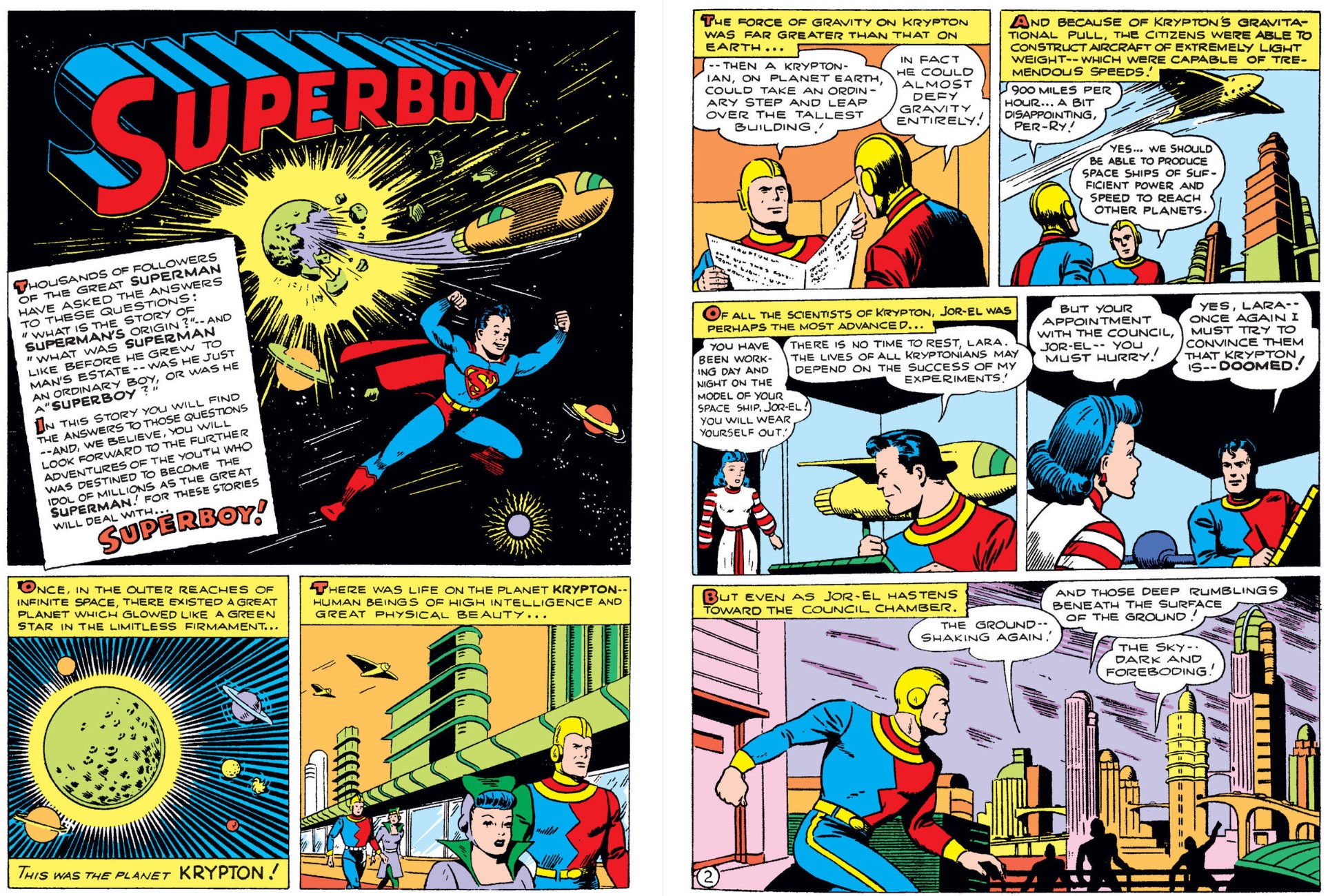
The creation of Superman and his unprecedented adoption by a desperate, joy-starved generation quite literally gave birth to a genre if not an actual art form. Within three years of his debut in the summer of 1938, the intoxicating mix of eye-popping action and social wish-fulfilment which hallmarked the early exploits of the Man of Tomorrow had grown to encompass cops-and-robbers crime-busting, reforming dramas, science fiction, fantasy and even whimsical comedy: all deep and abiding issues for the American public at that time.

However, once the war in Europe and the East snared America’s consciousness, combat themes and patriotic imagery dominated most comicbook covers if not interiors and the Man of Steel was again in the vanguard.

In comic book terms Superman was master of the world and had already utterly changed the shape of the fledgling industry. There was a popular newspaper strip, a thrice-weekly radio serial, games, toys, foreign and overseas syndication and the Fleischer studio’s astounding animated cartoons. Thankfully, the quality of the source material was increasing with every four-colour release and the energy and enthusiasm of Jerry Siegel & Joe Shuster informed and infected the burgeoning studio that grew around them to cope with the relentless demand.

Superman was definitely every kid’s hero, and the raw, untutored yet captivating episodes reprinted here were also completely embraced by the wider public, as the new so very portable entertainment medium of comic books became a vital tonic for the troops and all the ones they had left behind…

I sometimes think – like many others of my era and inclinations – that superhero comics are never more apt or effective than when whole-heartedly combating global fascism with explosive, improbable excitement courtesy of a myriad of mysterious, masked marvel men. All the most evocatively visceral moments of the genre seem to come when gaudy gladiators soundly thrashed – and I hope you’ll please forgive the appropriated contemporary colloquialism – “Nips and Nazis”. Isn’t it great then that they’re political legacy remains and a whole new diverse, multinational bunch are back again for the latest costumed cavorters to knock around some more?

This superb hardcover archive – unavailable digitally but still readily accessible in paper formats – has been curated by comic book pioneer Roy Thomas, exclusively honing in on the euphoric output of the war years, even though in those long-ago dark days, publishers and creators were wise enough to offset their tales of espionage and imminent invasion with a barrage of home-grown threats and gentler or even more whimsical fare…

A past master of WWII era material, Thomas opens this tome with a scene-setting Introduction and prefaces each chapter division with an essay offering tone and context before the four-colour glories commence with Part 1: The Road to War, as following the cover to Action Comics #1, the first Superman story begins.

Most of early tales were untitled, but for everyone’s convenience have in later years been given descriptive appellations by editors. Thus, after describing the foundling’s escape from exploding Planet Krypton and explaining his astonishing powers in nine panels, with absolutely no preamble the wonderment begins in ‘Superman, Champion of the Oppressed’ and ‘War in San Monte’ from Action Comics #1 & 2 (June and July 1938 by Jerry Seigel & Joe Shuster) as a costumed crusader who masquerades by day as reporter Clark Kent began averting numerous tragedies.

As well as saving an innocent woman from the electric chair and delivering rough justice to a wife-beater, the tireless crusader works over racketeer Butch Matson – consequently saving suave and feisty colleague Lois Lane from abduction and worse, since she was attempting to vamp the thug at the time! The mysterious Man of Steel made a big impression on her by then outing a lobbyist for the armaments industry who was bribing Senators on behalf of greedy munitions interests fomenting war in Europe…

The next breathtaking instalment ‘Revolution in San Monte’ sees the mercurial mystery-man travelling to the war-zone and spectacularly shutting down hostilities already in progress…

Maintaining the combat theme, the cover of Action Comics #10 (March 1939) follows and the cover and first two pages of Superman #1 (Summer 1939): an expanded 2-page origin describing the alien foundling’s escape from Krypton, his childhood with unnamed Earthling foster parents and eventual journey to the big city. A back-cover ad for the Superman of American club and the October 1939 Action Comics #17 cover precedes Fall 1939’s Superman #2 cover and rousing yarn ‘Superman Champions Universal Peace!’, depicting the dynamic wonder man once more thwarting unscrupulous munitions manufacturers by crushing a gang who had stolen the world’s deadliest poison gas weapon…

After another concise history lesson Part 2: War Comes to Europe re-presents a stunning outreach article thanks to Look Magazine commissioning a legendary special feature by the original creators for their 27th February 1943 issue. ‘How Superman Would End the War’ is a glorious piece of wish-fulfilment which still delights, as the Man of Tomorrow arrests and hauls budding belligerents Hitler and Stalin to a League of Nations court in Geneva.

Accompanied by the March 1940 cover, Action Comics #22 & #23 then declares ‘Europe at War’: a tense, thinly disguised call to arms for the still neutral USA, and in a continued story – almost unheard of in those early days of funnybook publishing. Here Lois and Clark’s fact-finding mission (by Siegel, Shuster and inker Paul Cassidy) spectacularly escalates, and after astounding carnage reveals a scientist named Luthor to be behind the international conflict…

The anti-aircraft cover for Superman #7 (November/December 1940) and an ad for the Superman Radio Program precede Siegal, Wayne Boring & Don Komisarow’s ‘The Sinister Sagdorf’ (Superman #8 January/February 1941). This topical thriller spotlights enemy agents infiltrating American infrastructure whilst ‘The Dukalia Spy Ring’ (Superman #10 May/June 1941) references the 1936 Olympics and sees the Action Ace trounce thinly-veiled Nazis at an international sports festival and expose vicious foreign propaganda: themes regarded as fanciful suspense and paranoia as the US was still at this time still officially neutral in the “European War”.

Behind Fred Ray’s Armed services cover for Superman #12 (September/October 1941, ‘Peril on Pogo Island’ (Siegel, Shuster & Leo Nowak) finds Lois and Clark at the mercy of rampaging tribesmen, although spies from a certain foreign power are at the back of it all, after which a Fred Ray gallery of covers – Action Comics #43 (December 1941), Superman #13 (November/December 1941), Action Comics #44 (January 1942) and Superman #14 (January/February 1942) – concludes the chapter.

All of these were prepared long before December 7th changed the face and nature of the conflict…

After Japan’s attack on Pearl Harbor everything changed and Part 3: America Goes to War reflects the swift shift to a war footing, beginning with the notorious Siegel & Boring ‘Superman Daily Strips’ from January/February 1942, wherein an overeager Clark Kent tries too hard to enlist and only succeeds in getting himself declared 4F (unfit to fight)…

Timeless Fred Ray patriotic masterpieces from Superman #17 (July/August 1942) and #18 (September/October 1942) precede a stirring yarn from the latter. ‘The Conquest of a City’ (Siegel & John Sikela) sees Nazi agents using a civil defence drill to infiltrate the National Guard and conquer Metropolis in the Fuehrer’s name… until Superman spearheads a counter-attack…

The other great patriotic cover master was Hardin “Jack” Burnley and a quartet of his very best follow – Action Comics #54 (November 1942) & #55 (December 1942), World’s Finest Comics #8 (Winter 1942 with Batman & Robin thrown in for good measure) and Superman #20 (January/February 1943). That last also provides ‘Destroyers from the Depths’ wherein Hitler himself orders dastardly Herr Fange to unleash an armada of marine monstrosities on Allied shipping and coastal towns. Of course, they prove no match for the mighty magnificent Man of Steel…

After Burnley’s Action Comics #58 cover (March 1943), Siegel, Ed Dobrotka & Sikela detail the saga of ‘X-Alloy’ from Superman #21 (March/April 1943) as a secret army of Nazi infiltrators and fifth columnists steal US industrial secrets and would have conquered the nation from within if not for the ever-vigilant Man of Steel. Sikela’s cover Action Comics #59 (April 1943) concludes this section as Part 4: In for the Duration discusses the long, hard struggle to crush the Axis. By the time of these tales, the intense apprehension of the early war years had been replaced with eager anticipation as tyranny’s forces were being rolled back on every Front…

Following Burnley’s May 1943 Action Comics #60 cover, Superman #22 May/June 1943 provides Siegel & Sam Citron’s ‘Meet the Squiffles’: a light-hearted but barbed flight of whimsy wherein Adolf Hitler is approached by the king of a scurrilous band of pixies who offer to sabotage America’s mighty weapons. Neither nefarious rogue had factored Superman – or patriotic US gremlins – into their schemes though…

Action #62 (July 1943) and Superman #22 (July/August 1943) showcase two of Burnley’s very best covers, with the latter fronting an astounding masterpiece of graphic polemic. Don Cameron scripts and Citron illustrates ‘America’s Secret Weapon!’: a rousing paean to US military might wherein Clark and Lois report on cadet manoeuvres and the Man of Steel becomes an inspiration to demoralised troops in training. Covers by Burnley for Action #63 (August 1943) and Superman #24 (September/October 1943) – which latter provides ‘Suicide Voyage’ – follow. This exuberant yarn by Cameron, Dobrotka & George Roussos finds Clark (and pesky stowaway Lois) visiting the Arctic as part of a mission to rescue downed American aviators. Of course, no one is expecting a secret invasion by combined Nazi and Japanese forces, but Superman and a patriotic polar bear are grateful for the resultant bracing exercise…

‘The Man Superman Refused to Help’ comes from Superman #25 (November/December 1943) and follows Burnley and Stan Kaye’s November 1943 cover for Action Comics #66. In a far more considered and thoughtful tale from Siegel, Ira Yarbrough & Roussos expose the American Nazi Party – dubbed the “101% Americanism Society” – whilst offering a rousing tale of social injustice as an US war hero is wrongly implicated in the fascists’ scheme until the Man of Steel investigates…

Next up and from the same issue is a much reprinted and deservedly lauded patriotic classic.

‘I Sustain the Wings!’ by Mort Weisinger & Fred Ray was created in conjunction with the Army Air Forces Technical Training Command under Major General Walter R. Weaver, designed to boost enlistment in the maintenance services of the military. In this stirring tale Clark attends a Technical Training Command school as part of the Daily Planet’s attempt to address a shortfall in vital services recruitment (a genuine problem at this time in our real world) but the creators still find space for our hero to delightfully play cupid to a lovestruck kid who really wants to be a hot shot pilot and not a mere “grease monkey”…

Wayne Boring & Roussos’ cover for Superman #26 (January/February 1944) precedes Boring’s ‘Superman Sunday Strips #220-227’ for January -March 1944, with the Metropolis Marvel heading to multiple theatres of War to deliver letters from loved ones on the Home Front after which Roussos’ ‘Public Service Announcement’ (from Superman #28, May 1944) urges everyone to donate waste paper – like comic books!

July/August 1944’s Boring cover for Superman #29 finds Lois greeting the USA’s real Supermen – servicemen all – before Action #76 (September 1944 and Kaye over Boring) leads to anonymously-scripted ‘The Rubber Band’ from World’s Finest Comics #15 (Fall 1944). Illustrated by Sikela & Nowak and concentrating on domestic problems, it details the exploits of a gang of black market tyre thieves who are given a patriotic “heads-up” after Superman dumps their boss on the Pacific front line where US soldiers are fighting and dying for all Americans…

Drawn by Boring, ‘Superman Sunday Strips #280-282? (March 1945) then rubbish and belittle the last vestiges of the Third Reich as Hitler and his inner circle desperately try to convince the Action Ace to defect to the side comprised of Supermen like them…

In Superman #34 (May/June 1945) Cameron, Citron & Roussos attempt to repeat the magic formula of ‘I Sustain the Wings’ with ‘The United States Navy!’ as Clark is despatched to follow three college football heroes as they progress in different maritime specialisations through the hellish war in the Pacific.

The enthralling sally through Superman’s martial exploits conclude with one final Thomas-authored article as Part 5: Atoms for Peace? reveals how the fruits of the Manhattan Project changed everything…

As fresh and thrilling now as they ever were, these endlessly re-readable epics are perfectly situated in these gloriously luxurious editions; worthy, long-lasting vehicles for the greatest and most influential comics stories the art form has ever produced. Such Golden Age tales are priceless enjoyment at absurdly affordable prices and in a durable, comfortingly approachable format. What dedicated comics fan could possibly resist them?
™ & © 2015 DC Comics. All Rights Reserved.

The Spider’s Syndicate of Crime vs The Crime Genie (volume 3)


By Jerry Siegel & Reg Bunn, with Geoff Campion, David Sque, Jesús Blasco & various (Rebellion)
ISBN 978-1-83786-173-6 (TPB/Digital edition)

This book includes Discriminatory Content produced in less enlightened times.

I once again find myself in a quandary. When seriously reviewing something you must always keep a weather eye on your critical criteria. For me, the biggest danger when looking at comic collections is to ensure the removal of the nostalgia-tinted spectacles of the excitable, uncritical scruffy little kid who adored and devoured the source material every week in the long ago and long-missed.

However, after thoroughly scrutinising myself – no pleasant task, as you can imagine – I can honestly say that not only are the adventures of the macabre and malevolent Spider as engrossing and enjoyable as I remember, but will also provide the newest, most contemporary reader with a huge hit of superb artwork, compelling, caper-style cops ‘n’ robbers fantasy and thrill-a-minute adventure. After all, the strip usually ran two (later three) pages per episode, so a lot had to happen in pretty short order.

A triumphant beacon of Rebellion’s Treasury of British Comics line, The Spider’s Syndicate of Crime vs. The Crime Genie is the latest offering in what I hope will be a complete revival of the UK’s most marvellous vintage comics fantasies (bring on Smoke Man, Tri Man, Gadget Man & Gimmick Kid – we can take it!). Gathering material from peerless weekly anthology Lion and Champion spanning February 4th 1967- May 20th 1967, plus pertinent extracts from Lion Annual 1968 and 1969.

Mystery criminal genius and eventual superhero The Spider debuted on June 26th 1965 and reigned supreme until April 26th 1969. He has periodically returned in reprint form and occasional new stories ever since. As first introduced by Ted Cowan (Ginger Nutt, Paddy Payne, Adam Eterno, Robot Archie) & Reg Bunn (Robin Hood, Buck Jones, Captain Kid, Clip McCord), the moody malcontent was an enigmatic super-scientist whose goal was to be acclaimed the greatest criminal of all time. The flamboyantly wicked narcissist began his public career by recruiting crime specialists – safecracker Roy Ordini and genteelly evil genius inventor Professor Pelham – prior to a massive gem-theft from America’s greatest city. He was foiled by cruel luck and resolute cops Gilmore and Trask: crack detectives cursed with the task of capturing the arachnid arch-villain.

Cowan scripted the first two serialised sagas before handing over to comics royalty: Jerry Siegel (Superman, Superboy, The Spectre, Doctor Occult, Slam Bradley, Funnyman, The Mighty Crusaders, Starling), who had been forced to look elsewhere for work after an infamous dispute with DC Comics over the rights to the Man of Steel. His supervision of UK arachnid amazement began just as Britain and the entire, but less fab & groovy world succumbed to “Batmania”. In case you’re not old, the term covers a period of global hysteria sparked by the 1966 Batman TV show, as the planet went crazy for superheroes and an era dubbed “camp” saw humour, satire, and fantastic psychedelic whimsy infect all categories of entertainment. It was a time of peace, love, wild music and radical change, and I believe there were lots of drugs being experimented with at the time…

British comics were not immune, and a host of more conventional costumed crusaders sprang up in our traditionally unconventional pages. Scripted by the godfather of the genre – and an inveterate humourist – The Spider skilfully shifted gears without a squeak and became a superhero, battling in rapid succession The Exterminator, Crime Incorporated, The Silhouette, Dr. Mysterioso, The Android Emperor, The Infernal Gadgeteer, and The Crook From Outer Space

Played out for months at breakneck rollercoaster pace, each monochrome story positively bulged with imaginative ingenuity, manic combats and crazy inventions peppering wide-eyed British kids with a bizarre conception of the USA. The strip grew ever more popular and by the time of this epic encounter demanded a full 5 pagers per episode, in a periodical where one or two pages a week was the norm. At the height of its creativity The Spider embraced full on surrealism in the tale as petty convict and recently escaped fugitive from a chain gang Steve Gurko finds a bottle with a djinn inside and strikes the deal of a lifetime…

Gifted with unlimited wishes, Gurko and the Genie go on a crime rampage and draw The Spider’s attention, leading to a protracted war of fantastic creatures against the arrogant hero’s ingenuity and inventions. A masterpiece of illustrative wonderment displaying Reg Bunn’s incredible gift for visualisation, the lengthy campaign finds The Spider, Pelham & Ordini facing hyper-enlarged insects, banishment to other eras, ancient warriors, terrible titans, wicked wizards, an army of modern mobsters, monstrous disembodied limbs, legions of trolls and giants, swarms of flying “stingers”, invading transdimensional “monstrogs”, erupting volcanoes, rampaging dinosaurs, missing links and Gurko himself willingly transformed into a super-heated “Sun-Man”…

Eventually, when he’s fed up with Gurko’s insipid uninspired ideas, the immortal genie turns on his Master and sets out to punish the infernal humans who have constantly escaped and humiliated him, and then the war gets really wild. Ultimately however, The Spider’s brain proves too much for ancient mystical brawn, especially after the increasing incensed apparition angers fellow mystical immortal Queen Lana of Valley of the Doomed

It could have all ended there, but for the haughty Spider rebuffing her amorous advances and offers of alliance…

The climax comes when the retrenching genie mind controls the police as his new army and sets colossal arachnids on the hero, only to fall for a slick piece of conceptual sleight of hand and return to his own specialised “glass house”…

The months-long miracle war concluded, there’s still space for some extras, beginning with comic romp ‘The Spider and the Stone of Venus’. Illustrated by David Sque (The Skid Kids, Roy of the Rovers, Scorer) for Lion Annual 1968 and set when the Spider was seeking to shed his villainous, past it sees rival arch fiend Mister Mastermind frame him for a jewel theft and regret his folly very much indeed…

A year later an untitled Spider text story – lavishly adorned with Geoff (Battler Britton, Captain Condor, Typhoon Tracy, The Spellbinder, Captain Hurricane, D-Day Dawson) Campion illustrations – revealed how an army of assassins play on their enemy’s immense ego and successfully invade his castle as a film crew seeking to record his greatness for history. Sadly for them, even the Spider isn’t that vain…

Also from Lion Annual 1969, a second treat sees comics master Jesús Blasco (Steel Claw, Tex Willer, Buffalo Bill, Cuto, Capitán Trueno) limn a brutal war of wills and inventions as a fascistic tyrant threatens civilisation with his super weapons only to fall to the Spider’s boldness and amazing arachnid arsenal…

Completing the vintage treats is a full colour cover gallery, a Crime Syndicate pinup by Campion from Lion Summer Special 1968 and creator biographies. This compilation of retro/camp masterpieces is jam-packed with arcane dialogue, insane devices and outrageous antics that are perhaps an acquired taste. However, no one with functioning eyes can fail to be astounded by the artwork of Reg “crosshatch king” Bunn which handles mood, spectacle, action and Siegel’s frankly unbelievable script demands with captivating aplomb.

This titanic tome confirms that the King is back at last and should find a home in every kid’s heart and mind, no matter how young they might be, or threaten to remain. Batty, baroque and often simply bonkers, The Spider proves that although crime does not pay, it always provides a huge amount of white-knuckle fun…
© 1967, 1968, 1969, 2024 Rebellion Publishing IP Ltd. All Rights Reserved.

DC Finest: Metamorpho – The Element Man


By Bob Haney, Gardner Fox, Ramona Fradon, Joe Orlando, Sal Trapani, Chic Stone, Jack Sparling, Charles Paris, Mike Sekowsky, Jim Aparo, Mike Esposito, Bernard Sachs & various (DC Comics)
ISBN: 978-1-79950-184-8 (TPB)

This book includes Discriminatory Content produced in less enlightened times.

It’s a big year for comics anniversaries, and we can’t let this special guy go unmentioned – especially as he’s in this years much-debated new Superman blockbuster.

Sadly, most of his far & wide back catalogue is still unavailable even in digital formats, and when the star is as long-lived and media-present as this guy that’s an awful lot of extra appearances for a fan to find. Maybe this book and the film will act as a catalyst for DC to get a move on…

By the time Metamorpho, The Element Man was introduced to an increasingly superhero-obsessed world, the first vestiges of a certifiable boom were just becoming apparent. As such, his light-hearted, nigh-absurdist blue-collar take struck a Right-Time, Right-Place chord, blending far out adventure with tongue-in-cheek comedy. The bold, brash – often positively vulgar – “Man of a Thousand Elements” debuted in The Brave and the Bold #57, cover-dated January 1965 and on sale from October 29th 1964: just in time for Halloween. After a second try-out tale in the next issue, he and his crackers cast catapulted right into a solo title for an eclectic, oddly engaging 17-issue run augmented by plenty of opportunistic guest shots. Sadly, this canny compendium – collecting all those eccentric debut adventures from B&B #57- 58, 66, 68 & 101, Metamorpho, The Element Man #1-17 and Justice League of America #42 – is at present unavailable in digital formats too.

Sans dreary preamble, the action commences immediately with ‘The Origin of Metamorpho’, written by Bob Haney, who created the concept and character and wrote everything here bar the Justice League story. The captivating art is by Ramona Fradon & Charles Paris and introduces glamorous he-man Soldier of Fortune Rex Mason: employed as a globetrotting artefact-procurer and agent for ruthlessly acquisitive scientific genius/business tycoon Simon Stagg. Mason is obnoxious, tough talking and insolent, but his biggest fault as far as the boss is concerned is that the mercenary dares to love – and be loved by – the plutocrat’s only daughter Sapphire

Determined to rid himself of the impudent “fortune-hunter”, Stagg sends his potential son-in-law to Egypt tasked with retrieving fantastic artefact the Orb of Ra from the lost pyramid of Ahk-Ton. The tomb raider is accompanied only by Java: formerly a fossilised Neanderthal corpse Rex had extracted from a swamp and whom Stagg subsequently restored to life. Mason plans to take his final fabulous fee and whisk Sapphire away from her controlling father forever, but fate and his companion have other plans…

Utterly faithful to the scientific wizard who was his saviour, Java sabotages the mission, leaving Mason to die in the tomb, victim of an ancient, glowing meteor. The man-brute rushes back to his master, carrying the Orb and fully expecting Stagg to honour his promise and give him Sapphire in marriage. Meanwhile, trapped and painfully aware his time has come, Mason swallows a suicide pill as the scorching star-stone rays burn through him…

Instead of death relieving his torment, Rex mutates into a ghastly chemical freak able to shapeshift and transform into any of the elements or compounds that comprised his human body: carbon, hydrogen, oxygen, calcium, iron, cobalt and so many others…

Hungry for vengeance, Mason returns to confront his betrayers, only to be overcome by alien energies emanating from the Orb of Ra. An uneasy détente is declared as Mason accepts Stagg’s desperate offer to cure him – “if possible”. The senior Stagg is further horrified when Rex reveals his condition to Sapphire and finds she still loves him. Totally unaware of his employer’s depths of duplicity, Mason starts working for the tycoon as metahuman problem-solver Metamorpho, the Element Man

Brave and the Bold #58 (February-March 1965) reveals more of Stagg’s closeted skeletons when old business partner Maxwell Tremayne kidnaps the Element Man and later abducts Sapphire to ‘The Junkyard of Doom!’ Apparently, the deranged armaments manufacturer was once intimately acquainted with the girl’s mother and never quite got over it…

The test comics an unqualified success, Metamorpho promptly started in his own title, cover-dated July-August 1965 and on sale from May 27th, just as a wildly tongue-in-cheek “High Camp” craze was catching on in all areas of popular culture. This blended ironic vaudevillian kitsch with ancient movie premises as theatrical mad scientists and scurrilous spies began appearing absolutely everywhere…

‘Attack of the Atomic Avenger’ sees nuclear nut-job Kurt Vornak seeking to crush Stagg Industries, only to be turned into a deadly, planet-busting radioactive super-atom, after which fashionably foreboding ‘Terror from the Telstar’ pits our charismatic characters against Nicholas Balkan, a ruthless criminal boss set on sabotaging America’s Space Program. Manic multi-millionaire T.T. Trumbull uses his own daughter Zelda to get to Simon Stagg through his heart, accidentally proving to all that the old goat actually has one. This was part of TT’s attempt to seize control of America in ‘Who Stole the U.S.A.?’ with the ambitious would-be despot backing up the scheme with an incredible robot specifically designed to murder Metamorpho. Happily, Rex Mason’s guts and ingenuity prove more effective than the Element Man’s astonishing powers…

America saved, the dysfunctional family head South of the Border, becoming embroiled in ‘The Awesome Escapades of the Abominable Playboy’ as Stagg schemes to marry Sapphire off to Latino Lothario Cha Cha Chavez. The spoiled, wilful child is simply trying to make Mason jealous and has no idea of Daddy’s true plans whilst Stagg senior has no conception of Chavez’s real intentions… or connections to the local tin-pot dictator…

With this issue gloriously stylish innovator Ramona Fradon left the series, to be replaced by two artists who strove to emulate her unique, gently madcap manner of drawing with varying degrees of success. Luckily, veteran inker Charles Paris stayed on to smooth out rough edges.

Before we see them though, the buzz extended to a quick guest shot in a top mainstream title.

A classic romp written by Gardner Fox and illustated by Mike Sekowsky & Bernard Sachs, Justice League of America #42 (February 1966) sees the reluctant hero joyfully join the World’s Greatest Superheroes to defeat cosmic menace The Unimaginable. The grateful champions instantly offer him membership but are astounded when – and why – ‘Metamorpho Says… No!’:

In Metamorpho #5 the first substitute was E.C. veteran Joe Orlando whose 2-issue tenure began with outrageous doppelganger drama ‘Will the Real Metamorpho Please Stand Up?’ wherein eccentric architect Edifice K. Bulwark wants Mason to lend his abilities to his chemical skyscraper project. When Metamorpho declines, Bulwark and Stagg attempt to create their own Element Man with predictably disastrous consequences. ‘Never Bet Against an Element Man!’ (#6 May-June 1966) then takes the team to the French Riviera as gambling grandee Achille Le Heele snookers Stagg and wins “ownership” of Metamorpho. The Gallic toad’s ultimate goal was stealing the world’s seven greatest wonders (including the Taj Mahal and Eiffel Tower) and, somehow, only the Element Man can make that happen…

Elemental entertainment returned to The Brave and the Bold in #66 (June/July 1966) as ‘Wreck the Renegade Robots’ by Haney, Sekowsky & Mike Esposito sees a mad scientist usurp control of the Metal Men just as their creator Will Magnus is preoccupied with a cure to turn Metamorpho back into an ordinary mortal…

Sal Trapani began drawing the regular title with #7’s ‘Terror from Fahrenheit 5,000!’ as the acronymic superspy fad hit hard. Metamorpho is enlisted by the C.I.A. to stop suicidal maniac Otto Von Stuttgart destroying the entire planet by dropping a nuke into the Earth’s core, before costumed villain Doc Dread is countered by an undercover Metamorpho becoming ‘Element Man, Public Enemy!’ in a diabolical caper of doom and double-cross.

B & B #68 (October/November 1966), the still chemically active crimebuster battles popular TV Bat-Baddies The Joker, Penguin and Riddler as well as a fearsomely mutated Caped Crusader in thoroughly bizarre tale ‘Alias the Bat-Hulk!’ – both yarns courtesy of Haney, Mike Sekowsky & Mike Esposito.

Metamorpho #9 shifted to classic fantasy when suave and sinister despot El Mantanzas maroons the cast in ‘The Valley That Time Forgot!’: battling cavemen and antediluvian alien automatons, after which a new catalysing element is added in ‘The Sinister Snares of Stingaree!’ This yarn introduces Urania Blackwell – a secret agent somehow transformed into an Element Girl and sharing all Metamorpho’s incredible abilities. Not only is she dedicated to eradicating evil like criminal cabal Cyclops, but Urania is also the perfect paramour for Rex, who even cancels his wedding to Sapphire to go gangbusting with her…

With a new frisson of sexual chemistry sizzling barely beneath the surface, ‘They Came from Beyond?’ finds a conflicted Element Man confronting an apparent alien invasion whilst ‘The Trap of the Test-Tube Terrors!’ sees another attempt to cure Rex of his unwanted powers. This allows mad scientist Franz Zorb access to Stagg Industry labs long enough to build an army of chemical horrors. The plot thickens with Zorb’s theft of a Nucleonic Moleculizer, prompting continuation in #13 wherein Urania is abducted only to triumphantly experience ‘The Return from Limbo’

Prior to that, however, the tone of the times dictated the birth of a new – comedic – feature as ‘Meta-Maniacs of the World Unite!’ exposes domestic secrets of the cast. A second dose, ‘Meta-Maniacs of the World Unite… Again??’ closed the issue and even more in-vogue nonsense closed #14 in the form of ‘Meta-Maniacs of the Universe (we’re expanding) Unite… Once More??’

Events and stories grew increasingly outlandish and outrageous as TV’s superhero craze intensified, and ‘Enter the Thunderer!’ (#14, September/October 1967) depicted Rex pulled between Sapphire and Urania whilst marauding extraterrestrial Neutrog terrorises the world in preparation for the arrival of his mighty mutant master. The next instalment augured an ‘Hour of Armageddon!’ as the uniquely menacing Thunderer takes control of Earth until boy genius Billy Barton aids the Elemental defenders in defeating the alien horrors. The drama closed with more silliness and a competition in ‘Meta-Maniacs of the World, This is it… The Big Payola!’

Trapani inked himself for Metamorpho #16: an homage to H. Rider Haggard’s She novels (and the 1965 movie blockbuster) wherein ‘Jezeba, Queen of Fury!’ changes the Element Man’s life forever. When Sapphire marries playboy Wally Bannister, the heartbroken Element Man undertakes a mission to find the lost city of Ma-Phoor and encounters an undying beauty who wants to conquer the world… and who just happens to be Sapphire’s exact double.

Moreover, the immortal empress of a lost civilisation once loved an Element Man of her own: a Roman soldier named Algon who became a chemical warrior 2000 years previously. Believing herself reunited with her lost love, Jezeba finally launches a long-delayed attack on the outside world with disastrous, tragic consequences…

‘Metamaniacs! The Large Payola… Again???’ and a cast pinup by Fradon & Paris stridently underscore the parlous state of play before the oddly appetising series came to a shuddering, unsatisfactory halt with the next issue as the superhero bubble burst. Costumed comic characters suffered their second recession in 15 years and Metamorpho was an early casualty, cancelled just as (or perhaps because) the series was emerging from its quirky comedic shell with the March/April 1968 issue. Illustrated by Jack Sparling, ‘Last Mile for an Element Man!’ sees Mason tried – and executed! – for the murder of Bannister, resurrected by Urania Blackwell and set on the trail of true killer Algon. Consequently, Mason and Element Girl uncover a vast conspiracy and rededicate themselves to defending humanity at all costs. The tale ends on a never-resolved cliffhanger: when Metamorpho was revived as a back-up feature some years later no mention was ever made of these last game-changing issues…

Before that though, one final indigity to endure offers a last look at the cast as‘Meta-Maniacs of East Cupcake (wherever that is), Unite! More Mighty Element Man Contest Winners!’

delivers the last edirorial duties before the lights went out.

The final exploit in this volume as comes from Brave and the Bold #101 (April/May 1972) as, Haney & Jim Aparo close proceedings with a grim and gritty finish for our hero when he assists the World’s Greatest Detective in outrageous murder-mystery ‘Cold-Blood, Hot Gun!’: seeking to save stubborn disinherited Sapphire Stagg from the World’s deadliest hitman.

Individually enticing, always exciting but oddly frustrating in total, this book will delight readers who aren’t too wedded to cloying continuity but simply seek a few moments of casual, fantastic escapism.
© 1964, 1965, 1966, 1967, 1968, 1970, 1972, 2005 DC Comics. All Rights Reserved.

Eagle Classics: The Adventures of P.C. 49


By Alan Stranks & John Worsley (Hawk Books -1990)
ISBN: 978-0-948248-17-7 (album TPB)

This book includes Discriminatory Content produced in less enlightened times.

Eagle is 75 years old this year and the reason we old farts remember it so fondly are many and various. Here’s just one of them.

On 14th April 1950 Britain’s grey, postwar gloom was partially lifted with the first issue of a glossy new comic that seemingly gleamed with light and colour. Eagle was the most influential comic of the era, running until 26th April 1969, and its legions of mesmerised readers were understandably enraptured with the gloss and dazzle of Dan Dare, Pilot of the Future: a charismatic star-turn venerated to this day. However it also carried a plethora of traditional genre strips, fact and prose regulars. These included both original features and further exploits of some of their favourite radio shows and cinema heroes – and even best beloved gustatory treats!

It was the brainchild of a Southport vicar, the Reverend Marcus Morris, who was worried about the detrimental effects of US comic books on British children. He advocated a good, solid, Christian antidote. Seeking out like-minded creators he jobbed around a dummy to British publishers for over a year – with little success – until he found an unlikely home at Hulton Press, a company producing general interest magazines such as Lilliput and Picture Post. The result was a huge hit that spawned in-house clones Swift, Robin and Girl – targeting other sectors of the children’s market – whilst generating crucial radio series, books, toys and other sorts of merchandising. The Eagle phenomenon reshaped the industry, compelling UK comics colossus Alfred Harmsworth to release cheaper imitations through his Amalgamated Press/Odhams/Fleetway/ IPC group such as the far longer-lived Lion (23rd February 1952 – 18th May 1974) and many companion titles like Tiger and Valiant.

A huge number of soon-to-be prominent creative figures worked on Eagle, and although Dan Dare is deservedly revered as its star, many other strips were as popular at the time, some rivalling the lead in quality and entertainment value. At its peak the periodical sold close to a million copies a week, before changing tastes and a game of “musical owners” killed Eagle. In 1960 Hulton sold out to Odhams, who became Longacre Press. A year later they were bought by The Daily Mirror Group who evolved into IPC. Due to multiple episodes of cost-cutting, many later issues carried Marvel Comics reprints rather than home-originated material. It took time, but the Yankee cultural Invaders won out in the end. In 1969, with the April 26th issue, Eagle merged into Lion, before eventually disappearing altogether. Successive generations revived the title, but never the initial blockbuster success.

In its youth, heydays and prime, Eagle was tabloid sized with photogravure colour inserts, alternating with monochrome pages of text and comic features. Tabloid is a big page, and you can get a lot of material onto each one, so – at the start – something of equal merit deserved almost as much space. One of the biggest draws to Eagle’s mighty pantheon was family radio/film attraction P.C. 49. Although latterly eclipsed by BBC radio colleagues Jeff Arnold/Riders of the Range (whose comic exploits were handled by Charles Chilton & Frank Humphris), and John Ryan’s TV sensation-in-waiting Captain Pugwash and the inimitable Harris Tweed, the unflagging beat copper pre-dated the comic, bringing an established (and frequently older) audience with him. All of them became darlings of other media too via promotional tie-ins such as books, puzzles, toys, games, apparel and comestibles as well as and all other sorts of ancillary merchandising – although the PC had his share of that boodle too…

Dare of course soon overtook them all, especially after acquiring his own weekly radio serial on Radio Luxembourg. The Adventures of Dan Dare played out five nights a week from July 1951 to May 1956…

Preceded by fantastically informative pictorial essay ‘The Many Adventures of P.C.49 – An introduction by Norman Wright’, this epic oversized (330 x 238mm) tribute edition provides background on the radio episodes, both films and all iterations of the comic and prose publishing incarnations of Archibald Berkeley-Willoughby AKA “Fortynine”. That specifically includes how the radio hero progressed from ambitious affable “plod” to proud father and family man after marrying his sassy, smarter, fiancée/crimebusting rival/competitor Joan Carr in the broadcast world, as well as how all that was shunted aside and ignored in comics. Instead from August 1951 Joan vanished and was replaced by an international kid’s gang of juvenile sidekicks – the Boys Club – who would help Fortynine solve crimes if not actually get his longed-for promotion to plainclothes detective…

Initially illustrated by illustrator/gallery artist Charles Sidebotham “Strom” Gould (Storm Nelson) – who limned the first four cases – The Adventures of P.C.49 – from the famous radio series by Alan Stranks began on page 3 of Eagle #1, and ran until March 1957, long after the radio show finished. It featured the daily travails of genial posh berk turned keen as mustard Police Constable Archibald Berkeley-Willoughby as he sought to make progress from beat copper into the serried ranks of plainclothes detectives. This all occurred in Q Division, the sleeziest parts of a major modern metropolis where, despite many weekly triumphs and his immediate uniformed superiors being utterly convinced that “Fortynine” did not have “what it takes”, he proved he did…

Collected here are three yarns by originator Stranks and the strip’s most beloved co-creator. In 1903, Australian Alan Stranks (Dick Barton, Special Agent, Dan Dare- Prisoners of Space) was born in Brunswick, Victoria. Beginning his career in the 1920s as a lyricist – he penned Britain’s very first Eurovision entry “All” – Stranks became a crime reporter before moving to England. He continued in the field but added feature writing and gradually moved sideways into drama; writing novels, radio plays and serials, as well as movies and comics. He died suddenly and without warning from a cerebral haemorrhage in 1959.

The radio Adventures of PC 49 ran (intermittently thanks to Stranks’ increasingly busy schedule) on the BBC Home Service from October 27th 1947 to Summer 1953, just as the astounding John Worsley was making the comic strip one of the most entertaining and enthralling pages in the periodical with his charmingly informative and sublimely expressionistic cartooning style.

Illustrator/Naval war artist, police sketch artist, commercial designer, president of the Royal Society of Marine Artists and certified war hero John Godfrey Bernard Worsley was born on 16th February 1919 in Liverpool and raised in Kenya. After studying at Goldsmiths College of Art he became a travelling artist and portraitist before joining the Royal Navy in WWII. For a fuller assessment of this incredible man go to John Worsley (artist) – Wikipedia or track down John Worsley’s War… or watch the film Albert RN

For all his other artistic endeavours Worsley is rightly renowned, but we’re here for the comics. His cartooning career began with Tommy Walls in Eagle. An advertising campaign for the ice cream company masquerading as an adventure strip serial, it led to him taking over P.C. 49 from Strom Gould and handling ancillary strips and illustrations for Annuals and Archie’s own line of books. This led to more strips: Daughter of the Nile and Belle Of The Ballet in Girl – reprinted as Lindy of Latmyer Grange in Princess Tina – and the delightful Wee Willie Winkie for Treasure as well as ads, military recruitment materials, books such as The Little Grey Men and The Wind in the Willows, and – his personal favourite – a lavish cartoon interpretation of A Christmas Carol created to support a major television special in 1970. Aged 81, Worsley died on October 3rd 2000.

In lieu of a full P.C. 49 collection or other curated compilations, his gifts live on here as first seen here in seventh serial saga ‘The Case of the Spotted Toad’. This began in the Christmas 1952 issue of Eagle and carried on into May 1953 as the cheery copper is hospitalised by ruthless gangsters Knocker Dawson and Slim Jiggs after saving homeless boy Dickie Duffle and his dog Rip. His eager young pals and Boy’s Club protégées Toby, Mongatiki, Snorky, Gigs & Bunny plus “Terrible Twins” Pat & Mick Mulligan join forces to finish the job of capturing the murderous fur thieves and finding the well-hidden loot, with Archie back on his feet just in time to face the explosive final showdown…

Nervous tyke Bunny and his pocket pet Victor take centre stage in follow up ‘The Case of the Magnificent Mouse’ wherein the nosy nipper sees local tramp Tatty Bogle kidnapped and a perfect duplicate beggar appear. Of course no one believes him but before too long it all unfolds as a major counterfeiting caper run by Lew Lupus and Nix Nobbler. When they snatch Bunny, the police are stumped until the Boys Club lead P.C. 49 to the impenetrable lair of the villains, but in the ends it’s up to Victor to magnificently save the day…

Concluding the casebook, ‘The Case of the Old Crock’ finds the Boys Club preparing for their annual hike/unsupervised holiday at the seaside (because all us Boomer kids were utterly feral and fearless!). Seeing how worn out Archie is thanks to loads of compulsory overtime, the lads use club funds to buy the weary, footsore adult a “car”. Sadly, their choice is not only an appalling fixer-upper, it’s secretly the safe used by master thief Tiger Maggs to stash a map to where he’s buried his carefully hoarded loot. Guess which seaside beach it’s stashed under?

Of course Maggs’ henchmen Junky and Dandy have no idea of the clunker’s real value when they dupe the boys into buying it, but with Scots Boys Club recruit Tam Piper unleashed on it, the junker soon seems roadworthy and eye-catching. Best of all, Bunny has found a map, but he can’t convince anyone that it could lead to pirate treasure…

When Maggs gets out of prison and goes to pick up his car, all hell breaks loose, leading to escalating excitement, another shockingly white-knuckle concatenation of circumstances and a brutally gripping denouement…

Blending genuine tension with schoolboy thrills and genteel police procedurals, The Adventures of P.C. 49 is a true lost gem of British comics, funny, warm, scary, inclusive (as any strip of that period can be), rollercoaster-paced and truly beautiful to see. I can’t see how it will ever be reproduced in full, but I so very much wish it would be. Yet another one to add to “The Why Is This Not In Print?” drawer…
P.C. 49 strip © 1990 Fleetway Publications. This arrangement and Compilation © 1990 Hawk Books.

War Picture Library: The Iron Fist


By Hugo Pratt, Val Holding, W. Howard Baker, A. Carney Allen & various (Rebellion Studios/Treasury of British Comics)
ISBN: 978-1-83786-200-9 (HB/Digital Edition)

This book includes Discriminatory Content produced in less enlightened times.

Born in Rimini, Ugo Eugenio Prat, AKA Hugo Pratt (June 15th 1927 – August 20th 1995) spent his early life wandering the world, in the process becoming one of its paramount comics creators. From the start his enthralling graphic inventions like initial hit Ace of Spades (in 1945 whilst still studying at the Venice Academy of Fine Arts) were many and varied. His signature character – based in large part on his exotic formative years – is mercurial soldier (perhaps more accurately sailor) of fortune Corto Maltese.

Pratt was a consummate storyteller with a unique voice and a stark expressionistic graphic style that should not work, but so wonderfully does: combining pared-down, relentlessly modernistic narrative style with memorable characters, always complex whilst bordering on the archetypical. After working in Argentinean and – from 1959 – English comics like UK top gun Battler Briton, and on combat stories for extremely popular digest novels in assorted series such as War Picture Library, Battle Picture Library, War at Sea Picture Library and more – Pratt settled in Italy, and later France. In 1967, with Florenzo Ivaldi, he produced a number of series for monthly comic Sgt. Kirk.

In addition to the Western lead star, he created pirate feature Capitan Cormorand, detective feature Lucky Star O’Hara, and moody South Seas saga Una Ballata del Mare Salato (A Ballad of the Salty Sea). When that folded in 1970, Pratt remodelled one of Una Ballata’s characters for French weekly Pif Gadget before eventually settling in with the new guy at legendary Belgian periodical Le Journal de Tintin. Corto Maltese proved as much a Wild Rover in reality as in his historic and eventful career…

In Britain Pratt found rich thematic pickings in the ubiquitous mini-books like Super Picture Library, Air Ace Picture Library, Action Picture Library and Thriller Picture Library: half-sized, 64-page monochrome booklets with glossy soft paper covers containing lengthy complete stories of 1-3 panels per page. These were regularly recycled and reformatted, but the stories gathered here – from War Picture Library #25 (September 1959), #62 (August 1960) & #133 (February 1962) – have only appeared once… until now…

Resurrected and repackaged by Rebellion Studios for their Treasury of British Comics imprint, eponymous opener The Iron Fist is a blistering tale of tank combat scripted by Val Holding, who served in the Parachute Regiment before becoming a War Picture Library stalwart. He also wrote air ace Paddy Payne and became Fleetway’s Managing Editor: Juvenile Publications in 1961.

Opening in October 1942 at the Battle of El Alamein, The Iron Fist traces the service of Corporal Johnny Gray, driver Tug Wilson and radio operator Ken Byrne: “tank jockeys” who, after losing their Sherman tank in opening chapter ‘Out of Action’, are ordered to ferry a prototype of the next generation A.F.V. (Armoured Fighting Vehicle) across the desert at the height of the battle.

Commanded by taciturn, draconian Lieutenant Carson, the lads have no idea that they’re also field testing the colossal war chariot in second chapter, ‘Enter Goliath’

The trek is a shocking ‘Fight for Survival’, with bloody encounters with German troops and fighter planes supplemented by an infinite variety of natural hazards from heat and sheer exhaustion to dry quicksand!

Gradually warming to their bleakly uncommunicative but strategically superior officer, the team eventually discover Carson’s personal stake in the colossal XT-Eight their lives depend upon and once the mission is successfully completed are all despatched to different postings…

All four are reunited in ‘Beach of Death’ as their combined experiences make them the best qualified instructors of a new tank squadron preparing for D-day, and once that balloon goes up, nothing as trivial as rank can stop them from joining the action on the ground, ultimately culminating in a deadly duel with German cavalry counterpart Panzer Tanks in final chapter ‘Battle of Giants’

Scripted by W. Howard Baker, the blistering motorised military action is supported here by ‘Stronghold’ from WPL #62 (August 1960): a taut tale of personal enmity and potential murder. Author and journalist Arthur Atwill William “Bill” Baker was born in Cork on October 3rd 1925, not long after the partition and foundation of the nation of Ireland. Despite that, he fought for Great Britain in WWII and after becoming a globetrotting freelance foreign correspondent in the immediate aftermath, moved to and settled in London. He became an editor for Panther books, and wrote many Sexton Blake novels (where he created his secretary Paula Dane) before becoming the franchise editor in 1955. As the Controlling Group Editor at Fleetway, he launched the Air Ace Picture Library line whilst continuing to write content and full stories for War Picture Library. When Fleetway axed Sexton Blake in 1963 Baker acquired all rights and continued the series as an independent publisher under his Howard Baker Books imprint until 1969. Whilst writing genre novels under a bunch of pen names he also embarked on the massive task of reprinting the entire run of classic boys story-paper The Magnet (home of Billy Bunter) but died just short of his epic goal in 1991, having published 1520 of the 1683 issues in hardback collections.

Delivered in pithy, tension-packed chapters ‘First Action’, ‘No-Man’s Land’, ‘Path of Peril’ and ‘The Lucky Coin’, Stronghold is set during the siege of Cassino in 1944, where British Royal Engineers Lance Corporal Tug Wilson (no relation) and sapper Jack Barker fall foul of brutal spiteful Sergeant Burke after a mine sweeping mission goes tragically wrong. As a result, the grudge-bearing thug makes their life hell over succeeding months of bitter fighting even as he terrorises and causes the deaths of his own unit. Increasingly unstable, Burke even “removes” Private Ron Williams after becoming convinced the cheery chap’s good luck piece has made him immune to enemy fire…

The crisis point comes when Burke accidentally leads his remaining troops behind the German lines just as the dramatic end of the siege begins…

Closing accounts here is ‘The Big Arena’ from War Picture Library #133 (February 1962) scripted by A. Carney Allen with Pratt delivering some of his most boldly experimental visuals. Something of an enigma to us today, A. Carney Allen wrote many stories for War Picture Library and Battle Picture Library, and performed similar duties for DC Thomson’s rival line Commando Picture Library – and that’s about all I can tell you about him although as the ripping yarn here concerns Anzac soldiers and feels a little more rowdy that the company’s usual fare, it isn’t hard to speculate that he might have originally come from Oz or New Zealand…

Back in Afrika with Rommel’s Afrika Korps in the crosshairs, The Big Arena features the Second/Ninth Battalion of the Empire, as represented by unruly scamps and veteran killers Lofty Lucas and Chub Doolan. After ‘Over the Hill’ depicts a particularly spectacular clash against Rommel’s tanks and ground troops, the triumphant “Diggers-from-Down-Under” are fully geared up for the leave they’ve been promised, and when again denied it – for the very best of reasons – by platoon commander Lieutenant Brodie, Lucas & Doolan go Absent With Out Leave, determined to find a bar in distant Sidi Barrani and get drunk. Of course the other lads appreciate their feelings and instantly aid and abet their malfeasance…

Things immediately go wrong as ‘Fateful Encounter’ finds the boys bar fighting with other Anzac and Empire soldiers with even military police turning a blind eye until new spit & polish replacement Provost Sergeant Drummond has them arrested and personally drives them to their fate before a military court. That’s when a German counterattack catches them in the open and triggers a ‘Storm in the Desert’. Forced into a broad detour and another campaign-crushing pitched battle, the Diggers unite in a common purpose and find gallantry under fire carries its own rewards…

Packed with powerful, exhilarating action and adventure and exactly what you’d expect from a kids’ comic crafted to sell in the heyday of UK war films commemorating the conflict their parents lived through, this is another bombastic artistic triumph and offers at the end the original eye-catching painted covers: two by Giorgio De Gaspari (War Picture Library #25: September 1959 – ‘The Iron Fist’ & WPL #62: August 1960 –‘Stronghold’) plus one from Biffignandi (War Picture Library #133: February 1962,‘The Big Arena’).

Potent, powerful, genre-blending and irresistibly cathartic, these are brilliant examples of the British Comics experience. If you are a connoisseur of graphic thrills and dramatic tension – utterly unmissable.
© 1959, 1960, 1962, 2021 Rebellion Publishing IP Ltd. All rights reserved.