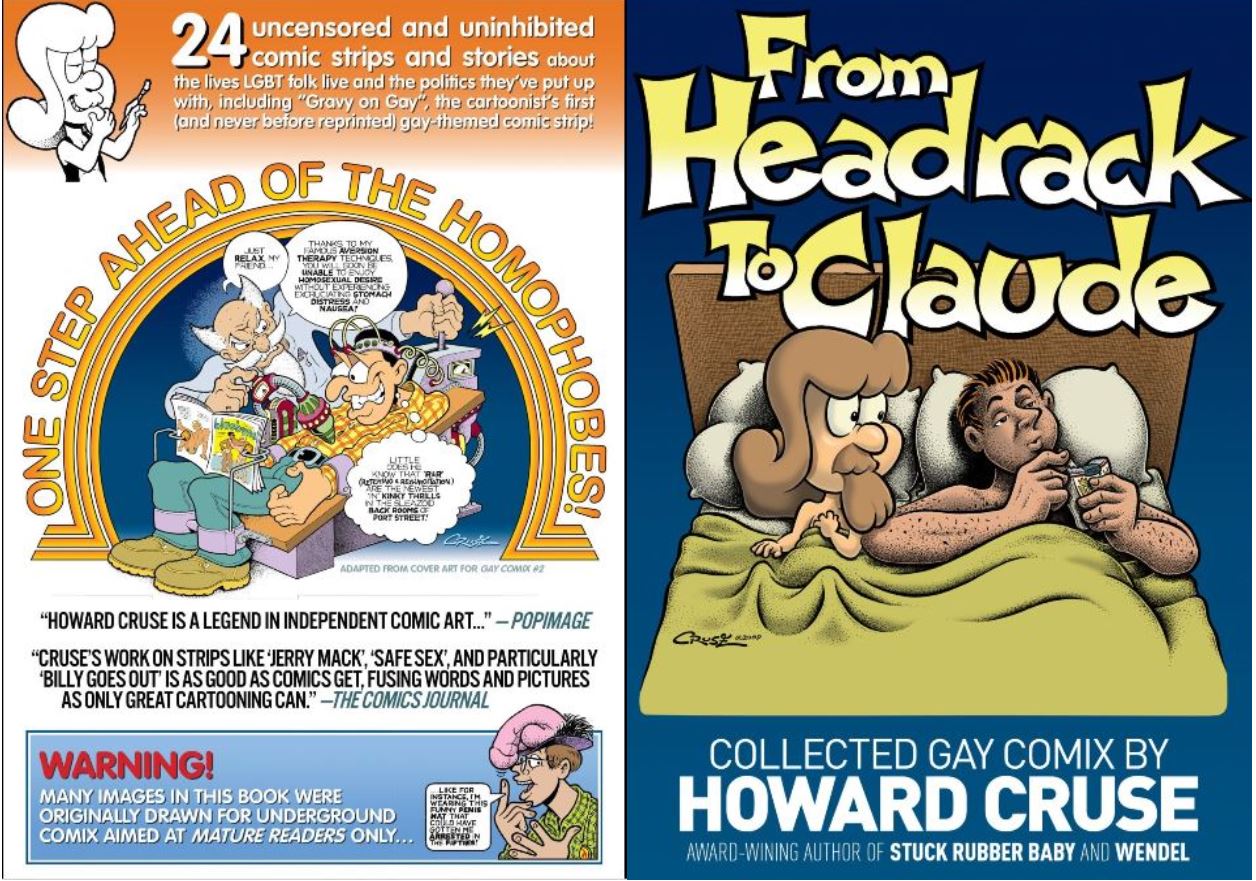
From Headrack to Claude – Collected Gay Comics of Howard Cruse


By Howard Cruse (Nifty Kitsch Press/Northwest Press)
ISBN: 978-0-578-03251-1 (TPB/Digital edition)

It’s long been an aphorism – if not an outright cliché – that Gay comics – can we be contemporary and say LGBTQIA+? – have long been the only place in the graphic narrative business to see real romance in all its joy, pain, glee and glory.

It’s still true: an artefact, I suppose, of a society seemingly obsessed with demarcating and separating sex and love as two utterly different and possibly even opposing principles and activities. I’d like to think that here in the 21st century – at least in the more sensible, civilised parts of it – we’ve outgrown the juvenile, judgemental, bad old days and can simply appreciate powerfully moving and/or funny comics about people of all sorts without any kind of preconception.

Sadly, that battle’s nowhere near won yet and in truth it all looks pretty bleak unless you’re a fundamentalist zealot or bigot. Hopefully, compendia such as this will aid the fight, if only we can get the other side to read them…

To facilitate that, after this archive was originally self-published in 2008 it was rendered fully digital – with updates and extra material – from those wonderful people at Northwest Press. Oh, and there’s an abundance of sex and swearing on view, so if you’re the kind of person liable to be upset by words and pictures of an adult nature (such as joyous, loving fornication between two people separated by age, wealth, social position and race who happily possess and constantly employ the same range of naughty bits on each other) or sly mockery of deeply-held, outmoded and ludicrous beliefs then best retreat and read something else.

In fact, just go away: you have no romance in your soul or love in your heart.

Howard Cruse (May 2nd 1944-November 26th 2019) enjoyed a remarkable cartooning career spanning decades that overlapped a number of key moments in American history and social advancement. Beginning as a hippy-trippy, counter-culture, Underground Comix star with beautifully drawn, witty, funny (not always the same thing in those days – or now, come to think of it) strips, his work evolved over years into a powerful voice for change in both sexual and race politics. Initially as strips in magazines but ultimately through such superb collections and Original Graphic Novels as Wendel and Stuck Rubber Baby: an examination of oppression, tolerance and freedoms in 1950s America.

Since then he has become a columnist, worked on other writers’ work, illustrated an adaptation of Jeanne E. Shaffer’s The Swimmer With a Rope In His Teeth and continued his own unique brand of cartoon commentary.

Born the son of a Baptist Minister in Birmingham, Alabama, Cruse grew up amid the instinctive race-based privilege and smouldering intolerance of the region’s segregationist regime: an atmosphere that shaped him on a primal level. In the late ‘60s, he escaped to Birmingham-Southern College to study Drama: graduating and winning a Shubert Playwriting Fellowship to Penn State University.

Campus life never really suited him and he dropped out in 1969. Returning to the South, he joined a loose crowd of fellow Birmingham Bohemians; allowing room to blossom as a creator. By 1971, Cruse was drawing a spectacular procession of strips for an increasingly hungry and growing crowd of eager admirers. Whilst working for a local TV station as both designer and children’s show performer, he created a kid’s newspaper strip about talking squirrels Tops & Button, and still found time to craft the utterly whimsical and bizarre tales of a romantic quadrangle. Intended for the more discerning college crowd he remained in contact with, these strips appeared in a variety of college newspapers and periodicals and starred a very nice young man and his troublesome friends…

In 1972 the strip was “discovered” by publishing impresario Denis Kitchen who began disseminating Barefootz to a far broader audience via such Underground periodical publications as Snarf, Bizarre Sex, Dope Comix and Commies From Mars: all published by his much-missed Kitchen Sink Enterprises.

Kitchen also hired Cruse to work on an ambitious co-production with rising powerhouse Marvel Comics: attempting to bring a (somewhat sanitised) version of the counter-culture’s cartoon stars and sensibilities to the mainstream. The Comix Book was a traditionally packaged and distributed newsstand magazine that only ran to a half-dozen issues. Although deemed a failure, it provided the notionally more wholesome and genteel Barefootz with a larger audience and yet more avid fans…

As well as being an actor, designer, art-director and teacher, Cruse appeared in Playboy, The Village Voice, Heavy Metal, Artforum International, The Advocate and Starlog and countless other publications, yet the tireless story-man found the time and resources to self-publish Barefootz Funnies: two comic collections of his addictively whimsical strip in 1973.

For us, a captivatingly forthright grab-bag and memoir gathers the snippets and classics left out of previous must-have collections The Compete Wendel and Early Barefootz, with Cruse tracing his development through cartoons and strips all thoroughly and engagingly annotated and contextualised by the author himself: fondly, candidly revisited against a backdrop of the men he loved at the time.

Acting as an historical place-setter, Cruse’s informative Preface sets the ball rolling, laconically tracing his artistic career and development through domestic autobiographical strip ‘Communique’ (from Heavy Metal) to unveil home life at the time. A more detailed exploration overview of the Queer comics scene follows in ‘From Miss Thing to Jane’s World’ before the book truly begins.

For a better, fuller understanding you’ll really want to see the aforementioned Wendell and Barefootz collections, but for now we relive history in first chapter Artefacts & Benchmarks Part 1: 1969-76, blending contextualising prose recollection with noteworthy strip ‘That Night at the Stonewall’s’, advertising art, abortive newspaper strip sample, an episode of Tops & Button, and other published work, plus gay sitcom feature ‘Cork & Dork’.

An early example of advocacy comes from wry cartoon homily ‘The Passer-By’ before further reminiscences and picture extracts take us to an uncharacteristically strident and harsh breakthrough.

Preceded by explanatory sidebar ‘Backstory: Gravy on Gay’, we are formally introduced to Barefootz’s, way-out friend confidante – and openly gay hippy rebel – Headrack in ‘Gravy on Gay’: wherein – the laid-back easy-going artist is confronted with the ugly, mouthy side of modern living as voiced by obnoxious jock jerk Mort

The march of progress continues in Artefacts & Benchmarks Part 2: 1976-80, detailing a variety of comics jobs from Dope Comix and Snarf to the semi-legitimacy of Playboy and Starlog. It also features the first meeting with life partner – and ultimately, husband – Eddie Sedarbaum before My Strips from Gay Comix 1980-90 traces his editorial career on the landmark anthology through reprints of his own strip contributions.

It begins in ‘Billy Goes Out’: recalling the joyous – or it that empty and tedious? – hedonistic freedoms of the days immediately before the AIDS crisis…

Incisive cloaked autobiographical fable ‘Jerry Mack’ takes us inside the turbulent mind of an ultra-closeted church minister in full regretful denial, after which further heartbreak is called up in devious tragedy ‘I Always Cry at Movies’ before home chores are dealt with in a manly manner in ‘Getting Domestic’.

Historical and political insight comes in ‘Backstory: Dirty Old Lovers’ before the outrageous and hilarious antics of the oldest lovers in town scandalise the Gay community in ‘Dirty Old Lovers’, whilst the thinking behind clarion call ‘Safe Sex’ is detailed in a ‘Backstory’ article prior to a straightforward examination of Acquired Immune-Deficiency Syndrome and its effects on personal health and public consciousness…

Surreal comedy infuses the tale of a man’s man and his adored ‘Cabbage Patch Clone’ after which faux ad ‘I Was Trapped Naked inside the Jockey Shorts of the Amazing Colossal Man!’ and Matt Groening spoof ‘Gay Dorks in Fezzes’ closes this chapter to make way for Topical Strips 1983-93.

With Cruse’s particular brand of “Gay” commentary/advocacy reaching more mainstream audiences through publications like The Village Voice, a ‘Backstory’ relates the author’s ultimately unnecessary anxiety over inviting in the wider world through polemical sally ‘Sometimes I Get So Mad’ and wickedly pointed social and media satire ‘The Gay in the Street’. That oracular swipe and ‘1986 – An Interim Epilogue’ are also deconstructed by Backstory segments (the latter being a 2-page addendum created for the Australian release of ‘Safe Sex’ in Art & Text magazine) before ‘Backstory: Penceworth’ shares one of British Prime Minister Margaret Thatcher’s vilest moments.

In 1988, her government attempted to set back sexual freedom to the Stone Age (or Russia, Turkey, Nigeria and other uncivilised countries today) by prohibiting the “promotion of homosexuality”. The British law – (un)popularly known as Clause 28 – was resisted on many fronts, including benefit comic AARGH (Artists Against Rampant Government Homophobia). Invited to contribute, Cruse channelled Hillaire Belloc’s Cautionary Verses and excoriatingly assaulted the New Nazism with ‘Penceworth’: a charming illustrated poem like a spiked cosh snuggled inside a rainbow coloured velvet slipper…

Luxuriating in righteous indignation and taking his lead from the New York Catholic Church’s militant stance against the LGBT community, Cruse then illuminated a supposed conference between ‘The Kardinal & the Klansman in Manning the Phone Bank’ and targeted similar anti-gay codicils in America’s National Endowment for the Arts in ‘Homoeroticism Blues’

Another Backstory explains how and why a scurrilous article in Cosmopolitan resulted in ‘The Woeful World of Winnie and Walt’ – a complacency-shattering tale in Strip AIDS USA, pointedly reminding White Heterosexuals that the medical horror wasn’t as discriminating as they would like to believe…

That theme is revisited with the kid gloves off in ‘His Closet’, after which ‘Backstory: Rainbow Curriculum Comix’ clarify how School Board rabble-rouser Mary Cummings set back decades of progress in American diversity education through her oratorical witch hunts. Cruse’s potent responses ‘Rainbow Curriculum Comix’ and ‘The Educator’ follow…

The artist’s Late Entries 2000-08 round off the historical hay ride: snippets including a full-colour rebuttal from Village Voice to Dr. Bruce Bagemihl’s study on animal homosexuality. ‘A Zoo of Our Own’ is accompanied by a fulsome Backstory and followed by wryly engaging modern fable ‘My Hypnotist’ and semi-autobiographical conundrum ‘Then There Was Claude’ before the bemused wonderment wraps up with prose article ‘I Must Be Important …Cause I’m in a Documentary (2011)’ and a superb Batman pin-up/put down…

This is a sublime and timeless compilation: smart, funny, angry when needful and always astonishingly entertaining. Read it with Pride.
© 1976-2008 Howard Cruse. All rights reserved.
For further information and great stuff check out Howardcruse.com

Night Nurse


By Jean Thomas, Linda Fite & Win Mortimer; Brian Michael Bendis & Alex Maleev, & various (MARVEL)
No ISBN: Digital-only edition

During the costumed hero boom of the 1960s, Marvel experimented with a solo title shot for Inhuman anti-hero/political refugee Madame Medusa (Marvel Super-Heroes #15, July 1968) and a solo series for established supporting character The Black Widow (Amazing Adventures # 1-8, August 1970 – September 1971). Both were sexy, reformed supervillains, not wholesome girl-next-door heroines like long-domesticated costumed chicks The Invisible Girl, Marvel Girl and The Wasp… and neither lasted solo for long.

The other two actual action women – rather than simple romantic-complication fodder – of that early Marvel era were The Scarlet Witch (mutant/ex-villain/occasional Avenger) and superspy Sharon Carter/Agent 13 of S.H.I.E.L.D.

Just for the sake of completeness: post-World War II, Timely/Atlas Comics embraced and published fiercely independent, capable female operators like Miss America, Namora, Golden Girl, Sun Girl, Blonde Phantom, Venus and more. None survived the insidious social domestication movement that drove American women out of the workplace and back into kitchens and bedrooms: a period that (coincidentally?) generated a growing fascination with captivating jungle women living wild and free in primal freedom – in space as well as on Earth – and a huge explosion in straight romance comics where decent white girls competed for the best husband…

When the costumed crazies craze began to subside in the 1970s, newly-promoted Publisher Stan Lee and his editor-in-chief Roy Thomas looked into creating a girl-friendly boutique of proper “heroines” for the changing tastes of the nation. Written by women, they sought to address and satisfy a wider market than simple boy-fuelled superheroics ever could.

The early 1970s was an era of turbulent social change, with established notions, traditions and laws being constantly challenged. Banner headlines and TV news everywhere confirmed that women’s rights were now being fought for – and thus consequently fiercely resisted – just as vigorously as the Civil Rights movement that had polarised and incensed Americans a handful of years previously…

Marvel’s opening shots in this mini-liberation war were in established genres and both cover-dated November 1972. Claws of the Cat – by Linda Fite, Marie Severin & Wally Wood – added a female superhero to the pantheon, whilst Night Nurse combined contemporary daytime television medical dramas with Marvel’s long-established romance/“career girl” tradition. New post-Feminism jungle goddess Shanna the She-Devil – by Carole Seuling & George Tuska – debuted in December 1972.

Despite impressive creative teams, none of these fascinating and trailblazing experiments lasted beyond a fifth issue, but the characters have all since then become fully established in the greater continuity…

That certainly applies to today’s pioneer. Collecting Night Nurse #1-4 and a stunning reinvention from Marvel Knights Daredevil (volume 2) #80 – also numbered #460 as a result of renumbering nonsense you really don’t need to care about. This digital-only compilation gathers the entire melodrama-drenched saga of a tough and determined young woman looking to make a difference. The print equivalent is the 2015 Night Nurse one-shot: cover-dated July and published to capitalise on the traction her appearance in the mainstream MU generated.

With covers by Winslow Mortimer, John Romita Sr., Frank Giacoia & Joe Sinnott, and adapting the character and concepts first seen in Linda Carter: Student Nurse (#1-9, spanning cover-dates September 1961-January 1963), Night Nurse saw writer Jean Thomas and illustrator Mortimer reintroduce our star as her-long-deferred graduation day approached: peeking behind the curtain of professionalism to reveal ‘The Making of a Nurse!’

Carter and her roomies – ghetto child Georgia Jenkins and disgraced, disinherited rich kid Christine Palmer – have all been learning-by-working at vast and prestigious Metro General: enduring a relentless regimen of complex hands-on training adapting them to the constant high pressure demands of their proposed careers. Particularly difficult was the suffering they were daily exposed to, and how each student coped with it…

Things start to get truly complicated when Linda falls for wealthy good-looking patient Marshall Michaels. His whirlwind courtship leads to a marriage proposal and wedding plans… until he reveals that no wife of his will ever prioritise a job over running his home…

Georgia, meanwhile, finds her ghetto roots still dragging her down when – in the midst of a city-wide power-outage – her brother Ben and his activist friend Rocky try to blow up Metro’s back-up generator. When she and Linda discover them the result is tragedy…

In the second issue, a ‘Night of Tears… Night of Truth!’ sees Carter save a VIP life during a hit-and-run incident, only to endure an acclaimed and ultra-rich surgeon parachuted in to conspicuously fix the patient and reap temporary glory.

Arrogant Dr. Sutton subsequently offers well-bred rebel Palmer a job as his permanent assistant: a position that comes with amorous assumptions and intent. However, the snobbish surgeon underestimates her resolve and loathing of the unspoken code dictating that the wealthy should stick together and he can’t understand why Christine calls the cops when she finds out his side hustle business, how he uses his prescription privileges and one other secret he’s been keeping from all his powerful friends and associates…

Linda, meanwhile, is getting far too friendly with hunky doctor Jack Tryon

Events escalate in ‘Murder Stalks Ward 8!’ when Carter is the only witness to a gangland killing that leads back to major mobster Victor Sloan: a crime kingpin connected to Georgia’s wayward brother Ben. When Sloan is admitted to Metro, nurse Jenkins finds her dedication and resolve severely tested, especially after rival crooks invade the hospital looking for payback and Jack and Linda have to play detective and bodyguard…

There’s an abrupt change of pace in final issue #4 and a touch of gothic romance in the air as Thomas and co-writer Linda Fite focus on Christine. Rocked by scandal, Dr. Sutton’s betrayal and repeated rejection by her elitist father, nurse Palmer seeks a different career path and answers an ad for a live-in nurse/physiotherapist in Boston.

Illustrated by Mortimer, ‘The Secret of Sea-Cliff Manor!’ revels in all the trappings of gothic mystique typifying that period, as Christine meets and manages moody, magnificently angry paraplegic Derek Porter, his sweet Aunt Edna, and spooky old manservant Harold: dispensing care and comfort whilst being dragged deep into a manic murder plot…

The series terminated there, although the nurses popped up occasionally in various titles over the years. Then in Marvel Knights Daredevil volume 2 #58 (May 2004) Linda Carter returned without warning and in an extremely specific role: running a sort-of secret underground clinic in NYC as the enigmatic “Night Nurse”. The facility catered exclusively to metahumans – mostly the heroic or vigilante ones – who needed fixing and couldn’t trust the regular hospital system…

Inexplicably, that yarn is not included here. Instead we have Marvel Knights Daredevil volume 2, #80 (February 2006): fifth chapter 5 of ‘The Murdock Papers’ wherein Brian Michael Bendis, Alex Maleev and colourist Dave Stewart detail how Matt Murdock is almost fatally shot after his secret identity is made public.

On the run, his occasional ally and paramour Elektra drags his failing form to the clinic where it transpires Murdock is a frequent flyer. As the mysterious medic seeks to stabilise him, heroes like Jessica Jones, Luke Cage, Iron Fist and Black Widow rush to his side. It’s a smart move since Kingpin Wilson Fisk, an army of irate Feds and ninja cult The Hand have all zeroed in on the dying man, all determined to complete their unfinished business with Daredevil

From this revival and revision, Night Nurse evolved into a crucial component of both the print and cinematic Marvel Universes, playing a role in the Civil War and Secret Invasion storylines; working with The Young Avengers, Captain America, Doctor Strange, Iron Man and all the above-mentioned street level champions…

A tribute to Marvel’s ceaseless commitment to reinvention, reappraisal and rebirth, Night Nurse is an intriguing example of how the role of women has evolved in comic books and will delight both incurably addicted fans and those casual dabblers looking for different flavours of Marvel medicine.
© 2013 Marvel Characters, Inc. All rights reserved.

Krazy & Ignatz 1916-1918: The George Herriman Library volume 1


By George Herriman (Fantagraphics Books)
ISBN: 978-1-68396-255-7 (HB/Digital edition)

In a field positively brimming with magnificent and eternally evergreen achievements, Krazy Kat is – for most cartoon cognoscenti – the pinnacle of pictorial narrative innovation: a singular and hugely influential body of work which shaped the early days of the comics industry whilst elevating itself to the level of a treasure of world literature.

Krazy & Ignatz, as it is dubbed in these gloriously addictive archival tomes from Fantagraphics, is a creation which must always be appreciated on its own terms. Over the decades the strip developed a unique language – simultaneously visual and verbal – whilst delineating the immeasurable variety of human experience, foibles and peccadilloes with unfaltering warmth and understanding…and without ever offending anybody. Baffled millions certainly, but offended? …No.

It certainly went over the heads and around the hearts of many, but Krazy Kat was never a strip for dull, slow or unimaginative people: those who can’t or simply won’t appreciate complex, multilayered verbal and cartoon whimsy, absurdist philosophy or seamless blending of sardonic slapstick with arcane joshing. It is still the closest thing to pure poesy narrative art has ever produced.

Think of it as Dylan Thomas and Edward Lear playing “I Spy” with James Joyce amongst beautifully harsh, barren cactus fields whilst Gabriel García Márquez types up shorthand notes and keeps score…

George Joseph Herriman (August 22, 1880-April 25, 1944) was already a successful cartoonist and journalist in 1913 when a cat and mouse who’d been noodling about at the edges of his domestic comedy strip The Dingbat Family/The Family Upstairs graduated to their own feature.

Mildly intoxicating and gently scene-stealing, Krazy Kat debuted in William Randolph Hearst’s New York Evening Journal on Oct 28th 1913: a 5-day-a-week monochrome comedy strip. By sheer dint of the overbearing publishing magnate’s enrapt adoration and direct influence and interference, it gradually and inexorably spread throughout his vast stable of papers.

Although Hearst and a host of the period’s artistic and literary intelligentsia (such as Frank Capra, e.e. Cummings, Willem de Kooning, H.L. Mencken and more) adored the strip, many local and regional editors did not; taking every potentially career-ending opportunity to drop it from those circulation-crucial comics sections designed to entice Joe Public and the general populace.

The feature found its true home and sanctuary in the Arts and Drama section of Hearst’s papers, protected there by the publisher’s unshakable patronage. Eventually enhanced (in 1935) with the cachet of enticing colour, Kat & Ko. flourished unhampered by editorial interference or fleeting fashion, running generally unmolested until Herriman’s death on April 25th 1944 from cirrhosis caused by Non-alcoholic fatty liver disease. Eschewing standard industry policy of finding a substitute creator, Hearst decreed Krazy Kat would die with its originator and sole ambassador.

The premise is simple: Krazy is an effeminate, dreamy, sensitive and romantic feline of variable gender, hopelessly smitten with venal, toxically masculine everyman Ignatz Mouse. A spousal abuser and delinquent father, the little guy is rude, crude, brutal, mendacious and thoroughly scurrilous.

Ignatz is a proudly unreconstructed male and early forerunner of the men’s rights movement: drinking, stealing, fighting, conniving, constantly neglecting his wife and many children and always responding to Krazy’s genteel advances of friendship (…or more) by clobbering the Kat with a well-aimed brick. These he obtains singly or in bulk from local brick-maker Kolin Kelly. The smitten kitten always misidentifies these gritty gifts as tokens of equally recondite affection, showered upon him/her/they in the manner of Cupid’s fabled arrows…

Even in these earliest tales, it’s not even a response, except perhaps a conditioned one: the mouse spends the majority of his time, energy and ingenuity (when not indulging in crime or philandering) launching missiles at the mild moggy’s mug. He can’t help himself, and Krazy’s day is bleak and unfulfilled if the adored, anticipated assault fails to happen.

The final critical element completing an anthropomorphic emotional triangle is lawman Offissa Bull Pupp. He’s utterly besotted with Krazy, professionally aware of the Mouse’s true nature, but hamstrung by his own amorous timidity and sense of honour from permanently removing his devilish rival for the foolish feline’s affections. Krazy is – of course – blithely oblivious to the perennially “Friend-Zoned” Pupp’s dolorous dilemma…

Secondarily populating the mutable stage are a large, ever-changing supporting cast of inspired bit players including relentless deliverer of unplanned babies Joe Stork; unsavoury Hispanic huckster Don Kiyoti, hobo Bum Bill Bee, self-aggrandizing Walter Cephus Austridge, inscrutable, barely intelligible (and outrageously unreconstructed by modern standards!) Chinese mallard Mock Duck, portraitist Michael O’Kobalt, dozy Joe Turtil and snoopy sagacious fowl Mrs. Kwakk Wakk, often augmented by a host of audacious animal crackers – such as Krazy’s niece Ketrina – all equally capable of stealing the limelight and supporting their own features…

The exotic, quixotic episodes occur in and around the Painted Desert environs of Coconino (patterned on the artist’s vacation retreat in Coconino County, Arizona) where surreal playfulness and the fluid ambiguity of the flora and landscape are perhaps the most important member of the cast.

The strips themselves are a masterful mélange of unique experimental art, cunningly designed, wildly expressionistic (often referencing Navajo art forms) whilst graphically utilising sheer unbridled imagination and delightfully evocative lettering and language. This last is particularly effective in these later tales: alliterative, phonetically, onomatopoeically joyous with a compellingly melodious musical force and delicious whimsy (“Ignatz Ainjil” or “I’m a heppy, heppy ket!”).

Yet for all our high-fallutin’ intellectualism, these comic adventures are poetic, satirical, timely, timeless, bittersweet, self-referential, fourth-wall bending, eerily idiosyncratic, outrageously hilarious escapades encompassing every aspect of humour from painfully punning shaggy dog stories to riotous, violent slapstick. Herriman was also a master of action: indulging in dialogue-free escapades as captivating as any Keystone Kop or Charlie Chaplin 2-reeler. Kids of any age will delight in them as much as any pompous old git like me and you…

Collected in a comfortably hefty (257 x 350 mm) hardcover edition – and available as a suitably serendipitous digital edition, this cartoon wonderment is bulked up with a veritable treasure trove of unique artefacts: plenty of candid photos, correspondence, original strip art and astounding examples of Herriman’s personalised gifts and commissions (gorgeous hand-coloured artworks featuring the cast and settings), as well as a section on the rare merchandising tie-ins and unofficial bootleg items.

These marvels are supported by fascinating insights and crucial history in Bill Blackbeard’s essay ‘The Kat’s Kreation’: detailing the crackers critters’ development and their creators’ circuitous path to Coconino, via strips Lariat Pete, Bud Smith, The Boy Who Does Stunts, Rosy’s Mama, Zoo Zoo, Daniel and Pansy, Alexander, Baron Mooch and key stepping stone The Dingbat Family

From there we hie straight into the romantic imbroglio with ‘The Complete Krazy Kat Sunday Strips of 1916’ beginning with the full-page (17 panels!) episode for April 23rd wherein the Kat rudely absconds from a picnic to carry out a secret mission of mercy and sweet sentiment…

The peculiar proceedings were delivered – much like Joe Stork’s bundles of joy and responsibility – every seven days, ending that first year on December 31st. Across that period, as war raged in Europe and with America edging inexorably closer to joining in the Global Armageddon, the residents of Coconino sported and wiled away their days in careless abandon: utterly embroiled within their own – and their neighbours’ – personal dramas.

Big hearted Krazy adopts orphan kitties, accidentally goes boating and ballooning, saves baby birds from predatory mice and rats, survives pirate attacks and energy crises, constantly endures assault and affectionate attempted murder and does lots of nothing in an utterly addictive, idyllic and eccentric way. We see nature repeat itself with the introduction of our star’s extended family in “Kousins” Krazy Katbird and Krazy Katfish

Always our benighted star gets hit with bricks: many, variegated, heavy and forever evoking joyous, grateful raptures and transports of delight from the heartsore, hard-headed recipient…

Often Herriman simply let nature takes its odd course: allowing surreal slapstick chases, weird physics and convoluted climate carry the action, but gradually an unshakeable character dynamic was forming involving love and pain, crime and punishment and – always – forgiveness, redemption and another chance for all transgressors and malefactors…

In ‘The Complete Krazy Kat Sunday Strips of 1917’ – specifically January 7th to December 30th – the eternal game plays out as usual and with an infinite variety of twists, quirks and reversals. However, there are also increasingly intriguing diversions to flesh out the picayune proceedings, such as recurring explorations of terrifying trees, grim ghosts, two-headed snakes and obnoxious Ouija Boards. Amidst hat-stealing winds, grudge-bearing stormy weather, Kiyote chicanery and tributes to Kipling we discover why the snake rattles and meet Ignatz’s aquatic cousins, observe an extended invasion of Mexican Jumping Beans and a plague of measles, discover the maritime and birthday cake value of “glowerms”, learn who is behind a brilliant brick-stealing campaign, graphically reconstruct brick assaults, encounter early “talkies” technology, indulge in “U-Boat diplomacy”, uniquely celebrate Halloween and at last see Krazy become the “brick-er” and not “brickee”…

With strips running from January 6th to December 29th, ‘The Complete Krazy Kat Sunday Strips of 1918’ finds Herriman fully in control of his medium, and kicking into poetic high gear as America finally entered the War to End All Wars.

As uncanny brick apparitions scotch someone’s New Year’s resolutions, cantankerous automobiles began disrupting the desert days, fun of a sort is had with boomerangs and moving picture mavens begin haunting the region. There are more deeply strange interactions with weather events, the first mentions of a “Spenish Influenza”, and a plague of bandit mice alternately led by or victimizing Ignatz. Music is made, jails are built and broken, Mrs Hedge-Hogg almost become a widow and criminal pig Sancho Pansy makes much trouble. Occasional extended storylines begin with the saga of an aberrant Kookoo Klock/avian refuge and invasive species of bean and “ko-ko-nutts”, and Krazy visits the Norths and Souths poles, foot specialist Dr. Poodil and Madame Kamouflage’s Beauty Parlor

More surreal voyages are undertaken but over and again it’s seen that there is literally no place like Krazy & Ignatz’s home. There was only one acknowledgement of Kaiser Bill and it was left to the missile-chucking mouse to deliver it with style, stunning accuracy and full-blooded venom…

And then it was Christmas and a new year and volume lay ahead…

To complete the illustrious experience and explore an ever-shifting sense of reality amidst the constant visual virtuosity and verbal verve we end with splendidly informative bonus material.

Curated by Blackbeard, The Ignatz Mouse Debaffler Page provides pertinent facts, snippets of contextual content and necessary notes for the young, potentially perplexed and historically harassed. Michael Tisserand’s ‘“The Early Romance between George Herriman’s Krazy Kat and William Randolph Hearst’s ‘City Life”’ explores the strip’s growing influence on the world around him, and it’s supported by an article of the period.

A Genius of the Comic Pageis an appreciation and loving deconstruction of the strip – with illustrations from Herriman – by astoundingly perspicacious and erudite critic Summerfield Baldwin and originated in Cartoons Magazine (June 1917) and is followed by Blackbeard’s biography of the reclusive creator in George Herriman 1880-1944’.

Herriman’s epochal classic is a genuine Treasure of World Art and Literature. These strips shaped our industry, galvanised comics creators, inspired auteurs in fields as disparate as prose fiction, film, sculpture, dance, animation and jazz and musical theatre whilst always delivering delight and delectation to generations of devoted, wonder-starved fans.

If however, you are one of Them and not Us, or if you still haven’t experienced the gleeful graphic assault on the sensorium, mental equilibrium and emotional lexicon carefully thrown together by Herriman from the dawn of the 20th century until the dog days of World War II, this glorious parade of cartoon masterpieces may be your last chance to become a Human before you die…

That was harsh, I know: not everybody gets it and some of them aren’t even stupid or soulless – they’re just unfortunate…

Still, for lovers of whimsy and whimsical lovers “There Is A Heppy Lend Furfur A-Waay” if only you know where and how to look…
© 2019 Fantagraphics Books, Inc. All contents © 2019 Fantagraphics Books, Inc., unless otherwise noted. “The Kat’s Kreation”, “The Ignatz Mouse Debaffler Page”, and Herriman biography © 2019 Bill Blackbeard. “The Early Romance between George Herriman’s Krazy Kat and William Randolph Hearst’s ‘City Life”’ © 2019 Michael Tisserand. All other images and text © 2019 their respective copyright holders. All rights reserved.

The Batman Adventures: Mad Love Deluxe Edition


By Paul Dini & Bruce Timm, with Rick Taylor, Tim Harkins & various (DC Comics)
ISBN: 978-1-4012-5512-1 (HB/Digital edition)

Harley Quinn wasn’t supposed to be a star… or even an actual comic book character. As soon became apparent, however, the manic minx always has her own astoundingly askew and off-kilter ideas on the matter… and any other topic you could name: ethics, friendship, ordnance, true love…

Created by Paul Dini & Bruce Timm, Batman: The Animated Series aired in the US from September 5th 1992 to September 15th 1995. Ostensibly for kids, the breakthrough television cartoon revolutionised everybody’s image of the Dark Knight and immediately began feeding back into the print iteration, leading to some of the absolute best comic book yarns in the hero’s many decades of existence.

Employing a timeless, all-embracing visual style dubbed “Dark Deco”, the show mixed elements from all iterations of the character and, without diluting the power, tone or mood of the premise, reshaped the grim avenger and the extended team around him into a wholly accessible, thematically memorable form that the youngest of readers could enjoy, whilst adding shades of exuberance and panache only most devout and obsessive Batmaniac could possibly object to…

Harley was first seen as the Clown Prince of Crime’s slavishly adoring, extreme abuse-enduring assistant in Joker’s Favor, which aired on September 11th 1992. She instantly captured the hearts and minds of millions of viewers.

From then on she began popping up in the incredibly successful licensed comic book and – always stealing the show – soon graduated into mainstream DC continuity.

After a period bopping around the DCU, she was re-imagined as part of the company’s vast post-Flashpoint major makeover: regularly appearing as part of a new, gritty-but-still-crazy iteration of the Suicide Squad. However, at heart she’s always been a cartoon glamour-puss, with big, bold, primal emotions and only the merest acknowledgement of how reality works…

Re-presenting the 1994 one-shot Batman Adventures: Mad Love, this slight and breezy hardcover is made up of mostly recycled material – including writer Paul Dini’s comfortably inviting Foreword and co-plotter/illustrator Bruce Timm’s effusive and candidly informative ‘Mad Love Afterword’.

However, a truly unmissable bonus treat for art-lovers and all those seeking technical insight (perhaps with a view to making comics or animation their day job) is the illustrator’s full monochrome ‘Original Layouts for The Batman Adventures: Mad Love’: displaying how the story materialised page by page. There’s even previous and variant covers to earlier editions and unused painted back cover art plus highly detailed, fully-annotated colour guides for the complete story, offering a perfect “How To”  lesson for aspiring creators…

All that being said though, what we want most is a great story, and that magnificently madcap mayhem commences after Police Commissioner James Gordon heads to the dentist. When Batman easily foils the Joker’s latest manic murder attempt, the mountebank of Mirth pettishly realises he’s lost his inspirational spark.

He’s therefore in no mood for lasciviously whining lapdog Harley’s words of comfort or flirtatious pep talks…

As the Dark Knight reviews his files on the Joker’s girlfriend and ponders on how Harleen Frances Quinzel breezed through college and came away with a psychology degree that bought her a staff position at Arkham Asylum, in the now, the larcenous lady in question has gone too far in the Joker’s lair. The trigger is comforting sympathy and telling her “precious pudden” how his baroque murder schemes could be improved…

Kicked out and almost killed (again), Harleen harks back to her first meeting with the devilishly desirable crazy clown and how they instantly clicked. She fondly recalls how her original plan to psychoanalyse the Joker and write a profitable tell-all book was forgotten the moment she fell under his malign spell. In that moment she became his adoring, willing and despised slave…

She also realises that Batman too-quickly scotched their budding eternal love by capturing the grinning psycho-killer she secretly aided and abetted, both before and after she created her own costumed alter ego…

In fact, Batman always spoils her dreams and brutalises her adored “Mistah J”. It’s long past time she took care of him once and for all…

Driven by desperation and fuelled by passion, Harley Quinn appropriates one of the Joker’s abortive schemes and tweaks it.

Before long, the Gotham Gangbuster is duped, doped, bound and destined for certain doom. Sadly, the triumphant Little Woman hasn’t reckoned on how her barmy beloved will react to learning she has done in mere hours what he’s failed to accomplish over many bitter years…

Coloured by Rick Taylor and lettered by Tim Harkins, the classy, classically staged main feature plays very much like a 1940s noir blend of morbid melodrama and cunning crime caper – albeit with outrageous over-the-top gags, sharply biting lines of dialogue and a blend of black humour and bombastic action. This story easily qualifies as one of the top five bat-tales of all time.

A frantic, laugh-packed, action-driven hoot that manages to be daring, deranged and demure by turns, Mad Love is an absolute delight, well worth the price of admission and an irresistible treasure to be enjoyed over and over again.
© 1994, 2015 DC Comics. All Rights Reserved.

If You Loved Me, You’d Think This was Cute – Uncomfortably True Cartoons About You


By Nick Galifianakis (Andrews McMeel)
ISBN: 978-0-7407-9947-1 (TPB/Digital edition)

Delivering biting wit, groundbreaking revelation or an excoriating assault with an unforgettable drawing and a few well-chosen words is one of the greatest gifts humans might possess. Even those stuck-up holdouts who pointedly claim to have “never read a comic” certainly enjoy strips or panels: a golden bounty of brief amusement demanding no commitment other than a moment’s close attention.

Truth be told, it’s probably in our genes and a bit like love, no?

According to the text preface by Carolyn Hax in this astoundingly funny collection, the cartoons gathered here by immensely gifted illustrator Nick Galifianakis were originally intended as little pictorial add-ons to accompany and supplement her nationally syndicated Advice Column (cited by Time magazine as America’s best…).

Apparently, Nick kept making them so funny that the pictures became an intrinsic and unmissable companion and in 2010 a whole bunch of the very best of them turned into this book.

Also included are an outrageous Foreword by his cousin Zach – yes, that movie comedian guy – sharing the kind of intimate incident insights and past humiliations only a close family member can; as well as a vast Acknowledgments section and insider information on the way Nick works in his Introduction. There are also concrete clues that his one true love is his dog ZuZu

All that aside, what’s on offer here is a spellbinding examination of human relationships as seen from a natural raconteur’s perspective: devastatingly penetrating, sharp to the point of cruelty, warmly sympathetic, ultimately understanding and forgiving and, most importantly, laugh-out-loud, Horlicks-jetting-out-of-your-nose funny.

Or whatever your shared evening tipple of choice might be. I’m not saying that his gags make your body mysteriously manufacture Horlicks. That would be weird…

In this delicious monochrome paperback (or eBook, you choose: it’s an officially free albeit expensive world and you’re most likely some sort of consenting adult) you’ll see all the perilous wonders and tribulations of human relationships. Crucially, you will also find the search for love reduced to simple, forthright categories stuffed with beautifully rendered line drawings exemplifying the rights and wrongs of finding and keeping – or satisfactorily jettisoning – a partner.

It kicks off with the male perspective as seen through female eyes in ‘The Bastard Files’ before naturally offering an opposing viewpoint in ‘The Unfair Sex’

The eternal hunt is deconstructed in ‘Finding the Ones(s)’ and expanded upon in ‘So This Was The One’ before learning how to negotiate deadly traps and bile-filled traumas of ‘The Bridal Industrial Complex’.

Weddings avoided or survived, everybody’s all reconciled to being one great big joyous clan, as proved here in the acerbically astute ‘Putting the Eff in Family’, but please remember, Love’s all about the children really, isn’t it? Thus a close-up-and-personal dissection of procreation in ‘Just Kidding’ which leads to the conclusion that some sons and daughters don’t ever grow up in ‘When We’re Five We’re All Artists…’

If confused or in trouble, the natural thing to do is depend on your closest comrades in the Battle of the Sexes, but ‘With Friends Like These’, clarity and understanding are early casualties. Still, if we’re being truly honest we can only trust our ‘Lusting Impressions’ before settling for ‘A Little Something on the Side’ to avoid getting ‘Ego-Tripped’.

At least our animal companions still offer us unconditional love… don’t they? Perhaps not, if the bestial examples in ‘Ark Types’ are to be believed and if you ‘Catch My Riff’

When all’s said (sad?) and done then, perhaps it’s best to play safe and just try the ‘Flair of the Dog’ when looking for truly lasting love…

With recurring themes including Frogs and Princesses, malevolent Cupids, uncomprehending Adams and Eves, weary Saint Peter at the Pearly Gates and the absolutely crucial role of Lawyers and Counsellors in all relationship matters, this compendium of situational quandaries and unromantic entanglements is a superbly cathartic look at love and one every new home and generational estate should have in pride of place on the mantelpiece – near the heavy candlesticks, poker, poisons and matching tasers…

© 2010 by Nick Galifianakis. All rights reserved.

The Complete Love Hurts – Horrifying Tales of Romance


By Kim W. Andersson with Sara B. Elfgren & various (Dark Horse Books)
ISBN: 978-1-61655-859-8 (TPB) eISBN: 978-1-63008-152-2

Internationally acclaimed and award-winning, Kim W. Andersson began his comics career in fanzines, and after studying at the Serieskolan School of Art in Malmö began his professional life with contributions to Sweden’s broad and varied comics industry. His first hit series was Love Hurts which began in 2009.

Wry, creepy, mordant and ironically funny, the series appeared in numerous venues before serialisation in anthology series Dark Horse Presents, for us English speakers. In 2015 Dark Horse Books re-presented the entire shebang in one titanic, trenchant tome…

Collecting Love Hurts #1-22, Love Hurts: Anastasia from Nemi, and #23-32 as seen in Utopi Magasin, also included here is one-shot Love Hurts: Dead End courtesy of Johnossi Comics – which you would already know if you read more stuff published in Scandinavia…

Since then, Andersson has returned to school thematically in chiller Alena (made into a movie) and Astrid: Cult of the Volcanic Moon. When not lecturing, creating gallery shows or making comics, the auteur works as an illustrator of book, magazines and for TV.

Following Peter Snejbjerg’s barbed Introduction ‘It was a Dark and Stormy Night’, what follows is a rapid-fire, smartly sarcastic and cunningly pilfered and plundered tribute to all aspects of mass entertainment and popular fiction from EC Comics to slasher movies, manipulating relationships as a trigger for jabs, pokes and broadsides at how and why people (and related beings) want, need and use other people…

The result is a nonstop procession of gags and incidents starring serial killers, domestic abusers, needy girlfriends, procurers, and wayward teens all encountering endings they might not deserve but certainly should have been expecting…

Sexy, gory yet remarkably not salacious, pastiches of screen shockers are supplemented by surreal and metaphysical moments, historical fantasies, ghostly encounters or sci fi and monster moments: all leavened by a darkly childish sense of the absurd and all illustrated with fetching style…

From spoofs starring 50-foot girlfriends to perplexing prom night pranks; from western showdowns and manga cautionary tales to lovingly irreverent myths mauled and manipulated, the marriage of amour and peril is dissected, with demons, devils, doctors, dweebs and dolly-birds re-examined via a puckish contemporary lens. There’s even a murky nod to superheroes and – just when you’re off guard – genuine tragedy amidst the crimson-spattered comedy…

Here love comes in all sizes, shapes and kinds with nothing barred or forbidden but with precious little in the way of happy endings…

The short punchy vignettes are bolstered by two longer tales: frenzied fairy tale Love Hurts: Anastasia darkly riffs on the tale of Bluebeard and 1001 Arabian Nights by way of Puss in Boots and Night of the Living Dead whilst Love Hurts: Dead End depicts a deadly pan-dimensional trip to the bad places and a celebrity La-la-land after one poor guy “wins” ‘The Lottery’

Scary, hilarious, mordant, and in wickedly Bad Taste, these tales for culturally savvy appetites are augmented by a bonus section of Sketches and Extras offering ‘Happy Valentine’s Day!’ cards; working sketches of the models used to create the strips; cover designs; previous collection covers; layouts; original pages in various stages of completion, tattoo art and a biography.

Dark, doom-swept, daft, deranged and delightful, this may be the most appropriate appreciation of the annual emotional event yet conceived…
Love Hurts™ © 2015 Kim W. Andersson. All rights reserved.

Young Romance: The Best of Simon & Kirby’s Romance Comics


By Joe Simon & Jack Kirby, restored & edited by Michael Gagné (Fantagraphics Books)
ISBN: 978-1-60699-502-0 (HB)

Comics dream team Joe Simon & Jack Kirby presaged and ushered in the first American age of mature comics – not just with the Romance genre, but through all manner of challenging modern graphic dramas about real people in extraordinary situations… before seeing it all disappear again in less than eight years.

Their small stable of magazines – produced for a loose association of companies known as Prize/Crestwood/Pines – blossomed and wilted as the comics industry contracted throughout the 1950s.

As the popularity of flamboyant escapist superheroes waned after World War II, newer yet more familiar genres like Crime, Westerns and Horror returned to the fore in all popular entertainment media, as audiences increasingly rejected simplistic, upbeat or jingoistic fantasy for grittier, more sober themes.

Some comic book material, such as Westerns or anthropomorphic “Funny Animals”, hardly changed at all, whereas gangster and detective tales were utterly radicalised by the temperament of the post-war world.

Stark, uncompromising, cynically ironic novels, plays and socially aware, mature-themed B-movies that would be later defined as Film Noir offered post-war civilian society a bleakly antiheroic worldview that often hit too close to home and set fearful, repressive, middle-class parent groups and political ideologues howling for blood.

Naturally, these new forms and sensibilities seeped into comics, transforming good-natured, two-fisted gumshoe and Thud-&-Blunder cop strips of yore into darkly intriguing, frightening tales of seductive dames, last chances, big pay-offs and glamorous thuggery.

Sensing imminent Armageddon, the moral junkyard dogs bayed even louder as they saw their precious children’s minds under seditious attack…

Concurrent to the demise of masked mystery-men, industry giants Simon & Kirby – who were already capitalising on the rapidly growing True Crime boom – legendarily invented the genre of comic book Romance with mature, beguiling, explosively contemporary social dramas equally focussed on a changing cultural scene and adult-themed relationships. They also – with very little shading – discussed topics of a sexual nature!

After testing the waters with the semi-comedic prototype My Date for Hillman in early 1947, Joe & Jack plunged in full force with Young Romance #1 in September of that year. It launched through Crestwood Publications: a minor outfit which had been creating (as Prize Comics) interesting but far from innovative comics since 1940.

Following Simon’s plan to make a new marketplace out of the grievously ignored older girls of America, they struck gold with stories addressing serious issues, pitfalls and even genuine hazards of relationships…

Not since the invention of Superman had a single comic book generated such a frantic rush of imitation and flagrant cashing-in …although you might argue that MLJ’s Archie Andrews came close in 1942-1943.

Young Romance #1 was a monumental hit and the team acted accordingly: rapidly retooling and expanding, “S&K” released spin-offs Young Love (February 1949), Young Brides and In Love, all under a unique profits-sharing deal that quickly paid huge dividends to the publishers, creators and a growing studio of specialists.

All through that turbulent period, comic books suffered impossibly biased oversight and hostile scrutiny from hidebound and panicked old guard institutions such as church groups, media outlets and ambitious politicians. A number of tales and titles garnered especial notoriety from those conservative, reactionary doom-smiths and when the industry buckled and introduced a ferocious Comics Code, it castrated the creative form just when it most needed boldness and imagination.

Comics endured more than a decade and a half of savagely doctrinaire self-imposed censorship until swiftly changing youthful attitudes, a society in crisis and plummeting profits forced the artform to adapt, evolve or die.

Those tales all come from a simpler time: exposing a society in meltdown and suffering cultural PTSD – and are pretty mild by modern standards of behaviour – but the quality of art and writing make those pivotal years a creative highpoint well worthy of a thorough reassessment…

In 1947, fictionalising True Crime Cases was tremendously popular and profitable, and of the assorted outfits generating such material, nobody did it better than Simon & Kirby. Crucially they proved that a technique of first-person confession also perfectly applied to just-as-uncompromising personal sagas told by a succession of archetypal women and girls who populated their new comic book smash.

Their output as interchangeable writers, pencillers and inkers (aided from early on by Joe’s brother-in-law Jack Oleck in the story department) was prodigious and astounding. Nevertheless, other hands frequently pitched in, so although these tales are all credited to S&K, art-aficionados shouldn’t be surprised to detect traces of Bill Draut, Mort Meskin, Al Eadeh, George Roussos or other stalwarts lurking in the backgrounds… and minor figures and…

Michelle Nolan’s ‘Introductionfor this rousing full-colour compilation analyses the scope and meteoric trajectory of the innovation and its impact on the industry before the new era opens with ‘Boy Crazyfrom Young Romance #2 (cover-dated November/December1947) wherein a flighty teenager with no sense of morality steals her aunt’s man with appalling consequences…

From the same issue, Her Tragic Lovedelivers a thunderbolt of melodrama as an amorous triangle encompassing a wrongly convicted man on death row presents one woman with no solution but a final one…

Scripted by Oleck, ‘Fraulein Sweetheart(YR #4, March/April 1948) reveals dark days but no happy endings for two German girls eking out existence in the American-occupied sector of post-war Marburg, whilst ‘Shame– from #5 – deals with an ambitious, social-climbing young lady too proud to acknowledge her own scrub-woman mother whenever a flashy boyfriend comes around.

Next is ‘The Town and Toni Benson’ from Young Romance #11 (contemporarily designated volume 2, #5, May/June 1949) which offers a sequel to ‘I Was a Pick-Up’ from the premiere issue (which tale is confusingly included in the sequel to this volume Young Romance 2: The Early Simon & Kirby).

Here, however, S&K cleverly build on that original tale, creating a soap opera environment which could so easily have spawned a series, as the now-newlywed couple struggle to make ends meet under a wave of hostile public scrutiny…

On a roll, the creative geniuses began mixing genres. Western Love #2 (September/October 1948) provides ‘Kathy and the Merchant of Sunset Canton!’, as a city slicker finds his modern mercenary management style makes him no friends in cowboy country – until one proud girl takes a chance on getting to know him…

‘Sailor’s Girl!’ (Young Romance #13/Vol. 3, #1, September 1949) then picks over the troubles of an heiress who marries a dauntless sea rover working for Daddy. She is absolutely confident that she can tame or break her man’s wild, free spirit…

We head out yonder once more to meet ‘The Perfect Cowboy!’ (Real West Romances # 4, October/November 1949) – at least on set – a well as the simple sagebrush lass whose head he briefly turns, before social inequality and petty envy inform brutally heavy-handed ‘I Want Your Man’ (Young Romance #21/Vol. 3 #9, May 1950).

Here a young woman of meagre means realises almost too late the cost of her vendetta against a pretty little rich girl…

In the name of variety ‘Nancy Hale’s Problem Clinic(Young Romance #23/Vol. 3 #11, July 1950) offers a brief dose of sob-sister advice as “treatment for the troubled heart” before the romantic rollercoaster rides resume with ‘Old Fashioned Girl(YR #34/Vol. 4 #10 June 1951) as a forceful young woman raised by her grandmother slowly has her convictions about propriety challenged by intriguing men and her own barely subsumed passions… Alternatively, ‘Mr. Know-It-All Falls in Love(Young Love #37/Vol. 7 #10, September 1952) takes a rare opportunity to speak with a male narrator’s voice as a buttoned-down control freak decides that with his career in order it’s time to marry. But who’s the best prospect?

Another of those pesky lovers’ triangles then results in one marriage, one forlorn heartbreak, war, vengeance and a most appropriate ‘Wedding Present!(Young Love #50/Vol. 5 #8 October 1953) before this cleverly conceived chronicle takes a conceptual diversion – after one last tale from the same issue – detailing the all-business affair of ‘Norma, Queen of the Hot Dogsand her (at first) strictly platonic partner…

In 1955 the Comics Code Authority began its draconian bowdlerising of the industry’s more mature efforts and Romance titles especially took a big conceptual hit. Those edgy stories became less daring and almost every ending was a happy one – at least for the guy or the parents…

Following a superbly extensive ‘Cover Galleryfeaturing a dozen of the most evocative images from those wild and free early years, The Post-Code Era re-presents the specific conditions affecting romantic relations from the censorious document, followed by a selection of the yarns S&K and their team were thereafter reduced to producing.

Even the art seems less enthusiastic for the wholesome, unchallenging episodes which begin with ‘Old Enough to Marry!(Young Romance #80/Vol. 8 #8, cover-dated December 1955/January 1956) wherein a young man confronts his grizzled cop dad. The patriarch has no intention of letting his son make a mess of his life…

Next, a maimed farmer tries to sabotage the budding romance between his once-faithful girlfriend and the brilliant good-looking doctor who cured him in ‘Lovesickfrom the same issue.

The following four tales all originated in Young Romance #85/Vol. 10, #1 (December 1956/January 1957), beginning with ‘Lizzie’s Back in Townas a strong, competent girl returns home to let Daddy pick her husband for her (no, really!).

Next, two guys fight and the winner gets the girl in ‘Lady’s Choicewhilst another, less frenzied duel results in a ‘Resort Romeomarrying the girl of everybody’s dreams, even as ‘My Cousin from Milwaukeeexposes a gold-digger before reserving her handsome relative for herself…

These anodyne antics mercifully conclude with ‘The Love I Lost!(Young Romance #90/Vol. 12 #3, October/November 1957) wherein another hospital case realises just in time that the man she wants is not the man she deserves…

This emotional rollercoaster is supplemented with a number of well-illustrated bonus features including ‘Why I Made this Book, ‘Simon and Kirby’s Romance Comics: A Historical Overview; a splendid selection of S&K’s pioneering ‘Photo Covers (18 in all) and a fascinating explanation of the process of artwork-rehabilitation in ‘About the Restoration

The affairs then wrap up with the now-traditional ‘Biographiessection.

Simon & Kirby took much of their tone – if not actual content – from movie melodramas of the period (such as Mr. Skeffington, All About Eve or Mildred Pierce and/or Noir romances like Blonde Ice or Hollow Triumph) and, unlike what we might consider suitable for romantic fiction today, their stories crackled with tension, embraced violent action and were infested with unsavoury characters and vicious backstabbing, gossiping hypocrites.

Happily, those are the tales which mostly fill most of this book, making for an extremely engaging, strikingly powerful and thoroughly addictive collection of great yarns by brilliant masters of the comics arts: and one no lover (of the medium) should miss…
Young Romance: The Best of Simon & Kirby’s Romance Comics © 2012 Fantagraphics Books Inc. Introduction © 2012 Michelle Nolan Schelly. All rights reserved.

Ares & Aphrodite: Love Wars


By Jamie S. Rich &Megan Levens, lettered by Crank! (Oni Press)
ISBN: 978-1-62010-208-4 (TPB) eISBN: 978-1-62010-209-1

It might be hard to believe for people like us, but not all love stories are about hunting the villain who murdered your “Only One” or fighting dragons, or even seeking out the ghosts of those who are gone. Sometimes it’s just mutual attraction, Meet-cutes, Getting-to-know-you’s and taking some chances…

Author, editor, comics scripter and film fan Jamie S. Rich (12 Reasons Why I Love Her, You Have Killed Me, Cut My Hair, Lady Killer, Archer Coe and the Way to Dusty Death, It Girl and the Atomics, A Boy and a Girl, Justice League: Endless Winter) is a big fan of classic romance and film fiction and here unites with his collaborator on Madame Frankenstein to celebrate the genre and all its trappings. Best yet it’s all drenched in the heady miasma of modern life in Hollywood…

This tale was a breakthrough venture for Megan Levens, who went on to score big with Buffy the Vampire Slayer, Star Trek, Spell on Wheels, Mysticons, Wonder Woman: Black and Gold and more…

The similarities with cinematic RomComs are both deliberate and delightfully effective as we meet successful Tinseltown divorce lawyer Will Ares: a dedicated singleton doing his job well but paying for it through the malicious and destructively vindictive acts of a mystery stalker targeting his car, home and private life…

As a result, his dating profile is bleak and his love life is non-existent but he clings to the dream that somehow somewhere love conquers all…

The client taking up most of his time these days is legendary (and geriatric) Producer/serial romantic Evans Beatty. Ares handles all his divorces and is currently deeply involved in the necessary legal motions to accommodate his next walk up the aisle – with recently matured & legal former child-star Carrie Cartwright.

All that remains for Will to do is finalise Beatty’s split from extremely unhappy wife #4 Eileen. She, however, is not playing ball…

The impending bride-to-be is sweet but tough. Raised in Hollywood, she’s trying to be everyone’s friend, but in the unblinking spotlight of Hollywood’s news cycle, her only real ally at this moment is jaded yet ultra-competent wedding planner Gigi Averelle who owns Goddess of Love Nuptials.

Averelle’s really good at her job, but the daily grind and manufactured dream game has convinced her that there’s truly no such thing as Love. When marital mastermind and legal beagle meet and clash in Beatty’s office, all the wrong sort of sparks fly…

Will’s barely-acknowledged interest in the tough-cookie facilitator is soon sidelined as the targeted vandalism escalates and completely forgotten by the time Evans drunkenly reveals that he’s already secretly wed Carrie – despite still being tethered to Eileen…

With his client’s entire fortune and now liberty at stake, Will frantically strives to crisis-manage a catastrophe, whilst Gigi continues orchestrating an utterly unnecessary but so fabulously flashy Hollywood glamour-fest. Interest in the affair reaches fever-pitch when news breaks that Carrie’s next movie role will be as ingenue in classic fantasy Crown Princess

The forthcoming blockbuster’s lead is Allison Queen and the salivating press-pack clearly anticipate fireworks aplenty with the next Mrs. Beatty picked to play second fiddle on set to Evans’ formidable, star-powered and apparently happily-divorced second wife…

Repeatedly forced into close contact, Will and Gigi witness the worst that LaLa Land’s scandal mill can generate, and as speculation, malicious rumour, misinformation, unvetted and illegal photo-scoops and ex-wife mischief mounts, the love-wary professionals foolishly contrive an ill-considered wager…

Arguing that the outcome will validate one or the others’ ideals, they bet on whether the upcoming wedding will actually happen. Fixing the prize/penalty as a date with the lawyer if Will wins and his having to publish a full accounting in the papers of every marriage he’s ruined if Gigi gets it right…

Forced into close proximity, both sides warm and mellow, and before long that penalty is watered down to Averelle rebuilding Ares’ online dating profile if she wins. Of course, she’s still unaware that the process is completely sham as Carrie and Evans are already hitched…

As the big day approaches, all hell repeatedly breaks loose with rogue reporters, spies, runaway brides and a tissue of lies drawing the distanced, smugly aloof and superior-feeling outsiders ever closer, even before “The Date” can happen. Then, when Carrie Cartwright delivers a shocking bombshell announcement, Gigi and Will are forced to reassess their opinions…

Wry and playful, this appalling yarn has engaging echoes of movies like Destination Wedding or the 1950 Father of the Bride, gently prodding all the established accoutrements of an evergreen plot and genre. It’s undemanding and might well give your comics-indulgent significant other an unexpected treat – or at least a brief break from Batman and Star Wars.

Bonus material includes a faux Trailer for Crown Princess, an appreciative Afterword from Jacque Nodell of romance comics site Sequentialcrush.com and a rundown of the full art process from script to final pages.

There’s also a previously unseen vignette by Rich & Levens about disentanglement. Short and sweet, it involves bridges, potential strangers, relationship insecurities and the eternal war between cyclists and pedestrians: all prime fantasy fodder for mismatched marital mayhem. ‘Two Wheels, Two Feet’ plays out here with subtlety and whimsical wit, proving love is all around…
Ares & Aphrodite is ™ & © Jamie S. Rich and Megan Levens 2015. All rights reserved.

A Very DC Valentine’s Day


By Cecil Castellucci, Amanda Conner, Andy Diggle, Paul Dini, Ray Fawkes, Phil Hester, Kyle Higgins, Collin Kelly, Alisa Quitney, Jackson Lanzing, Peter Milligan, Ann Nocenti, Steve Orlando, Jimmy Palmiotti, James Robinson, Mark Russell, Mairghread Scott, Tim Seeley, Simon Bisley, Ben Caldwell, Aaron Campbell, Giuseppe Camuncoli, Mirko Colak, Andrew Currie, Javier Fernandez, Julio Ferreira, Julius Gopez, Sanford Greene, Stephanie Hans, Bryan Hitch, Frazer Irving, Kelley Jones, Nic Klein, Emanuela Lupacchino, Guillem March, John McCrea, Jaime Mendoza, Inaki Miranda, Robson Rocha, Thony Silas, Cam Smith, John Timms & various (DC Comics)
ISBN: 978-1401287665 (TPB/Digital edition)

After generations of incorporating seasonal occasions, milestones and themes into their regular chronology, in recent years comics publishers have started releasing special issues and compilations to single out those sale-enhancing moments. For DC, that process really began during their New 52 reboot…

Regrettably eschewing their own vast back catalogue of magnificently-limned genre romance material (still… maybe one day, hey?) the home of Batman, Superman and Wonder Woman released all-new anthologies exploring the many roads to and ways of loving.

In 2018, three one-shots – Young Monsters in Love #1, Young Romance: The New 52 Valentine’s Day Special #1 and Harley Quinn Valentine’s Day Special #1 – were tangled together as a celebratory tome which might entice less traditional fans…

We begin with Young Monsters in Love #1, which hit stores on February 7th 2018 carrying an April cover-date. It opens with a tale of Man-Bat wherein Kyle Higgins, Kelley Jones & colourist Michelle Madsen expose the bestial inner monologue of Kirk Langstrom’s “Nocturnal Animal”’ as the self-mutated science renegade seeks to rekindle his romantic relationship with ex-wife Francine

Tim Seeley, Giuseppe Camuncoli & Cam Smith also explore that theme of stability lost as Frankenstein, Agent of S.H.A.D.E. reviews his centuries-long relationship with “The Bride” in ‘Pieces of Me’ whilst Clark Kent and his son Jon learn a few hard truths about love and loss in ‘Buried on Sunday’. It’s a potentially shattering lesson for the Man of Steel and Superboy who seek to ensure that Solomon Grundy does not wallow in the eternal despair of bereavement as sensitively detailed by Mairghread Scott, Bryan Hitch & Andrew Currie…

Disgruntled Teen Titan/peripatetic ghost buster Raven discovers ‘The Dead Can Dance’ on a long-deferred Prom Night(mare) by Collin Kelly, Jackson Lanzing & Javier Fernandez, after which Paul Dini & Guillem March expose the cruel traumas of elementary school bullying when Deadman saves a lonely boy crushed and nearly killed by the annual purgatory of card-giving in ‘Be My Valentine’

Swamp Thing loves and loses another frail and fragile human contact in the beautifully eerie ‘Heart-Shaped Box’ by Mark Russell & Frazer Irving, before Steve Orlando & Nic Klein push the parameters of amour and self-sacrifice when queer cop Maggie Sawyer seeks to stop a potential bloodbath as Monsieur Mallah & The Brain (of the Brotherhood of Evil) seek a way to further their impossibly complex relationship by looking backwards in ‘Visibility’

Andrew Bennet (I, Vampire, by Alisa Quitney & Stephanie Hans) then experiences painful revelation when forced to accept a new role for his ever-maturing disciple in ‘The Turning of Deborah Dancer’, whereas EtriganThe Demon – brutally challenges the entire infernal host to reach Jason Blood’s lost love in ‘To Hell and Gone’ by Phil Hester &Mirko Colak.

Amidst the madness of WWII, the warped wooing closes with a distressing brush-off letter to the Creature Commandos’ man-made vampire in ‘Dear Velcoro’, by James Robinson & John McCrea.

Heralding a shift from dark dilemmas to costumed courting – courtesy of the contents of Young Romance: The New 52 Valentine’s Day Special #1 (originally cover-dated April 2013) – our soap-opera sagas start with Catwoman reminiscing over her first meeting and troubled history with Batman in Ann Nocenti, Emanuela Lupacchino & Jaime Mendoza’s ‘Think it Through’

Aquaman & Mera uncover unrequited love and reunite unquiet separated spirits in ‘The Lighthouse’ (by Cecil Castellucci & Inaki Miranda) before Batgirl Babs Gordon lets her guard down with a certified bad boy in Ray Fawkes & Julius Gopez’s ‘Dreamer’.

Superhero teammates Apollo & Midnighter revisit their first “ mad moment” mid-mission in ‘Seoul Brothers’ by Peter Milligan & Simon Bisley, whilst paragon legacy hero Nightwing makes all his old mistakes again with new foe/ally/love interest Ursa in ‘Another Saturday Night’ by Kyle Higgins & Sanford Greene…

One of the biggest and most touted draws of the New 52 was the sidelining of Lois Lane and shocking romantic entanglement of Superman and Wonder Woman. Here, Andy Diggle, Robson Rocha & Julio Ferreira depict the ultimate power couple in the early, exploratory stages of that relationship and learning via a shocking game of ‘Truth or Dare’ …until spiteful sirens and a possessed god of love violently object…

The final third of this torrid tome sees lunatic love bandit Harleen Quinzel hog the limelight and steal the show with an extended epic from the Harley Quinn Valentine’s Day Special #1: released on February 11th 2015 and once again cover-dated for the month of All Fools…

Written by Amanda Conner & Jimmy Palmiotti, and collaboratively illustrated by John Timms, Ben Caldwell, Aaron Campbell, Thony Silas and colourists Paul Mounts & Hi-Fi, ‘Just Batty Over You’ offers an hallucinogenic rollercoaster ride of passions and perplexing playfulness as The Joker’s former main squeeze espies and is enthralled by super-sexy Bruce Wayne who is a prize in a charity dating auction…

She determines to make him hers and the abduction part goes off pretty much as required. However, complicating the scheme is Harley’s own meandering grip on reality, Bruce’s many jobs and secrets, so very much over-applied and shared narcotic inducement, hench-folk who can only see the billionaire’s vast dollar-value and the perpetual interference of briny costumes activists The Carp and Sea Robin, who really want everybody to heed their message of marine environmental crisis…

Daft, delightful and delivered with perfect timing and elan, this lustful lark caps a supremely frothy and inconsequential diversion to charm casual and fully committed thrill seekers in equal amounts.
© 2013, 2015, 2018 DC Comics. All Rights Reserved.

Marvel Romance


By Stan Lee, Larry Lieber, Jean Thomas, Gary Friedrich, Jean Thomas, Jack KirbyDick Giordano, Vince Colletta, Joe Orlando, Gene Colan, Al Hartley, Sol Brodsky, John Romita Sr., John Buscema, Jim Steranko, Don Heck, Bill Everett, Jim Starlin, Jack Abel, Jim Mooney, Frank Giacoia & various (Marvel)
ISBN: 978-0-7851-2089-6 (TPB/Digital edition)

It’s the officially mandated period for us all to boost the economy by thinking of Love, Happy Ever Afters and furtive desperate hooks-ups, so if you’re reading this rather than frantically swiping your way through TENDR, eHugmany, GRUMBLR or GREEBLR?, you are probably old, unhip (perhaps Replacement Hipped?) or just like comics.

Once upon a time, comic books were the singular first port of call for entertainment/hope deprived, lovelorn ladies of all ages, whilst many a baffled bloke consulted such publications for useful hints on how to approach their amatory prey – before donning metaphorical rutting stag antlers and putting all their time and efforts into a staggeringly (tee hee!) inappropriate and never-to-be-repeated grandstanding stunt that simultaneously stunned their potential inamorata and forever burned out all desire ever to be such a sappy silly bugger again.

Such is modern love…

However, over the decades, the commercial aspects of the never-ending battle generated pretty good stories and paid the bills of some of our artform’s greatest talents, and early in this century Marvel celebrated with a splendid archival gift for the fans…

As the escapist popularity of flamboyant superheroes waned after World War II, newer genres such as Romance and Horror came to the fore even as older ones regained their audiences. Some, like Westerns and Funny Animal comics, had hardly changed at all but crime and detective tales were utterly radicalised by the temperament of the times.

Stark, uncompromising, cynically ironic novels and socially aware, mature-themed movies that would become categorised as Film Noir offered post-war society a bleakly antiheroic worldview that often hit too close to home and set fearful, repressive, middleclass parent groups and political ideologues howling for blood.

Naturally, these new sensibilities seeped into comics, transforming two-fisted gumshoe and cop strips of yore into darkly beguiling, even frightening tales of seductive dames, big pay-offs and glamorous thugs. Sensing imminent Armageddon, America’s moral junkyard dogs bayed even louder as they saw their precious children’s minds under seditious attack…

Concurrent with the decline of masked mystery-men, industry giants Joe Simon & Jack Kirby famously invented the romantic genre for comic books: devising beguiling, explosively mature social dramas equally focussed on a changing cultural scene and adult themed relationships. They began with semi-comedic prototype My Date in early 1947, before plunging into the torrid real deal with Young Romance #1 in September of that year.

Not since the invention of Superman had a single comic book generated such a frantic rush of imitation and flagrant cashing-in. It was a monumental hit and “S&K” quickly expanded: releasing spin-offs Young Love (February 1949), Young Brides and In Love.

Simon & Kirby presaged and ushered in the first American age of mature comics – not only with their creation of the Romance genre, but with challenging modern tales of real people in extraordinary situations – before seeing it all disappear again in less than eight years.

Their small stable of magazines produced for the loose association of companies known as Prize/Crestwood/Pines blossomed and wilted as the industry contracted throughout the 1950s.

All through that turbulent period, comic books suffered impossibly biased oversight and hostile scrutiny from hidebound and panicked old guard institutions such as church groups, media outlets and ambitious politicians. A number of tales and titles garnered especial notoriety from those social doom-smiths, and hopeful celebration and anticipation amongst tragic, forward-thinking if psychologically scarred comics-collecting victims was quashed when the industry introduced a ferocious Comics Code that castrated the creative form just when it most needed boldness and imagination.

We lost and comics endured more than a decade and a half of savagely doctrinaire, self-imposed censorship.

Those tales from a simpler time, exposing a society in meltdown and suffering cultural PTSD, are mild by modern standards of behaviour, but the quality of art and writing make those pivotal years a creative highpoint long overdue for a thorough reassessment.

For years such Code-vetted romance comics were a comfortably profitable, solid staple of Marvel – as well as almost every other publishing house. It’s also a truism that girls are pickier than boys – or at least have more discerning tastes – so most of those titles, whilst extremely limited by editorial tastes in the stories they offered, were generally graced with some of the best artwork the industry could offer.

Those love-starved chicks might have been content to absorb the same old perpetually regurgitated characters and plot pablum, but they definitely, defiantly wanted it all to look the best it possibly could…

Having accepted that the art for comics aimed at females has always been of a higher standard and observed that many of Marvel’s greatest action illustrators have secretly toiled in the tear-sodden Hearts and Flowers mines, the wisely cynical Editorial heads at The House of Ideas released an archival edition of the best of the bunch in 2006. – just in time for St. Valentine’s day! – Marvel Romance. To cover all bases (third is my favourite!), they also released comedic one-shot versions: latterly collected as Marvel Romance Redux

Contained herein are a selection of 1960s relationship yarns that cunningly show the formulaic nature of the genre at the time Marvel was revolutionising superhero comics, backed up by significant and memorable stories from the early 1970s when the company tried to repeat the process for the romance genre.

I fear it’s a subtly intrinsic indicator of the tone of the times and state of society, but you may notice how crying seems to be the natural resting state of women in romance comics, and love stories were always a good and sound excuse to show pretty girls in swimsuits or their underwear. As us guys always suspected, un- or semi-dressed was the fitting and proper state of females….

The amorous advances begin with the contents of Love Romances #89, cover-dated September 1960. Presumably scripted by Stan Lee and Larry Lieber, all are limned by Dick Giordano & Vince Colletta, opening with ‘I Mustn’t Love You, My Darling!’ as a woman seeking eligible bachelors almost misses out on a hot doctor due to her prejudices, after which the same attitude nearly saves a dishy director and producer from an aspiring actress who eventually decides he’s ‘The Only Man for Me’

When a high school girl is let down and has ‘No Dates for the Dance!’, a little maternal advice leads to happy ending before ‘The Last Good-By’ reminds a woman of a smugly arrogant college flame and why she left him…

The romance market was always subdivided into niche categories and young love was catered too in books like Teen-age Romance. From September 1960, #77 spawned a brace of tales possibly drawn as well as inked by Colletta. ‘A Teen-Ager Can Also Love!’ revealed how one fan’s devotion saved the career of an up-&-coming crooner whilst ‘Someday He’ll Come Along’ showed how an ambitious and determined secretary became an ad exec and still got to marry the boss…

Cover-dated November 1961, Teen-age Romance #84 sees Jack Kirby excel in ‘The Summer Must End!’ (Lee script & Colletta inks) as a haughty and beautiful social butterfly – and predator – luxuriates in the pick of men before making the wrong choice and regretting it…

Gene Colan then renders a simple and charming story of instant connection in ‘He Never Said a Word’ from Love Romances #101 (September 1962) before one month later #102 serves up a double dose of magic from Lee, Kirby & Colletta when a bride-to-be jumps to a painfully erroneous conclusion in ‘By Love Betrayed!’ after which a graduate returns to the scene of her bitterest disappointment and finally bags the lecturer she was too young for in ‘Give Back My Heart!’

Cover-dated January1963, Love Romances #103 saw Kirby inked by Al Hartley in  ‘The Dream World of Doris Wilson!’ – wherein a lonely outsider finds her perfect partner in a young comic book artist – and ‘If Your Heart I Break…’ depicting an imminent bride and groom both realising just in time the mistake they’re about to make…

The socially conformist sampling ceases with ‘Please Don’t Let Me Be a… Spinster!’ (Love Romances #104, March 1963 by what looks like Colletta inking Joe Orlando) as a young woman forgoes her own needs to care for her ailing mother. Just when all hope is lost, a dishy new doctor cures the elder and offers a new life for the dutiful daughter…

As already indicated, Romance played a big part in the Pre-Marvel Comics Atlas Era and next up is an issue of a teen star who was a big gun of that success.

Patsy Walker was an ideal girl-next-door whose wholesome teen-comedic exploits delighted readers for decades following her debut in Miss America #2 (Nov. 1944). She starred in seven separate comic series until 1967 and was dramatically retooled in the 1970s by Steve Englehart, Tom Sutton, George Pérez and others, eventually evolving into supernatural superhero Hellcat.

Patsy Walker #119 (November 1964) is by Lee & Sol Brodsky, revealing ‘Patsy’s Secret Boyfriend’, with the wholesome, decent teen star’s friends shocked and amazed by her apparent two-timing of high school sweetheart Buzz Baxter, in the days leading up to his coming home from the Vietnam war. Of course, there’s a sound and sensible reason for her actions that everyone has completely misunderstood…

This segment also includes the issue’s perennially adored style and clothing tips courtesy of ‘Patsy, Hedy and Nan’s Smart Styles’, ‘Patsy’s Fashion Page’, ‘Hedy’s Fashion Page’, ‘Patsy’s Heavenly Hairdos’ and ‘Hedy’s Charming Coiffures’. There are naturally lots of underwear moments…

After utterly changing the superhero scene, Stan Lee turned his attentions to reviving the ailing fortunes of the moribund romance division. Unlike competitors DC and Charlton Comics, Marvel’s comparatively limited creative resources and restrictive distribution contracts meant that the love anthologies had to go as the costumed cohort proliferated.

However, in 1969, with a new distributor and a burgeoning creative workforce, Marvel launched anthologies My Love (volume 2) and Our Love Story: offering new, edgier, contemporary stories by top flight writers and artists. Arguably, the project was a rare failure, but both books carried on into 1976, releasing 39 and 38 issues respectively, even though by 1972 new stuff was increasing supplemented by modified and updated reprints.

Again, the tales were heavily geared towards images of beautiful girls in glamorous roles and poses…

Here we begin with ‘I Do My Thing… No Matter Whom It Hurts!’ by Lee, John Buscema & John Romita Sr. as first seen in My Love #2 (cover-dated November 1969): the tale of a lovely but self-serving go-go dancer who learns too late that selfishness is its own punishment, after which Lee & Jim Steranko’s landmark pop-art masterpiece gets another airing. After debuting in Our Love Story #5 (June 1970) ‘My Heart Broke in Hollywood!’ was acclaimed as a breakthrough in graphic storytelling, although the story is a simple one of an aspiring actress losing a role but gaining a husband. Visually, it alone is worth the price of this book…

Lee, Don Heck & Romita Sr. then depict how a lonely, oblivious lass is ‘Jilted!’ (My Love #14, November 1971) and discovers that her true love has been right beside her all along, whilst Gary Friedrich, Colan & Giordano delve deep into hero-worship in My Love #16’s ‘As Time Goes By!’: exploring how a modern woman obsessed by Humphrey Bogart in Casablanca is returned to reality by a determined former boyfriend. The same issue – cover-dated March 1972 – also provides the ‘Formula for Love!’ with Jean Thomas, Colan & Bill Everett collaboratively proving that even a tutor-obsessed chemistry student can find true love, even after acting like a (Sandra) bullock in a china-shop, setting herself on fire and soaking the lab…

A deeply dissatisfied nurse then discovers ‘Another Kind of Love!’ (My Love #18, July 1972 by Lee, John Buscema & Colletta), ditching her dull banker boyfriend for a patient with months to live, whilst Romita Sr.-inked Lee & JB’s ‘I Love Him… But He’s Hers!’ (My Love #19, September 1972) sees a hardworking waitress/poor college student find her man when her work ethic outshines the wealth, glamour and self-indulgence of her spoiled competitor dorm roommate…

The dalliances close with a trio of tales from My Love #20 (November 1972), starting with Friedrich, Jim Starlin & Jack Abel’s ‘One Day a Week!’ as a diner waitress is beguiled by a fancy man who is there all the time – unlike her trucker fiancé…

Lee, John B, Romita Sr. & Frank Giacoia turn the tables on expectation in ‘Love Isn’t in the Cards for Me!’ as a charming conman selling a shop owner a line ultimately redeems himself, after which Lee, Colan & Jim Mooney wrap things up revisiting an old story of betrayal by a best friend when a conflicted woman remembers ‘The Boy That Got Away!’

For many, love stories are just an inaccessible “other country”, but even the most formulaic of these tales are beautiful examples of comics creation and if you can unbend a bit – and swallow some painfully outdated notions and attitudes – these mini-dramas can still delight and enthral. Why not take a chance on love and see what’s in it for you?
© 2020 MARVEL.