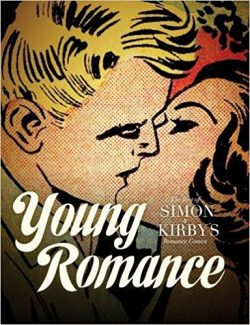
Young Romance: The Best of Simon & Kirby’s Romance Comics


By Joe Simon & Jack Kirby, restored & edited by Michael Gagné (Fantagraphics Books)
ISBN: 978-1-60699-502-0

Comics dream team Joe Simon & Jack Kirby presaged and ushered in the first American age of mature comics – not just with the Romance genre, but through all manner of challenging modern graphic dramas about real people in extraordinary situations… before seeing it all disappear again in less than eight years.

Their small stable of magazines – produced for the loose association of companies known as Prize/Crestwood/Pines – blossomed and wilted as the comics industry contracted throughout the 1950s.

As the popularity of flamboyant escapist superheroes waned after World War II, newer yet more familiar genres like Crime, Westerns and Horror returned to the fore in popular entertainment media, as audiences increasingly rejected simplistic, upbeat or jingoistic fantasy for grittier, more sober themes.

Some comicbook material, such as Westerns or anthropomorphic “Funny Animals”, hardly changed at all, but gangster and detective tales were utterly radicalised by the temperament of the post-war world.

Stark, uncompromising, cynically ironic novels and socially aware, mature-themed B-movies that would be later defined as Film Noir offered the post-war civilian society a bleakly antiheroic worldview that often hit too close to home and set fearful, repressive, middle-class parent groups and political ideologues howling for blood.

Naturally the new forms and sensibilities seeped into comics, transforming good-natured, two-fisted gumshoe and Thud-&-Blunder cop strips of yore into darkly intriguing, frightening tales of seductive dames, last chances, big pay-offs and glamorous thuggery.

Sensing imminent Armageddon, the moral junkyard dogs bayed even louder as they saw their precious children’s minds under seditious attack…

Concurrent to the demise of masked mystery-men, industry giants Simon & Kirby – who were already capitalising on the rapidly growing True Crime boom – legendarily invented the genre of comicbook Romance with mature, beguiling, explosively contemporary social dramas equally focussed on the changing cultural scene and adult-themed relationships. They also, with very little shading, discussed topics of a sexual nature…

After testing the waters with the semi-comedic prototype My Date for Hillman in early 1947, Joe & Jack plunged in full force with Young Romance #1 in September of that year. It launched through for Crestwood Publications: a minor outfit which had been creating (as Prize Comics) interesting but not innovative comics since 1940.

Following Simon’s plan to make a new marketplace out of the grievously ignored older girls of America, they struck gold with stories addressing serious issues and hazards of relationships…

Not since the invention of Superman had a single comicbook generated such a frantic rush of imitation and flagrant cashing-in. Young Romance #1 was a monumental hit and the team acted accordingly: swiftly expanding, they released spin-offs Young Love (February 1949), Young Brides and In Love, all under a unique profits-sharing deal that quickly paid huge dividends to the publishers, creators and a growing studio of specialists.

All through that turbulent period comicbooks suffered impossibly biased oversight and hostile scrutiny from hidebound and panicked old guard institutions such as church groups, media outlets and ambitious politicians.

A number of tales and titles garnered especial notoriety from those conservative, reactionary doom-smiths and when the industry buckled and introduced a ferocious Comics Code, it castrated the creative form just when it most needed boldness and imagination.

Comics endured more than a decade and a half of savagely doctrinaire self-imposed censorship until changing youthful attitudes, society in crisis and plummeting profits forced the art form to adapt, evolve or die.

Those tales all come from a simpler time: exposing society in meltdown and suffering cultural PTSD and are pretty mild by modern standards of behaviour but the quality of art and writing make those pivotal years a creative highpoint well worthy of a thorough reassessment.

In 1947, fictionalising True Crime Cases was tremendously popular and profitable, and of the assorted outfits that generated such material nobody did it better than S&K. That technique of first-person confession also perfectly applied to just-as-uncompromising personal sagas from a succession of archetypal women and girls who populated their new comicbook smash.

Their output as interchangeable writers, pencillers and inkers (aided from early on by Joe’s brother-in-law Jack Oleck in the story department) was prodigious and astounding. Nevertheless, other hands frequently pitched in, so although these tales are all credited to S&K, art-aficionados shouldn’t be surprised to detect traces of Bill Draut, Mort Meskin, Al Eadeh, George Roussos or other stalwarts lurking in the backgrounds…

Michelle Nolan’s ‘Introduction’ for this rousing full-colour hardback (available in eBook format should you prefer) deftly analyses the scope and meteoric trajectory of the innovation and its impact on the industry before the new era opens with ‘Boy Crazy’ (from Young Romance #2,1947) wherein a flighty teenager with no sense of morality steals her aunt’s man with appalling consequences…

From the same issue, Her Tragic Love’ delivers a thunderbolt of melodrama as an amorous triangle encompassing a wrongly convicted man on death row presents one woman with no solution but the final one…

Scripted by Oleck, ‘Fraulein Sweetheart…’ (YR #4, 1948) reveals dark days but no happy endings for two German girls eking out existence in the American-occupied sector of post-war Marburg whilst ‘Shame’ – from issue #5 – deals with an ambitious, social-climbing young lady too proud to acknowledge her own scrub-woman mother whenever a flashy boyfriend comes around.

Next is ‘The Town and Toni Benson’ from Young Romance #11 – contemporarily designated volume 2, #5, 1949 – which offers a sequel to ‘I Was a Pick-Up’ from the premiere issue (which tale is confusingly included in the sequel to this volume Young Romance 2: The Early Simon & Kirby).

Here S&K cleverly build on that original tale, creating a soap opera environment which could so easily have spawned a series as the now-newlywed couple struggle to make ends meet under a wave of hostile public scrutiny…

On a roll, the creative geniuses began mixing genres. Western Love #2, (1948) provides ‘Kathy and the Merchant of Sunset Canton!’ as a city slicker finds his modern mercenary management style makes him no friends in cowboy country – until one proud girl takes a chance on getting to know him – after which ‘Sailor’s Girl!’ (Young Romance #13/Vol. 3, #1 1949) picks over the troubles of an heiress who marries a dauntless sea rover working for Daddy. She is confident that she can tame or break her man’s wild, free spirit…

We head out yonder once more to meet ‘The Perfect Cowboy!’ (Real West Romances # 4 1949) – at least on set – a well as the simple sagebrush lass whose head he briefly turns, before social inequality and petty envy inform the brutally heavy-handed ‘I Want Your Man’ (Young Romance #21/Vol. 3, #9 1950) wherein a young woman of meagre means realises almost too late the cost of her vendetta against a pretty little rich girl…

In the name of variety ‘Nancy Hale’s Problem Clinic’ (Young Romance #23/Vol. 3, #11, 1950) offers a brief dose of sob-sister advice as “treatment for the troubled heart” before the romantic rollercoaster rides resume with ‘Old Fashioned Girl’ (YR #34/Vol. 4, #10 1951) as a forceful young woman raised by her grandmother slowly has her convictions about propriety challenged by intriguing men and her own barely subsumed passions, whereas ‘Mr. Know-It-All Falls in Love’ (Young Love #37/Vol. 7, #10 1952) takes a rare opportunity to speak with a male narrator’s voice as a buttoned-down control freak decides that with his career in order it’s time to marry. But who’s the best prospect?

Another of those pesky lovers’ triangles then results in one marriage, one forlorn heartbreak, war, vengeance and a most appropriate ‘Wedding Present!’ (Young Love #50/Vol. 5, #8 1953) before this cleverly conceived chronicle takes a conceptual diversion – after one last tale from the same issue – detailing the all-business affair of ‘Norma, Queen of the Hot Dogs’ and her (at first) strictly platonic partner…

In 1955 the Comics Code Authority began its draconian bowdlerising of the industry’s more mature efforts and the Romance titles especially took a big conceptual hit. The edgy stories became less daring and almost every ending was a happy one – for the guy or the parents at least.

Following a superbly extensive ‘Cover Gallery’ featuring a dozen of the most evocative images from those wild and free early years ‘The Post-Code Era’ re-presents the specific conditions affecting romantic relations from the censorious document, followed by a selection of the yarns S&K and their team were thereafter reduced to producing.

Even the art seems less enthusiastic for the wholesome, unchallenging episodes which begin with ‘Old Enough to Marry!’ (Young Romance #80/Vol. 8, #8, 1955) wherein a young man confronts his grizzled cop dad. The patriarch has no intention of letting his son make a mess of his life…

Next, a maimed farmer tries to sabotage the budding romance between his once-faithful girlfriend and the brilliant good-looking doctor who cured him in ‘Lovesick’ from the same issue.

The following four tales all originated in Young Romance #85/Vol. 10, #1 1956, beginning with ‘Lizzie’s Back in Town’ as a strong, competent girl returns home to let Daddy pick her husband for her (no, really!); two guys fight and the winner gets the girl in ‘Lady’s Choice’ whilst another, less frenzied duel results in a ‘Resort Romeo’ marrying the girl of everybody’s dreams even as ‘My Cousin from Milwaukee’ exposes a gold-digger and reserves her handsome relative for herself…

The anodyne antics mercifully conclude with ‘The Love I Lost!’ (Young Romance #90/Vol. 12, #3, 1959) wherein another hospital case realises just in time that the man she wants is not the man she deserves…

This emotional rollercoaster is supplemented with a number of well-illustrated bonus features including ‘Why I Made this Book’, ‘Simon and Kirby’s Romance Comics: A Historical Overview’; a splendid selection of S&K’s pioneering ‘Photo Covers’ (18 in all) and a fascinating explanation of the process of artwork-rehabilitation in ‘About the Restoration’.

The affairs then wrap up with the now-traditional ‘Biographies’ section.

Simon & Kirby took much of their tone – if not actual content – from movie melodramas of the period (such as Mr. Skeffington, All About Eve or Mildred Pierce or Noir romances like Blonde Ice or Hollow Triumph) and, unlike what we might consider suitable for romantic fiction today, their stories crackled with tension, embraced violent action and were infested with unsavoury characters and vicious backstabbing, gossiping hypocrites.

Happily, those are the tales which mostly fill most of this book, making for an extremely engaging, strikingly powerful and thoroughly addictive collection of great yarns by brilliant masters of the comics arts: and one no lover (of the medium) should miss…
Young Romance: The Best of Simon & Kirby’s Romance Comics © 2012 Fantagraphics Books Inc. Introduction © 2012 Michelle Nolan Schelly. All rights reserved.
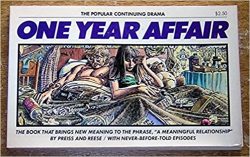
One Year Affair


By Byron Preiss & Ralph Reese (Workman Publishing Co.)
ISBN: 978-0-91110-486-8

It seems cruel to point it out if you’re currently unpartnered or between dalliances, but love is in the air at this time of year. It’s also wise to reiterate that even though your grand passion is comics, maybe your current inamorata is more indulgent and understanding than equally addicted to masks, tights or batmobiles…

So, even though we’re going to be talking romantic comics for the next week, why not consider flowers (and not from a garage forecourt), exotic excursions or shopping somewhere other than a comicbook store over the next few days?

Before beginning his own attempts to invent the Graphic Novel, Byron Preiss worked on a number of projects including a comic strip for the American humour magazine National Lampoon. With celebrated cartoonist and illustrator Ralph Reese he produced a wry, charming and oddly engaging examination of the contemporary dating scene, circa 1973.

Steve is just some guy and his casual meeting with the so-with-it, so-sexy Jill over a dropped feminine hygiene product leads to a funny, quirky and thoroughly readable modern romance of the type we’d call a RomCom nowadays.

From one-night stands to open relationships, through engagements to the ending (and I’m not telling you just in case you find a copy of this criminally overlooked and out-of-print item) this little treat shows with crushing warmth and superbly beguiling artwork (like Mort Drucker meeting Jack Davis with Wally Wood and Dick Giordano doing the catering) how human mating rituals have never really changed since men eschewed Big Wooden Clubs and tried to grow “A Good Sense of Humour” instead.

A genuine lost masterpiece of sequential narrative, the strip and this collection was followed up by tragically uncompleted sequel Two Year Affair. Just like true love for most carbon-based lifeforms it was simply destined not to be…

Still you can always console yourself with this book, a big box of tissues and gallons of chocolate ice cream…
© 1973, 1974, 1975, 1976 Byron Preiss Visual Publications, Inc., by arrangement with Ralph Reese & Byron Preiss. All rights reserved.

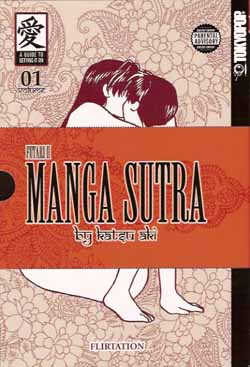
Manga Sutra – Futari H, Volume 1: Flirtation


By Katsu Aki (Katsuaki Nakamura) (Tokyopop)
ISBN: 978-1-4278-0536-2

I don’t think I’ve offended anybody for a while now, so with St. Valentine’s Day fast approaching I think we’re about due.

Therefore, if you are made uncomfortable, easily offended or embarrassed by the mention of graphic cartoon nudity and sexual situations, or if you have any problems at all with the oddly coy forthrightness of manga, please skip this review and move on.

Otherwise this peculiar coagulation of earnest soap opera and sexual self-help manual might be worth a moment of your attention. You might even be interested and want to see more…

Billed as “the best-selling sex guide from Japan” this initial volume – of at least 5 to my knowledge – is more accurately a sweet but explicit soap-opera love-story – albeit related in a staggeringly clinical-yet-chatty manner.

Makota and Yura are just married, but unbeknownst to each other, both still virgins. In short narrative episodes we follow their stumbling first steps to a healthy sex life, peppered with diagrams, statistics and a disturbingly jolly commentary. And lots of hilarity…

The act and any experience-improving techniques themselves are almost of secondary importance to the telling of a sweet and innocent RomCom yarn, with unsubtly-vamping co-workers, interfering know-it-all siblings and inquisitive parents all incessantly queuing up with advice and questions and inevitably making an embarrassing situation agonisingly worse…

There’s lots of nudity and oddly graphic-yet-(self)-censored copulation on show (neither male nor female primary sexual organs are ever depicted – it’s assumed you already know what they look like and besides, the Japanese consider their depiction to be in poor taste) but in no way does this resemble any Western style of “How-to-Do-It” (better) manual where the emphasis is on dispassionate, clinical education and task-oriented elucidation.

Of course, I’m just guessing about the last bit – I’ve never needed a manual or even a map in my life, no, not me, nope, Nuh-Uh…

Seriously, though, this isn’t so much an educational experience as much as a fascinating and beautifully drawn insight into the acceptable face of Japanese sexuality, and as such has lots to recommend it.

Which I do, as long as you’re old enough and promise to stop sniggering…
© 1996 KATSUAKI. All Rights Reserved. English text © 2008 TOKYOPOP Inc.

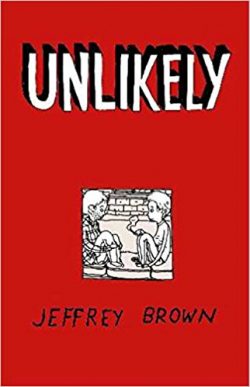
Unlikely


By Jeffrey Brown (Top Shelf Productions)
ISBN: 978-1-89183-041-4                  978-1-89183-041-9

If you’re a fan of Jeffrey Brown’s cartoon exploits you might understandably admit to a small degree of confusion. In 2012 he scored his first global best-seller with a hilarious spin on the soft and nurturing side of the Jedi experience in Darth Vader and Son, following up with equally charming and hilarious sequels Vader’s Little Princess, Star Wars: Jedi Academy and others. He followed that up by contributing to the franchise’s dramatic comics canon with Star Wars Jedi Academy; Star Wars Jedi Academy: Return of the Padawan and Star Wars Jedi Academy: The Phantom Bully (2013-2015).

He has also directed music videos, created film posters, worked for public radio and co-written the feature film Save the Date.

Before that another Jeffrey Brown was the sharply sparkling wit who had crafted slyly satirical all-ages funny stuff for The Simpson’s Treehouse of Horror, Marvel’s Strange Tales, Incredible Change-Bots and similar visual venues.

There is yet another Jeffrey Brown: instigator and frequent star and stooge of such quirkily irresistible autobiographical Indy comics classics as Bighead, Little Things, Mome, Funny, Misshapen Body, Undeleted Scenes and the four-volume “Girlfriend Trilogy” (of which this is the second), comprising Clumsy, Unlikely, AEIOU and Every Girl is the End of the World for Me …

Whichever Brown’s your preferred choice, he’s a cartoonist of rare insight and unflinching integrity who still makes you laugh out loud when not prompting you to offer a big consoling hug…

Brown was raised in Michigan; relocating to Chicago in 2000 to attend the School of the Arts Institute and study painting. Before graduating he had switched to drawing comics and in 2002 Clumsy was released. A poignant and uncompromising dissection of a long-distance relationship, it quickly becoming a surprise hit with fans and critics alike.

A little later – and in the same vein – he produced Unlikely (or How I Lost My Virginity) – a True Love Story.

In both paperback and digital formats it describes a succession of painful torments, frustrations and moments of unparalleled joy as “250+ pages of young love, sex, drugs, heartbreak & comedy” involving the long and agonisingly extended process of “becoming a Man”…

The material is both delicious and agonising in its forthright simplicity: a sequence of pictorial snippets and vignettes detailing how a meek, frumpy, horny, inoffensively average film-fan art-student – and long-overdue virgin – cautiously navigates his first fully-sexualised relationship with a girl.

As is always the case, his prospective partner comes with baggage that is at first beguiling and charming – or at least overlook-able – but which soon becomes a major sticking point. More telling, however, is what Jeffrey learns about himself in the process…

Every young man who’s gone gagging for it, gone for broke when the opportunity arose, and gone off to college or elsewhere to lick his amorous wounds has been through this, and for every inflammatory romance that makes it, there are a million that don’t…

Drawn in his deceptively effective Primitivist monochrome style with masterful staging, a sublime economy of phrase and a breathtaking gift for generating in equal amounts belly-laughs and those poignant lump-in-throat moments we’ve all experienced and regretted forever-after, this is a potent procession of crystallised moments which establish one awful truth. This is Not The One…

We’ve all been there, done that and then relentlessly reviewed and revised in our heads and wished we’d done it all differently…

Through dozens of individual episodes with titles like ‘Things of Mine She Still Has’, ‘I’d Do Her’, ‘No, This is Jeff’, ‘Virgin Alert’, ‘Talking and, Talking’, ‘All Nighter’, ‘I Had a Weird Dream’, ‘Will you Still’, ‘Sex’, ‘Sweetness Frustration’, and ‘The Last Time’: a web of triumphant relief, fractious accommodation and eventually, inevitably disappointment and fresh awareness for Jeff and Allisyn …

Brimming with portentous discovery, hopeful revelation and the shattering angst us oldsters can barely remember now let alone understand, Unlikely is a powerful delight for everybody who has confused raging hormones and intimate physical contact with love, and a sublime examination of what makes us human, hopeful and perhaps wistfully incorrigible…
© 2007 Jeffrey Brown.

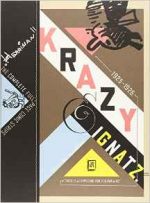
Krazy & Ignatz 1929-1930: A Brick, A Mice, A Lovely Night


By George Herriman, edited by Bill Blackbeard (Fantagraphics Books)
ISBN: 978-1-56097-529-8

Krazy Kat is quite possibly the pinnacle of graphic narrative innovation; an immensely influential body of work which shaped the early days of the comics industry and became an undisputed treasure of world literature.

Krazy & Ignatz (as it is in these fabulous commemorative tomes from Fantagraphics) is a creation which can only be appreciated on its own terms. Over delicious decades of abstracted amazement the series developed a unique language – both visual and verbal – whilst abstrusely exploring the immeasurable variety of human experience, foibles and peccadilloes with unfaltering warmth and understanding… and without ever offending anybody except a few local newspaper editors…

Sadly, however, it certainly baffled far more than a few…

Krazy Kat was never a strip for unimaginative people who won’t or can’t appreciate complex multi-layered verbal and/or pictorial whimsy, absurdist philosophy or seamless blending of sardonic slapstick with arcane joshing. It is still the closest thing to pure poesy that narrative art has ever produced.

Herriman was already a thriving cartoonist and journalist in 1913 when a cat and mouse who had been cropping up in his whacky domestic comedy strip The Dingbat Family/The Family Upstairs graduated to their own feature. Krazy Kat officially debuted in William Randolph Hearst’s New York Evening Journal on Oct 28th 1913 and – largely by dint of the publishing magnate’s overpowering direct intervention and interference – gradually spread throughout his vast stable of papers.

Although Hearst and a host of the period’s artistic and literary intelligentsia (notably – but not exclusively – e.e. Cummings, Frank Capra, John Alden Carpenter, Gilbert Seldes, Willem de Kooning, H.L. Mencken and others) all adored the strip, many regional editors did not; taking every potentially career-ending opportunity to drop it from the comics section.

Eventually the feature found a home and sanctuary in the Arts and Drama sections of Hearst’s papers. Protected there by the publisher’s heavy-handed patronage, the Kat flourished unharmed by editorial interference and fashion, running generally unmolested until Herriman’s death in April 1944.

The basic premise is evergreen and deceptively simple: Krazy is a rather effeminate – not to say gender-indeterminate – dreamily sensitive and romantic feline hopelessly in love with rude, crude, brutal, mendacious and thoroughly scurrilous Ignatz Mouse. It’s the old story of opposites attracting but here the oodles of affection are unreciprocated and the love is certainly only going one way…

Ignatz is a true unreconstructed male; drinking, stealing, fighting, conniving, constantly neglecting his wife and children and always responding to Krazy’s genteel advances by clobbering the Kat with a well-aimed brick (obtained singly or in bulk from noted local brick-maker Kolin Kelly) which our smitten kitten invariably and inexplicably misidentifies as tokens of equally recondite affection.

The third crucial element completing an anthropomorphic eternal triangle is lawman Offissa Bull Pupp, who is completely besotted with Krazy, professionally cognizant of the Mouse’s true nature, yet hamstrung by his own amorous timidity and sense of honour from removing his diabolical and irredeemable rival for the foolish feline’s affections.

Krazy is, of course, blithely oblivious to Pupp’s dilemma…

Collaboratively co-populating the ever-mutable stage are a stunning supporting cast of inspired bit players such as dreaded deliverer of unplanned, and generally unwanted, babies Joe Stork; wandering hobo Bum Bill Bee, unsavoury conman and trickster Don Kiyoti, busybody Pauline Parrot, self-aggrandizing Walter Cephus Austridge, inscrutable – often unintelligible – Chinese mallard Mock Duck, dozy Joe Turtil and a host of other audacious characters, all equally capable of stealing the limelight and even supporting their own features.

The exotic, quixotic episodes occur in and around the Painted Desert environs of Kokonino (based on the artist’s vacation retreat in Coconino County, Arizona) where surreal playfulness and the fluid ambiguity of the flora and landscape are perhaps the most important member of the cast.

The strips themselves are a masterful mélange of unique experimental art, wildly expressionistic and strongly referencing Navajo art forms whilst graphically utilising sheer unbridled imagination and delightfully evocative lettering and language: alliterative, phonetically and even onomatopoeically joyous with a compelling musical force (“Soff, soff brizz”, “l’il dahlink” or “Ignatz, ware four is thou at Ignatz??”).

Yet for all that, the adventures are poetic, satirical, timely, timeless, bittersweet, self-referential, fourth-wall bending, eerie, idiosyncratic, astonishingly hilarious escapades encompassing every aspect of humour from painfully punning shaggy dog stories to riotous, violent slapstick. Oft times Herriman even eschewed his mystical meandering mumblings and arcane argots for the simply sublime grace of a silent gag in the manner of his beloved Keystone Cops…

There have been numerous Krazy Kat collections since the late 1970s when the strip was rediscovered and reclaimed by a better-educated, open-minded and far more accepting audience.

This captivating chronicle – covering 1929-1930 in a comfortably hefty (231 x 15 x 305 mm) monochrome softcover tome – as always offers added value as context, background and other cartoon treats. Here Ben Schwartz critically appraises the exalted eccentric content of the material in ‘The Court Jester: Hearst, Herriman, and the Death of Nonsense’ whilst the much-missed Bill Blackbeard delves deeper into the feature’s background in his Introduction essay ‘The Man Behind the Pupp Behind the Mouse Behind the Kat: George Herriman, 1880-1944’; paying particular attention to the sublime scribbler’s relationship with other cartoonists of the era such as Jimmy Swinnerton, Tad Dorgan and a young upstart named Elzie Segar…

On to the strips then: within this strange brew of eccentric emotional overload, the perpetual play unfolds as always but with one major evolution as Herriman begins to indulge in extended storylines and continuing continuity…

The emphasis is strongly on bricks and how to get them in the early episodes with the law mostly having the upper paw. The mouse regularly ends up banged up in the county hoosegow as Krazy pines for passionately propelled portions of brick-shaped symbolism even whilst further pursuing that dream of a singing career.

Ignatz, as ever, hunts for the perfect projectile – heavy, accurate and of negligible cost – but hasn’t learned that nothing comes for free as he regularly falls prey to mountebanks, charlatans and fortune tellers…

Brickmaker Kolin Kelly gets into a shooting war with the region’s other baker – bread pundit Kikkero Kooki – and their search for ammunition leads to much more projectile peril.

Bull Pupp is wiser to the Mouse’s modus operandi these days, prompting Ignatz to take to the skies in a variety of unlikely aircraft and as always there are strictly visual pun sessions to play well against the numerous slapstick antics, as Ignatz devises ever-more complex schemes to bounce his earthen wares off the Kat’s bean whilst the weird landscapes and eccentric elemental conditions as ever add to the humorous inspiration with apocryphal wind witches and snow squaws constantly making their invisible presences felt…

Joe Stork continues to divide his time between the delivery of babies and other, less legal packages and there’s a many a jest regarding the total illegality of easily obtained hooches and fire-waters…

As 1930 dawns change is in the air and – after a series of wintery japes and a surprise eruption of local volcano Agathla – strange yet comfortably unchanging Kokonino get its biggest shake-up of all when amorous predator Monsieur Kiskidee Kuku hits town and make a determined play for the sentiment-starved Kat…

Having made allies of Ignatz and Offisa Pupp, the rascally gallic rogue turns the heads of many of the female inhabitants incurring the ire of many males, but the bounder is also an expert fencer so reprisals are grudging and muted…

Before long one of those troublesome continental ménage-triangle deals is in play and fireworks start brewing before the affairs of dishonour are all settled…

…And always irresistible mischief truly rules, whenever Herriman pictorially plays hob with the laws of physics, just to see what will happen…

Wrapping up the cartoon gold is another erudite and instructional ‘Ignatz Mouse Debaffler Page’ (providing pertinent facts, snippets of contextual history and necessary notes for the young and potentially perplexed) plus a foray of final fillip offering an example how certain papers played with the layout of the strip to enhance its popularity and a genuine historical find: the sheet music to 1911’s Krazy Kat Rag…

Herriman’s masterpiece is a phenomenal achievement: in all the arenas of Art and Literature there has never been anything like these strips. If, however, you are one of Them and not Us, or if you haven’t experienced the gleeful graphic assault on the sensorium, mental equilibrium and emotional lexicon thrown together by George Herriman from the dawn of the 20th century until the dog days of World War II, this companionable compendium is a most accessible way to do so. Heck, it’s even available as an eBook now so don’t waste the opportunity…
© 2003, 2008 Fantagraphics Books. All rights reserved.

Krazy and Ignatz 1927-1928: Love Letters in Ancient Brick


By George Herriman, edited by Bill Blackbeard (Fantagraphics Books)
ISBN: 978-1-56097-507-6

The cartoon strip starring Krazy Kat is quite possibly the pinnacle of graphic narrative innovation; a hugely influential body of work which shaped the early days of the comics industry and became an undisputed treasure of world literature.

Krazy and Ignatz (as it is dubbed in these fabulous commemorative tomes from Fantagraphics) is a creation which can only be appreciated on its own terms. Over its many years of abstracted amazement the series gradually developed a unique language – at once both visual and verbal – whilst abstrusely exploring the immeasurable variety of human experience, foibles and peccadilloes with unfaltering warmth and understanding and without ever offending anybody… except a few local newspaper editors…

Sadly, however, it certainly baffled far more than a few…

Krazy Kat was never a strip for dull, slow or unimaginative people who simply won’t or can’t appreciate the complex multilayered verbal and pictorial whimsy, absurdist philosophy or seamless blending of sardonic slapstick with arcane joshing. It is still the closest thing to pure poesy that narrative art has ever produced.

Herriman was already a successful cartoonist and journalist in 1913 when a cat and mouse who had been cropping up in his outrageous domestic comedy strip The Dingbat Family/The Family Upstairs graduated to their own feature. Krazy Kat debuted in William Randolph Hearst’s New York Evening Journal on Oct 28th 1913 and – largely by dint of the publishing magnate’s overpowering direct influence and interference – gradually spread throughout his vast stable of papers.

Although Hearst and a host of the period’s artistic and literary intelligentsia (notably – but not exclusively – e.e. Cummings, Frank Capra, John Alden Carpenter, Gilbert Seldes, Willem de Kooning, H.L. Mencken and others) all adored the strip, many regional editors did not; taking every potentially career-ending opportunity to drop it from the comics section.

Eventually the feature found a home and safe haven in the Arts and Drama section of Hearst’s papers. Protected there by the publisher’s heavy-handed patronage, the Kat flourished unharmed by editorial interference and fashion, running generally unmolested until Herriman’s death in April 1944.

The basic premise is evergreen and deceptively simple: Krazy is an effeminate, dreamy, sensitive and romantic feline of indeterminate gender hopelessly in love with rude, crude, brutal, mendacious and thoroughly scurrilous Ignatz Mouse. It’s the old story of opposites attracting but here the oodles of affection are unreciprocated and the love is certainly only going one way…

Ignatz is a true unreconstructed male; drinking, stealing, fighting, conniving, constantly neglecting his wife and children and always responding to Krazy’s genteel advances by clobbering the Kat with a well-aimed brick (obtained singly or in bulk from noted local brick-maker Kolin Kelly) which the smitten kitten invariably and inexplicably misidentifies as tokens of equally recondite affection.

The third crucial element completing an anthropomorphic eternal triangle is lawman Offissa Bull Pupp, who is completely besotted with Krazy, professionally aware of the Mouse’s true nature, yet hamstrung – by his own amorous timidity and sense of honour – from removing his diabolical and un-reconstructable rival for the foolish feline’s affections.

Krazy is, of course, blithely oblivious to Pupp’s dilemma…

Collaboratively co-populating the ever-mutable stage are a stunning supporting cast of inspired bit players such as dreaded deliverer of unplanned, and generally unwanted, babies Joe Stork; wandering hobo Bum Bill Bee, unsavoury conman and trickster Don Kiyoti, busybody Pauline Parrot, self-aggrandizing Walter Cephus Austridge, inscrutable – often unintelligible – Chinese mallard Mock Duck, dozy Joe Turtil and a host of other audacious characters, all equally capable of stealing the limelight and even supporting their own features.

The exotic, quixotic episodes occur in and around the Painted Desert environs of Kokonino (based on the artist’s vacation retreat in Coconino County, Arizona) where surreal playfulness and the fluid ambiguity of the flora and landscape are perhaps the most important member of the cast.

The strips themselves are a masterful mélange of unique experimental art, wildly expressionistic and strongly referencing Navajo art forms whilst graphically utilising sheer unbridled imagination and delightfully evocative lettering and language: alliterative, phonetically and even onomatopoeically joyous with a compelling musical force (“Soff, soff brizz”, “l’il dahlink” or “Ignatz, ware four is thou at Ignatz??”).

Yet for all that, the adventures are poetic, satirical, timely, timeless, bittersweet, self-referential, fourth-wall bending, eerie, idiosyncratic, astonishingly hilarious escapades encompassing every aspect of humour from painfully punning shaggy dog stories to riotous, violent slapstick. Oft times Herriman even eschewed his mystical meandering mumblings and arcane argots for the simply sublime grace of a silent gag in the manner of his beloved Keystone Cops…

There have been numerous Krazy Kat collections since the late 1970s when the strip was rediscovered and reclaimed by a better-educated, open-minded and far more accepting audience.

This tantalising tome – covering 1927-1928 in a comfortably hefty (231 x 15 x 305 mm) monochrome softcover edition as always offers added value as context, background and other cartoon treats are delivered by the much-missed Bill Blackbeard in his puckish Introduction essay of short informational snippets ‘Pilfering Mrs. Kwak-Wak’s Good Old Goods and Goodies Bag’

Here press clippings of a near-death experience for Herriman and fellow strip man Jimmy Swinnerton are re-presented beside early gag pages such as Embarrassing Moments and excepts from Hearst Joke Book editions of The Dingbats. Also included are a wealth of strips by Herriman’s contemporaries, rivals and plagiarists…

On to the strips then: within this compelling chronicle of undying amours utterly unhorsed by smirking Fate, the perpetual play unfolds as always but with some of those intriguing supplementary characters increasing coming to the fore.

We open with the change of years bringing weeks’ worth of seasonal disorders and sartorial shenanigans as Krazy further pursues that dream of a singing career. Ignatz, meanwhile, hunts for the perfect projectile which over and again draws him into the clutches of mountebanks, charlatan and magicians…

That search for ammunition leads to many more brick-based broadsides but these days Bull Pupp is far wiser to the Mouse’s modus operandi…

An occasional strictly visual pun session plays well against the numerous slapstick antics, even as Ignatz devises ever-more convoluted ways to bounce his bricks off the Kat’s bean whilst the weird landscapes and eccentric elemental conditions increasingly add to the humorous inspiration with apocryphal wind witches and snow squaws making their invisible presences felt…

Recurring cousins Krazy Katfish and Krazy Katbird pop up to muddy the romantic waters, whilst Kat and Mouse frequently indulge in the growing freedom of the skies and waterways via balloon and other aeronautical apparatus or maritime machine.

Joe Stork continues to divide his time between the delivery of (generally unwanted) babies and other, less legal packages and there’s a many a jest regarding the total illegality of easily obtained hooches and fire-waters…

As the years progress Ignatz spends ever-longer periods in jail yet seldom fails to find a way to deliver the punishing skull blows Krazy yearns for…

Many cast members become obsessed with being struck by lightning and other electrical intercessions, but the biggest surprise is undoubtedly a time-warping origin sequence which carries us back to the obscure infancies of Krazy, Ignatz and Bull…

There are more wandering wonderments as certain elephantine geological features again take up unescorted perambulation and the county even catches a touch of meteor fever as the landscape is beset by falling stars and fiery flotsam from space.

The year again concludes with uncharacteristic chills and spills as Kokonino is subjected to squalls of snow but worst of all is a plague of politicians, prophets and preachers all proselytising on the path to peace, forcing the residents make their feelings acrimoniously clear…

…And always plain mischief rules, whenever Herriman pictorially plays hob with the laws of physics, just to see what will happen…

Wrapping up the cartoon gold is a peek at one of the earliest and rarest of merchandising items – a 1920s wooden Ignatz doll – as well as another erudite and instructional ‘Ignatz Mouse Debaffler Page’ (providing pertinent facts, snippets of contextual history and necessary notes for the young and potentially perplexed). One final fillip is a selection of out-of-sequence replacement pages plus a sequence of pertinent daily strips which tie into the regular run of Sundays collected here…

Herriman’s epochal classic is a phenomenal achievement: in all the arenas of Art and Literature there has never been anything like these comic strips which have shaped our industry and creators, inspiring auteurs in fields as disparate as prose fiction, film, dance, animation and music, whilst delivering delight and delectation to generations of wonder-starved fans.

If, however, you are one of Them and not Us, or if you haven’t experienced the gleeful graphic assault on the sensorium, mental equilibrium and emotional lexicon thrown together by George Herriman from the dawn of the 20th century until the dog days of World War II, this companiable compendium is a most accessible way to do so. Heck, it’s even available as an eBook now so don’t waste the opportunity…
© 2002, 2008 Fantagraphics Books. All rights reserved.

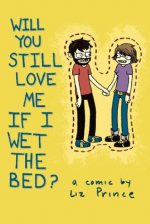
Will You Still Love Me If I Wet the Bed? – A Comic by Liz Prince


By Liz Prince (Top Shelf Productions)
ISBN: 978-1-89183-072-3

There’s an irrepressible rumour going about that Love makes the world go round. My grasp of physics isn’t strong enough to confirm or deny that hypothesis but I have read enough comics in my time to spot a magical and unmissable celebration of the all-consuming emotion when I see one.

Liz Prince originally hailed from Sante Fe, New Mexico before heading across county in an Eastward direction to attend the School of the Museum of Fine Arts in Boston (Massachusetts, not Lincolnshire).

She is a cartoonist – one of many – who thankfully opted to create a visual journal of her life and saw that one subject kept monopolising her attention. She is also an inspired raconteur who knows how to spin a graphic yarn in adroitly truncated form. Thus this slim collection which gathers a whole bunch of sublimely intimate, hilariously real moments spent with and apart from her equally fascinating man Kevin and the awesome force which is their cat Science.

Contained in this marvellous monochrome paperback posy are vignettes exploring the giddy silliness of fresh physicality, quirkily adorable breaking of bathroom taboos, the agony and relief of momentary solitude, incidents of intimate accommodation and lots of lovely eternal challenges that test every couple… especially the often bloody traumas of explaining to the incumbent household pet that they are not necessarily “Number One” any more…

Fronted by a suitably droll but downbeat pictorial Introduction ‘On Liz Prince’ by legendary lovelorn doodler Jeffrey Brown, Will You Still Love Me If I Wet the Bed? is thankfully still available – and instantly so if you opt for one of the downloadable versions (Kindle, Comixology etc.), or preferably direct from Top Shelf Productions – so if you want to share some romantic fellow feeling or just need to see that there’s still hope for all the lonely hearts, this a graphic gem you should promptly treat yourself to.
© & ™ Liz Prince 2005. All rights reserved.

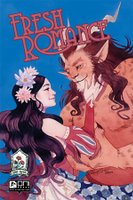
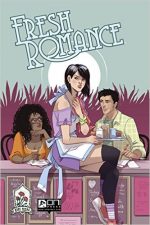
Fresh Romance volume 1


By Kate Leth & Arielle Jovellanos, Sarah Vaughn & Sarah Winifred Searle, Sarah Kuhn & Sally Jane Thompson, Marguerite Bennett & Trungles, Keiron Gillen & Christine Norrie & various (Rosy Press/Oni Press)
ISBN: 978-1-62010-346-3                  eISBN: 978-1-62010-347-0 (Kickstarter exclusive)

Once upon a time romance comics were the backbone of the comicbook industry, selling in the millions and capturing the crucial yet elusive and fickle women’s market where war, westerns and superhero titles just couldn’t get a foothold.

Times passed, fashions changed and the genre all but vanished in comics form, to occasionally resurface in rare re-emergences filled with quality writing and art but still unable to justify the expense of a regular print slot.

Thankfully the internet changed all that, with devotees able to create, disseminate and consume articles of visual amour free of draconian and tawdry business pressures. One such enterprise was anthological enterprise Fresh Romance from Rosy Press which offers startlingly uncompromising modern love stories in a broad variety of styles and themes and tones from simple person-meets-person encounters to classical pastiches to rom-com rollercoaster rides.

So well-received were these tales that in partnership with Oni Press the stories have made the retrograde jump back into physical form such as this initial collection…

Supplemented throughout with round-robin discussions and commentaries from the creators involved the wide-eyed wonderment opens with a no-holds-barred, ferociously contemporary spin on the coming-of-age ritual known as Prom Night…

‘School Spirit’ by scripter Kate Leth, illustrator Arielle Jovellanos, colourist Amanda Scurti and letterer Taylor Esposito details the build up to that very special occasion, focussing on unwitting chick-magnet Miles, haughty queen-bee Justine, moody Corrine and eager-beaver over-achiever Malie.

None of their peers are privy to their true natures, though. Miles’ reputation is largely bogus, allowing him to act as a beard for two of the girls whilst the lass he really likes has a secret she joyously shares with him alone: she’s a witch with fantastic powers she’s just desperate to exercise even though her dads forbid her getting intimate with mortals…

Pressure mounts as the Prom approaches and all four are reaching emotional crisis points: all they want to do is be themselves and be done with secrets…

But when the subterfuge falls apart just before the big event all the quartet can do is make it a night everybody will remember…

In stark contrast ‘Ruined volume 1’ by Sarah Vaughn & Sarah Winifred Searle (lettered by Ryan Ferrier) serves up a heaping helping of stolid and claustrophobic Regency romance in the manner of Jane Austen as young Catherine dolorously acquiesces to parental pressure and marries a man she does not know. As her parents constantly remind her, it’s the best she can hope now that her reputation has been so utterly despoiled by her recent indiscretion…

Her marriage into the prestigious but impoverished Davener family was never going to be a famous love match but after being packed off to his decrepit and distant estate Catherine’s slow acceptance of her taciturn, inscrutable husband is constantly impeded by one inescapable quandary. If no decent man would want her in her present state, why has Andrew Davener made her his bride?

Does he want her? Is he, in fact, a decent man?

A beguiling and compelling take on the traditional gothic novel – complete with troubled sister-in-law and antagonistic elder dowager in residence – Ruined does not conclude in this volume and leaves the reader hungry for a resolution…

From staid conformity to wild abandon as ‘The Ruby Equation’ by Sarah Kuhn & Sally Jane Thompson (coloured by Savanna Ganucheau and lettered by Steve Wands) pursues wild whimsy in a little coffee shop which serves as a dating drop-in centre run by extra-dimensional super-entities masquerading as baristas and waitresses.

These wondrous creatures are intent on helping their unwitting human clients find true happiness, but impatient young operative Ruby can’t wait to finish this dumb assignment and progress to missions of truly cosmic importance.

Sadly for her, Ruby can’t close the deal with prospective happy couple Josh and Megan, and she’s the only one who can’t see that they are not perfect soul-mates. Not when one of them is actually the only being Ruby could ever love…

A dark reinterpretation of a very familiar fairytale, ‘Beauties’ by Marguerite Bennett & Trungles – lettered by Rachel Deering – sees a beautiful beast captured and enslaved by a callous prince and his cruel daughters, only to win over one of his tormentors and trigger an uncanny transformation. With love triumphing over every adversity the liberated lovers must then seek escape or death together whatever the ultimate cost…

As icing on the cake this collection closes with a delightful bonus vignette by Keiron Gillen & Christine Norrie. ‘First, Last and Always’ slyly reveals the cautious, cunning politics that underlie that initial brushing of lips that presages the start of everything…

Powerful, charming, engaging and endearing, these yarns of yearning and fulfilment are superb examples of how varied comics can be. Why not let a little romance into your heart today?
Fresh Romance volume One © 2016 Rosy Press. All individual stories are the property of and © their respective creators. All rights reserved.

Krazy & Ignatz volume 4 – 1925-1926: “There is a Heppy Lend, Fur, Fur Awa-a-ay”


By George Herriman, edited by Bill Blackbeard (Fantagraphics Books)
ISBN: 978-1-56097-386-7

The cartoon strip starring Krazy Kat is quite possibly the pinnacle of graphic narrative innovation; a hugely influential body of work which shaped the early days of the comics industry and became an undisputed treasure of world literature.

Krazy and Ignatz, as it is dubbed in these glorious commemorative collected tomes from Fantagraphics, is a creation which can only be appreciated on its own terms. It developed a unique language – at once both visual and verbal – and dealt with the immeasurable variety of human experience, foibles and peccadilloes with unfaltering warmth and understanding without ever offending anybody.

Sadly, however, it baffled far more than a few…

It was never a strip for dull, slow or unimaginative people who simply won’t or can’t appreciate the complex multilayered verbal and pictorial whimsy, absurdist philosophy or seamless blending of sardonic slapstick with arcane joshing. It is still the closest thing to pure poesy that narrative art has ever produced.

Herriman was already a successful cartoonist and journalist in 1913 when a cat and mouse who had been cropping up in his outrageous domestic comedy strip The Dingbat Family/The Family Upstairs graduated to their own feature. Krazy Kat debuted in William Randolph Hearst’s New York Evening Journal on Oct 28th 1913 and – largely by dint of the publishing magnate’s overpowering direct influence and interference – gradually spread throughout his vast stable of papers.

Although Hearst and a host of the period’s artistic and literary intelligentsia (notably – but not exclusively – e.e. Cummings, Frank Capra, John Alden Carpenter, Gilbert Seldes, Willem de Kooning, H.L. Mencken and – later – Jack Kerouac) all adored the strip, many local and regional editors did not; taking every potentially career-ending opportunity to drop it from the comics section.

Eventually the feature found a home and safe haven in the Arts and Drama section of Hearst’s papers. Protected there by the publisher’s heavy-handed patronage, the Kat flourished unharmed by editorial interference and fashion, running generally unmolested until Herriman’s death in April 1944.

The basic premise is simple: Krazy is an effeminate, dreamy, sensitive and romantic feline of indeterminate gender hopelessly in love with Ignatz Mouse: rude crude, brutal, mendacious and thoroughly scurrilous.

Ignatz is a true unreconstructed male; drinking, stealing, fighting, conniving, constantly neglecting his wife and children and always responding to Krazy’s genteel advances by clobbering the Kat with a well-aimed brick (obtained singly or in bulk from noted local brick-maker Kolin Kelly) which the smitten kitten invariably misidentifies as tokens of equally recondite affection.

The third crucial element completing an anthropomorphic eternal triangle is lawman Offissa Bull Pupp, who is completely besotted with Krazy, professionally aware of the Mouse’s true nature, yet hamstrung – by his own amorous timidity and sense of honour – from removing his devilish rival for the foolish feline’s affections.

Krazy is, of course, blithely oblivious to Pupp’s dilemma…

Also populating the ever-mutable stage are a stunning supporting cast of inspired bit players such as dreaded deliverer of unplanned, and generally unwanted, babies Joe Stork; hobo Bum Bill Bee, unsavoury conman and trickster Don Kiyoti, busybody Pauline Parrot, self-aggrandizing Walter Cephus Austridge, inscrutable – often unintelligible – Chinese mallard Mock Duck, dozy Joe Turtil and a host of other audacious characters all equally capable of stealing the limelight and even supporting their own features.

The exotic, quixotic episodes occur in and around the Painted Desert environs of Coconino (based on the artist’s vacation retreat in Coconino County, Arizona) where surreal playfulness and the fluid ambiguity of the flora and landscape are perhaps the most important member of the cast.

The strips themselves are a masterful mélange of unique experimental art, wildly expressionistic and strongly referencing Navajo art forms whilst graphically utilising sheer unbridled imagination and delightfully evocative lettering and language: alliterative, phonetically and even onomatopoeically joyous with a compelling musical force (“Soff, soff brizz”, “l’il dahlink” or “Ignatz, ware four is thou at Ignatz??”).

Yet for all that, the adventures are poetic, satirical, timely, timeless, bittersweet, self-referential, fourth-wall bending, eerie, idiosyncratic, astonishingly hilarious escapades encompassing every aspect of humour from painfully punning shaggy dog stories to riotous, violent slapstick. Sometimes Herriman even eschewed his mystical mumblings and arcane argots for the simply sublime grace of a silent gag in the manner of his beloved Keystone Cops…

There have been numerous Krazy Kat collections since the late 1970s when the strip was rediscovered by a better-educated, open-minded and far more accepting audience. This fabulous forth tome – covering 1925-1926 in a comfortably hefty (231 x 15 x 305 mm) softcover edition returns the strip to its monochrome roots and offers added value as context, background and possible explanations are delivered by the much-missed Bill Blackbeard in his effusive essay ‘By George, It’s Krazy’ before a second text “found-feature” exploits Herriman’s journalistic gifts with contemporary movie reviews delivered by “Thet Ket” in ‘“The Gold Rush” as Seen by Krazy Kat’ and ‘Krazy Kat Sees Miss Davies in “Janice Meredith”’ as both prose and cartoon critiques…

On to the strips then: within this compelling compendium of incessant passions thwarted in another land and time the unending drama plays out as usual, but with some of those intriguing supplementary characters increasing coming to the fore.

We open with the change of years bringing a few weeks’ worth of weird ruminations on the nature of time before Ignatz’s continual search for his ammunition of choice leads to many brick-based gags and his occasional fleecing by Coconino’s copious coterie of confidence tricksters.

Of course the mouse is a man who enjoys revenge served hot, cold or late…

As well as increased roles for the Kat’s cousins Krazy Katfish and Krazy Katbird there is more involvement for Joe Stork, who expands out of the exclusive delivery of (generally unwanted) babies into the hooch-dissemination business during those heady days of Prohibition, as well the introduction of tail-less Manx Cat and a Krazy cow.

As expected there is a solid dependence on the strange landscapes and eccentric flora for humorous inspiration. Moreover in the Jazz Age of Technological Marvels the mouse frequently takes to the skies to deliver his brain-busting bon mots…

The dangerous delights of Piñatas are introduced to American readers and there’s a healthy dose of surrealism after certain elephantine geological features come to life, whilst Krazy’s Kool is at last lost once Ignatz begins baking his own bricks and cutting Kolin Kelly out of the mounting fiscal equation. Once rubber trees start popping up all over the landscape, nobody is truly safe from the consequences of escalating slapstick silliness…

The year then concludes with uncharacteristic chills and spills when Coconino is subjected to sudden squalls of snow which lead inevitably to too much water as 1926 opens cold and crisp and sodden…

Herriman incorporated his love of cinema here by introducing an itinerant film crew to the cast and began playing even more with his audience and the Fourth Wall after one of the cartoon regulars swiped all the black ink leaving the rest of the cast in a deeply diminished state of embellishment.

The infinitely inventive scribbler also created a bigger role for Mock Duck who temporarily quit the laundry business to set up as a psychic prognosticator and surly seer whilst poor Pupp began to slowly gain the upper paw in the turbulent triangular relationship…

Krazy, meanwhile, discovered a previously unsuspected – and apparently genetically predisposed – affinity for lighting and electricity which the rest of the cast were able to share but not enjoy…

Also always on offer are wry cartoon commentaries on the increasingly technological advancement of the nation, seasonal landmarks and the evergreen fodder of unwanted kids and illegal drinking as well as more pomposity punctured and penny-pinching money-making schemes from the town’s great and good always coming to nothing…

…And sometimes plain mischief rules, such as when Herriman pictorially plays hob with the laws of physics just to see what will happen…

Wrapping up the cartoon gold is another erudite and instructional ‘Ignatz Mouse Debaffler Page’, providing pertinent facts, snippets of contextual history and necessary notes for the young and potentially perplexed.

Herriman’s epochal classic is a phenomenal achievement: in all the arenas of Art and Literature there has never been anything like these comic strips which have shaped our industry and creators, and inspired auteurs in fields as disparate as prose fiction, film, dance, animation and music, whilst delivering delight and delectation to generations of wonder-starved fans.

If, however, you are one of Them and not Us, or if you actually haven’t experienced the gleeful graphic assault on the sensorium, mental equilibrium and emotional lexicon carefully thrown together by George Herriman from the dawn of the 20th century until the dog days of World War II, this glorious compendium is a most accessible way to do so. Heck, it’s even available as an eBook now so don’t waste the opportunity…
© 2002 Fantagraphics Books. All rights reserved.

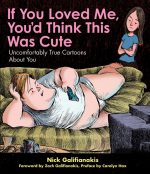
If You Loved Me, You’d Think This Was Cute – Uncomfortably True Cartoons About You


By Nick Galifianakis (Andrews McMeel)
ISBN: 978-0-7407-9947-1

Win’s Christmas Gift Recommendation: Exposing the Tinsel and Glitter of Romance… 9/10

Delivering biting wit, a groundbreaking revelation or an excoriating assault with an unforgettable drawing and a few well-chosen words is one of the greatest gifts humans can possess. Even those stuck-up holdouts who pointedly claim to have “never read a comic” certainly enjoy strips or panels: a golden bounty of brief amusement demanding no commitment other than a moment’s close attention.

Truth be told, it’s probably in our genes…

According to the text preface by Carolyn Hax in this astoundingly funny collection, the cartoons gathered here by immensely gifted illustrator Nick Galifianakis were originally intended as little pictorial add-ons to accompany and supplement her nationally syndicated Advice Column (cited by Time magazine as America’s best…).

Apparently, Nick kept making them so funny that the pictures became an intrinsic and unmissable companion and in 2010 a whole bunch of the very best of them turned into this book.

Also included are an outrageous Foreword by his cousin Zach – yes, that movie comedian guy – sharing the kind of intimate incident insights and past humiliations only a close family member can; as well as a vast Acknowledgments section and insider information on the way Nick works in his Introduction. There are also concrete clues that his one true love is his dog ZuZu…

All that aside, what’s on offer here is a spellbinding examination of human relationships as seen from a natural raconteur’s perspective: devastatingly penetrating, sharp to the point of cruelty, warmly sympathetic, ultimately understanding and forgiving and, most importantly, laugh-out-loud, Horlicks-jetting-out-of-your-nose funny.

Or whatever your shared evening tipple of choice might be. I’m not saying that his gags make your body mysteriously manufacture Horlicks. That would be weird…

In this delicious monochrome paperback (or eBook: you choose; it’s a free world and you’re most likely some sort of consenting adult) you will find all the perilous wonders and tribulations of human relationships and the search for love reduced to simple, forthright categories stuffed with beautifully rendered line drawings exemplifying the rights and wrongs of finding and keeping – or satisfactorily jettisoning – a partner.

It kicks off with the male perspective as seen through female eyes in ‘The Bastard Files’ before naturally offering the opposing viewpoint in ‘The Unfair Sex’…

The eternal hunt is deconstructed in ‘Finding the Ones(s)’ and expanded in ‘So This Was The One’ before negotiating deadly traps and bile-filled traumas of ‘The Bridal Industrial Complex’.

Weddings survived, everybody’s all reconciled to being one great big joyous clan, as proved here in the acerbically astute ‘Putting the Eff in Family’, but Love’s all about the children really, isn’t it? Thus a close-up-and-personal dissection of procreation in ‘Just Kidding’ which leads to the conclusion that some sons and daughters don’t ever grow up in ‘When We’re Five We’re All Artists’…

When confused or in trouble, the natural thing to do is depend on your closest comrades in the Battle of the Sexes, but ‘With Friends Like These’ clarity and understanding are early casualties. Still, if we’re being truly honest we can only trust our ‘Lusting Impressions’ before settling for ‘A Little Something on the Side’ to avoid getting ‘Ego-Tripped’.

At least our animal companions still offer us unconditional love. don’t they? Perhaps not, if the bestial examples in ‘Ark Types’ are to be believed, if you ‘Catch My Riff’…

When all’s said and done then, perhaps it’s best to play safe and just try the ‘Flair of the Dog’ when looking for a truly lasting love…

With recurring themes including Frogs and Princesses, malevolent Cupids, uncomprehending Adams and Eves, weary Saint Peter at the Pearly Gates and the absolutely crucial role of Lawyers and Counsellors in all relationship matters, this compendium of situational quandaries and unromantic entanglements is a superbly cathartic look at love and one every new home and generational estate should have in pride on place on the mantelpiece – near the heavy candlesticks, poker, poisons and stun guns…
© 2010 by Nick Galifianakis. All rights reserved.