
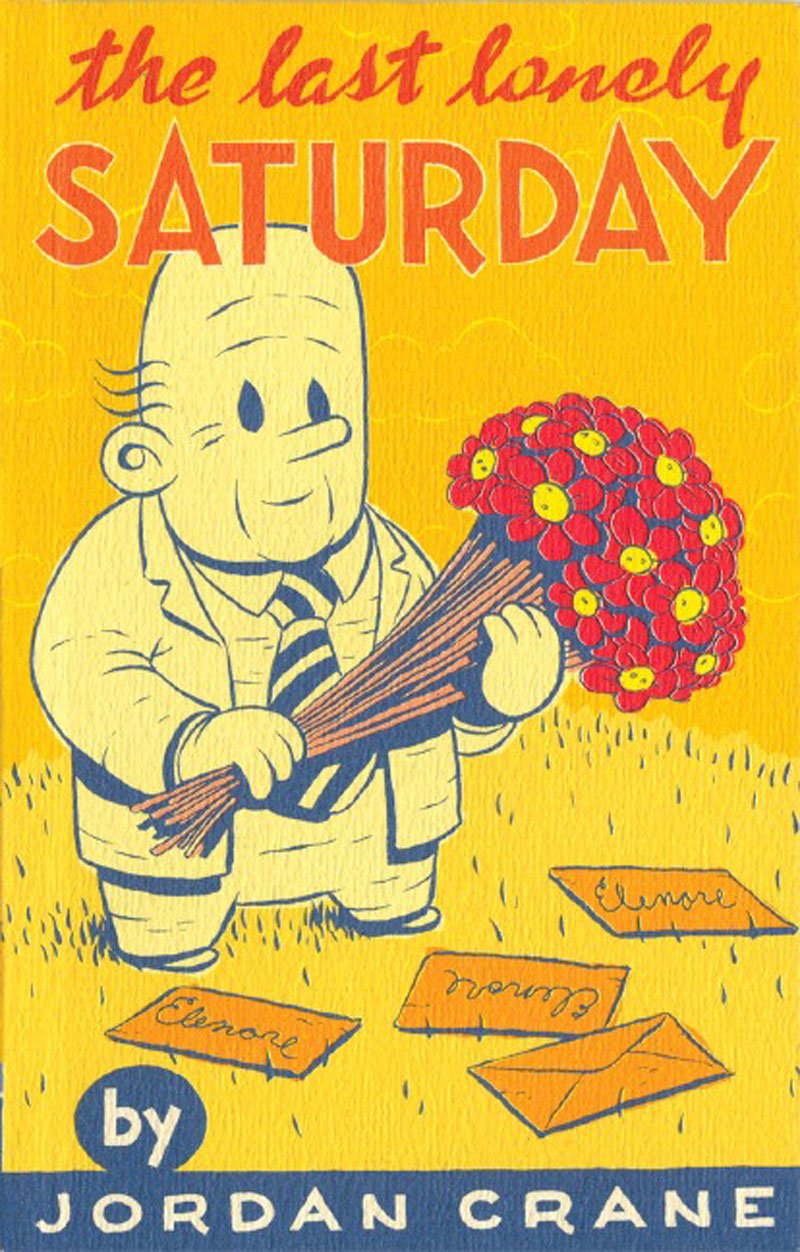
The Last Lonely Saturday


By Jordan Crane (Fantagraphics Books)
ISBN: 978-1-56097-743-8 (HB)

Award-winning Jordan Crane is a child of the 1970s and first garnered notice in comics circles with his 1996 anthology NON: an experimental vehicle very much in the manner of Art Spiegelman’s Raw and latterly quarterly anthology Uptight.

Working far too slowly for my greedy appetites, he’s also released a trio of graphic novels to date, Col-Dee, children’s adventure The Clouds Above and this one – his first and most moving.

Available in both hardcover and digital editions, The Last Lonely Saturday is crafted in a strange blend of vivid-yet-muted reds and yellows and comedically lugubrious cartoon style. Delivered in two panels per page, it recounts – almost exclusively without dialogue – one quiet day in August when a lonely widower once again diligently makes his way to the florist’s, the cemetery and inevitably the grave of his beloved Elenore.

It’s a ritual he’s enacted for many years, indulging in bittersweet memories as he clings to life while yearning to be reunited with his truly beloved. However, as the endless duty unfolds, events take an oblique turn and melancholy whimsy becomes something more as we’re reminded that it’s not just the living who feel the pangs of loss or yearn for reunion…

Smart, charming, witty and devilishly wry, this is a lost delight that proves the deceptive potency of comics and enduring power of love.
© 2000 Jordan Crane. All rights reserved.

Beauty and the Feast volume 1


By Satomi U, translated by Sheldon Drzka (Square Enix)
ISNB: 978-1-64609-062-4 (Tankōbon PB)

Not all manga is gorily action-packed and overflowing with astoundingly robust wonder warriors or deeply introspective and socially redeeming: some Japanese comics just want you to have a good time and some gentle enjoyment.

Here’s one of those in the form of a jolly and uncomplicated semi rom-com, rich and redolent with cultural confusion and pretty illustration from enigmatic creator Satomi U.

It all begins with a revelation in ‘Yakumo-San Wants to Feed You!’ as pretty widow Shuko Yakumo invites a rather unprepossessing young man into her apartment. It’s not the first time Shohei Yamato has come around from his next door flat and, without preamble or converse, tucks into a vast display of succulent home-cooked food.

He’s a first year High School student at prestigious Tosei Academy, on the equivalent of a baseball scholarship, with strict orders to bulk up. Shohei sees nothing amiss in a stranger and single lady indulging him in a strictly-platonic relationship: feeding up the socially-awkward, tongue-tied baseball prodigy who is unable gain necessary poundage due to a lack of funds…

He doesn’t seem very bright – or even communicative – but sure can pack away the glorious meals she happily produces, apparently, just for the sheer joy of cooking again.

It’s not a normal relationship, but both seem to get what they need out of the ritual…

Determined to be the best she can, the delirious domestic goddess constantly considers new recipes and bigger portions before ‘Yakumo-San Buys a Rice Cooker’ sees a change in the status quo as the human locust gradually shares details of his past before we see what his life currently demands in ‘A Day in the Life of Shohei Yamato’.

‘A Day in the Life of Shuko Yakumo’ moves into new territory as school pressure makes the lad miss a few visits, prompting his culinary custodian to start following him with mobile morsels and picnic treats, culminating in an actual and mutual emotional connection on ‘A Night for Cherry Blossoms’…

An old complication resurfaces as ‘Enter Rui, the Reckless High School Girl’ sees an extremely raucous and proprietary former classmate of the sporting cadet reinsert herself in his life. Little Rui Nishihara believes she’s responsible for Shohei’s accomplishments and intends to be the wife of a major baseball superstar, and instantly recognizes a potential rival in the “old lady” with the big boobs and always-open kitchen…

Given to histrionics, Rui is determined to regain the boy’s attention, and refuses to listen to the advice of her super-sensible best pal Ritsuko Nagai, who calmly and constantly reminds her that she never had it in the first place…

Shuko is largely unaware of the impending storm, spending a day at her husband’s grave and catching up with old friend Yuri who reminds her that ‘Nothing Stays the Same’. It’s a fact hammered home that night when Shohei again decimates her larder, only this time something else – something new – happens…

Supplemented by Bonus Manga ‘A Day in the Life of Rui and Ritsuko’ offering insight into the little firecracker’s backstory; design and fact pages on Shuko, Shohei, Rui and Ritsuko via ‘The Inside Scoop’ before ending on a slapstick excerpt from Satomi U’s ‘Baseball Team Research Journal’, this is a bright, breezy and silly, salivatory saga that will satisfy any cravings for something more tastily intriguing than substantial and heavy.
Beauty and the Feast volume 1 © 2016 Satomi U/SQUARE ENIX CO., LTD. English translation © 2021 SQUARE ENIX CO., LTD. All rights reserved.

Haru’s Curse


By Asuka Konishi translated by Hannah Airriess (Vertical)
ISBN: 978-1949980264 (Tankōbon PB)

Manga has an unfair reputation for being lightweight and genre-centric in the west, but if that’s true in any way it’s more an artefact of what we’ve seen translated into English rather that an inherent aspect of the form. Here’s a deceptively dark and subtly off-kilter example of my point from Asuka Konishi, who’s most successful offering to date is gangster romance Raise wa Tanin ga li.

Like that remarkable thriller, Haru’s Curse (which first saw life as Haru no Noroi 1 and 2 in Gekkan Komikko Zero Samu from Ichijinsha, Inc.) also examines the Japanese tradition of arranged marriage, but this time in purely emotional terms as it outlines a potent romantic triangle fuelled by filial devotion and societal expectation.

And pressure. Lots and lots of self-imposed, guilt-tinged pressure…

A comedically mature romance with sharp edges and dangerous corners, the relationship blossoms in seasonally-themed chapters which begin with ‘Spring is gone’ as boisterous, overactive underachiever Natsumi Tachibana reels in grief following the death of her beloved younger sister Haru. The shattering sense of loss over her meek, mild eternal soulmate is peppered with anger and shame when she attends the funeral rites and meets again the stiff-necked, stand-offish rich boy her little Haru was forced to become engaged to, but whom she grew to adore…

Although now just an ordinary middleclass family – apart from having a status-diminishing stepmother thanks to father’s scandalous divorce – the Tachibana’s are of a proud and ancient lineage. So, when the matriarch of a spectacular rich banking family wanted a wife for her heir, she didn’t much care which daughter her son Togo Hiragi picked.

Natsumi was just happy it wasn’t her, and quite baffled at the genuine affection Haru felt. However, after Haru’s debilitating disease and tragic demise, the pressure was on again to honour the contract…

A distant and reserved discussion with the emotionless golden boy results in a bizarre devil’s bargain. Togo seems as reluctant to pursue matrimony as she is, but family duty compels them both, and Natsumi is consumed with curiosity as to what her sister ever saw in the big oaf. She accepts the situation on condition that he takes her to every place and re-enacts every date he had with Haru. At least this way, the sisters can be together again, after a fashion…

The campaign begins in ‘July’ and carries on into ‘August’ with all concerned going through the very painful motions, but gradually dislike and shame (Natsumi feels cursed and dreads public scorn for betraying her sister’s memory and “cheating” on her with her fiancé) turns to neutrality and grudging interest.

Events take a surprising twist in ‘September (Parts One and Two)’ after Natsumi finds Haru’s online diary and is forced to make radical changes to her own flighty lifestyle and assessment of her devoted departed…

Small, apparently incidental developments finally bring Togo out of his defensive shell, and by the time ‘November (Part One and Two)’ rolls round a major familial earthquake is set to upset everybody and redefine the future of all concerned in ‘and winter will come’…

The secrets of the changes of stance are explored at the end via a brace of sidebar vignettes. ‘Bonus comic 1 and 2’ reveal how small incidental moments can spark big responses…

At heart a very mature modern romance, Haru’s Curse is a splendid example of how very alike we all are, and how social mores aren’t worth a damn when we’re truly honest with ourselves…
© 2016, 2017 Asuka Nonishi. All rights reserved.

Queen Margot volume 1: The Age of Innocence


By Olivier Cadic, François Gheysens & Juliette Derenne, coloured by Sophie Barroux: translated by Luke Spears(Cinebook)
ISBN: 978-1-90546-010-6 (Album PB)

Although not so well known in Britain as his other novels, on the Continent Alexandre Dumas père’s historical romance La Reine Margot is an extremely popular and well-regarded fictionalisation of the life of Marguerite de Valois.

This unlucky historical figure was the daughter of Henry VII of France and infamously diabolical arch-plotter Catherine de Medici, spending most of her early life as a bargaining chip in assorted convoluted dynastic power-games.

We don’t see a lot of proper historical romance in English-language comics; which is a shame as the stylish intrigue, earthy humour, elegant violence and brooding suspense (just think The Great without the excessive sex and violence… or vodka) of this one would certainly attract legions of fans in other sectors of artistic endeavour.

This substantial yet enchanting treatment of events and uncorroborated legends of the girl who eventually became the wife of Henri IV, Queen Consort of France twice over and the most powerful, influential, infamous woman in Europe is well worth a look-see, especially as most of what we know about her comes first-hand.

Queen Margot related the events of the times and her life – in exquisite, penetrating detail – through an infamous series of memoirs published posthumously in 1628…

Co-scripted by publisher, politician, computer entrepreneur, historian and statesman Olivier Cadic and François Gheysens, illustrated with intensely evocative passion and potently authentic lyricism by Juliette Derenne (Les Oubliés, Le 22e jour de la Lune) and enlightened through the graceful colours of Sophie Barroux; the first chapter appeared in 2006 as La Reine Margot: Le Duc de Guise and opens here in English with a spiffy gate-fold cover offering a potted history and run-down of the major players before the intrigue unfolds…

In August 1569, 16-year-old Margot and her Lady-in-waiting/governess Madame Mirandole arrive at the castle of Plessis-lez-Tours. In the ongoing wars between Papists and Huguenots, Margot’s ailing brother Charles might be King of Catholic France, but her other brother Henri, Duke of Anjou is the darling of the court: a veritable Adonis and glorious war-hero smiting the Protestant foe.

Anjou is also a sibling she adores and worships like a schoolgirl…

What little brotherly love there was stood no chance against a sea of popular feeling and cruel, envious unstable, hypochondriac Charles is determined to see it end and all Henri’s growing power and inherent glamour with it. Naturally, his dynastically-obsessed mother has plans to fix everything, but they never extend to showing her practically worthless daughter the slightest hint of kindness or approval.

Although young, Margot (who prefers the familiar name “Marguerite”) knows well that she’s nothing more than a disposable piece in a grand game, but briefly forgets her inevitable fate as Henri bedazzles the Court with tales of his martial triumph. Later he shares his own ambitions and misgivings with her. He dreads jealous, inept Charles taking the role of military commander for his own, and does not want to be married off to the Arch-Duchess of Austria…

Marguerite has problems of her own: Henri’s most trusted lieutenant; the appalling Lord Du Guast, tries to force himself upon her whilst making the most disgusting suggestions and veiled accusations before she can escape…

Worst of all, her mother – steeped in five generations of Machiavellian Medici manipulation and inspired by the bizarre prognostications of her personal seer Ruggieri – has begun setting her plans for the potentially invaluable, royally connected daughter.

Margot can do nothing against her mother’s wishes but, with the aid of drugged wine, she repays Du Guast’s affront with a public humiliation she will come to regret…

Everything changes when charismatic Henri, Duke of Guise and hero of the Siege of Poitiers arrives. He and Marguerite were childhood friends and now they are both grown, their mutual attraction is clear to all. Instantly, his lurking family sense a chance to advance themselves through a love match and quick marriage…

The kids themselves are only dimly aware of alliances. They want each other and even an entire gossiping, constantly watching Court is not enough to deter them…

As the war devolves into slow and depressing attrition, Anjou doggedly pursues victory and awaits his inevitable ousting, whilst Du Guast lays his plans to destroy and possess Marguerite.

News of her dalliance with Guise is of great worth to him and even though Catherine has organised a tentative betrothal to the Catholic king of Portugal, the vile seducer has ways and means of spoiling the proposed match. He’s even inadvertently aided by Marguerite herself, who tries many stratagems to disrupt the regal deal…

The constant in-fighting and subterfuge turns Anjou against his sister and when “proof” of her affair with Guise reaches Catherine the old queen moves swiftly.

Marguerite is compelled to capitulate to save Guise from Charles’ insane wrath and grimly faces the prospect of never seeing him again: cushioned in despised luxury and once more the pliable prize and powerless pawn in a game she cannot escape, avoid or win…

Colourful, intoxicating and powerfully compelling, The Age of Innocence is a beguiling view of eternal passions and human intrigue to delight the hardest of hearts and the most finicky of comics aficionados.
Original edition © 2006 Cinebook Ltd/Cadic – Gheysens. All rights reserved. English translation 2006 © Cinebook Ltd.
Heart in a Box


By Kelly Thompson & Meredith McClaren (Dark Horse)
ISBN: 978-1-61655-694-5 (PB)

It’s that time again and no, not even the end of the bleedin’ world will excuse not making suitable arrangements for your truly beloved. Don’t break Lockdown but use your imagination. There’s plenty you can still do to show your appreciation and undying devotion. While you’re thinking, though, here’s a great book you might like…

Let’s face it kids, Love Hurts. This mesmerising modern parable – available digitally and in Olde Worlde paperback – demonstrates that maxim with stunning audacity and devilish charm as author Kelly Thompson (Storykiller, The Girl Who Would be King, Jem and the Holograms) and illustrator Meredith McClaren (Hinges) drag a young woman on a harsh yet educative road trip to learn a life lesson regarding ill-considered wishes and Faustian bargains…

After young Emma has her heart broken by her unforgettable “Man with No Name” she foolishly listens to an insistent stranger who promises to make the shattering pain go away forever. He’s as good as his word, too, but within nine days Emma realises that what she feels after he’s worked his magic is absolutely nothing at all, and that’s even worse than the agony of loss and betrayal which nearly ended her…

The aggravating Mephistophelean advisor – she calls him “Bob” – is still popping in however, and promptly offers her a way to can reclaim the seven shards of sentiment/soul she threw away. There will of course be a few repercussions: as much for her as those folks who have been enjoying the use of a little feeling heart ever since Emma so foolishly dispensed with it. They might not want to relinquish that additional loving feeling…

As Emma doggedly travels across America, hunting down those mystically reassigned nuggets of passion, she discovers not only how low she’ll stoop to recover what’s hers, but also where and when all the moral boundaries she never thought she had can’t be bent, bartered or broken…

A dark delight, Emma’s literal emotional journey takes her into deadly danger, joyous cul-de-sacs and life-changing confrontations with her past and future in a clever reinvigoration of one of literature’s oldest plots and probably mankind’s most potent and undying philosophical quandary…

Funny, sad, scary and supremely uplifting, Heart in a Box is a beguiling rollercoaster ride to delight modern lovers and every grown-up too mature to ever be lonely or dependent…
© 2013, 1979 Semi-Finalist Inc. & Meredith McClaren. All rights reserved.
10, 20 and 30 volume 1


By Morim Kang (Net comics)
ISBN 13: 978-1-60009-183-4 (Tankōbon PB)

Some stories are great because of their innovation and novelty, whilst others just tell the same old tale over and over. When these latter tales succeed, it’s solely because of the nuance, skill and artistry with which the commonplace has been shaped to feel fresh and new.

Available in paperback and digital editions, 10, 20, And 30 is an evergreen saga of women and the search for love, tenderly observed, pragmatically and humorously told. Rok Nah is a young teenaged girl (a “10-Something”) going through those difficult years. She has a boyfriend – sort of – but is obsessed with all the other confusions of growing up to deal with.

Her mother Krumb Yoon (“30-Something”) is a widow with a thankless job at a fashion company. Recently, though, the company boss has been taking an inappropriate (but still chaste) interest in her. The “20” part of the equation is Krumb’s niece Belle Woo who has become like an older sister to Rok since her parents all but disowned her for having sex and refusing to get married. As the totally different, yet painfully similar, problems of love confront the three, their natures and unique responses make for an entrancing and addictive read.

Although a standard soap-opera romance in conception, the light treatment and strong characterisations give this Manhwa (manga style comics produced in and for South Korea) a compelling edge that should win it fans across not just the age but also the gender divide…
© 1998 Morim Kang. All Rights Reserved. English text © 2007 NETCOMICS. All Rights Reserved.

Things Undone


By Shane White (NBM/ComicsLit)
ISBN: 978-1-56163-563-4 (PB)

The sheer variety of themes and species in contemporary cartooning can be quite breathtaking to an old coot who grew up with the restricted comics fare of a baby-boomer in Britain – and I wouldn’t have it any other way. These days I can peruse a graphic novel on any subject in any style and incorporating any number of converging genres – and this compelling gem comes pretty close to defying categorisation.

Things Undone is a little bit romance, a little bit alternative biography, a little bit punk and a whole lot of terrific. Young Rick Watts is an artist and world-weary peon in the art-consuming field of video games graphics. He’s just moved to Seattle for a new job, but nothing’s really changed, and relationship-wise things aren’t going so great either. Long-distance never works so he dragged his girl-friend clear across the country, and his 7-year hitch with her couldn’t have ended more badly…

When you can’t catch a break and the new life proves no better than the old one, what can a guy do? And it’s only a matter of time before somebody notices that Rick is a zombie, what with him leaving decaying extremities and eyeballs and such like all over the place. Maybe he should just get a gun and do the job right…?

This sharp and bittersweet examination of modern life is funny and poignant, using the populist imagery of the walking dead as an effective metaphor for modern life, but it’s the amazingly comforting art and production (the book is printed in black, white and shocking orange, in a kind of raucous skate-punk cartoon style) that underpins this tale, making the tragic comedic, and making confusion the means of exploring the mundane horrors of urban living.

Clever, witty and one of the most sensitive funny/sad, real/imaginary stories you’ll ever read. Track this down and change your life…
© 2009 Studiowhite LLC.

What We Don’t Talk About


By Charlot Kristensen (Avery Hill)
ISBN: 978-1-91039-555-4 (PB)

There plenty wrong with the world, but most of it could probably be sorted if people got together and discussed things rationally and honestly. Some individuals, however, don’t want to change positions or even agree there’s a problem at all. This book isn’t for them, and we’ll have to find more drastic ways to deal with their nonsense…

Dublin-based artist Charlot Kristensen graduated from Middlesex University in 2015 with a degree in Illustration and has since pursued a career in the arts. Her visual and narrative gifts are superbly highlighted in this vibrant examination of an interracial relationship in crisis. Kristensen is of Afro-Danish descent and clearly knows what she’s talking about and how best to depict it…

Painted in lavish and mood-setting colours, What We Don’t Talk About focuses on an idyllic modern romance as artist Farai accompanies her white boyfriend Adam to Lake Windemere to finally meet his parents. They’ve been lovers for two years now, ever since University, but her beautiful gentle musician is uncharacteristically nervous – even short-tempered – as the journey begins. Farai almost regrets the trip, even though she’s been pushing for it from the start…

Her nerves and his tension dissipate on the trip up, but are immediately revived when she meets Charles and Martha. The look on their faces and the tone of the greeting tell Farai an old story…

In frosty diffidence, the social amenities are followed but it’s not just a barely suppressed attitude of polite condescension Farai experiences. Martha’s blunt opinions extend to all aspects of her son’s life. Although she clearly opposes Adam’s choice of career, after meeting the girlfriend, Mother now has a new problem to gnaw at…

As the weekend progresses, Martha’s sneering, passive aggressive comments go from dismissive to openly hostile: mocking Farai’s clothes and denigrating the achievements of her Zimbabwean parents (a doctor and engineer). It soon transpires that it’s not just her who’s a problem: people with funny names or difficult accents and all Muslims also fail Martha’s tests of decency and acceptable standards. The matriarch also thinks the world should be grateful for British colonialism…

And Adam? He’s loving and conciliatory but ultimately weak and avoiding the issue. He knows what his mum says is objectionable, offensive and just plain wrong, but can’t bring himself to say anything or rebuke his parents. He tries to divert conversations rather than defend Farai, even employing the “just a joke defence” at a most distressing family dinner…

He doesn’t seem to believe their attitude is unacceptable or that it even matters. Farai’s seen it all before. This is a love story that cannot possibly end well…

Like a modern-day Guess Who’s Coming to Dinner, this powerful graphic drama forensically picks open the sores underlying much of modern society’s attempts to integrate and assimilate long-entrenched attitudes: revealing not just how far we’ve all come, but how far we still have to go.

Comics have always had an admirable record in addressing issues of bigotry and racial injustice, and this tale takes that to the next level with wonderful empathy and through the eyes of someone who’s sadly “been there, done that” all too often…

That the ignorance and intolerance still daily endured by so many today is perpetually ignored, diminished and dismissed by those in charge has never been more effectively shown as in this unforgettable vignette. Luxuriant colours and a welcoming cartoon style act to subversively and devastatingly prove that prejudice doesn’t lurk in dark corners any more but instead proudly rears its head everywhere it can. But that just means we can – and should – slap it down more forcefully and decisively.
© 2020 Charlot Kristensen

What We Don’t Talk About is scheduled for release on September 10th 2020 and is available for pre-order now.

Mongrel


By Sayra Begum (Knockabout)
ISBN: 978-0-86166-269-2 (PB)

Comics offer an immediate and potent method of communication that is both universally accessible and subtly intimate. You want countless characters and exotic locales? Just draw them. Need to navigate the most torturous tracks of the psyche and expose the most taciturn soul? Just fill captions and balloons with the words and tone that cut to the heart of the matter…

Somebody who got that from get-go was Sayra Begum, who first presented her life story in pictorial form in 2017. Happily, she shared it with the perceptive folks at Knockabout Comics who recognised a great work when they saw it…

In her own incisive words and deft pencil work, Begum – identifying here as “Shuna” – shares what growing up meant for the child of a strict, devout and loving Bangladeshi Muslim mum only living in England until the family has enough money to retire to a mansion in her beloved homeland. It’s not an easy existence since her dad is a white man (a convert to Islam) who still remembers the freedoms of his old life. Moreover, the community treats them with polite disregard…

As seen in ‘Meet the Mongrel’, ‘Memories of Waterland’, and ‘The Forgotten Self’, Shuna and her siblings are pulled in many directions growing up. She wants to be an artist, but her Amma is more concerned that she be ‘A Good Muslim’, believing that ‘Life is a Test’ and her old ways such as ‘An Arranged Marriage’ are the only proper life to live…

For her parents England ends at the front door and the household is pure Bangla within the walls. The lure of the outer world has already proved too much for one brother as seen in ‘My Poor Family’, ‘Suffocated’ and ‘The Disownment’ and soon Shuna too is living a secret life with an English lover mother could never approve of…

Contrasts with her perfect cousin in Bangladesh constantly wrack her conscience but Shuna has long capitulated to the wiles of Shaitan in her head. Life has a trick of upsetting all plans and exposing secrets and ‘Our Parallel Family’, ‘The Meeting’, ‘Judgement Day’ and ‘The Mongrel Children’ reveal how even the harshest opinions can shift leading to a truly romantic happy ending in ‘Goodbye Anger’ and the ruminatory ‘Epilogue’…

Begum weds brisk, informative line drawing with traditional patterns of Islamic art and the excesses of surrealism to weave a compelling and visually enticing tale of real people coping with ancient intolerances and rapidly evolving family stresses in a fluid, multicultural society. It’s all the more affecting to realise she’s bravely sharing the minutiae and intimacies of her own life to highlight a situation as old as humanity itself.

A magical story and a stunning debut, Mongrel is book you must read and share.
Mongrel © by 2020 Sayra Begum All rights reserved.

Liebestrasse


By Greg Lockard, Tim Fish, Héctor Barros, Lucas Gattoni (Greg Lockard/ComiXology Originals)
No ISBN: digital only.

I’m ending our salute to Gay Pride and LGBTQ publishing with a little something that encapsulates the core concept of the entire issue: the right to love and be loved by whoever you choose. In our history, that’s been a long hard battle and one not won yet, but if you never start anything, you’ll never finish and I firmly believe bigotry is ultimately self-defeating. I just wish it was a faster process and that our opposition was more reasonable and less fanatical…

Set firmly in the footsteps of Christopher Isherwood’s Berlin Stories, this tale of regret and thwarted love comes from writer Greg Lockard and artist Tim Fish, aided and abetted by Héctor Barros on colours with Lucas Gattoni providing letters and calligraphy.

The story opens covertly in the Land of the Free in 1952 as an aging, wealthy man seeks solace and the company of “his own kind” in a very special bar…

The next day, Sam Wells visits a modern art exhibition where a brief encounter with a young man of similar tastes triggers a flashback to an old friend. Soon after, Wells is flying to Berlin to establish new business contacts and, hopefully, relive the better moments of his past.

As he moves about the divided city, Wells’ mind flits back to 1932 when, as a young Mover & Shaker, he was posted to Germany to set up an overseas office for his company. For a young man of wealth and his particular tastes, the Weimar Republic offered many opportunities, temptations and, crucially, freedom from dangerous oversight. However, there was also a sense of oppressive menace, especially after meeting audacious, outspoken Philip Adler… and falling madly, passionately, head over heels in love.

Philip’s sister Hilde was already in the sights of the rising National Socialists for creating un-Aryan art, but his constant challenging of the party in words, and especially with his “degenerate” lifestyle, soon painted a target on all their backs, as well as on the numerous doomed and dancing-on-the-volcano’s-edge liberals Sam met at parties in in the music clubs…

As the months passed, the affair intensified – as did the danger – and inevitably, the hammer fell. For Sam that meant a beating and deportation, but for Philip there was no such callous leniency. Now decades later, Wells is back and has to face Hilde again…

Forceful, frantic, passionate and deeply moving, Liebestrasse is a powerful testament to the abiding power and wonder of passion and a sobering reminder of how far we’ve come: an irrefutable argument for live and let love…
LIEBESTRASSE © 2019 Greg Expectations, LLC & Timothy Poisson. All rights reserved.