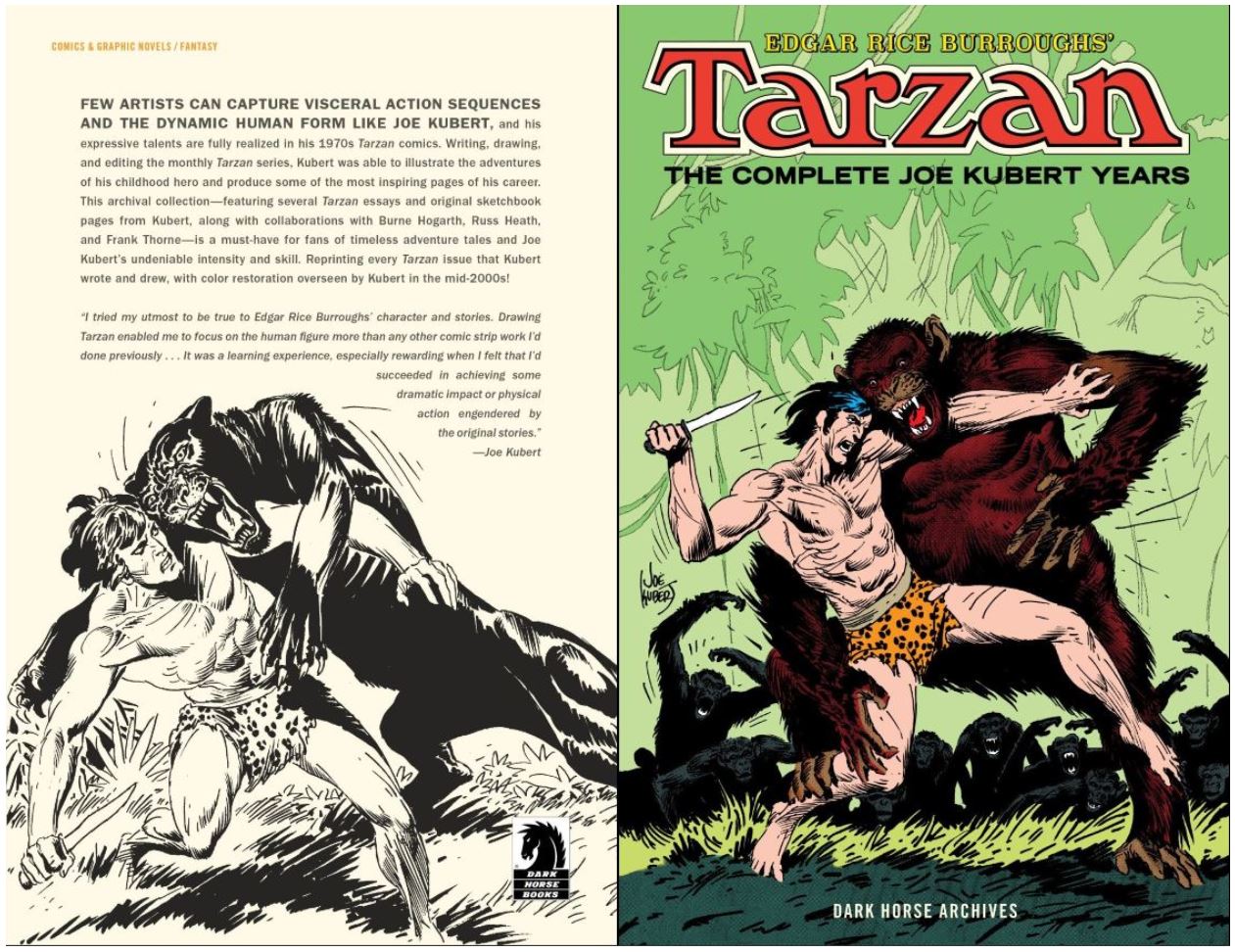
By Joe Kubert with Burne Hogarth, Hal Foster, Frank Thorne, Robert Kanigher, Russ Heath & various (Dark Horse)
ISBN: 978-1-61655-982-3 (TPB/digital editions)
For those that care, it’s a week until St. Valentine’s Day, and once more I’m foregoing gift recommendations in favour of comics-related pep talks. This year, you can see here how some relationships – albeit in cartoon form – have weathered the test of time. One of the longest drives a strip that – despite a shift in social sensibilities and general growth in consensus attitudes – still has lot to offer on many levels…
Soon after first publication in 1912, Tarzan of the Apes became a multi-media sensation and global brand. More novels and many, many movies followed: a comic strip arrived in 1929, followed by a radio show in 1932 with the Ape-Man inevitably carving out a solid slice of the comic book market too, once that industry was firmly established.
Rivalling and frequently surpassing DC and Marvel at the height of their powers, Western Publishing were a big publishing/print outfit based on America’s West Coast. They specialised in licensed properties and the jewels in their crown were comics starring the Walt Disney and Warner Brothers cartoon characters.
As publishers, they famously never capitulated to the wave of anti-comics hysteria that resulted in the crippling self-censorship of the 1950s. Dell Comics – and latter imprints Gold Key and Whitman – never displayed a Comics Code Authority symbol on their covers. They never needed to.
Dell also handled other properties like movie or newspaper strip franchises, and would become inextricably associated with TV adaptations once the small screen monopolised modern homes. In 1948, Dell produced the first all-new Tarzan comic book. The newspaper strip had previously provided plenty of material for expurgated reprint editions until Dell Four Color Comic #134 (February 1947).
That milestone featured a lengthy, captivating tale of the Ape-Man scripted by Robert P Thompson – who wrote both the radio show and aforementioned syndicated strip – with art by the legendary Jesse Marsh.
Marsh & Thompson’s Tarzan returned with two further tales in Dell Four Color Comic #161, cover-dated August 1947. This was a frankly remarkable feat: Four Colour was an umbrella title showcasing literally hundreds of different properties – often as many as ten separate issues per month – so such a rapid return meant pretty solid sales figures.
Within six months, the bimonthly Tarzan #1 was released (January/February 1948), beginning an unbroken run that only ended in 1977, albeit by a convoluted route…
After decades as solid Whitman staples, licensed Edgar Rice Burroughs properties transferred to DC – not just Tarzan and his extended family, but also fantasy pioneers John Carter of Mars, Carson of Venus, Pellucidar and others – with the new company continuing the original numbering.
Tarzan #207 had an April 1972 cover-date and the series carried on until #258 in February 1977. Thereafter, Marvel, Malibu and Dark Horse extended the Jungle Lord’s comic canon…
The early 1970s were the last real glory days of National/DC Comics. As they lost market share to Marvel, their response was controversial: delivered in the form of landmark superhero material eschewing fantasy and super-villains in favour of social commentary. However their greatest strength lay – as it always had – in the variety and quality of its genre divisions. War, Mystery & Supernatural, Romance, and Kids’ titles remained strong and the company’s eye for a strong brand was as keen as ever.
The Ape Man and his family were a Dell/Gold Key mainstay and global multi-media phenomenon, so when DC acquired rights they justifiably trumpeted it out, putting one of their top creators in sole charge of the legend’s monthly exploits, as well as generating a boutique bunch of ERB titles in a variety of formats.
DC’s incarnation premiered in a blaze of publicity at the height of a nostalgia boom and was generally well received by fans. For many of us, those years provided the definitive graphic Tarzan, thanks solely to the efforts of the Editor, publisher and illustrator who shepherded the Ape-man through the transition.
They were all the same guy: Joe Kubert.
Kubert was born in 1926 in rural Southeast Poland (which became Ukraine and might be Outer Russia by the time you read this). His parents took him to America when he was two. and he grew up in Brooklyn. According to his Introduction, his earliest memory of cartooning was Hal Foster’s Tarzan Sunday strips…
Joe’s folks encouraged him to draw and the precocious kid began a glittering career at the start of the Golden Age, before he was even a teenager. Working and learning at the Chesler comics packaging “Shopâ€, MLJ, Holyoke and assorted other outfits, he began his lifelong association with DC in 1943.
A canny survivor of the Great Depression, he also maintained outside contacts, dividing his time and energies between Fiction House, Avon, Harvey and All-American Comics, where he particularly distinguished himself on The Flash and Hawkman. In the early 1950s he and old school chum Norman Maurer were the creative force behind publishers St. Johns: creating evergreen caveman Tor and launching the 3D comics craze with Three Dimension Comics.
Joe never stopped freelancing: appearing in EC’s Two-Fisted Tales, Avon’s Strange Worlds, Lev Gleason Publications & Atlas Comics until 1955 when, with the industry imploding, he took a permanent position at DC, only slightly diluted whilst he illustrated the contentious and controversial newspaper strip Tales of the Green Berets (1965 to 1968). From then on, he split his time drawing Sgt. Rock and other features, designing covers and editing DC’s line of war comicbooks.
And then DC acquired Tarzan…
This monumental archive collects the entirety of his work with the Ape-Man: stories from Tarzan #207-235 (April/November 1972 to February/March 1975): a tour de force of passion transubstantiated into stunning comic art, with Kubert writing, illustrating and lettering.
Moreover, the vibrant colours in this epic re-presentation are based on Tatjana Wood’s original guides, offering readers a superbly authentic and immersive experience whether you’re coming fresh to the material or joyously revisiting a beloved lost time.
The only disconcerting things about this stellar compilation are the cover reproductions, which appear in all their iconic glory but manipulated to remove DC’s trademark logos. The mightiest force in the modern jungle is still Intellectual Property lawyers…
The tense suspense begins with Kubert’s Introduction to earlier collections before his adaptation of debut novel Tarzan of the Apes opens with a safari deep in the jungle. A pretty rich girl is driving her white guide and native bearers at a ferocious pace as she desperately hunts for her missing father.
When a bronzed god bursts into view battling a panther, she watches aghast as human impossibly triumphs over killer cat and then pounds his chest whilst emitting astounding screams. As the terrifying figure vanishes back into the green hell, the girl’s questions are grudgingly answered by the old hunter who relates a story he has heard…
‘Origin of Tarzan of the Apes’ reveals how, following a shipboard mutiny, John Clayton, Lord Greystoke – and his wife Lady Alice – are marooned on the African coast with all their possessions, including a vast library of books and Primers intended for their soon-to-be-born baby…
Against appalling odds, they persevered with Greystoke building a fortified cabin to shelter them from marauding beasts, particularly the curious and savage apes roaming the region. Despite the birth of a son, eventually the jungle won and the humans perished, but their son was saved by a grieving she-ape who adopted the baby to replace her own recently killed “Baluâ€â€¦
The ugly, hairless boy thrived under Kala’s doting attentions, growing strong but increasingly aware of intrinsic differences. He only discovered the how and why after years of diligent effort: through sheer intellectual effort and the remnants of his father’s books and papers, Tarzan learned to read and thereby deduced that he was a M-A-N…
The tale within a tale continues in ‘A Son’s Vengeance: Origin of the Ape-Man Book 2’ as the boy rises to prominence amongst his hirsute brethren and through imagination and invention masters all the beasts of his savage environment. Eventually, brutal, nomadic natives settle in the area and Tarzan has his first contact with creatures he correctly identifies as being M-E-N like him…
The new situation leads to the greatest tragedy of his life as a hunter of M’Bonga‘s tribe kills beloved, devoted Kala and Tarzan learns the shock of loss and overpowering hunger for revenge…
Issue #209 revealed how civilisation finally caught up with Tarzan as ‘A Mate For the Ape-Man: Origin of the Ape-Man Book 3’ saw him meet and save American Jane Porter, her elderly father and his own cousin…
Just as had happened years earlier, these unlucky voyagers were marooned by mutineers. Discovering John Clayton’s cabin, the castaways find the lost peer’s diary, which is of especial interest to William Clayton, the current Lord Greystoke. As tensions rise and humans die, Tarzan takes his golden-haired mate deep into the impenetrable verdure…
It all concludes neatly and tantalisingly in ‘Civilisation: Origin of the Ape-Man Book 4’ wherein the innately noble Tarzan returns Jane to her fiancé William, just in time for the westerners to be rescued by Naval Officer Paul D’Arnot.
When the dashing French Lieutenant is captured and tortured by M’Bonga’s warriors, Tarzan rescues and nurses him back to health. In return, the grateful sailor teaches him to speak human languages that up until that moment he could only read and write in. By then, however, the navy vessel and saved souls have all sailed away, each carrying their own secrets with them…
With no other options, lovelorn Tarzan accompanies D’Arnot back to civilisation. The eternal comrades eventually settle in Paris with Tarzan practically indistinguishable from other men…
Even today ‘Origin of the Ape-Man’ is still the most faithful adaptation of ERB’s novel in any medium: potent and evocative, fiercely expressive: a loving, utterly visceral translation of the landmark saga.
Kubert’s intent was to adapt all 24 Burroughs novels and intersperse them with short, complete tales, but the workload, coupled with his other editorial duties, was crippling. To buy some time #211 combined old with new as ‘Land of the Giants’ partially adapted and incorporated Don Garden & Burne Hogarth’s newspaper classic ‘Tarzan and the Fatal Mountain’: Sunday strip pages #582-595 which had originally ran from May 3rd to August 2nd 1942.
A clash with crocodiles lands Tarzan in a lost valley where giant natives are persecuted by deformed, diminutive outworlder Martius Kalban: a sadist hungry for the secrets of their prodigious size and strength. Even after gaining his dark desire, Kalban finds himself no match for the outraged Ape-Man…
It’s followed by ‘The Captive!’: a latter-day exploit beginning a run of yarns based on the short stories comprising ERB’s book Jungle Tales of Tarzan as the relationship between Ape-Man and elephants is explored with each saving the other from the ever-present threat of the hunters of M’Bonga…
The Jungle Tales reworkings continue with ‘Balu of the Great Apes’ with childhood friends of Tarzan becoming incomprehensibly aggressive after the birth of their first baby, before ending with ‘The Nightmare’ as starving Tarzan steals and gorges on meat and drink from the native village. The resultant food poisoning takes him on a hallucinogenic journey never to be forgotten: one that almost costs his life when he can no longer tell phantasm from genuine threat…
Following Kubert’s Introduction to Tarzan #215-#224, the pictorial wonderment resumes with another vintage visual treat as ‘The Mine!’ (Tarzan #215, December 1972) incorporates material originally seen in 1930s Sunday newspaper strips (by Foster & George Carlin) embedded in an original tale by Kubert.
As before, deadline pressure again compelled Kubert to combine original with found material, detailing how Tarzan is captured by slavers and pressed into toil deep in the bowels of the earth for a sadistic mine owner. Naturally, he soon chafes at enforced servitude and leads a savage workers’ revolt to overturn and end the corporate bondage…
Issue #216 took another route to beating deadlines with old pal Frank Thorne pencilling Kubert’s script for ‘The Renegades’: leaving hard-pressed Joe to ink and complete the story of a murderous raid which wipes out a Red Cross mission.
Investigating the atrocity, Tarzan discovers the “maddened savages†responsible are actually white men in disguise; stealing supplies for a proposed expedition to plunder a lost treasure vault. When he catches the culprits, Tarzan’s vengeance is terrible indeed…
‘The Black Queen!’ was all-new, all-Kubert, as the Jungle Lord almost saves a man from crocodiles. Acceding to the ravaged victim’s last wish, Tarzan then travels to his distant country and overturns the brutal regime of tyrannical Queen Kyra – who rules her multicultural kingdom with whimsy, ingrained prejudice and casual cruelty…
The equally selfish choices of American millionaire tycoon Darryl T. Hanson blight his family as his search for ‘The Trophy’ decimates the fauna of Tarzan’s home and leads to a clash of wills and ideologies which can only end in tragedy…
With #219, Kubert began an epic 5-issue adaptation of ERB’s sequel novel The Return of Tarzan. It opens in Paris as the unacknowledged son of long-vanished Lord Greystoke tries to adapt to his new life as a civilised man of leisure.
One night, his natural gallantry draws him to the side of a woman screaming for help and he is attacked by a gang of thugs. After easily thrashing the brigands he is astounded to find her accusing him of assault and simply bounds effortlessly away from the gendarmes called to the disturbance. The entire trap had been engineered by a new enemy; Russian spy and émigré Nikolas Rokoff beside his duplicitous toady Paulvitch…
The rightful heir to the Greystoke lands and titles silently stood aside and let his apparently unaware cousin William Cecil Clayton claim both them and the American Jane Porter after the wild one rescued her from attacking apes in the jungle. Missing her terribly, Tarzan has chosen to make his own way in the human world beside French Naval Officer D’Arnot. In the course of his urbane progression, Tarzan had exposed the Russian cheating at cards to blackmail French diplomat Count De Coude and earned himself a relentless, implacable foe, forever.
When Rokoff subsequently tries to murder Tarzan, the vile miscreant agonisingly learns how powerful his jungle-bred enemy is…
With physical force clearly of no use, Rokoff’s latest plan is to put the Ape-Man through a ‘Trial by Treachery’: manufacturing “evidence†that Tarzan is having an affair with the Comte’s wife. Once again, the civilised beast underestimates his target’s forthright manner of handling problems and is savagely beaten until he admits to the plot and clears the innocent woman’s name…
With news of Jane’s impending marriage to Clayton, Tarzan seeks to ease his tortured mind with action, and the next chapter sees him in Algeria where, sponsored by the grateful, ashamed Count, he works for the French Secret Service in Sidi Bel Abbes, ferreting out a traitor in the turbulently volatile colony. His hunt leads to a likely turncoat and subsequent brutal battle with Arab agent provocateurs, but things start to turn his way after he liberates a dancing slave who is the daughter of a local sheik.
When word of Jane comes from D’Arnot, Tarzan throws himself even more deeply into his tasks and falls into another ambush organised by Rokoff. This time his ‘Fury in the Desert’ seems insufficient to his needs …until his newfound friend the Sheik rides to the rescue…
The intrigue further unfolds in ‘Return of the Primitive’ as Tarzan finally uncovers a link between Rokoff and spies at Sidi Bel Abbes. Mission accomplished, he is then posted to Capetown and aboard ship meets voyager Hazel Strong, a close friend of Jane’s who reveals the heiress had never forgotten her tryst with an Ape-Man.
Unable to watch Jane enter into a loveless marriage, Hazel took off on an ocean cruise…
The story rocks Tarzan’s mind, but not so completely that he fails to notice Rokoff is also aboard and murderously dogging his footsteps. This time, the Tsarist is properly prepared and that night the jungle man vanishes from the ship…
Rokoff’s act of assassination is a purely pyrrhic victory. Soon after reaching Capetown the villain insinuates himself into the Clayton wedding party but when their yacht’s boilers explode next morning, he, Hazel, Clayton, Jane and her father are left adrift in a lifeboat…
Tarzan, meanwhile, has survived being tumbled overboard and spent days swimming hundreds of miles. He now washes up on the same beach his parents were left upon decades ago. Staggering inland, he finds himself in the cabin his father built before being stolen and adopted by Kala the She-Ape.
John Clayton is forgotten, for fate has brought Tarzan home…
A man changed by his time amongst other men, the Jungle Lord instinctively saves a native warrior from certain death and is astonished to find himself declared chieftain of the Waziri nation.
…And off the coast, a lifeboat filled with dying travellers espies land and wearily sculls towards a welcoming beach in the heart of primeval forests…
Revelling in his newfound status, popularity and freedom, Tarzan enquires about the fabulous jewelled ornaments of his new friends and learns of an incredible lost metropolis. Soon he is curiously journeying to ‘The City of Gold’ to encounter debased, degenerate sub-men led by a gloriously beautiful Queen.
La is high priestess of lost Atlantean outpost Opar, but can barely control her subjects enough to allow the perfect specimen of manhood to escape to safety. Both she and Tarzan know they are destined to meet again…
Refusing to be cheated of their sacrifice, the bloodthirsty Oparian males search far into the jungle and soon encounter the Clayton yacht survivors. When the primitives attack the human strangers and carry off Jane, Rokoff shows his true colours, leaving William to his fate. This callous act also inadvertently clears the path for Tarzan to finally claim his inheritance and reunite with Jane. All the Jungle Lord has to do is break back into Opar, save his one true love from ‘The Pit of Doom!’ and escape the wrath of spurned Queen La…
That mission accomplished, he and Jane return to the beach in time to witness William’s dying confession and accept the succession to the estates and title of Lord Greystoke…
The adaptation is followed by an original adventure codicil, seeing Tarzan rescue a beautiful maiden from attacking apes to find she comes from La, now in peril of her life…
In Opar, another Beast Man insurrection has left the Queen imperilled by her subjects and threatened by a gigantic mutant whom she tearfully reveals is her sibling in ‘Death is My Brother!’ With no choice, Tarzan regretfully battles the nigh-mindless brute and proves to the insurgents that his wrath is greater than their malice…
A third and final Kubert text missive of fond reminiscences about Tarzan #225-235 leads into original tale ‘Moon Beast’ which sees a mother and child brutally slaughtered and Tarzan captured: framed for the hideous crime by cunning medicine man Zohar. When the vile trickster overreaches himself, the captive lord breaks free but still has to deal with the mutant brute Zohar employed to perpetrate the atrocity…
Kubert only produced the cover for #226, as deadline pressures finally caught up with him. The contents – not included here – featured a retelling of the Ape-Man’s origins by Russ Manning, taken from the Sunday newspaper strips of 15thNovember 1970-7th February 1971.
Back for #227, Joe took Tarzan out of his comfort zone as ‘Ice Jungle’ saw young warrior Tulum endure a manhood rite at the top of a mountain. Also converging on the site for much the same reason is American trust-fund brat J. Pellington Stone III: determined to impress his father by bagging a legendary snow ape. Sensing impending doom, Tarzan follows them both and is proved correct in his assessment…
After single-handedly killing an immense Sabretooth tiger in an unexplored region of the continent, Tarzan is captured by pygmies intent on offering him as sacrifice to a mighty monster that has terrorised them for years. However, a ‘Trial By Blood!’ sees the Ape-Man cleverly outwit a giant lizard and teach tribal elders a valuable lesson in leadership, after which albino queen Zorina seeks to extend her power by making him her consort.
The mighty wanderer wants nothing to do with ‘The Game!’, and, after the kingdom descends into savage civil war, sees ironic Fate deal the white queen a telling death blow…
With Tarzan #230 (April/May 1974), the title transformed into a sequence of 100-page giants, mixing new material with reprints of ERB characters and thematically-aligned stars from DC’s vast back-catalogue.
Leading off that issue was a brief all-Kubert vignette as ‘Tarzan’ saves a deer from a lioness. It neatly segues into ‘Leap into Death’ starring Korak, Son of Tarzan (written by Robert Kanigher, with Kubert pencilling and inks from Russ Heath). Here the titanic teen nomad hunts for his stolen true love Meriem and barbarian Iagho who   abducted her, before stumbling into a nest of aggressively paranoid bird-people who learn to respect his courage before flying away with his lover…
The next issue featured the start of another-Kubert-adapted Burroughs novel: possibly the most intriguing conception of the entire canon.
‘Tarzan and the Lion Man Part One’ sees a movie company on location in the deep jungle. They are making a picture about a white man raised by animals who becomes undisputed master of all he surveys. The chain of coincidences grows more improbable as actor Stanley Obroski is a dead ringer for Tarzan… which probably explains why he is taken by savages set on torturing the Jungle Legend to death…
Rescued by Tarzan, Stanley explains how the expedition was attacked, unaware exactly how much trouble his fellow actors are in. During Obroski’s absence, stand-in Rhonda Terry and starlet Naomi Madison are kidnapped by El Ghrennem‘s Arab bandits. They think the production’s prop map leads to an actual valley of diamonds…
When Tarzan finds the rest of the film crew, he is mistaken for Stanley and drawn into their search for the missing women. The plucky Americans have already made a mad dash for freedom, however, and Rhonda has been captured by creatures she simply cannot comprehend…
After a fascinating bonus section revealing Kubert’s ‘Layouts and Thumbnails’ for the opening chapter, ‘Tarzan and the Lion Man Part Two’ reveals Rhonda taken by apes who speak Elizabethan English, and made the subject of a fierce debate. Half of the articulate anthropoids want to take her to “God†whilst the other faction believes her a proper prize of their liege lord “King Henry VIIIâ€â€¦
After being briefly recaptured by El Ghrennem, Naomi too is taken by the talkative Great Apes. When Tarzan discovers the kidnapper’s corpses, he follows a trail up an apparently unscalable escarpment. Rescuing and returning Miss Madison to her surviving friends, “Stanley†then re-ascends the stony palisade to discover an incredible pastoral scene complete with feudal village and English castle…
Tracking Rhonda, he enters the citadel and meets a bizarre human/ape hybrid calling himself God. The garrulous savant explains that once he was simply a brilliant Victorian scientist pursuing the secrets of life. When his unsavoury methods of procuring test-subjects forced him to flee England and relocate to this isolated region of Africa, he resumed his experiments and transformed himself into a superior being, before making the apes into fitting servants.
Now they have a society of their own – based on the history books he brought with him – and his experiments near completion. Having already extended his life and vitality far beyond its normal span by experimenting upon himself, God is now ready to attain immortality and physical perfection. All he has to do is consume Tarzan…
Of course, the madman has no conception of his captive’s capabilities, and when the Ape-Man and Rhonda promptly vanish from his dungeon it sends the palace into turmoil and God into a paroxysm of insanity…
The chaos also prompts already ambitious apostate King Henry to begin a revolt to overthrow his creator. As ‘Part Three‘ opens, war between Church and State is in full swing and Tarzan battles to rescue Rhonda whilst God’s castle becomes a flaming hell. Losing her in the chaos, Tarzan is forced into a hasty alliance with God, unaware that maniacal monarch Henry has taken her back to the jungles below the escarpment, and into a region where God casts his scientific failures…
All too soon Henry is dead and Rhonda is facing beings even stranger than talking apes. Thankfully, ‘Part Four‘ (preceded by another fascinating Kubert Layout spread) sees the Ape-Man arrive in time to save and return her to the film party in a dazzling, tragic conclusion…
Kubert ended his close association with Tarzan in #235’s ‘The Magic Herb’. Here, the hero saves a couple from a crashed aeroplane and siblings Tommy and Gail urge him to help them find a legendary flower that might cure the man’s fatal ailment. However, something about them makes Tarzan deeply suspicious…
Nevertheless, he takes them to the primeval lost valley where it grows, only to be betrayed as the intruders frame him: throwing the jungle lord to the resident lizard men and fleeing with specimens that will make them millionaires in the outside world. Sadly, the treacherous pair have completely misunderstood the powers of the plant and pay the ultimate price all betrayers must…
Wrapping up the astounding thrills and captivating artistry, more revelatory treasures from ‘Joe Kubert’s Tarzan Sketchbook’ trace the art process from page-roughs to competed page.
Supplemented by Creator Biographies of Burroughs and Kubert, this tome is an unmissable masterpiece of romance fantasy, wild adventure and comics creation no lover of the medium or genre can do without.
Edgar Rice Burroughs’ The Complete Joe Kubert Years © 1972, 1973, 1974, 1975, 2005, 2016 Edgar Rice Burroughs, Inc. All rights reserved. Trademark Tarzan and Edgar Rice Burroughs Inc. All rights reserved.