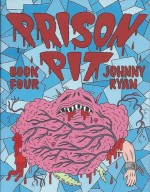
Prison Pit Book Four


By Johnny Ryan (Fantagraphics Books)
ISBN: 978-1-60699-591-4

Johnny Ryan is a comedian who uses comics as his most liberated medium of expression. Whether in his own Angry Youth Comix, or the many commissions for such varied clients as Nickelodeon, Hustler, Mad, LA Weekly and elsewhere, his job/mission is to create laughter. Depending on your point of view, he is either a filth-obsessed pervo smut-monger or a social iconoclast using the same tactics as Lenny Bruce or Bill Hicks to assault the worst and most hidebound aspects of society.

His wild, loose cartoon drawing style is deceptively engrossing, and his seeming pictorial Tourette’s Syndrome of strips and gags involving such grotesque signature characters as Boobs Pooter (world’s most disgusting stand-up comedian), Loady McGee, Sinus O’Gynus and especially the incredible Blecky Yuckeralla (originally weekly from 2003 in The Portland Mercury and Vice Magazine before switching to Ryan’s own on-line site) will, frankly, appal many readers, but as with most questions of censorship in a Free Society, they are completely at liberty to neither buy nor read the stuff.

Ryan dubs his stinging graphic assaults on American culture ‘misanthropic comics’ and one of the most effective and honestly engaging is a simple riff on kids and fighting…

Ryan is a cartoonist with an uncompromising vision and an insatiable desire to shock and revolt whenever he wants to. In his ongoing Prison Pit series he perpetually pushes the graphic narrative envelope and the outer limits of taste with a brutal, primitive cascade of casual violence that has sprung, fangs bared, claws extended and arcanely barbed genitalia fully brandished, from his apparent obsession with casual ultra-violence, social decay and the mythology of masked wrestling. He is also a delighted devotee of the “berserk” manga strips of Kentaro Miura…

In the first volume criminal grappler Cannibal F***face (my asterisks not his) was banished to an extra-dimensional purgatory where the most violent felons from all over creation were dumped to live or die by societies which had outgrown the need for them. This barren hell-scape was littered with grotesque monsters, vile organisms and the worst specimens of humanity ever captured by the forces of civilisation. The masked wrestler was dumped there to fight and die, but his indomitable spirit and brutally battered body became bonded to a ghastly parasite, and together they thrived by killing everyone – and thing – they encountered…

In this fourth fearsome monochrome tome – which opens with the eighth uncanny episode of the unflinching epic – C.F. and his savage, semi-sentient new left arm awake in a crystalline cell and are informed they are imprisoned within the psychic confines of the insidious Caligulon. When the parasite abandons and attacks the wrestler, the result is an even more horrific monster and a temporary alliance which sees the brutal end of the mental wizards who form the ‘Brain Bitch’.

After demolishing, destroying and even consuming their foes and then dealing so-very-harshly with still more perilously paranormal priapic horrors, C.F. and his erstwhile ally turn on each other in ‘Slugstaxx’. After a horrendous clash which sees the unruly parasite devolved and returned to his rightful left arm-stump, the mighty masked wrestler then totally – and literally – screws with the massive computer behind his latest trials and returns to the Hadean wilderness where he then meets a roving band of marauding killers and proves to their juggernaut leader ‘Undigestible Scrotum’ that he was nothing of the kind…

Suddenly a strange flying machine begins to rain down devastating terror from above…

To Be Continued – and you can’t stop it…

In this non-stop welter of exceedingly excessive force, vile excrescences, constant combat challenges, scatological salvoes and sheer unadulterated graphic carnage, the never-ending Darwinian struggle of C.F. – forever beyond the reach of hope or rescue but never, ever contemplating surrender – is a macabre yet beguiling, loathsomely intriguing miracle of cartoon exuberance.

Man’s oldest gynophobic horrors and most simplistic delight in sheer physical dominance are savagely delineated in this primitive, appalling, cathartic and blackly funny campaign of comic horror. Resplendent, triumphant juvenilia has been adroitly shoved beyond all ethical limits into the darkest depths of absurdist comedy. This is another non-stop rollercoaster of brain-blistering action, profound, profanity and pictorial Sturm und Drang at its most gorge-rising and compelling: a never-ending battle delivered in the raw, frenetically primitivist ink-stained stabbings of an impassioned, engrossed child…

Not for kids, the faint-hearted or weak-stomached, here is extreme cartooning at its most visceral and pure.

…And now that we’ve placated the intellectual/moral imperative inside us all, I’ll also confirm that this book is another, all-out, over the top, indisputably hilarious hoot. Buy it and see if you’re broad-minded, fundamentally honest and purely in need of ultra-adult silliness…
© 2012 Johnny Ryan. All rights reserved.

Mac’s Year: 1984 – Cartoons from the Daily Mail


By Mac – Stan McMurtry (Sphere)
ISBN: 978-0-7221-5798-5

“Democracy must be something more than two wolves and a sheep voting on what to have for dinner” – James Bovard

If you live long enough you’ll experience the pop culture keystones of every definitive era of your life at least twice more. The base, tasteless and utterly superficial aspects of the 1980s are currently doing the rounds again as the current generation – which was too young to remember them – get all nostalgic for the good bits and blithely ignore all the bad stuff: same as it ever was…

For us Brits it was Union-Bashing, Loads-a-Money, Yobs and Yuppies, poverty, excess, Royal Weddings, daft hair and Thatcher, whilst America endured trickle-down Reaganomics, insider dealing, illicit warfare and poodle rock – so nobody really got off lightly either side of the Pond – and then all the money ran out…

The truly amazing – and most depressing – realisation is that the issues never go away. The names and faces of the political or industrial scoundrels and mountebanks may change, but the mistakes they make and problems they create just keep going, so it’s always a wearisome, disturbing but oddly topical exercise to examine news cartoons this long after the fact and discover how distressingly familiar the hot topics still are. Same as it ever was…

So here’s another little dip into the vast forgotten annals of cartoon comedy generated by Britain’s greatest natural resource (and still un-privatised so it belongs to us all for the moment) – Clever Folks What Make Us Laugh…

Oftentimes our industry is cruel and unjust and frequently prone to guilt by association. This collection of cartoons is by Stan McMurtry – perhaps unfairly attributed a cartoon champion of the Populist Right – who, as “Mac”, has worked for nearly 40 years as social and political cartoonist for The Daily Mail.

Cartooning is a hard, demanding, mercurial job and a regular gig is every brush-monkey’s dream. Although it’s fair to say that most artists who settle in one place have an affinity for a periodical’s positions, stance and core politics, there will always be friction between creative expression and the Editor’s own inclinations and prudence…

The precociously artistic Mac was born inEdinburghin 1936 but raised inBirminghamfrom 1944. His father, a travelling salesman, never supported his son’s dreams of a career in art, but Stan persevered, attending Birmingham College of Art from 1950-1953, after which his 2-year National Service saw him serve in the Royal Army Ordnance Corps until 1956.

On demobilisation he entered the animation industry (at Henley-On-Thames), producing short films for the newly-launched commercial broadcast company ITV. Two of his efforts were prize winners at Cannes. Like so many other artists he also began contributing to the huge and broad cartoon market, selling his first job to Today in 1961. He became a full-time freelancer in 1965, drawing comics strips for a number of Odhams/IPC kids’ periodicals such as Wham! and Buster whilst selling gag panels to Punch, The London Evening News and others.

When Norman Mansbridge retired in 1968, Mac was offered his spot as topical cartoonist on the Daily Sketch, a centrist paper whose politics the artist generally agreed with.

In 1971 the paper was absorbed by the Daily Mail, a broadsheet which was repositioning itself as a tabloid. The once-posh paper had for years favoured the use of two staff cartoonists but was letting the revered Wally “Trog” Fawkes go (to The Observer). Offered the vacant chair, Mac alternated with the venerable John Musgrave-Wood – who signed his beautiful but so savage visual blasts against the Left “Emmwood” – until the senior partner retired in 1976.

From then, although other cartoonists appeared, the paper was Mac’s playground. Despite Editor David English constantly urging McMurtry to be “more politically minded”, Mac felt happiest employing sarcasm and gentle mockery, regarding his job as making “the dreary news-copy of the daily paper brighter by putting in a laugh”.

Mac has always been adamant that he was more a social than political animal. Even whilst spending decades turning last night’s newsflash into this morning’s mirth, McMurtry has always pursued other lucrative creative pursuits: working in advertising, straight illustration and greetings card design. In 1977 he wrote and drew children’s book The Bungee Venture and negotiated it into a Hanna-Barbera animated feature. With writing partner Bernard Cookson he also wrote TV scripts for comedians Tommy Cooper and Dave Allen. He was awarded an MBE in 2003 and remains at large and comically active to this day…

Artists like Mac who were commenting on contemporary events are poorly served by posterity. This particular volume (re-presenting a selection of single panel-gags from August 9th 1983 to June 8th of the politically and culturally front-loaded year 1984), like all of these books, was packaged and released for that year’s Christmas market, with the topics still fresh in people’s minds.

Decades later the drawing is still superb and, despite perhaps the wry minutiae escaping a few, the trenchant wit, dry jabs and outraged passion which informed these visual ripostes are still powerfully effective. And obviously human nature never changes and there’s nothing new under the sun…

Many of the blasts in this book deal unkindly – but rather hilariously, I’m forced to admit – with the fallout from the Greenham Common protest (and I’m speaking as someone who lost his then-girlfriend to that clarion call to arms, and marvels that today’s Occupy movement is so marvellously Co-Ed), underage sex and contraception, industrial turmoil and business closures, Health scandals and the NHS under attack whilst the Police themselves were increasingly Under The Cosh: same as it ever was…

There’re also episodes of Royal embarrassment and unwise escapades caught on film, doping and gender testing at major sporting events, the outrages of racist football thugs and players, vacillating doctors’ advice on booze and smokes, turmoil as opposition leaders were judged inadequate and heartfelt tributes to entertainment giants who had passed away…

Then as now, the overwhelming rain and horrendous climate often seized our attention, as did Irish Republican killers, the threat of Iran, illegal American wars, Arab Oil, celebrity love cheats, Airline blues, tacky TV Magicians, Judges with no grasp of modern life, holiday horrors, Parliamentary scandals (sex and money) and mouthy maverick cricketers causing trouble, all while the battle for equal pay for women was raging…

We kept annoying the French, there were Olympic surprises, welcome pops at privileged Toffs and posh-boys, wry Anniversary celebrations of WWII, the Scots were revolting, we all thought the Chancellor was inept or crooked, there were Papal gaffes and the Press was obsessed with Princesses…

My absolute favourite gag is a panel from February 23rd 1984 in which an ambitious couple behind a tree aim a little tot at the pram carrying the baby William Windsor and urged her to ‘Think of your career, kid – just saunter up to the Prince William and say “Hello gorgeous’”…

Thankfully some progress has occurred. Less perennial topics included pops at the PM’s idiot children (give it time), the prejudices shown to returned and wounded servicemen, body-issues and diet Nazis, arrogant and paranoid Yankee Presidents, insane African dictators, out of control school kids and… Hey, wait a minute…

Despite being often and usually unfairly targeted by factions of the Left and Right – and even accused of racism on one occasion – Mac is one of most celebrated and lauded cartoonists in British history: his energy, creativity, perspicacity and grasp of the public mood generating thousands of unforgettable gags and acres of brilliant cartoons.

His comical commentaries, produced on a punishing daily deadline, were appreciated if not feared by Peers and plebs alike and were all created with a degree of craft and diligence second to none. Even now, decades later, they are still shining examples of wit and talent… and still bitingly funny too.

It’s a terrible shame that the vast body of graphic excellence which topical cartoonists produce has such a tenuous shelf-life. Perhaps some forward-looking educational institution with a mind to beefing up the modern history or social studies curricula might like to step in and take charge of the tragically untapped and superbly polished catalogue of all our yesterdays.

Clearly they’re all short of a bob or two these days and I’m pretty sure these cartoon gems could find a willing market eager to invest in a few good laughs, or even market them as social history books that students might actually enjoy absorbing. Same as it never was…

© 1984 Stan McMurtry. All rights reserved.

Brought to Light – Thirty Years of Drug Smuggling, Arms Deals, and Covert Action


By Alan Moore, Bill Sienkiewicz, Joyce Brabner, Tom Yeates, Paul Mavrides & others (Eclipse Books/Titan Books)
ISBNs: 978-0913035672 (Eclipse),                978-1-85286-154-4 (Titan)

“It is lamentable, that to be a good patriot one must become the enemy of the rest of mankind” – Voltaire

There’s no more painful truism than Politics is Dirty Business, but as information has become more readily obtainable and widely disseminated from the 1980s onward, scandal after scandal has surfaced everywhere men of power play their games, seemingly impossible to cover up by administrations and regimes all over the planet.

This was never more common than in Ronald Reagan’s America.

No matter what else you may think of the Land of the Free, that’s one supreme advantage that their Inalienable Right to Free Speech gives them over so many other cultures. Still, that’s nothing a few judicious Plutocratic backhanders and dedicated lobbyists won’t one day fix, I’m sure…

As always us proud, dirty Liberals in comics got into the exposé act early and often, hopefully opening many young complacent eyes at just the right developmental moment…

While I’m unsure of the exact and total effect of comic condemnation as opposed to legal sanctions and official reprimands, I am utterly certain that politicians eventually have to listen to the people who vote them in and out, so the power to arouse Joe Public is one I completely appreciate and respect – even if these days there’s an apparent campaign of legalised disenfranchisement being steadily carried in the once-civilised west…

During the Reagan Era, many of the poisonous pigeons of previous administrations finally came home to roost and a high-profile legal case involving a CIA operative accused of blowing up journalists in South America first cast a very unwelcome light on US covert operations in sovereign nations.

However, even after very public hearings and a torrent of media scrutiny, nobody particularly high up was ever punished, and those middle-rankers actually convicted of crimes were soon Presidentially pardoned…

The Christic Institute, a “Public Interest” law firm which had successfully tackled the Nuclear Power industry on behalf of Karen Silkwood, the Ku Klux Klan, institutionally corrupt Police Departments and the American Nazi Party, finally met their match when they tried to use Rico (Racketeer Influenced and Corrupt Organizations Act) Laws to expose clandestine elements of the Administration which wilfully circumvented the Senate, Congress and the Constitution in pursuit of their own illegitimate goals.

Prior to that they had acted upon the behalf of American reporters Tony Avirgan and Martha Honey when they brought suit against the covert, unsanctioned CIA agents who had been working with right-wing terrorist groups – Contras – and even destabilising democratically elected socialist governments in Central America.

Devised as a “Flip Book” with two separate stories joined back to back, I’ve decided to start with ‘Flashpoint – The La Penca Bombing’, constructed from legal affidavits and the journalists’ own accounts by editor/scripter Joyce Brabner and illustrated by Thomas Yeates.

Beautifully rendered with stylish aplomb, this tale of cynical, institutionalised malfeasance documents the growth of a clandestine wing of operatives designed to work beyond the oversight of Congress to make America safe by any means necessary. It opens by covering the fall of Cubato Castro and Vice-President Nixon‘s illegal formation of a Contra-revolutionary army to take the island back for the Mafia bosses who had previously run it. This led to the gradual growth of an illicit anti-communist “Secret Team” which would perpetrate and facilitate countless acts of terrorism across the continent and incidentally create most of the trade routes and contacts used by drug cartels for the next fifty years.

In 1980 President Reagan had authorised the CIA to fund, train and supply “Contras” in Honduras with the intention of unseating Nicaraguan revolutionary Eden Pastora“Comandante Zero” – who had overthrown the regime of corrupt Right Wing reactionary President Anastasio Somoza in 1978.

When he refused overtures to work with the CIA, Pastora became a prime target for the Secret Team which consisted of obsessive American patriots, anti-communist thugs and career criminals. It was decided that assassination was the most expedient solution…

The focus then switches to Avirgan and Honey, whose latest overseas assignment saw them and their family transfer fromAfricatoCosta Rica. In 1984, as part of their news brief, Avirgan attended an international press conference held by Pastora in La Penca where the disillusioned Nicaraguan leader was stating his new aim and denouncing his erstwhile comrades who had abandoned their revolutionary principles and started cashing in…

Comandante Zero narrowly escaped death in a huge bomb blast which, according to figures at the time, killed 8 and brutally maimed another 28 journalists.

In the aftermath the recovering Avirgan and Honey began diligently investigating the hitman who caused the blast and overturned a can of worms which changed America’s conception of itself. Eventually they resorted to litigation, exposing key players to piercing public scrutiny in the groundbreaking case of Avirgan vs. Hull. The CIA agent was only one of more than twenty covert American operatives involved in the network and who would all figure prominently in the later Congressional Investigations and Tower Commission reports we know today as the Iran-Contra Scandals.

…And of course the Secret Team struck back in their own time-honoured and so-very effective ways…

“Patriotism is the willingness to kill and be killed for trivial reasons” – Bertrand Russell

This documentary foray into the underprovided genre of graphic activism alternatively undertakes a sublimely surreal and devastatingly memorable tutorial as Alan Moore and Bill Sienkiewicz transform the dry facts of redacted history into a masterful and impassioned satirical blast against the unsanctioned status quo with ‘Shadowplay – The Secret Team’.

A guy walks into a bar and cosies up to a smug, drunk and pompously bloated American Eagle. Soused and soured, the repellent fallen symbol begins to boast and babble of the things he and his guys at The Company have been proud to do to keep America Strong and Free since WWII…

Acerbic, biting and miraculously packed with astoundingly copious information, this is a visual tour de force which sublimely demonstrates the unmatched ability of comics to convey hard facts, inform by implication, and even shade tone and timbre. Translating the most dry and dusty detail to beguiling, unforgettable truths, the battered old bird reveals the complete history and exposes the many sins of the Central Intelligence Agency from Pinochet to Noriega, Vietnam to Iran and all over South America in a litany of horror too incredible to be made up…

A supremely evocative counter-attack against the unsanctioned dark forces which have committed innumerable atrocities in the name of the American People, this immorality play still has terrifying resonance to today’s world and remains one of the most bleakly lovely exhibitions of sequential narrative ever produced.

This striking chronicle also includes text pieces from attorney Daniel Sheehan and author Jonathan Marshall and extensive creator biographies plus a ferocious cartoon history – ‘Ailing World’ – of America and a world map of ’30 Years of Covert Action: Brought to Light’ from underground cartoonist and political activist Paul Mavrides, relating many of the CIA’s past “successes” in election tampering, drug trafficking, assassination and other less definable exercises in democracy.
© 1989 Eclipse Enterprises, Inc. Flashpoint: the La Penca Bombing © 1989 Joyce Brabner & Thomas Yeates. Shadowplay: the Secret Team © 1989 Alan Moore & Bill Sienkiewicz. Ailing World & Map of Covert Operations © 1989 Paul Mavrides. All other material © 1989 the respective creators/owners.

Stabbed in the Front – Post-War General Elections through Political Cartoons


By Dr. Alan Mumford (Centre for the Study of Cartoons & Caricature, U of K,Canterbury)
ISBN: 978-1-90267-120-8

“True patriotism hates injustice in its own land more than anywhere else” – Clarence Darrow

From its earliest inception cartooning has been used to sell: initially ideas or values but eventually actual products too. In newspapers, magazines and especially comicbooks the sheer power of narrative with its ability to create emotional affinities has been linked to the creation of unforgettable images and characters. When those stories affect the daily lives of generations of readers, the force that they can apply in a commercial or social arena is almost irresistible…

InBritainthe cartoonist has held a bizarrely precarious position of power for centuries: the deftly designed bombastic broadside or savagely surgical satirical slice instantly capable of ridiculing, exposing and always deflating the powerfully elevated and apparently untouchable with a simple shaped-charge of scandalous wit and crushingly clear, universally understandable visual metaphor.

For this method of concept transmission, literacy or lack of education is no barrier. As the Catholic Church proved millennia ago with the Stations of the Cross, stained glass windows and a pantheon of idealised saints, a picture is absolutely worth a thousand words…

More so than work, sport, religion, fighting or even sex, politics has always been the very grist that feeds the pictorial gadfly’s mill. This gloriously informative book (sponsored by the marvellous Centre for the Study of Cartoons and Caricature, University of Kent at Canterbury), offers a fantastic overview of political adaptability and cultural life as Britain moved from Empire to mere Nationhood in the latter half of the 20th century, examined through General Elections and the wealth of cunningly contrived images and pictorial iconography they provoked and inspired.

After an effusive Foreword by professional politician and celebrated cartoon aficionado (the Rt. Hon.) Lord Kenneth Baker of Dorking, author Alan Mumford – a specialist in management training – covers the basic semiology and working vocabulary of the medium in his copious Introduction.

Designating definitions and terms for the treatise, he subdivides the territory into ‘Origins’, ‘Criteria for Selection’, ‘Newspapers and Magazines’, ‘The Longevity of Political Cartoonists’, ‘References, Symbols and Metaphors’, ‘The Impact of Cartoons on General Elections’ and ‘Savagery in Political Cartoons’ as a very effective foundation course in how to best contextualise and appreciate the plethora of carefully crafted mass-market messages which follow.

The format is extremely ergonomic and effective. Thus Philip Zec’s iconic cartoon and caption/slogan “Here You Are. Don’t Lose it Again!” begins the Great Endeavour with historical background in The Run-up to the General Election of 1945, followed by Election Issues and the 1945 Campaign, major Personalities of the 1945 General Election, Results of… and finally a nominated “Cartoonist of the Election” whose work most captured the spirit of or affected the outcome of a particular contest.

This methodology then proceeds to efficiently and comprehensively recreate the tone of each time, augmented whenever possible by a personal interview or remembrance from one of the campaigners involved. These telling vignettes include contributions from Frank Pakenham/Lord Longford, Barbara Castle, Edward Heath, Denis Healey, Roy Jenkins, Kenneth Baker again, Jim Callaghan, Jim Prior, Margaret Thatcher, David Steel, Norman Tebbit, John Major and Tony Blair…

Each fact-packed, picture-filled chapter then dissects every succeeding campaign: 1950’s tame ‘Consolidation not Adventure’ which resulted in Labour and Clement Attlee’s second victory by the narrowest – practically unworkable – of margins, Churchill’s resurgence in 1951 as ‘The Grand Old Man Returns’ and a slow steady decline in fortunes and growth of a New Politics as Anthony Eden’s star rose for the 1955 General Election when ‘The Crown Prince Takes Over’…

In an era of international unrest Harold McMillan eventually rose to become Tory top gun and in 1959 was ‘Supermac Triumphant’, but domestic troubles – race, unionism and the always struggling economy – wore away his energies. In a minor coup he was ousted andSirAlecDouglasHome took over mid-term, consequently losing to glib, charismatic new Labour leader Harold Wilson.

This entire era is one of aged and infirm Big Beasts passing away suddenly with too many lesser lights to succeed them; further complicated by both Labour and Conservative parties rent by infighting and jockeying for position with wannabe upstarts such as the Liberals cruising the room looking to pick up what scraps they could (so it’s not a new thing, OK?).

In 1966 “Labour Government Works” took Labour to a second term but social turmoil in the country, with unions demands spiralling out of control, enabled Edward Heath to lead the Conservatives into the most dangerous and turbulent decade in modern British history. The General Election of 1970 proved ‘Wilson Complacent, Heath Persistent’…

There were two General Elections in 1974.

A massive ongoing crisis in industrial relations and the growing racial tension caused by maverick Tory Enoch Powell’s continual cries to “end Immigration or face rivers of blood in the streets” forced Prime Minister Heath to ask in February ‘Who Governs Britain?’ He was informed by the disaffected electorate “Not you, mate.”

Even though Wilson and Labour were returned to power, the majority was miniscule and by October the people were compelled to do it all again and ‘Vote for Peace and Quiet’.

Although he’d again narrowly led them to victory, Wilson’s time was done and he abruptly resigned in 1976 to be replaced by deputy Jim Callaghan.

Heath too was reduced to the ranks and relegated to the Tory Back benches, replaced by a rising star from Finchley. As Britain staggered under terrifying economic woes in 1979, Callaghan called an election and lost to Margaret Thatcher who had famously said “No Woman in My Time” would ever be Prime Minister. I think that was the last time she ever admitted to being wrong…

Despite horrifying and sustained assaults on the fabric of British society – and great unpopularity – she enjoyed two more election victories: in 1983 “The Longest Suicide Note in History” and again in 1987 as ‘Thatcher Moves Forward’ before finally being turned on by her own bullied and harried cabinet.

The best political cartooning comes from outrage, and the Tory administrations of the 1980’s provided one bloated, bile-filled easy mark after another. Just look at TV’s Spitting Image which grew fat and healthy off that government’s peccadilloes, indignities and iniquities (as well as Reagan’sAmerica and the Royal Family) in just the way that millions of unemployed and disenfranchised workers, students and pensioners didn’t. The election cartoons reproduced here from that period, come from a largely Tory Press, and whilst contextualised and accurate don’t approach the level of venom she engendered in certain sections.

For a more balanced view one should also see Plunder Woman Must Go! by Alan Hardman, Drain Pig and the Glow Boys in Critical Mess,  You are Maggie Thatcher: a Dole-Playing Game or even Father Kissmass and Mother Claws by Bel Mooney & Gerald Scarfe, not to mention any collection of the excoriating Steve Bell’s If…

In 1992 the only thing stopping a Labour landslide was the party itself, which had so dissolved into factional infighting and ideological naval-gazing that not even the fiery oratory of Welsh Wizard Neil Kinnock could pull them together. Once again however the newspapers claimed the credit when Tory consensus/concession leader John Major pulled off a surprising ‘Triumph of the Soapbox?’

That Labour Landslide had to wait until 1997 and the ‘Teeth and Sleaze’ of Tony Blair (although at that time we all thought the latter term only applied to corrupt Tory MPs selling parliamentary time and attention to business interests) which brings this incredibly appealing tome to a close. Since then a whole lot has happened and I think it’s long past time for a new, revised and updated edition…

As well as making addictively accessible over half a century of venal demagoguery, hard work, murky manipulations, honest good intentions and the efforts of many men and women moved in equal parts by dedication and chicanery, this oversized monochrome tome is also literally stuffed with the best work some of the very best cartoonists ever to work in these Sceptred Isles.

The art, imagination, passion and vitriol of Abu, Steve Bell, Peter Brookes, Dave Brown, Michael Cummings, Eccles, Emmwood, Stanley Franklin, George Gale, Nick Garland, the Davids Gaskill and Ghilchik, Les Gibbard, Charles Griffin, Graham High, Leslie Illingworth, Jak, John Jensen, Jon, Kal, David Low, Mac, Mahood, Norman Mansbridge, Sidney Moon, Bill Papas, Chris Riddell, Paul Rigby, Rodger, Stephen Roth, Martin Rowson, Willie Rushton, Peter Schrank, Ernest Shepard, Ralph Steadman, Sidney Strube, Trog, Vicky, Keith Waite, Zec and Zoke are timeless examples of the political pictorialist’s uncanny power and, as signs of the times, form a surprising effecting gestalt of the never happy nation’s feeling and character…

None of that actually matters now, since these cartoons have performed the task they were intended for: shaping the thoughts and intentions of generations of voters. That they have also stood the test of time and remain as beloved relics of a lethal art form is true testament to their power and passion, but – to be honest and whatever your political complexion – isn’t it just a guilty pleasure to see a really great villain get one more good kicking?

Stuffed with astounding images, fascinating lost ephemera and mouth-watering tastes of comic art no fan could resist, this colossal collection is a beautiful piece of cartoon history that will delight and tantalise all who read it… and it’s still readily available through the University of Kent’s website…
© 2001. Text © 2001 Alan Mumford. All illustrations © their respective holders or owners. All rights reserved.

The Adventures of Tintin – Breaking Free


By J. Daniels (Attack International/Freedom Press)
ISBNs: 0-9514261-0-9,      978-0-9514261-0-4,        978-1-90449-117-0 (Freedom Press)

“Freedom of the Press is only guaranteed to those who own one” – Abbott Joseph Liebling

Politics is always composed of and used by firebrands and coldly calculating grandees, but that’s the only guiding maxim you can trust. Most other people don’t give a toss until it affects them in the pocket and, no matter to what end of the political spectrum one belongs, the greatest enemy of the impassioned ideologue is apathy. This forces activists and visionaries to ever-more devious and imaginative stunts and tactics…

Crafted by the enigmatically anonymous J. Daniels and concocted and released by the anarchist faction Attack International in 1988, The Adventures of Tintin – Breaking Free is a perfect exercise in the use of Détournement (“turning expressions of the capitalist system and its media culture against itself”), using mimicry, mockery, parody and satire to counter the seductive subversion of the Monied Interests of the status quo.

It also reads rather well as social documentary and human drama, for all its earnest worthiness and fiercely dogmatic posturing…

The gimmick is this: the comforting cosy style and iconic images of Hergé’s immortal adventurers are removed into our pedestrian oppressive, corrupt world and co-opted to incite a revolution in thinking and action…

In Chapter 1, ‘We’ve Had Enough!’ has unemployed hothead, petty thief and disenfranchised youthful dole-queue outcast Tintin visit his uncle on the run-down-and-dying council estate where the once-vital man and his wife Mary now live on the breadline. The boy needs money and The Captain suggests a labouring job with him on the new building site. Although there’s work to be had, tensions are high there: dangerous working conditions, shoddy management practices and subsistence wages for the desperate men crafting luxury flats for more of the rich and gentrified types steadily pushing real people out of the community…

Another alienated faction joins the swell of discontent when squatters break in to the flat next door and the Captain helps them sort out the utilities. Everybody knows the council is letting the estate die of neglect so that the corrupt councillors can sell it off, so the lesbian activists are welcomed as fellow fighters against the powers that be.

Tensions mount as the National Front recruit in broad daylight, skinheads carry out racist attacks and yuppie winebars push out good old-fashioned working-men’s pubs. Soon Tintin is striking back whenever he can: vandalising posh cars and pickpocketing rich poseurs. All proper men need is jobs, beer, football and a decent life, but the boy soon has his eyes opened – if not his opinions changed – when he is made painfully aware of how even those lower class paragons treat their women…

Events come to a head when a worker dies on the building site and the supervisor is more concerned about lost time; even suggesting poor Joe Hill was drunk and not the hapless victim of negligent, non-existent safety procedures…

‘One Out, All Out!’ sees a wildcat strike seeking compensation for Joe’s widow escalate into a national furore after trade union officials strike a shady deal with the property developers and the incensed workers reject their useless official action for measures that will actually work.

Soon bosses and unions are conspiring together to break the unsanctioned, unofficial action as the ordinary people rally around the strikers, providing food, money and – most important of all – encouragement.

Soon the authorities resort to their tried and true dirty tactics: picket-breaking riot squads, undercover agent provocateurs, intelligence-led targeted arrests of “ringleaders” and general, brutal intimidation.

Scab labour is harshly dealt with in ‘Let’s Get Organised’ as the hard-working, underappreciated women increasingly take up the challenge. The movement is growing in strength and national support. Soon other cities are in revolt too, and The Captain is becoming an unwilling and unlikely figurehead. Tintin, ever impatient, finds like-minded hotheads and secretly begins a campaign of literally explosive sabotage…

It all culminates in ‘Getting Serious’ as everything kicks into overdrive when the Captain endures a punishment beating from unidentified thugs and his family is similarly threatened. Scared but undeterred, the old salt carries on, and planning for a national march continues unabated. With reports coming in of similar movements inPoland,Yugoslavia and other Warsaw Pact countries (the Soviet Empire was still very much in existence and continually crushing workers’ freedoms at this time) the local groundswell becomes a national expression of solidarity and the underclass consolidates under a mass rallying call to arms…

When the riot squads are again deployed it all turns ugly and the events go global, but in the aftermath The Captain has been “disappeared” or, as the authorities would have it, been “arrested for conspiracy”.

With half a million people on the streets of the city, the powers-that-be move to full military response but it’s too late…

The later edition, published by Freedom Press in 2011, also includes the infamous early adventures of this extremely alternative Tintin (as first seen in polemical pamphlet The Scum in 1986) from the scallywag’s days sorting out Rupert Murdoch from the picket line at Wapping during the legendary Printer’s Strike…

Passionate and fiercely idealistic, the initial release of Breaking Free unsurprisingly unleashed a storm of howling protest from the establishment, Tory Press and tabloid papers (especially News International) and by all accounts even Prime Minister Thatcher was “utterly revolted”.

Of course that only meant that the little guys had won: achieving a degree of publicity and notoriety such puny, powerless underdogs could only have dreamed of but never afforded by any traditional means of disseminating their message…

More a deliciously tempting dream than a serious clarion call to end social injustice, this is a wickedly barbed and superbly well-intentioned piece, lovingly capturing the sublime Ligne Claire style and utterly redirecting its immense facility to inform and beguile…

First released in April 1988 by Attack International. This book proudly proclaims that no copyright has been invoked unless capitalists want to poach it…

Apes of Wrath


By Steve Bell (Methuen in association with The Guardian)
ISBN: 978-0-41377-450-7

For as long as we’ve had printing in this country we’ve had gadfly artists commentating on society and its iniquities, and visually haranguing the powerful, pompous, privileged and just plain perfidious through swingeing satire and cunning cartoons.

Even after many centuries of savage satirical Masters, we’re still throwing up brilliant firebrands and cruelly artistic geniuses whose political acumen, societal consciences and staggering graphic gifts irresistibly combine to make the powerful, unscrupulous and hypocritically venal sweat a bit in their own self-important juices whilst making we mere rabble of hoi-polloi and avowed plebs chuckle and smirk at their revealed discomforts…

Probably the most effective and dedicated of the modern crop of cartoonist champions of the underclass (or “the public” as I call them) is Steve Bell, who has been skewering the Great and the not-so Good since 1977.

Born in Walthamstow in 1951, raised in Sloughand North Yorkshireand educated at Teeside College of Art, the Universities of Leeds and later Exeter(where he obtained a teaching qualification from St. Luke’s Campus), he abandoned education for freelance art as both comics artist (the Gremlins in Jackpot) and cartoonist.

His strident, polemical strips ‘Maggie’s Farm’ (Time Out and City Limits) and ‘Lord God Almighty’ in The Leveller led to a commission from The Clash for the album Sandanista! and eventually his own regular feature ‘If…’ which began in national newspaper The Guardian in 1981 and is still going hard and strong…

It’s a controversial maxim of political cartooning that you’re only as good as the times you’re in and the targets on offer, but if so either Bell has been born into the End of Days or he’s particularly blessed in having a perpetually renewing procession of perfectly risible prime lampooning targets – or maybe that should be “suspects”…

After lambasting a succession of utterly ghastly Tory leaders and their appalling acolytes at home, and rabid Rightist rulers abroad for years, blow me if a global swing to the left didn’t seemingly leave Bell with nothing to shoot at. However it all soon proved to be a false alarm which offered a new American C-i-C with his own on-board, self-destructive arsenal of gaffes and a covert continuation of Conservative idiocy ideology at home with the election of Labour’s Saviour Tony Blair.

And then in 2000, the Nicedaysmerca and birthplace of Freem even found itself another Bush to hide in front of…

Collecting and repurposing comical cutlass-slashes, surgically sardonic scalpel-cuts, a riot of rapier-like witticisms and, when nothing else will do, the occasional bludgeon with the blunt-end of a cartoon cudgel, this crushingly hilarious  full-colour  – and often off-colour – compendium collects Guardian cartoons from 1988, 1991 and 1998-2004, tracing the rise of the Bush Dynasty in war and profit peace, without ever underplaying the key role played by dogged Little Britain in assuring a nice steady pace on the road to mutually-assured Armageddon…

The grand conceit of this savage little hardcover treat is that we get to peek beneath the hem of great men in a time of turrble crisis where Freeman Moxy were threatened and only the Curge of our leaders kept us all from  being wiped out by Slamic Fananimalism and Terrrsts. Moreover we get to hear it all in the humble words of George Dubya Bush as he recounts his role in countering the crisis…

Featuring 110 wickedly manic graphic salvoes against just about everybody and a few utterly damning moral condemnations as only arch cartoonists can concoct them, Apes of Wrath captures the true spirit of those troubled times with such standout pictorialised diatribes as ‘Bigtime for Bonzo’, ‘Electile Dysfunction’, ‘Al Who’da??’, ‘The Age of Irony is Dead…’, ‘Corporate Responsibility’, ‘The Humanitarian Thrust Continues’ and so many more…

Thoughtfully containing a comprehensive glossary of frequently-used terms such as “Morl Curge” (What you need to be a wurl class wurl leader), “Cladral damage” (What happens to pain in the ass innocent bystanders that don’t keep their heads down) and “Diplocrap” (talking to forners) which will help us all speak Presidentially and understand the complexity of high level negotiation, this chronicle of catastrophe is a perfectly guided missile of agonised, mordant mirth that no as-yet free-thinking individual should miss, especially as elections just keep on happening…
Text © 2004 Steve Bell. Illustrations © 1988, 1991, 1998, 1999, 2000, 2001, 2002, 2003, 2004 Steve Bell. All rights reserved.

Signal: 02 – A Journal of International Political Graphics


Edited by Alec Dunne & Josh MacPhee (PM Press)
ISBN: 978-1-60486-298-0

“A week is a long time in Politics” – Harold Wilson

I’m going to go all traditional here and offer a few on-line dictionary definitions before I head off on one of my own oblique and off-kilter diatribes.

Politics can be reduced to:

  • The art or science of governing – especially of a political entity such as a nation – and the administration and control of its affairs.
  • The activities or affairs engaged in by a government, politician, or political party.
  • The methods or tactics involved in managing a state or government.
  • Intrigue or manoeuvring within a political unit or group in order to gain control or power.
  • The often internally conflicting interrelationships among people in a society

I’d like to add my own codicil which translates as

  • “Getting large groups of people to do what you want by making them believe it’s their own idea; as perpetually practiced by advertisers, teachers in classrooms, rich folk, commercial organisations and special interest groups, trades unions, and organised religions”.

The early years of the 21st century were plagued with horrors and disasters exacerbated by a hideous global proliferation of lying, greedy, venal, demented and just plain stupid bosses and governments. These paragons finally succeeded in elevating politicians of every stripe to that phylum of generally useless tools and pimples on the butt of humanity once only occupied by lawyers and management consultants.

Since then so many apparently entitled and greedy types like bankers, astrologers, wedding planners, doorstep evangelists, CEOs, celebrity gossip columnists, newspaper editors, the shamelessly privileged and all types of psychics have joined their rarefied ranks, and I’m thinking I probably need to either cut down on coffee or refine my critical parameters…

The century before that wasn’t much better either, but it did spawn a global awareness of the sheer symbolic power of pictures to promote debate, action and change. The political image was used over and over again by the underdogs – and to be honest, the more savvy oppressors – in countless intellectual wars as an irresistible Weapon of Mass Deliberation…

When creative passions are aroused there is no more powerful medium of expression or tool of social change than graphic narrative working in seamless conjunction with a trenchant, targeted image. Whether it’s the swingeing satire of reformers such as Hogarth, the prose of Dickens illustrated by Hablot Knight Browne AKA “Phiz”, the publications of Mark Lemon and Henry Mayhew (founders of Punch), the questing explorations of Will Eisner, Joe Sacco, Art Spiegelman and Marjane Satrapi or even the devastatingly deployed propaganda art of every nation on Earth, the incisive, excoriating or simply biting illustration wedded to the well-loaded word is an overwhelming force and Mass Communication’s only renewable resource: cheap, universally accessible and capable of extrapolating terrifying conclusions from the scarcest of supplied data.

Although not strictly a graphic novel, Signal: 02 was selected to begin this Week in Politics season because it embodies and celebrates the earliest and still most effective forms of mass communication; circumventing reason and language – often even literacy itself – by reaching through the eyes right into the heart and the gut of the viewer.

Signal is produced by illustrator, historian and printmaker Alec Dunn and designer/artist Josh MacPhee, co-founder of the Interference Archive and organizer of Celebrate People’s History Poster Series. Their occasional periodical is dedicated to documenting and sharing political graphics, creative projects and cultural artefacts of international resistance and liberation struggles.

Utilising typography and design in the same bold exuberant manner as the British Vorticist Movement‘s manifesto Blast (which declared war on traditional art in its landmark edition of 1914) to disseminate and keep alive historic moments of global mass-movements, this edition opens with Judy Seidman’s ‘Malangatana’s Fire’: a comprehensive review of the life and achievements of legendary revolutionary painter and UNESCO Artist for Peace Malangatana Valente Nguenha.

The liberally-illustrated piece celebrates the Mozambiquan painter, poet, musician and intellectual whose life and haunting works spanned his rural upbringing under Portuguese colonial rule through revolution and years of civil war to the current national renaissance and his role as Mozambique’s Cultural Ambassador to the World.

The artist’s stunning, moodily symbolic works carried his people through the liberation, civil war, decades of political turmoil and savage brutality into the peaceful present by exalting the people’s age old roots and symbols…

This is followed by ‘Street Murals in the Portuguese Revolution’ wherein Phil Mailer details the guerrilla art and its factional creators who plastered the walls of the nation in a massive explosion of anonymous popular creativity during and after a military coup toppled the Fascist government which ruled Portugal in April 1974, after which Editors Dunn & MacPhee offer a fascinating typographical treat in ‘Selling Freedom’.

This glorious visual reminiscence reveals a riot of ‘Early Twentieth-Century Anarchist Broadsides’ – letterpress printed, broadsheet advertisements for the venerable (established in 1886 and still going) publication Freedom: A Journal of Anarchist Communism. This entrancing example of the polemical power of the printed word is followed by ‘Cranking It Out Old School Style’ as Lincoln Cushing describes the age of Gestetner printers which first brought the process of mass communication into the hands of the people, long before photocopiers, faxes, computer printers, instant messaging and e-pages of every sort. In the hands of imaginative and determined artists visual miracles were made, from campaigns seeking to end violence against women to populist movements fighting prejudice and social injustice …

The ‘Art of Rebellion’ by Deborah Caplow then explores Oaxacan street art in context, recounting decades of internecine strife in Mexico, after which The Center for International Research on Anarchism: Japan describes the life of seminal printer, propagandist, anti-fascist, anti-militarist Esperanto advocate Taiji Yamaga who published radical periodical The People’s Newspaper and opposed the repressive militarist regime of the expansionist Warlords who were de facto rulers of Japan until the end of WWII. At the end of a turbulent life, the great thinker recreate key moments of his life in an autobiographical comic, and ‘Sketches from Memory’ is undoubtedly the star of this show, focussing a surmising light on ‘The Yamaga Manga and Japanese Anarchism’…

By captivatingly relating days and years of domestic intimacy, personal imprisonment, triumph, tragedy and turmoil under appalling political duress, Yamaga turns a spotlight on an aspect of Japanese history carefully glossed over and almost redacted from conventional histories…

‘A Heart of Concrete through Fire and Water’ by Kasper Opstrup Frederiksen explores the history and achievements of the Danish Røde Mor art collective 1968-78 which adopted showbiz techniques and public stunts to change the cultural landscape and mindset. After years of challenging, surreal events, the core of dedicated New Left surrealists in the “Red Mother” art collective gradually became subsumed into the national psyche, as a graphic workshop, a band, a circus and finally a fund to finance political art projects.

So was that a victory or a defeat?

Scholarly, challenging, utterly engrossing and intoxicating, this is a superb treat for everyone whose mind works in pictures and causes…

© 2012 PM Press. Individual copyright retained by respective contributors.

The Co-operative Revolution – A Graphic Novel


By Polyp, with Paul Monaghan, Rachel Vorburg-Rugh, Gillian Lonergan, Ed May and Ian Nixon (New Internationalist on behalf of the Co-operative Group)
ISBN: 978-1-906523-19-0

You might not be aware of it but 2012 is the United Nations International Year of Co-operatives – which I’ll define here as people working in community rather than competition, and applying that fundamental principle to the world of business.

Today Co-operative societies and groups have spread to every corner of the globe and proved a successful and frequently innovation-friendly alternative model to straight consume-expand-or-die Capitalism in commercial arenas as varied as wholesale and retail, agriculture, journalism, banking, car-making, textiles, construction, hotel management, all sorts of service industries and even Healthcare provision.

The potential of the simple notion of working together for mutual benefit seems to terrify some people – let’s call them greedy and selfish – but since the successful experiment of the Rochdale Pioneers in 1844 the philosophy has grown and blossomed and provided decent livelihoods for generations of workers and enabled them to provide increasingly better lives for their children.

Co-operation isn’t a tactic or model but rather a philosophy that encourages people to take full responsibility and reward for the fruits of their labours, which necessarily makes all their endeavours operate on a human scale and with a face anonymous corporate production finds impossible to match or emulate. The modern, thriving international movement grew from an impassioned but measured response to the worst excesses of the Commercial Age and is deftly recounted in the first section of this compelling and informative graphic history.

During the early years of the Industrial Revolution it was standard practice for the owners of British factories and industrial works to pay appalling wages to their workforces and simultaneously run the only shops where those meagre remunerations could be spent. Usually the bosses also owned the houses where workers lived: another method of ensuring the monies they paid out coming back into their own coffers.

As you’d expect such a closed system was easily prone to abuse: sales to the labourers – food, candles, clothes and every other household need – were rife with shoddy, cheap workmanship, with debased and adulterated food frequently sold in short measures and priced in such a way as to keep workers alive but with no hope of improving themselves or escaping the system. Credit was always extended – with no real intention of ever collecting on it – and workers were trapped forever in an inescapable spiral of debt to the company. It was pure economic feudalism and little better than slavery.

Many times before, workers had attempted to address the problem by uniting to buy goods in bulk and distribute them communally, but always the enterprises had failed. However on December 21st 1844 in Rochdale, a small band of working men – weavers, colliers, woolsorters and cloggers – pooled their small cash reserves and opened a rough-and-ready general store selling flour, sugar, butter and candles, promising “unadulterated wares in honest weights and measures”.

Instead of mutually ruinous credit, The Rochdale Society of Equitable Pioneers offered all members of their collective enterprise a dividend – a fair and regular redistribution of profit after working costs were covered.

As the chapter ‘Yesterday’ details, despite fierce and unscrupulous opposition from established businessmen and authorities terrified of revolution by the lower class, the Co-operative movement endured and grew. When farmers and companies were squeezed to stop them providing produce to the Pioneers, the Society simply went further afield and even began sourcing or making their own items – a process and solution repeated over and again through nearly 170 years of continued existence and growth.

The burgeoning movement was a constant force for social mobility and improvement: in their first rented premises in Toad Lane, the upper floor swiftly became meeting rooms and a free Library, with not just books but microscopes, globes and all modern scientific instruments where the poor could educate themselves to eventually escape the trap of ignorance and poverty the wealthy created for them…

The slow but solid growth and geographical expansion of the radical movement is charted against the changing social and cultural climate in a beguiling and elegiac potted history after which ‘Today’ recounts many examples of successful Co-operative practice currently improving lives better all over the world.

One of the movement’s greatest successes was the establishment of Fair-Trade farms, plantations and other businesses around the globe, from Canada where more than a third of the World’s Maple Sugar is produced by Co-ops, to the USA where 900 rural Co-ops produce 42% of the nation’s electricity distribution, covering 75% of the landmass.

In India – where 239 million people belong to a Co-operative society – a tribe of hereditary snake-catchers even transformed their unique, traditional but dying trade into a thriving repurposed business.

Closer to home, when I first started freelancing as an artist/graphic designer, I belonged to a loose association of specialists who shared or traded jobs according to our specialities and particular strengths…

Almost as soon as they were published, Darwin’s discoveries regarding the fundamental evolutionary principle described as “Survival of the Fittest” were co-opted by Capitalists, hungry to justify their appalling excesses. Here ‘Always’ focuses on the plenitude of scientific discoveries which counter those spurious commercial notions and act as a happy rebuttal to the spurious commercial mantra of an utterly unchecked free market which continuously permits greedy and cavalier bankers to bankrupt economies and nations, whilst rapacious rampant tycoons and corporations create Crash after Recession after Depression, over and over again and with no thought of redress or reparations to the billions of people they impoverish…

‘Tomorrow’ takes a speculative look at how Co-operation could take us to even greater communal achievements by following a really good day in 2044 when the happy partners of the Rochdale Aerotech Co-op celebrate their contribution to the mission which is landing men on Mars…

This alluring and pleasingly education chronicle concludes with an absorbing ‘Timeline’ following the progress of “Co-operation Through History” by tracking changes in politics and culture promoted, prompted and provoked by the movement from the very first recorded 1769 bulk purchase scheme of the Fenwick Weavers to the 2012 UN declaration of the International Year of Co-operatives…

Since its creation, the Co-operative movement has promoted education for the poor, social equality, universal health, and equanimity in farming, banking, manufacturing and production. By making simple retail fair it has freed society’s least advantaged from de facto slavery, shaped political and social reform across the world and offered true opportunity for improvement and a better life for all people.

This wonderful book – hopefully destined for every school library and history syllabus – using all the force and power which only comics narrative can provide, is a sterling example of what people can do when working together and in unity and one no fair minded individual should miss.

© The Co-operative Group. All rights reserved.
Radical cartoonist and activist Polyp has worked with campaigning organizations around the world for over fifteen years. He lives and works in a co-operative housing complex inManchester,England.

The Town That Didn’t Exist


By Enki Bilal & Pierre Christin, translated by Tom Leighton (Titan Books & Humanoids Publishing)
ISBN: 978-1-85286-147-6 (1989)      978-1-93065-237-8 (2003)

Here’s a masterpiece of subtle moody comics storytelling criminally out of print and long overdue for rediscovery in the frankly incomprehensible modern English language comics marketplace.

Enes Bilalović AKA Enki Bilal was born in Belgrade in 1951 and broke into French comics in 1972 with Le Bal Maudit for Pilote. Throughout the 1970s he grew in skill and fame, and achieved English-language celebrity once his work began appearing in America’s Heavy Metal magazine.

Although best known for his self-scripted Nikopol Trilogy (Gods in Chaos, The Woman Trap and Cold Equator) this bleakly contemplative anti-capitalist fable always felt like a tale the socially-concerned and intellectually aware Serbian would like to be best remembered for; again scripted by old comrade Christin, and arguably Bilal’s most evocative and plaintive work.

In recent years Bilal returned to contemporary political themes with his much-lauded, self-penned Hatzfeld Tetralogy…

As if writing one of the most successful and significant comics series in the world (the groundbreaking and influential Valérian and Laureline series) was not enough, full-time Academician Pierre Christin has still found time over the years to script science-fiction novels, screenplays and a broad selection of comics, beginning in 1966 with Le Rhum du Punch with Valérian co-creator Jean-Claude Mézières.

The truly prolific Christin has produced stellar graphic stories with such artistic luminaries as Jacques Tardi, Raymond Poïvet, Annie Goetzinger, François Boucq, Jijé and many others, but whenever he collaborated with the brilliant Bilal, beginning in 1975 with their exotic and surreal Légendes d’Aujourd’hui or in other classic tales such as The Hunting Party or The Black Order Brigade, the results have never been less than stunning.

In this captivating, slyly polemical parable, aspiration, disdain, idealism and human nature have never been more coldly and clearly depicted…

Beginning and ending with a dream of something better, The Town That Didn’t Exist focuses on the recent past and the country’s depressed industrial North, where a strike at the cement works has prompted the death of the aged oligarch who has ruled the town and district of Jadencourt like a feudal baron for decades.

Generations of Hannard have run the web of businesses that put food on the table of the workers, but now that their first ever industrial action has killed the old man, tensions, passions, opinions and rumours are running wild…

With Hannard’s cronies and yes-men equally unsure of their futures, the Board of Directors gathers to determine who will lead the company in the trying times ahead and are compelled to accept that the old man’s solitary, long-sequestered invalid granddaughter has to take the helm – even if in name only…

With workers terrified of losing even their meagre subsistence livelihood and the comfortably installed fat-cats fearing the surrender of so very much more, the pallid, ethereal Madeleine Hannard is dragged from the bleak, rugged and lonely beach and house which have been her refuge for seven years and moves into the morass of boiling cauldrons, bubbling and brewing amidst the closed and grimy alleys of Jadencourt…

She soon proves to be as powerful a personality as her grandfather and by charm, duplicity and force of will manages to unite the perpetually warring and self-serving sides on management and labour in an incredible, groundbreaking, benignly doctrinaire project.

Ignoring cries to rationalise the companies, lay off workers and reorganise the corporation, Madeleine counters with an insane proposal: expansion, full employment and a retasking of every commercial and design resource into the construction of a fantastic, enclosed and self-perpetuating City under a dome – a utopian paradise where everybody will live in perfect harmony forever free from want and need…

The hardest people to convince are the downtrodden workers who have the most to gain, but once they are aboard the plan proceeds apace. Within a year Jadencourt is gone and an utterly unique paradise under glass is filled with the once hopeless and aspiration-deprived citizenry…

However, some people cannot be satisfied even when they have everything they ever dreamed of…

A telling and effective portrayal of greed, self-interest, disillusionment and the innate snobbery plaguing every class of modern society, this lyrically uncompromising examination of the failure of even the most benign tyranny is a mesmerising, beguiling and chilling parable which methodically skins the hide from an idealistic dream and spills the dark hot guts of guilt, arrogance and the pursuit of power in a sublime example of graphic narrative’s unique facility to tell a story on a number of levels.

In 1989 Titan Books released The Town That Didn’t Exist in a captivating softcover album as part of their push to popularise European comics classics, and in 2003  Humanoids Publishing published a sturdy oversized (315x 238mm) hardback edition for the US market, either of which will delight any fan in search of a more mature and thought-provoking reading experience.
© 1989 Dargaud Editeur, Paris by Christin & Bilal. English language edition © 1990 Titan Books. All Rights Reserved.

Good-Bye


By Yoshihiro Tatsumi, translated by Yuji Oniki (Drawn & Quarterly)
ISBN: 978-1-77046-078-2

Since the 1950s, compulsive storyteller and inventor of the mature and socially relevant Gekiga comics-form Yoshihiro Tatsumi worked at the fringes of the Japanese manga industry as it grew from a despised sub-art form to an unstoppable global colossus of the entertainment media.

Freelancing for whoever would take a chance on him, whilst producing bargain-basement Manga lending shop Kashihon (story-books purpose-made for comics lending libraries), and even self-publishing – as Dōjinshi or “Vanity projects” – his uniquely personal graphic explorations of the world as he saw it, Tatsumi slowly gained prominence amongst other artists and a small dedicated cognoscente.

Eventually his dedication to tales of deeply personal, agonisingly intimate and slyly accusatory cartoon reportage filtered into and became the mainstream and in recent years Tatsumi has received the accolades and acclaim he long deserved as, at last, society caught up with him…

After decades at the periphery of comics consciousness, Tatsumi was “discovered” by the West at the dawn of the new millennium (despite a bootlegged English-language edition in 1987 and occasional European reprints) and in 2005 Drawn & Quarterly began releasing collections of his vast output in hardback editions which re-presented a taste of material culled from specific years.

Now the fruits of that on-going annual project are at last available in deluxe monochrome softcover editions, their appeal greatly benefited by the fact that in 2009 Tatsumi’s monolithic cartoon autobiography A Drifting Life turned him into a domestic and world superstar, garnering a brace of Eisner Awards, Japan’s Osamu Tezuka Cultural Prize as well as the regards sur le monde Award at the Angoulême International Comics Festival.

Following an introduction from author, historian, translator and pundit Frederik L. Schodt, this third volume presents works from the period 1971-1972 when Tatsumi settled into an unqualified burst of inspired creativity and produced some of his most memorable pieces: dissections, queries and tributes to the Human Condition as experienced by the lowest of the low in a beaten but re-emergent nation-culture which was ferociously and ruthlessly re-inventing itself all around him

The panoply of disturbing, beguiling, sordid, intimate, heartbreaking, trenchantly wry and utterly uncompromising strips dealing with uncomfortable realities, inescapable situations, punishing alienations, excoriating self-loathing and the bleakest, emptiest corners and crannies of human experience begins in ‘Hell’ – a tale which recalls the bombing of Hiroshima and the headiest days of the passionately anti-H-Bomb movement in 1967. A former Japanese Army photographer recalls a shot he took in the aftermath: a silhouette burned into a wall of a loving son massaging his weary mother’s shoulders. In 1951 he had sold the photo to a news agency and the shot became a potent symbol of the “No More Hisoshimas” movement, rocketing the photographer to world-wide prominence.

Now in the shadow of a newly dedicated monument a stunning revelation threatens to undo all the good that photo has done…

At the end of his working life Saburo Hanayama was sidelined by all the younger workers: all except kind Ms. Okawa whose kindly solicitousness rekindled crude urgings in the former soldier and elderly executive. With his wife and daughter already planning how to spend his retirement pension, Saburo rebels and blows it all on wine, women and song, but even when he achieves the impossible hidden dream with the ineffable Ms. Okawa, he is plagued by impotence and guilt and is still ‘Just a Man’…

In ‘Sky Burial’ disaffected slacker Nogawa isn’t even shaken up when the mummified body of his neighbour is discovered, a victim of neglect, undiscovered for months until the smell became too overpowering.

After all, his life is a mess too and he keeps seeing vultures in the sky above the bustling streets… As his surviving neighbours all move out following the death, Nogawa stays, abandoning himself to the birds and vermin eager to colonise the vacant building…

When he retired, a nondescript businessman deeded all his possessions to his family and went to live in the woods, obsessed with a bizarre ‘Rash’ that afflicted his body. However, when a young girl attempts suicide he saves her and gains new interest in the world. How tragic that his notions and hers are so different…

Businessman Kazuya returns to the old neighbourhood and recalls a bizarre friendship with a ‘Woman in the Mirror’. Once he and Ikeuchi were great friends, but when he accidentally discovered his pal’s need to dress as a girl, a great fire changed both their lives forever…

When ‘Night Falls Again’ a desperately lonely man haunts the strip joints and bars of Osaka, despising himself, missing his rural home and bombarded by images of sex for sale. Driven to the edge he at long last buys a ticket…

Two bar girls clean up after the night’s toil, but Akemi is preoccupied. It’s time to visit her husband in prison, even if he is a changed, brutalised man and doesn’t believe she has kept herself for him all these years. When he threatens to become her pimp once released, she takes extreme action in ‘Life is so Sad’…

Tatsumi experimented with wash tones rather than the usual line, brush and mechanical tone screens for his tale of a foot fetishist driven to outlandish steps just so he could keep hearing heels go ‘Click Click Click’, and this compelling collection concludes with the eponymous minor masterpiece which was until recently the artist’s most (in)famous tale.

The semi-autobiographical ‘Good-Bye’ describes the declining relationship between prostitute Mariko or “Mary” – who courts social ignominy by going with the American GI Joe’s – and her dissolute father; once a proud soldier of Japan’s beaten army, reduced to cadging cash and favours from her.

Her dreams of escape to America are shattered one day and in her turmoil she pushes her father too far and he commits an act there’s no coming back from…

Tatsumi uses art as a symbolic weapon, using an instantly recognisable repertory company of characters pressed into service over and again as archetypes and human abstracts of certain unchanging societal aspects and responses. Moreover he has an astounding ability to present situations with no clean and clear-cut resolution: the tension and sublime efficacy revolves around carrying the reader to the moment of ultimate emotional crisis and leaving you suspended there…

Tatsumi, like Robert Crumb and Harvey Pekar, largely set his own agenda, producing work which first and foremost interested himself, toiling for decades in relative isolation producing compelling, explicit, groundbreaking stories which were the foundation of today’s “literary” or alternative field of graphic narrative: a form which whilst mostly sidelined and marginalised for most of their working lives has at last emerged as the most important and widely accepted avenue of the comics medium.

These are stories no true lover of comics can afford to miss and this series of collections is a must-have for every adult reader’s bookshelf.

Art and stories © 19771, 1972, 2012 Yoshihiro Tatsumi. Introduction © 2008, 2012 Frederik L. Schodt. This edition © 2012 Drawn & Quarterly. All rights reserved.