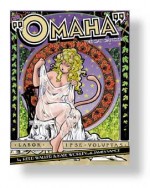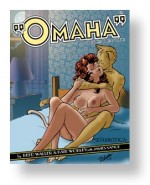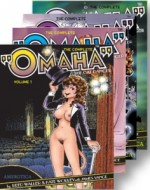
Omaha the Cat Dancer Complete Set (part 2)


By Reed Waller & Kate Worley with James M. Vance (NBM/Amerotic)
Set ISBN: 978-1-56163-601-3
Vol. 4 ISBN: 978-1-56163-451-4, vol. 5 ISBN: 978-1-56163-451-4, vol. 6 ISBN: 978-1-56163-451-4, vol. 7 ISBN: 978-1-56163-451-4

These books are intended to make adults laugh and think and occasionally feel frisky. If the cover images haven’t clued you in, please be warned that these items contain nudity, images of sexual intimacy – both hetero and homosexual – and language commonly used in the privacy of the bedroom and probably school playgrounds whenever supervising adults aren’t present.

If that sort of thing offends you, read no further and don’t buy these books. The rest of us will just enjoy one of the best graphic novel experiences ever created without you.

Omaha the Cat Dancer began during the 1970s as an “underground” venture and over slow torturous decades grew into a brilliant but controversial drama of human fallibility were all the actors just happened to be ordinary people with animal characteristics. What most people noticed was the matter-of-fact and constant inclusion of graphic sex acts, extremely well rendered.

As there’s only so much a man of my hard-lived years can endure and certainly only so much me you can stand, I’ve divides this graphic novels review of the series and specifically the glorious seven-volume complete set that prompted it in two (see yesterday’s post for the rest). The entire supremely economical shrink-wrapped gift set is available for your reading pleasure and you’d be bonkers not to not take advantage of the fact, but if you are of a cautious nature most individual editions can still be obtained through internet retailers.

The stunning, addictive saga of the erotic dancer, her bone-headed boyfriend and the anthropomorphic extended ensemble cast takes a dark and dreadful turn with Volume 4 (re-presenting the Kitchen Sink Omaha issues #10-13 and the one-page gag strip ‘Alterations’ from Fire Sale #11988-1989) as the mysterious death of Charles Tabey Sr., the increasing violence and oppression of the Campaign for Decency and a seemingly constant stream of personal revelations strain Omaha and Chuck’s relationship to the breaking point.

The Story resumes after an introduction from writer James Vance (who married Kate Worley after she split up with Waller and worked with the artist to finish the saga from her notes after her untimely death in 2004), before the tense drama kicks into high gear as Chuck comes to terms with the shocking knowledge that his mother didn’t die decades ago. The pressure seems to be affecting him badly – or perhaps the thought of all the wealth and responsibility – and the decent young man is becoming as exploitative, abusive and creepy as his manic dad was, but even though he’s acting paranoid, it doesn’t mean he’s hasn’t got real and deadly enemies. The situation isn’t helped by learning that somewhere his beloved Omaha has a husband she hasn’t quite divorced and never ever mentioned…

The sinister Senator Bonner is ratchetting up the pressure of his anti-smut campaign and even close ally Jerry is working to his own agenda, with the assistance of avaricious partner Althea. Confused, lonely and neglected, Omaha devotes her energies to dancing for the upcoming video for Shawn’s band, and Rob confronts Shelley whom he believes ordered the attempt on his life and torching of his studio…

At long last the will is read and Chuck does indeed inherit the bulk of his father’s holdings and, apparently, many of Tabey Sr.’s deranged obsessions. The far more intriguing than she appears Shelley acts on Rob’s misperceived accusations whilst her lover/carer Kurt Huddle finds part-time employment with the mysterious Mr. Lopez – the last major player in an increasingly complex game. Meanwhile high-powered call-girl, blackmailer and keeper of Secrets Joanne re-insinuates herself with Jerry and Chuck and Bonner in a terrifying confrontation threatens to destroy Omaha and Chuck in his own blackmail scheme…

During the video shoot Omaha and Joanne compare notes on Bonner, after which the capable call-girl enlists Rob’s photographic aid in a scheme to get the goods on the hypocritical Senator – with whom she shares a highly secret and extremely specialised professional relationship…

Whilst both Joanne and Rob are practising their unique skills the senator is murdered in the most compromising of all positions and the story moves effortlessly from human drama to dark murder mystery. Abandoned, bewildered, angry and very hurt, Omaha leaves town unaware that both she and Joanne are suspects in the Bonner murder case…

As she heads for a new life in rural Wisconsin, Chuck is learning some long-forgotten personal history from his mother, but no matter how she disguises her appearance that increasingly popular video means the cat dancer will never be truly safe or unseen…

Volume 5 is introduced by Neil Gaiman, after which issues #14-17 (1990-1992) find the lovers painfully adapting to life apart, with all of Omaha’s old friends wondering where she’s gone. Meanwhile in Lawrenceville, Wisconsin, after an abortive stab at office work for an all-too-typical, male-dominated factory, “Susan Johnson” goes back to honest work dancing in the town’s only strip joint, making some reliable new friends and meeting a young man who will become far more…

In Mipple City, Joanne and her lawyer finally clear her of suspicion in Bonner’s murder, Jerry is planning to reopen infamous bordello The Underground as a legitimate nightclub, and Chuck is making new friends and intimate acquaintances whilst spending his days trying to save the Bohemian A Block district from redevelopment, inadvertently getting far closer to the heart of all the various intrigues that threaten the players in the drama, and Jerry’s business partner Althea reveals her true colours and allies. At Senator Bonner’s funeral Lopez reveals an unsuspected connection to the venomous politician…

Shelley has made new friends too (in a scathing and utterly delightful episode exposing unexpected biases in certain sorts of feminists and do-gooders), Joanne is increasingly at odds with Rob regarding the films of Bonner’s last moments and when Jerry invites Chuck to become a partner in his new nightclub Althea tries to secure the deal by offering herself as sweetener… or does she actually have another reason for her bold advances?

Kurt and Shelley’s relationship begins to show signs of strain but in Lawrenceville “Susan” is relaxed and happy, with the strength to contact the friends she ran out on.

In Mipple, the cops are slowly uncovering some uncomfortable facts about everybody in the Bonner case when the Senator’s private secretary comes forward with new information, whilst Joanne is finally securing her final weapon necessary to expedite her plans…

The final Kitchen Sink issues (#18-20, 1993-1994) comprise the major part of the sixth volume, and follow an introduction from Terry Moore, a brief discourse on the cat dancer cast’s other appearances and a few shorts pieces from diverse places.

First there’s a delightful humorous foray into mainstream comics from Munden’s Bar Annual #2 in 1991. ‘A Strip in Time’, wherein the exotic kitty pops up in the legendary pan-dimensional hostelry, after which two short and sexy vignettes originally produced for The Erotic Art of Reed Waller , one untitled and the other graced with the subtly informative designation ‘Waking Up Under a Tent’, act to somewhat offset the angst and drama of the main event.

Rob learns what Shelley’s actual role was in the arson attack on his shop, Joanne takes a live-in position with Mr Lopez and after many abortive attempts Chuck and Omaha finally speak. As Thanksgiving dawns many of Omaha’s friends gather for a momentous dinner, things start to unravel for the bad-guys trying to destroy A Block and in Wisconsin, just as she is becoming reconciled with Chuck, the cat dancer’s fling with appreciative punter Jack intensifies to a crisis point. Meanwhile elsewhere, somebody with an intimate knowledge of her recognises the hot dancer in a rock video and begins making fevered inquiries…

When Shawn’s touring band reaches Lawrenceville and discover “Susie” is Omaha, the scene is set for her return to Mipple City, where, after being arrested in connection with Bonner’s murder, Chuck’s mother reveals the whole story of her past and the sordid truth of Calvin Bonner’s obsessive depravity and Charles Tabey’s bi-polar affliction. In light of the horrific revelations Chuck seems to go completely off the deep end and, far too late, his friends and family realise that money and looks might not be the only things the son inherited from the father…

Next, just a smidge out of chronological order, comes ‘Tales of Mipple City: Rob Steps Out’ a charming first date tale which first appeared in the anthology series Gay Comics #22 (1994) after which the tension and revelations resume as the cops release Maria Elandos Tabey, whilst her son is sectioned. In Lawrenceville, Susie gets an unforgettable farewell from Jack after which she returns to her true love who has never needed her more…

The final volume in this magnificent series features the last four issues published by Fantagraphics as Omaha the Cat Dancer volume 2, #1-4 (1994-1995). The series has at times seemed cursed: plagued by illness and creative problems which have taken its toll on all the creators. The creators ended their relationship in spectacular fashion at this time and only began working together again in 2002. Soon after Kate Worley died from cancer and it seemed the saga was destined to remain an unfinished masterpiece, but in 2006 Waller and Worley’s husband James Vance began to finish the job from her notes, with the concluding chapters serialised in the magazine Sizzle. When those final instalments are finally collected the completed Omaha the Cat Dancer will be possibly the finest adult comics tale in history…

For now however the brilliant yarn reaches a kind of conclusion here as after an introduction from honorary Mipple City resident Denis Kitchen, and a stunning cartoon recap Omaha and Chuck renew their relationship, Jerry and Shelley and Rob and Joanne reach workable détente agreements and that missing husband tracks the cat dancer to her new home. Set over the Christmas/New Year period, all the various plot threads come together during an unforgettable party at Chuck’s palatial new house, although the hung-over aftermath promises that there are still stories to be told and loose ends to be knotted off once and for all.

Even if the saga stopped here, Omaha the Cat Dancer would be an incredible narrative achievement and groundbreaking landmark of comics creation, but with the promise of a final resolution still to come, it looks set to become an icon of our industry, celebrated forever for moving beyond simple titillation and happy, innocent prurience to become a fully matured work of Art.

Captivating, intense, deeply moving and addictively engrossing, Omaha never forgets to be also be fun and fabulous and utterly inclusive: full of astonishingly well drawn, folk (admittedly largely furry or feathered folk) happily naked and joyously guilt – free… at least about sex…

No cats, dogs, birds or ferrets were harmed, abused, distressed or disagreeably surprised in the making of these lovely, lovely books, so if you’re open-minded, fun-loving and ready for the perfect grown-up adventure please take advantage of this unmissable opportunity. You won’t regret it….

© 1987-1996 Reed Waller & Kate Worley. Contents of these editions © 2005-2008 NBM. All Rights Reserved.

Omaha the Cat Dancer Complete Set (part I)


By Reed Waller & Kate Worley with James M. Vance (NBM/Amerotic)
Set ISBN: 978-1-56163-601-3
Vol. 1 ISBN: 978-1-56163-451-4, vol. 2 ISBN: 978-1-56163-457-3, vol. 3 ISBN: 978-1-56163-474-3

These books are intended to make adults laugh and think and occasionally feel frisky. If the cover images haven’t clued you in, please be warned that these items contain nudity, images of sexual intimacy – both hetero and homosexual – and language commonly used in the privacy of the bedroom and probably school playgrounds whenever supervising adults aren’t present.

If that sort of thing offends you, read no further and don’t buy these books. The rest of us will just enjoy one of the best graphic novel experiences ever created without you.

Omaha the Cat Dancer began during the 1970s as an “underground” venture and over the torturous decades grew into a brilliant but controversial drama of human fallibility with all the characters played by funny animals. What most people noticed was the matter-of-fact and constant inclusion of graphic sex acts.

The series was subject to many obscenity seizures by various muddle-headed stickybeaks over the years, inspiring the formation of the Comic Book Legal Defense Fund. One classic case apparently involved the local defenders of morality raiding a comics store because Omaha promoted Bestiality!

As there’s only so much excitement a man of my advanced years and proclivities can endure (and probably only so much me you can stand) I’ll be to reviewing these seven tomes in two batches rather than in totality but I will remind you each time that the whole saucy saga is available in a supremely economical shrink-wrapped gift set that you’d be crazy to not take advantage of.

After an introduction by late-coming co-scripter James Vance and Reed Waller’s original intro from the 1987 collected edition, The Complete Omaha the Cat Dancer volume 1 gathers the short story appearances from a number of Counter-culture Commix as well as some out-of-continuity infilling short pieces so readers can enjoy what can best be described as the official Directors Cut of the tale.

The wicked wonderment begins with the very first ‘Adventures of Omaha’ from Vootie in 1978. Vootie began in 1976 as a self-published fanzine founded by Reed Waller and like-minded artistic friends who bemoaned the loss of anthropomorphic comics – once a mainstay of US comicbooks.

When contributors also griped that there wasn’t much sex in comics either, Waller, taking inspiration from R. Crumb’s Fritz the Cat and responding to an intensification of local Blue Laws, created the evocative, erotic dancer and compared her free and easy life-style against a typical, un-elected, interfering know-it-all moral guardian busybody. Blue Laws are particularly odious anti-fun statutes – usually instigated by religious factions – designed to keep the Sabbath holy by dictating shop-opening hours and generally limit or ban adult entertainments like clubs and pubs, and their repressive use (in fact and fiction) became a major narrative engine for the series.

‘Why they Call Her Omaha’ introduces young stripper Susie Jensen who hits the metropolis of Mipple City, Minnesota (a thinly concealed Minneapolis) and signs up with a modelling agency where she meets fellow dancer Shelley Hine. Over lunch they bond and pick a better stage name for the gorgeous but naive newcomer, whilst ‘Kitten of the Month’ and ‘Omaha centrefold’ reveal the first glorious results of her managements efforts. No-holds barred sexual action returns in ‘Shelley and Omaha’ with the girls, now popular erotic dancers, meeting some guys who will play a big part in the unfolding drama to come.

In ‘Chuck and Omaha’, which officially heralded the beginning of scripter Kate Worley’s stunning contribution to the series, Jerry – one those aforementioned pick-up guys – introduces Omaha to Chuck Katt, a shy artist who will become the great love of the sexy kitty’s life. ‘Adventures of Omaha’ sees the budding relationship progress whilst ‘Tip of the Iceberg’ moves the grander story arc along when Mipple bans nipples in the opening shot of a political power-grab using Christian and Family-morality pressure groups as unwitting, if fervent, patsies…

Although it comprises less than 50 pages the preceding material took nearly fifteen years to produce. For years Omaha had no fixed abode; peripatetically wandering from magazine to Indie book and even guest-shots in the occasional mainstream publication. From Kitchen Sink’s Bizarre Sex #9-10 in 1981-2, a pastiche page in E-Man (in 1983 and included in volume 2), Dope Comix #5 (1984), she even starred in a story from Munden’s Bar Annual #2 in 1991. Often stalled for creative, not censorship, reasons Omaha finally won her own title in 1984 from SteelDragon Press, but vanished again until 1986 when Kitchen Sink Press finally took over publication. For further details I strongly advise checking the lovely official website at www.omahathecatdancer.com.

Volume 1 switches to high gear and addictive narrative mode with the 40 page ‘Omaha #0’: a single page recap followed by a powerfully compelling yarn wherein the forces of decency make life increasingly difficult for the adult entertainment industry. With stripper bars closing Omaha is recruited to dance for “The Underground”: an exclusive, ultra-secret, high-class bordello that caters to the darkest desires of America’s ultra-elite of: businessmen and politicians many of whom are actively leading the Decency campaign…

Shelley is involved too, recruiting contacts from her old profession for more hands-on roles. Meanwhile Chuck has reapplied for his old advertising job where his old girlfriend Joanne makes life uncomfortable. However she has other problems as powerful forces are drawing Omaha and Chuck into a far-reaching and sinister scheme…

On opening night all the elements for disaster converge as the “Movers and Shakers” get more debauchery than even they can handle: someone has doped the entire proceedings leading to a violent, destructive orgy and set up cameras to record the whole event for blackmail purposes. As they flee the club hitmen try to kill Chuck but shoot Shelley instead. Believing her dead, Omaha and Chuck run for their lives. Heading for Joanne’s house Chuck reveals that he is the son of Charles Tabey: monomaniacal millionaire businessman, undisputed ruler of Mipple City and the probable target of the assassination…

Narrowly escaping another murder attempt they find Tabey and Joanne are intimately involved and are horrified to find that the millionaire was behind the whole thing, intending to mould Chuck into the kind of son he needs. The man is also clearly raving mad…

The traumatised, terrified young lovers jump into their car and head for California in the short ‘Adventures of Omaha’ vignette and the first volume concludes with the contents of ‘Omaha #1‘ as they reach San Francisco tired, hungry and broke.

Grateful for the kindness of strangers, they soon discover Joanne waiting for them and find that Tabey is not their only persecutor. During a drunken three-way another hired killer almost ends them all…

From a well-intentioned, joyous celebration of open living free-loving modernity Omaha had evolved into a captivating adult soap opera and conspiracy thriller of mesmerising intensity and complexity…

Volume 2, with a reprinted introduction by Kate Worley, eases into the enticing adult entertainment with the aforementioned ‘Hotziss Twonkies’ parody from First Comics’ E-Man #5 before issues #2-5 enlarge the sinister saga. In the aftermath of their latest close shave, Chuck and Joanne antagonistically spar whilst the increasingly traumatised cat dancer wanders the streets of San Francisco. When she is abducted by Tabey, who is moving against all his old enemies, Chuck and Joanne fall into bed…

Meanwhile Jerry, who also works for Tabey, is busying sorting the fallout from the club riot and shooting. In a secluded palatial beach-house Omaha discovers that Chuck’s dad has been watching over them for some time and soon discovers another shocking secret….

Omaha was utterly groundbreaking in its mature treatment of gay and disabled relationships; offering the sound and common sense opinion that this is what all people think and do and after all, “it’s just sex”…

Paralysed but not deceased Shelley is also sequestered in the house. She is a long-term Tabey employee and slowly developing a relationship with her nurse Kurt Huddle, and the manic tycoon has convinced Omaha to stay and help care for her. Back in Frisco Chuck has rekindled his old relationship with Joanne, utterly unaware that she has the films and photos taken at the club on that terrible night.

Rob Shaw, gay photographer, enters the picture, as developer and guardian of the contentious materials and old friend of Joanne. Chuck misses Omaha and the tension leads to him splitting with Joanne and moving in with Rob. The cat dancer too is lonely and finds unsatisfactory solace with Jerry again, but when Tabey goes off his meds Jerry arranges for Chuck and Omaha to reunite, leading to a dreadful confrontation between father and long-estranged son, as an apparent result of which the millionaire takes his own life…

Together again at last, Omaha and Chuck comfort each other as the repercussions of Charles Tabey Sr.’s demise shake the country and the cast. The close-knit group endure loss, guilt and outrageous press scrutiny as the matter of inheritance crops up. Against his wishes, Chuck might be incredibly rich and saddled with unwanted responsibilities but there are some unspecified problems with the will.

The plots thicken when Joanne and Rob have a falling out and as all this is going on, back in Mipple City a powerful new threat makes his move. Senator Bonner was one of the patrons at the Underground that fateful night but now he’s making a move for total power, stirring up a wave of fundamentalist hatred and anti-smut indignation with his “Crusade for Decency”…

Volume 3 (covering issues #6-9 and with an introduction by Trina Robbins) follows the action back to Minnesota, but things are difficult for Chuck and Omaha who can’t seem to re-establish their earlier, innocent rapport. They go house-hunting, whilst in San Francisco Rob Shaw is visited by thugs after the photos of the riot at The Underground. His shop destroyed, the photographer narrowly escapes burning with it…

Mipple City’s Blue Laws are more draconian than ever. When Omaha and Shelley, who has moved into the ground floor of the Cat dancer’s new house, visit their old workplace the Kitty Korner, they discovers that the performers now have to dance behind plate glass – which makes tucking punter’s tips into g-strings really tricky…

When old friend Shawn turns up he tells Chuck and Omaha of the plan to redevelop A Block – that part of town where all the artists, musicians and strip clubs are. Something needs to be done to stop it – and now, Chuck might just be the richest, most influential degenerate in town…

As the lovers go furniture shopping Shelley and Kurt look for a suitable physical therapy clinic – preferably a non-religious, non-judgemental un-condescending one – and later whilst Omaha helps Shelley move in, Chuck and Jerry make plans to fight the destruction of A Block, but as ever, there is far more going on than the lovers can imagine…

Omaha wants to get back into dancing and as Chuck becomes increasingly mired in the running of his father’s many businesses, Kurt learns some of Shelley’s murky history and Joanne and Jerry compare notes and make plans.

Rob turns up in Mipple after more attempts on his life, convinced that he needs to find his attackers’ boss before his luck runs out and the book ends on a shocking note for Chuck when he discovers that long-dead mother isn’t…

All these volumes, printed in black and white and at 8½ inches by 11, much larger than the original comicbooks, also contain many full page illustrations (many from the delightful art-book The Erotic Art of Reed Waller). This saga is one of the turning points of comics history – a moment when we could all provably say “this is socially relevant, capital “A” Art” – as viable and important as the best play or film or symphony: don’t miss this opportunity to make the whole marvellous classic yours forever…

© 1978, 1981, 1982, 1984, 1985, 1986, 1987-1996 Reed Waller & Kate Worley. Contents of these editions © 2005-2007 NBM. All Rights Reserved

Celeb


By Charles Peattie, Mark Warren & Russell Taylor (Private Eye/Corgi)
ISBN: 0-552-13858-4

In terms of taste, as in so many other arenas, our modern world seems to be heading for Heck in a hand-basket, so  I thought I’d take the opportunity to cover a little lost gem of British cartooning delight that’s increasing re-relevant in these appalling days of fame campaigns and dodgy talent show democracy.

Celeb was a strip which ran in that evergreen gadfly Private Eye, beginning in May 1987, created by Mark Warren and the team of Charles Peattie and Russell Taylor (who were simultaneously crafting the abortive first iteration of greed-glorifying mini-classic Alex for Robert Maxwell’s short-lived London Daily News).

For years credited to the pseudonymous “Ligger”, the pithy and hilarious episodes followed the day to day life of Swinging Sixties survivor and disgracefully declining rock-legend Gary Bloke as he dealt with a changing world, thinning hair, parenthood and inexorable middle age.

These days with 24/7 reality shows, desperate celebrities enduring career-resuscitating humiliations in locked houses and jungle clearings and a host of other self-inflicted, double-edged B-list exposé freak-shows everywhere, the outrageous pronouncements and antics of Gary seem pretty tame but in the days before Ozzy Osbourne became more famous for parenting and not singing whilst footballers’ performance off the field took precedence over goals scored on it, the sozzled, crass, befuddled, and pitifully pompous cocky cockney-boy-made-good was the very epitome of affably acceptable, ego-bloated, publicity-seeking, self-aggrandizing, drug-fuelled idiocy.

Within this collection from 1991 the legendary “Man of the Peeple” distributes kernels of hard-won wisdom to the likes of Michael Parkinson, Terry Wogan, Clive James, Cilla Back, Ruby Wax, Barry Norman, Anne Diamond, Selena Scott, Michael Aspel and other interviewers of lesser longevity, tackles world poverty and the environment head-on (and eyes tight shut), learns how to cope with those new-fangled rock videos, adapts to the needs of his burgeoning family and, of course, consumes a phenomenal quantity of recreational pharmaceuticals…

Including a selection of interviews from the Sunday Times (October 1989), The Sun (Wednesday August 3rd 1988) and candid shots of Gary with Bob Geldof and George Michael at Live Aid, the collection concludes with the infamous days during which Gary was dead of an overdose and met both God and Elvis, plus the sordid truth behind his numerous brushes with the law, leading to his 18-month stretch At Her Majesty’s Pleasure and subsequent key role in a terrible prison riot for better conditions and macrobiotic food…

The heady cocktail of drink, sex, drugs, money, sport, music, adoration and always-forgiven crassness is perhaps the reason so many folks are seduced by celebrity. If you want to see another side to the fame-game and have a hearty laugh into the bargain Gary Bloke is your man…
© 1991 Peattie, Taylor & Warren. All Rights Reserved.

Little Ego


By Vittorio Giardino, translated by Jean-Jacques Surbeck (Catalan Communications)
ISBN: 978-1-56163-094-3

Born on Christmas Eve 1946, Italian electrician Vittorio Giardino changed careers at age 30 and began his true life’s work as one of the world’s most gifted graphic storytellers. Initially working for many European comics magazines, his first collection, Pax Romana, was released in 1978. There have been many more since.

Giardino has worked slowly but consistently on intriguing and complex characters such as detective Sam Pezzo, the cold-war hero Jonas Fink and diffident super-spy Max Fridman as well as general fiction tales, producing more than 35 albums to date.

In January 1984 Italian Popular Arts and nostalgic style magazine Glamour International featured an engaging ingénue in a sexually charged yet delightfully innocent homage to Winsor McKay’s immortal fantasy strip Little Nemo in Slumberland. Little Ego then graduated to in her own occasional series in Comic Art (July 1985 to November 1989) which was reprinted in this saucy little collection and Heavy Metal and Penthouse Comics.

As well as some of the most clean-lined and sublime narrative art produced in the last half century Giardino’s unique ability to inform and suggest with nuanced expression and gesture plus his scrupulous devotion to research and historical accuracy elevates his work far above the usual adults-only one-handed reading matter whilst his clearly heartfelt homage to a past master and lost age reveals a sly, dry sense of humour and deliciously whimsical bent. Whenever his frankly frustrated heroine dreams the world is full of wickedly animated flowers, an amorous crocodile in her bath, mischievously narcissistic mirror-images, persistent but extremely handy umbrellas and the double-edged problems of ultra efficient bust-enhancement creams.

As all the vignettes end with Ego wondering what her therapist will think, it’s clear that psychological “hot-button topics” played a big part in the strip’s make-up…

Eventually the two-page complete adventures gave way to longer and even continued escapades, beginning with an embarrassing public nudity dream – but one with a happy ending – followed by the introduction of dream companion Onis, whose bold and boisterous nature inevitably got her and Ego into lots of sticky scrapes and situations as they went on an extended dream-vacation through the labyrinths of erotic imagery and her suppressed subconscious…

With wing-walking, the exotic Middle-East, lost palaces, Bedouin encampments, Big City fashion houses, night clubs and the permanent promise of the enigmatic Green Sheik and his under-used and over zealous harem to tantalise and titillate Little Ego (and her readers) this is a book open-minded adults will yearn to own.

Lucky for one and all then that even though out of print this seductive slim tome is still readily available…
© 1989 Vittorio Giardino. English edition © 1989 Catalan Communications. All Rights Reserved.

Max


By Giovanetti (Macmillan, New York)
No ISBN

Pericle Luigi Giovanetti was a huge star in the cartoon firmament in the years following World War II and one look at his work will instantly show you why. Born in 1916 in Switzerland, this doyen of brilliant penmen launched his most famous character in Punch in April 1953 – from whence most of these scintillating escapades sprang (the remaining pieces are courtesy of Nebelspalter and Glamour).

Max is a small, round furry creature most likened to a hamster, whose wordless pantomimes were both cute and whimsical – as well as trenchantly self-deprecating. Don’t ask me how a beautifully rendered little puff-ball could stand for pride brought low and pomposity punctured, but he did. The weekly incidents were also blissfully free of mawkish sentimentality; a funny animal for adults and children.

Max was syndicated across the world, (known as Mr. Makkusu-san in Japan) numbering such diverse luminaries as Jason Robards and Charles Schulz as fans and even lending its image and cache to the British Navy and Swiss Air Force as mascot and figurehead.

There were four collections between 1954 and 1961: this one, Max Presents, Nothing But Max and the Penguin Max. Like these, two other collections, Beware of the Dog and Birds without Words, are also criminally out of print.

In this initial 96 page hardback the hairy hero happily demonstrates the challenges inherent in assorted musical instruments, ink-pens, all kind of cooking, drink, hats, hobbies and a host of other occupations and interests…

For all his trenchant ability to convey meaning and offer salutary warnings without uttering a sound, Max’s origins – and indeed species – was a subject of much dispute in the four corners of the globe until Clive King and Giovanetti revealed all in the magical children’s book Hamid of Aleppo, (written in 1958) which delightfully revealed the little wonder’s true origins, antecedents, taxonomy and species: Max is a Syrian Golden Hamster!

The sheer artistic virtuosity of Giovanetti is astounding to see and the fact that his work should be forgotten is a travesty and a crime. If you ever find a collection of his work do yourself the biggest favour of your life and grab it with both hands.

The internet is a wonderful thing. Just as it finally provided me with a book I’d been hunting out for decades it also revealed that I’d been a short-sighted idiot for not looking further afield – or indeed across the Channel.

A French edition was released in 2003 (ISBN-13: 978-2-21107-074-4) because our Gallic cousins have a far more informed opinion of comics and cartooning than us Anglos – and since all these glorious cartoons are wordless masterpieces that shouldn’t hinder anybody wishing to make the acquaintance of this magical superstar of yesteryear – and, hopefully tomorrow…
© 1954 Pericle Luigi Giovannetti. All Rights Reserved.

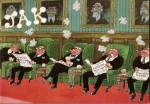
Jak volume 13 (1981)


By Jak (Express Newspapers)
ISBN: 0-85079-117-0

I reviewed one of Jak’s earliest collections a few years back and churlishly bemoaned the lack of contextual grounding, utterly forgetting that a brief time later the editors of the series began doing just that so here’s another bite of a superb cartoon cherry that’s still not impossible for the determined fan to find.

The truly sad if not terrifying thing about rereading topical news cartoons years if not decades later is how distressingly familiar the subjects and hot topics are.

For example this volume taken from 1981 features an impending Royal Wedding, bombings in Ireland, nuclear contamination, BP cocking up the planet, banking scandals, insane cuts in military spending, increased unemployment – especially for school and college leavers, brutal spending cuts, a chancellor who couldn’t add up (Geoffrey Howe back then), cynical disinformational bitching about overpaid Council and public sector workers plus a Tory government falling apart and attacking itself and its partners.

However, that time the Government saved itself by fighting a war with somebody thousands of miles away over oil, but there’s no chance of that happening aga…

Hey, wait a minute…

Even the quirky “silly season” stories seem afflicted by generational déjà vu then and now: ITV’s breakfast show was suffering a star-strapped meltdown, the space shuttle was big news (the first not last ever flight into orbit), Prince Andrew was embarrassing us in the eyes of the world, a major acting star went spectacularly off the rails and we were “all in it together” with even rich people cutting down on luxuries (slightly) and England had an appalling football team…

This compendium even closes with the threat of impending war in Libya…

Sometimes our industry is cruel and unjust. This collection of cartoons by Raymond Allen Jackson, who, as Jak, worked for thirty years as political cartoonist for London Evening Standard – renamed by this time as The Standard – is one of many that celebrated his creativity, perspicacity and acumen as he drew pictures and scored points with and among the entire range of British Society.

His gags, produced daily to a punishing deadline as they had to be topical, were appreciated, if not feared, by toffs and plebs alike and were created with a degree of craft and diligence second to none. Even now, decades later, they are still shining examples of wit and talent. Most of them are still scathingly funny too.

Artists like Jak who were commenting on contemporary events are poorly served by posterity. This particular volume (re-presenting a selection of single panel-gags from September 5th 1980 to October 19th 1981), like all of these books, was packaged and released for that year’s Christmas market, with the topics still fresh in people’s minds. Thirty years later – although the drawing is still superb – although the minutiae might escape a few – the trenchant wit, dry jabs and outraged passion which informed these pictorial puncture wounds is still powerfully present. And clearly human nature never changes…

It’s just a huge shame that the vast body of graphic excellence that news cartoonists produce has such a tenuous shelf-life. Perhaps some forward looking university with a mind to jazzing up their modern history or social studies curricula might want to step up and take charge of the tragically untapped and superbly polished catalogue of all our yesterdays…
© 1981 Express Newspapers Limited.

Heartburst – A Marvel Graphic Novel


By Rick Veitch (Marvel/King Hell Press)
ISBN: 0- 939766-82-5  King Hell edition ISBN: 978-0-98002-060-1

Once upon a time Marvel led the publishing pack in the development of high quality original graphic novels: mixing creator-owned properties, licensed assets like Conan, special in-continuity Marvel Universe tales and even new series launches in extravagant over-sized packages (a standard 285 x 220mm rather than the now customary 258 x 168mm based on the globally accepted European album format) which felt and looked instantly superior to the standard flimsy US comicbook no matter how good, bad or controversial the contents might be.

This terrifically appetising tale, developed under the company’s creator-owned Epic imprint in 1984, was one of the most experimental of those heady early days: a bold and impressive allegory of and attack on the assorted bigotries still too proudly cherished and even boasted of by so many in those distant days… in the 21st century we’re far less concerned with what you buy, pray to, look like or sleep with, aren’t we?

The drama begins with ‘Heartbeat’ as on a far-distant Earth colony circling Epsilon Bootis the theocratic authorities are in a state of constant crisis. In the centuries since humans first landed they have polarised into a closed, dogmatic and militaristic society, devoted to the worship of gods who regularly and actively communicate with them.

They have no truck with heretical Earth scientists like Miss Rimbaud whose explanation that the Holy Sponsor’s electronic teachings are merely old TV broadcasts. They don’t want to hear that those 1950s attitudes are discredited now. They absolutely won’t tolerate any hint of ending their campaign to sterilise and eradicate the native Ploo…

The indigenous natives are in dire distress: beautiful, friendly bright green beings, sexually and genetically compatible with humans and permanently emitting an aphrodisiac musk Terrans cannot resist. If the race is to be kept pure the Ploo simply cannot be allowed to survive…

Young Sunoco Firestone (most humans have good scriptural names like Pepsi, Schlitz or Bilko) is present when his uncle Inquisitor Xerox interrogates Rimbaud. Her story strikes a disturbing chord in the lad, already pushed to breaking point by recurring dreams of a magical well and a cosmic voice calling to him… When he sees a forbidden Ploo exotic dancer in a banned sector of town Sunoco is irresistibly drawn to her and the biologically inevitable happens…

Obsessed with his alien soul-mate Maia, shaken by his delirious fall into miscegenation and terrified because the Sacred Broadcasts have suddenly stopped, Sunoco snaps and abandons his life, joining Maia as a traveling entertainer, experiencing daily delight as the world rapidly goes to hell and beyond. But even though free, happy and proud; with Maia pregnant the dream voice won’t leave him alone, hinting at some incredible celestial destiny whilst the eternally vigilant gene-police are stepping up their pogroms and getting closer to the desperate fugitives…

With ‘Heartrhythm’ the forces of oppression close in and the lovers are separated as Sunoco is captured and the planet descends into outright civil war with the faithful eradicating the last Ploo and their turncoat human lovers. Broken and desperate Firestone agrees to become a spy for the human army, but when he meets the enigmatic Rimbaud he changes sides once more and finally discovers the secret of the voice and a fantastic universal power that will shape the destiny of two worlds in ‘Heartburst’…

Rick Veitch is a criminally undervalued creator, with a poet’s sensibilities and a disaffected Flower-Child’s perspectives informing a powerful social and creative consciousness and conscience. This spectacularly mind-bending romp synthesizes the total late 20th century American experience from the bland triumph of cultural imperialism to the spiritual disenfranchisement of Vietnam whilst telling an uplifting story of love and hope – a really neat trick if you can do it…

This sly, dry, funny, impressively adult and breathtakingly reflective full painted yarn proves that he can and Heartburst should be on the must read list of any serious fan…

In 2008 Veitch released a remastered, slightly smaller-dimensioned edition under his own King Hell Press imprint. Heartburst and Other Pleasures also includes three short graphic collaborations with those other outré  masters of unconventional love Alan Moore and Steve Bissette: including ‘Mirror of Love’, ‘Underpass’, ‘Try to Remember’ as well as unseen art-pages. This too is well worth  tracking down or you could simply order direct from the man himself by typing www.rickveitch.com into your favourite search-engine, remembering always to keep a credit card handy – preferably your own…
© 1984, 2008 Rick Veitch. All Rights Reserved.

Twilight of the Assholes: Cartoons and Essays


By Tim Kreider (Fantagraphics Books)
ISBN: 978-1-60699-398-9

This book is intended to make adults laugh and think. If the title isn’t clue enough, please be warned that these pages contain nudity, sexual imagery, intentionally insulting images of political figures and rational opinions clothed in harsh language and thought-provoking political comedy.

If that sort of thing offends you or you believe that blasphemy is a sin and/or a crime, read no further and don’t buy this book. The rest of us will just have to manage without you.

The early years of the 21st century were plagued with horrors and disasters exacerbated by a hideous global proliferation of lying, greedy, venal, demented and just plain stupid rulers and governments who finally elevated politicians to that phylum of useless tools and pimples on the butt of humanity once only occupied by lawyers.

Since then bankers, astrologers, wedding planners, doorstep evangelists, celebrity gossip columnists and all types of psychics have joined their rarefied ranks and I’m thinking I need to cut down on coffee or tighten my critical parameters…

When George Dubya Bush acceded to the throne of America there were a lot of apologetic liberals and whooping goons. There was also cartoonist Ted Kreider.

Born in 1967 and raised on comicbooks whilst actually paying attention in school, Kreider is an erudite and passionate man with thoughtfully reasoned opinions on politics, religion and the human condition among many other things. He is also an extremely gifted writer and cartoonist who began self publishing in 1994.

By 1997 The Baltimore City Paper had picked up his deliciously polemical panel strip-with-accompanying essay ‘The Pain – When Will it End?’ and they were closely followed by the Jackson Planet Weekly, Illinois’ Indy in Bloomington-Normal, The New York Press, The Stranger, Philadelphia Weekly plus other independent and alternative papers. In September 2000 Kreider began releasing the material as a webcomic.

Although a self-confessed left-leaning Democrat, that hasn’t ever stopped him punishing his own camp’s many gaffes, goofs, lies, embarrassments and ideological idiocies. Like our own Gerald Scarfe and Steve Bell with Margaret Thatcher, Kreider was lucky enough (if you discount elevated blood-pressure, maxed-out sense of disbelief and perpetually outraged moral compass) to have been given the gift of a perfect incumbent target in the Bush administration of 2000-2008 and the greater, right-wing anti-intellectual, Christian-fundamentalist crusade/pogrom that brought them to power.

Along the way Kreider also managed to incense other churches and faiths from Catholics to Moslems, all manner of bigot from racists to homophobes and outrage proponents of all those other aspects of modern US society that makes all us non-Americans nervous and giggly in equal measure.

Subtitled ‘Volume II of the Chronicles of the Era of Darkness 2004-2009’ this weighty and hilariously biting collection of gags and commentaries covers the – to Kreider especially – incomprehensible re-election and second term of the Republican Saviour and his dark apostles Cheney, Rumsfeld, Rove, Rice and the rest, whilst still finding room and Reasonable Cause to pictorially pummel Chinese expansion, assorted religions’ definitions of life and attitudes to sex, aspects and definitions of Freedom, geopolitics and Big Oil, Intelligent Design, the new Russian Empire, Secret Fantasies of the rich and statesmanlike, Crackpot Theories and all sorts of Science: from the author’s spirited defence of Pluto’s planet-hood to Human-Animal Hybrids, Parallel Universes and new roles for the Giant Squid…

With stunning examples of the cartoonist’s eternal roles as social conscience, intellectual champion, puncturer of pomposity and lampooning last bastion of grace under oppressive political pressure, Kreider boldly kicks the shins of the smug over-class and stamps on the toes of all the entrenched whited sepulchres and obnoxiously applied shibboleths that made him annoyed and ashamed of huge swathes of his fellow Americans. Not that Britain or any other colonial power has any moral high-ground to sneer down from…

The work covers the period November 4th 2004 to October 29th 2009 and includes the shocked rapture of a Democratic win and the nation’s first non-white president – and ends with a shaky dawning suspicion that all politicians might just be the same…

Particularly effective are ‘Jesus vs. Jeezus’, ‘The Conservative Christian’s Guide to Compassion’, ‘I “heart” Saddam’, ‘The War on Christmas’, ‘Americans vs. ‘Muricans’, ‘What is Freedom?’, ‘Me & George, We Got Problems’, ‘Silver Linings of the Holocaust’, ‘What You Can Do to Fight the War on Sex’, ‘Everything I Know I Learned from the Bush Administration’, ‘Secret Vices of the Liberals’, ‘Republican Sex Toys’, ‘God: Republican or Democrat?’, ‘After All the Money’s Gone’, ‘We Even Yet?’ and the 5-part ‘Contributions of the World’s Religions’ but there’s guaranteed to be something to shock  or offend everybody here – you might even be compelled to think for yourself and question a little bit more…

Excoriating, withering humour and viciously necessary satire tellingly rendered and savage yet personable and winningly intimate reportage make this one of the best cartoon coshes ever applied to the politics of this century.

His previous collections include The Pain – When Will It End? (2004) and Why Do They Kill Me? or: Scream, Honkey, Scream (2005), and I look forward to more from Kreider in the sorry certainty that people won’t get less stupid, rulers can’t change their spots and religions will never stop dictating what their followers can think or feel…

Cartoons and text © 2011 Tim Kreider. All rights reserved.

Will Eisner’s New York the Big City


By Will Eisner (Kitchen Sink Press)
ISBN: 0-87816-020-5  Hardcover: 0-87616-019-1

William Erwin Eisner was born in 1906, on March 6th in Brooklyn, and grew up in the ghettos of the city. They never left him. After time served inventing much of the visual semantics, semiotics and syllabary of the medium he dubbed “Sequential Art” in strips, comicbooks, newspaper premiums and instructional comics he then invented the mainstream graphic novel, bringing maturity, acceptability and public recognition to English language comics.

In 1978 a collection of four original short stories in comics form released in a single book, A Contract With God and Other Tenement Stories. All the tales centred around 55 Dropsie Avenue, a 1930’s Bronx tenement, housing poor Jewish and immigrant families. It changed the American perception of cartoon strips forever. Eisner wrote and drew a further 20 further masterpieces opening the door for all other comics creators to escape the funnybook and anodyne strip ghettos of superheroes, funny animals, juvenilia and “family-friendly” entertainment. At one stroke comics grew up.

Eisner was constantly pushing the boundaries of his craft, honing his skills not just on the legendary Spirit but with years of educational and promotional material. In A Contract With God he moved into unexplored territory with truly sophisticated, mature themes worthy of Steinbeck and F. Scott Fitzgerald, using pictorial fiction as documentary exploration of social experience.

Restlessly plundering his own childhood and love of human nature as well as his belief that environment was a major and active character in fiction, in the 1980s Eisner began redefining the building blocks unique to sequential narrative with a portmanteau series of brief vignettes that told stories and tested the expressive and informational limits of representational drawings on paper.

In New York the Big City he took nine themes pertaining to life in the Big Apple and pictorially extemporised combining drama, comedy, politics, adventure and fantasy: producing urban art-music from Blues to Punk, Soul to Ragtime and Gospel to sweet, hot Jazz – all with a pencil and brushes.

Many of these enticing, entrancing micro-plays are silent; but whenever necessary and apropos Eisner’s ear for idiom and inflection made miracles and his affection for the ambient sounds of the streets always underscores the harsh, happy and wholly immersive experience of living for The City.

Delivered in monochrome line and seductive grey wash tones the impressionistic voyage begins with The Treasure of Avenue ‘C’ which explores the all-encompassing maw that is a street grating with ‘The Ring’, ‘The Money’, ‘The Weapon’, ‘The Key’ and the connective punch-line ‘The Treasure’. ‘Stoops’ similarly examines the lives that pass before the ubiquitous front steps of tenements, beginning with ‘Witnesses’, ‘Supper Time’ and ‘Home’ before concluding with a description of ‘Stoopball’.

Each individual section is preceded by a moving and expressive tone-painting of the unmistakable cityscapes, and none more powerful than the view from an “El” train that introduces ‘Subways’. Included are ‘An Affair on the BMT Local’, ‘Theater’, ‘Art’, ‘Night Rider’, ‘Blackout’ and ‘The Last Man’. Wherever people congregate there is ‘Garbage’ and Eisner’s sly, witty but compulsively human commentary comprises a look at ‘Cans’, ‘Trash’, ‘The Source’ and ‘Waste’ whilst ‘Street Music’ more closely scrutinises the makers of the messes in ‘Love Song Fortissimo’, ‘Pianissimo’, ‘In Concert’, ‘Opera’, ‘Aria’, ‘Decibel’ and the hilarious ‘Rhythm’.

‘Sentinels’ tackles the monuments of street furniture with ‘Hydrant’, ‘Wayside’, ‘Fountainhead’, ‘Fire Alarm’, ‘Mailbox’, ‘Dead Letter’, ‘Last Minute Mail’, ‘Signal’, ‘Lamppost’, ‘Ringeleivio’, ‘Sewers’ and ‘The River’ whilst ‘Windows’ uncovers all the world’s secrets with ‘A View of Life’, ‘Crows Nest’, ‘Observer’, ‘Fire Exit’, ‘Privacy’, ‘Disposal’, ‘Peeper’, ‘Prisons’, ‘Worm’s Eye View’ and the powerfully evocative ‘Sermonette’.

‘Walls’ are everywhere and here they describe ‘Space’, define ‘Freedom’, delineate a ‘Maze’ and ‘Man’s Castle’, act as a ‘Bulletin Board’ and offer ‘Enclosure’ and ‘Escape’. Moreover ‘Walls Have Ears’, promote another kind of ‘Privacy’ and provide a unique ‘Backdrop’, before re-enacting ‘Jericho’ and becoming ultimately the ‘Last Frontier’.

In NYC everything revolves around ‘The Block’; it is ‘The Old Neighborhood’, home of the ‘Neighborhood Girl’ from ‘Our Block’ on ‘The Good Street’ where ‘Aliens’ get a particular welcome. Eventually though, the homeliest slum inevitably becomes a ‘High Rent District’ and even ‘The Belmont Avenue Gang’ has to yield to the inexorable force of ‘Gentrification’…

Eisner’s elegiac fascination with city life, deep empathy with all aspects of the human condition and instinctive grasp of storytelling produced here another magnificently mortal and compellingly mundane melodrama, moving and uplifting and funny and deeply, wistfully true.

You’ll laugh, you’ll cry, you’ll be amazed…

As ever the Medium is the Message, especially when the artefact is such a substantially solid tome delivering comics gold in beguiling, incisive black and white – and once again I’m smugging it up because my hardcover with tipped in illustrative plate has proved to have been well worth the initial investment as Will Eisner’s New York the Big City is a veritable cartoon touchstone of all that’s best about the art of cartooning.

Whether it’s your first or ten thousand and first time of reading, this is a tome every comics aficionado will treasure forever, so any edition you can get, you really, really must…

Art and story © 1981, 1982, 1983, 1986 Will Eisner. © 1986 Kitchen Sink Press. All Rights Reserved.

Salvatore volume 1: Transports of Love


By Nicolas de Crécy, colour by Ruby & Walter, translated by Joe Johnson (NBM)
ISBN: 978-1-56163-593-1

Salavatore is a car mechanic: an absolute wizard with all things mechanical but a grumpy sod who dislikes customers so much he built his garage on the peak of a mountain to discourage them. However he is just so good that they come anyway, prepared to put up with the grief and his attitude, if only he would fix their ailing vehicles… and besides, Salvatore has a secret he needs peace and quiet for…

Nicolas de Crécy has released more than thirty albums since he began working in 1990, both one-off books such as Journal d’un fantôme, Escales, Plaisir de myope and La Nuit du grand méchant loup and series/serials such as Léon la came, Monsieur Fruit and Salvatore; the first two of which comprise the artfully arch little romance under review here.

Salvatore is a dog with a lot of pain in his life but has struggled on, buoyed by his artisan’s dedication and sensibility which makes him such an exceedingly good mechanic. One day the tragically short-sighted widow Amandine pulls into his frosty, mountaintop garage with a suspicious knocking in her car engine and his life changes for ever.

As well as practically blind, Amandine is heavily pregnant with twelve piglets (not unknown for a sow of her breed) and something softens within the cold canine. Offering her the unexpected hospitality of his fondue lunch, Salvatore nevertheless succumbs to his one weakness – “borrowing” a surplus part from her vehicle for his great project.

The little dog has a dream and is prepared to sacrifice his principles to achieve it: he once loved and lost a bitch named Julie who moved to South America. Since then he has devoted all his spare time to building a fantastic vehicle to follow her and where undoubtedly, love will reunite them forever…

His super-car is almost ready: the last part necessary can be picked up on the way; all he has to do is reach an understanding with its current owner – a perfectly reasonable bull named Jerome.

Amadine however, has not quite left his life: a practically sightless, heavily pregnant lady should never be trusted to drive a small family runabout down a snow-capped mountain slope…

Her chaotic and magnificently slapstick journey leaves her and the car stranded many kilometres away atop a Parisian rooftop where she prematurely delivers her dozen babies. Horribly one little piggy goes missing on the way to hospital, and one fine day that stray waif will have a huge impact on Salvatore’s fate…

Originally released in 2005 as Transports Amoureux (beautifully coloured by Ruby) ‘Transports of Love’ seamlessly segues here into the second album, Le Grand Départ or ‘The Grand Departure’ with tints and hues provided this time by Walter.

Finally en route to his dream in the almost perfect Julie-Mobile Salvatore has hit a snag. Jerome might be an amenable type but the wife who just divorced him is not. She took the car – including that desperately needed final component – as part of the settlement and had it dismantled as an art installation – or possibly just out of spite.

Amadine meanwhile has broken out of hospital with her eleven piglets, driven by maternal hormones to find her missing baby. The lost cherub has fallen into odd circumstances, amongst sewer scum, political activists and a seductively dark and twisted catwoman siren of the underworld…

Hard-pressed by his defrayed desire for his distant Julie, Salvatore’s ethics have degenerated to the point where he is contemplating fraud and outright theft to get that vagrant last part: luckily he has allied himself with a mysterious and peculiarly moralistic tiny little mute man with a facility for computer science. Perhaps together they can find a way to ease true love’s path…

Surreal and joyously whimsical, but with a delightfully dark edginess, the multi-award winning cartoonist de Crécy has revolutionised French comics with such popular and groundbreaking works as Période glaciaire (released in English as Glacial Period) and this hypnotically addictive sophisticated fable is undoubtedly destined to be just as successful.

Funny, gently adventurous, subversively satirical and yet filled to bursting with empathy and pathos, this beguiling yarn will schmooze itself into your head and make itself too comfortable for you to remove…

© 2005 Dupuis, by de Crécy, Ruby. © 2006 Dupuis, by de Crécy, Walter. English edition © 2010 NBM. All rights reserved.