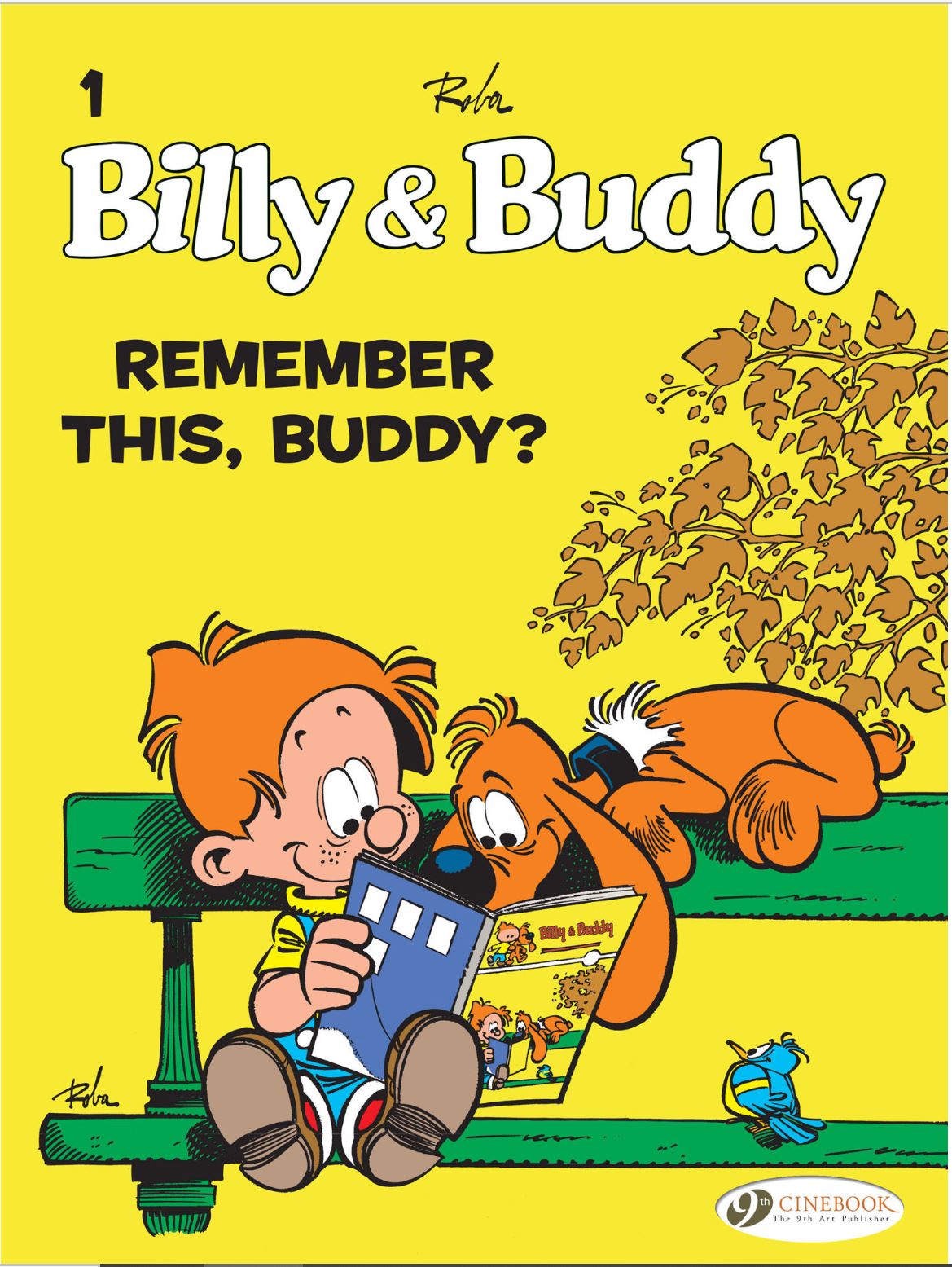
Billy & Buddy volume 1: Remember This, Buddy?


By Jean Roba, translated by Luke Spear (Cinebook)
ISBN: 978-1-905460-91-5 (Album PB/Digital edition)

Known as Boule et Bill on the Continent (in the French speaking bits – Dutch and Flemish folk call them Bollie en Billie), this evergreen, immensely popular cartoon story of a boy and his dog debuted in the Christmas 1959 edition of multinational anthology Le Journal de Spirou.

It came from Belgian writer-artist Jean Roba (Spirou et Fantasio, La Ribambelle, Gomer Goof) putting his head together with the magazine’s Artistic Director/Ideas Man Maurice Rosy – who had also ghosted art and/or scripts on Jerry Spring, Tif et Tondu, Bobo and Attila during a decades-long, astoundingly productive career with the legendary periodical.

Intended as a European answer to Charles Schulz’s Peanuts, Boule et Bill would quickly go its own way and carve out a unique personality all its own, becoming Rosa’s main occupation for the next 45 years.

He tirelessly crafted more than a thousand gag-strip pages of a beguiling idealised domestic comedy about a little lad and his rather clever Cocker Spaniel before – in 2003 – handing art-chores over to his long-term assistant Laurent Verron. The substitute subsequently took over writing too after Roba died in 2006.

Born in Schaerbeek, Belgium on July 28th 1930 Jean Roba grew up reading mostly US reprint strips. He was particularly partial to Rudolph Dirks and Harold H. Knerr’s Katzenjammer Kids. After the War, he began as a jobbing illustrator before adopting a loose, free-wheeling cartooning style known as the “Marcinelle School” and joining the Spirou crew.

He followed Uderzo on Sa majesté mon mari and perfected his comics craft under Franquin on Spirou et Fantasio before launching Boule et Bill in a mini-récit (32-page, half-sized freebie insert) in the December 24th 1959 LJdS. Like our own Dennis the Menace in The Beano, the strip was incredibly popular from the off and for 25 years held the coveted and prestigious back-cover spot. Older British fanboys might recognise the art as early episodes – retitled It’s a Dog’s Life – ran in Fleetway’s Valiant between 1961- 1965.

A cornerstone of European life, the strip has sparked a live-action movie, animated TV series, computer games, permanent art gallery exhibitions, sculptures and even postage stamps. Like some select immortal Belgian comics stars, Bollie en Billie have a commemorative plaque and a street named after them in Brussels…

Large format album editions began immediately, totalling 21 volumes throughout the 1960s and 1970s. These were completely redesigned and re-released in the 1980s, supplemented by a range of early reader books for the very young. Comics collections have been translated into fourteen languages and sold in excess of 25 million copies of the 32 albums to date.

Renamed Billy and Buddy, the strip debuted en Angleterre in Cinebook compilations from 2009 on: introducing a standard sitcom nuclear family consisting of one bemused and long-suffering father, a warm, compassionate but painfully ditzy mother, a smart son and his genius dog which has a penchant for finding bones, puddles and trouble…

The majority of this book – Tu te rappelles, Bill? – was the sixth original collection before being cut down and reissued as volume 17 in Europe, but here acts as an ideal vehicle to set up the characters and settings for our delight and delectation. Inside you’ll see a non-stop parade of quick-fire quips and jests as 7-year-old Billy enjoys carefree romps with 4-footed friend Buddy: digging up treasure on the beach, chasing cats, learning tricks to be useful around the house and generally baffling and annoying grown-ups.

Buddy is the perfect pet for an imaginative boy, although he’s overly fond of bones and rather protective of them. He also does not understand why everyone is so keen to constantly plunge him into foul-tasting soapy water, but it’s just a sacrifice he’s prepared to make to be with Billy.

Gently-paced and packed with wry wit and potent sentiment, these captivating vignettes range from heart-warming to hilarious: a delightful tribute to and argument for a child for every pet and vice versa. This is a solid, family-oriented collection of comics no one trying to introduce youngsters to the medium should be without.
Original edition © Studio Boule & Bill 2008 by Roba. English translation © 2009 Cinebook Ltd.

Cedric volume 3: What Got Into Him?


By Laudec & Cauvin with colours by Leonardo & translated by Erica Jeffrey (Cinebook)
ISBN: 978-1-84918-081-8 (Album PB/Digital edition)

Raoul Cauvin (26 September 1938-19 August 2021) was one of Europe’s most successful comics scripters. Born in Antoing, Belgium in 1938, by 1960 he was working in the animation department of publishing giant Dupuis after studying Lithography. Happily, he quickly discovered his true calling was writing funny stories and began a glittering, prolific career at Le Journal de Spirou.

With Salverius, he conceived the astounding successful Bluecoats, and dozens more award-winning series like Sammy, Cupidon, Les Femmes en Blanc, Pauvre, Lampil Boulouloum et Guiliguili, and Agent 212: cumulatively comprising well over 240 separate albums.

His collaborator on superbly witty kid-friendly family strip Cédric was Italian-born, Belgium-raised Tony de Luca, who studied electro-mechanics and toiled as an industrial draughtsman before making his own break into bandes dessinée.

Following fanzine efforts in the late 1970s as “Laudec”, he landed soap-style strip Les Contes de Cure-la-Flute at Le Journal de Spirou in 1979. He traded that for a brace of war-time serials (L’an 40 in 1983 and March Noir et Bottes à Clous in 1985) whilst working his way around the comic’s other strips. In 1987, he joined Cauvin on the first Cédric shorts. From then on it was child’s play…

We have Dennis the Menace (the Americans have their own too, but he’s not the same) whilst the French-speaking world has Cédric: an adorable, lovesick rapscallion with a heart of gold and an irresistible penchant for mischief. He’s also afflicted with raging amour…

Collected albums – 34 thus far – of variable-length strips (ranging from a ½ page to half a dozen) began appearing in 1989, and the lad remains amongst the most popular and best-selling in Europe, as is the animated TV show spun off from the strip.

… A little Word to the Wise: this is not a strip afraid to suspend silly yoks in deference to a little suspense or even near-heartbreak. The bonny boy is crushingly smitten with Chen: a Chinese girl newly arrived in class and so very far out of his league, leading to frequent and painful confrontations and miscommunications.

Harking back to 2011 and first continentally released in 1992 as Cédric 5: Quelle mouche le pique? – this third Cinebook translation opens with ‘A Pebble in the Shoe’: a moving and uplifting generational collaboration as Grandpa tells his daughter’s son stories of a dearly-departed wife that has the eavesdropping household (and you, too, if you have any shred of heart or soul) in emotional tatters…

We return to big laughs as a dose of unwelcome homework results in ‘A Big Fat Zero’ whilst ‘A Lousy Story’ details the pros and cons of a school nit epidemic before pester power is deployed to secure an addition to the household in ‘Man’s Best Friend’.

The crusty elder statesman of the family learns a painful lesson as ‘Grandpa Takes a Turn’ sees the creaky reactionary suckered into chaperoning a school dance, after which little Cedric has a beguiling and potentially life-altering experience when his adored Chen marches through town in the uniform of ‘The Majorettes’

Grandpa and Cedric unite to shame Dad into purchasing ‘The Board that Skates’ but it’s every man for himself when the kid comes cadging cash in ‘You Wouldn’t Have a 20?’, whilst ‘Out of Sight, Out of Mind’ playfully shows that although the boy’s love for Chen is all-abiding and true, it isn’t necessarily reciprocated…

When Chen’s mother accidentally prangs Dad’s car, Cedric goes violently berserk until the families have demonstrably agreed détente and rapprochement is reached via ‘An Amicable Arrangement’  before the pesky pup accidentally boosts his hard-pressed papa’s earning potential through inadvertent confidence trickery in ‘Business is Business’.

‘Jealousy’ rears its ugly head when Chen begins ballet classes and literally jumps into the arms of Cedric’s bitterly despised romantic rival The Right Honourable Alphonse Andre Jones-Tarrington-Dupree – with catastrophic repercussions for all concerned – whilst ‘Short of Breath’ sees the whole family play a mean but hilarious trick involving Dad’s birthday cake…

‘Solemn Communion’ wastes a much-needed opportunity to salve Cedric’s already-tarnished soul when the boy’s first Catholic sacrament ceremony devolves into a drunken debacle for the attending adults, after which we come full circle as amorous memories are tickled and ‘The Quarrel’ resumes after Cedric inquires how Mum and Dad got together. Happily, everything returns to bittersweet tears when the old man is asked for more reminiscences of Grandma Germaine in moving finale ‘Remember, Gramps…’

Rapid-paced, warmly witty, and not afraid to explore sentiment or loss, the exploits of this painfully keen, bemusingly besotted rascal are a charming example of how all little boys are just the same and infinitely unique. Cedric is a superb family strip perfect for youngsters and old folk alike…
© Dupuis 1992 by Cauvin & Laudec. All rights reserved. English translation © 2011 Cinebook Ltd.

Man I Hate Cursive – Cartoons for People and Advanced Bears


By Jim Benton (Andrews McMeel)
ISBN: 978-1-4494-7889-6 (PB) eISBN: 978-1-4494-8414-9

I love cartoons. Not animated films, but short, visual (although most often text-enhanced) stylised drawings which tell a story or potently and pithily express a mood or tone. In fact most people do. That’s why historians and sociologists use them as barometers of a defined time or era.

For nearly 200 years gag-panels and cartoon strips were the universal medium to disseminate wit, satire, mirth, criticism and cultural exchange. Sadly, after centuries of pre-eminence and ferocious power, these days the cartoon has been all but erased from printed newspapers – as indeed the physical publications themselves have dwindled in shops and on shelves.

However, thanks to the same internet which is killing print media, many graphic gagsters and drawing dramatists have enjoyed resurgence in an arena that doesn’t begrudge the space necessary to deliver a cartoon in all its fulsome glory…

Cartooning remains an unmissable daily joy to a vast global readership whose requirements are quite different from those of hard-core, dedicated comic fans, or even that ever-growing base of intrigued browsers just starting to dip their toes in the sequential narrative pool.

Even those stuck-up holdouts proudly boasting they have “never read a comic” certainly enjoy strips or panels: a golden bounty of ephemeral amusement demanding no commitment other than a moment’s close attention. Truth be told, it’s probably in our genes…

And because that’s the contrary nature of things, those gags now get collected in spiffy collections like this one, intended to be enjoyed over and over again like a beloved favourite song…

Jim Benton began his illustration work making up crazy characters in a T-Shirt shop and designing greetings cards. Born in 1960, he’d grown up in Birmingham, Michigan before studying Fine Arts at Western Michigan University.

Now tirelessly earning a living exercising his creativity, he started self-promoting those weird funny things he’d dreamed up and was soon raking in the dosh from properties such as Dear Dumb Diary, Dog of Glee, Franny K. Stein, Just Jimmy, Just Plain Mean, Sweetypuss, The Misters, Meany Doodles, Vampy Doodles, Kissy Doodles, jOkObo and It’s Happy Bunny in a variety of magazines and other venues. Latterly, he made a move into more conventional but no less entertaining delights. You should especially seek out Attack of the stuff and Fann Club: Batman Squad

His gags, jests and japes are delivered in a huge variety of styles and manners: each perfectly in accord with whatever sick, sweet, clever, sentimental, whimsical or just plain strange content each idea demands. This particular collection is from 2016 but is still fresh, strange and irreverent enough to have you clutching your sides in approved cartoon manner…

Here you will explore the innocently horrific inner world of children and monsters, learn to appreciate anew the contributions to society of teachers and experience Benton’s satirical side as bigots and racists are convicted out of their own mouths.

There are heaping helpings of animal antics – both wryly sardonic and barbarously slapstick – and wicked observations on the dating scene, plus true love pictured in all its infamy, how robots need a little tenderness too as well as the inside track on what it means to be Death…

You’ll see some of the strangest and most disquietingly surreal gags ever penned – such as the dysfunctional band made of animate body parts or the bizarrely extrovert characters comprising ‘The Sideshow’ – and even a truly unique take on historical personages and superheroes of the screen and comics pages…

As ever, there are trenchant swipes at the worlds of Art and Big Business as well as incisive explorations of the relationship between us and our pets, the perils of inventing stuff and a pants-wetting selection debating the downsides of air travel…

And best of all, the artist sets aside time and space to share with us God’s Plan and proves that the Almighty’s sense of humour is both wicked and petty…

You might discover Not-Facts that will change your life after gleaning Benton’s take on loneliness, fast food, binge eating, farting, periods, disabilities, growing up, Big Pharma, and the business of medicine in single page giggle-bombs ranging from strident solo panels to extended strips; silent shockers to poetically florid and verbose tracts.

There are also some jokes about bears…

Another uproarious compilation to make the sourest persimmon laugh as sweetly as pie (there are no joke about pies in this volume)…
© 2016 Jim Benton. All rights reserved.

Ducoboo volume 2: In the Corner!


By Godi & Zidrou, coloured by Véronique Grobet & translated by Luke Spear (Cinebook)
ISBN: 978-1-905460-26-7 (Album PB/Digital edition)

School stories and strips of every tone about juvenile fools, devils and rebels are a lynchpin of modern western entertainment and an even larger staple of Japanese comics – where the scenario has spawned its own wild and vibrant subgenres. However, would Dennis the Menace (ours and theirs), Komi Can’t Communicate, Winker Watson, Don’t Toy with Me, Miss Nagatoro, Power Pack, Cédric or any of the rest be improved or just different if they were created by former teachers rather than ex-kids or current parents?

It’s no surprise the form is evergreen: schooling (and tragically, sometimes, a lack of it) takes up a huge amount of children’s attention no matter how impoverished or privileged they are, and their fictions will naturally address their issues and interests. It’s fascinating to see just how much school stories revolve around humour, but always with huge helpings of drama, terror, romance and an occasional dash of action…

One of the most popular European strips employing those eternal but basic themes and methodology began in the last fraction of the 20th century, courtesy of scripter Zidrou (Benoît Drousie) and illustrator Godi.

Drousie is Belgian, born in 1962 and for six years a school teacher prior to changing careers in 1990 to write comics like those he probably used to confiscate in class. Other mainstream successes in a range of genres include Petit Dagobert, Scott Zombi, La Ribambelle, Le Montreur d’histoires, African Trilogy, Shi, Léonardo, a superb revival of Ric Hochet, and many more. However, his most celebrated and beloved stories are the Les Beaux Étés sequence (digitally available in English as Glorious Summers) and 2010’s Lydie, both illustrated by Spanish artist Jordi Lafebre.

Zidrou began his comics career with what he knew best: stories about and for kids, including Crannibales, Tamara, Margot et Oscar Pluche and, most significantly, a feature about a (and please forgive the charged term) school dunce: L’Elève Ducobu

Godi is a Belgian National Treasure, born Bernard Godisiabois in Etterbeek in December 1951. After studying Plastic Arts at the Institut Saint-Luc in Brussels he became an assistant to comics legend Eddy Paape in 1970, working on the strip Tommy Banco for Le Journal de Tintin whilst freelancing as an illustrator for numerous comics and magazines. He became a Tintin regular three years later, primarily limning C. Blareau’s Comte Lombardi, but also working on gag strip Red Rétro by Vicq, with whom he also produced Cap’tain Anblus McManus and Le Triangle des Bermudes for Le Journal de Spirou in the early 1980s. He also soloed on Diogène Terrier (1981-1983) for Casterman.

Godi then moved into advertising cartoons and television, cocreating with Nic Broca the animated TV series Ovide. He only returned to comics in 1991, collaborating with newcomer Zidrou on L’Elève Ducobu for magazine Tremplin. The strip launched in September 1992 before transferring to Le Journal de Mickey, and collected albums began in 1997 – 27 so far in French and Dutch, with separate editions for Turkish and Indonesian readers.

When not immortalising modern school days for future generations, Godi latterly diversified, co-creating (1995 with Zidrou) comedy feature Suivez le Guide and game page Démon du Jeu with scripter Janssens.

The series has spawned a live action movie franchise and a dozen pocket books plus all the usual attendant merchandise paraphernalia. English-speakers’ introduction to the series (5 volumes thus far) came courtesy of Cinebook with 2006’s initial release King of the Dunces which was in fact the 5th European collection L’élève Ducobu – Le roi des cancres.

The unbeatable format is loads of short – most often single page – gag strips just like you’d see in The Beano, featuring a revolving cast who are all well established by this point, but also fairly one-dimensional and easy to get a handle on.

Our star is a well-meaning, good natured but terminally lazy young oaf who doesn’t get on with school. He’s sharp, inventive, imaginative, inquisitive, personable and just not academical at all. We might today put him on a spectrum or diagnose a disorder like ADHD, but at heart he’s just not interested and can always find better – or at least more interesting – things to do…

Dad is a civil servant and Mum left home when Ducoboo was a baby, but then there’s a lot of that about. Leonie Gratin – from whom he constantly copies answers to the interminable tests – only has a mum. As this collection shows the seniors do not get on when it comes to matters of child-rearing, and Madame Gratin believes that stupidity is hereditary and passed on through the male line…

Ducoboo and his class colleagues attend Saint Potache School and are mostly taught and tested by ferocious, impatient, mushroom-mad Mr Latouche. He’s something of humourless martinet, and thanks to him, Ducoboo has spent so much time in the corner with a dunce cap on his head that he’s struck up a friendship with the biology skeleton. He (she? they) answers to Neness and is always ready with a theory or suggestion for fun and frolics…

As L’élève Ducobu – Au Coin! this volume was first released in 1998: the second riotous compilation which begins with the start of a new term and traces a year in the life of all concerned. On view are always relevant riffs on being late and missing class; roll calls and registers; times tales and dictation woes; imaginative ways for Ducoboo to copy answers; writing lines and ways to hack the system; the ultimate futility of bad boys actually working and still being called a cheat and always, always cheating, copying and guessing answers…

Escape – either physically or via various dreams and daydreams – is mixed with actual and frequently surreal human interactions like Leonie bringing ferocious hound Growler to class to guard her test answers or even entombing herself in a concrete blockhouse during exams to keep the arch copier at bay in weekly single instalments. These are counterpoised by extended sequences.

One such is inspired by the boy’s greatest wish come true: contracting an illness that keeps him at home and bedbound. The fool has developed Acute Duncitis, but his sweet relief is short lived as Latouche and gloating Leonie delight in bringing work and punishment assignments home for him to not do…

Christmas comes and goes as do the first snowfalls before another extended run of gags focussing on the class and its weedy teacher enduring mass swimming lessons, where – amidst the usual hijinks and low comedy – a little romance is forestalled by our idiot getting between Latouche and burly, buxom lifeguard Miss Katherina

Just like your educational memories, days and daftness rapidly pass and as the holidays unleash the youngsters the teachers confront the prospect of weeks of idleness with typical stoic ingenuity…

Wry, witty and whimsical whilst deftly recycling constant and adored childhood themes, Ducuboo is an up-tempo, upbeat addition to the genre every parent or pupil can appreciate and enjoy. If your kids aren’t back from school quite yet, why not anticipate keeping them occupied when that happens with In the Corner! and thank your lucky stars that there are kids far more demanding than yours…?
© Les Editions du Lombard (Dargaud- Lombard) 1998 by Godi & Zidrou. English translation © 2007 Cinebook Ltd.

Spinning


By Tillie Walden (SelfMadeHero)
ISBN: 978-1-62672-772-4 (HB/Digital edition)

Transitions are important. In fact, they are literally life changing. Here’s another one captured and shared by the amazing Tillie Walden…

We usually attribute wisdom and maturity in the creative arts to having lived a bit of life and getting some emotional grit in our wheels and sand in our faces, but that’s not the case for Texas-raised Tillie, whose incredible canon includes I Love this Part, On a Sunbeam, Are You Listening? and Clementine, not to mention award-winning debut graphic novel The End of Summer and the revelatory biography we’re discussing here today.

If you’re a completist, you’ll also want her picture book My Parents Won’t Stop Talking (created with Emma Hunsinger) and even her Cosmic Slumber Tarot set.

You don’t need a mask to have an origin story, and it’s a rare person – or perhaps indicative of self-deception or mental illness – who never ponders who they are or how they got to right here, right now. It’s a process that’s infinitely rewarding for creators and their readers. Spinning is a perfect example of an extremely talented person taking a basic human drive, exploiting it and turning it into magic. It’s a very personal origin story, which may have great relevance and meaning for many seeing it – and it’s got costumes too…

As previously stated, Walden has created a bunch of books and they mostly have little bios that say that she’s from Austin, Texas, as if that’s some kind of warning or character reference. Later ones say that she lives in Vermont with her wife and two cats and teaches at the Center for Cartoon Studies. So how did that happen?

Intimate and revelatory, some of the story is here: concentrating on her middle school years, back when she was a competitive ice skater.

There’s something worrisome and uncomfortable about the kind of family that allows – or worse, pushes – a child into a punishing regime of intense training in pursuit of sporting (or any other kind of excellence with a monetary benefit attached). I’ve heard all the arguments for and frankly, I don’t care. I was in a choir from age 5 to the end of secondary school, and I know just when it stopped being fun and became a burden…

Tillie back then was a kid who had to get up hours before school, travelling mostly on her own to isolated rinks and push relentlessly just to be one of the few seeking to excel at figure and synchronised skating. There were countless hours of sleep deficit, cruelly screaming or smotheringly solicitous coaches, equally exhausted and brittle girls just as reluctant to be there and always perishing cold. And that’s only how each day started.

… And then the family abruptly upped sticks from New Jersey to resettle in Austin, Texas…

The next few years are revisited with punishing candour and beguiling charm, employing the conceit of specific moves in a skating program as indicators/chapter headings. We open with ‘Waltz Jump’, covering her East Coast life and cross-country transition to a whole new world as soon as 5th grade classes ended…

‘Scratch Spin’ sees scorching August heat as the new kid meets teammates and/or rivals Michaela, Jennifer, Rosalind, Dasha and Little Dasha: as Tillie quickly learns that nothing she knew before applies here. At least coach Caitlin seems supportive and not another screaming harpy…

To supplement the misery, boost her grades and ostensibly offset bullying, Tillie is enrolled in a private girls’ school and sent for private cello lessons, proving her parents knew nothing about girls or school. Even skating has changed. Now she must attend two different rinks at separate times of day, constantly test to qualify and of course, endure more new friends… and otherwise.

Although Carly, Trinity, Sarah and the rest are all nice enough, it somehow only reinforces Tillie’s feelings of isolation and discomfort…

‘Flip Jump’ features first crushes, new bestie Lindsay, scary moments with adored brother John and a creepy old guy, with Miss Walden triumphantly rejoining the traveling competition circuit, and ‘Axel’ celebrates her turning 12 and become bogged down in all the complex social interactions she just doesn’t understand but which increasingly obsess her class and teammates. There’s also a bitterly regretted missed chance to confront the bully who made her life hell for a year…

Increasingly aware that skating is now a chore not a choice, Tillie begins to ‘Spiral’ after a near fatal accident she refuses to tell anyone about, but which has lasting repercussions. There’s a life changing moment when she realises how much she enjoys drawing and how good she is at it, and a far happier discovery: classmate Rae likes her every bit as much as Tillie likes her – and in just the same way.

‘Spread Eagle’ sees that critical first love brutally end when her girlfriend’s parents find out and take preventative action: something Tillie would have far preferred to the understanding talk her own mother forces upon her, and which leads to the skater coming out to anyone who cares to listen…

As art grows to consume her, skating declines as an interest but paradoxically boosts her ability to win. Nevertheless, a crisis inevitably approaches and ‘Counter’ focuses on her at age 16, simultaneously seeking to bolster her skate ranking and planning on leaving Texas as soon as possible. SATs loomed large on everyone’s horizon and Tillie has to endure extra tutoring despite having no intention of going to college. The arrangement almost makes her another crime statistic, but the real result of her narrow escape is realisation that her entire life is all about being tested and narrowly passing or surviving…

Floating days go by in a non-involved haze, before she eventually wakes up and takes charge. ‘Lutz’ addresses all her biggest challenges coming at once, yet another near-death experience, a life-altering unburdening and a decision at last made, leading into the liberating whirl of ‘Twizzle’ to free herself from twelve years a slave to other people’s wishes and the beginning of her own life…

That’s further addressed in the biographical Author’s Note that closes this magnificent and moving memoir. I said earlier that this was a part of Tillie Walden’s story: for more – as much as she’s willing to share – you’ll need to read her other books, both the biographical and fully fictional ones. Get them, read them, tell a friend.
© 2017 Tillie Walden. All rights reserved.

Lion Annual 1954


By Frank S. Pepper, Ron Forbes, Edwin Dale, Ted Cowan, Vernon Crick, & many & various (Amalgamated Press)
No ISBN: Digital edition

The 1950s ushered in a revolution in British comics. With wartime restrictions on printing and paper lifted, a steady stream of new titles emerged from many companies and when The Eagle launched from the Hulton Press in April 1950, the very idea of what weeklies could be altered forever. That kind of oversized prestige package with photogravure colour was exorbitantly expensive however, and when London-based publishing powerhouse Amalgamated Press retaliated with their own equivalent, it was an understandably more economical affair.

I’m assuming they only waited so long before the first issue of Lion launched (cover-dated February 23rd 1952) to see if their flashy rival periodical was going to last. Lion – just like The Eagle – was a mix of prose stories, features and comic strips and even offered its own cover-featured space-farer in Captain Condor – Space Ship Pilot.

Initially edited by Reg Eves, the title ran for 1156 weekly issues until 18th May 1974 when it merged with sister-title Valiant. Along the way, in the approved manner of British comics which subsumed weaker-selling titles to keep popular strips going, Lion absorbed Sun (in 1959) and Champion (1966) before going on to swallow The Eagle in April 1969 before merging with Thunder in 1971. In its capacity as one of the country’s most popular and enduring adventure comics, the last vestiges of Lion finally vanished in 1976 when Valiant was amalgamated with Battle Picture Weekly.

Despite its demise in the mid-70s, there were 30 Lion Annuals between 1953 and 1982, all targeting the lucrative Christmas market, combining a broad variety of original strips with topical and historical prose adventures; sports, science and general interest features; short humour strips and – increasingly in the 1970s – reformatted reprints from IPC/Fleetway’s vast back catalogue.

That’s certainly not the case with this particular item. Forward-dated 1954, but actually published in late 1953, it’s the first counterstrike from AP in the war to own Christmas: a delicious – but occasionally ethno-socially and culturally dated and dubious – dose of traditional comics entertainment. Big on variety, sturdily produced in a starkly potent monochrome, it offers a wide mixed bag of treats to beguile boisterous boys in a rapidly-changing world. What’s especially satisfying is that, current sensibilities notwithstanding, this volume has been digitised and can be bought and read electronically by kids of all vintages today…

I’m sure I don’t need to remind you that these entertainments were produced in good faith with the best of intentions by creators in a culture and at a time very different from ours. Very frequently attitudes and expressions are employed which we now find a little upsetting, but this book is actually one of the better examples of racial, gender and cultural tolerance. Still, even so…

The cornucopia of prose, puzzles, strips and features (all illustrated by artists as photography was too expensive) opens with a rather disturbing but truly lovely painted frontispiece ‘The Redskin Accepts the Challenge’ before a contents page promises astounding wonders to come.

We then rocket into adventure in the future where freedom fighter Captain Condor – by Frank S. Pepper and probably illustrated by original artist Ron Forbes – continues his war against despots running the solar system by solving ‘The Mystery of the Vanished Space-Ship!’ Edwin Dale then provides a prose thriller starring troubleshooter Mr. X, who discovers ‘The Tree that Stopped a Rebellion’ as he traverses the fabled African Veldt…

Presumably scripted by Ted Cowan & illustrated by Barry (R. G. Thomas) Nelson, ‘Sandy Dean’s Prize Guy’ is a comic strip wherein the schoolboy paragon and his chums deal with cheating classmates sabotaging and stealing effigies built to celebrate Guy Fawkes Night. It’s followed by Nigel Dawn’s prose thriller ‘Too Smart for the Atom Spy!’ wherein a schoolboy pigeon fancier foils a cunning espionage plot, after which we segue into a historical action strip credited to George Forrest (Cowan again).

‘The Slaves who Saved the Emperor’ follows two recently escaped British warriors who foil an imperial Roman assassination and is counterbalanced by Tom Stirling’s (E. L. Rosman) humorous text tale ‘Only a Press-Button Champ!’ This sees inventor’s nephew Jingo Jones stir up tons of trouble using his “Invisibliser” to save himself from a bully. Sadly, it also gives his headmaster and a boxing promoter the idea that the skinny runt is a fighting marvel…

‘The Weird Ways of Witch-Doctors Beat the Bush-Rangers’ (possibly by John Donnelly Jr.) shares amazing “facts” about jobbing mages in the post-war world after which John Barnes -AKA Peter O’Donnell – tells prose tale of ‘Chalu the Elephant Boy’ who clears his beloved four-legged co-worker Tooska when the big beast is framed as a murderous rogue animal…

Rex King (A.W. Henderson) delivers comic strip cowboy thrills as cavalry scout exposes a traitor and battles ‘Peril on the Tomahawk Trail’ before ‘Wiz and Lofty – Rescuers of the Kidnapped King’ (by E.L. Rosman as Victor Norman) delivers text thrills and spills as the globetrotting speed merchants stumble into a deadly plot to usurp a kingdom…

Harry Hollinson D.F.C. details and depicts some soon to be commonplace future wonders in speculative feature ‘Scientists Land on the Moon’ after which we pop back to WWII where Edward R. Home-Gall (AKA Edwin Dale) reveals in cartoon form how ‘The Lone Commandos’ scupper hidden Nazi artillery and save British soldiers in ‘Operation Gunfire’ before Vernon Crick shows in prose that ‘Rust’s the Boy for Stunts’: a rousing tale of motorcycle mayhem and skulduggery at a circus’ Wall of Death ride…

A pictorial ‘World-Wide Quiz’ tests your general knowledge before Peter O’Donnell – as Derek Knight – delivers a chilling prose vignette of Arctic endeavour as ‘Tulak Hunts the Polar Terror’, saving lost scientists, capturing murderous outlaws and stalking a killer bear…

A sea strip by A. W. Henderson as Roy Leighton sees schooner skipper Don Watson save pearl divers and solve ‘The Secret of Ju-Ju Island’ whilst Michael Fox’s prose story ‘Mike Merlin – Master of Magic’ details the greatest trick of a schoolboy conjuror before we meet one of British comics’ most enduring stars.

Robot Archie began life as ‘The Jungle Robot’ and his comic strip (by E. George Cowan & Ted/Jim Kearon) reveals how the mechanical marvel becomes the ‘Pal o’ the Pigmies’ before another prose piece by R. G. Thomas sees a western trader and his Native American pal stave off bandits and a hidden tribe of renegades in ‘Rod and the Red Arrow Raiders’

A ‘Picture Parade of Facts from Near and Far’ precedes a text thriller by Hedley Scott (AKA Hedley O’Mant) wherein ‘The Schoolboy Treasure Hunters’ do a bit of digging and uncover presumed pirate gold with a far more modern and sinister provenance, before John Fordice (Colin Robertson) employs the comic strip form to catch ‘The Smash-and-Grab Speedster’, courtesy of consulting crimebuster Brett Marlowe, Detective as he explores the contemporary sporting phenomenon of motorcycle speedway…

Donald Dane’s prose yarn ‘Kurdo of the Strong Arm’ details the fascinating, action-packed saga of a Viking teenager – from ancient Scotland – stranded in North America hundreds of years before Columbus and leads to all those puzzle answers and final cartoon fact file ‘Fishy Tales – But They’re True!’ before a House Ad for weekly Lion – “The King of Picture Story Papers!’ brings us to the back cover and a sponsored treat: early infotainment treat ‘Cadbury’s Car Race puzzle’.

Sadly, many of the creators remain unknown and uncredited, especially the exceptional artists whose efforts adorn the prose stories, but this remains a solid box of delights for any “bloke of a certain age” seeking to recapture his so-happily uncomplicated youth. It also has the added advantage of being far less likely than other (usually unsavoury) endeavours which, although designed to rekindle the dead past, generally lead to divorce…

Before I go, let’s thank Steve Holland at Bear Alley (link please) and all the other dedicated diligent bods researching and excavating the names and other facts for everyone like me to cite and pretend we’re so clever…

A true taste of days gone by, this is a chance for the curious to test bygone tomes and times and I thoroughly recommend it to your house…
© 1955 the Amalgamated Press and latterly IPC. All rights reserved.

Oh My Goddess! volume 1


By K?suke Fujishima, original translation by Dana Lewis, Alan Gleason & Toren Smith (Dark Horse Manga)
ISBN: 978-1-59307-387-9 (tank?bon TPB) eISBN: 978-1-62115-755-7

Talking of school – as we were the other day – college days also offer plenty of opportunities for comics creativity and, as is usually the case, manga has been there first and explored avenues you never even realised existed.

Fujishima K?suke was born in Chiba, Japan on July 7th 1964, and after completing High School, got a job as an editor. His plans to be a draughtsman had foundered after failing to secure a requisite apprenticeship, and he instead joined Puff magazine in that backroom role. Life began looking up after he became assistant to manga artist Tatsuya Egawa (Be Free, Golden Boy, Magical Taluluto)

Fujishima graduated to his first solo feature in 1986: writing and illustrating police series You’re Under Arrest until 1992. In 1988, he began a consecutive second series: a fantasy comedy that would reshape his life forever. Although he would work on other manga like Paradise Residence and Toppu GP over the decades, Aa! Megami-sama – alternatively translated as Ah! My Goddess and Oh My Goddess! became his signature work and one that has made him a household name in Japan.

The series began in the September 1988 issue of Kodansha’s seinen (“young males”) manga periodical Monthly Afternoon. The strip ran until April 2014, generating enough stories for 48 tank?bon volumes, a spin-off series and spawning anime, special editions, numerous TV series, musical albums, games and all the attendant spin-offs and merchandise such popular success brings.

In 2020 there were 25 million physical copies of the editions in circulation and an unguessable number of digital sales. OMG! has won awards, been translated across the globe in print and on screens and has a confirmed place in comics history…

Oh My Goddess! is a particularly fine example of a peculiarly Japanese genre of storytelling combining fantasy with loss of conformity and embarrassment. In this case, and as seen in opening chapter ‘The Number You Have Dialled is Incorrect’ nerdy engineering sophomore Keiichi Morisato dials a wrong number one night and inadvertently connects to the Goddess Technical Help Line.

When the captivatingly beautiful and cosmically powerful minor deity Belldandy materialises in his room offering him one wish, he mockingly asks that she never leave him. This rash response effectively traps her on Earth, unable even to move very far beyond his physical proximity. Her powers are mighty but also come with a bucketload of provisos and restrictions. The most immediate and terrible repercussion manifests quickly as he is ejected from his student residence for having a girl in his room…

Belldandy’s profligate use of her divine powers, utter naivety and tendency to attract chaos and calamity make their search for a new home a fraught exercise, but finally second chapter ‘Lair of the Anime Mania’ finds Keiichi trying the apartment of old friend Sada. He was not a preferred choice because he is addicted to anime: a living zombie of fannishness who welcomes the refugees in without even noticing them …or letting go of the TV and video remotes…

All too soon however, and again thanks to the Goddess’ gifts, Sada notices Belldandy’s similarities to his cartoon fantasies and they have to move again…

After a night on the freezing streets, providence smiles on them when a Buddhist priest welcomes them into his dwelling. An individual prone to conclusion-jumping, the holy man’s eventual deduction of her true nature prompts him to undertake a pilgrimage of rediscovery, bequeathing them custody of his earthy abode in ‘A Man’s Home is His… Temple?’

With accommodation secured, the hapless student needs to get back to his education, and in a structured society like Japan there’s plenty of scope for comedy when a powerful and beautiful female seemingly dotes on a barely average male, especially as Keiichi’s new girlfriend seems unwilling to even leave his side…

The solution is to use her powers to “enrol” at his school – the Nekomi Institute of Technology. However, when the clearly “European” newcomer becomes a ‘College Exchange Goddess’ she can’t help but draw unwelcome attention, particularly from Keiichi’s macho, petrolhead fellow students and creepy lecturer Dr. Ozawa. The lifelong rival of Morisato’s favourite teacher “Doc” Kakuta has his suspicions aroused when all his students switch to the classes Belldandy audits and he begins a covert campaign to get rid of her…

More trouble materialises in ‘Those Whom Goddess Hath Joined Together, Let No Woman Put Asunder’ as thoroughly unlikeable campus queen and predatory Mean Girl Sayoko Mishima realises the new kid is a threat to her social supremacy and sets her destructive sights and wealth on Belldandy’s hapless chump. The goddess is more aware of the interlopers inadvertent mystical bad mojo and takes kind, gentle but firm retaliatory action…

College is a series of crucial interconnections and – other than Belldandy – Morisato is closest to his colleagues in the Nekomi Institute of Technology Motor Club: a gang of overbearing, bullying gear-head maniacs, always spending his money, eating his food and getting him into trouble…

However, the earthbound divinity’s role is to aid those in need and when she detects chief brute Otaki is enduring unrequited love she plays matchmaker in ‘Single Lens Psychic: The Prayer Answered’ and sets off a chain of domestic shock and awe…

This mainly monochrome compendium is peppered with brief full colour sections and one such opens ‘Lullaby of Love’ as Morisato finally summons the nerve to move beyond the painfully platonic life sentence he’s been locked into. Sadly, books like Going Steady for Dummies can get him no closer to even kissing his goddess and their first stab at an intimate dinner date turns into a disaster further compounded in ‘The Blossom in Bloom’ as financial shortfalls presage the introduction of Morisato’s little sister Megumi: a gossip spreader and imaginative tale teller. What family furore she will make of him living with a gorgeous exotic foreigner cannot be allowed…

She causes chaos from the start: bearing enough cash to tide them over but only if Keiichi boards her for a week while she takes some important entrance exams. There’s no way the kid won’t expose Belldandy’s supernatural nature to the world…

What big brother should have fretted over was the actual tests, as Megumi aces he exams and is admitted to Nekomi Tech. Now Morisato is plagued with ‘Apartment Hunting Blues’ as he hunts for a decent place to house her. It’s a good thing that Belldandy accompanies the siblings as – once they find the perfect place – the goddess has to exorcise and transform the evil spirit haunting it …the true reason it was so cheap in the first place…

Following the comics comes a text feature by editor Carl Gustav Horn. ‘Letters to the Enchantress’ details the strip’s history and evolution to an English language series, and is supplemented by ‘Editor’s Commentary on Vol. 1’: an expansive collection of footnotes clarifying everything from explaining untranslated background kanji and graphics to detailing significant cultural clues that might bypass most readers.

Oh My Goddess! is a beguiling, engaging and eminently re-readable confection, at once frothy fun and entrancing drama. Think of it as a Eastern take on Bewitched or I Dream of Genie, especially as the romance develops: one that both mortal and immortal protagonists are incapable of admitting to. Throw in the required supporting cast of friends, rivals, insane teachers and interfering entities and there’s plenty of light-hearted fun to be found in this bright and breezy manga classic.
© 2005 by Kosuke Fujishima. All Rights Reserved. This English language edition © 2005 Dark Horse Comics.

Ducoboo volume 1 – King of the Dunces


By Godi & Zidrou, coloured by Véronique Grobet & translated by Luke Spear (Cinebook)
ISBN: 978-1-905460-15-1 (Album PB/Digital edition)

School stories and strips of every tone about juvenile fools, devils and rebels are a lynchpin of modern western entertainment and an even larger staple of Japanese comics – where the scenario has spawned its own wild and vibrant subgenres. However, would Dennis the Menace (ours and theirs), Komi Can’t Communicate, Winker Watson, Don’t Toy with Me, Miss Nagatoro, Power Pack, Cédric or any of the rest be improved or just different if they were created by former teachers rather than ex-kids or current parents?

It’s no surprise the form is so evergreen: school life takes up a huge amount of children’s attention no matter how impoverished or privileged they are, and their fictions will naturally address their issues and interests. It’s fascinating to see just how much school stories revolve around humour, but always with huge helpings of drama, terror romance and an occasional dash of action…

One of the most popular European strips employing the eternal basic themes and methodology began in the last fraction of the 20th century, courtesy of scripter Zidrou (Benoît Drousie) and illustrator Godi.

Drousie is Belgian, born in 1962 and for six years a school teacher prior to changing careers in 1990 to write comics like those he probably used to confiscate in class. Other mainstream successes in a range of genres include Petit Dagobert, Scott Zombi, La Ribambelle, Le Montreur d’histoires, African Trilogy, Shi, Léonardo, a revival of Ric Hochet, and many more. However, his most celebrated and beloved stories are the Les Beaux Étés sequence (digitally available in English as Glorious Summers) and 2010’s Lydie, both illustrated by Spanish artist Jordi Lafebre.

Zidrou began his comics career with what he knew best: stories about and for kids, including Crannibales, Tamara, Margot et Oscar Pluche and, most significantly, a feature about a (and please forgive the charged term) school dunce: L’Elève Ducobu

Godi is a Belgian National Treasure, born Bernard Godisiabois in Etterbeek in December 1951. After studying Plastic Arts at the Institut Saint-Luc in Brussels he became an assistant to comics legend Eddy Paape in 1970, working on the strip Tommy Banco for Le Journal de Tintin whilst freelancing as an illustrator for numerous comics and magazines. He became a Tintin regular three years later, primarily limning C. Blareau’s Comte Lombardi, but also working on gag strip Red Rétro by Vicq, with whom he also produced Cap’tain Anblus McManus and Le Triangle des Bermudes for Le Journal de Spirou in the early 1980s. He soloed on Diogène Terrier (1981-1983) for Casterman.

He then moved into advertising cartoons and television, cocreating with Nic Broca the animated TV series Ovide. He only returned to comics in 1991, collaborating with newcomer Zidrou on L’Elève Ducobu for magazine Tremplin. The strip launched in September 1992 before transferring to Le Journal de Mickey, and collected albums began in 1997 – 25 so far in French and Dutch, 8 for Turkish readers, and 6 for Indonesia.

When not immortalising modern school days for future generations, Godi latterly diversified, co-creating (1995 with Zidrou) comedy feature Suivez le Guide and game page Démon du Jeu with scripter Janssens.

The series has spawned a live action movie franchise, a dozen pocket books plus all the usual attendant merchandise paraphernalia. and we English-speakers’ introduction to the series (5 volumes thus far) came courtesy of Cinebook with 2006’s initial release King of the Dunces which was in fact the 5th European collection L’élève Ducobu – Le roi des cancres.

The format is loads of short – most often single page – gag strips starring a revolving cast who are all well established by this point, but also fairly one-sided and easy to get a handle on.

Our star is a well-meaning, good natured young oaf who doesn’t get on with school. He’s sharp, inventive, imaginative, inquisitive, personable and just not academical at all. We might today put him on a spectrum or diagnose a disorder like ADHD, but at heart he’s just not interested and has better things to do…

Dad is a civil servant and Mum left home when Ducoboo was a baby, but then there’s a lot of that about. Leonie Gratin – from whom he constantly copies answers – only has a mum.

The boy and his class colleagues attend Saint Potache School and are mostly taught by draconian Mr Latouche who’s something of humourless martinet. Thanks to him, Ducoboo has spent so much time in the corner with a dunce cap on his head that he’s struck up a friendship with the biology skeleton. He calls himself Neness and is always ready with a theory or suggestion for fun and frolics…

In this volume, after being caught cheating again, Latouche applies what he calls “truth serum” to the squabbling kids. The wild kid fakes taking it, but Leonie is an obedient child and soon can’t help blurting out her hidden feelings for the class outlaw – thereby ensuring he voluntarily tries keeping his distance for some time after …or at least until the next test or exercise…

On view are fresh riffs on being late and missing class; roll calls and registers; new and old class furniture; novel ways to copy answers; writing lines and how to hack the system; the power of art; collecting educational stickers; yawning in class; grammar and grandmas, punctuation, warring student radio stations; the restorative blessings of short naps whilst working; the ultimate futility of bad boys actually working and still being called a cheat and always, always cheating, copying and guessing answers…

Also encountered are jaunts to a circus, educational psychologists, Teachers’ changing pay and conditions, new ways to learn, the origins of his skeletal comrade, Nativity plays and mistletoe mischief, classical poetry – like ‘The Nitwit and the Trickster’ by bony scribe Nessy de la Fontanelle, dress codes for kids from other cultures (especially fascinating new girl Fatima and her lovely chador), new romantic fancies and classroom exoticism, outrageous example test papers and – as a main event – the educational crucible of April Fool’s Day and its cumulative effect on Latouche…

Wry, witty and whimsical whilst rehashing evergreen childhood themes, Ducuboo is an up-tempo, upbeat addition to the genre that any parent or pupil can appreciate and enjoy. If your kids aren’t back at school quite yet, why not keep them occupied a little longer with the King of the Dunces – whilst thanking your lucky stars that he’s not yours?
© Les Editions du Lombard (Dargaud- Lombard) 2000 by Godi & Zidrou. English translation © 2006 Cinebook Ltd.