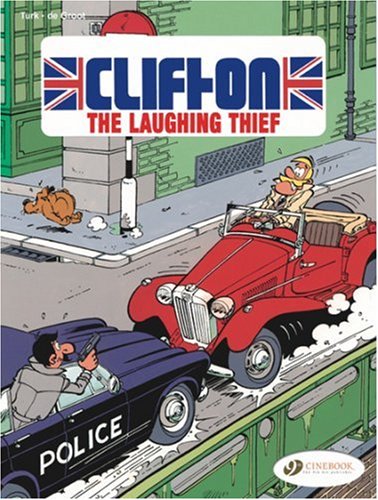
Clifton volume 2 The Laughing Thief


By De Groot & Turk, translated by Luke Spear (Cinebook)
ISBN: 978-1-905460-07-4 (Album PB)

For some inexplicable reason most of Europe’s comics cognoscenti – most especially French and Belgians – seem fascinated with us Brits. Maybe it’s our shared heritage of Empires lost and cultures in transition? An earlier age would have claimed it’s simply a case of “Know your Enemy”…

Whether we look at Anglo air ace Biggles, indomitable adventurers Blake and Mortimer, the Machiavellian machinations of Green Manor or even the further travails of Long John Silver, the serried stalwarts of our Scepter’d Isles cut a dashing swathe through the pages of the Continent’s assorted magazines and albums.

And then there’s Clifton…

Originally devised by child-friendly strip genius Raymond Macherot (Chaminou, Les croquillards, Chlorophylle, Sibylline) for iconic magazine Le Journal de Tintin, this doughty True Brit troubleshooter first appeared in December 1959. After three albums worth of material – compiled and released between 1959 and 1960 – Macherot quit Tintin for arch-rival Le Journal de Spirou leaving his eccentric comedic crime-fighter to flounder until LJdT revived him at the height of the Swinging London scene, courtesy of Jo-El Azaza & Greg (Michel Régnier).

Those strips were subsequently collected as Les lutins diaboliques in French and De duivelse dwergen for Dutch-speakers in 1969.

Then it was back into retirement until the early 1970s when writer Bob De Groot and illustrator Philippe “Turk” Liegeois revived Clifton for the long haul, producing ten tales of which this – Le voleur qui rit – Clifton (from 1973) – was their second collaboration.

From 1984 on, artist Bernard Dumont – AKA Bédu – limned De Groot’s scripts; eventually assuming the writing chores as well, persevering until the series ended in 1995. In keeping with its rather haphazard nature and typically undying nature, the Clifton experience resumed once again in 2003, crafted by De Groot & Michel Rodrigue in four further adventures; a grand total of 26 to date.

The setup is deliciously simple: pompous and irascible Colonel Sir Harold Wilberforce Clifton, ex-RAF, former Metropolitan Police Constabulary and recently retired from MI5, has a great deal of difficulty dealing with being put out to pasture in rurally bucolic Puddington. He thus takes every opportunity to get back in the saddle, occasionally assisting the Government or needy individuals as an amateur sleuth.

Sadly for Clifton – as with that other much-underappreciated national treasure Captain Mainwaring in Dad’s Army – he is convinced that he is usually the only truly competent man in a world full of blithering idiots…

In this second translated album from 2005, the Gentleman Detective is embroiled in not one but two uncanny incidences, beginning with eponymous epic ‘The Laughing Thief’ wherein the still much-missed lawman rather forcefully inserts himself into a current case baffling Scotland Yard.

London is wracked by devilishly clever crimes executed with infallible precision by a crack crew of blaggers, but the profits of each caper seem far below what such expert criminals should be bothering with. Moreover, each perfectly executed heist is preceded by a telephone warning from a braying braggart with the most annoying and distinctive laugh imaginable…

These felons are incredibly bold and arrogant. Even after Clifton intervenes in the second robbery, the scoundrels easily outwit him, leaving the dapper sleuth unconscious with dozens of other peculiarly proud and strangely supportive victims…

Moreover, although police “higher-ups” welcome Clifton’s help, officer-in-charge Lieutenant Hardfeeling doesn’t want the show-stealer around and is doing all he can to impede the Colonel’s investigations, despite protests from senior colleagues and the bobbies on the beat…

Nevertheless, persistence is its own reward, and when Clifton finally deduces the true reasons for the publicity-seeking crime-spree, the resultant confrontation is spectacularly satisfying and hilariously rewarding…

Being British and an ex-spy, Clifton has hung on to the odd gadget or two, such as an amazingly tricked out umbrella which plays a major part in this volume’s second tale ‘The Mystery of the Running Voice’. A suspenseful spooky yarn, it begins when the unhappy pensioner meets old comrade Donald McDonald Muckyduck, who appears to have worn out every vestige of verve and is on the verge of a nervous breakdown…

Close consultation reveals that the former Police Inspector is being haunted by a robber ghost; one that has already claimed six victims. However, upon viewing crime scene photos Clifton gains an inkling into how the trick is done and temporarily moves to sedate and sedentary village Flatfish-on-Apron, setting himself up as bait for a diabolical genius with a penchant for clever gimmicks…

Visually spoofing Swinging Sixties London and staidly stuffy English Manners with wicked effect, these gentle thrillers are big on laughs but also pack loads of consequence-free action into their eclectic mix. Delightfully surreal, instantly accessible and doused with daft slapstick à la Jacques Tati and intrigue like Margaret Rutherford as Miss Marple, this brace of romps rattle along in the grand old tradition of Will Hay, Terry-Thomas and Alistair Sim – or Wallace and Gromit if you’re of a later generation – offering splendid fun and timeless laughs for all.
Original edition © 1973 Le Lombard (Dargaud-Lombard S. A.) 1988 by De Groot & Turk. English translation © 2005 Cinebook Ltd.

Steed and Mrs Peel volume 3: The Return of the Monster


By Caleb Monroe, Steve Bryant, Will Sliney, Yasmin Liang & Chris Rosa (Boom! Studios)
ISBN: 978-1-60886-363-1 (TPB) eISBN: 978-1-61398-363217-4

The (British) Avengers was an astoundingly stylish, globally adored TV show glamorously blending espionage with arch comedy and deadly danger with technological extrapolation from swinging Sixties through to the beginning of the 1980s. A phenomenal cult hit, it and sequel The New Avengers call up pangs of Cool Britannia style, cheeky action-adventure, kinky quirkiness, mad gadgetry, dashing heroics, bizarrely British festishistic attire, surreal suspense and the wholly appropriate descriptive phrase “Spy Fi”.

Enormously popular everywhere, the show evolved from 1961’s gritty crime thriller Police Surgeon into a paragon of witty, thrilling and sophisticated adventure lampoonery with suave, urbane British Agent John Steed and dazzlingly talented amateur sleuth Mrs. Emma Peel battling spies, robots, criminals, secret societies, monsters and even “aliens” with tongues very much in cheeks and always under the strictest determination to remain calm, dashingly composed and exceedingly eccentric…

The format was a winner. Peel, as played by Dame Diana Rigg, and replacing landmark character Cathy Gale – the first hands-on fighting female on British TV history – took the show to even greater heights of success. Emma Peel’s connection with viewers cemented the archetype of a powerful, clever, competent woman into the nation’s psyche: largely banishing the screaming, eye-candy girly-victim to the dustbin of popular fiction.

Rigg left in 1967, herself replaced by another feisty female: Tara King (Linda Thorson) who carried the series to its demise in 1969. Continued popularity in more than 90 countries led to a revival in the late 1970s. The New Avengers saw glamorous Purdey (Joanna Lumley) and manly Gambit (Gareth Hunt) as partners and foils to the agelessly debonair but deadly Steed…

The show remains an enduring cult icon, with all the spin-off that entails. During its run and beyond, The Avengers spawned toys, games, collector models, a pop single and stage show, radio series, audio adventures, posters, books and all the myriad merchandising strands that inevitably accompany a media sensation. The one we care most about is comics and, naturally, the popular British Television program was no stranger there either.

Following an introductory strip starring Steed & Gale in listings magazines Look Westward and The Viewer – plus the Manchester Evening News – (September 1963 to the end of 1964), legendary children’s staple TV Comic launched its own Avengers strip in #720 (October 2nd 1965) with Emma Peel firmly ensconced.

This ran until #771 (September 24th 1966) and the dashing duo also starred in TV Comic Holiday Special, whilst a series of young Emma Peel adventures featured in June & Schoolfriend, before transferring to DC Thomson’s Diana until 1968 whereupon it returned to TV Comic with #877, depicting Steed and Tara King until #1077 in 1972.

In 1966 Mick Anglo Studios unleashed a one-off, large-sized UK comicbook, and two years later in America, Gold Key’s Four-Color series published a try-out book using recycled UK material as John Steed/Emma Peel – since Marvel had secured an American trademark for comics with the name “Avengers”…

A constantly evolving premise, fans mostly fixate on the classic pairing of Steed and Peel – which is handy as the Avengers title is embargoed up the wazoo now

There were wonderful, sturdily steadfast hardback annuals for the British Festive Season trade, beginning with 1962’s TV Crimebusters Annual and thereafter pertinent TV Comic Annuals before a run of solo editions graced Christmas stockings from 1967-1969: supplemented by a brace of New Avengers volumes for 1977 and 1978.

Eclipse/ACME Press produced a trans-Atlantic prestige miniseries between 1990 and 1992. Steed & Mrs. Peel was crafted by Grant Morrison & Ian Gibson with supplementary scripts from Anne Caulfield. That tale was reprinted in 2012 by media-savvy publishers Boom! Studios: a kind of pilot for the later iteration under review here.

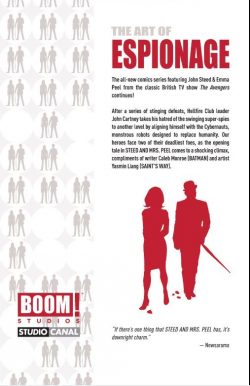
The Adventures of Steed and Mrs. Peel began with issue #0 (August 2012), reintroducing the faithful and newcomers to a uniquely British phenomenon, and terminate here with #8-11, as Caleb Monroe, Yasmin Liang, Ron Riley and letterer Ed Dukeshire conclude the sparkling revival with a quartet of fabulous missions, beginning with ‘The Art of Resurrection’.

A long-delayed sequel to 1966 TV episode ‘A Touch of Brimstone’ sees the demented offspring of Hellfire Club Supremo the Honorable John Cleverly Cartney rescue their barely-alive sire and begin a campaign of vengeance decked out as doppelgangers of Steed and Peel.

The manic scheme takes a darker twist as daddy dearest’s personality is installed in a robotic body for ‘The Clothes Make the Cybernaut’ (who featured in three small screen episodes). His progeny might be no match for our True Brits, but Cartney 2.0 is far more formidable, easily subduing the agents when they track down the mad malefactors…

However, the perfidious plan unravels in ‘Punchlines and Proposals’ when the wicked kids accidentally discover their daddy never had any children and still intends on making Mrs Peel his bride…

The madness and mayhem spectacularly wrap up in wedding issue ‘What They Do’, with the reunited operatives firing on all cylinders to thwart all the treacherous plots and counterplots before enjoying a spot of bubbly and another splendid sunset…

Wry, arch and wickedly satisfying, this closing salvo of the reborn franchise is a delight for staunch fans and curious newcomers alike and includes a covers and variants gallery by Joseph Michael Linsner, Joe Corroney & Brian Miller, and Dan Davis & Vladimir Popov to charm the eyes whilst the story salves the senses…
© 2014 Studio Canal S.A. All rights reserved.

Steed and Mrs Peel volume 2: The Secret History of Space


By Caleb Monroe, Yasmin Liang, Ron Riley & various (Boom! Studios)
ISBN: 978-1-60886-340-2 (TPB)

The (other) Avengers was an incredibly stylish, globally popular British TV show which blended espionage with arch glamor, seductively knowing comedy and deadly danger with elements of technological fantasy. It ran from the 1960s through to the beginning of the 1980s. A phenomenal cult hit, the show (and sequel The New Avengers) is best remembered for Cool Britannia outreach, stylish action-adventure, kinky quirkiness, mad gadgetry, dashing heroics, uniquely English festishistic trappings, surreal suspense and the wholly appropriate descriptive phrase “Spy Fi”.

Enormously popular all over the globe, the show evolved from 1961’s gritty crime thriller Police Surgeon into a paragon of witty, thrilling and sophisticated drama/lampoonery with suave, urbane British Agent John Steed and dazzlingly talented amateur sleuth Mrs. Emma Peel battling spies, robots, criminals, secret societies, monsters and even “aliens” with tongues very much in cheeks and always under the strictest determination to remain calm, dashingly composed and exceedingly eccentric…

The format was a winner. Peel, as played by Dame Diana Rigg, had replaced landmark character Cathy Gale – the first hands-on fighting female on British TV history – and took the show to even greater heights of success. Emma Peel’s connection with viewers cemented into the nation’s psyche the archetype of a powerful, clever, competent woman: largely banishing the screaming, eye-candy girly-victim to the dustbin of popular fiction.

Rigg left in 1967, herself replaced by another feisty female: Tara King (Linda Thorson) who carried the series to its demise in 1969. Continued popularity in more than 90 countries led to a revival in the late 1970s. The New Avengers saw glamorous Purdey (Joanna Lumley) and manly Gambit (Gareth Hunt) as partners and foils to agelessly debonair but deadly Steed…

The show remains an enduring cult icon, with all the spin-off that entails. During its run and beyond, The Avengers spawned toys, games and collector models; a pop single, stage show and radio series, plus audio adventures, posters, books and all the myriad merchandising strands that inevitably accompany a media sensation. The one we care most about is comics and naturally, the popular British Television program was no stranger there either.

Following an introductory strip starring Steed & Gale in listings magazines Look Westward and The Viewer – plus the Manchester Evening News – (September 1963 to the end of 1964), legendary children’s staple TV Comic launched its own Avengers strip in #720 (October 2nd 1965) with Emma Peel firmly ensconced.

This ran until #771 (September 24th 1966), and the dashing duo also starred in TV Comic Holiday Special, whilst a series of young Emma Peel adventures featured in June & Schoolfriend, before transferring to DC Thomson’s Diana until 1968 whereupon it returned to TV Comic with #877, depicting Steed and Tara King until #1077 in 1972.

In 1966, Mick Anglo Studios unleashed a one-off, large-sized UK comicbook, and two years later in America, Gold Key’s Four-Color series published a try-out book using recycled UK material as John Steed/Emma Peel – since Marvel had since secured an American trademark for comics with the name “Avengers”. Although a constantly evolving premise, fans mostly fixate on the classic pairing of Steed and Peel – which is handy as the Avengers title is embargoed up the wazoo now.

There were wonderful, sturdily steadfast hardback annuals for the British Festive Seasonal trade, beginning with 1962’s TV Crimebusters Annual and thereafter pertinent TV Comic Annuals before a run of solo editions graced Christmas stockings from 1967-1969: supplemented by a brace of New Avengers volumes for 1977 and 1978.

Most importantly, Eclipse/ACME Press produced a trans-Atlantic prestige miniseries between 1990 and 1992. Steed & Mrs. Peel was crafted by Grant Morrison & Ian Gibson with supplementary scripting from Anne Caulfield. That tale was reprinted in 2012 by media-savvy publishers Boom! Studios: a notional pilot for the later iteration under review here.

The Adventures of Steed and Mrs. Peel began with issue #0-3 (August 2012), reintroducing the faithful and newcomers to a uniquely British phenomenon and saw the grand dames of Spy Fi tackle old (TV) enemies The Hellfire Club at the height of the 1960s.

After quelling last volume’s A Very Civil Armageddon, the intrigue resumes here and now with Steed and Peel clearing up loose ends by attending a highly suspect gala soiree in ‘Ballroom Dance Fu’ (by Caleb Monroe, Yasmin Liang & colourist Ron Riley). The scoundrel du jour under investigation is wealthy rogue Lloyd Cushing, but the true target is scurrilous brainwasher Mr. Blackwell – the sinister mindbender who facilitated the Hellfire Club’s schemes and previously warped Mrs Peel into their Queen of Sin.

Sadly, despite a minimum of murders and the defeat of their foe, our heroes are left little wiser, and blithely unaware that the schemes of a hidden mastermind are still proceeding apace…

Main event ‘The Secret History of Space’ then kicks off with the abduction of British Air Chief Marshal Trevor Seabrook‘s wife in opening gambit ‘Steed Drifts Off into Space’. The hidden villain’s ultimate aim is achieved when the distraught airman – head of the UK’s Space Program – hands over an item long stored and forgotten in a research facility. Investigating the extortion, Steed and Peel are baffled to learn that the top-secret booty is a decades-old empty glass jar…

Diligent investigation leads the Derring Duo to a warehouse where old enemy Dr. Peter Glass (another TV series recruit) has been continuing his deadly experiments into optical lasers. It’s quite the conundrum since Steed clearly remembers killing him…

The answer is forthcoming as ‘Time Flies’ reveals a bit of chronal meddling from the bonkers boffin’s future assistant Jamie upsetting the timeline and risking things from beyond our comprehension getting dangerously close to humanity. Thankfully, even a gang of time-duplicated henchpersons are no match for Mrs Peel in full assault mode…

With normality restored, our heroes then voyage to small Welsh mining town Abergylid, where an unlikely cluster of suicides (24 in one month) has the Ministry deeply concerned. After both almost simultaneously succumb to manic death-urges, simple deduction leads to an outside influencer callously operating with malign intent and methods in ‘Tawdry Little Endings’.

Wry, sharp and wickedly satisfying, these classy cloak-&-dagger dramas are sheer delight for staunch fans and curious newcomers alike and this volume also includes a wealth of covers and variants gallery by Joe Corroney & Brian Miller; Drew Johnson, Mike Perkins, Barry Kitson and Davis (all coloured by Vladimir Popov), Lorena Carvalho and Chan Hyuk Lee.
© 2012, 2013 Studio Canal S.A. All rights reserved.

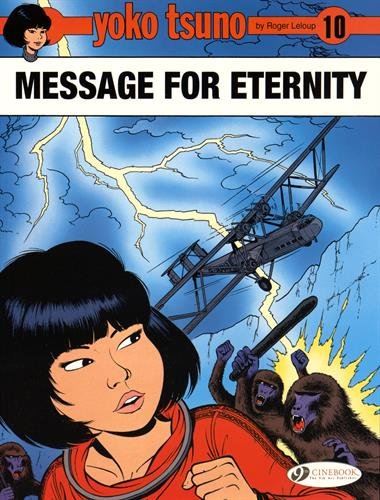
Yoko Tsuno volume 10: Message for Eternity


By Roger Leloup translated by Jerome Saincantin (Cinebook)
ISBN: 978-1-84918-251-5 (Album PB)

The uncannily edgy yet excessively accessible exploits of Japanese scientific adventurer Yoko Tsuno first graced the pages of Le Journal de Spirou in September 1970 and are still going strong, with 29th album Anges et Faucons (Angels and Falcons) released in 2019.

The eye-popping, expansively globe-girdling multi-award-winning series is the brainchild of Roger Leloup, another hugely talented Belgian who worked as a studio assistant on Herge’s Adventures of Tintin before striking out on his own. Compellingly told, astoundingly imaginative yet always grounded in hyper-realistic settings whilst sporting utterly authentic and unshakably believable technology, these illustrated epics were at the vanguard of a wave of comics featuring competent, clever and brave female protagonists that revolutionised Continental comics from the last third of the 20th century onwards and are as potently empowering now as they ever were.

The initial Spirou stories ‘Hold-up en hi-fi’, ‘La belle et la bête’ and ‘Cap 351’ were short introductory vignettes prior to the superbly capable Miss Tsuno and her always awestruck and overwhelmed male comrades Pol and Vic truly hitting their stride with premier extended saga Le trio de l’étrange (which began serialisation with the May 13th 1971 issue).

That epic of extraterrestrial intrigue was the first of many European albums, with the one here first serialised in LJdS #1882-1905 (from 9th May-17 October 17th 1974) and released a year later as Message pour l’éternité. A skilfully crafted suspenseful mystery thriller, the chronologically fifth album over there reaches us as Cinebook’s 10th translated chronicle.

It all begins as Yoko perfects her skills in a new hobby. Gliding high above Brittany. she fortuitously sets down in a field near a vast telecommunications complex. Offered a tour of the space-probing facility, she learns from one of the scientists of a fantastic “ghost message” recently picked up by their satellites: a Morse code signal from a British plane lost in 1933. Moreover, the signal is still being regularly broadcast…

As Yoko tries to arrange for her glider to be collected, a mysterious Englishman offers her a lift in his private helicopter but he has an ulterior motive. He works for the company which insured the lost flight and is looking for someone with certain exacting qualifications to trace the downed flight and recover a fortune in jewels from it. Her fee will be £20,000…

His firm has known where the plane went down for quite some time, but geographical and logistical difficulties have prevented them from undertaking a recovery mission until now. Moreover, although they have now started the process, the petite engineer is physically superior to the candidates the company are currently working with…

Cautiously accepting the commission, Yoko starts planning but even before Pol and Vic can join her the following day, strange accidents and incidents impact and imperil her life…

The boys are understandably reluctant but that attitude turns to sheer frustration and terror after someone tries to shoot Yoko down as she practises in her glider. This only makes her more determined to complete the job at all costs…

Two weeks later the trio are heading to the daunting Swiss fortress the company uses as a base, when another spectacular murder attempt almost ends their lives. Yoko remains undaunted but not so Vic and Pol, especially after overhearing that two of her fellow trainees recently died in similar “accidents” in the mountains…

Carrying on regardless, she assesses the technologically sophisticated glider-&-launch system which will take her to the previously unattainable crash site and perfects her landing technique in a fantastic training simulator. Eventually more details are provided and the real story unfolds.

In November 1933, the Handley-Page transport they are hunting was conveying diplomatic mail from Karachi to London before vanishing in a storm over Afghanistan. Decades later, a satellite somehow picked up a broken radio message stating it had landed…

Somewhere…

The businessman the trio call “Milord” identifies himself as Major Dundee – a spymaster from Britain’s Ministry of Defence – who explains how a shady American former U2 pilot approached the British government, claiming to have spotted the downed ship during a clandestine overflight of Soviet territories.

He provided purloined photos showing the plane in the centre of a vast circular crater on the Russo-Chinese border, but subsequent reconnaissance flights revealed nothing in the hole so the decision was taken to make a physical assessment, even though the already inaccessible site was deep in hostile enemy territory. Since then, it has become clear that some unidentified agent or group is acting against the recovery project, presumably intent on retrieving the ship’s mysterious but valuable cargo for a foreign power.

Events spiral out of control when a traitor in the training team attempts to kill Yoko and “Operation Albatross” is rushed to commencement before the unknown enemy can try again…

Within a day she is transported in a speedy manner around the world before her space-age glider prototype is secretly deployed over the enigmatic crater…

Narrowly avoiding patrolling Soviet jets, Yoko deftly manoeuvres into the mist-covered chasm and plunges into one of the most uncanny experiences of her life.

The old plane is certainly gone. The floor of the crater is strangely  cracked and at the centre stands a burned and blackened monolith; there are uncharacteristic animal bones everywhere and at one end of the vast cavity is a primitive but large graveyard…

When the astounded girl goes exploring, she is ambushed by her treacherous fellow trainee who has raced after her by conventional means before parachuting into the bizarre basin. However, his original plans have changed drastically since arrival, and despite the machine gun he wields, he needs Yoko’s help. He’s already located the Handley-Page – somehow manually dragged under an unsuspected overhang in the crater – but is mortally afraid of what he describes as the “tiny people” infesting the terrifying impact bowl…

As the unlikely allies head towards the eerily preserved plane, the truth about the terrifying homunculi is shockingly revealed and they encounter the last human survivor of the downed Diplomatic Flight, discovering to their cost the uncanny and ultimately deadly atmospheric anomaly which has kept the plane a secret for decades and turned the crater into a vast geological radio set…

When the dust settles, Yoko realises she is trapped in the subterranean anomaly. With all her escape plans rendered useless she must align herself with the bizarre sole survivor and his bestial, rebellious servants, but she also refuses to give up on the recovery mission. Of course, that doesn’t mean that she has to trust anything the old relic in the hole or Major Dundee has said. With that in mind she lays her own plans to settle matters…

As ever, the most potent asset of these breathtaking dramas is the astonishingly authentic and staggeringly detailed draughtsmanship and storytelling, which benefits from Leloup’s diligent research and meticulous attention to detail, honed through years of working on Tintin.

With this sleekly beguiling tale Yoko proved that she was a truly multi-faceted adventurer, equally at home in all manner of dramatic milieux and able to hold her own against the likes of James Bond, Modesty Blaise, Tintin or any other genre-busting super-star: as triumphantly capable thwarting spies and crooks as alien invaders, weird science effects or unchecked forces of nature…

This is a splendidly frenetic, tense thriller which will appeal to any fan of blockbuster action fantasy or devious espionage exploit.
Original edition © Dupuis, 1973, 1979 by Roger Leloup. All rights reserved. English translation 2015 © Cinebook Ltd.

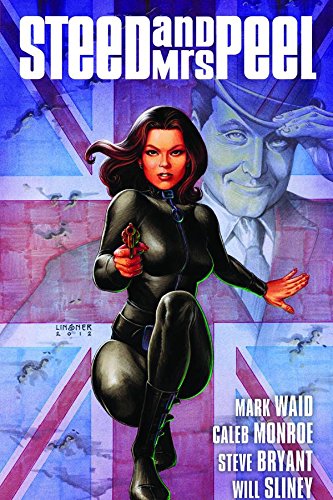
Steed and Mrs Peel volume One: A Very Civil Armageddon


By Mark Waid, Caleb Monroe, Steve Bryant, Will Sliney, Yasmin Liang & Chris Rosa & various (Boom! Studios/Titan Books)
ISBN: 987-1-60886-306-8 (TPB)

Generally, when I write about the Avengers, we’re all thinking about an assembled multitude of Marvel superheroes, but – until the blockbuster movie franchise stormed the 21st century world – for most non-comics civilians that name usually conjured up images of dashing heroics, old world charm, incredible, implausible adventure and true British style – not to say bizarrely fetishistic attire. It’s easy to see how that might lead to some consumer confusion…

In this anniversary year for the TV show, I thought we’d revisit some of the many comics outings of the English iteration, so we’re starting here. Be prepared for a sparkling variety of follow-up treats in the months ahead…

The (other) Avengers was a stylish, globally popular crime/spy TV show made in Britain: glamorously and seductively blending espionage thrills with arch, knowing comedy. After a grim-‘n’-gritty start in 1961, it gradually combined deadly danger with elements of technological fantasy, capturing the mood of two distinct eras, A phenomenal cult hit, the show and its1980s sequel The New Avengers are best remembered now for Cool Britannia-styled action, kinky quirkiness, mad gadgetry, surreal suspense and the wholly appropriate descriptive phrase “Spy Fi”.

The legacy of the series is apparent in many later shows like The Invisible Man (both TV spy iterations); Chuck, the Mission: Impossible movie franchise and Marvel’s Agents of S.H.I.E.L.D.

Enormously popular across the globe – even Warsaw Pact Poland was crazy for Rewolwer i melonik (“A Revolver and a Bowler Hat”) – the show evolved from bleak vengeance thriller Police Surgeon (September-December 1961) into the epitome of wittily sophisticated adventure lampoonery with suave, urbane British Agent John Steed partnering with a succession of dazzlingly talented women displaying the true meaning of the term “agency”.

Most revered was amateur sleuth Mrs. Emma Peel who battled spies, supervillains, robots, criminals, secret societies, monsters and even “aliens” with tongue very much in cheek and always under the strictest determination to remain cool, dashingly composed and exceedingly eccentric…

The format was a winner. Peel, as played by (Dame) Diana Rigg, had been a replacement for landmark and breakthrough character Cathy Gale – the first hands-on fighting female in British television history. She left the show in 1964 to become Bond Girl Pussy Galore (in Goldfinger), but her replacement with Rigg took the show to even greater heights of success. The role of recently bereaved Emma Peel hit a chord with viewers and cemented the archetype of a powerful, clever, competent woman into the nation’s psyche: forever countering – if not quite abolishing – the screaming, eye-candy girly-victim to the dustbin of popular fiction.

Rigg left in 1967 (to marry James Bond in On Her Majesty’s Secret Service) and another feisty female was found in the person of Tara King (Linda Thorson) to carry the series to its demise in 1969. Its continued popularity in more than 90 countries eventually resulted in a revival during the late 1970s. The New Avengers saw glamorous “Sloane Ranger” Purdey (Joanna Lumley) and brutishly manly Gambit (Gareth Hunt) acting as partners and foils to the agelessly debonair and deadly Steed…

The show has remained a hugely enticing cult icon. There was a rather ill-conceived major motion picture in 1998, but the television version regularly features in Top 20 rankings for assorted polls assessing Cult TV Shows. During its run and beyond, the internationally adored series has spawned toys; games; collector models; a pop single and stage show; radio series; posters and books plus all the myriad merchandising strands that inevitably accompany an evergreen media sensation.

Naturally, as a popular British Television program these Avengers were no stranger to our comics pages either.

Following an introductory cartoon strip starring Steed & Gale in listings magazines Look Westward, The Viewer and Manchester Evening News (September 1963 to the end of 1964), legendary children’s staple TV Comic launched its own Avengers strip in #720 (October 2nd 1965) with Emma Peel firmly ensconced and crushing crime.

This serial ran until #771 (September 24th 1966), with the dashing duo also starring in TV Comic Holiday Special, whilst a series of young Emma Peel adventures featured in June & Schoolfriend. This feature transferred to DC Thomson’s Diana, running until 1968 whereupon it returned to TV Comic (from #877): now depicting Steed and Tara King until 1972 (#1077).

In 1966 there was a one-off, large-sized UK comicbook from Mick Anglo Studios whilst in America, Gold Key’s Four-Color series published a try-out book in 1968 using recycled UK material under the rather obvious title John Steed/Emma Peel – since Marvel had already secured an American trademark for comics with the name “Avengers”.

There were also a number of wonderful, sturdily steadfast hardback annuals for the British Festive Season trade, beginning with 1962’s TV Crimebusters Annual and thereafter pertinent TV Comic Annuals after which a run of solo editions graced Christmas stockings from 1967-1969, augmented by plus a brace of New Avengers volumes for 1977 and 1978.

Between 1990 and 1992, Eclipse Comics and the UK’s ACME Press produced a trans-Atlantic prestige miniseries, Steed & Mrs. Peel: crafted by Grant Morrison, Anne Caulfield & Ian Gibson. Stay tuned for a review of that one too…

Repackaged and reprinted in 2012 by media-savvy publishers Boom! Studios, that event acted as a pilot for a fresh iteration, the first compilation of which is under review here. Wisely set in the series’ Swinging Sixties Britain heyday, this volume of Steed and Mrs. Peel collects issues #0-3 (August-December 2012): a worthy reintroduction for the faithful and happily accessible introduction for notional newcomers as the dedicated followers of felons return for another clash with memorable TV antagonists The Hellfire Club.

These baroque bounders appeared in episode ‘A Touch of Brimstone’ and so warped the maturing personalities of young Chris Claremont & John Byrne that they later created their own version for a comic book they were working on – the Uncanny X-Men…

The drama here opens in ‘A Very Civil Armageddon: Prologue’ (written by Boom! chief creative guru Mark Waid and illustrated by Steve Bryant) as, way back then, our heroes are called upon to investigate ‘The Dead Future’, as an active – albeit murdered – agent seemingly ages decades overnight.

The situation reminds Mrs. Peel of the mind-bending, lethally effective fun-&-games perpetrated by the insidious Hellfire Club and its now-defunct leader the Honourable John Clever-Cartney…

Further inquiries take them to the latest incarnation of the ancient Gentleman’s Club where avowed futurist Ian Lansdowne Dunderdale Cartney disavows any knowledge of the matter… or his dad’s old antisocial habits. In fact, the current scion is far more absorbed with the World of Tomorrow than the embarrassing peccadilloes of the past. However, it’s all a trap and whilst Mrs Peel is attacked by a killer robot maid, Steed is ambushed – only to awaken as a doddering old man 35 years later in the year 2000AD!

Forever undaunted, the temporarily separated Derring-Duo refuse to accept the improbable, impeccably and individually striking back to uncover the incredible answer to an impossible situation…

The main event – by Waid & Caleb Monroe with art from Will Sliney – depicts ‘London Falling’ as long-anticipated and dreaded nuclear Armageddon finally happens, leaving Steed, Peel and a swarm of politicians, Lords and civil servants as the only survivors, hunkered down in a battered atomic bunker beneath the utterly devastated Houses of Parliament.

The shattered, shaken remnants of Empire and Civilisation soon discover that the only other survivors are ghastly atomic mutants and a coterie of exceptionally well-stocked and fully prepared members of the Hellfire Club…

‘Life in Hell’ finds the former foes joining forces and combining resources, but Steed and Peel are convinced something is “not kosher”. For one thing, former members of once-important political committees and knowledgeable generals keep disappearing, but – most importantly – Ian Cartney and his deplorable sister Dirigent are now known to be masters of their father’s dark arts of illusion, trickery and brainwashing…

Almost too late, Steed rumbles the nature of an audaciously cunning Psy-Ops espionage scheme as Emma is once more transformed into a ferocious, whip-wielding bondage nightmare for concluding instalment ‘Long Live the Queen’. Of course, a good spy, like a boy scout, is always prepared, and the dapper detective adroitly turns the tables on his foes just in time for a rollicking, explosively old-fashioned comeuppance…

Wry, arch and wickedly satisfying, this opening salvo in the reborn franchise remains a delight for staunch fans and curious newcomers alike. This volume includes a vast (28) gallery of covers and variants by Joseph Michael Linsner, Phil Noto, Joshua Covey & Blond, Mike Perkins & Vladimir Popov and Drew Johnson to astound the eyes as much as the story assaults the senses…

…And the best is yet to come…
© 2013 StudioCanal S.A. All rights reserved.

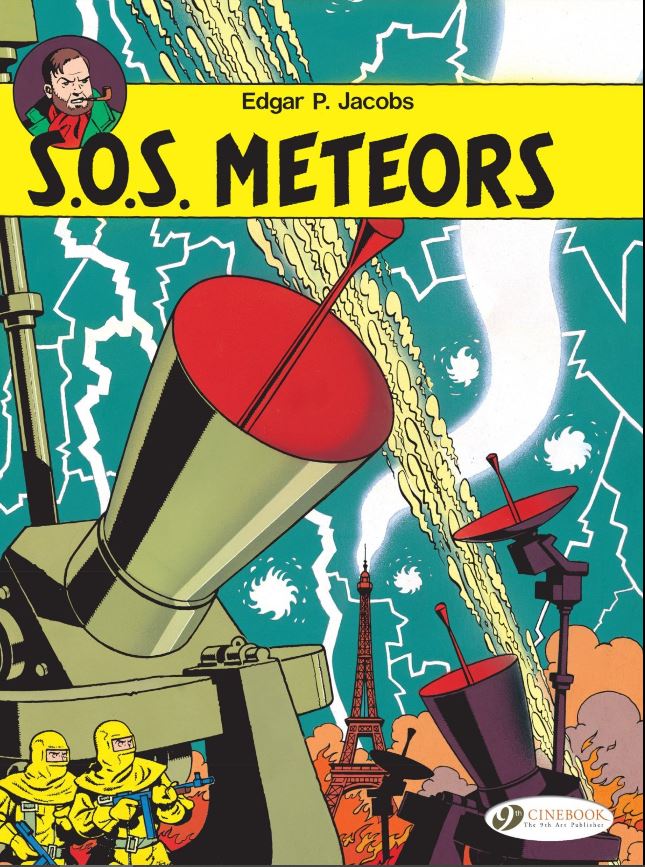
Blake and Mortimer: S.O.S. Meteors


By Edgar P. Jacobs, translated by Jerome Saincantin (Cinebook)
ISBN: 978-1-905460-97-7 (Album PB)

Not all of 2021’s comics milestones are Anglo-American affairs. These guys are celebrating 75 glorious years of uncanny exploits and still going strong. Bon Anniversaire, mes amis …

Master storyteller Edgar P. Jacobs pitted his distinguished duo of Scientific Adventurers Professor Philip Mortimer and Captain Francis Blake against a wide variety of perils and menaces in stunning yarns combining science fiction scope, detective mystery suspense and supernatural thriller action, rendered in the same ageless and inviting Ligne Claire style which first made intrepid boy reporter Tintin into a global sensation.

The strip debuted in the premier issue of Le Journal de Tintin (dated 26th September 1946): an international anthology comic with multi-language editions in Belgium, France and Holland. The magazine was edited by Hergé himself, with his eponymous star ably supplemented by a host of new heroes and features designed to inspire young readers of the post-war world…

S.O.S. Météores began serialisation in the January 8th 1958 issue: running until April 22nd 1959 before being subsequently collected six months after the conclusion as the 8th album of the drama-drenched epic escapade. It was just in time for the Christmas rush.

In 2009 the tale was translated into English as Cinebook’s 6th Blake and Mortimer release, and – subtitled ‘Mortimer in Paris’ – opens here with the incomparable boffin in the City of Lights, answering a Gallic colleague’s pleas for assistance.

Like all his unhappy ilk, meteorologist Professor Labrousse is shouldering the brunt of public ire over freak weather events which are systematically bringing France to its knees. When Mortimer arrives, he experiences for himself the chaos tumultuous storms are inflicting upon the traffic-heavy metropolis. Thankfully, the embattled weatherman has despatched a taxi to collect the weary Englishman and bring him to the relative calm of suburban enclave Jouy.

Both driver and passenger are unaware of a flashy American car covertly dogging them. As conditions steadily worsen, the ride becomes truly hazardous, leading to an inevitable crash. Separated from the driver and blindly wandering in the storm, Mortimer plunges into a lake and barely manages to scrabble to safety.

Finding his way back to the road, the exhausted scientist thumbs a lift to Labrousse’s house and is warmly welcomed. Of the taxi driver, however, there is no trace…

The old chums discuss the catastrophic conditions and uncanny events long into the night, but the next morning further deliberations are curtailed when the police arrive, eager to interview the Englishman about a certain cab driver’s disappearance…

Deeply troubled, the learned men attempt to retrace Mortimer’s steps and discover the terrain is completely different from Englishman’s memories. They also encounter a thug and his immense dog going over the same sodden ground. The strangers are clearly following the orders of a boss who keeps well hidden, and a violent altercation is barely avoided with a simple whistle from the unseen voyeur…

Eventually the lifetime experience of the local postman enables the baffled British boffin to solve his geographical conundrum, and a recovered trail leads to a nearby estate with huge walls patrolled by the same terrifying hound he met earlier. Well-versed in surveillance procedure, Mortimer prepares to probe further but is distracted when a sudden snowstorm begins. Determinedly he returns later, well-prepared and using the blizzard as cover to investigate the estate. It proves to be a tremendous mistake…

Next morning in Paris, Divisional Commissioner Pradier of French Intelligence welcomes a counterpart from Great Britain, looking into an espionage ring at work in France. Captain Francis Blake’s keen insight quickly scores a hit: opening up new leads that seemly connect to the weather conditions tormenting the nation. However, on meeting hastily-summoned Labrousse, Blake learns old comrade Mortimer has vanished after announcing that the aberrant meteorology is man-made…

Travelling to Jouy with the horrified weatherman, Blake makes a shocking impression on Labrousse’s usually-affable neighbour as the strange atmospheric conditions are abruptly compounded with odd little accidents and frustrations that can only be seen in total as concerted enemy action…

The saga kicks into high gear when Blake recognises old – and presumed dead – enemies and is chased through unrelenting arctic conditions back to Paris in a deadly, hair-raising game of cat-&-mouse which culminates in another confrontation with his most implacable foe…

Assisted by Pradier’s forces, Blake soon has the villains on the run, spectacularly fleeing over Parisian rooftops, but the big fish again escapes, and our heroes face the fact that they may never know what has become of Mortimer…

In Jouy, however, the irascible researcher has made good use of his time. Incarcerated with diabolical Professor Milosh Georgevich – who has used the vast resources of an aggressor nation to weaponise weather in advance of an audacious scheme to invade France for the third time in a century – Mortimer acts alone and escapes his jailers. Picking up an unexpected ally as he tries to sabotage the colossal climate engines, the Prof is utterly unaware that his greatest friend has picked up new clues and is closing in on the plotters…

Moody and comparatively low-key until the final act – when tensions build to explosive heights and a Bond-Movie finish – S.O.S. Meteors is a splendid romp packed with astounding action, scads of sinister deviltry and a blockbuster climax to delight spy-buffs and all devotees of the Distinguished Duo.

Addictive and absorbing in the truest tradition of pulp sci-fi and Boy’s Own Adventures, Blake and Mortimer are the epitome of dogged heroic determination and the natural successors to such heroic icons as Professor Challenger, Bulldog Drummond and Richard Hannay, delivering grand Blood-&-Thunder thrills, chills and spills in timeless fashion and with a mesmerising visual punch.

Any kid able to suspend modern mores and cultural disbelief (call it alternate earth history or bakelite-punk if you want) will enjoy the experience of their lives…

This Cinebook edition – available in paperback and digital editions – also includes excerpts from two other B&M albums plus a short biographical feature and publication chart of Jacobs’ and his successors’ efforts.
Original edition © Editions Blake & Mortimer/Studio Jacobs (Dargaud-Lombard S. A.) 1989 by E.P. Jacobs. All rights reserved. English translation © 2009 Cinebook Ltd.

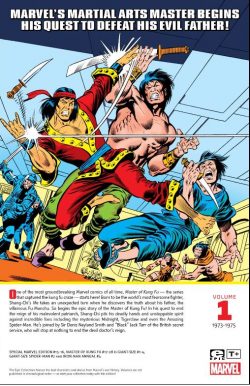
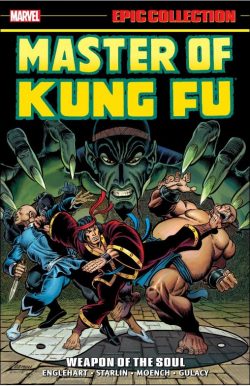
Master of Kung Fu Epic Collection volume 1: 1973-1975 Weapon of the Soul


By Steve Englehart, Jim Starlin, Doug Moench, Gerry Conway, Len Wein, Roger Stern, Paul Gulacy, Ron Wilson, Al Milgrom, Ross Andru, Keith Pollard, Alan Weiss, Walter Simonson, John Buscema, Ed Hannigan, Aubrey Bradford, P Craig Russell, Frank McLaughlin, Jeff Aclin & various (Marvel)
ISBN: 978-1-3029-0135-6 (TPB)

Comic books have always operated within the larger bounds of popular trends and fashions – just look at what got published whenever westerns or science fiction dominated on TV – so when the ancient philosophy and discipline of Kung Fu made its unstoppable mark on domestic western entertainment, it wasn’t long before all those kicks and punches found their way onto four-colour pages of America’s periodicals. Early starter Charlton added Yang and House of Yang to the pioneering Judo Joe and Frank McLaughlin’s Judomaster; DC debuted Richard Dragon and rebooted Karate Kid; Atlas/ Seaboard opened The Hands of the Dragon and Marvel rapidly converted a proposed literary adaptation into an ongoing saga about a villain’s son. A month after it launched, a second orient-tinged hero in Iron Fist: combining combat philosophy, high fantasy and magic powers with a proper superhero mask and costume…

At their core, comics are just another mass-media entertainment form, but even (or do I mean especially?) the most frivolous fun for the largest audiences may carry at its heart cultural and social iniquity, easily-exploitable prejudices and dangerously-pernicious stereotyping and profiling. With that in mind, here’s a thorny subject for all concerned, on so many levels…

After the sublime success and cultural phenomenon of the Black Panther movie, people of colour finally had a heroic icon and cultural touchstone of their very own. The glorious and affirmative characters and stories were based on comics generated over many years by a multitude of talented, well-meaning creators, all originating at a company that was generally liberal, socially aware and earnestly seeking to address issues of prejudice and inclusivity whenever and wherever they found them.

That was black folk sorted, right? However, people of Asian ancestry still cry out for something of relevance and meaning to them. That’s why there’s a blockbuster Shang-Chi movie heading towards our screens in September.

It’s also notionally based on some incredible comics by a variety of gifted individuals and teams, but the white world in general and Marvel in particular have a different kind of history with those of Asian heritage…

Although largely retrofitted for modern times, inspirational Master of Kung Fu star Shang-Chi comes with a lot of tricky baggage. He debuted in the autumn of 1973, cashing in on a 1970s craze for Eastern philosophy and martial arts action which generated an avalanche of “Chop Sockey” movies and a controversial TV sensation entitled Kung Fu. You may recall that the lead in that western-set saga was a half-Chinese Shaolin monk, played – after much publicised legal and industry agitation – by a white actor…

At Marvel, no one at that time particularly griped about the fact that Shang-Chi was designed by editor Roy Thomas and artisans Steve Englehart, Jim Starlin & Al Milgrom as a naive innocent (also half Chinese, with an American mother) thrown into tumultuous modern society as a rebellious but involved counterpoint to his father: an insidious scheming fiend intent on global domination.

Back then, securing rights to a major literary property and wrapping new comics in it was an established practise. It had worked spectacularly with Conan the Barbarian and horror stars like Dracula and Frankenstein. The same process also brilliantly informed seminal science fiction icon Killraven in War of the Worlds and plenty more…

These days we comics apologists keep saying “it was a different era”, but I genuinely don’t think anyone in the editorial office paused for a moment of second thoughts when their new Kung Fu book secured the use one of literature’s greatest villains as a major player. Special Marvel Edition #15 (cover-dated December 1973) launched to great success, and the overarching villain was already a global personification of infamy …Fu Manchu.

Arthur Henry Sarsfield Ward AKA Sax Rohmer’s ultimate embodiment of patronising mistrust and racist suspicion had been hugely popular since 1913’s The Mystery of Dr. Fu-Manchu. The prime archetype for mad scientists and the remorseless “Yellow Peril” threatening civilization, the character spread to stage, screen, airwaves and comics (even appropriating the cover of Detective Comics #1, heralding an interior series that ran until #28), but most importantly, became the visual affirmation and conceptual basis for countless evil “Asiatics”, “Orientals” and “Celestials” dominating popular fiction ever since.

In recent years as we’ve all (well, mostly all) acknowledged past iniquities, Shang-Chi has been reimagined, with that paternal link downplayed or abandoned – as much for licensing laws as social justice.

For the movie, the villainous sire is now The Mandarin, but that only reminds us that, over its decades of existence, Marvel has employed plenty of “Yellow Peril” knock-offs and personifications – including Wong Chu; Plan Tzu (AKA the Yellow – or latterly GoldenClaw); Huang Zhu; Silver Samurai; Doctor Sun ad infinitum: all birds of another colour that are still nastily pejorative shades of saffron. Perhaps this is just my white guilt and fanboy shame talking. These stories, crafted by Marvel’s employees were – and remain – some of the best action comics you’ll ever encounter, but never forget what they’re actually about… distrust of the obviously other…

Without making excuses, I should also state that despite the easy, casual racism suggested by legions of outrageously exotic, inscrutable bad guys haunting this series at every level, Master of Kung Fu did sensitively address issues of race and honestly attempt to share non-Christian philosophies and thought whilst, most importantly, offering potent and powerful role models to kids of Asian origins. So at least there’s that to defend…

Packed with stunning adventure and compellingly convincing drama, this trade paperback and digital collection gathers far-ranging appearances from Special Marvel Edition #15-16; Master of Kung Fu #17-28; Giant-Size Master of Kung Fu #1-4; Giant-Size Spider-Man #2, plus material from Iron Man Annual #4 (collectively spanning December 1973-August 1977) and it opens without a preamble in the middle of a mighty battle…

‘Shang-Chi, Master of Kung Fu!’ introduces a vibrant, brilliant young man raised in utter isolation in the style and manner of imperial China. Reared by monks and savants, the boy is the result of a match between a physically perfect American woman and misunderstood patriot Fu Manchu: a noble hero unfairly hunted and slandered by corrupt western governments and the communist usurpers now blasphemously controlling the world’s greatest empire.

This son was schooled to respect and obey his sire, trained to perfection in martial arts: designed as the ultimate warrior servant and the doctor’s devoted personal weapon against lifelong enemies Sir Dennis Nayland Smith and Doctor Petrie.

On reaching maturity, Shang – who’s name means “the rising and advancing of a spirit” – is despatched to execute Petrie, but after the obedient weapon executes his mission, he subsequently questions his entire life and the worldly benefit of killing an elderly, dying man. An emotional confrontation with Nayland Smith – who endures the daily agonies of being maimed at the Devil Doctor’s command – further shakes the boy’s resolve and eventually Shang’s sublime education demands that he reassess everything his father has taught him…

After invading the villain’s New York citadel and crushing his army of freaks and monsters, Shang Chi faces his father and rejects all he stands for. The battle lines of an epic family struggle are drawn…

Focusing on the madness of modern living, outcast misfit Shang navigates the perils of New York City in the next episode, before reluctantly fighting his childhood companion M’nai in ‘Midnight brings Dark Death!’ It’s another bittersweet betrayal, since Midnight has always known of Fu’s true nature and happily acted as his infallible assassin… until now…

The series had launched in bimonthly reprint title Special Marvel Edition as The Hands of Shang Chi: Master of Kung Fu and by the third issue (April 1974) it became exclusively his. Issue #17’s ‘Lair of the Lost!’ introduced (a painfully, equally stereotypical) True Brit foe who would soon become a trusted ally.

Blackjack Tarr seeks vengeance for his old ally Petrie; luring Shang Chi to a private murder mansion. However, the battle royal ends with all concerned re-evaluating their positions and agreeing to unite to defeat the actual enemy of all humanity…

Scripted by Englehart and inked by Milgrom, #18 was the true turning point in the series. Newcomer Paul Gulacy became penciller, blending a love of popular cinema with a vivid illustration style based on the comics designs of Jim Steranko. ‘Attack!’ sees Shang taking his war to Fu Manchu and his complex, convoluted secret society of assassins and acolytes, invading Fu’s New York base to deliver a salutary declaration of war before undertaking his first mission for spymaster Nayland Smith.

Despatched to Florida to intercept mysterious smugglers and an unknown cargo, the Master of Kung Fu foils a scheme to poison America’s gasoline supply, defeats a supernaturally enhanced Dacoit (look it up: Rohmer’s literary creation enlisted almost every Asian subculture into an admittedly beguiling army of oriental killers faithfully aligned against white imperialism) and escapes a hallucinogenic ambush…

Promoted to monthly with #19 (August 1974), the next chapter sees the hero’s full initiation into the Marvel Universe with a crossover. ‘Retreat’ depicts the still-drugged Shang lost in the Everglades, hunted by assassins and clashing with the monstrous Man-Thing. There’s even a cheeky acknowledgement of the series’ antecedents with a cameo starring a certain TV Sino-American wandering philosopher…

Gerry Conway scripts ‘Weapon of the Soul’ as Mafia boss Demmy Marston targets Shang Chi in an effort to curry favour with Fu Manchu before Doug Moench begins his long association with the series in concluding chapter ‘Season of Vengeance…’ (illustrated by Ron Wilson & Milgrom) clearing the decks for explosive action and epic adventure by demonstrating why Fu is the most dangerous ally an ambitious crook could ever encounter…

By this time – the summer of 1975 – the series was one of Marvel’s most successful, spawning guest shots and extra issues galore. Cover-dated September 1974, Giant-Size Master of Kung Fu #1 offered even more martial arts mayhem in a quarterly spin-off that opened with ‘Death Masque!’ (Moench, Gulacy & Dan Adkins). To celebrate Shang’s birthday, his father orchestrates a terrifying gauntlet of killers, even as the son infiltrates his administrative Council of 7: the Si-Fan…

The double-sized issue also offers apparent change-of-pace yarn ‘Frozen Past, Shattered Memories’ (Moench & P. Craig Russell) as Shang fails to foil a museum robbery; a fact page on ‘Shaolin Temple Boxing’ by comic book Kung Fu pioneer Frank McLaughlin and a parable on racism and psychopathy in Moench, Wilson & Mike Esposito’s ‘Reflections in a Rippled Pool!’

In quick order, Giant-Size Spider-Man #2 (October 1974, by Len Wein, Ross Andru & Milgrom) reinforced the hero’s crossover credentials as ‘Masterstroke!’ finds the wondrous webslinger drawn into battle with the Master of Kung Fu after Fu Manchu frames Spider-Man for attacking Chinese-Americans and sabotaging New York’s power grid. Eventually the duped heroes clear the air Marvel-style in ‘Cross… and Double-Cross!’ before uniting to foil the madman’s true scheme to mindwipe America from the ‘Pinnacle of Doom!’

MOKF #22 (November) sets up the next phase of Shang’s life as a secret agent. In ‘A Fortune of Death!’ (Moench, Gulacy & Dan Adkins) he saves Nayland Smith and Blackjack Tarr while foiling another attempt to destroy America’s complacency and security before Giant-Size Master of Kung Fu #2 (December 1974, by Moench, Gulacy & Jack Abel) declares ‘The Devil-Doctor’s Triumph’ with romantic distraction Sandy Chen enticing our young lonely warrior before tragically teaching him the power of deceit while courting his aid to rescue her father from his father…

With Gulacy going from strength to strength in the Giant-Size tales, Al Milgrom & Klaus Janson stepped in for Moench’s next twisty epic; beginning in MOKF #23 as Shang agrees to quash his father’s potential alliance with a Nazi war criminal, necessitating a lethal voyage up the ‘River of Death!’ The bloody debacle goes completely off-script in ‘Massacre Along the Amazon!’ (Milgrom, Alan Weiss, Starlin, Walt Simonson & Sal Trapani) as Si-Fan, neo-Nazis and indigenous forest people clash, leading to Shang running a savage gauntlet in brutal conclusion ‘Rites of Courage, Fists of Death!’ (Gulacy & Trapani).

Vince Colletta inks Giant-Size Master of Kung Fu #3 (March 1975) as ‘Fires of Rebirth’ introduces British agent Clive Reston (an homage to and descendent of literary icons like James Bond and Sherlock Holmes) as both sides in the unending war seek the last remaining stock of Fu Manchu’s immortality-inducing Elixir Vitae. The hunt catastrophically encompasses Central Park West, the British Museum and Buckingham Palace, involving lethal Phansigars, reanimated Neanderthals and potential new archnemesis Shadow-Stalker before delivering an utterly life-altering surprise to Shang-Chi…

Digging deeper into Romer’s novels, Moench increasingly capitalizes on Fu Manchu’s expansive cast with Master of Kung Fu #26. Limned by Keith Pollard & Trapani, ‘Daughter of Darkness!’ features the Devil Doctor’s recalcitrant first-born Fah Lo Suee (who debuted in either third book The Si-Fan Mysteries/The Hand of Fu-Manchu in 1917 or fourth outing The Daughter of Fu-Manchu in 1931, depending on who you ask) and the son of former valiant Brit Shan Greville and her latest treacherous scheme to supplant her sinister sire using an ancient Egyptian relic…

John Buscema & Frank Springer unite to depict Moench’s ‘Confrontation’ as the family war intensifies over possession of the last dregs of Elixir Vitae and conflicted Shang is pressed to pick a side after the collateral death of an innocent bystander after which Wilson, Ed Hannigan & Aubrey Bradford join Moench and Trapani for #28 as ‘A Small Spirit Slowly Shaped…’ finds Shang Chi invading his childhood home in Honan to save Nayland Smith from his ascendant sister…

Slightly askew of the tight continuity, Giant-Size Master of Kung Fu #4 (June 1975) absurdly enquires ‘Why a Tiger-Claw?’ in a surreal comedy thriller from Moench, Pollard & Trapani as Shang encounters Groucho Marx tribute and living force of irascible nature Rufus T. Hackstabber when a mundane bank robbery leads to a rebellious Si-Fan assassin with a personal agenda and big ambitions…

Wrapping up the martial arts mastery is a short piece from Iron Man Annual #4 (August 1977): an out-of-place Kung Fu vignette by Roger Stern, Jeff Aclin & Don Newton. ‘Death Lair!’ stars the long dead but never forgotten Midnight on a mission of murder for Fu Manchu and targeting Vietnamese rival and old Iron Man enemy Half-Face…

Adding value to the package are Starlin & Milgrom’s original art for the cover of Special Marvel Edition #15; Roy Thomas’ editorial from that issue and assorted house ads, a spoof ad from official fanzine F.O.O.M. and an unused Starlin & Milgrom cover for #17.

In recent years, Shang Chi’s backstory has been forced to adapt and alter. His father has been reinvented as Zheng Zu, Mr. Han, Chang Hu, Wang Yu-Seng and The Devil Doctor and in the end, you have the ultimate choice and sanction of not buying or reading this material.

If you do – with eyes wide open and fully acknowledging that the past is another place that we can now consign to history – your comics appreciation faculties will see some amazing stories incredibly well illustrated: ranking amongst the most exciting and enjoyable in Marvel’s canon.
© 1973, 1974, 1975, 1977, 2018 Marvel Characters, Inc. All rights reserved.

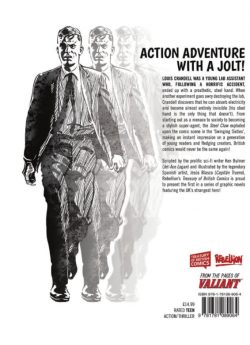
The Steel Claw: Invisible Man


By Ken Bulmer & Jesús Blasco (Rebellion)
ISBN: 978-1-78108-906-4 (TPB)

One of the most fondly-remembered British strips of all time is the startlingly beautiful Steel Claw. From 1962 to 1973the stunningly gifted Jesús Blasco and his small studio of family members thrilled the nation’s children, illustrating the angst-filled adventures of scientist, adventurer, secret agent and even costumed superhero Louis Crandell.

The majority of the character’s career was scripted by comic veteran Tom Tully, but initially follows the premise of HG Wells’ original unseen adversary as prolific science fiction novelist Ken Bulmer devises a modern spin on the Invisible Man…

Another stunning salvo of baby boomer nostalgia from Rebellion’s Treasury of British Comics strand, this first collection is available in paperback and digital editions. The Steel Claw: Invisible Man gathers material from timeless weekly anthology Valiant, spanning 6th October 1962 to 21st September 1963 and stories from the Valiant Annual 1965 and 1966.

Following an Introduction from Paul Grist, the tense drama begins with our eventual hero debuting as a rather surly assistant to the venerable Professor Barringer, working to create a germ-destroying ray.

Crandell is an embittered man, possibly due to having lost his right hand in a lab accident. After his recovery and itsreplacement with a steel prosthetic he is back at work when the prof’s device explodes. Crandell receives a monumental electric shock and is bathed in radiation from the ray-device which, rather than killing him, renders him totally transparent. Although he doesn’t stay unseen forever, this bodily mutation is permanent. Electric shocks cause all but his metal hand to disappear.

Kids of all ages, do not try this at home!

Whether venal at heart or temporarily deranged, Crandell goes on a rampage of terror against society and destruction of property throughout Britain which culminates in an attempt to blow up New York City before he finally coming to his senses. Throughout Crandell’s outrages, Barringer is in guilt-fuelled pursuit, determined to save or stop his former friend…

The second adventure channels another classic (The Strange Case of Dr Jekyll and Mr Hyde), intriguingly pitting the Claw against his therapist, who – in an attempt to treat him – is also traumatically exposed to Barringer’s ray. Instead of permanent invisibility, Dr. Deutz develops the ability to transform himself into a bestial ape-man who malevolently turns to crime and frames Crandell for a series of spectacular robberies and rampages.

On the run and innocent for once, Crandell is saved by the intervention of Barringer’s niece Terry Gray. After weeks of beast-triggered catastrophe and panic in the streets, the Steel Claw is vindicated and proved a hero… of sorts…

Bulmer’s next tale changes location to the Bahamas as our star shifts from outlaw to hero. While recuperating on an inventor-friends yacht, Crandell is accidentally embroiled in a modern-day pirate’s attempt to hijack an undersea super-weapon system…

After would-be bullion bandit Sharkey and his nefarious gang steal the device and use it to capture a submarine, their convoluted scheme to rob an ocean liner falters when a steel fisted ghost starts picking them off one by one…

More than any other comics character, the Steel Claw was a barometer for reading fashions. Starting out as a Quatermass style science fiction cautionary tale, the strip mimicked the trends of the greater world, becoming a James Bond-style super-spy strip with Crandall eventually tricked out with outrageous gadgets, and latterly, a masked and costumed super-doer when TV-show-triggered “Batmania” gripped the nation and the world. When that bubble burst, he resorted to becoming a freelance adventurer, combating eerie menaces and vicious criminals. Before we head too far down that path however, his contributions to Valiant Annuals 1965 and 1966 (released Autumn 1964 and 1965 respectively) afford rather more constrained thrills and chills as Crandell defeats a gang using an electricity-supressing gadget to rob a blacked-out London and one year later aid the Metropolitan police force corral a bunch of apparently invisible bandits dubbed the Phantom Raiders…

The thrills of the writing are engrossing enough, but the real star of this feature is the artwork. Blasco’s captivating classicist drawing, his moody staging and the sheer beauty of his subjects make this an absolute pleasure to look at. Buy it for the kids and read it too; this is a glorious book, and brace yourself for even better yet to come …
© 1962, 1963, 1965, 1966 & 2021 Rebellion Publishing IP Ltd. All Rights Reserved.

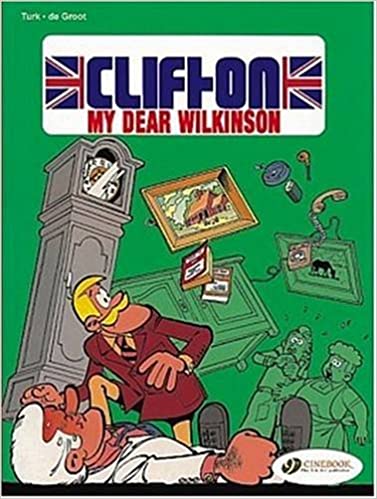
Clifton volume 1: My Dear Wilkinson


By De Groot & Turk translated by Luke Spear (Cinebook)
ISBN: 978-1-905469-06-9 (Album PB)

For some inexplicable reason most of Europe’s comics cognoscenti – especially the French and Belgians – are fascinated with us Brits. Gosh, I wonder if that’s still the case…?

Whether it’s Anglo air ace Biggles, indomitable adventurers Blake and Mortimer, the Machiavellian machinations of Green Manor or even the further travails of Long John Silver, or the amassed amateur sleuths of the Detection Club, the serried stalwarts of our Scepter’d Isles have cut a dashing swathe through the pages of the Continent’s assorted magazines and albums.

And then there’s Clifton…

Originally devised by child-friendly strip genius Raymond Macherot (Chaminou, Les croquillards, Chlorophylle, Sibylline) for Le Journal de Tintin, the doughty troubleshooter first appeared in December 1959.

After three albums worth of short strip material – compiled and released between 1959 and 1960 – Macherot left the magazine to join arch-rival Le Journal de Spirou and the eccentric comedy crime-fighter floundered until Tintin revived and repurposed him at the height of the Swinging London scene courtesy of Jo-El Azaza & Greg. These strips were subsequently collected as Les lutins diaboliques in French and De duivelse dwergen for Dutch-speakers in 1969.

He was furloughed again until the mid-1970s when writer Bob De Groot and illustrator Philippe “Turk” Liegeois revived Clifton for the long haul, producing ten tales of which this –Ce cher Wilkinson: Clifton from 1978 – was the fifth.

From 1984 onward artist Bernard Dumont AKA Bédu limned De Groot’s scripts before eventually assuming the writing chores too until the series folded in 1995. In keeping with its rather haphazard but Diehard nature, Clifton resurfaced again in 2003, crafted by De Groot and Michel Rodrigue in four further adventures; a grand total of 26 to date.

The setup is deliciously simple: pompous and irascible Colonel Sir Harold Wilberforce Clifton, ex-RAF and recently retired from MI5, has a great deal of difficulty accommodating being put out to pasture in rural Puddington. He thus takes every opportunity to get back in the saddle, occasionally assisting the Government or needy individuals as a gentleman troubleshooter.

Sadly, for Clifton – as with that other much-underappreciated national treasure Captain Mainwaring in Dad’s Army – he is keenly aware that he is usually the only truly competent man in a world full of blithering idiots…

In this initial translated adventure first seen in 2005 – and at last available in digital formats – the forceful personality is seething at home one night, reading ghost stories when a sequence of odd events culminates in both he and his nationally celebrated cook and housekeeper Miss Partridge witnessing plates of food and glasses of wine flying about and crashing to the floor.

Fortifying themselves with the remaining sherry, the staunch duo repair to their separate beds unaware that a very live presence has been spying on them and playing pranks…

The next day finds the perplexed sleuth at the town library, scanning the stacks for reports of similar phenomena and tediously regaled by one of the whippersnapper counter-staff who just happens to be an amateur and closet psychokinetic: demonstrably and smugly able to move small objects with the power of his mind…

With proof of a rather more rational explanation for recent events and an appropriate reference tome, Clifton bones up and is soon made annoyingly aware of stage performer the Great Wilkinson who is reputedly the world’s greatest exponent of the art of psychokinesis.

A quick jaunt to London in the old red sports car soon sees the former spy getting along famously with a diminutive performer who happily agrees to come down to Puddington and recce the Colonel’s troubled home. To be perfectly frank, the smiling showman is far more interested in meeting celebrated chef Miss Partridge…

A pleasant afternoon is interrupted by old associate Chief Inspector John Haig of Scotland Yard who is drowning in an uncanny mystery and desperately needful of a second opinion from MI5’s most self-congratulatory alumnus. Giant safes are going missing, seemingly plucked from buildings as if by mighty, invisible hands…

Thus proceeds a wickedly fast-paced romp with a genuine mystery tale at its comedic core. Clifton and Co fumble their way past roguish red herrings and through a labyrinthine maze of clues to the lair of a canny criminal mastermind with what seems the perfect MO. However, long before justice triumphs, the tinderbox temper of the suave sleuth is repeatedly triggered by clodhopping cops, obnoxious officials, short-fused chefs, imbecilic bystanders and a succession of young fools and old clowns all getting in the way and utterly spoiling the thrill of the chase…

Delightfully surreal, utterly accessible and doused with daft slapstick in the manner of Jacques Tati or our own Carry Onfilms (sans the saucy “slap ‘n’ tickle” stuff), this light-action epic rattles along in the grand old tradition of Will Hay, Terry-Thomas and Alistair Sim – or Wallace and Gromit and Mr Bean if you’re a callow yoof – offering readers a splendid treat and loads of timeless laughs.
Original edition © 1978 Le Lombard (Dargaud-Lombard S. A.) 1988 by De Groot & Turk. English translation © 2005 Cinebook Ltd.

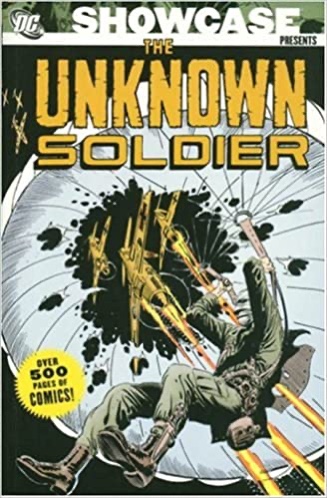
Showcase Presents The Unknown Soldier volume 1


By Joe Kubert, Bob Haney, Robert Kanigher, Archie Goodwin, Frank Robbins, David Michelinie, Irv Novick, Dan Spiegle, Doug Wildey, Jack Sparling, Gerry Talaoc & various (DC Comics)
ISBN: 978-1-4012-1090-2 (TPB)

Digital comics are a welcome miracle these days, but still painfully uninspired and under provided for as regards certain genres. I’m not sure if it’s the platforms or the publishers who are at fault, but I do know that an incredible wealth of superb comics material – most of it in proven genres such as war or humour – remains locked in paper when it could be reaching new audiences at the push of a button. Here’s an absolute gem from DC’s venerable combat annals that can still be readily acquired in its physical form at least…

After the death of EC Comics in the mid-1950’s and prior to the game-changing Blazing Combat, the only guaranteed place to find powerful, controversial, challenging and entertaining American war comics was DC. In fact, even whilst Archie Goodwin’s stunning but tragically mis-marketed quartet of classics were waking up a generation, the home of Superman, Batman and Wonder Woman was a veritable cornucopia of gritty, intriguing and beautifully illustrated battle tales presenting war on a variety of fronts and from many differing points of view.

When the Vietnam War escalated, 1960’s America entered a home front death-struggle pitting deeply-ingrained establishment social attitudes against a youth-oriented generation with a radical new sensibility. In response DC’s (or rather National Periodical Publishing, as it then was) battle books became even more bold and innovative…

This stunning monochrome compendium – collecting the lead feature from issues #151-188 (June-July 1970 to June 1975) of the veteran Star-Spangled War Stories anthology features one of the very best concepts ever devised for a war comic: a faceless, nameless hero perpetually in the right place at the right time, ready, willing and oh, so able to turn the tide…

The Unknown Soldier was actually a spin-off: having first appeared as a one-off in a Sgt. Rock story in Our Army at War #168 (June 1966, by Robert Kanigher & Joe Kubert).

In 1970, the artist had become editor of the company’s war division and was looking for a new (American) cover/lead character to follow the critically acclaimed “Enemy Ace” tales of a WWI German fighter pilot. Hans von Hammer had been summarily bounced to the back of the book after issue #150 and as Superheroes faded in popularity in favour of more traditional genres, Kubert wanted a striking new hero to front one of DC’s oldest war titles.

Written and drawn by Kubert ‘They Came Back from Shangri-La!’ introduced a faceless super-spy and master-of-disguise whose forebears had fought and died in every American conflict since the birth of the nation. Set in 1942 here, he took on the identity of B-25 pilot Capt. Shales as he participated in vital, morale-building retaliatory bombing raids on Japanese cities. When their plane is shot down over occupied China, “Shales” leads his crew through enemy-infested territory to the safety of the Chinese resistance…

From this no-nonsense start, the feature grew to be one of DC’s most popular and long-lived: with issue #205 Star-Spangled became The Unknown Soldier in 1977 and the comic only folded in 1982 with issue #268.

One intriguing factor in these tales is that there is very little internal chronology: the individual adventures take place anytime and anywhere between the bombing of Pearl Harbor and the surrender of Germany and Japan. This picaresque approach adds a powerful sense of both timelessness and infallible, unflinching continuity. The invisible man known only as The Unknown Soldier has always and will always be where he is most needed…

His second adventure ‘Instant Glory!’ finds a US patrol captured by the SS as they enter a German city in 1944. An excoriating examination of brutality, heroism and philosophy, this story sets the hard-bitten, bitter-edged tone for the rest of the series.

Always economy-conscious and clever with scissors and glue, DC reformatted a number of old stories at this time, particularly old westerns and mystery stories so it should be no surprise that they would try the same thing with their newest star.

‘Everybody Dies’ was retooled into a new offering via a framing sequence drawn by Kubert, but the body of the tale was originally seen as ‘A GI Passed Here’ (illustrated by Irv Novick in Star-Spangled War Stories #36). In its revamped form, the saga recounts a grim 24 hours in the life of anonymous Eddie Gray as he survives just one more day in the deserts of Nazi-held Africa.

The Unknown Soldier got a full origin in #154’s ‘I’ll Never Die!’, recounting how two inseparable brothers join up in the days before America was attacked and are posted to the Philippines just as the Japanese begin their seemingly unstoppable Pacific Campaign. Overwhelmed by a tidal wave of enemy soldiers, the brothers hold their jungle posts to the last and when relief comes only one has survived. His face is a tattered mess of raw flesh and bone…

As the US forces retreat from the islands, the indomitable survivor is evacuated to a stateside hospital. Refusing medals, honours and retirement, the recuperating warrior dedicates his remaining years to his lost brother Harry and determinedly retrains as a one man-army intelligence unit. His unsalvageable face swathed in bandages, the nameless fighter learns the arts of make-up, disguise and mimicry before offering himself to the State Department as an expendable resource that can go anywhere and do anything…

All DC’s titles were actively tackling the issue of race at this time and #155’s ‘Invasion Game!’ (written by Bob Haney) sees the Soldier parachuted into France in Spring 1944 to connect with the Underground’s mysterious leader “Chat Noir”. Sent to finalise the plans for D-Day, he is horrified to discover the enigmatic commander is a disgraced black US Army sergeant with a grudge against his old country. Chat Noir was too good a character to waste and became a semi-regular cast member…

Haney was on top form for the next epic too. ‘Assassination’ details the Immortal G.I.’s boldest mission and greatest failure as he impersonates but cannot destroy Hitler himself, after which that aforementioned Sgt. Rock classic by Kanigher & Kubert is recycled as an untitled but deeply moving yarn for Star-Spangled War Stories #157. Haney & Kubert then reunited for ‘Totentanz!’ as the faceless warrior breaks into a top security concentration camp to rescue a captured resistance leader.

General George S. Patton is the thinly-veiled subject of ‘Man of War’ as Unknown Soldier is dispatched to investigate a charismatic general who has pushed his own troops to the brink of mutiny, before ‘Blood is the Code!’ finds him captured and tortured by a Japanese Colonel until he snaps: revealing every secret America wants the enemy to know…

Doug Wildey illustrated Haney’s superb ‘The Long Jump’ as the Soldier infiltrates occupied Holland, only to meet more resistance from a stubborn, misguided Dutchman than all the Nazis hunting for the faceless spy, after which ‘Take My Coward’s Hand’ recycles 1960 Sgt. Rock story ‘No Answer from Sarge’ (by Kanigher & Kubert from Our Army at War #91) and ‘Kill the General!’ – by Haney & Dan Spiegle – pits the Man of a Thousand Faces against Nazi infiltrators determined to assassinate General Eisenhower at the height of the Battle of the Bulge.

‘Remittance Man!’ in #164 has the anonymous warrior replace a legendary spotter on an occupied Pacific island, directing Allied attacks on Japanese strongholds, after which Jack Sparling came aboard as artist in ‘Witness for a Coward’. Here, a US tank commander sentenced to death for desertion is saved by the testimony of a Nazi Officer – but only after he is abducted from his HQ by the Immortal G.I., after which a debt of honour has to be repaid…

Bill Mauldin’s legendary wartime dogfaces “Willie and Joe” (see assorted Up Front collections for further details) pay an unannounced visit in #166’s ‘The True Glory’ when the Unknown Soldier travels to Italy to find out what is holding up the advance in Haney’s last offering…

Archie Goodwin steps in to script ‘Three Targets for the Viper!’ wherein the faceless man hunts an assassin set on killing Churchill, Roosevelt and De Gaulle during a conference in 1943 Morocco. We jump to France in 1944 next, and a close encounter with an American officer determined to make a name for himself at any cost in ‘The Glory Hound!’

Goodwin’s tenure saw a stronger concentration on espionage drama, as with issue #169’s ‘Destroy the Devil’s Broomstick!’ which finds the Immortal G.I. infiltrating a compound where Hitler’s latest secret weapon is being built, after which the Soldier stands in for an irreplaceable Marine Major and captures an impregnable island fortress in ‘Legends Don’t Die!’

‘Appointment in Prague!’ offers a rare and tragic glimpse into the Unknown Soldier’s past as he follows the aged actor who taught him mastery of make-up and impersonation into Nazi-occupied Czechoslovakia to rescue a grandson thought long dead, after which scripter Frank Robbins took over, moving the action to the Eastern Front in ‘A Cocktail For Molotov!’ wherein Nazis pull out all the stops to destroy Russia’s charismatic foreign Minister before he concludes a treaty with the Allies.

Star-Spangled War Stories #173 finds the G.I. infiltrating a Japanese Submarine base disguised as a Nazi wrestler invited to an exhibition match against a Sumo master. ‘No Holds Barred!’ proves that,, although allies, Japanese and Germans weren’t exactly friends…

‘Operation Snafu!’ begins an extended storyline as it found him impersonating a German tank-commander and forced to sacrifice his own Resistance allies in order to complete a mission vital to the Allied advance, whilst ‘A Slow Burn… From Both Ends!’ offers him the chance to make amends and #176’s ‘Target: The Unknown Soldier!’ ramps up the tension as the Nazis discover a way to identify the faceless warrior no matter how he is disguised…

With Von Sturm – his deadly Nazi counterpart – on his trail, the Unknown Soldier stirs up ‘The Hornet’s Nest!’ and is hunted and hounded towards a concentration camp where inmates work as slaves to construct V1 rockets. Trapped, with the net closing around him, he replaces one of the jailers but Von Sturm is determined to deliver ‘The Sting of Death!’ in a spectacular climactic duel to the death…

Star-Spangled War Stories #179 focuses on the aftermath of his close escape when the Soldier stumbles into ‘A Town Called Hate!’ where racial tensions between white and black G.I.s has devolved into tit-for-tat murders. Unfortunately, whilst disguised as a member of an SS infiltration squad, he can only exacerbate the situation. With the Germans about to deliver a devastating counter-attack, it’s a good thing the long-missing Chat Noir is also on hand…

‘The Doomsday Heroes!’ despatches the anonymous agent to the Leyte Gulf where Japanese suicide attacks have halted the US advance. However, before he can begin his mission, he is shot down and forced to work with a failed Kamikaze pilot to survive the cruel Pacific seas…

After that tragedy of honour the mission continues with ‘One Guy in the Right Place…’ as the Soldier links up with natives fighting Japanese invaders. Disturbingly, they are led by an unseen American who sounds like the brother he lost in the first days of the war. Can Harry have survived all these years…?

Robbins and Sparling bowed out with a classy mini-classic in Star-Spangled War Stories #182. Set in Tunisia, ‘A Thirst for Death!’ sees the Soldier and a crew of veterans on the sandy trail of Rommel‘s hidden petrol reserves, after which new kids David Michelinie & Gerry Talaoc herald a change of direction with ‘8,000 to One’.

The horror boom in comics was at its peak in 1974 and new editor Joe Orlando capitalised on that trend with a few startling changes – the most controversial being to regularly reveal the Unknown Soldier’s grotesque, scar-ravaged face – presumably to draw in monster-hungry fear fans…

The story itself harks back to the Immortal G.I.’s earliest days as an American agent; sent to Denmark to rescue a ship full of Danish Jews destined for Hitler’s death camps. Disguised as SS Captain Max Shreik, the Soldier is forced to make an unconscionable choice to safeguard his mission. The degree and manner of graphic violence also exponentially increases to accommodate a perceived more mature readership as the Soldier takes a very personal revenge…

‘A Sense of Obligation’ places the cold, remorseless warrior in France, tasked with infiltrating a Special Kommando Training Centre and destroying it from within. However, as with all undercover work, the risk of going too deep and making friends who you might have to kill later inevitably leads to another tragic life or death decision for the increasingly grim and soulless Soldier, whilst ‘The Hero’ finds the faceless man invading neutral Switzerland to kidnap a British scientist held by Nazis. This time, his lethal final judgement costs him no sleep at all…

In ‘Man of God… Man of War’ (#186) a Catholic Priest duped into working with the Nazis in Italy becomes the Soldier’s latest target, but the plan is forestalled and a shocking situation revealed and rectified after ‘A Death in the Chapel’.

This imposing, impressive and thoroughly entertaining first volume concludes with Star-Spangled War Stories #188 and ‘Encounter’ as the Unknown Soldier strives to prevent the scuttling of a hospital ship by Nazis, unaware that his only ally is in love with the enemy commander…

Dark, powerful, moving and overwhelmingly ingenious, The Unknown Soldier is a magnificent addition to the ranks of extraordinary mortal warriors in an industry far too heavy with implausible and incredible heroes. These tales will appeal to not just comics readers but all fans of action fiction, and one day will make it to TV or movies and blow us all away all over again…
© 1970, 1971, 1972, 1973, 1974, 1975, 2006 DC Comics. All rights reserved.