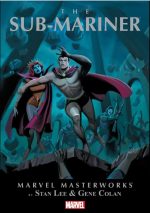
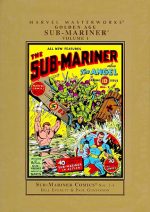
Marvel Masterworks: Golden Age Sub-Mariner volume 1


By Bill Everett, Paul Gustavson, Alan Mandel & others (Marvel)
ISBN: 978-0-7851-1617-2 (HC)                    978-0-7851-5789-2 (PB)

Prince Namor, the Sub-Mariner is the hybrid offspring of an undersea Atlantean princess and an American polar explorer; a being of immense strength, highly resistant to physical harm, able to fly and thrive above and below the waves. Created by young Bill Everett, Namor technically predates Marvel/Atlas/Timely Comics.

He first caught the public’s attention as part of the Fire vs. Water headlining team in Marvel Comics #1 (October 1939, before becoming Marvel Mystery Comics with the second issue). His elementally apposite co-star was the Human Torch, but Namor had originally been seen – albeit in a truncated version – in the monochrome freebie Motion Picture Funnies: a weekly promotional giveaway handed out to moviegoers earlier that year.

Quickly becoming one of Timely’s biggest draws, Namor gained his own title at the end of 1940 (cover-dated Spring 1941) and was one of the last super-characters to go at the end of the first heroic age.

In 1954, when Atlas (as the company had become known) briefly revived its “Big Three” (the Torch and Captain America being the other two), Everett returned for an extended run of superb fantasy tales, but the time wasn’t right and the title sunk again. Once more Subby was the last revived character to be cancelled, as rumours of a possible TV series deal kept the book afloat…

When Stan Lee & Jack Kirby began reinventing the superhero genre in 1961 with the Fantastic Four, they quickly revived the forgotten amphibian as a troubled, semi-amnesiac, yet decidedly more regal and grandiose anti-hero, understandably embittered at the loss of his sub-sea kingdom (seemingly destroyed by American atomic testing).

He also became a dangerous bad-boy romantic interest: besotted with the FF’s golden-haired Sue Storm…

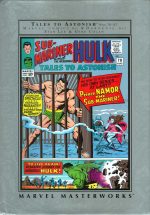
Namor knocked around the budding Marvel universe for few years, squabbling with assorted heroes such as Daredevil, the Avengers and X-Men, before securing his own series as part of “split-book” Tales to Astonish with fellow antisocial antihero the Incredible Hulk and went on to become a cornerstone of the modern Marvel Universe.

Following his dynamic relaunch/debut in the anthological Marvel Comics #1, the Sub-Mariner solo title began in Spring 1941, and the first four issues are gathered here (available as a sturdy hardcover, titanic trade paperback of electrifying eBook) with a reminiscence-packed, fact-filled Introduction from comics scribe and historian Roy Thomas to provide all the context and backstory any finny fun-fan would ever need, and also incorporates all the rousing in-situ ads seen in the original releases.

Sub-Mariner Comics #1 featured two complete strip-stories starring the conflicted overlord of Atlantis plus a chilling yarn featuring costumed detective and adventurer The Angel: the first of a long run of macabre thrillers…

In first tale ‘Deep-Sea Blitzkrieg’, Namor goes to war against the perfidious Nazis after a fleet of German U-Boats depth-charges the underwater city of Atlantis. The Avenging Prince immediately retaliates in a bombastic show of super-power that perfectly displays the unmatched graphic virtuosity of his creator Bill Everett.

The second story (by Everett and unknown assistants) concerns a deadly disease afflicting his aquatic subjects, necessitating the Sub-Mariner’s return to New York to obtain – by any means necessary – a supply of Radium. The dual Hero/Villain nature of the character was always a major factor in Namor’s popularity, so even a shared enemy couldn’t keep him on the good side of the American authorities for long…

For most of these stories Everett and other lead artists used a string of assistants culled from the comicbook “Shop” outfits. With no accurate records, best guesses for uncredited contributors include Charles Nicholas (née Wojtkoski), Witmer Williams, Ben Thompson, Sam Gilman, George Mandel, Mike Roy, Al Fagaly & Jimmy Thompson.

These deluxe collections also include those mandatory text features comics were compelled to run to maintain their postal status (an arcane system that allowed them to procure large postal discounts as “second class mail”) so you can also enjoy prose fable ‘Namor… His Boyhood’ by Roy Gill before moving on to Paul Gustavson’s caped and costumed detective in the 20-page gothic chiller ‘The Angel and the House of Horror’.

Although dressed like a superhero, this dashing do-gooder was actually a blend (knock-off would be perhaps a bit unkind) of Leslie Charteris’s The Saint and The Lone Wolf (Louis Vance’s urbane two-fisted hero who was the subject of 8 books and 24 B-movies between 1917 and 1949).

One marked difference was the quality of the Angel’s enemies: his foes tended towards the arcane, the ghoulish and the just plain demented…

The globe-trotting paladin also seemed able to cast a giant shadow in the shape of an angel. Not the greatest aid to cleaning up the scum of the Earth but he seemed to manage…

Sub-Mariner Comics #2 (Summer 1941) starts off with another (untitled) Nazi-busting tale – even though America was officially neutral until December 8th of that year – as Namor foils a scheme to spring thousands of German POW’s from internment in Canada.

Everett’s hand is still in evidence but by this time an increasing number of those aforementioned assistants were slowly diluting his work as he struggled to produce a monthly strip in Marvel Mystery and his other commitments.

‘Steaming Statistics of Fire and Water’ – illustrated by Harry Sahle – offers a package of fun facts before the second adventure finds Namor in a Pennsylvania town hunting fifth-columnists and spies who have fomented a strike amongst the miners producing coal for ships fuel. Cartoonist Lewis Glanzman provided a ‘Bum Jokes’ gag-page and young Stan Lee wrote a text feature entitled ‘The Story behind the Cover: Namor “Blitzes” a Nazi Sub’ before The Angel (illustrated by Alan Mandel) quashes a sinister plot in New England to free ‘The Slaves of the Python’.

The Fall 1941 issue then opens with ‘The Mystery of the Disappearing Island’: a strikingly topical two-part tale that mixes Winston Churchill, the thorny question of Irish neutrality and a submerged city of druids invaded by Nazis as a staging post for future bomber raids on Britain.

This exotic fight-heavy romp, tinged with immediacy by political issues, was an extra-long one (40 pages) followed by a mediocre and uncredited prose tale ‘Dispatch from Africa’ before culminating with a rather incestuous murder mystery wherein the Angel hunts for a killer when ‘Death Draws a Comic Strip!’

Sub-Mariner Comics #4 begins with ‘Murders by Ghost Light’ and Namor investigating a haunted hospital hiding all manner of non-Hippocratic shenanigans. The spooky themes continue when he then encounters a giant madman-made monster in ‘The Horror That Walked.’

‘Fresh Meat for a Raider’ is a prose naval adventure written by a promising young writer named Mickey Spillane, whilst ‘Pop’s Whoppers’ (by Art Gates) is a jolly comedy feature starring an inveterate tall-tale teller, followed by another sinister horror puzzler for the Angel: ‘Death’s Merry-Go-Round!’.

The vintage voyages then conclude with a lost gem from the legendary Basil Wolverton who wraps things up with a comically surreal Dr. Dimwit page.

Before we leave, however, a selection of Sub-Mariner Comics house ads and photo features of a contemporary comics newsstand and Everett himself further enhance the period experience…

Many early Marvel Comics are more exuberant than qualitative, but this volume, even if largely devoid of premiere league talent, is a wonderful exception. Offering high-octane, outrageously jingoistic tub-thumping and staggering action: a splendid, historically unvarnished read as well as forgotten treasure Fights ‘n’ Tights fans will find irresistible.
©1941, 2005, 2012, 2017 Marvel Characters, Inc. All rights reserved.
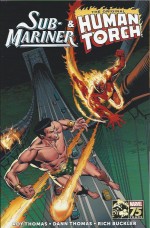
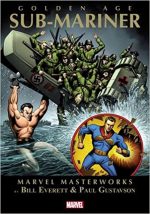
Sub-Mariner & the Original Human Torch


By Roy Thomas, Dann Thomas, Rich Buckler & various (Marvel)
ISBN: 978-0-7851-9048-6

Prince Namor, the Sub-Mariner is the hybrid offspring of a sub-sea Atlantean princess and an American polar explorer; a being of immense strength, highly resistant to physical harm, able to fly and thrive above and below the waves. Created by young Bill Everett, Namor technically predates Marvel/Atlas/Timely Comics.

He first caught the public’s attention as part of the elementally electrifying Fire vs. Water headlining team in Marvel Comics #1 (October 1939 and soon to become Marvel Mystery Comics) alongside the Human Torch, but had originally been seen in a truncated version in the monochrome Motion Picture Funnies, a weekly promotional giveaway handed out to moviegoers earlier in the year.

Quickly becoming one of the new company’s biggest draws, Namor gained his own title at the end of 1940 (cover-dated Spring 1941) and was one of the last super-characters to go at the end of the first heroic age. In 1954, when Atlas (as the company then was) briefly revived its “Big Three” (the Torch and Captain America being the other two), Everett returned for an extended run of superb fantasy tales, but even so the time wasn’t right and the title sunk again.

When Stan Lee & Jack Kirby began reinventing comic-books in 1961 with Fantastic Four, they revived the forgotten amphibian as a troubled, semi-amnesiac, yet decidedly more regal and grandiose anti-hero, understandably embittered at the loss of his sub-sea kingdom which had seemingly been destroyed by American atomic testing.

He also became a dangerous bad-boy romantic interest: besotted with the FF’s golden-haired Sue Storm…

Namor knocked around the budding Marvel universe for few years, squabbling with assorted heroes such as Daredevil, the Avengers and X-Men, before securing his own series as part of “split-book” Tales to Astonish with fellow antisocial antihero the Incredible Hulk,

In 1988, as part of Marvel’s 50th Anniversary celebrations, that phenomenal half-century of comicbook history was abridged, amended, updated and generally précised by avowed fan and self-appointed keeper of the chronology Roy Thomas and his writing partner Dann Thomas who collaboratively commemorated the Avenging Son’s contribution in 12-part Limited Series miniseries The Saga of the Sub-Mariner. The saga was rapturously drawn by Rich Buckler.

Roy and Rich did the same with The Saga of the Original Human Torch – a 4-part series which ran from April to July 1990 – and both sides of the tempestuous coin are triumphantly tossed together in this splendidly all-encompassing, no-nonsense textbook of historic Fights ‘n’ Tights mythology…

It all begins thousands of years ago with ‘A Legend a-Borning’ from The Saga of the Sub-Mariner #1 (November 1988) with Buckler inked by Bob McLeod. A short history of the sinking of antediluvian Atlantis and its eventual reoccupation by nomadic tribes of water-breathing Homo Mermanus follows. The water-breathing wanderers splendidly flourish deep in the icy waters, and their story leads to a certain American research vessel which sails into icy waters in 1920…

Its depth-charging and icebreaking has horrendous consequences for the citizens of the depths and in response Emperor Thakorr organises a possibly punitive expedition. Instead his daughter Princess Fen uses experimental air-breathing serums to infiltrate the ship and forms a brief liaison with Captain Leonard McKenzie. They even marry but neither is aware that the voyage has been arranged by unscrupulous telepath Paul Destine who is drawn to the area by an uncanny device of ancient power and origins…

Whilst Destine is being buried under a catastrophic avalanche trying to excavate the artefact, a raiding party from Atlantis boards the ship and drags Fen back home. She believes her husband is killed in the attack…

Nine months later a strange, pink-skinned baby is born beneath the deep blue sea…

The story resumes years later with teenaged Namor experiencing prejudice firsthand as he plays with his blue-skinned chums and royal cousin Prince Byrrah. The passing of his callow years are interspersed with his grandfather’s disdain, his mother’s tales of the fabled “Americans” and the annoying girl Dorma who is always hanging around…

Every day seems to point out another way in which he differs from his people, such as his ever increasing strength, ability to live unaided on the surface and the wings on his ankles which give him the power of flight.

Life changes forever when the youngster is salvaging a sunken ship and shockingly encounters a brace of clunky mechanical men from the surface world doing the same.

In panic he attacks, severing the control cables which connect to a ship far above and proudly hauling them to Atlantis as a prize. For once grandfather is delighted: especially when the face plates are pried open and he sees dead surface-men within.

He’s ever more gleeful when Byrrah suggests Namor should go beard the Surfacers in their own realm to pay them back for the past destruction of Atlantis. Young, feisty and gullible, Namor sets off, ready to live up to his name which means ‘Avenging Son’…

‘A Prince in New York’ spectacularly depicts the fantastic reign of terror and destruction Sub-Mariner wrought upon the city until distracted and talked down by plucky blonde policewoman Betty Dean. It then reveals how he learns to despise Nazi Germany’s maritime depredations before ‘A Fire on the Water’ details how New York Special Policeman the (original) Human Torch is deputised to stop him at all costs…

He never quite succeeds but the ongoing clash resulted in some of the most astonishing scraps in comics history. With the city almost wrecked by their battles Betty Dean again steps in to calm the boiling waters and the next chapter – inked by Richardson & Company – introduced the ‘Invaders!’ as Hitler incomprehensibly decides to eradicate Atlantis with depth charges and U-boats. The act of wanton hatred merely secures the Sub-Mariner’s fanatical aid for the Allied Powers.

With Thakorr wounded, the people elect Namor Emperor by popular acclaim before watching him swim off to crush the Axis and their super-powered servants. He fights with and beside the Torch, Captain America, Bucky, Spitfire and Union Jack. By the time the war is won and Namor returns to his realm, Byrrah and his crony Commander Krang have turned recuperating Thakorr against his interim emperor and Sub-Mariner finds himself banished. Only Lady Dorma’s impassioned intervention prevents the homecoming becoming a bloodbath…

With nowhere else to go Namor rejoins his surface superhero friends to create the post-war All-Winners Squad, before eventually being summoned home by his cousin Namora. Atlantis has been ravaged by air-breathing gangsters…

Seeking vengeance they team up with Betty for a short-lived crusade against criminals, madmen and monsters until again recalled to the rebuilt underwater kingdom.

Namor’s years away had gradually diminished his mighty hybrid abilities, but now-recovered Thakorr orders Atlantis’ greatest scientists to restore them so the Sub-Mariner can renew the Realm’s war against all surface-men…

Instead, Namor attempts diplomacy but his State Visit to the United Nations resulted in violent protests and the death of a bystander. He returns to his grandfather a bitter man, but still argues against war, no matter how hard General Krang and Byrrah urge it…

When Atlantis is wracked by seaquakes Namor leads a patrol to the polar cap above and discovers freshly-exhumed Paul Destine is responsible. The psychic had found a fantastic Helmet of Power which magnified his gifts exponentially and decided to test his new abilities on the closest population centre…

Enraged Namor’s physical might is useless against the tele-potent madman and in an instant Destine wipes his fishy foe’s memories and sends him to live as an amnesiac amongst the dregs of New York, blindly awaiting his future ‘Dark Destiny’ (McLeod inks)…

The epic history lesson reaches the dawn of the Marvel Age decades later as ‘Rage and Remembrance’ recaps the epochal events after new Human Torch Johnny Storm restores the memory of a weary derelict and unleashes the rage of the Sub-Mariner once again. With his mind and most of his memories back Namor instantly heads home to find Atlantis razed and his people scattered. Blaming the humans, he launches a series of blistering attacks on the Fantastic Four whilst attempting to win the heart of the clearly conflicted Invisible Girl…

As months pass he discovers his people had relocated and rebuilt Atlantis. Namor is re-elected Emperor over the protests of Byrrah and betrothed to Lady Dorma, unknowingly earning the eternal enmity of Warlord Krang who has always wanted her…

His war against the surface-men continues, escalating into a brief invasion of New York, a turbulent alliance with the Hulk and clash with the ‘Avengers!’ (Mike Gustovich inks) which results in the revival of his now-forgotten Invaders comrade Captain America…

Sub-Mariner’s pointless sorties against mankind continue as he forcefully adds the X-Men and Magneto to his roster of enemies whilst still trying to take Sue Storm away from Reed Richards.

After repelling an invasion by sub-sea barbarian Attuma he softens and again attempts to gain official recognition for Atlantis. Whilst he is making his embassage, however, Krang seizes control of Atlantis. After battling Daredevil, Namor returns too his kingdom, deals with the usurper and more-or-less dials back his campaign against the surface. Sadly this peace is interrupted as Destine again strikes inviting the new monarch to a ‘Rendezvous with Destiny!’ (McLeod inks).

Time and events telescope from now on as ‘Losses in Battle’ rapidly traces Namor’s showdown with the mental maniac, alliance with the Inhuman Triton and battles with Plantman, Dr. Dorcas, Tiger Shark, the Thing and a host of others, as well a reunion with Betty Prentiss (nee Dean) and rise of the sinister antediluvian Serpent Cult of Lemuria which first devised the formidable Helmet of Power in eons past.

Also revealed is how Namor’s marriage to Dorma is thwarted by murderous Lemurian LLyra and his subsequent agonising first and last meetings with his father…

‘Blood Ties’ then details his meeting with and adoption of Namora’s teenaged daughter Namorita, clashes with Doctor Doom and MODOK, an alliance of Byrrah and Llyra and origins of the Defenders before ‘Triumphs… and Tragedy!‘ (inked by McLeod & Co) brings us to a cameo-packed conclusion, relating Namor’s enforced alliance with Doom, admission into the Mighty Avengers and loss of two of his greatest loves…

Although appearing a tad rushed, the writing is strong: offering fresh insights for those familiar with the original material whilst presenting the chronicles in an engaging and appetising manner for those coming to the stories for the first time. Moreover Buckler’s solidly dependable illustration capably handles a wide, wild and capacious cast with great style and verve.

Balancing the watery wonderment is the later and far shorter comics chronology of Sub-Mariner’s arch ally and favourite enemy as first seen in The Saga of the Original Human Torch.

It starts with ‘The Lighted Torch’ by Thomas, Buckler & Danny Bulanadi, which shows how the Flaming Fury burst into life as a malfunctioning humanoid devised by troubled and acquisitive Professor Phineas Horton. Instantly igniting into an uncontrollable fireball whenever exposed to air, the artificial innocent was consigned to entombment in concrete but escaped to accidentally imperil the metropolis until it/he fell into the hands of a malign mobster named Sardo.

When the crook’s attempts to use the android as a terror weapon dramatically backfired the hapless newborn was left a misunderstood fugitive – like a modern day Frankenstein’s monster. Even his creator only saw the fiery Prometheus as a means of making money.

Gradually gaining control of his flammability, the angry, perpetually rejected android decides to make his own way in the world…

Instinctively honest, the creature saw crime and wickedness everywhere and resolved to do something about it. Indistinguishable from human when not afire, he joined the police as Jim Hammond, tackling ordinary thugs even as his volcanic alter ego battled such outlandish bandits as Asbestos Lady. Before long the Torch met Betty Dean when New York City Chief of Police John C. Wilson asked him to stop the savage Sub-Mariner from destroying everything. The battles are spectacular but inconclusive but only end after Betty intervenes and brokers a tenuous ceasefire.

Later, a brusque reunion with Horton sets the Torch of the trail of his creator’s former assistant Fred Raymond. Hammond is too late to stop Asbestos Lady murdering the Raymonds in a train wreck but adopts their little boy Toro who gains the power to become a human torch as soon as he meets the artificial avenger. The partners in peril become a team who set ‘The World on Fire!’; battling beside Namor in the Invaders for the duration of WWII.

They even play a major role in ending the conflict in 1945 when they storm a Berlin bunker and incinerate Hitler, before rising ‘Out of the Ashes…’ (inked by Alfredo Alcala) by battling Homefront hostiles, exposing Machiavellian android mastermind Adam-II who, with knowledge of the future, attempts to assassinate a group of strangers who would all eventually be Presidents of the USA. The Fiery Furies formed the backbone of the All-Winners Squad, battling maniacs and conquerors from tomorrow, continuing their campaign against crime long after their comrades retired…

When a family crisis benches Toro, the Torch soldiers on with new sidekick Sun Girl until he returns. The reunion is destined to short and far from sweet…

The hot history lesson concludes in ‘The Flaming Fifties!’ (inked by Romeo Tanghal) as Jim Hammond bursts from a desert grave during a nuclear test explosion, revived from a chemically-induced coma mimicking death. His last memory was of being ambushed by gangsters and sprayed with a chemical which inhibited his flame and knocked him out. Blazing back to the ambush site he attacks his assailants and discovers four years have passed…

When they try the same solution again the compound no longer works on his atomically charged form and after a band of G-Men burst in the truth comes out. The Torch and Toro vanished in 1949 and when pressed the crooks admit to having got their chemical cosh from the Russians. More chillingly, they paid for it by handing Toro over to the Reds…

After spectacularly rescuing and deprogramming the Soviets’ flaming secret weapon, the Torch brings Toro home and they continue their anti-crime campaign against weird villains, Red menaces and an assortment of crooks and gangsters but before long tragedy again strikes as the atomic infusion finally reaches critical mass in Jim’s android body.

Realising he is about to flame out in a colossal nova, the Human Torch soars into the desert skies and detonates like a supernova…

The pre-Marvel Age adventures of the Torch end here but devotees already know Jim Hammond was resurrected a number of times in the convoluted continuity that underpinned the modern House of Ideas…

This substantial primer into the prehistory of the Marvel Universe also includes a quartet of original art covers plus a brace of full-colour, textless covers.

Fast, furious and fabulously action-packed, this is a lovely slice of authentic Marvel mastery to delight all lovers of Costumed dramas.
© 1988, 1989, 1990, 2014 Marvel Characters, Inc. All rights reserved.
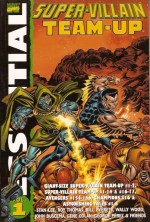
Essential Super-Villain Team-Up volume 1


By Roy Thomas, Steve Englehart, Wally Wood, Keith Giffen & various (Marvel)
ISBN: 978-1-9041-5973-5

Prince Namor, the Sub-Mariner was the second super-star of the Timely Age of Comics (but only because he followed after the cover-featured Human Torch in Marvel Mystery Comics #1) and has had the most impressive longevity of the company’s “Big Three” Torch, Subby and Captain America.

He was revived in 1962 in Fantastic Four #4; once again an anti-hero/noble villain and has been prominent in the company’s pantheon ever since.

The following issue introduced the first great villain of the Silver Age in the form of technologically armoured dark knight Doctor Doom, who takes up the lion’s share of this eclectic yet excellent collection of dastardly double-dealings encompassing Astonishing Tales #1-8, Giant-Sized Super-Villain Team-Up #1-2, Super-Villain Team-Up #1-14 and 16-17, as well as pertinent crossover appearances in Avengers #154-156 and Champions 16.

Incidentally, Fantastic Four #6 featured the first Super-Villain Team-Up of the Marvel age as Doom and Namor joined forces as ‘The Deadly Duo’. The Master of Latveria inevitably betrayed and tried to kill the Prince of Atlantis in that tale: an event which colours the relationship of the characters to this day… All of those magical moments appear in Essential Fantastic Four volume 1, by the way.

Although Doom had his first true solo outing in Marvel Super-Heroes #20 (May 1969) this magnificent and monumental monochrome collection opens with his follow-up series which began with ‘Unto You is Born… the Doomsman!’ (July-August 1970) wherein Roy Thomas & Wally Wood revealed the master manipulator’s daily struggle to maintain his iron control over the Ruritanian kingdom of Latveria, building a super-robot to crush the incipient rebellion of ousted Crown Prince Rudolfo and his mysterious sponsor.

However the use of a girl who seemed to be Victor von Doom’s lost love had the desired effect and the rebels almost succeeded in driving the tyrant from Doom Castle. In the attendant chaos the Doomsman device wandered away…

‘Revolution!’ proved Doom was not the only master of mechanoids as Rudolfo and the enigmatic Faceless One used the Doomsman to wreak havoc throughout the country, before a final assault in ‘Doom Must Die!’ (scripted by Larry Lieber) found all the tyrant’s enemies vanquished and the Monarch of Menace once more firmly in control.

Lieber & Wood then pitted Doom against the Red Skull in ‘The Invaders!’ as an army of leftover Nazis stormed into the country whilst Doom was away, only to be crushed and banished in ‘A Land Enslaved!’ (Astonishing Tales #5, by Lieber, George Tuska & Mike Esposito) as soon as he came back.

Issue #6 saw the Lord of Latveria invade the African nation of Wakanda in ‘The Tentacles of the Tyrant!’ determined to seize the vast stock of wonder mineral Vibranium only to fall foul of the furious tenacity of its king and defender T’Challa the Black Panther in ‘…And If I be Called Traitor!’ (Gerry Conway, Gene Colan & Frank Giacoia).

The short solo run ended in high style with a little landmark entitled ‘Though Some Call it Magic!’, wherein Conway, Colan & Tom Palmer revealed Doom’s darkest secret. Every year the ultimate villain was forced to duel the rulers of Hell in the vain hope of freeing the soul of his mother from eternal torment, and every year he failed: a tragic trial which punished both the living and the dead.

With this tormented mini-epic even further depth and drama were added to the greatest villain in the Marvel universe.

The series vanished with no warning and Doom returned to his status as premier antagonist in the Fantastic Four and elsewhere until Giant-Sized Super-Villain Team-Up #1 was released (March 1975), once more bathing the Deadly Despot in a starring spotlight.

In the intervening years the Sub-Mariner had also lost his own series, despite some very radical and attention-grabbing stunts. A nerve gas dumping accident perpetrated by surface dwellers had catastrophically altered his hybrid body, forcing him to wear a hydrating-suit to breathe. The same toxin had plunged the entire nation of Atlantis into a perpetual coma.

Alone and pushed to the brink of desperation, Prince Namor rescued Doom from a deadly plunge to Earth after the Iron Dictator’s latest defeat the hands of the FF and Silver Surfer in an impressive and effective framing sequence bracketing two classic reprint tales. ‘Encounter at Land’s End!’ (by Roy Thomas, John Buscema & Joe Sinnott) saw Doom plucked from the sea and the edge of death by a Sub-Mariner in dire need of scientific wizardry to cure his somnolent race and prepared to offer an alliance against all mankind to get it…

Painfully aware of their unhappy past history the outlaws recalled a previous encounter ‘In the Darkness Dwells Doom!’ (from Sub-Mariner #20, by Thomas, Buscema & Johnny Craig) wherein the fugitive Atlantean was offered sanctuary in New York’s Latverian embassy before being blackmailed and betrayed (again) by the Devil Doctor…

Initially reluctant, Doom reconsiders after recalling a past battle against the diabolical Diablo. ‘This Man… This Demon!’ (Thomas, Lieber, Giacoia & Vince Colletta) is the aforementioned solo tryout from Marvel Super-Heroes #20, which restated the Doctor’s origins and revealed his tragic, doomed relationship with a gypsy girl named Valeria…

The debate ends in a cataclysmic clash of egos and raw destructive power with both parties more bitterly opposed than ever but the follow-up ‘To Bestride the World!’ (Thomas, Mike Sekowsky & Sam Grainger) in the all-new Giant-Sized Super-Villain Team-Up #2 (June 1975), forced Doom to change his mind when his own android army rebelled after the long-lost Doomsman (under its new guise of Andro) returned and co-opted them for a war against organic life.

After blistering battle and extensive carnage Namor and Doom triumphed together and parted uneasy allies, only to regroup in the pages of Super-Villain Team-Up #1 (August 1975) as a chaotic ongoing series began with ‘Slayers from the Sea!’ by Tony Isabella, George Tuska, Bill Everett & Fred Kida.

As Doom actually contemplates treating an ally as a equal in the opening chapter ‘An Alliance Asunder?’, in the second part ‘Frenzy on a Floating Fortress’ (illustrated by George Evans & Frank Springer) Namor is ambushed by old foes Attuma, Dr. Dorcas and Tiger Shark, leading Doom to rush to his rescue in #2 as ‘In the Midst of Life…!’ (with art from Sal Buscema & Kida) the Sub-Mariner’s truest friend was murdered by his assembled enemies, leading to a brutal climax in ‘If Vengeance Fails!’ by Jim Shooter, Evans & Jack Abel.

Super-Villain Team-Up was an intriguing concept cursed with a revolving door creative team crisis: nobody seemed able to stay with the series for more than a couple of issues. Somehow the standards remained high but with no long-term planning the plots and characterisation jumped all over the place.

Bill Mantlo, Herb Trimpe & Jim Mooney produced ‘A Time of Titans!’ in #4 as Doom and Sub-Mariner battled each other and encountered a prototype Deathlok the Demolisher before splitting up yet again, after which Steve Englehart stepped in for ‘…And Be a Villain!’ (illustrated by Trimpe & Don Perlin) wherein the Lord of Latveria artificially exacerbated Namor’s breathing affliction and threatened to annihilate dormant Atlantis. Despite all the efforts of the Fantastic Four the Sub-Mariner was forced to swear fealty to Doom or see his people and himself perish forever…

This tumultuous issue also introduced mystic Batman knock-off the Shroud whose avowed mission was to free the world from the curse of Doom at all costs…

Jack Abel inked ‘Prisoner!’ in #6 as the FF invaded Latveria to rescue the promise-bound Sub-Mariner only to be sent packing by US Secretary of State Henry Kissinger who had just signed a non-aggression pact with Doom. One American observed no such legal or diplomatic niceties in ‘Who is… The Shroud?’ (Pablo Marcos inks) and, after revealing his origins to Namor, the Master of Darkness freed him from his vow by killing Dr. Doom.

As Shroud and Namor fled for the border chaos broke out in Latveria, but in actuality Doom was not dead. He had been rescued and imprisoned by Namor’s cousin Namorita and girlfriend Tamara in ‘Escape!’ (illustrated by Keith Giffen & Owen McCarron) under the misguided apprehension that they could force the Metal-shod Monarch into helping Atlantis and their Prince., The crisis escalated as it segued into an ongoing Avengers storyline, beginning ‘When Strikes Attuma?’ (Avengers #154 by Conway, George Perez & Marcos) as the Sub-sea Slayer enslaved the World’s Mightiest Heroes and commanded them to kill Namor…

The saga continued in Super-Villain Team-Up #9 (scripted by Mantlo, drawn by Jim Shooter & Sal Trapani) as the ‘Pawns of Attuma!’ attacked only to discover Doom in charge and easily able to thwart their half-hearted assault. In Avengers #155 the beaten heroes were helpless, leaving only the confused, battle-crazed Namor and a substitute team to hunt down the barbarian sea lord, with the epic conclusion ‘The Private War of Doctor Doom!’ in #156 (written by Shooter, drawn by Sal Buscema & Marcos) where the liberated and resurgent heroes joined forces to crush Attuma and prevent Doom from turning the situation to his own world-conquering advantage…

Behind the scenes in Latveria, Shroud had installed Prince Rudolfo as a faux Doctor Doom but things went wrong very quickly in Super-Villain Team-Up #10 (by Mantlo, Bob Hall & Perlin) when Captain America investigated ‘The Sign of the Skull!’

In the Latverian Embassy the genuine despot learned from the Star-Spangled Avenger that Red Skull had once more invaded Doom’s homeland, even as the Sub-Mariner discovered greedy surface-men pillaging his comatose city of Atlantis.

As Doom and Captain America battled their way through Latveria’s formidable defences the Skull proceeded in establishing his Fourth Reich, easily defeating the Shroud in ‘My Ally, my Enemy’ but when Namor raged in, tracking the ravagers of Atlantis to Doom’s castle, the tables were finally turned and the Iron Dictator swore to finally cure the Atlanteans in return for the Sub-Mariner’s aid against the Nazi invaders.

Firstly though, the Skull plans to enslave the earth with a hypno-ray had to be crushed in ‘Death Duel!’ with the Iron Doctor pursuing the Nazi mastermind to his hidden moonbase, casually sacrificing the Shroud in the process.

Finally fulfilling his oath Doom resurrected the comatose Atlanteans in #13, but only after a blistering sub-sea battle with amphibian arch-foe Krang and a brobdingnagian sea beast in ‘When Walks the Warlord!’ (by Mantlo, Giffen & Perlin)

With Atlantis and Namor restored a new era began and ended with Super-Villain Team-Up #14 (October 1977). ‘A World For the Winning!’ by Mantlo, Hall, Perlin & Duffy Vohland, opened with mutant villain Magneto tricked into a duel with Doom who was de facto master of the world since he had seeded the atmosphere with a mind control gas.

Ever the sportsman, the Lord of Latveria released Magneto from his control, allowed him to liberate one other thrall and challenged them both to save the world…

It was the last issue of the troubled title and the story concluded in Champions #19 (November 1977) as the Master of Magnetism and the Beast spectacularly overcame all odds and saved the day in ‘A World Lost!’ (Mantlo, Hall & Mike Esposito). A year later Super-Villain Team-Up #15 appeared from nowhere (dated November 1978 and presumably released to safeguard the copyright) with a reprint of the Red Skull story from Astonishing Tales #4-5.

‘Shall I Call Thee Master?’ by Peter Gillis, Carmine Infantino & Bruce Patterson was released a year later ( #16 May 1979, with one final issue 12 months after that) wherein the Skull, Hatemonger and radical geneticist Arnim Zola whiled away the days in a human atrocity lab. This was a dark exploration of monstrous inhumanity where torture and degradation were simply a way of passing the time until the leftover Fascists could build a new Cosmic Cube and reshape all reality to their twisted whims.

In this instance they were thwarted by merely mortal secret agents in the long delayed but savagely effective conclusion ‘Dark Victory!’ (Gillis, Arvell Jones & Patterson), after which the concept and title were shelved for decades.

This eccentric and thoroughly fan-only compendium concludes with a double page spread omitted from earlier reprintings of ‘This Man… This Demon!’ and the rather magnificent cover of that tale from Marvel Super-Heroes #20.

For all its flaws Super-Villain Team-Up was a bold experiment and a genuinely enjoyable dalliance with the different during the 1970s – as long as the reader had an in depth knowledge of the company’s ever- more complex continuity. I truly wish more people would sample the delights of this offbeat saga but I doubt any new reader could cope with the terrifying torrent of unexplained backstory.

Still, I’d be delighted if you prove me wrong…
© 1970, 1971, 1975, 1976, 1977, 2008 Marvel Characters, Inc.  All Rights Reserved.