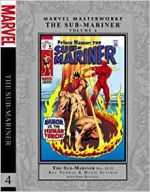
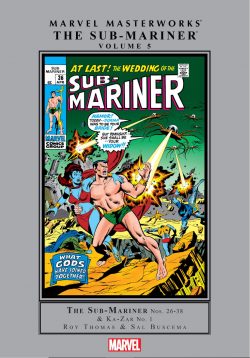
Sub-Mariner Marvel Masterworks volume 5


By Roy Thomas, Allyn Brodsky, Sal Buscema, Ross Andru, Frank Springer & various (Marvel)
ISBN: 978-0-7851-6619-1 (HB/Digital edition)

Prince Namor, the Sub-Mariner is the offspring of a water-breathing Atlantean princess and an American polar explorer; a hybrid being of immense strength, highly resistant to physical harm, able to fly, and thrive above and below the waves. Created by young, talented Bill Everett, Namor technically predates Marvel/Atlas/Timely Comics.

He first caught the public’s avid attention as part of an elementally appealing fire vs. water headlining team-up in the October 1939 Marvel Comics #1 (which renamed itself Marvel Mystery Comics from #2 onwards). The amphibian antihero shared honours and top billing with The Human Torch, but had originally been seen (albeit in a truncated, monochrome version) in Motion Picture Funnies: a promotional booklet handed out to moviegoers earlier in the year. Rapidly emerging as one of the industry’s biggest draws, Namor won his own title at the end of 1940 (cover-dated Spring 1941) and was one of the last super-characters to vanish at the end of the first heroic age.

In 1954, when Atlas (as the company then was) briefly revived its “Big Three” line-up – the Torch and Captain America being the other two – Everett returned for an extended run of superbly dark, mordantly timely fantasy fables. However, even his input wasn’t sufficient to keep the title afloat and eventually Sub-Mariner sank again.

In 1961, as Stan Lee & Jack Kirby were reinventing superheroes with the landmark title Fantastic Four, they revived the awesome, all-but-forgotten aquanaut as a troubled, semi-amnesiac antihero. Decidedly more bombastic, regal and grandiose, this returnee despised humanity: embittered and broken by the loss of his sub-sea kingdom which had been (seemingly) destroyed by American atomic testing. His rightful revenge became infinitely complicated after he became utterly besotted with the FF’s Susan Storm.

Namor knocked around the budding Marvel universe for a few years, squabbling with other star turns such as The Hulk, Avengers, X-Men and Daredevil before securing his own series as one half of Tales to Astonish, and from there graduating in 1968 to his own solo title.

This fifth subsea selection trawls Prince Namor, the Sub-Mariner #26-38 and portions of Ka-Zar #1, spanning June 1970 to June 1971, and opens with another heartfelt appreciation and more creative secret-sharing in an Introduction from life-long devotee – and primary scribe of this book – Roy Thomas. The drama recommences as recently self-appointed relentless guardian of the safety and ecology of all Earth’s oceans, the Prince of Atlantis furtively returns to the surface world.

In ‘“Kill!” Cried the Raven!’ by Thomas, Sal Buscema & Joe Gaudioso (AKA Mike Esposito) the Sub-Mariner has come to investigate reports of comatose superhuman Red Raven. He was the human emissary of a legendary race of sky-dwelling Birdmen recently encountered by The Angel of the X-Men in their last clash with Magneto. With the covert assistance of old friend Diane Arliss, Namor seeks to forge an alliance with the Avian race, but shocks, surprises and the Raven’s trauma-induced madness all conspire to sink the plan…

Back brooding in Atlantis in the wake of another failure, Namor’s mood is further plagued when a human pirate uses his giant monster-vessel to attack shipping with Atlantis bearing the brunt of blame ‘When Wakes the Kraken!’ His hunt for bizarre bandit Commander Kraken again involves Diane and ends only when the Sub-Mariner demonstrates what a real sea monster looks like…

Recuperating with her in New York City, Namor is incensed by the actions of an unrepentant industrial polluter and joins teen protestors fighting developer Sam Westman’s thugs and mega machines in ‘Youthquake!’ before we pause for a little diversion…

Beginning as a Tarzan tribute act relocated to a lost world in a sub-polar realm of swamp-men and dinosaurs, Ka-Zar eventually evolved into one of Marvel’s more complex and mercurial characters. Wealthy heir to one of Britain’s oldest noble families, his best friend is Zabu the sabretooth tiger, his wife is feisty environmental-crusader Shanna the She-Devil and his brother is a homicidal super-scientific bandit. Kevin Reginald, Lord Plunder is perpetually torn between the clean life-or-death simplicity of the jungle and the bewildering constant compromises of modern civilisation.

The primordial paragon even outranks Namor in terms of longevity, having begun as a prose pulp star, boasting three issues of his own magazine between October 1936 and June 1937. They were authored by Bob Byrd – a pseudonym for publisher Martin Goodman or one of a fleet of writers on his staff – and he was latterly shoehorned into a speculative new-fangled comic book venture Marvel Comics #1. There he roamed alongside another pulp mag graduate: The Angel, plus Masked Raider, the Human Torch and Sub-Mariner

When Ka-Zar reappeared all rowdy and renovated in 1965’s X-Men #10, it was clear the Sovereign of the Savage Land was destined for bigger things. However, for years all he got was guest shots as misunderstood foe du jour for Daredevil, Sub-Mariner, Spider-Man, and the Hulk.

In 1969, he took his shot with a solo saga in Marvel Super-Heroes and later that year – after Roy Thomas & Neal Adams used him so effectively in their X-Men run (issues #62-63) – was awarded a giant-sized solo title reprinting many previous appearances. The title also incongruously offered all-new stories of Hercules and the second, mutant X-Man Angel. That same month, Ka-Zar’s first regular series began in Astonishing Tales

That Hercules back up from Ka-Zar #1 (August 1970 by Allyn Brodsky, Frank Springer & Dick Ayers) is reprinted here as it impacts Namor’s exploits…

‘In his Footsteps… The Huntsman of Zeus!’ sees the potent Prince of Power on the run from an Olympian agent despatched by the King of the Gods. Following another bitter dispute with his sire Hercules returns to Earth, leaving Ares to foment trouble and prompt Zeus to set his terror-inducing Huntsman on the godling’s trail…

After seeking sanctuary with the Avengers, Hercules sees his mortal friends brutally beaten and flees once again…

The panicked rush takes him to Sub-Mariner #29 and the distant Mediterranean where the Huntsman ensorcells Namor and pits him against the fugitive. Although Hercules soon breaks the hypnotic spell, ‘Fear is the Hunter!’ reveals why the pursuer is so dreaded as he sends mythical terrors Scylla, Charybdis and Polyphemus against the heroes and the pitiful mortals of the region, until a valiant breakthrough ends the threat and forces a paternal reconciliation…

Another guest star treat materialises in #30 as ‘Calling Captain Marvel!’ sees Namor again reduced to a mesmerised puppet and attacking the Kree warrior and his human host Rick Jones. This time the condition is due to the amphibian’s falling in battle against toxic terrorist Mr. Markham who attempts to blackmail Earth by threatening to poison the seas with his molecular polluter. Once Captain Marvel batters Namor back to his right mind, they make quick work of the maniac in a concerted twin assault…

The fallout from his recent actions have unsettled Namor’s old friend Triton, and the Inhuman goes looking for the prince in #31 just as apparent Atlantean attacks on surface shipping mounts. Meeting equally concerned human Walt Newell (who operates as undersea Avenger Stingray) they finally find – and fight – the Sub-Mariner, only to learn the crisis has been manufactured by his old enemy who is now ‘Attuma Triumphant!’

The barbarian’s plans include destroying human civilisation, but he still has time to pit his captives against each other in a gladiatorial battle to the death; which of course is Attuma’s undoing…

Jim Mooney comes aboard as inker with #32 as a new and deadly enemy debuts in ‘Call Her Llyra… Call Her Legend!’ when fresh human atomic tests prompt Namor to voyage to the Pacific and renew political alliance with the undersea state of Lemuria. However, on arrival he finds noble Karthon replaced by a sinister seductress who lusts for war and harbours a tragic Jekyll & Hyde secret…

By the time he reaches Atlantis again the Sunken City is being ravaged by seaquakes and old political enemy Prince Byrrah is seizing control from Namor’s deputies and devoted paramour Lady Dorma. ‘Come the Cataclysm’ sees him first accuse surface-worlders before locating and defeating the true culprits – an alliance of Byrrah with failed usurper Warlord Krang and human mad genius Dr. Dorcas. In the throes of triumph, Prince Namor announces his imminent marriage to Dorma…

Antihero superteam The Defenders officially begin with Sub-Mariner #34-35 (cover-dated February & March 1971). As previously stated, the Prince of Atlantis had become an early and ardent activist and advocate of the ecology movement, and here he takes radical steps to save the planet by fractiously recruiting The Hulk and Silver Surfer to help him destroy an American Nuclear Weather-Control station.

In ‘Titans Three!’ and concluding chapter ‘Confrontation!’ (by Thomas, Sal Buscema & Jim Mooney) the always-misunderstood outcasts unite to battle a despotic dictator’s legions, the US Army, UN defence forces and the mighty Avengers to prevent the malfunctioning station from vaporising half the planet…

Inked by Berni Wrightson, Sub-Mariner #36 augurs a huge sea change in Namor’s fortunes that begins with time-honoured holy preparations for a happy event as ‘What Gods Have Joined Together!’ Elsewhere, arcane enemy Llyra is resuurected and seeks to steal the throne by abducting and replacing the bride-to-be whilst Namor is distracted by an invasion of Attuma’s hordes.

Ross Andru & Esposito take over illustration duties with #37 as an era ends and tragedy triumphs, leading to a catastrophic battle on ‘The Way to Dusty Death!’

Betrayed by one of his closest friends and ultimately unable to save his beloved, the heartbroken prince thinks long and hard before abdicating in #38 ‘Namor Agonistes!’: reprising his origins and life choices before choosing to henceforth pursue the human half of his hybrid heritage as a surface dweller…

To Be Continued…

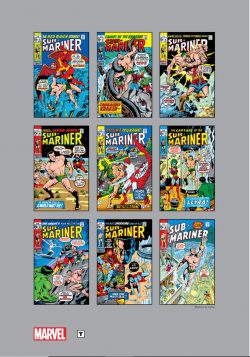
More sunken treasures salvaged here include the cover to all-reprint Sub-Mariner Annual #1 (January 1971, and reprising the underwater portions of Tales to Astonish #70-73) plus Bill Everett’s pin-up of young Namor, contemporary House Ads and Marie Severin’s glorious cover sketch for #33, plus a huge Biographies section.

Many early Marvel Comics are more exuberant than qualitative, but this volume, especially from an art-lover’s point of view, is a wonderful exception: a historical treasure with narrative bite that fans will delight in forever. Moreover, with the Prince of Atlantis now a bona fide big screen sensation that no one’s ever heard of, now might be the time to get wise and impress your friends with a little insider knowledge…
© 2018 Marvel Characters, Inc. All rights reserved.
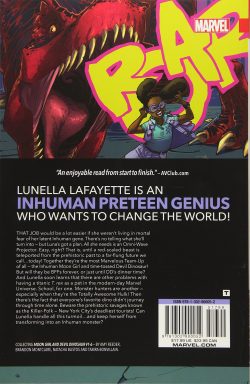
Moon Girl and Devil Dinosaur volume one: BFF


By Brandon Montclare, Amy Reeder, Natacha Bustos, Tamra Bonvillain & various (Marvel)
ISBN: 978-1-3029-0005-2 (TPB/Digital edition)

The Marvel Universe is absolutely stuffed with astounding young geniuses but Lunella Lafayette is probably the most memorable you’ll ever meet. Very young, very gifted and proudly black, she lives with her parents on Manhattan’s Lower East Side when not attending Public School 20 Anna Silver on Essex Street.

Thanks to her obsessive interest in astronomy and alien races the other kids mockingly call her “Moon Girl” whilst the brilliant, bored 4th grader’s teachers universally despair because she already knows so much more than they do…

It’s a hassle, but Lunella actually has bigger problems. Time is running out and her numerous applications to specialist schools such as the Fantastic Four’s Future Foundation have all gone unanswered. The situation needs resolving as it’s pretty important and urgent. Lunella has – correctly – deduced that she carries dormant Inhuman genes, and the constantly moving mutagenic Terrigen Cloud recently released into Earth’s atmosphere (see both the Infinity and Inhumanity events) could transform her into a monster at any windswept moment…

Thanks to her investigations, she’s an expert in advanced and extraterrestrial technology, and her quest for a cure or Terrigen-deterrence procedure sees her perpetually sneaking out past bedtime in search of gadgets and detritus left behind after frequent superhero clashes around town…

That impetus reaches its hope-filled climax when her handmade detectors locate a discarded Kree Omni-Wave Projector in opening chapter ‘Repeat After Me’…

At some unspecified time in Earth’s distant prehistory, various emergent species of hominids eked out a perilous existence beside the last of the great lizards and other primordial giants. At one particular key moment, a wide-eyed innocent of the timid yet clever Small Folk saved a baby tyrannosaur from ruthless pre-human hunters the Killer Folk.

They had already slaughtered its mother and siblings with cunning snares and were merrily torturing the little lizard with blazing firebrands – which turned its scorched hide a livid, blazing red – before Moon Boy intervened…

Under the roaring light of a blazing volcano, boy and beast bonded, becoming inseparable companions. It was soon apparent the scarlet saurian was no ordinary reptile: blessed with uncanny intelligence and unmatchable ferocity, Devil became an equal partner in a relationship never before seen in the world. It did not, however, prevent the duo becoming targets for ruthless Killer Folk leader Thorn-Teeth who now slaughters and sacrifices beasts and Small Folk to a mystic “Nightstone”. A more advanced observer might remark on how much it resembles a Kree Omni-Wave Projector…

When Moon-Boy steals the dread talisman, he is savagely beaten near to death even as – in a gym class on Essex Street – Coach Hrbek confiscates and accidentally activates a fancy doodad Lunella’s been playing with instead of paying attention to getting fit.

Lights flash, time shreds and universes collide. A hole opens in space and a pack of bizarre monkey men shamble into modern New York. Arriving too late in the antediluvian valley, Devil Dinosaur thunders straight through the portal, intent on avenging his dying comrade…

Arriving in an impossibly confusing new world, Devil understandably panics. After causing much chaos and carnage, the bombastic beast sniffs little Lunella and snatches her up…

A mad chase ensues in ‘Old Dogs and New Tricks’ as deeply confused Devil marauds through Manhattan with outraged Lunella unable to escape or control the ferocious thunder lizard.

Meanwhile, the Killer Folk rapidly adapt to the new environment. Hiding out and observing everything occurring in the Yancy Street Subway Station, they soon prove the old adage about primitive not meaning stupid. Within days they have grasped the fundamentals of English and new concepts like money and clothes, as well as the  trickier notions of “gangs” and “protection rackets”…

Most importantly, Thorn-Teeth remembers that when they arrived, one of the hairless Small Folk was holding his Nightstone…

In ‘Out of the Frying Pan’, Moon Girl is having little luck ditching the overly-attentive, attention-attracting Torrid T-Rex. Tragically, when she finally does, the Killer Folk grab her and the Omni-Wave…

Their triumph is short-lived, since the lizard’s superior sense of smell summons Devil to the rescue, although, in the resulting melee, the precious device is lost. Growing grudgingly fond of the colossal critter, Lunella stashes Devil in her super-secret lab underneath PS 20, but when a spot of student arson sets the school ablaze, her hideaway is exposed and Devil bursts up through the ground to rescue kids trapped on an upper floor…

The fracas also unfortunately attracts the kind of superhero response Lunella has been dreading. ‘Hulk + Devil Dinosaur – ‘Nuff Said’ sees smug, teenaged Gamma-powered Avenger Amadeus Cho butt in with his bulging muscles and inability to listen to reason…

Poor Devil is no match for the Totally Awesome Hulk, forcing Moon Girl to intervene with some her own inventions. Across town, the Killer Folk – proudly carrying the Nightstone – deal with the last obstacle to their supremacy in the Yancy Street criminal underworld…

The Battle of PS 20 reaches its inevitable conclusion and Cho confiscates Devil Dinosaur, leaving Lunella thoroughly grounded and (apparently) behaving like a normal little girl in ‘Know How’.

Of course, it’s all a trick and as soon as everybody is lulled into complacency Moon Girl kits herself out with more devious gadgetry and busts Devil out of the Top Secret Wing of the Natural History Museum. She’s on a tight deadline now: her weather-monitoring gear confirms the Terrigen Cloud is rolling back towards Manhattan…

The spectacular jailbreak results in a ‘Eureka!’ moment coinciding with the Killer Folk consolidating their grip on the streets and using the Omni-Wave to capture Moon Girl. It also results in Lunella’s mother discovering who broke a dinosaur out of jail, and she furiously heads to the school for a reckoning with her wayward child…

The final conflict sees our little warrior at last victorious over the Killer Folk, albeit too late. As Moon Girl and Devil Dinosaur roar in triumph on the rooftops, Lunella realises she is trapped outside with the Terrigen cloud descending. Her time and opportunity to create a cure has come and gone…

To Be Continued…

Collecting Moon Girl and Devil Dinosaur #1-6 from January to June 2016, this compelling, immensely entertaining romp is crafted by writers Brandon Montclare & Amy Reeder, with art from Natacha Bustos, colours by Tamra Bonvillain and letters from Travis Lanham. With a cover and variants gallery from Trevor Von Eeden, Pascal Campton, Paul Pope, Jeffrey Veregge & Pia Guerra, this addictively engaging yarn affords non-stop fun: a wonderful all-ages Marvel saga that is as fresh, thrilling, moving and hilariously funny now as it ever was.

Moon Girl and Devil Dinosaur: BFF is the kind of tale to lure youngsters into the comics habit and a perfect tool to seduce jaded older fans back into the fold…
© 2016 Marvel Characters, Inc. All rights reserved.
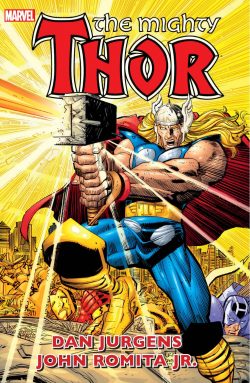
Thor Volume One


By Dan Jurgens & John Romita Jr., Klaus Janson, with Howard Mackie, Scott Hanna, & various (MARVEL)
ISBN: 978-0-7851-4632-2 (TPB/Digital edition)

In the middle of 1962, Stan Lee and Jack Kirby launched their latest offbeat superhero creation in anthology monsters-and-mysteries title Journey into Mystery #83. The tale introduced meek, disabled American doctor Donald Blake who took a vacation in Norway only to encounter the vanguard of an alien invasion. Fleeing in terror, he was trapped in a cave and found an old, gnarled walking stick. When, in helplessness and frustration, he smashed the cane into a huge boulder obstructing his escape, his insignificant frame was transformed into the hulking and brawny Norse God of Thunder, Thor!

The series grew from formulaic beginnings battling aliens, commies and cheap thugs into a vast, breathtaking cosmic playground for Kirby’s burgeoning imagination with Journey into Mystery inevitably becoming the Mighty Thor. After years of celestial adventuring, the peculiarities and inconsistencies of the Don Blake/Thor relationship were re-examined – as well as his doomed romance with his nurse Jane Foster – and all was finally clarified and explained regarding how an immortal godling could also be frail Don Blake.

The epic saga took the immortal hero back to his long-distant youth, ultimately revealing that the mortal surgeon was no more than an Odinian deception: a living shell designed to teach the Thunder God humility and compassion…

Time passed, Kirby left and the Thunderer’s fortunes waxed and waned. During the troubled mid-1990’s the title vanished, culled with The Avengers, Iron Man, Captain America and Fantastic Four and subcontracted out to Image creators Jim Lee and Rob Liefeld during 1996-1997 in a desperate attempt to improve sales after Marvel’s apocalyptic Onslaught publishing event.

In 1998 Heroes Return and Heroes Reborn saw those properties rejoin the greater Marvel Universe, relaunched with brand new first issues with the Thunder God reappearing a few weeks later. In July, Mighty Thor volume 2 launched, and this compendium gathers #1-8, plus Peter Parker, Spider-Man #2 spanning July 1998 to February #1999.

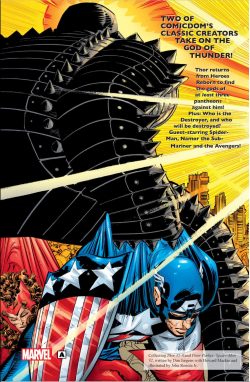
It begins with ‘In Search of the Gods’ by Dan Jurgens, John Romita Jr. & Klaus Janson and finds the Thunderer back on Midgard after more than a year away from the home cosmos, and instantly involved in a desperate hostage situation.

Acting immediately, he ends the crisis only to discover the perpetrator is the now-powerless Guardian God Heimdall. In the recently relaunched Avengers #1, Thor had found Asgard devastated and deserted and now that shocking mystery has been further compounded on Earth…

Elsewhere, Death Goddess Hela and Volla the Prophetess conspire in anticipation of cosmic calamity and desires reaching fruition, even as a military shipment goes badly wrong at New York’s docks where EMT/paramedic Jake Olsen gets the call to assist…

Before leaving Heimdall with (now) Doctor Jane Foster, Thor and the sentinel Asgardian explored shattered Asgard again, inadvertently liberating an unknown horror from ancient captivity, but that is forgotten as the docks situation worsens and Thor joins the hard-pressed Avengers in battling reawakened Odinian ultimate weapon The Destroyer

Despite the best efforts of the World’s Mightiest Heroes, the carnage is shattering and people die. People like Olson… and Thor…

Thor’s story nevertheless continues as his journey to Hela’s realm is interrupted by disturbing new cosmic entity Marnot who claims the Thunderer’s soul and returns it to the living world, bound to equally-miraculously resurrected Olsen in a revival of the spell that created Don Blake and just in time to stop The Destroyer. However, the new-old arrangement will prove to be a true ‘Deal with the Devil!’

Reborn as ‘God and Man’ in #3, the Storm Lord again walks the Earth – but only as the dormant-until-summoned alter-ego of another frail mortal host with a painfully complex personal life. It makes battling the sea-monsters of beguiling sea-goddess Sedna beside former Avenger Namor the Sub-Mariner a far from friendly reunion in ‘From the Ashes’ and leads to Mjolnir rebelling after Thor’s take-charge personality overrules Olsen’s legal authority when the Thunderer compels the paramedic to perform illegal surgery to save a life in ‘Heroes’

The wreckers of Asgard and Marnot have all been manoeuvring in the background throughout and following a flashback to Asgardian childhood ‘What’s a God to Do?’ finds Thor edging closer to the truth after another pointless clash with best pal Hercules. Once the dust has settled, Thor finds his people have been framed for attacking Olympus even as in Asgard the fate of the vanquished All-Father is revealed. However,  the ‘Deception’ has proven effective and Thor and Hercules are attacked by the entire outraged Hellenic pantheon…

The true architects of most of this mayhem are a pantheon of previously unknown Dark Gods – Perrikus, Adva, D’Chel, Slottoth, Tokkots and Majeston Zelia – so powerful that they have managed to take possession of the fallen Fabled Realm, constantly attack Thor since his return to Asgard and now bar him entirely from reaching his sundered home…

This initial collection concludes with a stellar crossover between hammer-hurler and webspinner as Thor #8 sees the Thunder God encounter Spider-Man when Tokkots goes on an Earthly rampage of destruction in ‘…and the Home of the Brave!’ before being spectacularly defeated and despatched to enslaved Asgard in ‘Plaything of the Gods’ (Peter Parker, Spider-Man #2, by Howard Mackie, Romita Jr. & Scott Hanna).

An all action, rocket-paced return to comic book basics, this revival includes a wealth of covers and variants by Romita Jr., Janson & Hanna, and, whilst perhaps not to everyone’s taste (it’s woefully short of anything even approaching a funny moment) is a blistering epic to delight the Fight’s ‘n’ Tights faithful, with the artwork undeniably some of the best of the modern Marvel Age. If you want your pulse to pound and your graphic senses to swim, this is the ideal item for you.
© 1998, 1999, 2010 Marvel Characters, Inc. All rights reserved. Digital version © 2020 MARVEL
Daredevil Marvel Masterworks volume 13 


By Marv Wolfman, Bill Mantlo, Jim Shooter, Chris Claremont, Bob Brown, John Buscema, John Byrne, Sal Buscema, Gil Kane, George Tuska, Frank Robbins, Al Milgrom & various (MARVEL) 
ISBN: 978-1-3029-1634-3 (HB/Digital edition) 

Matt Murdock is a blind lawyer whose remaining senses hyper-compensate, making him an astonishing acrobat, formidable fighter and living lie-detector. A second-string hero for much of his early career, Daredevil was nonetheless a striking and popular one, due mostly to the captivatingly humanistic art of Gene Colan. DD fought gangsters, super-villains and even the occasional monster or alien invasion, quipping and wisecracking his way through life and life-threatening combat, utterly unlike the grim, moody, quasi-religious metaphor he became.  

After a disastrous on-again, off-again relationship with his secretary Karen Page, Murdock took up with Russian émigré Natasha Romanoff, infamous and notorious ex-spy Black Widow. She was framed for murder and prosecuted by Matt’s best friend and law partner Foggy Nelson before the blind lawman cleared her. Leaving New York with her for the West Coast, Matt joined a prestigious San Francisco law firm but adventure, disaster and intrigue sought out the Sightless Sentinel and ultimately drew him back to the festering Big Apple… 

Spanning May 1976 to May 1977, the 13th compilation re-presents Daredevil #133-143, Annual #4, a crossover from Ghost Rider #19-20, and a spin-off from Marvel Premiere #39-40, cover-dated December 1977 and January 1978.  

We kick off with an Introduction from Marv Wolfman, recalling the strange days of his tenure as writer/editor before arguably the best proof possible of that opinion follows… 

Marvel was always keenly aware that any real-world attention was beneficial. Daredevil #133 begins laying groundwork for an unfolding epic about fake news and disinformation in public office (and remember this set just after Watergate and long before Trumpism!) before digressing with a fanciful fluff piece co-starring real-world stage trickster and headline-seeker Uri Geller. Concocted by Wolfman, Bob Brown & Jim Mooney, ‘Introducing: Mind-Wave and his Fearsome Think Tank!’ is a happily forgettable yarn about a maniac in a super-tank attacking Manhattan. Thankfully, Mind-Wave‘s arch enemy (Geller, claiming to have psychic powers granted him by aliens) is there to aid the Scarlet Swashbuckler… 

More sinister secrets of the perception-shaping masterplan of The Jester are revealed in #134’s ‘There’s Trouble In New York City…’ as disgruntled former football star/insurance salesman Brock Jones returns. Previously, he had stumbled into a plot to control Earth and took possession of a rocket-powered super-suit coveted by enemy agents. DD had almost been killed by the suit’s original owner, leading to the usual superhero misunderstanding and a savage clash. Now, as TV news showed Daredevil killing cops and with the shapeshifting Chameleon robbing at will, Brock again dons the suit to help the common man as The Torpedo, innocently adding to the chaos and confusion before the Chameleon is caught … 

The Jester’s grand scheme is revealed in ‘What Is Happening?’ The Manic Mountebank has exploited a computer pioneer to create a wave of stories making the public mistrust the authorities by manipulating the media. (I’m not commenting, I’m not commenting…) 

Seeing newspaper reports, photos and even news tapes of John and Robert Kennedy alive, superheroes killing cops and “proof” that Viet Nam never happened, but secret wars in Chile and Saudi Arabia did, much of the public readily accepts the villain was framed, resulting in DD being arrested and subsequently handed over to an army of thugs and gangsters. 

John Buscema assumed pencilling with #136 as the Jester’s endgame is exposed. When President Gerald Ford announces that New York City’ s police and all its superheroes have gone insane, citizens are urged to defend themselves at all costs. The entire scheme has been devised to leave the city open to plunder by the Jester’s hastily-united army of mobsters… 

Unable to keep away, DD takes action but is quickly captured and subjected to ‘A Hanging for a Hero!’ As a lynch mob of panicked citizens and enraged criminals almost execute the Man without Fear he flamboyantly escapes but is forced back into action for concluding episode 137 ‘The Murder Maze Strikes Twice!’ as “President Ford’s” broadcasts demand citizens take up arms and “take back Wall Street” from the thugs that now control it… 

Deducing the Jester’s location, DD storms in, dismantles all the villain’s traps – and minions – and restores order and justice, only to discover personal crises boiling over… 

Throughout the media reality war, Daredevil has been seeking to prove the innocence of Heather Glenn‘s father. Matt Murdock’s current girlfriend knows her dad isn’t a ruthless, murdering slumlord but that someone must have framed him. All evidence says otherwise. 

Now, as Matt and Foggy return to the case, word comes (for readers, as two excerpted pages from Ghost Rider #19 – August 1976 by Tony Isabella, Frank Robbins & Vince Colletta) depicting Karen Page being kidnapped by friend and ally Stuntman… 

It leads directly into Daredevil #138 where Wolfman, John Byrne & Mooney ask ‘Where is Karen Page?’ as the Man Without Fear drops everything for his one true love: heading for Los Angeles where Page is a Hollywood star with a complex convoluted life. However her relationship with hell-tainted Johnny Blaze is not why she was targeted, but rather from her father’s inventions and career as super-maniac Death’s Head …and the impostor now using the name to further his own insane plans… 

The saga concludes in Ghost Rider #20 (Wolfman, Byrne & Don Perlin) as ‘Two Against Death!’ exposes who is truly pulling all the strings with Satan-spawn and Scarlet Swashbuckler pairing to save Karen. Meanwhile in Manhattan, Foggy continues investigating Glenn Industries and is shot… 

The plot thread expands in Daredevil Annual #4’s ‘The Name of the Game is Death!’ Plotted by Wolfman, scripted by Chris Claremont, drawn by George Tuska and inked by Frank Chiaramonte, it finds The Black Panther aiding an industrialist whose son is abducted. 

Thanks to friendship with King T’Challa and judicious use of Vibranium, Robert Mallory has built the world’s first Tidal Power Station. Someone thinks holding his son will win them the plans but hasn’t counted on T’Challa paying his friend a visit at this inopportune moment… 

Daredevil, meanwhile, fights for his life, having stumbled into a furiously rampaging Sub-Mariner. Prince Namor has returned to the vile surface world because of a man named Mallory and a power station that while providing cheap clean energy for mankind will overheat the seas and divert the tides…  

Concluding chapter ‘And Who Shall Save the Panther?’ begins with the Great Cat prowling Manhattan, having tracked the crime to ambitious mobster Ruffio Costa. Sadly, he is unable to defeat the gangsters alone and eventually DD steps in to deliver a ransom, accidentally brining Sub-Mariner along for the ride… 

When the superbeings converge and clash, Costa is caught in the carnage and a lab explosion transforms him into something far worse that gradual climate crisis and the factions must all temporarily unite to defeat the threat of Mind-Master…  

The editorial story behind Wolfman, Sal Buscema & Mooney’s ‘A Night in the Life’ (Daredevil #139) is a true insight to comics at their best, but for readers it’s simply a chance to enjoy enhanced drama, suspense and action as the search for a missing haemophiliac boy overlaps a police manhunt for a mad bomber demanding the return of his drug-addicted wife. Wolfman was unsurpassed at interleaving soap opera melodrama with costumed cavorting, and the fraught tone carried over to in #140 as Bill Mantlo, Sal B & Klaus Janson detailed ‘Death Times Two!’ when a runaway bus dumped Daredevil into a hunt for accidentally united old enemies The Gladiator and The Beetle who then aimed a runaway train at Grand Central Station and attempted to settle old scores with the hero amidst the dead and dying… 

An even bigger change in tone began in #141. ‘Target: Death!’ was plotted by Wolfman, and scripted by Jim Shooter, with pencils divided between Gil Kane and Bob Brown, and Jim Mooney inking. It is very much a forerunner of what Roger McKenzie and Frank Miller would conceive of in months to come, opening with another murder attempt on Foggy and fresh insights into the abduction of his fiancée Debbie. More secrets of Glenn Industries are teased out, a killer dies and DD’s ultimate arch-nemesis returns for another killing spree before abruptly changing his mind and tying defeated Daredevil to a giant arrow and firing him at the New Jersey Palisades… 

Pulling out all the stops for his final forays, Wolfman – with Brown & Mooney – resurrected more classic villains for #142. Escaping one doom, DD meets new hero Nova, even as Mr. Hyde and The Cobra reunite, targeting the Scarlet Swashbuckler as he passes the rooftop rainforest garden of a young millionaire – ‘The Concrete Jungle’…  

This transitional selection concludes for now with ‘“Hyde and Go Seek” Sayeth the Cobra!’ (Wolfman, Brown & Keith Pollard) wherein the villains leave our hero to the carnivores populating the skyscraper Eden while they plunder the penthouse below. The goal is not wealth but ancient books and formulas to enhances their powers, but as ever, they grievously underestimate the boldness and ingenuity of the Man Without Fear… 

Also included in my dynamic digital edition is the two-issue try-out tale starring hero/villain The Torpedo who first accidentally battled DD in Daredevil #126-127. After the brief reprise recounted above he was given his big shot at fame Marvel Premiere #39-40 (from December 1977-January 1978) before ultimately dying in Rom: Spaceknight and being replaced by a teenaged female.  

‘Ride a Wild Rocket!’ and ‘…Battle with the Big Man!’ was a rushed-seeming collaboration of Wolfman, Mantlo, Brown, Al Milgrom, Josef Rubinstein, Bob Wiacek and Alan Weiss showing Brock hunting the rocketeer gang who originally owned his turbo-suit, but all his efforts to reclaim the acclaim of his quarterbacking days seem pointless. Harassed at home and bored at work, his American Dream is dying.  

After almost triggering a nuclear meltdown he is considered a menace, even though he saved the state from atomic catastrophe, and a critical change comes after the hidden mastermind behind all his woes and superhero aspirations decides enough is enough.  

As seen Captain America, Machine Man, and The Incredible Hulk, long-time villain Senator Eugene “Kligger” Stivak is a leader of criminal capitalists The Corporation and decides he will take care of Brock personally, but he has seriously underestimated the over-the-hill hero’s stubbornness and desperate need to regain his self-esteem… 

Supplementing all the amazing comics adventures, the extras sections include Wolfman’s editorial from #133 detailing the circumstances of Geller/Marvel’s publicity stunt, followed by original art pages all inked by Jim Mooney, a cover and splash page from John Buscema plus a splash each for Byrne and Brown, and an extensive biography section.  

As the social upheaval of the 1970s receded, these fabulous fantasy tales strongly indicated that the true potential of Daredevil was finally in reach. Their narrative energy and exuberant excitement are dashing delights no action fan will care to miss. 

…And the next volume heads into darker shadows, the grimmest of territory and the breaking of many boundaries… 
© 2019 MARVEL  

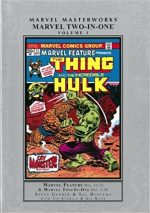
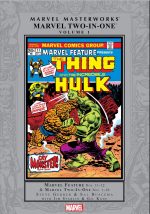
Marvel Two-in-One Masterworks volume 1


By Steve Gerber, Len Wein, Mike Friedrich, Chris Claremont, Jim Starlin, Gil Kane, Sal Buscema, George Tuska, Herb Trimpe, Bob Brown & various (Marvel)
ISBN: 978-0-7851-6633-7 (HB)

Imagination isn’t everything. As Marvel slowly grew to a position of dominance in the wake of losing their two most innovative and inspirational creators, they did so less by risky experimentation and more by expanding and exploiting proven concepts and properties.

The only real exception to this was their en masse creation of horror titles in response to the industry down-turn in super-hero sales – a move expedited by a rapid revision in the wordings of the increasingly ineffectual Comics Code Authority rules.

The concept of team-up books – an established star pairing, or battling – and usually both – with less well-selling company characters, was not new when Marvel decided to award their most popular hero the lion’s share of this new title, but they wisely left their options open by allocating an occasional substitute lead in the Human Torch. In those long-lost days, editors were acutely conscious of potential over-exposure – and since super-heroes were actually in a decline, they may well have been right.

After the runaway success of Spider-Man‘s collaborations in Marvel Team-Up, the House of Ideas reinforced the trend with a series starring bashful, blue-eyed Ben Grimm – the Fantastic Four‘s most iconic member – beginning with two test runs in Marvel Feature before graduating to its own somewhat over-elaborate title.

This compelling compendium – available in hardback and digital formats – gathers the contents of Marvel Feature #11-12 and Marvel Two-In-One #1-10, covering September 1973 – July 1975, and opens with a Roy Thomas Introduction explaining how it was Stan’s idea…

Then the much told tales take centre stage with a perennial favourite pairing and the Thing once more clashing with The Incredible Hulk in ‘Cry: Monster! by Len Wein, Jim Starlin & Joe Sinnott (from MF #11).

Here, Kurrgo, Master of Planet X and the lethal Leader manipulate both blockbusting brutes into duking it out – ostensibly to settle a wager – but with the mighty minded, misshapen masterminds each concealing hidden agendas…

That ever-inconclusive yet cataclysmic clash leaves Ben stranded in the Nevada desert where Mike Friedrich, Starlin & Sinnott promptly drop him in the middle of the ongoing war against mad Titan Thanos with Iron Man helping Ben crush monstrous alien invaders in ‘The Bite of the Blood Brothers!’ (Marvel Feature #12, November 1973): another spectacular and painfully pretty all-action punch-up.

Still stuck in the desert when the dust settles, Ben laboriously treks to a minor outpost of civilisation just in time to be diverted to Florida for the grand opening of his own title. Cover-dated January 1974, Marvel Two-In-One #1 sees Steve Gerber, Gil Kane & Sinnott magnificently detail the ‘Vengeance of the Molecule Man!’, with Ben learning some horrifying home truths about what constitutes being a monster after battling with and beside ghastly, grotesque anti-hero Man-Thing.

With the second issue Gerber cannily trades a superfluous supporting character from his Man-Thing series to add some much-needed depth to the team-up title. ‘Manhunters from the Stars!’ pits Ben, old enemy Namor, the Sub-Mariner (another series Gerber was currently writing) and the Aquatic Avenger’s feisty and single-minded cousin Namoritaagainst each other as well as aliens hunting the emotionally and intellectually retarded superboy Wundarr. Another dynamically, intoxicating tale illustrated by Kane & Sinnott, this case also leaves the Thing as de facto guardian of the titanic teenaged tot…

Sal Buscema signed on as penciller with #3 as the Rocky Ranger joins the Man Without Fear ‘Inside Black Spectre!’: a crossover instalment of the extended epic then playing out in Daredevil #108-112 (in case you’re wondering, this action-packed fight-fest occurs between the second and third chapters) after which ‘Doomsday 3014!’ (Gerber, Buscema & Frank Giacoia) finds Ben and Captain America visiting the 31st century to save Earth from enslavement by the reptilian Brotherhood of Badoon, leaving Wundarr with Namorita for the foreseeable future…

The furious future-shocker concludes in MTIO #5 as the original Guardians of the Galaxy (not the movie group) climb aboard the Freedom Rocket to help our time-lost heroes liberate New York before returning home. The overthrow of the aliens was completed by another set of ancient heroes in Defenders #26-29 (which is also the subject of a different review)…

Marvel Two-In-One #6 began a complex crossover tale with the aforementioned Defenders as Dr. Strange and the Thing witness a cosmic event which begins with a subway busker’s harmonica and leads inexorably to a ‘Death-Song of Destiny!’ (Gerber, George Tuska & Mike Esposito) before Asgardian outcasts Enchantress and the Executioner attempt to seize control of unfolding events in #7’s ‘Name That Doom!’ (pencilled by Sal Buscema).

As they are thwarted by Grimm and the valiant Valkyrie, there’s enough of an ending here for casual readers, but fans and completists will want to hunt down Defenders #20 or Defenders Masterworks link please volume 3 for the full story…

Back here, however, MTIO #8 teams Grimm and supernatural sensation Ghost Rider in a quirkily compelling Yuletide yarn. ‘Silent Night… Deadly Night!’ – by Gerber, Buscema & Esposito – finds the audacious Miracle Man trying to take control of a very special birth in a stable…

Gerber moved on after plotting Thor team-up ‘When a God goes Mad!’ for Chris Claremont to script and Herb Trimpe & Joe Giella to finish: a rushed and meagre effort with the Puppet Master and Radion the Atomic Man making a foredoomed power play, before issue #10 concludes this initial compendium.

Crafted by Claremont, the still much-missed Bob Brown & Klaus Janson, it is a slice of inspired espionage action-intrigue with Ben and the Black Widow battling suicidal terrorist Agamemnon who plans to detonate the planet’s biggest nuke in blistering thriller ‘Is This the Way the World Ends?’.

These stories from Marvel’s Middle Period are of variable quality but nonetheless represent an honest attempt to entertain and exhibit a dedicated drive to please. Whilst artistically the work varies from adequate to utterly superb, most fans of the frantic Fights ‘n’ Tights genre would find little to complain about.

Although not really a book for casual or more maturely-oriented readers there’s still buckets of fun on hand and young readers will have a blast, so why not to add this colossal comics chronicle to your straining superhero bookshelves?
© 2020 MARVEL

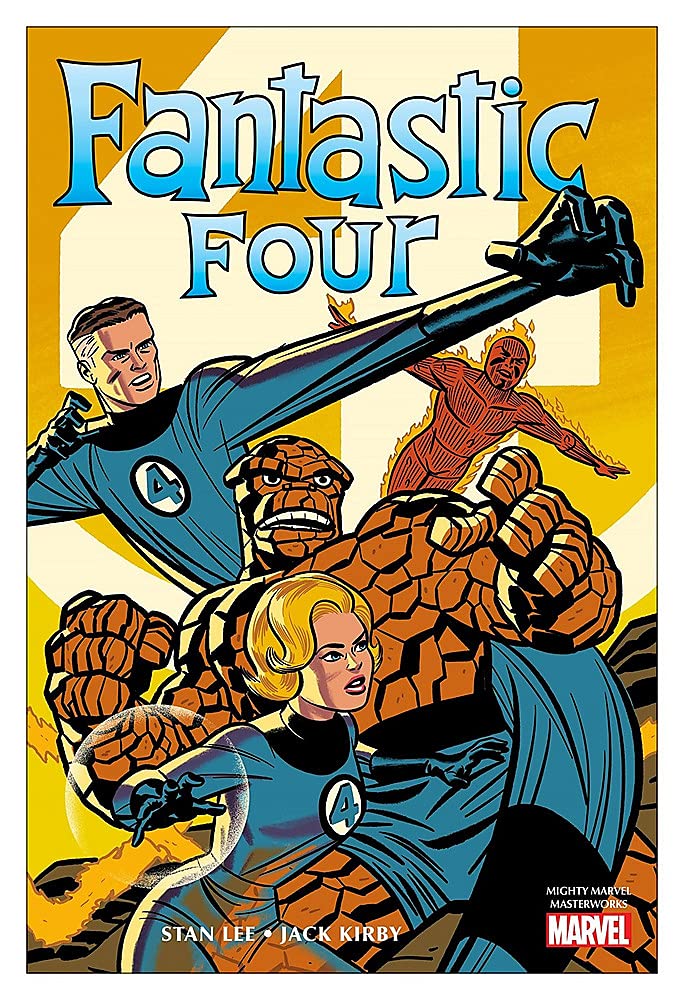
Mighty Marvel Masterworks -The Fantastic Four volume 1 : The World’s Greatest Heroes


By Stan Lee & Jack Kirby, with George Klein, Christopher Rule, Sol Brodsky, Dick Ayers, Joe Sinnott & various (Marvel)
ISBN: 978-1-3029-2979-4 (PB)

Win’s Christmas Gift Recommendation: An Immaculate Concoction… 9/10

In August 1961, a rather peculiar new comic hit US newsstands. At first glance it looked not dissimilar from lots of other monster books, but it was the start of an actual revolution. Because it had a November cover-date – specifying when unsold copies had to be returned – I’m celebrating it here and now… and in a rather controversial new format.

I’m partial to controversy so I’m starting off by declaring that Fantastic Four #1 is one of most important American comic book of all time. Feel free to disagree…

After a troubled period at DC Comics – National Periodicals as it then was – and a creatively productive but disheartening time on the poisoned chalice of the Sky Masters newspaper strip (see Complete Sky Masters of the Space Force), Jack Kirby settled into his job at a small, struggling outfit that used to be publishing powerhouse Timely/Atlas.

He crafted mystery, monster, war, romance and western material for a market he suspected was ultimately doomed but, as always, did the best job possible. That quirky genre fare is now considered some of the best of its kind ever seen.

However, his fertile imagination couldn’t be suppressed for long and when DC’s Justice League of America enflamed the readership’s attention, it gave him and writer/editor Stan Lee an opportunity to change the industry forever.

When publisher/owner Martin Goodman ordered his nephew Stan to try a group of super-characters like the one DC was doing, the result quickly took fans by storm. It wasn’t the powers: they’d all been seen since the beginning of the medium. It wasn’t costumes: they didn’t have any until the third issue. It was Kirby’s compelling art and the fact that these new guys weren’t anodyne cardboard cut-outs. In a real and a recognizable location – New York City – fractious, imperfect, raw-nerved, touchy people banded together out of tragedy, disaster and necessity to face the incredible.

The groundwork for all the wonders to come had been laid with 1957’s Challengers of the Unknown (Kirby’s prototype partners-in-peril at National/DC) but that company’s staid, cautious editorial strictures could never have allowed the undiluted energy of the concept to run all-but-unregulated. The Fantastic Four was the right mix in the right manner at the right moment and we’re all here now because of it. These stories are timeless and have been gathered many times before so I’m diverting to talk about format here.

The Mighty Marvel Masterworks line has been designed with economy in mind. Classic tales of Marvel’s key creators and characters re-presented in chronological order have been a staple since the 1990s, but always in lavish, expensive collectors editions. These new books are far cheaper, on lower quality paper and – crucially – are physically smaller, about the dimensions of a paperback book. Your eyesight might be failing and your hands too big and shaky, but they’re perfect for kids and if you opt for the digital editions, that’s no issue at all…

This first compilation represents the tentatively bi-monthly Fantastic Four #1-10, spanning November 1961 – January 1963 and opens as it means to go on. Courtesy of Lee, Kirby, George Klein & Christopher Rule the introductory adventure is crude, rough, passionate and uncontrolled excitement. Thrill-hungry kids pounced on it.

‘The Fantastic Four’ is exactly as seen in that groundbreaking premier issue, with maverick scientist Reed Richardsperemptorily summoning his fiancé Sue Storm, close friend Ben Grimm and Sue’s teenaged brother before heading off on their first mission. They are all freakish survivors of a private space-shot that went horribly wrong after Cosmic rays penetrated their ship’s inadequate shielding and mutated them all.

Richards’ body became elastic, Sue gained the power to turn invisible, Johnny Storm could turn into living flame and tragic Ben morphed permanently into a hideous freak trapped in a shambling, leathery body.

The second half of the issue reported how ‘The Fantastic Four meet the Mole Man’: promptly foiling a mad scheme by another outcast who controls monsters and enslaves humanoids from far beneath the Earth.

This summation of the admittedly mediocre plot cannot do justice to the engrossing wonder of that breakthrough issue – we really have no conception now of how different in tone, how shocking it all was.

“Different” doesn’t mean “better” even here, but the FF was like no other comic on the market at the time and buyers responded to it hungrily. The brash experiment continued with another old plot in #2. Inked by Klein, ‘The Skrulls from Outer Space’ were shape-changing aliens who framed the team in the eyes of shocked humanity, before the genius of Mister Fantastic bluffed them into abandoning plans for conquering Earth. The issue concluded with a monstrous pin-up of the Thing, proudly touted as the first in a series…

Sure enough, there was a pin-up of the Human Torch in #3 (inked by Sol Brodsky), which headlined ‘The Menace of the Miracle Man’ whose omnipotent powers had a simple secret. The tale is most notable for the first appearance of their uniforms, and a shocking line-up change, leading directly into the next issue (continued stories were an innovation in themselves) which revived a golden-age great.

‘The Coming of the Sub-Mariner’ reintroduced the all-powerful amphibian Prince Namor of Atlantis, a star of Timely’s Golden Age but one who had been lost for years.

A victim of amnesia, the rowdy relic recovers his memory thanks to some rather brusque treatment by the delinquent Torch. Namor then returns to his sub-sea home only to find it destroyed by atomic testing. A monarch without subjects, he swears vengeance on humanity and attacks New York City with a gigantic monster. This saga is when the series truly kicked into high-gear and Reed was the star of the pin-up section…

Until now the creative team – who had been in the business since it began – had been hedging their bets. Despite the innovations of a contemporary superhero experiment, their antagonists had relied heavily on the trappings of popular trends in the media – and as reflected in their other titles.

Aliens and especially monsters played a major part in the earlier tales but Fantastic Four #5 embraced the unique basics and took a full-bite out of the Fights n’ Tights apple by introducing the first full-blown, unrepentant super-villain to the budding Marvel Universe.

No, I haven’t forgotten Mole Man: but that tragic little gargoyle, for all his plans of world conquest, wouldn’t truly acquire the persona of a costumed foe until his more refined second appearance in #22.

‘Prisoners of Doctor Doom’ (July 1962, and inked by the sublimely slick and perfectly polished Joe Sinnott) has it all. An attack by a mysterious enemy from Reed’s past; super-science, magic, lost treasure, time-travel, even pirates. Ha-Haar, me ‘earties!

Sheer magic! and the creators knew they were on to a winner, as the deadly Doctor returned the very next issue, teaming with a reluctant Sub-Mariner to attack our heroes as ‘The Deadly Duo!’ (inked by new regular embellisher Dick Ayers). It also introduced the concept of antiheroes as the conflicted Sub-Mariner falls out with the demon doctor and saves the day…

Alien kidnappers were the motivating force behind another FF frame-up, resulting in the team becoming ‘Prisoners of Kurrgo, Master of Planet X’: a dark, grandiose, cosmic-scaled off-world thriller in #7 (the first monthly issue), whilst a new returning villain and the introduction of a love-interest for the monstrous Thing were the breakthrough high-points in #8’s ‘Prisoners of the Puppet Master!’

The emotional saga was balanced by a Fantastic Four Feature Page explaining how the Torch’s powers work. The next issue offered another, detailing with endearing mock-science ‘How the Human Torch Flies!’

That issue – #9 – trumpeted ‘The End of the Fantastic Four’ as Sub-Mariner returned to exploit another brilliant innovation in comic storytelling. When had a super-genius superhero ever messed up so much that the team had to declare bankruptcy? When had costumed crimefighters ever had money troubles at all? The eerily prescient solution was to “sell out” and make a blockbuster movie – giving Kirby a rare chance to demonstrate his gift for caricature…

1963 would be a pivotal year in the development of Marvel. Lee & Kirby had proved that their new high concept – human heroes with flaws and tempers – had a willing audience. Now they would extend that concept to a new pantheon of heroes. Here is where the second innovation would come to the fore. Previously, superheroes were sufficient unto themselves and shared adventures were rare. Here, however, was a universe where characters often tripped over each other, sometimes even fighting each other’s enemies! The creators themselves might turn even up in a Marvel Comic!

Although cover-date January 1963, Fantastic Four #10 was released in October of 1962 and featured ‘The Return of Doctor Doom!’. Here, the arch-villain used Stan & Jack to lure Richards into a trap where his mind is switched with the bad Doctor’s. The tale was supplemented by a pin-up of ‘Sue Storm, the Glamorous Invisible Girl’…

Although possibly – just a bit, perhaps – somewhat dated in tone, these are still undeniable milestones of comic storytelling illustrated by one of the world’s greatest talents approaching his absolute peak. They are fast, frantic fun and a joy to read or re-read. This comprehensive, joyous introduction (or reintroduction) to these characters is a wonderful reminder of just how good comic books can and should be.

Happy birthday and many, many more please…
© 2021 MARVEL

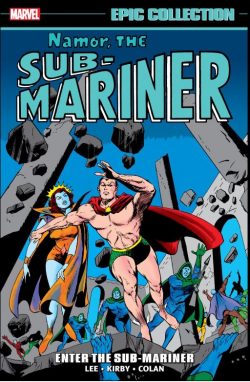
Namor, the Sub-Mariner Epic Collection volume 1 1962-1966: Enter the Sub-Mariner


By Stan Lee & Jack Kirby, Larry Lieber, Gene Colan, Dick Ayers, Wallace Wood & various (Marvel)
ISBN: 978-1-3029-2836-0 (TPB)

Prince Namor, the Sub-Mariner is the offspring of a water-breathing Atlantean princess and an American polar explorer: a hybrid being of immense strength; highly resistant to physical harm; able to fly and exist above and below the waves. Created by young, talented Bill Everett, Namor technically predates Marvel/Atlas/Timely Comics.

He first caught the public’s attention as part of the fire vs. water headlining team in Marvel Comics #1 (October 1939 and soon to become Marvel Mystery Comics). He shared honours and top billing with The Human Torch, but had originally been seen (albeit in a truncated monochrome version) in Motion Picture Funnies: a promotional giveaway handed out to moviegoers earlier in the year.

Quickly becoming one of the company’s biggest draws, Namor gained his own title at the end of 1940 (cover-dated Spring 1941) and was one of the last super-characters to go at the end of the first heroic age.

In 1954, when Atlas (as the company then was) briefly revived its costumed character “Big Three” (the Torch and Captain America being the other two), Everett returned for a run of superb fantasy tales, but even so the time wasn’t right and the title sunk again.

When Stan Lee & Jack Kirby started reinventing comic-books in 1961 with the Fantastic Four, they revived the all-but-forgotten awesome amphibian as a troubled, semi-amnesiac, and decidedly more regal, if not grandiose, antihero. The returnee despised humanity; embittered at the loss of his sub-sea kingdom (seemingly destroyed by American atomic testing) whilst simultaneously besotted with the FF‘s Sue Storm.

Namor knocked around the budding Marvel universe for a few years, squabbling with other assorted heroes such as the Hulk, Avengers and X-Men, before securing his own series as one half of Tales to Astonish.

Marvel’s “split-books” had been devised as a way to promote their burgeoning stable of stars whilst labouring under a highly restrictive distribution deal limiting the number of titles they could release per month. In 1968 the company ended this commitment and expanded exponentially.

This first celebratory volume – available in trade paperback and eBook formats collects all those early 1960’s guest shots in one tumultuous tome. Here you’ll find Fantastic Four # 4, 6, 9, 14, 27, 33 and Annual #1; Strange Tales #107 & 125; Avengers #3-4; X-Men #6, Daredevil #7 and the first arc of his own series from Tales to Astonish #70-76. These span May 1962 – February 1966 and open without preamble on that fateful first encounter in this cataclysmic clutch of curated classics…

Crafted by Lee Kirby & Sol Brodsky, Fantastic Four #4 proudly shouted ‘The Coming of the Sub-Mariner’, reintroducing (or introducing) the all-powerful amphibian Prince of Atlantis. The star of Timely’s Golden Age had been lost since 1955 – almost a lifetime for the kids believed to be the prime consumer of comics.

A victim of amnesia, the relic recovers his memory thanks to some rather brusque treatment by teen delinquent and AWOL Human Torch Johnny Storm. Namor rapidly returns to his sub-sea home only to find it destroyed by atomic testing. A monarch without subjects, he swears vengeance on humanity and attacks New York City with a gigantic monster. After its demise amidst a mass of collateral destruction, Sub-Mariner espies and falls for the Invisible Girl: a fascination that will fuel many a monumental battle…

This saga is when the Fantastic Four series truly kicked into high-gear and Reed Richards was the star of the pin-up section reprinted here…

FF #5 debuted the diabolical Doctor Doom who returned in the next issue after duping and teaming up with a reluctant Sub-Mariner to attack the quarrelsome quartet heroes as ‘The Deadly Duo!’ – inked by new regular embellisher Dick Ayers.

Issue #9 declared ‘The End of the Fantastic Four’ as Sub-Mariner Prince Namor returns to exploit another brilliant innovation in comic storytelling. When had a super-genius superhero ever messed up so much that the team had to declare bankruptcy? When had costumed crimefighters ever had money troubles at all? The eerily prescient solution was to “sell out” and make a blockbuster movie – giving Kirby a rare chance to demonstrate his talent for caricature…

Of course, Sub-Mariner’s film project is simply a ruse to divide and conquer and everything is settled with bombastic action and typically off-kilter romantic twist…

The saga is topped off with a Fantastic Four Feature Page explaining ‘How the Human Torch Flies!’

By this time kid-friendly teen Johnny Storm had been awarded a solo-starring lead series in former mystery anthology Strange Tales. Scripted by Larry Lieber and limned by Ayers, #107 featured a splendidly mindless punch-up with the ‘Sub-Mariner’ – a tale powerfully reminiscent of the spectacular and immensely popular Golden Age battles of their publishing forebears.

It’s back to Fantastic Four next as #14 (Lee, Kirby & Ayers) features the return of ‘The Sub-Mariner and the Merciless Puppet Master!’: with one vengeful fiend the unwitting mind-slave of the other, after which 1963’s Fantastic Four Annual #1 offers a spectacular 37-page epic battle as, finally reunited with their wandering prince, the warriors of Atlantis invade New York City and the rest of the world in ‘The Sub-Mariner versus the Human Race!’ by Lee, Kirby & Ayers.

A monumental tale by the standards of the time, the saga saw the FF repel the undersea invasion through valiant struggle and brilliant strategy, and includes the secret history of the secretive race Homo Mermanus. Nothing is really settled except a return to the original status quo, but the thrills are intense and unforgettable…

Also included is a rousing pin-up of Namor from ‘A Gallery of the Fantastic Four’s Most Famous Foes!’.

By now Marvel had many more superheroes and Namor met some in Avengers #3. In the previous issue, the volatile Hulk quit the nascent team in disgust, only to return here as an outright villain in partnership with ‘Sub-Mariner!’ (by Lee, Kirby & Paul Reinman). This globe-trotting romp delivers high-energy thrills and one of the best battle scenes in comics history as the assorted titans clash in abandoned World War II tunnels beneath the Rock of Gibraltar.

Inked by George Roussos, Avengers #4 was a groundbreaking landmark as Marvel’s greatest Golden Age sensation returned in another increasingly war-torn era. ‘Captain America joins the Avengers!’ has everything that made the early tales so fresh and vital. The majesty of a legendary warrior returned in our time of greatest need: stark tragedy in the loss of his boon companion Bucky, aliens, gangsters, the menacing majesty of Sub-Mariner and even subtle social commentary capped by vast amounts of staggering Kirby Action.

The creators had hit on a winning formula by including other stars in guest-shots – especially as readers could never anticipate if they would fight with or beside the home team. FF #27 again finds the undersea anti-hero in amorous mood, but after abducting Sue, he finds the boys have called in called in Doctor Strange, Master of the Mystic Arts to aid them in ‘The Search for Sub-Mariner!’

Delivered by Lee & Kirby, X-Men #6 features ‘Sub-Mariner Joins the Evil Mutants!’: a self-explanatory tale of gripping intensity elevated to magical levels of artistic quality as superbly slick inker Chic Stone adds crisp clarity to proceeding when potential mutant Namor is duped into joining malevolent Magneto and his sinister brotherhood. The issue also incorporates a stunning ‘Special Pin-up page’ starring “Cyclops”.

Impetus was building and support growing for renewed sub-sea skirmishes starring Namor, and Strange Tales #125 (October 1964) presented another bombastic battle between the old adversaries as the Torch and Thing picked a fight with the sea lord in ‘The Sub-Mariner Must Be Stopped!’ courtesy of Lee, Ayers & Reinman.

The princely PR campaign then blossomed into unlikely alliance as FF #33 saw the team ‘Side-by-Side with Sub-Mariner!’ (Lee, Kirby & Stone): bringing the aquatic antihero one step closer to his own series as they lend surreptitious aid to the embattled undersea monarch against deadly barbarian Attuma and supplemented by a glorious Kirby & Stone ‘Prince Namor Pin-up’.

As previously stated, prior to Tales to Astonish, Namor appeared in numerous titles as guest villain du jour. One last guest shot with Namor acting as a misunderstood bad-guy was Daredevil #7 (April 1965): a tale that qualifies as a perfect comic book and a true landmark – to my mind one of the Top Ten Marvel Tales of all Time.

Here, Lee and creative legend Wally Wood concocted a timeless masterpiece with ‘In Mortal Combat with… Sub-Mariner!’ as Prince Namor of Atlantis – recently reunited with the survivors of his decimated race – returns to the surface world to sue mankind for their crimes against his people. To expedite his claim, the Prince engages the services of Matt Murdock‘s law firm; little suspecting the blind lawyer is also the acrobatic Man without Fear.

Whilst impatiently awaiting a hearing at the UN, Namor is informed by his lover Lady Dorma that his warlord Krang has stolen the throne in his absence. The tempestuous monarch cannot languish in a cell when the kingdom is threatened, so he fights his way to freedom through the streets of New York, smashing battalions of National Guard and the dauntless Daredevil with supreme ease.

The hopelessly one-sided battle with one of the strongest beings on the planet shows the dauntless courage of DD and the innate nobility of a “villain” far more complex than most of the industry’s usual fare at the time.

Augmented by a rejected Wood cover repurposed as ‘A Marvel Masterwork pin-up: Namor and D.D.’ this yarn is merely a cunning prequel…

A few months later Tales to Astonish #70 heralded ‘The Start of the Quest!’ as Lee, Gene Colan (in the pseudonymous guise of Adam Austin) & Vince Colletta set the Sub-Mariner to storming an Atlantis under martial law. The effort is for naught and the returning hero is rejected by his own people. Callously imprisoned, the troubled Prince is freed by the oft-neglected and ignored Lady Dorma…

As the pompous hero begins a mystical quest to find the lost Trident of King Neptune – which only the rightful ruler of Atlantis can hold – he is unaware that treacherous Krang allowed him to escape, the better to destroy him with no witnesses…

The serialised search carries Namor through a procession of fantastic adventures and pits him against a spectacular array of sub-sea horrors: a giant octopus in ‘Escape… to Nowhere’; a colossal seaweed man in ‘A Prince There Was’ and a demented wizard and energy-sapping diamonds in ‘By Force of Arms!’

As the end approaches in ‘When Fails the Quest!’, revolution grips Atlantis, and Namor seemingly sacrifices his kingdom to save Dorma from troglodytic demons the Faceless Ones.

In issue #75 ‘The End of the Quest’ finds the Prince battling his way back into Atlantis with a gravely-injured Dorma, before the saga calamitously concludes in ‘Uneasy Hangs the Head…!’ with the status quo restored, Namor again on the stolen throne and further danger and drama to come…

Supplemented with House ads, a full cover gallery, unseen, unused and original artwork pages and more, this assemblage of tales feature some of Marvel’s very best artists at their visual peak, with creative verve and enthusiasm shining through.

Perhaps more vicarious thrill than fan’s delight, many early Marvel Comics are more exuberant than qualitative, but this volume, especially from an art-lover’s point of view, is a wonderful exception: a historical treasure that fans will find irresistible.
© 2021 MARVEL.

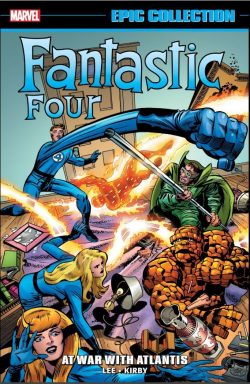
Fantastic Four Epic Collection volume 6 1969-1970: At War with Atlantis


By Stan Lee & Jack Kirby, John Romita, Ron Frenz, Joe Sinnott, Frank Giacoia, John Verpoorten & various (Marvel)
ISBN: 978-1-3029-2202-3 (TPB)

Cautiously bi-monthly and cover-dated November 1961, Fantastic Four #1 (by Stan Lee, Jack Kirby, George Klein & Christopher Rule) was crude: rough, passionate and uncontrolled excitement. Thrill-hungry kids pounced on it and the raw storytelling caught a wave of change starting to build in America. It and succeeding issues changed comics forever. Happy Anniversary!

This epic and extras-packed full-colour compendium – also available in digital editions – gathers issues #88-104 and Annual #7 (cumulatively spanning July 1969 – November 1970) plus Fantastic Four: The Lost Adventure #1 (2008). It covers the final days of the King’s reign on Marvel’s flagship title and shaky transitional start of a new era. And includes diverse bonus treats including a rejected, recovered, recycled tale to delight all aficionados, only finally released in April 2008.

As seen in the ground-breaking premier issue, maverick scientist Reed Richards, his fiancée Sue Storm, their close friend Ben Grimm and Sue’s teenaged brother survived an ill-starred private space-shot after Cosmic Rays penetrated their ship’s inadequate shielding and mutated them all.

Richards’ body became elastic, Sue gained the power to turn invisible, Johnny Storm could turn into living flame whilst tragic Ben shockingly devolved into a shambling, rocky freak. After the initial revulsion and trauma pass, they solemnly agree to use their abilities to benefit mankind and thus was born The Fantastic Four.

Throughout the 1960s the FF was the indisputable central title and most consistently groundbreaking series of Marvel’s ever-unfolding web of cosmic creation: a forge for new concepts and characters at a time when Kirby was in his creative prime and continually unleashing his vast imagination on plot after spectacular plot, whilst Lee scripted some of the most passionate superhero sagas ever seen.

Both were on an unstoppable roll, at the height of their creative powers, and full of the confidence that only success brings, with The King particularly eager to see how far the genre and the medium could be pushed… which is rather ironic since it was the company’s reticence to give the artist creative freedom which led to Kirby’s jumping ship to National/DC in the first place…

And then, he was gone…

Without preamble the magical wonderment resumes with Joe Sinnott inking Fantastic Four #88 which focuses on the five champions (Johnny’s Inhuman girlfriend Crystal had been standing in for Sue who was until recently enjoying a hard-earned maternity leave) back in the USA after defeating Doctor Doom. They are soon looking at an unconventional new house found by determinedly domesticated Mrs. Richards in her perpetual quest to carve out a relatively normal life for her new – and still unnamed – son.

Regrettably the trendy, extremely isolated detached dwelling in ‘A House There Was!’ has been designed by the team’s oldest enemy. No sooner do they all move in than ‘The Madness of the Mole Man!’ turns the deadly domicile against them even as the maniac’s goal of rendering the entire world blind and wiping out the extended heroic family comes within inches of succeeding…

The Thing then takes centre-stage in an extended epic as he is stalked and pressganged to another world when ‘The Skrull Takes a Slave!’ in #90. Abducted to fight in gladiatorial games on a colony world patterned after Earth’s 1920s gangster era, ‘The Thing… Enslaved!’ introduces rival Skrull mobs vying for planetary supremacy and a noble slave destined to slaughter our shanghaied champion. ‘Ben Grimm, Killer!’ efficiently ramps up the tension as Ben Grimm and mechanoid marvel Torgo discover their home-worlds are hostage to their fortunes and ferocity in the arena…

Elsewhere, Reed, Johnny and Crystal have not been idle. While Ben is at ‘The Mercy of Torgo!’ (inked by Frank Giacoia) his Earthly comrades are enacting a desperate plan to swoop in, save him and destroy the Skrulls doom-weapon… a task undertaken and accomplished with great speed and in stunning style…

Fantastic Four #94, began a string of single-issue stories with the doom-laden debut of eldritch babysitter/governess Agatha Harkness in ‘The Return of the Frightful Four!’. The eponymous recalcitrant rogues make a major mistake believing they can catch the FF off-guard by attacking while the heroes are interviewing a new nanny for the latest addition to the Fantastic Family…

At a time when superhero sales were in a slump and magical mystery themes resurgently returned, this rollercoaster ride of action, battle and suspense is most significant for finally giving Sue and Reed’s baby a name – Franklin Benjamin Richards – after literally years of shilly-shallying…

Technological super-assassin The Monocle is resolved to trigger global nuclear Armageddon in #95’s ‘Tomorrow… World War Three!’ – in the middle of which Crystal is astoundingly abducted by her own family – before ‘The Mad Thinker and his Androids of Death!’ (Giacoia inks) once again ambush the team and still prove to be no match for the fab foursome…

A tense and moody episode further cashing in on the growing trend for creepy creatures and supernatural shenanigans manifests as ‘The Monster from the Lost Lagoon!’ in #97, offering a decidedly different take on the horror-movies it gloriously homages as the First Family try to combine a quick tropical vacation with a little rumour-busting sea-beastie hunt…

Both Sinnott and the robotic Sentry Sinister return in #98’s turbulently then-topical ‘Mystery on the Moon!’ as global fervour over the first lunar landing in 1969 (conveniently forgetting, of course, the FF’s own numerous visits to our satellite, beginning with issue #13) results in a cracking yarn wherein the team stop the extra-galactic Kree Empire sabotaging mankind’s first steps into space.

In FF #99 heartsick Johnny Storm at last snaps, invading the hidden home of the Inhumans. His intent is to reunite with his lost love at all costs, but of course, tempers fray, everything escalates and ‘The Torch Goes Wild!’…

With Crystal happily in tow, the 100th anniversary adventure features a daft, extremely rushed but nonetheless spectacular all-out battle against robotic replicas of their greatest enemies in ‘The Long Journey Home!’ Nuff Said!

With the anniversary cataclysmically concluded, issue #101 provides a far more intriguing imbroglio when dastardly criminal combine the Maggia buy the team’s skyscraper HQ in a cunning, quasi-legal ploy to appropriate Reed’s scientific secrets, resulting in total ‘Bedlam in the Baxter Building!’

Fantastic Four #102 sported the first cover not drawn by The King as John Romita (senior) prepared to jump into the artistic hot-seat following Kirby’s abrupt move to the home of Superman, Batman and Wonder Woman.

After an incomprehensibly vast catalogue of creativity an unthinkable Changing of the Guard occurred when the increasingly discontented King of Comics left the House of (mostly his) Ideas for arch-rival National/DC to craft his Fourth World Magnum Opus plus a host of other game-changing comic book classics…

An era ended at Marvel when the King abdicated his seemingly divinely-ordained position. Left to pacify and win back the stunned fans were Lee and a couple of budding talents named Romita and Buscema…

Kirby was not quite gone, however, as he and Sinnott opened an impressive extended epic wherein mutant menace Magneto uses guile and subterfuge to turn ‘The Strength of the Sub-Mariner’ and his undersea armies against the FF and entire surface world…

Romita and inker John Verpoorten took over the story in mid-flow, depicting an embattled America ‘At War with Atlantis!’ before malign Magneto inevitably turns on Namor, inspiring the Prince to ally with the Fantastic Four to prevent the mutant’s dream of ‘Our World… Enslaved!’…

That was more or less the end. Romita drew a couple more issues and eventually John Buscema took up the challenge, although a later issue baffled us fans by inexplicably pairing the new artist with a somehow returned Kirby…

Before that, the cover of all-reprint Fantastic Four Annual #7 brightens our day, as does its contemporary photo-feature, revealing each and every member of the burgeoning Marvel Bullpen.

Fantastic Four #108 contained ‘The Monstrous Mystery of the Nega-Man!’ which “reintroduced” a character never before seen by recycling portions of a near-complete but rejected Kirby tale. This was modified with new sequences illustrated by John Buscema and Romita. In the published story (not included in this volume) the mysterious Janus tapped into the anti-matter power of the Negative Zone once and now “returned” to steal more via the portal in Reed’s lab.

Unfortunately, this attracts the attention of extinction-event predator Annihilus, who had long sought entry into our life-rich universe…

The origins of that yarn are convoluted and circuitous but are eruditely explained by archivist John Morrow in his article ‘Fantastic Four #108: Kirby’s Way’, supplemented by (almost) the entire original story reproduced from photostats of Kirby’s pencils and published pages from #108.

In 2007 those fragments and Kirby’s story notes were used by Lee, Joe Sinnott and Ron Frenz to reconstruct the tales as the King drafted it. The result was ‘Fantastic Four: The Lost Adventure’ which here offers a gloriously tantalising slice of times past as the team (circa 1970) tackle a seemingly schizophrenic super-villain in ‘The Menace of the Mega-Men!’

It doesn’t really fit anywhere into continuity but it is a superbly nostalgic rush for devotees of the classics…

Rounding out the Kirby Kommemorations are a selection of original art pages and covers from issues #88-90, unused cover art, house ads, portfolio and poster art and more: a graphic bonanza no fan could resist.

Epic, revolutionary and unutterably unmissable, these are the stories which made Marvel the unassailable leaders in fantasy entertainment. They remain some of the most important superhero comics ever crafted. Verve, conceptual scope and sheer enthusiasm shine through on every page and the wonder is there for you to share. If you’ve never thrilled to these spectacular sagas then this book of marvels is the perfect key to another – far brighter – world and time.
© 2020 MARVEL.

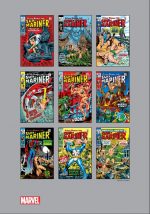
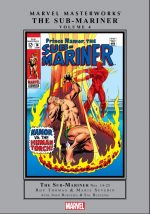
Sub-Mariner Marvel Masterworks volume 4


By Roy Thomas, Marie Severin, John Buscema, Sal Buscema, Jack Katz & various (Marvel)
ISBN: 978-0-7851-5048-0 (HB)

Prince Namor, the Sub-Mariner is the offspring of a water-breathing Atlantean princess and an American polar explorer; a hybrid being of immense strength, highly resistant to physical harm, able to fly and exist above and below the waves. Created by young, talented Bill Everett, Namor technically predates Marvel/Atlas/Timely Comics.

He first caught the public’s attention as part of the elementally appealing fire vs. water headlining team in the October 1939 cover-dated Marvel Comics #1 which became Marvel Mystery Comics with issue #2. He shared honours and top billing with The Human Torch, but had originally been seen (albeit in a truncated monochrome version) in Motion Picture Funnies: a weekly promotional giveaway handed out to moviegoers earlier in the year.

Rapidly emerging as one of the industry’s biggest draws, Namor gained his own title at the end of 1940 (Spring 1941) and was one of the last super-characters to go at the end of the first heroic age. In 1954, when Atlas (as the company then was) briefly revived its “Big Three” (the Torch and Captain America being the other two) costumed characters, Everett returned for an extended run of superb darkly timely fantasy tales, but even his input wasn’t sufficient to keep the title afloat and Sub-Mariner sank again.

When Stan Lee & Jack Kirby began reinventing comic book superheroes in 1961 with the groundbreaking Fantastic Four, they revived the awesome and all-but-forgotten amphibian as a troubled, semi-amnesiac anti-hero. Decidedly more bombastic, regal and grandiose, the returnee despised humanity; embittered at the loss of his sub-sea kingdom (seemingly destroyed by American atomic testing) whilst simultaneously besotted with the FF‘s Susan Storm.

Namor knocked around the budding Marvel universe for a few years, squabbling with other star turns such as the Hulk,Avengers, X-Men and Daredevil, before securing his own series as one half of Tales to Astonish, and ultimately his own solo title.

This fourth subsea selection – available in hardback and eBook editions – collects Prince Namor, the Sub-Mariner #14-25, spanning June 1969 to May 1970 and opens with another heartfelt appreciation and some creative secret-sharing from sometime-scribe and life-long devotee Roy Thomas in his Introduction.

Innovative action and shameless nostalgia vie for attention as Thomas, Marie Severin and Mike Esposito (moonlighting as Joe Gaudioso) decree ‘Burn, Namor… Burn!’ in Sub-Mariner #14, as the Mad Thinker apparently resurrects the original – android – Human Torch and sets him to destroy the monarch of Atlantis. This epic clash was one prong of an early experiment in multi-part cross-overs (Captain Marvel #14 and Avengers #64 being the other episodes of the triptych).

Inked by Vince Colletta, ‘The Day of the Dragon!’ finds Namor back in Atlantis after months away, only to find his beloved Lady Dorma has been abducted by old foe Dr. Dorcas. The trail leads to Empire State University and brutal battle against mighty android Dragon Man…

“Gaudioso” returned for Namor’s voyage to a timeless phenomenon in search of mutated foe Tiger Shark who had conquered ‘The Sea that Time Forgot!’, after which the Sub-Mariner contends with an alien intent on draining Earth’s oceans in ‘From the Stars… the Stalker!’ pencilled in tandem by Severin and Golden Age Great Jack Katz, using nom de plume Jay Hawk.

The saga ends calamitously in ‘Side by Side with… Triton!’ (Thomas, Severin & Gaudioso) as, with the help of the aquatic Inhuman, Namor repels the extraterrestrial assault, but loses his ability to breathe underwater. Now forced to dwell on the surface, the despised Atlantean then crushingly clashes with an old friend in the livery of a new superhero in ‘Support your Local Sting-Ray!’ This bombastic battle yarn also offers a delicious peek at the Marvel Bullpen, courtesy of (ex-EC veterans) Severin and inker Johnny Craig’s deft caricaturing skills…

John Buscema returns for #20, with Thomas scripting and Craig inking a chilling dose of realpolitik. ‘In the Darkness Dwells… Doom!’ sees Namor lured by the promise of a cure to his breathing difficulties into the exploitative clutches of the mad Monarch of Latveria. Trapping the Sub-Mariner and keeping him, however, are two wildly differing concepts…

Informed of Namor’s condition, the armies of Atlantis are marshalled by Dorma and disgraced Warlord Seth in ‘Invasion from the Ocean Floor!’ (art by Severin & Craig) besieging New York and almost invoking a new age of monsters.

As Namor’s malady is treated by Atlantean super-science, a key component of a new Superhero concept begins.

Last of the big star conglomerate super-groups, the Defenders would eventually count amongst its membership almost every hero – and a few villains – in the Marvel Universe. No surprise there as initially they were composed of the company’s bad-boys: misunderstood, outcast and often actually dangerous to know.

The genesis of the team in fact derived from their status as publicly distrusted “villains”, but before all that later inventive approbation linked tales of enigmatic antiheroes as best exemplified by Prince Namor, and the Incredible Hulk. When you add the mystery and magic of Doctor Strange the recipe for thrills, spills and chills became simply irresistible…

Following on from Dr. Strange #183 (November 1969) – which introduced the infernal Undying Ones, an elder race of demons hungry to reconquer the Earth – February 1970’s Sub-Mariner #22 ‘The Monarch and the Mystic!’ brought the Prince of Atlantis into the mix, as Thomas, Severin & Craig relate a moody tale of sacrifice in which the Master of the Mystic Arts apparently dies holding the gates of Hell shut with the Undying Ones pent behind them.

In case you’re curious, the saga concludes on an upbeat note in Incredible Hulk #126 (April 1970). You might want to track down that yarn too…

Even restored to full capacity, there’s no peace for the regal, and Sub-Mariner #23 finds Namor still contending with Dorcas and arch villain Warlord Krang after the human mad scientist uses his power-transfer process to create an Atlantean wonder with the might of killer whales in ‘The Coming of… Orka!’ The slow-witted psycho subsequently sets an army of enraged cetaceans against the sunken city as John Buscema & Jim Mooney step in artistically to depict how ‘The Lady and the Tiger Shark!’ finds Namor enslaved and Dorma making Faustian pacts to save Atlantis.

This scintillating volume concludes with a landmark tale as – restored to rule and ready to be riled – Namor becomes an early and strident environmental activist after surface world pollution slaughters some of his subjects. Crafted by Thomas, Sal Buscema & Mooney, ‘A World My Enemy!’ follows Sub-Mariner’s bellicose confrontation with the UN as he puts humanity on notice: clean up your mess or I will…

From this point on the antihero would become a minor icon and subtle advocate of the issues, even if only to young comics readers…

These tales feature some of Marvel’s greatest artists at their visual peak, with all the verve and enthusiasm still shining through. Many early Marvel Comics are more exuberant than qualitative, but this volume, especially from an art-lover’s point of view, is a wonderful exception: a historical treasure fans will delight in forever.
© 1968, 1969, 2018 Marvel Characters, Inc. All rights reserved.
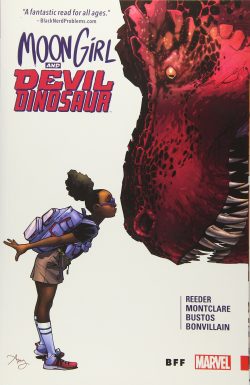
Daredevil Epic Collection volume 4 1970-1972: A Woman Called Widow


By Roy Thomas, Gerry Conway, Gary Friedrich, Gene Colan, Don Heck, Alan Weiss, Barry Windsor-Smith, Bill Everett & various (Marvel)
ISBN: 978-1-3029-2034-0 (TPB)

Matt Murdock is a blind lawyer whose remaining senses hyper-compensate, making him capable of astonishing acrobatic feats, a formidable fighter and a living lie-detector.

Very much a second-string hero for most of his early years, Daredevil was nonetheless a striking and popular one, due in large part to the roster of brilliant artists who had illustrated the strip. He only really came into his own, however, after artist Gene Colan signed up for the long haul…

The natal DD battled thugs, gangsters, an eclectic mix of established and new super-villains and even the occasional monster or alien invasion. He quipped and wise-cracked his way through life and life-threatening combat, utterly unlike the grim, moody quasi-religious metaphor he became under modern authorial regimes…

In these tales from the pivotal era of relevancy, social awareness and increasing political polarisation, the Man Without Fear was also growing into the judicial conscience of a generation turning its back on old values…

Covering May 1970 -April 1972, this trade paperback and digital compilation chronologically re-presents Daredevil #64-86 plus a crossover with Iron Man #35-36 and sees the once-staid and so-very Establishment Murdock move with the shifting cultural mores as scripter Roy Thomas hands over the reins to newcomer Gerry Conway in an increasingly determined move to make the Man Without Fear cutting edge and relevant… …

The action opens here with Horn-Head prowling the rooftops of Los Angeles. He’s there to find the love-of-his-life, who quit New York when the pressure of sharing DD’s secrets proved too much…

After trailing the star-struck Karen Page to Hollywood, DD gets to take out his bad mood on a handy hood in ‘Suddenly… The Stunt-Master!’ (Thomas, Gene Colan & Syd Shores) before eventually helping his old enemy (a petty criminal biker) get a TV show of his own…

Murdock remains in LA to oversee Karen’s first acting gig – a pastiche of then-hot spooky TV phenomenon Dark Shadows – and prevents her becoming part of a murder spree in ‘The Killing of Brother Brimstone’: a classy whodunit which cataclysmically climaxes one month later in ‘…And One Cried Murder!’

Still stuck on the West Coast, DD tackles another grudge-bearing villain as ‘Stilt-Man Stalks the Soundstage’ (Gary Friedrich, Thomas, Colan & Shores) with now-respectably reformed Stunt-Master ably assisting our hero. Matt eventually leaves Karen to the vicissitudes of Tinseltown, landing back in the Big Apple just in time to become embroiled in a plot blending radical politics and the shady world of Boxing – ‘The Phoenix and the Fighter!’

The Black Panther returns seeking a favour in ‘A Life on the Line’ as kid gangs and the birth of the “Black Power” movement leap from news headlines to comic pages. The same consideration of youth in protest also inspired the seditious menace of ‘The Tribune’ (written by Friedrich) as youthful ideologues, cynical demagogues and political bombers tear a terrified and outraged city apart.

The unrest peaks in Daredevil #71 as Thomas contributes his swansong script and concludes the right-wing manufactured anarchy in ‘If an Eye Offend Thee…!’

New find Gerry Conway assumed the scripting with #72, easing himself in with an interdimensional fantasy frolic wherein the Scarlet Swashbuckler encounters a strange rash of crimes and a mirror-dwelling mystery man named Tagak in ‘Lo! The Lord of the Leopards!’ before plunging readers into an ambitious cosmic crossover yarn which begins in Iron Man #35.

Here the Armoured Avenger, seductive, morally-ambivalent free agent Madame Masque and S.H.I.E.L.D. supremo Nick Fury all seek‘Revenge!’ (illustrated by Don Heck & Mike Esposito) for various vile acts, and specifically the near-fatal wounding of valiant young American agent Jasper Sitwell at the hand of the mercenary Spymaster.

Their efforts – and those of their assembled enemies – are somehow fuelling an alien artefact called the Zodiac Key and, when its creators suck Daredevil into the mix to battle Spymaster and a bunch of super-villains affiliated to the cosmic device, everybody is ultimately shanghaied to another universe for more pointless fighting in ‘Behold… the Brotherhood!’(Daredevil #73, illustrated by Colan & Shores with plot input from Allyn Brodsky) before the epic concludes with extreme briskness in Iron Man #36.

So brisk, in fact, that only the first 8 pages of ‘Among Us Stalks the Ramrod!’ (Conway, Heck & Esposito) are reprinted here, leaving this potent brew of action and suspense to wrap up with Daredevil #74: an impressive and mercifully complete conundrum with DD trapped ‘In the Country of the Blind!’ (art by Colan & Shores) and calling on a group of sight-impaired volunteers to help him thwart a criminal plot to cripple New York…

The social upheaval of the period produced a lot of impressively earnest material that only hinted at the true potential of Daredevil. These beautifully illustrated yarns may occasionally jar with their heartfelt stridency but the honesty and desire to be a part of a solution rather than blithely carry on as if nothing was happening affords them a potency that no historian, let alone comics fan, can dare to ignore.

The Sightless Swashbuckler makes a politically-charged appearance in Daredevil #75 (April 1971) in a drama of devious intrigue and kidnapping that begins as Murdock travels to the banana republic of Delvadia where ‘Now Rides the Ghost of El Condor!’ (Conway, Colan & Shores) offers a canny yarn of revolutionary fervour, self-serving greed and the power of modern mythology.

The saga concludes in ‘The Deathmarch of El Condor!’ – wherein inker Tom Palmer (perhaps Colan’s most effective inker) starts his long association with the penciller.

Guest stars abound in ‘…And So Enters the Amazing Spider-Man!’ when an uncanny artefact appears in Central Park, inviting DD, the webspinner and the Sub-Mariner to participate in a fantastic battle in a far-flung, lost world. The adventure concludes in the Atlantean’s own comic (#40) but as our hero didn’t join the quest, that sequel isn’t included in this tome.

Issue #78 returns to more traditional territory as ‘The Horns of the Bull!’ traces the downfall of petty thug Bull Taurusafter enigmatic mastermind Mr. Kline has him transformed into a savage beast and sets him upon the Scarlet Swashbuckler…

Friedrich scripted cataclysmic conclusion ‘Murder Cries the Man-Bull!’, but plotter Conway was back the following month to spectacularly reintroduce a vintage villain ‘In the Eyes… of the Owl!’: presaging a major format change for the series…

From issue #81’s ‘And Death is a Woman Called Widow’ (inked by Jack Abel), Soviet defector Natasha Romanoff bursts onto the scene as the ubiquitous Mr. Kline is finally unmasked and revealed to be behind most of DD’s recent woes and tribulations…

Sometimes called Natalia Romanova, she is a Soviet-era Russian spy who came in from the cold and stuck around to become one of Marvel’s earliest and most successful female stars. She started life as a svelte, sultry honey-trap during Marvel’s early “Commie-busting” days, battling Iron Man in her debut exploit (Tales of Suspense #52, April, 1964).

She was subsequently redesigned as a torrid tights-&-tech super-villain before defecting to the USA, falling for an assortment of Yankee superheroes – including Hawkeye and Daredevil – before finally enlisting as an agent of S.H.I.E.L.D., freelance do-gooder and occasional leader of The Avengers.

Throughout her career she has always been considered ultra-efficient, coldly competent, deadly dangerous and yet somehow cursed to bring doom and disaster to her paramours. As her backstory evolved, it was revealed that Natasha had undergone experimental processes which enhanced her physical capabilities and lengthened her lifespan, as well as assorted psychological procedures which had messed up her mind and memories…

Following a stunning pin-up of the bodacious Black Widow by Bill Everett, the conspiracy crisis continues with ‘Now Send… the Scorpion’, as Kline – AKA the Assassin – sets a manic artificial arachnid against DD and the Widow, even as his Machiavellian master attempts to suborn Murdock’s greatest friend Foggy Nelson.

At the end of that issue the Scorpion is apparently dead and ‘The Widow Accused!’ by Nelson of the villain’s murder. A sham trial intended to railroad and pillory the Russian émigré ensues in #83, (rendered by Alan Weiss, Barry Smith & Everett), with the Assassin subsequently dispatching brutish Mr. Hyde to ensure his victory.

Against all odds, however, Murdock exonerates Natasha of the charges, prompting the hidden mastermind to take direct action in ‘Night of the Assassin!’ (Colan & Syd Shores). After attacking DD and the Widow in Switzerland – whence the jetsetting former spy had fled to nurse her wounded pride – Kline at last meets final defeat in a stunning and baroque climax to the extended saga.

In the aftermath of that cataclysmic clash, the odd couple are stranded in Switzerland before #85 sees them tentatively beginning a romantic alliance and returning to America on a ‘Night Flight!’ courtesy of Conway, Colan & Shores.

Typically, the plane is hijacked by the bloodthirsty Gladiator, after which another long-forgotten foe resurfaces – for the last time – in ‘Once Upon a Time… the Ox!’ (with stunning Tom Palmer inks) culminating in the broken romantic triangle of Matt, Karen Page and Natasha compelling a life changing relocation for our players from the Big Apple to San Francisco…

The next volume heads even further into uncharted territory…

Rounding out the comics experience are bonus pages including the covers to all-reprint Daredevil Annual #2 and 3, a selection of house ads, unused cover pencils by Colan and his contribution to the 1970 Marvel Artist Self-Portrait project.

Despite a few bumpy spots, during this period Daredevil blossomed into a truly magnificent example of Marvel’s compelling formula for success: smart, contemporarily astute stories, truly human and fallible characters and always magnificent illustration. These bombastic tales are pure Fights ‘n’ Tights magic no fan of stunning super-heroics can afford to ignore.

© 2019 MARVEL.