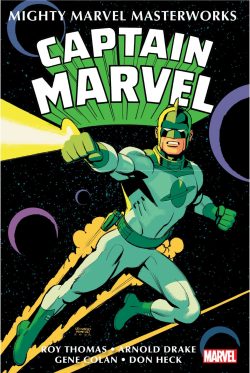
Captain Marvel Mighty Marvel Masterworks volume 1


By Stan Lee, Roy Thomas, Arnold Drake, Gene Colan, Don Heck & various (MARVEL)
ISBN: 978-1-3029-4889-4 (PB/Digital edition)

It’s a year of many anniversaries for Marvel, and 1968 marks a couple of truly significant ones. It was the year the company finally broke free of a restrictive distribution deal and began an explosive expansion that led to market dominance. The other was more symbolic and seminal: the company secured the rights to an evocative and legendary name which it has successfully exploited ever since. Moreover, that name led to the soft introduction of a character who has become one of the faces of the modern Marvel Age.

Happy birthday Mar-Vell and Carol…

The stories re-presented here are timeless and have been gathered many times before but today we’re enjoying another example of The Mighty Marvel Masterworks line: designed with economy in mind and newcomers as target audience. These books are far cheaper, on lower quality paper and smaller – like a paperback novel. Your eyesight might be failing and your hands too big and shaky, but at 152 x 227mm, they’re perfect for kids. If you opt for digital editions, that’s no issue at all.

After years as an also-ran and up-&-comer, by 1968 Marvel Comics was in the ascendant. Their sales were catching up with industry leaders National/DC Comics and Gold Key, and they had finally secured a distribution deal that would allow them to expand their list of titles exponentially. Once the stars of “split-books” Tales of Suspense (Iron Man & Captain America), Tales to Astonish (The Hulk & Sub-Mariner) and Strange Tales (Doctor Strange & Nick Fury, Agent of S.H.I.E.L.D.) all won their own titles, the House of Ideas just kept on creating. One dead-cert idea was a hero named after the company – and one bringing popular cachet and nostalgic pedigree as well.

After the notorious decade long DC/Fawcett court case that began in 1940, the title Captain Marvel disappeared from newsstands. In 1967, during the superhero boom and “camp” craze generated by the Batman TV show, publisher MLF seemingly secured rights to the name and produced a number of giant-sized comics. Their star was an intelligent alien robot who could fly, divide his body into segments and shoot lasers from his eyes.

Despite a certain quirky charm, and being devised by comics veteran Carl (Human Torch) Burgos, the feature failed to attract a large following. On its demise, the name was quickly snapped up by expansionist Marvel Comics Group.

Marvel Super-Heroes was a brand-new title: it had been giant-sized reprint comic book Fantasy Masterpieces: combining monster and mystery tales with Golden Age Timely Comics classics, but with the 12th issue it added an all-new experimental section for characters without homes. These included Inhuman Medusa, Ka-Zar, Black Knight and Doctor Doom, along with new concepts like Guardians of the Galaxy, Phantom Eagle and, to start the ball rolling, a troubled alien spy sent to Earth from the Kree Galaxy. He held a Captain’s rank and his name was Mar-Vell.

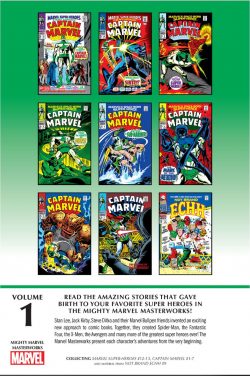
This cosmically conceived, kid-friendly collection offers that origin adventure from Marvel Super-Heroes #12-13, the contents of Captain Marvel #1-7 plus a humorous take from Not Brand Echh #9: collectively spanning cover-dates December 1967 to August 1968.

Crafted by Stan Lee, Gene Colan & Frank Giacoia, the initial MS-H 15 page-instalment ‘The Coming of Captain Marvel!’ The tale derived directly from Fantastic Four #64-65, wherein the quartet defeated a super-advanced Sentry robot marooned on Earth by a mythical and primordial alien race, only to be attacked by a high official of those long-lost extraterrestrials in the very next issue!

After defeating Ronan the Accuser, the FF heard no more from the far from extinct Kree, but the millennia-old empire became once again interested in Earth. Dispatching a surveillance mission, the Kree wanted to know everything about us. Unfortunately, the agent they chose was a man of conscience, whilst his commanding officer Colonel Yon-Rogg was his ruthless rival for the love of the ship’s medical officer Una.

No sooner has the dutiful operative made a tentative planet-fall and clashed with the US Army from a local missile base (frequently hinted at as being Cape Kennedy) than the instalment ends. Stan & Gene had set the ball rolling leaving Roy Thomas to establish the basic ground-rules in the next episode.

Colan remained, this time with Paul Reinman inking. ‘Where Stalks the Sentry!’ sees the spy improving his fantastic weaponry before a blatant attempt by Yon-Rogg to kill him collaterally destroys a light aircraft carrying scientist Walter Lawson to that military base.

Assuming Lawson’s identity, Mar-Vell infiltrates “The Cape” but arouses the suspicions of security Chief Carol Danvers. He is horrified to discover the Earthlings are storing the Sentry (defeated by the FF) on site. Yon-Rogg, sensing an opportunity, reactivates the deadly mechanoid. As it goes on a rampage, only Mar-Vell stands in its path…

That’s a lot of material for 20 pages but Thomas & Colan were on a roll. With Vince Colletta inking, the third chapter was not in Marvel Super-Heroes but in the premiere issue of the Captain’s own title – released for May 1968. ‘Out of the Holocaust… A Hero!’ is an all-action thriller, detailing the Kree-man’s victorious clash with the superbot, but which still found space to establish twin sub-plots. Succeeding issues would focus on “Lawson’s” credibility and Mar-Vell’s inner doubts as the faithful Kree soldier rapidly loses faith in his own race and falls under the spell of the strangely beguiling humans…

The Captain’s first foray against a super-villain comes in the next two issues as we learn the Kree and Skrull Empire have been intergalactic rivals for eons, and the shapeshifters now need to know why there’s an enemy soldier stationed on neutral Earth.

Despatching their own top agent, ‘From the Void of Space Comes the Super Skrull!’ and the resultant battle almost levels the entire state before bombastically concluding with the Kree beaten, captured and interrogated. A month later he rallies ‘From the Ashes of Defeat!’ and spectacularly triumphs, whilst on the orbiting home front the romantic triangle sub-plot intensified as Yonn-Rogg looked for ways to send Mar-Vell to a justifiable death…

Issue #4 saw the secret invader clashing with fellow anti-hero Prince Namor the Sub-Mariner in ‘The Alien and the Amphibian!’ even as Mar-Vell’s superiors make increasingly ruthless demands of their reluctant agent.

Captain Marvel #5 saw Arnold Drake & Don Heck assume the creative chores (with John Tartaglione on inks) in cold-war monster-mash clash ‘The Mark of the Metazoid’, wherein a mutated Soviet dissident is forced by his militaristic masters to kidnap Walter Lawson (that’s narrative symmetry, that is).I ssue #6 then places the Captain ‘In the Path of Solam!’: battling a marauding sun-creature even as Carol Danvers gets ever-closer to proving that something’s not right with the enigmatic consultant Lawson. Meanwhile, the man impersonating him is forced to prove his loyalty to his species by unleashing a Kree bio-weapon on an Earth community in ‘Die, Town, Die!’ However, all is not as it seems because murderous animate Quasimodo, the Living Computer is also involved…

To Be Continued…

Wrapping up this first volume is a burst of light relief from Marvel’s sixties parody comic Not Brand Echh From # 9, ‘Captain Marvin: Where Stomps the Scent-ry! or Out of the Holocaust… Hoo-Boy!!’ finds Thomas, Colan & Frank Giacoia wickedly reimagining the origin. It’s either funny or painful depending on your attitude…

Mar-Vell and Carol Danvers have both been Captain Marvel and starred in some our art form’s most momentous and entertaining adventures. Today’s multimedia madness all started with these iconic and evergreen Marvel tales, and it’s never too late for you to join the ranks of the cosmic cognoscenti…
© 2023 MARVEL.

The Invaders Classic: The Complete Collection volume 1


By Roy Thomas, Frank Robbins, Rich Buckler, Dick Ayers, Don Heck, Jim Mooney, Carl Burgos, Don Rico, Lee Elias, Alex Schomburg, Sal Buscema & various (Marvel)
ISBN: 978-0-7851-9057-8 (TPB/Digital edition)

The adage never grows stale: the best place to see American superheroes in action is in World War II, thrashing Nazis and their evil Axis allies. And yes, that includes their so-numerous copycats and contemporary legatees like Hydra, The National Southern Baptist Convention, Reclaim, The LGB Alliance and The Bullingdon Club too… whether contemporaneously or retroactively…

That was especially true in the 1970s when many guilt-free hours were devoted to portraying the worst people on Earth getting their just deserts (or just getting mocked in shows like Hogan’s Heroes and films like The Producers or To Be or Not to Be). In an era of generational backward-looking fostering cosy familiarity and with Lynda Carter on TV screens crushing the Third Reich every week in The New Adventures of Wonder Woman, admitted aficionado and irredeemable nostalgist Roy Thomas (Conan the Barbarian, X-Men, All-Star Squadron, Wonder Woman, Shazam!, Fantastic Four, Thor, Spider-Man, Daredevil ad infinitum) sought to revisit the “last good war”. Here he would back-write a super-team comprising Marvel’s (or rather Atlas/Timely’s) “Big Three” – Captain America, Sub-Mariner and the Human Torch – and however many minor mystery-men as he could shoehorn in…

Long before this series debuted, Prince Namor, the Sub-Mariner was the hybrid offspring of a sub-sea Atlantean princess and an American polar explorer: immensely strong, highly resistant to physical harm, able to fly and thrive above and below the waves. Created by young Bill Everett, Namor technically predates Marvel/Atlas/Timely Comics.

He first caught the public’s attention as part of the elementally electrifying “Fire vs. Water” headlining team in Marvel Comics #1 (October 1939 and Marvel Mystery Comics from the next issue) alongside The Human Torch, but had debuted earlier in the year in monochrome Motion Picture Funnies, a weekly promotional giveaway handed out to moviegoers.

Swiftly becoming one of the new company’s biggest draws, Namor gained his own title at the end of 1940 (cover-dated Spring 1941) and was one of the last super-characters to go at the end of the first heroic age. In 1954, as Atlas, the company briefly revived the Big Three and Everett returned for an extended run of superb fantasy tales. The time wasn’t right and the title sunk again.

When Stan Lee & Jack Kirby began reinventing comics in 1961 with Fantastic Four, they revived the forgotten amphibian as a troubled, semi-amnesiac, yet decidedly more regal and grandiose anti-hero, embittered at the loss of his sub-sea kingdom – seemingly destroyed by American atomic tests. He also became a dangerous bad-boy romantic interest: besotted with the FF’s Sue Storm.

Namor knocked around the budding Marvel universe, squabbling with assorted heroes like Daredevil, The Avengers and X-Men before securing his own series as half of “split-book” Tales to Astonish with fellow antisocial antihero The Incredible Hulk, eventually returning to solo stardom in 1968.

Crafted by Carl Burgos, the original Flaming Fury burst into life as a humanoid devised by troubled, greedy Professor Phineas Horton. Instantly igniting into a malfunctioning uncontrollable fireball whenever exposed to air, the artificial innocent was consigned to entombment in concrete but escaped to accidentally imperil New York City until he fell into the hands of malign mobster Sardo. His attempts to use the android as a terror weapon backfired and the hapless, modern day Frankenstein’s Monster became a misunderstood fugitive. Even his creator only saw the fiery Prometheus as a means of making money.

Gradually gaining control of his flammability, the angry, perpetually rejected android opted to make his own way in the world. Instinctively honest, he saw crime and wickedness everywhere and resolved to do something about it. Indistinguishable from human when not afire, he joined the police as Jim Hammond, tackling ordinary thugs even as his volcanic alter ego battled outlandish fiends like Asbestos Lady. Soon after, the Torch met his opposite number when the New York City Chief of Police asked him to stop the savage Sub-Mariner from destroying everything. The battles were spectacular but inconclusive, and only paused after policewoman Betty Dean brokered a tenuous ceasefire.

The Torch gained a similarly powered junior sidekick Toro, but both vanished in 1949: victims of organised crime and Soviet spies working in unison. They spectacularly returned in 1953’s revival, renewing their campaign against weird villains, Red menaces and an assortment of crooks and gangsters before fading again. In the sixties it was revealed that atomic radiation in the Torch’s body finally reached critical mass and Jim – realising he was about to flame out in a colossal nova – soared into the desert and went up like a supernova…

Jim Hammond was resurrected many times in the convoluted continuity that underpinned the modern House of Ideas and is with us still…

Created by Joe Simon & Jack Kirby in an era of national turmoil and frantic patriotic fervour, Captain America was a dynamic, emphatically visible response to the horrors of Nazism and the threat to democracy. Consequently, the concept quickly lost focus and popularity once hostilities ceased. The Sentinel of Liberty was lost during post-war reconstruction, only to briefly reappear after the Korean War: a harder, darker Cold Warrior hunting monsters, subversives and “Reds” who lurked under every American bed.

He vanished once more, until the burgeoning Marvel Age resurrected him just in time to experience the Land of the Free’s most turbulent, culturally divisive era. He became a mainstay of the Marvel Revolution in the Swinging Sixties, but arguably lost his way after that, except for a politically-fuelled, radically liberal charged period under scripter Steve Englehart.

Despite everything, Captain America evolved into a powerful symbol for generations of readers and his career can’t help but reflect that of the nation he stands for…

Devised in the fall of 1940 and on newsstands by December 20th, Captain America Comics #1 was cover-dated March 1941, and an instant monster, blockbuster smash-hit. He had boldly and bombastically launched in his own monthly title with none of the publisher’s customary caution, and instantly was the undisputed star of the Big Three. He was, however, the first to fall from popularity as the Golden Age ended.

You know the origin story like your own. Simon & Kirby depicted scrawny, enfeebled patriot and genuinely Good Man Steven Rogers – after constant rejection by the Army – is recruited by the Secret Service. Desperate to stop Nazi expansion, the passionate kid joined a clandestine experiment to create physically perfect super-soldiers.

I have no idea if the irony of American Übermenschen occurred to the two Jewish kids creating that mythology, but here we are…

When a Nazi infiltrated the project and murdered the pioneering scientist behind it all, Rogers was the only successful result and became America’s not-so-secret weapon. When he was lost, others took up the role and have periodically done so ever since. I might be wrong, but as I recall every substitute and replacement was white and male…

When Thomas was writing The Avengers, issues #69-71 featured a clash with Kang the Conqueror spanning three eras. It saw some of the team dumped in WWII Paris and manipulated into fighting in situ Allied costumed champions. When that memorable minor skirmish was expanded and extrapolated upon in 1975, history was (re)made…

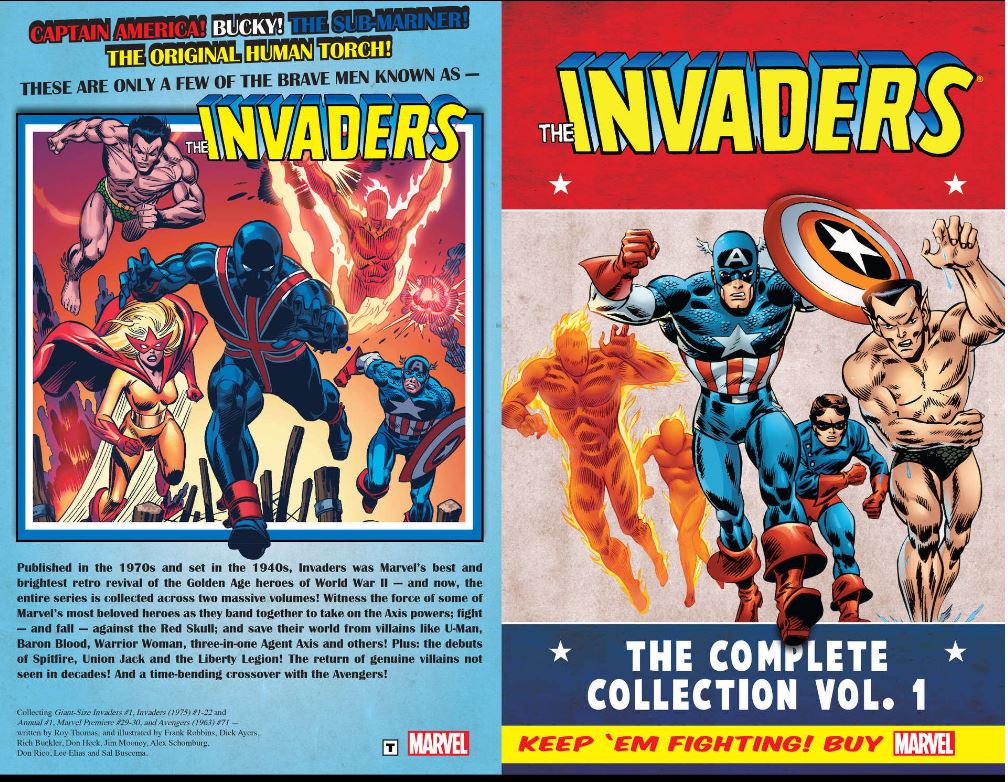
Re-presenting Giant-Sized Invaders #1, The Invaders #1-22 & Annual #1, Marvel Premiere #29-30, and Avengers #71 – collectively spanning June 1975 to November 1977 – this initial foray charts the course of the team and exponentially expands Marvel lore and history, opening with an extended multi-chapter romp.

Cover-dated June 1975, and crafted by Thomas, Frank Robbins (Johnny Hazard, Batman, Superboy, The Shadow, Morbius/Adventure into Fear, Captain America, Man from Atlantis) & Vince Colletta, ‘The Coming of the Invaders!’ saw a revisionist Big Three saving British Prime Minister Winston Churchill during a US visit in December 1941…

Nazi spies and saboteurs are crushed by boy marvel Bucky and ‘A Captain Called America!’ who is then recruited by the FBI to safeguard a mystery dignitary. The duo are ordered to cooperate with another extraordinary operative in ‘Enter: the Human Torch!’.

A tale of sinister super-science unfolds, revealing how Nazi Colonel Krieghund and the enigmatic Brain Drain have bult their own super-soldier. Master Man (AKA Ubermensch) has already beaten the Fiery Fury and sidekick Toro in pursuit of the plot. Grudging associates at best, the quartet of heroes rush to Chesapeake Bay in time to see how ‘The Sub-Mariner Strikes!’ when Master Man targets Churchill’s battleship. On the clash’s conclusion, the grateful premier suggests the saviours shelve their innate animosity for the duration and work together to crush the Axis alliance.

The blockbuster origin tale is augmented here by its accompanying editorial ‘Another Agonizingly Personal Recollection by Rascally Roy Thomas’

The launch was a huge success and The Invaders #1 (August) was rushed out. Like Giant-Size X-Men #1, an in production second issue was rapidly retooled, with the first half appearing as ‘The Ring of the Nebulas!’ and ‘From the Rhine… a Girl of Gold!’ with the new team relocated to blitz-blasted London and arriving in the middle of shattering air raid. As their flying compatriots bring down German bombers, Cap and Bucky land Namor’s Atlantean sky-sub Flagship and help clear burning buildings of casualties and rescue a strange, shellshocked woman who – although amnesiac – proves to be ‘A Valkyrie Rising!’ With “Hilda’s” help the heroes infiltrate ‘Beyond the Siegfried Line!’ and invade Brain Drain’s citadel only to be ambushed by a trio of Teutonic gods…

Following second editorial ‘Okay Axis, Here We Come!’, the saga explosively concludes in the second bimonthly issue (cover-dated October) as ‘Twilight of the Star-Gods!’ reveals the incredible truth about Hilda, Loga, Donar and Froh, the source of Brain Drain’s scientific advances and why it’s bad to abuse and exploits guest from other planets…

Action was never far away and #3 opened with the triumphant Invaders saving a convoy from U-Boats before briefly returning to America to forestall a ‘Blitzkrieg at Bermuda’. The crisis was instigated by an Atlantean traitor siding with and working for the Nazis.

Namor’s alliance with the Allies only existed because the Germans had depth-charged his undersea city to eradicate its sub-human inhabitants, but now a rogue named Merrano has artificially augmented his strength and led a cadre of Atlanteans and sea beasts against surface bases. The aquatic blockbuster was once Namor’s chief scientist and has misused Atlantean technology for his own purposes as U-Man. Regal pride stung, Namor demands to fight the traitor alone, sparking a split with his newfound comrades. In the end, he and Bucky go on without the others or any official sanction….

As the marine man-monster and his hordes head for Churchill’s secret meeting in the Caribbean, the quarrellers at last agree that ‘U-Man Must be Stopped!’ and take all necessary steps, spurred on and umpired by Namor’s human girlfriend Betty Dean.

The drama intensified with #5 (March 1976) as Thomas expanded his niche universe by creating a second squad of masked stalwarts. Pencilled by Rich Buckler and Dick Ayers, with inks from Jim Mooney. ‘Red Skull in the Sunset!’ opens a 4-issue epic which sees the Invaders captured by the ultimate fascist and turned into weapons against America. Only Bucky – disregarded as too puny to exploit – remained free. The tale continued in #6 (‘…And Let the Battle Begin!’ with art by Robbins & Colletta May) and also crossed over into Marvel Premiere #29’s ‘Lo, The Liberty Legion!’ & 30’s ‘Hey Ma,! They’re Blitzin’ the Bronx’ (April and June 1976) wherein Bucky recruited a number of new superheroes and made them into a team to defeat the Invaders and scupper the Skull’s schemes.

As delivered by Thomas, Don Heck, & Colletta the recruits – The Patriot, Whizzer, Miss Marvel, Blue Diamond, Red Raven, Jack Frost and the Thin Man – came from assorted Timely strips of the 1940s and remained state-side as Home Front heroes. A fabulously engaging primal romp, the epic is inexplicably divided, with the Marvel Premiere instalments (the second and fourth/final chapters) relegated to the back of the book along with editorial features ‘Give Me Liberty – or Give Me The Legion!’ parts 1 and 2.

With the confusion and reputations all cleared up, the liberated Invaders return to war-torn London for #7 (July 1976) to tackle ‘The Blackout Murders of Baron Blood!’, with a costumed German vampire terrorising the capital. During a nighttime assault, the Torch saves Air Raid Warden Lady Jacqueline Falsworth from the bloodsucker and is gratefully introduced to her father: a legendary “masked spy-buster of World War One”.

James Montgomery Falsworth had worked with an international group of proto-superheroes dubbed Freedom’s Five, and on hearing of the vampire, comes out of retirement to finish his duel with the Kaiser’s top secret weapon…

Meanwhile, the other Invaders have also clashed with Baron Blood and are happy that ‘Union Jack is Back!’ (inked by Frank Springer): blithely unaware that the beast is actually a member of Falsworth’s household waiting to pick them off at his leisure. It begins as Union Jack is crippled by Blood and seemingly helpless to save his daughter from being drained in #9’s ‘An Invader No More!’

With justice finally served, the need for a deadline-saving reprint sees #10 mix new framing sequence ‘The Wrath of the Reaper!’ with a remembrance amongst the heroes as they rush father and daughter to hospital: ‘Captain America Battles the Reaper!’ by Al Avison & Al Gabriele as first seen in Captain America #22 (January 1943) rowdily recounted the failure of one of Adolf Hitler’s top agents…

The new history resumed in #11 as Montgomery learns he will never walk again, and Jacqueline is saved by an emergency transfusion of the Torch’s artificial, instantly regenerating blood. However, the combination of vampiric body fluids and the Torch’s liquid fuel source transform her into something new and powerful…

In another wing of the hospital, refugee Dr Gold has been building an advanced warsuit which he inexplicably turns on the Invaders until Jacqui lends a fast and fiery hand on the ‘Night of the Blue Bullet!’

As she seeks to replace her father on the team as Spitfire, Captain America ferrets out the reason for Gold’s betrayal and orders a rescue mission ‘To the Warsaw Ghetto!’ to save the boffin’s hostage brother Jacob. The foray is a complete disaster and the squad is captured by macabre Gauleiter Eisen, but his triumph is short-lived as it provokes Jacob to summon ancient forces in #13’s ‘The Golem Walks Again!’

A new team debuted in the next issue with ‘Calling… The Crusaders!’ as a (mostly) British ensemble – comprising Spirit of ‘76, Ghost Girl, Captain Wings, Thunderfist, Tommy Lightning and Dyna-Mite – start outshining The Invaders and boosting morale. Tragically all is not as it seems and a deadly propaganda coup is barely thwarted in concluding episode ‘God Save the King!’

Penciller Jim Mooney joined Thomas and inker Springer for #16 and the start of an extended epic in ‘The Short, Happy Life of Major Victory!’ It begins when US soldier Biljo White (that’s an in-joke I’m not explaining here) is snatched off London’s streets despite the best efforts of Captain America and Bucky. It transpires that the young PFC is the creator of a comic book hero whose origin so-closely mirrors the actual process that turned Steve Rogers into a living weapon that the Nazis have deduced he must have inside knowledge…

Fuelled by guilt and outrage, Cap leads the team straight to Hitler’s Berchtesgaden fortress, only to have entire team ambushed and defeated by a re-invigorated Master Man.

Biljo has been tortured by sadistic officer Frau Rätsel, but only revealed under deep hypnosis how he heard the story of a super soldier in a bar: recalling a key clue allowing her to perfect Brain Drain’s Master Man process.

At that moment a male superior reprimands her for exceeding her authority (Aryan dogma being that women were only meant for breeding and entertainment purposes) and her violent rebuttal causes an explosion that wrecks the lab and totally changes her. ‘The Making of Warrior Woman, 1942!’ consequently frees the Allied captives, but their short-lived liberty ends when Master Man and the newly-minted Krieger-Frau (Warrior Woman) double-team them. With Captain America hurled to his death and the others despatched to Berlin to provide an obscene spectacle, events take a sudden shocking turn in #18 as ‘Enter: The Mighty Destroyer!’ reintroduces another Golden Age Great by way of a complex web of family ties and debts of honour finally repaid…

When Cap was thrown off the mountain, he was saved by a mystery-man who had been fighting behind enemy lines since 1941, terrorising the Wehrmacht through a one-man war of attrition. He reveals that he was imprisoned in Hamburg where fellow inmate Professor Erich Schmitt made him swallow his own version of the super-soldier serum to keep it from the Nazis. The potion made him a veritable superman and he’s been making them pay ever since. He also reveals to Cap his real name…

As they prepare an assault to free The Invaders, in England Spitfire has met with former Crusader Dyna-Mite and discovered some painful family secrets. Ignoring orders to say out of harms way, she commandeers a plane and heads for Germany with the Tiny Titan. Insubordination is a proudly inherited trait however, and the heroes cannot prevent wheelchair-bound Lord Falsworth and his “chauffeur” Oskar joining the expeditionary force…

Bach in Berchtesgaden, the ruthless infiltration is successful but too late. Namor, Bucky, Torch and Toro have already been shipped to Berlin for public execution, before #19’s ‘War Comes to Wilhelmstrasse’ sees Captain America’s futile attempt to save them foiled and his capture, augmented by the untold tales of Falsworth’s son Brian and companion Roger Aubrey. Conscientious objectors, they had shamefully gone to Berlin before vanishing years prior to war being declared, only for one of them to suddenly return as Dyna-Mite.

Another deadline debacle allowed a brace of classic reprints to resurface in #20 and 21 with climactic conclusion ‘The Battle of Berlin!’ cleft in two. The first half sees the Allied heroes saved from death by a revitalised Union Jack and the resultant battle for freedom allow Krieger-Frau to dodge the forced marriage to Master Man that Hitler had ordered…

That issue also held a colorized reshowing of ‘The Sub-Mariner’ by Everett from Motion Picture Funnies, after which ‘The Battle of Berlin! Part Two!’ follows the traumatic flight bac to Britain and the critical injury suffered by one of the heroes…

Another Everett ‘The Sub-Mariner’ mini-masterpiece – from Marvel Mystery Comics #10 (August 1940) – then sees the sea prince targeted by murderous surface men…

Their plane ditched in the English channel, The Invaders are saved by the Navy and treatment begins for bullet-riddled Toro. Again reduced to anxious waiting, the team learn how he began his career in #22’s ‘The Fire That Died!’ (by Thomas, Mooney & Springer and adapted from The Human Torch #2: September 1940).

Ending the official chronology is Invaders Annual #1 (November 1977),which tells the other side of the originating story from Avengers #71, from the viewpoint of the 1940s heroes. Moreover, each individual chapter is crafted by a veteran who worked on the characters during the Golden Age. The mission begins with ‘Okay, Axis… Here We Come!’ by Thomas, Robbins & Springer, with the heroes separately pursuing insidious supervillains. ‘The Human Torch’ battles The Hyena as limned by Alex Schomburg; Don Rico’s ‘Captain America’ clashes with Agent Axis and ‘Sub-Mariner’ sinks The Shark thanks to Lee Elias & Springer, before the Invaders are teleported to Paris by a mysterious power.

That’s Kang and his opponent the Grandmaster meddling with time to facilitate a duel with three Avengers from 1969, and concludes here with ‘Endgame: Part II’. A semblance of sense is afforded by Thomas’ essay ‘Okay, Axis… Here We Come – Again!’

Woefully misfiled, the contents of Marvel Premiere #29 & 30 are next, before we end with the opening shot from the Avengers #71, by Thomas, Sal Buscema & Sam Grainger. ‘Endgame!’ was the final chapter in a triptych that saw the World’s Mightiest Heroes hijacked to the future to by old enemy Kang: living pieces in a cosmic chess-game with an omnipotent alien. If the Avengers fail – Earth would be eradicated from reality. the tale was significant for introducing 2/3 superteams: Squadron Supreme, Squadron Sinister and The Invaders. The saga culminated with The Vision, Black Panther and Yellowjacket sent to 1941 to fight the WWII incarnations of Namor, Human Torch and Captain America…

With covers by Robbins, John Romita Sr., Jack Kirby, Gil Kane, Ed Hannigan, Alex Schomburg, Joe Sinnott & Frank Giacoia, this is a no-nonsense, albeit convoluted thrill-ride for continuity-addicts and fervent Fights ‘n’ Tights fans that is full of fun from first to finish.
© 1969, 1975, 1976, 1977, 2014 Marvel Characters, Inc. All Rights Reserved.

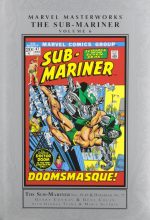
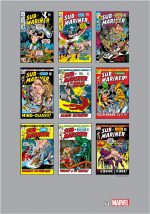
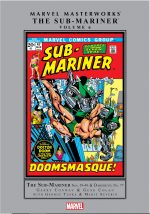
Sub-Mariner Marvel Masterworks volume 6


By Gerry Conway, Roy Thomas, Gene Colan, George Tuska, Marie Severin, Ross Andru & various (Marvel)
ISBN: 978-0-7851-9184-1 (HB/Digital edition)

In his most primal incarnation (other origins are available but may differ due to timeslips, circumstance and screen dimensions) Prince Namor, the Sub-Mariner is the proud, noble and generally bellicose offspring of the union of a water-breathing Atlantean princess and an American polar explorer.

That doomed romance resulted in a hybrid being of immense strength and extreme resistance to physical harm, able to fly and thrive above and below the waves. Over the years, a wealth of creators have played with the fishy tale and today’s Namor is frequently hailed as Marvel’s First Mutant. What remains unchallenged is that he was created by young, talented Bill Everett, for non-starter cinema premium Motion Picture Weekly Funnies: #1 (October 1939) so – technically – Namor predates Marvel, Atlas and Timely Comics.

The Marine Miracleman first caught the public’s avid attention as part of an elementally appealing fire vs. water headlining team-up in the October 1939 Marvel Comics #1 (which renamed itself Marvel Mystery Comics from #2 onwards. The amphibian antihero shared honours and top billing with The Human Torch, having debuted (albeit in a truncated, monochrome version) in the aforementioned promotional booklet which had been designed to be handed out to moviegoers earlier in the year.

The late-starter antihero rapidly emerged as one of the industry’s biggest draws, and won his own title at the end of 1940 (cover-dated Spring 1941). His appeal was baffling but solid and he was one of the last super-characters to vanish at the end of the first heroic age.

In 1954, when Atlas (as the company then was) briefly revived its “Big Three” line-up – the Torch and Captain America being the other two – Everett returned for an extended run of superbly dark, mordantly moody and creepily contemporary fantasy fables. Even so, his input wasn’t sufficient to keep the title afloat and eventually Sub-Mariner sank again.

In 1961, as Stan Lee & Jack Kirby were reinventing superheroes with the Fantastic Four, they revived the awesome, all-but-forgotten aquanaut as a troubled, semi-amnesiac antihero. Decidedly more bombastic, regal and grandiose, this returnee despised humanity: embittered and broken by the loss of his sub-sea kingdom which had been (seemingly) destroyed by American atomic testing. His rightful revenge became infinitely complicated after he became utterly besotted with the FF’s Susan Storm.

Namor knocked around the budding Marvel universe for some years, squabbling with other star turns such as The Hulk, Avengers, X-Men and Daredevil before securing his own series as one half of Tales to Astonish. From there he graduated in 1968 to his own solo title.

This sixth subsea selection trawls The Sub-Mariner #39-49, and includes a crossover confrontation from Daredevil #77. The subsea sagas cumulatively span cover-dates July 1971 to May 1972 and are preceded by heartfelt appreciation and more creative secret-sharing from incoming scripter Gerry Conway in his Introduction ‘See the Sea’ before the (now) dry land dramas recommence…

Previously, Namor had endured months of escalating horror as old enemies like Prince Byrrah, Warlord Krang, Attuma and Dr. Dorcas continuously assaulted his sunken kingdom. They were soundly defeated, and, in the throes of triumph, the Prince announced his marriage to lifelong companion Lady Dorma. He was then betrayed by his most trusted ally whilst sinister shapeshifter Llyra murdered his bride and sought to replace her…

Heartsick, angry and despondent, Namor abdicated the throne: choosing to henceforth pursue the human half of his hybrid heritage as a surface dweller…

The tragedy instantly intensifies in Sub-Mariner #39 as seasoned scripter Roy Thomas bows out with ‘…And Here I’ll Stand!’ Illustrated by Ross Andru & Jim Mooney, it sees the former royal arrive in New York City and move onto abandoned, desolate Prison Island.

However, the intrusion is taken for invasion by the curmudgeonly human authorities who mobilise the military to drive him out. A tense stand-off soon escalates and a typically bombastic response all round reduces Sub-Mariner’s sanctuary to shards and rubble.

In the aftermath, human friends Diane Arliss and Walt Newell (who operates parttime as undersea Avenger Stingray) bring the twice-exiled Prince staggering news…

Meanwhile in Manhattan – and depicted in Daredevil #77 – Conway, Gene Colan & Tom Palmer embroil Namor in a 3-way clash after a strange vehicle materialises in Central Park. Irresistibly summoned by telepathic force, Namor arrives just in time for the Sightless Swashbuckler to jump to a wrong conclusion and attack… Then a late-arriving third hero butts in…

Guest stars abound in ‘…And So Enters the Amazing Spider-Man!’ and when the uncanny alien artefact explodes, a mysterious woman ominously invites DD, the webspinner and Namor to participate in a fantastic battle in a far-flung, dimensionally-adrift lost world. Exhausted by the traditional misunderstanding and subsequent fight, Daredevil begs off and goes home, leaving the wallcrawler to join now-nomadic Namor on a fantastic voyage and bizarre adventure that concludes in the Atlantean’s own comic…

Sub-Mariner #40 sees Conway, Colan & Sam Grainger detail how Spider-Man and Namor are compelled ‘…Under the Name of Ritual…’ to save The People of the Black Sea from murderous usurper Turalla. The telepathic subspecies has undisclosed links to Atlantis and a claim on Namor’s honour: demanding he fight on their behalf since their true king has been missing for decades…

In distant Boston, angry and reclusive elder Stephan Tuval is somehow aware of what’s transpiring and – just when arachnid and amphibian are about to fall in the brutal duel – strikes with all the terrifying power of his mind…

Returned to Manhattan, the weary heroes part, and Sub-Mariner #41 finds Namor following up the revelations shared by Diane and Walt. Illustrated by George Tuska & Grainger, ‘Whom the Sky Would Destroy!’ sees the sea lord struck down over rural New York by mutants artificially created by deranged scientist Aunt Serr.

Her son Rock is terrifying, but the real threat is meek, gentle, deceptive Lucile and before long Namor has fallen to the demonic clan. Seen as raw material, the former prince barely escapes destruction in #42’s ‘…And a House Whose Name…is Death!’ as Conway, Tuska & Mooney briskly build to larger epic featuring Tuval…

If you’re a completist, this issue also offers a brief Mr. Kline interlude, as Conway continued an early experiment in close-linked crossover continuity. Issue #42 contributes to a convoluted storyline involving the mystery mastermind from the future, twisting human lives and events. For the full story you should also track down contemporaneous Daredevil and Iron Man issues: you won’t be any the wiser, but at least you’ll have a complete set…

For one month, Marvel experimented with double-sized comic books (whereas DC’s switch to 52-page issues lasted almost a year: August 1971 to June 1972 cover-dates). November’s Sub-Mariner #43 held an immense, 3-chapter blockbuster beginning with ‘Mindquake!’ as Namor reaches Boston. He has come in search of his father Leonard McKenzie, whom he believed had been killed by Atlanteans in the 1920s. Instead he finds Tuval, driven mad by his re-emerging psychic abilities and now a danger to all.

Crafted throughout by Conway, Colan & Mike Esposito, the tale of the aged tele-potent reveals how he has built a cult around himself ‘…And the Power of the Mind!’, before his increasingly belligerent acts trigger ‘The Changeling War!’ and cause his own downfall…

Cruelly unaware how close he is to his father, Sub-Mariner is then distracted by the return of Llyra and new consort Tiger Shark in #44’s ‘Namor Betrayed!’ With art by the magnificent Marie Severin & Mooney, the story reviews the antihero’s love-hate relationship with Human Torch Johnny Storm, just in time for the shapeshifter to orchestrate a heated clash with the teen hero.

The blistering battle concludes in #45 with McKenzie’s abduction, and ‘…And Fire Stalks the Skies!’ sees Namor surrender himself to save his sire…

Conway, Colan & Esposito then pile on the trauma in #46 as ‘And Always Men Will Cry: Even the Noble Die!’ sees the son’s quest end in death and disaster, despite the best – if badly mismanaged – interventions of the Torch and Stingray.

Doubly orphaned and traumatised, Namor loses his memory again, and is easily gulled by ultimate manipulator Victor Von Doom in #47’s ‘Doomsmasque!’: duly deployed as cannon fodder in the Demon Doctor’s duel with M.O.D.O.K. and AIM to control a reality-warping Cosmic Cube.

The war is dirty and many-sided, with a frontal assault in #48’s ‘Twilight of the Hunted!’ leaving Namor to a pyrrhic triumph in concluding chapter ‘The Dream Stone!’ (inked by Frank Giacoia) before retrenching in confusion to ponder his obscured future…

To Be Continued…

Sunken treasures salvaged here include Everett’s cover to all-reprint Sub-Mariner Annual #2 (January 1972, reprising the underwater portions of Tales to Astonish #74-76); a covers gallery by Sal Buscema, Everett ,Tuska, Gil Kane & Giacoia; original art from Andru & Mooney, Sal B, Severin, Kane, Giacoia & Esposito plus a copious Biographies section.

Many early Marvel Comics are more exuberant than qualitative, but this volume, especially from an art-lover’s point of view, is a wonderful exception: historical treasures with narrative bite that fans will delight in forever. Moreover, as the Prince of Atlantis is now a bona fide big screen sensation, now might be the time to get wise and impress your friends with a sunken treasure…
© 2018 Marvel Characters, Inc. All rights reserved.

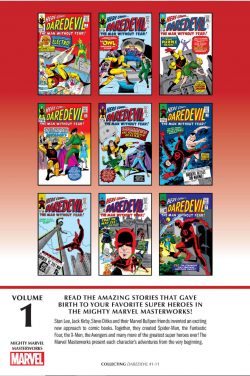
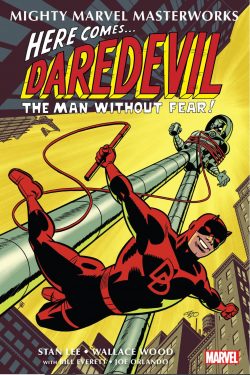
Mighty Marvel Masterworks Daredevil volume 1


By Stan Lee, Bill Everett, Joe Orlando, Wally Wood, Bob Powell & various (MARVEL)
ISBN: 978-1-3029-3440-8 (PB/Digital edition)

As the remnants of Atlas Comics grew in popularity in the early 1960s it slowly replaced its broad variety of genre titles with more and more super-heroes. The recovering powerhouse that was to become Marvel was still hampered by a crippling distribution deal that limited the company to 16 titles (curtailing their output until 1968), so each new untried book would have to fill the revenue-generating slot (however small) of an existing title.

Moreover, as costumed characters were selling, each new similarly-themed title would limit the breadth of the monster, western, war, humour or girls’ comics that had been the outfit’s recent bread and butter. It was putting a lot of eggs in one basket, and superheroes had failed twice before for Stan Lee.

So in retrospect the visual variety of the first few issues of Daredevil, the Man Without Fear seemed a risky venture indeed. Yes, the artists were all talented, seasoned veterans, but not to the young kids who were the audience. Most importantly, they just weren’t Jack Kirby or Steve Ditko, and new features need consistency and continuity…

Still, Lee and his rotating line-up of artists plugged on, concocting some extremely engaging tales until the latest Marvel Sensation found his feet, and the fascinating transition of moody masked avenger to wisecracking Scarlet Swashbuckler can be enjoyed in this collection gathering the first 11 issues (spanning April 1964 to December 1965): an effervescent package of thrills and spills which begins with ‘The Origin of Daredevil’

This much-retold tale recounts how young Matthew Murdock grew up in the slums of New York City, raised alone by his father: washed-up second-rate prize-fighter Battling Jack Murdock.

Determined that his boy will be something, the father extracts a solemn promise from Matt that he will never fight. Mocked by other kids who sarcastically dub him “Daredevil”, the kid abides by his vow, but secretly trains his body to physical perfection.

One day, he saves a blind man from being hit by a speeding truck, only to be struck in the face by its radioactive cargo. His sight is burned away forever, but his other senses are super-humanly enhanced and he gains a sixth, “radar-sense”.

He tells no-one, not even his dad.

The senior Murdock is in dire straits. As his career declined, he signed with The Fixer, knowing full well what the corrupt promoter expected from his fighters. Somehow, the pug’s star started to shine again and his downward spiral reversed itself. Unaware that he was being set up, Battlin’ Jack got a shot at the Big Time, but when ordered to take a dive, he refused. Winning was the proudest moment of his life. When his bullet-riddled corpse was found, the cops had suspicions but no proof…

Heartbroken, Matt graduated college with a law degree and set up in business with his room-mate FranklinFogg” Nelson. They hired a quiet young secretary named Karen Page and, with his life on track, young Matt now had time to solve his father’s murder…

His promise stopped him from fighting, but what if Matt became “someone else”?

Scripted by Lee and moodily illustrated by the legendary Bill Everett (with the assistance of Ditko), this is a rather formulaic and nonsensical yarn but is astonishingly engaging visually. The oft-told tale looked a little dated even at the time, but hinted at magic yet to come…

Plot-wise, the second issue fares little better as Joe Orlando & Vince Colletta assume the art chores for ‘The Evil Menace of Electro!’: a saga wisely exploiting the celebrity of guest-stars The Fantastic Four and featuring a second-hand Spider-Man villain.

The FF consult lawyer Matt Murdock just as the electrical outlaw tries to break into their building and before long Daredevil is spectacularly and relentlessly dealing with the voltaic villain. DD #3 finally offers the sightless swashbuckler a super-foe of his own when he meets and trounces crooked corporate raider ‘The Owl, Ominous Overlord of Crime!’

Daredevil #4 was a turning point, and possibly just in time. ‘Killgrave, the Unbelievable Purple Man!’ finally gave some distinctive character to the big stiff as he strove to overcome a villain who could exert total control over anyone who saw him. Although Orlando & Colletta’s uncomfortable, sedate and over-fussy illustration remained for one last episode, Lee finally got a handle on the hero; just in time for a magician-in-waiting to elevate the series to spectacular heights.

With #5, Wally Wood assumed the art chores and his lush, lavish work brought power, grace and beauty to the series. At last the costumed combat acrobat seemed to spring and dance across the rooftops and pages. Wood’s contribution to the plotting didn’t hurt either. He actually got a cover plug on his first issue.

In ‘The Mysterious Masked Matador!’ a cool, no-nonsense hero who looked commanding and could handle anything started fighting hard and fast. The series began advancing the moribund romantic sub-plot – Foggy adores Karen, who only has eyes for Matt, who loves her, but won’t let her “waste” her life on a blind man – and actually started making sense and progress.

Most importantly, the action scenes were intoxicating…

Although a bullfighter who used his skills for crime is frankly daft, the sublime drawing and sleek inking makes it all utterly convincing, and breathtakingly battle sequence is augmented by a Wood ‘Marvel Masterwork Pin-up of “DD”’ signalling a grand change in fortune…

The wonderment intensified in the following issue as the bold bravo was  ‘Trapped by the Fellowship of Fear!’: a minor classic as the Man Without Fear must defeat not only the super-powered Ox and Eel (two more recycled villains) but also his own threat-specific foe Mr. Fear – who could instil terror and panic in victims, courtesy of his ghastly gas gun.

The improvements led to a major change in Daredevil #7: a true landmark and to my mind one of the Top Ten Marvel Tales of all time.

Here Lee & Wood concocted an indisputable masterpiece as ‘In Mortal Combat with… Sub-Mariner!’ sees Prince Namor of Atlantis travel to the surface world to have his day in court. Resolved to sue all Mankind, he hires Nelson & Murdock and submits to being arrested, but discovers too late that his warlord Krang has usurped the throne in his absence. The tempestuous monarch will not languish in a cell when the kingdom is threatened, so he fights his way to freedom and the sea.

This saga shows Murdock the lawyer to be a brilliant orator, whilst his hopelessly one-sided battle against one of the strongest beings on the planet shows the dauntless courage of DD and true nobility of the Sub-Mariner.

Most notably, and with no fanfare at all, Wood replaced the original yellow-&-black “wrestler’s costume” with the iconic and beautiful all-red outfit we know today. As one pithy commentator stated, “the original costume looked as if it had been designed by a blind man”…

Augmented by another pin-up – in actuality a rejected cover for the tale – this issue proved beyond doubt the potential of Daredevil and promised even better to come…

Another all-new villain debuted in #8; a gripping industrial espionage thriller, ‘The Stiltman Cometh!’ pits the ace acrobat against a thieving, murderous masked miscreant towering above the skyscrapers, after which Golden Age Great Bob Powell came aboard as penciller to Wood’s layouts and inks with #9’s That He May See!’

Relentlessly badgered by Karen, Matt finally agrees to see an eye-specialist who might cure his blindness, but his visit to the European principality of Lictenbad quickly embroils the adventurer in a plot to conquer the world by a Ruritanian maniac with twin knights-in-armour and killer robot fixations…

Wood was clearly chafing after a year on the book and looking to stretch himself. Thus he also scripted the series’ first continued story ‘While the City Sleeps!’: a sophisticated political thriller and complex crime caper which first saw Foggy run for District Attorney of New York, even as a mysterious mastermind known as The Organizer created an animal-powered gang comprising Bird-Man, Frog-Man, Cat-Man and Ape-Man to terrorise the city.

With Powell now on layouts and pencils with Wood as finisher, Lee was left to dialogue the concluding chapter (which also proudly proclaimed the title’s advancement to a monthly schedule) ‘A Time to Unmask!’ as Daredevil pulled out all the stops to confound a devious power-grab scheme which saw the villains defeated, but only at great personal cost to Nelson & Murdock…

Offering covers from Everett, Jack Kirby, Colletta, Wood and Powell and closing with a rousing house ad by Wood, this sleek, economical, kid-friendly Mighty Marvel Masterworks compendium offers a few bumpy false starts before blossoming into a truly magnificent example of Marvel’s miraculously compelling formula for success: smart stories, human characters and magnificent illustration.

If you’ve not read these tales before I strongly urge you to rectify that error as soon as superhumanly possible…
© 2022 MARVEL.

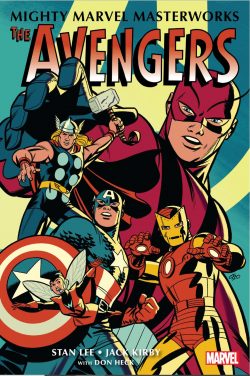
Mighty Marvel Masterworks The Avengers volume 1: The Coming of The Avengers


By Stan Lee & Jack Kirby, Don Heck, Dick Ayers, Paul Reinman, George Roussos, Chic Stone, Sam Rosen, Art Simek & various (MARVEL)
ISBN: 978-1302929787 (TPB/Digital edition)

Probably Marvel’s biggest global franchise success, The Avengers celebrate their 60th anniversary in September 2023, so let’s start the New Year with acknowledgement of that landmark event and a promise of more of the same over the next 12 months…

These stories are timeless and have been gathered many times before but here we’re looking at The Mighty Marvel Masterworks line: designed with economy in mind and newcomers as target audience. These books are far cheaper, on lower quality paper and smaller – about the dimensions of a paperback book. Your eyesight might be failing and your hands too big and shaky, but at 152 x 227mm, they’re perfect for kids. If you opt for the digital editions, that’s no issue at all.

After a period of meteoric expansion, in 1963 the burgeoning Marvel Universe was finally ready to emulate the successful DC concept that had cemented the legitimacy of the Silver Age of American comics. The notion of putting a bunch of all-star eggs in one basket had made the Justice League of America a winner and subsequently inspired the moribund Atlas outfit – primarily Stan Lee, Jack Kirby & Steve Ditko – into conceiving “super-characters” of their own. The result – way back in 1961 – was the Fantastic Four

Nearly 18 months later, the fledgling House of Ideas had generated a small and (mostly) successful stable of costumed leading men (but still only 2 sidekick women!), allowing Lee & Kirby to at last assemble a select handful of them into an all-star squad, moulded into a force for justice and soaring sales…

Seldom has it been done with such style and sheer exuberance. Cover dated September 1963, and on sale from Early July, The Avengers #1 launched as part of an expansion package which also included Sgt. Fury and his Howling Commandos and The X-Men

This premier volume gathers The Avengers #1-10 (running to cover-date September 1965): a stellar sequence of groundbreaking tales no lover of superhero stories can do without…

The tense action kicks off with ‘The Coming of the Avengers! where – rather than starting at a neutral beginning – Stan & Jack (plus inker Dick Ayers) assumed buyers had a passing familiarity with Marvel’s other heroes and wasted very little time or space on introductions.

In Asgard, immortal trickster Loki is imprisoned on a dank isle, hungry for vengeance on his noble half-brother Thor. Whilst malevolently observing Earth, the god of evil espies the monstrous, misunderstood Hulk and mystically engineers a situation wherein the man-brute seemingly goes on a rampage, simply to trick the Thunder God into battling the monster.

When the Hulk’s teen sidekick Rick Jones radios the FF for assistance, Loki scrambles and diverts the transmission, smugly awaiting the blossoming of his mischief. Sadly for the schemer, Iron Man, Ant-Man and the Wasp also pick up the redirected SOS…

Only after the alerted heroes all converge on the American Southwest to search for the Jade Giant, do they realise that something is oddly amiss…

This terse, epic, compelling and wide-ranging yarn (New York, New Mexico, Detroit and Asgard in 22 pages) is Lee & Kirby at their bombastic best, and remains one of the greatest stories of the Silver Age (it’s certainly high in my own top ten Marvel Tales) and is followed by ‘The Space Phantom(Lee, Kirby & Paul Reinman), wherein an alien shape-stealer infiltrates and almost destroys the team from within.

With latent animosities exposed by the malignant masquerader, the epic ends with the volatile Hulk quitting the team in disgust, only to return in #3 as an outright villain in partnership with ‘Sub-Mariner!This globe-trotting romp delivers high-energy thrills and one of the blistering best battle scenes in comics history as the assorted titans clash in abandoned World War II tunnels beneath the Rock of Gibraltar. The tale was preceded hereby the galvanic house ad announcing the clash as seen in Avengers #2…

Inked by George Roussos, Avengers #4 was an indisputable, game-changing landmark as Marvel’s greatest Golden Age sensation returns for another increasingly war-torn era. ‘Captain America joins the Avengers!has everything that made the company’s early output so fresh and vital. The majesty of a legendary warrior returned in our time of greatest need; stark tragedy in the loss of his boon companion Bucky; aliens, gangsters, tragedy-drenched antagonist The Sub-Mariner and even subtle social commentary, all naturally wrapped up in vast amounts of staggering Kirby Action. It even begins with a cunning infomercial as Iron Man unsuccessfully requests the assistance of the company’s other fresh young stars, giving readers a taste of the other mighty Marvels on offer to them…

Reinman returned to ink ‘The Invasion of the Lava Men!: another staggering adventure romp wherein the team – with the unwilling assistance of the ever-incredible Hulk – battle incendiary subterraneans and a world-threatening mutating mountain…

However, even all that pales before the supreme shift in artistic quality that is Avengers #6.

Chic Stone – arguably Kirby’s most effective inker of the period – joined the creative team just as a classic arch-foe was born. ‘The Masters of Evil!reveals how Nazi super-scientist Baron Zemo (who debuted that same month as a Nazi scientist in Sgt. Fury and his Howling Commandos #8) returns from self-exile in South America.

The petty tyrant is forced by his own arrogance and paranoia to emerge from the anonymity of the jungle he’s been skulking in since the Third Reich fell, after learning his despised nemesis Captain America has returned from the dead…

To this end, the war-criminal recruits a gang comprising previously established supervillains to attack New York City and destroy the Avengers. The unforgettable clash between valiant heroes and vile murdering mercenaries Radioactive Man, Black Knight (Nathan Garrett) and The Melter is to this day an unsurpassed example of prime Marvel magic.

Issue #7 followed up with two more malevolent recruits for the Masters of Evil, as Asgardian outcasts Enchantress and The Executioner are exiled to Midgard by Odin and waste no time allying with Zemo. This coincides with Iron Man being suspended from the team, due to “misconduct” occurring in his own series at that time. This was the start of the era of close-continuity where events in one series were regularly referenced and built upon in others. The practise quickly became a rod for the creators’ own backs and led to a radical rethink…

It might have been ‘Their Darkest Hour!, but follow-up Avengers #8 delivered the team’s greatest triumph and tragedy as Kirby (inked with fitting circularity by Ayers) relinquished his full drawing role with a superbly entrancing invasion-from-time thriller. Riffing on The Day the Earth Stood Still, the B-movie-toned classic introduced ‘Kang the Conqueror!: depicting an impossible powerful foe defeated by the cunning of ordinary teenagers and the indomitable spirit of Earth’s Mightiest Heroes…

Whenever Kirby left a title he’d co-created, it took a little while to settle into a new rhythm, and none more so than with these collectivised costumed crusaders. Although Lee and the fabulously utilitarian Don Heck were perfectly capable of producing cracking comics entertainments, they never had The King’s uncanny sense of panoramic scope and scale which constantly sought bigger, bolder blasts of excitement.

The Avengers evolved into an entirely different series when the subtle approachability of Heck’s human-scaled vision replaced Kirby’s larger-than-life bombastic bravura. The series had advanced to monthly circulation and even King Kirby could not draw the massive number of pages his expanding workload demanded.

Heck was a gifted and trusted artist with a formidable record for meeting deadlines and, progressing under his pencil, sub-plots and character interplay finally got as much space as action and spectacle. After Kirby, stories increasingly focused on scene-stealing newcomer Captain America: concentrating on frail human beings in costumes, rather than wild modern gods and technological titans bestriding and shaking the Earth…

Inked by Ayers, Heck’s first outing was memorable tragedy ‘The Coming of the Wonder Man!wherein the Masters of Evil plant superhuman Trojan Horse Simon Williams within the heroes’ ranks, only to have the conflicted infiltrator find deathbed redemption by saving them from the deadly deathtrap he creates…

Another Marvel mainstay debuted with the introduction of (seemingly) malignant master of time Immortus, who briefly combines with Zemo’s devilish cohort to engineer a fatal division in the ranks by removing Cap from the field in ‘The Avengers Break Up!A sign of the Star-Spangled Sentinel’s increasing popularity, the issue is augmented by a Marvel Masterwork Pin-Up of ‘The One and Only Cap, courtesy of Kirby & Ayers, and is followed by a 1963 house ad for Avengers #1 to close this pocket-sized bombshell of wonders.

These are immortal tales that defined the early Marvel experience and are still a joy no fan should deny themselves or their kids. How can you survive without them?
© 2021 MARVEL.

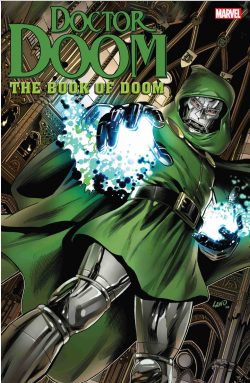
Doctor Doom: The Book of Doom Omnibus


By Stan Lee & Jack Kirby, Steve Ditko, Larry Lieber, Roy Thomas, Gerry Conway, Denny O’Neil, Chris Claremont, David Michelinie, John Byrne, Jim Shooter, Roger Stern, Walter Simonson, Mark Waid, Dwayne McDuffie& Ed Brubaker, Bob Layton, Tom DeFalco, Christopher Priest, Wally Wood, Gene Colan, Mike Sekowsky, Keith Giffen, Bob Hall, Frank Miller, Dave Cockrum, John Romita Jr., Mike Zeck, Mike Mignola, Mike Wieringo, Casey Jones & Pablo Raimondi, Frank Giacoia, George Tuska, John Buscema, Arthur Adams & Paolo Rivera, & many & various (Marvel)
ISBN: 978-1-3029-3420-0 (HB/Digital edition)

Win’s Christmas Gift Recommendation: One of Marvel’s Mightiest… 10/10

As a rule I’ve traditionally steered clear of reviewing the assorted Omnibus editions out there. For the longest time we felt that they were a bit elitist: phenomenally expensive and frequently only available in physical formats. The print version of this hardback book is 1336 pages and weighs 3.5 kilos – over 7½ pounds! – so if you’re old, infirm or have simply never developed any muscles because you’ve frittered away your life READING COMICS, that’s a big downside…

That’s all starting to change now, so here’s a review of the digital version – which is only as unwieldy as your preferred electronic reader of choice and cost me far less because of a discount sale…

Once upon a time, you hadn’t really made it as a Marvel superhero – or villain – until you’d clashed with Doctor Doom. Victor Von Doom is a troubled genius who escaped the oppression heaped on his Romani people via an ultimately catastrophic scholarship to America. Whilst there he succumbed to an intense rivalry with young Reed Richards, even then perhaps the most brilliant man alive.

The arrogant student performed unsanctioned experiments which went wrong and marred his perfect features, leading him down a path of super-science and sinister sorcery and fuelled his overwhelming hunger for ultimate power and total control. From the ashes of his failure, Von Doom rebuilt his life, returned to seize control of his Balkan homeland and become a danger to the world and the multiverse.

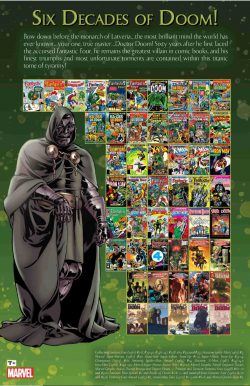
This truly king-sized and epically imperious compendium was released to celebrate the 60th anniversary of the Lord of Latveria, who debuted in Fantastic Four #5 April 1962. It gathers many of his greatest battles and other landmark moments of triumph and tragedy, and opens with a contextualising Introduction from Ralph Macchio before reprising the contents of Fantastic Four #5, 6, 39-40, 246-247, 258-260, 350, 352, 500; Amazing Spider-Man #5 & Annual #20; Marvel Super-Heroes #20; Giant-Size Super-Villain Team-Up #1-2 & Super-Villain Team-Up #13-14: Champions #16; Uncanny X-Men #145-147; Iron Man #149-150; Marvel Super-Heroes Secret Wars #10-12; Marvel Graphic Novel Emperor Doom; Marvel Graphic Novel Doctor Strange and Doctor Doom: Triumph and Torment; Fantastic Four (volume 2) #67-70; Fantastic Four Special (2005) #1 and Books of Doom #1-6, as well as material from Fantastic Four #236, 358 & Annual 2; Astonishing Tales #1-3, 6-8 and Marvel Double-Shot #2 collectively spanning July 1962-June 2006.

The drama begins as it must with that debut in Fantastic Four #5. At that time, aliens and especially monsters played a major part in earlier Marvel’s output. However, after a tentative start, Stan Lee & Jack Kirby’s recreation of super-heroes embraced the unique basics of the idiom: taking a full bite out of the Fights ‘n’ Tights apple by introducing the first full-blown, unrepentant super-villain to their budding Marvel Universe.

Admittedly the Mole Man had appeared in #1, but that tragic little gargoyle, for all his plans of world conquest, wouldn’t truly acquire the persona of a costumed foe until his more refined second appearance in FF #22.

‘Prisoners of Doctor Doom’ (inked by the sublimely slick and perfectly polished Joe Sinnott) had it all. An attack by a mysterious enemy from Mr. Fantastic’s past; super-science, magic, lost treasure, time-travel, even pirates. Ha-Haar, me ‘earties!

The tale is sheer comics magic and the creators knew they were on to a winner, as the deadly Doctor returned in the very next issue, teaming with the recently revived and recalcitrantly reluctant Sub-Mariner to attack our heroes as ‘The Deadly Duo!’ in the first Super-Villain Team-Up of the Marvel Age…

Prince Namor, the Sub-Mariner was the second super-star of the Timely Age of Comics – but only because he followed the cover-featured Human Torch in the running order of Marvel Mystery Comics #1 in 1939. He has had, however, the most impressive longevity of the company’s original “Big Three” – Torch, Subby and Captain America. The Marine Marvel was revived in 1962 in Fantastic Four #4; once again a conflicted noble villain, prominent in the company’s pantheon ever since.

Inked by Dick Ayers, FF #6 also introduced the concept of antiheroes as Namor was promptly betrayed by Doom and ended up saving the heroes from death in space: creating a truly complex dynamic with his fellow rogue monarch and the FF. The Master of Latveria’s inevitably betrayal colours the relationship of both kingly characters to this day…

Doom was frequent threat to the Fantastic Four, and was the first foe to break another unspoken rule by going after other heroes in the cohesive shared universe Lee & Kirby were building.

Cover dated October 1963, Amazing Spider-Man #5 found the webspinner ‘Marked for Destruction by Dr. Doom!’ – not so much winning as surviving his battle against the deadliest man on Earth. In this titanic comedy of errors the villain again sought super-powered pawns for his war against humanity, but seriously underestimated his juvenile opponent…

The one-dimensional evil genius was recast as a tragic figure forever shackled by his flaws thanks to the primary contents of Fantastic Four Annual #2 (September 1964) where Chic Stone inked ‘The Fantastic Origin of Doctor Doom!’

A short (12 page) scene-setter, it momentously detailed how brilliant “gypsy” youth Victor Von Doom remade himself into the most dangerous man in creation: ruthlessly overcoming obstacles such as ethnic oppression, crushing poverty and the shocking stigma of being the son of a sorceress. That past informed the present as the ultimate villain again attacks old friend Reed Richards and is left falsely believing he has achieved ‘The Final Victory of Dr. Doom!’ through guile, subterfuge and mind-control, but he has in fact suffered his most ignominious defeat. This clash also introduced a long-running plot thread connecting the Monstrous Monarch to time-travelling tyrant Rama Tut/Kang the Conqueror

Jumping forward to the summer of 1965 FF #39 (cover-dated June, with Frank Giacoia – as Frank Ray – inking) saw the team stripped of their powers and targeted by an enraged Doctor Doom in ‘A Blind Man Shall Lead Them!’ wherein sightless vigilante Daredevil stepped up and provided their only hope of staying alive.

The tale concluded in #40’s ‘The Battle of the Baxter Building’ with Vince Colletta inking a bombastic battle revealing the undeniable power, overwhelming pathos and indomitable heroism of the brutish Thing as – cruelly restored to his monstrous mutated form – he hands Doom the most humiliating defeat of his life…

Experimental try-out title Marvel Super-Heroes #20 (May 1969) awarded the villain his first full-length solo shot in ‘This Man… This Demon!’ Written by Larry Lieber & Roy Thomas, and illustrated by Lieber, Giacoia & Colletta, it restated Doom’s origins and revealed a youthful dalliance with an innocent Romani maid named Valeria. In the now, that failed relationship was exploited by demon alchemist Diablo who claimed to need an ally and partner but truly sought a slave. Doom dealt with the charlatan in typically effective style…

The metal-shod maniac profited from Marvel’s first big expansion and won his own solo-series (Astonishing Tales #1-8). It began with ‘Unto You is Born… the Doomsman!’ (July-August 1970) wherein Thomas & Wally Wood depicted the master manipulator’s daily struggle to maintain iron control over the Ruritanian kingdom of Latveria: building a super-robot to crush an incipient rebellion led by ousted Crown Prince Rudolfo and his mysterious sponsor.

However, the use of Victor von Doom’s lost love had the desired effect and the rebels almost succeeded in driving the tyrant from Doom Castle. In the attendant chaos the Doomsman device wandered away…

AT #2 declared ‘Revolution!’, proving Doom was not the only master of mechanoids as Rudolfo and the enigmatic Faceless One used the lost Doomsman to wreak havoc throughout Latveria, before the final assault in ‘Doom Must Die!’ (scripted by Lieber) saw all the tyrant’s enemies vanquished and the Monarch of Menace once more firmly in control…

Astonishing Tales #6 (June 1971, by Lieber, George Tuska & Mike Esposito) saw the Lord of Latveria invade African nation Wakanda in ‘The Tentacles of the Tyrant!’, resolved to seize its Vibranium, only to fall to the furious tenacity of its king and defender T’Challa the Black Panther in ‘…And If I be Called Traitor!’ (Gerry Conway, Gene Colan & Frank Giacoia).

A major plot and character strand was added for his final solo story in AT #8 (October 1971). ‘…Though Some Call it Magic!’ is a minor landmark entitled wherein Conway, Colan & Tom Palmer revealed the Devil Doctor’s darkest secret. On one night every year the ultimate villain duelled the rulers of Hell in the vain hope of liberating his mother’s soul. She had been a sorceress, and now burned in the inferno for the unholy powers she used in life, powers which her son also possesses.

Victor battled to free her from eternal torment and always failed: a tragic trial which punished both the living and the dead…

With this tormented tale even more depth and drama were added to the greatest villain in the Marvel universe. His residency ended without warning; Doom resumed his status as the MU’s premier antagonist until Giant-Sized Super-Villain Team-Up #1 (cover-dated March 1975): again bathing the Iron Dictator in a starring spotlight beside aggrieved acquaintance The Sub-Mariner. The special and its sequel led to significant series Super-Villain Team-Up and major crossovers in The Avengers and The Champions.

Giant-Sized Super-Villain Team-Up #1 detailed how Doom and Namor grudgingly reunited, in a framing sequence by Thomas, John Buscema & Sinnott interlaced with reprints of previous meetings.

In the intervening years since FF #6, Sub-Mariner had won and lost his own series, despite some very radical and attention-grabbing stunts. At the close, surface dwellers dumped nerve-gas into the sea, accidently but catastrophically altering Namor’s hybrid body, forcing him to wear a hydrating-suit to breathe. The same toxin had plunged the entire nation of Atlantis into a perpetual coma…

Here, in ‘Encounter at Land’s End!’, Prince Namor – alone and pushed to the brink of desperation – rescues Doom from a deadly plunge to Earth after the Iron Dictator’s latest defeat (at the hands of the FF and Silver Surfer) in an impressive and effective framing sequence bracketing two classic reprint tales (the aforementioned ‘This Man… This Demon!’ and ‘In the Darkness Dwells Doom!’ from Sub-Mariner #20 – and not included in this already too-heavy tome).

Sub-Mariner is in dire need of scientific wizardry to cure his sleeping kin and prepared to offer an alliance against mankind to get it. Initially refused and rebuked by Doom, Namor refuses to back down…

Following Thomas’ editorial ‘The Road to Land’s End’, Giant-Sized Super-Villain Team-Up #2 sees Doom reconsider the partnership deal in ‘To Bestride the World!’ (June 1975, by Thomas, Mike Sekowsky & Sam Grainger) after his own vast robot army rebels. The crisis is caused by the tyrant’s long-lost Doomsman droid – in its new guise of Andro – who returns and co-opts the mechanoids for a war against all organic life. As a result of the blistering battle and extensive carnage-wreaking, Namor and Doom triumph together and part as uneasy allies, only to regroup in the pages of Super-Villain Team-Up #1 (beginning August 1975) in a chaotic ongoing series…

SVTU #13 (August 1977) ended the sleeping Atlantis storyline as Doom finally fulfilled his oath, and resurrected the comatose mer-people, but only after a blistering sub-sea battle between Namor, amphibian arch-nemesis Krang and a Brobdingnagian sea beast in ‘When Walks the Warlord!’ courtesy of Bill Mantlo, Keith Giffen & Don Perlin).

With Atlantis and Namor restored, a new era began in Super-Villain Team-Up #14 (October 1977). ‘A World for the Winning!’, by Mantlo, Bob Hall, Perlin & Duffy Vohland found mutant villain Magneto tricked into a duel with Doom who was at that moment de facto master of the world after since seeding the planet’s atmosphere with mind-control gas. Ever the sportsman, the Lord of Latveria released Magneto from mental control, allowing him to liberate one other thrall and challenging them both to save the world from his ultimate dominance…

It was SVTU’s last issue and the story concluded in The Champions #16 (November 1977) as the Master of Magnetism and The Beast overcame all odds to save the day in ‘A World Lost!’ (Mantlo, Hall & Mike Esposito).

Despite appearing seemingly everywhere we pick up Doom three years later as Amazing Spider-Man Annual #14 (1980) sees Frank Miller & Tom Palmer perfectly recapture the moody mastery of Steve Ditko’s peak periods. That year’s summer offering was a frantic magical mystery masterpiece scripted by Denny O’Neil wherein Doctor Doom and extra-dimensional dark god Dread Dormammu attempt to unmake Reality by invoking the Arcane Armageddon of “The Bend Sinister”.

‘The Book of the Vishanti’ reveals how an unsuspecting dupe captures Doctor Strange for the malevolent allies, almost unleashing cosmic hell with only the wondrous wallcrawler left to literally save the world: a thrilling confection of magic and mayhem that deeply references and reverences the glory days of Ditko, by channelling the legendary first team-up of webspinner and wizard from Spidey’s second annual.

Gathering Uncanny X-Men #145-147 – spanning May to July 1981 – Chris Claremont, Dave Cockrum & Joe Rubinstein oversaw an extended clash of cultures with ‘Kidnapped!’ finding the mutant outcasts targeted by Doom. The assault was triggered through the machinations of deranged assassin Arcade, with half of the team – Storm, Colossus, Angel, Wolverine and Nightcrawler – invading the Diabolical Dictator’s castle whilst a substitute-squad consisting of Iceman, Polaris, Banshee and Havoc despatched to the latter maniac’s mechanised ‘Murderworld!’ to rescue innocent family and friends kidnapped as a preliminary to the plot…

Sadly, in the interim Doom triumphs over the invaders to his castle, but his act of entrapping claustrophobe Ororo backfires, triggering a ‘Rogue Storm!’ that threatens to erase the USA from the globe…

August and September 1981 heralded Iron Man #149-150, wherein David Michelinie, John Romita Jr. & Bob Layton crafted a time-travelling clash with Marvel’s deadliest villain. In ‘Doomquest!’ and ‘Knightmare’ the Armoured Avenger and Demon Doctor are trapped in the days of King Arthur and must unite to rebuild themselves and their tech as well as defeat evil Morgana Le Fey before they can return to their home time!

After achieving superstar status on The X-Men, writer/artist John Byrne moved on to carve out a one-man renaissance of the Fantastic Four, beginning with #232. He achieved his dream of relatively complete autonomy when assigned all the creative chores on Marvel’s flagship book and hit an early peak in #236’s ‘Terror in a Tiny Town’ (cover-dated November 1981).

His fifth issue was a 40-page epic crafted to celebrate the 20th anniversary of the team: reprising the classic origin and crafting a classic confrontation with both Doctor Doom and Puppet Master. It remains one of the very best non-Kirby tales of the entire canon.

The Lord of Latveria returned in a thematic sequel in Fantastic Four #246 & 247 (cover-dated September & October 1982) as ‘Too Many Dooms’ saw the Iron Tyrant escape incarceration to launch a retaliatory strike against all his enemies and reclaim his shattered but free kingdom in concluding chapter ‘This Land is Mine!’

Another extended Doom saga appeared in FF #258-260 (September – November 1983) beginning with ‘Interlude’ as the newly reinstalled ruler schools and programs his appointed heir Kristoff in statecraft and dominance whilst preparing his next strike against his American enemies. Recruiting cosmic marauder Terrax the Tamer, he launches that attack in ‘Choices’, only to apparently perish when the Silver Surfer joins the escalating battle ‘When Titans Clash!’

Regarded as dead and replaced by Kristoff as a legacy tyrant, Victor Von Doom became the star of Marvel Super Heroes Secret Wars: kickstarting the seemingly insatiable modern passion for vast, braided mega-crossover publishing events, which came about because of an impending action figures licensing deal with toy monolith Mattel.

Marvel Editor-in-Chief Jim Shooter, a great advocate of tales accessible to new, younger readers as well as the dedicated fan-base, apparently concocted the rather simplistic but engaging saga starring the House of Ideas’ top characters: building his tale around a torrent of unsolicited, inspirational mail from readers, all begging for one huge dust-up between all the heroes and villains…

The 12-issue Limited Series launched with a May 1984 cover-date and closed (April 1985) with a double-sized blockbusting battle that left many characters changed forever – or at least as “Forever” as comics get…

The premise was that all-powerful force The Beyonder abducted many Earth heroes and villains – and Galactus – in a quest to understand the emotion of desire. The enigmatic, almighty entity dumped the abducted on a purpose-built Battleworld created from and populated with fragments of other planets as a vast arena in which to prove which was better: “self-gratification or sacrifice”…

As crafted by Shooter, Mike Zeck & John Beatty, it saw Avengers, X-Men, FF, the Hulk, Spider-Man, Doom, Molecule Man, Ultron, Dr. Octopus, the Lizard, Enchantress, Absorbing Man, Kang the Conqueror, Wrecking Crew and Galactus teleported into the deep unknown…

After Doom fails to convince his fellow villains of the underlying threat, he tries to join the heroes before in exasperation, taking charge for himself…

Represented here by Secret Wars #10-12 (February-April 1985), ‘Death to the Beyonder!’ sees Doom makes his move, using a hastily constructed device to absorb all the omnipotent instigator’s power, using the stolen energies to rebuild himself and declare the Secret War over with Doom the sole victor…

In ‘…And Dust to Dust!’, he exults in the joys of becoming omnipotent, but the troubled new god finds it hard to hang on to lust for conquest, or even personal ambition after achieving all-consuming divinity, and his benign acts and vapid indolence betray a certain lack of drive and ambition…

With heroes and villains nervously awaiting the new supreme one’s next move, events take a subtly disturbing turn as a strange energy wisp begins to possess a succession of heroes, making its way ever closer to the Doom Deity…

The other heroes remain deep in conference, debating their response to the self-proclaimed but apparently benevolent saviour of the universe. At the moment they finally decide to oppose him they are all vaporised by a bolt of energy…

Of course it doesn’t end there as the resurgent Beyonder battles through heroic and villainous proxies to reclaim his purloined power and put everything to rights – sort of – in blockbusting finale ‘…Nothing to Fear!…’

Returned to mortal life, he appears here next as Emperor Doom (1987): an all-original graphic novel conceived by Mark Gruenwald, Michelinie and Shooter, scripted by Michelinie and illustrated by Bob Hall with additional inking by Keith Williams.

The plot itself is delightfully sly and simple: for once eschewing rash attacks against assembled superheroes, deadly dictator Doom has devised a scheme to dominate humanity through subtler means. Inviting Sub-Mariner to act as his agent, the master villain uses the sub-sea anti-hero to neutralise mechanical heroes and rivals prior to using a pheromone-based bio-weapon to make all organic beings utterly compliant to his will. Naturally, Doom then betrays his aquatic ally…

Meanwhile, energy being Wonder Man is undergoing a month-long isolation experiment to determine the nature of his abilities. When he exits the chamber, he discovers the entire planet has willingly, joyously accepted Doom as their natural and beloved ruler. Alone and desperate, the last Avenger must devise a method of saving the world from its contented subjugation…

Of course there’s another side to this story. Doom, ultimately utterly successful, has turned the planet into an orderly, antiseptic paradise: no war, no want, no sickness and no conflict, just happy productive citizens doing what they’re told. In this totalitarian triumph, all trains run on time and nobody is discontented. All Doom has to do is accept heartfelt cheers and do the daily paperwork.

Sadly, with the entire world an idealised clone of Switzerland, the Iron Despot is bored out of his mind…

So it’s with mixed emotion that Doom realises Wonder Man and a select band of newly liberated Avengers are coming for him, determined to free the world or die…

Tense and compelling this intriguingly low-key tale abandoned traditional all-out action for a far more reasoned and sinisterly realistic solution – disappointing and baffling a large number of fans at the time – but the clever premise and solution, understated illustration and wickedly tongue-in-cheek attitude remove this yarn from the ordinary Fights ‘n’ Tights milieu and elevate it to one of the most chillingly mature Avengers epics ever produced.

It’s followed by another OGN: Triumph and Torment by Roger Stern, Michael Mignola & Mark Badger.

This occult odd couple concoction is one of the very best Marvel Universe yarns; a powerful tale contrasting the origins of the two doctors to produce effective motivations for and deeper insights into both characters.

Stephen Strange was America’s greatest surgeon, a vain and arrogant man who cared nothing for the sick, except as a means to wealth and glory. When a drunken car-crash ended his career, Strange hit the skids until an overheard barroom tall tale led him to Tibet, an ancient magician, and eventual enlightenment through daily redemption. He battles otherworldly evil as Sorcerer Supreme and Master of the Mystic arts.

When a magical call goes out to all the World’s adepts, offering a granted wish to the victor in a contest of sorcery, both Doom and Strange are among those gathered. After mystic combat reduces the assemblage to the two doctors, Doom’s granted wish is to rescue his mother’s soul from Hell…

A classic quest saga, Triumph & Torment saw the twinned mages storming the Underworld in a mission of vain hope and warped mercy, battling the hordes of Mephisto and their own natures in a mesmerizing epic of power and pathos.

Stern was at his absolute writing peak here and the unlikely art team of Mignola and Badger defy any superlatives I could use. The art is simply magical, especially the mesmerising colouring, also courtesy of Mr Badger. It’s augmented here by Macchio’s Afterword to the original release.

Writer/artist Walt Simonson and inker Allen Milgrom then end years of confusion in ‘The More Things Change…! (Or… It’s the Real Thing…’ (Fantastic Four #350, cover-dated March 1991) as Doom, Kristoff and countless rogue Doombots all battle to decide who’s the real deal: a conflict mirrored by two overlapping iterations of the FF also deciding – far less lethally – who will stay in the official line up. With treachery and betrayal everywhere, the tale concludes in Fantastic Four #352 (May 1991) as ‘No Time Like the Present! (Or… It Ain’t Funny How Time Slips Away!’ sees both clashes coincide as time itself is sundered and the bureaucratic myrmidons of the Time Variance Authority step in…

Some crucial clarity into all that chaos comes in Fantastic Four #358 (November 1991) as Tom DeFalco & Arthur Adams provide ‘The Official Story’ (A Tale of Doom!)’ to reset reality and usher in a less confused cosmos…

A beautifully painted vignette from Marvel Double Shot #2 (February 2003 by Christopher Priest & Paolo Rivera), ‘Masks’ is a character piece revealing how a psychological assassin almost ends the tyranny of Doom before Fantastic Four (volume 3) #67-70 & (volume 1) #500 – cumulatively spanning May-September 2003 – sees the villain reinvent himself and almost win his eternal war against Reed Richards. This saga concluded the FF’s third volume before the series reverted to its original numbering with #500: capping a spectacular run by writer Mark Waid and illustrator Mike Wieringo, gloriously celebrating their “back-to-basics” approach which utterly rejuvenated the venerable property in 2003.

Key to that revival was a reassessment and reappraisal of their greatest foe as seen in ‘Under her Skin’ (#67, inked by Karl Kesel) wherein Doom abandons his technological gifts and inclinations, rejecting them for overwhelming sorcerous might to humiliate and destroy his greatest rival. All he must do is sacrifice his greatest love and only hope of redemption…

This terrifying glimpse into Doom’s past and shocking character study in obsession was but prologue to 4-part epic Unthinkable’ which opened one month later. Waid’s greatest gift is his ability to embed hilarious moments of comedy into tales of shattering terror and poignant drama, and it’s never better displayed than here when Marvel’s First Family suddenly find their daily antics and explorations ripped from them.

The method is straightforward enough: Doom attacks them through their children, using baby Valeria as a medium for eldritch exploitation and sending firstborn Franklin Richards to Hell as part payment to the demons to whom the debased doctor has sold the last dregs of his soul…

A supreme technologist, Richards had never truly accepted the concept of magic, but with Mystic Master Stephen Strange oddly unwilling to help, the reeling and powerless Mr. Fantastic nonetheless leads his team to Latveria for a showdown, still unable to grasp just how much his arch-foe has changed.

Invading the sovereign – if rogue – nation, the team fight the greatest battle of their lives and lose anyway. The normally quicksilver mind of Richards seems unable to deal with his new reality and the FF are locked away in prisons specifically and sadistically designed to torment them. As a sign of his utter disdain, Doom locks his broken rival in a colossal library of grimoires and mystic manuscripts, knowing the defeated, dogmatic scientist can never make use of what is there. Big mistake…

Before attacking the FF, Doom had ensorcelled Dr. Strange, but greatly underestimated the Sorcerer Supreme. Struggling to free himself, the mage established contact with Richards and began teaching the unbelieving ultra-rationalist the basics of magic…

By the time Doom discovers his danger, Reed has freed his comrades and daughter. In the catastrophic battle which ensues, the Iron Dictator replaces Franklin as the hostage of Hell, but not before, in one final act of malice, maiming Reed with searing mystic retaliation: melting half his face by means neither magic nor medicine can mend…

Although victorious, the Fantastic Four are far from winners. Doom’s assault upon the family has scarred them all, but none more so than Franklin, whose time in Hell left him deeply traumatised and near-catatonic.

Dwayne McDuffie, Casey Jones & Vince Russell then deliver a restrained psycho-drama in ‘My Dinner with Doom’ (Fantastic Four Special, February 2006). Here the rivals intellectually sparr: testing each other’s defences as the Latverian simultaneously seeks to wipe out all his lesser enemies.

The story portion of this book concludes as Ed Brubaker, Pablo Raimondi, Mark Farmer, Drew Hennessy & Robin Riggs revisit, in-fill, expand and apply mature modern nuance to Doom’s origins and life in Books of Doom #1-6 (January-June 2006) detailing again how a hounded boy became a wounded exile who overcame all obstacles – physical, emotional and ethical – to become supreme ruler of Latveria and menace to all mankind…

The comic classics are supplemented by a gallery of covers by Kirby – with Sinnott, Ayers, Wood & Giacoia; Ditko, Lieber, Colletta; Marie Severin, Bill Everett. John Buscema, John Verpoorten, Esposito, John Romita Sr., Herb Trimpe; Ron Wilson, Gil Kane, Giffen, Byrne, Terry Austin, Miller, Cockrum, John Romita Jr., Simonson, Zeck, Hall, Williams, Mignola, Paul Ryan, Joe Jusko, Wieringo, Kesel, Rivera and Leinil Francis Yu with even more to adore.

The graphic grimoire continues with a section of Doom pinups from Fantastic Four Annual #1 (1963, by Kirby), Amazing Spider-Man Annual #1(1964, by Ditko), Marvelmania Poster (1970, by Kirby) and Quotations from Chairman Doom 1984 (F.O.O.M. #4 Winter 1973, by Robert Cosgrove Kirby); Doom’s entry from the Official Handbook of the Marvel Universe Deluxe Edition (1985, by Gruenwald, Peter Sanderson, Byrne & Kirby), spoof ads from Marvel 1989: The Year in Review (by Mignola, Gregory Wright) plus a Marvel Masterwork Pin-up by Ron Frenz & Sinnott from Fantastic Four #358.

Dedicated art lovers can luxuriate in layouts, design sketches and unused art from Wieringo and the covers to The Villainy of Doctor Doom TPB (1999 by Kirby, Klaus Janson & Marie Javins) – plus Tom Brevoort’s Introduction to that tome – and earlier Doom depictions revisited in this big book.

These include covers to Marvel Masterworks Fantastic Four vol. 4 (Kirby & Dean White) and Fantastic Four Annual #7 (1969, Kirby & Sinnott); Spider-Man Classics #6 (Frenz & Austin, September 1993); Spider-Man Collectible Series #11 (Frenz & Milgrom, October 2006); X-Men Classic #49 & 51 (Steve Lightle, July & September 1990); Iron Man vs. Doctor Doom (Julie Bell, 1994); Greatest Villains of the Fantastic Four TPB (Vince Evans 1995), variant covers to Emperor Doom and Triumph and Torment, Fantastic Four #500 Directors Cut (2003 by Wieringo, Kesel & Richard Isanove.

Sheer comic enchantment, this a book no lover of the fantastic fiction can afford to ignore -just as long as they eat plenty of Spinach…
© 2022 MARVEL

Iron Man Epic Collection volume 5: Battle Royal 1972-1974


By Roy Thomas, Jim Starlin, Steve Gerber, Bill Everett, George Tuska, Barry Windsor-Smith, P. Craig Russell, John Romita & various (MARVEL)
ISBN: 978-1-3029-3361-6 (TPB/Digital edition)

Win’s Christmas Gift Recommendation: Glittering Marvel Madness… 8/10

First conceived in the wake of the Cuban Missile Crisis at a time when the economy was booming and “Commie-bashing” was an American national obsession, the emergence of a new and shining young Thomas Edison, using Yankee ingenuity, wealth and invention to safeguard the Land of the Free and better the World, seemed an obvious development. Combining the then-sacrosanct faith that technology and business in unison could solve any problem, with the universal imagery of noble knights battling evil, Tony Stark the Invincible Iron Man – seemed an infallibly successful proposition.

Of course, whilst Tony Stark was the acceptable face of 1960s Capitalism – a glamorous millionaire industrialist/scientist and a benevolent all-conquering hero when clad in the super-scientific armour of his alter-ego – the turbulent tone of the 1970s soon relegated his suave, “can-do” image to the recycling bin of history.

With ecological disaster and social catastrophe from the myriad abuses of big business the new zeitgeists of the young, the Golden Avenger and Stark International were soon confronting a few tricky questions from the increasingly politically savvy readership.

With glamour, money and fancy gadgetry not quite so cool anymore, the questing voices of a new generation of writers began posing uncomfortable questions in the pages of a series that was once the bastion of militarised America…

This grand and gleaming chronological compendium navigates that transitional period, re-presenting Iron Man #47-67 and the period cover-dated June 1972 through April 1974, as the title experienced an unprecedented and often uncomfortable number of creative personnel changes whilst the country endured a radical and often divisive split in ideology.

It begins in the aftermath of best friend Kevin O’Brian’s pointless death and the gradual disintegration of his girlfriend Marianne Rodgers who is slowly being driven insane by her own psychic abilities.

After the funeral, Stark traumatically reviews his origins, twin careers and now-obscured objectives in ‘Why Must There be an Iron Man?’ (by Roy Thomas, Barry Windsor-Smith & Jim Mooney) after which, emotionally reinvigorated and rededicated to his life of service, the Armoured Avenger welcomes new scripter Mike Friedrich and established artists George Tuska & Vince Colletta to again face the ferocious threat of radical incendiary terrorist Firebrand in ‘The Fury and the Inferno!’

Meanwhile, whilst attempting a new start in life, Marianne’s final breakdown begins…

‘…There Lurks the Adaptoid!’ finds her experiencing horrifying precognitive visions of a power-mimicking robot attacking Iron Man, and leads to her accidental betrayal of the man she loves when the automaton actually arrives and evolves into an unbeatable new form in #50’s ‘Deathplay!’

This coincides with equally-troubled Z-list villain Princess Python attempting to kidnap Stark, just as our hero is being targeted by power-leeching sub-atomic tyrants, before the bizarre saga concludes with bombastic battle in ‘Now Stalks the Cyborg-Sinister!’

New Age mysticism and West Coast celebrity-cults informed Iron Man #52 as Stark faces ‘Raga: Son of Fire!: an emotion-fuelled, flaming maniac trained by an evil guru who subsequently takes over from his failed disciple when things get too hot…

With additional pencils from star-in-waiting Jim Starlin, concluding chapter ‘The Black Lama!’ shows that the master mage is also unable to destroy the Golden Avenger, but would subsequently return to become one of the hero’s greatest and most insidious foes of the period.

Issue #54 found Stark in California and drawn into what became one of Marvel’s earliest and most successful crossover epics. ‘Sub-Mariner: Target for Death!’ debuted pitiless alien researcher Madame MacEvil – later re-branded as Moondragon during the Thanos Saga…

She was a bald, sexy science siren who manipulated Iron Man into attacking the Prince of Atlantis in a spectacular blockbusting bout further enhanced by additional art from the legendary Bill Everett supplementing the efforts of Friedrich, Tuska & Colletta…

The Thanos story moved into full gear in Iron Man #55, as Friedrich scripted illustrator Jim Starlin’s opening gambit ‘Beware The… Blood Brothers!’: introducing haunted humanoid powerhouse Drax the Destroyer, who had been trapped by extraterrestrial invader Thanos under the Nevada desert and was in dire need of rescue…

(This was all merely a prelude to the full saga which appeared in Captain Marvel #25-33, Marvel Feature #12, Daredevil #106-107 and Avengers #125, and has been collected in many compilations…

Iron Man #56 was a literally magical palate-cleanser, as Steve Gerber joined Starlin & Mike Esposito to tell the satirically hilarious tragedy of ‘Rasputin’s Revenge!’, wherein a street corner doom-prophet accidentally gains the power to fulfil his prognostications but still falls sadly short of engineering an apocalypse…

It was back to business as usual with Gerber, Tuska, Esposito & Frank Giacoia in #57 as a devastating ‘Strike!’ hits troubled Stark Industries. The dissent has been engineered by an insidious old enemy who inevitably overplays his be-ringed hand in concluding episode ‘Mandarin and the Unicorn: Double-Death!’ (with Friedrich returning to script Gerber’s plot) after which ‘A Madness in Motown!’ sees Stark battling revenge-crazed anti-capitalist Firebrand whilst unknowingly falling for the torrid terrorist’s sister Roxie Gilbert.

Another 2-part clash follows – this time against a deadly technology-thief – opening with ‘Cry Marauder!’ after a masked malcontent steals Stark’s experimental space shuttle. Culmination comes with ‘Death Knells over Detroit!’ as the purloined prototype is aimed like a monstrous missile at the heart of Motor City, leaving a crippled Iron Man only seconds to save the day…

With Friedrich scripting, the action stays in Detroit as Stark inspects one of his factories until former Maggia assassin ‘Whiplash Returns!’ (illustrated by P. Craig Russell, Esposito, Frank Giacoia & John Romita Sr.). The crazed killer-for-hire is raging for revenge and especially ticked off that his girlfriend has been made his boss…

Illustrated by Tuska & Esposito, an extended epic began in #63 with ‘Enter: Dr. Spectrum’, seeing Stark relentlessly – and fruitlessly – romantically pursues pacifist dissident Roxie Gilbert in Detroit, whilst obnoxious Ugandan financier and diplomat Dr. Kinji Obatu visits the Long Island plant and is attacked by a gang of masked thugs…

The assault is repelled thanks to the timely assistance of stand-in Iron Man Eddie March, who is promptly offered a bodyguard job by the creepy ambassador and invited to accompany him to a meeting with Stark in Detroit.

On Stark’s arrival, photonic fiend Dr. Spectrum ambushes the inventor, before being driven off by the Armoured Avenger after a titanic and costly struggle. A far more serious problem emerges later when old friend Happy Hogan accuses Tony of having an affair with his wife Pepper

Spectrum strikes again in the next issue, with a similar lack of success, before Happy blows his top and takes a swing at Stark, but that confrontation is curtailed when a gigantic monster kidnaps just-arrived Obatu in ‘Rokk Cometh!’

When the beast then targets Roxie, exhausted Iron Man intervenes but is too drained to resist the relentless Spectrum…

Issue #65 exposes ‘The Cutting Edge of Death!’ when the Golden Avenger learns the true parasitical nature of Spectrum’s Power Prism as it transfers itself from wilfully disobedient villain Obatu to our worn-out hero.

Its glee is short lived though, as the possessed Iron Man is challenged by recently arrived comrade Thor, resulting in a blockbusting ‘Battle Royal!’ which only ends when the Thunderer crushes the crystal conqueror and discovers the dying man inside the armour is neither Stark nor Obatu…

As a consequence of that climactic clash of myth and mechanism, IM #67 sees the impostor Iron Man temporarily mutated by Stark’s medical miracle machine the Cobalt Enervator into a rampaging monster in ‘Return of the Freak’ but no sooner do the genuine Armoured Avenger and surgeon Don Blake (who we all know was Thor back then) stop and save the berserk victim than Stark is drawn into another conflict in South East Asia…

Sadly. That falls into the category of “To Be Continued”…

With covers by Kane, Colletta, Giacoia, Tuska, Starlin, Joe Sinnott, Rich Buckler, John Romita & Mike Esposito, the galvanised wonderment also includes many beautiful original art pages and covers by Windsor-Smith, Mooney, Tuska, Everett, Colletta, Starlin, Esposito, John Romita & Kane: wrapping up this collection with the Golden Gladiator being carefully politically repositioned at a time when Marvel solidly set itself up at the vanguard of a rapidly changing America increasingly at war with itself.

With this volume Marvel further entrenched itself in the camp of the young and the restless, experiencing first hand, and every day, the social upheaval America was undergoing. This rebellious teen sensibility and increased political conscience permeated Marvel’s publications as their core audience evolved from Flower Power innocents into a generation of acutely aware activists. Future tales would increasingly bring reformed capitalist Stark into many unexpected and outrageous situations…

That’s the meat of another review, as this engrossing ride is done. From our distant vantage point the polemical energy and impact might be dissipated, but the sheer quality of the comics and the cool thrill of the eternal aspiration of man in perfect partnership with magic metal remains. These superhero sagas are amongst the most underrated but impressive tales of the period and are well worth your time, consideration and cold hard cash.

Mighty Marvel Masterworks – The Fantastic Four volume 2: The Micro-World of Doctor Doom


By Stan Lee & Jack Kirby, with Dick Ayers, Steve Ditko, George Klein, Sol Brodsky, Joe Sinnott & various (MARVEL)
ISBN: 978-1-3029-3436-1 (PB/Digital edition)

Win’s Christmas Gift Recommendation: Properly Ultimate Comics Creations… 10/10

I’m partial to controversy so we’re starting off by declaring that Fantastic Four #1 is the third most important American comic book in the industry’s astounding history. Just ahead of it are The Brave and the Bold #28, which brought superhero teams back via the creation of the Justice League of America, and always at the top Showcase #4, which introduced The Flash and therefore the Silver Age. Feel free to disagree…

After a troubled period at DC Comics – National Periodicals as it then was – and a creatively productive but disheartening time on the poisoned chalice of the Sky Masters newspaper strip Complete Sky Masters of the Space Force), Jack Kirby settled into his job at the small outfit that used to be publishing powerhouse Timely/Atlas.

He generated mystery, monster, romance and western material in an industry and marketplace he suspected was ultimately doomed but, as always, did the best job possible. That quirky genre fare is now considered some of the best of its kind ever seen.

However, his fertile imagination couldn’t be suppressed for long and when the JLA caught the readership’s attention, it gave him and writer/editor Stan Lee an opportunity to change the industry forever.

Depending upon who you believe, a golfing afternoon led publisher/owner Martin Goodman ordering his nephew Stan to try a series about a group of super-characters like the one DC was doing. The resulting team quickly took fans by storm. It wasn’t the powers: they’d all been seen since the beginning of the medium. It wasn’t the costumes: they didn’t have any until the third issue.

It was Kirby’s compelling art and the fact that these characters weren’t anodyne cardboard cut-outs. In a real and a recognizable location – New York City – imperfect, raw-nerved, touchy people banded together out of tragedy, disaster and necessity to face the incredible.

In most ways, The Challengers of the Unknown (Kirby’s prototype partners-in-peril project at National/DC) laid all the groundwork for the wonders to come, but the staid, almost hide-bound editorial strictures of National would never have allowed the undiluted energy of the concept to run all-but-unregulated. The Fantastic Four was the right mix in the right manner at the right moment and we’re all here now because of it. These stories are timeless and have been gathered many times before, so I’m digressing to talk about format here.

The Mighty Marvel Masterworks line was designed with economy in mind. Classic tales of Marvel’s key creators and characters re-presented in chronological order have been a staple since the 1990s, but always in lavish, expensive collectors editions. These new books are far cheaper, with some deletions like the occasional pin-up. They are printed on lower quality paper and – crucially – are physically smaller, about the dimensions of a paperback book. Your eyesight might be failing and your hands too big and shaky, but they’re perfect for kids and if you opt for the digital editions, that’s no issue at all…

Fantastic Four #1 (bi-monthly and cover-dated November 1961, by Lee, Kirby, George Klein & Christopher Rule) was crude: rough, passionate and uncontrolled excitement. Thrill-hungry kids pounced on it. That ground-breaking premier issue saw maverick scientist Reed Richards, his fiancé Sue Storm, close friend Ben Grimm and Sue’s bratty, teenaged brother in an ill-starred private space-shot after Cosmic rays penetrated their ship’s inadequate shielding… and mutated them all into beings unlike any others.

Richards’ body became elastic, Sue became invisible, Johnny Storm could turn into living flame and poor, tragic Ben devolved into a shambling, rocky freak. Despite these terrifying transformations, before long the quartet had become the darlings of the modern age: celebrity stalwarts alternately saving the world and shamefully squabbling in public…

This second full-colour compendium spans February to November 1963, collecting Fantastic Four #11-20 plus the first Annual, and we open sans preamble with more groundbreaking innovations as FF #11 offers two short stories instead of the usual book-length yarn. ‘A Visit with the Fantastic Four’ provides a behind-the-scenes travelogue and examination of our stars’ pre-superhero lives, after which ‘The Impossible Man’ proves to be a baddie-free, compellingly comedic tale about facing an unbeatable foe.

FF #12 featured an early example of guest-star promotion as the team are required to help the US army capture ‘The Incredible Hulk’: a tale packed with intrigue, action and bitter irony as the man-monster was actually being framed by a Russian spy for acts of sabotage. It’s followed by an even more momentous and game-changing episode.

‘Versus the Red Ghost and his Incredible Super Apes!’ is another cold war thriller pitting the heroic family against a Soviet scientist in the race to reach the Moon: a tale notable both for the moody Steve Ditko inking of Kirby’s artwork (replacing adroit Dick Ayers for one glorious month) and the introduction of the oxygen-rich “Blue Area of the Moon” as well as the omnipotent, omnipresent cosmic voyeurs called The Watchers

As the triumphant Americans rocket home, issue #14 touts the return of ‘The Sub-Mariner and the Merciless Puppet Master!’ – with one vengeful fiend made the unwitting mind-slave of the other. The romantic triangle of Reed, Sue and Namor added lustre and tantalising moral ambivalence to the mighty Sea King who was to become the company’s other all-conquering antihero in months to come…

That epic is followed by ‘The Mad Thinker and his Awesome Android!’. wherein a chilling war of intellects between driven super-scientists results in a cerebral duel and yet all-action clash with plenty of room for smart laughs to leaven the drama. There’s a pin-up extra this time: a candid group-shot of the entire team.

Fantastic Four #16 explores ‘The Micro-World of Doctor Doom!’ in a spectacular romp guest-starring new hero Ant-Man whilst also offering a Fantastic Four Feature Page outlining the powers and capabilities of elastic Mister Fantastic. Despite his resounding defeat, the steel-shod villain promptly returned with more infallible, deadly traps a month later in ‘Defeated by Doctor Doom!’ Of course, they actually weren’t and soon sent the sinister tyrant packing…

The shape-shifting aliens who challenged the team in their second adventure returned with a new tactic in #18 as the team tackle an implacable foe equipped with their own powers. ‘A Skrull Walks Among Us!’ is a potent prelude to greater, cosmos-spanning sagas yet to come…

The unused cover to Fantastic Four Annual #1 precedes the one that actually fronted one of the greatest tales in comics history. The colossal summer special comic book was a spectacular 37-page epic by Lee, Kirby & Ayers as – after finally reuniting with their sea-roving prince – the armies of Atlantis invade New York City and the rest of the world in ‘The Sub-Mariner versus the Human Race!’

A monumental tale by the standards of the time (and today!), the saga saw the FF repel the initially overwhelming undersea invasion through valiant struggle, brilliant strategy and technological innovation, as well as providing the hidden history of the secretive Homo Mermanus race and even an origin for the surly Sub-Mariner,,,

Nothing was really settled except a return to the original status quo, but the thrills are intense and unforgettable…

Also included are rousing pin-ups and fact file features. Interspersed by ‘A Gallery of the Fantastic Four’s Most Famous Foes!’ (potent pin-ups of The Mole Man, Skrulls, Miracle Man and Prince Namor, the Sub-Mariner). You can also enjoy by learning in ‘Questions and Answers about the Fantastic Four’: a diagrammatic trip ‘Inside the Baxter Building’, before the rogue’s gallery resumes with pin-ups of Doctor Doom, Kurrgo, Master of Planet X and The Puppet Master, and a bemusing short tale ‘The Fabulous Fantastic Four meet Spider-Man!’ This is an extended re-interpretation of the first meeting between the two most popular Marvel brands, extrapolated from the premiere issue of the wallcrawler’s own comic. Pencilled this time by Kirby, the dramatic duel was graced by Ditko’s inking to create a truly novel and compelling look.

One last dose of villainous mug-shots highlights The Impossible Man, Incredible Hulk, Red Ghost and his Indescribable Super-Apes and The Mad Thinker and his Awesome Android, before we return to the regular run as – cover-dated October 1963 – Fantastic Four #19 introduced another remarkable, top-ranking super-villain after the quarrelsome quartet travel back to ancient Egypt and become ‘Prisoners of the Pharaoh!’

This time-twisting tale has been revisited by so many writers that it’s considered one of the key stories in Marvel Universe history; introducing a future-Earth tyrant who would evolve into three overarching time menaces: Kang the Conqueror, Rama Tut AND Immortus

The vintage wonderment concludes here with one last universe-rending, keystone foe debut with the threat again overcome by brains not brawn. FF #20 (again preceded by another Kirby cover that didn’t make the final cut) shows how ‘The Mysterious Molecule Man!’ briefly menaces New York before being soundly outsmarted and removed…

Some might argue that these yarns might be a little dated in tone, but they these are still classics of comic story-telling illustrated by one of the world’s greatest talents approaching his mature peak. Fast, frantic fun and a joy to read or re-read, this comprehensive, joyous introduction/reintroduction to these immortal characters is a wonderful reminder of just how good comic books can and should be…
© 2021 MARVEL.

Black Panther: Visions of Wakanda


By Jess Harrold, Rodolfo Muraguchi & Adam Del Re with Stan Lee & Jack Kirby, Roy Thomas & John Buscema, Don McGregor, Rick Buckler, Billy Graham & Gene Colan, Ta-Nehisi Coates & Brian Stelfreeze and many & various (MARVEL)
ISBN: 978-1302919382 (HB/Digital edition)

Win’s Christmas Gift Recommendation: Categorically Picture Perfect… 9/10

Celebrated as the first black superhero in American comics and one of the first to carry his own series, the Black Panther’s popularity and fortunes have waxed and waned since the 1960s when he first attacked the FF (in Fantastic Four #52; cover-dated July 1966) as part of an elaborate plan to gain vengeance on the murderer of his father.

T’Challa, son of T’Chaka was revealed as an African monarch whose hidden kingdom was the only source of a vibration-absorbing alien metal upon which the nation’s immense wealth was founded. Those mineral riches – derived from a fallen meteor which struck the continent in primeval antiquity – had powered his country’s transformation into a technological wonderland. That tribal wealth had long been guarded by a hereditary feline-garbed champion deriving physical advantages from secret ceremonies and a mysterious heart-shaped herb that ensured the generational dominance of the nation’s warrior Panther Cult.

After being a steadfast if minor Marvel stalwart for decades, the character and his world finally achieved global stardom thanks to a series of stunning movie interpretations and is now an assured icon of planetary consciousness…

With accumulated years of superb comics material to fall back on, the company would be crazy not to use that in reprints and overviews like this one: creating a resource for new fans to consult and veterans to relish again.

They’re not crazy and this spiffy landscape edition – written by Jess Harrold and designed by Rodolfo Muraguchi & Adam Del Re – came out a couple of years ago. With a sequel in cinemas and the Holiday Season looming, it’s only sensible to point you in this direction if you’re seeking gift suggestions…

Following Introduction ‘Dear Brian…’ by 1990s scripter Christopher J. Priest, what follows is a series of informative, contextualising – but accessibly fun – essays, dotted with candid behind-the-scenes illustrations (like Kirby’s original concept of “The Coal Tiger”), quotes from contributing creators and artwork from classic issues and storylines: tracing the entire career of the Hero/Heroes who have steered Wakanda through Marvel Comics history…

It starts with Chapter One and ‘Enter… The Black Panther!’, with the aforementioned debut and early days supplemented by printed pages, and original art by Kirby & inker Joe Sinnott, highlighting not just the man but especially the astonishingly futuristic kingdom he ruled. As well as origins, there are introductions to concepts and villains who would shape the destinies of the characters and country…

After treading the guest star route, T’Challa got his first regular gig as Captain America’s replacement on the World’s Mightiest Supergroup. ‘Avengers Assemble!’ reprises those walk-ons and traces the solitary hunter’s career as part of a team, with excerpted art and covers from Kirby, John Buscema, Frank Giacoia, Sal Buscema, Rich Buckler, George Tuska, John Romita Sr., Arthur Adams, Marcos Stein and Phil Noto.

‘Panther’s Rage’ reveals how the King faced an existential threat in his homeland as, after policing the Marvel Universe, the summer of 1973 saw the Black Panther finally advance to solo star in his own series. In Jungle Action #6-18, Don McGregor scripted an ambitious epic of love, death, vengeance and civil war: inventing from whole cloth and Kirby’s throwaway notion of a futuristic jungle, the most unique African nation ever imagined…

With art from Rich Buckler, Klaus Janson and Billy Graham, the chapter highlights the unique structure and page design of what is arguably one of comics’ earliest graphic novels. Also provided are the first maps of Wakanda and hits of McGregor’s follow-up tale.

The Panther versus the Klan shifted focus from war stories to crime fiction, replacing exotic Africa for America’s poverty-wracked, troubled, still segregated-in-all-but-name Deep South for a head-on collision with centuries of entrenched and endemic racism. The multi-layered tale ended but did not conclude as Jungle Action was cancelled before its time…

Two months later, under the auspices of returning creative colossus Jack Kirby, a wholly different kind of Black Panther enjoying utterly unrelated adventures was launched, and ‘The Return of the King’ celebrates a new era of excitement.

Kirby’s return proved to be controversial. He was never slavishly wedded to tight continuity and preferred, in many ways, to treat his stints on titles as a “Day One”. His commitment was to wholesome, eye-popping adventure, breakneck action and breathless, mind-boggling wonderment. Combined with his absolute mastery of the comic page and unceasing quest for the Next Big Thrill, it made for a captivating read, but found little favour with those readers fully committed to the minutiae of the Marvel Universe.

With Black Panther #1, what they got was a rollercoaster ride of classic Kirby concept-overload as the Hereditary King of a miraculous Lost Kingdom gallantly pursued fabulous time machines, fought future men and secret samurai clans, thwarted the plots of super-rich artefact stealers and foiled schemes to nuke his hidden homeland, usurp his rule and even consume his faithful subjects. Kirby even introduced an entire, unsuspected extended Royal Family: a Panther clan who would become an intrinsic part of the new mythology.

All this is dynamically revealed in a wave of wonder from Kirby before ‘Where Prowls the Panther?’ explores the 1980s – and a relative dry spell for the hero. Primarily back as a guest star, T’Challa nevertheless completed the “The Klan” saga, revealed a childhood adventure with Storm of the X-Men and closed the decade with a politically-charged miniseries confronting Apartheid. Art contributors here include Jerry Bingham, Al Milgrom, John Byrne, Bob McLeod, Walter Simonson, Steve Rude and Denys Cowan.

Chapter Six examines ‘Panther’s Quest… Panther’s Prey’ when, – as the 1990s began – South Africa’s morally bankrupt ruling system was buckling and became an acceptable target in many creative fields. McGregor returned after years away from the comics mainstream, and with artists Gee Colan & Tom Palmer, spun a shocking tale of intolerance as an epic serial in 25 chapters (published in fortnightly anthology Marvel Comics Presents #13-37, from February to December1989).

One of the most thought-provoking mainstream comics tales ever released, Panther’s Quest reveals how T’Challa infiltrated totalitarian South Africa in search of Ramonda, the beloved stepmother he had believed dead for decades. His hunt for her uncovered conspiracy and abduction, whilst placing him at the forefront of the battle for survival daily endured by the black majority. The saga added pressure to the ever-growing Anti-Apartheid movement in comics and western media, by examining not only the condition of racial inequality but also turning a damning eye on sexual oppression.

It was followed by prestige Limited Series Panther’s Prey, set in Wakanda and again examining the dichotomy of tradition versus progress that had underpinned Panther’s Rage. McGregor’s chilling script was transformed by the art of Dwayne Turner, as seen here in numerous pages and covers from the series, counterpointed by excepts from 2018’s reprise of the tale illustrated by Daniel Acuña from Black Panther Annual #1.

As seen in ‘The Marvel Knight’, T’Challa’s story took a huge leap when Christopher Priest utterly revamped and modernised the hero – and Wakanda – in an epically transformational run. How and why is supported by sketches, designs, finished art and covers by Mark Texiera, Joe Quesada, Joe Jusko, Mike Manley, Sal Velluto, Norm Breyfogle, Andy Kubert, Jim Calafiore, Kyle Hotz, Tomm Coker. Bruce Timm and more.

Screenwriter Reginald Hudlin’s tenure is covered next with ‘Who is the Black Panther?’ as the king takes a wife and full charge of his country in truly perilous circumstances, just as the secret history of Wakanda is revealed at last…

This epic period of change and revelation was supported by many artists and included here are John Romita Jr., Janson, Esad Ribi?, Fran Cho, David Yardin, Scot Eaton, Olivier Coipel, Leinil Francis Yu, Michael Turner, Joseph Michael Linsner, Trevor Hairsine, Mike Deodato Jr., Gary Frank, Nico Henrichon, Simone Bianchi, Arthur Suydam, Cafu, Alan Davis, Francis Portela, Jason Pearson, Jefté Palo and Denys Cowan.

Tribal wealth had always been guarded by hereditary feline champions deriving physical advantages from secret ceremonies and a mysterious heart-shaped herb. This ensured the generational dominance of Wakanda’s warrior Panther Cult. However, in recent years, Vibranium made the country a target for increasing subversion and incursion. After clashes with Namor the Sub-Mariner and an attack by Doctor Doom, T’Challa was forced to render all earthly Vibranium inert, defeating the invader but leaving his homeland broken and economically shattered.

During that cataclysmic clash, the King’s flighty, spoiled brat half-sister Shuri took on the mantle of Black Panther, becoming clan and country’s new champion whilst her predecessor struggled with the disaster he had caused and also recuperated from near-fatal injuries.

Despite initially being rejected by the divine Panther Spirit, Shuri proved a dedicated and ingenious protector, serving with honour until she perished defending Wakanda from alien invader Thanos. When T’Challa resumed his position as warrior-king, one of his earliest tasks was resurrecting his sister. She had passed into the Djalia (Wakanda’s spiritual Plane of Memories) where she absorbed the entire history of the nation from ascended Elders. On her return to physicality, she gained mighty new powers as the Ascended Future…

That’s addressed in rapid succession via ‘Shuri… the Black Panther!’, ‘The Most Dangerous Man Alive!’ and ‘King of the Dead’ – with art from J. Scott Campbell, Ken Lashley, Paul Neary, Paul Renaud, Will Conrad, Romita Jr., Mike Del Mundo, Francesco Francavilla, Simone Bianchi, Andrea Silvestri, Patch Zircher, Giuseppe Camuncoli, Alex Maleev, Adam Kubert, Tom Raney, Steve Epting, Deodato Jr., Jim Cheung, Christian Ward, Valerio Schiti, Kev Walker, Esad Ribi? and Kenneth Rocafort – before ‘A Nation Under Our Feet’ shows how writer Ta-Nehisi Coates and artists Brian Stelfreeze imagined the concept.

That 2016 reinvention again tackled revolution in Wakanda, but also addressed democracy versus autocracy, science against magic, women’s rights, freedom of education and body autonomy whilst telling astounding powerful heroic tales. Stelfeeze’s art and designs are augmented by art and commentary from Chris Sprouse, Wilfredo Torres, Leonard Kirk, Paolo & Joe Rivers and Janie McKelvie & Matthew Wilson.

The series sparked a renaissance and flurry of spin-off titles and ‘The World of Wakanda’

examines that expanded universe, and utilises art by Alitha E. Martinez, Stelfreeze, Jen Bartel, John Cassaday, Butch Guice, Sprouse, Juan Ferreya, Ed McGuiness, Davis, Deodato Jr., Sam Spratt, Leonardo Romero and Kirbi Fagan.

The Panther’s tale pauses here with Coates final storyline ‘The Intergalactic Empire of Wakanda’ as T’Challa abandoned Earth to investigate a vast cosmic tyranny somehow based on his beloved country: a mystery gradually unfolded through the art of Stelfreeze, Acuña and Jen Bartel before we close with ‘Portraits of a Panther’ and a treasure trove of more incredible images that have resulted from the characters and stories preside here. This includes work and commentary by Bianchi, Mike McKone, Alex Ross, Kirby, Skottie Young, Coipel, Neal Adams, Yasmine Putri, Larry Stroman, Acuña, Mike Perkins, Sanford Greene, Jamal Campbell, Inhyuk Lee, Sophie Campbell, Tradd Moore, Natacha Bustos and Ribi?.

Emotionally engaging, powerfully inspirational, and cathartically thrilling, the fictive realm of the Panther People is one that every fan of thrills and lover of wonder should enjoy. This spectacular visual feast is certainly the only guidebook you should need…
© 2020 MARVEL.

Marvel Masterworks: Golden Age Sub-Mariner volume 1


By Bill Everett, Paul Gustavson, Roy Gill, Harry Sahle, Lewis Glanzman, Stan Lee, Alan Mandel, Mickey Spillane, Art Gates, Basil Wolverton & others (Marvel)
ISBN: 978-0-7851-1617-2 (HB) 978-0-7851-5789-2 (TPB/Digital edition)

Win’s Christmas Gift Recommendation: The Sea Son’s Greatest Golden Moments… 8/10

Prince Namor, the Sub-Mariner was the second super-star of the Timely Age of Comics – but only because he followed the cover-featured Human Torch in the running order of Marvel Comics #1 in October 1939. He has had, however, the most impressive longevity of the company’s “Big Three”: Torch, Subby and Captain America

The Marine Marvel was revived in 1962, an unbeatable force in Fantastic Four #4; once again an anti-hero/noble villain, prominent in the company’s pantheon ever since.

In world, the hybrid offspring of an undersea Atlantean princess and American polar explorer is a being of immense strength: highly resistant to physical harm, able to fly and thrive above and below the waves.

Created by young Bill Everett, Namor technically predates Marvel/Atlas/Timely Comics entirely, and first caught the reading public’s attention as part of the “Fire vs. Water” headliners in the anthological Marvel Comics #1 – which became Marvel Mystery Comics with the second issue. His elementally apposite co-star was the Human Torch, but Namor had originally been seen – albeit in a truncated version – in the monochrome freebie Motion Picture Funnies: a weekly promotional giveaway handed out to moviegoers earlier that year.

Swiftly becoming one of Timely’s biggest draws, Namor won his own title at the end of 1940 (cover-dated Spring 1941) and was one of the last super-characters to go at the end of the first heroic age.

In 1954, when Atlas (as the company had become known) briefly revived the Big Three Everett returned for an extended run of superb fantasy tales, but the time wasn’t right for superheroes yet and the title sunk again. Once again, Subby was the last revived character to be cancelled, as rumours of a possible TV series deal kept the book afloat…

When Stan Lee & Jack Kirby reinvented superheroes in 1961 with the Fantastic Four, they revived the angry amphibian as a troubled, amnesiac, yet decidedly more regal and grandiose anti-hero, who was understandably embittered at the loss of his sub-sea kingdom (seemingly destroyed by American atomic testing). He also became a dangerous bad-boy romantic interest: besotted with the FF’s golden-haired Sue Storm – who couldn’t make up her mind about him for decades…

Namor knocked around the budding Marvel universe for years, squabbling with assorted heroes like the Avengers, X-Men and Daredevil before securing his own series as part of “split-book” Tales to Astonish beside fellow antisocial antihero the Incredible Hulk. From there both went on to become cornerstone of the modern Marvel Universe.

Way back then, after his illustrious (and at long last finally filmic) career began in Marvel Comics #1, the Sub-Mariner solo vehicle launched in Spring 1941. The first four issues are gathered here – in hardcover, trade paperback and digital formats – accompanied by a fact-filled reminiscent Introduction from Subby scribe and comics historian Roy Thomas: sharing all the context and backstory any finny fun-fan could ever need. This titanic tome also incorporates all the rousing in-situ ads seen in the original releases…

Sub-Mariner Comics #1 featured two complete strip-stories starring the conflicted overlord of a “lost subsea kingdom at the South Pole”, plus a chilling back-up yarn starring costumed detective/adventurer The Angel: the first of a long run of macabre thrillers…

The drama begins with a ‘Deep-Sea Blitzkrieg’, prompting Namor to declare war on the perfidious Nazis after a fleet of U-Boats depth-charges his underwater home city. The Avenging Prince immediately retaliates in a bombastic show of super-power that deftly displays the unmatched graphic virtuosity of his creator Bill Everett.

The second story (by Everett and unknown assistants) concerns a deadly disease afflicting the Prince’s aquatic subjects, necessitating the Sub-Mariner’s return to New York. This trip is to obtain – by any means necessary – a supply of Radium. The dual nature of the antihero was always a major factor in Namor’s popularity, so even a shared enemy couldn’t keep him on the good side of the American authorities for long…

For most of these stories Everett and other lead artists used a string of assistants culled from the comic book “Shop” outfits. Sadly, with no accurate records, best guesses for uncredited contributors include Charles Nicholas (nee Wojtkoski), Witmer Williams, Ben Thompson, Sam Gilman, George Mandel, Mike Roy, Al Fagaly & Jimmy Thompson.

These deluxe editions also include the mandatory text features comics were compelled to run to maintain their postal status (an arcane system allowing publishers to procure large postal discounts as “second class mail”) so you can also enjoy prose fable ‘Namor… His Boyhood’ by Roy Gill before moving on to Paul Gustavson’s caped & costumed shamus in 20-page gothic chiller ‘The Angel and the House of Horror’.

Although dressed like a superhero, this dashing do-gooder was actually a blend (knock-off would be perhaps a bit unkind) of Leslie Charteris’ The Saint and The Lone Wolf (Louis Vance’s urbane two-fisted hero who was the subject of 8 books and 24 B-movies between 1917 – 1949).

One marked difference was the quality of the Angel’s enemies: his foes tended towards the arcane, the ghoulish and the just plain demented…

The globe-trotting paladin also seemed able to cast a giant shadow in the shape of an angel -. not the greatest aid to cleaning up the scum of the Earth, but he seemed to manage…

Sub-Mariner Comics #2 (Summer 1941) starts off with an untitled Nazi-busting tale – even though America was officially neutral until December 8th of that year – with Namor foiling a scheme to spring thousands of German POW’s from internment in Canada.

Everett’s hand is still in evidence, but by this time a growing number of the aforementioned assistants were slowly diluting his work as he struggled to produce a monthly strip in Marvel Mystery and his other commitments.

‘Steaming Statistics of Fire and Water’– illustrated by Harry Sahle – offers a package of fun facts before a second tale finds Namor in a Pennsylvania town hunting Fifth columnists and spies fomenting a strike amongst the miners producing coal for ships fuel. Cartoonist Lewis Glanzman provided a ‘Bum Jokes’ gag-page and young Stan Lee scripts text feature ‘The Story behind the Cover: Namor “Blitzes” a Nazi Sub’ before The Angel (art by Alan Mandel) quashes a sinister plot in New England to free ‘The Slaves of the Python’.

The Fall 1941 issue then opens with ‘The Mystery of the Disappearing Island’: a strikingly topical two-part tale combining Winston Churchill, the thorny question of Irish neutrality and a submerged city of druids invaded by Nazis as a staging post for future bomber raids on Britain.

Tinged with immediacy by political issues, this exotic fight-heavy romp was extra-length (40 pages), and followed by a mediocre, uncredited prose tale ‘Dispatch from Africa’ before culminating with a rather incestuous murder mystery wherein the Angel hunts for a killer when ‘Death Draws a Comic Strip!’

Sub-Mariner Comics #4 opens with ‘Murders by Ghost Light’ as Namor investigates a haunted hospital hiding all manner of non-Hippocratic shenanigans. The spooky themes continue when he then encounters a giant madman-made monster in ‘The Horror That Walked’.

‘Fresh Meat for a Raider’ is a prose naval adventure written by a promising young writer named Mickey Spillane, whilst ‘Pop’s Whoppers’ (by Art Gates) is a jolly comedy feature starring an inveterate tall-tale teller, followed by another sinister horror puzzler for the Angel: ‘Death’s Merry-Go-Round!’.

The vintage voyages conclude with a lost gem from legendary graphic genius Basil Wolverton who wraps things up with a comically surreal Dr. Dimwit page.

Before we leave, however, a selection of Sub-Mariner Comics house ads and photo features of a contemporary comics newsstand – with Everett himself – further enhance the period experience…

Many early Marvel Comics are more exuberant than qualitative, but this compendium, even if largely devoid of premier league talent, is a wonderful exception. Offering high-octane – albeit outrageously jingoistic and culturally enmired in its time – staggering action, it is a splendid, historically unvarnished read as well as a forgotten treasure Fights ‘n’ Tights fans will find irresistible.
© 1941, 2005, 2012, 2017 Marvel Characters, Inc. All rights reserved.