Blackmark – 30th Anniversary Edition


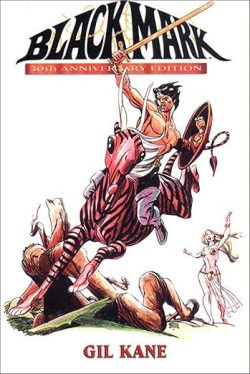
By Gil Kane, with Archie Goodwin, Harvey Kurtzman & Neal Adams (Fantagraphics Books)
ISBN: 978-1-56097-456-7 (TPB)

This book includes Discriminatory Content produced in less enlightened times.

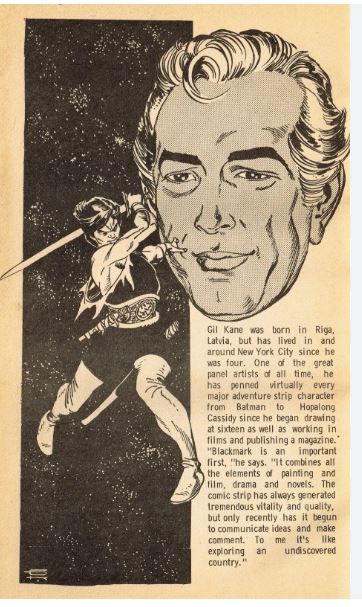
Gil Kane was one of the pivotal players in the development of the American comics industry, and indeed of the art form itself. Working as an artist, and an increasingly more effective and influential one, he drew for many companies since his 1940s debut: on superheroes, action, war, mystery, romance, movie adaptations and, perhaps most importantly, Westerns and Science Fiction tales. In the late 1950s Kane became one of editor Julius Schwartz’s key artists in regenerating the superhero. Yet by 1968, at the top of his (admittedly much denigrated) profession, this relentlessly revolutionary and creative man felt so confined by the juvenile strictures of the industry that he struck out on bold new ventures that jettisoned the editorial and format bondage of comic books for new visions and media.

His Name Is Savage was an adult-oriented black & white magazine about a cold and ruthless super-spy in the James Bond/Matt Helm/Man Called Flint mould, co-written by friend and collaborator Archie Goodwin. It was very much a precursor in tone, treatment and subject matter of many of today’s adventure titles.

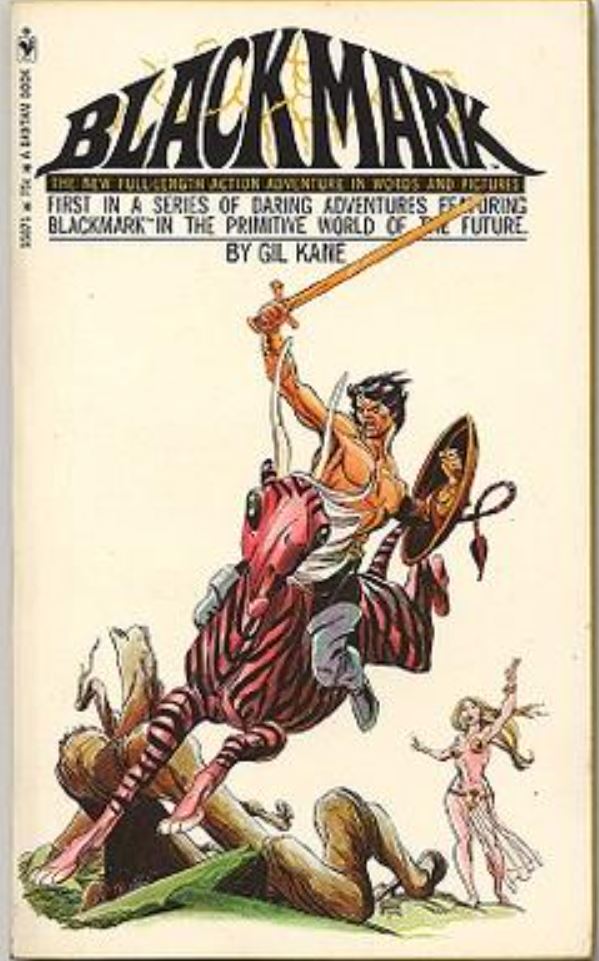
The other venture, Blackmark (also with Goodwin), not only ushered in the comic book age of Sword and Sorcery, but also became one of the first Graphic Novels. Technically, as the series was commissioned by fantasy publisher Ballantine as eight volumes, it was also envisioned as America’s first comic Limited Series. Volume 1 was released in January 1971, with volume 2 just completed when the publisher cancelled the project. A generation Kane’s junior but a long term, seasoned collaborator, Roy Thomas reprinted those tales in Marvel’s monochrome magazines Savage Sword of Conan and Marvel Preview, with the artwork rejigged to accommodate the different page format.

That’s enough background. Blackmark tells the tale of a boy born into a war-ravaged, primitive future where atomic holocaust has resulted in a superstitious society that fears and shuns technology and science – like parts of the American Bible Belt. Similarly, feudal lords rule by might and terror, whilst rebel technophiles are hunted like dogs. One night, and when fleeing persecution, a married couple encounter a dying scientist-king who pays the woman to impregnate her with a son pre-programmed to be a messiah of science.

Blackmark is born into a life of poverty and toil. When his parents are killed by a wandering warlord he devotes his life to vengeance, and learns all the physical skills necessary when he is taken for a gladiator slave. It is (sadly) overwhelmingly familiar to us today, simply because it was so influential at the time – albeit with those few original purchasers who seem to have become the next generation of comics and literary creators.

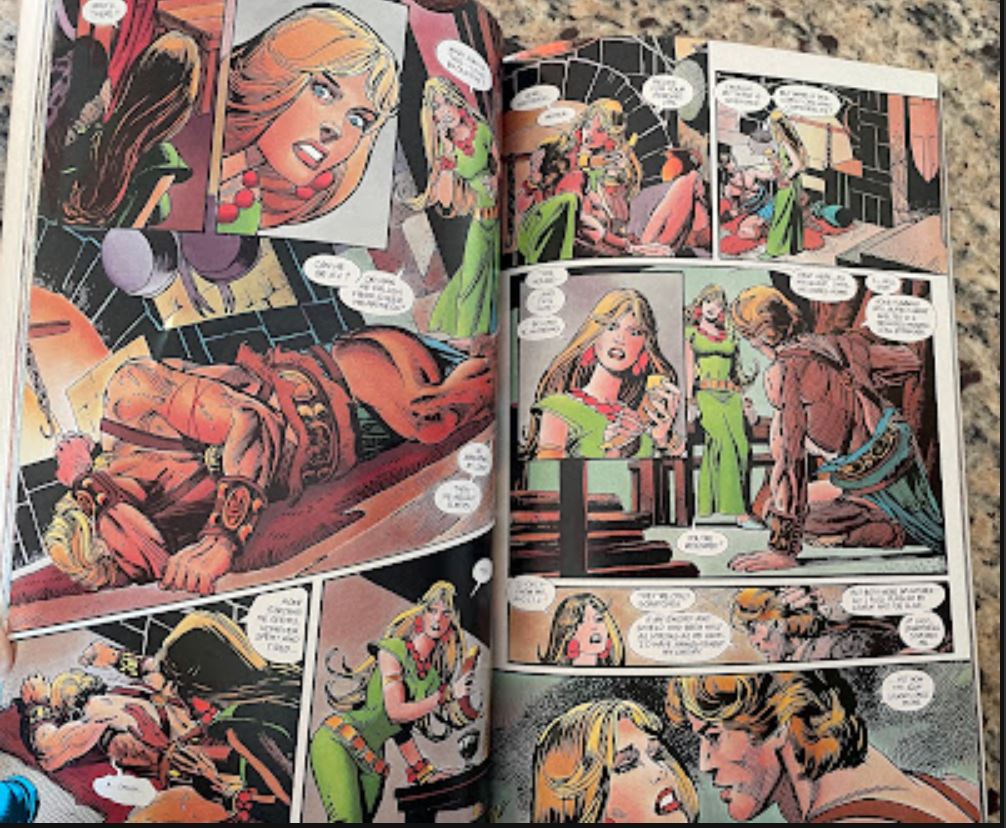
Although the plot might seem old hat, the beauty and power of the illustration has never been matched. Kane designed the pages with blocks of text as part of the whole, rather than with willy-nilly blurb and balloons to distract the eye, and his evocative figure drawing has never been as taut, tense and passionate. Always suffering from deadline pressures, the artist called in colleagues Harvey Kurtzman & Neal Adams to help lay out and finish the project on time. The script, over Kane’s story, was provided by the incomparable Goodwin, as much a master as Kane himself; Nevertheless, Blackmark is very much quintessential Kane.

This compilation (incomprehensibly out of print and hard to find) collects original volumes 1 and 2 and presents them in a size far larger than the original standard paperback. As well as a fantasy masterpiece, and a spectacular comic romp, it preserves and presents a literal breakthrough in comic storytelling that should be on every fan’s must-read list.

And in bloody print…
© 2002 Fantagraphics Books & the estate of Gil Kane. All Rights Reserved.

Today in 1857 pioneering cartoon satirist and comic strip creator Frederick Burr Opper was born. He did Happy Hooligan, And Her Name Was Maud and Alphonse and Gaston and so have we, so go look back in wonder. In 1913 George McManusBringing Up Father launched and charmed generations until 2000. Look for that too, but perhaps wonder why Red Ryder isn’t better represented here. After all its artist Fred Harman died today in 1982…

In comic books, unsung wonders Joe Certa (Martian Manhunter) and Don Heck (everything) were born in 1919 and 1929 respectively. In 1958 the utterly unique H. G. Peter passed away. He was still drawing Wonder Woman at the time. Less well known but just as dedicated, Kid Colt, Outlaw and drag racing comics illustrator Jack Keller passed on in 2003.

The Rise and Fall of the Trigan Empire volume 1


By Mike Butterworth & Don Lawrence & various (Rebellion Studios)
ISBN: 978-1-78108-755-8 (TPB/Digital edition)

This book includes Discriminatory Content produced in less enlightened times.

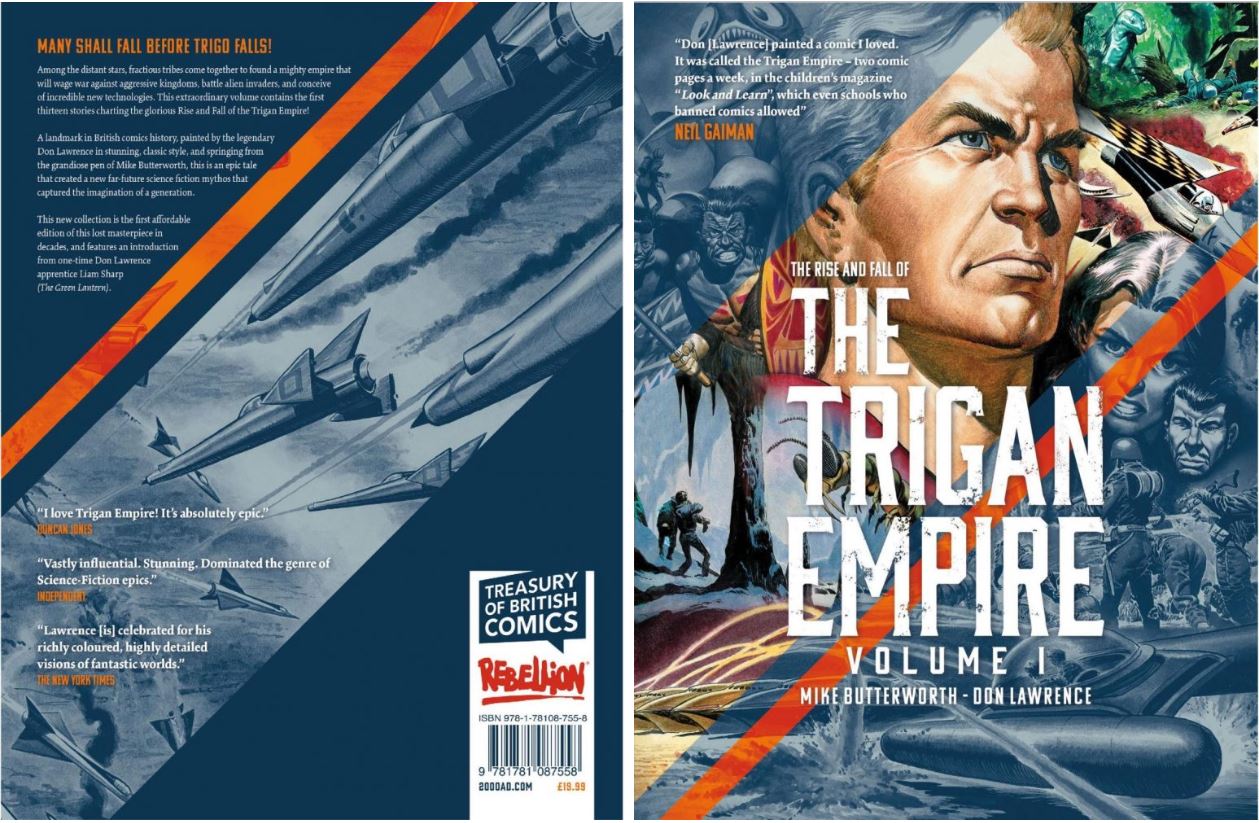
For British – and Dutch – readers of a certain age and prone to debilitating nostalgia, The Trigan Empire (or The Rise and Fall of the Trigan Empire to give it its ponderous full title) was only ever about two things: boyish wish-fulfilment and staggeringly beautiful art.

The strip was created by Senior Group Editor Leonard Matthews and given to the editor of Sun and Comet to develop and continue. A trained artist, Mike Butterworth became writer of many historical strips such as Buffalo Bill, Max Bravo, the Happy Hussar, Battler Britton and Billy the Kid – and latterly a crime and gothic romance novelist with more than 20 books to his pen names.

Based in equal part on cinematic Sword & Sandal/Biblical epics and the space age fascination of a planet counting down to a moonshot, for the saga Butterworth combined his love of the past, a contemporary comics trend for science fiction and that long-established movie genre of manly blockbusters to construct a vast sprawling serial of heroic expansionism, two-fisted warriors, wild beasts, deadly monsters and even occasionally the odd woman.

The other primary influence on the series was the fantasy fiction of Edgar Rice Burroughs (especially John Carter of Mars and Pellucidar) but without his concentration on strong and/or blatantly sexy women – usually as prizes for his heroes to save. In the formative days of the Trigan Empire, ladies dressed decorously, minded their manners and were dutiful wives or nurses… unless they were evil, vindictive or conniving…

The compellingly addictive, all-action thematic precursor to Warhammer, Civilisation and Warcraft might have been a short run venture had it not been for the art. The primary illustrator was Don Lawrence (Marvelman, Wells Fargo, Billy the Kid, Karl the Viking, Fireball XL5, Maroc the Mighty, Olac the Gladiator, The Adventures of Tarzan, adult comedy strip Carrie and his multi-volume Dutch magnum opus Storm), who painted each weekly instalment.

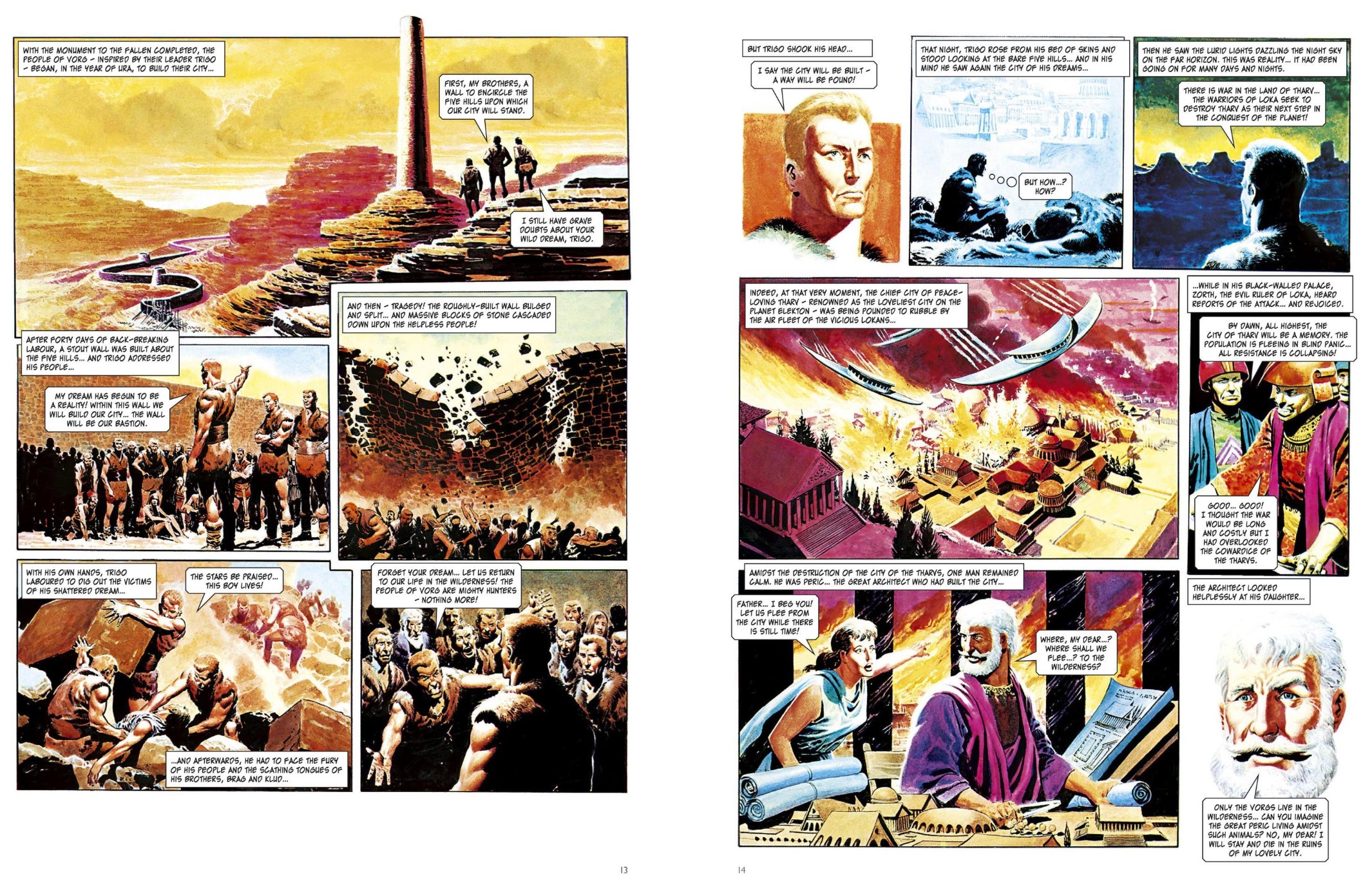
Initially he used watercolours before switching to quicker-drying gouaches, rendered in a formal, hyper-realistic style that still left room for stylistic caricature and wild fantasy, and one that made each lush backdrop and magnificent cityscape a pure treasure. Other, later artists included Ron Embleton, Miguel Quesada, Philip Cork, Gerry Wood and Oliver “Zack” Frey, as the strip notched up 854 weekly instalments, beginning in September 1965 and only ending in 1982. Along the way, it had also appeared in Annuals and Specials and become a sensation in translated syndication across Europe.

Even after it ended – and, thanks to these collections, it has recently resumed! – the adventure continued: in reprint form, appearing in the UK in Vulcan and across the world; in two Dutch radio plays; collected editions sold in numerous languages; a proposed US TV show and numerous collected editions from 1973 onwards. Surely someone must have a movie option in process: if only Kirk Douglas, Burt Lancaster and Tony Curtis were still around, we could completely close the creative circle…

Lawrence (17th November 1928 – 29th December 2003) inspired a host of artists such as Brian Bolland and Dave Gibbons, but as he worked into the 1990s, his eyesight was increasingly hindered by cataracts and he took on and trained apprentices such as Chris Weston and Liam Sharp (who offers his own potent reminiscences in the Introduction to this first archival volume from Rebellion Studios’ Treasury of British Comics). Sharp collaborated with the venerable artist on his last Storm stories…

Inescapably mired in powerful nostalgia, but also standing up remarkably well on its own merits, this first collected volume re-presents the series from its enigmatic opening in high-end tabloid weekly magazine Ranger, combining comics with a large selection of factual features. The fantasy soon began to steal the show and was the most noteworthy offering for the entirety of the publication’s 40 week run, spanning 18th September 1965 to 18th June 1966. It then carried over – with a few other choice strips – into Look and Learn, beginning with #232: remaining until the magazine closed with #1049 (April 1982).

Ranger had been a glossy, photogravure blend of traditional comic anthology strips and educational magazine, and when it folded, the only publication able to continue The Trigan Empire in its full grandeur was Look and Learn

One of our most missed publishing traditions is the educational comic. From science, history and engineering features in the legendary Eagle to a small explosion of factual and socially responsible boys and girls papers in the late 1950s to the heady go-getting heydays of the 1960s & 1970s, Britons always enjoyed a healthy sub-culture of comics that informed, instructed and revealed – and that’s not even counting all the pure sports comics!

Amongst many others Speed & Power, Treasure, World of Wonder, Tell Me Why, and Look and Learn spent decades making things clear, illuminating understanding and bringing the marvels of the changing world to our childish but avid attentions with wit, style and – thanks to the quality of the illustrators involved – astonishing beauty. Look and Learn launched on 20th January 1962: brainchild of Fleetway Publications’ then Director of Juvenile Publications Leonard Matthews. The project was executed by editor David Stone (almost instantly replaced by John Sanders), sub-editor Freddie Lidstone and Art Director Jack Parker.

For 20 years it delighted children, and was one of the country’s most popular children’s weeklies. Naturally there were many spin-off tomes such as The Look and Learn Book of 1001 Questions and Answers, Look and Learn Book of Wonders of Nature, Look and Learn Book of Pets and Look and Learn Young Scientist as well as utterly engrossing Christmas treat tradition The Look and Learn Book and – in 1973 – The Look and Learn Book of the Trigan Empire: the serial’s very first hardback compilation.

Strangely, many, many kids learned stuff they didn’t think they cared about simply because it filled out the rest of that comic that carried the Trigan Empire…

In this tome we review 25th June1966 through 17th May 1968, encompassing Ranger #1-40 and Look and Learn #232-331: subdivided for your convenience into 13 chapter plays of what we oldsters absorbed as one continuous unfolding procession of wonder…

Depicted with sublime conviction and sly wit, it begins with ‘Victory for the Trigans’ (18th September 1965 – 29th January 1966) as fishermen in the Florida swamps witness a spaceship crash. All aboard are dead, and after, the global news cycle wearies of the story, the craft is reduced to a sideshow attraction whilst scholars meticulously investigate its technology, dead voyagers and a huge set of journals written in an indecipherable language. No one succeeds and eventually, no one cares…

All except student Richard Peter Haddon, who spends the next half century looking for the key and – at age 70 – cracks the code, subsequently translating the history of a mighty race of aliens so very like earthmen…

From then on the scene switches to distant twin-sunned world Elekton, where numerous kingdoms and empires-in-waiting jostle for dominance. In many ways it’s like Earth a few thousand years before the birth of Christ… except for all the monsters, skycraft and ray guns…

In the wilds and wastes between the nations of Loka, Tharv, Davelli and Cato, brutish far-ranging tribes of nomadic Vorg hunt and clash and live brief free lives, until three brothers decide existence could be so much more…

Driven, compelling and charismatic, notional leader Trigo has a dream and convinces his siblings Brag and Klud to ask their people to cease following roving herds of beasts and settle by a river where five hills meet. Before long they have raised a city and begun the march to empire. Of course, all those defiant libertarians were initially resistant to becoming civilised, but that ended after the more advanced Lokans began hunting them for sport from their flying ships…

By the time Loka’s King Zorth finally gets around to conquering Tharv and formally annexing the lands of Vorg in his plan to become global dictator, Trigo has begun building his city and invited refugees from Tharv to join him. Amongst the many displaced survivors of Lokan atrocity is Peric – an architect and philosopher generally acclaimed as the smartest man alive. He is cared for by his daughter Salvia. Both will play major roles in the foundation of the Trigan Empire…

When Zorth at last turns to consolidation by taking Vorg, his air, sea and land forces are met by an unbeatable wall of death and history is rewritten. It comes at great cost, most notably to Trigo as victory is almost snatched from him when brother Klud attempts to murder him, seize power and betray their people to the Lokans…

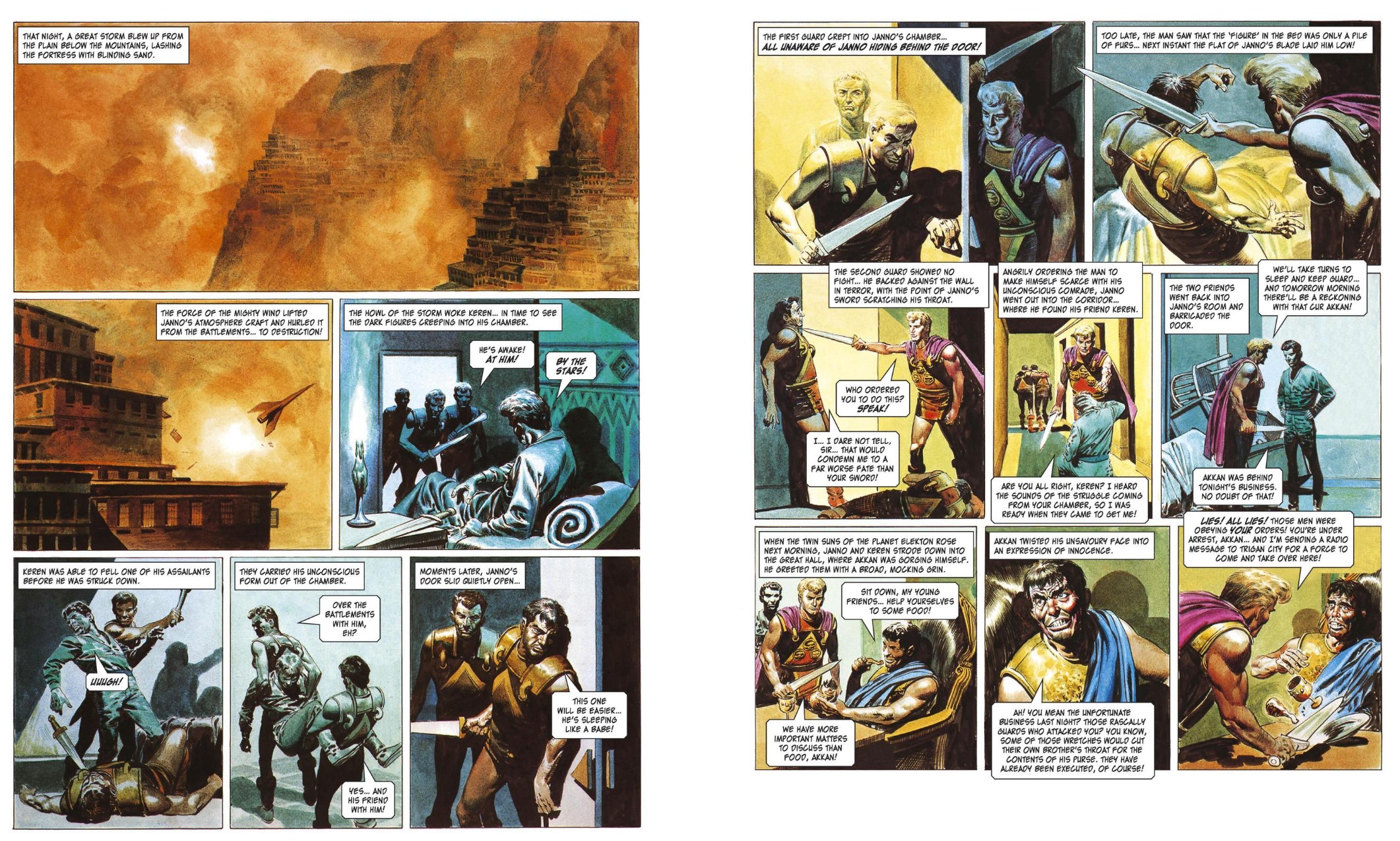
With an empire established, one translated book ends, and Professor Haddon’s life’s work moves on to what we’ll call ‘Crash in the Jungle’ (5th February – 19th February 1966), introducing young warrior/pilot Janno. The son of Brag, he is childless Trigo’s nephew and heir apparent: enjoying many dynamic adventures as an imperial troubleshooter whilst being groomed for rule. Here, still wet behind the ears, the lad crashes in the plush rainforests of Daveli, befriends Keren – son of a formerly antagonistic aboriginal chieftain – and facilitates their alliance with the ever-expanding Trigan Empire. When Janno returns to pilot training, Keren is beside him and will be his constant companion in all further exploits…

Planetary chaos erupts next as ‘The Falling Moon’ (26th February – 28th May 1966) reshapes Elekton’s political map. When Gallas impacts sister moon Seres, the cosmic collision sends the satellite smashing into Loka where – forewarned – Zorth seeks to relocate his power base and entire populace by seeking sanctuary in Trigo’s city. Once admitted and welcomed, the Lokans bite the hand that shelters them by seizing the city. Valiant Brag manages to save wounded Trigo, but they are captured and enslaved by desert raiders of the Citadel…

As Janno and Keren escape to mount a futile resistance to the Lokans, slave worker Trigo foils an assassination and earns the gratitude of the Citadel king, who lends him a band of warriors to retake his own city. When they link up with Janno & Keren, Zorth’s defeat and doom are assured…

Time moves differently on Elekton and many events seem telescoped, but as the strip jumps to a new home, continuity manifests in ‘The Invaders from Gallas’ (4th June – 18th June) in Ranger before continuing in Look and Learn #232-237 from 25th June to 30th July 1966. As the fallen moon cools, aliens dwelling inside emerge to attempt the conquest of their new world via their mind control techniques. With the Trigans crazed and killing each other, only a deaf man holds the key to their survival…

Look and Learn #238-242 (6th August – 3rd September 1966) featured ‘The Land of No Return’ – which sees Janno accidentally sent along the River of Death (a rather cheeky “tribute” to Burroughs’ Mars stories), debunking an insidious religious belief that had for millennia curtailed life for Elekton’s elderly whilst ending a cult of elder-abusing slavers…

‘The Revolt of the Lokans’ (L&L #243-255, 10th September – 3rd December 1966) returns to the exiled former-conquerors who poisoned and deranged Trigo before retaking his city. Thankfully, Keren and Peric find a way to restore order to the city and its ruler, after which #256-264 (10th December 1966 – 4th February 1967) detail ‘War with Hericon’ as Trigo marries Lady Ursa, sister of King Kassar: ruler of the aloof, distant empire (a visual melange of Earth’s Persian and Byzantine kingdoms).

The diplomatic love match is soured by a single sinister malcontent when Yenni – a vengeful criminal outcast of both Hericon and Trigan – foments racial unrest in both realms and lets human nature do its worst…

Janno & Keren took the lead again in ‘Revolution in Zabriz’ (#265-273, 4th February – 8th April 1967), when despatched to survey a distant mountain outpost only to uncover a plot by its governor. He uses captive labour to finance a coup to oust Uncle Trigo and take over the empire, after which ‘The Lokan Invasion’ (L&L #274-279, 15th April – 20th May) sees the brothers-in-arms stumble into a devious scheme by chemist Vannu to destroy the Trigans by contaminating their water with amnesia-inducing potions…

Vengeful retaliation is once more the pivotal factor as ‘The Revenge of Darak’ (#280-290, 27th May – 5th August) reveals how Trigan’s greatest pilot betrays his emperor and is punished with slavery in the mines. After a year, he escapes and uses his insider knowledge to drive a wedge between Trigo and Brag, poison Peric and embroil Hericon in war. Thankfully, brotherly love trumps hurt feelings and justice conquers all…

A taste of horror comes with ‘The Alien Invasion’ L&L #291-297 (13th August – 23rd September) as energy beings land on Elekton. Able to possess organic brains, the intruders work their way up the planet’s food chain until Keren, Kassar and Trigo are fully dominated, but the cerebral tyrants have not reckoned on Peric’s wit or Janno’s cunning…

The first major role for a woman comes in ‘The Reign of Thara’ (L&L #298-316, 30th September 1967 – 3rd February 1968) as the royal family is ousted by deceit and a secret society of soldiers instals the daughter of Klud in Trigo’s place. Vain, haughty and imperious, she is intended to be a puppet of secret manipulators, but proves to possess too much pride and backbone to allow the empire to fall to mismanagement and enemy incursions. Happily, the actual Royal Family have survived their well-planned dooms and returned, leading an army of liberated slaves and a fleet of pirates sworn to Trigo’s service…

During the campaign, Kern & Janno befriend a rural bumpkin, obsessed with flying, and clownish Roffa becomes their third “musketeer”, playing a major role in the concluding tale here.

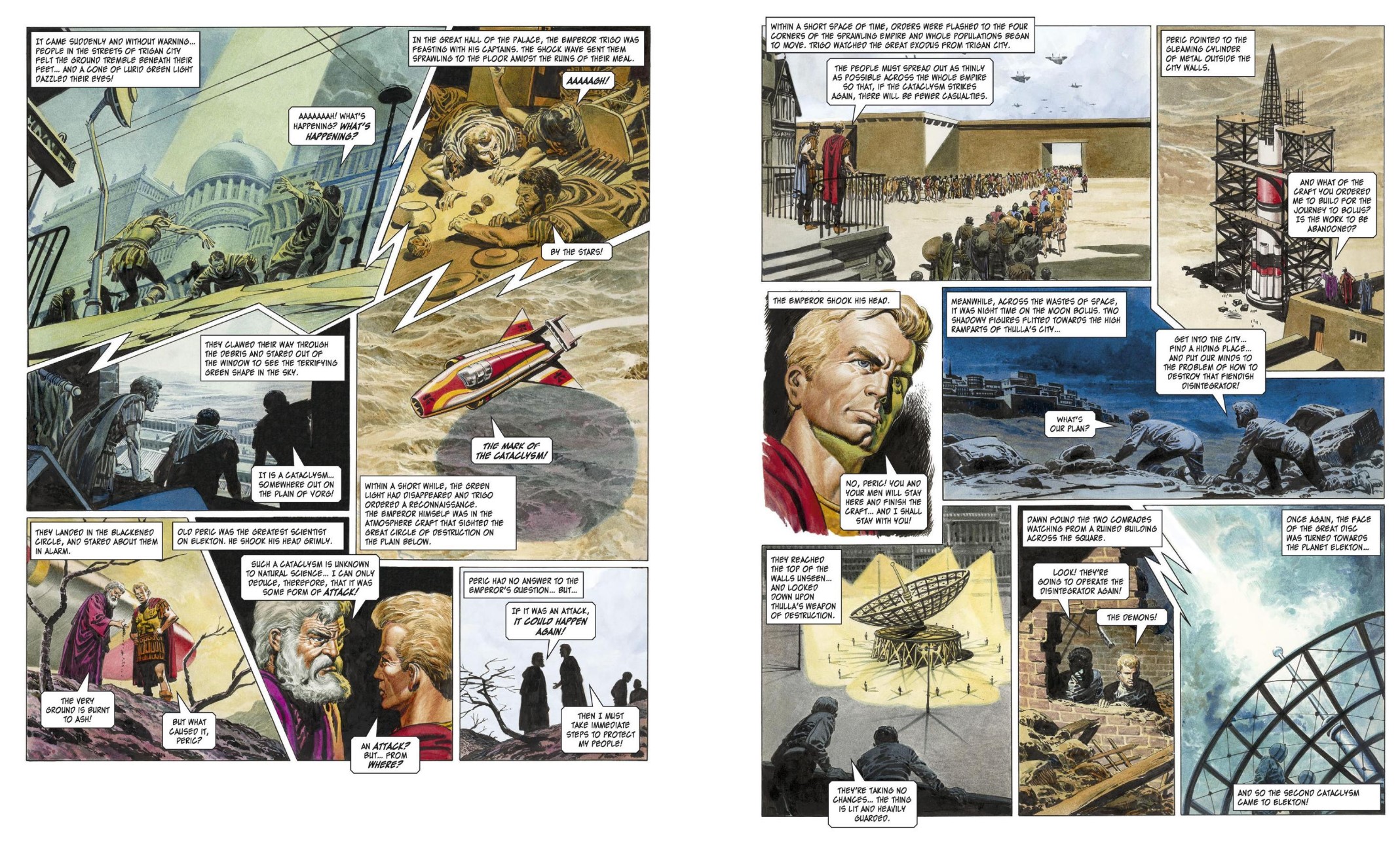
Spanning Look & Learn #317-331 (10th February – 17th  May 1968), ‘The Invasion of Bolus’ sees the trio captured by rogue scientist Thulla and pressganged into joining his mission to build a ship and conquer Elekton’s inhabited moon. Unable to defy or escape, they become unwilling members in his army, before defecting to the super-advanced but pacifistic Bolans. At least the lads left a warning before lift-off: one that – eventually – reaches Trigo & Peric.

As the Trigans rush to construct a rescue vessel, Thulla brutally seizes the moon people’s city and commences the second part of his plan: building a colossal ray cannon to destroy all life on Elekton. As Trigo’s ship takes off – too late to stop devasting blasts from Bolus – Janno & Keren are forced to desperate measures to save their people from the murderous madman…

Incorporating a tantalising teaser for the next volume and creator biographies, this spectacular visual triumph is a monument to British Comics creativity: one that simultaneously pushes memory buttons for old folk whilst offering a light but beautiful straightforward space opera epic readily accessible to the curious and genre inquisitive alike.

Is that you or someone you know?
The Rise and Fall of the Trigan Empire is ™ Rebellion Publishing IP Ltd. © 1965, 1966, 1967 & 2019 Rebellion Publishing IP Ltd. All Rights Reserved.

Literally born yesterday in 1928 Stanley Lieber – AKA Stan Lee – did a whole lot and appears many times in this blog. You should go look. In 1967 groundbreaking Acme Novelty Library cartoonist Chris Ware arrived, followed two years later by sound fella P.J. Holden (2000 AD, Judge Dredd, Warhammer) who we last covered in Bad Magic – A Skullduggery Pleasant Graphic Novel.

However, TODAY in 1946, Milton Caniff’s last Terry and the Pirates episode appeared. Whilst he rose to even greater heights with Steve Canyon, George Wunder carried Terry, Pat & Co. until 1973.

In 1963 Dave McKean was born, but otherwise today is one for the “loss” column, with Raeburn van Buren dying in 1987, Disney artist Tony Strobl in 1991, Barbarella creator Jean-Claude Forest in 1998 and wonderful Don Lawrence in 2003. As always you can search our engine or find one of your own preference for more…

Conan the Barbarian Epic Collection volume 1: The Coming of Conan (1970-1972)


By Roy Thomas & Barry Windsor-Smith with John Jakes, Gil Kane, Dan Adkins, Sal Buscema, Frank Giacoia, Tom Palmer, Tom Sutton, “Diverse Hands”, Marie Severin, John Romita Sr. & various (MARVEL)
ISBN: 978-1-3029-2555-0 (TPB/Digital edition)

This book includes Discriminatory Content produced in less enlightened times.

Win’s Christmas Gift Recommendation: Because We Believe in Blockbusters… 9/10

During the 1970’s the US comic book industry opened up after more than 15 years of cautiously calcified publishing practises that had come about as a reaction to censorious oversight of its self- inflicted Comics Code Authority. This body was created to keep the publishers’ product wholesome after the industry suffered their very own McCarthy-style Witch-hunt during the 1950s.

One of the first genres revisited was Horror/Mystery comics and from that sprang pulp masterpiece Conan the Cimmerian, via a tale in anthology Chamber of Darkness #4, whose hero bore no little thematic resemblance to the Barbarian. It was written by Roy Thomas and drawn by Barry (Windsor-) Smith, a recent Marvel find, and one who was gradually breaking out of the company’s all-encompassing Jack Kirby house-style.

Despite some early teething problems – including being cancelled and reinstated in the same month – the comic book adventures of Robert E. Howard’s brawny warrior became as big a success as the revived prose paperbacks which had heralded a world flowering in tales of fantasy and the supernatural.

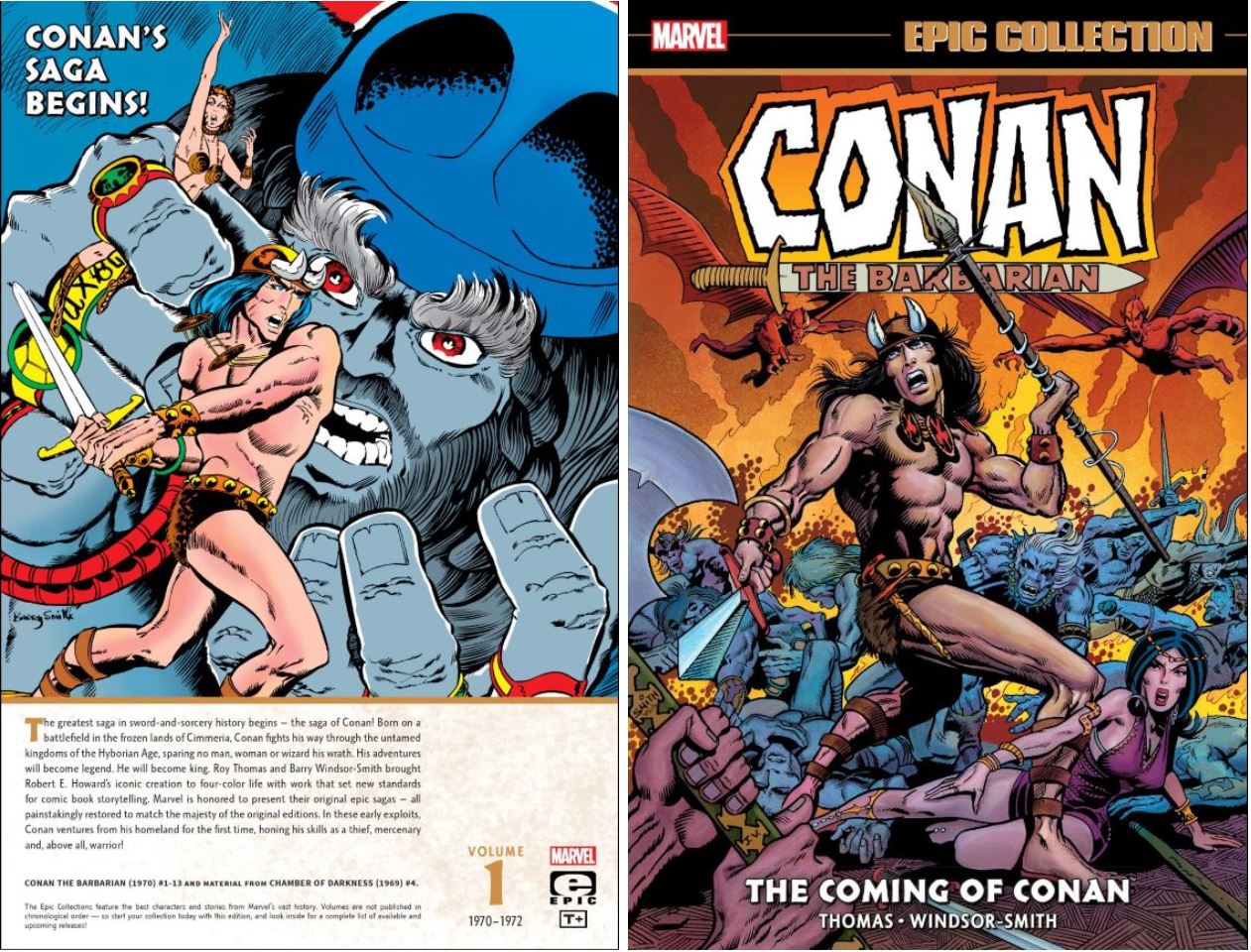
After decades away, the brawny brute recently eventually to the aegis of Marvel. Designated “the Original Marvel Years” (due to the character’s sojourn with other publishers/intellectual properties rights holders), this bombastic tome of groundbreaking action fantasy yarns re-presents the contents of Conan the Barbarian #1-13 plus that trailblazing short story, cumulatively spanning cover-dates April 1970 to January 1972. Digitally remastered and available as a trade paperback or eBook, these are the absorbing arcane adventures that sparked a revolution in comics and a franchising empire in my youth, and are certainly good enough to do so again. They are also astonishingly readable…

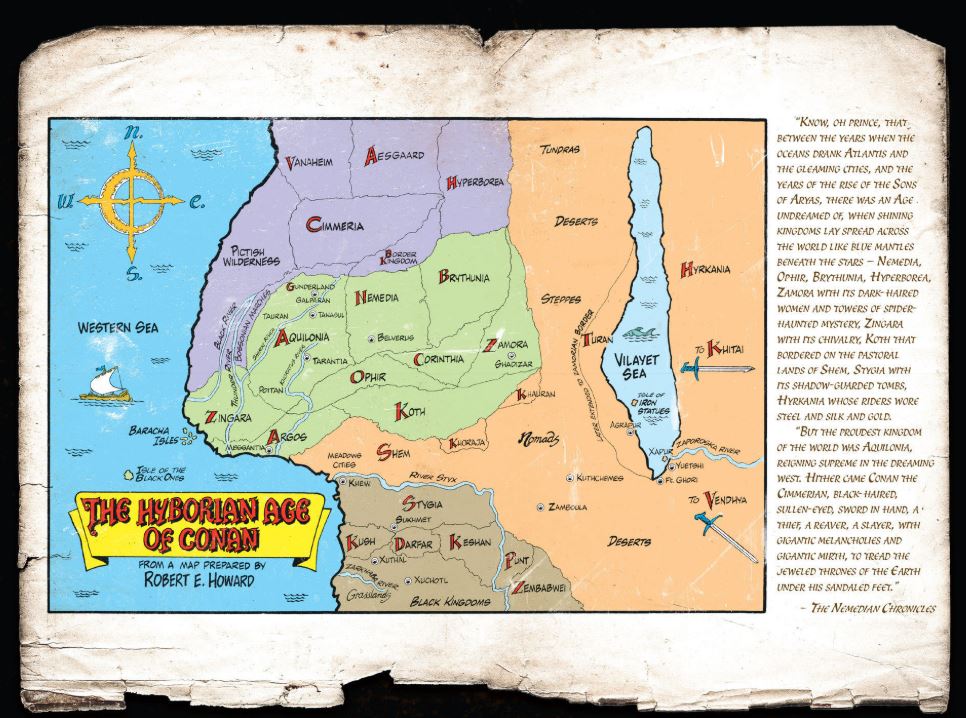
The drama begins most fittingly after a glimpse at a classic map of ‘The Hyborean Age of Conan’ plus an accompanying quote I’m sure every devoted acolyte already knows by heart, after which that precursor romp sets the scene.

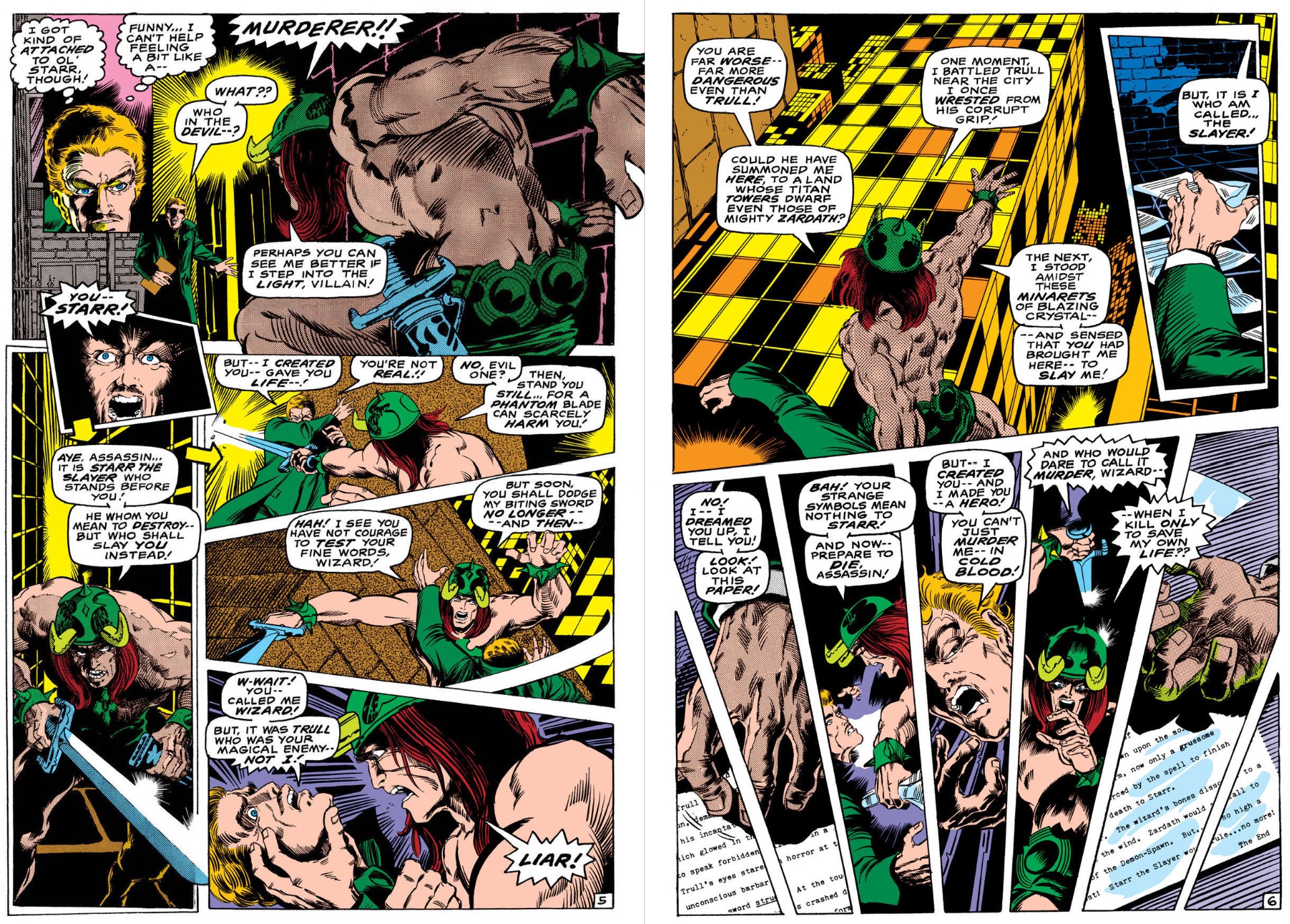
Set in modern America, ‘The Sword and the Sorcerers!’ primes the pump with the tale of a successful writer who foolishly decides to kill off his most beloved character Starr the Slayer: a barbarian so beloved that he has taken on a life of his own and is determined to do whatever is necessary to keep it…

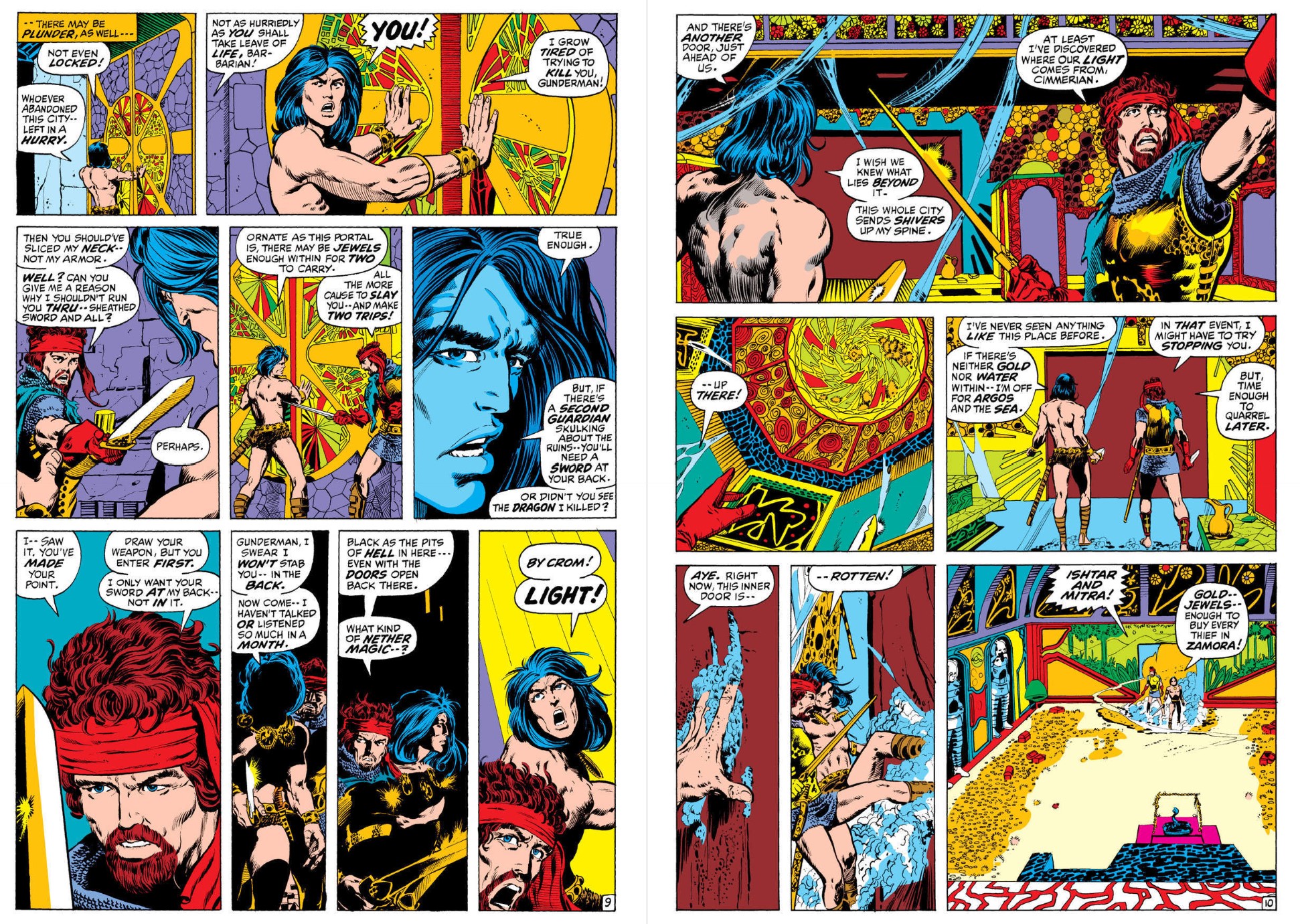
After that we are catapulted back in time approximately 12,000 years into a forgotten age of terrors and wonders as scripter Thomas broadly follows Howard’s life path for young Conan of Cimmeria, beginning with the still teenaged warrior’s meeting with a clairvoyant wizard who predicts a regal destiny in ‘The Coming of Conan’ (inked by Dan Adkins), through brief but brutal enslavement in ‘The Lair of the Beastmen’ (Sal Buscema finishes), before experiencing a minor Ragnarok and witnessing ‘The Twilight of the Grim Grey God!’

An aura of lyrical cynicism grows to balance the wealth of mystical menaces and brooding horror as the wanderer becomes a professional thief and judge of human foibles in ‘The Tower of the Elephant’. Conan’s softer side is revealed in CtB #5 after meeting bewitching ‘Zukala’s Daughter’ (Frank Giacoia inks) and liberating a wizard-plagued town. Buscema returned for ‘Devil Wings over Shadizar’, wherein the warrior lad tackles a welter of antediluvian terrors, with both Adkins & Sal B applying their pens and brushes to expose ‘The Lurker Within’ – based on Howard’s magnificent chiller The God in the Bowl – after which tomb raider Conan crushes zombies and dinosaurs in ‘The Keepers of the Crypt’ (inked by Toms Palmer & Sutton)…

Thomas’s avowed plan was to closely follow Conan’s established literary career from all-but-boyhood to his eventual crowning as King of Aquilonia, adding to and adapting Howard’s prose works and that of his posthumous collaborators on the way. This agenda led to some of the best, freshest comics of the decade. The results of (not-yet-Windsor-) Smith’s search for his own graphic style led to unanimous acclaim and many awards for the creative duo.

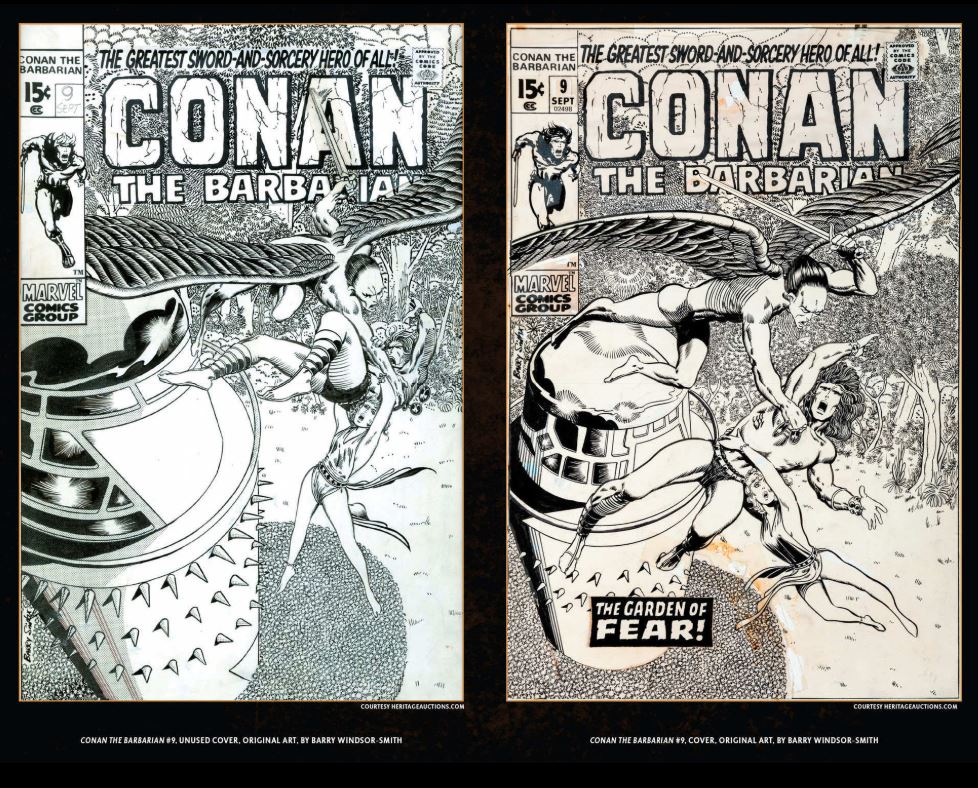
By issue #9 the character had taken the comics world by storm and any threat of cancelation was long gone. ‘The Garden of Fear’ – adapted by Thomas & Smith, with inks by Sal B from Howard’s short story – features a spectacular battle with a primordial survivor in a lost valley before the wanderer returns to big city life, and learns too late to ‘Beware the Wrath of Anu!’

This god-slaying bout is mere prelude to another classic Howard adaptation, ‘Rogues in the House’: an early masterpiece of action and intrigue benefitting from a temporary doubling in page count.

‘Dweller in the Dark’ is an all-original yarn of monsters and maidens, notable because artist Smith inked his own pencils, and indications of his detailed fine-line illustrative style can be seen for the first time. An added bonus in that issue was a short back-up yarn by Thomas & Gil Kane with “Diverse Hands” called in to ink ‘The Blood of the Dragon!’: telling of a very different Hyborian hero getting what he deserves…

Fantasy author John Jakes plotted the final tale in this initial outing as ‘Web of the Spider-God’ offers a sardonic drama of the desert with the surly Cimmerian battling thirst, tyranny. pompous priests and a big, big bug in a riotous romp finished off by Thomas, Smith & Buscema.

Adding value to the treasury is a vast bonus section which includes pencilled cover art (used and unused); Thomas’ original script breakdowns as annotated by the artist; extracts from Marvelmania (the company’s first in-house fanzine); unused illustrations, house ads and Marvel bulletin items; cover roughs, concepts and finished art by Marie Severin & Gil Kane; Jakes’ plot synopsis and many pages of original art from the tales collected herein.

Also on show are cover galleries of the Marvel Books reprint paperback line and the Conan Classic comics series – all by Windsor-Smith – plus even before-&-after alterations demanded by the Comics Code Authority on the still contentious and controversial title.

These re-mastered epics are a superb way to enjoy some of US comics’ most influential and enjoyable blockbuster moments. They should have a place carved out on your bookshelf.
© 2020 Conan Properties International, LLC (“CPI”).

Herrrrge’s AdVentures of TinnnnTinn! (well, some of them) were largely drawn by Bob deMoor, who was born today in 1925, as was the wonderful Michael Zulli in 1952. Have you read The Puma Blues: The Complete Collection in One Volume?

In 1982 today, mangaka Katsuhiro Otomo saw the first episode of his astounding Akira epic published.

DC Finest Horror – The Devil’s Doorway


By Alex Toth, Gil Kane, Mike Friedrich, Gerry Conway, Sergio Aragonés, Dave Wood, Joe Orlando, Marv Wolfman, Len Wein, Steve Skeates, John Costanza, Otto Binder, D.J. Arneson, John Albano, Julius Schwartz, E. Nelson Bridwell, Joe Gill, Robert Kanigher, Jack Oleck, Cliff Rhodes, Bob Haney, George Kashdan, Jack Miller, Carl Wessler, Dennis O’Neil, Alan Riefe, Dave Kaler, Jack Phillips, Murray Boltinoff, Curt Swan, Jerry Grandenetti, Bill Draut, Werner Roth, Jack Sparling, Morris Waldinger, Tom Nicolosi, Bernard Baily, Jack Abel, George Roussos, Eddie Robbins, Wayne Howard, Stanley Pitt, Bruno Premiani, Dick Giordano, Dick Dillin, Murphy Anderson, Pat Boyette, Neal Adams, Nick Cardy, Mike Sekowsky, Sid Greene, Mike Roy, Mike Peppe, Don Heck, Wally Wood, Ralph Reese, George Tuska, Gray Morrow, John Celardo, Art Saaf, José Delbo, Vince Colletta, Frank Giacoia, Al Williamson & many & various (DC Comics)
ISBN: 978-1-79950-280-7 (TPB)

Sadly this masterful mystery megamix is not yet available digitally, but we live in hope…

This book includes Discriminatory Content produced in less enlightened times.

Win’s Christmas Gift Recommendation: Splendid Slice of Spectral Shock & Awe… 9/10

It’s the time for sweet indulgence, shocking over-eating and spooky stories, so let’s pay a visit to a much-neglected old favourite in a fresh new costume…

US comic books started slowly until the coming of superheroes unleashed a torrent of creative imitation and sparked a new genre. Implacably vested in World War II, the Overman swept all before him (and very occasionally her or it) until the troops came home and the more traditional genres resurfaced and eventually supplanted the Fights ‘n’ Tights crowd. Although new kids kept on buying, much of the previous generation of consumers also retained their four-colour habit but increasingly sought older themes in the reading matter. The war years altered global psychological landscapes and as a more world-weary, cynical young public came to see that all the fighting and dying hadn’t really changed anything, their chosen forms of entertainment (film and prose as well as comics) reflected this.

As well as Westerns, War and Crime comics, celebrity tie-ins, madcap escapist comedy and anthropomorphic funny animal features were immediately resurgent, but gradually another of the cyclical revivals of spiritualism and public fascination with all things occult, eldritch and arcane led to them being outshone and outsold by a wave of increasingly impressive, evocative and shocking horror comics.

There had been grisly, gory and supernatural stars before, including a pantheon of ghosts, monsters and wizards draped in mystery-man garb and trappings (The Spectre, Mr. Justice, Sgt. Spook, Frankenstein, The Heap, Sargon the Sorcerer, Zatara, Monako, Zambini the Miracle Man, Kardak the Mystic, Dr. Fate and dozens more), but these had been victims of circumstance: The Unknown as a “narrativium” power source for super-heroics.

Now the focus shifted to ordinary mortals thrown into a world beyond their ken with the intention of unsettling, not vicariously empowering, the reader. Almost every publisher jumped on the increasingly popular bandwagon, with B & I (which became magical one-man-band Richard E. Hughes’ American Comics Group) launching the first regularly published horror comic in the Autumn of 1948. Technically, though, Adventures Into the Unknown was actually pipped by Avon who had released an impressive single issue entitled Eerie in January 1947 before finally committing to a regular series in 1951. By this time, and following the filmic horror heyday of Universal Pictures’ fright films franchises, worthy comic book monolith Classics Illustrated had already long milked the literary end of the medium with adaptations of The Headless Horseman, Dr. Jekyll and Mr. Hyde (both 1943), The Hunchback of Notre Dame (1944) and Frankenstein (1945) among others.

If we’re keeping score, this was also the period in which Joe Simon & Jack Kirby identified another “mature market” gap by inventing the Romance comic (Young Romance #1, cover-dated September 1947) but they too saw sales potential in macabre mood material, resulting in seminal anthologies Black Magic (launched in 1950) and boldly obscure psychological drama vehicle Strange World of Your Dreams (1952). Around that time the staid cautious company that would become DC Comics bowed to the commercial inevitable and launched a comparatively straightlaced anthology that became one of their longest-running and most influential titles with the December 1951/January 1952 opening of The House of Mystery.

When the hysterical censorship scandal which led to witch-hunting hearings was at its height, the mobs with pitchforks furore was adroitly curtailed by the industry adopting a castrating straitjacket of self-regulatory rules. Horror titles produced under the aegis of the Comics Code Authority were sanitised, anodyne affairs in terms of Shock ‘n’ Gore.

However, since appetite for suspenseful short stories remained high, in 1956 National DC introduced sister title House of Secrets (a November/December cover-date). Plots were dialled back into superbly illustrated, rationalistic, fantasy-adventure vehicles which would dominate the market until the 1960s when superheroes (which began sneaking back in 1956 after Julius Schwartz reintroduced The Flash in Showcase #4), finally overtook them.

Green Lantern, Hawkman, The Atom and a slew of other costumed cavorters generated a gaudy global bubble of masked mavens which even forced the dedicated anthology suspense titles to transform into super-character split-books, with Martian Manhunter and Dial H for Hero monopolising House of Mystery whilst Mark Merlin – later Prince Ra-Man – sharing space with Eclipso in House of Secrets. When caped crusader craziness peaked and popped, HoS was one of the first casualties, folding with #80, the September/October 1966 issue.

However, nothing combats censorship better than falling profits and by the end of the 1960s the Silver Age superhero boom was over, with many titles gone and some of the industry’s most prestigious series circling the drain. This real-world Crisis prompted surviving publishers to loosen self-imposed restraints against crime and horror comics. Nobody much cared about gangster titles at that juncture, but liberalisation coincided with another bump in public interest for all things Worlds Beyond-ey, so resurrection of scary stories was a foregone conclusion and obvious no-brainer…

Even ultra-wholesome Archie Comics re-entered the field with a rather tasty line of Red Circle Chillers: a minor substrate they regularly return to with style and potency to this day.

Thus, with absolutely no fanfare at all House of Mystery #174 (cover dated May/June 1968), confirmed the downturn in superhero stories eveywhere as it hit newstands everywhere presenting a bold banner asking Do You Dare Enter The House of Mystery? Inside it reprinted admittedly excellent short fantastic thrillers originally seen in House of Secrets from those heady days when it was okay to scare kids…

It was a slow but unstoppable hit which just kept spreading…

This DC Finest collection gathers a year’s worth of scary stuff snapshotted from House of Secrets #81-85; House of Mystery #180-185; The Witching Hour #3-7; The Unexpected #113-117 and includes a short back-up yarn from Phantom Stranger volume 2 #5, which cumulatively filled dank evenings from May 1969-April 1970. It all starts – with absolutely no fanfare at all – in HoM #180…

Going from strength to strength, the fear flagship was increasingly drawing on DC’s major artistic resources. Astounding opener ‘Comes a Warrior’ is a chilling faux Sword & Sorcery classic written and drawn by da Vinci of Dynamism Gil Kane, and inked by incomparable Wally Wood, before they illustrate Mike Friedrich’s fourth-wall-demolishing ‘His Name is Cain Kane!’

A Sergio Aragonés gag page in the long-running ‘Cain’s Game Room’ roaming sequence then cleanses palates for Cliff Rhodes & Joe Orlando’s text-terror ‘Oscar Horns In!’ before Marv Wolfman & Bernie Wrightson proffer prophetic vignette ‘Scared to Life’. A double-page ‘Cain’s Game Room’ precedes an uncredited forensic history lesson drawn by Morris Waldinger and recycled as‘Cain’s True Case Files’ to close proceedings for that title. Meanwhile over in long-running, recently remodelled fantasy anthology The Unexpected, the former sci fi vehicle was retooling as a gritty, weird thriller venue with George Kashdan, Jack Sparling & Vince Colletta detailing ‘The Shriek of Vengeance’. Here, Golden Age troubleshooter Johnny Peril is accused of heinous crimes and then abducted by maniac justice dispenser The Executioner. His gladiatorial tests are no problem for an ordinary guy who’d been facing the incomprehensible unknown since Comics Cavalcade #19 (February 1947) and soon the true motive is exposed and the scheme crushed…

Dave Wood & recent Charlton Comics émigré Pat Boyette then glare into ‘The Eyes of Death’, revealing the fate of an actual criminal who gains the power to see iminent fatalities before Wood, Curt Swan & Mike Esposito ride ‘The Tunnel of Love Fear!’ to introduce potential host narrator Judge Gallows, discussing one of his stranger cases…

With Tales of the Unexpected #105 and House of Mystery #174, National/DC had gambled heavily that anthology horror material was back and wouldn’t call the wrath of the gods – and parents – down upon them. Now that they had a boutique mystery stable, they put lots of thought and effort into creating an all-new title to further exploit our morbid fascination with all thingies fearsome and spooky. They would also resurrect House of Secrets (cancelled in late 1969. Apparently in those heady days it was okay – and profitable – to scare the heck out of little kids if you also made them laugh.

Edited until #14 by Dick Giordano, The Witching Hour first struck with a February/March 1969 cover-date (actually on-sale from December 19th 1968). From the outset it was an extremely experimental and intriguing beast. Here however we begin with #3 (cover-dated July 1969). In this graphic grimoire, cool & creepy horror-hosts traditionally introducing the entertainments are replaced by three witches. Based as much on a common American misapprehension of Macbeth as the ancient concept of Maiden, Mother & Crone, this torrid trio constantly strove to outdo (and outgross) each other in telling of terror tales.

Crucially, Cynthia, Mildred & Mordred – as well as shy monster man-servant minion Egor – were designed by and initially delineated by master illustrator Alex Toth, making framing sequences between yarns as good as and frequently more enthralling than the stories they brazenly bracketed. Following intro ‘You Be Our Judge’ from Toth & Giordano, the graphic genius & Colletta illustrate Don Arneson’s medieval mood masterpiece ‘The Turn of the Wheel!’ before Alan Riefe & Sparling tell a decidedly different ghost-story in ‘The Death Watch’. Steve Skeates & Bernie Wrightson then debut a decidedly alterative fantasy hero in ‘…And in a Far-Off Land!’, followed by the first in a series of short prose vignettes: anonymous fright-comedy ‘Potion of Love’ and Mike Sekowsky & Giordano deliver the sisters’ farewell epilogue…

Back at House of Mystery #181, scripted by Otto Binder and drawn by quirkily capable Sparling, ‘Sir Greeley’s Revenge!’ offers a heart-warmingly genteel spook story, albeit jump-cut interrupted by new comedy featire Page 13 (from Aragonés) after which Wrightson’s first long tale is fantastical reincarnation saga ‘The Siren of Satan’ (scripted by Bob Kanigher) before we get to the next big thing – and an actual resurrection…

House of Secrets returned with #81 (August/September 1969) just as big sister HoM had done a year previously. Under a bold banner declaiming “There’s No Escape From… The House of Secrets”, Mike Friedrich, Jerry Grandenetti & George Roussos introduced a ramshackle, sentient old pile in ‘Don’t Move It!’, after which Bill Draut limned the introduction of bumbling caretaker Abel (with a guest-shot by his murderous older brother Cain) in eponymous intro set-up fable ‘House of Secrets’. A prose yarn by Gerry Conway ‘Burn this House!’ gave the portly porter a pause before he kicked off his storytelling career with Conway & Sparling’s‘Aaron Philip’s Photo Finish!’ before the inaugural issue is put to bed with a Draut limned ‘Epilogue’

The Unexpected #114 led with Kashdan, Ed Robbins & Colletta’s ‘Johnny Peril – My Self… My Enemy!’ as a modern day alchemist unleashes a lifeforce-stealing golem on the doughty P.I., after Dave Wood & Art Saaf premier a new host regaling readers with ‘Tales of the Mad, Mod Witch’ and opening with a warning about magic fountains and poorly aimed coins in ‘The Well of Second Chances’. Thematically on safe ground, we switch to Witching Hour #4 as Toth renders a ‘Witching Hour Welcome Wagon’ after which Conway scripts spectral saga ‘A Matter of Conscience’ for Sparling & George Roussos. Anonymous prose piece ‘If You Have Ghosts?’ then segues into smashing yarn ‘Disaster in a Jar’ (Riefe & Boyette) before Conway turns in period witchfinder thriller ‘A Fistful of Fire’ for José Delbo – a vastly underrated artist who was on the best form of his career at this time.

Toth’s Weird Sisters close out that issue as we move on to HoM #182 which opens with one of the most impressive tales of the entire decade. Jack Oleck’s take on the old cursed mirror plot is elevated to high art with his script for ‘The Devil’s Doorway’ illustrated by incredible Alex Toth. Marv Wolfman & Wayne Howard follow with ‘Cain’s True Case Files: Grave Results!’, and an expose of the Barbadian sugar trade, after which an Aragonés Game Room break leads to nightmarish Gothic revenge tale ‘The Hound of Night!’ from Kanigher & Grandenetti. HoS #82 was a largely Conway scripted affair with Draut drawing both ‘Welcome to the House of Secrets’ and ‘Epilogue’, whilst cinema shocker ‘Realer Than Real’ was illustrated by Werner Roth & Vince Colletta. Prose poser ‘His Last Resting Place!’ leads to Wolfman & Giordano’s short sci fi saga ‘Sudden Madness’ prior to Conway & Sparling regaling us with salutary tale of murder and revenge ‘The Little Old Winemaker’. Finally, as realised by Dick Dillin & Neal Adams ‘The One and Only, Fully-Guaranteed, Super-Permanent, 100%’ presents a darkly comedic eerily unsettling tale of domestic bliss and how to get it…

Carl Wessler & Ed Robbins open Unexpected #115 with Blitz- survivor Maude Waltham unwisely accessing the ‘Diary of a Madman’ and being drawn into a world she could not comprehend or cope with, after which Dave Wood, Swan & Jack Abel reveal how an opportunistic showman appropriates an old abndined house and discovers ‘Abrakadabra – You’re Dead!’ A classic plot gets a sixties makeover as ‘The Day Nobody Died!’ (by Wood as D.W. Holz, Werner Roth & Frank Giacoia) details the repercussions of a wise man unwisely caging the angel of death…

In Witching Hour #5 the sisters are at their most outrageously, eerily hilarious introducing an anonymous yarn lavishly embellished by Wrightson – a nifty nautical nightmare of loneliness and ‘The Sole Survivor!’, before text-teaser ‘The Non-Believer! and Boyette’s stunning, clownish creep-feature ‘A Guy Can Die Laughing!’ set the scene for Steve Skeates, Stanley Pitt & Giordano’s dating dilemma ‘The Computer Game’ I think this was one of the first to explore that now-hoary plot, and it neatly anticipates Toth’s sign off for the witches and added single-page black-comedy bonus ‘My! How You’ve Grown!’ from Sid Greene…

For #183, Joe Orlando offers Cain introductory chuckle ‘Welcome to the House of Mystery’ before, in collaboration with Oleck, Grandenetti reveals the misery of ‘The Haunting!’ Following more mirth in Cain’s Game Room (by John Albano) and vintage Bernard Baily ‘Odds and Ends from Cain’s Cellar’, ‘Curse of the Blankenship’s’ and ‘Superstitions About Spiders’, Wolfman & Wrightson contribute ‘Cain’s True Case Files: The Dead Can Kill!’ A bonanza of Aragonés comprising a comedic horroscope on Page 13 and two pages of Cain’s Game Room precedes a canny teaming of Kanigher with Grandenetti & Wally Wood that results in the truly bizarre ‘Secret of the Whale’s Vengeance’

After Draut & Giordano’s ‘Welcome to the House of Secrets’ piece, superstar Toth made his modern HoS debut with Wolfman-written fantasy ‘The Stuff That Dreams are Made Of’, before Mikes Royer & Peppe visualise sinister love-story ‘Bigger Than a Breadbox’, bookended by anonymous text teaser ‘Once Upon a Time in Mystery Book…’ Wrapping up, Conway & Draut revive gothic menace for chilling fable ‘The House of Endless Years’.

Modernity is briefly embraced in Unexpected #116 as thanks to Dave Wood & Art Saaf, The Mad Mod Witch escorts a group of strangers on an ‘Express Train to Nowhere!’ after which author unknown & Boyette describe a doomed Dutch peddlar’s brush with legend and ‘Steps to Disaster’, before Murphy Anderson picks out apparel ‘Mad to Order’ as Wrightson details the problems wrapped up in a ‘Ball of String!’ ‘Ashes to Ashes, Dustin to Dust?’ then closes the issue with a spectral tale of love & death from Murray “Al Case” Boltinoff & Sid Greene…

Sekowsky & Giordano limn Dave Kaler’s take on the sinister sisters’ intro for Witching Hour #6, after which far darker horror debuts as ‘A Face in the Crowd!’ (Conway, Mike Roy & Mike Peppe), wherein a Nazi war-criminal and concentration camp survivor meet in an American street. Wolfman & Delbo depict a tale of neighbourly intolerance in ‘The Doll Man!’ and ‘Treasure Hunt’ (Skeates, John Celardo & Giordano) shows why greed isn’t always good. Also included were Conway’s prose tale ‘Train to Doom’, ‘Mad Menace’ – a ½-page gag strip by John Costanza – and ‘Distortion!’: another Greene-limned one-pager.

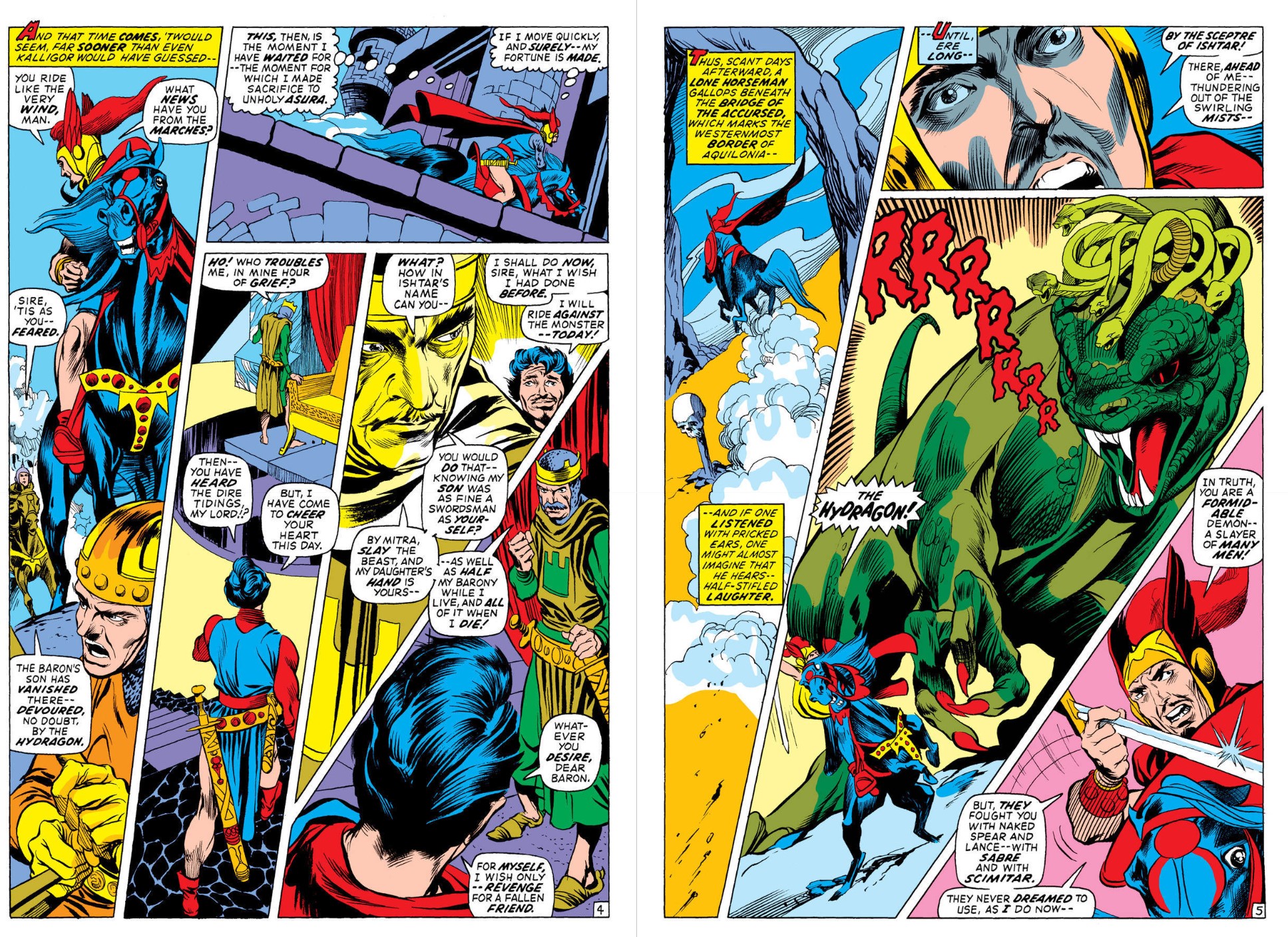
HoM #184 features the triumphant return of Oleck & Toth for captivating Egyptian tomb raider epic ‘Turner’s Treasure’ before cartoon pauses for Page 13 (a diploma fron Aragonés & Orlando) and Orlando gag ‘The Fly’ deftly segues into epic barbarian blockbuster ‘The Eyes of the Basilisk!’ by Bridwell, Gil Kane & Wally Wood…

Closing with more Albano Cain’s Game Room giggles, next comes info short ‘The Devil’s Footprints!’ by Kanigher, Swan & Nick Cardy from The Phantom Stranger #5 (cover-dated January/February 1970) before in House of Secrets #84, Conway & Draut maintain the light-hearted bracketing of stories prior to properly beginning with ‘If I Had but World Enough and Time’ (Wein, Dillin & Peppe): a cautionary tale about too much TV. Tensions grow with Wolfman & Greene’s warning against wagering in ‘Double or Nothing!’ and Skeates, Sparling & Abel’s utterly manic parable of greed ‘The Unbelievable! The Unexplained!’, before Wein & Sparling mess with our dreams in ‘If I Should Die before I Wake…’

Johnny Peril leads in Unexpected #117, as Kashdan & Greene reveal how he becomes the patsy for a clan seeking to avoid a hereditary curse in ‘Midnight Summons the Executioner!’, after which Case, Grandenetti & Draut see a woman trick fate by accepting ‘Hands of Death’ whilst Wessler & Tuska detail the downfall of a money-mad beast in ‘The House that Hate Built!’ Wessler & Bruno Premiani then detail the uncanny ‘Death of the Man Who Never Lived!’ in a spy yarn unlike any other…

In Witching Hour #7, Toth & Mike Friedrich show spectacular form for the intro and bridging sequences, whilst Draut is compulsively effective in prison manhunt saga ‘The Big Break!’, with scripter Skeates also writing modern-art murder-mystery ‘The Captive!’ for Roussos. Friedrich & Abel advise a most individual baby to ‘Look Homeward, Angelo!’, whilst text piece ‘Who Believes Ouija?’ and Jack Miller & Michael Wm. Kaluta’s Gothically delicious ‘Trick or Treat’ round out the sinister sights in this issue. Then, House of Mystery #185 sees Cain take a more active role in all-Grandenetti yarn ‘Boom!’, with Albano, Aragones & Orlando Page13 and Cain’s Game Room, prior to Wayne Howard illustrating the sinister ‘Voice from the Dead!’ Following more Orlando Game-iness prolific Charlton scribe Joe Gill debuts with ‘The Beautiful Beast’: a lost world romance perfectly pictured by EC alumnus Al Williamson.

This monolitic montage of macabre mirth and scary sagas ceases with House of Secrets #85. Here, Cain & Abel acrimoniously open, after which Wein & Don Heck disclose what can happen to ‘People Who Live in Glass Houses…’ whilst graphic legend Ralph Reese limns Wein’s daftly ironic ‘Reggie Rabbit, Heathcliffe Hog, Archibald Aardvark, J. Benson Baboon and Bertram the Dancing Frog’, ere John Costanza contributes comedy page ‘House of Wacks’ and Conway, Kane & Adams herald the upcoming age of slickly seductive barbarian fantasy with gloriously vivid and vital ‘Second Chance’.

With iconic covers from Neal Adams, Jack Adler, Toth, Sekowsky, Cardy and Gray Morrow this (hopefully first of many) moody mystery compilations is a perfect accompaniment to dark nights in, and one you can depend on to astound and amaze in equal amounts.
© 2025 DC Comics. All Rights Reserved.

Today – or maybe even tonight – in 1939 underground cartoonist Frank Stack was born. His blasphemous antics have made us laugh for decades. Why not check out The New Adventures of Jesus: The Second Coming.

In 2011 today UK icon Mick Anglo died. He’s all over this blog if you want to see something very special but I’d advise scoping out one of his unique Annual creations, such as Batman Story Book Annual 1967 (with Robin the Boy Wonder).

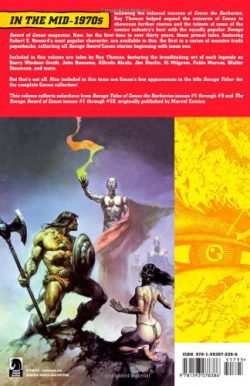
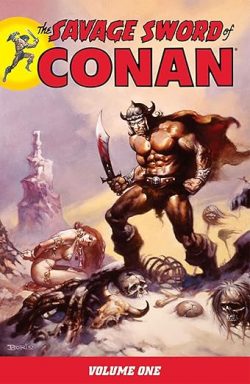
Savage Sword of Conan volume 1


By Robert E. Howard, Roy Thomas, John Jakes, Lin Carter, Barry Windsor-Smith, John Buscema, Pablo Marcos, Gil Kane, Neal Adams, Jim Starlin & Al Milgrom, Alfredo Alcala, Tony DeZuñiga, Alex Niño, Vince Colletta, Steve Gan, Tim Conrad, Yong Montano, Jess Jodloman, “The Tribe”, Rudy Mesina, Freddie Fernandez, Sonny Trinidad, & various (Dark Horse Books)
ISBN: 978-1-59307-838-6 (TPB)

This book includes Discriminatory Content produced in less enlightened times.

During the 1970’s the American comic book industry opened up after more than 15 years of cautiously calcified publishing practises that had come about as a reaction to the censorious oversight of the self-inflicted Comics Code Authority: a publishers’ oversight body created to keep the product wholesome after the industry suffered their very own McCarthy-style Witch-hunt during the 1950s. One of the first literary hardy perennials to be revisited was Horror/Mystery comics and from them came the creation of a new comics genre. Sword & Sorcery stories had been undergoing a prose revival in the paperback marketplace since the release of softcover editions of Lord of the Rings in 1954 and, by the 1960s, revivals of the two-fisted fantasies of Edgar Rice Burroughs, Otis Adelbert Kline, Fritz Lieber and so many more were making huge inroads into buying patterns across the world. Moreover, the old masters had been constantly augmented by modern writers. Michael Moorcock, Lin Carter and many others kickstarted their prose careers with contemporary versions of man against mage against monster. Even so, the undisputed overlord of the genre was Robert E. Howard with his 1930s pulp masterpiece Conan of Cimmeria.

Gold Key had notionally opened the field in 1964 – and created a cult hit – with Mighty Samson. Then in 1966 came Clawfang the Barbarian’ in Thrill-O-Rama #2. Both steely warriors battled in post-apocalyptic technological wildernesses, but in 1969 DC dabbled in previously code-proscribed mysticism with Nightmaster (Showcase #82 -84), following on from the example of CCA-exempt Warren horror anthologies Creepy, Eerie & Vampirella. Marvel tested the waters with barbarian villain – and Conan prototype – Arkon in Avengers #76 (April 1970) and the same month went all-out with short supernatural thriller ‘The Sword and the Sorcerers’ in their own watered-down horror anthology Chamber of Darkness #4.

Written by Roy Thomas and drawn by fresh-faced Barry Smith (a recent Marvel find just breaking out of the company’s still-prevalent Kirby house-style), the tale introduced Starr the Slayer – who also bore no small resemblance to the Barbarian-in-waiting…

Conan the Barbarian debuted with an October 1970 cover-date and – despite some early teething problems, including being cancelled and reinstated in the same month – the comic-strip adventures of Howard’s primal hero were as big a success as the prose yarns they adapted. Conan became a huge hit: a pervasive brand that prompted new prose tales, movies, TV series, cartoon shows, a newspaper strip and all the other paraphernalia of global superstardom.

And American comics changed forever.

In May 1971, Marvel moved into Warren’s territory for a second time, after an abortive attempt in 1968 to create an older-readers, non-Comics Code monochrome magazine: Spectacular Spider-Man. Now, Savage Tales offered stories with stronger tone, mature sexual themes, less bowdlerised violence and partial nudity… and no superheroes. It was the perfect place to introduce Futuristic Femizon Thundra and the macabre Man-Thing whilst offering more visceral vignettes starring the company’s resident jungle-man Ka-Zar and red-handed slayer Conan

The anthology had an eventful reception and the second issue didn’t materialise until October 1973 under the aegis of Marvel’s parent company Curtis Distribution. Conan starred in the first five issues before spinning off into his own adult-oriented monochrome magazine which debuted in August 1974. Free of all Code-mandated restrictions, The Savage Sword of Conan became a haven for mature storytelling, with top flight artists queuing up to flex their creative muscles.

In 2007, after acquiring the license to publish Conan comics, Dark Horse began gathering Marvel’s Savage Sword canon in a series of 500+ page Essentials-style volumes. Today these stories are mostly available in heavy, costly macho-man-testing Omnibus editions too, but still not any kind of digital edition. Why, Crom? Why?

This first titanic tome – also available as an eBook – collects pertinent material from Savage Tales #1-5 and Savage Sword of Conan #1-10: collectively covering May 1971 through February 1976; a period when the unwashed lout was swiftly becoming the darling of the comics world, and chief scribe Roy Thomas was redefining what American comics could say, show and do…

It all starts here with a much-reprinted classic.

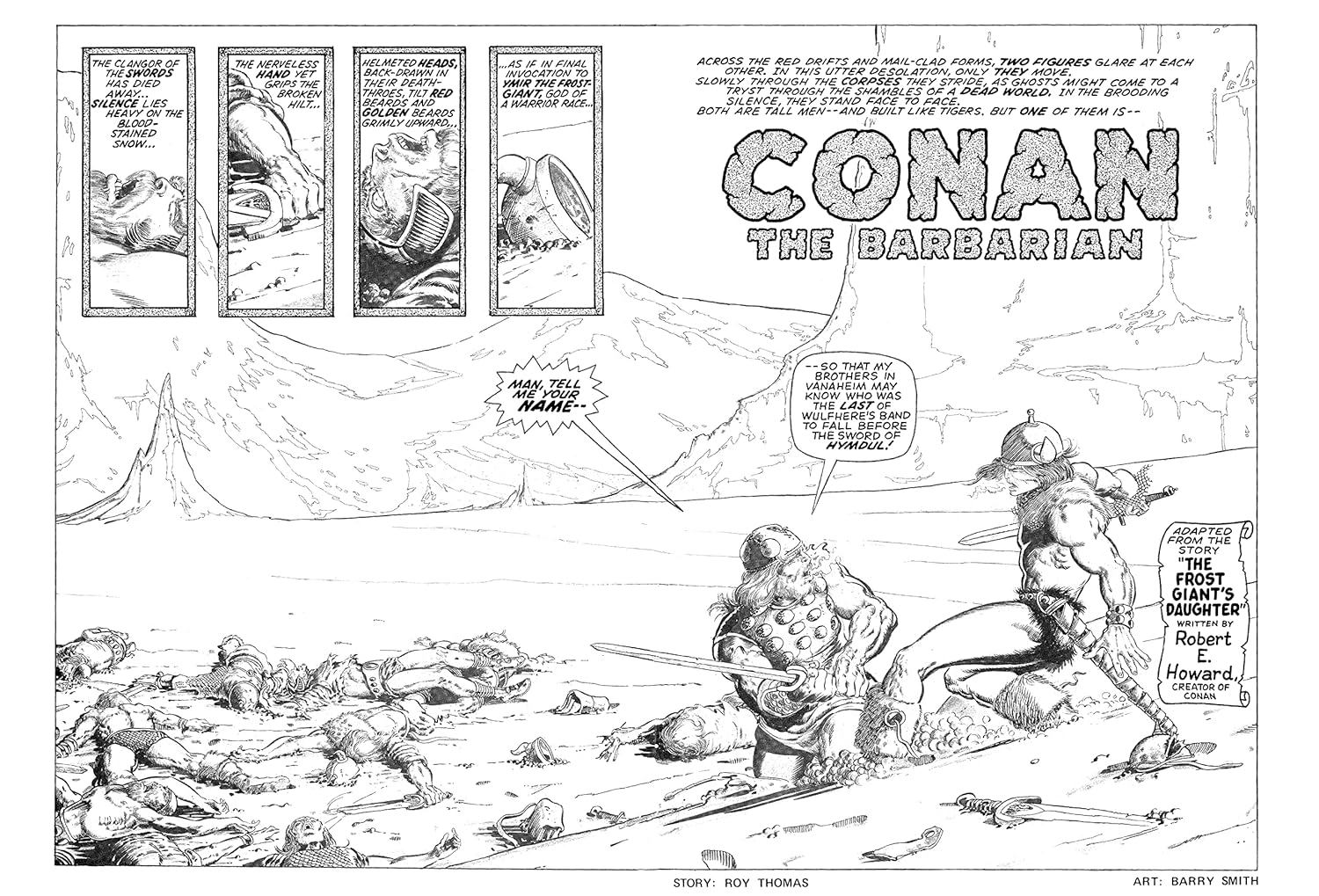
‘The Frost Giant’s Daughter’ is a haunting, racy tale written by Howard, originally adapted in line and tone by Barry Smith for Savage Tales #1. It was later coloured – and adulterated – for the all-ages comic book (#16) as it detailed how a lusty young Cimmerian chased a naked nymph into the icy winter and found himself prey in a trap set by gods or monsters…

By the time Savage Tales returned after a two-year hiatus, Barry Windsor-Smith had pretty much left comics but had agreed to illustrate ‘Red Nails’ one day if he could do it his way and at his own pace. The eventual result was an utter revelation, moody, gory, soaked in dark passion and entrancing in its savage beauty. With some all-but-invisible art assistance from Pablo Marcos this journey into the brutal depths of obsession and the decline of empires is the perfect example of how to bow out at the top of one’s creative game.

The adaptation began in ST #2 as Conan and pirate queen Valeria survive a trek through scorching deserts to fetch up in a vast walled city. Stealing inside they find immense riches casually ignored as the last members of the tribes of Tecuhlti and Xotalanc pick each off or wait for the monsters infesting the place to take them. All too soon, the visitors are embroiled in a simmering, oppressive war of extinction. The third issue completed the ghastly epic as the slow conflict between rival branches of a decadent race explodes into a paroxysm of gore and aroused monsters…

Savage Tales #4 (May 1974) held a brace of tales. ‘Night of the Dark God’ was limned by Gil Kane, Neal Adams, Marcos & Vince Colletta from Howard’s tale The Dark Man. It revealed how Conan came hunting abductors of his childhood first love and found them just as a terrify mystery idol began exerting its own malefic influence on a hall full of already-enraged warriors…

‘Dweller in the Dark’ was Smith’s swansong and saw the wandering warrior become a plaything for lascivious Queen Fatima of Corinthia. Her lusts were matched only by her jealousy, however, and it wasn’t long before she had turned against Conan and tried to feed him to the monster lurking below the city…

The fifth and final Conan appearance in Savage Tales was ‘Secret of Skull River’: a wryly laconic yarn Thomas adapted from a John Jakes plot, illustrated by Jim Starlin & Al Milgrom. The barbarian sell-sword is hired to remove a wizard whose experiments are polluting a town. The reward lusty Conan claims for his murderous services surprises everybody…

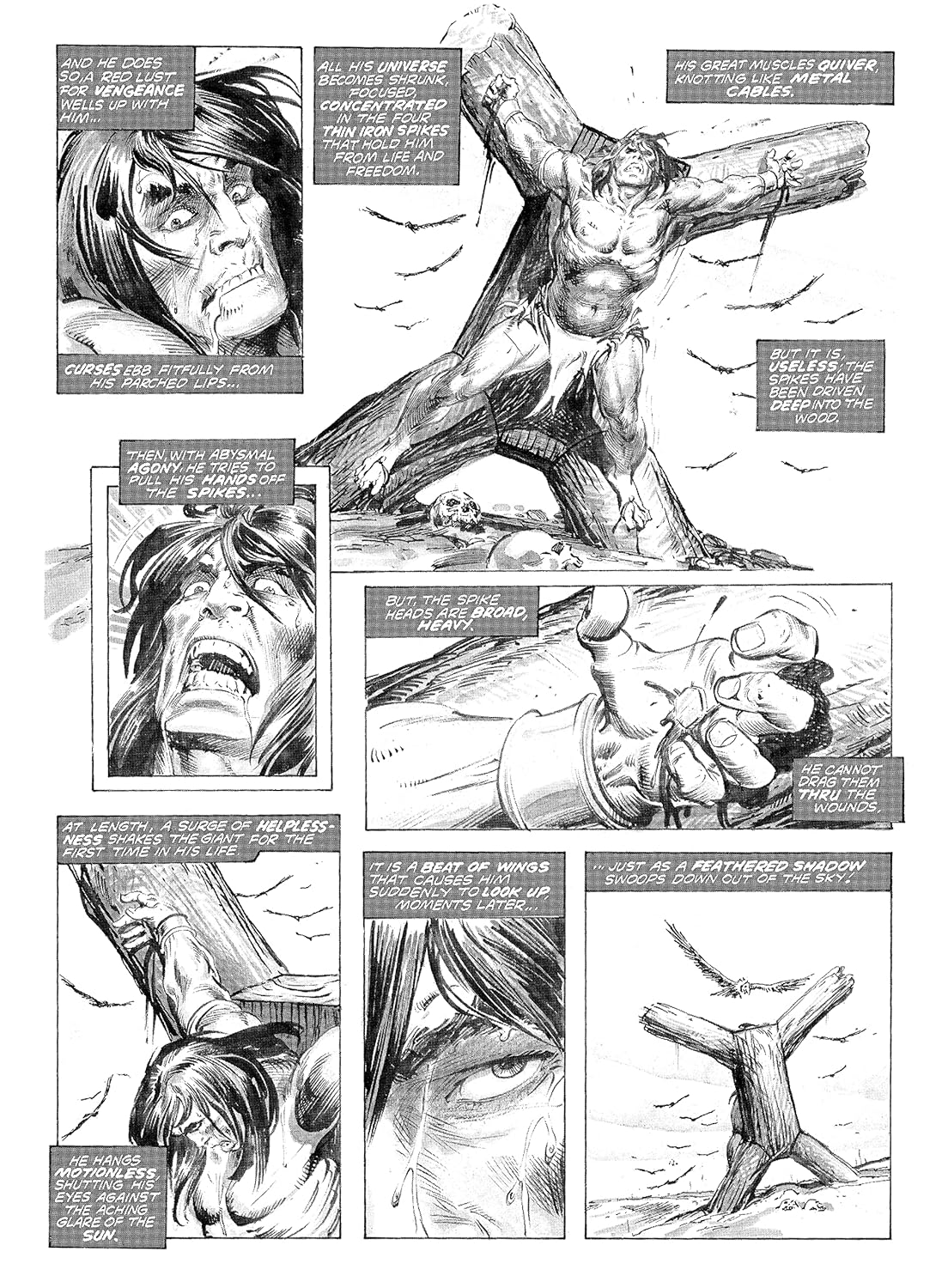
From there it was only a short jump to his own mature-themed starring vehicle, but although Savage Sword starred Conan it was initially a vehicle for numerous barbarian themed yarns – such as a serialised reprinting of Gil Kane’s epic Blackmark – and other Howard properties such as Bran Mac Morn or Red Sonja. Those aren’t included here, but are well worth searching out too…

The SSOC experience opens with the first issue and ‘Curse of the Undead-Man’ by Thomas, John Buscema & Marcos, adapted from Howard’s short story Mistress of Death. Here Conan encounters old comrade Red Sonja amongst the fleshpots of “The Maul” in Zamora’s City of Thieves before falling foul of sorcerer Costranno: a mage for whom being chopped to mincemeat is only a minor inconvenience…

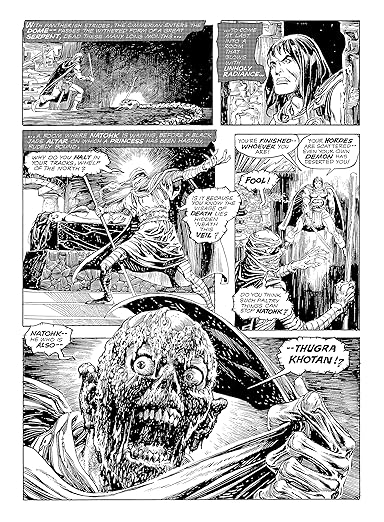
Thomas wrote all SSOC Conan material included here: blending adaptations of Howard’s stories – Conan’s and his other fearsome fighting men as well – and such successor authors as Lin Carter or L. Sprague de Camp with original tales. A stunning visual tour de force, ‘Black Colossus’ in #2 was illustrated by Buscema & Alfredo Alcala; detailing how antediluvian priest Natohk returns from death to imperil the kingdom of Princess Yasmela… until stalwart general Conan leads her armies to a victory against armed invaders, uncanny occultism and a legion of devils.

SSOC #3 contributed two tales, beginning with Buscema & Marcos’ ‘At the Mountain of the Moon-God’ with Conan high in Yasmela’s court and attempting to head off the kingdom’s annexation from encroaching neighbours and encountering mountain-dwelling bandits and a demon pterosaur. The issue concluded with ‘Demons of the Summit’ – an adaptation of Bjorn Nyberg & de Camp’s People of the Summit – turned into comics by Thomas & Tony DeZuñiga as an encounter with more high-living brigands brings the Cimmerian into conflict with a dying race of wizards who want his latest curvy companion to mother their next generation…

Issue #4 features Howard’s ‘Iron Shadows on the Moon’, realised by Buscema & Alcala. Having lost a war whilst leading a Kozak horde, Conan flees into the Vilayet Sea with escaped slave Olivia after killing enemy general Shah Amurath. On an uncharted island they then encounter ancient statues which come to life at the moon’s touch. The bloodthirsty horrors fall upon a band of pirates watering on the island and after leading them to victory against the supernatural fiends Conan manoeuvres himself into the captain’s role and begins a life of freebooting piracy…

Howard’s ‘A Witch Shall Be Born’ took up most of Savage Sword of Conan #5. Illustrated by Buscema and The Tribe – a loose association of Marvel’s Filipino art contingent (DeZuñiga; Steve Gan; Rudy Mesina; Freddie Fernandez and others) it saw virtuous Queen Taramis replaced by her demonic twin sister Salome, who debauches and ravages the kingdom of Kauran whilst her accomplice Constantius has her guard captain Conan crucified. After (almost) saving himself, the Cimmerian recuperates with desert-raiding Zuagirs, and after ousting their brutal chieftain Olgerd Vladislav returns to save Taramis and revenge himself upon the witch…

The epic is balanced by two shorter tales in the next issue. ‘The Sleeper Beneath the Sands’ is a Thomas original limned by Sonny Trinidad revealing how Olgerd encounters a caravan of clerics en route to pacify an elder god buried since time immemorial beneath the desert. The rejected bandit-lord senses a chance for revenge but soon regrets allowing the beast to wake and luring Conan into its path…

Howard’s Celtic reincarnation thriller ‘People of the Dark’ is radically adapted by Thomas and stunningly illustrated by master stylist Alex Niño next as, in modern times, Jim O’Brien plots to kill rival Richard Brent to win the hand of Eleanor. However, a fall into an ancient cavern transports the would-be killer into antediluvian prehistory where – as Conan – he battles the debased descendants of things which were once men. In that forgotten hell a burden is placed upon him and, once returned to the present, O’Brien faces another monster and pays a millennial debt…

‘The Citadel at the Center of Time’ by Thomas, Buscema & Alcala in #7 finds the Cimmerian leading desert-raiding Zuagirs and attacking a caravan only to be confronted by a sabretooth tiger. After despatching the wanton killer, Conan learns from the surviving merchants of a great ziggurat with vast riches and only attendant priests to guard them. Ever-needful of loot to placate his greedy followers, Conan leads an expedition against the eerie edifice but soon finds himself captured and offered up as a sacrificial tool to time wizard Shamash-Shum-Ukin and battling dinosaurs, beasts and brutes from many ages before finally settling his score with the time-meddler…

SSOC #8 offered many short sharp shockers beginning with ‘The Forever Phial’, illustrated by Tim Conrad doing his best Windsor-Smith riff. Here immortal wizard Ranephi desires to end his interminable existence and manipulates a certain barbarian into helping him out. The main part of the issue continues Thomas & Kane’s adaptation of Howard’s King Conan novel The Hour of the Dragon, which had begun in Giant-Size Conan but foundered as Marvel ended their oversized specials line. Inked by Yong Montano, ‘Corsairs Against Stygia’ resumes the tale with shanghaied King Conan leading a slave revolt on the ship he’s been abducted upon. Back in Aquilonia, a cabal of nobles backed by Stygian wizard Thutothmes has usurped his throne…

Having taking control of the ship Conan opts to infiltrates the evil empire to rescue the stolen talisman known as the Heart of Ahriman and end the conflict…

Wrapping up this segment is Lin Carter’s evocative poem ‘Death Song of Conan the Cimmerian’ adapted by Thomas and Jess Jodloman…

Issue #9 offered another new tale by Thomas & Marcos as Conan’s Zuagirs raid another priest-packed caravan and come under the diabolical influence of a small statue with great power. ‘The Curse of the Cat-Goddess’ corrupts, divides and promises many great things: causing the doom of many brothers in arms before the iron-willed Cimmerian ends its seductive threat. The adaptation of The Hour of the Dragon concludes in this hefty tome’s final chapter as SSOC #10 reveals how ‘Conan the Conqueror’ (rendered by Buscema & The Tribe) sneaks into Stygian capitol Khemi to defeat snake-worshipping priests, immortal vampire queen Akivasha and Thutothmes’ inner circle, before stealing back the Heart of Ahriman and heading home to occupied Aquilonia to destroy wizard king Xaltotun and his human lackeys, and reclaim his stolen throne…

With a painted covers gallery – reproduced only in black-&-white here – by Buscema, Marcos, John Romita, Adams, Boris Vallejo, Mike Kaluta, Niño, Frank Magsino, Frank Brunner & Bob Larkin and pin-up/frontispiece art by Marcos, Adams & Esteban Maroto, this weighty collection provides a truly epic experience for all fans of thundering mystic combat and esoteric adventure.

If the clash of arms, roar of monsters, unwise gloating of connivers and destruction of empires sets your pulse racing and blood rushing, this titanic tome is certainly your cup of mead. There are plenty of Thrones in peril, but this all-action extravaganza of sex, slaughter, snow, sand and steel is no Game. Get it and see what real intrigue and barbarism look like…
Savage Sword of Conan® and © 2007 Conan Properties International, LLC. All rights reserved.

Maroc the Mighty


By an unknown author & Don Lawrence with Alfredo Marculeta (Rebellion Studios/ Treasury of UK Comics)
ISBN: 978-1-83786-517-8 (TPB/Digital edition) 978-1-83786-518-5 (Webshop Edition)

This book includes Discriminatory Content produced in less enlightened times.

For British, commonwealth and European readers of a certain age and prone to debilitating nostalgia, the comic works of Don Lawrence (17th November 1928 – 29th December 2003) are a treat that never pales and always satisfies. His lavish painted-narrative illustration was only ever about two things: boyish wish-fulfilment and staggeringly beautiful images.

Beginning in the 1950s, Lawrence (Marvelman, Wells Fargo, Billy the Kid, Fireball XL5, Olac the Gladiator, The Adventures of Tarzan, The Rise and Fall of the Trigan Empire, adult comedy strip Carrie and multi-volume Dutch magnum opus Storm), inspired a host of artists like Brian Bolland and Dave Gibbons. However, as Lawrence worked into the 1990s, his eyesight was increasingly impaired by cataracts, and he took on and diligently trained apprentices like modern stars Chris Weston and Liam Sharp who collaborated with the venerable mentor on his last Storm stories.

Although magnificent painted fantasies are Don’s everlasting legacy, he was also a supremely gifted master of monochrome illumination and gritty realism. Astoundingly, in Britain most of those pre-colour comics remained unreprinted until relatively recently. Now a regular and recognised wellspring for Rebellion Studios’ Treasury of UK Comics, two volumes of his Karl the Viking have been augmented by a true lost classic: a historical but engagingly daft fantasy that Lawrence was plucked from in midstream to begin the Trigan Empire opus…

The extraordinary adventures of a valiant and benevolent wandering Devonshire yeoman making his way back to England after the Third Crusade never actually carried the hero’s name in the weeklies where it was serialised, but ever since the feature – long mis-attributed to writer Michael Moorcock, but now officially devoid of a credited author – has been called by fans Maroc the Mighty

This brief but bombastic movie-influenced (particularly Ray Harryhausen) skein of sword & Sorcery sagas was first seen in Lion: a triptych of tales spanning 3rd October 1964 to 6th February 1965 (The Hand of Zar); 13th February – May 1st (The Red Knights of Morda) and then May 8th to 3rd July 1965 (The Gigantos), augmented by a short escapade from Lion Annual 1967 as originally released in the autumn of 1966.

Following an enthusiastic and informative Introduction from historian Steve Holland ‘The Hand of Zar’ introduces John Maroc: a doughty English fighter serving the Lords and Nobles of militant Christendom, who now the defeated Christian warriors flee the Holy Land. Sadly, the term “noble” never really applied to aristocratic leader Sir Guy who uses the retreat to pillage and plunder, and when his depredations threaten a helpless Arab boy, outraged Maroc leaps to his defence and must battle his way out with young Ahmid. Fleeing to the mountains they meet an old man who gives the Englishman a golden wrist bracer. The Hand of Zar originally belonged to an ancient “Sun warrior” who fought for justice, and will make Maroc “a giant among men”. It gets the chance almost immediately as Sir Guy’s men ambush them and overwhelm them… until John discovers he has strength enough to snap chains and topple stone pillars…

Over ensuing weeks Maroc and Ahmid thwart Sir Guy’s schemes despite quickly discovering that although the relict imparts incomprehensible strength – and a little enhanced stamina and durability – it only does so as long as it remains in direct sunlight. If clouds appear or night arrives, Maroc is reduced to his ordinary self…

The clashes eventually attract the attention of Richard the Lionheart, who values and admires the efforts of the peasant warrior, but must follow the codes of chivalry and shun him for fighting against his betters, no matter how scurrilous they might be. To make matters worse, Sir Guy accuses the lowly hero of treason and settles a death sentence upon his head…

Their flight across the middle east brings them into extended conflict with all-conquering Warlord Kalin and his war elephants, wicked mountain wizards and dinosaurs, marine slavers, shark packs and reivers, and embroils Maroc and Ahmid in a deadly quest for a mystic artifact – the Stone of Aolath – fighting antediluvian primitives inhabiting The City of the Clouds. Ultimately the legacy of Zar proves unconquerable and the wandering heroes part ways…

One week later, the Englishman abroad reached Spain as The Red Knights of Morda plunged into more of the episodic same. In mountainous, arid Morda Maroc encounters a band of rogue paladins steadily eroding established rule and bleeding the coffers of true local sovereign Don Miguel Y Cipriano. When Maroc befriends the Baron’s son Carlos and charming scoundrel “Ramon the Gypsy”, it begins a brutal, bloody fightback to restore order and justice. The real enemy is a secret society led by evil genius mastermind Satana, and encompasses defeating his colossal enforcer Khala the Strong and legions of fanatical killers, bad knights, huge swamp lizards and more war elephants…

The final Lawrence exploit began in colour on the cover of Lion’s May 8th 1965 issue, with the wanderer still trudging through Spain and abruptly ambushed by archers. Falling victim to the assault he sees with amazement that none of his attackers are over four feet tall…

Explanations by the Minimas lead to the Englishman enlisting to aid the “dwarf folk” against a determined foe sworn to enslave them for their mines – ‘The Gigantos’. Nominative determinism was a major factor at this time in comics and their oppressors are a tribe of oversized tyrants misusing their strength and exploiting equally prodigious wildlife – like giant eagles and bears – to tyrannise the Minimas, but all their might, diabolical traps and the wiles of their leader Pesado – and the active volcano they live in – are insufficient to deter Maroc when he finds injustice festering…

… And that was it for Lawrence’s most superheroic star since Marvelman. From September 18th 1965 fans were periodically gobsmacked and enthralled by The Rise and Fall of the Trigan Empire – and never really looked back. Editors, however, are callous pragmatic folk and established name brand Maroc returned via Lion Annual 1967 in another anonymously scripted, done-in-one tale illustrated by UK comics mainstay Alfredo Marculeta. He was a regular of the era’s weeklies probably most recognisable today for The Rubber Man, a superhero knock-off of Jack Cole’s Plastic Man written by Ken Mennell and running in Smash from #15.

I can’t find out much about him, but his work and overall style look remarkably similar to that of Spanish political exile, cartoonist, caricaturist and comics illustrator Edmundo Marculeta (6th April 1923 – 3rd May 1989 and AKA “Marcouleta”, “Marcouletta”, “Marcou”, “Tony Cranach” & “Boris Tunder”) who worked in Europe and the UK in the 1960s & 1970s on everything from all-ages westerns and historical adventures to adult comics.

Here, those gifts are employed depicting how mighty Maroc is tramping through Germany’s Black Forest and attacked. Losing and winning back the armlet of Zar, he joins ousted prince Johann of Grunde, helping him regain his birthright from usurping murderer Baron Grimm, a tyrant obsessed with gladiatorial contests and animal cruelty…

Based in equal part on cinematic Sword & Sandal and Knight & Ladies epics and a long-cherished movie genre of manly blockbusters to construct a vast sprawling serial of heroic vigilantism, two-fisted warriors, wild beasts, deadly monsters and even occasionally the odd female (very, very occasionally in this instance!) Maroc the Mighty is the quintessential 5-minute read, but with visuals every boy I knew spent hours staring at. Some – who shall remain nameless – might even have traced or copied many of the panels and tableaux for art and history projects, Hem Hem…

Incorporating a tantalising teaser for the next volume and creator biographies, this truly spectacular visual triumph is a monument to British Comics creativity, simultaneously pushing memory buttons for old folk whilst offering a light but beautiful straightforward epic readily accessible to the curious and genre inquisitive alike or anyone who actually saw the latest William Tell movie…

Is that you or someone you know?
Maroc the Mighty is ™ Rebellion Publishing IP Ltd. © 1964, 1965, 1966 & 2025 Rebellion Publishing IP Ltd. All Rights Reserved.

Richard Wagner’s The Ring of the Nibelung


Adapted by P. Craig Russell, translated by Patrick Mason, with Lovern Kindzierski & Galen Showman (Dark Horse)
ISBN: 978-1-61655-401-9 (HB) eISBN 978-1-63008-154-6

This book includes some Discriminatory Content included for dramatic effect.

If you’re planning on being in Germany next month, music lovers are reminded that THE BAYREUTH FESTIVAL is performing Wagner’s superhero-inspiring RING CYCLE (Das Rheingold:26 July – Schwarz/Young, Die Walküre: 27 July – Schwarz/Young, Parsifal: 28 July – Scheib/Heras-Casado and Siegfried: 29 July – Schwarz/Young. If you check out or even take this tasty tome along, you may achieve a far greater understanding of the text and even certain leitmotif…  but probably not most of the prevailing attitudes, bad manners and big fancy hats…

  1. Craig Russell began his illustrious career in comics during the early 1970s: coming to fame early for a groundbreaking run on science fiction adventure series Killraven, Warrior of the Worlds.

Russell’s fanciful, meticulous classicist style was derived from the great illustrators of Victorian/Edwardian heroic fantasy and was greatly at odds with the sausage-factory deadlines and sensibilities of the mainstream comic book industry. By the 1980s he had largely retired from the merciless daily grind, preferring to work on his own projects (mostly adapting operas and plays into sequential narratives) whilst undertaking occasional high-profile Special Projects for the majors – such as Dr. Strange Annual 1976 (totally reworked and re-released as the magnificent Dr. Strange: What Is It that Disturbs You, Stephen? in 1996) or Batman: Robin 3000.

As the industry grew up and a fantasy boom began, he returned to comics with 1982’s Marvel Graphic Novel: Elric, further adapting Michael Moorcock’s iconic sword-&-sorcery star in the magazine Epic Illustrated and elsewhere. Russell’s stage-arts adaptations had begun appearing in 1978: firstly in groundbreaking independent Star*Reach specials Night Music and Parsifal and then, from 1984, at Eclipse Comics where the revived Night Music became an anthological series showcasing his earlier experimental adaptations: not only the operatic dramas but also tales from Kipling’s Jungle Books and other sources.

As mainstream comics rapidly matured, his stylings were seen in Vertigo titles like The Sandman and Mike Mignola’s Hellboy titles. He never, however, abandoned his love of operatic drama. In 2003 Canadian publisher NBM began a prodigious program to collect all those music-based masterpieces into The P. Craig Russell Library of Opera Adaptations, but just before that, the artist took a couple of years (2000 – 2001) to complete a passion project. Originally released as a procession of linked miniseries – The Ring of the Nibelung: The Rhinegold #1-4, The Ring of the Nibelung: The Valkyrie #1-3, The Ring of the Nibelung: Siegfried #1-3 and The Ring of the Nibelung: Götterdämmerung #1-4 – Russell and his regular collaborator Lovern Kindzierski adapted Richard Wagner’s masterpiece to comics. His wasn’t the first, but it’s most certainly the best.

Collected in a stunning single volume the Teutonic saga is augmented by a Preface from music critic and scholar Michael Kennedy, an Introduction by comics star Matt (no relation) Wagner, and is followed by Russell’s fascinating, heavily-illustrated essay ‘What is an Adaptation?’: describing his thinking, creative process and philosophy in the crafting of this epic, whilst offering an intimate peek into how the magic was made along via a range of pencil, ink and/or fully-coloured sketches and art studies as well as the entire gallery of covers from the original comics.

The four operas Das Rheingold, Die Walküre, Siegfried and Götterdämmerung (or Twilight of the Gods if you’re less pompous or well-travelled than me) is a classic distillation of Germano-Norse myth and the poems collected as the Icelandic Eddas. Over 26 years the master of German music distilled them into a cycle of staggering power, which people either love or hate. Great tunes, too.

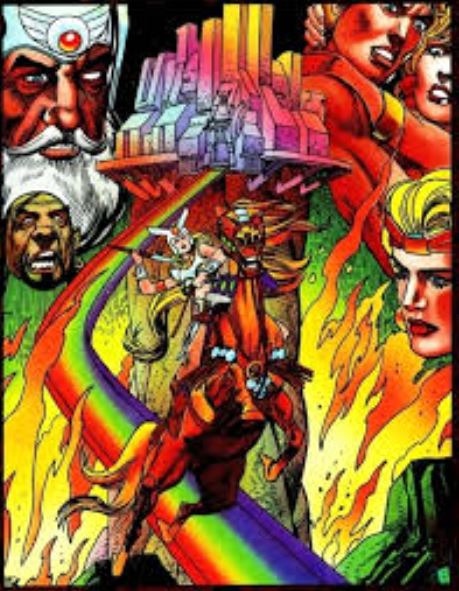
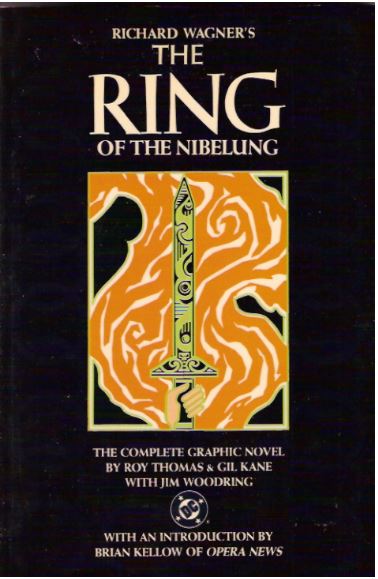
Doesn’t absolutely everybody love the brilliant animated tribute-come-distillation starring Bugs Bunny entitled ‘What’s Opera, Doc?’ They probably refer to it as “Kill the Wabbit!” though. Joking aside, the Ring Cycle is a true masterpiece of Western Culture and immortal inspiration to purveyors of drama and historic fiction. In 1989 and 1990 long-time fans and comics superstars Roy Thomas (who’d already integrated the plot into the canon of Marvel’s Mighty Thor) and Gil Kane produced a 4-part, prestige-format miniseries that adapted the events into comic strip form. That’s superbly impressive, but trust me, Russell’s is in a league of its own…

Bold, bright, glittering and tightly adhering to the rhythms and staging of the theatre version – thanks to translator Patrick Mason’s deft contribution – it all begins with the creation of the world…

At some time later, Alberich the Nibelung is a hideous troglodytic Dwarf shunned by all, but smart enough to outwit the three haughty Rhine Maidens. Commanded to guard an accursed treasure horde even the Gods cannot tame, the river nymphs reveal the secret to the glib intruder. Whoever casts The Rhinegold into a ring will have all the wealth and power of the world, but must forever forswear love and joy. Never having known either, greedy Alberich readily and scornfully forsakes these dubious emotional necessities and seizes the treasure even All-Father Voton feared to touch.

Meanwhile, wily Logé has convinced Voton to promise giants Fasolt and Fafnir anything they wish if they build the great castle Valhalla to house the world’s heroes. Assured that the trickster god can free him from his promise to the giants, the All-Father and Preserver of Oaths accepts their price, but on completion the giants demand possession of Freia; goddess of the apples of immortality.

Bound by their Lord’s sworn oath, the gods must surrender Freia, but malicious Logé suggests that Alberich’s stolen gold – now reshaped into a finger-ring – can be used by any other possessor without abandoning love. The brothers then demand the world-conquering trinket as a replacement fee… and no god can sway or deter them. The course is set to disaster!

Second miniseries The Valkyrie sees an earthly warrior calling himself “Woeful” as the sole survivor of a blood-feud. Fleeing, he claims Right of Hospitality from a beautiful woman in a remote cottage. However, when her husband Hunding returns, they all discover that he belongs to the clan Woeful recently slaughtered so many of…

Secure for the night under the sacrosanct bond of Hospitality, Woeful realises he must fight for his life in the morning when the sacred truce expires. Without weapons, he counts little for his chances until the woman reveals to him a magic sword embedded in the giant Ash tree that supports the house. Unfortunately, the gods have already decreed that there can be no happy ending to be won, only further sin and shame and the fall of Voton’s most beloved servant Brunhildé

Sixteen years later, Siegfried is the child of an illicit union, raised by malicious, cunning Mime: a blacksmith who knows the secrets of the Nibelung. No loving parent, the metal-shaper wants the indomitable wild boy to kill a dragon (Fafnir, who was once a giant) and steal the magical golden horde the monster so jealously guards. Of course, the young hero has his own heroic dreams and faces the fearsome firedrake for his own reasons: glory, fame, pride and because he wishes to awaken an otherworldly maiden who slumbers eternally behind a wall of fire!

Years of plotting and treachery and the inescapable onerous burden of fate culminate in Götterdämmerung as all the machinations, faithlessness and oath-breaking of truly flawed divinities lead to their ultimate destruction. Siegfried has won his beauteous Brunhildé from the flames but their happiness is not to be. False friends Hagen and Gunther drug him to steal his beloved, simultaneously betrothing the befuddled hero to a woman he does not love. Final betrayal by a comrade – whose father was Alberich – leads to his death and the inevitable fall of all that is!

If you know the operas you know how much more remains to enjoy in this quartet of tales, and the scintillating passion and glowing beauty the art magnificently captures the grandeur and tragedy of it all. This primal epic is visual poetry and no fan should be without it.
© 2000, 2001, 2014 P. Craig Russell. All rights reserved.

Noggin the Nog


By Oliver Postgate & Peter Firmin (Egmont)
Noggin the King ISBN: 978-1- 4052-8152-2 (HB)
Noggin and the Whale ISBN: 978-1- 4052-8153-9 (HB)
Nogbad Comes Back ISBN: 978-1- 4052-8155-3 (HB)
Noggin and the Dragon ISBN: 978-1- 4052-8154-6 (HB)
Nogbad and the Elephants ISBN 978-1- 4052-8142-3 (HB)
Noggin and the Moon Mouse ISBN: 978-1- 4052-8141-6 (HB)
Noggin and the Storks ISBN: 978-1- 4052-8144-7 (HB)
Noggin and the Money ISBN: 978-1- 4052-8143-0 (HB)

Baby Boomers like me consider our childhoods – no matter how feted or feral, and personally privileged or dire and deprived – to have been a golden age in terms of liberty, agency and especially entertainment. That’s probably due in large part to being exposed to the gentle, life-affirming fantasy worlds of these guys.

Today celebrating a century of being splendid, Richard Oliver Postgate was a writer, puppeteer, animator and unrepentant itinerant storyteller who was born to an extremely prestigious, overachieving and drama-drenched family. He entered the world on April 12th 1925 in Hendon Middlesex and was eventually educated at Woodstock School, Woodhouse Secondary, the legendary Dartington Hall School/College and Kingston College of Art. He joined the Home Guard in 1942 but when at last called up, declared himself a Conscious Objector – just as his father had during the Great War. Court martialled and sentenced to Feltham Prison, Oliver eventually became a land-worker growing crops. After the war he worked for the Red Cross in Occupied Germany. On returning to Britain in 1948, he went to Drama School and drifted from job to job.

In 1957, whilst working as a stage manager for commercial TV company Associated Rediffusion, he observed the appalling quality of children’s programming up close and knew he could do better for the same paltry money offered. Writing Alexander the Mouse he convinced a Central School of Art tutor named Peter Firmin to draw the backgrounds for him. After moving on to short-lived deaf-viewer project The Journey of Master Ho, in 1959 the creators formalised their partnership as independent studio Smallfilms. The rest is history… and fantasy and wonder and charm and devastating nostalgia…

When not shaping the minds of 30-years-worth of kids, Postgate continued trying to save the world and refine its inhabitants. He was active in the CND movement, penning their pamphlet The Writing on the Sky and 1981 book Thinking it Through: The Plain Man’s Guide to the Bomb. In 1986, he created a 15-meter artwork for his latterday romantic partner Naomi Linnell’s book Illumination of the Life and Death of Thomas Beckett, repeating the exercise for The Triumphant Failure (about Christopher Columbus) and triptych A Canterbury Chronicle, which ended up in the city’s Royal Museum Art Gallery and Eliot College Campus…

Working when he pleased, Postgate narrated – in the calm, quietly compelling voice that became hardwired into the brains of millions – radio comedy and documentary shows, more books such as autobiography Seeing Things, and accompanied (arguably) his greatest creation Bagpuss – voted in 1999 the Most Popular Children’s Television Programme of All Time – as the plushly-stuffed purple & white cat accrued awards such as an honorary degree from the University of Kent at Canterbury.

Postgate died – hopefully properly and rightly well-contented – in Broadstairs Kent, on December 8th  2008.

Peter Arthur Firmin was born in Harwich on 11th December 1928. Following training at Colchester School of Art and National Service in the Royal Navy, he attended Central School of Art and Design in London from 1949 to 1952. A creative man of many talents and disciplines, he then worked as a stained-glass designer, jobbing illustrator and lecturer.

Whilst teaching at Central in 1957 he was targeted by audacious, up-and-coming children’s TV writer Oliver Postgate who believed (quite rightly) that clever individuals could produce high-quality kids’ viewing at reasonable cost.

After crafting backgrounds for Postgate’s Alexander the Mouse and The Journey of Master Ho, Firmin became equal partner in new venture Smallfilms, which grew in and out of a shed at the artist’s Canterbury home. The kindred spirits initially produced hand-drawn cartoons and eventually stop motion animation episodes for series including Ivor the Engine, Pingwings, The Saga of Noggin the Nog, Pogle’s Wood/The Pogles, Bagpuss, The Clangers and much more. Postgate wrote, voiced and filmed, whilst Firmin – roping in any family and friends in the immediate vicinity – drew, painted, built sets and made puppets. Their spouses were often dragooned too, if they showed useful talents like sewing or knitting…

During those early days Firmin seemed tireless. In addition to the Smallfilms job he also devised, designed and populated other kids shows such as The Musical Box and Smalltime. In 1962 with Ivan Owen he created a fox puppet for The Three Scampies. That creation soon had his own show and career as Basil Brush

Throughout his life, Firmin continued his cartooning and illustration career. This included writing and/or illustrating a number of books including Basil Brush Goes Flying, The Winter Diary of a Country Rat, Nina’s Machines and Postgate’s Seeing Things – An Autobiography. Firmin also worked as a printmaker and engraver, designer and educator. In 1994 he was asked to create a British postage stamp and produced a magnificent offering featuring Noggin and the Ice Dragon.

Even at their most productive and overworked, Postgate & Firmin always ensured there was plenty of ancillary product such as Christmas Annuals, comic strips, spin-off books, games and puzzles for their devoted young fans. One of the most charming and enduring was a series of “Starting-to-Read” books released by Kaye & Ward between 1965 and 1973. Postgate & Firmin crafted all 8 books in a kid-friendly format gently sharing the further adventures of the Nicest Norseman of Them All…

In 2016 the octet of all ages, easy-going comedy dramas and gently humorous escapades were rereleased as superb hardcover editions perfect for tiny hands, but are now (at least thus far) out-of-print-&-hard-to-find. Starring the full TV cast and illustrated in a variety of duo-toned line-&-colour tomes, they display all the wit and subtle charm of the irrepressible Firmin whilst Postgate seductively and seditiously showed how much nicer things could be if we all tried a little harder to get on with each other.

This is the Saga of Noggin the Nog… Upon the death of his father, quiet, unassuming Noggin becomes king of the northland Viking tribe known as the Nogs. He rules with understanding and wisdom – generally thanks to his advisors: wife Nooka who hails from the far north (we’d call her an Inuit or Inuuk princess these days), bluff old codger Thor Nogson and wisdom-stuffed talking green cormorant Graculus. Despite many fantastic but necessary adventures, Noggin prefers a quiet home life with his people and his boisterous son Knut

Noggin the King opens with bucolic pastoral scenes of the Nogs, with the good-hearted sovereign helping his people however he can. However, whilst happily repairing the roof of an old farmer, the ruler dislodges a bird’s nest. Bringing the nest and its occupants back to his castle, he cares for the fledglings and mother, pondering if he is also the King of birds in the Land of Nogs. If he is, then they are his subjects too and thus he is responsible for their safety and welfare. Riven with doubt, the King, with Nooka at his side, sets out on a short quest/ fact-finding mission to confirm his suspicions and is rewarded by the feathered kingdom with a great but grave new honour…

Noggin and the Whale features far more light-hearted aspects of kingship as the mild-mannered monarch celebrates his birthday in the usual manner: doling out gifts to all the children of his realm. This year they all get musical instruments, but when they hold an impromptu concert on a boat in the little walled harbour, the merriment is interrupted by a most insistent whale.

Every time the kids get going the cetacean surges up under the boat and eventually even placid Noggin loss his temper and orders the sea-beast to swim away. Instead it glides over to the open harbour gate and sulkily blocks the way, just as Noggish fishing boats are trying to moor up for the night. Nothing the townsfolk can do will shift the surly creature.

Suddenly Prince Knut has an idea. He realises why the whale has been acting so strangely and, after consulting with his father, commissions Royal Inventor Olaf the Lofty to create a unique present for the morose marine mammal…

Originally released in 1966, Noggin and the Dragon sees little Prince Knut and his chums pestering the royal couple to let them go on a dragon hunt. Noggin and Nooka are reluctant at first – Dragon Valley is no place for little boys and besides, the best thing to do with dragons is give them sweets and make friends – but eventually the proud parents capitulate to pester power. To ensure things go smoothly they insist doughty old warrior Thor Nogson goes with them, but as the unruly boys trek into a gathering storm, no one has any idea of the shocking surprise in store for them all…

From the same year, Nogbad Comes Back highlights the return from exile of Noggin’s wicked usurping uncle, just in time to try and spoil the King’s annual animal and vegetable show. Living up to his name, Nogbad the Bad tries to win the glittering jewel-encrusted cup for best flora and fauna by devious cheating and, when that fails, through simple shameful theft. Thankfully, Nooka is not as forgiving and kind as her husband and has been keeping a close eye on her outlaw in-law…

The next year saw two more tomes: one of which may have been a notional precursor to one of Smallfilms’ most successful franchise creations. Noggin and the Moon Mouse begins with Knut enacting an official ceremony at a water trough. Proceedings are utterly disrupted when a strange silver ball crashes down and a child-sized rodent-like creature emerges. Caught up in the excitement, the prince and his unruly pals give chase… until Queen Nooka takes charge. After admonishing the boys, she and Noggin befriend the strange visitor (who actually comes from another world) helping him gather odd household items he requires to return to the stars.

And yes, a few years later a peculiar band of armoured woolly beasties began communicating with us all in their universally comprehensible pennywhistle pipings in a little show called The Clangers

Nogbad and the Elephants proves there are many perks to being royal. One is wonderful presents such as the gigantic gem-encrusted, long-nosed big-eared beast presented to Prince Knut by the King of Southland. Sadly, the wonderful creature is perpetually unhappy and falls under the sway of crafty Nogbad who lures it away to steal its jewelled coat. Realising it’s been hoodwinked, the piteous pachyderm takes restorative action in its own unique manner, compelling Knut to make his first grown-up decision…

The last brace of tales originated in 1973, beginning with hilariously anti-capitalist tract Noggin and the Money. Here Court Inventor Olaf the Lofty suffers a setback in his dream to modernise the nation. Nogs have been happily soldiering on using barter and trade as long as anyone can remember, so when the big thinker creates coins as currency, he thinks he’s made life easier for everybody. Thor Nogson soon disagrees after he’s despatched to acquire eggs for the royal breakfast and meets rather a lot of resistance to this new-fangled commerce nonsense…

Wrapping up the fun is Noggin and the Storks as the King sagely deals with a minor ecological crisis. Sooty Storks have nested on the chimneys of the town for decades, using the heat of human cooking fires to warm their eggs. This year, as the birds are particularly numerous, the populace are continually being smoked out of their own homes.

Despite his people angrily petitioning Noggin to let them chase the pests away, as king of birds as well as people, the smooth sovereign seeks another, more equitable solution. Cue Olaf the Lofty, who has an idea involving an old chalk quarry, a stand of hollow trees, masses of convoluted piping, steel sheets and tons of firewood…

Serenely bewitching, engaging and endlessly rewarding (both these books and their much-missed, multi-talented originators) the works of Postgate and Firmin shaped generations of children and parents. If you aren’t among them, do yourself a great favour and track down those DVD box sets, haunt the streaming services and buy these books and anything else with their names on it. You won’t regret it for an instant.
Text © The Estate of Oliver Postgate 1965-1973. Illustrations © Peter Firmin/The Estate of Peter Firmin 1965-1973.

Mighty Marvel Masterworks presents Mighty Thor volume 4: When Meet the Immortals


By Stan Lee & Jack Kirby, with Vince Colletta, Art Simek, Sam Rosen & various (MARVEL)
ISBN: 978-1-3029-5426-0 (TPB/Digital edition)

This book includes Discriminatory Content produced in less enlightened times.

These stories are timeless and have been gathered many times before, but today I’m once again focussing on format. The Mighty Marvel Masterworks line launched with economy in mind: classic tales of Marvel’s key creators and characters re-presented in chronological publishing order. It’s been a staple since the 1990s, but always in lavish, hardback collectors editions. These editions are cheaper, on lower quality paper and – crucially – smaller, about the dimensions of a paperback book. Your eyesight might be failing and your hands too big and shaky, but at 152 x 227mm, they’re perfect for kids. If you opt for digital editions, that’s no issue at all…

Even more than The Fantastic Four, Sci Fi fantasy title The Mighty Thor was the arena in which Jack Kirby’s boundless fascination with all things Cosmic was honed and refined through his increasingly groundbreaking graphics and captivating concepts. The King’s plethora of power-packed signature pantheons began in a modest little monster mag called Journey into Mystery where – in the summer of 1962 – a tried-&-true comic book concept (feeble mortal transformed into god-like hero) was revived by the rapidly resurgent company who were not yet Marvel Comics: adding a Superman analogue to their growing roster of costumed adventurers.

This cheap & cheerful epochal pocket tome re-presents more pioneering Asgardian exploits from Journey into Mystery Annual #1, JiM #120-125, and The Mighty Thor #126-127: altogether spanning cover-dates September 1965 to April 1966 as the venerable anthology title changed name to further magnify its magnificent wide-screen feature hero, in a blazing blur of innovation and seat-of-the-pants myth-revising and universe-building. It is lettered throughout by unsung superstars Art Simek & Sam Rosen, and an unjustly anonymous band of colourists.

As you already know: Once upon a time, lonely, lamed American doctor Donald Blake took a vacation in Norway and encountered the vanguard of an alien invasion. Trapped in a cave, Blake found a gnarled old walking stick, which when struck against the ground, turned him into the Norse God of Thunder! Within moments he was defending the weak and smiting the wicked. As months swiftly passed, rapacious extraterrestrials, Commie tyrants, costumed crazies and cheap thugs gradually gave way to a vast panoply of fantastic worlds and incredible, mythic menaces. Moreover, from JiM #110, the wild warrior’s Realm of Asgard was a regular feature and mesmerising milieu for our hero’s earlier exploits, heralding an era of cosmic fantasy to run beside young Marvel’s signature superhero sagas.

Every issue carried spectacular back-up sagas Tales of Asgard – Home of the Mighty Norse Gods gifting Kirby space to indulge his fascination with legends. They also allowed both complete vignettes and longer epics – in every sense of the word. Initially adapted myths, these yarns evolved into serial sagas unique to the Marvel universe where Kirby constructed his own cosmos and mythology, underpinning the company’s entire continuity.

Here – with everything attributed to Lee, Kirby & Vince Colletta and after Thor has defeated his malign step-brother Loki and The Destroyer in Vietnam – the Thunder God returns to America, leaving room for a special event and flashback tale too big for the regular periodical.

The blockbusting lead story from Journey into Mystery Annual #1 reveals how in undisclosed ages past the God of Thunder fell across dimensions into the realm of the Greek Gods for a landmark heroic hullabaloo ‘When Titans Clash! Thor vs. Hercules!’ The spectacular clash of theologies was an incredible all-action episode, and is augmented by a stunning double-page pin-up of downtown Asgard – a true example of Kirby magic…

Back in the now, Thor stops at Pittsburgh’s steel mills to repair Mjolnir – cut into pieces by the Destroyer – and ‘With My Hammer in Hand..!’ prepares to denounce Loki’s villainy to Odin. In the process he mislays one of his brother’s magical Norn Stones: a mishap that will cost him dearly later. Meanwhile, beloved Jane Foster has been abducted by a hidden miscreant with mischief in mind but before the Thunderer can act on that he is ambushed by Loki’s contingency plan as the awesome Absorbing Man returns…

In the back, the Tales of Asgard serial ‘The Quest’ further unfolded as hand-picked warriors on Thor’s flying longship endure further hardship in their bold bid to forestall Ragnarok. This month’s Asgardian edda sees their bold but misguided attempt finally start, as they ‘Set Sail!’ against their legendary prophesied foes…

JiM #121 opens mid-melee as the Thunderer’s attack against colossal Crusher Creel intensifies in ‘The Power! The Passion! The Pride!’ before the god’s compassion for human spectators sparks his downfall and defeat. Seemingly doomed Thor’s cliffhanger fate is paused as B-feature ‘Maelstrom!’ sees Asgardian Argonauts epically encounter an uncanny living storm…

In #122’s ‘Where Mortals Fear to Tread!’ triumphant Crusher Creel is prevented from finishing Thor when he is abducted by Loki to attack Asgard and Odin himself: an astounding clash capped by cataclysmic conclusion ‘While a Universe Trembles!’ Meanwhile at the rear, ‘The Grim Specter of Mutiny!’ invoked by seditious young Loki is quashed in time for valiant Balder to save the Argonauts from ‘The Jaws of the Dragon!’ in the ever-escalating Ragnarok Quest.

In modern times, with the latest threat to Asgard ended and Creel and Loki banished, Thor returns to Earth to defeat The Demon: a “witchdoctor” empowered by the magical Norn Stone left behind after the Thunder God’s Vietnamese venture. However, whilst the Storm Lord is away, Hercules is dispatched to Earth on a reconnaissance mission for Zeus. ‘The Grandeur and the Glory!’ opens another extended story-arc/action extravaganza, bouncing the Thunderer from bruising battle to brutal defeat to ascendant triumph…

As seen in Journey into Mystery Annual #1, long ago the God of Thunder inadvertently invaded the realm of the Greek Gods. Now with the Greek godling clearly popular with readers, Hercules properly enters the growing Mavel Universe. After the impending imbroglio with Thor, the Prince of Power would battle the Hulk and eventually join the Avengers but right now he’s still just another enemy for the Thunderer to face…

Issue #125 –‘When Meet the Immortals!’ – was the last Journey into Mystery for decades. With next month’s ‘Whom the Gods Would Destroy!’, the comic became The Mighty Thor and the drama amped up, culminating with ‘The Hammer and the Holocaust!’ In short order Thor crushes the Norn-fuelled Demon, tells Jane his secret identity and is deprived of his powers by Odin. He is then brutally beaten by Hercules, and subsequently seemingly loses Jane to the Prince of Power, yet still manages to save Asgard from unscrupulous traitor Seidring the Merciless who had usurped Odin’s mystic might while the All-Father was distracted with family matters. And in the wings another epic encounter opened as a certain satanic terror set his infernal sights on an unwitting godly prince…

To Be Continued…

The accompanying Tales of Asgard instalments see the Questers home in on the cause of all their woes. ‘Closer Comes the Swarm’ pits them against the Flying Trolls of Thryheim, before ‘The Queen Commands’ sees Loki captured until Thor answers ‘The Summons!’, promptly returning all Argonauts to Asgard to be shown ‘The Meaning of Ragnarok!’

In truth, these mini-eddas were, although still magnificent in visual excitement, becoming rather rambling in plot, so the narrative reset was neither unexpected nor unwelcome…

The episodic exploits then close with the original pencil art to the cover of JiM #123.

These Thor tales show the development not only of one of Marvel’s fundamental continuity concepts but more importantly the creative evolution of the greatest imagination in comics. Set your common sense on pause and simply wallow in the glorious imagery and power of these classic adventures for the true secret of what makes graphic narrative a unique experience.
© 2024 MARVEL.

Conan Epic Collection volume 5: Of Once and Future Kings (1976-1977)


By Roy Thomas & John Buscema, with John Jakes, Len Wein, Skip Kirkland, Ralph Macchio, Jim Starlin & Al Milgrom, Val Mayerik, Vicente Alcázar, Howard Bender, Marshall Rogers, Neal Adams, Tim Conrad & various (MARVEL)
ISBN: 1-84576- (TPB/Digital edition)

This book includes Discriminatory Content produced in less enlightened times.

In the 1970’s, America’s comic book industry opened up after more than 15 years of calcified publishing practises promulgated by the censorious, self-inflicted Comics Code Authority: a self-imposed oversight organisation created to police product after the industry suffered its very own McCarthy-style 1950s witch-hunt. The first genre revisited during the literary liberation was Horror/Mystery, and from those changes sprang migrated pulp star Conan.

Sword & Sorcery stories had been undergoing a prose revival in the paperback marketplace since the release of softcover editions of Lord of the Rings in 1954 and, in the 1960s, revivals of the fantasies of Edgar Rice Burroughs, Otis Adelbert Kline, Fritz Lieber and others were making huge inroads into buying patterns across the world. The old masters had also been augmented by many modern writers. Michael Moorcock, Lin Carter and others kick-started their prose careers with contemporary versions of man against mage against monsters. The undisputed overlord of the genre was Robert E. Howard with his 1930s pulp masterpiece Conan of Cimmeria.

Gold Key had notionally opened the field in 1964 with cult hit Mighty Samson, followed by Harvey Comics’ ‘Clawfang the Barbarian’ (1966’s Thrill-O-Rama #2). Both steely warriors dwelt in post-apocalyptic techno-wildernesses, but in 1969 DC dabbled with previously code-proscribed mysticism as Nightmaster came (and went) in Showcase #82-84, following the example of CCA-exempt Warren anthologies Creepy, Eerie and Vampirella. Marvel tested the waters with barbarian villain/Conan prototype Arkon the Magnificent in Avengers #76 (April 1970) – the same month they went all-out with short supernatural thriller ‘The Sword and the Sorcerers’ in their own watered-down horror anthology Chamber of Darkness #4.

Written by Roy Thomas and drawn by fresh-faced Barry Smith (a recent Marvel find just breaking free of the company’s still-prevalent, nigh-compulsory Kirby house style) the tale introduced Starr the Slayer… who also bore no small resemblance to our Barbarian-in-waiting…

Conan the Barbarian debuted with an October 1970 cover-date and despite early teething problems (including being cancelled and reinstated in the same month) these strip adventures of Howard’s primal hero were as big a success as the prose yarns they adapted. Conan became a huge hit: a blockbuster brand that prompted new prose tales, movies, TV series, cartoon shows, a newspaper strip and all the other paraphernalia of global superstardom.

However, times changed, sales declined and in 2003 the property moved to another comics publisher. Then in 2019 the brawny brute returned to the aegis of Marvel.

Their first bite of the cherry was retroactively subtitled “the Original Marvel Years” due to the character’s sojourn with Dark Horse Comics and other intellectual rights holders, and this fifth compendium spans cover-dates March 1976 to February 1977. It reprints Conan the Barbarian #60-71, Conan Annual #2-3 plus material from Power Records #31, F.O.O.M. #14 and elsewhere, highlighting a period when the burly brute was very much the darling of the comics crowd, and when artist John Buscema made the hero his very own.

Adaptor Thomas had resolved to follow the character’s narrative timeline as laid out by Howard and successors like L. Sprague de Camp and Lin Carter, expanded and padded out with other adaptions of REH and his contemporaries and – almost as a last resort – all-new adventures. Thus, content was evermore redolent of pulp-oriented episodic action rather than traditional fantasy fiction. As usual, firstly hurtle back in time approximately 12,000 years to a forgotten age of wonders, and follow the now traditional map of ‘The Hyborean Age of Conan’ plus accompanying mandatory establishing quote.

Maybe we’d best pause a moment and say something necessary. Many of the trappings and themes of Sword & Sorcery stories – especially those from the 1970s & 1980s adapting even earlier tales when racism, sexism and the presumed superiority of white males was a given – are not as comfortable – or unchallenged – for modern readers as they were for my generation or its forebears. Many elements here, for all their artistic and narrative excellence, will be hard to swallow for a lot of younger readers.

At least I hope so…

If barely-clad women casually traded as prizes and trophies and brown people waving spears and wearing feathers are a trigger, please don’t read these tales. I’m not making apologies when I say Thomas and his collaborators were actively working to subvert the established paradigm even then, or that these stories are powerful, thrilling and of evolving cultural significance, but, until so very recently, this kind of epic was a diminishing force with dwindling power to supress or denigrate ethnicities and minorities.

Now, with ugly race supremacism, resurgent sexism, and all forms of “othering” on the rise once more, I get the need to call out or shout down things that could warp young or weak minds. Don’t read these if you can’t. They are only comics, but it doesn’t take much to form and fix a bias, does it?

If you’re still with us, the hopefully harmless action nonsense resumes with a riotous romp from CtB #60 introducing ‘Riders of the River-Dragons!’ The Cimmerian wanderer continues as red-handed consort to pirate queen Bêlit, a Shemite orphan raised by a Kushite witch doctor and considered an avatar of his tribe’s death goddess…

Pulp novelette Queen of the Black Coast was originally published in the May 1934 Weird Tales, and obliquely told of Conan’s time as infamous pirate “Amra”: plundering the coasts of Kush (prehistoric Africa) beside his first great love. The brief but tragic tale of bold buccaneer Bêlit was a prose one-off, but Thomas expanded it over years into an epic comics storyline that ran to #100 of the monthly title.

It had all begun in  Conan The Barbarian #58, where Thomas, Buscema & Steve Gan debuted their Queen of the Black Coast! After the fugitive Cimmerian found safe harbour on an outward bound Argossean trading ship. The Northborn outlaw befriended entrepreneurial Captain Tito and settled into the mariner’s life. After visiting many fabulous ports and exotic wild places, Conan’s life changed when the ship encountered the most feared vessel afloat. Only Conan survived the assault of Kushite warriors, but as he prepared to die fighting, their white queen spared his life, and allowed Conan to earn his place by fighting any objectors before settling in as Bêlit’s prize…

As Thomas fleshed out the text tale, eventually Conan learned from shaman/mentor/guardian N’yaga how the warrior woman had remade herself. How a daughter of Asgalun’s king escaped murder by the Stygians who placed her uncle on the suddenly vacant throne, and how she grew up among barbarous tribesmen of the Silver Isles. Trained to best any man and after mastering supernal horrors, she destroyed a jealous chieftain, proving her in the eyes of the tribes an earthly daughter of Death Goddess Derketa: sworn to inflict bloody vengeance on Stygians and all who stand with them. Before long she had trained them as seafaring plunderers building a war chest to retake her throne: her, deadly, merciless devoutly loyal “black Corsairs”…

Conan also realises that he loves Bêlit beyond all else, even if she may not be wholly human…

Here the saga further expands in Thomas, Buscema & Gan’s opening shot where the pirate goddess is captured by crocodile-riding warriors as she visits a vassal coastal tribe, When the dragon riders come again, Conan, his shipmates and the river dwelling Watambis turn the tables on them, forcing captive raiders to lead them to their distant domain and hidden lord: a bestial godlike entity called “Amra”…

Ploughing through foetid forests, the rescue party is hard ‘On the Track of the She-Pirate!’ (#61), but Bêlit has already escaped, only to fall victim to a monstrous Moth creature. Her death is only prevented by the arrival of the brutal ‘Lord of the Lions!’ in #63, who takes a fancy to a woman who is the same colour he is…

In a barbed pastiche of ultimate white god Tarzan, Thomas, Buscema & Gan reveal how a red-haired noble child lost in jungles is reared by lions. On maturity, his physical might and domination of beasts makes him de facto ruler of terrorised local tribes surrounding the ruined lost city he calls home. Sadly, Amra’s fascination with Bêlit drives a previous captive paramour – chief’s daughter Makeda – to jealously retaliate by awakening demonic creatures asleep in the city’s bowels.

By the time Conan arrives to duel his rival and physical equal, the entire region is imperilled as the dead hunt the living and ‘Death Among the Ruins!’ leads to Amra’s defeat and the Cimmerian being hailed as a new Lord of Lions…

Deadlines were always a scourge at this time and #64 pauses the serial to reprint a colorised, toned down tale from mature readers magazine Savage Tales #5 (July 1974). Crafted by Thomas from a John Jakes plot, ‘The Secret of Skull River’ is illustrated Jim Starlin & Al Milgrom, detailing the Cimmerian’s mercenary’s battle against monster-making alchemists Anaximander and Sophos, prior to CtB #65’s ‘Fiends of the Feathered Serpent!’ (inked by the Tribe) returning to the shipboard romance in a canny adaptation of Howard’s The Thunder Rider. Here the Corsairs are driven by a Stygian fleet into uncharted waters, encountering the accursed remains of legendary black slave liberator Ahmaan the Merciless and the sorcerer who finally killed him. Tezcatlipoca is still there, trying to steal the dead man’s magic axe – which has already chosen Conan/Amra as its next host – when Ahmaan comes back to settle unfinished business, with the entire atoll paying the price of that clash…

Still inked by The Tribe, ‘Daggers and Death-Gods!’ brings the corsairs back to Argossean port city Messantia as Bêlit seeks to barter her plunder for Shemite currency to fund her counter-revolution. When shady fence Publio offers a big payout for a special job robbing a temple , it results in a mesmerising priest pitting the lovers against each other after seemingly awakening guardian death deities Derketa and Dagon, The pitiless duel is interrupted by the sudden arrival of Conan’s old sparring partner Red Sonja

Although based on Robert E. Howard’s Russian war-woman Red Sonya of Rogatine (from 16th century-set thriller The Shadow of the Vulture with a smidgen of Dark Agnes de Chastillon thrown into the mix) the comic book Red Sonja is very much Thomas’ brainchild. She debuted in Conan the Barbarian #23 (in November 1973) and became an unattainable gadfly/lure for the Cimmerian before gaining her own series and creative stable. Thomas returned as scripter to set up a tumultuous extended team-up with Conan and Bêlit that began with CtB #67’s ‘Talons of the Man-Tiger!’ as the Pirate Queen suspiciously eyes her man’s “one that got away” – and who is also after the loot Pulbio wants so badly…

Sonja was commissioned by Karanthes, High Priest of the Ibis God, to secure a page torn from mystic grimoire the Iron-Bound Book of Skelos in demon-haunted Stygia. She’s barely aware of an unending war between ancient deities, or that old colleague and rival Conan of Cimmeria is similarly seeking the arcane artefact. Ignoring his offer to work together, the women set off singly after the artefact, and Conan meets old apprentice Tara of Hanumar, who begs him to rescue her husband Yusef from a castle dungeon guarded by were-panther. By the time he finds Bêlit, Sonja has ridden off with the prize and the lovers give chase…

Prose recap of Marvel Feature #7 ‘The Battle of the Barbarians!’ summarises the other side of the story – and for her exploits see The Adventures of Red Sonja vol. 1. Sonja clashes repeatedly with her rivals and defeats many beasts and terrors, believing she has the upper hand, but there’s more at stake than any doughty warrior might imagine as the players reconvene with Karanthes.

Attacked by a demon bat who steals the page, Sonja, Amra and Bêlit give chase until they discover a strange city in the wastelands. Pencilled & inked by Buscema, CtB #68’s ‘Of Once and Future Kings!’ sees the sorcery of a sinister mastermind bring King Kull and his armies out of the past to conquer Conan’s era in a spectacular crossover conclusion that sets the scene for future forays of the fantastic before the love story takes centre stage once more with ‘The Demon Out of the Deep!’ as Thomas, Val Mayerik & the Tribe adapt REH’s historical horror classic Out of the Deep with the Cimmerian sharing an exploit of his teen years when as a captive of the enemy Vanir tribe he witnessed a sea devil decimate a fishing village before killing the thing with own brawny arms, neatly segueing into a two-part thriller from Conan the Barbarian #70 & 71, freely adapted from Howard’s The Marchers of Valhalla and inked by returning embellisher Ernie Chan.

In ‘The City in the Storm!’ a mighty storm drives the pirates far from recognisable shores and the corsairs’ iron discipline begins the fracture as they reach a welcoming island adorned with a fabulous walled metropolis of gold. With N’Yaga injured the crew head for shore and find glorious women serving a population of near-bestial sub-men. After an inconclusive battle, serving maid Aluna and her priestly master Akkheba negotiate a deal for the corsairs to defend the city – Kelka – from rival Barachan pirates, but there’s double dealing in the contract and soon the Kushites and their queen are captives awaiting sacrifice…

However as Conan discovers in ‘The Secret of Ashtoreth!’, the immortal captive the Kelkans worship and abuse in equal measure is no patron but vengeful victim who only needs a little aid to end their treacherous depredations forever…

The volume pauses Belit’s romance here to conclude with a selection of out-chronology oddments, beginning with 1976’s Conan the Barbarian Annual  #2. Opening with graphic reprise ‘Conan the Cimmerian’ by Thomas, Buscema & Yong Montano, the main event is a much abridged adaptation of ‘The Phoenix on the Sword’ by Thomas, Vicente Alcázar & Yong Montano, as aging King Conan faces sedition, rebellion and usurpation as he rules mighty empire Aquilonia. The thriller is backed up by The Hyborian Page text feature detailing the convoluted path of Howard’s original tale.

One year later, Conan the Barbarian Annual 3 reprinted some of Savage Sword of Conan #3 (December 1974) in a colourised, bowdlerised family friendly form, preceded by framing sequence ‘Conan the Barbarian and King Kull!’. Thomas, Buscema & Pablo Marcos placed General Conan of Khoraja ‘At the Mountain of the Moon-God’ and ‘Where Dark Death Soars’ to foil a scheme to replace the new King Khossus with a puppet of King Strabonus of Koth

With covers by Gil Kane, John Romita, Rich Buckler, Vince Colletta, Mike Esposito, Dan Adkins, Marcos, Chan, Buscema, Adams & Crusty Bunkers, the regular comics fare is augmented by rare treats, beginning with a genuine rarity. Power Records #31: Conan the Barbarian was part of line of vinyl records packaged with comic adventures. Other titles included Batman, Planet of the Apes and many more, but here – scripted by Len Wein & J.M. DeMatteis and illustrated by Buscema, Neal Adams, Dick Giordano and friends – ‘The Crawler in the Mists!’ offers an old fashioned monster & misjudgement parable as Conan faces the uncanny and comes away far wiser…

House fan mag F.O.O.M. #14 (June 1976) was an all barbarian special and from it liberally-illustrated features ‘The Barbarian and the Bullpen!’, ‘Thomas Speaks!’, ‘Robert E. Howard: The Man Who Created Conan!’, ‘Conan Checklist’, ‘A Marvel Artistic Double-Treat’ and ‘Marvel Writer/Artist Scorecard’ reveal all things Hyborian. Then Conan ‘Marvel Value Stamp’, assorted house ads and pages from Mighty Marvel Bicentennial Calendar (April 1976 by Gil Kane & Tony Isabella) reflect the comics popularity, and a Power Comics Conan promo and sleeve art by Adams leads to incisive article ‘The (Almost) Forgotten Tales of Conan’ by Fred Blosser from SSoC #40, a Romita pencil sketch and original art by Buscema & Gan, many pages of layouts, Tim Conrad pin-up and artwork from 1976’s Marvel Comics Index #2, painted by Conrad.

Stirring, evocative, cathartic and thrilling for all their modern faults and failings, these yarns are deeply satisfying on a primal level, and this is one of the best volumes in a superb series starring a paragon and icon of adventure heroes. This is classic pulp/comic action in all its unashamed exuberance: an honestly guilty pleasure for old time fans and newbies of all persuasion. What more does any red-blooded, action-starved fan need to know?
Conan the Barbarian Published Monthly by MARVEL WORLDWIDE Inc, a subsidiary of MARVEL ENTERTAINMENT, LLC. © 2022 Conan Properties International, LLC (“CPI”).